Insights and Inspiration
Explore Our Blog
Dive into our blog for expert insights, tips, and industry trends to elevate your project management journey.

Top RAG Development Services for Scalable AI Solutions
A comprehensive buyer's guide comparing the top RAG development providers, architectures, and costs to help enterprises build production ready AI systems on their own data.

RAG (Retrieval Augmented Generation) development services help enterprises build AI systems that answer questions from their own data with accuracy, traceability, and scale. The top RAG development providers in 2026 combine vector database architecture, LLM integration, and AI consulting services to deliver systems that outperform standard generative AI on factual precision and domain specificity.
Why RAG Is the Enterprise AI Architecture of 2026
Standard generative AI has a fundamental problem for enterprise use: it hallucinates. It generates confident sounding answers from training data that may be outdated, irrelevant, or simply wrong for a specific business context.
RAG solves this by grounding LLM responses in real time retrieval from your own document libraries, databases, and knowledge stores. The model does not guess. It retrieves relevant context first, then generates a response anchored to that context.
As Neuramonks' analysis of where RAG architecture is headed makes clear, standard RAG is already being replaced by more sophisticated architectures in 2026. The market has moved from simple vector search + generation pipelines to multi stage retrieval, hybrid search, and agentic RAG systems capable of reasoning across complex enterprise knowledge bases.
This guide maps the top RAG development services, what they offer, how they differ, and what it costs to build the right system for your organization.
What Makes a RAG Development Service "Enterprise Grade"
Not all RAG implementations are equal. A proof of concept RAG system built on a weekend with LangChain and a PDF upload is not the same as a production RAG architecture supporting 5,000 daily queries across a 10 million document knowledge base.
Enterprise grade RAG development requires:

When evaluating RAG development services, the gap between these tiers is the gap between a system that works in demo and a system that performs in production.
The Top RAG Development Services in 2026
1. Neuramonks Best for Custom Enterprise RAG Architecture
Neuramonks specializes in end to end RAG implementation consulting for enterprises that need production grade systems built to specification. Their engagements are not template deployments. They build custom RAG systems for enterprise clients with specific data environments, compliance requirements, and performance SLAs.
Their RAG practice covers the full stack: document ingestion and preprocessing, vector database selection and configuration, LLM Model integration, hybrid retrieval architecture, output validation, and deployment infrastructure. They bring AI consulting services expertise that ensures the system architecture matches the business requirements, not the other way around.
For organisations evaluating whether to build or buy, Neuramonks offers structured scoping engagements and AI Proof of Concept Services that answer the architecture question before development begins.
Relevant for: Healthcare, legal, financial services, enterprise knowledge management, customer support automation
Typical engagement size: $80,000–$350,000 for full production deployment
Case Study: AI Podcast Generation Platform
One example of Neuramonks' RAG architecture in action is their work building an AI Podcast Generation Platform for a digital media client. Long form podcast production is operationally expensive. Manual scripting, editing, and narration created slow production cycles, inconsistent quality, and high per episode costs. LLMs alone struggled with the coherence demands of 30–60 minute episodes.
Neuramonks solved this with a multi agent, RAG powered architecture: 10+ specialized agents handle flow, tone, transitions, and emotional cues, while RAG driven content grounding (via Dify APIs) keeps each episode factually accurate and on topic. The system supports configurable hosts, multiple TTS providers (ElevenLabs, OpenAI TTS, Gemini TTS), and delivers the complete workflow from topic input to final audio through a chat based interface.
The Results:
- 60 to 70% reduction in manual production effort
- 50 to 65% shorter end to end production timelines
- 30 to 40% improvement in long form topic coherence
This case illustrates what separates Neuramonks' approach from generic RAG deployments: the RAG layer is not bolted on for Q&A. It is doing the heavy lifting of grounding long duration generative output in source material at a scale and complexity where hallucinations or topic drift would make the output unusable.
Read the full AI Podcast RAG Case Study
2. LlamaIndex Cloud Best for Developer Led RAG Infrastructure
LlamaIndex has become the dominant open source framework for RAG pipeline construction, and their cloud offering brings managed infrastructure to teams that want to build without managing vector databases and retrieval infrastructure.
Their managed service handles document parsing, chunking, embedding, and retrieval, leaving development teams to focus on application logic and LLM integration. The framework's flexibility supports complex multi-document retrieval, agent-driven query routing, and fine grained context management.
LlamaIndex works best for engineering led organizations that want infrastructure control without the DevOps overhead of managing their own vector databases and embedding pipelines. For organizations seeking one-time AI solutions without long term infrastructure commitments, LlamaIndex Cloud offers rapid deployment with minimal operational overhead.
Pricing: Free tier available; cloud plans start at $99/month; enterprise contracts custom
3. Pinecone + Partner Ecosystem Best for Scalable Vector Infrastructure
Pinecone is not a RAG service. It is the vector database that most enterprise RAG systems are built on. Their serverless architecture scales from zero to billions of vectors without capacity planning. The partner ecosystem around Pinecone (LangChain, LlamaIndex, Haystack) means that Pinecone based RAG systems benefit from a large development community and extensive integration options.
For organizations building custom RAG with existing engineering teams, Pinecone + a RAG implementation consulting partner is often the most cost effective path to production.
Pricing: Serverless tier starts free; standard plans from $70/month; enterprise custom
4. Cohere Best for Enterprises Prioritizing Security and Data Control
Cohere's enterprise positioning centers on deployment flexibility: their models run in your cloud, your VPC, or on premise. For enterprises in regulated industries (healthcare, finance, legal) where data cannot leave the organizational boundary, Cohere's architecture is a meaningful differentiator.
Their Rerank API is particularly valuable in RAG pipelines, delivering cross encoder reranking that dramatically improves retrieval precision compared to vector similarity alone.
Pricing: Enterprise contracts from $50,000/year; API pricing available for smaller workloads
5. Microsoft Azure AI Search + Azure OpenAI Best for Microsoft Ecosystem Enterprises
For enterprises already running on Azure, Microsoft's native RAG stack (Azure AI Search for retrieval, Azure OpenAI Service for generation) offers the path of least infrastructure resistance. The integrated stack handles hybrid search (vector + keyword), semantic reranking, and role based access control (RBAC) natively.
The limitation is flexibility: organizations that want to swap models, experiment with different architectures, or build highly customized retrieval pipelines will find Azure's opinionated stack constraining.
Pricing: Azure AI Search from $250/month (standard tier); Azure OpenAI pricing per token
6. AWS Bedrock Knowledge Bases Best for AWS Native Organizations
Amazon's RAG offering through Bedrock Knowledge Bases provides managed document ingestion, vector storage (via OpenSearch), and retrieval augmented generation with Anthropic, Meta, and Mistral models. The serverless architecture means no infrastructure management, and the AWS IAM integration handles enterprise grade access control.
Best for organizations that want a managed RAG service without deep architectural customization.
Pricing: Pay per use; embedding and retrieval costs vary by model and query volume
Architecture Deep Dive: What Modern Enterprise RAG Looks Like
The RAG systems delivering the best enterprise results in 2026 share a common architectural pattern, even when the specific tools differ.
Stage 1: Ingestion Pipeline
Documents arrive from diverse sources (SharePoint, Confluence, S3, databases, email archives). A preprocessing layer handles format normalization, PII detection, and quality filtering before any content reaches the index.
Stage 2: Intelligent Chunking
Fixed size character splitting is being replaced by semantic chunking. Documents split at natural topic boundaries rather than arbitrary character counts. Hierarchical indexing stores both granular chunks and document level summaries, enabling retrieval at the right granularity for different query types.
Stage 3: Hybrid Retrieval
Production RAG systems combine dense vector search (semantic similarity) with sparse BM25 keyword matching. Each method has different strengths: vector search excels at conceptual queries; BM25 excels at exact term matching. Combining both significantly improves recall.
Stage 4: Reranking
Retrieved candidates are reranked using a cross encoder model that scores each candidate against the original query directly. This step filters the top 20 retrieved candidates down to the top 3 most relevant, dramatically improving generation quality.
Stage 5: Generation with Guardrails
The LLM generates a response grounded in the reranked context. Output validation checks for hallucinations, relevance drift, and policy violations before the response reaches the user.
Stage 6: Observability
Every query, retrieval, and generation event is logged and traceable. Retrieval analytics identify which documents are being used, which queries are failing, and where latency bottlenecks exist.
This is what it means to build custom RAG systems for enterprise: not a vector database with a chatbot on top, but a multi stage system engineered for reliability at scale.
RAG Implementation Consulting: When to Hire vs. Build
The build vs. buy decision for enterprise RAG has two distinct dimensions: infrastructure and expertise.
Build if: You have a strong ML engineering team, clear data governance processes, and the appetite to own the system architecture long term. Open source tools (LlamaIndex, Haystack, Qdrant) give engineering teams the components to build production RAG without proprietary lock in.
Consult if: You need to deliver a production system in 60–90 days, you lack in house vector database and LLM integration expertise, or your use case has domain specific requirements (regulatory compliance, specific EHR integrations, legal document structures) that require specialized knowledge.
RAG implementation consulting from a specialist like Neuramonks accelerates the path to production by transferring the architectural knowledge that teams typically spend 6 12 months acquiring through trial and error. The consulting engagement also prevents the most expensive mistakes: wrong chunking strategies, inadequate security architecture, and scaling bottlenecks that require system rebuilds.
AI consulting services are particularly valuable in the architecture phase, before development begins. The cost of getting the retrieval architecture wrong is paid in rebuild time, not consultation fees.
Pricing and Cost: What RAG Development Services Actually Cost in 2026
RAG development pricing reflects the complexity of the engagement, from off the shelf managed services to fully custom enterprise architecture.
Managed RAG Services (AWS Bedrock, Azure AI Search, LlamaIndex Cloud): $100 to $2,000/month for SMB workloads; $5,000–$30,000/month for enterprise document volumes and query rates. These services handle infrastructure but require engineering resources for application development.
Open Source RAG Stack (self managed): Infrastructure costs for a self managed stack (vector database like Pinecone, Weaviate, or Qdrant, embedding model API, LLM API) run $1,500–$8,000/month at enterprise scale. Add engineering costs for initial development ($150,000 to $400,000) and ongoing maintenance.
Custom RAG Development (Neuramonks and specialist firms): Full stack custom RAG builds for enterprise run $80,000 $350,000 depending on data volume, integration complexity, and performance requirements. This includes architecture design, development, integration, testing, and deployment. Post deployment support typically runs 15 20% of build cost annually.
RAG Consulting and Architecture Review: Scoping engagements, architecture reviews, and technology selection consulting run $15,000 $50,000. This is often the right starting point before committing to development.
The ROI calculation for enterprise RAG is consistent: organizations that replace manual document research, customer support escalations, and knowledge management workflows with production RAG systems report a 40 70% reduction in time to answer for knowledge workers and 20 40% reduction in support ticket volume. At enterprise scale, these translate to millions in annual operational savings.
How to Evaluate RAG Development Partners
Before engaging any partner on this list for RAG implementation consulting, ask these questions:
- What is your retrieval architecture approach? A partner who defaults to single vector search without discussing hybrid retrieval or reranking is selling 2022 RAG, not 2026 RAG.
- How do you handle document security and access control? In enterprise environments, users should only retrieve documents they are authorized to access. Multi tenant RAG architecture is non trivial and reveals implementation maturity.
- What does your observability stack look like? If the partner cannot tell you how they monitor retrieval quality in production, they are not operating production systems.
- Can you show me case studies for my industry? Domain specific RAG (legal document retrieval, healthcare protocol search, financial regulation navigation) requires contextual knowledge that generic RAG vendors do not have.
- How do you handle model updates? LLM versions change. The underlying LLM you build on today may be deprecated in 18 months. A mature implementation partner has a model upgrade strategy built into their architecture.
Neuramonks addresses all of these questions in their initial scoping engagements, and their published technical perspective on where RAG is heading provides useful context for any organization navigating this decision.
Ready to Build Production RAG for Your Enterprise?
If these evaluation criteria resonate with your RAG requirements, Neuramonks specializes in custom enterprise RAG architecture and implementation. Their team brings hands on experience with the exact trade offs outlined above: hybrid retrieval, multi tenant security, production observability, and model upgrade strategies.
Next step: Schedule a 30 minute RAG scoping conversation to:
- Discuss your data environment and retrieval requirements
- Identify the RAG architecture that matches your business needs
- Clarify build vs. buy trade offs for your organization
- Estimate timeline and cost for a production RAG deployment
Schedule Your RAG Scoping Call →
No sales pitch. Just technical depth. Neuramonks' initial engagements are architecture focused conversations with ML engineers and product leaders designed to answer the "how would we build this?" question before any development commitment.
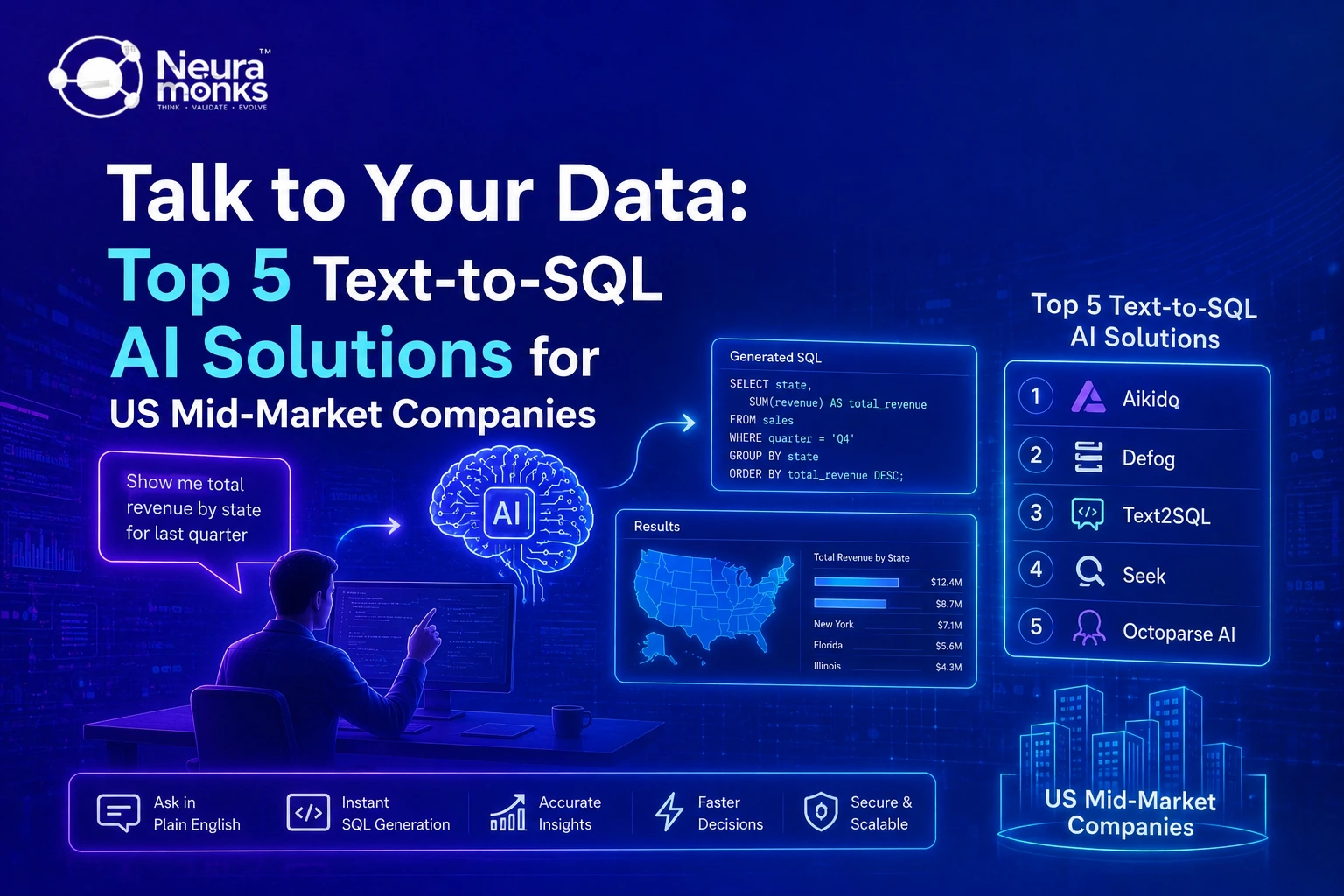
Talk to Your Data: Top 5 Text to SQL AI Solutions for US Mid Market Companies
Mid-market companies are rapidly adopting AI-powered text-to-SQL tools to let teams query business data using plain English instead of complex SQL. This blog compares the top 5 solutions in 2026, helping US businesses choose the right platform based on ERP integration, scalability, security, and real-world ROI.
QUICK ANSWER
If you want to talk to your data without writing SQL, you're in the right place. Mid-market companies across the US are deploying text-to-SQL systems that let analysts, ops managers, and even finance leads type a plain-English question and get an answer in seconds no data team required. This guide breaks down the five tools doing it best in 2026, what they actually cost, and where they fall short.
Why mid-market companies are done waiting on data teams
Here's the math that's driving this shift.
A data analyst at a US company earns $95,000 to $130,000 per year (Bureau of Labor Statistics, 2025). They spend roughly 40% of their time writing and debugging queries that business users could have answered themselves. Meanwhile, a Suzano case study published by Google Cloud in 2026 showed a 95% reduction in query time after deploying a Gemini-powered agent that translates natural language directly into SQL. That's not a rounding error that's a structural change in how a business operates.
Mid-market companies generally 500 to 5,000 employees are in an odd spot. They have real data complexity: ERP systems, Salesforce, multiple warehouses, compliance requirements. But they don't have a 20-person data engineering team to build custom tooling. That gap is exactly what text-to-SQL AI solutions are filling.
By 2026, 68% of mid-market US companies report using or actively evaluating AI-assisted data query tools (Gartner, 2025). The question isn't whether to talk to data it's which tool to use.
Quick comparison: top 5 text-to-SQL tools for mid-market US companies

The 5 tools, honestly reviewed
1. Google Gemini + BigQuery
The Suzano outcome (95% query time reduction) used a Gemini agent. Google's approach lets you describe what you need in plain English and get SQL back, executed against your BigQuery data. For companies already on Google Cloud, the setup is relatively clean.
Where it struggles: if your data isn't in BigQuery, you're adding a migration project before you even get to the AI part. Mid-market companies on SAP or Oracle ERP typically need custom connectors that Google doesn't provide out of the box.
Stat: Google Cloud revenue grew 28% YoY in Q1 2026 (Alphabet earnings), suggesting strong enterprise adoption but that's not the same as mid-market fit.
2. Microsoft Copilot for Power BI
If your company runs on Azure and Microsoft 365, Copilot's text-to-SQL layer is the path of least resistance. It reads from your existing Power BI semantic models and lets users ask questions in plain English.
The catch: it only works well if your Power BI models are already clean and well-documented. Most mid-market companies we've seen have fragmented BI setups Copilot surfaces that mess rather than hiding it.
Stat: 85% of Fortune 500 companies use Microsoft 365 (Microsoft, 2025), but mid-market penetration of Copilot specifically sits around 23% (IDC, 2025).
3. ThoughtSpot Sage
ThoughtSpot built its entire product around search-driven analytics long before LLMs were mainstream, so the natural language layer here is mature. Sage adds generative AI on top of that foundation.
It's good for companies that want something out-of-box and have a clean data warehouse (Snowflake, Databricks). The enterprise contract structure means it's expensive for sub-1,000 seat companies.
4. Databricks SQL AI
If your team has strong data engineering skills and your data lives in a Databricks lakehouse, their SQL AI assistant is technically solid. It understands schema context well and generates accurate queries for complex joins.
This is a tool for data teams, not business users. The gap between "data engineer who uses this" and "ops manager who needs an answer" is still wide.
5. Neuramonks purpose-built for ERP-heavy mid-market
This is where Neuramonks takes a different approach from the platforms above. Rather than retrofitting a general AI tool onto your data, we builds a custom talk to data layer directly against your source systems SAP, Oracle, NetSuite, Microsoft Dynamics without requiring a data warehouse migration first.
The practical result: a finance manager can type "show me overdue AR by region for Q1" and get an accurate answer in under 10 seconds, pulled live from ERP. No BI team in the loop.
See the full case study: Talk to Data Secure, Intelligent Analytics for ERP Systems
Neuramonks also supports a voice agent interface, which matters for operational roles warehouse supervisors, field ops leads who aren't going to open a browser to ask a data question.
Stat: Companies with direct ERP-to-AI integrations report 3.2× faster decision cycles compared to those routing through a BI layer (McKinsey, 2025).
What actually breaks text-to-SQL in practice
Most pilots fail for the same three reasons, and none of them are about the AI model.
Schema ambiguity. ERP systems have tables with names like VBAK, MARA, or BKPF. Without business-context mapping, even a strong LLM generates wrong SQL. The fix is a semantic layer that translates business language to schema terms and that layer has to be built, not assumed.
Security. When you allow natural language queries, you need row-level security enforced at the database level, not the UI level. Otherwise someone can ask a creative question and surface data they shouldn't see.
Hallucination at the aggregation layer. LLMs sometimes generate plausible-looking SQL that produces subtly wrong numbers. This is more dangerous than an error message it looks correct. The mitigation is query validation and result-range checks built into the pipeline.
If you want to understand more about what talk to data actually means technically, this beginner-friendly guide from Neuramonks is a solid starting point before you evaluate vendors.
What to ask vendors before you sign anything
Five questions that cut through demo theater:
- Can you show me a query against our actual schema, not a sandbox?
- How does your system handle row-level security in our ERP?
- What's the fallback when the model generates incorrect SQL?
- Do you support a voice agent interface for non-desk workers?
- What does onboarding look like for a company with 15+ data sources?
If a vendor hesitates on questions 1 or 2, that's information.
The commercial reality in 2026
AI solutions in this category span a wide price range. SaaS platforms charge $20–$80 per seat per month. Custom implementations from firms like Neuramonks typically run $60,000–$180,000 for the initial build, with ongoing retainers for model fine-tuning and schema updates.
The ROI math isn't complicated. If three analysts each spend 15 hours a week on ad-hoc SQL requests and that work drops to 3 hours you've recovered $180,000+ in annual capacity at median salaries. The payback period on a custom build is typically 6–10 months for a 200-person analytics-dependent team.
Stat: IDC projects the global text-to-SQL AI market will reach $4.1 billion by 2027, up from $890 million in 2024.
How to scope your own implementation
Three steps before you talk to any vendor:
Step 1: Inventory your data sources. List every system that holds data someone asks questions about. ERP, CRM, HRM, spreadsheets. Count the number of unique tables that matter.
Step 2: Identify your highest-value query patterns. What are the 20 questions your business asks most often? Revenue by region. Inventory turns. DSO. Those are your MVP queries. A good implementation nails those first.
Step 3: Define who the users are. Analysts are different from ops managers who are different from executives. Each user group has different tolerance for error and different query patterns. Design for the least technical user who needs access.
Ready to scope your project?
Neuramonks runs free proof-of-concept scoping calls for US mid-market companies evaluating text-to-SQL AI. In 30 minutes, you'll get a technical assessment of your data environment, a realistic timeline, and an honest read on which approach fits your stack whether that's Neuramonks or a platform tool.
Book your free POC scoping call with Neuramonks
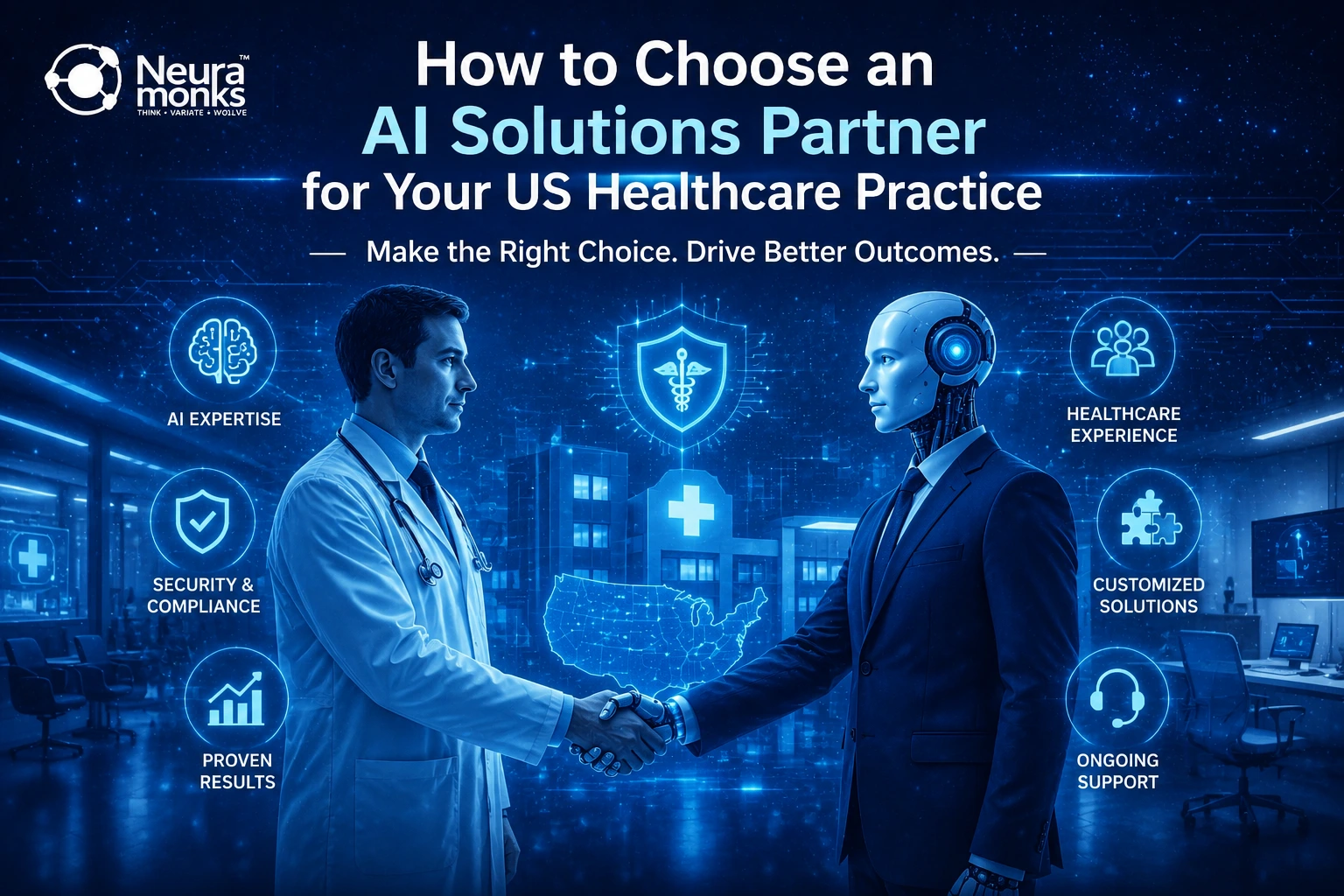
How to Choose an AI Solutions Partner for Your US Healthcare Practice
Choosing the right AI partner for your US healthcare practice in 2026 is not just about technology — it is about compliance, patient safety, workflow integration, and long-term scalability. This blog breaks down a practical 12-point checklist to help healthcare organizations evaluate AI vendors with confidence and avoid costly implementation mistakes.
QUICK ANSWER
Choose an AI solutions partner for your US healthcare practice using a 12-point checklist covering HIPAA compliance, BAA willingness, FDA SaMD experience, EHR integration depth, clinical validation, data residency, model transparency, security certifications, implementation timeline, total cost of ownership, ongoing support, and case study evidence in your specialty.
Every US healthcare practice is being pitched AI solutions in 2026, from ambient documentation to revenue cycle automation to clinical decision support. The technology is real. The risk of picking the wrong partner is also real. A failed implementation does not just waste budget. It can trigger a HIPAA breach, slow a clinical workflow, or quietly degrade patient outcomes. This 12-point checklist is the same evaluation framework NeuraMonks uses with US healthcare clients before any contract is signed.
Why Partner Selection Matters More in Healthcare Than Anywhere Else
Healthcare AI is not consumer software. A bad recommendation engine on a streaming service is annoying. A bad clinical AI partner is a regulatory and patient safety event. The market has scaled fast and the gap between strong and weak partners is widening.
The numbers tell the story. The US healthcare AI market is projected to reach 187 billion USD by 2030, with 2026 alone expected to drive over 25 billion USD in deployments (Source: Grand View Research, US Healthcare AI Market Report, 2025). Yet 73 percent of healthcare AI pilots fail to scale to production, most often due to integration, compliance, or workflow fit issues, not model accuracy (Source: HIMSS State of Healthcare AI Survey, 2025). And the average HIPAA settlement in 2024 reached 1.04 million USD, with AI-related breach investigations up 58 percent year-over-year (Source: HHS Office for Civil Rights Resolution Agreements Database, 2024).
Translation: the cost of a bad partner is not just the consulting fee. It is the breach, the failed pilot, the staff frustration, and the months of lost momentum. The 12 points below filter signal from noise.
The 12-Point Evaluation Checklist (At a Glance)

The 12 Criteria, Explained in Depth
1. HIPAA compliance and Business Associate Agreement (BAA)
This is non-negotiable. Any partner who handles, processes, or stores Protected Health Information (PHI) must sign a BAA before any data flows. Ask for their BAA template upfront. A serious partner has it ready within 24 hours. A weak one delays, redirects, or wants to use yours unmodified. Verify they understand the difference between de-identified data, limited datasets, and full PHI, and that their architecture matches what their BAA promises.
2. FDA SaMD experience (where applicable)
If your AI use case touches diagnosis, treatment recommendation, or clinical risk scoring, FDA's Software as a Medical Device (SaMD) framework may apply. Ask whether the partner has supported a 510(k), De Novo, or Pre-Submission. Even if your initial use case is administrative, a partner who understands SaMD will design with future regulatory paths in mind. An AI development company without any FDA exposure will build something you may not be able to commercialize.
3. EHR integration depth
Integration is where most healthcare AI dies. Ask specifically: How many production Epic, Cerner (Oracle Health), or Athenahealth integrations have you shipped? FHIR R4 is now the floor in 2026, but real practices still run heavy HL7v2 and proprietary APIs. A partner with five live Epic integrations will navigate this in weeks. A partner with zero will take six months and still miss edge cases.
4. Clinical validation methodology
How does the partner prove the AI works in your specific clinical setting? Strong answers include retrospective validation against your historical data, prospective shadow deployment, and pre-defined success metrics like sensitivity, specificity, and clinical agreement. Weak answers point to general benchmark numbers from a paper. Real validation is specialty-specific, site-specific, and population-specific. AI consulting services that skip this step are selling marketing, not medicine.
5. Data residency and sovereignty
Where exactly does the data live? US-only hosting is the minimum. Some states (notably Texas, California with CCPA-HIPAA overlap, and New York with SHIELD Act) push further. Ask which AWS, Azure, or GCP region. Ask whether any subprocessors are outside the US. Ask whether model training or fine-tuning ever ships data offshore. Get the answers in writing as part of the BAA addendum.
6. Model transparency and explainability
Black-box models are a non-starter for clinical decisions. Even for administrative AI, explainability matters when staff or patients ask why the system made a recommendation. Ask for model cards, bias evaluation results, and the explainability technique used (SHAP, LIME, attention visualization, or rule-based wrappers). The 2025 NIST AI RMF specifically calls out healthcare as a high-risk domain requiring documented transparency.
7. Security certifications
SOC 2 Type II is the baseline. HITRUST CSF certification is the gold standard for US healthcare. ISO 27001 helps if you operate internationally. Ask for the actual reports under NDA, not just logo claims. A partner who lists badges but cannot produce a current audit report has effectively lied to you, and your compliance officer will catch it during onboarding anyway.
8. Implementation timeline (realistic, not heroic)
Be skeptical of any AI Product Development Company that promises a production healthcare AI deployment in 2 weeks. A typical realistic timeline runs 8 to 16 weeks for the first production workflow, including discovery, data access agreements, integration build, validation, training, and go-live. Faster than 6 weeks usually means corners are being cut on validation or change management. Slower than 24 weeks usually means scope is too large for a first phase.
9. Total cost of ownership across 3 years
Sticker price hides the truth. Ask for a full TCO model: implementation fee, year-one license, year-three license, integration maintenance, model retraining, support tier upgrades, and additional user or location costs. A partner who cannot produce this in writing is either inexperienced or hiding the math. NeuraMonks publishes TCO ranges before signed engagement so the client can budget honestly.
10. Ongoing support and SLA
What happens at 2 AM on a Saturday when the documentation AI stops working in the middle of a hospitalist shift? Ask for the SLA in writing: response time, resolution time, named escalation contact, and severity definitions. A 99.9 percent uptime SLA without a clear severity matrix is marketing. A weak support model is the single biggest cause of post-launch dissatisfaction.
11. Specialty case studies and references
General healthcare AI experience is not the same as experience in your specialty. A partner who has deployed in radiology may know nothing about behavioral health workflows. Ask for two reference customers in your clinical area with a similar size and EHR. Talk to them without the partner on the call. The honest details (what went wrong, how it was fixed) are worth more than any deck.
For a broader context on which firms are leading this space in the US, this resource is a useful market map:
Top AI Development Companies in the USA 2026
12. Exit clause and data portability
The most professional partner conversation includes how the relationship ends. Ask: If we offboard in 18 months, how do we get our data, our trained models, our prompts, and our integration mappings out, and in what formats? A partner who has thought this through has nothing to hide. A partner who deflects has structural lock-in baked in, and you will pay for it later.
Red Flags That Should End the Conversation
- They cannot produce a BAA template within 48 hours.
- They claim 99.99 percent model accuracy without specifying the dataset or population.
- Pricing is opaque or scales unexpectedly with usage with no upfront cap.
- All case studies are from non-healthcare verticals (or none are US-based).
- They cannot name a clinical lead on their team or a recent FDA-related project.
- The proposed timeline assumes you have no existing EHR integration constraints.
How to Run the Evaluation in 30 Days
A disciplined process beats a long process. Here is the 30-day cadence we recommend to clinical and operations leaders evaluating AI partners.
Days 1 to 7: Define the use case and longlist
Pick one workflow with measurable pain (documentation time, denied claims, scheduling no-shows, prior auth turnaround). Source 6 to 8 candidate partners through trusted analyst lists, peer references, and direct outreach. Resist the urge to pick a partner before defining the problem.
Days 8 to 14: RFP and shortlist
Send the 12-point checklist as the RFP. Score responses on completeness and specificity. Shortlist the 3 strongest. NeuraMonks routinely sees that 2 of the original 8 self-eliminate at this stage by failing on HIPAA, BAA, or EHR integration questions.
Days 15 to 22: Reference calls and security review
Run 30-minute reference calls with prior customers. Have your CISO and Privacy Officer review the SOC 2 / HITRUST reports under NDA. Identify any deal-breakers before commercial discussion.
Days 23 to 30: Commercial alignment and pilot scope
Negotiate a paid pilot with clear success metrics, not a free trial. Free trials encourage demos, not real validation. A 60 to 90 day paid pilot at 10 to 25 percent of the annual contract value forces both sides to commit and produces real data for the production decision.
How the Best AI Partners Earn Trust in the First 90 Days
The discovery and contracting phase reveals the partner's salesmanship. The first 90 days of execution reveals their craft. Three signals separate strong partners from weak ones once work actually starts.
First, they translate clinical workflows into design before writing code. A strong partner sits with nurses, billers, or front-desk staff for at least a week before architecture is finalized. They map the actual click path, the workarounds, the exception handling. AI that ignores existing workflow gets bypassed within a month of go-live, no matter how accurate the model is.
Second, they instrument everything from day one. A real production AI deployment ships with logging, monitoring, drift detection, and feedback loops baked in, not bolted on later. Ask to see the dashboard the partner will hand over. If it does not exist as a template before the engagement, it likely will not exist after either.
Third, they prepare the practice for the human side of change. Even the best AI fails when staff are not trained, incentives are misaligned, or leadership has not committed publicly. The strongest AI consulting services partners include change management hours in the proposal by default. The weakest treat training as an afterthought, billed separately.
Book a Free AI Consultation With NeuraMonks
Evaluating AI partners for your US healthcare practice? Book a free consultation with the NeuraMonks healthcare AI team. We will walk through the 12-point checklist against your shortlist, flag risks, and outline a HIPAA-safe pilot scope tailored to your specialty and EHR.
Schedule your call: https://tidycal.com/team/neuramonks/consultation-booking
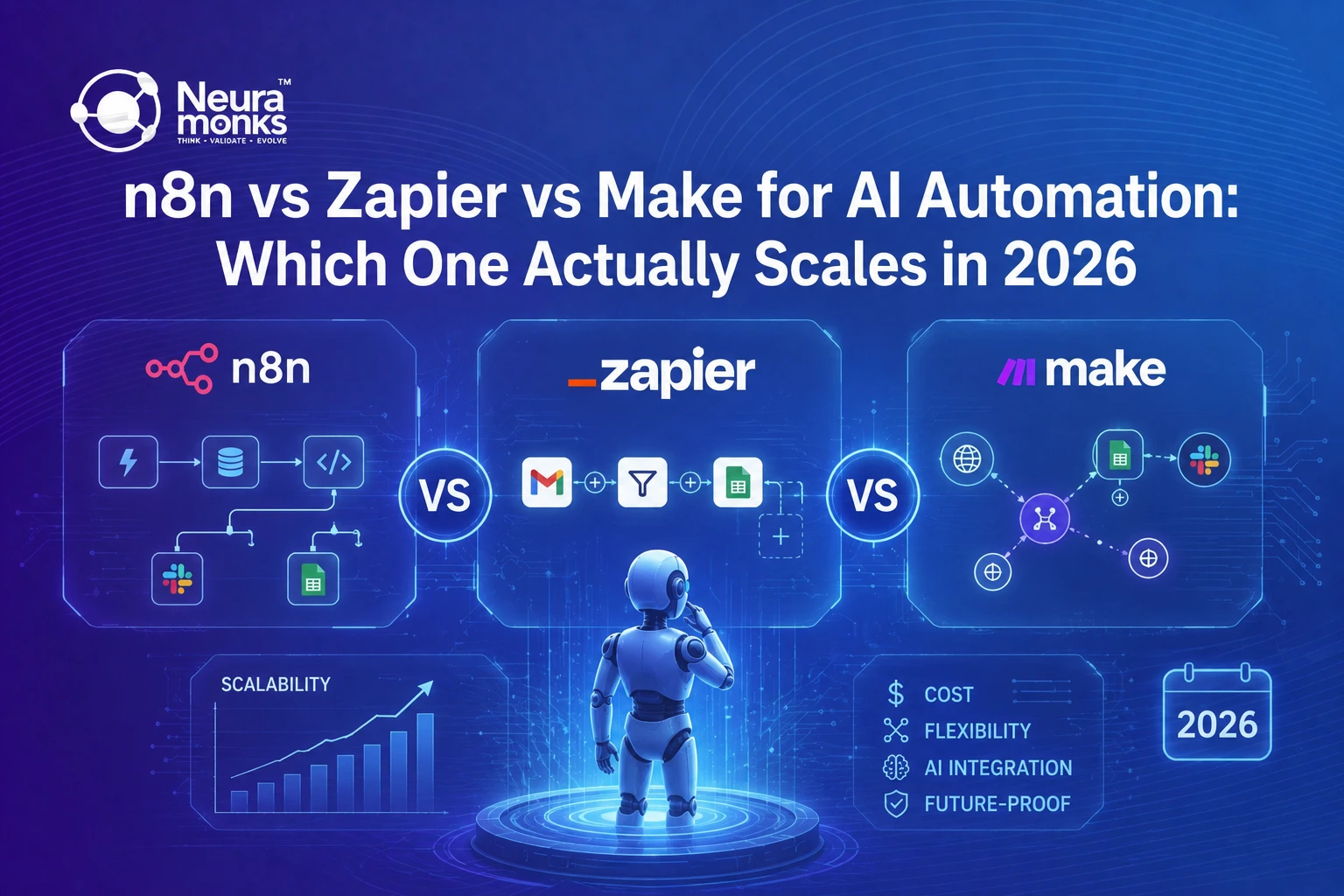
n8n vs Zapier vs Make for AI Automation: Which One Actually Scales in 2026
Compare n8n, Zapier, and Make for AI automation in 2026 from pricing and scalability to AI agent capabilities, compliance, and enterprise readiness to discover which platform truly scales for modern AI workflows.

QUICK ANSWER
For AI automation that actually scales in 2026, n8n is the strongest choice for technical teams handling 10,000 plus monthly executions, complex AI agent workflows, and self-hosted data control. Zapier wins for non-technical users running simple tasks. Make sits in the middle, ideal for visual mid-volume workflows under 50,000 operations per month.
Choosing the wrong automation platform is the most expensive mistake AI teams make in 2026. The platform that worked for 500 monthly tasks collapses at 50,000. Pricing models that looked cheap in proof of concept become budget-killers at scale. And the AI agent workflows you actually need, vector retrieval, multi-step LLM chains, and human-in-the-loop approval, are not equally supported across n8n, Zapier, and Make. This guide compares the three platforms head-to-head on the dimensions that determine whether your AI automation stack scales or stalls.
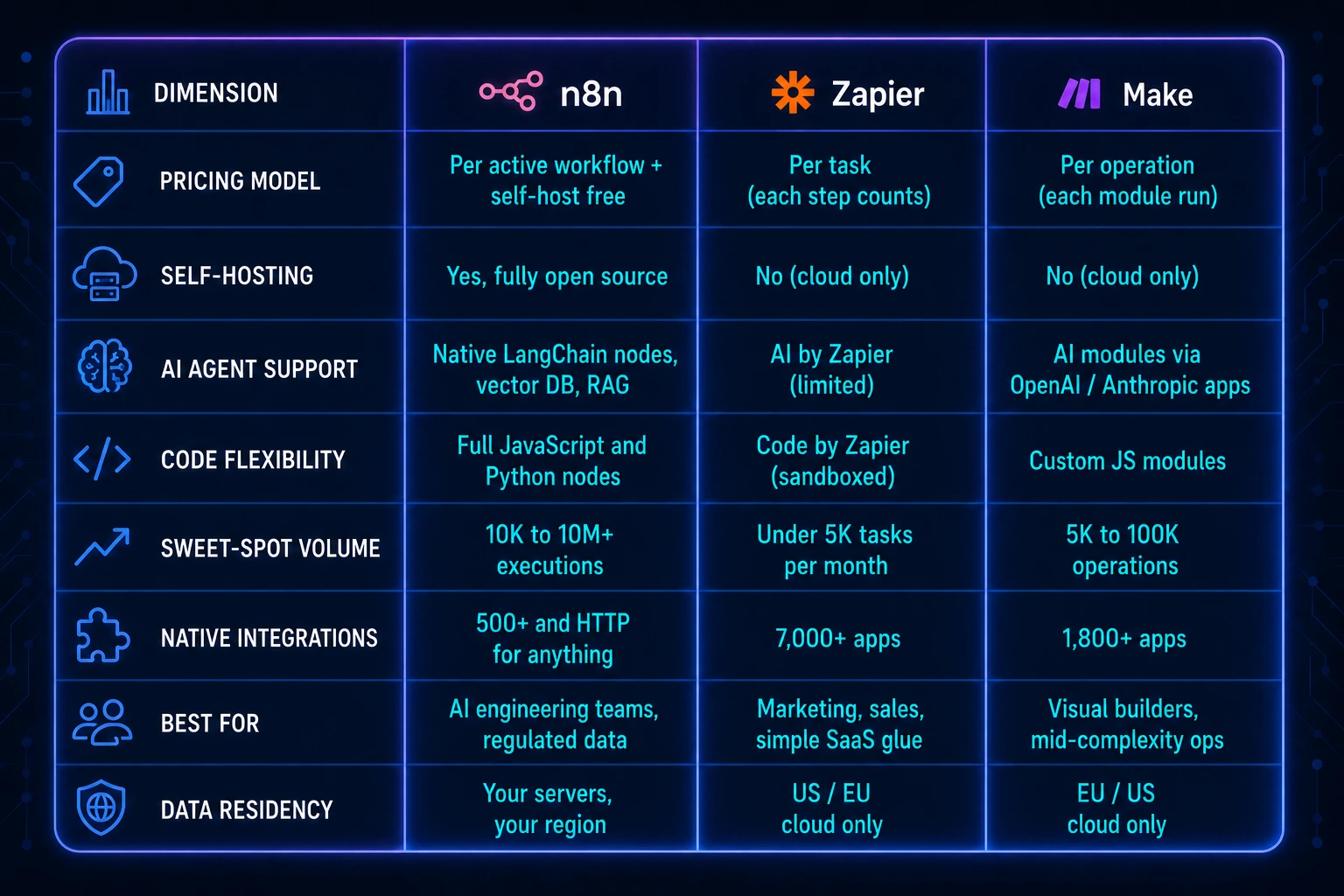
Comparison Table: n8n vs Zapier vs Make at a Glance
Why Pricing Models Make or Break AI Automation at Scale
The single fastest way to burn an AI automation budget in 2026 is to pick a per-task pricing model when your workflows have 10 or more steps. A single AI agent loop with retrieval, classification, summarization, and a webhook back to your CRM is four billable tasks on Zapier. Run that 50,000 times a month, and the math becomes very unfavorable very quickly.
Recent industry data shows just how stark the gap is. According to G2 reviews aggregated across automation platforms in 2025, the median enterprise team running AI workflows reported a 3.4x cost difference between per-task and per-execution pricing once monthly volume exceeded 25,000 runs (Source: G2 Automation Software Category Report, 2025).
State of AI Automation surveys show 67 percent of enterprise teams that started on Zapier eventually migrated at least one workflow tier to n8n or Make for cost reasons (Source: Workflow Automation Benchmark Report by Tray.io, 2025). And Gartner forecasts that by the end of 2026, 70 percent of new enterprise applications will use AI-augmented automation, up from less than 10 percent in 2020 (Source: Gartner Hyperautomation Forecast, 2024).
How n8n pricing actually works
n8n charges per active workflow on cloud (not per task or per step). A workflow that fires 100,000 times a month costs the same as one that fires 100 times. On the self-hosted version, the software itself is free under the Sustainable Use License. You pay only for the server it runs on. This is why AI engineering teams running high-volume agent loops gravitate to it.
How Zapier pricing actually works
Zapier counts each step inside a Zap as a billable task. A 6 step Zap that runs 1,000 times burns 6,000 tasks. Plans in 2026 start around 19.99 USD per month for 750 tasks and scale to enterprise tiers at thousands per month. The platform shines for sub-5,000-task workflows where engineering effort is more expensive than task fees.
How Make pricing actually works
Make charges per operation, where one operation equals one module execution. It is cheaper than Zapier per step but more expensive than n8n at scale. Make plans in 2026 cap most teams comfortably at the 100,000 operation tier. Above that, the per-operation creep starts to bite.
A real cost comparison at 100,000 monthly executions
Take a representative AI workflow: 8 steps including a vector lookup, two LLM calls, a CRM update, and an alert. Running this 100,000 times per month, Zapier would consume 800,000 tasks (around 2,000 to 2,800 USD per month on the Team plan). Make would consume roughly 800,000 operations (around 700 to 1,100 USD per month at the Pro tier with overages). n8n Cloud Pro covers unlimited executions on the workflow at a flat 50 to 120 USD per month, while self-hosted n8n on a 60 USD per month VPS handles the entire load with headroom. The pricing gap is not 20 percent. It is often 10x or more once volume crosses six figures.
AI Agent Capabilities: Where the Three Platforms Diverge in 2026
Routine app to app automation is a solved problem. The real 2026 differentiator is whether a platform can run production-grade AI agents, the kind that retrieve context from a vector database, call an LLM with tool use, validate output, and loop until a goal is reached. This is where the gap between the three platforms widens dramatically.
n8n: built for AI engineering
n8n shipped native LangChain nodes in 2024 and has expanded the AI feature set every quarter since. As of 2026, the platform offers built-in nodes for vector stores (Pinecone, Qdrant, Weaviate, Supabase), agent orchestration with tool calling, structured output parsers, retrieval chains, and human-in-the-loop approval steps. Custom JavaScript and Python nodes mean teams can drop in any model SDK that does not yet have a first-party node. For AI development companies building production agent systems, this is the reason n8n has become the default.
A real example: Neuramonks recently shipped a content automation system that ingests RSS feeds, classifies topic relevance with an LLM, retrieves brand voice context from a vector store, generates draft posts, runs a fact-check pass, and pushes to WordPress with SEO metadata. The full pipeline runs entirely on n8n with no custom infrastructure. Read the full breakdown here:
Neuramonks AI Blog Post Generation Automation Case Study
Zapier: AI as bolt-on, not foundation
Zapier introduced AI by Zapier and Zapier Agents in 2024, which work well for adding an LLM step to a simple flow (summarize this email, classify this lead). The architecture, however, is fundamentally task-based. There is no native vector database. Multi-turn agent loops have to be simulated with workarounds, and pricing penalizes loops because every iteration is billable tasks.
Make: visual AI for mid-complexity
Make ships first-party modules for OpenAI, Anthropic, and other LLM providers, plus a Vector module for embedding storage. The visual builder is genuinely good for prototyping AI flows. The ceiling is real, though. Once an agent needs more than a handful of conditional branches and retries, the visual canvas becomes harder to maintain than code.
Observability and debugging at scale
AI workflows fail in ways that traditional automations do not. An LLM returns malformed JSON. A vector query times out. A tool call hits a rate limit mid-loop. The platform you pick determines how fast you find and fix these failures. n8n provides full execution logs, replay from any node, and structured error workflows that route failures to a separate handler. Zapier's history is task-by-task and replay options are limited on lower tiers. Make's visual execution log is excellent for debugging single runs but becomes unwieldy when you need to triage 500 failed runs from yesterday. For production AI systems, debuggability is not a nice-to-have. It is the difference between a 15-minute incident and a 4-hour one.
Data Residency, Security, and Compliance for US Enterprise
US enterprise buyers in regulated industries, healthcare, finance, defense, legal, cannot send PHI, PII, or trade secrets through a third-party cloud they do not control. This eliminates Zapier and Make from many serious enterprise procurement processes from the start. n8n, because it can be self-hosted on your own VPC, in your own region, behind your own firewall, is often the only platform that survives a CISO review.
Compliance data underscores the stakes. IBM's Cost of a Data Breach Report 2024 puts the average US data breach at 9.36 million USD, with healthcare averaging 9.77 million USD per incident (Source: IBM Cost of a Data Breach Report, 2024). HIPAA enforcement actions have risen 40 percent year-over-year through 2025 (Source: HHS Office for Civil Rights Annual Enforcement Summary, 2025). And NIST's 2025 AI Risk Management Framework guidance now explicitly recommends self-hosted automation for any workflow handling regulated data classifications (Source: NIST AI RMF 1.0 Implementation Guide, 2025).
For US healthcare, fintech, and government contractor use cases, the calculus is simple. If your AI workflow touches regulated data, n8n self-hosted is usually the only one of the three platforms that clears the security review.
Total cost of ownership beyond the subscription
Subscription pricing is only one line in the TCO equation. Engineering time to build, maintain, and migrate workflows often dwarfs platform fees. Teams that pick a tool primarily on sticker price tend to regret it within 12 to 18 months. A useful rule of thumb: budget 60 percent of year-one spend for platform fees and 40 percent for build and maintenance time. By year three on a stable stack, that flips. Self-hosted n8n at scale frequently lands at 5 to 15 percent of the equivalent Zapier Enterprise quote once you cross the 250,000 monthly execution threshold, even after counting infrastructure and DevOps time.
Decision Framework: Which Platform Fits Your 2026 Stack
Pick Zapier when
- Your team is non-technical and the workflows are simple (under 5 steps).
- Total monthly volume stays under 5,000 tasks.
- You need niche SaaS integrations (Zapier still leads at 7,000+ apps).
- Speed of building matters more than per-execution cost.
Pick Make when
- Workflows are visually complex but volume is moderate (5K to 100K operations).
- Your team prefers a visual canvas over code.
- Data residency is not a hard requirement.
- You want better pricing than Zapier without running infrastructure.
Pick n8n when
- You are building production AI automation with agents, retrieval, or multi-step LLM chains.
- Monthly execution volume exceeds 10,000 (and especially over 100,000).
- Data residency, HIPAA, SOC 2, or self-hosted control is required.
- You have engineering capacity to manage workflows as code.
- You want to avoid vendor lock-in (n8n workflows are JSON, fully exportable).
Where AI Automation Is Heading in 2026 and Beyond
Three trends shape platform selection over the next 18 months. First, agentic AI moves from prototype to production. McKinsey's 2025 State of AI report notes 78 percent of organizations now use AI in at least one business function, up from 55 percent the prior year, with agentic workflows the fastest-growing category (Source: McKinsey Global Survey on AI, 2025).
Second, regulatory pressure intensifies. The EU AI Act enforcement window opened in 2025 and US state level AI laws are multiplying. Third, model costs keep falling, but orchestration cost (the workflow platform itself) is becoming the dominant line item in AI operating budgets.
For a deeper view on what enterprise leaders should prepare for, NeuraMonks published a strategic outlook that pairs well with this comparison:
AI Automation in 2026: What Enterprise Leaders Must Prepare For
Free POC Scoping Call With Neuramonks
Not sure which platform fits your AI roadmap? Book a free 30 minute POC scoping call with the NeuraMonks team. We will map your top three workflows to n8n, Zapier, or Make based on volume, compliance, and AI complexity, then give you a build estimate before you commit a dollar.
Schedule your call here: https://www.neuramonks.com/contact

Live Safety Detection with AI Turning CCTV Cameras into Real Time OSHA Protection Systems
AI-powered safety detection is transforming construction sites by converting existing CCTV cameras into real-time hazard monitoring systems. Instead of reacting after incidents, contractors can now prevent violations before they happen. With computer vision, edge processing, and intelligent alerts, companies are reducing OSHA fines, improving worker safety, and gaining a competitive edge through data-driven compliance.
Every 99 minutes, a construction worker in the United States dies on the job. That is not a statistic buried in a government footnote it is the OSHA reality for an industry generating over $2 trillion in annual output while consistently ranking among the nation's most dangerous sectors. The question construction safety officers, general contractors, and operations VPs are now asking is not whether technology can change this. They are asking how fast they can deploy it.
The answer lies in the cameras already mounted across your job site. Paired with AI in Construction, those passive surveillance feeds become active, intelligent safety systems that detect hazards in real time, alert supervisors before injuries occur, and generate audit-ready compliance records automatically.
The Gap Between CCTV Footage and Actual Safety
Traditional CCTV infrastructure was built for one purpose: recording. Footage sits on local servers, reviewed only after an incident has already occurred. A worker entering a restricted zone, a forklift operating without clear sightlines, a team member skipping PPE before a welding task — none of these trigger any alert in a conventional system. A human operator watching 12 simultaneous feeds will miss most violations simply due to attention limits.
This is the blind spot that Artificial Intelligence in Construction eliminates.
AI-powered safety detection layers a real-time analytical brain on top of your existing camera network. No new hardware required on most deployments. No ripping out infrastructure. The system watches every frame, on every feed, simultaneously — and it never blinks.

How AI in Construction Actually Works on a Job Site
The architecture behind a live safety detection system is more accessible than most construction technology leaders expect. It combines three core technologies into one integrated layer:
1. Computer Vision — The Eyes of the System
Computer vision is the foundational layer. Deep learning models trained on millions of construction-specific images learn to identify and classify objects, people, postures, and behaviors with high precision. The models can distinguish between a hard hat and an uncovered head, a forklift in motion versus stationary, a worker inside a geo-fenced exclusion zone versus standing at its edge.
What makes this different from generic object detection is domain specificity. Models trained on hospital interiors or retail environments perform poorly on construction sites with variable lighting, dust, partial occlusion, and fast-moving machinery. Construction-purpose-built computer vision models are trained and validated specifically for these conditions.
2. vLLM Model Integration — Context and Communication
A raw alert "PPE violation detected, Camera 7" has limited operational value unless it reaches the right person with enough context to act. This is where a vLLM-powered model layer adds significant intelligence. vLLM enables efficient, high-performance serving of large language models, allowing structured safety event data to be processed and transformed into contextual, human-readable alerts: which worker zone, what violation type, recommended immediate action, and escalation priority.
It can also synthesize shift-end safety summaries, flag repeated violation patterns, and surface proactive risk advisories for site supervisors—while ensuring faster response times and scalable deployment across multiple camera feeds.
3. Real-Time Edge Processing — Speed Without Latency
Safety alerts have zero value if they arrive 45 seconds after the hazard event. Modern AI safety systems process video at the edge — meaning on-site hardware or low-latency cloud nodes analyze frames in real time, triggering alerts within 2 to 8 seconds of a violation being detected. This is fast enough for a supervisor to intervene before an injury occurs.
Key Insight for Safety Officers
Most job sites already have 60 80% of the CCTV infrastructure required for AI safety deployment. The investment is in software, integration, and model fine-tuning not wholesale hardware replacement.
See What Your Current Cameras Are Missing
Request a complimentary site safety gap analysis — we map your existing CCTV infrastructure against AI detection coverage potential with zero obligation.
OSHA Violations AI Can Detect in Real Time
The following hazard categories are among the most consistently detectable by trained computer vision models deployed on construction sites across the United States:
- Hard hat, safety vest, and glove non-compliance across all personnel
- Unauthorized access to restricted or high-voltage zones
- Workers operating near unguarded edges, floor openings, or scaffolding without fall protection
- Forklift and heavy equipment proximity violations with pedestrians
- Lockout/tagout area breaches during maintenance activities
- Ladder safety violations, including improper angle, unsecured base, or overreaching
- Crowd density monitoring in confined spaces
- Smoke, fire, and unusual thermal signature detection
- Vehicle speed limit violations within site boundaries
- After-hours unauthorized personnel access
Each of these categories directly maps to OSHA's Top 10 Most Cited Standards — the violations responsible for the majority of construction fatalities and fines in the United States annually. Addressing them proactively, rather than reactively, is where AI in Construction delivers the highest measurable ROI.
The Commercial Case: What ROI Looks Like for General Contractors
Safety technology decisions in construction are ultimately financial decisions. Here is how the numbers typically pencil out for mid-to-large general contractors operating in the US market:
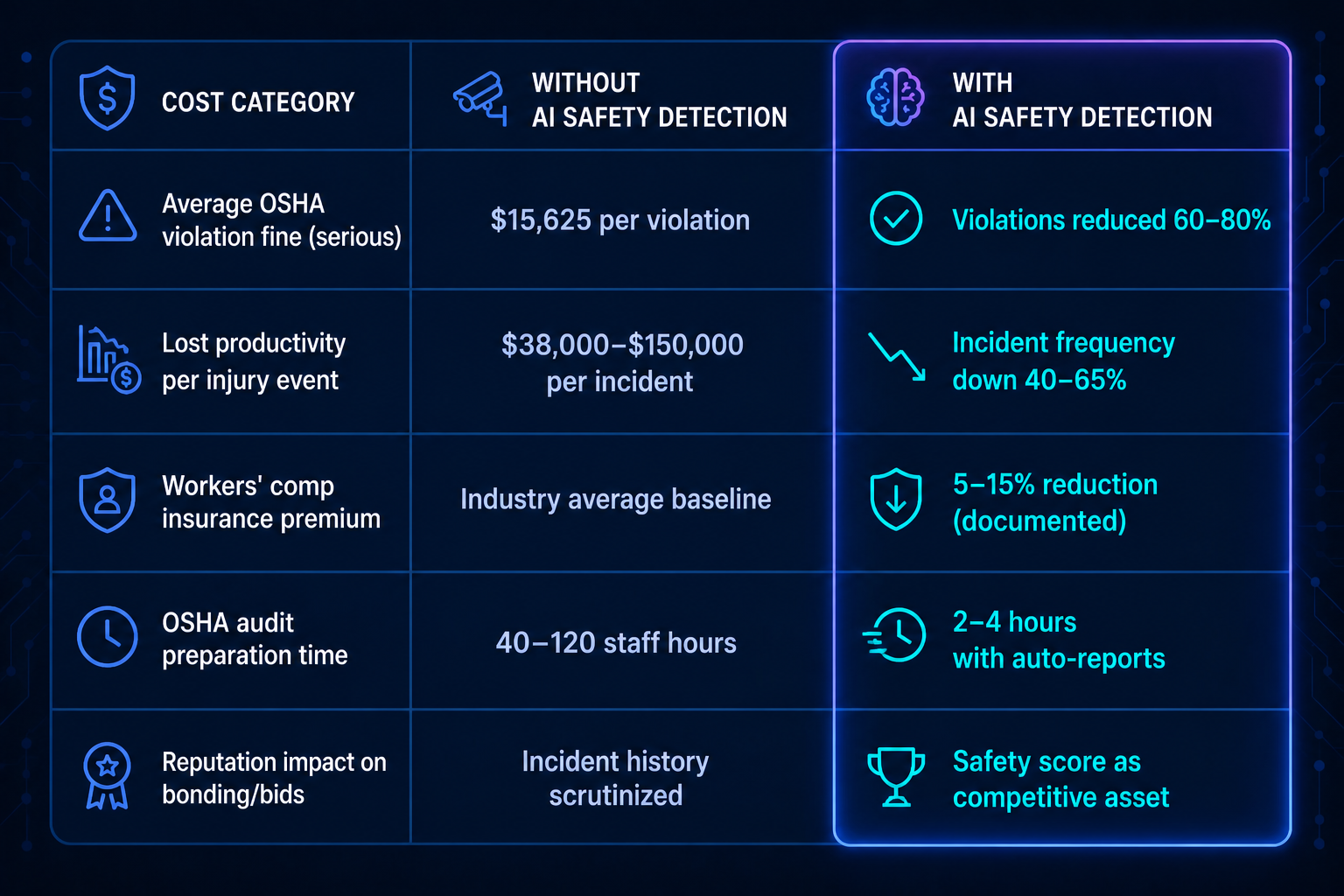
One documented case from a 400 worker commercial construction project in Texas showed a 71% reduction in reportable incidents in the 18 months following AI safety system deployment. OSHA fines dropped from an annual exposure of approximately $280,000 to under $40,000. The system paid for itself in under seven months.
For Risk Managers and CFOs
Insurers are beginning to recognize AI verified safety programs as quantifiable risk reduction. Several carriers now offer documented premium discounts of 5 15% for contractors who can demonstrate real-time safety monitoring with AI solutions. This changes the ROI math significantly.
What a Deployment Actually Looks Like: A 6-Phase Implementation
Construction technology leaders frequently overestimate the complexity of AI safety deployment. For a site with existing CCTV infrastructure, a full deployment follows a structured six-phase process:
- Phase 1 — Site Survey & Camera Audit: Map existing camera coverage, identify blind spots, assess feed quality and resolution for model performance.
- Phase 2 — Model Selection & Fine Tuning: Select pre-trained construction safety models; fine-tune on site-specific conditions (lighting, machinery types, worker density patterns).
- Phase 3 — Integration & Edge Deployment: Connect AI processing nodes to existing CCTV streams via RTSP or API bridge. No camera replacement required in most cases.
- Phase 4 — Alert Workflow Configuration: Define escalation rules, notification channels (SMS, Slack, dashboard), and violation severity thresholds by camera zone.
- Phase 5 — Safety Team Training & Calibration: Onboard site supervisors to the dashboard; refine model confidence thresholds based on first 2 4 weeks of live data.
- Phase 6 — Compliance Reporting Automation: Configure OSHA-formatted daily and monthly safety reports with incident logs, violation trends, and corrective action tracking.
Total deployment time for a single construction site ranges from 3 to 8 weeks depending on site scale, integration complexity, and the number of camera feeds being processed. Multi-site enterprise rollouts typically run on a phased schedule of 90 to 180 days.
The Hidden Value: Safety Data as a Competitive Differentiator
The most forward thinking contractors in the US market are not deploying AI safety detection purely to avoid fines. They are building a data asset.
Every violation logged, every pattern identified, every near-miss captured creates a structured safety intelligence database. Over 12 to 24 months, this data tells a story that manual incident logs simply cannot: which subcontractors consistently underperform on PPE compliance, which site zones carry disproportionate risk, which shift windows show elevated violation rates, and which supervision staffing models correlate with the safest outcomes.
This intelligence feeds directly into project bidding, subcontractor selection, insurance negotiations, and bonding conversations. Owners and developers increasingly require documented safety performance as part of the prequalification process for large projects. Contractors with AI verified safety records arrive at those conversations with a quantified, defensible advantage.
What Leading Construction Firms Are Discovering
Safety score documentation from AI systems is becoming a procurement criterion on federal, commercial, and healthcare construction projects. Contractors who have this data are shortlisting more frequently. Those without it are being asked to explain why.
Map Your Safety Intelligence Potential
Our construction AI team analyzes your current CCTV coverage and produces a personalized Safety Detection Readiness Score delivered within 5 business days at no cost.
When evaluating partners, construction safety leaders should assess the following:
- Model training data: Was the computer vision model trained specifically on construction environments, or on generic workplace footage?
- OSHA alignment: Does the system's violation taxonomy map directly to OSHA 29 CFR 1926 construction standards?
- Deployment track record: How many construction sites has the partner deployed on, and what documented safety improvement metrics are available?
- Integration depth: Can the platform connect to your existing safety management software, ERP, and reporting systems?
- Ongoing model improvement: Does the partner provide model updates as regulations change and new hazard patterns are identified?
The right partner delivers more than software they deliver a working AI solutions ecosystem that improves demonstrably over time, producing sharper detection, fewer false positives, and richer safety intelligence with every month of operation.
Your Job Site Is Already Equipped. It Just Needs Intelligence. The cameras are there. The hazards are there. The regulatory exposure is there.
What is missing is the layer that connects them and transforms surveillance footage into a living, breathing OSHA protection system.
Bring Your Construction Safety into 2026
NeuraMonks engineers construction-grade AI safety systems built for OSHA compliance, US job sites, and zero-tolerance incident environments.
Claim Your Free Safety Detection Scoping Session
Build vs Partner: The Real Cost of Adding an AI Team in 2026
Building an in-house AI team in 2026 costs far more than most leaders budget for — salaries, recruiting, compute, and attrition push year-one totals past $700K. This post breaks down the full cost comparison between building internally vs. partnering with an AI firm like NeuraMonks, with numbers by vertical.
Let's skip the fluff.
If your company is seriously considering building out an AI capability right now, you've probably already done some back-of-napkin math. You've looked at a few LinkedIn profiles. Maybe you've talked to a recruiter. And somewhere in that process, the number got scary fast.
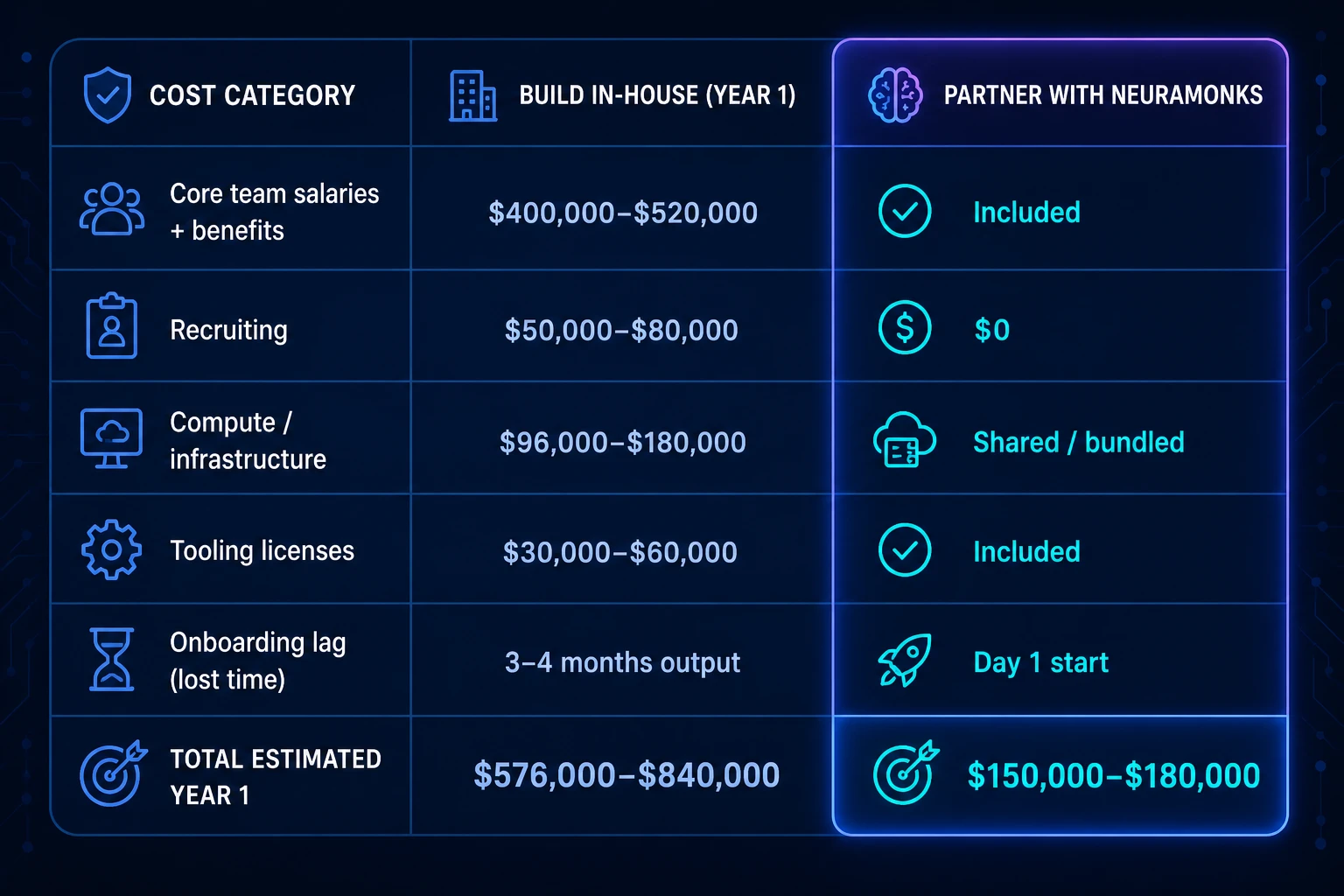
This post breaks down exactly why the "build it in-house" path costs between $500,000 and $700,000 in year one alone and what the alternative actually looks like when you run the same numbers.
Why companies are getting this decision wrong right now
The AI hiring market in 2026 isn't the same as it was two years ago. Demand for machine learning engineers, AI architects, and LLM model specialists has outpaced supply significantly. Companies that started hiring in 2023 are still struggling to retain the people they brought on.
There's also a less discussed problem: the skills you hire for today may not be the skills your product needs in 18 months. The field moves fast. An in house team built around one architecture or framework can become a liability the moment the tooling shifts.
None of this means building in house is wrong. It means you need to run the numbers before you commit.
What it actually costs to build an in-house AI team
Here's where most budget conversations go sideways leaders compare a partner's annual retainer to a single engineer's salary, not to the full cost of the team you'd need to get comparable output.
A functional AI development team that can take a product from prototype to production typically requires at least 4 5 people.
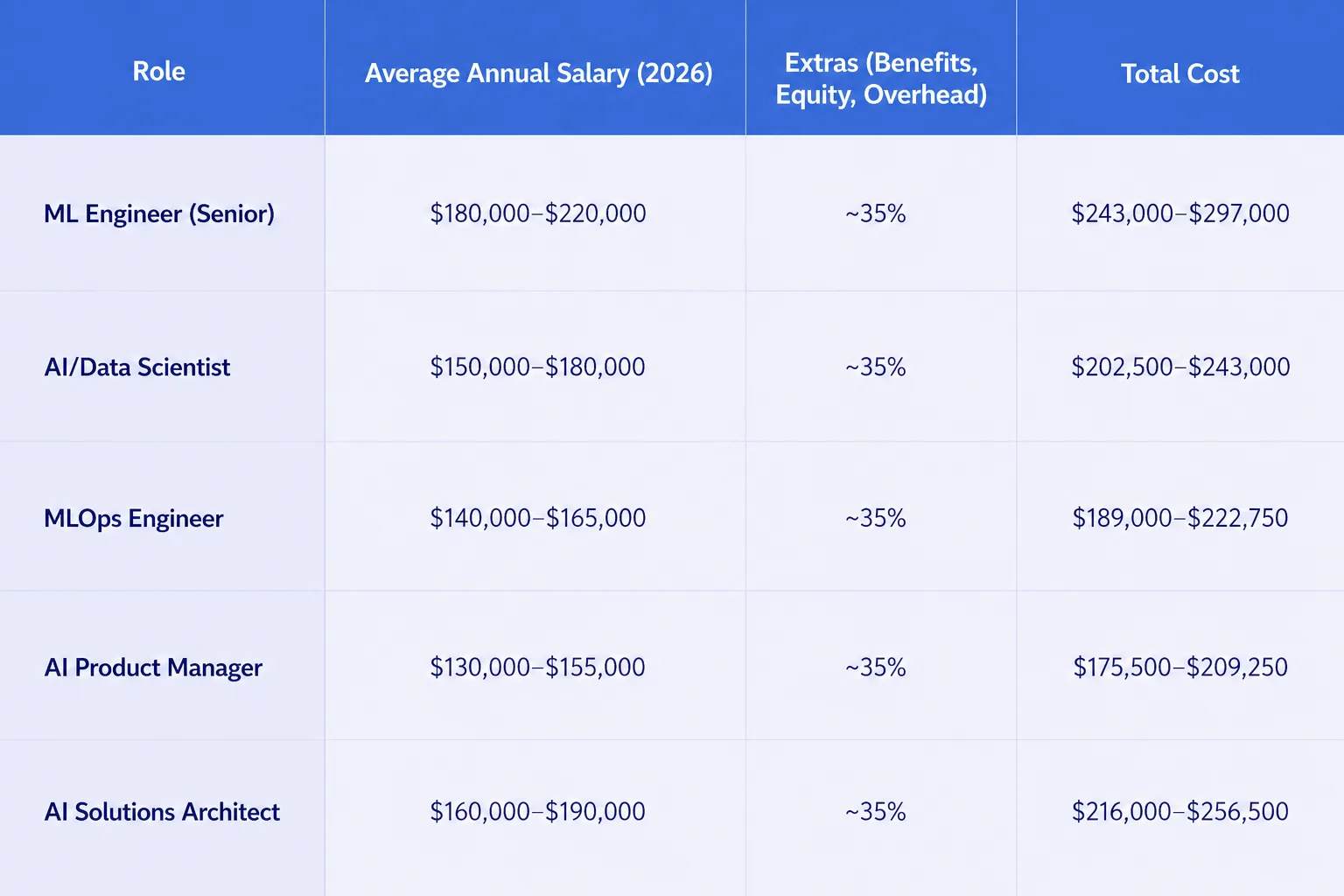
Add recruiting costs ($25,000 to $40,000 per senior hire), onboarding time (typically 3 to 4 months before meaningful output), tooling licenses, compute infrastructure, and management overhead and a conservative estimate for year one lands between $520,000 and $700,000.
That's before you ship a single model to production.
What partnering with NeuraMonks looks like by comparison
NeuraMonks works with companies that need production grade AI solutions without the overhead of a full internal team. The engagement model is built around delivery, not headcount.
A typical mid scope engagement covering architecture, build, deployment, and ongoing iteration runs between $150,000 and $180,000 annually. That's the full cost. No equity dilution, no benefits overhead, no 3 month ramp period while someone gets up to speed on your codebase.
The gap is significant: companies that partner rather than build typically see 60 to 70% lower first year costs for comparable AI capability output.
The numbers by vertical
Not every company has the same risk profile or timeline. Here's how the build vs partner calculation looks across three common ICPs.
Construction
In-house requirements in construction are higher than most sectors. Project complexity around site safety compliance, equipment tracking, budget forecasting, and real time coordination means you're not just hiring for AI capability you're hiring for domain expertise in construction workflows too. A construction AI team built to handle on-site safety protocols and project management integration routinely pushes past $650,000 in year one.
The faster path: partner with a team that has already built construction-specific AI automation pipelines and can integrate directly with your project management systems and site operations from day one.
Healthcare and health tech
Healthcare in AI runs into similar compliance walls HIPAA, FDA guidance on software as a medical device, and the general caution that comes with patient data. Building internal expertise across clinical AI and compliance typically requires 12 to 18 months before a team is genuinely productive.
For health tech companies, the time cost is often more damaging than the budget cost. The window to ship competitive AI features is narrow.
SaaS and product companies
SaaS companies face a different pressure: speed. Product roadmaps move quarterly, and a hiring cycle that takes 5–6 months to fill three key roles means you're a year behind before the team is functional.
SaaS companies that work with an ai development company typically ship AI powered features 3–4x faster than teams building the function from scratch.
The hidden costs nobody puts in the deck
Salary comparisons miss a lot. Here are the line items that tend to surprise finance teams mid-year:
Compute and infrastructure: LLM model training and inference at production scale isn't cheap. AWS, GCP, or Azure bills for a team running real workloads regularly exceed $8,000 to $15,000/month. In a partnership model, those costs are shared or bundled.
Tooling and licensing: Enterprise licenses for model monitoring, data labeling platforms, and vector database infrastructure add up. Expect $30,000 to $60,000 annually for a mid Size team.
Attrition: Senior AI engineers are highly mobile. The average tenure for ML engineers at non tech companies is under 2 years. Replacing a senior hire costs roughly 50 to 75% of their annual salary in recruiting, onboarding, and lost productivity.
Management overhead: Someone has to manage this team. If that's a CTO or VP of Engineering who's already stretched, the opportunity cost rarely shows up on a budget line but it's real.
When building in-house actually makes sense
This isn't a one size answer. There are cases where hiring internal AI talent is the right call.
If your core product is the AI meaning the model is your IP and your competitive moat you probably need to own that capability over time. Companies like this should plan for a 2 to 3 year build with heavy early investment.
If your data is so sensitive that it genuinely cannot leave your infrastructure under any circumstances, a fully internal team may be required despite the cost.
And if you're a large enterprise with runway and a clear 5 year AI roadmap, building internal centers of excellence makes strategic sense.
For everyone else mid size companies, fast-growth startups, product teams trying to ship AI features in the next 6 months the math favors partnership.
What Neuramonks actually builds
We have delivered AI solutions across NLP, computer vision, recommendation systems, and document intelligence. The team includes specialists in ai solutions architecture, model fine-tuning, and production deployment not generalist developers who've read a few papers.
Projects typically include an initial discovery sprint (2 to 3 weeks), a prototype phase (4 to 6 weeks), and a production deployment phase with SLAs. The engagement doesn't end at launch we maintains and iterates on deployed models as your data and use case evolves.
Stop doing the math wrong
The real question isn't "can we afford to hire AI talent?" It's "what does it cost us not to ship AI capability in the next 12 months?"
For most companies, the answer to that second question is market share, customer churn, or a product roadmap that looks outdated by the time it ships.
Ready to see what a scoped engagement actually looks like for your product?
Book a 30 minute conversation with the Neuramonks team. No pitch deck, no sales cycle just a straight conversation about whether partnership makes sense for where you are.
Start with the right model for your stage. Transform your AI roadmap from a budget problem into a shipping plan.

You asked, we precisely answered.
Still got questions? Feel free to reach out to our incredible
support team, 7 days a week.
What kind of web development projects does NeuraMonks handle?
NeuraMonks builds custom web platforms for businesses that need more than a template — think recruitment automation portals (Extrahourz), immigration management systems (Patel Canada Visa), real estate operations dashboards (Bavadiya & Co), and digital payment systems for restaurants and parking services (Xcashmenu). Every project in our case study library started with a specific operational problem, not a design brief.
How to choose the right AI solutions company?
Choosing the right AI solutions company means looking beyond technical skills. Key factors include:
Proven experience in custom AI solutions
Ability to deliver production-ready systems
Strong focus on business outcomes and ROI
Clear implementation and support processes
Security and compliance expertise
What makes NeuraMonks a reliable AI development agency?
NeuraMonks operates as a full-cycle AI development partner, not just a service vendor. We combine strategy, engineering, and deployment to build AI systems that work in real business environments. Our focus is on clarity, execution, and measurable outcomes, making us a trusted partner for organizations serious about AI.
Do you offer AI implementation services or only AI consulting?
We provide end-to-end AI implementation services, from initial use-case discovery and data readiness to model deployment and optimization. Unlike pure consultants, we take responsibility for building, integrating, and scaling AI systems inside your existing operations.
How is NeuraMonks different from other artificial intelligence development companies?
Most artificial intelligence development companies focus on experiments or proofs of concept. We focus on production-ready AI. Our team designs systems that integrate with real workflows, scale securely, and drive real business outcomes—without disrupting your operations.
Which industries do your industry-specific AI solutions serve?
Our industry-specific AI solutions support healthcare, ,eCommerce, manufacturing, Construction and Renovation, Dimond Merchant. Each solution is engineered to address sector-specific challenges, regulations, and operational needs.
How long does AI implementation typically take?
AI implementation timelines vary by complexity, but most projects move from strategy to deployment within 6–12 weeks. As an experienced AI implementation services provider, we follow structured milestones to ensure faster time-to-value.
Can you integrate AI with existing or legacy systems?
Absolutely. We specialize in AI-driven legacy system modernization, enabling businesses to embed intelligence into existing platforms without costly system replacements or operational downtime.