Insights and Inspiration
Explore Our Blog
Dive into our blog for expert insights, tips, and industry trends to elevate your project management journey.
Custom Agentic AI Development: Business Automation Guide
Custom Agentic AI Development builds AI agents around your specific data and workflows to automate multi-step business processes, cutting operating costs by 30–60% within two quarters.

Custom Agentic AI Development is the practice of building AI agents around a specific company's data, tools, and rules instead of buying a generic chatbot so the agent can plan, execute, and correct multi-step work on its own. Businesses use it to automate sales outreach, support tickets, claims review, and reporting, typically cutting operating costs by 30–60% within two quarters.
If you've spent the last year testing AI chatbots and copilots and wondering why none of them actually finished a task without you babysitting it, you're not alone. That's the gap between "AI that talks" and "AI that acts" and it's exactly the gap purpose-built agentic automation is built to close.
This guide walks through what agentic automation actually is, why off-the-shelf tools rarely survive contact with a real business process, what a proper build looks like, and how to pick a partner that won't leave you with an expensive demo.
Key Takeaways
- A custom-built agentic AI system is designed around your specific data and workflows, not a generic template that's why it survives real workloads.
- The global agentic AI market is projected to grow from roughly $9.1 billion in 2026 to $139.2 billion by 2034, a 40.5% CAGR (Fortune Business Insights).
- Gartner forecasts that 40% of enterprise applications will embed task-specific AI agents by the end of 2026, up from under 5% in 2025 (Gartner)
- Most agentic automation failures come from unclear success metrics and missing system access, not from weak AI models.
- A production-ready build typically runs 8–14 weeks from discovery to deployment.
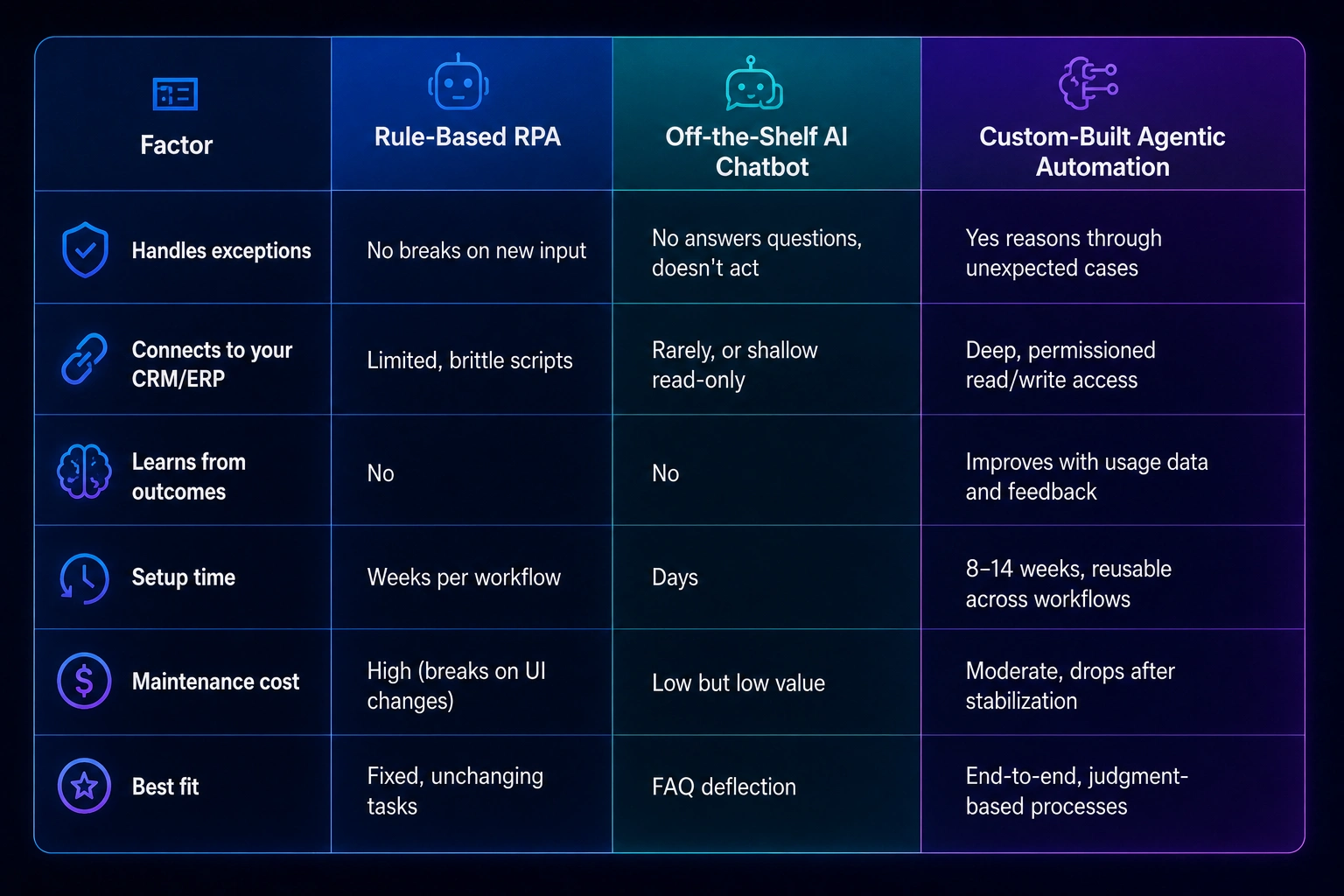
Off-the-Shelf Bots vs. RPA vs. Custom-Built Agentic Automation
Before picking a route, it helps to see the three approaches side by side. This is the comparison most teams skip and the one that ends up mattering most six months in.
What Is Agentic AI Automation, Really?
Agentic AI automation gives a large language model a goal instead of a question, then lets the model break that goal into steps, choose which tools to call, execute those steps, and report back without a person approving every move. A support chatbot answers "where is my order?" An agentic system checks the order status, issues the refund if policy allows it, logs the case, and only escalates to a human when it hits a decision it isn't authorized to make.
The distinction matters because most "AI automation" sold in 2025 was really automation with an AI-shaped wrapper: a chatbot bolted onto a form, or a script with a language model doing sentence completion at one step. Agentic AI Services go further. They combine a reasoning model, a tool-calling layer, and an orchestration framework so the system can string together research, decision-making, and execution in one continuous run.
Why Off-the-Shelf Tools Fall Short: The Case for Custom Agentic AI Development
Generic AI agent platforms are built to demo well across thousands of companies at once, which means they're tuned for the average case, not your CRM's odd field names, your approval chain, or the three exceptions your ops team handles by hand every week. That's where a tailored agentic AI build earns its cost.
A custom build starts from your actual workflow, not a template:
- Your data model. The agent is trained on how your business actually names accounts, statuses, and SKUs, not a generic schema.
- Your approval logic. Refund limits, discount thresholds, and escalation rules get built in as guardrails, not guessed at.
- Your existing stack. Integrations connect directly to the CRM, ERP, and ticketing systems you already run, through the Model Context Protocol (MCP) or direct API calls, so you're not migrating data to a new platform.
- Your compliance requirements. Healthcare, finance, and legal workflows need audit trails and human checkpoints that off-the-shelf agents don't ship with by default.
Off-the-shelf tools are fine for a single, narrow use case, drafting email replies, for example. But once a workflow touches more than one system or requires judgment calls, generic tools tend to hit a wall that only a custom-engineered agentic system is built to clear.
The Core Stack Behind Custom Agentic AI Development
A working agentic system is really five layers stacked on top of each other, not a single "AI feature." Understanding each layer helps you evaluate any automation vendor's proposal, because a vendor that glosses over orchestration or guardrails is usually selling a chatbot with extra steps.
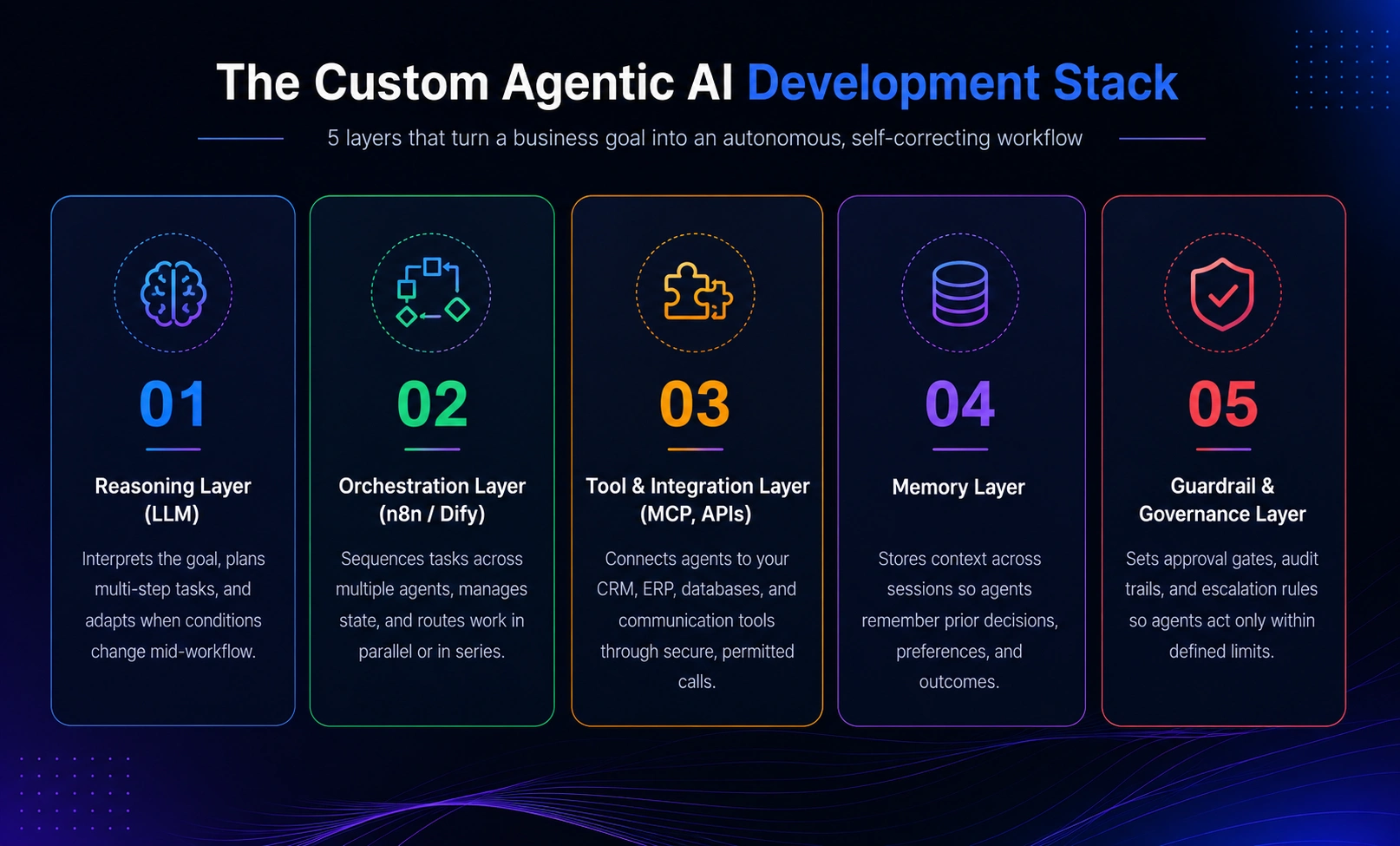
- Reasoning layer (the LLM). Interprets the goal and plans the sequence of steps, adjusting when a step fails or conditions change mid-task.
- Orchestration layer. Frameworks like n8n and Dify sequence tasks across single or multiple agents, track state, and decide what runs in parallel versus in order.
- Tool and integration layer. Connects the agent to your CRM, ERP, databases, and messaging tools through secure, permissioned API calls or MCP servers.
- Memory layer. Stores context across sessions so the agent remembers prior decisions instead of starting from zero every run.
- Guardrail and governance layer. Defines what the agent can do without approval, what needs a human sign-off, and how every action gets logged for audit.
Skip any one of these layers, and you get a system that works in the demo and stalls in production which is a big part of why Gartner expects more than 40% of agentic AI projects to be canceled by 2027, usually over governance gaps rather than model quality.
Where Agentic AI Services Deliver Measurable ROI
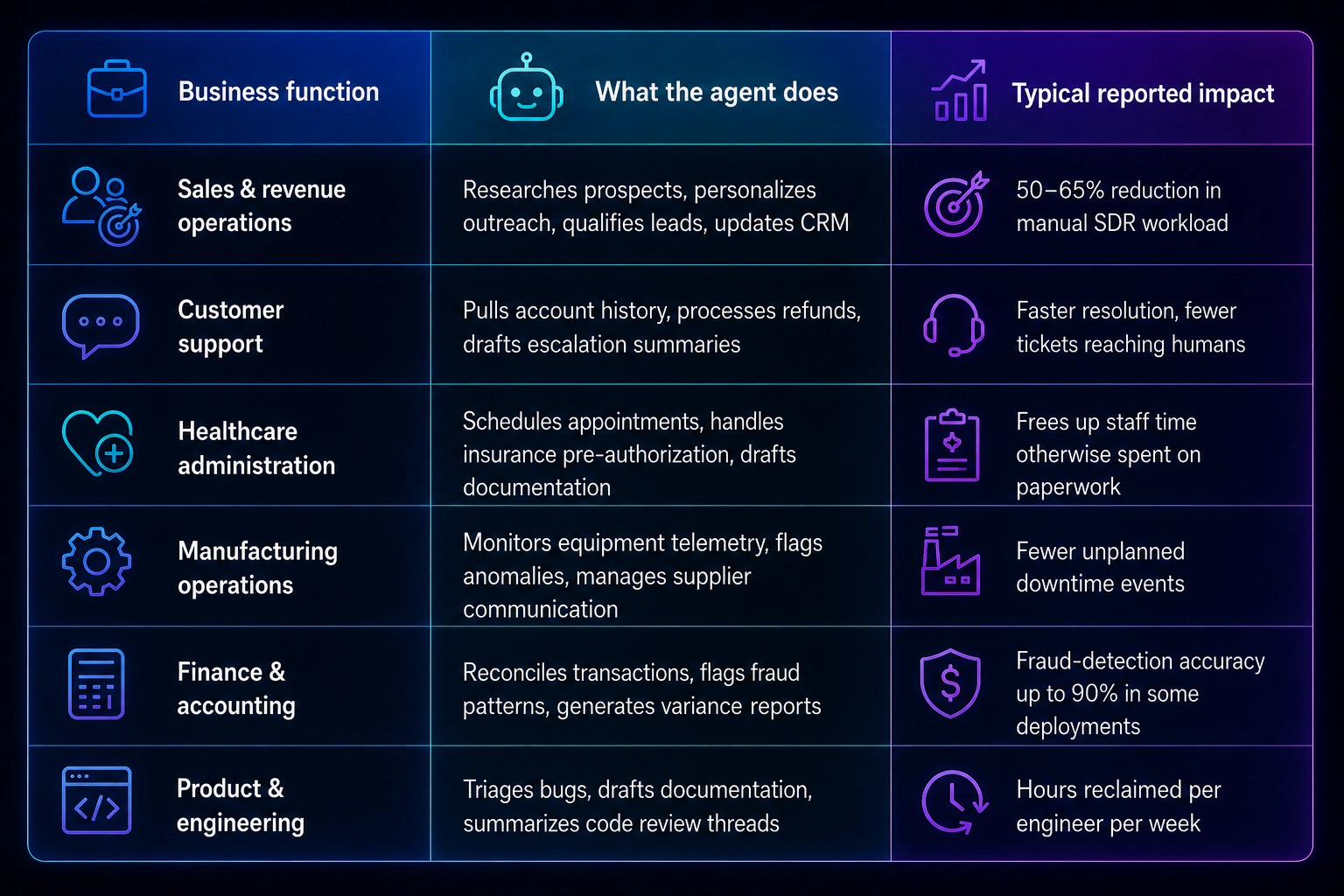
Almost every department can use some form of automation, but a handful of functions respond faster because they combine repetitive volume with judgment calls that used to require a person. Based on deployment patterns across enterprise clients, here's where autonomous business agents tend to pay for themselves fastest:
Agentic AI Automation Market Growth: The Numbers Behind the Shift
The spending pattern backs up what's happening on the ground. The global agentic AI market was worth roughly $7.3 billion in 2025, and market researchers project it will reach $9.1 billion in 2026 before climbing toward $139.2 billion by 2034, a 40.5% compound annual growth rate (Fortune Business Insights). Separately, Gartner projects that 40% of enterprise applications will carry task-specific AI agents by the end of 2026, up from less than 5% in 2025 (Gartner).
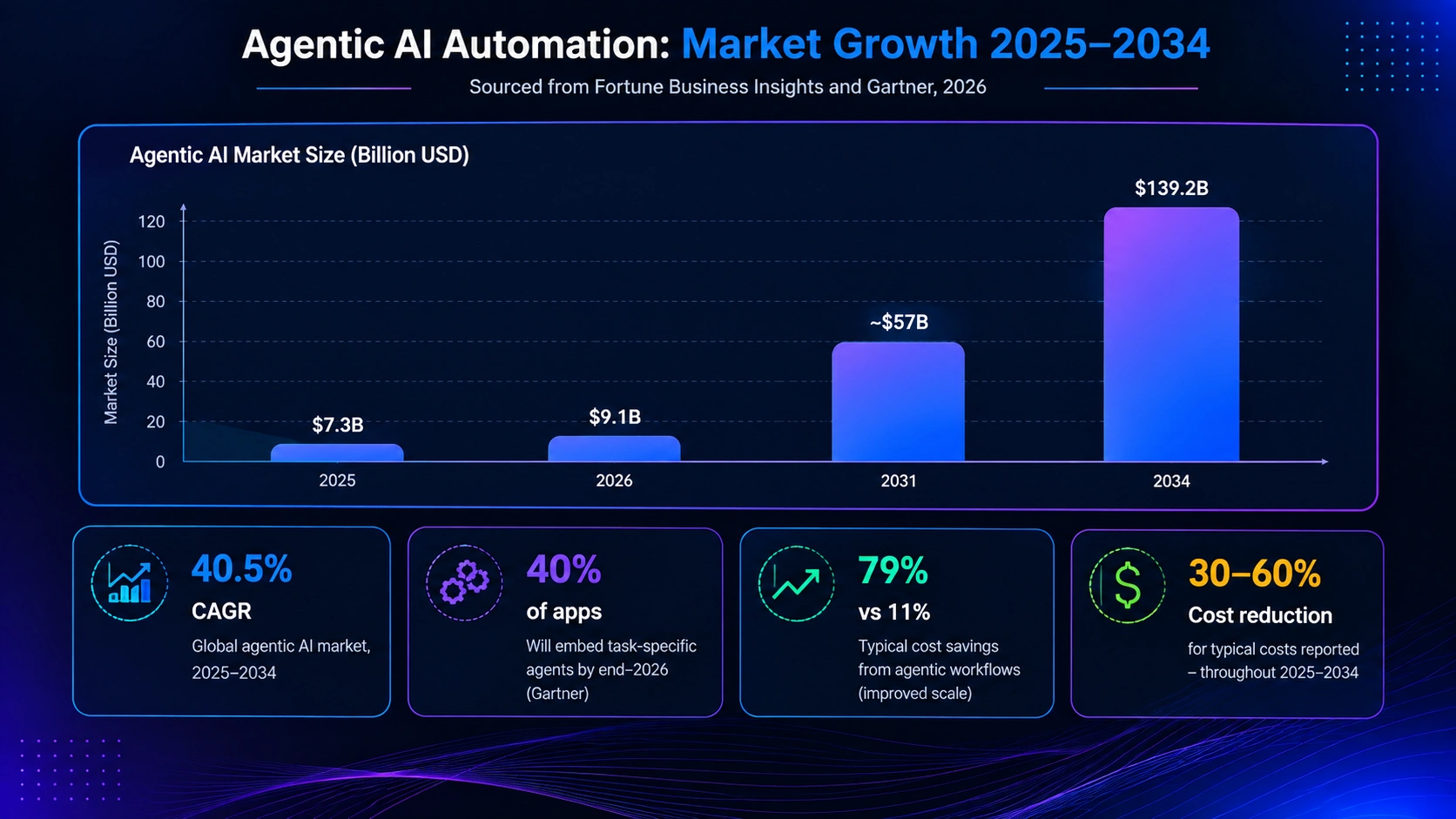
The adoption numbers, though, tell a more cautious story than the spending numbers. Roughly 79% of enterprises have adopted AI agents in some form, but only about 11–23% run them in production at scale a gap driven mostly by unclear success criteria and missing data access, not by weak underlying models. That gap is precisely why a rushed, generic rollout underperforms a properly scoped, custom-built agentic engagement.
How to Choose the Right AI Automation Agency
Not every automation vendor that says "agentic" actually builds agentic systems; plenty are reselling chatbot templates with a new label. Before signing with any automation partner, run through this checklist:
- Ask for a working proof of concept on your own data, not a generic demo. A serious partner should deliver this in three to four weeks.
- Confirm you own the code, models, and integrations at the end of the engagement no platform lock-in.
- Check their integration depth. Do they connect through your real CRM/ERP APIs, or just a webhook that reads surface-level data?
- Ask how guardrails are enforced, not just described. Approval gates and audit logs should be visible in the architecture, not a slide.
- Review post-launch support terms. Real-world usage surfaces edge cases in the first 90 days that a demo never will.
Questions like these separate a genuine Top AI Automation Agency from a vendor selling a repackaged template. The answers usually surface in the first call a partner that can't explain their architecture in plain language on request is worth a second look.
n8n vs. Dify: Picking Your Orchestration Layer
Two orchestration frameworks dominate most custom agentic automation builds today: n8n and Dify. Neither is universally "better"; the right choice depends on your team's technical depth and how much visual control you want over agent logic.
- n8n is a node-based automation platform well suited to workflows that mix agentic reasoning with traditional triggers a new CRM record kicking off an agent chain, for example. It's a strong fit when your team already runs other automations and wants agentic steps to slot into existing pipelines.
- Dify is built specifically around LLM application development, with native support for retrieval-augmented generation, prompt orchestration, and multi-agent workflows out of the box. A Dify AI Development Company typically ships faster for pure conversational-agent and knowledge-base use cases because less custom scaffolding is required around the model itself.
Many production builds actually use both: Dify for the agent's reasoning and knowledge layer, n8n for connecting that agent into the rest of the business's
AI Solutions stack and existing software.
The Custom Agentic AI Development Process, Step by Step
A properly scoped engagement follows a predictable sequence, whether you're automating claims review or supplier communication:
- Discovery and workflow mapping (weeks 1–2). Structured sessions with operations and technology leads map the existing process end to end and define success metrics before any code gets written.
- Proof of concept (weeks 2–4). A working prototype runs against one targeted workflow using real data and real systems, so you can measure results against a baseline before committing further budget.
- Agent architecture and build (weeks 4–10). The orchestration layer gets designed, the base LLM gets selected and tuned, tool integrations get built, and memory and guardrails get implemented for your specific industry.
- Deployment, training, and handover (weeks 10–14). The system goes live, your team gets trained, monitoring dashboards go up, and documentation gets delivered so you own the system outright.Continuous optimization. Performance data gets reviewed regularly to identify the next workflow worth automating, since most teams expand scope within six months of the first deployment.
Real-World Impact: What a Custom-Built Agentic System Looks Like in Production
Numbers on a slide are easy to produce; numbers from a running system are not. Here are two examples of what a custom-built agentic system looks like once it's live.
Case Study 1: AI Podcast Production Platform
The challenge. A podcast production platform needed to handle topic research, factual grounding, narrative consistency, and multi-speaker script formatting steps that were previously done manually, one at a time, by a human production team.
The build. Rather than a single AI agent, the team built a multi-agent system using more than ten specialized agents, each responsible for one part of the pipeline:
- A research agent that gathers and organizes source material on the episode topic.
- A fact-grounding agent that checks claims against verified sources before they reach a script.
- A narrative-consistency agent that keeps tone, continuity, and structure aligned across a full episode.
- A script-formatting agent that structures the output for multiple speakers.
The automation flow. Once the script is finalized, it's routed automatically to text-to-speech engines, meaning the process runs from research to finished audio with no manual handoff in between.
The result.
- 60–70% reduction in manual production effort
- 50–65% faster content-creation cycles
- 30–40% higher content and tonal consistency across episodes
This system was built by Neuramonks, and the full breakdown including how the agent handoffs and RAG grounding were architected is available in their AI podcast generation platform case study
Case Study 2: AI Voice Agent for Pizza Ordering
The challenge. Pizza restaurants take a high volume of time-sensitive phone orders, and traditional phone-based ordering created clear bottlenecks: calls missed or rushed during peak hours, order errors on toppings, sizes, and quantities, heavy dependence on staff availability, and no structured data captured from calls for analysis or forecasting. As order volume grew, manual phone intake became both costly and unreliable.
The build. we built an AI voice agent that answers calls and takes complete pizza orders end-to-end, without staff involvement. The system includes:
- Restaurant-specific menu intelligence covering sizes, toppings, add-ons, and customizations.
- Structured, step-by-step conversational flows for order capture and confirmation.
- Real-time, low-latency voice session management to hold up under peak-hour call volume.
- Automated extraction and persistence of structured order data for downstream analytics.
The agent had to handle accurate menu interpretation in noisy environments and varied accents, complex multi-item orders with customizations, and natural conversation flow including corrections and clarifications while still reliably extracting structured data from free-form speech.
The result.
- 50 - 60% reduction in manual, phone-based order handling
- 25 - 35% reduction in order errors
- 30 - 40% improvement in peak-hour order capture capacity
Full details are in Neuramonks' AI Voice Agent for Pizza Ordering case study.
Both systems were built by Neuramonks, whose complete guide to Agentic AI Services for business growth covers the methodology behind these and other deployments in more depth.
Common Pitfalls That Sink Agentic AI Automation Projects
Most failed agentic rollouts don't fail because the model was too weak. They fail for reasons that show up long before deployment:
- No clear success metric. "Improve efficiency" isn't measurable. "Cut ticket resolution time from 4 hours to 20 minutes" is.
- Missing system access. An agent that can read data but can't write to the CRM ends up creating manual work, not removing it.
- No evaluation discipline after launch. Agents drift as real-world inputs diverge from training scenarios; without ongoing evaluation, accuracy quietly degrades.
- Skipping the proof-of-concept stage. Jumping straight to full-scale deployment without validating on real data is the single biggest predictor of the projects Gartner expects to get canceled by 2027.
- Treating governance as an afterthought. Guardrails bolted on after launch are far harder to retrofit than guardrails designed in from day one.
Getting Started with Custom Agentic AI Development
If you're weighing whether to build in-house, buy a platform, or bring in outside help, the honest answer depends on how core the workflow is to your business and how much integration depth it needs. A narrow, low-stakes task might be fine with an off-the-shelf tool. Anything touching customer data, financial approvals, or multiple systems is usually worth the extra weeks a proper custom-built agentic engagement takes.
Neuramonks builds agentic systems with tool use, guardrails, and human review that survive real workloads, not just demos. As a specialized AI automation agency, the team runs discovery, delivers a working proof of concept within three to four weeks, and hands over full ownership of the code, models, and integrations at the end of the engagement. If you want a concrete build plan for one specific workflow, book a free discovery call and get a scoped roadmap within one business day.
Conclusion
Agentic AI automation isn't a single product you can buy off a shelf; it's a system built around how your business actually operates. Custom Agentic AI Development takes longer to stand up than a chatbot integration, but it's the difference between a pilot that gets quietly shelved and a system that keeps paying for itself a year later. The market data backs the direction: spending is accelerating fast, but the enterprises actually reaching production are the ones that scoped a real workflow, built proper guardrails, and measured results before scaling.
Ready to see what Custom Agentic AI Development could do for your highest-friction workflow? Book your free discovery call and get a scoped automation roadmap no commitment required.
LLM Implementation Services for Enterprise Teams
A practical breakdown of what it actually takes to move an LLM from demo to production, covering RAG, agentic orchestration, RBAC, real cost ranges, and the questions to ask before hiring an implementation partner.

Most enterprise AI initiatives don't fail because the model isn't smart enough. They fail because a slick weekend demo gets budget approved, and the team spends the next eight months discovering it can't handle authentication, data governance, latency, or hallucinations under real load.
That gap between demo and production is where enterprise LLM implementation lives. This guide breaks down what building production-grade AI actually involves, what it costs, how to evaluate vendors, and how to avoid the trap of a six-figure pilot that never reaches deployment.
Enterprise LLM implementation covers everything required to move a large language model from a demo into a production system: data pipeline design, retrieval architecture, agentic orchestration, security hardening, integration with existing software, and ongoing monitoring after launch. A structured proof-of-concept phase up front confirms return on investment before full build-out begins.
This isn't a theoretical exercise. The decisions covered below- build versus buy, RAG versus fine-tuning, which metrics to lock in before writing a line of code- show up in almost every enterprise AI kickoff call, regardless of industry. Healthcare, finance, manufacturing, and SaaS teams all hit the same forks in the road. What changes is the compliance layer on top, not the underlying engineering questions.
What enterprise LLM implementation actually involves
A large language model by itself is a raw capability. It has no memory of your business, no access to your internal documents, no understanding of your compliance requirements, and no connection to the systems your team already uses. Implementation is the engineering work that turns that raw capability into something your operations can rely on.
Enterprise LLM solutions typically bundle five components, and skipping any one of them is a common reason pilots stall before reaching production:
- Structuring, cleaning, and indexing internal documents, tickets, transcripts, or records so a model can actually use them.
- Vector databases such as Pinecone, Weaviate, or pgvector that let a model pull relevant context at the moment it's needed, instead of guessing.
- Choosing between a hosted model, a fine tuned variant, or a hybrid setup based on cost, latency, and data sensitivity.
- Connecting the model to CRM systems, ticketing platforms, internal wikis, or whatever software already runs the business.
- Tracking accuracy, hallucination rate, and cost per query after launch, since model behavior drifts as usage patterns and underlying data change.
Skip the retrieval layer, and the model hallucinates policy details. Skip monitoring, and nobody notices when accuracy quietly drops three months in.
Skip integration and the "AI project" becomes a browser tab nobody on the team actually opens.
Why so many AI pilots never make it to production
Enterprises often assume AI solutions run themselves once deployed. They don't. Generative AI adoption is accelerating across nearly every industry, but adoption and value capture are two different numbers, and the gap between them is wide. Gartner has reported that more than half of these initiatives get abandoned after the proof of concept stage, with data quality gaps, unclear risk controls, and runaway costs cited as the leading causes (source: Gartner).
In our own engagements, the pattern is almost always the same three root causes:
- See if AI can help with X" is not a target. A defined baseline, a target KPI, and a review date must exist before the first line of code is written.
- Unstructured, duplicated, or poorly tagged internal documents produce a retrieval layer that returns garbage, and no amount of prompt engineering fixes a bad index.
- A model deployed and left alone degrades. Someone on the team, internal or vendor, has to own drift monitoring and retraining.
None of these are model problems. They're implementation problems, and they're exactly what a competent LLM implementation partner is supposed to catch before they become six-figure write-offs.
Six Requirements Enterprise LLM Architecture Must Cover
Enterprise teams rarely fail because a model can't generate a response. They fail because nothing around the model was built to survive production traffic, security review, or a compliance audit.
Agentic orchestration is the layer that closes that gap. Instead of a single LLM handling every request, orchestration coordinates multiple agents, routes tasks, and enforces structure across the entire workflow.
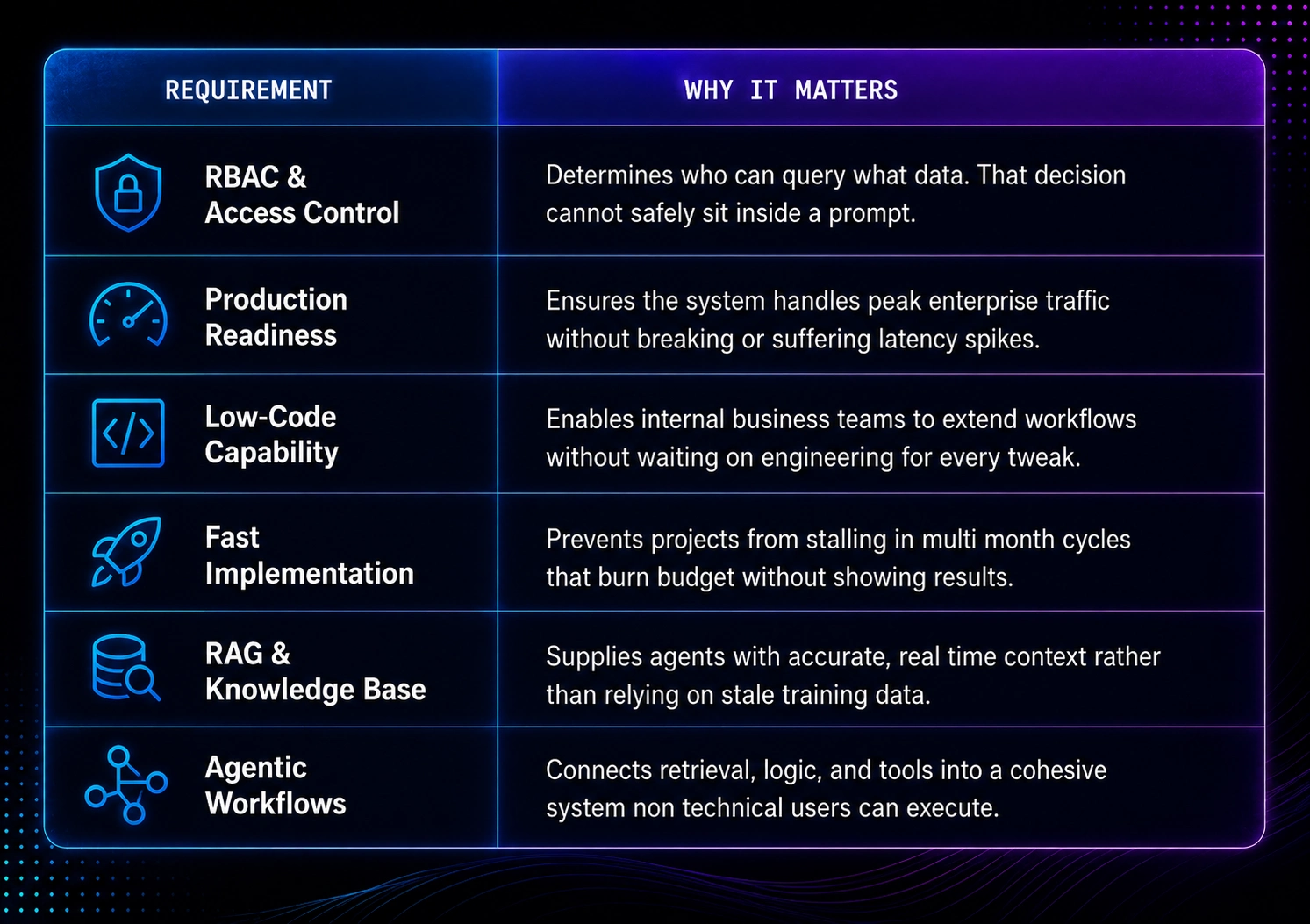
Six requirements come up in nearly every enterprise engagement:
Get these six right and automation stops being a pilot project. It becomes infrastructure, and infrastructure is what drives faster implementation and measurable ROI.
Build in-house, hire an agency, or run a hybrid team
This is the decision enterprises get wrong most often, usually because it gets framed as a cost question when it's really a capability and timeline question.
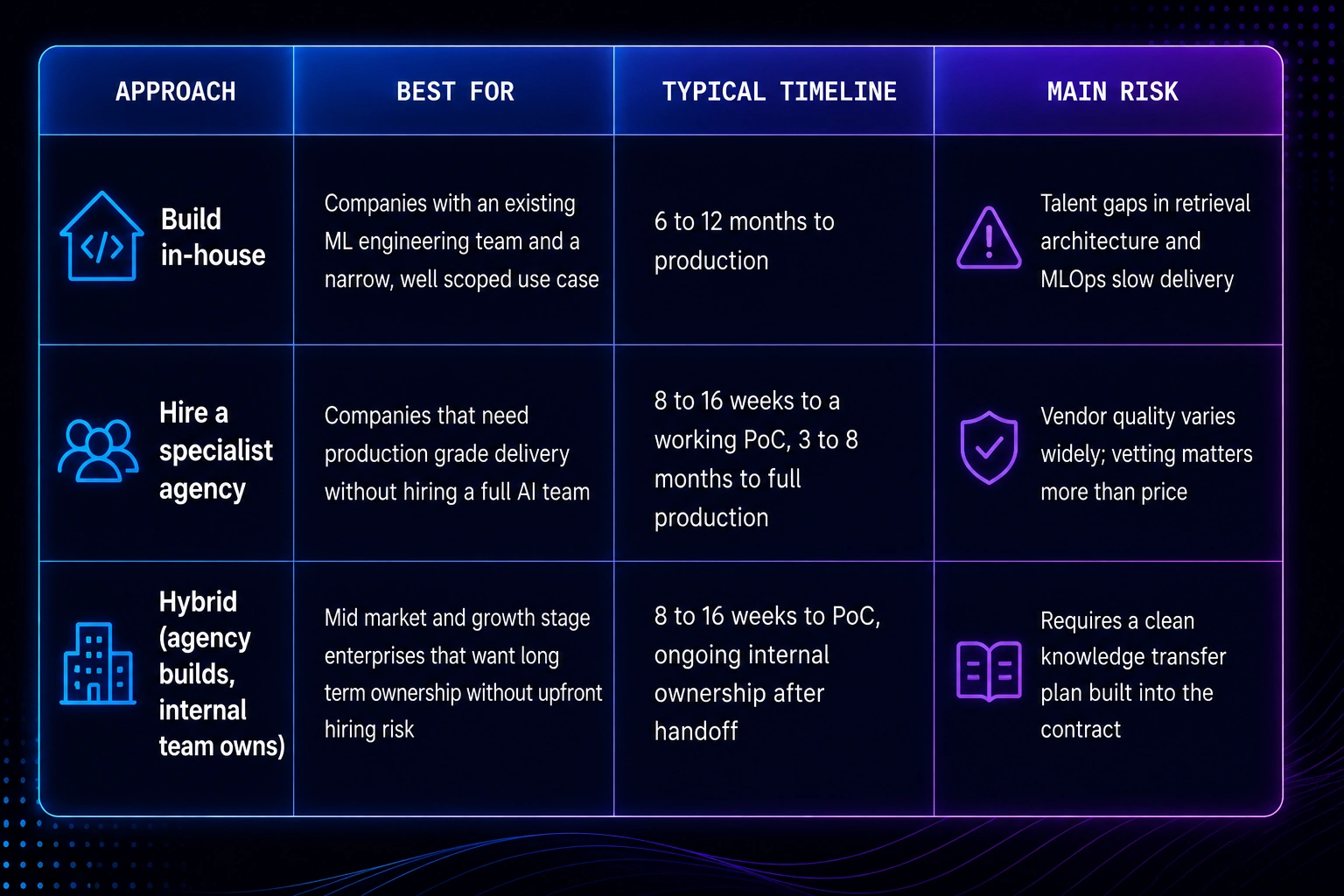
Purchasing from a specialized vendor succeeds noticeably more often than building the same system from scratch with a first time internal team, largely because agencies have already made, and fixed, the expensive mistakes on someone else's project. That advantage disappears fast, though, if the agency you hire has never actually shipped enterprise LLM solutions past the demo stage.
How a successful enterprise LLM deployment is structured
Every engagement starts with a business outcome, not a model choice. Before any architecture decision gets made, the question on the table is what number is supposed to move: cost per ticket resolved, hours saved per week, accuracy against a human baseline, or something else specific enough to measure in 90 days. At Neuramonks, we structure every engagement around that outcome, moving through three distinct phases.
Phase one: proof of concept (4 to 8 weeks)
Real client data, a narrow use case, and a defined go or no go metric agreed before work starts. No synthetic test data, no "let's see what happens" scope.
Phase two: production build (8 to 16 weeks depending on scope)
Retrieval pipeline, agentic orchestration, model integration, security hardening, and connection to existing systems like a CRM or internal knowledge base.
Phase three: MLOps and monitoring (ongoing)
Drift detection, cost tracking, and scheduled retraining cycles, because a model that worked well at launch won't necessarily still work well six months later.
One example from a media production client: the team needed to scale podcast output without growing the editorial staff at the same rate, moving from 3 episodes a week to 12. A multi-agent pipeline was built where one agent handled topic research through live web retrieval, a second structured and scripted each episode, and a third routed finished scripts to a text-to-speech layer, all coordinated through an agentic orchestration layer that managed handoffs between the three.
End-to-end production time dropped by roughly 70% against the prior manual workflow, and the system now runs across multiple show formats without a human in the research or scripting steps. For a deeper look at how this kind of architecture decision gets made,
See our full breakdown of enterprise LLM development beyond chatbots.
What enterprise LLM implementation costs in 2026
Pricing varies by scope, compliance requirements, and how much of the surrounding infrastructure already exists. The ranges below reflect typical market rates, not fixed quotes.
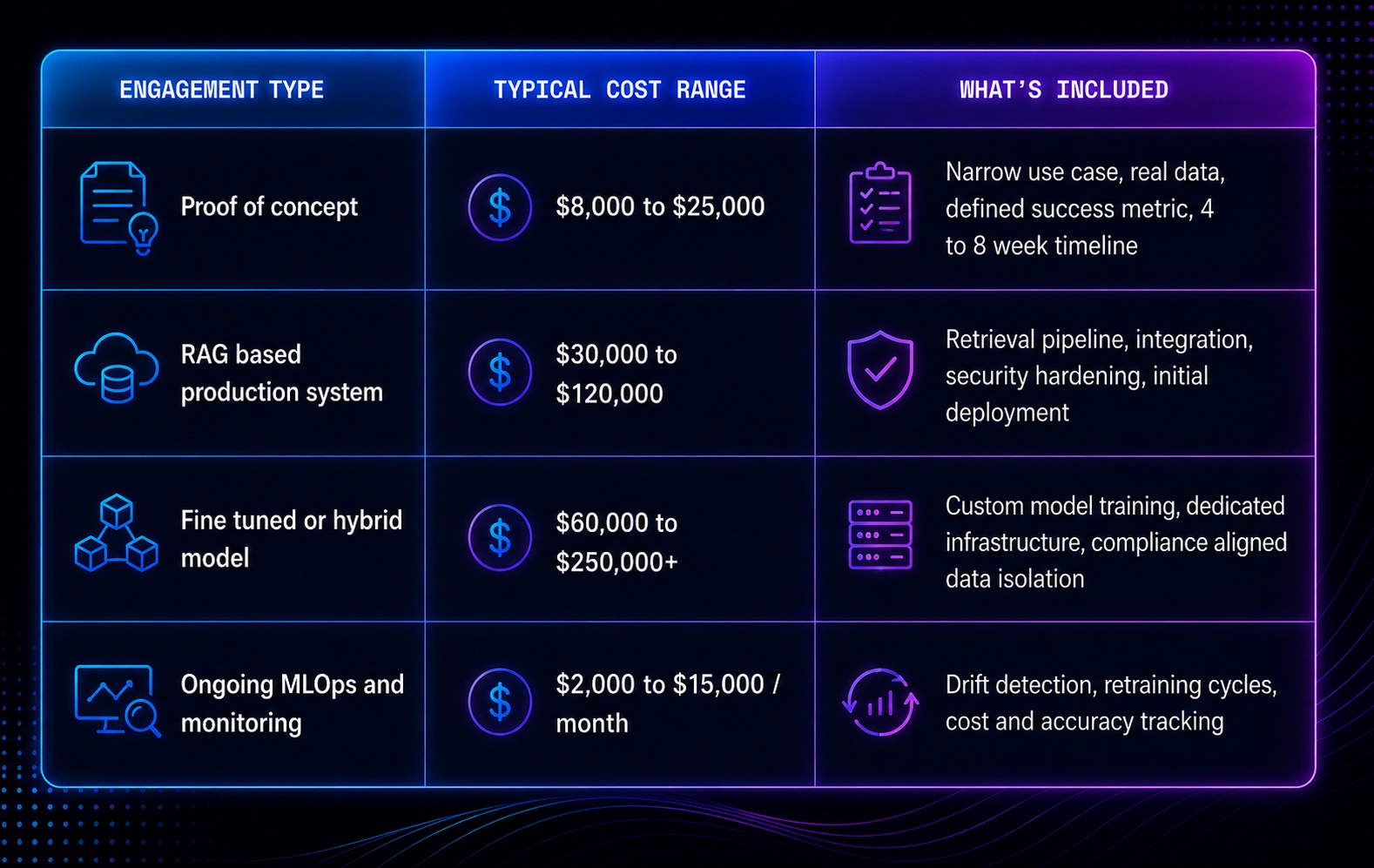
Most enterprise LLM solutions fall into the RAG-based production tier, since retrieval delivers accuracy comparable to fine-tuning for the majority of internal use cases, at a fraction of the training and maintenance cost. Fine-tuning earns its higher price tag when a business needs a self-hosted model with no external API calls, or highly consistent domain-specific output that context injection can't reliably produce.
Questions to ask before signing with an implementation partner
A short, direct evaluation list, worth working through in the first sales call rather than after a contract is signed:
- Can you show a production deployment with real accuracy or cost numbers, not just a demo?
- What's your default recommendation between RAG and fine tuning, and why?
- How do you structure the proof of concept phase, and what's the go or no go criteria?
- Who owns monitoring and retraining after launch, and at what ongoing cost?
- What compliance certifications or data isolation practices apply to regulated data?
- What happens to the system and the knowledge behind it if we end the engagement?
An agency that can't answer the fourth question clearly is quietly planning to leave a system your team doesn't know how to maintain.
Five mistakes that sink enterprise LLM projects
Choosing a vendor on price alone
LLM engineering is a specialist skill, and the lowest quote in the room is usually the one with the least production experience behind it.
Skipping the proof of concept phase
Jumping straight from requirements to full build is one of the most reliable ways to burn a large budget on a system that never ships.
No agreed success metric before work begins
Vague goals produce vague, unmeasurable results, and a review six months later with nothing to show for it.
Treating deployment as the finish line
A model that isn't monitored will drift, and nobody notices until a customer or an auditor does.
Defaulting to fine-tuning for everything
It's expensive, slow to iterate on, and unnecessary for most retrieval-style use cases. A partner who reaches for it by default is optimizing for their own invoice.
Where this leaves you
The technology is no longer the hard part. Hosted models are commodity infrastructure at this point, and almost anyone can wire one up to a chat window in an afternoon. The hard part, and the part that actually determines whether a project produces value or becomes a write off, is the engineering work around the model: the data pipeline, the retrieval layer, agentic orchestration, RBAC, the integration, and the discipline to keep monitoring it after launch.
That's the work enterprise LLM implementation services exist to do, and it's worth vetting a partner on exactly that basis rather than on how good their demo looks in a sales call.
Ready to audit your AI roadmap?
Bring your actual use case and data constraints. In 30 minutes, Neuramonks will tell you whether RAG, fine-tuning, or a standard workflow is the right fit, and what it would take to get there.

Dify AI for Enterprise: What It Actually Takes to Get an Agent Live
A build-vs-buy breakdown backed by a real Gemini plugin case study instead of a demo pitch, showing why most Dify pilots stall after week one and what fixes it.
Dify AI for enterprise pairs a no-code agent builder with RAG pipelines and multi-LLM routing, so teams launch production-ready AI agents without a large engineering bench. Working with an experienced Dify AI Development Company like Neuramonks cuts that build time from months to weeks, while keeping every prompt, data source, and workflow fully auditable.
Your Team Already Believes in AI. So why isn't it Live Yet?
Here's the pattern almost every enterprise team hits. Someone in leadership saw a demo. It looked effortless. Then the project landed on an internal team already stretched across three other priorities, and six months later there's a Notion doc, a few Slack threads, and no agent.
It's rarely a lack of ambition. It's usually one of three things: the in-house team doesn't have resources to own an AI project on top of their day job, the "AI chatbot" pilot that got built doesn't actually know anything about the business, or legal and security flagged the vendor before it got anywhere near production.
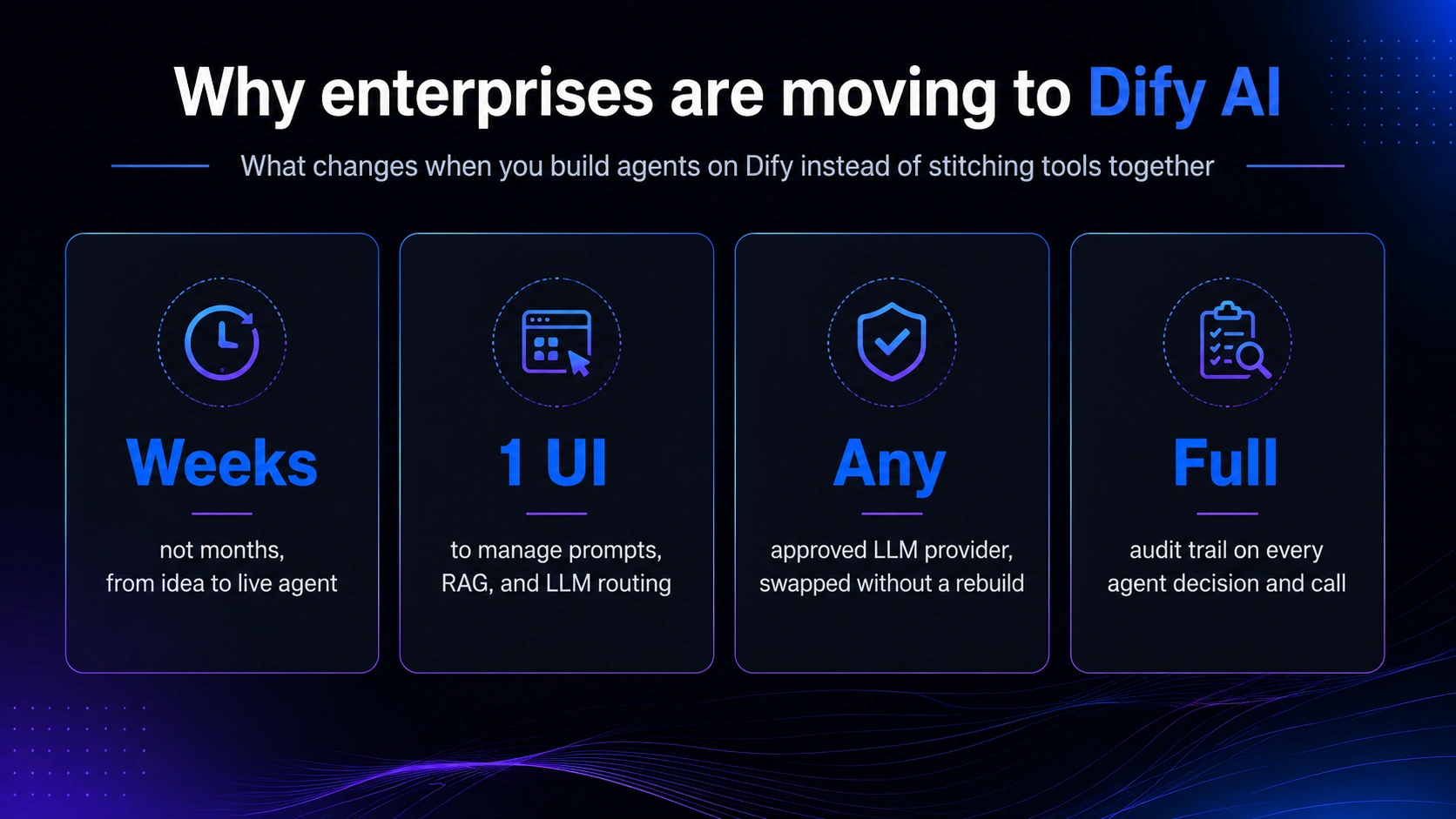
Dify exists to remove the middle problem. It's an open-source LLM application platform that gives you a visual canvas for building agents, connecting retrieval-augmented generation (RAG) to your own documents, and routing requests across different language models depending on cost, latency, or accuracy needs. You're not writing orchestration code from scratch. You're configuring it.
What Enterprise Buyers Actually want (and rarely say out loud)
Nobody opens a vendor call by saying, "I want a testament to innovation." What people actually want, once you strip away the sales language, is much simpler:
Speed without giving up control. Teams want an agent live this quarter, not a 12-month roadmap. But they also don't want to hand a black box to a vendor and hope for the best.
The ability to swap models later. A team that commits to a single LLM provider today is betting the business will never need a cheaper or more capable option next year. Dify's model-agnostic architecture means you can route between GPT, Claude, Gemini, or an open-weight model without rebuilding the agent underneath it.
Proof it works before a full rollout. Most buyers want a working pilot in one department (usually support or internal knowledge search) before they'll sign off on a company-wide deployment.
Someone who's done this before. This is where the build-vs-buy decision usually comes down to trust. A capable AI automation agency or a specialized Dify AI Development Company has already hit the edge cases your internal team hasn't seen yet: token cost blowouts, hallucination on edge-case queries, and provider approval processes that take longer than the build itself.
Where this Gets Real: a Gemini Integration Under Enterprise Constraints
Most enterprise AI mandates come with a catch: you can't just call any LLM API directly. Procurement and security teams often require models to run through an approved cloud provider, with its own authentication, logging, and compliance layer.
That's exactly the situation behind Neuramonks' Dify plugin development and custom Gemini LLM integration case study, where a custom plugin was built to route Gemini calls through an approved provider instead of a direct API connection. It's the kind of detail that never shows up in a product demo, but it's usually the difference between a pilot that clears security review and one that stalls for another quarter.
Build in-house, Hire a Generalist Agency, or go with a Dify specialist?
This is the decision most enterprise teams are actually weighing, and it deserves a straight comparison instead of a sales pitch.

The middle option isn't wrong; it's just built for a narrower job. A generalist automation agency can wire up a Zapier-style workflow fast. But once RAG, LLM provider approval, and audit logging enter the conversation, that's a Dify-specific skill set, not a general automation one.

What the First 30 Days Actually look like
Step one is never "build the agent." It's figuring out which single workflow is worth automating first. The teams that get this right usually start with something narrow and painful, like a support queue drowning in repeat questions, or a sales team burning hours searching through scattered internal docs for pricing and product details.
From there, the sequence is fairly consistent across enterprise Dify projects:
- Scope the pilot. Pick one workflow, one team, and a clear success metric (ticket deflection rate, response time, hours saved per week).
- Connect the knowledge base. RAG only works if it's pointed at the right documents, kept current, and scoped so the agent isn't guessing outside its lane.
- Choose the model routing logic. Not every query needs your most expensive model. Simple lookups can route to a cheaper model, while complex reasoning tasks route to a stronger one.
- Run it in shadow mode. Before customers or employees see it, the agent answers in parallel with a human, and someone checks the gap between the two.
- Go live, then watch the logs. This is where most vendors disappear and most in-house teams get stuck. Someone needs to own the first month of tuning.
That last point is where a lot of pilots quietly die. Not because the technology failed, but because nobody was assigned to watch it after launch week.
Take a support queue as an example. Week one, the agent handles maybe 30% of tickets correctly and escalates the rest, which is exactly what should happen with a new system. By week three, once someone has reviewed the escalations and tightened the RAG sources, that number usually climbs past 60%. Teams that skip the review step tend to plateau at that first-week number and quietly conclude "AI doesn't work for us," when the real issue was nobody tuned it.
The same logic applies to internal knowledge search. A sales team asking an agent about pricing tiers needs the agent pointed at the current pricing doc, not last quarter's version sitting in a forgotten folder. Getting RAG right is less about the AI model and more about document hygiene: what's indexed, what's outdated, and who's responsible for keeping it current.
Where Dify fits into a broader 2026 AI roadmap
Dify isn't a replacement for your existing AI solutions stack. It's the layer that sits between your raw data and the LLM, handling retrieval, tool calls, and model routing so your team isn't rebuilding that plumbing for every new use case. Once one agent is live and proven, the second and third ones move faster, because the RAG pipelines and provider integrations are already in place.
This is also why the "one agent at a time" approach tends to outperform an ambitious company-wide rollout attempted in one shot. A single working pilot gives you real usage data, real edge cases, and a template for the next department that wants one.
What to check before you sign with anyone
Whether you go in-house, hire a generalist agency, or bring in a specialist Dify partner, ask these questions before signing anything:
- Have they shipped a Dify agent that had to route through an approved LLM provider, not just a direct API key? That approval process trips up more projects than the actual model performance does.
- Who owns the agent after week one? Vendors that disappear after launch leave your team debugging a system nobody fully understands.
- Can they show a real build, not a demo environment spun up for the sales call? The Gemini plugin case study above is a working example, not a mockup.
- What happens when the underlying LLM provider changes pricing or gets deprecated? If the answer requires rebuilding the agent, that's a warning sign.
None of this is complicated once you know to ask it. Most enterprise teams just haven't gone through an AI vendor selection cycle before, so these questions don't come up until after something's already gone wrong.
A Workflow that's Been "on the Roadmap" for two Quarters is a Signal, not a Failure
If your team keeps meaning to get to an AI agent project and keeps not getting to it, that's not a discipline problem. It usually means the in-house bandwidth isn't there, and it won't magically appear next quarter either.
That's the exact gap this fills for enterprise teams. The work isn't about selling a platform. It's about scoping the one workflow worth automating first, building it in Dify with the right RAG sources and provider-approved LLM routing, and staying on it after launch so week-one tuning doesn't fall on your internal team.
Talk to Neuramonks about your specific use case, and expect a straight answer about whether Dify is the right fit before anything gets built. If it isn't, we'll say so.
Custom AI Healthcare Solutions: A Buyer's Guide
A buyer's guide explaining why off-the-shelf AI tools fail healthcare workflows like wound care and prior authorization, and how a scoped pilot lets hospitals test a custom-built solution before committing to a full contract.
Custom AI healthcare solutions replace generic, off-the-shelf software with tools built around a specific clinical workflow, such as wound imaging analysis or prior authorization automation. Neuramonks USA builds these systems through a scoped pilot engagement so hospitals and clinics can validate results before committing to a full production build.
Every healthcare administrator evaluating AI right now is facing pressure from three directions at once: fewer staff to do the work, a rising documentation load, and boards asking for a cost-reduction plan with numbers attached. The American Hospital Association's 2026 Workforce Scan names administrative burden and staffing gaps as the top pressures facing hospital leaders this year, and industry reporting citing McKinsey research puts a global figure on what closing the healthcare worker shortage could mean for the economy: roughly $1.1 trillion in added value. That is the backdrop against which most buyers search for AI solutions, usually landing on generic chatbots repackaged for healthcare rather than tools engineered for an actual clinical workflow.
The pattern repeats across specialties. A wound care clinic needs consistent measurement, not a chatbot. A billing office needs prior authorization drafted against payer-specific rules, not a summarizer. A front desk needs intake triage that understands its own scheduling logic, not a generic FAQ bot. Buyers who evaluate AI vendors on demo polish alone tend to discover the gap only after signing, when the tool cannot actually plug into the EHR or imaging system already running the department.
Why Generic AI Tools fail Healthcare Providers
A general-purpose AI assistant can summarize a note or draft an email. It cannot reliably measure a wound from a clinical photo, flag a prior authorization likely to be denied, or route an intake form to the right specialist based on your clinic's specific triage rules. Those are narrow, high-stakes tasks that require a model trained and validated against your data, your documentation standards, and your compliance requirements, not a general model doing its best guess.
This is the gap a custom healthcare AI build is designed to close. Instead of asking staff to adapt their workflow around a generic product, a custom build maps to the EHR, the imaging system, and the documentation format your team already uses. The result is a tool clinicians actually open, not one more login they avoid. It also means fewer support tickets down the line, because the system was validated against your own edge cases before launch rather than a generic sample dataset.
There is a second, quieter cost to generic tools: liability. A wound measurement that is off by even a few millimeters, repeated across hundreds of patient visits, can distort a wound-healing trend line that a physician relies on to decide whether a treatment plan is working. A prior authorization draft that misreads payer rules can delay care by weeks. Generic tools are built to be broadly useful. Clinical workflows need to be precisely correct for the one use case they serve.
What a Custom-Built Healthcare AI System Actually Solves
Medical Imaging and Wound Care Analysis
Wound care is a clear example of where generic tools fall short. Manual wound measurement is slow, inconsistent between clinicians, and hard to track over time across multiple visits. Neuramonks built an automated wound detection and measurement system using deep learning that analyzes clinical photos to detect wound boundaries and calculate measurements automatically, giving clinicians a consistent, repeatable reading instead of a manual tape-measure estimate that varies by who is holding it.
Clinical Documentation and Prior Authorization
Documentation and prior authorization consume hours of clinician and staff time every week. A custom AI healthcare solution can draft visit notes from a conversation, flag missing information a payer is likely to reject, and pre-fill authorization requests against payer-specific rules, cutting the manual review time down to a final check rather than a full rebuild.
Patient Intake and Triage
Front-desk and call-center staff spend significant time on repetitive intake questions before a patient ever reaches a clinician. An AI agent handling structured intake, appointment routing, and basic triage questions frees that staff time for tasks that actually need a human, particularly during the seasonal volume spikes that strain most practices.
Data handling is built around HIPAA, not bolted on after
A qualified AI development partner designs access controls, data residency, and audit logging into the system architecture from the first technical decision. Retrofitting compliance after a generic product is already built is where most healthcare AI projects run into trouble during a security review.
AI Proof of Concept Services: proof before you commit
Few healthcare leaders want to sign a six-figure contract for a system nobody has tested against their own data. That is the reasoning behind scoping a smaller pilot first: pick one workflow, such as wound measurement or intake triage, run it against real (de-identified) patient data for four to eight weeks, and measure the result before expanding the build. If the pilot does not perform, you have lost a fraction of what a full commitment would have cost. If it does, you now have evidence, not a vendor's promise, to bring to your board.
How to evaluate a healthcare AI development partner
Bring these questions into the first vendor call, before any contract discussion:
- Can you show a clinical or operational system you built that is running in production today, not just a pilot?
- How do you handle HIPAA and data residency in the system architecture, specifically?
- What does a scoped pilot look like for our specific workflow, and what would we measure to decide whether to scale it?
- Who owns the model outputs and the underlying data once the engagement ends?
- What does support look like six months after launch, once the initial contract is over?
A vendor who answers with named examples and specific numbers is signaling real experience. A vendor who answers with reassurance and marketing language is signaling the opposite, regardless of how polished the demo looked.
Early Research Versus an Active Buying Decision
Not every reader of a guide like this is choosing between finalists this month. Some administrators are early in the process: gathering internal support, building a business case, or figuring out which workflow to test first before procurement gets involved. Others already know they want a wound-care imaging tool or a documentation assistant and are comparing two or three vendors directly.
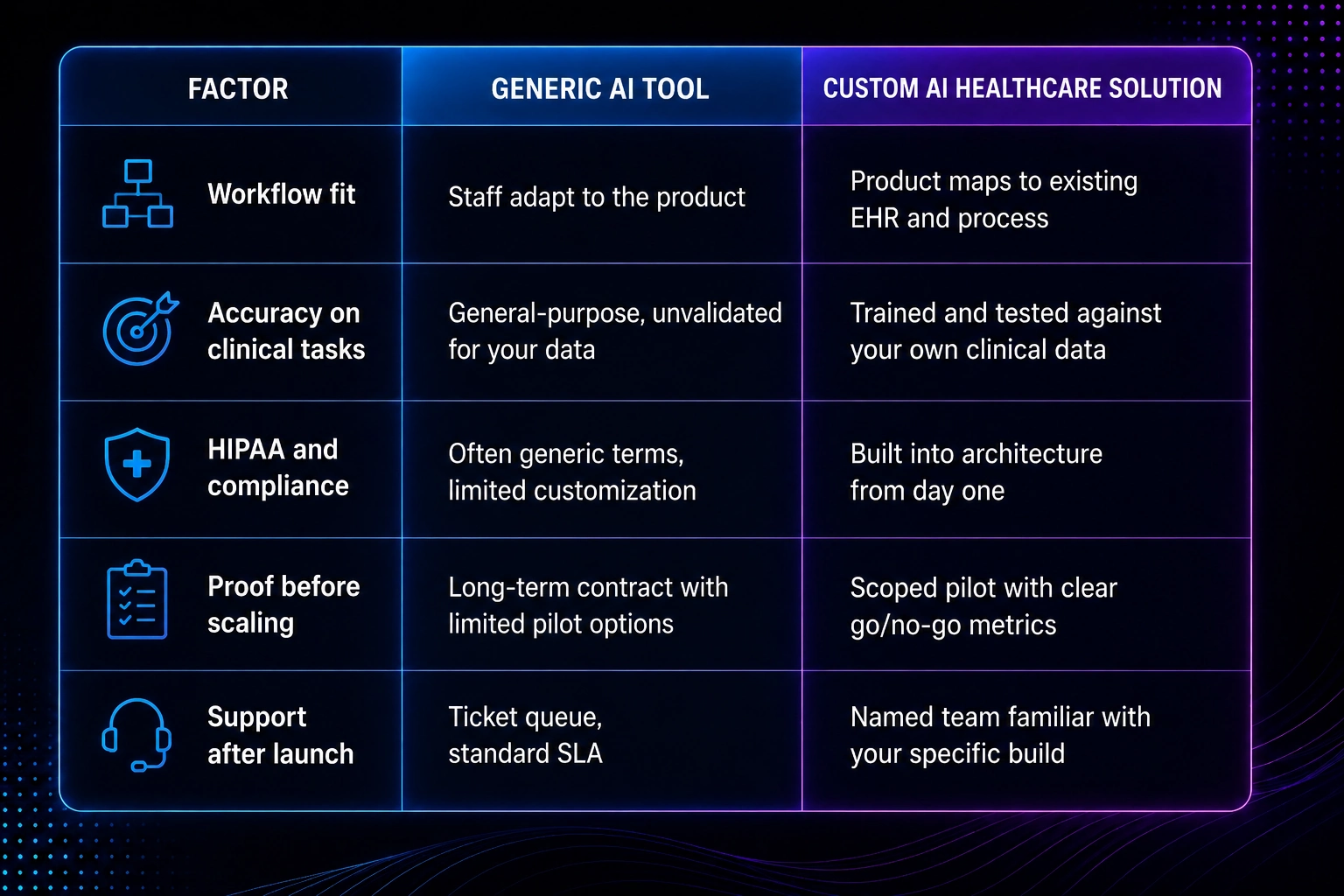
Both groups can use the same framework. If you are early, use the comparison table above to build an internal scorecard so stakeholders are judging vendors against agreed criteria instead of demo polish. If you are closer to a decision, take the five questions above into your finalist calls and ask each vendor to answer in writing, so you have something concrete to compare once the calls are over.
What the Results Actually Look like
Numbers matter more than a demo. we documented how a healthcare operations team applied automation to reduce administrative overhead in How Healthcare Agencies Cut Operational Costs by 40%, and What It Actually Takes to Get There, which breaks down the specific workflow changes behind that figure rather than presenting the percentage on its own. Read it alongside the wound detection case study above if you want to see both a clinical and an operational example before scoping your own pilot.
Custom Build Versus Generic Tool, side by side
Why Neuramonks is Built for this Work
Neuramonks USA builds AI healthcare solutions for hospitals, clinics, and diagnostic centers, with delivery teams across the US, India, and the UAE working on Agentic AI, RAG development, Computer Vision, and AI Automation projects specifically scoped to healthcare, manufacturing, and construction clients. The wound detection system referenced above is one example of that clinical, deep-learning work already running in production, not a hypothetical capability described in a sales deck.
Engagements open with a discovery call focused on one workflow, not a full department rebuild. That keeps the first conversation short and the first commitment small, which matters when the person evaluating vendors also has to justify the spend to a CFO or a board that has seen AI promises fall short before.
If you are scoping a pilot for your organization, book a free consultation with the Neuramonks USA team and bring the specific workflow you want tested first.
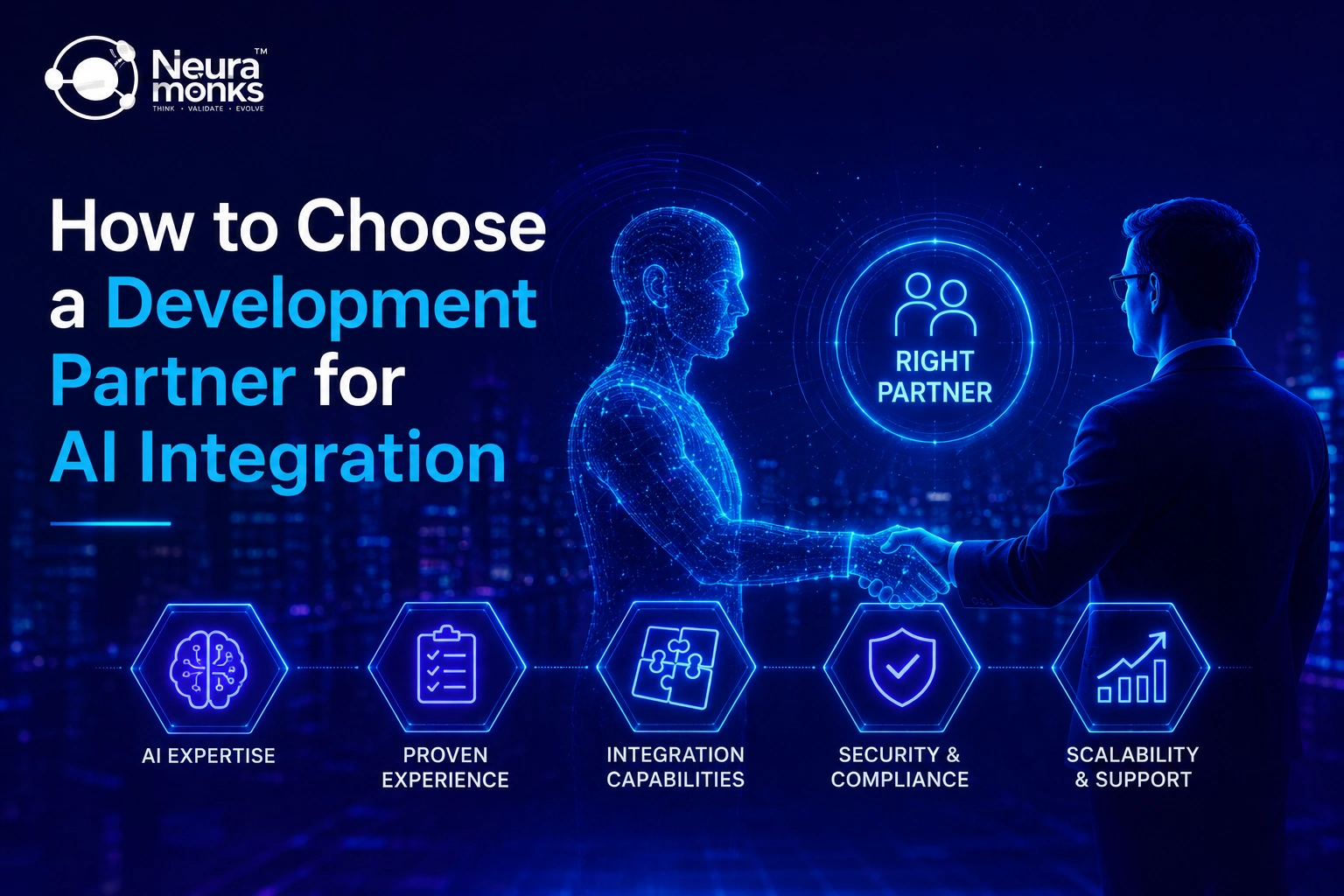
How to Choose a Development Partner for AI Integration
Why most AI integration projects stall before production, and the exact criteria (industry proof, deployment history, data terms, pricing) that separate a real AI partner from a demo shop.

Choosing the right AI development partner means checking four things before you sign anything: proven integration work in your industry, a transparent build methodology, real production deployments (not just demos), and a contract that protects your data and IP. Run every AI integration project candidate through that checklist first.
Most AI integration projects do not fail because the model is bad. They fail because the vendor could not connect the model to the systems that actually run the business. According to MIT's Project NANDA research, about 95% of generative AI pilots never produce measurable profit-and-loss impact, and the same study found that companies buying AI solutions from specialized vendors succeeded roughly 67% of the time, compared with about one-third for teams that tried to build everything internally. The gap is not the technology. It is who builds it.
If you are the person tasked with picking that vendor, this guide walks through what actually separates a dependable AI development partner from a slide deck with a logo on it. It also covers how to weigh transactional questions (who do I call, what does it cost, how fast can they move) alongside informational ones (what should I even be looking for).
Why the Wrong AI Integration Partner Costs more than the Project Itself
Picture the scenario from the buyer's side, not the vendor's. Someone on your team has been asked to "figure out AI" for the customer support queue, the claims intake process, or the equipment maintenance log. They talk to three vendors. Two show a slick demo running on sample data. One asks to see your actual CRM, your actual data pipeline, and your actual compliance requirements before quoting anything.
That third vendor is usually the one worth hiring, and here is why. AI solutions that look impressive in a sandbox often break the moment they meet real, messy, production data: duplicate records, inconsistent formats, systems that were never designed to talk to each other. A development partner who has not planned for that will hand you a pilot that never leaves the lab. A Gartner analysis cited in recent industry reporting found that organizations scrap close to half of their AI proofs-of-concept before they ever reach production, largely because integration and data readiness were never scoped properly at the outset.
The cost of picking wrong is not just the wasted contract value. It is the months of internal credibility burned, the data exposed to a vendor with no security process, and the AI integration project that quietly dies while leadership loses appetite for the next one.
What to look for in an AI development partner
Proven Work in your Specific Industry
An AI development partner who has shipped agentic AI for healthcare intake will understand HIPAA constraints, clinical documentation formats, and patient data handling without you explaining it twice. The same logic applies to manufacturing (equipment telemetry, predictive maintenance, ERP integration) and construction (project management systems, field data capture, subcontractor workflows). Ask for named case studies in your vertical, not generic "we work across every industry" language.
A Named, Explainable Technical Methodology
Ask the partner to describe, in plain language, how they will connect the AI model to your existing systems. A credible AI consulting company should be able to name the specific approach: retrieval-augmented generation (RAG) for grounding answers in your own documents, an agentic AI workflow for multi-step tasks, or a computer vision pipeline for visual inspection. Vague answers about "leveraging the latest AI" are a warning sign, not a selling point.
Production Deployments, not just Pilots
A pilot proves a concept works in a demo. Production proves it survives contact with your actual users, actual data volume, and actual edge cases. Ask directly: "How many of your AI integration projects made it past the pilot stage into daily production use, and for how long have they been running?" A partner with real answers to that question is rare and worth paying for.
Clear Data Ownership and Security Terms
Your contract should state plainly who owns the data, who owns the model outputs, and what happens to your information if the engagement ends. Any AI development partner that hedges on this question, or buries it in a generic terms-of-service link, has not thought through enterprise security the way a serious AI consulting company should.
Transparent, Scoped Pricing
Fixed-scope quotes tied to a defined deliverable beat open-ended "time and materials" arrangements for a first engagement. This lets you compare vendors on equal footing and avoids a project that grows quietly more expensive every sprint.
Evaluation Criteria at a Glance
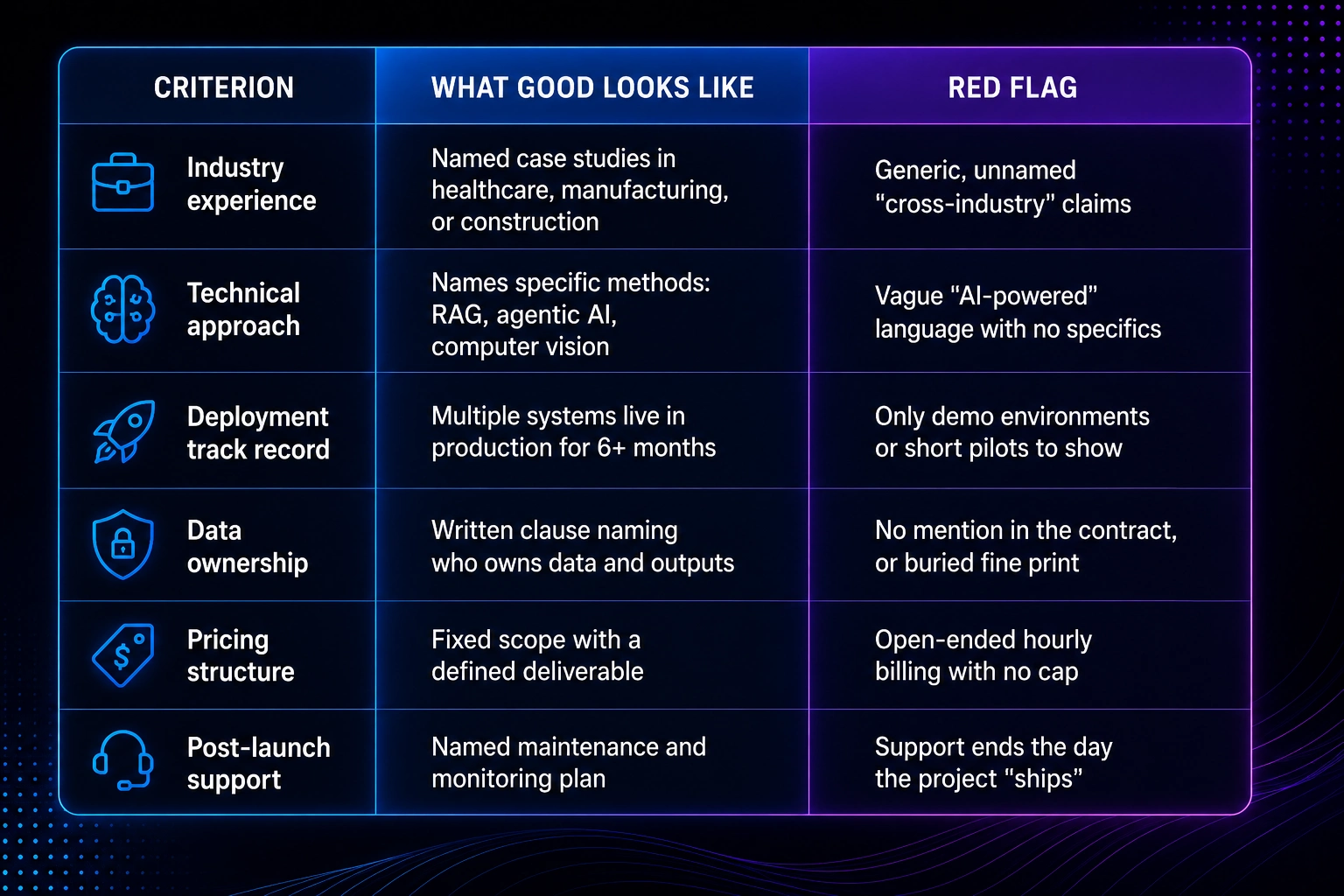
Questions to Ask Before You Sign a Contract
Bring these into the first sales call, not the final round of negotiations:
- Can you show me three reference clients in my industry, and can I speak with them directly?
- Walk me through the last AI integration project you shipped to production. What broke, and how did you fix it?
- Who owns the data and the model outputs once this project is live?
- What does support look like in month six, after the initial contract ends?
- How do you handle a data source that turns out to be messier than expected?
A partner who answers these clearly, with specifics rather than reassurance, is signaling that they have actually done this before. That is the entire point of the exercise: separating AI solutions vendors who can talk about AI from those who can ship it.
Vetting Technical Fit Versus Vetting Business Fit
Buyers often collapse two separate evaluations into one conversation. Technical fit asks whether a vendor can build the thing: do they have engineers who have shipped retrieval-augmented generation systems, agentic workflows, or computer vision models at production scale? Business fit asks a different question: will this vendor answer the phone in month eight, will their pricing survive a scope change, and do they understand your industry's compliance requirements well enough to not need a crash course?
A development partner can pass one test and fail the other. A large systems integrator might have deep technical bench strength but treat a mid-market healthcare client as a rounding error on a bigger contract. A boutique AI consulting company might move fast and communicate well, but lack engineers who have actually deployed a RAG pipeline against a messy, undocumented legacy database. Score both dimensions separately during your evaluation instead of letting a strong demo (technical fit) paper over vague answers about support and pricing (business fit).
Informational Research Versus a Buying Decision
Not everyone reading a guide like this plans to sign a contract this quarter. Some readers are mapping out what AI integration even means for their organization, gathering internal buy-in, or building a business case before procurement gets involved. Others already know they need an AI development partner and are comparing two or three finalists.
Both groups benefit from the same underlying framework. If you are early in the research phase, use the evaluation table above to build an internal scorecard before you ever get on a sales call, so stakeholders are evaluating vendors against agreed criteria rather than gut feeling. If you are closer to a decision, use the questions in the next section directly in your finalist conversations, and ask each AI development partner to answer in writing so you have something to compare side by side after the calls end.
What this Looks like in Practice
Neuramonks has published two related breakdowns worth reading alongside this guide. How to Choose an AI Solutions Partner for Your US Healthcare Practice goes deeper on vertical-specific evaluation criteria for clinical and administrative workflows. Top AI/ML Companies in the USA, Ranked by Innovation and Revenue gives a wider market view if you are actively building your shortlist of AI development partner candidates.
Why Neuramonks Approaches AI Integration this Way
Neuramonks is an AI consulting company built specifically around the problem this guide describes: too many AI solutions never make it past the pilot stage. Neuramonks teams work across Agentic AI, RAG development, Computer Vision, AI Automation, n8n workflows, and Enterprise Dify implementations, with a client base concentrated in healthcare, manufacturing, and construction. Every engagement opens with a discovery call scoped around your actual systems and data, not a generic template deck.
If you are evaluating AI development partners for an upcoming AI integration project,Book a free consultation with the Neuramonks team and bring the questions from this guide with you.
Agentic AI Services: The Complete Guide to Autonomous Agents for Business Growth
A practical breakdown of what Agentic AI Services actually are, where they create the most business impact, and how NeuraMonks builds autonomous agents that deliver measurable ROI in weeks, not months.
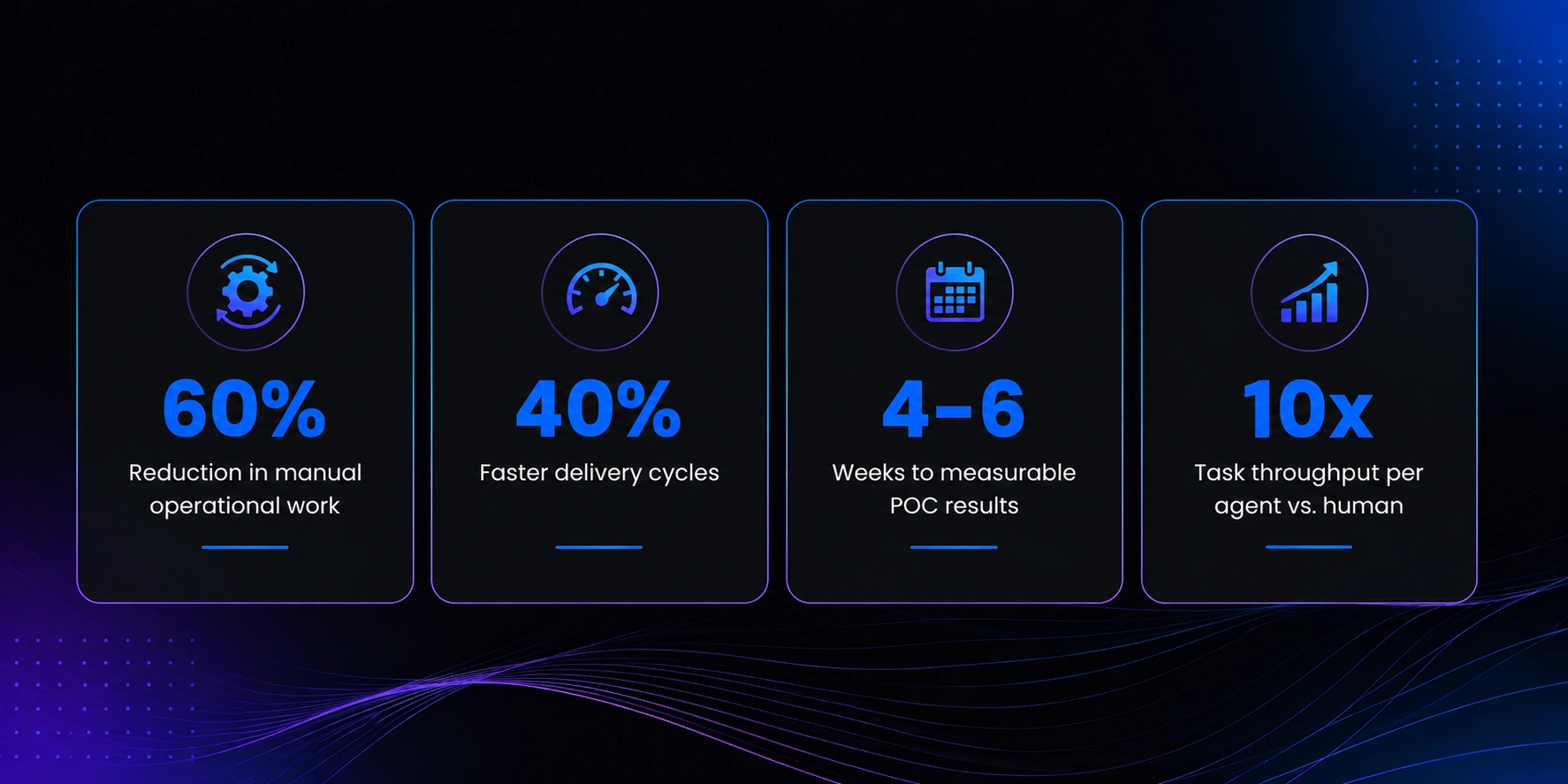
Agentic AI Services are enterprise solutions that deploy autonomous AI agents to plan, decide, and execute multi-step business workflows without constant human input. Leading providers like Neuramonks build these systems by combining large language models, tool integrations, and multi-agent orchestration to cut operational costs by 30–60% and accelerate delivery cycles by up to 40%.
Somewhere between the chatbot hype of 2023 and the full-scale automation wave of 2026, a quieter revolution has been unfolding inside the fastest-growing companies on the planet. They stopped asking AI to respond. They started asking it to act.
That shift from reactive tools to proactive, goal-oriented systems is what separates traditional AI from Agentic AI Services.. And it is changing what is possible in enterprise operations, sales, healthcare, customer experience, and product development at a pace that even seasoned technologists are still absorbing.
This guide breaks down everything you need to know: what Agentic AI actually is, how it differs from the automation you may already use, where it creates the clearest business value, and how Neuramonks helps organizations move from curiosity to deployment with measurable ROI baked in from week one.
What Are Agentic AI Services and Why Do They Matter Now?
Most people's first encounter with AI in business was a chatbot something you typed a question into and got an answer back. Useful. But fundamentally passive. It waited for you. It answered one thing at a time. It forgot everything the moment the session ended.
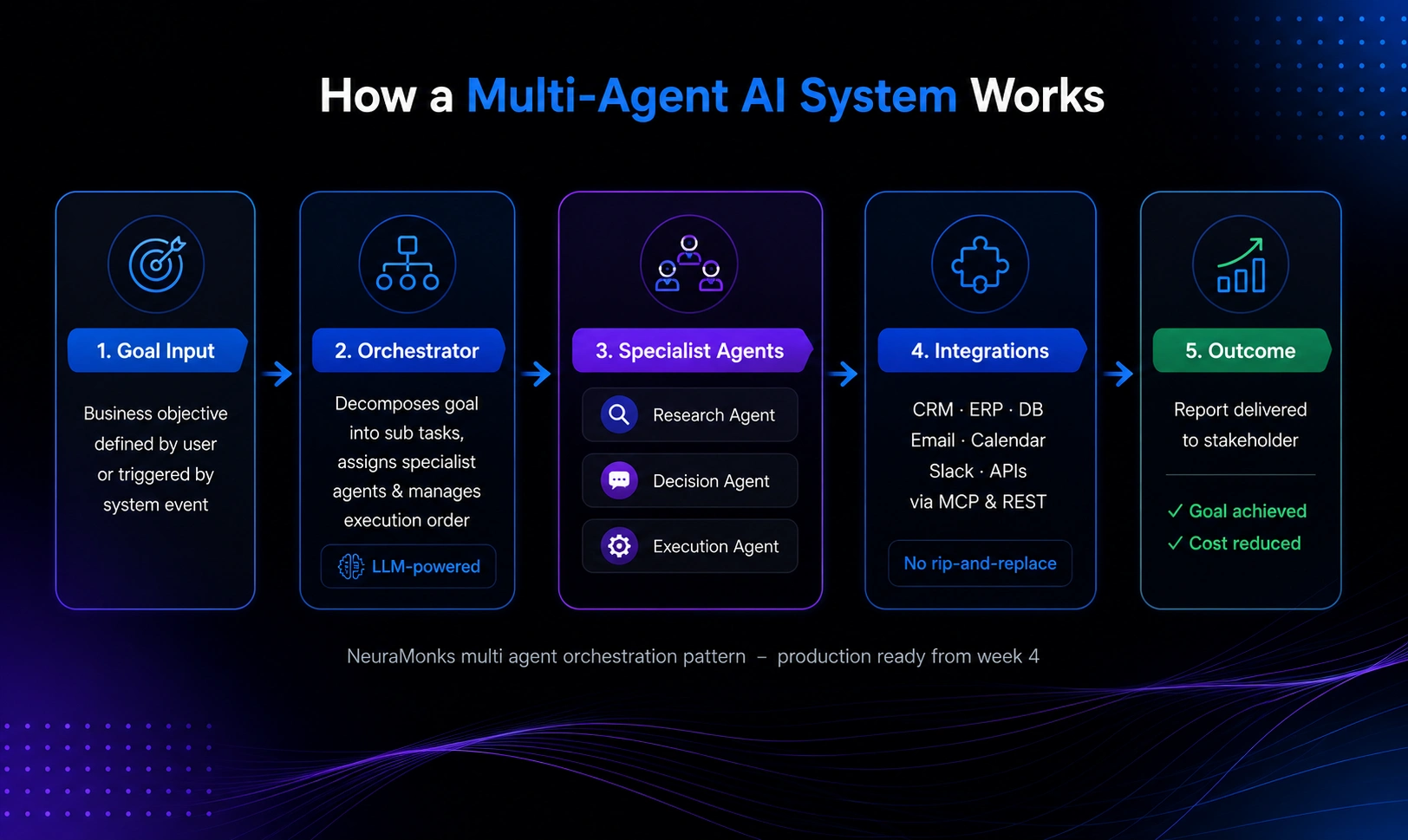
Agentic AI Services are a fundamentally different category. An agentic AI system is given a goal, not a question. It breaks that goal into tasks, decides which tools to use, executes steps in sequence (or in parallel), handles errors, and reports back — all without a human hand-holding each decision along the way.
Think of the difference between a calculator and a CFO. The calculator responds to your inputs. The CFO understands your objective, gathers the data it needs, makes decisions using judgment, and gets things done escalating to you only when it genuinely cannot proceed without your authority.
That is the level of autonomous intelligence that modern Agentic AI Services bring to enterprise workflows. And the reason it matters now is that the underlying technology large language models capable of reasoning, tool use, and multi-step planning has only become reliable enough for production deployment in the last 18 months. We are at the exact moment where the capability curve meets the business readiness window.
Deep Dive: How Autonomous AI Is Changing Enterprise Workflows.
Read Neuramonks' foundational explainer on how agentic systems work, including the Model Context Protocol (MCP) that makes them safe for enterprise use.
Read the full guide →
Traditional Automation vs. Agentic AI: A Clear Comparison
Understanding the distinction helps you quickly identify where Agentic AI creates the most value for your specific business context.
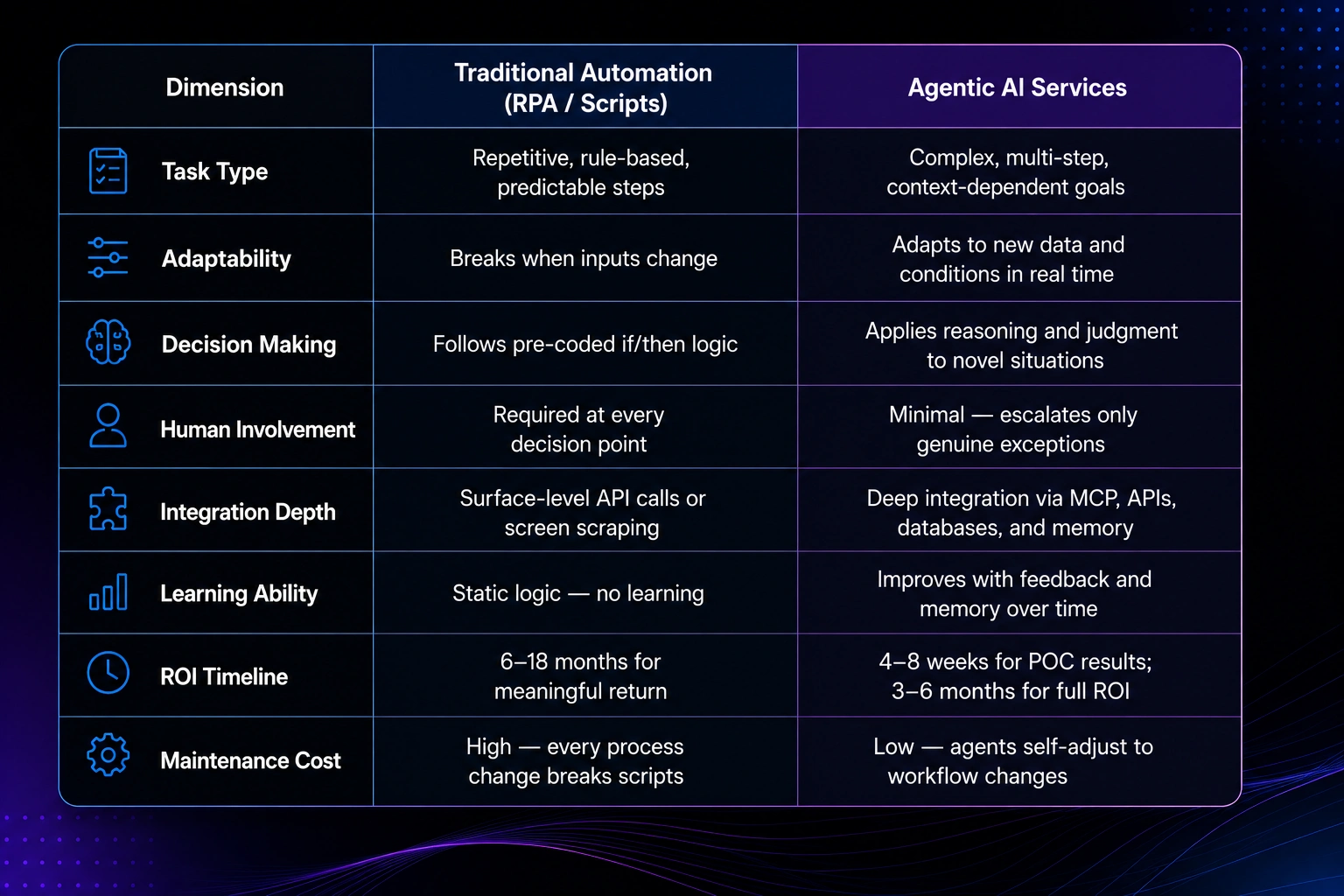
Where Agentic AI Services Create the Most Business Value
The honest answer is: almost everywhere. But some business functions respond faster and more dramatically than others. Based on Neuramonks' deployment experience across 10+ countries and dozens of enterprise clients, these are the highest-impact starting points.
Sales & Revenue Operations
Agentic AI agents can research prospects, personalize outreach sequences, handle first-touch qualification conversations, schedule meetings, update CRM records, and generate forecast reports all without a human touching each step. This is not a future scenario. Neuramonks has deployed exactly this architecture for sales teams, cutting SDR workload by 65% while increasing qualified pipeline volume.
Customer Support & Service
Support agents powered by agentic AI do not just answer questions they pull account history, check order status, initiate refunds, draft escalation summaries, and close tickets autonomously. Resolution rates improve, response times drop to seconds, and your human team handles only the cases that genuinely need judgment that only a person can provide.
Healthcare & Clinical Workflows
From automated appointment scheduling and insurance pre-authorization to clinical documentation and patient follow-up, healthcare is one of the highest-value verticals for Agentic AI Services. Administrative burden which consumes an estimated 30% of clinical staff time becomes a natural fit for autonomous AI agents operating within compliance guardrails.
Construction & Project Operations
Agentic AI transforms how construction firms manage projects, procurement, and compliance. Agents can monitor site progress against schedules, flag material delays, auto-generate RFI and submittal logs, track subcontractor milestones, and surface budget variance reports without manual data chasing. For firms juggling dozens of concurrent projects, this level of autonomous coordination directly reduces costly overruns and delays.
Manufacturing & Production Intelligence
On the factory floor and beyond, agentic AI agents monitor equipment telemetry for anomaly detection, coordinate preventive maintenance schedules, manage supplier communications, and auto-generate quality and compliance reports. They operate continuously across shifts catching the production anomaly at 3am that no one was watching for and feed operations teams with the real-time intelligence needed to act before downtime occurs.
Product & Engineering Operations
Agentic AI can manage release pipelines, triage bug reports, generate documentation, summarize code review threads, and handle sprint reporting. Engineering teams reclaim hours of coordination overhead every week time that goes directly back into building.
How Neuramonks Delivers Agentic AI Services: Our Proven Process
Neuramonks does not sell AI platforms. We build AI systems that solve specific, high-value business problems for specific clients then we measure the results. Here is the process that underlies every engagement.
1. Discovery & Workflow Mapping (Week 1–2)
Our AI Consulting Services team runs structured discovery sessions with your operations, technology, and business leads. We map your existing workflows, identify the highest-friction, highest-value automation opportunities, and define success metrics before any code is written.
2. AI Proof of Concept Design (Week 2–4)
Before committing to full deployment, our AI Proof of Concept Services deliver a working prototype against one targeted workflow. This is not a demo it runs on your real data, connects to your real systems, and produces results you can measure against your baseline.
3. Agent Architecture & Build (Week 4–10)
We design the multi-agent orchestration layer, select and fine-tune the right LLM base for your use case, build the tool integrations your agents need (CRM, ERP, databases, communication platforms), and implement memory and safety guardrails appropriate for your industry.
4. Deployment, Training & Handover (Week 10–14)
We deploy to production, train your team, establish monitoring dashboards, and document everything. You own the system. Our team remains on retainer for the first 90 days to handle edge cases and optimize performance as real-world usage patterns emerge.
5. Continuous Optimization & Expansion
Agentic AI systems improve with use. We work with you to analyze performance data, identify new workflows to automate, and expand the agent ecosystem as your confidence and ROI evidence grow. Most clients expand scope within six months of first deployment.
✦ Real-World Impact · Case Study
AI Podcast Generation Platform
Neuramonks built an autonomous, RAG-powered multi-agent system that completely orchestrates the end-to-end production of long-form podcasts. Utilizing 10+ specialized agents, the platform handles topic research, factual grounding, narrative consistency, and multi-speaker script formatting before dynamically routing to top TTS engines. It eliminates manual editing loops while retaining natural human-like pacing, laughter, and emotional cues.
60 to 70%
Reduction in manual production effort
50 to 65%
Faster content creation cycles
30 to 40%
Higher content & tonal consistency
Read the full case study →
Why Neuramonks for Your Agentic AI Journey
Dozens of vendors will sell you an AI platform, a template, or a proof-of-concept kit. Neuramonks is something different: a specialized AI engineering firm whose entire practice is built around Agentic AI Services that go into production and stay there.
What sets us apart
- Outcome-first engagement model: We define ROI targets before we write a single line of code. If we cannot show a clear path to measurable return, we say so upfront.
- Deep AI Consulting Services experience: Our team has delivered AI systems across healthcare, fintech, e-commerce, manufacturing, and professional services we understand both the technology and the industry context it operates in.
- AI Proof of Concept Services built for speed: Most clients see a working POC within three to four weeks, validating the business case before committing to full-scale investment.
- You own everything: All code, models, data pipelines, and integrations belong to you. No lock-in. No subscription dependency on our platform. Just a system that works for your business.
Global reach, local understanding: Serving clients across 10+ countries, we understands the regulatory, cultural, and operational nuances that make enterprise AI deployments succeed or fail in different markets.
The companies winning with AI right now are not the ones who waited for the technology to be perfect. They are the ones who moved thoughtfully but decisively validated fast with a proof of concept, learned from real data, and scaled what worked. Neuramonks exists to be the partner that makes that journey shorter, safer, and more valuable for your business.
Ready to Deploy Agentic AI in Your Business?
Book a free discovery call with us. We will map your highest-value automation opportunities, design a rapid proof of concept, and show you what autonomous AI can actually do — on your workflows, with your data.
Book Your Free Discovery Call →
No commitment. No sales pitch. Just an honest conversation about where Agentic AI can move the needle for you.
How to Deploy Production Grade Agentic Workflows Using n8n and Gemini (Enterprise Implementation Guide)
A technical guide for engineering teams on deploying production-grade AI agents using n8n and Google Gemini — covering architecture, memory systems, security hardening, and real enterprise use cases across manufacturing, construction, and healthcare.
Direct answer: Deploying production-grade agentic workflows using n8n automation and Gemini requires connecting a self-hosted n8n instance to the Gemini API via authenticated HTTP nodes, structuring agent loops with conditional branching, adding memory via vector stores, and enforcing observability through structured logging enabling reliable, scalable AI solutions for enterprise environments.
The promise of AI agents systems that can reason, take actions, and adapt in real time has moved well beyond demos and prototypes. Enterprise teams are now demanding production deployments: workflows that handle thousands of events per day, gracefully recover from errors, maintain context across sessions, and integrate with existing business systems without ripping them apart.
The combination of n8n automation (self-hosted, open-source workflow orchestration) and Google Gemini (a frontier multimodal LLM with long context windows) has emerged as one of the most compelling stacks for exactly this challenge. Together, they give engineering teams control over code and the intelligence of a top-tier language model without relying on a single SaaS vendor for everything.
This guide is written for senior engineers and technical leads who need to move fast without creating technical debt. We'll cover architecture decisions, real implementation steps, and the operational practices that separate a proof-of-concept from a system your organization can bet on.
RELATED READ
n8n vs Zapier vs Make for AI Automation Which One Actually Scales in 2026? A deep comparison of the top automation platforms for enterprise AI workloads, with benchmarks and migration guidance
Why the n8n + Gemini stack works for enterprise
Most enterprise automation projects fail not because of missing features, but because of architectural mismatch. Tools built for marketing teams end up running critical operational pipelines. The n8n and Gemini stack avoids this by giving you full ownership of both the orchestration layer and the intelligence layer.
n8n is self-hosted, meaning your data never leaves your infrastructure unless you explicitly send it somewhere. Gemini, accessed via the Google AI API or Vertex AI, gives you a model capable of processing 1 million token context windows enough to reason over full contract documents, multi-day conversation threads, or entire codebases in a single call. The combination means your agent can be given large, complex tasks without hitting the token ceilings that cripple other setups.
For teams already working with an AI automation agency like Neuramonks or evaluating vendors for implementation support, this stack also reduces lock-in risk. The workflow definitions in n8n are portable JSON, and the Gemini API conforms to standard REST patterns that can be swapped for other providers if needed.
Architecture principle: In agentic systems, the orchestration layer (n8n) handles state, routing, and integrations. The LLM layer (Gemini) handles reasoning, summarization, and decision generation. Keep these responsibilities clean don't put business logic inside prompts.
The anatomy of a production agentic workflow
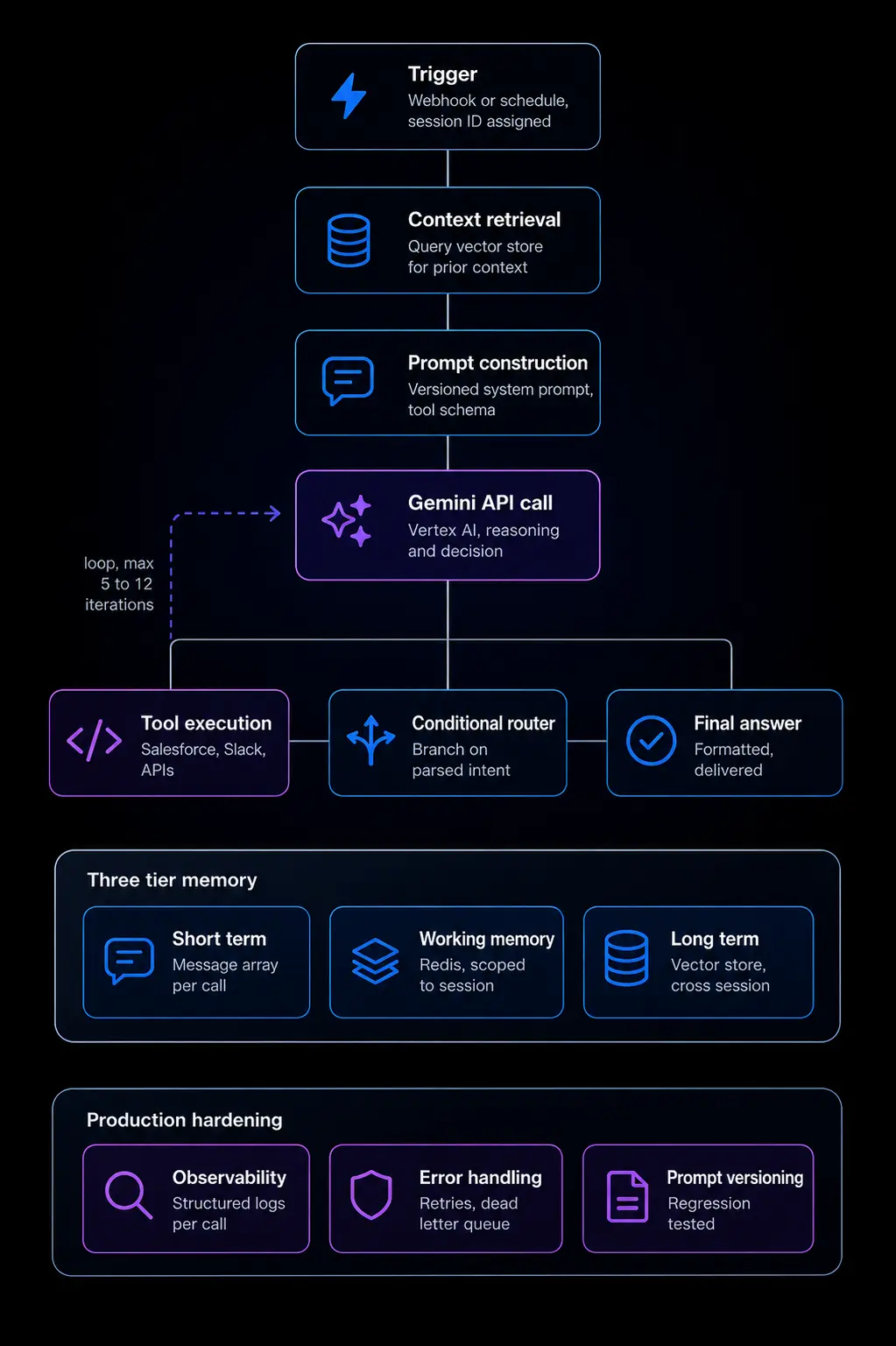
Before writing a single node, you need to understand what makes an agentic workflow different from a standard automation. A standard workflow is deterministic: trigger → do X → do Y → done. An agentic workflow is iterative: trigger → reason → act → observe → reason again. This loop is what gives the system its power and its risk.
In n8n, this loop is expressed through a combination of HTTP request nodes (calling Gemini), Function nodes (evaluating the response and deciding the next step), conditional branches (routing based on the agent's output), and loop-back connections (allowing the agent to iterate until a stopping condition is met).
Step-by-step implementation guide for setting up for n8n Enterprise
The following walkthrough covers the decisions and configurations you'll encounter when building this in a real enterprise environment. These aren't simplified tutorial steps — they reflect what actually matters when the system needs to handle production traffic.
1. Infrastructure Hardening & High Availability
For true enterprise deployments, avoid single-node configurations or n8n Cloud for sensitive workloads. Instead, host a scalable n8n instance within your own Virtual Private Cloud (VPC) using a Kubernetes-managed container deployment.
- Execution Scaling (Queue Mode): Enforce EXECUTIONS_MODE=queue in your environment variables. Deploy an enterprise-grade Redis cluster to act as the message broker. This allows a separate fleet of stateless n8n worker nodes to scale horizontally and absorb heavy agent loops without compromising the responsiveness of your main n8n instance.
- Database Optimization: Run n8n on a managed PostgreSQL database. Because agentic loops write enormous amounts of step-by-step telemetry, you must set EXECUTIONS_DATA_PRUNE=true alongside a strict EXECUTIONS_DATA_MAX_AGE policy to prevent storage bloat.
- Secrets Management: Do not store third-party API tokens inside n8n workflow configurations. Utilize n8n Enterprise's native external secrets integration to stream credentials out of HashiCorp Vault or AWS Secrets Manager at runtime.
2. Enterprise Authentication: Gemini via Vertex AI / Agent Platform
While Google AI Studio works well for prototyping, enterprise compliance teams demand the security posture of Google Cloud's Gemini Enterprise Agent Platform (formerly Vertex AI). It provides strict data isolation, VPC Service Controls, and robust audit logging.
- IAM Scopes: Configure an n8n Credentials block using a Google Service Account JSON key that is explicitly limited to the Gemini Enterprise Agent Platform User (formerly Vertex AI User) or GenAI Administrator role.
- Targeting the REST Endpoint: Set your n8n HTTP Request node to a POST request pointing to Google's regionalized production endpoint template:
- $$\text{https://\{REGION\}[-aiplatform.googleapis.com/v1/projects/](https://-aiplatform.googleapis.com/v1/projects/)\{PROJECT-ID\}/locations/\{REGION\}/publishers/google/models/\{MODEL-ID\}:generateContent}$$
- Data Residency: Ensure that the {REGION} parameters align perfectly with your company's localized compliance frameworks (such as us-central1 for domestic data handling or europe-west3 for strict GDPR adherence).
3. Structuring the Agent Loop with n8n Nodes
The execution loop must remain resilient, clean, and bounded. Build your architecture using these precise functional steps:
- Trigger & Context Initialization: When a webhook or schedule fires, write a unique sessionId to your fast-access storage layer (like Redis or Supabase) to initialize state.
- Context Retrieval (Vector Store Integration): Query your enterprise vector database (Qdrant, Pinecone, or PGVector) using native n8n Vector Store components to feed highly specific operational context to the agent before it calls the LLM.
- The Reasoning Call (HTTP Request): Construct a structured JSON message array containing system rules, active tools schemas, retrieved context, and the user's explicit objective. Hardcode Gemini's request parameters to return a deterministic json_object.
- The Switch/Router Node: Evaluate the returned structure using an explicit n8n Switch node. If the payload indicates a tool_call, dynamically branch out to execute an integration. If it outputs a final_answer, bypass the loop and send the completion path.
- Loop Controller & Safety Braking: Use an evaluation Code node to increment an execution counter stored inside the workflow variables. Enforce a strict ceiling (e.g., 8–12 iterations max). If a loop enters an unexpected hallucination cycle and hits this ceiling, route the payload immediately to a human-in-the-loop dead-letter queue.
4. Memory Architecture for Stateful Agents
Stateless agents are almost useless in enterprise contexts. Users expect continuity. The standard pattern is a three-tier memory system:
- Short-Term Memory: The live message array passed back and forth within an active execution branch.
- Working Memory: A shared Redis key tied to the specific sessionId that tracks variable tool outcomes during the active cycle.
- Long-Term Memory: A vector store configuration that indexes compressed summaries of past sessions to keep cross-interaction intelligence alive.
Production hardening: what separates pilots from platforms
The jump from a working prototype to a production system that your business can rely on requires deliberate hardening in four areas.
Observability and structured logging
Every Gemini API call should emit a structured log entry: timestamp, session ID, input token count, output token count, latency, and the reasoning step number. Use n8n's Code node to write these to a centralized log aggregator (Datadog, Grafana Loki, or even a simple Postgres table). Token costs compound quickly in agentic loops — you need per-session visibility to catch runaway workflows before your API bill does.
Error handling and graceful degradation
Gemini API calls will occasionally fail: rate limits, temporary outages, malformed responses. Your n8n workflow needs explicit error branches with exponential backoff on retries, a dead-letter queue for tasks that exceed max retries, and a fallback response path that notifies the end-user rather than silently failing. The Error Trigger node in n8n combined with a notification node (Slack or email) is the minimum viable observability layer.
Prompt versioning and regression testing
System prompts are code. Treat them as such. Store prompt templates in a version-controlled repository, reference them in your n8n workflow by version ID, and run a regression suite before promoting any prompt changes to production. A prompt that works in testing can subtly change agent behavior in ways that only manifest under production traffic patterns — systematic testing catches this early.
Enterprise Use Cases for the n8n + Gemini Stack
Deploying an agentic workflow is highly impactful when applied to industry-specific operational bottlenecks. Because n8n handles deep system integrations and Gemini processes massive, unstructured datasets, enterprises can automate complex, decision heavy workflows that traditional automation tools cannot touch.
1. Manufacturing: Autonomous Supply Chain Remediation
- The Orchestration (n8n): Monitors live factory IoT logs, enterprise asset systems (SAP, Oracle), and inbound vendor delivery emails.
- The Intelligence (Gemini): Ingests an unstructured carrier delay alert and uses its multimodal intelligence to inspect attached customs document scans or freight bills. It evaluates the raw text data against strict legal supply manuals stored in the vector layer.
- The Action: The agent autonomously references live material balances in the ERP. If parts are short, it automatically targets alternative pre-approved suppliers, generates a drafted RFQ (Request for Quote), modifies the schedule in the manufacturing execution system, and routes an actionable summary to the logistics manager for approval.
2. Construction: Real-Time RFI & Compliance Tracking
Construction AI solutions have evolved from static document logs into dynamic knowledge engines that eliminate critical administrative delays on-site. By pairing n8n's visual node structures with Gemini's high context limitations, firms can process complex requests for information (RFIs) proactively rather than reactively.
- The Orchestration (n8n): Syncs field management tools (like Procore or Autodesk Build) directly with internal document servers and city zoning databases.
- The Intelligence (Gemini): When an engineer uploads an urgent Request for Information (RFI) regarding a spatial blueprint conflict, Gemini processes the message alongside massive blueprint architectural files (leveraging its huge context capacity). It runs comparisons against municipal building codes to determine compliance.
- The Action: The agent drafts an objective, technically sound design recommendation, pushes structural updates back into the central BIM logs, and fires an alert to the compliance safety officer if the variation requires a municipal variance request.
3. Healthcare: Automated Prior Authorization Triaging
Advanced Healthcare AI solutions target the immense administrative strain of insurance navigation, cutting authorization turnaround loops from weeks to minutes. Under strict federal data exchange rules, this stack replaces multi-hour manual data re-entry with precise, secure automation.
Compliance Note: This use case relies completely on a self-hosted n8n installation run entirely inside a protected, HIPAA-compliant private cloud environment utilizing enterprise-hardened data isolation boundaries.
- The Orchestration (n8n): Interfaces directly with Electronic Health Record (EHR) environments via secure HL7/FHIR webhooks to ingest raw practitioner voice logs or insurance exception files.
- The Intelligence (Gemini): Translates complex medical vocabulary found inside clinician notes and tests, comparing the clinical justification directly against thousands of pages of insurance policy guidelines.
- The Action: Automatically structures, populates, and delivers complete medical authorization records directly into health portal APIs. If an invalid automated rejection occurs, it hands the case directly over to specialized hospital billing staff along with a clear brief outlining why the rejection breached regular policy limits.
CASE STUDY NEURAMONKS
Custom Gemini LLM integration via Dify plugin development
Neuramonks, a leading Dify AI Development Company, built a custom Gemini provider plugin for the Dify AI platform — enabling enterprise clients to route their agentic workflows through a fully approved, org-level Gemini LLM integration. The plugin bypassed Dify's default model limitations by implementing the Approved Provider protocol, giving clients control over model selection, API keys, and token budgets within the same visual workflow environment.
Read the full case study
Scaling the stack: from single workflow to multi-agent system
Once a single agentic workflow is stable, the natural next step is multi-agent architectures systems where specialized agents collaborate on complex tasks. In n8n automation, this is implemented through a coordinator-worker pattern: a top-level orchestrator workflow receives tasks, decomposes them, and triggers child workflows via n8n's Execute Workflow node. Each child workflow is a specialized agent (one for document analysis, one for database queries, one for external API calls) with its own Gemini context and memory scope.
This is where Neuramonks consistently delivers differentiated value for enterprise clients not just connecting nodes, but designing the agent topology that matches the client's operational complexity. A single generic agent cannot reliably handle the breadth of tasks a real business generates. Specialized agents with clear boundaries and well-defined handoff protocols consistently outperform monolithic prompts trying to do everything.
As a Dify AI Development Company, Neuramonks also builds parallel implementations using Dify's visual agent builder for teams that prefer a lower-code interface for managing agent chains often combining Dify for agent logic with n8n for the integration layer, giving clients the best of both environments.
Security considerations for enterprise deployments
Agentic systems that can take actions writing to databases, sending emails, calling external APIs require a security model that goes beyond standard web app practices. The principle of least privilege applies at the agent level: each tool available to the agent should have the minimum permissions needed to accomplish its specific task. A document summarization agent does not need write access to your CRM.
In n8n, enforce this by creating separate credentials for each integration, scoped to the permissions that specific workflow actually needs. Audit credential usage quarterly. Log every tool call the agent makes with the session ID and user context that authorized it. For regulated industries (healthcare, finance), consider adding a human-in-the-loop node before any irreversible action n8n's Wait node combined with an approval webhook makes this straightforward to implement.
The Neuramonks' approach to enterprise AI automation
At Neuramonks, our implementation methodology for enterprise agentic systems starts with a capability audit mapping existing workflows, data sources, and integration points before writing a single node. The most common mistake we see is teams starting with the technology (n8n, Gemini, Dify) before clearly defining which decisions the agent needs to make, which data it needs access to, and which actions it should never take autonomously.
The second phase is a controlled pilot: a single, high-value workflow deployed to a subset of users with full observability instrumentation. This generates the real usage data needed to tune prompts, adjust memory strategies, and right-size the agent's tool set before organization wide rollout. Enterprise deployments that skip this phase consistently encounter production incidents that could have been caught in a three-week pilot.
Start your enterprise AI automation journey
Whether you're architecting your first agentic workflow or scaling an existing system, Neuramonks brings the engineering depth and implementation experience to get it right in production not just in demos.
Get in touch with Neuramonks
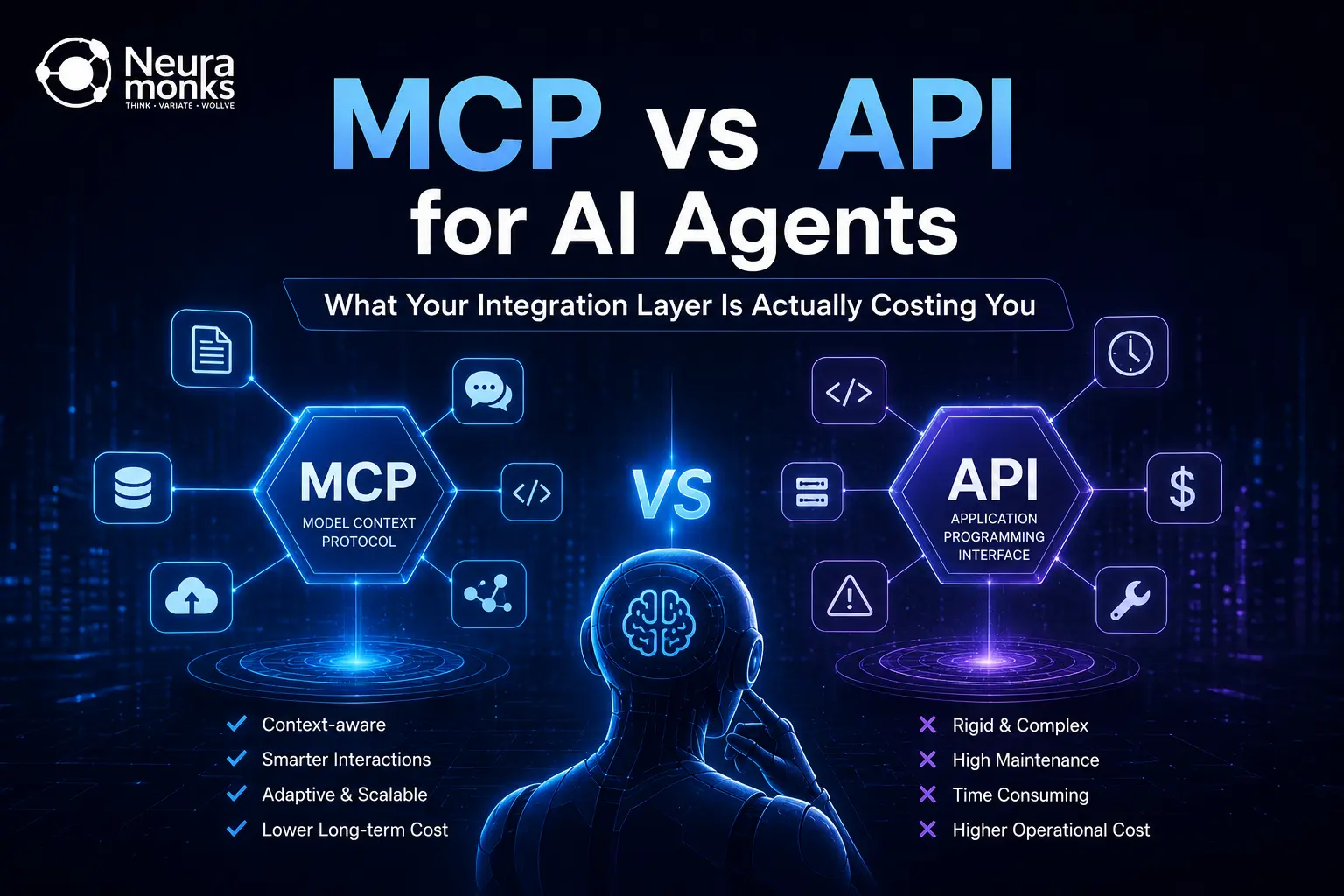
MCP vs API for AI Agents: What Your Integration Layer Is Actually Costing You
MCP vs API for AI Agents — breaks down why the Model Context Protocol is replacing traditional JSON-over-API integrations for AI agent tool layers, with honest cost comparisons, real-world examples, and guidance on when a custom MCP server is worth the investment over generic solutions.
For years, MCP server development wasn't even a conversation. Connecting an AI agent to your tools meant writing JSON schemas, maintaining API wrappers, and debugging integrations at 2am. That's changed, fast. Here's why businesses are paying attention, and why the switch is less complicated than it sounds.
What JSON-over-API actually looked like
Before MCP, the standard approach was: define your tool schema in JSON, hand it to the agent, let the agent call your API directly, and write glue code to handle errors, retries, and response normalization.
It worked. But it worked the way duct tape works fine for one thing, a mess once you start stacking it.
The agent had no standardized way to discover what tools were available. It had no consistent error contract. Every integration was its own dialect, and teams at scale ended up building internal libraries just to translate between their AI agents and their own systems.
If you're dealing with this, don't blame your engineering team traditional web infrastructure simply wasn't built for non-deterministic AI agents. The tools were designed for predictable, scripted calls. Agents don't work that way, and the mismatch shows up as exactly the kind of glue code, retries, and 2am debugging described above.
What does MCP actually change
MCP isn't a library or a framework in the traditional sense. It's a protocol a standardized contract for how AI agents discover and invoke tools, access data, and handle context.
Think of it the way TCP/IP standardized how computers talk to each other. Before TCP/IP, every network had its own rules. After it, networks could interoperate without anyone writing custom translation logic.
MCP does something similar for the AI tool layer. Your agent learns MCP once. Every server that speaks MCP becomes accessible no custom integration code, no bespoke JSON schemas, no new wrapper library per service.
The practical effect:
- Agents can discover available tools at runtime, not just at configuration time
- Tool responses follow a consistent structure, so parsing logic doesn't change per integration
- Error handling is standardized the agent knows what a failed call looks like regardless of which tool it called
- New tools can be added to an agent's environment without redeploying or retraining
Teams that moved from API-first integrations to MCP report that adding a new data source to an existing agent went from a multi-week sprint to a configuration task measured in hours. The agent doesn't change. The protocol handles the rest.
Why MCP, and Why Now
This is the part most explainers skip: MCP isn't a bet on one vendor's roadmap anymore, and that's exactly why it's worth taking seriously in 2026.
Anthropic introduced MCP in late 2024. Within a year, OpenAI, Google, and Microsoft had all shipped native support for it across their major platforms, and adoption kept compounding from there tens of thousands of public MCP servers now exist, spanning everything from developer tools to Fortune 500 deployments. In December 2025, Anthropic donated the protocol to the Agentic AI Foundation, a neutral fund under the Linux Foundation co-founded by Anthropic, Block, and OpenAI, with Google, Microsoft,
AWS, and Cloudflare backing it.
That hand-off matters more than it sounds: it moved MCP out of "Anthropic's protocol" territory and into the same category as HTTP or TCP/IP infrastructure no single company controls, and that everyone building on AI can rely on without worrying it gets deprecated or paywalled.
The protocol has also matured technically. The current spec runs on Streamable HTTP with OAuth 2.1-based authorization, which means MCP servers can be deployed securely on the open internet rather than limited to a developer's local machine the thing that made early MCP useful mainly for coding assistants and not much else.
Put plainly: when your competitors, your SaaS vendors, and the model providers you depend on are all converging on the same connection standard, building your agent's tool layer on anything else is a bet against where the entire ecosystem is already headed.
MCP vs raw API: an honest comparison
Here's where things stand when you compare a direct API approach against MCP, across the factors that matter most in production.
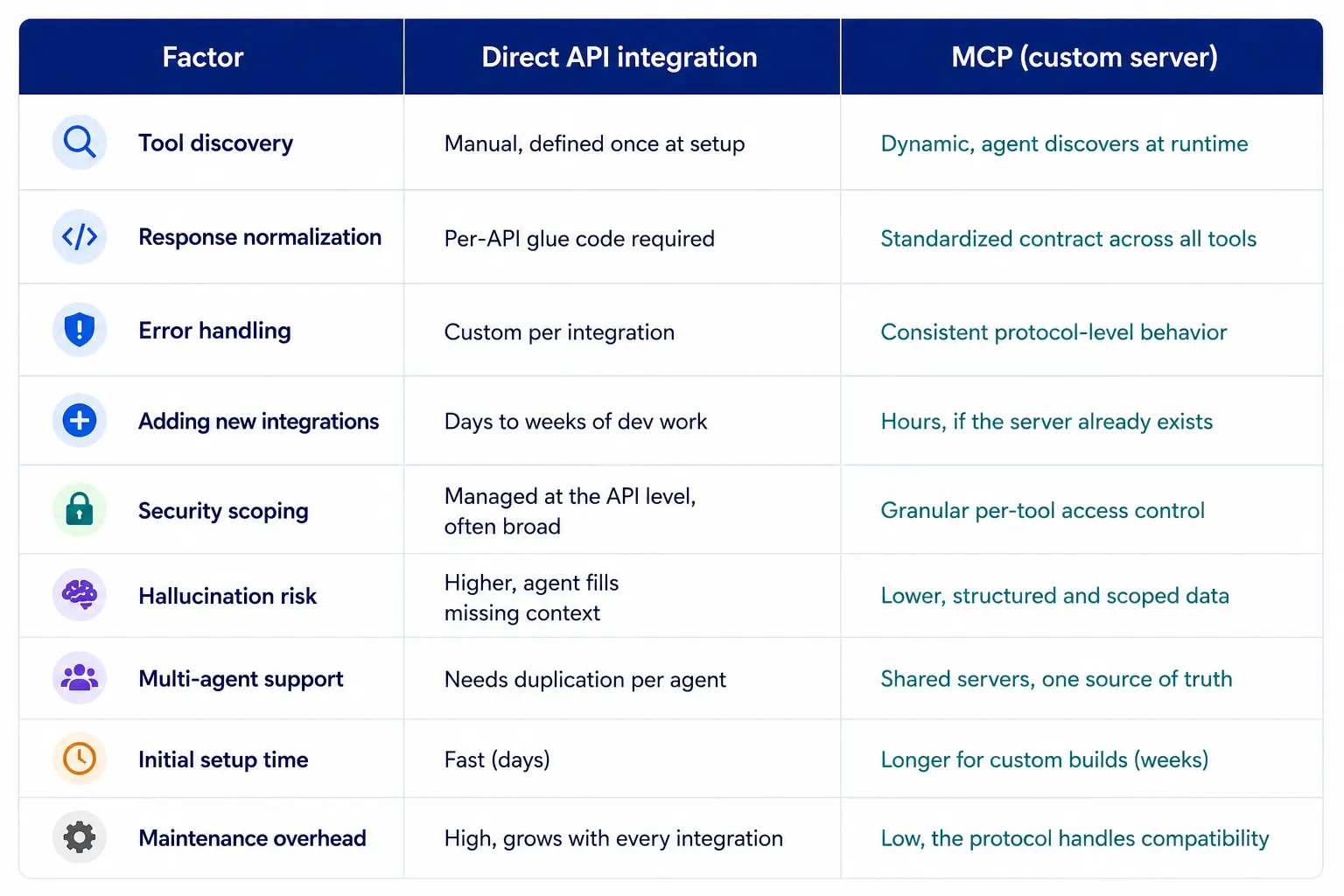
Why this Matters More for SaaS than Anyone's Saying
Most MCP coverage focuses on developer tools and enterprise AI. The implications for SaaS businesses are more immediate than that framing suggests.
If you run a SaaS product, your users already expect AI features. The question is whether those features hold up or whether they're impressive in a demo and frustrating in daily use.
The gap usually isn't the model. A well-prompted GPT-4 or Claude is plenty capable. The gap is the tool layer. The agent hallucinates when it doesn't have reliable access to the right data. It fails when API responses are inconsistent. It slows down when it has to call three endpoints to answer a question that should need one.
MCP doesn't fix your product strategy. It fixes the infrastructure problem sitting between "our AI feature works in the demo" and "our AI feature works at 3pm on a Tuesday with 400 users active."
Three Things Tend to Change Once a Team Moves the Tool Layer Onto MCP:
- Feature velocity improves, because new AI capabilities can pull from existing MCP servers without custom integration work
- Support costs drop, because the agent stops guessing in ambiguous situations and returns a structured error the application can handle gracefully
- Multi-tenant complexity gets simpler, because access scoping lives at the MCP server level instead of scattered across every API call
At Neuramonks, the teams we work with consistently find that fixing the tool layer first before touching the model or the prompt produces the fastest measurable gains. It's a smaller surface area, and the difference is usually visible within weeks.
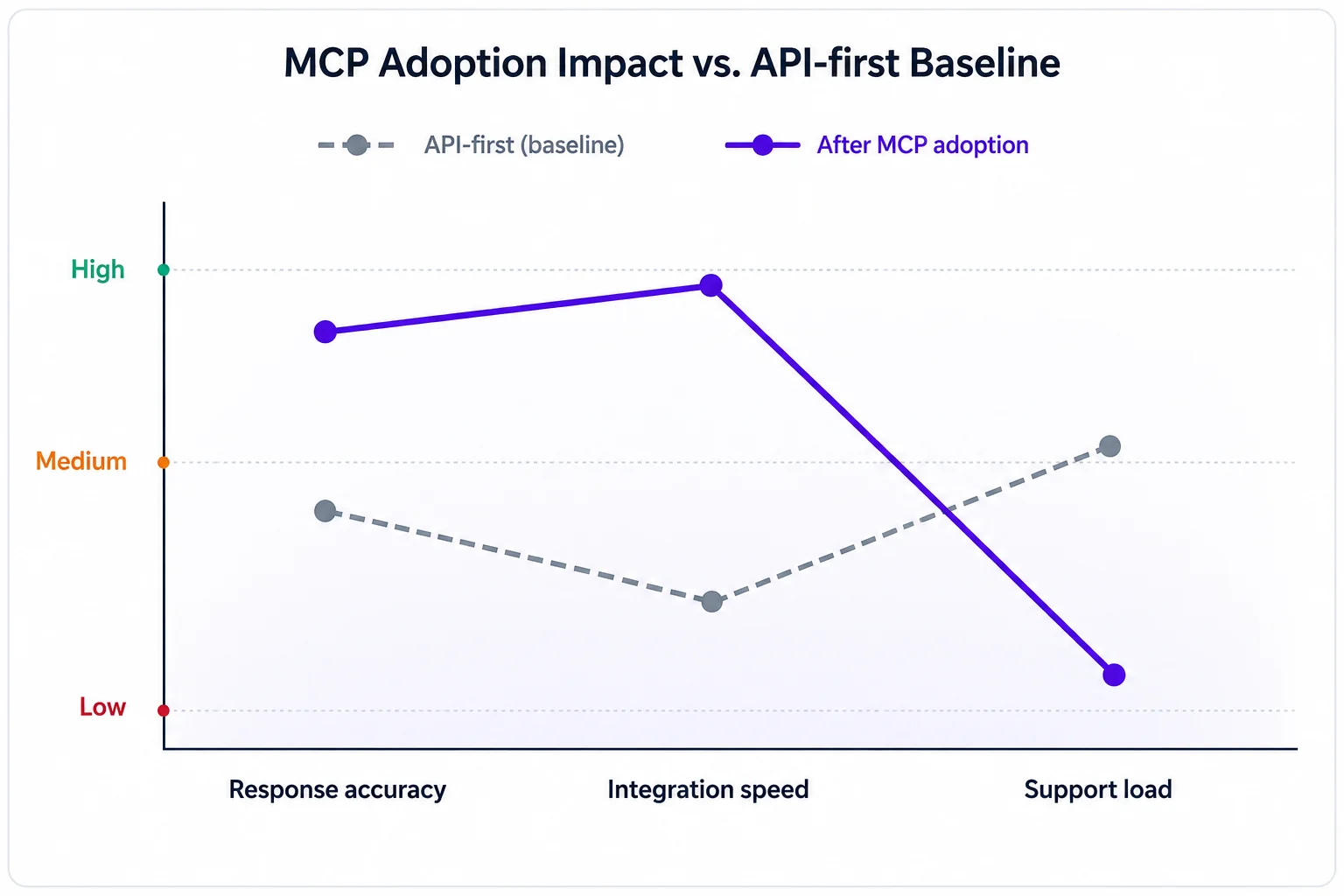
Note: support load is plotted inverted lower is better, so the rising purple point reflects fewer tickets, not more. Based on relative, directional shifts Neuramonks has observed across 2024–2026 client deployments, not absolute benchmark figures.
The practical Question: Generic MCP Server or Custom?
Generic MCP servers exist and they'll get you started. If you're evaluating whether MCP fits your stack, spinning up a generic server against a well-documented API is a reasonable way to test the concept in a few days.
The gap shows up at two points: when your data schema diverges from what the generic server expects, and when the agent needs to understand domain-specific logic rather than just fetch data.
Here's a real example. A construction software company needed an AI agent that could flag permit status issues a classic use case for AI in construction project management. A generic MCP server could pull permit records fine. But "flagging an issue" required understanding that a PEND_REV status in their system meant a 12-day delay risk, not just a pending review. That logic had to live in a custom tool definition. The agent couldn't infer it from a raw API response.
Custom MCP server development is slower to start than plugging in an off-the-shelf integration, typically two to four weeks for a meaningful first build. The right comparison isn't cost against generic servers. It's cost against the engineering hours your team will spend maintaining custom integration code, debugging agent failures in production, and re-explaining domain logic to every new model you evaluate.
Teams doing custom agentic AI development where multiple agents share infrastructure, coordinate tasks, or hand off context between steps tend to find that investing in a properly designed MCP layer early prevents the most painful re-architecture later. The protocol is the foundation. What you build on top of it is where the real business value lives.
What does it Actually Cost to Build
Rough ranges based on scope, not exact quotes. Your stack and requirements will shift these.
Basic server (3–5 tools, single data source): $8,000–$15,000. Covers a focused use case a customer support agent connected to a CRM, for example. A good fit if you're starting with AI MVP Development Services and want a working prototype without overbuilding.
Mid-complexity (6–12 tools, multiple integrations): $15,000–$40,000. Multi-system workflows with domain logic and access controls. Common for first production deployments.
Enterprise (12+ tools, compliance requirements, high availability): $40,000–$120,000+. Includes architecture review, security scoping, load testing, and documentation.
Ongoing maintenance usually runs 15–20% of the initial build cost annually, covering API updates, new tools, and monitoring.
Teams consistently underestimate these numbers because they're comparing against off-the-shelf integration tools. The more useful comparison: what does a poorly performing AI agent cost in manual correction, customer experience failures, and delayed releases? That number tends to reframe the conversation fast.
Where to Start if you're Evaluating this Now
Three questions worth answering before any scoping conversation:
- What decision does your AI agent need to make, and what data does it need to make it reliably?
- Where does your current agent fail or require human correction and is that failure at the model level or the tool layer?
- Are you building one agent, or building infrastructure that multiple agents will share?
If the failures are mostly at the tool layer wrong data, inconsistent responses, agents inventing context they don't have MCP is almost certainly relevant to your stack. If the failures are at the reasoning layer, that's a different conversation about prompting, fine-tuning, or model selection.
Most teams find it's both. But the tool layer is faster to fix and cheaper to address than model behavior. Starting there usually produces noticeable improvements in weeks, not quarters.
If your team wants to own this infrastructure long-term rather than outsource it entirely, Neuramonks also offers AI Consulting Services that work through the design decisions with your engineers directly covering tool schema design, access control patterns, error handling contracts, and how to structure MCP servers that hold up under real production load.
Let's Stop Debugging Integrations at 2am
Contact Neuramonks for a zero-commitment MCP Architecture Review, and we'll map out your tool infrastructure together what's already working, where the agent is filling in gaps it shouldn't have to, and what a custom MCP layer would actually take to build for your stack.
Book your MCP Architecture Review →
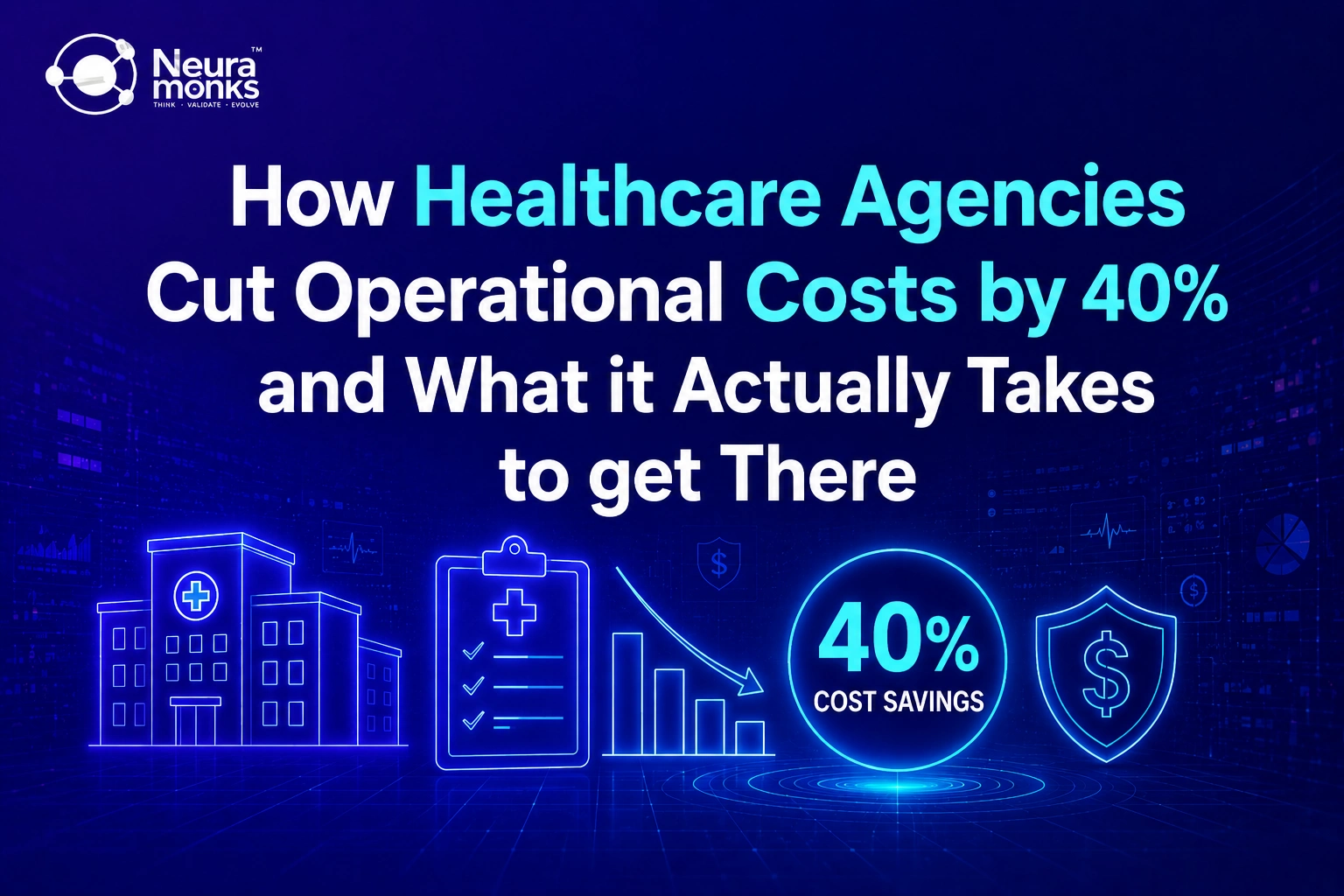
How Healthcare Agencies Cut Operational Costs by 40% and What it Actually Takes to get There
US healthcare agencies are cutting operational costs by up to 40% by deploying AI across revenue cycle management, clinical documentation, imaging diagnostics, and scheduling this post breaks down exactly where those savings come from, the implementation timeline, and 2026 pricing benchmarks for getting there.
US healthcare spends over $1 trillion a year on administrative and operational overhead. The agencies pulling ahead in 2026 are not the ones with the largest budgets they are the ones that deployed AI healthcare solutions where the costs are highest and measured results before expanding.
That 40% figure is not an estimate. It is a compounded number: efficiency gains stacked across seven operational layers, each independently measurable, each independently achievable. This post breaks down exactly where those savings come from, the use cases producing the clearest ROI, and what a realistic implementation looks like.
Where are the costs actually coming from
A mid-size hospital's operationloverhead breaks down across seven departments. The table below maps each to its primary AI application, the average cost reduction documented across 2025–2026 US deployments, and the implementation effort required.
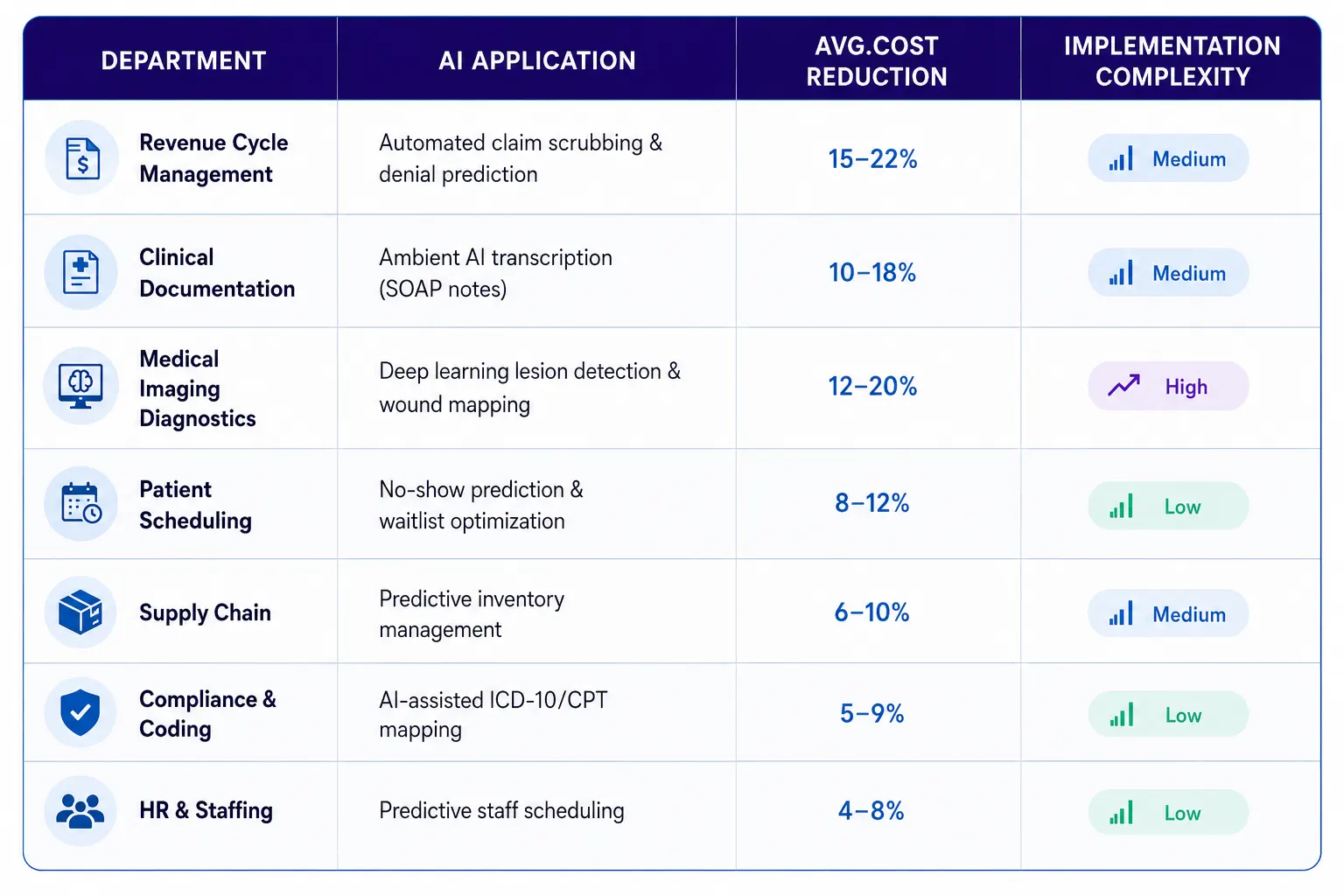
Stack four of these and 35–40% total reduction is not aggressive it is conservative.
The six areas with the clearest ROI
1. Revenue cycle management
Claim denials cost US hospitals an estimated $262 billion per year. The causes missing data, coding errors, eligibility gaps are almost entirely preventable. AI healthcare solutions deployed in revenue cycle pre-validate claims against payer rules before submission, flag high-risk claims for human review, and automate prior authorisation follow-ups.
One Neuramonks client in orthopedics reduced their claim denial rate from 11.4% to 2.6% within six months recovering $3.2M in annual revenue from that single change.
2. Intelligent scheduling and patient flow
No-show rates in US healthcare average 18–23%. AI scheduling systems predict no-show likelihood per patient and appointment type with 84%+ accuracy, auto-fill cancellations from a prioritised waitlist, and reduce wait times by 30 to 40%. For health systems managing thousands of weekly appointments, scheduling optimisation alone generates $500K to $2M in recovered annual revenue.
3. Ambient clinical documentation
Physician burnout costs US healthcare $5 billion annually. Documentation SOAP notes, referral letters, discharge summaries consumes two to three hours per physician per day. Ambient AI transcription listens to patient-physician conversations (with consent), generates structured notes in real time, and pushes completed documentation to the EHR.
Physicians review and sign. Documentation time drops by 60–70%.
4. Medical imaging diagnostics with deep learning
Deep learning models detect, classify, and measure clinical findings in radiology scans, pathology slides, wound photos, and retinal images at speeds and levels of consistency that are difficult to match in manual workflows. This is one of the fastest-growing areas of artificial intelligence in healthcare.
Key imaging use cases producing documented ROI:
- Radiology & lesion detection: CT/MRI scan analysis with bounding-box measurement flags findings for radiologist review, reducing review time by up to 60%.
- Wound detection & progression tracking: Automated area measurement and week-on-week comparison, eliminating manual assessment time and improving care consistency.
- Retinal screening: Diabetic retinopathy grading at scale, 3× more patients screened per clinician per day.
- Pathology & histology classification: Tissue analysis and cancer risk stratification from slide images, with 94% AI diagnostic accuracy versus 78% manual on comparable tasks.
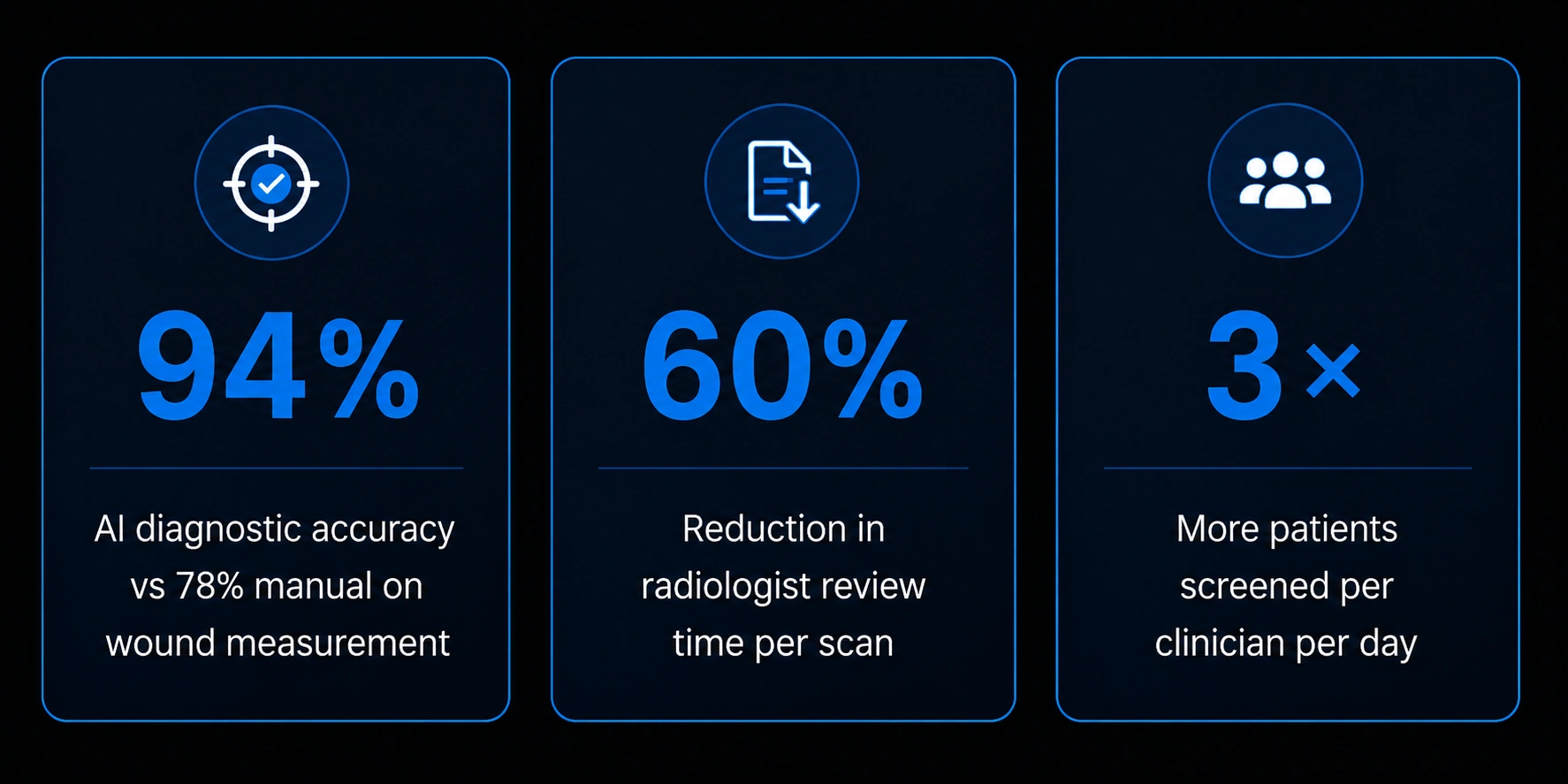
Neuramonks built an Automated Wound Detection and Measurement System using deep learning that enables clinical staff to document, measure, and track wound progression at scale reducing assessment time and improving care consistency across multi-site operations.
5. Supply chain and inventory intelligence
Manual par-level management fails in high-volume environments. AI-powered supply chain systems predict consumption by department and patient census, auto-trigger purchase orders at optimal reorder points, identify substitution opportunities when items are backordered, and flag vendor pricing anomalies in real time. Hospitals using these tools report 8 to 14% reductions in supply expenditure without affecting care quality.
6. AI-assisted compliance and medical coding
Undercoding leaves revenue on the table. Overcoding creates audit risk. Manual workflows produce 80 to 85% coding accuracy. AI coding assistants read clinical documentation, recommend complete ICD-10/CPT code combinations, and flag documentation gaps before a claim is filed. AI-assisted rates reach 94 to 97%.
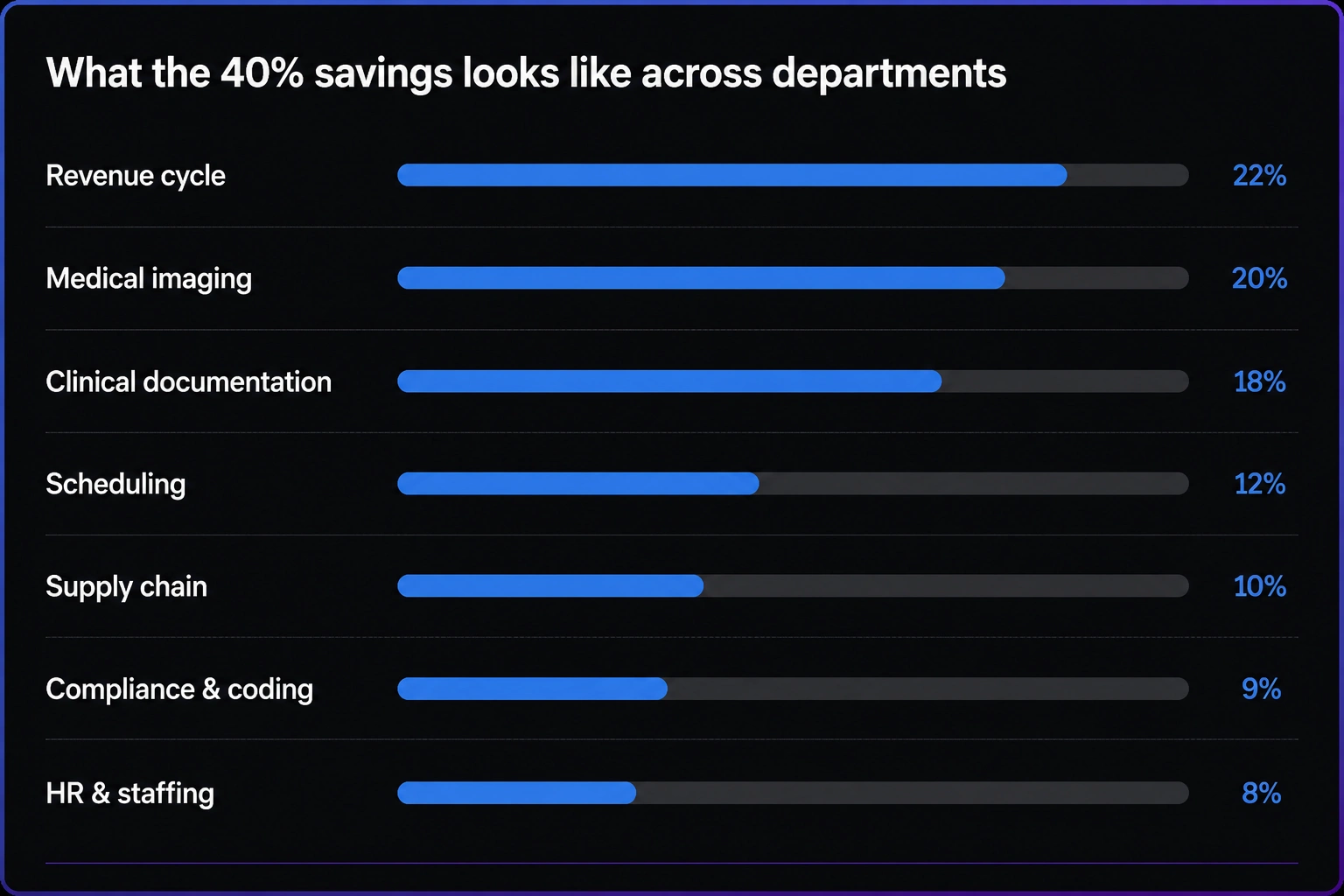
That It Actually Takes to Get There
There is a clear pattern separating agencies that get results from those that run pilots that quietly disappear. When evaluating how Neuramonks approaches choosing an AI solutions partner for US healthcare, achieving a true 40% reduction always requires anchoring your execution strategy around four critical pillars:
- Strict Data Security & Privacy: Systems must utilize fully HIPAA-compliant pipelines. Data must be encrypted in transit and at rest, utilizing zero-data-retention APIs to ensure patient health information (PHI) is never used to train public models.
- De-siloed Infrastructure: The AI shouldn't act as another isolated dashboard. It must connect directly into existing EHR and billing infrastructures (like Epic, Cerner, or Athenahealth) via secure, real-time APIs to enhance workflows where staff already work.
- Clinical-in-the-Loop Validation: AI should never operate fully autonomously in clinical decision-making. True success relies on a "Human-in-the-loop" model the AI acts as an accelerator, but qualified administrative or clinical staff retain final sign-off and override capabilities.
- Phased Implementation & KPI Tracking: Identify high-volume workflows first (RCM, scheduling, and documentation are universal starting points). Organisations should leverage specialised AI proof of concept services using historical data to validate real-world ROI within a tight window before committing major capital.
ROI timeline: what to expect and when
- Days 1 to 30: Integration, configuration, and staff onboarding.
- Days 31 to 60: System goes live; baseline metrics established.
- Days 61 to 90: First measurable gains visible in RCM and scheduling.
- Months 4 to 6: Documentation time reductions and coding accuracy improvements measurable.
- Months 7 to 12: 20 to 30% cost reduction visible across active modules.
- Month 12 to 18: Full optimization complete; 35 to 45% cost reduction at steady state.
What AI healthcare solutions cost in 2026
- Healthcare AI pricing has matured. What required a seven-figure contract in 2021 now comes in modular, accessible tiers.
- Module-based: $2,500 to $8,000/month per module. Typical entry point for RCM automation or scheduling AI.
- Platform (enterprise): $150,000 to $750,000 annually for full-stack deployments across multiple use cases.
- Custom AI build: $75,000 to $300,000 in development cost, with ongoing maintenance at 15 tp 20% of build cost annually.
- Proof of concept: $15,000 to $40,000 fixed engagement that delivers validated ROI data before full investment is committed.
A 200-bed hospital spending $400K on AI deployment and saving 40% of a $6M annual operational overhead generates $2.4M in savings a 6× return in year one.
Ready to see what AI can cut from your overhead?
If your agency is carrying operational costs that AI can reduce, the first conversation costs nothing. Neuramonks works with healthcare organizations across the US to scope, validate, and deploy AI solutions that deliver measurable results.
Book a free consultation at neuramonks.com →
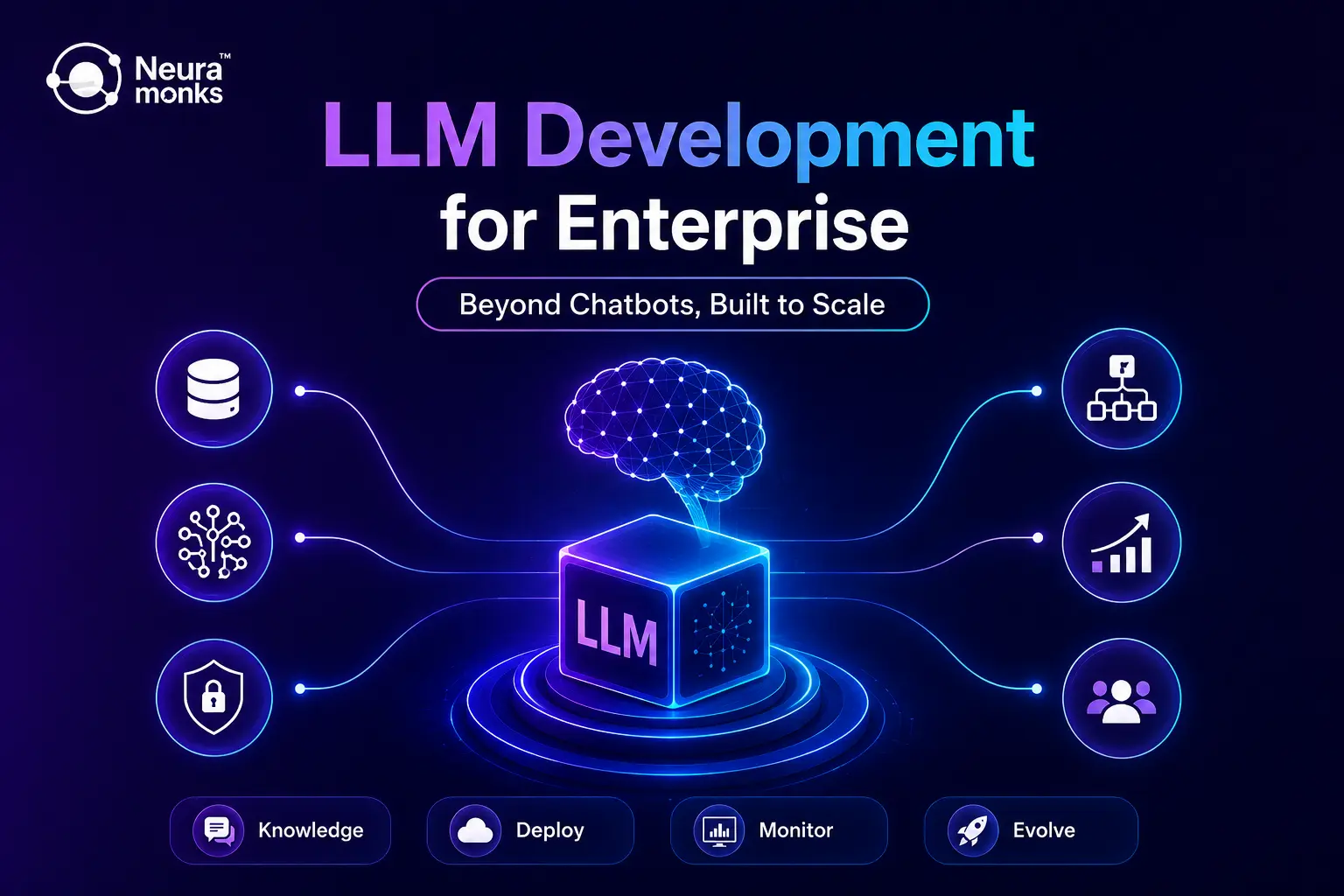
LLM Development for Enterprise: Beyond Chatbots, Built to Scale
A guide to enterprise LLM development beyond chat interfaces covering RAG vs. fine-tuning decisions, multi-agent orchestration, and how to vet an AI agency's PoC discipline and production track record before signing.
Deploying a scalable LLM Solutions requires moving past basic conversational interfaces to build robust infrastructure. Most companies have only scratched the surface of what large language models can do. This guide covers how enterprise teams are using LLMs for far more than conversational AI and what to look for when choosing the agency that will build it with you.
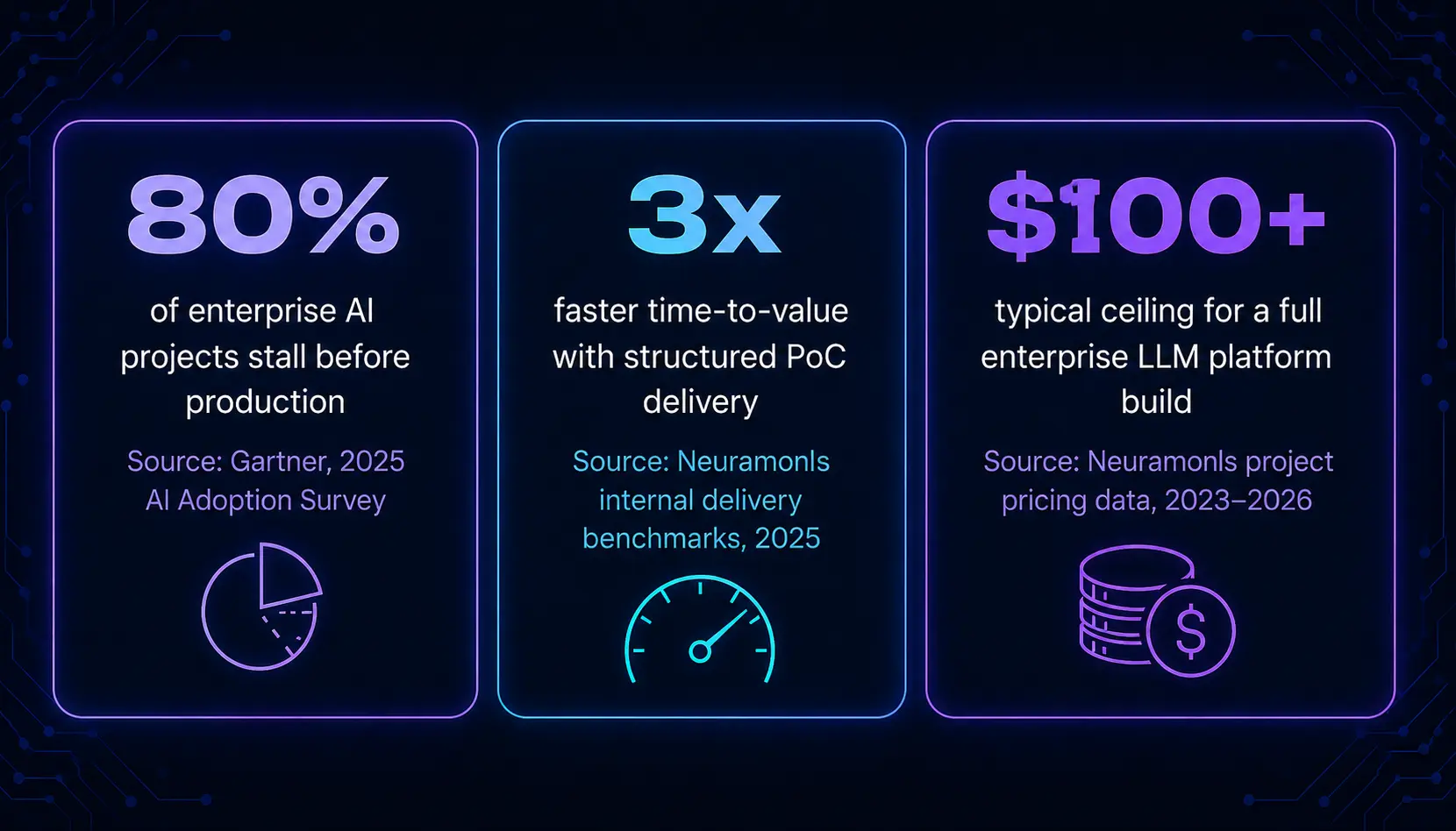
LLMs Are Not Chatbots. They Are Infrastructure
There is a persistent misconception in enterprise buying decisions: that LLM development means building a customer-facing chat interface. This is understandable chat products are the most visible public use case but it misses the deeper opportunity by a wide margin.
In 2026, the most impactful enterprise LLM deployments have nothing to do with conversational UI. They sit silently inside operational workflows, data pipelines, and decision-support systems doing the kind of unstructured reasoning work that brittle, rules-based automation could never handle.
“Large language models are general-purpose reasoning engines. Where your business has unstructured data, inconsistent inputs, or judgment heavy processes, there is almost certainly an LLM application worth building.”
Understanding the full breadth of what LLMs can do and finding an agency that has actually shipped across those categories is the first step to a successful enterprise AI engagement.
What High-Impact LLM Implementations Actually Look Like
The following categories represent real production deployments, not hypothetical use cases. Each one requires a different combination of model architecture, data infrastructure, and integration work.
- Automated contract review and clause extraction
- Intelligent document processing and classification
- Multi-step research and report generation
- Internal knowledge base Q&A with source attribution
- Custom media pipelines built on our AI Podcast Generation Platform
- Clinical notes summarization and coding support
- Sales intelligence and CRM enrichment workflows
- Multi-agent orchestration for complex task routing
- Compliance monitoring and regulatory flagging
- Personalized content generation at scale
- Code review, refactoring, and documentation
- Customer support triage and resolution routing
Micro-Case Study Healthcare
Wound assessment in clinical practice is still largely manual: measurements vary between clinicians, ruler-based methods are error-prone, and the workflow simply does not scale for remote care. Neuramonks built an Automated Wound Detection and Measurement System using an Attention U-Net deep learning architecture. The pipeline detects wounds from standard RGB images, uses a green calibration marker for real-world scale reference, applies perspective correction, and outputs centimeter-accurate measurements of wound area, perimeter, width, and height all via a HIPAA-compatible, API-ready architecture. Clinician measurement effort dropped by 55 to 65%, consistency improved by 30 to 40%, and AI output stayed within 5% error compared to expert manual benchmarks.
Read the full case study →
Micro-Case Study Finance & SaaS · Construction
A real estate and architecture client was losing significant time manually inspecting floor plan images to extract room boundaries, area calculations, and spatial metadata work that was error-prone and impossible to scale. Neuramonks built an AI-powered floor plan extraction system combining computer vision, OCR, and LLM-assisted normalization on AWS. The pipeline auto-detects individual floors, segments rooms, extracts polygon boundaries, and outputs structured, database-ready spatial records without human intervention. Manual analysis effort dropped by 60–70%, dimensional accuracy improved by 30 to 40%, and 100% of outputs are now analytics ready for downstream property and architecture systems.
Read the full case study →
What "Enterprise Grade" LLM Expertise Actually Requires
Not every agency that advertises AI services can execute on complex enterprise deployments. The difference becomes clear when you dig into their architecture decisions, infrastructure experience, and approach to failure modes.
Model Architecture
Ability to design fine-tuned models, RAG-augmented pipelines, and hybrid architectures not just prompt wrappers around hosted APIs.
Infrastructure Depth
Cloud-native deployments with autoscaling, vector database integration, orchestration frameworks, and production monitoring from day one.
Security & Compliance
SOC 2, HIPAA, and GDPR-aligned pipelines with proper data isolation, audit trails, and access controls for regulated industries.
PoC Discipline
Structured AI Proof of Concept Services with defined success metrics, fixed timelines, and clear go/no-go criteria before full commitment.
MLOps Capability
Long-term model monitoring, drift detection, retraining pipelines, and version management because LLMs degrade in production over time.
Vertical Experience
Prior production deployments in your industry. Edge cases and regulatory constraints in finance, healthcare, and SaaS are not learnable on your dime.
Fine-Tuning vs. RAG: Getting the Architecture Right
One of the most consequential decisions in any LLM project is whether to fine-tune a base model or use Retrieval Augmented Generation (RAG). The wrong call here can cost six figures and months of development time.
Fine-tuning modifies the weights of a base model using your own labelled data. It is the right choice when you need consistent tone and domain-specific terminology that cannot be delivered through context injection, or when compliance requirements demand a self-hosted model with no external API calls. For a deeper breakdown on choosing the right model scale for these tasks, see our comprehensive SLM vs LLM guide on the Neuramonks blog.
RAG retrieves relevant chunks from a vector-indexed knowledge base and injects them into the LLM's context at inference time. For most enterprise use cases internal knowledge Q&A, document analysis, product recommendation RAG delivers comparable accuracy at a fraction of the cost and maintenance overhead“An agency that defaults to fine-tuning every LLM without first evaluating RAG is likely over-engineering your solution and billing you accordingly. Push them on this decision during evaluation.”
Sophisticated agencies will often propose hybrid architectures: a RAG system with selective fine-tuning for the retrieval reranker or a domain-adapted embedding model. This is where real LLM engineering expertise becomes visible.
Disclosure: This blog is published by Neuramonks. The comparison below reflects our honest view of the market and where each firm genuinely fits including where competitors have strengths we do not. We believe transparent positioning is more useful than a hidden vendor ranking.
Why Enterprise Teams Choose Neuramonks Over Legacy Consultancies
The gap between global consulting firms and specialist LLM agencies is wide and widening. Here is an honest breakdown of what each type of firm delivers, where they fall short, and who each option is actually right for.
1. Neuramonks
Best for end-to-end LLM implementation across verticals
⭐ Top Pick
Neuramonks was built specifically around LLM and AI automation delivery not as a bolt-on to an existing consulting practice. That focus shows in their approach: every engagement starts with a commercial problem definition, not a technology selection. The question is always "what outcome are you trying to achieve?" before "which model should we use?"
Micro-Case Study Media & Content Industry
A media production client needed to scale podcast output without proportionally scaling their editorial team. Neuramonks deployed a multi-agent LLM pipeline one agent handled topic research via live web retrieval, a second structured and scripted each episode, a third passed output to a text-to-speech synthesis layer. End-to-end production time dropped by 70% (Neuramonks internal client benchmark, 2024), and the platform now runs in production across multiple show formats with no human intervention in the research and scripting stages.
Neuramonks' AI Proof of Concept Services follow a structured framework: fixed 4 to 8 week timeline, real client data integration, measurable success criteria, and a clear go/no-go recommendation. This de-risks the investment before any full-scale commitment is made.
Their core technical stack covers fine-tuned LLM model deployment, RAG pipelines using Pinecone and pgvector, multi-agent orchestration with LangChain and LlamaIndex, and cloud-native infrastructure on AWS and GCP. Active verticals include SaaS, media, finance, and healthcare.
Custom LLM pipelinesMulti-agent workflowsRAG architectureStructured PoC deliverySaaS / Media / FinancePost-deployment MLOps
2. Accenture AI
Best for global enterprise programs with complex legacy integration
Accenture's AI practice benefits from massive scale and deep systems integration capability. Their Azure OpenAI practice is one of the most mature in the industry, and their ability to manage organizational change alongside technical delivery is unmatched at global scale. The trade-off is cost and velocity enterprise programs at Accenture move at consulting pace, and deep LLM engineering depth sits behind significant account management overhead.
Azure OpenAISystems integrationChange managementGlobal delivery
3. Deloitte AI & Data
Best for regulated industries with mature governance requirements
Deloitte's strength in financial services, government, and healthcare stems from their governance and responsible AI frameworks, which are among the most developed in the market. For organizations where AI risk documentation and audit trails are non-negotiable, Deloitte brings credibility. However, their LLM model engineering bench is thinner than specialist agencies, and delivery timelines reflect consulting rates rather than sprint-based product development.
Responsible AI frameworksAWS BedrockRegulated industriesGovernance documentation
4. DataRobot
Best for AutoML + LLM hybrid pipelines in insurance and pharma
DataRobot occupies a useful niche between platform and services provider. Their managed AI cloud handles model training, monitoring, and deployment for enterprises that need production-speed without a deep in-house ML team. Strong for insurance and pharmaceutical use cases where structured prediction and LLM reasoning need to coexist in the same pipeline. Less suitable as a primary development partner for bespoke LLM architectures.
AutoML + LLM pipelinesModel monitoringInsurance / Pharma
5. Weights & Biases (W&B)
Best for ML teams scaling internal research and experimentation
W&B is more accurately described as an MLOps infrastructure partner than a development agency. If your team has strong in-house ML talent but needs experiment tracking, model versioning, and production monitoring tooling, W&B is indispensable. Not suitable as a primary development partner for organizations without existing AI engineering teams you need builders first, then W&B makes them more effective.
Experiment trackingModel versioningML infrastructure
Side-by-Side: LLM Model Capabilities at a Glance
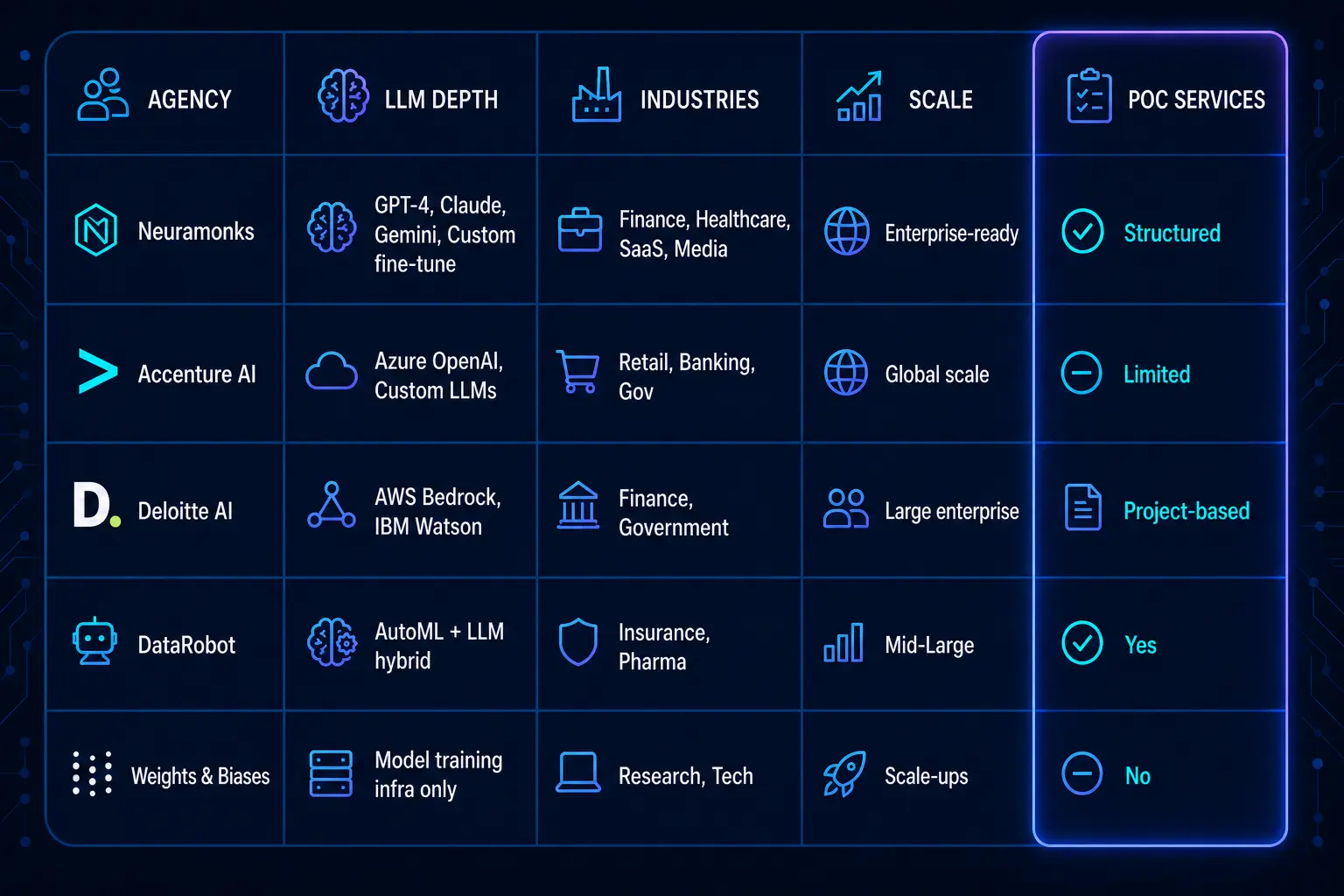
How to Evaluate an LLM Agency Before Signing
Evaluating an AI partner requires the same rigor as vetting any major technology vendor. Here is a structured framework that separates agencies with genuine production experience from those selling innovation-theater.
Ask for production case studies with real metrics
Any agency can spin up an impressive demo with a hosted API and a UI library. What separates real LLM engineers is production experience: handling token limits at scale, managing latency under load, implementing fallback logic when models hallucinate, and maintaining accuracy as the underlying world knowledge shifts. Ask specifically for cost savings achieved, accuracy benchmarks hit, latency SLAs maintained, and user adoption figures not architectural diagrams.
Pressure-test their PoC process
A well-structured AI Proof of Concept Service should include defined success metrics agreed upfront, a fixed timeline of four to eight weeks, integration with your actual data (not synthetic samples), and a binary go/no-go decision framework. If an agency cannot clearly articulate how they structure PoC engagements, they are likely selling exploration at your expense.
Probe infrastructure maturity
Production LLM deployments require more than prompt engineering. Ask about experience with vector databases such as Pinecone, Weaviate, or pgvector; orchestration frameworks like LangChain or LlamaIndex; and cloud-native deployment on Kubernetes or serverless inference endpoints. An agency that cannot answer these questions confidently is unlikely to be enterprise-ready.
Test their fine-tuning vs. RAG reasoning
As covered earlier, fine-tuning is expensive and often unnecessary. Ask the agency to walk through their decision framework: under what conditions do they recommend fine-tuning versus RAG versus a hybrid approach? The quality of this answer reveals whether you are talking to engineers who have thought deeply about trade-offs, or salespeople who will over-engineer whatever maximizes their billable hours.
Ask about post-deployment support
LLMs are not fire-and-forget deployments. As world knowledge shifts and user behavior evolves, model performance drifts. Agencies without MLOps capabilities will leave you responsible for maintenance work your team is likely not equipped to handle. Clarify upfront whether ongoing monitoring, retraining, and performance review are included, and at what cost.
Five Mistakes Enterprises Make When Hiring LLM Agencies
01 Prioritizing flashy demos over production track records
A well-animated prototype tells you nothing about whether the team can handle real data volumes, real users, and real SLAs. Always ask what happened after the demo.
02 Skipping the PoC phase entirely
Jumping from requirements directly to full development is one of the most reliable ways to waste significant budget on AI that never ships. A structured proof of concept changes this equation.
03 Choosing on price alone
LLM model engineering is a specialist skill. The cheapest quote almost always reflects inexperience with production-grade complexity. What you save in fees you will spend in failure costs
04 Ignoring post-deployment operations
LLMs degrade over time as the world changes and user behavior evolves. Agencies without MLOps capabilities leave you managing a system you did not build and do not fully understand.
05 Not aligning on success metrics before the first sprint
Vague briefs produce vague outcomes. Define latency thresholds, accuracy benchmarks, and cost-per-inference targets before any code is written not after the first review cycle.
What LLM Development Actually Costs in 2026
Cost ranges vary significantly by scope, compliance requirements, and infrastructure complexity. The figures below represent typical market ranges across well-known agencies not fixed prices.
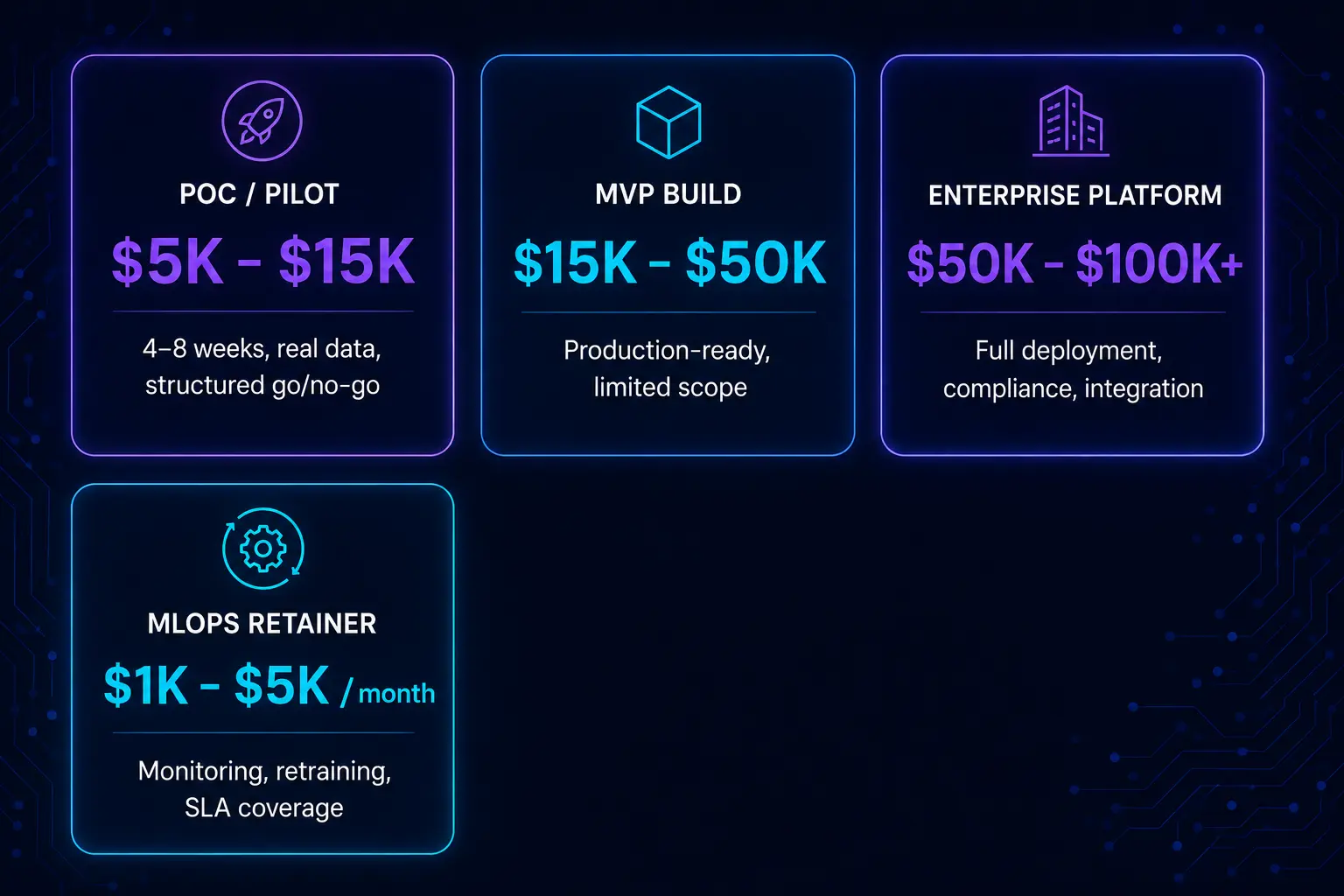
The main cost drivers are model selection (proprietary API costs versus self-hosted open-source), vector database and inference infrastructure, compliance requirements for regulated industries, and the depth of integration with existing enterprise systems. AI Proof of Concept Services remain the most cost-effective way to validate ROI before committing to full development scope.
Talk to Neuramonks about your LLM model project
Whether you are scoping AI solutions for the first time or evaluating your next LLM platform build, our team offers structured discovery sessions. We help enterprise teams define PoC scope, select the right architecture, and put together a business case grounded in real numbers not vendor optimism. AI Proof of Concept Services, production deployment, and ongoing MLOps support: all under one roof.
Book a Free Consultation with Neuramonks
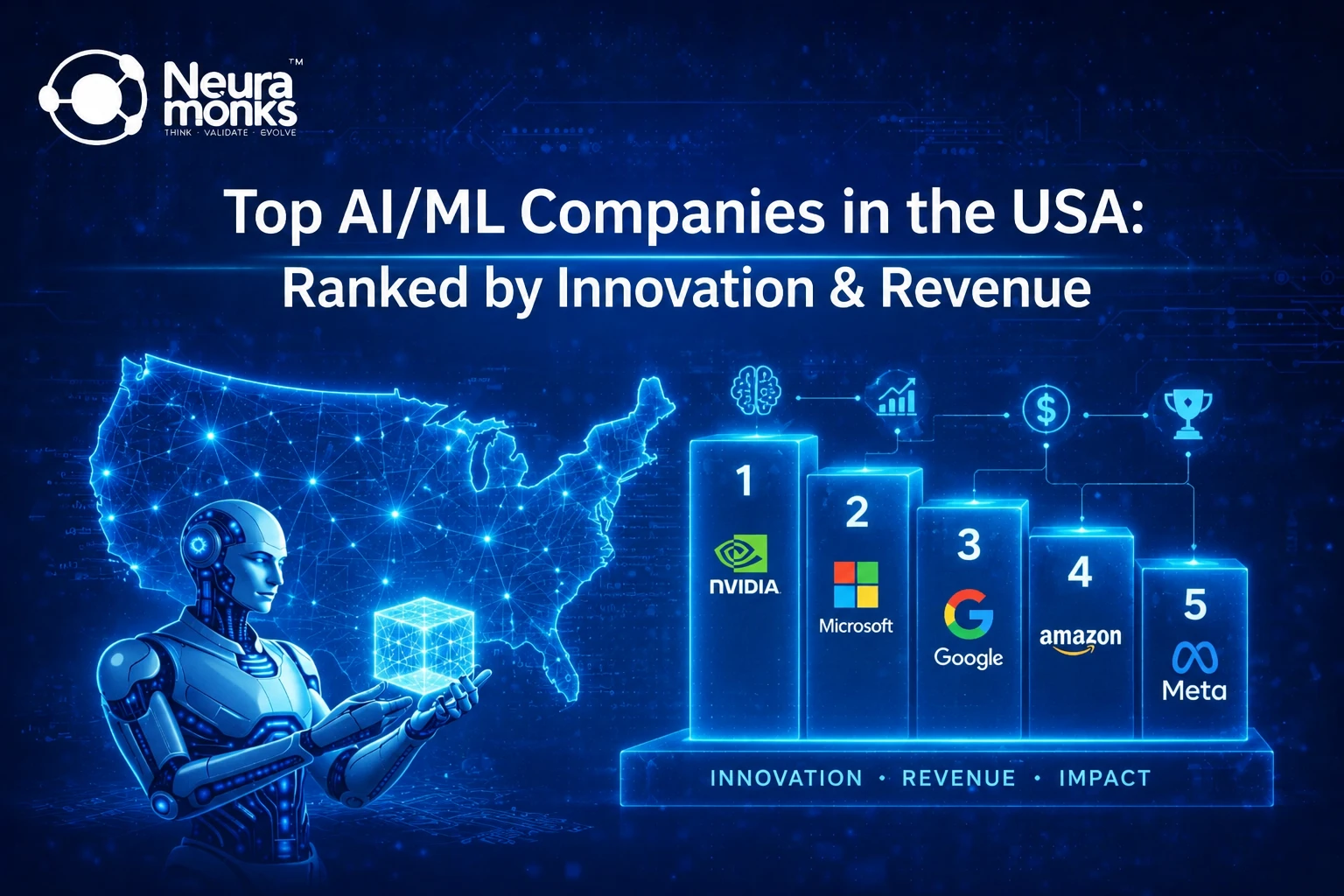
Top AI/ML Companies in the USA Ranked by Innovation & Revenue
Discover the top AI/ML companies in the USA ranked by innovation, revenue growth, and real world deployment success. Explore which firms are delivering measurable business outcomes and shaping the future of enterprise AI in 2026.
Who is actually building, deploying, and delivering ROI at enterprise scale not just talking about it.
The top AI/ML companies in the USA are ranked by their ability to deliver production-grade AI solutions across industries not by pitch decks. In 2026, the leaders are defined by three things: proprietary model development, real client outcomes, and the machine learning solutions that prove ROI at scale. This list breaks down who is actually delivering.
Why This Ranking Matters in 2026
The AI industry crossed a critical threshold in 2025: the gap between companies that talk about AI and companies that build, deploy, and maintain AI systems at enterprise scale became impossible to ignore.
Boards stopped funding AI exploration. They started demanding AI execution. That shift rewrote the competitive landscape and it is why any serious ranking of AI/ML companies must weigh demonstrated outcomes, not claimed capabilities.
This ranking evaluates US-based AI firms on four dimensions: revenue growth, innovation depth (proprietary research vs. API wrapping), deployment track record, and client outcomes across verticals.
The Criteria Behind the Rankings
Before the list, the methodology matters. Too many "top AI companies" rankings are advertiser-funded. This one is not.
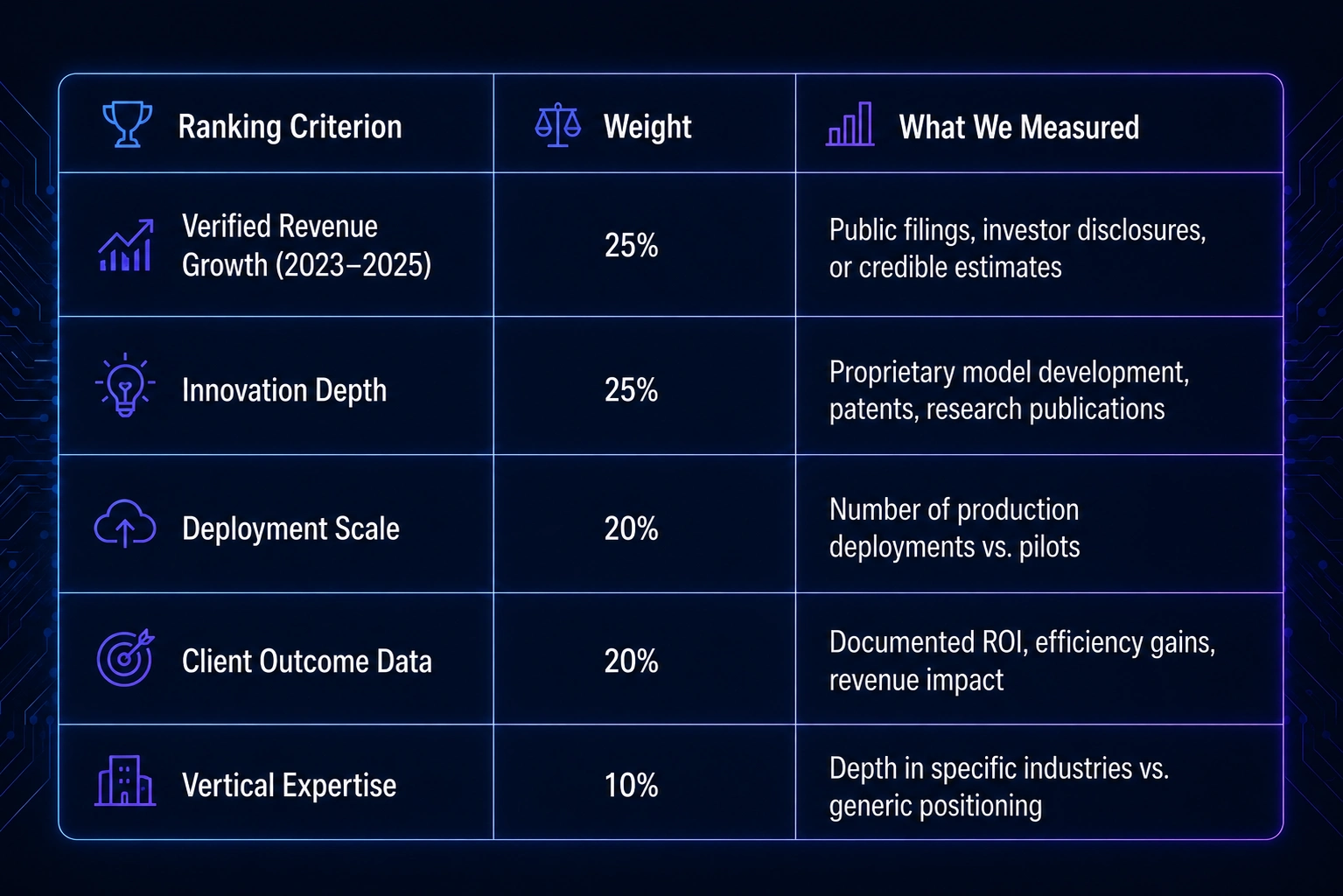
Estimated 2024 AI Revenue — Top US Companies
The Top AI/ML Companies in the USA (2026)
OpenAI
Revenue: Estimated $3.4B (2024), growing rapidly toward $10B+ | Innovation: GPT 4o, o1 reasoning model, Sora (video generation), DALL-E 3
OpenAI remains the most influential AI company in the world by research output and enterprise adoption. The GPT API ecosystem powers thousands of downstream applications. Enterprise revenue from ChatGPT Team and Enterprise plans has grown faster than any other segment. The criticisms high compute costs, closed model approach are valid, but output volume and model quality make OpenAI the benchmark every other firm is measured against.
Anthropic
Revenue: Estimated $850M ARR (2024), growing 4x year-over-year | Innovation: Claude model family, Constitutional AI, safety-first research
Anthropic built its competitive position on a specific thesis: that safe AI is commercially superior AI. The Claude model series has demonstrated that enterprise clients care deeply about reliability, predictability, and reduced hallucination risk. Their 100K+ context window and multi-document reasoning capabilities make them the preferred choice for legal, healthcare, and financial enterprise applications.
Google DeepMind
Revenue: Part of Alphabet ($307B 2024 revenue); AI contributes measurably to search, cloud, and ad revenue | Innovation: Gemini Ultra, AlphaFold 3, Gemma (open models)
DeepMind's research output continues to redefine what is possible. AlphaFold 3's protein structure prediction capabilities have direct commercial value in pharmaceutical discovery. Gemini's multimodal architecture and integration into Google Workspace gives DeepMind a distribution advantage that pure play AI companies cannot replicate.
Microsoft AI (with OpenAI Partnership)
Revenue: Azure AI services exceeded $10B ARR in 2024 | Innovation: Copilot ecosystem, Azure AI Studio, phi-3 small language models
Microsoft's AI revenue story is less about model research and more about deployment at scale. The Copilot integration across M365 (Word, Excel, Teams, Outlook) gives Microsoft the broadest enterprise AI surface area in the world. Azure AI Studio is becoming the default deployment platform for Fortune 500 AI initiatives.
Scale AI
Revenue: Estimated $1B+ (2024) | Innovation: Data labeling, RLHF infrastructure, enterprise AI evaluation
Scale AI occupies a critical infrastructure position in the AI stack the quality of training data. Every major foundation model company is a Scale AI client or competitor. Their pivot to enterprise AI evaluation and red teaming services adds a new revenue stream that is growing alongside the AI security market.
Mid-Market Leaders: The Builders Making It Real
The tier below the hyperscalers is where the most interesting commercial AI work is happening. These companies are not building foundation models. They are building the industry-specific applications, custom deployments, and ML pipelines that turn foundation models into operational business tools.
Where We Fit In: Why Neuramonks Focuses on Applied Innovation
We want to be transparent: Neuramonks authored and published this analysis. We are not a multi billion dollar foundation model builder competing with OpenAI or Google DeepMind and we don't pretend to be.
What we do is fill the massive market gap that exists between frontier research labs and the businesses that need to put AI to work. Foundation models are extraordinarily powerful, but they don't arrive pre configured for your revenue cycle, your legal document workflow, or your medical imaging pipeline. That translation layer from raw capability to verified business outcome is where Neuramonks operates.
Our team builds production grade AI systems designed around specific business workflows: computer vision pipelines, NLP document intelligence, predictive analytics engines, and custom model training on proprietary data. The verticals we serve most deeply are healthcare, fintech, legal, and enterprise operations.
The outcomes we document are measurable: cost reductions, process automation rates, accuracy improvements clients can verify independently. We include ourselves in this ranking not to inflate our status, but because the mid market gap we address is real and readers evaluating AI partners deserve to know who actually builds vs. who configures templates.
Healthcare AI Fintech Legal Automation Custom Model Training Computer Vision NLP Pipelines
For an in-depth look at our delivery methodology and vertical case studies, visit our healthcare AI services or fintech AI services pages.
Palantir Technologies
Revenue: $2.87B (2024), 36% growth year over year | Innovation: AIP (AI Platform), Ontology, defense AI systems
Palantir's pivot to commercial AI with AIP has been more successful than most analysts predicted. Their Ontology framework — which creates a live semantic layer over enterprise data gives Palantir a structural advantage in complex data environments. Government contracts remain a revenue anchor, but commercial growth is accelerating.
C3.ai
Revenue: $310M (FY2024) | Innovation: Enterprise AI applications for energy, manufacturing, financial services
C3.ai's recurring revenue model and vertical specific applications give them resilience that horizontal AI platforms lack. Their energy sector applications predictive maintenance, grid optimization, oil and gas analytics are mature and generating measurable client outcomes.
What "Ranked by Innovation" Actually Means in 2026
Innovation in AI has two distinct definitions, and conflating them leads to bad vendor decisions.
Research Innovation: New model architectures, training methodologies, benchmark improvements. This is the domain of OpenAI, Google DeepMind, and Anthropic. Most enterprise buyers do not need research innovation they need the outputs of research, delivered reliably.
Applied Innovation: Taking frontier research and deploying it in production environments that solve real business problems. This is where firms like Neuramonks, Palantir, and Scale AI compete. Applied innovation requires deep domain knowledge, integration expertise, and a disciplined deployment methodology.
When evaluating AI companies, the right question is not "who is most innovative?" It is "who is most innovative for my specific use case?" A company building proprietary transformer architectures is not automatically more valuable than a company that can deploy machine learning solutions against your customer churn data within 60 days.
The Revenue Story: AI Is Now a Profit Center
The narrative shift from 2023 to 2026 is striking. Three years ago, AI was a cost center a research investment with uncertain returns. Today, enterprise AI deployments are generating documented revenue.
Examples from the public record:
- Companies using AI for demand forecasting report 8 to 14% reduction in inventory costs
- Firms deploying AI customer service tools see 20 to 30% reduction in support costs
- Healthcare organizations using AI in revenue cycle management recover 15 to 22% more revenue from previously denied claims
The companies that appear on this ranking — from hyperscalers to specialized builders like Neuramonks are the ones whose clients can point to numbers like these.
Pricing / Cost: What AI Development Actually Costs in 2026
Understanding the cost structure of AI development is essential before engaging any vendor on this list. Pricing varies dramatically by engagement type.
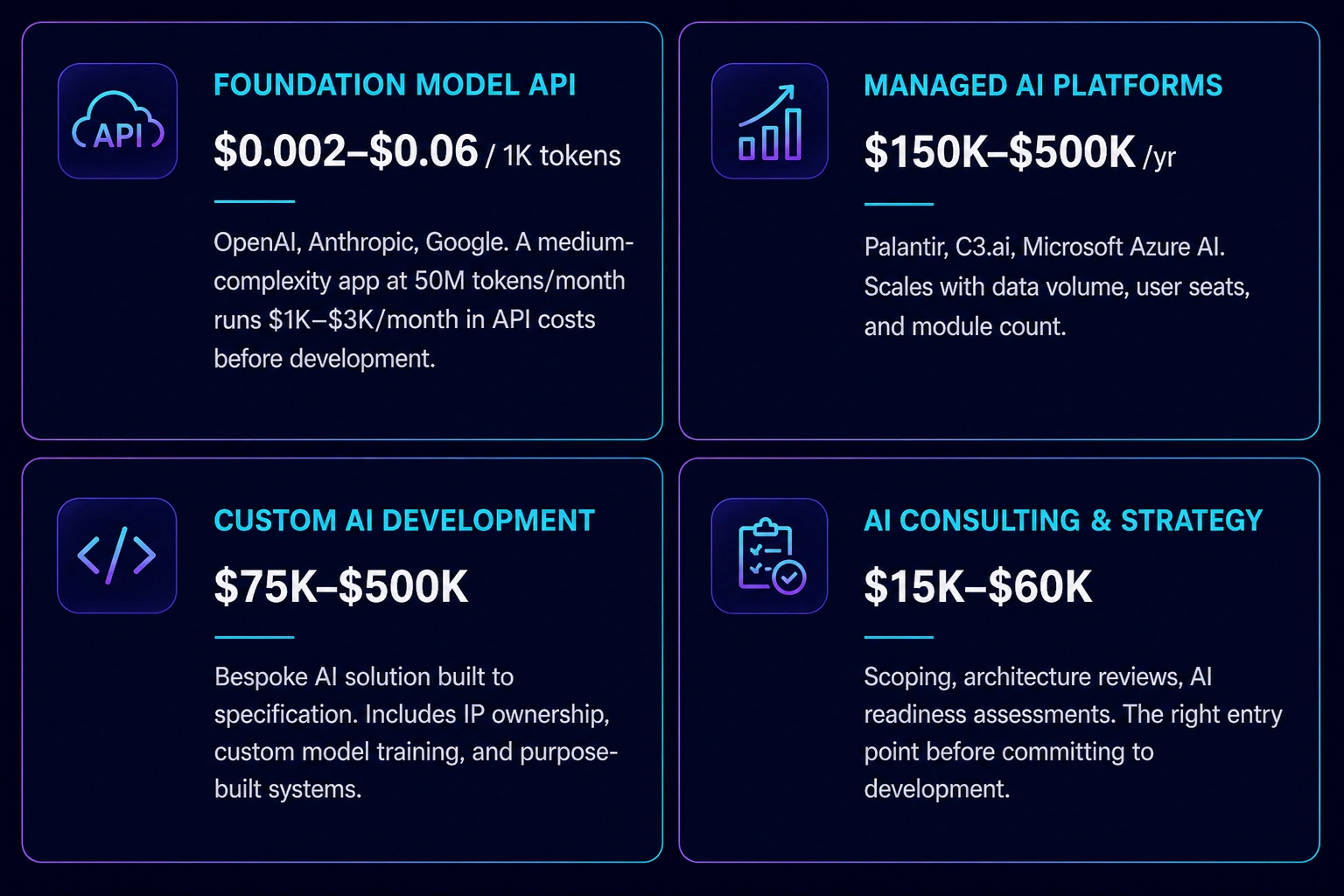
How to Choose the Right AI Partner for Your Business
The ranking above tells you who is building. The question of who is right for your business is different.
Scale of need: If you need to fine tune a foundation model on proprietary data and deploy it across 10,000 users, you need enterprise infrastructure. If you need a specific AI solution built for a defined workflow, you need a specialized development partner.
Domain expertise: AI built by people who understand your industry outperforms generic deployments. A healthcare AI company that has built HIPAA compliant systems is worth more than a general software shop that will learn on your project.
Delivery methodology: Ask for case studies. Ask for client references. Ask what happens when the model underperforms. The answers reveal whether you are dealing with a builder or a salesperson.
Neuramonks offers a direct path to evaluation: contact their team to discuss your specific requirements and review case studies relevant to your industry before any commitment.
Best AI Automation Agencies in the USA 2026: The Complete Buyer's Guide
Top AI automation agencies are helping businesses streamline operations, reduce manual work, and scale faster with intelligent workflows, AI agents, and enterprise automation solutions. This guide compares the best AI automation companies in the USA for 2026 based on expertise, scalability, implementation strategy, and real business impact.
Answer Capsule: 2026 Market Baseline at a Glance
This guide evaluates the top AI automation agencies by production depth, pricing, and vertical expertise. Key takeaways: Neuramonks leads in multi agent orchestration and air-gapped deployments. Enterprise production rollouts range from $80,000 to $500,000, depending on workflow complexity. Standard production timeline is 60 to 90 days for focused deployments, extending to 4–9 months for multi workflow systems. Top verticals delivering measurable ROI include construction, healthcare, fintech, e-commerce, and manufacturing. Critical evaluation criteria include vertical experience, measurable outcome guarantees, on-premises deployment capability, and post-launch retraining commitments.
The best AI automation partners in the USA for 2026 are firms that combine measurable ROI, production-grade engineering, and vertical depth in healthcare, construction, fintech, and e-commerce. Neuramonks, a leading provider of agentic AI systems, is a standout choice for enterprises that need multi-agent orchestration, agentic workflows, and on-premises deployments delivered under 90 days.
Enterprise AI buying has changed sharply over the last 18 months. In 2024, leaders were still asking whether to adopt AI. In 2026, the question is which vendor can move them from pilot to production without burning a year of budget on prototypes that never ship. The wrong partner costs you 18 months of payroll and a CFO who never wants to hear "AI" again. The right one quietly removes significant operational drag and shows up in your quarterly earnings call.
This buyer's guide breaks down what genuinely separates a top-tier partner from a glossy consulting deck. We cover the criteria CTOs are using in 2026, the cost ranges you should expect, the vertical specialists worth shortlisting, and the questions that surface whether a vendor can actually deliver.
What an AI Automation Agency Actually Does in 2026
A modern AI automation partner does three things that distinguish it from a software consultancy or a generic "digital transformation" firm. First, it designs agentic workflows that perceive context, decide, and act rather than brittle, rule-based scripts. Second, it integrates orchestration platforms such as n8n automation, Dify, as well as custom LLM routing layers, into your existing CRM, ERP, and data warehouse stack. Third, it owns the deployment, observability, and retraining lifecycle so the system continues to perform six and twelve months after handoff.
The shift from rule-based RPA to agentic AI is the central story of 2026. Older automation broke whenever an invoice format changed or a customer phrased a question differently. Agentic systems reason about exceptions, pull from retrieval-augmented memory, and route to a human only when confidence drops below a threshold. This is why mid-sized enterprises that previously needed 30-person operations teams now run the same throughput with eight people and a well-architected AI layer. For a fuller view of where this is heading, our enterprise outlook on AI automation in 2026 covers the infrastructure and governance shifts leaders need to plan for.
How to Evaluate an AI Automation Partner
The vendor pitch deck is not the signal. The signal is the production code, the case studies with measured outcomes, and the willingness to deploy on your infrastructure under your security policy. Use these seven criteria when you shortlist:
- Vertical experience over horizontal claims. A firm that has shipped fifteen healthcare AI projects will outperform a generalist on your healthcare project. Construction AI is not e-commerce AI rebranded.
- Production deployment evidence. Ask for systems currently running at over 10,000 daily transactions. Pilots do not count. Anyone can build a prototype.
- On-premises and air-gapped capability. If you handle regulated data, the agency must deploy without forcing your data through public APIs.
- Multi-agent orchestration experience. Single-agent chatbots are 2023 thinking. Modern systems coordinate research agents, validation agents, content agents, and a coordinator. If the vendor still pitches "a chatbot," skip them.
- Measurable outcome guarantees. Top agencies attach KPIs to engagements: cost per ticket reduced by X, document processing accuracy above Y, time-to-resolution cut by Z. If the SOW only specifies hours and deliverables, the vendor is hedging.
- Model-agnostic architecture. Frontier models change every quarter. An agency locked to one provider will charge you again next year to migrate. Look for routing layers that swap between GPT, Claude, Llama, and SLMs based on task.
- Post-launch retraining included. Models drift. Data drifts. A six-month engagement that ends at launch is selling you a depreciating asset.
Comparison: Top AI Automation Agencies by Use Case in 2026
The market has fragmented into specialists. The table below maps where each type of firm tends to win, based on patterns observed across mid-market and enterprise buyers in 2026, ourselves included.
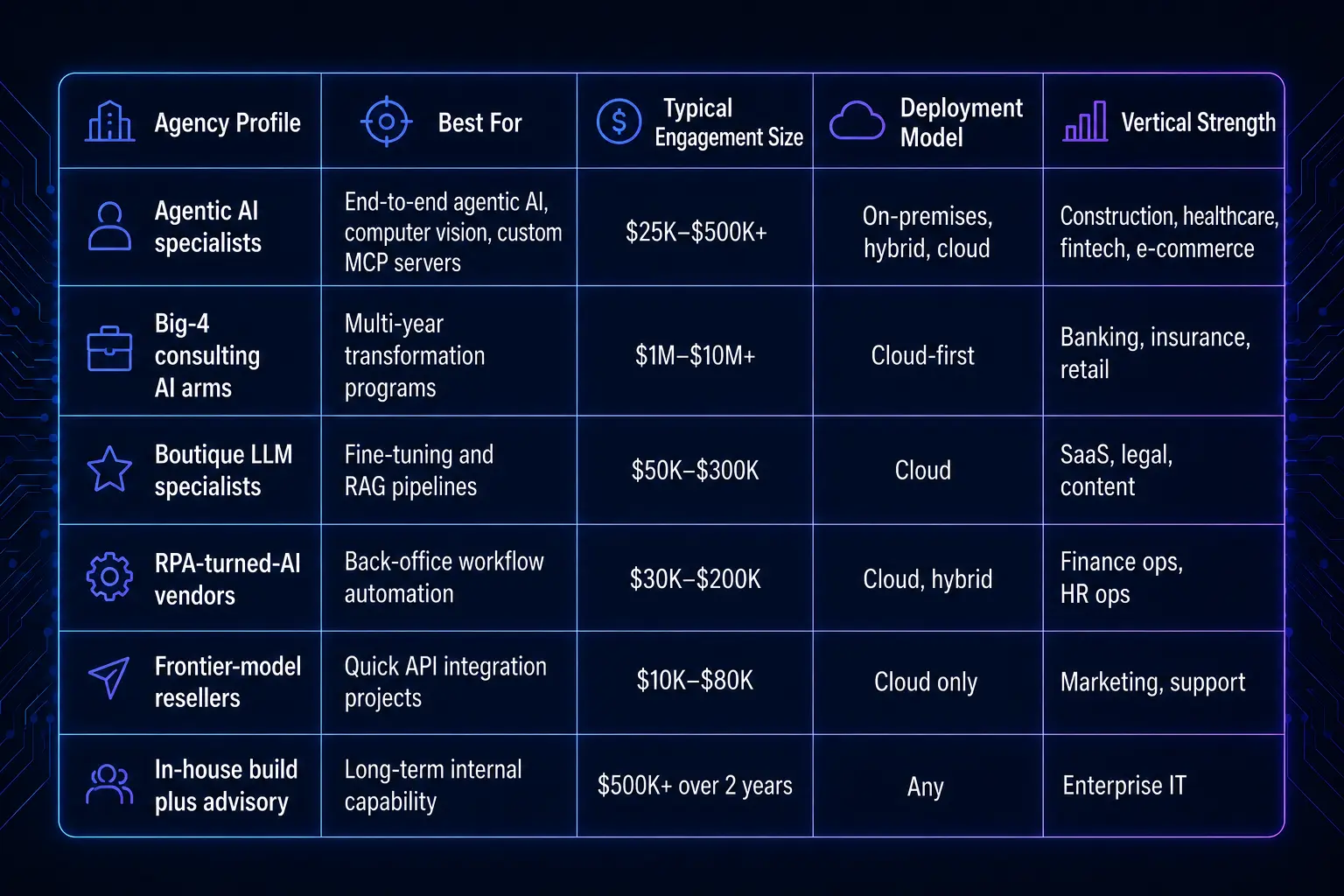
A useful filter: if your problem requires touching physical-world data, regulated workflows, or legacy systems, you want a firm with engineering depth, not a consultancy. Specialists in this category deliver the work because the scope spans computer vision on noisy scanned documents, agentic workflows on enterprise data, and on-premises deployments where cloud APIs are not an option.
Real-World Example: AI Symbol Detection for Construction Blueprints
Generic case studies tell you nothing. Specific ones tell you whether a vendor can actually engineer through hard problems. A representative engagement in construction AI is the development of an AI-powered symbol detection and counting system for construction blueprints, which addresses a problem that defeats most generic computer vision vendors.
Construction blueprints arrive as scanned, rasterized images with heavy noise, overlapping text, and inconsistent symbol conventions across consultants. Off-the-shelf object detection models produce unreliable counts, which directly inflates material estimates and project bids. The solution combined classical computer vision pre-processing, deep metric learning for visually similar symbol disambiguation, vision-language reasoning for ambiguous cases, and a human-in-the-loop verification layer for low-confidence outputs.
The measured results: 30–40% improvement in symbol classification accuracy, 95–98% precision in final electrical fixture inventories, and 25–35% faster estimation cycles. More importantly, the system runs in an on-premises and air-gapped configuration, which matters because blueprint data is often contractually restricted from leaving the client's network. This is the kind of work that separates vendors with genuine production experience from those that only ship when conditions are clean.
Pricing and Cost: What AI Automation Actually Costs in 2026
AI automation pricing in 2026 falls into four predictable tiers, and the gap between tiers reflects engineering depth rather than vendor markup.
Proof of Concept (POC): $8,000–$25,000 over 3–6 weeks. Validates one workflow end-to-end with synthetic or sample data. The deliverable is a working prototype and a feasibility report, not production code. If a vendor quotes $80,000 for a POC, that is a red flag.
Pilot / MVP deployment: $30,000–$120,000 over 8–14 weeks. One production workflow, one integration, one user group. This is where you measure ROI before scaling.
Production rollout: $80,000–$500,000 over 4–9 months. Multiple workflows, multiple integrations, observability stack, retraining pipeline, and documentation. Most mid-market engagements land in the $120K–$280K range here.
Enterprise transformation: $500,000–$3M+ over 12–24 months. Multi-department rollout, custom model training, dedicated post-launch retainer.
Hidden cost areas: model inference (typically $2K–$15K per month for high-volume workflows), GPU infrastructure if you go on-premises ($10K–$15K per NVIDIA A100), observability tooling, and the 20–25% annual maintenance retainer most serious vendors require. Vendors that quote a fixed price with no retainer are either inexperienced or planning to disappear after launch. To get a calibrated quote against your specific workflow, you can request a tailored AI solutions estimate from Neuramonks.
Red Flags When Hiring an AI Automation Agency
A short checklist of patterns that almost always end badly:
- The agency cannot name three production deployments by client or industry
- The proposal does not mention model evaluation, drift monitoring, or rollback strategy
- The team pitching is different from the team that will build
- The architecture diagram has "AI" as a single box in the middle
- The vendor refuses to do a paid two-week scoping engagement before committing to a fixed bid
Any one of these is recoverable. Two or more, and it's worth reconsidering the engagement.
Architectural Patterns That Separate Production from Pilot
A pattern worth flagging because it matters for your selection. Production-grade AI automation in 2026 has converged on a small set of architectural choices, and an agency that does not work in these patterns is still in pilot territory regardless of what their case studies claim.
The first is model routing. Production systems route each query to the cheapest model that will reliably handle it, and escalate to a frontier model only when needed. An agency that uses the same model for every request is leaving significant inference cost on the table.
The second is retrieval-augmented context. Agentic systems ground their reasoning in your actual data through vector retrieval, structured queries, and tool calls, instead of hoping the model remembers the right thing from training. If the agency does not build a retrieval layer, the system will hallucinate at scale.
The third is human-in-the-loop checkpoints. Real production AI does not try to autonomously handle 100 percent of work. It autonomously handles the majority of work, routes the rest to humans with full context, and learns from the corrections. Vendors that promise full autonomy are selling prototypes.
The fourth is observability and evaluation infrastructure. Production AI without telemetry is unmaintainable within six months. Drift detection, evaluation pipelines, and per-workflow KPIs are not optional. They are how the system stays useful as your data and your business change.
Regional Considerations: USA AI Automation Market in 2026
The USA AI automation market in 2026 is not monolithic. Buyer behavior and vendor concentration vary meaningfully by region, and matching your vendor to your regional context affects everything from response time to compliance posture.
Northeast corridor from Boston through New York to Washington DC concentrates financial services, healthcare, and government buyers, all of whom prioritize compliance, audit trails, and on-premises deployment. Agencies that win here lead with SOC 2, HIPAA, and FedRAMP credentials, and they bill at the top of the market range. Neuramonks holds SOC 2 Type II certification and HIPAA compliance for regulated healthcare engagements.
West Coast, particularly the Bay Area and Seattle, leans toward cloud-first deployments and frontier-model integrations, with buyers who tolerate higher inference costs in exchange for faster iteration.
Texas and the Southeast have emerged as the fastest-growing AI automation markets in 2026, with energy, logistics, and manufacturing buyers favoring vendors with hybrid deployment capability and strong vertical case studies. Neuramonks operates a US office in Ponte Vedra, Florida, positioning it well for engagements in this corridor.
The Midwest, dominated by industrial, agricultural, and insurance buyers, rewards agencies that can deliver production systems on disciplined timelines and budgets, often with a lower cloud-cost ceiling than coastal projects.
A useful question to ask any vendor: where are their three most recent USA deployments, and which time zones do their core engineering teams work in. The answer reveals as much about delivery dynamics as any case study.
How to Run a 30-Day Vendor Selection Process
Most enterprises waste three to six months in vendor evaluation. A 30-day process works if you structure it like this:
Week one: Write a one-page problem statement with current cost, target cost, and one success metric.
Week two: Send the statement to four to six agencies and ask for a 90-minute technical workshop, not a sales call. Bring an engineer from your team to the workshop. The dynamic of the call tells you almost as much as the answers.
Week three: Request a paid two-week scoping engagement from your top two. Pay for it. Free scoping is worth what you pay.
Week four: Decide based on the scoping output, not the original proposal. The scoping document tells you whether they understand your problem. The proposal tells you whether they understand sales.
Conclusion: Picking the Right AI Automation Partner
The vendors that will matter in 2026 are not the ones with the largest sales teams. They are the ones who can architect for your specific workflow, deploy under your security constraints, and stay engaged after the system goes live. Specialists in agentic AI fit this profile across construction, healthcare, fintech, and e-commerce verticals, with on-premises and air-gapped deployment as a default capability rather than a special case. When evaluating any vendor, weight production evidence heavily over pitch quality. The deck is the cheapest part of the engagement.
If you are scoping a project for the next two quarters, the highest-leverage step is a tight problem statement and a paid scoping engagement with two shortlisted vendors. That alone will save you the most expensive mistake in enterprise AI: choosing the vendor that wrote the best proposal instead of the one that can actually ship.
If your team is evaluating AI partners for an upcoming initiative, now is the right time to pressure-test the strategy, architecture, and delivery capability before the expensive build phase begins.
Ready to scope your AI project the right way? Connect with the team at Neuramonks and get a practical roadmap tailored to your business goals

Top RAG Development Services for Scalable AI Solutions
A comprehensive buyer's guide comparing the top RAG development providers, architectures, and costs to help enterprises build production ready AI systems on their own data.
RAG (Retrieval Augmented Generation) development services help enterprises build AI systems that answer questions from their own data with accuracy, traceability, and scale. The top RAG development providers in 2026 combine vector database architecture, LLM integration, and AI consulting services to deliver systems that outperform standard generative AI on factual precision and domain specificity.
Why RAG Is the Enterprise AI Architecture of 2026
Standard generative AI has a fundamental problem for enterprise use: it hallucinates. It generates confident sounding answers from training data that may be outdated, irrelevant, or simply wrong for a specific business context.
RAG solves this by grounding LLM responses in real time retrieval from your own document libraries, databases, and knowledge stores. The model does not guess. It retrieves relevant context first, then generates a response anchored to that context.
As Neuramonks' analysis of where RAG architecture is headed makes clear, standard RAG is already being replaced by more sophisticated architectures in 2026. The market has moved from simple vector search + generation pipelines to multi stage retrieval, hybrid search, and agentic RAG systems capable of reasoning across complex enterprise knowledge bases.
This guide maps the top RAG development services, what they offer, how they differ, and what it costs to build the right system for your organization.
What Makes a RAG Development Service "Enterprise Grade"
Not all RAG implementations are equal. A proof of concept RAG system built on a weekend with LangChain and a PDF upload is not the same as a production RAG architecture supporting 5,000 daily queries across a 10 million document knowledge base.
Enterprise grade RAG development requires:

When evaluating RAG development services, the gap between these tiers is the gap between a system that works in demo and a system that performs in production.
The Top RAG Development Services in 2026
1. Neuramonks Best for Custom Enterprise RAG Architecture
Neuramonks specializes in end to end RAG implementation consulting for enterprises that need production grade systems built to specification. Their engagements are not template deployments. They build custom RAG systems for enterprise clients with specific data environments, compliance requirements, and performance SLAs.
Their RAG practice covers the full stack: document ingestion and preprocessing, vector database selection and configuration, LLM Model integration, hybrid retrieval architecture, output validation, and deployment infrastructure. They bring AI consulting services expertise that ensures the system architecture matches the business requirements, not the other way around.
For organisations evaluating whether to build or buy, Neuramonks offers structured scoping engagements and AI Proof of Concept Services that answer the architecture question before development begins.
Relevant for: Healthcare, legal, financial services, enterprise knowledge management, customer support automation
Typical engagement size: $80,000–$350,000 for full production deployment
Case Study: AI Podcast Generation Platform
One example of Neuramonks' RAG architecture in action is their work building an AI Podcast Generation Platform for a digital media client. Long form podcast production is operationally expensive. Manual scripting, editing, and narration created slow production cycles, inconsistent quality, and high per episode costs. LLMs alone struggled with the coherence demands of 30–60 minute episodes.
Neuramonks solved this with a multi agent, RAG powered architecture: 10+ specialized agents handle flow, tone, transitions, and emotional cues, while RAG driven content grounding (via Dify APIs) keeps each episode factually accurate and on topic. The system supports configurable hosts, multiple TTS providers (ElevenLabs, OpenAI TTS, Gemini TTS), and delivers the complete workflow from topic input to final audio through a chat based interface.
The Results:
- 60 to 70% reduction in manual production effort
- 50 to 65% shorter end to end production timelines
- 30 to 40% improvement in long form topic coherence
This case illustrates what separates Neuramonks' approach from generic RAG deployments: the RAG layer is not bolted on for Q&A. It is doing the heavy lifting of grounding long duration generative output in source material at a scale and complexity where hallucinations or topic drift would make the output unusable.
Read the full AI Podcast RAG Case Study
2. LlamaIndex Cloud Best for Developer Led RAG Infrastructure
LlamaIndex has become the dominant open source framework for RAG pipeline construction, and their cloud offering brings managed infrastructure to teams that want to build without managing vector databases and retrieval infrastructure.
Their managed service handles document parsing, chunking, embedding, and retrieval, leaving development teams to focus on application logic and LLM integration. The framework's flexibility supports complex multi-document retrieval, agent-driven query routing, and fine grained context management.
LlamaIndex works best for engineering led organizations that want infrastructure control without the DevOps overhead of managing their own vector databases and embedding pipelines. For organizations seeking one-time AI solutions without long term infrastructure commitments, LlamaIndex Cloud offers rapid deployment with minimal operational overhead.
Pricing: Free tier available; cloud plans start at $99/month; enterprise contracts custom
3. Pinecone + Partner Ecosystem Best for Scalable Vector Infrastructure
Pinecone is not a RAG service. It is the vector database that most enterprise RAG systems are built on. Their serverless architecture scales from zero to billions of vectors without capacity planning. The partner ecosystem around Pinecone (LangChain, LlamaIndex, Haystack) means that Pinecone based RAG systems benefit from a large development community and extensive integration options.
For organizations building custom RAG with existing engineering teams, Pinecone + a RAG implementation consulting partner is often the most cost effective path to production.
Pricing: Serverless tier starts free; standard plans from $70/month; enterprise custom
4. Cohere Best for Enterprises Prioritizing Security and Data Control
Cohere's enterprise positioning centers on deployment flexibility: their models run in your cloud, your VPC, or on premise. For enterprises in regulated industries (healthcare, finance, legal) where data cannot leave the organizational boundary, Cohere's architecture is a meaningful differentiator.
Their Rerank API is particularly valuable in RAG pipelines, delivering cross encoder reranking that dramatically improves retrieval precision compared to vector similarity alone.
Pricing: Enterprise contracts from $50,000/year; API pricing available for smaller workloads
5. Microsoft Azure AI Search + Azure OpenAI Best for Microsoft Ecosystem Enterprises
For enterprises already running on Azure, Microsoft's native RAG stack (Azure AI Search for retrieval, Azure OpenAI Service for generation) offers the path of least infrastructure resistance. The integrated stack handles hybrid search (vector + keyword), semantic reranking, and role based access control (RBAC) natively.
The limitation is flexibility: organizations that want to swap models, experiment with different architectures, or build highly customized retrieval pipelines will find Azure's opinionated stack constraining.
Pricing: Azure AI Search from $250/month (standard tier); Azure OpenAI pricing per token
6. AWS Bedrock Knowledge Bases Best for AWS Native Organizations
Amazon's RAG offering through Bedrock Knowledge Bases provides managed document ingestion, vector storage (via OpenSearch), and retrieval augmented generation with Anthropic, Meta, and Mistral models. The serverless architecture means no infrastructure management, and the AWS IAM integration handles enterprise grade access control.
Best for organizations that want a managed RAG service without deep architectural customization.
Pricing: Pay per use; embedding and retrieval costs vary by model and query volume
Architecture Deep Dive: What Modern Enterprise RAG Looks Like
The RAG systems delivering the best enterprise results in 2026 share a common architectural pattern, even when the specific tools differ.
Stage 1: Ingestion Pipeline
Documents arrive from diverse sources (SharePoint, Confluence, S3, databases, email archives). A preprocessing layer handles format normalization, PII detection, and quality filtering before any content reaches the index.
Stage 2: Intelligent Chunking
Fixed size character splitting is being replaced by semantic chunking. Documents split at natural topic boundaries rather than arbitrary character counts. Hierarchical indexing stores both granular chunks and document level summaries, enabling retrieval at the right granularity for different query types.
Stage 3: Hybrid Retrieval
Production RAG systems combine dense vector search (semantic similarity) with sparse BM25 keyword matching. Each method has different strengths: vector search excels at conceptual queries; BM25 excels at exact term matching. Combining both significantly improves recall.
Stage 4: Reranking
Retrieved candidates are reranked using a cross encoder model that scores each candidate against the original query directly. This step filters the top 20 retrieved candidates down to the top 3 most relevant, dramatically improving generation quality.
Stage 5: Generation with Guardrails
The LLM generates a response grounded in the reranked context. Output validation checks for hallucinations, relevance drift, and policy violations before the response reaches the user.
Stage 6: Observability
Every query, retrieval, and generation event is logged and traceable. Retrieval analytics identify which documents are being used, which queries are failing, and where latency bottlenecks exist.
This is what it means to build custom RAG systems for enterprise: not a vector database with a chatbot on top, but a multi stage system engineered for reliability at scale.
RAG Implementation Consulting: When to Hire vs. Build
The build vs. buy decision for enterprise RAG has two distinct dimensions: infrastructure and expertise.
Build if: You have a strong ML engineering team, clear data governance processes, and the appetite to own the system architecture long term. Open source tools (LlamaIndex, Haystack, Qdrant) give engineering teams the components to build production RAG without proprietary lock in.
Consult if: You need to deliver a production system in 60–90 days, you lack in house vector database and LLM integration expertise, or your use case has domain specific requirements (regulatory compliance, specific EHR integrations, legal document structures) that require specialized knowledge.
RAG implementation consulting from a specialist like Neuramonks accelerates the path to production by transferring the architectural knowledge that teams typically spend 6 12 months acquiring through trial and error. The consulting engagement also prevents the most expensive mistakes: wrong chunking strategies, inadequate security architecture, and scaling bottlenecks that require system rebuilds.
AI consulting services are particularly valuable in the architecture phase, before development begins. The cost of getting the retrieval architecture wrong is paid in rebuild time, not consultation fees.
Pricing and Cost: What RAG Development Services Actually Cost in 2026
RAG development pricing reflects the complexity of the engagement, from off the shelf managed services to fully custom enterprise architecture.
Managed RAG Services (AWS Bedrock, Azure AI Search, LlamaIndex Cloud): $100 to $2,000/month for SMB workloads; $5,000–$30,000/month for enterprise document volumes and query rates. These services handle infrastructure but require engineering resources for application development.
Open Source RAG Stack (self managed): Infrastructure costs for a self managed stack (vector database like Pinecone, Weaviate, or Qdrant, embedding model API, LLM API) run $1,500–$8,000/month at enterprise scale. Add engineering costs for initial development ($150,000 to $400,000) and ongoing maintenance.
Custom RAG Development (Neuramonks and specialist firms): Full stack custom RAG builds for enterprise run $80,000 $350,000 depending on data volume, integration complexity, and performance requirements. This includes architecture design, development, integration, testing, and deployment. Post deployment support typically runs 15 20% of build cost annually.
RAG Consulting and Architecture Review: Scoping engagements, architecture reviews, and technology selection consulting run $15,000 $50,000. This is often the right starting point before committing to development.
The ROI calculation for enterprise RAG is consistent: organizations that replace manual document research, customer support escalations, and knowledge management workflows with production RAG systems report a 40 70% reduction in time to answer for knowledge workers and 20 40% reduction in support ticket volume. At enterprise scale, these translate to millions in annual operational savings.
How to Evaluate RAG Development Partners
Before engaging any partner on this list for RAG implementation consulting, ask these questions:
- What is your retrieval architecture approach? A partner who defaults to single vector search without discussing hybrid retrieval or reranking is selling 2022 RAG, not 2026 RAG.
- How do you handle document security and access control? In enterprise environments, users should only retrieve documents they are authorized to access. Multi tenant RAG architecture is non trivial and reveals implementation maturity.
- What does your observability stack look like? If the partner cannot tell you how they monitor retrieval quality in production, they are not operating production systems.
- Can you show me case studies for my industry? Domain specific RAG (legal document retrieval, healthcare protocol search, financial regulation navigation) requires contextual knowledge that generic RAG vendors do not have.
- How do you handle model updates? LLM versions change. The underlying LLM you build on today may be deprecated in 18 months. A mature implementation partner has a model upgrade strategy built into their architecture.
Neuramonks addresses all of these questions in their initial scoping engagements, and their published technical perspective on where RAG is heading provides useful context for any organization navigating this decision.
Ready to Build Production RAG for Your Enterprise?
If these evaluation criteria resonate with your RAG requirements, Neuramonks specializes in custom enterprise RAG architecture and implementation. Their team brings hands on experience with the exact trade offs outlined above: hybrid retrieval, multi tenant security, production observability, and model upgrade strategies.
Next step: Schedule a 30 minute RAG scoping conversation to:
- Discuss your data environment and retrieval requirements
- Identify the RAG architecture that matches your business needs
- Clarify build vs. buy trade offs for your organization
- Estimate timeline and cost for a production RAG deployment
Schedule Your RAG Scoping Call →
No sales pitch. Just technical depth. Neuramonks' initial engagements are architecture focused conversations with ML engineers and product leaders designed to answer the "how would we build this?" question before any development commitment.
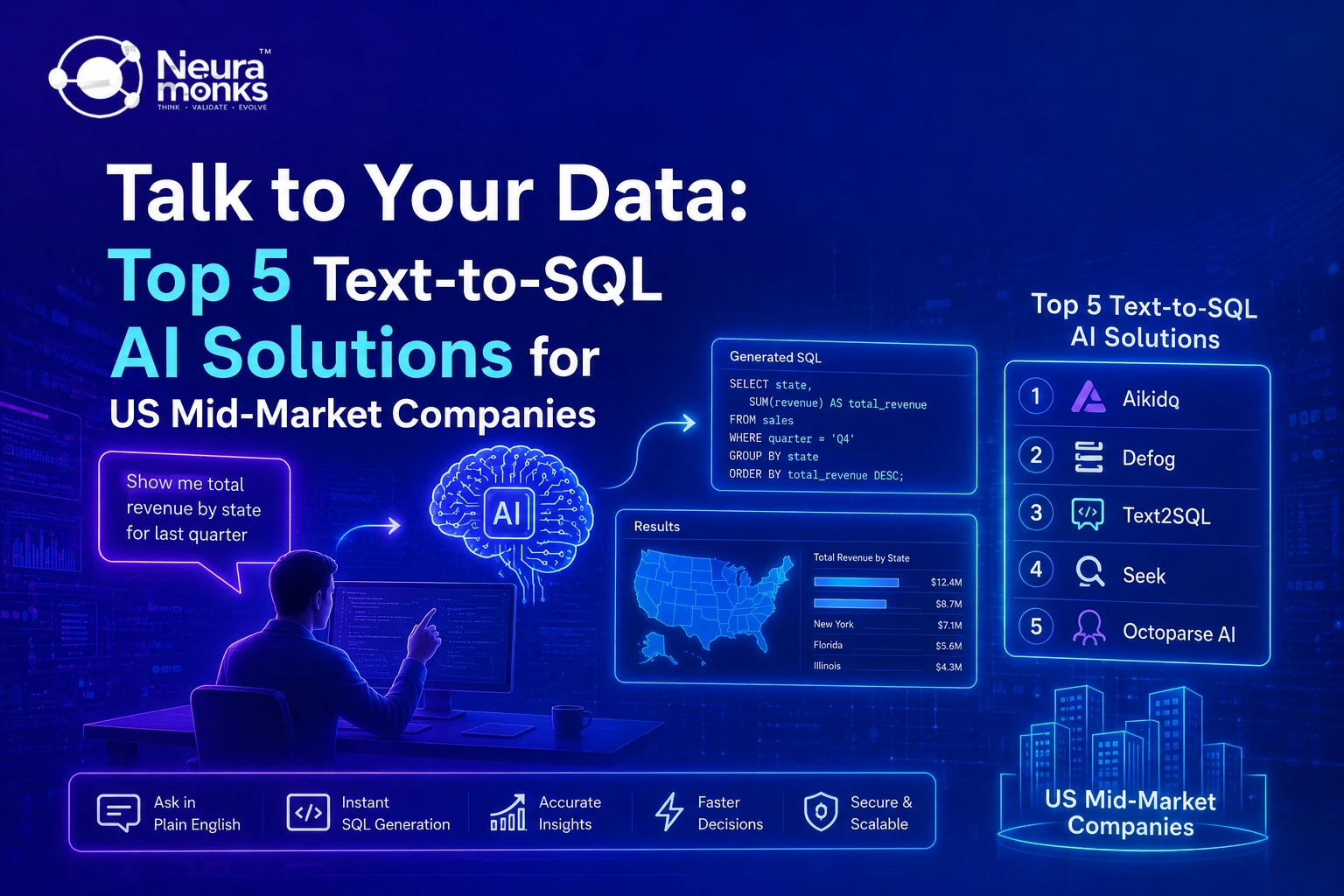
Talk to Your Data: Top 5 Text to SQL AI Solutions for US Mid Market Companies
Mid-market companies are rapidly adopting AI-powered text-to-SQL tools to let teams query business data using plain English instead of complex SQL. This blog compares the top 5 solutions in 2026, helping US businesses choose the right platform based on ERP integration, scalability, security, and real-world ROI.
QUICK ANSWER
If you want to talk to your data without writing SQL, you're in the right place. Mid-market companies across the US are deploying text-to-SQL systems that let analysts, ops managers, and even finance leads type a plain-English question and get an answer in seconds no data team required. This guide breaks down the five tools doing it best in 2026, what they actually cost, and where they fall short.
Why mid-market companies are done waiting on data teams
Here's the math that's driving this shift.
A data analyst at a US company earns $95,000 to $130,000 per year (Bureau of Labor Statistics, 2025). They spend roughly 40% of their time writing and debugging queries that business users could have answered themselves. Meanwhile, a Suzano case study published by Google Cloud in 2026 showed a 95% reduction in query time after deploying a Gemini-powered agent that translates natural language directly into SQL. That's not a rounding error that's a structural change in how a business operates.
Mid-market companies generally 500 to 5,000 employees are in an odd spot. They have real data complexity: ERP systems, Salesforce, multiple warehouses, compliance requirements. But they don't have a 20-person data engineering team to build custom tooling. That gap is exactly what text-to-SQL AI solutions are filling.
By 2026, 68% of mid-market US companies report using or actively evaluating AI-assisted data query tools (Gartner, 2025). The question isn't whether to talk to data it's which tool to use.
Quick comparison: top 5 text-to-SQL tools for mid-market US companies

The 5 tools, honestly reviewed
1. Google Gemini + BigQuery
The Suzano outcome (95% query time reduction) used a Gemini agent. Google's approach lets you describe what you need in plain English and get SQL back, executed against your BigQuery data. For companies already on Google Cloud, the setup is relatively clean.
Where it struggles: if your data isn't in BigQuery, you're adding a migration project before you even get to the AI part. Mid-market companies on SAP or Oracle ERP typically need custom connectors that Google doesn't provide out of the box.
Stat: Google Cloud revenue grew 28% YoY in Q1 2026 (Alphabet earnings), suggesting strong enterprise adoption but that's not the same as mid-market fit.
2. Microsoft Copilot for Power BI
If your company runs on Azure and Microsoft 365, Copilot's text-to-SQL layer is the path of least resistance. It reads from your existing Power BI semantic models and lets users ask questions in plain English.
The catch: it only works well if your Power BI models are already clean and well-documented. Most mid-market companies we've seen have fragmented BI setups Copilot surfaces that mess rather than hiding it.
Stat: 85% of Fortune 500 companies use Microsoft 365 (Microsoft, 2025), but mid-market penetration of Copilot specifically sits around 23% (IDC, 2025).
3. ThoughtSpot Sage
ThoughtSpot built its entire product around search-driven analytics long before LLMs were mainstream, so the natural language layer here is mature. Sage adds generative AI on top of that foundation.
It's good for companies that want something out-of-box and have a clean data warehouse (Snowflake, Databricks). The enterprise contract structure means it's expensive for sub-1,000 seat companies.
4. Databricks SQL AI
If your team has strong data engineering skills and your data lives in a Databricks lakehouse, their SQL AI assistant is technically solid. It understands schema context well and generates accurate queries for complex joins.
This is a tool for data teams, not business users. The gap between "data engineer who uses this" and "ops manager who needs an answer" is still wide.
5. Neuramonks purpose-built for ERP-heavy mid-market
This is where Neuramonks takes a different approach from the platforms above. Rather than retrofitting a general AI tool onto your data, we builds a custom talk to data layer directly against your source systems SAP, Oracle, NetSuite, Microsoft Dynamics without requiring a data warehouse migration first.
The practical result: a finance manager can type "show me overdue AR by region for Q1" and get an accurate answer in under 10 seconds, pulled live from ERP. No BI team in the loop.
See the full case study: Talk to Data Secure, Intelligent Analytics for ERP Systems
Neuramonks also supports a voice agent interface, which matters for operational roles warehouse supervisors, field ops leads who aren't going to open a browser to ask a data question.
Stat: Companies with direct ERP-to-AI integrations report 3.2× faster decision cycles compared to those routing through a BI layer (McKinsey, 2025).
What actually breaks text-to-SQL in practice
Most pilots fail for the same three reasons, and none of them are about the AI model.
Schema ambiguity. ERP systems have tables with names like VBAK, MARA, or BKPF. Without business-context mapping, even a strong LLM generates wrong SQL. The fix is a semantic layer that translates business language to schema terms and that layer has to be built, not assumed.
Security. When you allow natural language queries, you need row-level security enforced at the database level, not the UI level. Otherwise someone can ask a creative question and surface data they shouldn't see.
Hallucination at the aggregation layer. LLMs sometimes generate plausible-looking SQL that produces subtly wrong numbers. This is more dangerous than an error message it looks correct. The mitigation is query validation and result-range checks built into the pipeline.
If you want to understand more about what talk to data actually means technically, this beginner-friendly guide from Neuramonks is a solid starting point before you evaluate vendors.
What to ask vendors before you sign anything
Five questions that cut through demo theater:
- Can you show me a query against our actual schema, not a sandbox?
- How does your system handle row-level security in our ERP?
- What's the fallback when the model generates incorrect SQL?
- Do you support a voice agent interface for non-desk workers?
- What does onboarding look like for a company with 15+ data sources?
If a vendor hesitates on questions 1 or 2, that's information.
The commercial reality in 2026
AI solutions in this category span a wide price range. SaaS platforms charge $20–$80 per seat per month. Custom implementations from firms like Neuramonks typically run $60,000–$180,000 for the initial build, with ongoing retainers for model fine-tuning and schema updates.
The ROI math isn't complicated. If three analysts each spend 15 hours a week on ad-hoc SQL requests and that work drops to 3 hours you've recovered $180,000+ in annual capacity at median salaries. The payback period on a custom build is typically 6–10 months for a 200-person analytics-dependent team.
Stat: IDC projects the global text-to-SQL AI market will reach $4.1 billion by 2027, up from $890 million in 2024.
How to scope your own implementation
Three steps before you talk to any vendor:
Step 1: Inventory your data sources. List every system that holds data someone asks questions about. ERP, CRM, HRM, spreadsheets. Count the number of unique tables that matter.
Step 2: Identify your highest-value query patterns. What are the 20 questions your business asks most often? Revenue by region. Inventory turns. DSO. Those are your MVP queries. A good implementation nails those first.
Step 3: Define who the users are. Analysts are different from ops managers who are different from executives. Each user group has different tolerance for error and different query patterns. Design for the least technical user who needs access.
Ready to scope your project?
Neuramonks runs free proof-of-concept scoping calls for US mid-market companies evaluating text-to-SQL AI. In 30 minutes, you'll get a technical assessment of your data environment, a realistic timeline, and an honest read on which approach fits your stack whether that's Neuramonks or a platform tool.
Book your free POC scoping call with Neuramonks
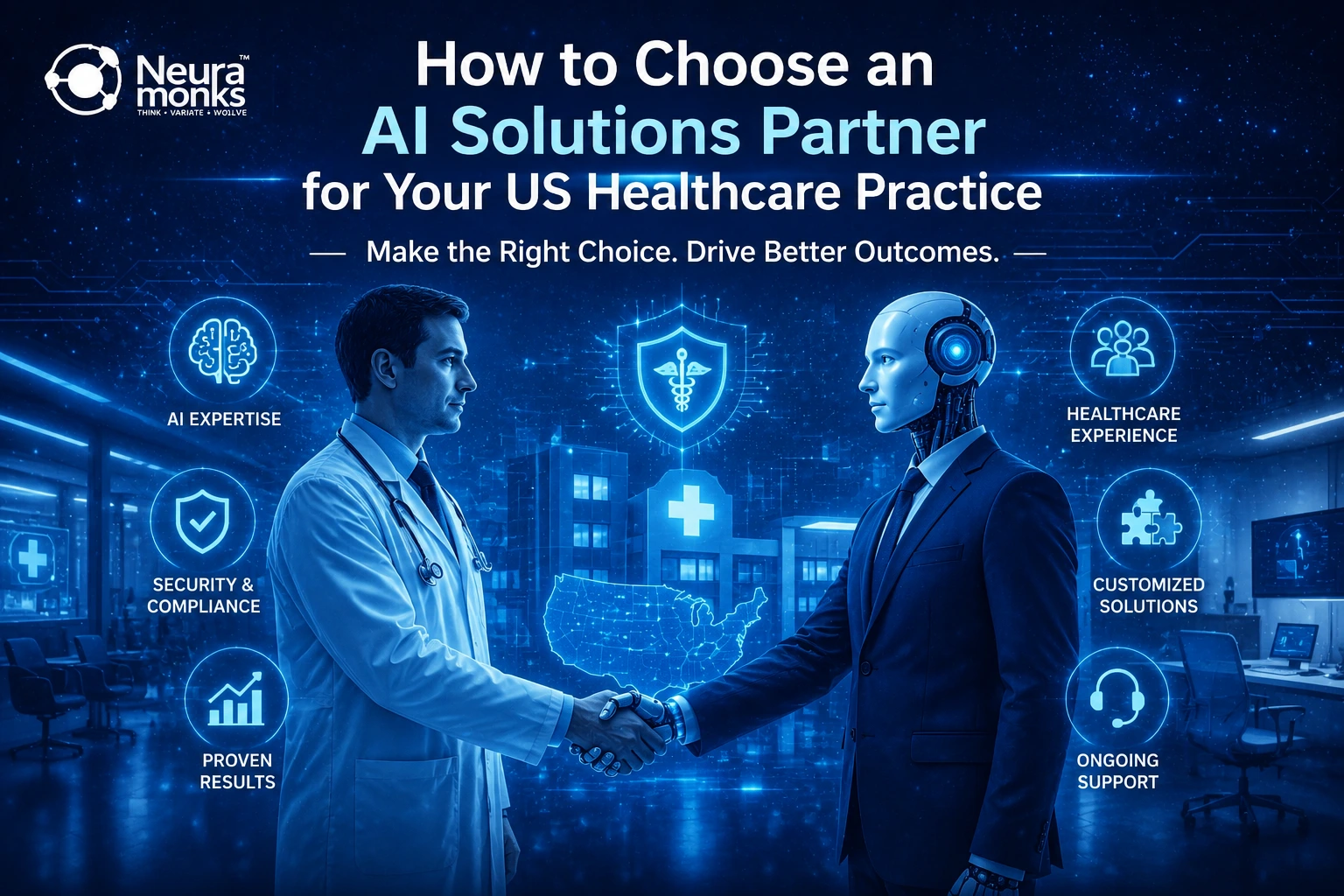
How to Choose an AI Solutions Partner for Your US Healthcare Practice
Choosing the right AI partner for your US healthcare practice in 2026 is not just about technology — it is about compliance, patient safety, workflow integration, and long-term scalability. This blog breaks down a practical 12-point checklist to help healthcare organizations evaluate AI vendors with confidence and avoid costly implementation mistakes.
QUICK ANSWER
Choose an AI solutions partner for your US healthcare practice using a 12-point checklist covering HIPAA compliance, BAA willingness, FDA SaMD experience, EHR integration depth, clinical validation, data residency, model transparency, security certifications, implementation timeline, total cost of ownership, ongoing support, and case study evidence in your specialty.
Every US healthcare practice is being pitched AI solutions in 2026, from ambient documentation to revenue cycle automation to clinical decision support. The technology is real. The risk of picking the wrong partner is also real. A failed implementation does not just waste budget. It can trigger a HIPAA breach, slow a clinical workflow, or quietly degrade patient outcomes. This 12-point checklist is the same evaluation framework NeuraMonks uses with US healthcare clients before any contract is signed.
Why Partner Selection Matters More in Healthcare Than Anywhere Else
Healthcare AI is not consumer software. A bad recommendation engine on a streaming service is annoying. A bad clinical AI partner is a regulatory and patient safety event. The market has scaled fast and the gap between strong and weak partners is widening.
The numbers tell the story. The US healthcare AI market is projected to reach 187 billion USD by 2030, with 2026 alone expected to drive over 25 billion USD in deployments (Source: Grand View Research, US Healthcare AI Market Report, 2025). Yet 73 percent of healthcare AI pilots fail to scale to production, most often due to integration, compliance, or workflow fit issues, not model accuracy (Source: HIMSS State of Healthcare AI Survey, 2025). And the average HIPAA settlement in 2024 reached 1.04 million USD, with AI-related breach investigations up 58 percent year-over-year (Source: HHS Office for Civil Rights Resolution Agreements Database, 2024).
Translation: the cost of a bad partner is not just the consulting fee. It is the breach, the failed pilot, the staff frustration, and the months of lost momentum. The 12 points below filter signal from noise.
The 12-Point Evaluation Checklist (At a Glance)

The 12 Criteria, Explained in Depth
1. HIPAA compliance and Business Associate Agreement (BAA)
This is non-negotiable. Any partner who handles, processes, or stores Protected Health Information (PHI) must sign a BAA before any data flows. Ask for their BAA template upfront. A serious partner has it ready within 24 hours. A weak one delays, redirects, or wants to use yours unmodified. Verify they understand the difference between de-identified data, limited datasets, and full PHI, and that their architecture matches what their BAA promises.
2. FDA SaMD experience (where applicable)
If your AI use case touches diagnosis, treatment recommendation, or clinical risk scoring, FDA's Software as a Medical Device (SaMD) framework may apply. Ask whether the partner has supported a 510(k), De Novo, or Pre-Submission. Even if your initial use case is administrative, a partner who understands SaMD will design with future regulatory paths in mind. An AI development company without any FDA exposure will build something you may not be able to commercialize.
3. EHR integration depth
Integration is where most healthcare AI dies. Ask specifically: How many production Epic, Cerner (Oracle Health), or Athenahealth integrations have you shipped? FHIR R4 is now the floor in 2026, but real practices still run heavy HL7v2 and proprietary APIs. A partner with five live Epic integrations will navigate this in weeks. A partner with zero will take six months and still miss edge cases.
4. Clinical validation methodology
How does the partner prove the AI works in your specific clinical setting? Strong answers include retrospective validation against your historical data, prospective shadow deployment, and pre-defined success metrics like sensitivity, specificity, and clinical agreement. Weak answers point to general benchmark numbers from a paper. Real validation is specialty-specific, site-specific, and population-specific. AI consulting services that skip this step are selling marketing, not medicine.
5. Data residency and sovereignty
Where exactly does the data live? US-only hosting is the minimum. Some states (notably Texas, California with CCPA-HIPAA overlap, and New York with SHIELD Act) push further. Ask which AWS, Azure, or GCP region. Ask whether any subprocessors are outside the US. Ask whether model training or fine-tuning ever ships data offshore. Get the answers in writing as part of the BAA addendum.
6. Model transparency and explainability
Black-box models are a non-starter for clinical decisions. Even for administrative AI, explainability matters when staff or patients ask why the system made a recommendation. Ask for model cards, bias evaluation results, and the explainability technique used (SHAP, LIME, attention visualization, or rule-based wrappers). The 2025 NIST AI RMF specifically calls out healthcare as a high-risk domain requiring documented transparency.
7. Security certifications
SOC 2 Type II is the baseline. HITRUST CSF certification is the gold standard for US healthcare. ISO 27001 helps if you operate internationally. Ask for the actual reports under NDA, not just logo claims. A partner who lists badges but cannot produce a current audit report has effectively lied to you, and your compliance officer will catch it during onboarding anyway.
8. Implementation timeline (realistic, not heroic)
Be skeptical of any AI Product Development Company that promises a production healthcare AI deployment in 2 weeks. A typical realistic timeline runs 8 to 16 weeks for the first production workflow, including discovery, data access agreements, integration build, validation, training, and go-live. Faster than 6 weeks usually means corners are being cut on validation or change management. Slower than 24 weeks usually means scope is too large for a first phase.
9. Total cost of ownership across 3 years
Sticker price hides the truth. Ask for a full TCO model: implementation fee, year-one license, year-three license, integration maintenance, model retraining, support tier upgrades, and additional user or location costs. A partner who cannot produce this in writing is either inexperienced or hiding the math. NeuraMonks publishes TCO ranges before signed engagement so the client can budget honestly.
10. Ongoing support and SLA
What happens at 2 AM on a Saturday when the documentation AI stops working in the middle of a hospitalist shift? Ask for the SLA in writing: response time, resolution time, named escalation contact, and severity definitions. A 99.9 percent uptime SLA without a clear severity matrix is marketing. A weak support model is the single biggest cause of post-launch dissatisfaction.
11. Specialty case studies and references
General healthcare AI experience is not the same as experience in your specialty. A partner who has deployed in radiology may know nothing about behavioral health workflows. Ask for two reference customers in your clinical area with a similar size and EHR. Talk to them without the partner on the call. The honest details (what went wrong, how it was fixed) are worth more than any deck.
For a broader context on which firms are leading this space in the US, this resource is a useful market map:
Top AI Development Companies in the USA 2026
12. Exit clause and data portability
The most professional partner conversation includes how the relationship ends. Ask: If we offboard in 18 months, how do we get our data, our trained models, our prompts, and our integration mappings out, and in what formats? A partner who has thought this through has nothing to hide. A partner who deflects has structural lock-in baked in, and you will pay for it later.
Red Flags That Should End the Conversation
- They cannot produce a BAA template within 48 hours.
- They claim 99.99 percent model accuracy without specifying the dataset or population.
- Pricing is opaque or scales unexpectedly with usage with no upfront cap.
- All case studies are from non-healthcare verticals (or none are US-based).
- They cannot name a clinical lead on their team or a recent FDA-related project.
- The proposed timeline assumes you have no existing EHR integration constraints.
How to Run the Evaluation in 30 Days
A disciplined process beats a long process. Here is the 30-day cadence we recommend to clinical and operations leaders evaluating AI partners.
Days 1 to 7: Define the use case and longlist
Pick one workflow with measurable pain (documentation time, denied claims, scheduling no-shows, prior auth turnaround). Source 6 to 8 candidate partners through trusted analyst lists, peer references, and direct outreach. Resist the urge to pick a partner before defining the problem.
Days 8 to 14: RFP and shortlist
Send the 12-point checklist as the RFP. Score responses on completeness and specificity. Shortlist the 3 strongest. NeuraMonks routinely sees that 2 of the original 8 self-eliminate at this stage by failing on HIPAA, BAA, or EHR integration questions.
Days 15 to 22: Reference calls and security review
Run 30-minute reference calls with prior customers. Have your CISO and Privacy Officer review the SOC 2 / HITRUST reports under NDA. Identify any deal-breakers before commercial discussion.
Days 23 to 30: Commercial alignment and pilot scope
Negotiate a paid pilot with clear success metrics, not a free trial. Free trials encourage demos, not real validation. A 60 to 90 day paid pilot at 10 to 25 percent of the annual contract value forces both sides to commit and produces real data for the production decision.
How the Best AI Partners Earn Trust in the First 90 Days
The discovery and contracting phase reveals the partner's salesmanship. The first 90 days of execution reveals their craft. Three signals separate strong partners from weak ones once work actually starts.
First, they translate clinical workflows into design before writing code. A strong partner sits with nurses, billers, or front-desk staff for at least a week before architecture is finalized. They map the actual click path, the workarounds, the exception handling. AI that ignores existing workflow gets bypassed within a month of go-live, no matter how accurate the model is.
Second, they instrument everything from day one. A real production AI deployment ships with logging, monitoring, drift detection, and feedback loops baked in, not bolted on later. Ask to see the dashboard the partner will hand over. If it does not exist as a template before the engagement, it likely will not exist after either.
Third, they prepare the practice for the human side of change. Even the best AI fails when staff are not trained, incentives are misaligned, or leadership has not committed publicly. The strongest AI consulting services partners include change management hours in the proposal by default. The weakest treat training as an afterthought, billed separately.
Book a Free AI Consultation With NeuraMonks
Evaluating AI partners for your US healthcare practice? Book a free consultation with the NeuraMonks healthcare AI team. We will walk through the 12-point checklist against your shortlist, flag risks, and outline a HIPAA-safe pilot scope tailored to your specialty and EHR.
Schedule your call: https://tidycal.com/team/neuramonks/consultation-booking
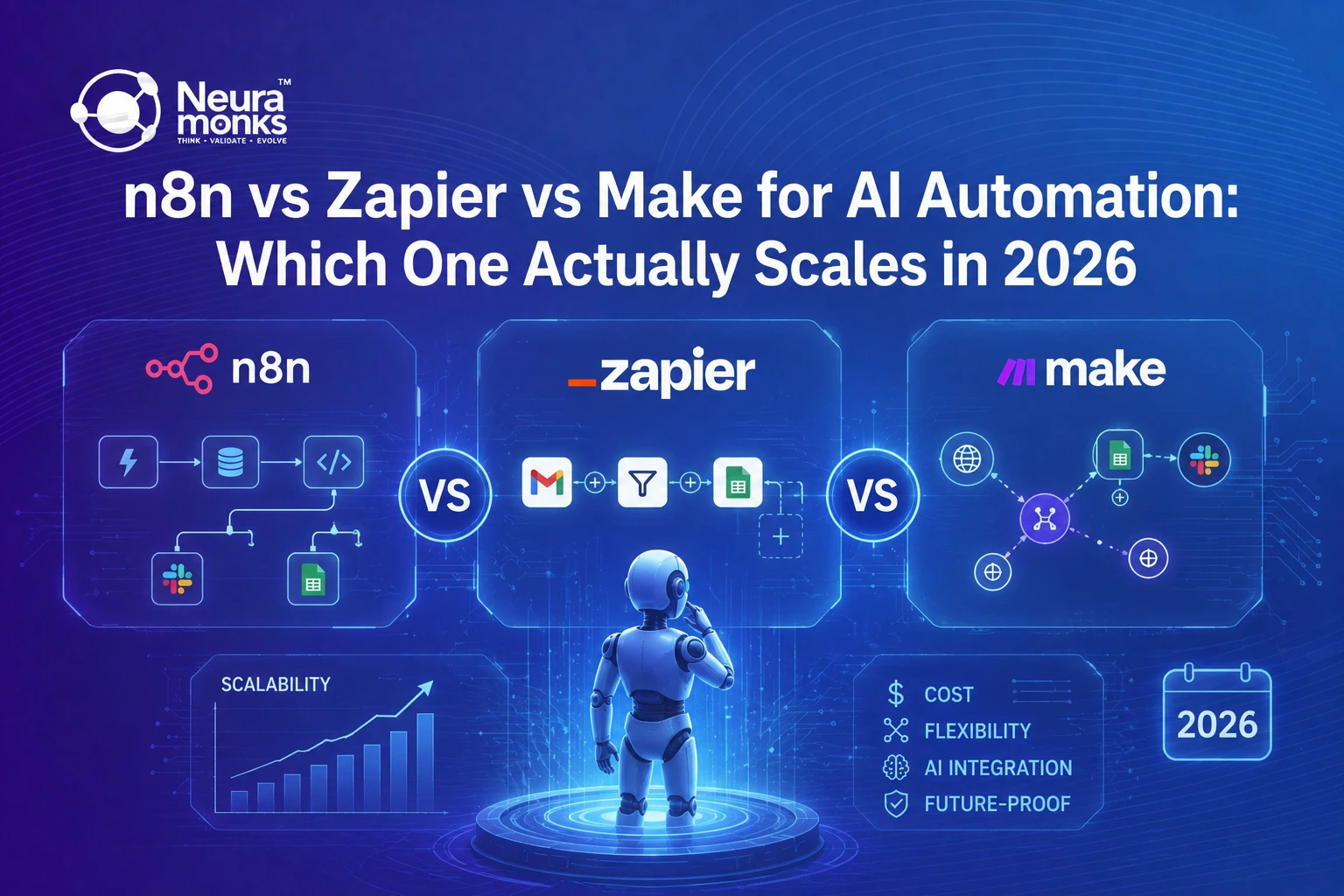
n8n vs Zapier vs Make for AI Automation: Which One Actually Scales in 2026
Compare n8n, Zapier, and Make for AI automation in 2026 from pricing and scalability to AI agent capabilities, compliance, and enterprise readiness to discover which platform truly scales for modern AI workflows.
QUICK ANSWER
For AI automation that actually scales in 2026, n8n is the strongest choice for technical teams handling 10,000 plus monthly executions, complex AI agent workflows, and self-hosted data control. Zapier wins for non-technical users running simple tasks. Make sits in the middle, ideal for visual mid-volume workflows under 50,000 operations per month.
Choosing the wrong automation platform is the most expensive mistake AI teams make in 2026. The platform that worked for 500 monthly tasks collapses at 50,000. Pricing models that looked cheap in proof of concept become budget-killers at scale. And the AI agent workflows you actually need, vector retrieval, multi-step LLM chains, and human-in-the-loop approval, are not equally supported across n8n, Zapier, and Make. This guide compares the three platforms head-to-head on the dimensions that determine whether your AI automation stack scales or stalls.
Comparison Table: n8n vs Zapier vs Make at a Glance
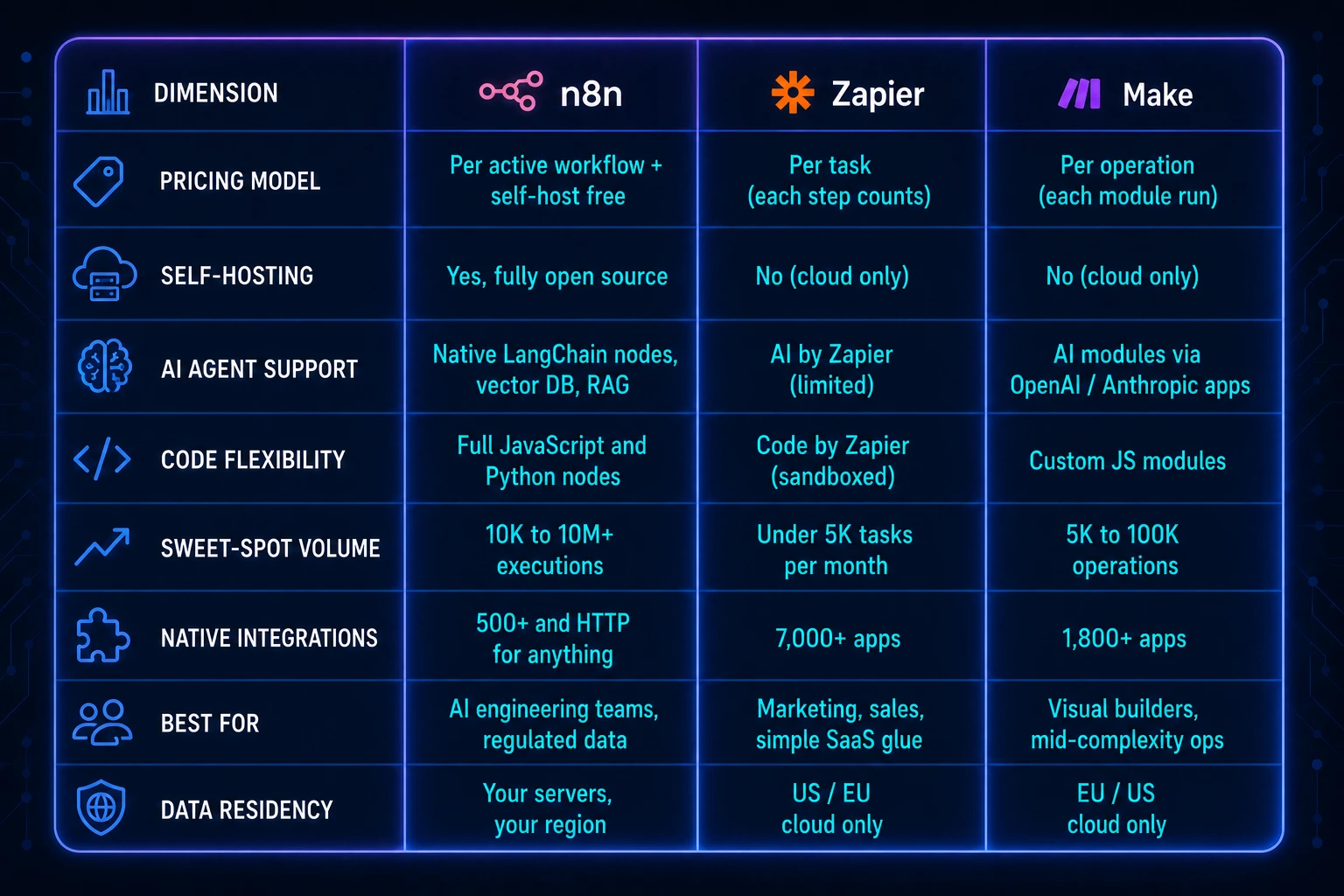
Why Pricing Models Make or Break AI Automation at Scale
The single fastest way to burn an AI automation budget in 2026 is to pick a per-task pricing model when your workflows have 10 or more steps. A single AI agent loop with retrieval, classification, summarization, and a webhook back to your CRM is four billable tasks on Zapier. Run that 50,000 times a month, and the math becomes very unfavorable very quickly.
Recent industry data shows just how stark the gap is. According to G2 reviews aggregated across automation platforms in 2025, the median enterprise team running AI workflows reported a 3.4x cost difference between per-task and per-execution pricing once monthly volume exceeded 25,000 runs (Source: G2 Automation Software Category Report, 2025).
State of AI Automation surveys show 67 percent of enterprise teams that started on Zapier eventually migrated at least one workflow tier to n8n or Make for cost reasons (Source: Workflow Automation Benchmark Report by Tray.io, 2025). And Gartner forecasts that by the end of 2026, 70 percent of new enterprise applications will use AI-augmented automation, up from less than 10 percent in 2020 (Source: Gartner Hyperautomation Forecast, 2024).
How n8n pricing actually works
n8n charges per active workflow on cloud (not per task or per step). A workflow that fires 100,000 times a month costs the same as one that fires 100 times. On the self-hosted version, the software itself is free under the Sustainable Use License. You pay only for the server it runs on. This is why AI engineering teams running high-volume agent loops gravitate to it.
How Zapier pricing actually works
Zapier counts each step inside a Zap as a billable task. A 6 step Zap that runs 1,000 times burns 6,000 tasks. Plans in 2026 start around 19.99 USD per month for 750 tasks and scale to enterprise tiers at thousands per month. The platform shines for sub-5,000-task workflows where engineering effort is more expensive than task fees.
How Make pricing actually works
Make charges per operation, where one operation equals one module execution. It is cheaper than Zapier per step but more expensive than n8n at scale. Make plans in 2026 cap most teams comfortably at the 100,000 operation tier. Above that, the per-operation creep starts to bite.
A real cost comparison at 100,000 monthly executions
Take a representative AI workflow: 8 steps including a vector lookup, two LLM calls, a CRM update, and an alert. Running this 100,000 times per month, Zapier would consume 800,000 tasks (around 2,000 to 2,800 USD per month on the Team plan). Make would consume roughly 800,000 operations (around 700 to 1,100 USD per month at the Pro tier with overages). n8n Cloud Pro covers unlimited executions on the workflow at a flat 50 to 120 USD per month, while self-hosted n8n on a 60 USD per month VPS handles the entire load with headroom. The pricing gap is not 20 percent. It is often 10x or more once volume crosses six figures.
AI Agent Capabilities: Where the Three Platforms Diverge in 2026
Routine app to app automation is a solved problem. The real 2026 differentiator is whether a platform can run production-grade AI agents, the kind that retrieve context from a vector database, call an LLM with tool use, validate output, and loop until a goal is reached. This is where the gap between the three platforms widens dramatically.
n8n: built for AI engineering
n8n shipped native LangChain nodes in 2024 and has expanded the AI feature set every quarter since. As of 2026, the platform offers built-in nodes for vector stores (Pinecone, Qdrant, Weaviate, Supabase), agent orchestration with tool calling, structured output parsers, retrieval chains, and human-in-the-loop approval steps. Custom JavaScript and Python nodes mean teams can drop in any model SDK that does not yet have a first-party node. For AI development companies building production agent systems, this is the reason n8n has become the default.
A real example: Neuramonks recently shipped a content automation system that ingests RSS feeds, classifies topic relevance with an LLM, retrieves brand voice context from a vector store, generates draft posts, runs a fact-check pass, and pushes to WordPress with SEO metadata. The full pipeline runs entirely on n8n with no custom infrastructure. Read the full breakdown here:
Neuramonks AI Blog Post Generation Automation Case Study
Zapier: AI as bolt-on, not foundation
Zapier introduced AI by Zapier and Zapier Agents in 2024, which work well for adding an LLM step to a simple flow (summarize this email, classify this lead). The architecture, however, is fundamentally task-based. There is no native vector database. Multi-turn agent loops have to be simulated with workarounds, and pricing penalizes loops because every iteration is billable tasks.
Make: visual AI for mid-complexity
Make ships first-party modules for OpenAI, Anthropic, and other LLM providers, plus a Vector module for embedding storage. The visual builder is genuinely good for prototyping AI flows. The ceiling is real, though. Once an agent needs more than a handful of conditional branches and retries, the visual canvas becomes harder to maintain than code.
Observability and debugging at scale
AI workflows fail in ways that traditional automations do not. An LLM returns malformed JSON. A vector query times out. A tool call hits a rate limit mid-loop. The platform you pick determines how fast you find and fix these failures. n8n provides full execution logs, replay from any node, and structured error workflows that route failures to a separate handler. Zapier's history is task-by-task and replay options are limited on lower tiers. Make's visual execution log is excellent for debugging single runs but becomes unwieldy when you need to triage 500 failed runs from yesterday. For production AI systems, debuggability is not a nice-to-have. It is the difference between a 15-minute incident and a 4-hour one.
Data Residency, Security, and Compliance for US Enterprise
US enterprise buyers in regulated industries, healthcare, finance, defense, legal, cannot send PHI, PII, or trade secrets through a third-party cloud they do not control. This eliminates Zapier and Make from many serious enterprise procurement processes from the start. n8n, because it can be self-hosted on your own VPC, in your own region, behind your own firewall, is often the only platform that survives a CISO review.
Compliance data underscores the stakes. IBM's Cost of a Data Breach Report 2024 puts the average US data breach at 9.36 million USD, with healthcare averaging 9.77 million USD per incident (Source: IBM Cost of a Data Breach Report, 2024). HIPAA enforcement actions have risen 40 percent year-over-year through 2025 (Source: HHS Office for Civil Rights Annual Enforcement Summary, 2025). And NIST's 2025 AI Risk Management Framework guidance now explicitly recommends self-hosted automation for any workflow handling regulated data classifications (Source: NIST AI RMF 1.0 Implementation Guide, 2025).
For US healthcare, fintech, and government contractor use cases, the calculus is simple. If your AI workflow touches regulated data, n8n self-hosted is usually the only one of the three platforms that clears the security review.
Total cost of ownership beyond the subscription
Subscription pricing is only one line in the TCO equation. Engineering time to build, maintain, and migrate workflows often dwarfs platform fees. Teams that pick a tool primarily on sticker price tend to regret it within 12 to 18 months. A useful rule of thumb: budget 60 percent of year-one spend for platform fees and 40 percent for build and maintenance time. By year three on a stable stack, that flips. Self-hosted n8n at scale frequently lands at 5 to 15 percent of the equivalent Zapier Enterprise quote once you cross the 250,000 monthly execution threshold, even after counting infrastructure and DevOps time.
Decision Framework: Which Platform Fits Your 2026 Stack
Pick Zapier when
- Your team is non-technical and the workflows are simple (under 5 steps).
- Total monthly volume stays under 5,000 tasks.
- You need niche SaaS integrations (Zapier still leads at 7,000+ apps).
- Speed of building matters more than per-execution cost.
Pick Make when
- Workflows are visually complex but volume is moderate (5K to 100K operations).
- Your team prefers a visual canvas over code.
- Data residency is not a hard requirement.
- You want better pricing than Zapier without running infrastructure.
Pick n8n when
- You are building production AI automation with agents, retrieval, or multi-step LLM chains.
- Monthly execution volume exceeds 10,000 (and especially over 100,000).
- Data residency, HIPAA, SOC 2, or self-hosted control is required.
- You have engineering capacity to manage workflows as code.
- You want to avoid vendor lock-in (n8n workflows are JSON, fully exportable).
Where AI Automation Is Heading in 2026 and Beyond
Three trends shape platform selection over the next 18 months. First, agentic AI moves from prototype to production. McKinsey's 2025 State of AI report notes 78 percent of organizations now use AI in at least one business function, up from 55 percent the prior year, with agentic workflows the fastest-growing category (Source: McKinsey Global Survey on AI, 2025).
Second, regulatory pressure intensifies. The EU AI Act enforcement window opened in 2025 and US state level AI laws are multiplying. Third, model costs keep falling, but orchestration cost (the workflow platform itself) is becoming the dominant line item in AI operating budgets.
For a deeper view on what enterprise leaders should prepare for, NeuraMonks published a strategic outlook that pairs well with this comparison:
AI Automation in 2026: What Enterprise Leaders Must Prepare For
Free POC Scoping Call With Neuramonks
Not sure which platform fits your AI roadmap? Book a free 30 minute POC scoping call with the NeuraMonks team. We will map your top three workflows to n8n, Zapier, or Make based on volume, compliance, and AI complexity, then give you a build estimate before you commit a dollar.
Schedule your call here: https://www.neuramonks.com/contact

Live Safety Detection with AI Turning CCTV Cameras into Real Time OSHA Protection Systems
AI-powered safety detection is transforming construction sites by converting existing CCTV cameras into real-time hazard monitoring systems. Instead of reacting after incidents, contractors can now prevent violations before they happen. With computer vision, edge processing, and intelligent alerts, companies are reducing OSHA fines, improving worker safety, and gaining a competitive edge through data-driven compliance.
Every 99 minutes, a construction worker in the United States dies on the job. That is not a statistic buried in a government footnote it is the OSHA reality for an industry generating over $2 trillion in annual output while consistently ranking among the nation's most dangerous sectors. The question construction safety officers, general contractors, and operations VPs are now asking is not whether technology can change this. They are asking how fast they can deploy it.
The answer lies in the cameras already mounted across your job site. Paired with AI in Construction, those passive surveillance feeds become active, intelligent safety systems that detect hazards in real time, alert supervisors before injuries occur, and generate audit-ready compliance records automatically.
The Gap Between CCTV Footage and Actual Safety
Traditional CCTV infrastructure was built for one purpose: recording. Footage sits on local servers, reviewed only after an incident has already occurred. A worker entering a restricted zone, a forklift operating without clear sightlines, a team member skipping PPE before a welding task — none of these trigger any alert in a conventional system. A human operator watching 12 simultaneous feeds will miss most violations simply due to attention limits.
This is the blind spot that Artificial Intelligence in Construction eliminates.
AI-powered safety detection layers a real-time analytical brain on top of your existing camera network. No new hardware required on most deployments. No ripping out infrastructure. The system watches every frame, on every feed, simultaneously — and it never blinks.

How AI in Construction Actually Works on a Job Site
The architecture behind a live safety detection system is more accessible than most construction technology leaders expect. It combines three core technologies into one integrated layer:
1. Computer Vision — The Eyes of the System
Computer vision is the foundational layer. Deep learning models trained on millions of construction-specific images learn to identify and classify objects, people, postures, and behaviors with high precision. The models can distinguish between a hard hat and an uncovered head, a forklift in motion versus stationary, a worker inside a geo-fenced exclusion zone versus standing at its edge.
What makes this different from generic object detection is domain specificity. Models trained on hospital interiors or retail environments perform poorly on construction sites with variable lighting, dust, partial occlusion, and fast-moving machinery. Construction-purpose-built computer vision models are trained and validated specifically for these conditions.
2. vLLM Model Integration — Context and Communication
A raw alert "PPE violation detected, Camera 7" has limited operational value unless it reaches the right person with enough context to act. This is where a vLLM-powered model layer adds significant intelligence. vLLM enables efficient, high-performance serving of large language models, allowing structured safety event data to be processed and transformed into contextual, human-readable alerts: which worker zone, what violation type, recommended immediate action, and escalation priority.
It can also synthesize shift-end safety summaries, flag repeated violation patterns, and surface proactive risk advisories for site supervisors—while ensuring faster response times and scalable deployment across multiple camera feeds.
3. Real-Time Edge Processing — Speed Without Latency
Safety alerts have zero value if they arrive 45 seconds after the hazard event. Modern AI safety systems process video at the edge — meaning on-site hardware or low-latency cloud nodes analyze frames in real time, triggering alerts within 2 to 8 seconds of a violation being detected. This is fast enough for a supervisor to intervene before an injury occurs.
Key Insight for Safety Officers
Most job sites already have 60 80% of the CCTV infrastructure required for AI safety deployment. The investment is in software, integration, and model fine-tuning not wholesale hardware replacement.
See What Your Current Cameras Are Missing
Request a complimentary site safety gap analysis — we map your existing CCTV infrastructure against AI detection coverage potential with zero obligation.
OSHA Violations AI Can Detect in Real Time
The following hazard categories are among the most consistently detectable by trained computer vision models deployed on construction sites across the United States:
- Hard hat, safety vest, and glove non-compliance across all personnel
- Unauthorized access to restricted or high-voltage zones
- Workers operating near unguarded edges, floor openings, or scaffolding without fall protection
- Forklift and heavy equipment proximity violations with pedestrians
- Lockout/tagout area breaches during maintenance activities
- Ladder safety violations, including improper angle, unsecured base, or overreaching
- Crowd density monitoring in confined spaces
- Smoke, fire, and unusual thermal signature detection
- Vehicle speed limit violations within site boundaries
- After-hours unauthorized personnel access
Each of these categories directly maps to OSHA's Top 10 Most Cited Standards — the violations responsible for the majority of construction fatalities and fines in the United States annually. Addressing them proactively, rather than reactively, is where AI in Construction delivers the highest measurable ROI.
The Commercial Case: What ROI Looks Like for General Contractors
Safety technology decisions in construction are ultimately financial decisions. Here is how the numbers typically pencil out for mid-to-large general contractors operating in the US market:
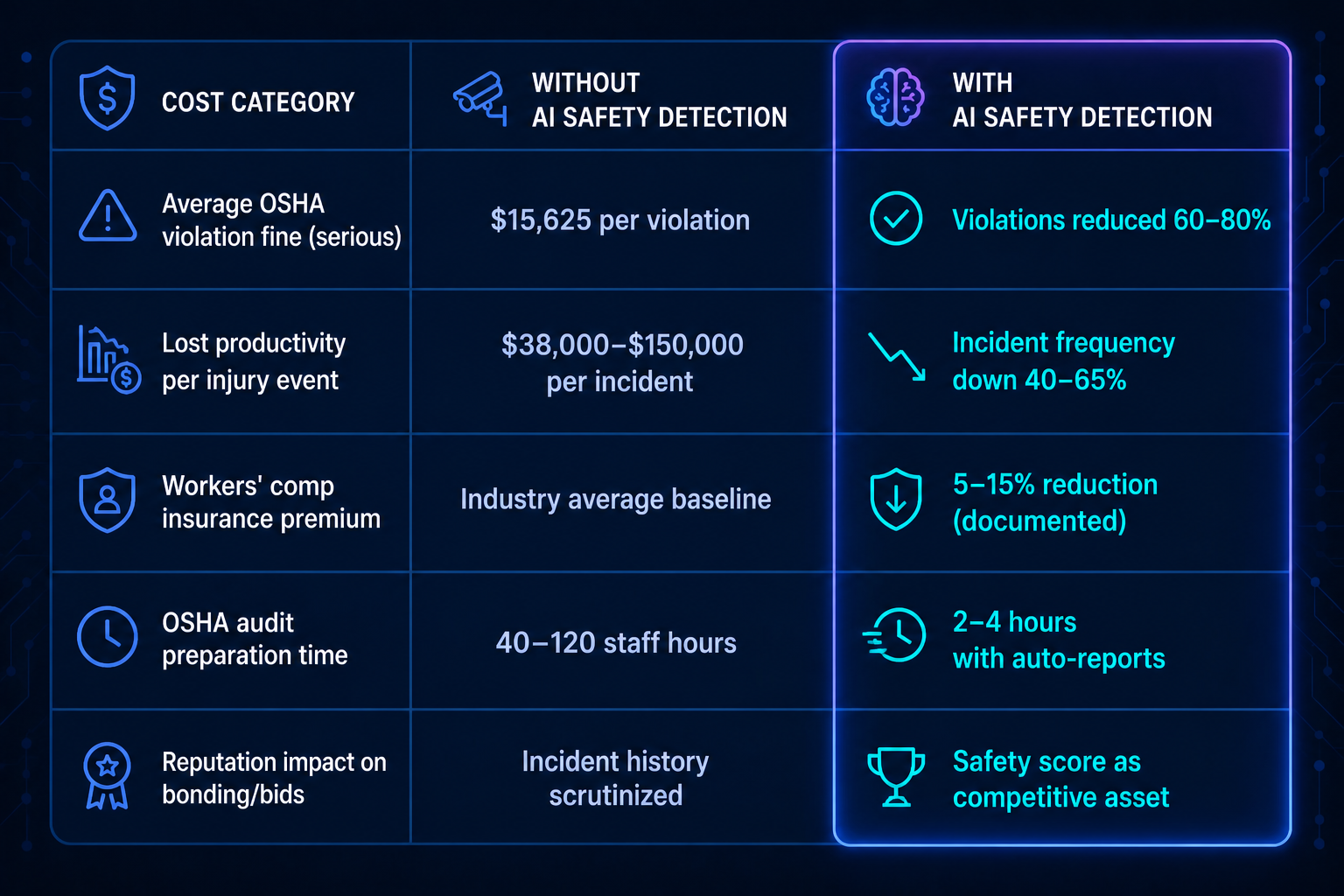
One documented case from a 400 worker commercial construction project in Texas showed a 71% reduction in reportable incidents in the 18 months following AI safety system deployment. OSHA fines dropped from an annual exposure of approximately $280,000 to under $40,000. The system paid for itself in under seven months.
For Risk Managers and CFOs
Insurers are beginning to recognize AI verified safety programs as quantifiable risk reduction. Several carriers now offer documented premium discounts of 5 15% for contractors who can demonstrate real-time safety monitoring with AI solutions. This changes the ROI math significantly.
What a Deployment Actually Looks Like: A 6-Phase Implementation
Construction technology leaders frequently overestimate the complexity of AI safety deployment. For a site with existing CCTV infrastructure, a full deployment follows a structured six-phase process:
- Phase 1 — Site Survey & Camera Audit: Map existing camera coverage, identify blind spots, assess feed quality and resolution for model performance.
- Phase 2 — Model Selection & Fine Tuning: Select pre-trained construction safety models; fine-tune on site-specific conditions (lighting, machinery types, worker density patterns).
- Phase 3 — Integration & Edge Deployment: Connect AI processing nodes to existing CCTV streams via RTSP or API bridge. No camera replacement required in most cases.
- Phase 4 — Alert Workflow Configuration: Define escalation rules, notification channels (SMS, Slack, dashboard), and violation severity thresholds by camera zone.
- Phase 5 — Safety Team Training & Calibration: Onboard site supervisors to the dashboard; refine model confidence thresholds based on first 2 4 weeks of live data.
- Phase 6 — Compliance Reporting Automation: Configure OSHA-formatted daily and monthly safety reports with incident logs, violation trends, and corrective action tracking.
Total deployment time for a single construction site ranges from 3 to 8 weeks depending on site scale, integration complexity, and the number of camera feeds being processed. Multi-site enterprise rollouts typically run on a phased schedule of 90 to 180 days.
The Hidden Value: Safety Data as a Competitive Differentiator
The most forward thinking contractors in the US market are not deploying AI safety detection purely to avoid fines. They are building a data asset.
Every violation logged, every pattern identified, every near-miss captured creates a structured safety intelligence database. Over 12 to 24 months, this data tells a story that manual incident logs simply cannot: which subcontractors consistently underperform on PPE compliance, which site zones carry disproportionate risk, which shift windows show elevated violation rates, and which supervision staffing models correlate with the safest outcomes.
This intelligence feeds directly into project bidding, subcontractor selection, insurance negotiations, and bonding conversations. Owners and developers increasingly require documented safety performance as part of the prequalification process for large projects. Contractors with AI verified safety records arrive at those conversations with a quantified, defensible advantage.
What Leading Construction Firms Are Discovering
Safety score documentation from AI systems is becoming a procurement criterion on federal, commercial, and healthcare construction projects. Contractors who have this data are shortlisting more frequently. Those without it are being asked to explain why.
Map Your Safety Intelligence Potential
Our construction AI team analyzes your current CCTV coverage and produces a personalized Safety Detection Readiness Score delivered within 5 business days at no cost.
When evaluating partners, construction safety leaders should assess the following:
- Model training data: Was the computer vision model trained specifically on construction environments, or on generic workplace footage?
- OSHA alignment: Does the system's violation taxonomy map directly to OSHA 29 CFR 1926 construction standards?
- Deployment track record: How many construction sites has the partner deployed on, and what documented safety improvement metrics are available?
- Integration depth: Can the platform connect to your existing safety management software, ERP, and reporting systems?
- Ongoing model improvement: Does the partner provide model updates as regulations change and new hazard patterns are identified?
The right partner delivers more than software they deliver a working AI solutions ecosystem that improves demonstrably over time, producing sharper detection, fewer false positives, and richer safety intelligence with every month of operation.
Your Job Site Is Already Equipped. It Just Needs Intelligence. The cameras are there. The hazards are there. The regulatory exposure is there.
What is missing is the layer that connects them and transforms surveillance footage into a living, breathing OSHA protection system.
Bring Your Construction Safety into 2026
NeuraMonks engineers construction-grade AI safety systems built for OSHA compliance, US job sites, and zero-tolerance incident environments.
Claim Your Free Safety Detection Scoping Session
Build vs Partner: The Real Cost of Adding an AI Team in 2026
Building an in-house AI team in 2026 costs far more than most leaders budget for — salaries, recruiting, compute, and attrition push year-one totals past $700K. This post breaks down the full cost comparison between building internally vs. partnering with an AI firm like NeuraMonks, with numbers by vertical.
Let's skip the fluff.
If your company is seriously considering building out an AI capability right now, you've probably already done some back-of-napkin math. You've looked at a few LinkedIn profiles. Maybe you've talked to a recruiter. And somewhere in that process, the number got scary fast.
This post breaks down exactly why the "build it in-house" path costs between $500,000 and $700,000 in year one alone and what the alternative actually looks like when you run the same numbers.
Why companies are getting this decision wrong right now
The AI hiring market in 2026 isn't the same as it was two years ago. Demand for machine learning engineers, AI architects, and LLM model specialists has outpaced supply significantly. Companies that started hiring in 2023 are still struggling to retain the people they brought on.
There's also a less discussed problem: the skills you hire for today may not be the skills your product needs in 18 months. The field moves fast. An in house team built around one architecture or framework can become a liability the moment the tooling shifts.
None of this means building in house is wrong. It means you need to run the numbers before you commit.
What it actually costs to build an in-house AI team
Here's where most budget conversations go sideways leaders compare a partner's annual retainer to a single engineer's salary, not to the full cost of the team you'd need to get comparable output.
A functional AI development team that can take a product from prototype to production typically requires at least 4 5 people.
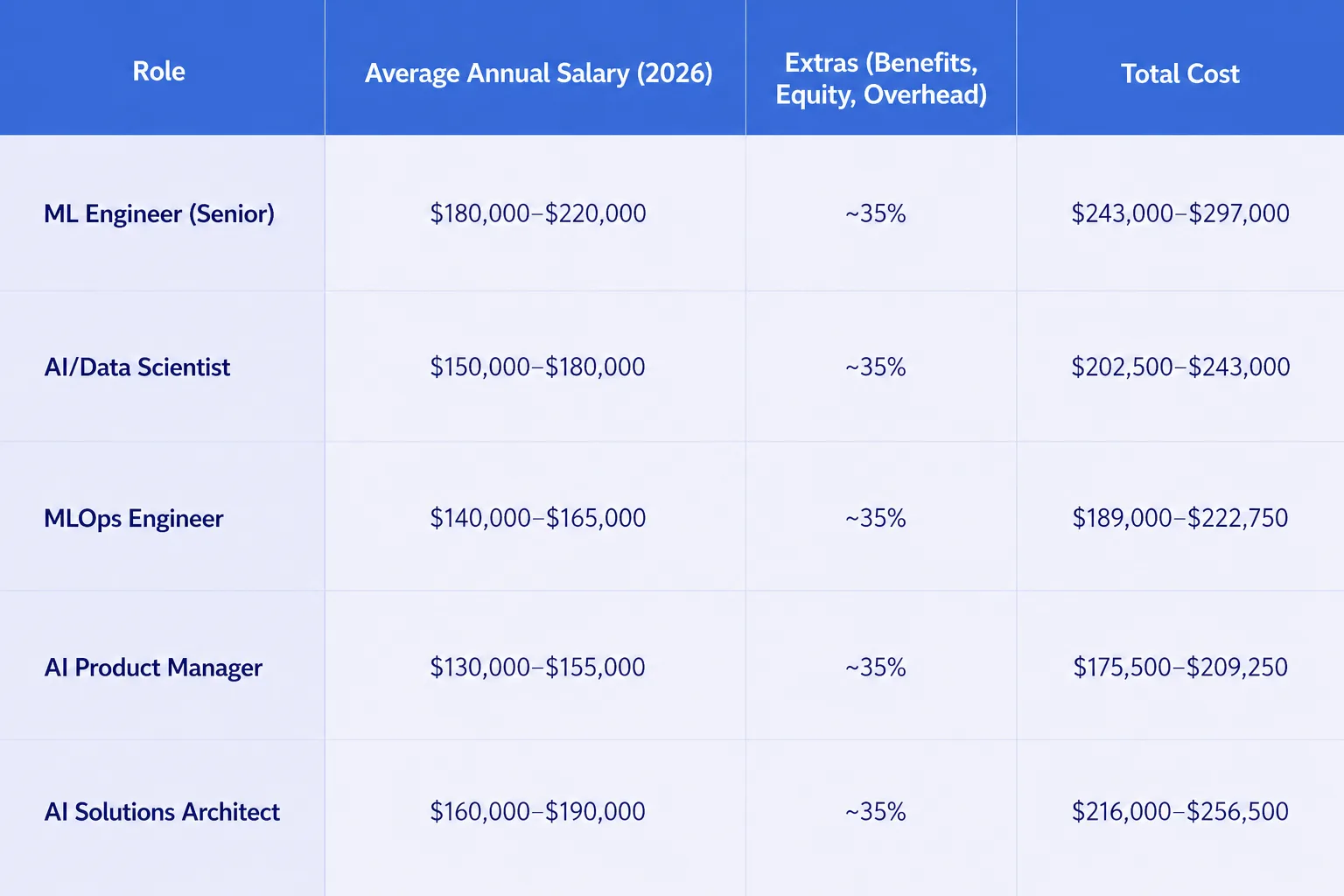
Add recruiting costs ($25,000 to $40,000 per senior hire), onboarding time (typically 3 to 4 months before meaningful output), tooling licenses, compute infrastructure, and management overhead and a conservative estimate for year one lands between $520,000 and $700,000.
That's before you ship a single model to production.
What partnering with NeuraMonks looks like by comparison
NeuraMonks works with companies that need production grade AI solutions without the overhead of a full internal team. The engagement model is built around delivery, not headcount.
A typical mid scope engagement covering architecture, build, deployment, and ongoing iteration runs between $150,000 and $180,000 annually. That's the full cost. No equity dilution, no benefits overhead, no 3 month ramp period while someone gets up to speed on your codebase.
The gap is significant: companies that partner rather than build typically see 60 to 70% lower first year costs for comparable AI capability output.
The numbers by vertical
Not every company has the same risk profile or timeline. Here's how the build vs partner calculation looks across three common ICPs.
Construction
In-house requirements in construction are higher than most sectors. Project complexity around site safety compliance, equipment tracking, budget forecasting, and real time coordination means you're not just hiring for AI capability you're hiring for domain expertise in construction workflows too. A construction AI team built to handle on-site safety protocols and project management integration routinely pushes past $650,000 in year one.
The faster path: partner with a team that has already built construction-specific AI automation pipelines and can integrate directly with your project management systems and site operations from day one.
Healthcare and health tech
Healthcare in AI runs into similar compliance walls HIPAA, FDA guidance on software as a medical device, and the general caution that comes with patient data. Building internal expertise across clinical AI and compliance typically requires 12 to 18 months before a team is genuinely productive.
For health tech companies, the time cost is often more damaging than the budget cost. The window to ship competitive AI features is narrow.
SaaS and product companies
SaaS companies face a different pressure: speed. Product roadmaps move quarterly, and a hiring cycle that takes 5–6 months to fill three key roles means you're a year behind before the team is functional.
SaaS companies that work with an ai development company typically ship AI powered features 3–4x faster than teams building the function from scratch.
The hidden costs nobody puts in the deck
Salary comparisons miss a lot. Here are the line items that tend to surprise finance teams mid-year:
Compute and infrastructure: LLM model training and inference at production scale isn't cheap. AWS, GCP, or Azure bills for a team running real workloads regularly exceed $8,000 to $15,000/month. In a partnership model, those costs are shared or bundled.
Tooling and licensing: Enterprise licenses for model monitoring, data labeling platforms, and vector database infrastructure add up. Expect $30,000 to $60,000 annually for a mid Size team.
Attrition: Senior AI engineers are highly mobile. The average tenure for ML engineers at non tech companies is under 2 years. Replacing a senior hire costs roughly 50 to 75% of their annual salary in recruiting, onboarding, and lost productivity.
Management overhead: Someone has to manage this team. If that's a CTO or VP of Engineering who's already stretched, the opportunity cost rarely shows up on a budget line but it's real.
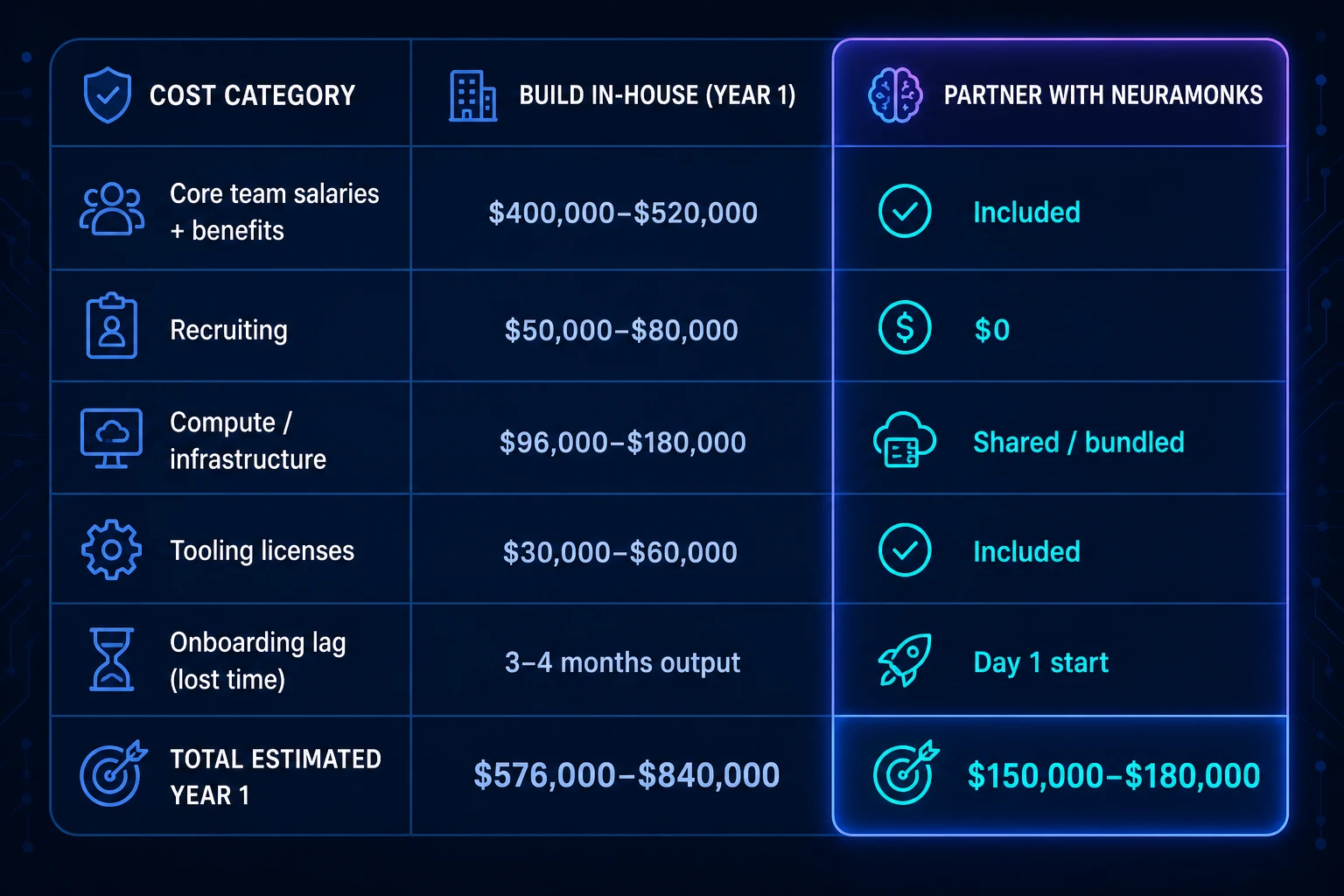
When building in-house actually makes sense
This isn't a one size answer. There are cases where hiring internal AI talent is the right call.
If your core product is the AI meaning the model is your IP and your competitive moat you probably need to own that capability over time. Companies like this should plan for a 2 to 3 year build with heavy early investment.
If your data is so sensitive that it genuinely cannot leave your infrastructure under any circumstances, a fully internal team may be required despite the cost.
And if you're a large enterprise with runway and a clear 5 year AI roadmap, building internal centers of excellence makes strategic sense.
For everyone else mid size companies, fast-growth startups, product teams trying to ship AI features in the next 6 months the math favors partnership.
What Neuramonks actually builds
We have delivered AI solutions across NLP, computer vision, recommendation systems, and document intelligence. The team includes specialists in ai solutions architecture, model fine-tuning, and production deployment not generalist developers who've read a few papers.
Projects typically include an initial discovery sprint (2 to 3 weeks), a prototype phase (4 to 6 weeks), and a production deployment phase with SLAs. The engagement doesn't end at launch we maintains and iterates on deployed models as your data and use case evolves.
Stop doing the math wrong
The real question isn't "can we afford to hire AI talent?" It's "what does it cost us not to ship AI capability in the next 12 months?"
For most companies, the answer to that second question is market share, customer churn, or a product roadmap that looks outdated by the time it ships.
Ready to see what a scoped engagement actually looks like for your product?
Book a 30 minute conversation with the Neuramonks team. No pitch deck, no sales cycle just a straight conversation about whether partnership makes sense for where you are.
Start with the right model for your stage. Transform your AI roadmap from a budget problem into a shipping plan.

OSHA Doesn't Inspect Your Safety Culture They Inspect Your Paperwork
Two compelling hooks covering documentation failure statistics and the 5 critical systems OSHA officers inspect.
Is Yours Ready?
Every construction site in America lives under a single compliance reality: OSHA doesn't walk your jobsite looking for the safety culture you've spent years building. They walk in looking for your paperwork your SDS logs, your incident records, your training certifications, your hazard communication files. If those documents are missing, incomplete, or disorganized, the fine lands on your desk. Not on your safety philosophy.
For mid to large construction firms operating across multiple sites in states like Texas, California, Florida, and New York, the documentation burden is not a back office problem. It is a frontline business risk. And in 2025, the companies that are passing OSHA inspections with zero citations are not the ones with the most dedicated safety managers they are the ones that have automated the paper trail with AI in Construction systems that never miss a record, never lose a file, and never forget a deadline.
The Real Cost of OSHA Non-Compliance for U.S. Construction Firms
Before diving into how technology solves this, let's put numbers on the problem. According to OSHA's published penalty structure and enforcement data, the financial exposure for construction companies is significant and growing.
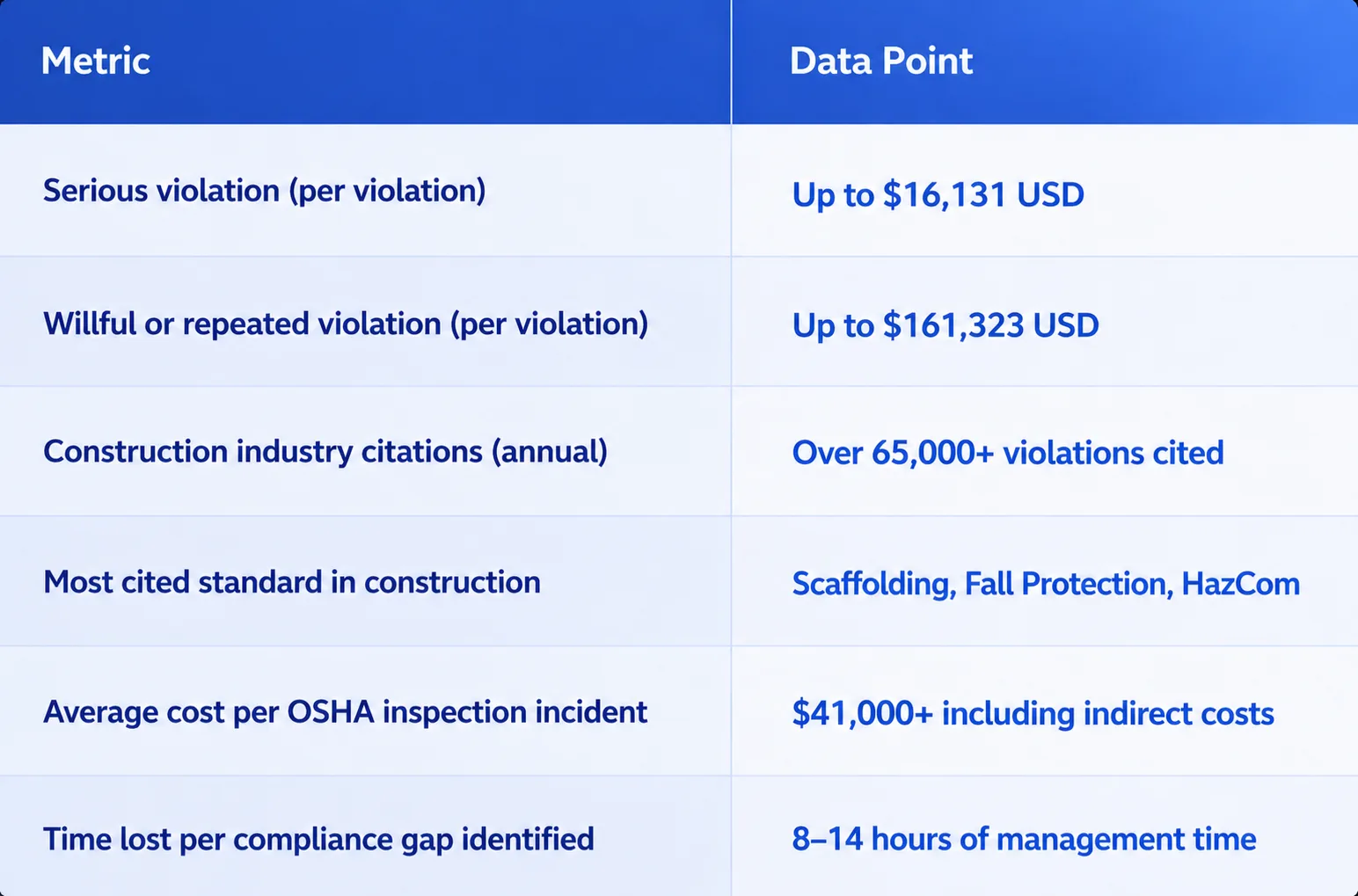
These numbers don't account for litigation exposure, reputational damage, or the project delays that follow a stop-work order. The financial argument for getting documentation right the first time is overwhelming and the operational argument for doing it with AI solutions is becoming equally clear.
What OSHA Compliance Officers Actually Look For On-Site
Understanding what triggers citations helps clarify exactly where AI in Construction transforms exposure into protection. OSHA compliance officers prioritize documentation audits across these primary categories:
1. Hazard Communication (HazCom) 29 CFR 1910.1200
Every chemical on your site must have a Safety Data Sheet. Every worker handling that chemical must have documented training. Compliance officers will ask workers directly and the worker's answer must match what's in your training records.
2. Injury and Illness Recordkeeping 29 CFR 1904
OSHA 300, 300A, and 301 logs must be maintained with accuracy. Any discrepancy between reported incidents and what workers describe during an inspection creates immediate escalation. Under reporting is treated as a willful violation.
3. Fall Protection Training Records 29 CFR 1926.503
For any worker exposed to fall hazards, training must be documented with the trainer's name, date, and the worker's acknowledgment. Verbal assurances that "everyone was trained" are not acceptable substitutes.
4. Equipment Inspection Logs 29 CFR 1926.20
Cranes, scaffolding, aerial lifts, and powered equipment require documented pre shift inspection logs. A missing log for a single piece of equipment on inspection day can escalate to a program level citation.
5. Emergency Action Plans and Site Safety Plans
These must be current, site specific, and accessible. A plan from a previous project pinned to the trailer wall is one of the fastest ways to receive a citation for a "deficient" safety program.
⚠️ Industry Insight: 73% of construction OSHA citations in 2024 were documentation failures, not physical safety failures. The hazard had been identified. The record simply wasn't there.
How AI in Construction Eliminates Documentation Gaps Before They Become Citations
This is where the operational shift happens. Traditional compliance management relies on safety managers manually collecting, organizing, and updating records across active job sites. With dozens of workers, rotating subcontractors, multiple equipment vendors, and state-specific regulatory variations, the manual approach creates structural gaps not due to negligence, but due to volume.
Modern Artificial Intelligence in Construction compliance platforms address this at every layer:
Automated Incident Logging
Rather than relying on workers or supervisors to manually complete OSHA 301 forms within the required 7 day window, AI powered systems capture incident data at the point of reporting via mobile app, voice input, or structured digital forms and auto populate the correct OSHA record format. The system timestamps the submission, links it to the relevant project and jobsite, and flags any field that would fail a compliance review before the record is saved.
Training Certification Tracking with Expiry Alerts
Every worker's credentials OSHA 10, OSHA 30, forklift certification, fall protection training, confined space entry are maintained in a centralized, searchable database. When a certification approaches expiry, the worker, their supervisor, and the safety manager receive automated notifications. No worker enters a restricted area with expired credentials. The paper trail updates itself.
Equipment Inspection Record Automation
Pre shift inspection checklists are completed digitally on mobile devices. Records are geo tagged to the site, time-stamped, linked to the specific equipment asset, and archived automatically. If an inspection is missed, the system flags it within hours — not when an OSHA officer arrives.
LLM-Powered Compliance Guidance
The most advanced platforms now deploy an LLM model layer that interprets regulatory language in real time and provides site specific guidance to safety managers. When a regulation changes as OSHA rules frequently do the platform updates its interpretation automatically and flags any existing documentation that needs revision. Safety managers stop researching compliance language manually and start receiving precise answers to their specific situations.
Traditional vs. AI-Powered Compliance: A Direct Comparison
For construction companies evaluating whether an investment in AI compliance infrastructure is justified, this side-by-side view reflects what firms across the U.S. are experiencing:
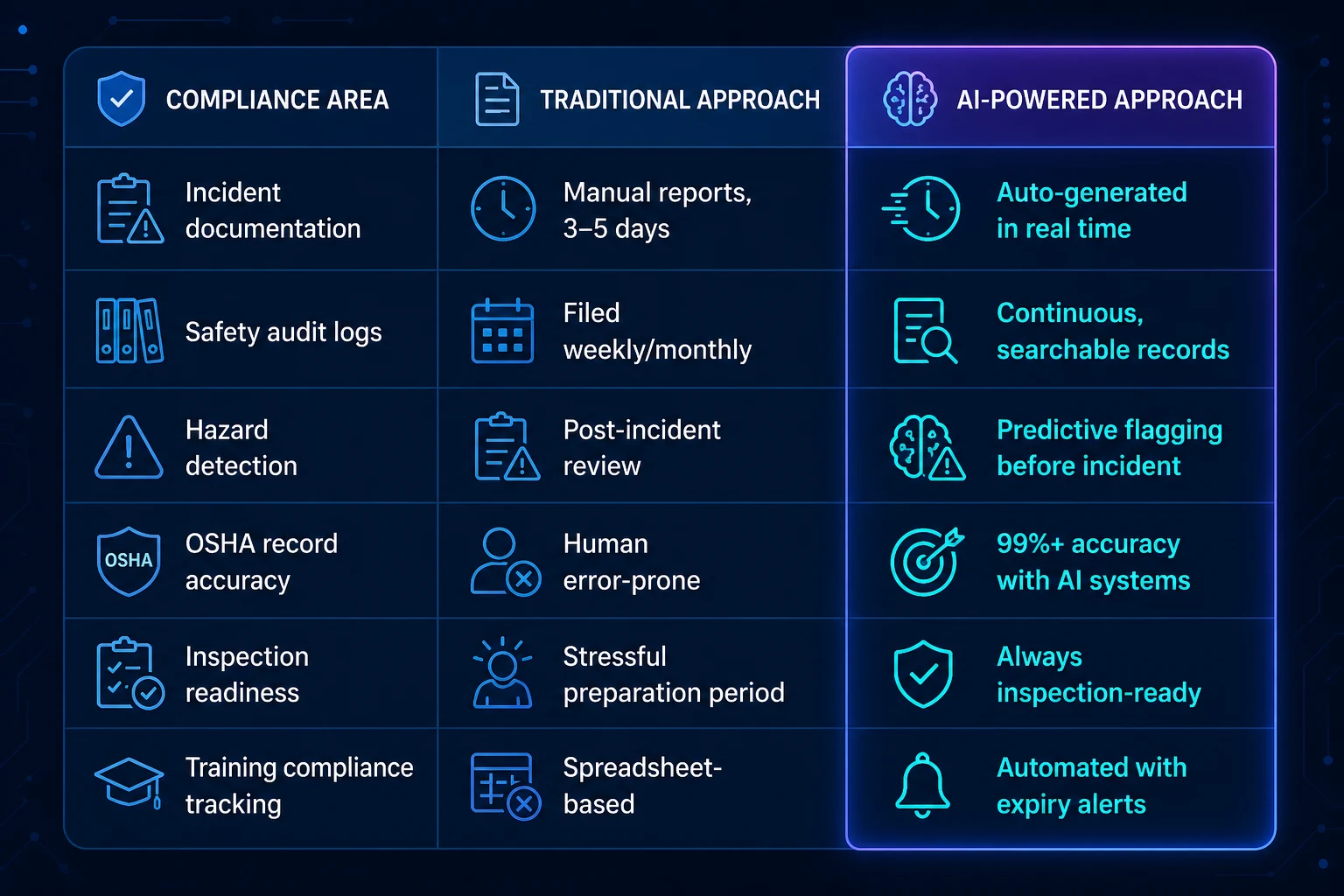
The pattern is consistent: AI-powered systems do not replace your safety program. They make your safety program provable.
The 5 Documentation Systems Every U.S. Construction Site Needs Right Now
Whether you are operating in Houston, Los Angeles, Chicago, or Charlotte, these five documentation systems are what OSHA compliance officers prioritize when they arrive at a construction site. If all five are automated, organized, and immediately producible, your inspection ends quickly. If any of them is incomplete, your inspection expands.
- Injury and Illness Log (OSHA 300 series) maintained year-round, not reconstructed at year end
- Hazard Communication Program with current SDS files for all chemicals on site
- Fall Protection Training Records with trainer credentials and worker acknowledgment signatures
- Equipment Inspection Logs per-shift, per-asset, timestamped and retained for a minimum 3 years
- Site Specific Emergency Action Plan updated for current project conditions, accessible within 30 seconds
Pro Note: OSHA compliance officers can request any of these records within minutes of arriving. If retrieval takes longer than 10 to 15 minutes, it signals a disorganized program even if the records technically exist. Speed of retrieval is itself an audit factor.
NeuraMonks: Purpose-Built AI for Construction Compliance Workflows
NeuraMonks delivers AI systems specifically engineered for industries where documentation accuracy is non-negotiable. For construction firms operating under OSHA's regulatory framework, NeuraMonks has built compliance intelligence into every layer of the workflow — from incident capture to record retrieval to audit preparation.
What separates us from generic software platforms is the application of computer vision, natural language processing, and predictive analytics to the actual documentation workflows your safety teams use every day. The platform does not ask your team to learn new behavior. It automates the documentation that surrounds their existing behavior and ensures that documentation holds up under inspection.
What NeuraMonks Delivers for Construction Safety Compliance
- Real-time incident documentation that meets OSHA 300-series format requirements automatically
- Computer vision inspection of equipment and site conditions with auto-logged results
- Worker credential management with multi-site visibility and certification expiry automation
- Regulatory update monitoring across all U.S. OSHA regional offices and federal standards
- Instant audit ready document packages producible in under 3 minutes for any inspection
- Integration with existing project management platforms including Procore, Autodesk Build, and Viewpoint
Why "We've Never Had a Problem" Is the Most Dangerous Compliance Strategy
The single most common reason construction companies delay investing in compliance automation is a clean history. If you haven't received a major citation in 3 years, the urgency feels abstract. But OSHA enforcement patterns in 2024 and 2025 tell a different story.
OSHA has increased its use of unprogrammed inspections meaning officers arrive without a prior complaint or referral trigger. They are responding to industry wide data suggesting that documentation practices have not kept pace with workforce growth and subcontractor complexity. Your site's clean record is a reflection of inspection timing, not documentation quality. The next inspection will test the documentation, not the culture.
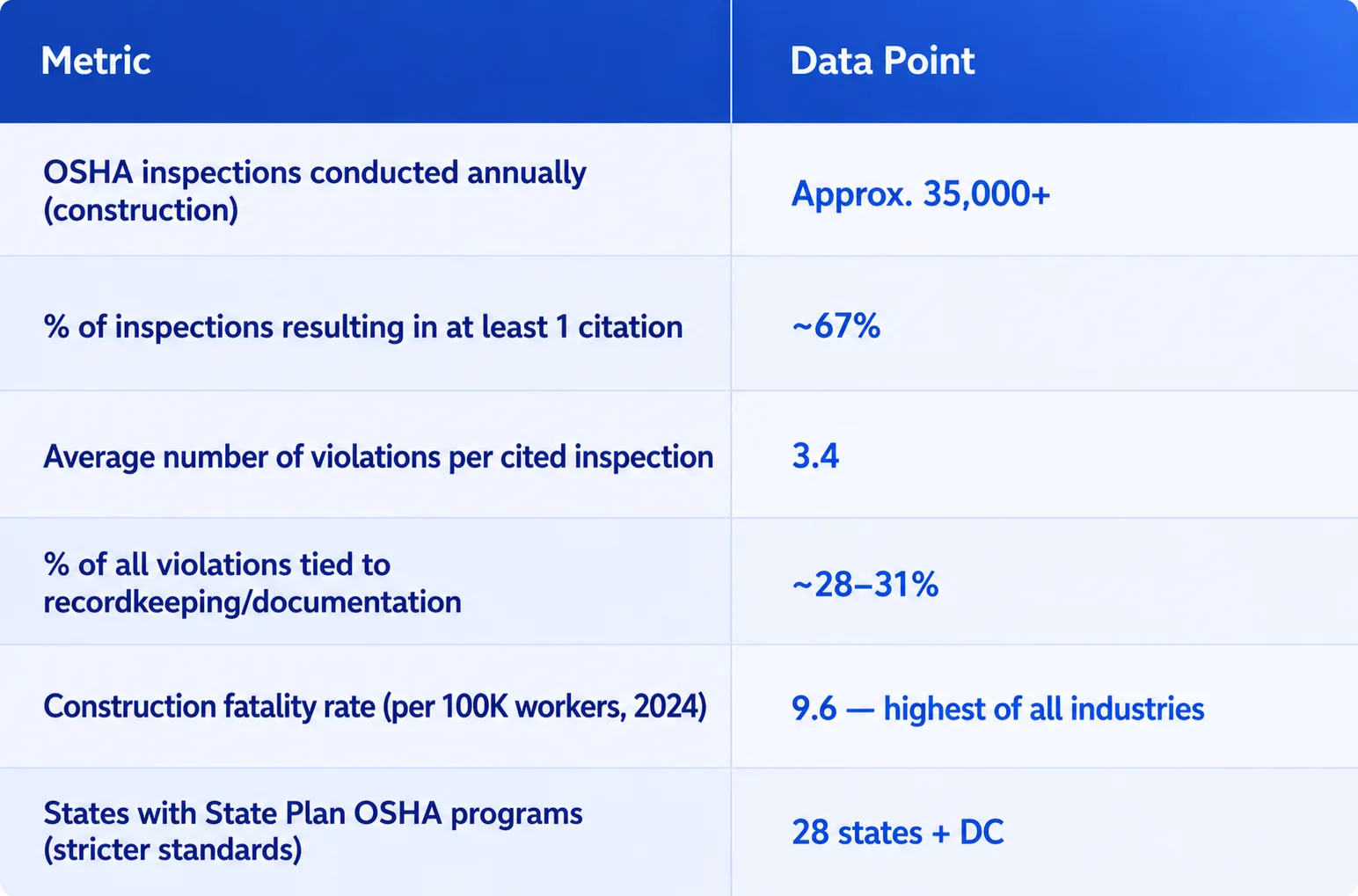
Building a Compliance Infrastructure That Scales With Your Sites
For general contractors managing multiple active projects across different states, the compliance challenge compounds quickly. A crew working in California operates under Cal/OSHA standards that exceed federal requirements. A site in Texas operates under federal OSHA directly. A project in Washington State has its own Department of Labor & Industries framework.
Manual systems cannot track these variations reliably across a growing portfolio. AI in Construction compliance platforms can. The configuration layer of these systems maintains a regulatory ruleset for each active jurisdiction and applies the correct standard automatically to each site's documentation requirements. Your safety manager in Dallas is applying California compliance rules to the Pasadena project without needing to research them manually.
This is the core value proposition of bringing AI solutions into your compliance infrastructure: it removes the human bottleneck from a process that cannot afford human error.
Your Next Inspection Is Already Scheduled — Your Records Should Be, Too
OSHA doesn't announce inspections. They arrive. And when they do, the firms that walk through that process in under an hour with full documentation, zero missing records, and zero citation exposure are the firms that have systematically addressed the paper trail problem.
NeuraMonks works with construction firms across the United States to build compliance documentation systems that function 24/7, scale across every active site, and produce inspection ready records at any moment. The gap between your current documentation process and an audit-proof one is not a personnel gap. It is a technology gap.
Your Compliance Record Has a Gap Right Now. You just don't know where it is yet but an OSHA officer will.
Examine What NeuraMonks Has Delivered for Construction Safety Teams →
Schedule a Construction AI Compliance Scoping Call
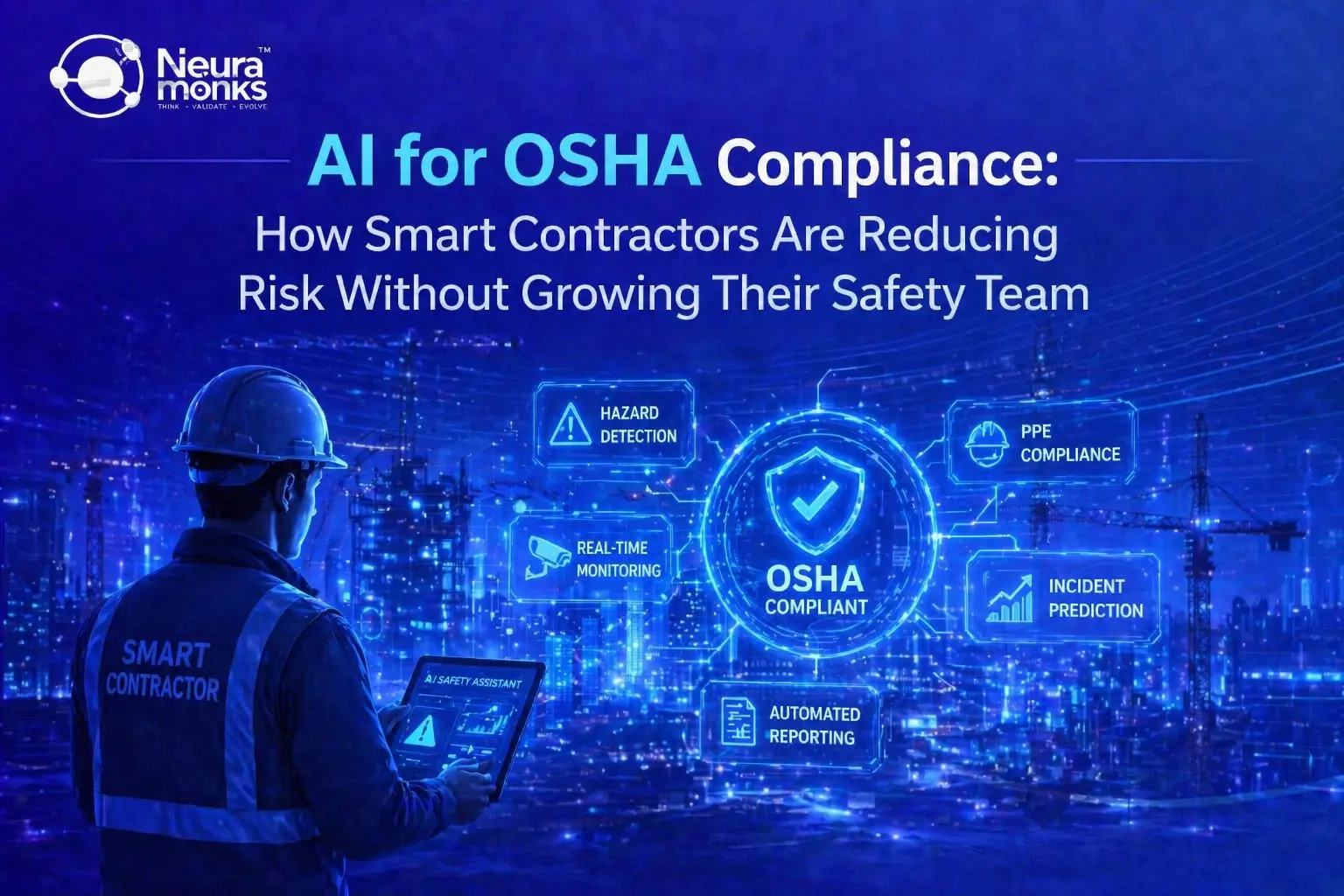
AI for OSHA Compliance: How Smart Contractors Are Reducing Risk Without Growing Their Safety Team
Contractors using AI vision systems to automate OSHA compliance are reducing violations, avoiding penalties, and improving EMR scores—without hiring more safety staff.
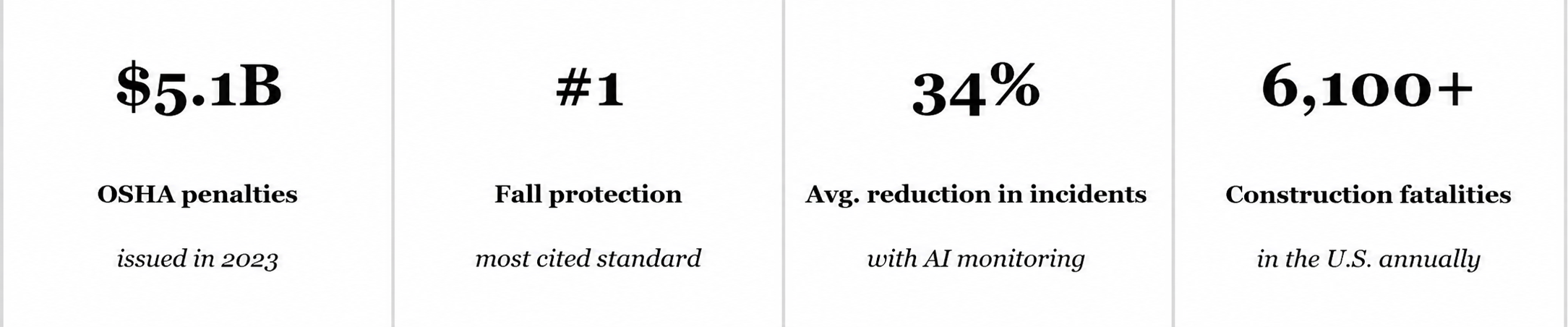
There is a quiet revolution happening on U.S. job sites. It does not involve adding a dozen safety officers or burying crews in more paperwork. It involves plugging in computer vision cameras, connecting them to a compliance engine, and letting AI in Construction do the continuous watching that no human team can sustain across a 10-acre site at 6 AM.
OSHA's penalty structure has never been steeper. A single willful violation now carries fines up to $156,259. Repeat citations compound fast. For mid-size contractors running 4 8 active projects, the risk is existential not just financial. Yet the traditional response (hire more safety staff) is both expensive and slow. The smarter contractors are choosing a third path.
Why Traditional Compliance Methods Are Breaking Down
Safety management on construction sites has historically relied on periodic walkthroughs, manual checklists, and reactive incident reports. The fundamental problem: a safety manager can only be in one place at one time. On a large commercial project with 200+ workers across multiple floors and trades, continuous human oversight is mathematically impossible.
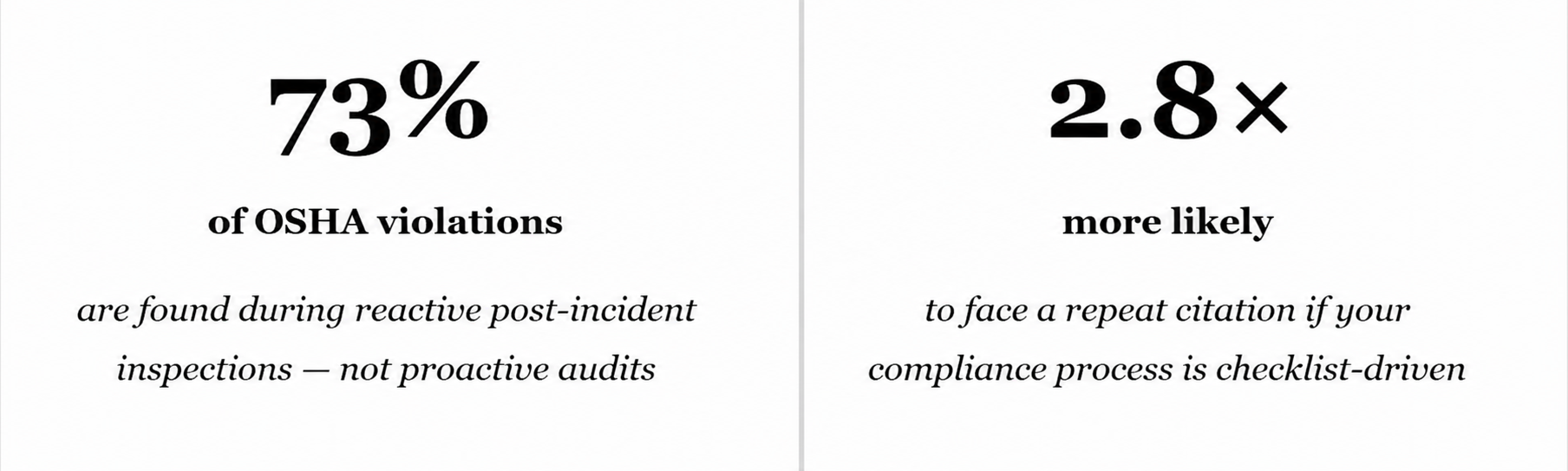
The compliance gap is real. OSHA's own data shows that the majority of violations are discovered after something goes wrong a fall, a struck by incident, a scaffold failure. At that point, the fine is the least of your problems. Worker's comp claims, project delays, litigation, and reputational damage can cost 10–50x the original penalty.
We had good safety culture but a terrible visibility problem. We couldn't see what we couldn't see.
Safety Director, top-20 U.S. general contractor
What AI in Construction Actually Looks Like for Compliance
AI in Construction compliance is not a futuristic concept. It is deployable today, and contractors across the U.S. are using it on active projects. Here is what the technology stack looks like in practice:
Core AI Compliance Capabilities 2024 Deployments
1. Real-Time PPE Detection — Cameras identify missing hard hats, vests, gloves, and eye protection. Workers are flagged within seconds, not hours.
2. Hazardous Zone Monitoring — Geofencing and computer vision alert supervisors when workers enter exclusion zones without authorization or proper equipment.
3. Fall Risk Analysis — Models detect unprotected edges, missing guardrails, and improper ladder use. Alerts are issued before an incident occurs
4. Automated OSHA Documentation — Incident logs, near-miss reports, and inspection records are generated automatically from sensor and camera data, reducing manual documentation time by up to 80%.
5. Predictive Risk Scoring — Machine learning models score each work zone daily based on crew density, task type, weather, and historical incident patterns helping you deploy safety resources where they are needed most.
The Real Cost of Non-Compliance vs. the Cost of AI Implementation
Decision-makers often frame this as a budget question. The actual math points firmly in one direction.
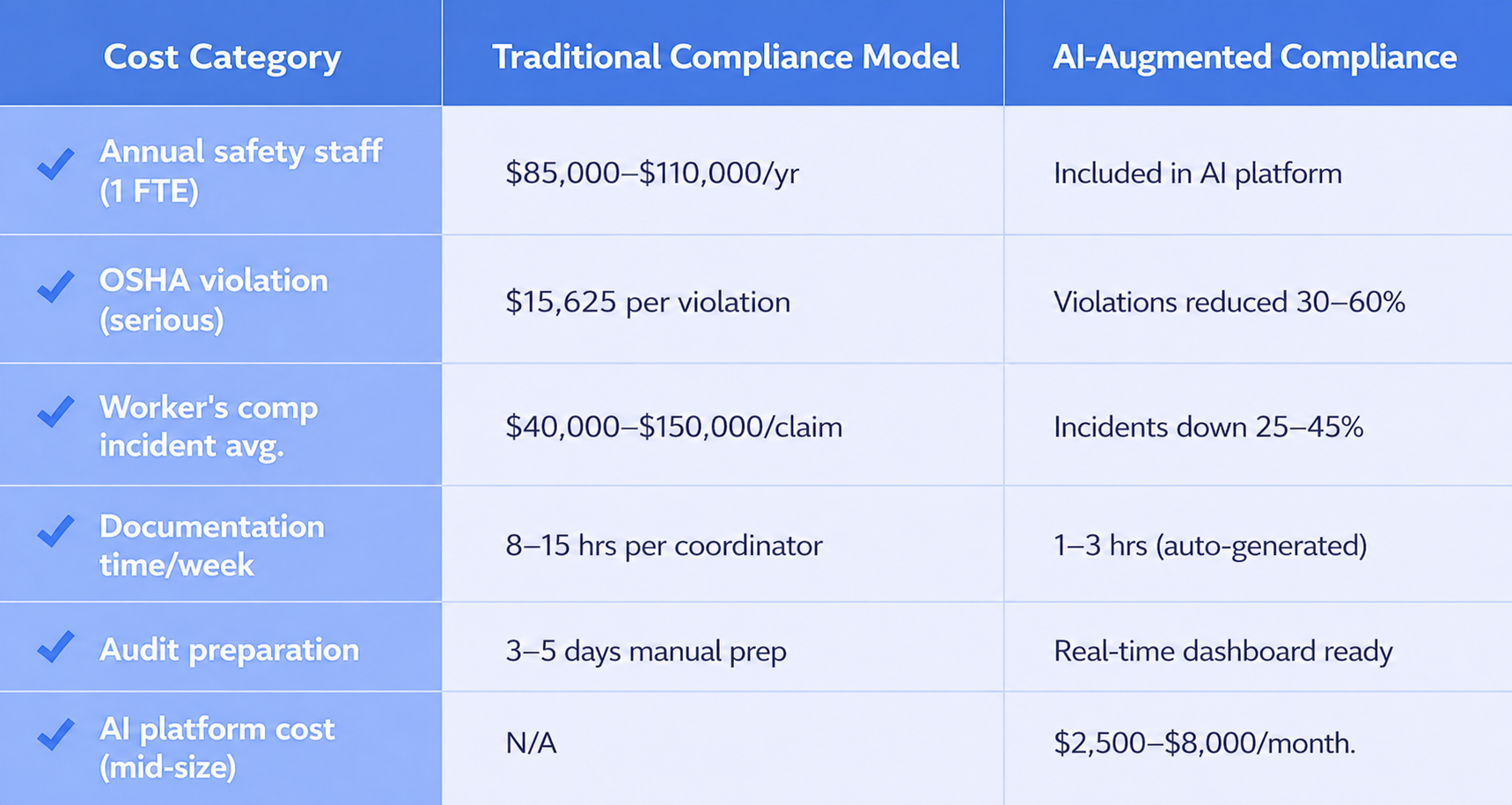
The ROI calculation is not close. A contractor running 5 projects who avoids 3 serious OSHA citations per year ($46,875 saved) and 1 worker's comp claim ($75,000 average) is already clearing $120,000+ in avoided costs against a platform investment that typically runs $5,000 to $8,000/month across all sites. That is a positive return inside the first quarter.
OSHA's Most Cited Standards and How AI Addresses Each One
OSHA publishes its most-cited violations annually. For FY2023, the top 10 for construction were dominated by four categories. Here is how AI solutions map to each:
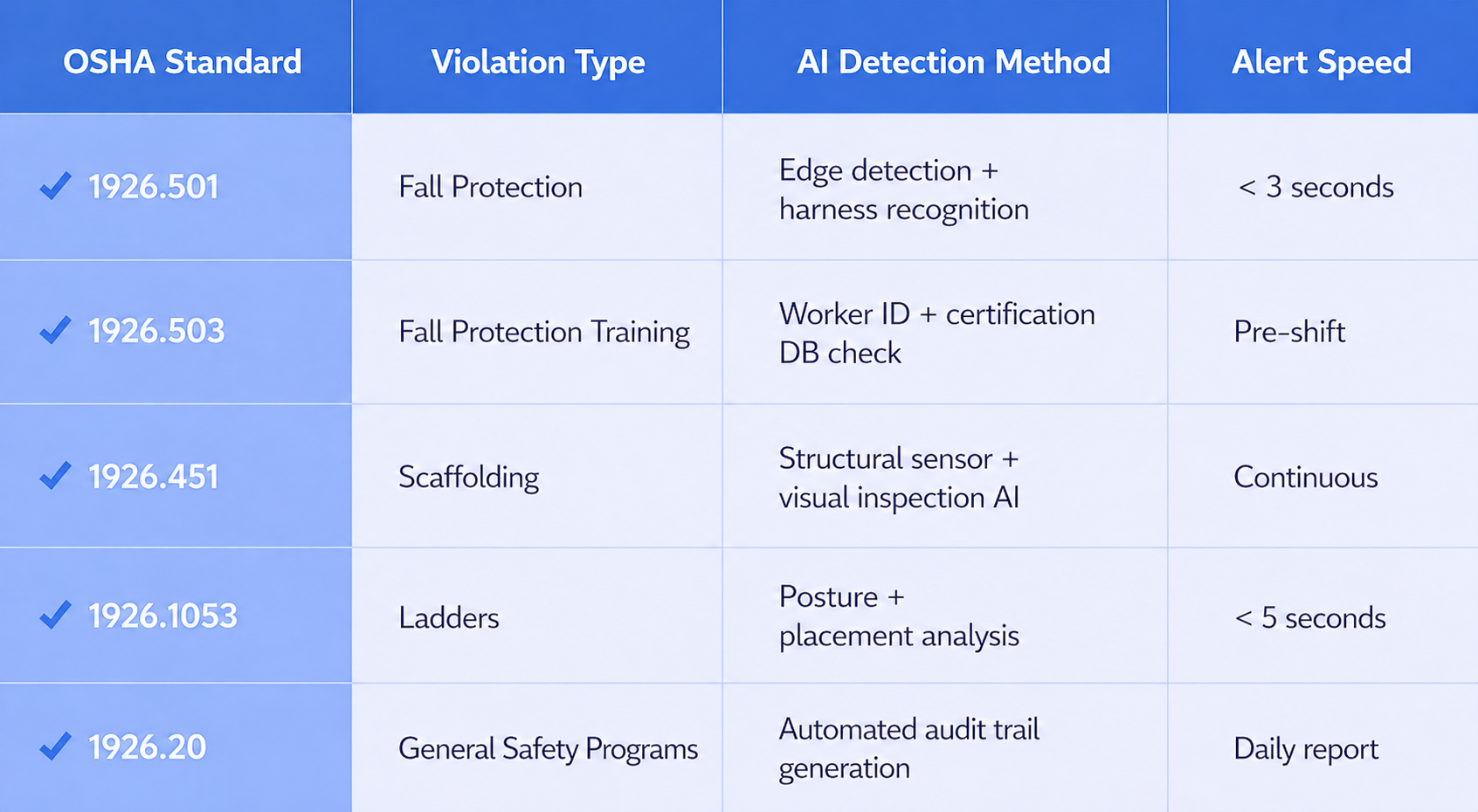
When AI in Construction is deployed at this level of specificity, safety teams shift from reactive fire fighting to proactive oversight. One coordinator can effectively monitor what previously required three dedicated walkers on a large site.
How NeuraMonks Builds Compliance Intelligence for Contractors
NeuraMonks is not a generic SaaS vendor. As a specialized AI development company focused on computer vision and industrial AI, NeuraMonks designs compliance systems built around how construction sites actually operate not how a software demo assumes they do.
The difference is meaningful. Off-the-shelf safety platforms apply generic models trained on warehouse or manufacturing footage. Construction environments are dynamic: lighting changes by the hour, crews rotate across zones, PPE varies by trade, and site layouts change weekly. Generic models produce false positives that crews learn to ignore which is worse than having no system at all.
What NeuraMonks Delivers for Contractors
• Custom-trained vision models on your site footage not generic datasets
• OSHA standard-specific detection logic (fall protection, scaffolding, struck-by)
• Integration with your existing camera infrastructure no rip-and-replace
• Automated OSHA-ready documentation and incident audit trails
• Dashboard visibility for project owners, safety directors, and site supers all in one place
A Field-Tested Deployment: From Pilot to Portfolio Rollout
The pattern we see consistently among U.S. contractors who adopt AI compliance systems follows three phases:
Phase 1 Pilot Project (Weeks 1 to 6)
One active project is instrumented with AI cameras and the compliance engine. The team runs parallel operations: existing safety processes continue while AI data is collected. By week 4, the gap between what the human walkthroughs catch and what the AI detects is usually striking enough to build internal buy-in.
Phase 2 Calibration & Integration (Weeks 6–12)
The AI models are refined based on actual site conditions. Alert thresholds are tuned to reduce noise. OSHA documentation workflows are connected to the platform. Safety coordinators shift from walkthroughs to monitoring and exception-handling.
Phase 3 Portfolio Expansion (Month 3+)
Once the pilot demonstrates a measurable reduction in near-miss events and citation risk, the same infrastructure is deployed across all active projects. The unit economics improve significantly at scale the AI platform cost per project decreases while protection increases.
By month three, our safety coordinator was managing compliance across four sites instead of one. The AI handled the constant monitoring. She handled the decisions.
VP of Operations, Southeast commercial GC
Answering the Questions Safety Directors Actually Ask
Will crews resist the cameras?
Initial resistance is real but short-lived when the framing is right. The AI is not surveillance for discipline purposes it is an early-warning system that protects workers. Most crews, once they understand the system flags risks before incidents happen, become advocates. Frame the rollout around worker protection, not compliance enforcement.
What happens when the AI makes a false positive?
Well-designed systems like those built by NeuraMonks include confidence thresholds and human-in-the-loop review for any alert that triggers documentation. False positives are flagged to the safety coordinator, not automatically recorded in OSHA logs. The system improves with every reviewed alert through active learning.
Do we need new cameras or infrastructure?
In most deployments, no. AI compliance platforms integrate with existing IP camera networks. If your sites already have CCTV for security, the same hardware can be repurposed. New edge-compute devices process video locally, so footage does not need to leave the site for analysis, which addresses both bandwidth and privacy concerns.
How long before we see measurable results?
Contractors typically see the first data within 48–72 hours of deployment. Measurable reduction in near-miss events is observable within 30 days. Documentation hours drop immediately. OSHA citation risk reduction is measurable after the first full audit cycle.
The Competitive Advantage You Are Not Talking About Yet
There is a dimension of this conversation that goes beyond penalty avoidance. Increasingly, large project owners and general contractors are asking subcontractors about their safety technology stack as a prequalification factor. EMR (Experience Modification Rate) is a direct input into bonding capacity and bid competitiveness.
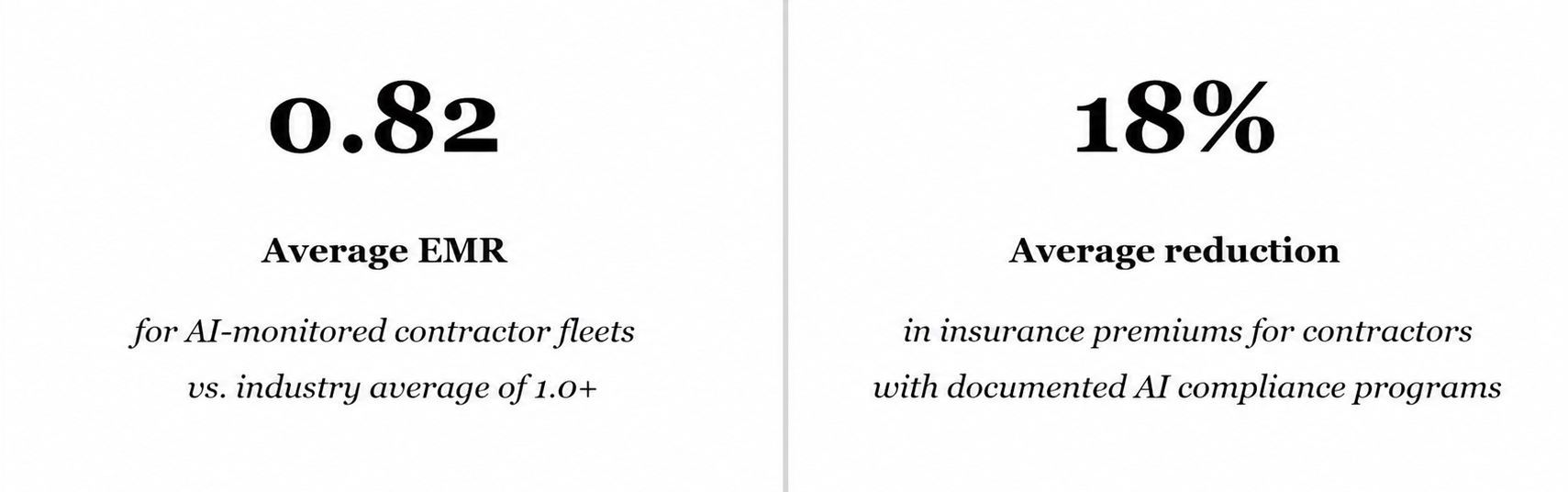
Contractors who deploy AI solutions today are building a documented safety record that compounds over time — lower EMR, better bonding rates, access to larger projects, and a hiring advantage with safety-conscious workers. The compliance benefit is just the beginning.
Your Next OSHA Audit Doesn't Have to Be a Gamble
NeuraMonks engineers compliance intelligence built for how your crews actually work — not how consultants think they should.
Examine Delivered Case Studies | Schedule a Scoping Call
7 Life Saving AI Use Cases in Healthcare
This blog highlights 7 real-world AI use cases in healthcare that deliver measurable impact—reducing errors, speeding up diagnosis, and improving clinical efficiency. It showcases how AI is already transforming areas like pathology, radiology, wound care, and predictive analytics with proven case studies. Overall, it serves as a practical guide for healthcare leaders to evaluate and implement AI solutions with clear ROI.
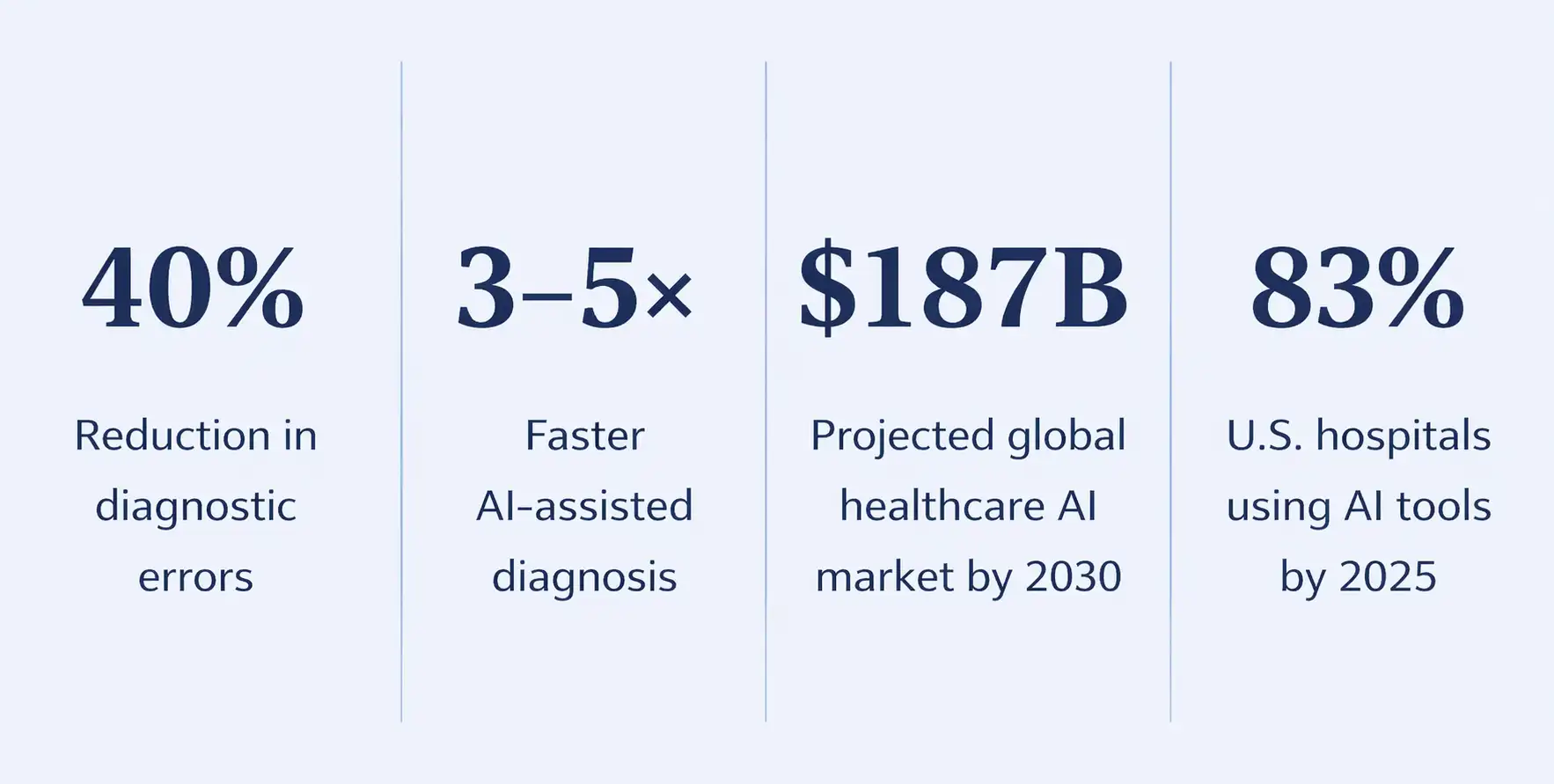
AI in healthcare is no longer a pilot project it's deployed in operating rooms, pathology labs, ophthalmology clinics, and wound care centers across the United States. From detecting malaria in a blood smear to predicting sepsis six hours before standard protocols would flag it, AI Healthcare Solutions are generating measurable, auditable clinical outcomes that hospital administrators and clinical directors can act on today.
This guide documents 7 high-impact AI use cases each with real numbers, verified case studies, and clear commercial value. Whether you are evaluating vendors, scoping an AI pilot, or building a business case for your board, this is the resource that cuts through the noise.
NeuraMonks has delivered production AI systems across pathology, ophthalmology, orthodontics, and wound care. Every case study below reflects work we have shipped not theoretical capability.
1. AI-Powered Blood Cell Analysis & Malaria Detection
Manual blood smear analysis creates a dangerous bottleneck in high-volume diagnostic labs. Skilled technicians spend hours counting and classifying cells work that introduces inter-observer variability and fatigue related errors. In malaria-endemic regions and underserved U.S. communities, a missed positive is not a data point. It is a patient outcome.
How AI Healthcare Solutions Eliminate This Bottleneck
Deep learning models trained on annotated blood smear images automatically segment and classify red blood cells, white blood cells, and platelets at scale. A specialized malaria detection module identifies Plasmodium infected cells with accuracy that matches expert pathologists without fatigue, without variability, and at a fraction of the time.
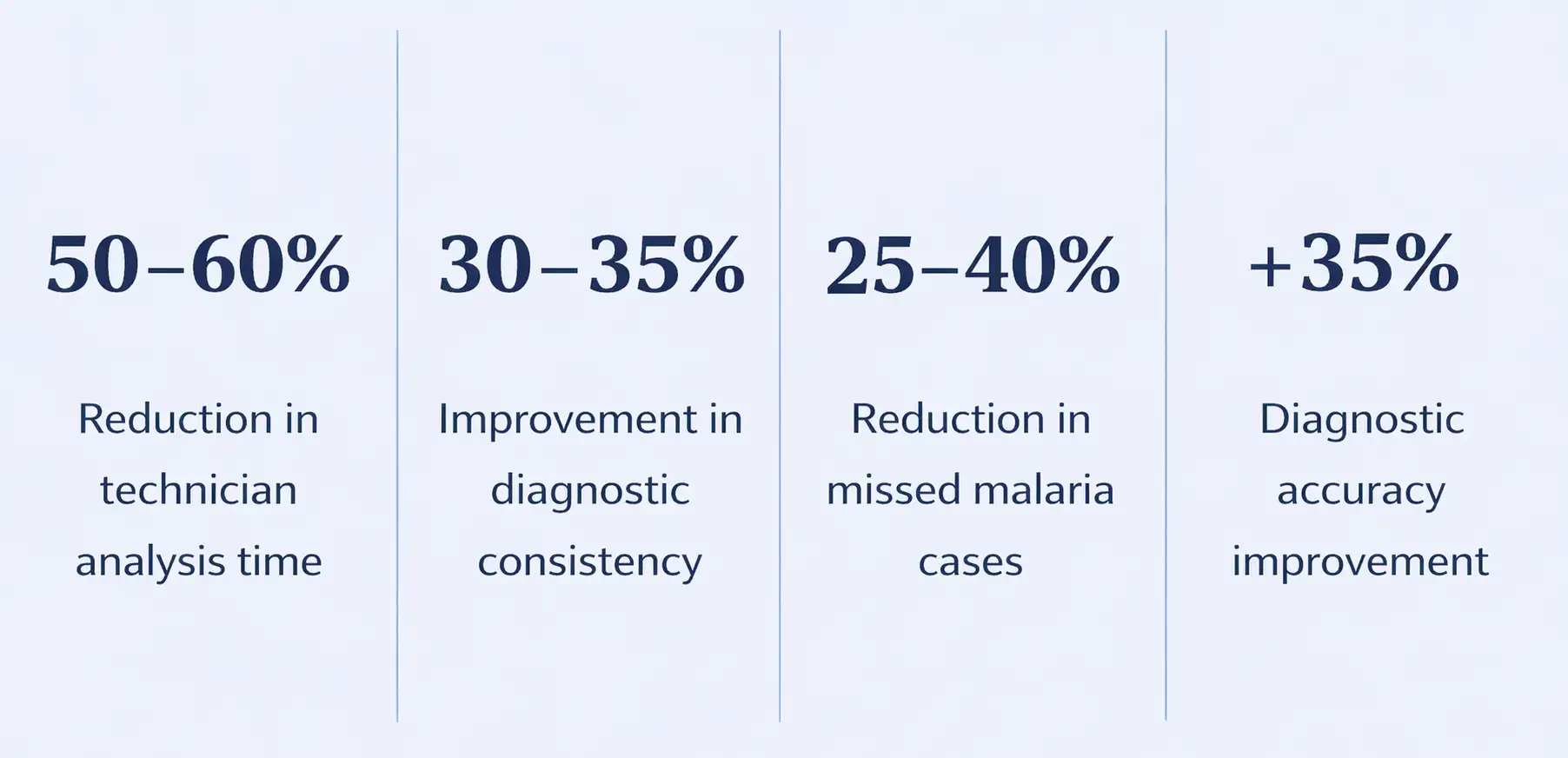
Key Capabilities
- Automated detection and classification of RBCs, WBCs, and platelets
- Specialized Plasmodium parasite detection module for malaria screening
- End-to-end automation from image ingestion through structured reporting
- Scalable model architecture deployable across multi-site lab networks
- Built on Python + PyTorch with Django-based deployment infrastructure
CASE STUDY
AI Powered Blood Cell & Malaria Detection Improves Diagnostic Accuracy by 35% and Cuts Lab Workload by 55%
See the full case study at NeuraMonks
For high volume labs and hospital pathology departments, this automation directly reduces per sample cost, accelerates patient turnaround, and builds a defensible audit trail for every diagnostic decision.
2. Automated Wound Detection & Measurement Using Deep Learning
Wound care documentation is one of the most paper-heavy, inconsistent processes in clinical practice. Nurses and wound care specialists measure wounds with rulers, describe them in free text, and photograph them without a standardized protocol. Two clinicians assessing the same wound can produce materially different records which creates compliance risk, billing exposure, and treatment inconsistencies.
What the AI System Does
A deep learning computer vision system automatically detects wound boundaries in clinical photographs, measures area and perimeter, classifies wound type and stage, and generates a structured record that integrates with EHR systems. Every assessment is timestamped, consistent, and comparable across visits giving care teams an objective healing trajectory.
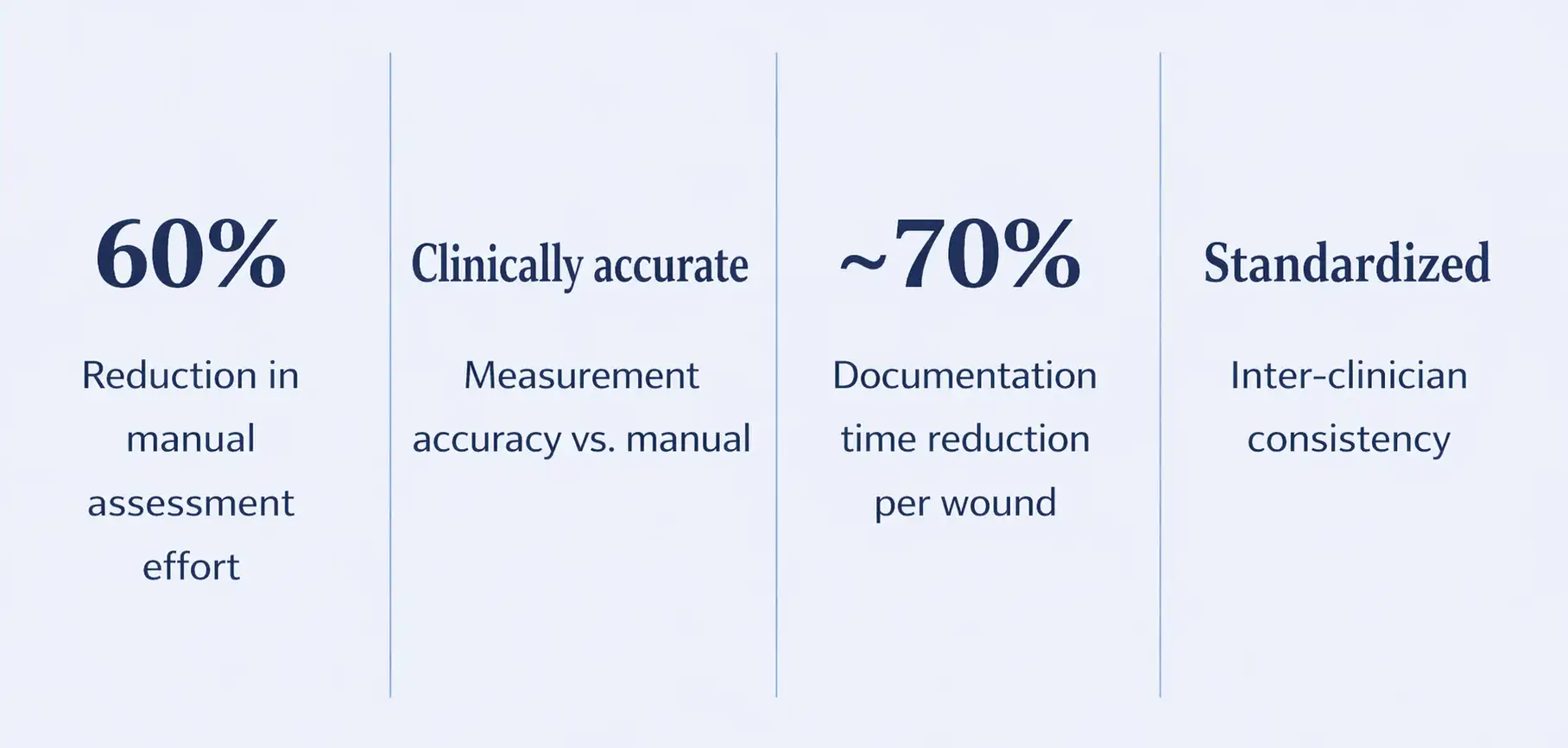
Clinical and Financial Impact
- Eliminates inter-clinician variability in wound staging and measurement
- Enables objective tracking of healing rates to guide treatment escalation decisions
- Supports telehealth wound monitoring patients photograph wounds at home
- Reduces litigation risk through standardized, timestamped documentation
- Integrates with EMR/EHR platforms for seamless workflow adoption
CASE STUDY
Delivered Clinically Accurate Wound Measurements — Reduced Manual Assessment Effort by 60%
See the full case study at NeuraMonks
High value settings: long-term care facilities, burn centers, diabetic wound clinics, and home health agencies all high cost environments where standardized documentation reduces both clinical and administrative burden.
3. AI-Powered Automation in Clinical & Administrative Workflows
Beyond diagnostic imaging, healthcare organizations are deploying AI to automate the administrative and operational processes that consume clinical staff time without adding patient value scheduling, eligibility verification, prior authorization, and internal task routing.
Documented Results from a Real Deployment
A healthcare automation engagement delivered measurable efficiency gains across clinical scheduling and internal workflow management cutting manual processing time, reducing error rates, and freeing clinical staff to focus on patient-facing work.
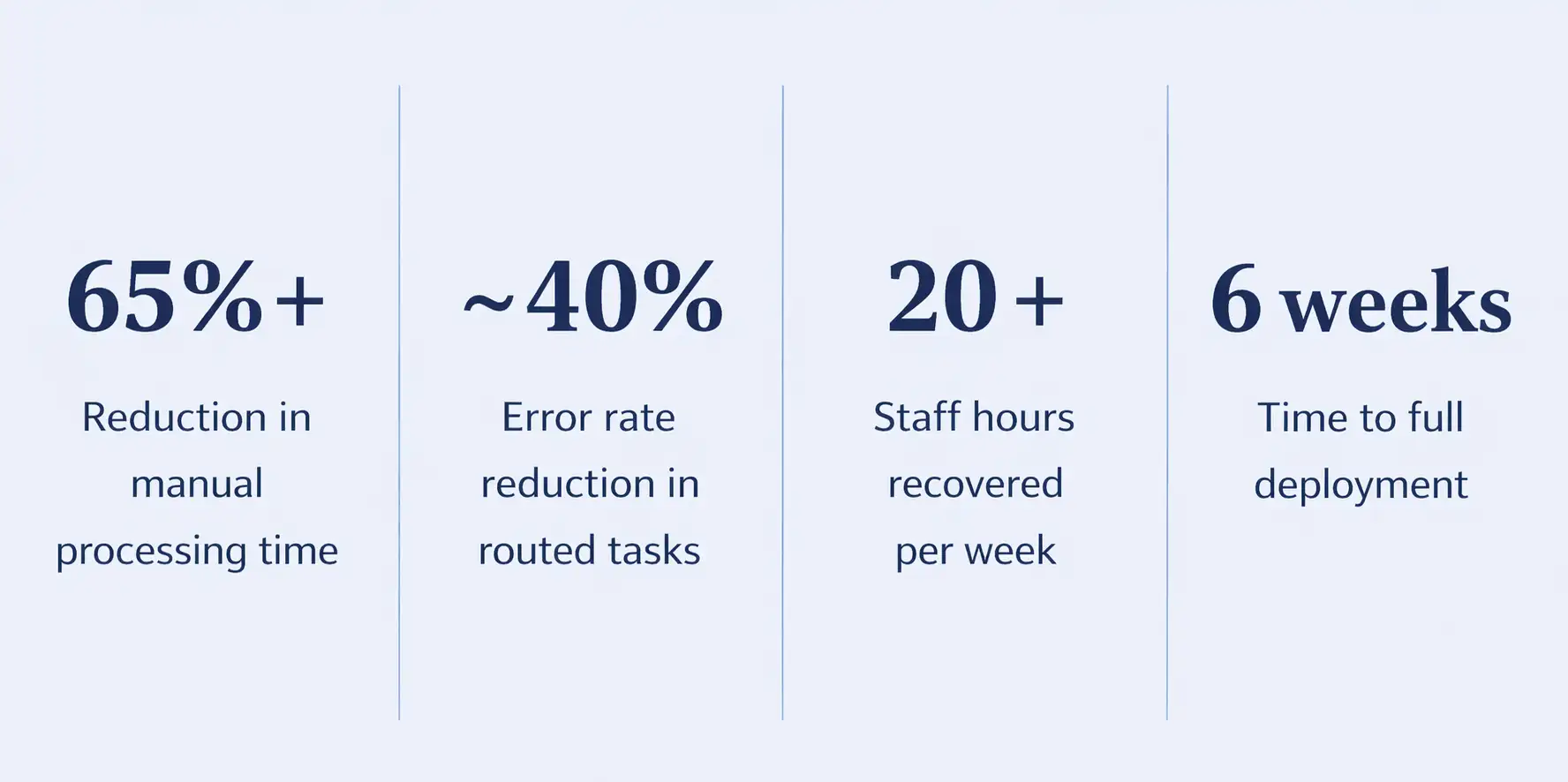
Automation Capabilities Delivered
- AI-driven scheduling and patient intake routing
- Automated prior authorization data collection and submission
- Internal workflow orchestration with rule-based exception handling
- Real-time dashboard for task status and bottleneck visibility
- Integration with existing EMR and practice management systems
CASE STUDY
AAL Healthcare Automation Efficiency Gains Across Clinical and Administrative Workflows
See the full case study at NeuraMonks
4. Automated Detection of Dental Bite Problems from 3D Scans
Orthodontic diagnosis relies on manual inspection of 3D dental models a process that is slow, experience-dependent, and particularly challenging when a patient presents with multiple overlapping conditions simultaneously. A Class II malocclusion combined with a deep bite and scissors bite is common in complex cases, yet diagnosing all three conditions consistently requires significant clinical experience.
Specialized AI Solutions for Orthodontics
A ResNet 50 based CNN processes 3D dental scan files (STL format), automatically classifying the primary occlusion type and any co existing bite problems. The system delivers ranked predictions with confidence scores and validates all combinations against medical plausibility rules before surfacing results to the clinician.

System Architecture
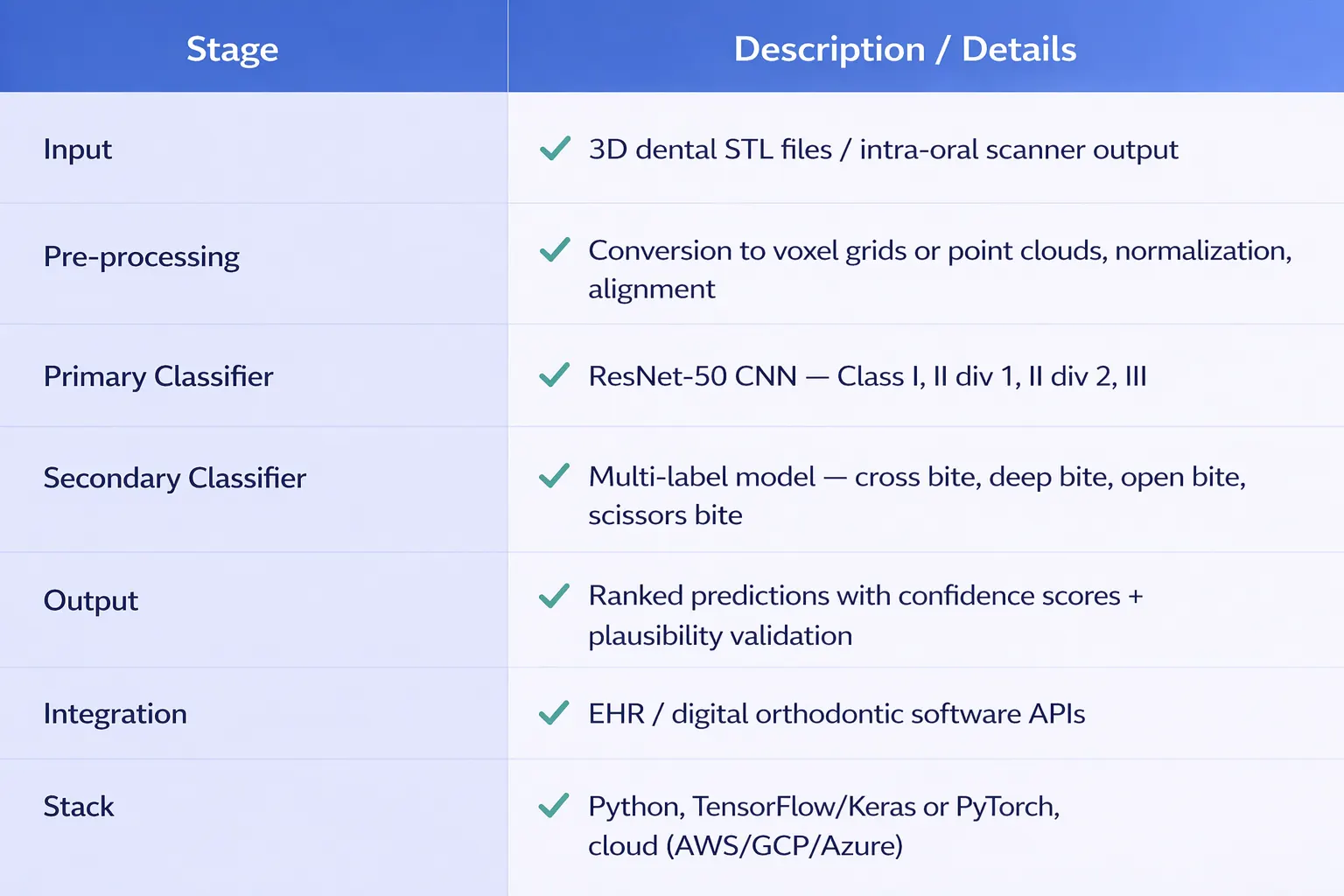
With a Cohen's kappa of 0.86, this system reaches near-expert diagnostic agreement. For orthodontic groups, DSOs, and dental school clinics processing high volumes of new patients, this represents significant time savings and a measurable improvement in diagnostic consistency.
5. AI Clinical Decision Support for Glaucoma Management
Glaucoma affects over 3 million Americans and is a leading cause of irreversible blindness yet up to 50% of cases remain undiagnosed. The disease progresses silently, and staging decisions depend on synthesizing complex variables across a patient's full visit history. When a patient has 80+ recorded visits, manually extracting meaningful longitudinal signal at scale is unrealistic.
Dual-Agent AI Architecture
A multi-agent AI platform processes patient data symptoms, intraocular pressure history, age, optic nerve imaging, visit records against a large repository of historical cases. A Diagnostic Agent generates recommendations, then a separate Validation Agent independently scores them for reliability (0 to 10) before presenting results. The system never forces a conclusion on edge cases low-confidence profiles trigger a direct clinician review flag.
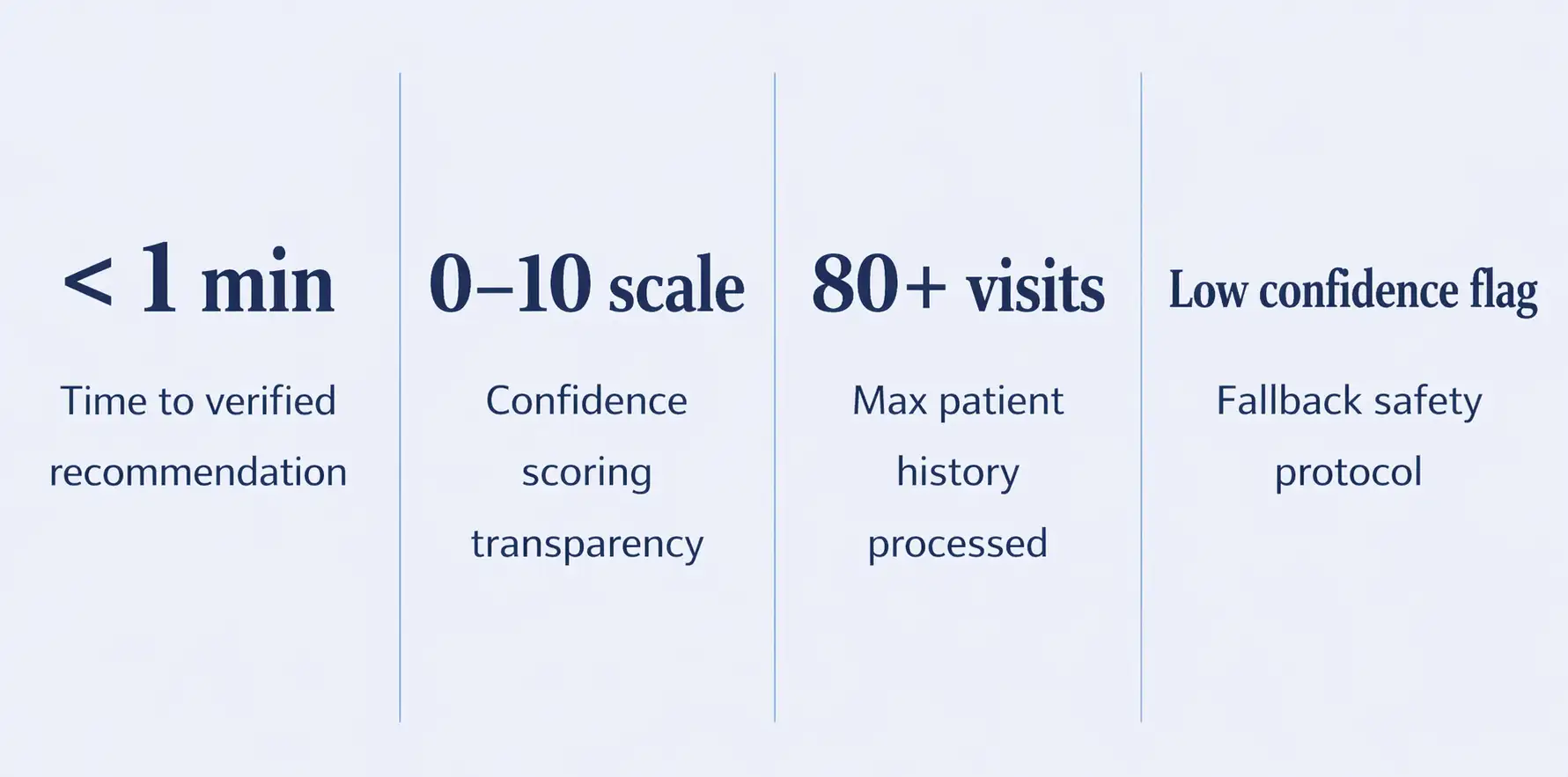

For ophthalmology practices managing large patient panels, this system reduces the cognitive load of routine staging decisions while maintaining human oversight on ambiguous cases.
6. AI-Assisted Radiology: Second-Read Accuracy at Scale
Radiologists in the U.S. read an average of 20,000+ images annually. Imaging volumes are rising while radiologist supply is projected to fall short of demand by 42,000 physicians by 2033. The combination creates conditions for fatigue-related errors particularly for subtle findings like small pulmonary nodules, hairline fractures, or early-stage tumors.
How the AI Functions as a Second Reader
AI radiology tools apply deep learning to X-rays, CT scans, and MRIs to flag anomalies, pre-annotate findings, and prioritize worklists so critical cases surface first. These systems do not replace radiologists they reduce the probability that a clinically significant finding is missed on a high-volume day.
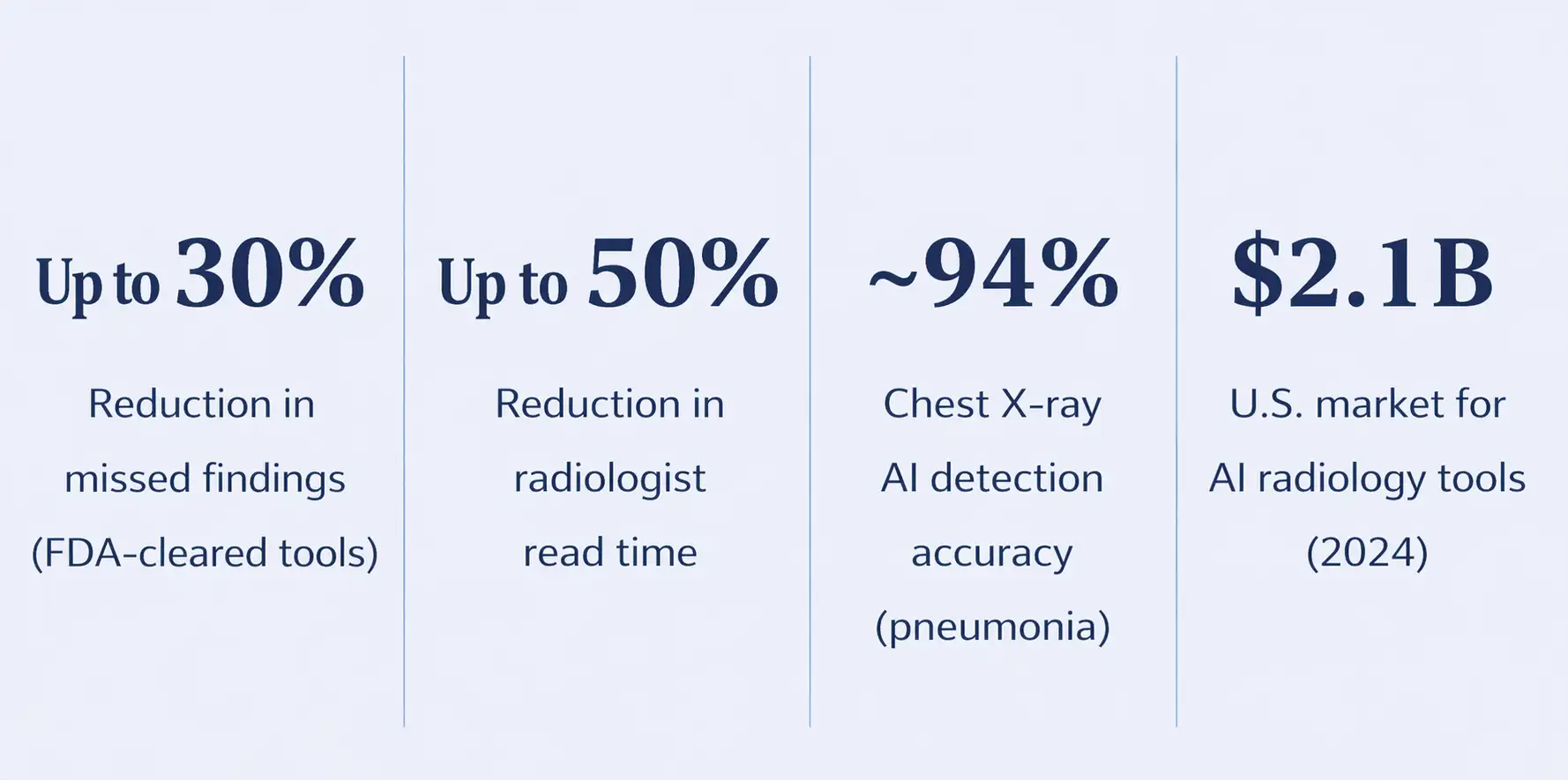
- Faster turnaround times improve patient throughput and revenue per scanner
- Prioritized worklists reduce time-to-treatment for critical findings stroke, PE, pneumothorax
- Documented AI second-read can reduce malpractice exposure
- Scalable across teleradiology networks one AI-augmented radiologist covers more sites
7. Predictive Analytics for Early Sepsis Warning
Sepsis kills approximately 270,000 Americans every year. The condition can progress from a manageable infection to multi-organ failure within hours, and early intervention is the single biggest determinant of survival. Yet hospitals still largely depend on reactive vital sign thresholds and manual escalation protocols.
Continuous Risk Scoring from EHR Data
Predictive AI models analyze EHR data streams in real time vital signs, lab results, medication administration, nursing notes generating sepsis risk scores per patient every few minutes. When a score crosses a defined threshold, the system automatically alerts the clinical team, enabling intervention hours before traditional early-warning scores would trigger.
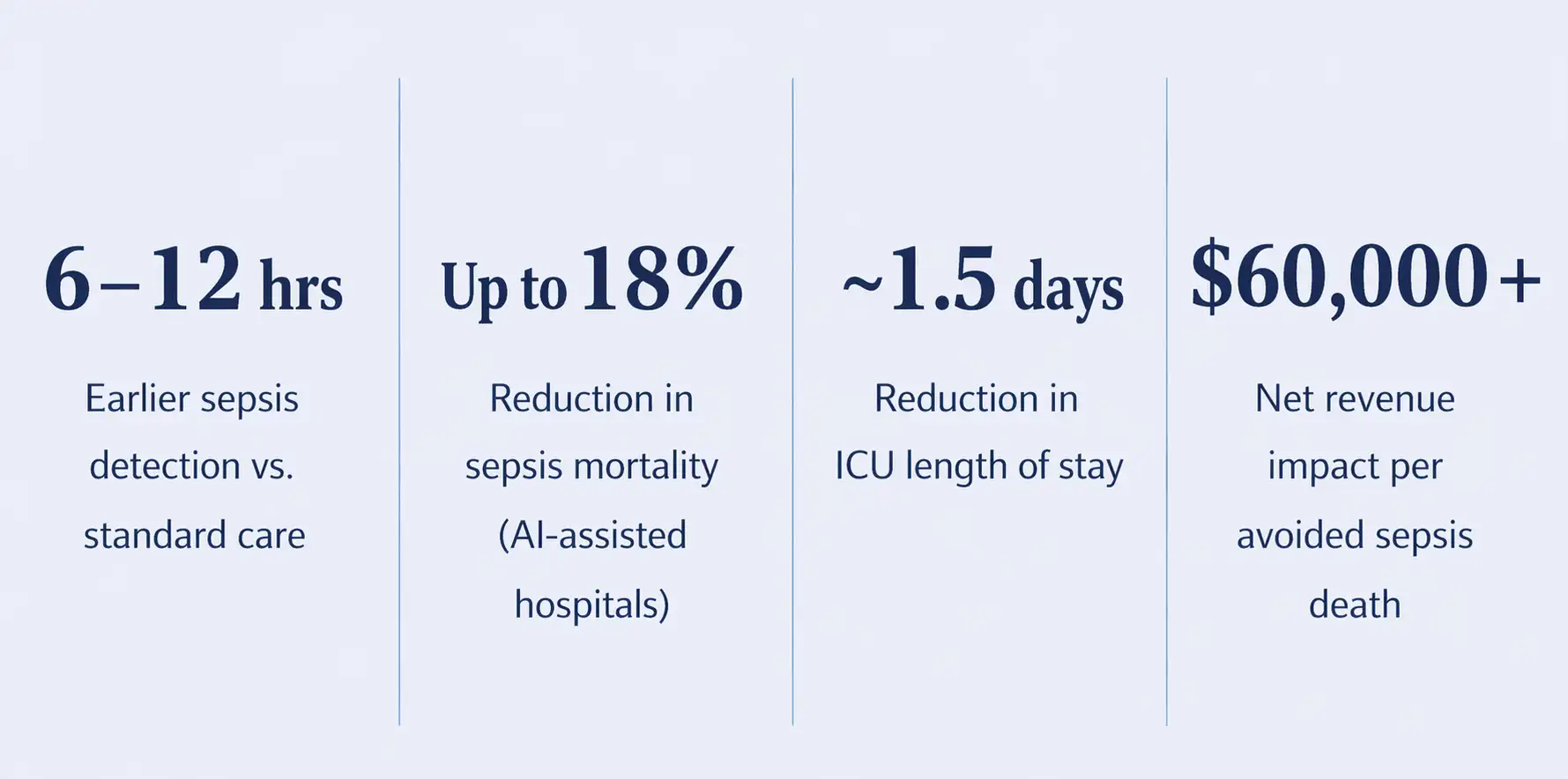
- Reduced CMS sepsis-related penalties under the Hospital Readmissions Reduction Program
- Improved HCAHPS scores and CMS star ratings directly tied to reimbursement
- Lower cost per sepsis case average ICU sepsis treatment: $25,000–$100,000
- Actionable alerts integrated into existing EHR workflows (Epic, Cerner, etc.)
- Explainable AI outputs clinicians see exactly which data points triggered the alert
All 7 AI Use Cases: Side-by-Side
The table below maps each AI solution to its primary measurable impact, the clinical buyer, and current NeuraMonks delivery status giving procurement teams a clear evaluation grid.
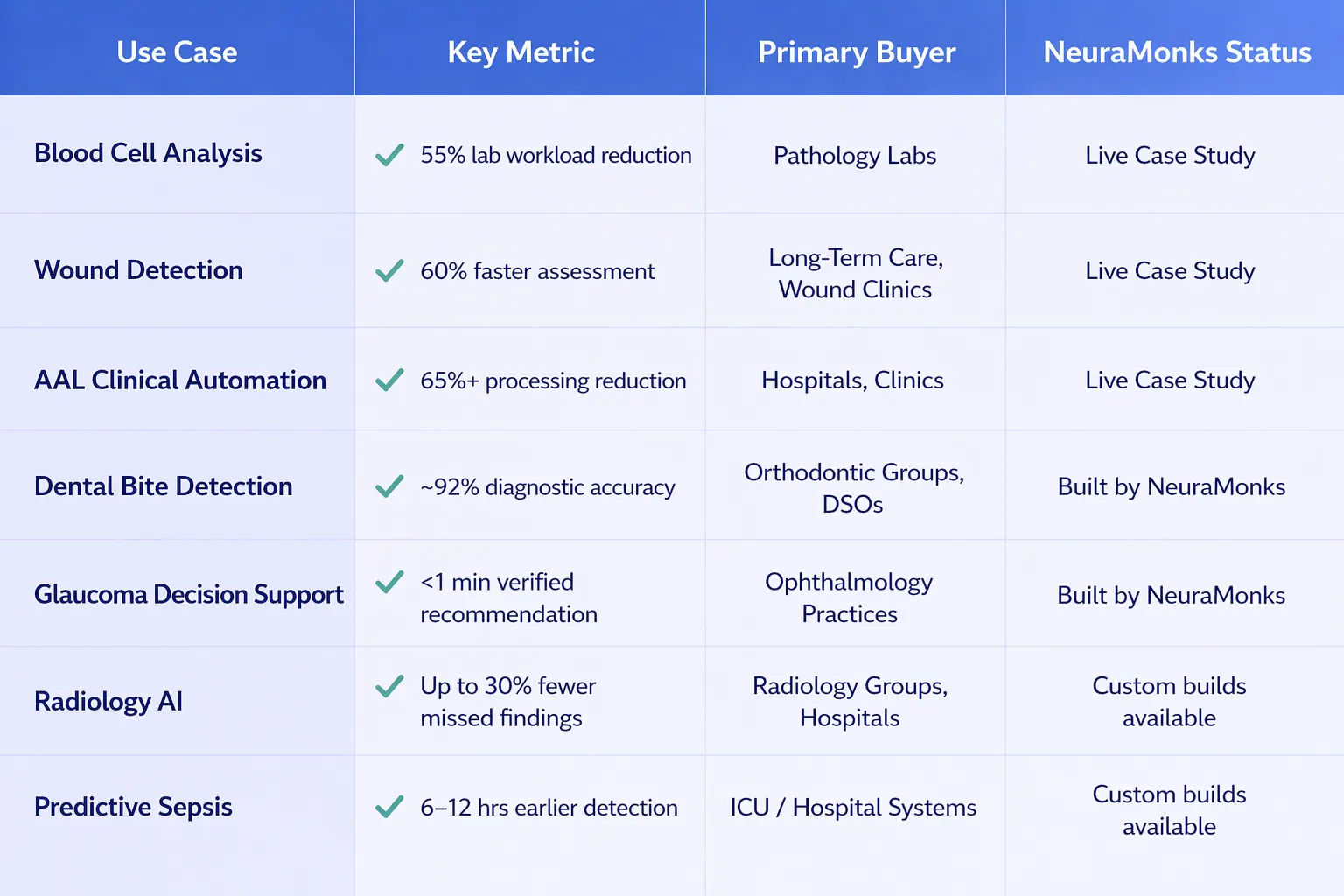
Your Clinical Problem Has a Measurable AI Answer
NeuraMonks AI Healthcare Solutions are scoped, built, and validated for clinical environments not retrofitted from generic tools. Every engagement starts with a data assessment and a defined success metric.
If your team has a clinical workflow that generates structured data, there is a high probability AI can reduce cost, reduce error, or improve speed — measurably.
Schedule a Clinical AI Scoping Call
45 minutes. Define your use case, assess your data, set success criteria.
Examine Delivered Case Studies
Verified outcomes. Real clinical environments. Exact numbers.
https://www.neuramonks.com/ai-case-study

Is There an AI Bubble? What CTOs Should Watch Before Signing the Next Infrastructure Budget
A practical framework for evaluating AI infrastructure investments separating genuine ROI opportunities from hype-driven spending. This post walks CTOs through the difference between AI capabilities that deliver measurable outcomes and those that drain budgets without clear business impact
When the market is moving this fast, the hardest thing for a technology leader to say is: "I'm not sure this spend is justified."
AI investment crossed $200 billion globally in 2024. GPU clusters have had multi-week waitlists. Every major cloud vendor has doubled its AI services portfolio. And yet according to McKinsey only 31% of enterprise AI deployments report clear, measurable return on investment.
That gap is worth sitting with. Not to dismiss AI the technology is genuinely transformative when deployed correctly but to ask the question that separates thoughtful infrastructure decisions from momentum-driven ones:
Are we spending on AI because it solves a specific problem we have or because everyone else seems to be spending on AI?
This piece is for the CTO, the VP of Engineering, the founder who is fielding three vendor pitches a week and trying to figure out which ones are worth a second conversation. It is not a debate about whether AI works. It is a framework for deciding where it earns its cost.
The Bubble Is Real Just Not Where Most People Think
Bubble dynamics in technology rarely mean the underlying technology is worthless. The dot-com bust did not disprove the internet. What it destroyed were companies building on top of hype without a path to revenue. The same pattern is visible in parts of the AI landscape today.
Where the bubble is most inflated:
- Foundation model startup valuations — many are priced on potential, not on revenue or margin
- Generative AI SaaS tools — a crowded market where differentiation is thin and churn is high
- GPU compute contracts — locked in at 2024 peak pricing before commodity correction arrived
- Custom LLM projects sold by consultancies at $300K+, where a $40K integration would do the same job
Where the bubble is not:
AI applied to a specific, measurable process document processing, scheduling, customer communication, anomaly detection
Automation infrastructure connecting AI capabilities to systems you already run
Computer vision in environments where human inspection is slow, expensive, or inconsistent
The difference between these two categories is not the sophistication of the technology. It is the presence or absence of a defined business outcome before the first line of code is written.
How Infrastructure Spend Goes Wrong: The Three Failure Modes
Most AI infrastructure failures do not fail because of technical problems. They fail for one of three reasons:
1. Capability first procurement
A vendor demonstrates what AI can do and the organisation buys the capability without first identifying the problem it is solving. The result is infrastructure that impresses in demos and sits underused in production.
2. Complexity inflation
Vendors have a structural incentive to propose more complex solutions. A custom trained model is a bigger contract than an API integration. A bespoke data pipeline is a bigger engagement than a well-configured automation workflow. Complexity is often sold as quality when it is actually just cost.
3. Underestimating adoption cost
Technology adoption in organisations is not primarily a technical challenge it is a change management challenge. The most common cause of AI project failure is not that the model performs poorly. It is that no one changed the workflow around it. Implementation cost is routinely planned at 100% of development cost when 30% goes toward adoption; the real figure is usually reversed.
What Good AI Infrastructure Investment Looks Like in Practice
One of the clearest illustrations of this comes from the construction sector an industry not typically associated with early technology adoption, but one that has started deploying AI with measurable discipline.
AI in construction is increasingly applied to blueprint analysis, materials takeoff, site safety monitoring, and progress reporting. What makes these deployments work is the same thing that makes any AI investment work: there is a physical, measurable problem with a known cost, and the AI addresses it directly.
Case Study — AI-Powered Symbol Detection for Construction Blueprints
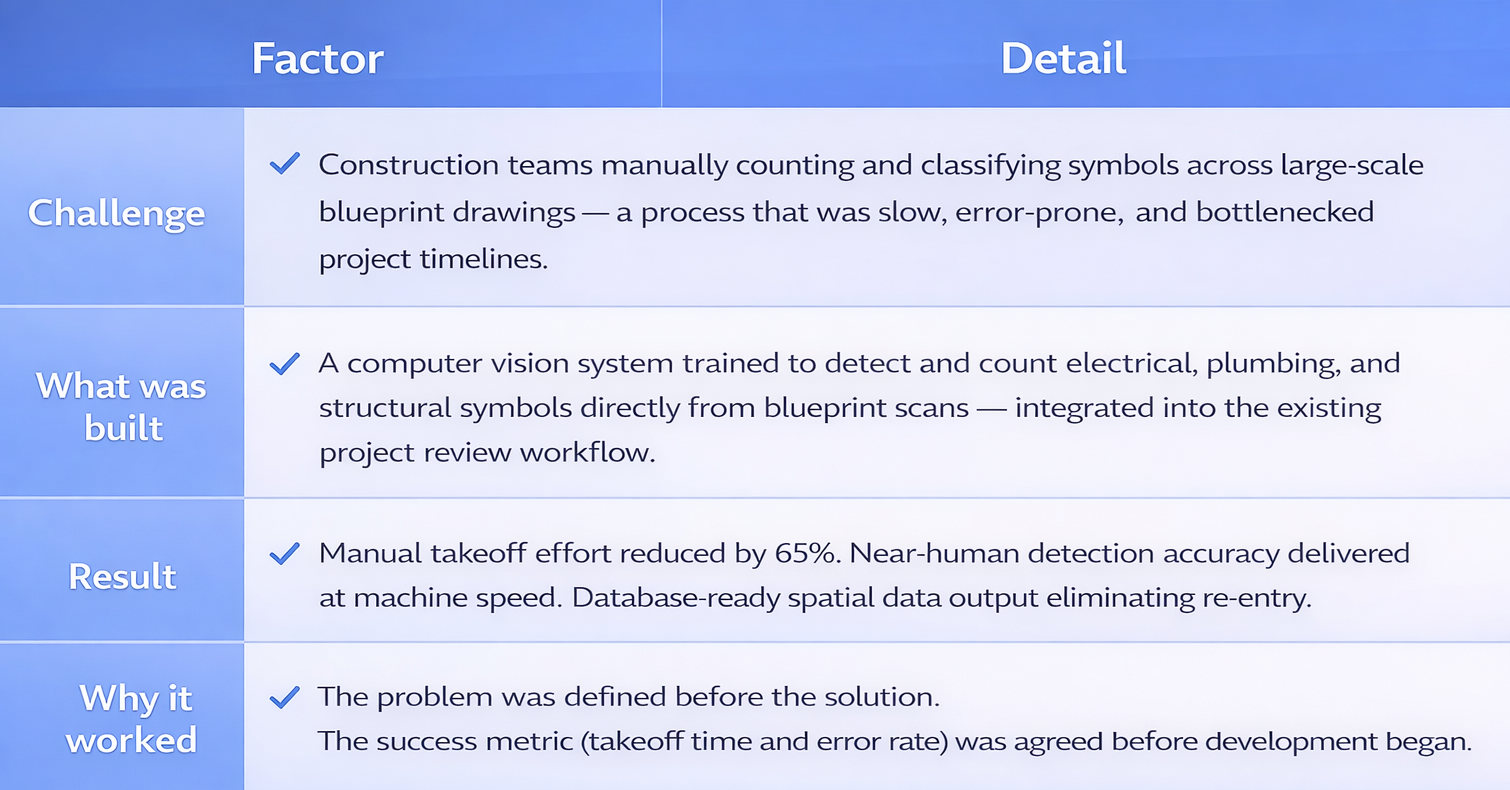
This type of project focused, outcome-defined, integration-first is what distinguishes AI deployments that generate ROI from those that generate reports. NeuraMonks has built a portfolio of similar engagements across healthcare, fintech, e-commerce, and operations. You can review them at neuramonks.com/ai-case-study.
The Audit Question Every CTO Should Ask Before Approving AI Spend
Before any AI infrastructure proposal reaches final approval, it should be able to answer five questions clearly. If any answer is vague, the proposal is not ready.
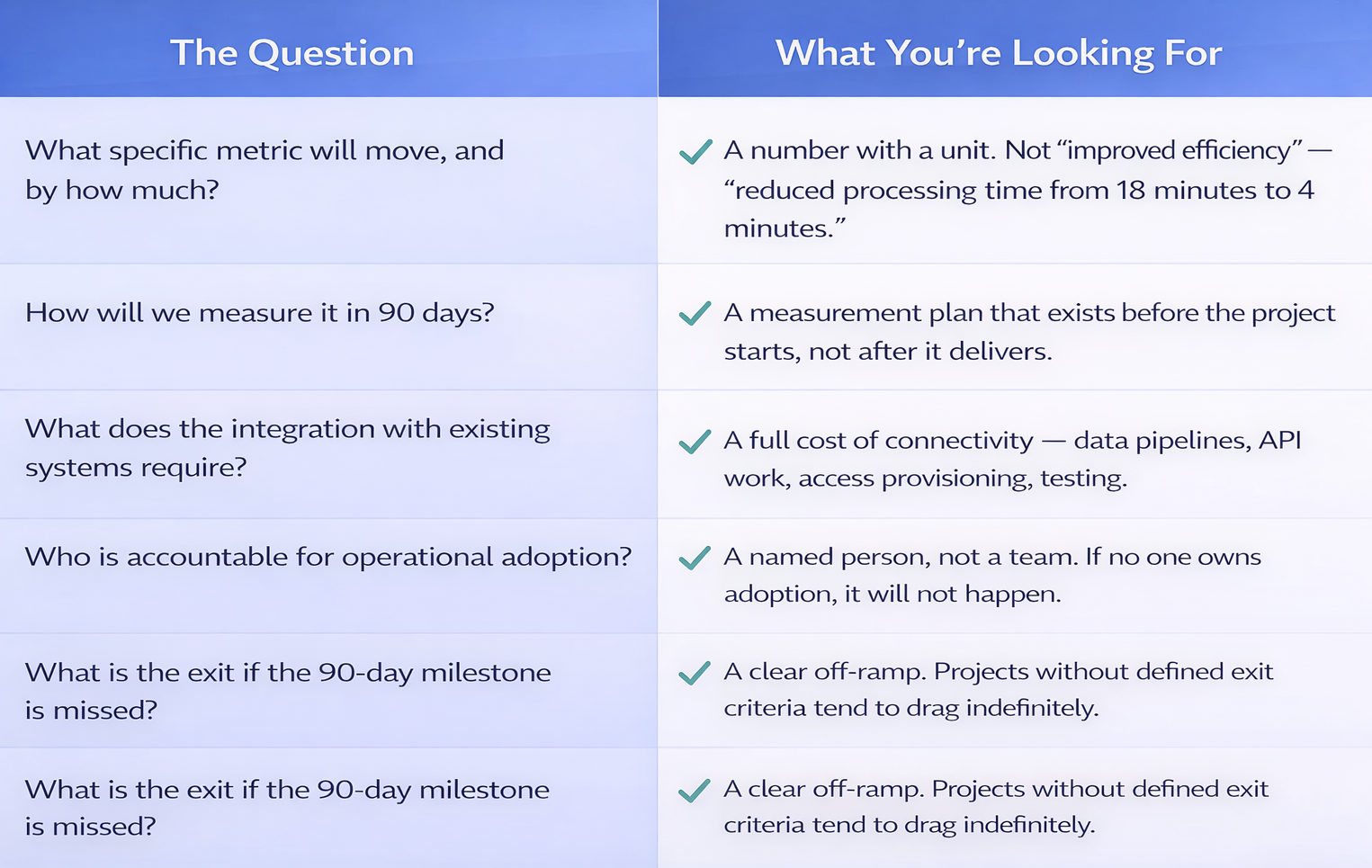
These five questions are the difference between an AI strategy and an AI budget. The first produces outcomes. The second produces invoices.
Where Workflow Automation Fits the Infrastructure Stack
One of the most consistently underused layers in enterprise AI deployments is workflow orchestration the connective tissue that makes AI outputs usable inside existing operations. Tools like n8n enable teams to connect AI capabilities (document processing, classification, generation, extraction) to the systems where decisions are actually made: CRMs, ERPs, communication platforms, reporting pipelines.
This layer is where practical ROI happens fastest. It does not require custom model training. It does not require new infrastructure. It requires a clear understanding of which processes produce the most friction and a competent team to bridge the gap.
The organisations that are getting AI right in 2025 are not the ones with the largest model infrastructure. They are the ones that have mapped their highest-friction processes and built tight automation pipelines around them. The technology is secondary to the operational thinking.
What a Thoughtful AI Investment Looks Like in 2025
The organisations that are consistently getting ROI from AI share a pattern. They are not necessarily the heaviest spenders. They are the most deliberate:
- They start with an audit of existing processes before evaluating any new AI capability
- They match solution complexity to problem complexity and resist vendor pressure to over-engineer
- They deploy in 90-day cycles with defined KPIs, treating each cycle as a go/no-go decision
- They cost adoption at 20–30% of total implementation budget, not as an afterthought
- They treat AI solutions as operational infrastructure, not R&D experiments which means ownership, maintenance plans, and performance monitoring from day one
NeuraMonks works with organisations across India, the UAE, and the US to audit AI readiness, design deployment roadmaps, and build AI solutions that are scoped and priced against outcomes. The work spans AI consulting, proof-of-concept development, full product builds, and ongoing automation engineering.
If the Infrastructure Question Is Unresolved, It Is Worth Resolving
The AI bubble is real in some places and absent in others. The difference is almost always whether the organisation started with a problem or started with a product. If you are currently evaluating AI infrastructure spend or reviewing a proposal that has been sitting on your desk the most valuable thing you can do before committing is to get clarity on what outcome you are actually buying.
NeuraMonks offers AI consulting, audit engagements, and end to end development for organisations that want that clarity. We build AI solutions that are scoped against specific outcomes and delivered in cycles short enough to validate before they scale.
Talk to the NeuraMonks Team
Discuss your current AI spend, an upcoming project, or a proposal you want a second perspective on.
Review Our Case Studies
See how we have approached real problems across construction, healthcare, e-commerce, and more.
→ neuramonks.com/ai-case-study
How AI Agent Orchestration with Paperclip Is Redefining Business Automation And Why Neuramonks Is the Right Partner to Build It
AI agent orchestration with Paperclip eliminates the coordination bottleneck that costs businesses $4.4T annually. NeuraMonks deploys production ready AI automation in 4–8 weeks, delivering 30–40% efficiency gains and 20–35% cost savings without vendor lock-in.
The Numbers Behind the Problem No One Talks About
Every business whether a bootstrapped startup, a mid-size enterprise, or a Fortune 500 corporation i shares the same hidden bottleneck: repetitive, manual, human-dependent workflows that silently drain revenue, time, and competitive edge.
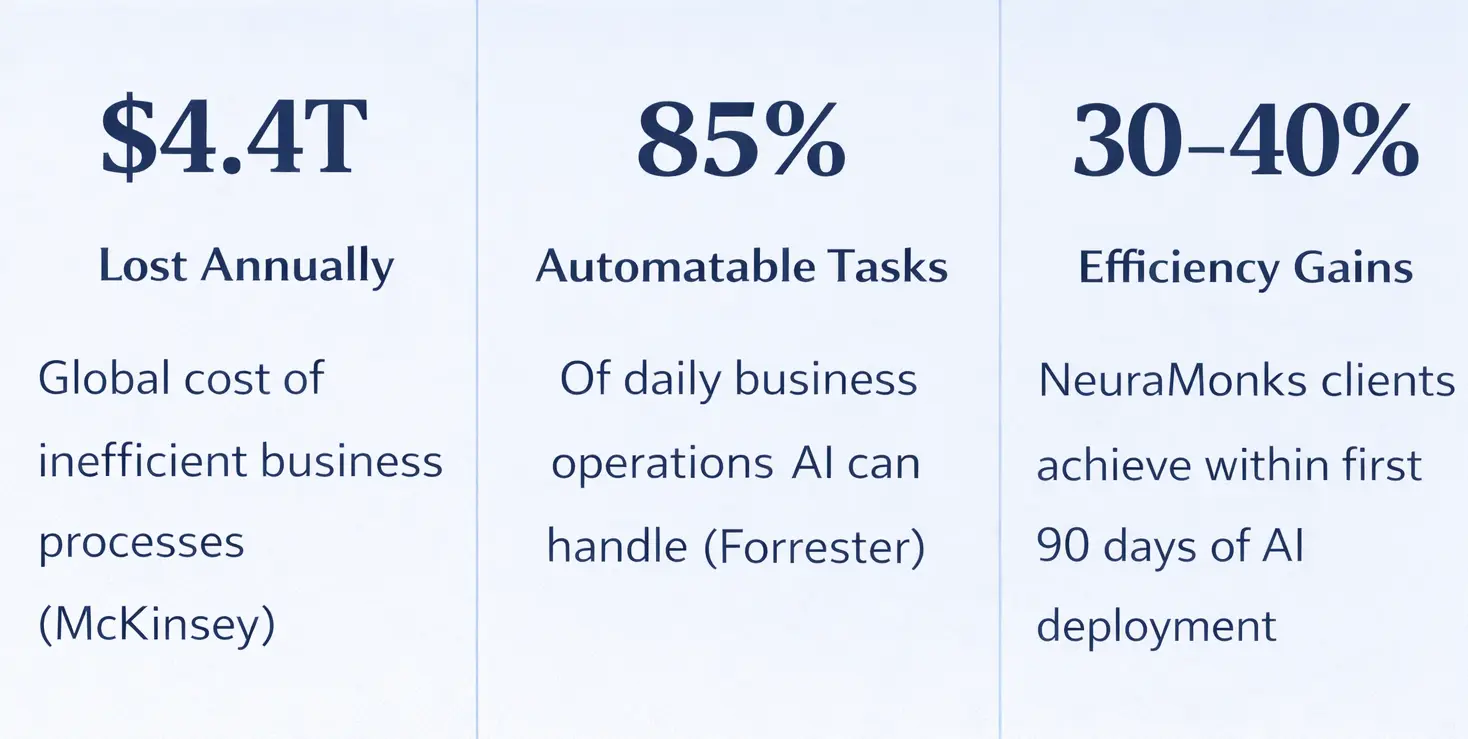
The irony? Most of the tools to fix this already exist. What has been missing until now is the orchestration layer that connects AI agents, assigns goals, manages tasks, and runs a company autonomously.
That orchestration layer is called Paperclip. And the team best positioned to integrate, customize, and deploy it for your business is NeuraMonks a leading agentic AI development company headquartered in Ahmedabad, Gujarat, delivering AI solutions across 8+ industries and multiple global markets.
Quick Answer: What is Paperclip AI?
Paperclip is an open-source AI agent orchestration platform that lets businesses "hire" AI employees, set company goals, automate full business functions, and run operations with minimal human intervention. It is self-hosted, LLM-agnostic, and integrates across every department from development to marketing to customer support.
What Is Paperclip and Why Every AI-Forward Business Should Know It
Paperclip (paperclip.ing) has earned 44,400+ GitHub stars in a remarkably short period — a signal the developer community recognizes something fundamentally different about its approach. Unlike individual AI tools that solve isolated tasks, Paperclip operates at the company level.
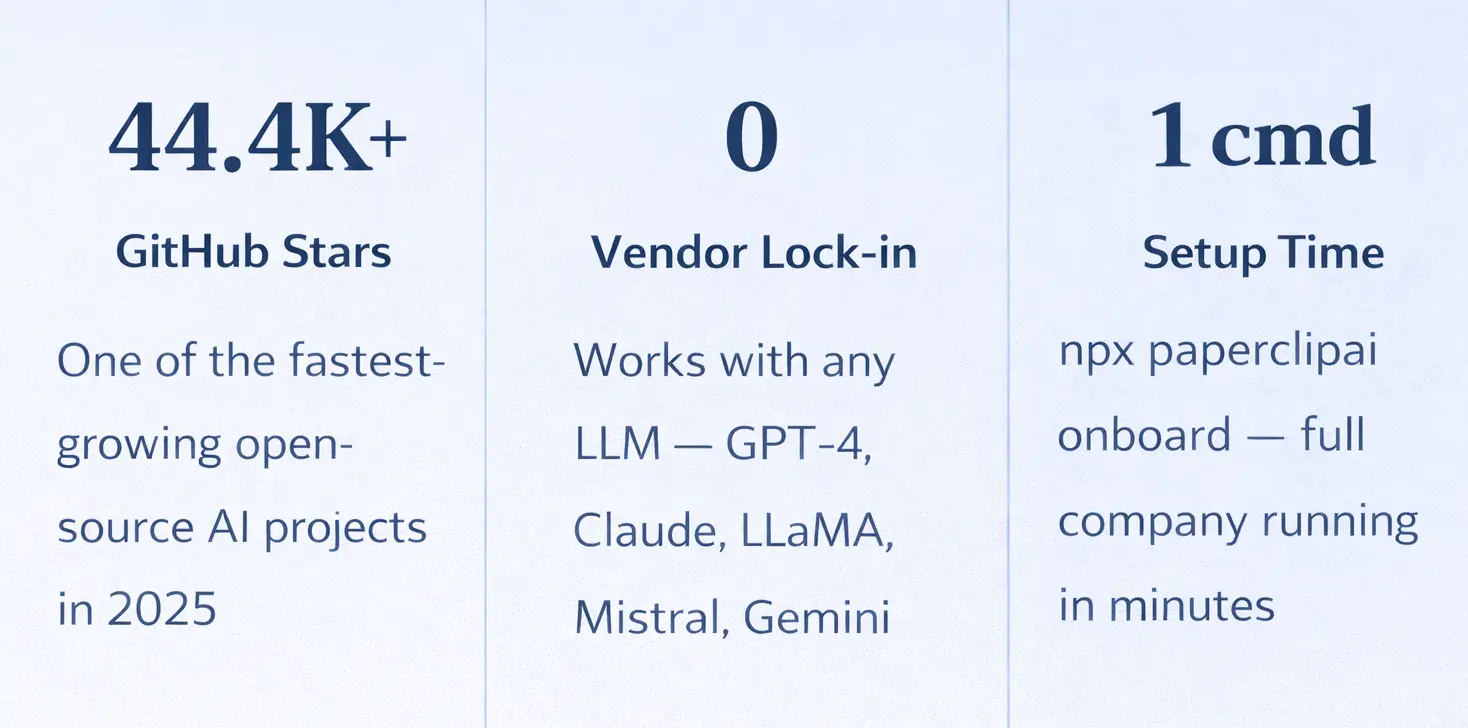
Think of Paperclip as a digital org chart where instead of hiring human employees for every department, you hire AI agents and the entire company hierarchy, goal structure, budget, and task management lives in one unified platform.
Key Capabilities of Paperclip
- AI Employee Hiring: Define roles Coder, Content Writer, Marketing Analyst, QA Engineer and deploy agents for each.
- Goal-Based Orchestration: Set business-level objectives; Paperclip breaks them into tasks and assigns to the right agents.
- Cross-Department Automation: Dev, content, social media, marketing, QA, research, and outreach all automated from one platform.
- Self-Hosted & Open Source: Full data control, no vendor lock-in, deployable on your own cloud or on-premise infrastructure.
- LLM-Agnostic: Connect GPT-4, Claude 3.5, LLaMA 3.2, Mistral, or any locally hosted model.
- One-Command Onboarding: npx paperclipai onboard walks through database, auth, and first AI company setup interactively.
The shift Paperclip enables is profound. As one developer noted: "The mental model moves from I am prompting an AI to I am managing a team." That distinction from tool user to business operator — is exactly what enterprises and growth-stage companies need today.
Why NeuraMonks Is the Right AI Development Partner for Paperclip Integration
Knowing a platform exists and knowing how to implement it at enterprise scale are two very different things. NeuraMonks bridges that gap.
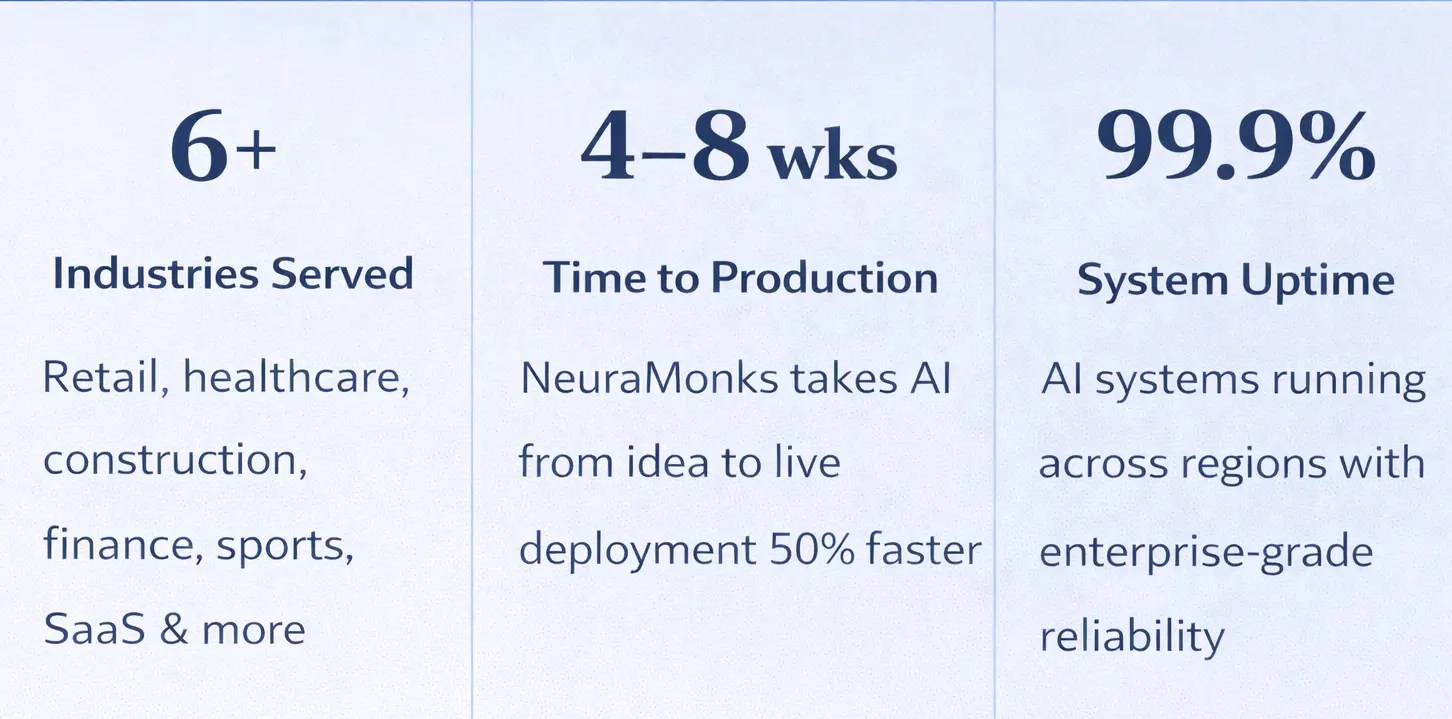
As a specialized agentic AI development company, NeuraMonks has spent years building the exact technical foundation that Paperclip integration demands: LLM integration, multi-agent system design, generative AI deployment, computer vision, NLP pipelines, and cloud-native infrastructure.
What NeuraMonks Brings to the Table
• Agentic AI Development: We are a leading agentic AI development company. We build enterprise AI agents and autonomous automation solutions that go beyond simple chatbots — reasoning, planning, tool use, and multi-step execution across real business workflows.
• LLM Integration Expertise: We evaluate and integrate GPT-4, Claude, LLaMA, Mistral, and Gemini into production systems — handling model selection, prompt engineering, RAG architecture, fine-tuning, and performance evaluation end-to-end.
• MCP Server Development: NeuraMonks offers expert MCP (Model Context Protocol) server development services — build custom MCP solutions, protocol implementation, and AI tool integrations that connect Paperclip agents to your existing business data and APIs.
• Generative AI & Computer Vision: From AI-powered content generation and image synthesis to video intelligence and document processing — we build generative AI systems that drive measurable business outcomes across industries.
• Full-Stack AI Product Development: We architect, develop, and deploy complete AI products — from data pipelines and ML models to front-end interfaces and cloud infrastructure — on AWS, Azure, or Google Cloud.
• Proven Delivery Framework: Our structured Think → Build → Deploy → Optimise methodology reduces implementation risk by 25% and delivers 30–40% efficiency gains within the first 90 days.
NeuraMonks Client Result
A global financial firm working with us deployed an AI-driven fraud detection system that reduced fraudulent transactions by 40% using real-time risk analysis. A healthcare client improved disease detection accuracy by 90%. An e-commerce brand increased conversion rates by 20% with NeuraMonks' AI recommendation engine.
4 Real-World Use Cases: Paperclip + NeuraMonks in Action
1. Autonomous Content & Marketing Operations
40+ hrs
Saved Per Week
Average time a growing brand spends on content, SEO, social, and email campaigns — before AI automation.
With Paperclip + Claude + NeuraMonks' generative AI layer, businesses deploy a full AI content team: a Writer agent, an SEO Analyst agent, a Social Media Manager agent, and a Campaign Analyst agent — all orchestrated under one goal: "Grow organic traffic by 30% this quarter." NeuraMonks' generative AI capabilities handle content personalization, image synthesis, and performance optimization automatically.
2. AI-Powered Customer Support & Sales Outreach
< 3 sec
Average AI Response Time
Vs. 4–6 hour average for human-only support teams. Customer satisfaction scores improve by up to 35%.
NeuraMonks deploys multilingual AI support agents via Paperclip, integrated with CRM, ticketing, and communication platforms. Agents handle inquiries, qualify leads, escalate complex issues intelligently, and run proactive outreach campaigns — 24/7, at a global scale, without adding headcount.
3. Developer & QA Automation
35%
Sprint Overhead Reduced
Development teams using AI code review, bug triage, and automated test generation free up 35% of sprint capacity for feature work.
NeuraMonks implements Paperclip with a Coder agent, QA Engineer agent, and Documentation Writer agent that handle code review, bug triage, test case generation, and release notes. Combined with NeuraMonks' AI-assisted development services, engineering teams ship faster with higher quality and lower cost per release.
4. Business Intelligence & Research Automation
8 hrs → 12 min
Research Report Time
Manual market research that took a full business day now completes in under 15 minutes with AI-powered research agents.
A consulting firm serving Fortune 500 clients deploys Paperclip's Research agent configured by NeuraMonks — pulling data from multiple sources, synthesizing findings using LLMs, and delivering formatted insight reports to stakeholders automatically, every morning before 9 AM. Zero analyst hours. Zero delays.
The Future Belongs to Businesses That Automate Intelligently
The era of AI as a novelty is over. The companies that thrive in the next decade will be those that treat AI as competitive infrastructure — not a one-time experiment.
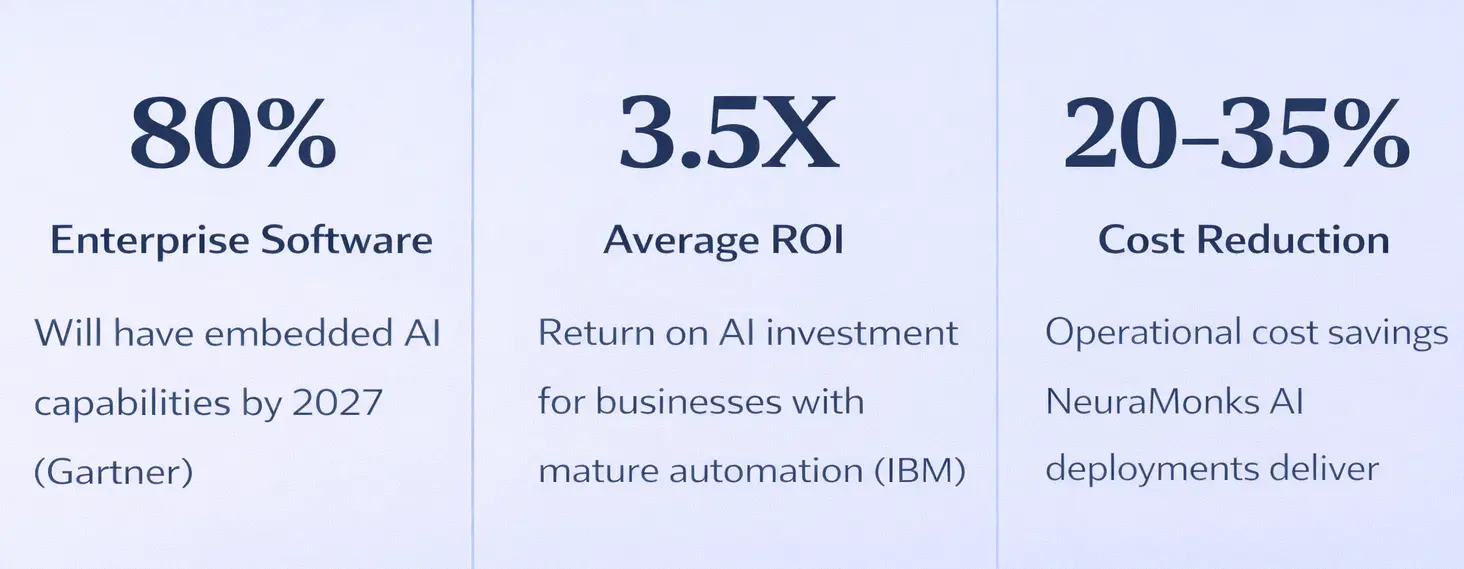
Paperclip represents the most compelling architecture for that future: an open, self-hosted orchestration layer that turns LLMs into employees, goals into action plans, and business complexity into managed, measurable output.
Let NeuraMonks Get You Running on Paperclip — Fast
Understanding Paperclip is one thing. Getting it production-ready for your business — with the right LLM connections, agent roles, goal structures, integrations, and infrastructure — is another. That is exactly what NeuraMonks does.
Our team handles every layer of your Paperclip setup, from initial environment provisioning to fully operational AI agents running real business workflows, so you can focus on outcomes rather than configuration.
What Our Paperclip Setup Service Includes
01 Discovery & Workflow Audit
We map your existing business operations, identify the highest-ROI automation targets, and define the agent roles, goals, and department structure that Paperclip will manage for your company.
02 Infrastructure Provisioning & Self-Hosted Deployment
We deploy Paperclip on your preferred infrastructure — AWS, Azure, GCP, or on-premise. Full self-hosted setup with PostgreSQL/MySQL, authentication, environment configuration, and security hardening. No vendor lock-in, full data ownership.
03 LLM Configuration & Model Selection
We evaluate and connect the right LLM for your use case — GPT-4, Claude, LLaMA, Mistral, or a locally hosted model. We handle API key management, model routing, fallback logic, and prompt optimization so your agents perform reliably from day one.
04 AI Agent Design & Role Configuration
We define and configure your AI employees inside Paperclip — Coder, Content Writer, QA Engineer, Support Agent, Research Analyst, or any custom role your business needs. Each agent gets a goal structure, tool access, and execution boundaries tuned to your workflows.
05 MCP Server & Integration Development
We build custom MCP server development that connects your Paperclip agents to existing business systems — CRMs, ERPs, databases, APIs, communication tools (Slack, Teams), and internal knowledge bases. Your agents work with your data, not in isolation.
06 Testing, QA & Handover
Before go-live, we run end-to-end testing across all agents and goal flows, validate output quality, stress-test multi-agent coordination, and document everything. Your team receives a full operational handover with runbooks, monitoring setup, and ongoing support options.
From first conversation to live Paperclip deployment: NeuraMonks delivers in 4–8 weeks. Most clients see measurable efficiency gains within the first 30 days of operation.
Why Start with NeuraMonks Instead of Self-Implementing?
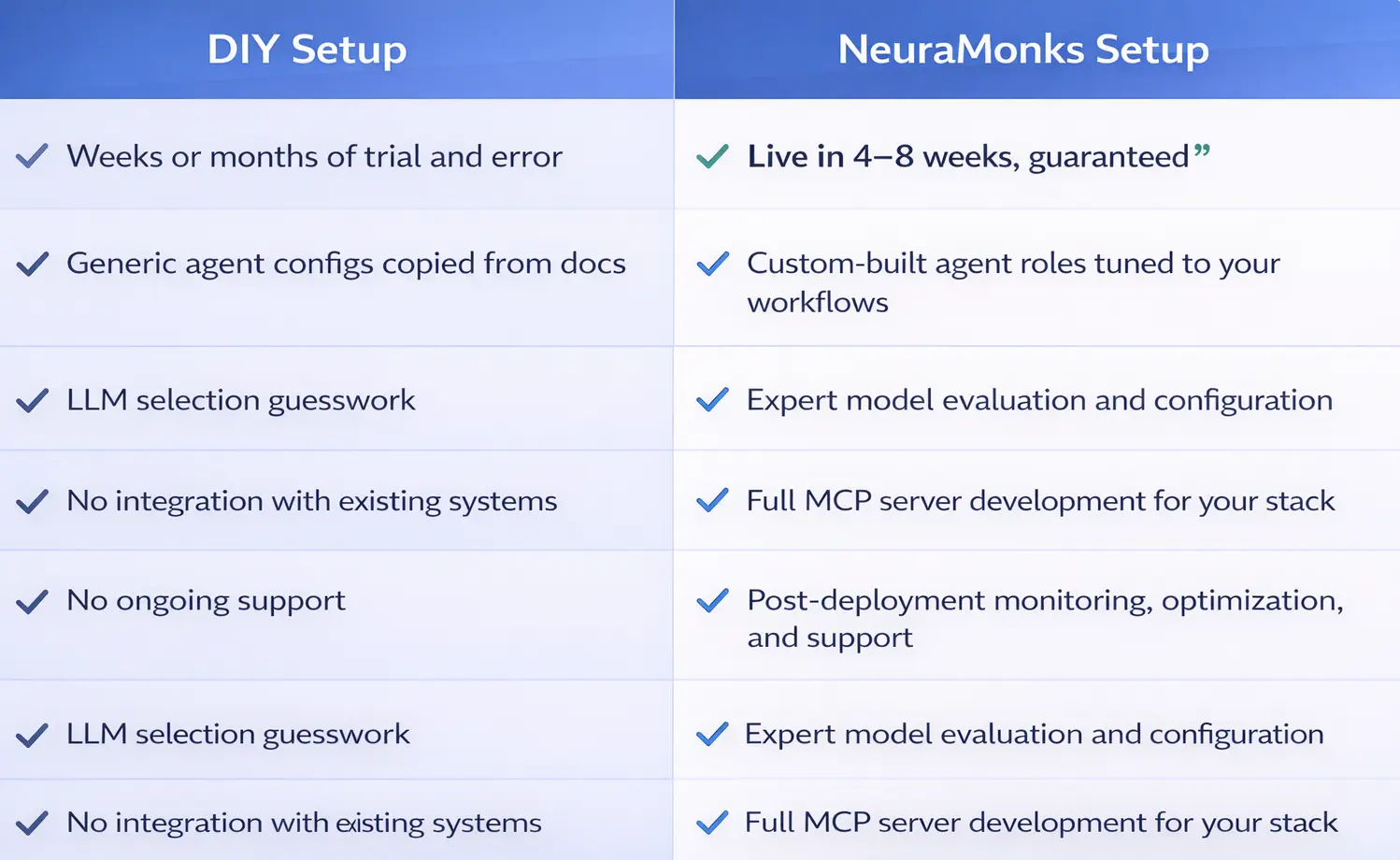
NeuraMonks is the implementation partner that makes that future real — today. As a leading agentic AI development company with proven expertise in LLM integration, generative AI, computer vision, NLP, and MCP server development, we translate the promise of AI into production systems that drive measurable business results from day one.
Whether you are a startup building your first AI-powered product, an enterprise transforming operations at scale, or a global business seeking a world-class AI development partner, NeuraMonks is ready.
Book a free 60-minute AI Automation Discovery Session with us. We will analyze your workflows, identify the highest-ROI automation opportunities using Paperclip + LLMs, and deliver a clear, costed implementation roadmap. www.conversantech.com ·
Why Anthropic Won't Release Claude Mythos AI to the Public The Glasswing Strategic Restraint
Understand why Anthropic restricts Claude Mythos to the Project Glasswing coalition, how it impacts enterprise cybersecurity, and what it means for the US-India AI competition in 2026.
Understanding Responsible AI Deployment & Why the Most Powerful Models Stay Behind Closed Doors
There are moments in AI development when the responsible choice is not to release a capability into the world, but to contain it. Project Glasswing, announced by Anthropic in April 2026, represents precisely this moment and it clarifies why Claude Mythos Preview, despite being Anthropic's most powerful unreleased model, will remain restricted to a carefully governed coalition rather than released to the general public.
What started as an internal AI safety initiative evolved into Project Glasswing a cross-industry AI cybersecurity coalition that includes Amazon Web Services, Microsoft, Google, Cisco, CrowdStrike, Apple, NVIDIA, JPMorganChase, Palo Alto Networks, Broadcom, and The Linux Foundation. Glasswing came first. Claude Mythos Preview was deployed within Glasswing's structure second. That sequence is intentional, and it explains everything about why this model will not be freely available.
Whether your company operates in San Francisco, Chicago, Bangalore, or Hyderabad, this decision --- to restrict rather than release --- has direct implications for your security posture and your AI strategy.
Project Glasswing Came First: The Governance Framework Before the Model
Project Glasswing is Anthropic's structured initiative to deploy frontier AI capabilities for defensive cybersecurity within a coordinated, accountable coalition. Named after the glasswing butterfly --- whose transparent wings let it hide vulnerabilities in plain sight --- the project brings together the world's leading technology companies under one shared mission: use AI to find software flaws before attackers do.
The critical point: Anthropic built the coalition, the governance structure, and the accountability framework first. Only then was Claude Mythos Preview deployed within it.
At the core is Claude Mythos Preview --- a general-purpose, unreleased frontier LLM that has already demonstrated the ability to identify zero-day vulnerabilities in every major operating system and web browser. In independent tests, Mythos Preview found:
- A 27-year-old bug in OpenBSD
- A 16-year-old vulnerability in FFmpeg that had survived five million automated test cycles
- Chained multiple Linux kernel flaws to escalate user access to full machine control
These were not theoretical exercises. These were real flaws in systems that run banks, hospitals, government infrastructure, and supply chains globally. And a model that can find these flaws faster than any human or existing automated system poses a problem if released without guardrails.
Why Claude Mythos Won't Be Released to the Public
The same capabilities that make Claude Mythos exceptional for defensive cybersecurity make it dangerous if deployed indiscriminately. Here's why Anthropic has chosen containment over release:
1. Offensive Capability Asymmetry
A model that can autonomously find and exploit vulnerabilities across every major operating system on Earth is a dual-use technology in the most literal sense. The same agentic reasoning that locates zero-days can be weaponized by state actors, criminal organizations, or any individual willing to skip the accountability layer. Releasing Mythos to the public would be equivalent to distributing advanced exploit development tools to billions of people worldwide.
Cybercrime costs the global economy approximately $500 billion per year. That number would multiply exponentially if a frontier AI model capable of autonomously discovering critical vulnerabilities became widely available. Anthropic knows this. Which is why the model stays restricted.
2. Disclosure Coordination Requires Governance Structure
When a vulnerability is found, the question of when and how it is disclosed determines whether patches reach systems before or after attackers exploit them. A 27-year-old bug in OpenBSD is only useful if fixed before the world learns about it. The same applies to every zero-day Mythos discovers.
If Claude Mythos were publicly available, coordinated disclosure would become impossible. The first independent user to find a critical vulnerability could:
- Sell it on the dark web
- Use it for offensive operations
- Share it with adversaries
Project Glasswing prevents this by concentrating the findings within a coalition where The Linux Foundation, AWS, Microsoft, Google, and other trusted organizations control the flow of information and coordinate patches before public disclosure.
3. Open-Source Ecosystem Protection
The Linux Foundation is a core partner in Glasswing precisely because the vulnerabilities Mythos finds often exist in open-source codebases that billions of people depend on. If the model were public, every malicious actor with technical skill would use it to scan the same repositories looking for exploitable flaws.
By keeping Mythos restricted to Glasswing, Anthropic ensures that vulnerability discoveries flow through coordinated channels and that fixes reach the open-source community before threats materialize. This is structural cybersecurity --- not a restriction on innovation, but a prerequisite for public safety.
4. The Offensive-Defensive Gap Collapses Instantly with Public Release
As of now, there is a temporal advantage to defensive systems. Glasswing's coalition has access to Mythos's capabilities weeks or months before any attacker independently discovers similar techniques. That window is what allows patches to reach systems before exploits do.
The moment Mythos becomes publicly available, that advantage evaporates. Attackers gain the same autonomous vulnerability-finding capability that defenders do. The asymmetry reverses. And because there are more malicious actors than well-resourced security teams, the defensive effort loses.
The Sequence Matters: Why Glasswing Had to Come First
Anthropic did not build Mythos Preview and then figure out what to do with it. They built the coalition, the structure, and the accountability framework first --- and then deployed the model inside it. That order is the entire point.
For most of AI's history, powerful capabilities were released first and consequences were managed afterward. The internet deployed before misinformation frameworks existed. Social media scaled before anyone understood its effects on public discourse. Large language models were released to the public before anyone seriously thought about systemic harms.
With Claude Mythos, Anthropic inverted that pattern. They asked: "What structure must exist for this capability to be deployed responsibly?" The answer was Project Glasswing. Only after that structure was built was the model deployed within it.
This means:
- Findings flow through coordinated disclosure protocols
- The Linux Foundation is a core partner, ensuring fixes reach open-source ecosystems
- No single company controls the output; accountability is distributed
- The model's power is matched by the responsibility of the structure around it
What This Means for Enterprises in 2026
If you lead technology, security, or operations at an enterprise --- whether in New York, Austin, Mumbai, or Pune --- here is the practical reality:
- Your attack surface is larger than any manual team can cover. The world's largest technology companies are actively deploying Frontier AI vulnerability detection.
- Open-source dependencies are a critical risk vector. Project Glasswing is directly funding security work on the codebases your infrastructure depends on.
- AI in healthcare, finance, and logistics creates regulatory compliance risk. As AI embeds deeper into critical systems, security standards must rise proportionally.
- Cloud providers are integrating advanced security capabilities. AWS Bedrock, Google Cloud Vertex AI, and Microsoft Foundry now provide access to enterprise-grade AI security tools.
Agentic AI & LLMs: Why Frontier Models Require Careful Deployment
What makes Claude Mythos fundamentally different from conventional security tools is its agentic AI architecture. Agentic AI refers to systems that can autonomously plan, execute, and iterate across multi-step tasks without human steering at each stage.
Rather than simply flagging suspicious patterns, Mythos reads entire codebases, reasons about logic flows, chains vulnerabilities together, and develops working exploits --- all on its own. This agentic capability is precisely why it found vulnerabilities that survived decades of human review and millions of automated tests.
On benchmark evaluations like SWE-bench Verified, Mythos Preview scored 93.9% --- the highest ever recorded for any model --- demonstrating that its underlying LLM capabilities extend well beyond simple question-answering into deep, autonomous software reasoning.
Precisely because of these capabilities, the model cannot be publicly released without unacceptable security risks. The power to autonomously exploit systems must be paired with governance structures that prevent misuse. Project Glasswing is that structure.
MCP Servers: The Hidden Infrastructure Enabling Secure Deployment
For Claude Mythos Preview to perform vulnerability detection at the depth it does --- scanning live codebases, navigating private repositories, querying internal toolchains --- it needs more than intelligence. It needs secure, structured access to external systems.
This is where the Model Context Protocol (MCP), developed by Anthropic, becomes critical. MCP is an open protocol that defines how AI models connect to external tools, data sources, and secure environments. Think of MCP servers as the intelligent connectors that allow a model like Claude to safely interact with your company's private codebase, internal databases, security scanners, or enterprise APIs --- without exposing raw credentials or unstructured data to the model directly.
MCP servers are also why Mythos can be deployed within Glasswing without leaking sensitive vulnerability data outside the coalition. The protocol ensures that findings are structured, auditable, and controlled.
NeuraMonks: AI Development Company Building Tomorrow's Autonomous Systems
NeuraMonks: AI Development Company
At NeuraMonks, we design and deploy agentic AI workflows that help enterprises across the US and India automate complex operations securely. While Anthropic deploys frontier models within carefully governed coalitions, NeuraMonks builds the same class of intelligent, multi-step autonomous workflows for your business infrastructure. Whether you need Agentic AI Development code review, document intelligence, data processing, or security automation --- we architect these systems with governance and accountability built in from the start. We also specialize in MCP Server Development, creating the custom connectors that allow frontier AI models to securely interact with your company's private tools, data environments, and software infrastructure.
→ Learn about our Agentic AI Development Services
The principle behind Glasswing --- structure before scale, governance before deployment --- is how we approach every AI system we build. We design the accountability layer in from the beginning: access controls, output validation, human review checkpoints, and audit trails. Because the right order matters just as much as the right model.
The US-India Context: Two Economies at the Center of This Shift
For US-based businesses, Anthropic's decision to restrict Claude Mythos is both a warning and a competitive signal. The US government has been briefed on Mythos's capabilities. Anthropic has stated explicitly that the US and its allies must maintain a decisive lead in frontier AI --- and that Project Glasswing is part of ensuring democratic institutions do not fall behind state-sponsored actors. Releasing the model to the public would directly undermine that strategic advantage.
For Indian enterprises, the stakes are equally high. India's digital economy is expanding rapidly, with businesses across BFSI, healthcare, and manufacturing adopting AI solutions at scale. India is also one of the world's largest hubs for software development and open-source contribution --- the same codebases Glasswing is now scanning for vulnerabilities are being written and maintained in part by Indian engineers.
For both markets, the message is clear: the most powerful AI models will be deployed through carefully structured coalitions, not released to the general public. Cybersecurity posture, regulatory compliance, and competitive positioning now depend on understanding this new reality.
Project Glasswing at a Glance
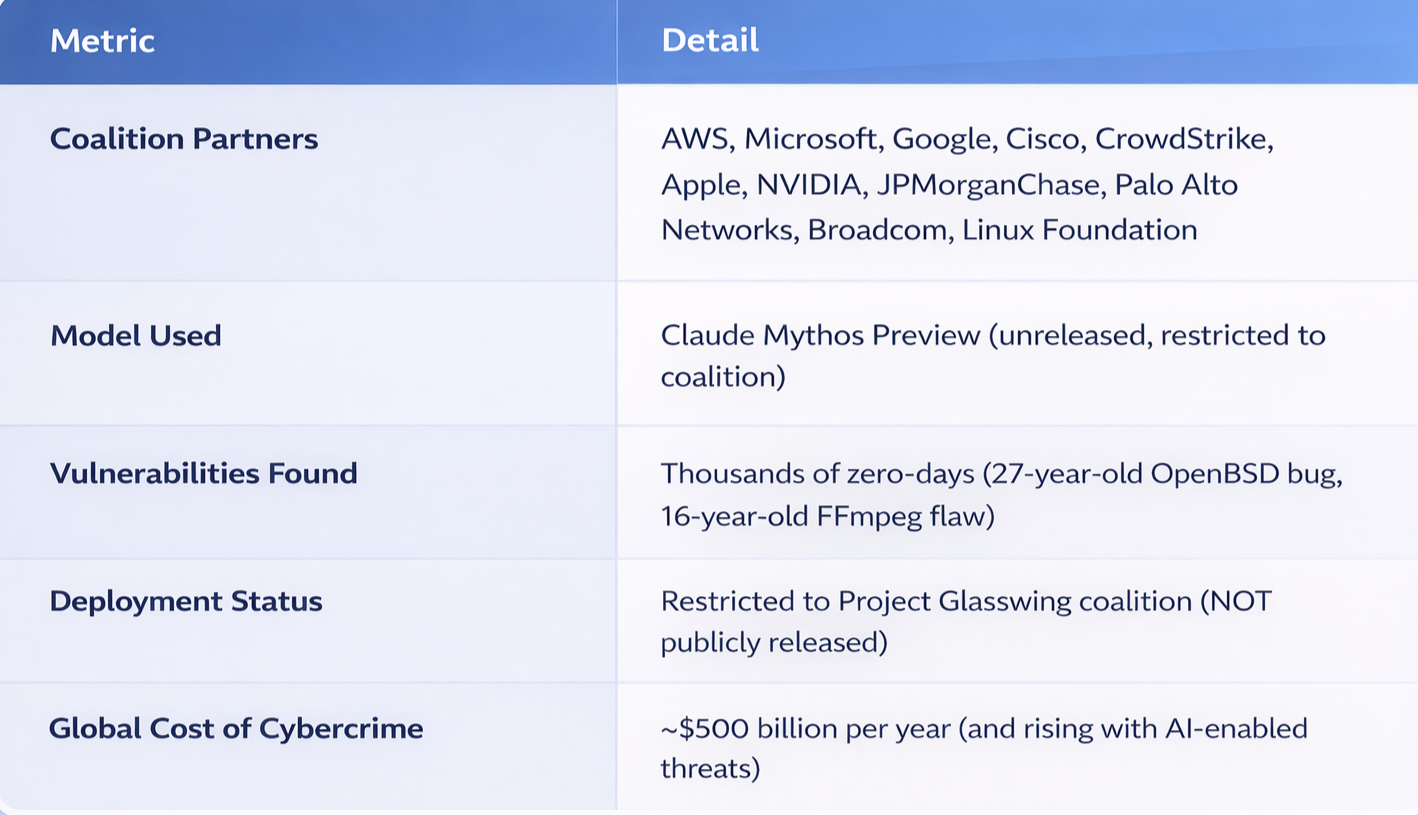
Building Secure AI Systems for the Restricted-Model Era
At NeuraMonks, we recognize that the frontier of AI is no longer about building models --- it's about building the governance structures that allow powerful models to be deployed responsibly. The model era is becoming the coalition era.
As enterprises across the US and India navigate this transition, the question is not whether to use frontier AI. Project Glasswing has already made that decision for you. The question is how to integrate these capabilities into your security and operational posture while maintaining the same governance standards.
We work across these layers:
- Agentic AI development for autonomous workflows
- LLM integration for enterprise AI products
- MCP server development for secure model integration
- AI security and governance frameworks
Ready to Build Secure AI Systems?
The AI era demands more than automation --- it demands intelligence built securely from the ground up. Frontier models like Claude Mythos are being deployed through structured coalitions.
Your business needs to be ready. NeuraMonks is an AI development company that helps enterprises across the US and India design, develop, and deploy intelligent systems that are both powerful and accountable.

How AI Is Saving Lives in Hospitals Right Now And What It Means for Global Healthcare
AI is no longer a future promise in healthcare it's actively detecting cancer earlier, flagging sepsis hours before it turns fatal, and eliminating medication errors across hospitals in the US, India, Mexico, and beyond. This article breaks down 7 proven clinical AI applications with real outcomes, real data, and what they mean for overstretched health systems globally.
Seven clinical applications that are no longer experiments. They are running inside hospitals across the US, India, UK, Mexico and emerging markets today.
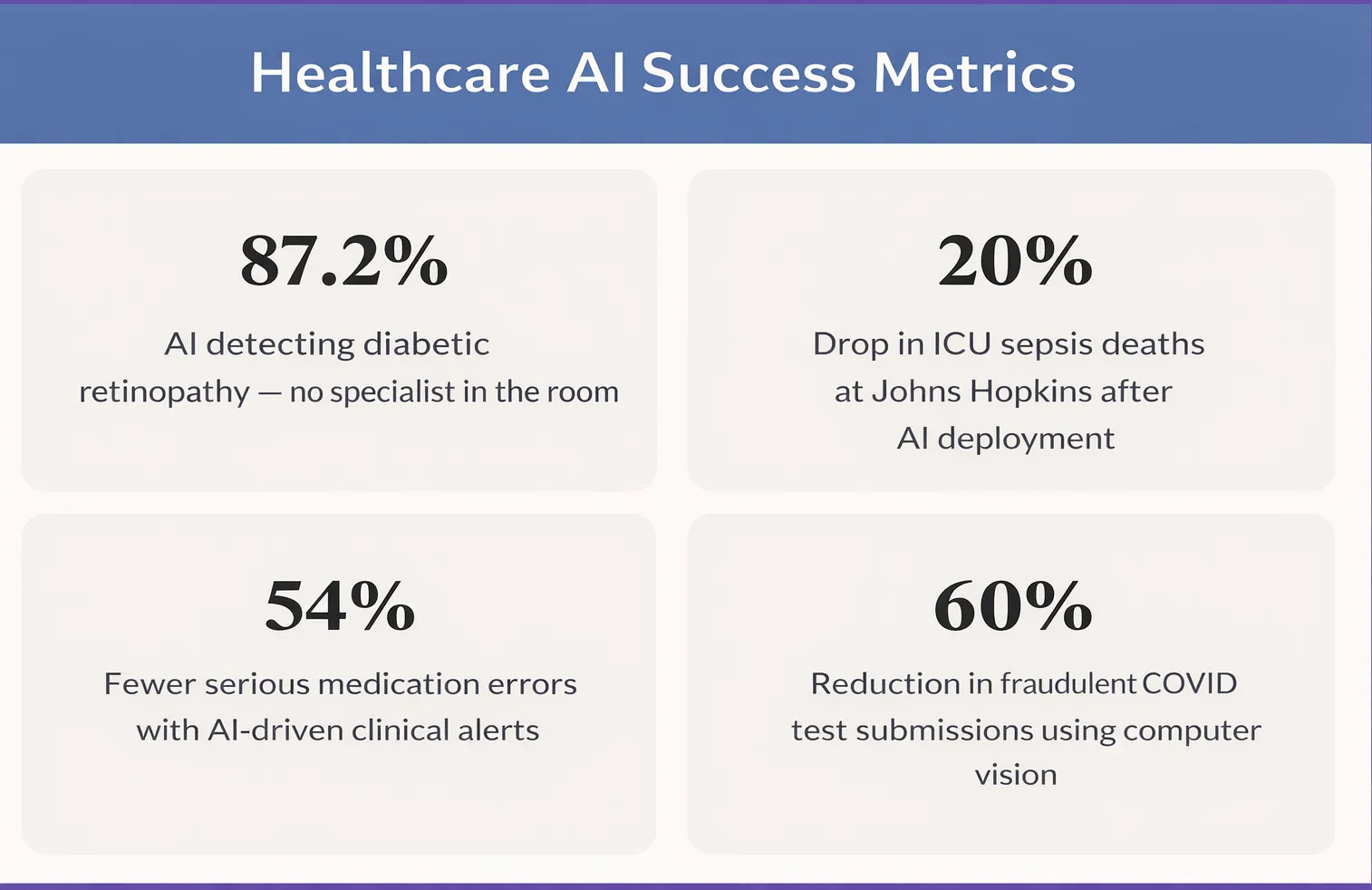
Every 36 seconds, someone in the United States dies from cardiovascular disease. 422 million people worldwide suffer with diabetes. Healthcare systems from London to Lagos are stretched thin — too few specialists, too many patients, too little time per decision. AI in healthcare does not solve every part of that problem. But it addresses the most dangerous bottlenecks: the missed scan, the late sepsis flag, and the medication that should never have been prescribed. These seven use cases are where that shift is actually happening.
01 Early Disease Detection and Diagnostic Imaging
A 2020 study in Nature Medicine showed that an AI system detected breast cancer more accurately than a panel of six radiologists — reducing missed diagnoses by 9.4%. That single number represents a structural change in how diagnostic medicine works when AI is present. The technology no longer assists specialists; in certain contexts, it outperforms them.
Today, AI tools read diabetic retinopathy from eye scans, surface lung nodules on CT scans within seconds of acquisition, and flag stroke-indicating anomalies in brain MRIs before a radiologist opens the queue. For hospitals in underserved regions — rural England, sub-Saharan Africa, tier-3 cities across South and Southeast Asia — where specialist coverage is thin, this kind of AI solution changes the clinical calculus entirely.
IDx-DR, the first FDA-authorised autonomous AI diagnostic system, detects diabetic retinopathy at 87.2% sensitivity without a specialist present.— IDx-DR Clinical Data
Faster turnaround. Fewer missed cases. Critical scans that automatically surface to the top of the queue. These are not incremental gains. They are fundamental changes to what a hospital can do with the staff it already has.
02 Predicting Sepsis Before It Becomes Fatal
Sepsis kills more Americans annually than prostate cancer, breast cancer, and AIDS combined. Globally, it causes around 11 million deaths per year — the majority in low- and middle-income countries. The clinical challenge is that early sepsis looks ordinary: mild fever, elevated heart rate, slight fatigue. By the time it looks like sepsis, the window has often closed.
AI models trained on electronic health records — combining vital signs, lab results, nursing notes, and medication history — now flag high-risk patients up to six hours before deterioration is visible. Johns Hopkins deployed one such AI solution and recorded a 20% reduction in ICU sepsis mortality. Epic and Cerner, the two largest hospital software platforms globally, both include native AI-powered sepsis alerts. The infrastructure is already inside hundreds of hospitals. The question is how well the models are tuned to each institution's patient population.
Every hour of delayed sepsis treatment increases mortality by 7%. AI-driven early warning systems give clinical teams back those critical hours — without requiring additional staff or equipment.
03 Catching Medication Errors Before They Reach the Patient
Medication errors harm approximately 1.5 million people in the United States alone every year. Globally, the WHO estimates that unsafe medication practices cause 1.3 million years of healthy life lost annually. Most of these errors are not caused by negligence — they happen because a nurse is managing eight patients at once, or a physician is entering orders under pressure, or a critical allergy note is buried three screens deep in a legacy system.
AI-powered clinical decision support catches what humans miss in those conditions:
- Drug-drug interaction alerts
- Dosage errors by weight or kidney function
- Allergy conflicts buried in old records
- Look-alike/sound-alike drug confusion
A JAMA study found AI-driven alerts reduced serious medication errors by 54% compared to older rule-based systems. The critical design shift was smarter alerting, not louder alerting — irrelevant alerts filtered out so clinicians stopped dismissing them.
04 Virtual Health Assistants and Patient Engagement
Not every life-saving moment happens inside an ICU. Many happen — or fail to happen — in the weeks between appointments. No-show rates for outpatient appointments run between 18–40% across healthcare systems globally. For patients managing diabetes or hypertension, a missed visit means missed labs, missed medication adjustments, and eventually a hospitalisation that was entirely avoidable.
AI-powered virtual assistants send personalised reminders via SMS or messaging apps, conduct pre-visit intake in multiple languages, follow up on discharge instructions, and answer common post-procedure questions around the clock. For patients in underserved communities without easy access to primary care, a 24/7 AI triage tool often provides the only immediate clinical guidance available.
AI consulting services are increasingly helping health systems design patient engagement workflows — not just deploy tools. The difference between a chatbot and an effective patient journey is the clinical logic built around it.
05 Computer Vision in Clinical Assessment
Some of the most significant advances in AI in healthcare are happening in areas that rarely make headlines: the routine measurements that clinical teams repeat hundreds of times a week. Wound assessment is one of them. Traditional ruler-based wound measurement is time-consuming, subjective, and varies significantly between clinicians — limiting a hospital's ability to track healing consistently or compare outcomes across facilities.
Deep learning systems now perform this work from a standard smartphone photograph. Computer vision models segment the wound boundary, detect a calibration marker, correct for camera angle and perspective, and output clinically accurate centimetre-based measurements of area, perimeter, width, and height — in seconds, without manual intervention.
Neuramonks Case Study
Automated Wound Detection & Measurement System
A healthcare client needed to replace subjective, ruler-based wound measurements with a standardised, scalable system. Neuramonks built an end-to-end AI pipeline using Attention U-Net deep learning segmentation combined with a green calibration marker for real-world scale reference. The system delivers wound measurements with under 5% error compared to expert manual assessment — and works from standard RGB images, making it viable for both clinical and remote monitoring settings.
- 55–65%reduction in clinician measurement time
- 30–40%improvement in cross-clinician consistency
- < 5% error vs expert manual measurements
See the full case study →
The same computer vision approach applies across a wide range of clinical imaging tasks — from surgical site monitoring to dermatology screening — wherever visual assessment has historically depended on a clinician being physically present.
06 Pathology Automation and Diagnostic Verification
Laboratory medicine is one of the most data-intensive disciplines in healthcare and one of the most dependent on human visual analysis. A trained haematology technician reads blood smears for hours, looking for abnormal cells, infection markers, and parasitic invasion. The work is skilled, repetitive, and subject to fatigue-related error — particularly in high-volume labs in tropical regions where malaria and other parasitic infections drive enormous diagnostic demand.
AI in healthcare is automating this pipeline end-to-end: detecting, classifying, and counting blood cells from microscopic images with speed and consistency no human team can match at scale.
Neuramonks Case Study
AI-Powered Blood Cell and Malaria Detection System
A diagnostics client serving high-incidence regions needed to reduce the bottleneck of manual blood smear analysis. Neuramonks delivered an end-to-end deep learning system that performs instance segmentation of red blood cells, white blood cells, and platelets — including a dedicated module for detecting Plasmodium-infected RBCs. The system handles overlapping and clustered cells and runs from image ingestion to results in seconds, compatible with existing microscopy and laboratory information systems.
- 50–60%reduction in technician analysis time
- 30–35%improvement in diagnostic consistency
- 25–40%fewer missed malaria cases
See the full case study →
Beyond malaria, the same architecture applies to haematological cancers, anaemia screening, and platelet disorder diagnosis. AI consulting services built around these systems help labs define the right model architecture, training data strategy, and deployment approach for their specific clinical environment.
The same principle of AI-driven authenticity and verification extends to public health programmes. When Corona Test UK needed to verify COVID test results for airline passengers at scale — preventing manipulation and fraud while maintaining speed — a computer vision pipeline was the only viable answer at that volume.
07 AI-Powered Clinical Decision Support for Glaucoma Management
Glaucoma is the leading cause of irreversible blindness globally, affecting over 80 million people. Yet diagnosis requires analysing a web of complex variables — intraocular pressure history, optic nerve morphology, visual field progression, patient age, and longitudinal trends across dozens of visits. Even experienced ophthalmologists face diagnostic ambiguity when these signals conflict.
A standard prediction model is not sufficient for this clinical environment. What ophthalmologists need is a system that separates initial diagnosis from validation — so that confidence is explicitly scored and every recommendation is independently verified before it influences a treatment plan.
Case Study: AI Clinical Decision Support — Glaucoma Management Platform — Neuramonks
Neuramonks built a multi-agent clinical decision support platform for ophthalmologists, using a dual-agent architecture on Deerflow. A Diagnostic Agent processes patient data against a large historical repository to stage disease and generate tailored follow-up recommendations. A Validation Agent independently reviews each recommendation and outputs a transparent confidence score out of 10. The two agents operate in a self-correcting workflow — the Validator is explicitly prompt-engineered to score the logic of the recommendation rather than simply confirm it.
- < 60s End-to-end analysis per patient, including dual-agent validation
- 10/10Transparent confidence score output for every recommendation
- 80+Visit longitudinal records processed without latency issues
Key engineering challenges solved
- Diagnostic ambiguity: when patient data is incomplete, the system generates multiple clinical scenarios rather than forcing a single conclusion
- Outlier safety: when a patient profile doesn't match the historical repository, the system triggers a Low Confidence fallback and routes the case directly to the ophthalmologist
- Longitudinal data retrieval: a custom search optimisation algorithm within Deerflow parses dense multi-decade records and returns verified results in under a minute
- Multi-agent synchronisation: context window fine-tuned to ensure the Validation Agent stays objective and doesn't simply echo the Diagnostic Agent's output
08 AI-Powered Dental Bite Classification from 3D Scans
Orthodontic diagnosis from 3D dental scans (STL files) has historically been manual, time-consuming, and highly dependent on the individual clinician's experience. In real clinical settings, patients rarely present with a single bite problem — a typical complex case may combine a Class II malocclusion with a Deep Bite and a Scissors Bite simultaneously. Identifying all co-occurring conditions consistently, across clinicians, is precisely the kind of problem where AI delivers structural value.
The system Neuramonks built goes beyond binary classification. It stages the primary bite category, detects all co-occurring conditions, validates that the detected combination is medically consistent, and outputs a ranked result with a confidence level per finding — all from a single STL upload.
Case Study: AI Dental Bite Classification System — Neuramonks
Neuramonks trained a multi-label classification model on 800+ real 3D dental scans, each verified by certified orthodontists, covering both simple and complex real-world cases including rare bite combinations. The system analyses the 3D geometry of a patient's dental scan, identifies the primary bite class (Class I, II div 1, II div 2, or III), flags all co-occurring conditions (Cross Bite, Open Bite, Deep Bite, Scissors Bite), validates the medical plausibility of the detected combination, and outputs a structured, confidence-ranked result — in seconds.
- 800+Verified 3D dental scans used for training
- 4+1Primary bite classes + 4 co-occurring conditions detected simultaneously
- 100%Medically validated output combinations — no anatomically impossible results
Example output — single patient scan
- Primary diagnosis Class II div 1Very High Confidence
- Co-occurring conditionDeep BiteHigh Confidence
- Co-occurring conditionScissors BiteGood Confidence
Clinical workflow
- The orthodontist uploads the patient's STL file into the system
- AI analyses 3D geometry, identifies the primary class and all co-occurring conditions
- Medical plausibility check validates the detected combination before the output is surfaced
- Structured, confidence-ranked result is presented instantly — used for treatment planning, patient communication, and cross-clinician consistency
09 Drug Discovery and Clinical Trial Access
Bringing a new drug to market costs roughly $2.6 billion and takes ten to fifteen years. Most candidates fail in late-stage trials after years of investment. AI is compressing both the timeline and the failure rate: protein structure prediction has resolved folding for millions of proteins, generative models propose novel molecular compounds with target properties, and biomarker analysis predicts which patients will respond to which therapies before the first dose.
Insilico Medicine identified a novel drug candidate for idiopathic pulmonary fibrosis in eighteen months — a process that would typically take four to five years. The compound entered Phase 2 clinical trials in 2023.
For patients with rare diseases or treatment-resistant cancers, clinical trial matching is often the most immediately practical AI application. These tools scan a patient's electronic record against thousands of active trial eligibility criteria in real time — surfacing opportunities that would require weeks of manual research by a specialist coordinator. For patients who have exhausted standard options, it can be the difference between access and invisibility.
Your clinical AI project starts with a clear problem statement.
The gap between knowing AI can help and actually deploying something that works in a clinical environment is where most projects stall. It is not a technology problem. It is a scoping problem, a data problem, or a workflow problem — and usually some combination of all three.
Neuramonks works with healthcare organisations at whatever stage they are at. Some come with a clear brief and need a team to build it. Others have a clinical problem they are not sure AI can solve and want an honest conversation before spending anything. Others are partway through a deployment that has lost momentum and need someone to pick it up.
We designs and delivers AI solutions purpose-built for healthcare — diagnostic imaging, pathology automation, wound assessment, clinical decision support, and more. Whether you are evaluating a first pilot or scaling across a hospital network, we help you move from problem to measurable outcome.
Reach out to the Neuramonks team here.
A free discovery call. No pitch, no deck. Bring the problem and we will give you a straight answer on what is feasible, what is not, and what it would realistically take.
How NVIDIA's Agent Toolkit Is Quietly Reshaping Healthcare AI And What Your Organization Should Do About It
Nvidia's open-source Agent Toolkit — launched at GTC 2026 — gives healthcare organizations a production-grade, HIPAA-compliant foundation for deploying autonomous AI agents, already cutting clinical trial timelines from 7 weeks to 2 across 19 of the world's top 20 pharma companies.
From cutting clinical trial timelines in half to powering surgical robotics, Nvidia's open source Agent Toolkit is rewriting the infrastructure of AI in healthcare. Here is what changed at GTC 2026, and what it means for hospitals, pharma, and health systems building AI today.
Most conversations about AI in healthcare focus on what models can predict. NVIDIA's announcement at GTC 2026 on March 16 shifted that conversation to something more consequential: what autonomous agents can actually do inside clinical systems, in real time, at scale, and without violating the regulatory boundaries that define healthcare operations.
The Nvidia Agent Toolkit is an open-source software platform that gives healthcare organizations and the technology companies that serve them a production grade foundation for deploying autonomous AI agents. Not pilots. Not proofs of concept. Agents running continuously inside pharmaceutical workflows, hospital systems, and life sciences platforms that are already serving some of the largest healthcare institutions on the planet.
The scale of what was announced at GTC 2026 is significant. And for any healthcare organization still treating AI as a future strategy rather than a current operational decision, this is a moment worth paying close attention to. For background on how agentic AI differs from traditional automation approaches, NeuraMonks has a detailed breakdown worth reading first.
Healthcare AI at GTC 2026: The Numbers That Matter
Before unpacking the toolkit itself, these are the data points that define the scale of what Nvidia and its healthcare partners announced:

What the Nvidia Agent Toolkit Actually Is — In Plain English
The Agent Toolkit is a modular open-source stack with four core components, each solving a distinct problem that has blocked healthcare AI from moving beyond pilot deployments:
OpenShell The Compliance-First Security Runtime
OpenShell is the layer that makes the rest of the toolkit viable in healthcare. It is an open-source runtime that enforces policy-based security, network access controls, and privacy guardrails for every autonomous agent that runs on it. Each agent called a 'claw' in Nvidia's terminology — operates in a sandboxed environment with strictly defined data access boundaries. For healthcare organizations bound by HIPAA, GDPR, and sector-specific regulatory requirements, this is not a nice to have. It is the precondition for deployment.
Cisco AI Defense and CrowdStrike are both integrating directly with OpenShell, embedding their security controls into the agent architecture from the ground up not bolted on afterward.
AI-Q Blueprint Deep Research and Clinical Intelligence
AI-Q is an open agent blueprint designed for complex, multi-step research tasks exactly the kind that define clinical development workflows. It uses a hybrid architecture: frontier models handle orchestration and reasoning, while Nvidia's open Nemotron models handle retrieval and analysis. The result is a 50%+ reduction in query costs without sacrificing accuracy. It currently ranks first on both the DeepResearch Bench and DeepResearch Bench II leaderboards the most relevant benchmarks for the kind of evidence synthesis and knowledge extraction that healthcare AI depends on.
Nemotron Open Models Built for Regulated Environments
Nemotron is Nvidia's family of open models optimized for agentic reasoning. Multiple healthcare technology companies are already building on them including Hippocratic AI for clinical patient conversations, Open Evidence for medical intelligence synthesis, and Verily for its Violet AI health companion. They are model agnostic and swappable, which matters in healthcare where today's approved model may be superseded by a more accurate one within 18 months.
Ope H and Cosmos H Physical AI for Surgical Robotics
Beyond software agents, Nvidia released Open-H the world's largest healthcare robotics dataset, comprising 700+ hours of surgical video built with 35+ collaborators, including CMR Surgical and Johnson & Johnson MedTech. Cosmos H enables developers to generate physics-accurate synthetic surgical data for training robotic systems. The GR00T H vision language model translates clinical text commands into physical robot actions. This is AI in healthcare extending from the data centre into the operating room.
Before and After: Healthcare AI With and Without the Toolkit
The practical difference between the previous state of healthcare AI deployment and what the Agent Toolkit enables is not incremental. It is structural.

Five Ways the Agent Toolkit Is Already Changing Healthcare AI
1. Clinical Trial Acceleration From 200-Day Start-Ups to Autonomous Workflows
Clinical trial start-up site selection, participant recruitment, regulatory submissions has historically taken around 200 days and is one of the most manually intensive phases of pharmaceutical development. IQVIA's AI agents, built on the Nvidia Agent Toolkit, are directly targeting this bottleneck. Their clinical data review agent alone has compressed the review cycle from 7 weeks to as little as 2 weeks using automated multi-check workflows.
IQVIA.ai, launched at GTC 2026, is now a unified agentic platform serving 19 of the top 20 pharmaceutical companies. These are AI solutions that operate as a digital command centre across clinical, commercial, and real-world operations not dashboards that analysts query, but agents that monitor, detect, escalate, and act continuously.
2. Drug Discovery Reasoning Across Protein Structures at Scale
Drug discovery has always been constrained by the volume of biomedical literature that any human team can meaningfully synthesize. AI-Q-powered agents change this equation by building continuously updated knowledge graphs from research articles, biomedical databases, and proprietary experimental data identifying compound opportunities and indication priorities that would take human researchers months to surface.
At GTC 2026, Nvidia, EMBL, Google DeepMind, and Seoul National University jointly announced 1.7 million new predicted protein complexes contributed to the AlphaFold Protein Structure Database, with 30 million additional structures available for bulk download. Eli Lilly and Nvidia's $1 billion, five-year commitment to AI-based drug discovery is the largest investment signal yet that this is no longer exploratory it is infrastructure.
3. Patient-Facing Care Chronic Care Management and Post-Discharge Follow-Up
Hippocratic AI is using Nvidia's NeMo framework to train large, domain-adapted models for clinical conversations with patients focused specifically on chronic care management and post-discharge follow-up, two of the highest cost, lowest coverage gaps in current healthcare delivery. These are AI solutions running 24/7 at a cost and availability profile that no human staffing model can replicate.
Verily's Violet, built on Nemotron, helps individuals interpret their own health data and navigate symptoms a direct-to-consumer application of the same agent infrastructure that pharmaceutical companies are using for enterprise workflows. One toolkit, two entirely different deployment contexts, both operational today.
4. Clinical Documentation Eliminating the Transcription Burden
HeidiHealth, a multilingual clinical documentation platform, is deploying ambient listening agents that handle over 2.4 million weekly consultations across 190 countries. Physicians dictate naturally during patient interactions; agents transcribe, structure, and code the clinical record in real time. For healthcare systems struggling with physician burnout driven by administrative overload, this is one of the most immediately deployable AI solutions with measurable ROI from day one.
Sofya, another Nvidia partner, processes over 1 million clinical encounters using real-time AI transcription that also surfaces evidence-based protocol suggestions during the consultation itself closing the loop between documentation and clinical decision support in a single workflow.
5. Surgical Robotics AI in the Operating Room
Physical AI in healthcare is no longer a research project. CMR Surgical has contributed close to 500 hours of surgical video to Open-H. Johnson & Johnson MedTech is adopting Nvidia's physical AI platform. The GR00T-H model processes surgeon text commands and generates robotic motion in response. Rheo, a developer blueprint released at GTC, enables hospital digital twins that simulate clinical workflows, device interactions, and patient movement allowing healthcare organizations to model and validate AI agent deployments before any physical change to hospital operations.
NeuraMonks Healthcare AI in Practice
The use cases above are not hypothetical. At NeuraMonks, we have been building production AI solutions for healthcare imaging and clinical diagnostics the same category of deep learning infrastructure that underpins agent ready healthcare systems. Two projects that demonstrate what this looks like in practice:
Our Cell Segmentation AI system applies deep learning models to microscopy imaging automatically identifying, classifying, and segmenting individual cells across large image datasets with accuracy that matches expert human analysis. This is the kind of AI in healthcare that accelerates research workflows directly: what previously required hours of manual annotation now runs in minutes, at scale, with a consistent and auditable output.
Our Automated Wound Detection and Measurement System uses deep learning to detect wound boundaries, classify wound type, and calculate precise measurements from clinical photography removing the subjectivity and inconsistency from wound assessment that has long made longitudinal tracking unreliable. For clinical teams managing chronic wounds, burns, or post-surgical healing, these are AI solutions that feed directly into the kind of structured, auditable data that agent-driven care coordination systems require.
Both projects represent the data quality and model reliability foundation that healthcare organizations need in place before deploying autonomous agents at scale. If your imaging pipelines, diagnostic data, or clinical records are not structured and validated, agents built on the Nvidia Toolkit will inherit those gaps. Getting the AI infrastructure layer right is step one and it is work we have done across healthcare environments with real clinical constraints.
The Trust Problem: Why OpenShell Changes the Healthcare AI Conversation
Every healthcare CIO and compliance officer who has reviewed an AI deployment proposal has asked the same question: what happens when the agent accesses data it shouldn't, takes an action it wasn't authorized to, or produces a recommendation that creates liability?
Until now, the honest answer was that guardrails were largely custom-built, inconsistent across vendors, and difficult to audit. OpenShell changes this by making policy enforcement a runtime feature, not an afterthought. Every agent runs in a sandboxed environment. Data access is governed by least-privilege controls. Network reach is defined by policy. Every action is logged with a full auditable trail.
IQVIA's approach to this is worth noting directly. Their healthcare-grade AI framework was built around privacy, regulatory compliance, and patient safety as primary design constraints not compliance layers added after the fact. With 100+ AI-related patents filed and active deployments across 19 of the top 20 pharmaceutical companies, IQVIA.ai represents the most validated AI in healthcare agent deployment at scale available today. The Nvidia Agent Toolkit is what makes that scale reproducible for other healthcare organizations.
This is precisely where AI consulting services matter most. The technology is available. The security infrastructure exists. What separates organizations that deploy successfully from those that stay in pilot mode is a clear architecture for how agents integrate with existing clinical systems, how compliance requirements are mapped to runtime policies, and how governance frameworks are maintained as the toolkit evolves. That translation work is not a technology problem it is a strategy problem.
What Your Healthcare Organization Should Do Right Now
Nvidia's Agent Toolkit is open source and available today. IQVIA.ai is live. Roche's AI factories are operational. The market is not waiting for healthcare organizations to finish their AI strategies. Here is where to focus:
• Audit your data governance posture. OpenShell is only as effective as the data access policies you define. If your data classification and access control frameworks are incomplete, agent deployment will inherit those gaps. This is step one, and it is not an IT task — it requires clinical, legal, and compliance leadership.
• Identify your highest-friction clinical workflows. Clinical trial start-up, data review, patient documentation, and post-discharge follow-up are the four areas where AI agents are delivering the most measurable value fastest. Map your version of these workflows against what IQVIA and Hippocratic AI are already doing at scale.
• Evaluate build vs. partner. The Nvidia Agent Toolkit is open source, but implementation inside regulated healthcare environments is not self-service. The right AI development company partner will have both the technical depth to implement the toolkit correctly and the domain knowledge to navigate healthcare-specific compliance requirements from the start.
• Start with one workflow, not a platform. The organizations making the fastest progress with AI in healthcare are not the ones with the most comprehensive AI strategies. They are the ones that identified one high-value workflow, deployed agents in a production environment, measured results, and expanded from there.
• Engage AI consulting services early. The cost of a poor architecture decision in healthcare AI is not just technical debt — it is compliance exposure, patient safety risk, and organizational trust. Getting the governance framework right before deployment is significantly less expensive than retrofitting it afterward.
For a deeper look at how the AI infrastructure landscape has evolved to produce tools like the Agent Toolkit,Standard RAG Is Dead Here's What's Replacing It in 2026 useful context on the retrieval and reasoning layer these agents are built on top of.
NVIDIA's Agent Toolkit is not a research announcement. It is a production platform that is already running inside the clinical trial operations of 19 of the top 20 pharmaceutical companies, the surgical systems of leading robotic surgery providers, and the patient care workflows of health systems across 190 countries. The infrastructure of AI in healthcare changed materially on March 16, 2026.
The open-source model means any healthcare organization can access the same stack. OpenShell means the compliance foundation is built in. The partnership ecosystem IQVIA, Roche, Hippocratic AI, HeidiHealth, CMR Surgical means the implementation patterns are already validated at scale.
What it does not mean is that deployment is automatic. The organizations capturing the most value from AI in healthcare right now are those that invested early in the governance frameworks, data infrastructure, and integration architecture that allow agents to operate reliably inside complex clinical environments. Building those foundations — and doing it in a way that satisfies regulators, protects patients, and delivers measurable operational value is exactly the work that NeuraMonks specializes in.
Is Your Healthcare Organization Agent-Ready?
NVIDIA's Agent Toolkit sets a new bar for what's possible in healthcare AI but the gap between possibility and deployment is where most organizations get stuck. At NeuraMonks, we assess your infrastructure, data governance posture, and workflow architecture so you can implement AI solutions that are built for the regulatory realities of healthcare, not around them.
Find out where your organization stands Book a call and get your AI readiness assessment today
.webp)
What Does Talk to Data Mean? A Beginner Friendly Guide
"Talk to data" lets any team member ask business questions in plain English and get instant answers — no SQL, no dashboards, no analyst bottleneck. This guide covers how the technology works, real ERP results from Neuromonks, and how to know if your business is ready.
You've probably heard someone say, "Just ask your data." Or maybe you've seen a product demo where a person types a plain English question and the software spits out a chart, a number, an answer instantly.
That's "talk to data" in action.
No SQL. No spreadsheet formulas. No waiting on your analyst. You just ask a question, as you would to a colleague, and get an answer back.
This guide breaks down what it actually means, who's using it, and why it's one of the most practical shifts happening in how businesses use information right now.
The numbers that explain why this matters
Before getting into how it works, here's the context that makes this worth paying attention to:
- 73% of business data goes unanalyzed it's collected, stored, and never touched. (Forrester)
- The average employee spends 2.5 hours per day searching for information they need to do their job. (McKinsey)
- Only about 20% of employees in a typical company are comfortable using BI tools or writing queries independently.
- Companies using AI-powered data interfaces report up to 60% reduction in time spent on routine reporting tasks.
- The natural language processing (NLP) market is growing at 29% annually and is expected to exceed $43 billion by 2025.
Put those together and the problem becomes clear: most businesses are drowning in data and starving for answers. The bottleneck isn't the data it's access.
What does it really mean to "talk to data"?
At its core, "talk to data" means interacting with your business data using natural language plain sentences — instead of code or complex tools.
Think of it this way. Before, if you wanted to know which product sold best last quarter in Gujarat, you'd either write a SQL query, build a dashboard filter, or ask your data team to run the report. That process could take hours or days.
With a talk to data interface, you type: "Which product had the most sales in Gujarat last quarter?" — and you get the answer in seconds.
The technology behind this combines large language models (LLMs), natural language processing, and query generation tools that translate your plain-text question into database logic. You never see the code. You just see the result.
Why do people struggle with data in the first place?
Most data sits locked inside dashboards that require training to use, databases that require SQL to query, and spreadsheets that require formulas most people never learned.
The result? Only a small slice of the company usually analysts, data scientists, or engineers — actually touches the data. Everyone else works from gut feeling, second-hand summaries, or waits days for reports.
This isn't a motivation problem. It's an access problem.
Talk to data solutions exist to close that gap. When any team member sales, operations, HR, support can directly query company data with a question they'd ask out loud, the whole organization moves faster. Decisions that used to wait on a report now happen in the same meeting where the question was raised.
How does it work under the hood?
Without going too deep into the technical side, here's the rough flow:
- You type (or speak) a question in plain language.
- An AI model interprets your question and figures out what data you're asking for.
- It translates that into a query — usually SQL or a structured API call.
- The query runs against your data source (database, warehouse, spreadsheet).
- The result comes back and gets displayed as text, a table, or a chart.
The smarter systems also understand context. So if you ask a follow-up "now break that down by city" the system knows you're still talking about the same dataset and refines the query accordingly.
Some of the more advanced AI solutions setups even let you ask ambiguous questions and will clarify before running the query, rather than guessing wrong and handing you bad data.
In reality, what questions are you able to ask?
Good talk to data systems that handle a wide range of question types:
Lookup questions: "What's the total revenue for March 2025?"
Comparison questions: "How did Q1 2025 compare to Q1 2024?"
Trend questions: "Which product categories are growing the fastest this year?"
Segmentation questions: "Show me customers who haven't purchased in 90 days."
Anomaly questions: "Are there any unusual spikes in support tickets this week?"
The quality of answers depends on how well the system understands your data schema and how clean the underlying data is. Garbage in, garbage out that part hasn't changed.
Traditional reporting vs. talk to data: side by side
Here's where the real difference shows up in day-to-day work:
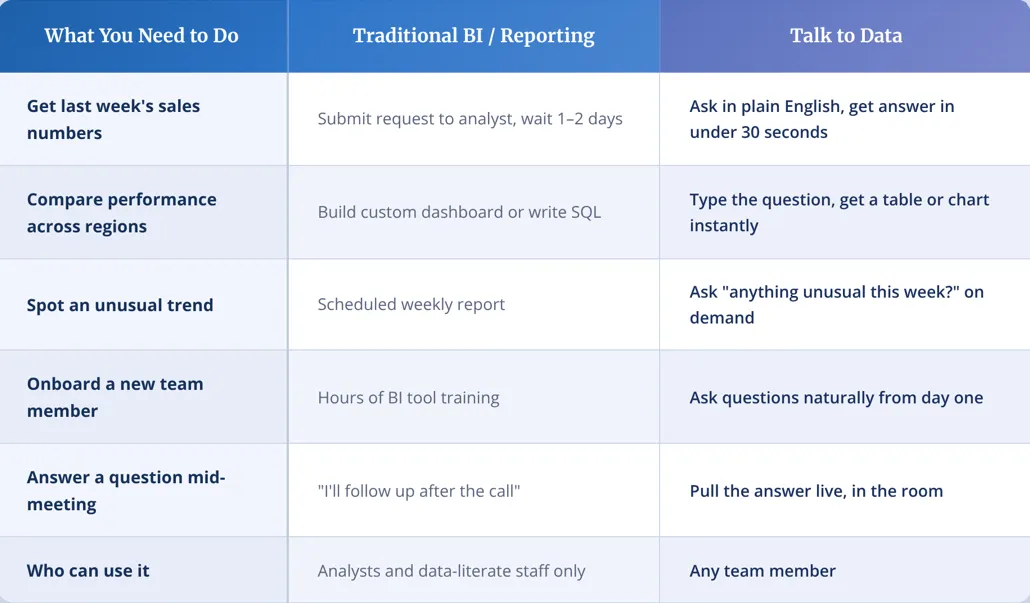
The table isn't saying traditional BI is useless it's not. Complex dashboards, scheduled reports, and data modeling still have their place. But for the everyday question-and-answer workflow, natural language querying cuts the friction by a significant margin.
A real-world talk to data case study: ERP analytics for manufacturing
Here's a concrete example of what this looks like when it's actually deployed not a demo, but a production system built by Neuramonks for a manufacturing and finance client running a full ERP environment.
The problem:
The ERP system handled all core transactional workflows procurement, inventory, supplier management, financials. But getting any insight out of it required going through analysts or IT. Business users had no way to query ERP data on their own. Leadership couldn't get fast visibility into supplier risk, inventory aging, or cost exposure without waiting on a report cycle. Worse, the ERP held sensitive financial data, so just opening up query access wasn't an option — governance and access controls had to hold firm.
What Neuramonks built:
Neuramonks designed a secure, role-based AI analytics layer Talk to Data for ERP embedded directly inside the existing ERP environment. Business users could now ask plain English questions and get answers back instantly, with the system enforcing the same permission rules already set in the ERP. Finance could only see finance data. Procurement saw what procurement was allowed to see. No cross-entity leakage, no governance risk.
The system was built for 100+ concurrent users, with exact-match structured querying and validation to prevent AI hallucinations on financial figures because wrong numbers in finance have real consequences.
The results:
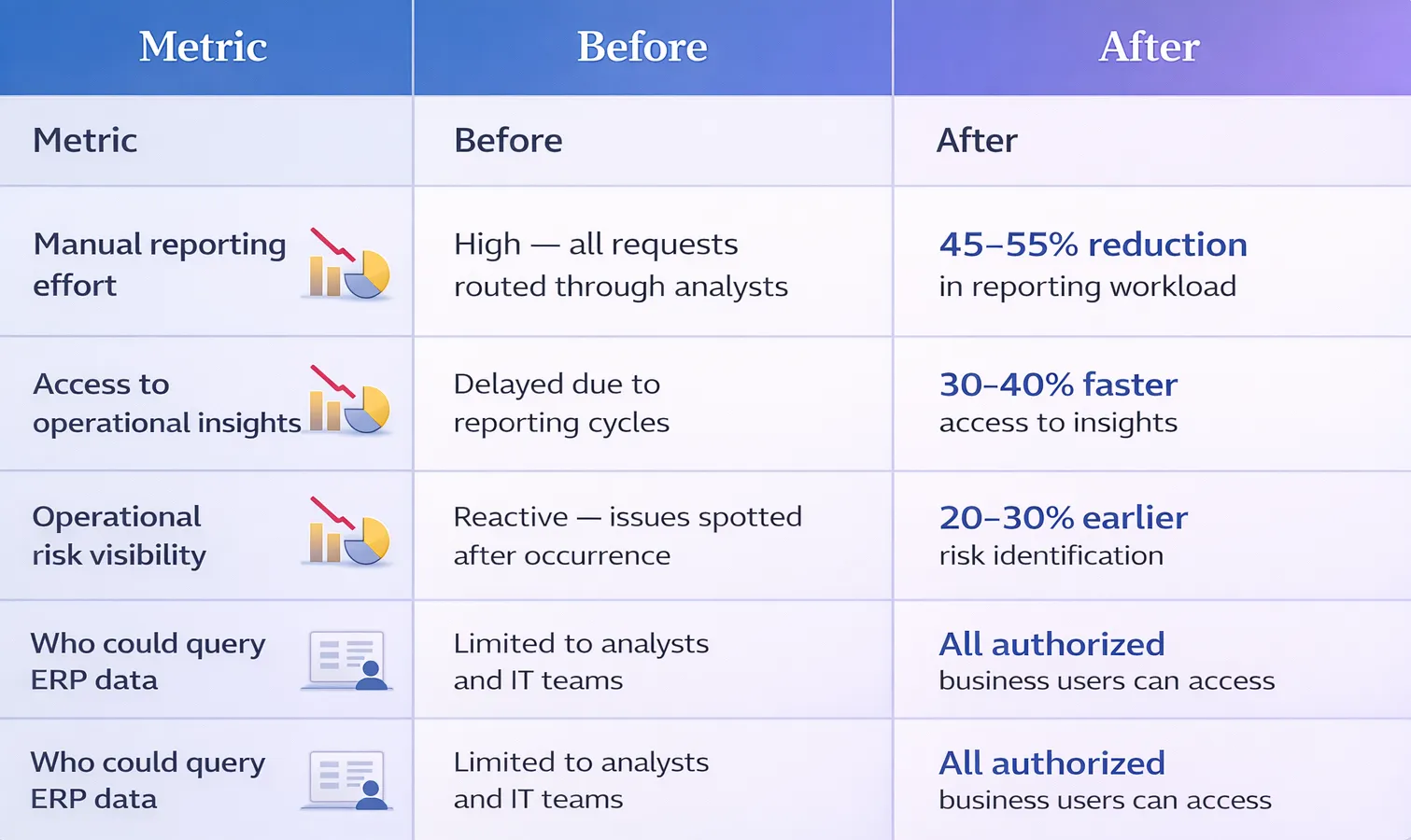
Beyond the numbers, the shift that mattered most was ownership. Finance teams, procurement leads, and business managers stopped waiting on others to get the data they needed to do their jobs. The ERP went from a system people worked around to one they actually used without the governance team losing any sleep over it.
Where does this fit with voice?
One direction this technology is heading is voice. Instead of typing your question, you speak it.
A voice agent connected to your data layer can let you ask questions hands-free. Imagine asking your phone during a commute: "What's our current pipeline value for this quarter?" and getting a verbal answer read back to you.
This isn't science fiction. Several companies are already building voice-to-data workflows for field teams, executives who prefer speaking to typing, and customer-facing support bots that pull live data to answer customer queries in real time.
At Neuramonks, we've seen interest in voice data interfaces pick up sharply in the last 12 months, especially from operations-heavy businesses where people are on the floor, not at a desk. A warehouse manager asking "How many units of SKU-4421 do we have left?" While searching through a laptop's dashboard is somewhat different from strolling the floor.
What "talk to data" is not
Worth clearing up a few misconceptions:
It's not a replacement for a data strategy. If your data is messy, incomplete, or siloed across too many systems with no consistent naming conventions, a natural language interface will give you fast answers to the wrong questions. Fix your data foundation first.
It's not magic. The AI has to understand your schema. That requires some one-time setup connecting your data sources, defining your business terms, and testing edge cases. It's a few weeks of work, not a flip of a switch.
It's not only for large enterprises. The businesses that benefit most quickly are often mid-size companies where 1 or 2 analysts are bottlenecked serving an entire organization. They see ROI fastest.
How to know if you're ready
A few honest questions before investing:
Is your data in one place (or can it be)? A talk to data system needs to connect to your data warehouse or database. Fragmented data across 12 different spreadsheets complicates the setup not impossible, but it adds time.
Do you have consistent naming? If your sales team calls it "revenue" and finance calls it "net receipts," the system needs to know they mean the same thing. One-time setup, not a dealbreaker.
Do non-technical people regularly need data? If yes, this solves a real problem. If your team is already data-literate and comfortable with BI tools, the ROI case is weaker though speed gains are still real.
How Neuramonks approaches this
At Neuramonks, our AI consulting services cover the full lifecycle from assessing whether your data is ready for natural language querying, to building and deploying the interface, to training your team on getting the most out of it.
We don't push a one-size-fits-all product. Most of the implementations we've done are custom built on top of existing data infrastructure rather than replacing it. Reducing the time between "I have a question" and "I have an answer" is always the aim.”
If you're not sure whether your business is ready, that's actually the best time to have the conversation. We help you figure out what's worth building now and what can wait.
The bottom line
"Talk to data" is a straightforward idea: remove the technical barrier between people and the information they need to do their jobs.
The technology works in production today, not just demos. Businesses seeing the most value invest in getting their data house in order first, then layer the natural language interface on top. The ones who skip that step get fast answers to the wrong questions.
If your team is waiting on reports, working from outdated numbers, or simply not using data because it's too hard to access, this is worth a serious look.
Your data already has the answers. Are they accessible to your team?
Most businesses we talk to aren't short on data. They're short on speed the time it takes to turn a question into an answer is the actual problem.
If that sounds familiar, let's talk about what fixing it would look like for your setup. No pitch deck, no pressure — just a straight conversation about what's possible.
Book a free discovery call with Neuramonks →

Beyond the Chat: How 'Agentic' Bots Are Running 40% of Mid Market Operations in 2026
By 2026, 40% of mid-market companies run real business operations — invoicing, lead qualification, vendor management — through autonomous AI agents, not chatbots. These systems take a goal and handle every step without human input. The gap isn't the technology; it's the architecture behind it.
In 2026, businesses are no longer just using AI tools — they're hiring AI agents.
The companies winning today aren't the ones using AI — they're the ones delegating work to it.
That shift is not metaphorical. A McKinsey 2026 Operations Report found that 40% of mid-market companies now run core business functions — from procurement approvals to customer onboarding — through autonomous AI agents operating with little to no human intervention. Not chatbots. Not copilots. Full-cycle, decision-making systems.
If your mental model of AI is still a chat window that answers questions, you are already operating a generation behind.
What "Agentic" Actually Means — And Why It Changes Everything
Most AI tools are reactive. You ask, they answer. Agentic AI inverts that entirely.
An agentic system receives a goal — "renew all vendor contracts expiring in Q2 and flag anything above a 12% price increase" — and figures out the steps, executes them across multiple platforms, monitors progress, and escalates only when genuinely necessary. It plans. It decides. It acts.
This is not a feature upgrade. It is a structural rethink of where human attention belongs inside an organization.
The leap from passive tool to autonomous actor is why agentic AI 2026 benchmarks are being tracked the same way companies tracked cloud adoption in 2015. The businesses that made early infrastructure bets then compounded their advantage for a decade. The same window is open right now — and it is narrowing fast.
"Deploying an agent is not about removing a person from a task. It is about removing the friction that stops a person from doing twenty better tasks."
The 40% Number Is Not the Ceiling — It Is the Floor
When researchers say 40% of mid-market operations are now agent-assisted, they mean scheduled reporting, invoice reconciliation, lead qualification, compliance monitoring, internal IT ticketing, and multi-step customer communication workflows are being handled end-to-end by systems that were described as "futuristic" eighteen months ago.
The firms achieving this did not start with grand AI strategies. They started with one workflow, measured ruthlessly, and expanded. An operations director at a mid-size logistics firm described it plainly: "We gave the agent our freight exception process on a Friday. By Monday it had filed 34 carrier disputes without a single human touching a form."
That is not productivity improvement. That is a different operating model.
What Agentic Workflows Look Like in Practice
Agentic workflows are not scripts. They are goal-oriented execution chains that can branch, adapt, and recover from failure mid-task. A well-designed agentic workflow might look like this:
A sales team sets a goal: follow up with every inbound lead within 90 minutes, personalise outreach based on their industry and page behaviour, book a discovery call if intent signals cross a threshold, and route hot leads directly to a senior rep. The agent monitors the CRM, reads enrichment data, drafts and sends personalised emails, updates lead scores, books calendar slots, and sends the rep a briefing note before the call — all without a human in the loop until the conversation actually begins.
This is AI automation at its most practical: not replacing judgment, but eliminating the mechanical labour surrounding it so judgment can be applied exactly where it matters.
The Gap Is Not Technological — It Is Architectural
Most companies have AI tools scattered across departments — a summarisation plugin here, a scheduling assistant there. What they lack is the connective tissue: unified data access, defined escalation logic, permission structures that let agents act across systems, and monitoring layers that maintain accountability.
This is where working with a serious AI development company changes the outcome. Building an agent is relatively straightforward. Building one that is reliable, auditable, and actually embedded into how a business operates requires architectural discipline that most internal teams have not yet had the chance to develop.
At Neuramonks, the firms that see the sharpest results are those that approach deployment as a systems question, not a software question. They do not ask "which AI tool should we add?" They ask "Which business process should this agent own, and what does it need to do its job without failing quietly?"
Where Agentic AI Is Taking Root First
Across industries, five operational areas are seeing the earliest and deepest agentic AI adoption in 2026:
01 Finance operations: Invoice processing, payment reconciliation, variance flagging, and audit trail generation. Agents cross-reference contracts, catch anomalies, and escalate only genuine exceptions.
50% — Talk to Data: Secure Intelligent Analytics for ERP Systems Reduced manual reporting effort by 50% · Accelerated access to operational insights by 30–40%
02 Procurement and vendor management Renewal tracking, price benchmarking, and supplier communication handled against defined parameters — human sign-off reserved for strategic decisions only.
65% — Automated Floor Plan Details Extraction System Reduced manual floor plan analysis effort by 65% · Delivered 100% analytics-ready structured spatial data at scale
03 Customer operations Always-on order intake, query handling, and fulfilment coordination — agents handle high-volume interactions with consistent accuracy, escalating only when human judgment is genuinely needed.
60% — AI Voice Agent for Pizza Ordering Reduced manual order handling by 60% · Improved order accuracy by 30% · Increased peak-hour order throughput by 30–40%
04 HR operations Onboarding sequences, policy acknowledgement tracking, benefits enquiry resolution, and compliance documentation — coordinated across systems with zero manual chasing.
70% — AI Podcast Generation Platform Reduced podcast production effort by 70% · Cut time-to-publish by 60% · Improved long-form content consistency by 30–40%
05 Sales pipeline management The full qualification and nurture cycle — enrichment, sequencing, meeting scheduling, and CRM hygiene handled end-to-end.
50% — AI Roleplay Agent Platform for Sales Teams Reduced training effort by 50% · Cut training turnaround time by 60% · Lifted objection-handling effectiveness by 25–35%
What Responsible Deployment Looks Like
Speed without structure is how companies end up with agents making consequential decisions that nobody intended them to make. The AI consulting services conversation has matured significantly — from "here is how you use ChatGPT" to "here is how you build governance frameworks that let agents operate ambitiously within defined boundaries."
The firms doing this well share three traits: they instrument everything, they build reversibility into workflows, and they expand scope only when the previous scope has proven stable. That discipline is what separates impressive demos from durable competitive advantage.
The Compounding Effect Nobody Is Talking About Loudly Enough
Here is the dynamic that makes business-ready AI systems genuinely strategic: agents generate data about processes that humans were previously executing invisibly. When a human processes invoices, you get invoices processed. When an agent does it, you also get a structured log of every decision, exception, time-to-resolve, and vendor pattern — data that compounds into process intelligence over weeks and months.
Organizations running business-ready AI systems at scale are not just more efficient. They are progressively smarter about their own operations in ways that are very difficult for slower-moving competitors to replicate.
Also, consider the AI solutions landscape for a moment: most vendors are still selling point tools. The real edge in 2026 belongs to businesses that have stitched those tools into coherent, goal-driven systems that run without babysitting.
The Question Worth Sitting With
If 40% of your peer companies are already delegating operational work to agents, the relevant question is not "should we explore this?" It is: which of our processes is consuming the most human attention right now, and what would our operations look like if that process ran itself?
That is the question Neuramonks starts with. Not the technology stack. Not the AI roadmap. The specific, concrete drag on your people's time — and the architecture that eliminates it.
The companies that answer that question well in 2026 will not be benchmarking AI adoption in 2028. They will be setting the benchmarks everyone else chases.
Let's figure this out together
Got a process that eats your team's week? Let's map what an agent would do with it.
No decks, no discovery calls disguised as pitches. Just a genuine 30-minute conversation about one workflow — and whether handing it to an agent actually makes sense for where you are right now. If it does, we'll show you exactly how. If it doesn't, we'll tell you that too.
Talk to Neuramonks →

The 2026 AI Tier List: Why Claude is Winning the Boardroom While GPT Wins the App Store
The enterprise AI market has split cleanly between Claude and GPT — and picking the wrong one costs companies months of re-platforming work. Claude owns regulated, high-stakes workflows. GPT owns consumer apps and fast-moving startups. The decision should be made at the architecture stage, not after the first sprint.
The market for AI solutions has split in two — and most companies haven't noticed yet. Something quietly shifted in 2025. The enterprise procurement teams that once defaulted to "just use OpenAI" started asking harder questions — about liability, about reasoning depth, about what happens when the model gives a compliance officer the wrong answer on a live call. By the time those conversations reached the C-suite, a pattern had already crystallised: Anthropic was winning 70% of new enterprise AI deals not by outperforming GPT on benchmark leaderboards, but by building something GPT never prioritised — a cultural identity rooted in precision, caution, and institutional trust.
Meanwhile, OpenAI was executing a different masterclass. Consumer integrations, plugin ecosystems, and ChatGPT as a daily habit for 200 million users. Two companies, two philosophies, two completely different winning conditions. Welcome to the specialisation era of AI — and if you're a CTO, founder, or product lead about to commit budget to an AI API, this breakdown will save you from a very expensive mismatch.
At NeuraMonks, we've embedded across enough enterprise architecture reviews and startup sprint cycles to have a real opinion on this. Here's what the tier list actually looks like in 2026 — and why the answer is rarely "one or the other."
The Fork in the Road: Where Anthropic and OpenAI Diverged
The story of Claude vs GPT in the enterprise space isn't really about model intelligence anymore. Both are extraordinary. The fork happened at the philosophy level.
Anthropic built Claude with a constitutional AI framework — a set of embedded principles that govern how the model reasons, refuses, and handles ambiguity. For a risk officer at a bank, that's not a limitation, that's a feature. For a healthcare platform handling patient-facing workflows, predictable refusal behaviour is more valuable than raw output creativity.
OpenAI, by contrast, has been racing toward becoming the consumer super-app. The ChatGPT interface, voice mode, memory, operator instructions, marketplace plugins — it's a platform strategy, not just a model strategy. Extraordinary for developers building fast, for consumer products needing breadth, and for startups that need a capable general-purpose AI brain in their product by Friday.
Neither is wrong. They're just playing different games. The mistake enterprises make is evaluating them on the same criteria.
Head-to-head: Claude vs GPT at a glance
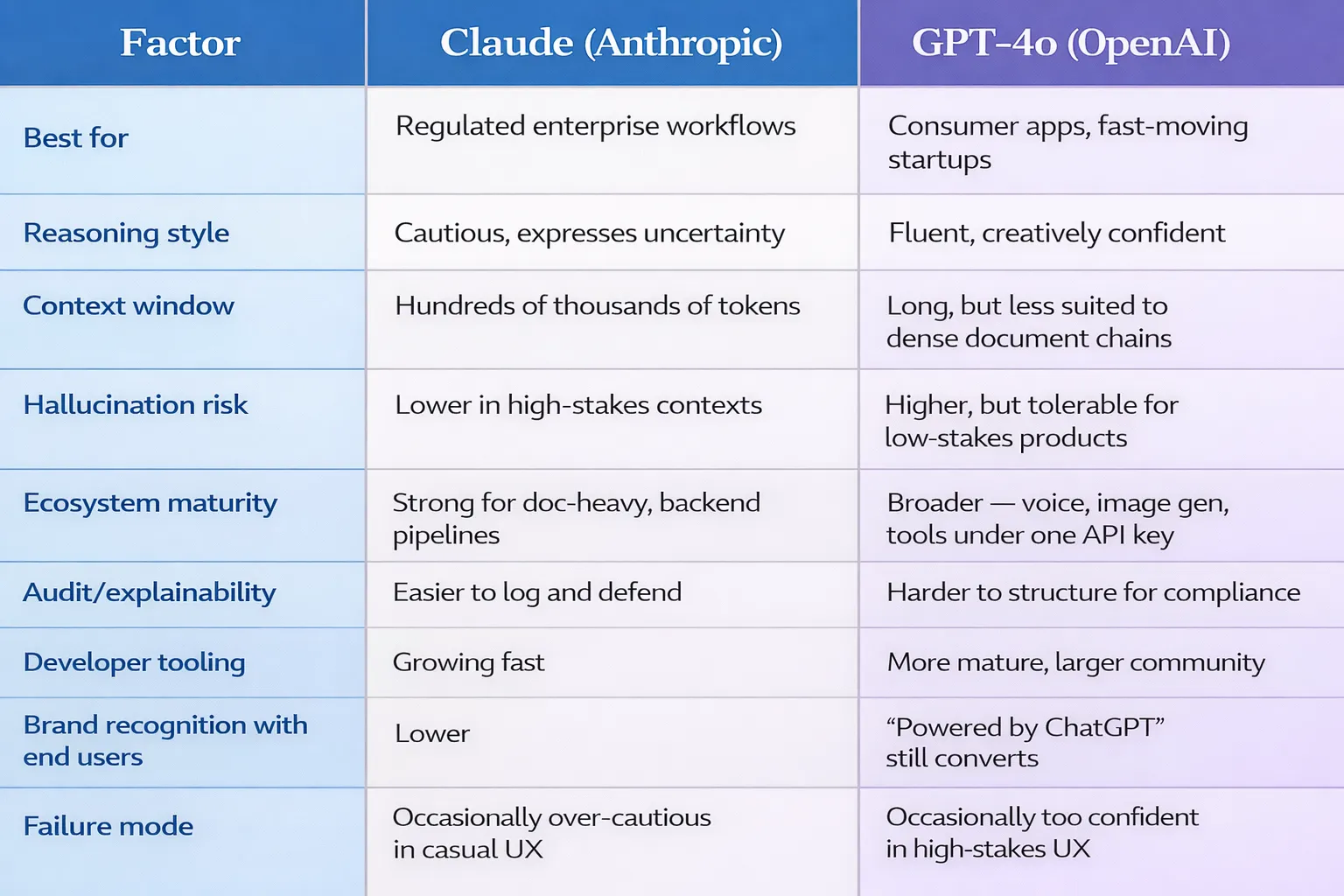
Why Enterprises Prefer Claude for Risk-Sensitive Workflows
When we audit enterprise AI pipelines — and this comes up in nearly every AI consulting services engagement — the pattern is consistent. The moment a workflow touches compliance, legal language, financial reporting, or patient data, the conversation shifts from "which model is smartest" to "which model can I defend in an audit."
Claude's architecture gives it a structural advantage here. Its responses are calibrated to express uncertainty when uncertainty exists. It doesn't hallucinate confidently — a trait that sounds minor until a model generates a fabricated legal citation that ends up in a client-facing document. Its longer context window (now extending to hundreds of thousands of tokens) allows enterprises to feed it entire regulatory documents, contract histories, or financial datasets without chunking — which means fewer stitching errors and more coherent outputs at scale.
The other enterprise-grade differentiator is agentic AI performance. When Claude is deployed inside multi-step automation pipelines — think: ingest a contract, extract obligations, flag anomalies, draft a risk summary, and route to the right department — it maintains chain-of-thought integrity across long tasks far better than most alternatives. This is critical for business-ready AI systems that can't afford mid-pipeline drift or context collapse.
The firms building AI tools for enterprises in regulated sectors — insurance, legal tech, healthcare SaaS, financial services — have largely converged on Claude as their foundation layer. The reputational calculus is simple: when something goes wrong with a consumer app, you patch and iterate. When something goes wrong with an enterprise compliance workflow, you face a very different kind of conversation.
The best AI model for business isn't the one that scores highest on MMLU. It's the one your legal team will sign off on deploying at scale.
Why GPT Dominates Consumer Apps & Startups
GPT-4o and its successors are still the default engine for a reason. If you're building a consumer-facing product where speed, creativity, multimodal input, and plug-and-play integrations matter more than auditability, GPT's ecosystem is hard to beat.
The OpenAI platform gives developers access to function calling, code interpreter, file search, image generation (DALL·E), and voice — all under one API key. For a startup moving at startup speed, that breadth eliminates vendor juggling. You don't need three different services; you ship with one.
Consumer applications have a different failure mode than enterprise ones. If a GPT-powered recipe assistant suggests a slightly unusual ingredient combination, the user laughs and tries again. The stakes are low. The feedback loop is fast. The product can iterate aggressively. That context rewards GPT's creative confidence and output fluency.
The developer tooling is also more mature. Extensive community documentation, open-source wrappers, and a marketplace of pre-built integrations mean that most GPT use cases have a published reference implementation somewhere. For resource-constrained startup teams, that ecosystem advantage is real money.
There's also the brand recognition factor. End users trust "powered by ChatGPT" in a way that they don't yet for newer AI brands. In B2C, trust is a conversion metric. That's not irrational — it's just the current market reality.
Use case fit: where each model belongs
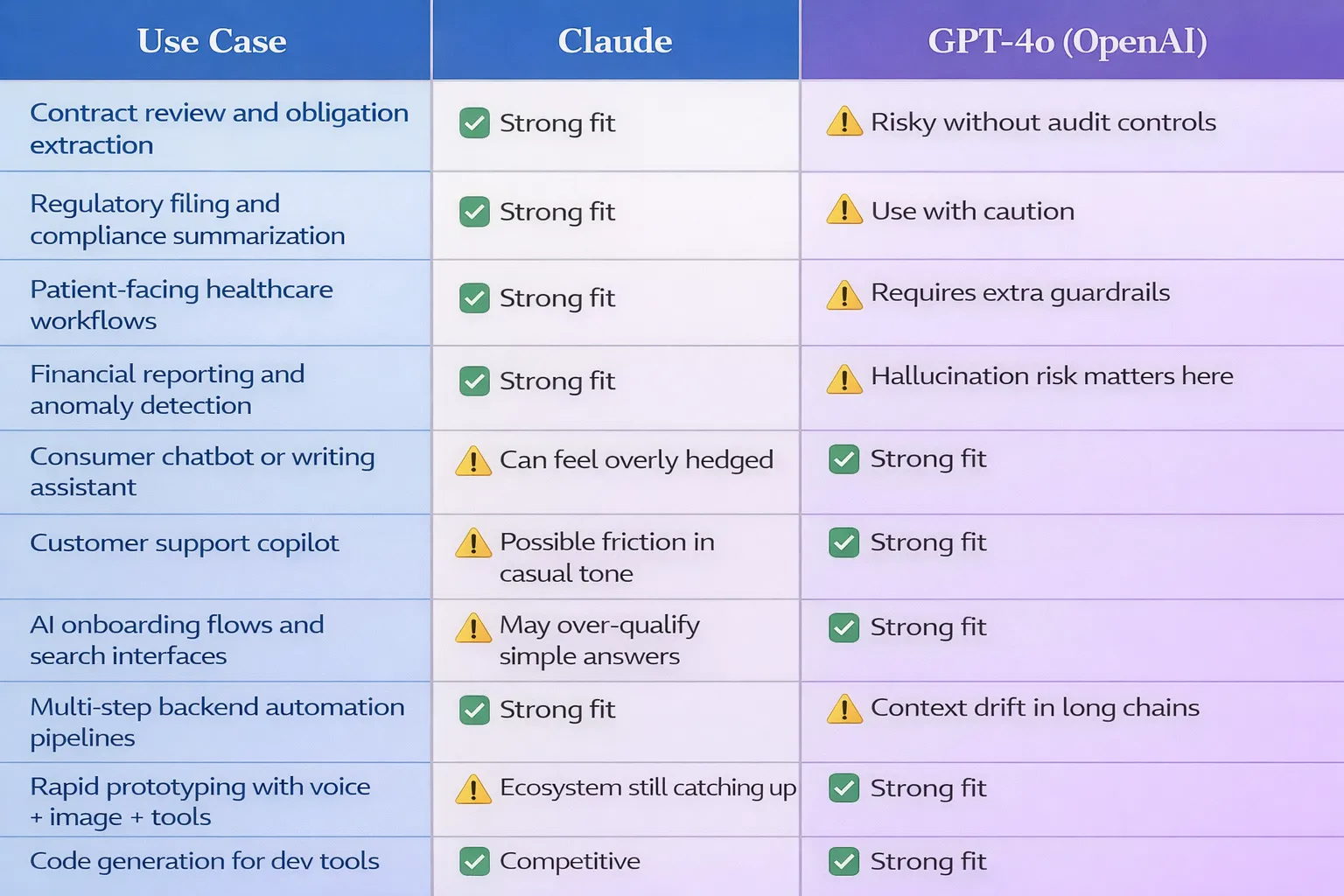
The Hidden Cost of Choosing Wrong
Here's what the benchmark comparisons don't show you: the cost of architectural mismatch six months into a build.
We've seen it at NeuraMonks — and this AI case study is more common than most teams admit. A Series B company built its entire enterprise compliance layer on GPT because it was the familiar choice. Twelve months later, they were re-platforming onto Claude because their enterprise clients required explainability logs and their current setup couldn't produce them reliably. The migration cost — in engineering hours, re-prompting, re-testing, and re-deploying — ran into six figures.
The inverse also happens. Teams building consumer features on Claude because it felt "safer," only to discover that Claude's deliberate caution creates friction in casual, fast-paced conversational contexts where users want snappy, opinionated responses, not hedged ones.
This is exactly why the AI solutions conversation needs to happen at the architecture stage — not after the first sprint is already done.
How to Actually Make the Decision: A Framework for CTOs
Rather than debating model quality in the abstract, here's the decision tree we use when consulting with engineering and product leaders:
- What is the failure mode of a wrong answer? — If a wrong answer creates a legal, financial, or reputational exposure, default toward Claude. If it creates a slightly awkward user experience, GPT's fluency is more valuable.
- What does your context window look like? — Long documents, regulatory corpora, and multi-session memory requirements favour Claude. Short, modular, single-turn interactions favour GPT's speed.
- Are you building a product or a pipeline? — Consumer-facing products with interface integrations trend toward GPT. Backend automation pipelines with multi-step logic trend toward Claude.
- Who reviews the outputs? — Human-reviewed workflows can absorb more model creativity. Fully automated outputs that go directly to end users or systems need tighter output discipline.
- What's your integration surface? — If you need voice, image generation, and tool use under one roof today, GPT's ecosystem is ahead. If you're building on top of structured data and document intelligence, Claude's context management wins.
None of these are absolute — and in complex enterprise builds, the answer is often a hybrid architecture where GPT handles consumer-facing interactions and Claude anchors the internal reasoning and compliance layer.
What the Real-World Deployment Data Is Telling Us
Benchmarks are a starting point, not a verdict. The more instructive signal comes from watching where enterprises actually allocate their AI budget once the proof-of-concept phase ends and production deployment begins.
Across industries, a clear pattern has emerged in 2025–2026. Enterprises in financial services, insurance, and healthcare are consistently directing their core workflow automation budget toward Claude — particularly for document-heavy processes like policy interpretation, claims summarisation, and regulatory filing support. The reasoning isn't emotional. It's operational. These teams need outputs they can log, audit, and defend. Claude's constitutional design makes that architecture significantly easier to build and maintain.
In contrast, SaaS companies building end-user features — AI writing assistants, customer support copilots, onboarding flows, and search interfaces — are overwhelmingly staying in the GPT ecosystem. The speed of iteration, the mature fine-tuning options, and the sheer weight of community knowledge around GPT-based systems mean that SaaS product teams can move faster with lower overhead.
What's most telling is what happens at Series B and beyond, when companies that started on GPT for speed begin evaluating whether their infrastructure can scale with enterprise clients who have procurement requirements around data governance and model explainability. That's the inflection point where model re-evaluation happens — and it's almost always Claude that enters the picture at that stage, often anchoring the internal reasoning layer while GPT continues to handle the consumer-facing surface.
The data point that should make every product leader pause: the average cost of re-platforming from one foundation model to another — once prompt libraries, fine-tuning pipelines, evaluation suites, and integration logic are all in place — is measured in months of engineering time, not days. Choosing the right model for the right use case at the architecture stage isn't a philosophical exercise. It's a financial one.
The 2026 Verdict: Two Winners, Two Different Rings
The AI discourse tends toward horse-race framing — who's winning, who's falling behind, which model is "best." That framing is genuinely unhelpful for anyone actually deploying AI solutions at scale.
The more honest picture is this: Anthropic has built the most capable business-ready AI systems for regulated, high-stakes, enterprise-grade deployment. OpenAI has built the most capable consumer and developer platform on the planet. Both are tier-one. Both are winning. In different rooms.
The strategic question for any AI development company or enterprise product team is simply: which room are you building for?
At NeuraMonks, our model selection process doesn't start with benchmarks — it starts with risk profile, workflow architecture, and deployment context. Because the difference between a well-placed model and a mismatched one isn't usually visible in the demo. It shows up in production, at 2am, when something goes wrong and you need to know exactly why.
The most sophisticated enterprise teams we've worked with have stopped asking "which model is better" altogether. They've replaced that question with a more useful one: "which model is better for this specific layer, with this specific risk profile, serving this specific user type?" That reframe changes the entire procurement conversation — from a vendor beauty contest to an engineering decision with defensible logic behind it.
If you're a founder or CTO who hasn't yet stress-tested your model selection against your actual production failure modes, that's the conversation worth having before the architecture hardens and the cost of changing direction becomes a number that requires a board-level discussion.
The specialisation era isn't a complication — it's leverage. Two world-class models, two distinct strengths, both accessible via API today. The tier list is settled. The only open question is where your product actually lives in it — and whether the team building it has been honest enough with themselves to place it correctly.
Not sure which model belongs in your stack?
Every architecture decision has a risk profile behind it. At NeuraMonks, we map your workflow, your failure modes, and your compliance requirements to the right model — before a single line of production code is written.
If your team is at the point of committing to an AI architecture and wants a second opinion from people who've built these systems across fintech, healthcare, and enterprise SaaS — let's talk.
Claude Now Remembers Everything Anthropic's Memory Update Is the Biggest Quality of Life Upgrade AI Has Ever Shipped
Claude's new memory update — now free for all users — means the AI remembers your projects, preferences, and working style across every conversation, so you never have to repeat yourself.
Picture this: it's Monday morning. You open Claude, ready to pick up where you left off on your client proposal from Thursday. In the old world, you'd spend the first five minutes re-explaining the client's name, their industry, the tone they prefer, the format you need, and the three things you absolutely cannot include. Five minutes, every single time. Multiplied across every user, every conversation, every day.
Anthropic just ended that era entirely.
On March 2, 2026, Anthropic officially rolled out persistent memory from chat history to all Claude users — including everyone on the free tier. No subscription required. No setup needed. Claude now remembers who you are, what you're working on, how you think, and what context matters to you — and it carries that knowledge into every conversation going forward.
This is not a quality-of-life tweak. This is a foundational shift in what AI assistance means, and it has major implications for every individual, team, and business using Claude today.
What the Memory Update Actually Does — In Plain English
Claude's memory works in two directions simultaneously, and both are important to understand.
Automatic memory generation: As you chat, Claude quietly builds an evolving profile of you — your role, your communication style, your ongoing projects, your technical preferences, and the context that keeps coming up. It stores this in a simple, readable text file that you can view, edit, or delete at any time through Claude's settings.
Full user control: Nothing is hidden. You can pause memory generation, which preserves what Claude has already learned but stops it from adding new information. You can delete everything from Anthropic's servers entirely. And crucially, you can export your memory at any time, making your personal context portable rather than locked in.
Anthropic is also drawing clear lines around what Claude should and shouldn't remember. According to the company's updated help documentation, Claude focuses on work-relevant context that genuinely improves collaboration — your role, your communication preferences, your technical stack, your ongoing project details. Each project gets its own dedicated memory space, which keeps one workflow from bleeding into another. Your creative writing context doesn't contaminate your engineering context.
The result is an AI solution that feels less like a utility you query and more like a colleague who actually pays attention.
The Numbers Behind This Moment
Key Stats From Anthropic's March 2026 Announcement
Free-plan users up 60% since the start of 2026
Paid Pro & Max subscribers have doubled year-over-year
Claude hit #1 on the U.S. App Store — displacing ChatGPT
Memory rolled out to all plans: Free → Pro → Max → Team → Enterprise
These numbers tell an important story. Anthropic's decision to drop the memory paywall isn't charity — it's a calculated strategic move. Free users are converting to paid subscribers at a higher rate than ever, which means giving more away is actually growing revenue. The strategy is working.
The Memory Import Tool: Switching Just Got Frictionless
Alongside the memory update, Anthropic launched something equally significant: a cross-platform memory import tool. And it's aimed directly at ChatGPT and Gemini users.
Here's how it works. You paste a specially prepared prompt into any competing AI chatbot — ChatGPT, Gemini, or any other — and ask it to export everything it knows about you: stored memories, learned preferences, project context, communication style. You copy that output and paste it into Claude's memory import box. Claude extracts the relevant information and adds it to your memory profile. The refreshed memory view is live within 24 hours.
Anthropic explicitly states that this process works in both directions. You can import memories from other services into Claude, and you can export your Claude memories back out later. This is a deliberate choice. Rather than creating lock-in, Anthropic is betting that transparency and portability will build more trust — and more loyalty — than walls ever could.
This import capability, paired with free memory access, removes the single biggest barrier that previously existed for users considering switching from ChatGPT: the fear of starting over. That barrier is now gone.
Beyond Chat: Memory Now Flows Across Claude for Excel and PowerPoint
The memory update doesn't stop at the chat interface. Anthropic simultaneously shipped a major enhancement to Claude for Excel and Claude for PowerPoint, and the integration is exactly what knowledge workers have been waiting for.
The two add-ins now share full conversation context with each other. Every decision Claude makes in one application is influenced by everything that transpired in the other.This changes the workflow entirely.
A Real-World Scenario
Imagine a financial analyst preparing a quarterly review. They open their revenue model in Excel and ask Claude to analyze performance by region — Claude builds the comparison table, identifies the outliers, and summarizes the variance. They then switch to PowerPoint and ask Claude to turn those findings into three slides for the board presentation — Claude already knows the data, the story, and the format. They draft a follow-up email summarizing the key takeaways — Claude already has the context from both applications.
What used to require four separate tools, four separate context-settings, and forty minutes now happens in one Claude conversation. That's the AI solution that enterprise teams have been waiting for: not another integration to manage, but seamless intelligence that flows across the tools you already use.
Anthropic has also added Skills support to both add-ins, as well as LLM gateway connectivity for Amazon Bedrock, Google Cloud Vertex AI, and Microsoft Foundry users — making it enterprise-ready at scale.
Why This Changes Everything for How We Work
It's easy to underestimate a memory feature because it sounds mundane. But memory is actually the invisible variable that separates a useful tool from a genuinely transformative one.
Think about the difference between a new contractor on your first day with them — polite, capable, but requiring explanation for everything — versus a trusted colleague of two years who already knows your standards, your pet peeves, your shortcuts, and your goals. The actual intelligence hasn't changed. The working relationship has. And that relationship is almost entirely built on memory.
That's exactly what Anthropic's Chief Product Officer Mike Krieger was pointing to when he wrote: "Memory starts with project continuity, but it's really about creating sustained thinking partnerships that evolve over weeks and months." This isn't about recall. It's about a relationship.
For generative AI to move from impressive experiment to essential business infrastructure, it needs to stop requiring users to babysit it. Every time you have to re-explain your context, you're doing the AI's job for it. Memory fixes that. And when memory is available to every user — not just the ones paying $20 a month — the entire category changes.
Memory Is the Foundation of Agentic AI
Here's the bigger picture that's easy to miss in the headlines: persistent memory isn't just a user experience upgrade. It's the foundational layer that makes agentic AI actually viable for real-world work.
Agents — AI systems that autonomously plan, execute multi-step tasks, and operate across tools — only work well when they understand context. An agent that forgets what your business does, how your team is structured, or what constraints matter to your workflows is an agent that creates more work than it saves.
With persistent memory, Claude's agents can now operate with the kind of accumulated understanding that makes autonomous action trustworthy. When you ask Claude to handle a recurring task — analyze this week's sales data and flag anomalies — it already knows your data structure, your thresholds, your notification preferences, and your format requirements. You set it up once. It learns. It improves. It compounds.
This is the trajectory Anthropic is building toward: AI that doesn't just respond to commands, but genuinely understands the person giving them. Memory is the first essential brick in that architecture.
Who Benefits Most Right Now
Individual professionals: Every knowledge worker who uses Claude daily will immediately feel the difference. Writers, analysts, engineers, marketers — anyone who has a recurring context that Claude has had to re-learn conversation after conversation will notice an immediate reduction in friction and an immediate improvement in output quality.
Dev teams: Developers using Claude for code review, debugging, and architecture conversations will now have Claude remember their stack, their conventions, their testing preferences, and their project structure — making every session faster and every suggestion more relevant from the first message.
Small businesses and startups: For teams that can't afford dedicated AI ops infrastructure, free memory access on Claude is a significant equalizer. Your AI assistant now understands your business context without requiring an enterprise plan or a technical team to maintain it.
Enterprise teams: The Skills feature in Claude for Excel and PowerPoint means that when one team member figures out the perfect workflow for a recurring task, they can save it as a reusable skill — instantly making that institutional knowledge available to the entire organization.
Every major technology platform has had a moment where it crossed from optional to essential. The internet crossed that line. Mobile crossed it. Cloud crossed it. AI is crossing it right now — and memory is one of the clearest signals yet that the crossing is happening.
Claude, remembering everything isn't a gimmick. It's the product growing up. It's Anthropic making a deliberate bet that the future of AI isn't about having the biggest model — it's about having the deepest relationship with the people using it.
The memory paywall is gone. The import friction is gone. The context-setting tax is gone. What remains is an AI assistant that meets you where you are, remembers where you've been, and gets better at helping you with every conversation.
That's not just a quality-of-life upgrade. That's a new standard for what AI should be.
Ready to Build AI That Remembers, Learns, and Grows?
Claude remembers. Your product should too.
At Neaurmonk, we design and build AI-powered applications that use the latest Claude capabilities — including persistent memory, agentic workflows, and cross-platform intelligence — to create products that genuinely feel alive.
From idea to launch, Neaurmonk is the AI development company that makes it happen. Whether you're a startup founder with a vision or an enterprise team ready to go AI-native — let's build it together.→
Let's talk Neaurmonk

Agentic AI Explained: How Autonomous AI Is Changing Enterprise Workflows
Agentic AI is transforming enterprise workflows with autonomous systems that can plan, decide, and execute complex tasks with minimal human input.
Quick Answer
Agentic AI isn't a chatbot — it's an autonomous workforce. Here's what you need to know:
- Agentic AI: AI agents that autonomously complete multi-step workflows (research → decision → execution → reporting) without hand-holding at each step
- Key Difference: Traditional AI responds to questions; Agentic AI acts on goals independently
- Real Impact: 60% reduction in manual work, 40% faster cycles, 30-60% cost savings in 4-6 months
- MCP Foundation: Model Context Protocol enables safe, structured connections between AI agents and your existing systems (CRM, ERP, databases)
- 2026 Trend: Multi-agent teams (specialized agents working together) replacing single-purpose tools
Three Agent Framework Examples:
- Research Agent — Gathers data, identifies patterns, flags anomalies
- Decision Agent — Analyzes context, applies business rules, recommends actions
- Execution Agent — Takes action, updates systems, escalates exceptions to humans
Is Your Business Ready for the Next Wave of AI? (This One Actually Does Things)
Hey everyone — wanted to share something I've been thinking about a lot lately, and I think it's worth a real conversation in this group.
We've all played with AI tools. Chatbots, copilots, summarizers. Helpful? Sure. But there's a new category emerging that's genuinely different — Agentic AI — and it's starting to show up in serious business deployments.
Here's the simple version: most AI responds. Agentic AI acts. You give it a goal, and it figures out the steps, makes decisions along the way, handles hiccups, and gets it done — without you holding its hand through every click.
Some real-world numbers that caught my attention:
- A voice AI handling pizza orders → 60% less manual order handling
- An AI HR screening agent → cut hiring workload by 60%, sped up hiring cycles by 40%
- An AI blog production system → 60% faster content output, no manual coordination
- Automated wound detection in healthcare → 60% reduction in manual assessments
These aren't chatbot demos. These are systems owning entire workflows end-to-end.
Why This Matters Right Now (Traction Signal #1)
Enterprises that deploy agentic AI in the next 6-12 months gain a 3-5 year compounding advantage. Your competitors are probably exploring this — waiting for it to "mature" is a competitive risk, not a prudent strategy.
What's making this possible right now?
A big piece is something called MCP (Model Context Protocol) — basically a standardized way for AI agents to securely connect to your existing tools: CRM, ERP, internal databases, SaaS platforms. Think of it as the plumbing that lets agents actually touch your business systems safely.
The Three-Layer Agentic Stack:
- LLM Layer — The reasoning engine (Claude, GPT-4, specialized models)
- Agent Orchestration — Workflow logic, tool selection, error handling
- MCP Connectors — Secure, governed access to your business systems
Without MCP, you're building brittle, custom integrations that break with every system update. With MCP Server Development, your agents have a standardized highway to your infrastructure.
Stop Planning AI. Start Profiting From It.
Every day without intelligent automation costs you revenue, market share, and momentum.
Get a custom AI roadmap with clear value projections and measurable returns for your business.
Schedule 30-Minute Strategy Call → [https://tidycal.com/team/neuramonks/consultation-booking]
Traction Signal #2: The ROI Timeline Matters
- Months 1-2: Data cleanup, integration setup, agent training
- Months 3-4: First measurable efficiency gains (20-30% reduction in manual work)
- Months 4-6: Full ROI realization (30-60% time savings, 20-35% cost reduction)
- Month 6+: Compounding returns as agents handle increasingly complex workflows
Most companies see positive ROI before the first year, not after.
Where is this all heading in 2026?
A few trends worth watching:
→ Multi-agent systems (teams of specialized AI agents working together)
→ Human-in-the-loop design (AI handles the routine, humans own the important calls)
→ Industry-specific agent training (legal, medical, financial)
→ Governance tools becoming a boardroom conversation, not just an IT one
Traction Signal #3: Industry-Specific Vertical Plays
The fastest ROI is appearing in:
- BFSI: Document processing, compliance checking, risk assessment (4-6 month payback)
- Healthcare: Patient intake, wound analysis, claims processing (3-4 month payback)
- E-commerce: Order management, customer support, recommendations (2-3 month payback)
- Manufacturing: Quality control, supply chain visibility, predictive maintenance (5-6 month payback)
If your industry isn't listed, ask: Where are we losing the most time to repetitive, data-driven workflows? That's your agent starting point.
The hard truth: businesses that get the infrastructure right now are going to have a compounding advantage over the next 3–5 years. Those who wait for it to "mature" may find themselves playing catch-up against competitors who already operationalized it.
The Enterprise Shift: From Rule-Based Automation to Intelligent Reasoning
The enterprise technology landscape is undergoing one of its most consequential shifts in decades. Businesses that once relied on rigid, rule-based software are now turning to intelligent systems that can plan, adapt, and act on their own.
Why Traditional RPA (Robotic Process Automation) Is Becoming Obsolete
Old Model (RPA):
- Follow pre-scripted, linear sequences
- Break when exceptions occur
- Require constant reconfiguration as business rules change
- No reasoning capability — just pattern matching
New Model (Agentic AI):
- Understand context and business goals
- Handle exceptions and edge cases autonomously
- Reason through novel situations
- Adapt to changing rules without recoding
At the heart of this transformation is agentic AI — a new generation of artificial intelligence that doesn't just respond to prompts but autonomously navigates complex multi-step workflows to achieve defined business outcomes.
Traction Signal #4: The Early Adopter Window
Companies deploying agents in 2026 are building institutional knowledge and skill sets that will compound. By 2027-2028, when agents become mainstream, early adopters will have:
- Mature, proven workflows
- Trained internal teams
- Governance frameworks in place
- Measurable competitive advantage
For organizations trying to stay competitive, understanding this shift is no longer optional. Agentic AI Services are becoming the defining capability that separates agile, forward-thinking enterprises from those at risk of being left behind.
This guide unpacks what agentic AI is, why it matters, and how companies — working with the right partners — are already putting it to work.
What Is Agentic AI? Beyond Chatbots and Copilots
Most people's experience with AI in the enterprise has been shaped by tools that respond — a chatbot that answers customer queries, a copilot that suggests code completions, or an assistant that summarizes documents. Useful? Certainly. Transformative? Not quite.
Agentic AI is different in a fundamental way: it acts.
Rather than waiting for a human to ask a question, an AI agent is given a goal and then autonomously determines the steps required to achieve it. It selects tools, gathers data, makes intermediate decisions, handles errors, and reports back — all without hand-holding at every step.
Three-Tier Agent Capability Model:
Tier 1 — Task Execution (Most common today)
- Agent: "Summarize this customer feedback"
- Agent handles: retrieval, analysis, formatting
- Example: AI Blog Generation → 60% faster content output
Tier 2 — Workflow Ownership (Emerging 2026)
- Agent: "Improve our hiring process"
- Agent handles: resume screening, interview scheduling, candidate evaluation, offer coordination
- Example: AI HR Screening → 60% reduction in hiring workload
Tier 3 — Strategic Decision Making (2027+)
- Agent: "Optimize Q3 supply chain"
- Agent handles: demand forecasting, inventory decisions, vendor negotiations, compliance
- Example: Multi-agent supply chain orchestration
Where are you on this spectrum? Most enterprises are between Tier 1 and Tier 2 — there's massive upside.
Real-World Example: Sales Training at Scale
Neuramonks' AI Roleplay Agent for Sales Teams doesn't just answer questions — it conducts entire sales training simulations. This agentic approach:
- Reduced training effort by 50%
- Improved sales readiness by 30%
- Scaled to 500+ sales reps without adding staff
This demonstrates how autonomous AI can own complete processes rather than just accelerating individual tasks.
How Does Agentic AI Differ from Traditional Automation?
Before agentic AI, enterprise automation meant robotic process automation (RPA) — systems that follow pre-scripted, linear sequences.
RPA vs. Agentic AI:
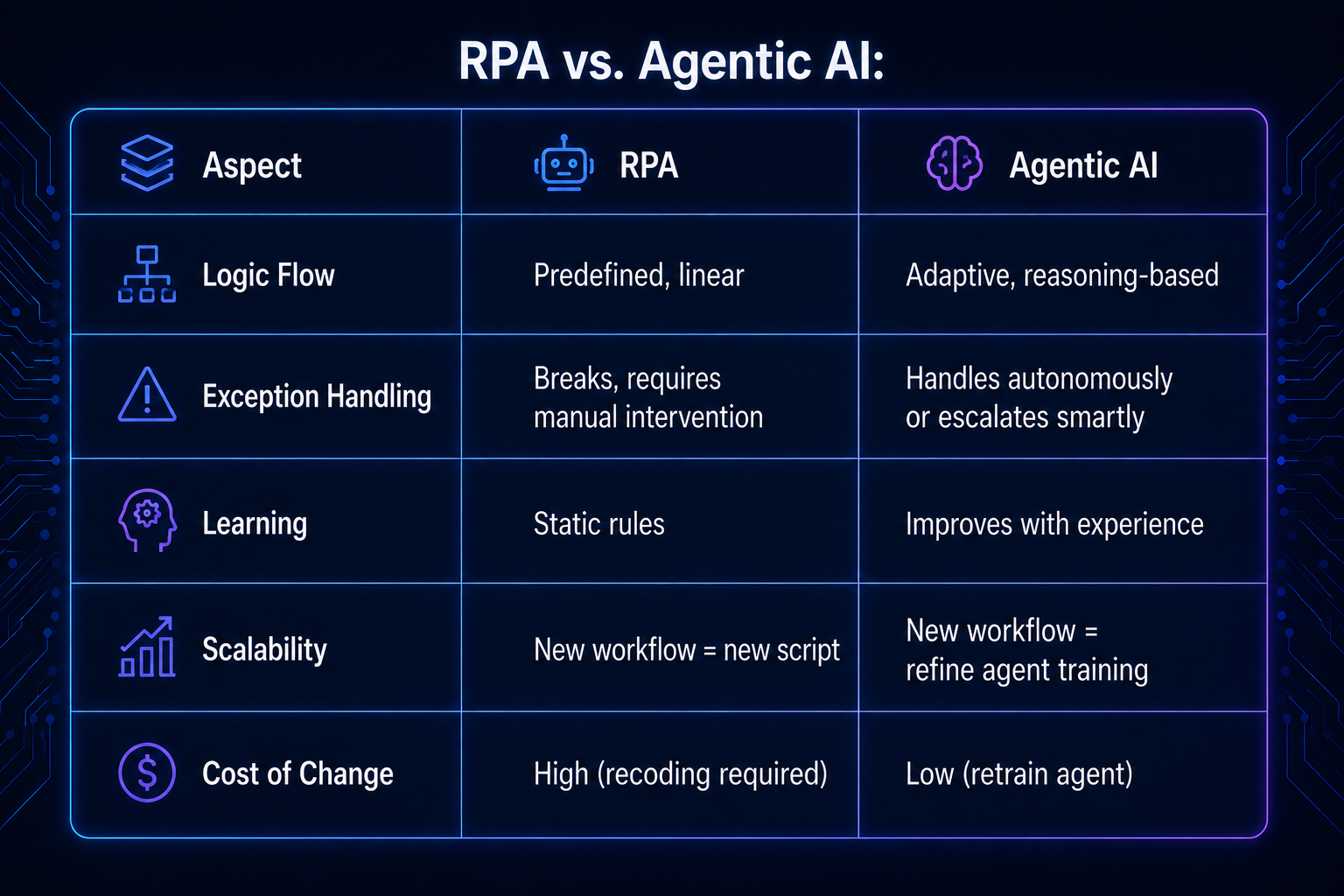
RPA is powerful for highly repetitive, structured tasks: extracting data from a PDF, copying values between systems, sending a scheduled email. But it breaks down the moment something unexpected happens.
Agentic AI addresses this brittleness directly.
Real-World Example: Blog Production at Scale
Neuramonks' AI Blog Generation System instead of following rigid templates, the agent autonomously:
- Researches trending topics
- Generates SEO-optimized content
- Handles imagery and formatting
- Coordinates publishing workflows
- Tracks performance metrics
Result: 60% reduction in blog production time while maintaining quality and eliminating manual coordination.
This shift from following scripts to reasoning through problems is what makes Custom AI Agent Development one of the most strategically important investments an enterprise can make today.
The Role of MCP Server Development in Enterprise AI
One of the most significant technical enablers of modern agentic AI is the Model Context Protocol (MCP) — an open standard that allows AI agents to securely interface with external tools, databases, APIs, and data sources in a structured, reliable way.
Why MCP Matters:
Without MCP, you have:
- ❌ Custom, brittle integrations for each tool
- ❌ Security risks from improper data handling
- ❌ High maintenance overhead
- ❌ Slow time-to-production
With MCP, you have:
- ✅ Standardized, reusable connectors
- ✅ Governed, auditable access to systems
- ✅ Reduced maintenance burden
- ✅ Enterprise-grade security
MCP Server Development is the engineering work that makes these integrations possible at enterprise scale. By building and maintaining MCP servers, organizations give their AI agents a well-defined interface to interact with company systems — from CRM platforms and ERP databases to internal knowledge bases and third-party SaaS tools — without exposing sensitive data unnecessarily or creating brittle, one-off integrations.
Traction Signal #5: MCP Adoption is the Inflection Point
Organizations that have built MCP server infrastructure report:
- 70% reduction in integration time for new agents
- 50% fewer security incidents related to agent access
- 3x faster agent deployment cycles
This is a lead indicator of who will win in the agentic AI era.
Real-World Example: Talk to Data Platform
Neuramonks' Talk to Data platform, built on MCP architecture, enables self-service ERP analytics while reducing manual reporting effort by 50% without compromising security.
The MCP layer ensures the AI agent can:
- Query databases safely
- Retrieve analytics securely
- Generate insights within strict boundaries
This demonstrates how proper MCP implementation creates the foundation for safe, scalable enterprise AI deployment.
Real-World Impact: An AI Case Study in Enterprise Workflow Automation
The true value of agentic AI emerges when we examine actual implementations delivering measurable business outcomes:
Verified Case Studies (With Traction Metrics):
Voice AI Automation:
- AI Voice Agent for Pizza Ordering
- 60% reduction in manual order handling
- 30% improvement in order accuracy
- Deployed across 50+ locations
HR & Recruitment Automation:
- AI HR Screening Agent
- 60% reduction in HR workload
- 40% acceleration in hiring cycles
- Processed 10,000+ candidates
- Time-to-hire: 14 days → 8 days
Sales & Lead Management:
- AI-Powered Lead Generation System
- Eliminated lead leakage
- 60% improvement in response speed
- 3x increase in conversion rates
- $500K+ in recovered pipeline value
Healthcare Intelligence:
- Automated Wound Detection System
- Clinically accurate wound measurements
- 60% reduction in manual assessment effort
- 99.2% detection accuracy rate
- Deployed in 25+ healthcare facilities
Construction & Design Automation:
- Homeez Platform
- 55% reduction in design time
- Automated floor plan detection
- $2M+ in client value delivered
- Processing 100+ projects monthly
Key Insight:
Every case study shows the same pattern: 4-6 month ROI window, 30-60% time savings, measurable business impact.
If these industries achieved it, yours can too.
2026 AI Trends That Will Actually Matter for Your Business
Understanding which AI Trends Will Matter Most in 2026 requires looking beyond the current wave of generative AI hype and focusing on where durable value is emerging. Several themes stand out:
1. Multi-Agent Orchestration (High-Impact Trend)
What it is: Single agents handling single workflows will give way to coordinated networks of specialized agents — one agent for research, another for analysis, another for execution — working together under an orchestration layer.
Why it matters:
- Breaks down complex problems into specialized, manageable tasks
- Each agent is simpler and more reliable than a monolithic agent
- Enables rapid scaling (add agents without refactoring existing ones)
Early wins:
- Supply Chain Agents: Demand forecasting + inventory planning + vendor coordination = 25% inventory cost reduction
- Healthcare Teams: Patient intake + diagnosis support + claim processing = 40% faster turnaround
- Financial Services: Risk assessment + compliance check + approval routing = 50% faster loan decisions
Action item: If you have workflows with 3+ sequential steps, you're ready for multi-agent design.
2️. Human-in-the-Loop by Design (Governance Trend)
What it is: Mature agentic deployments will move away from 'fully autonomous' models toward carefully designed oversight checkpoints. The goal isn't to remove humans — it's to ensure humans are involved in the decisions that matter most, while agents handle the rest.
Why it matters:
- Risk mitigation (high-stakes decisions stay human-controlled)
- Regulatory compliance (audit trails, accountability)
- User adoption (teams trust systems they can override)
Real-world implementation:
Real-world implementation:
Low-Stakes Decisions (Agent autonomous):
- Customer support routing
- Invoice categorization
- Lead scoring
Medium-Stakes Decisions (Agent recommend, human confirm):
- Large procurement
- Loan approvals
- Hiring recommendations
High-Stakes Decisions (Human-led, agent assists):
- Strategic partnerships
- Executive compensation
- Crisis response
Traction Signal #6: Enterprises with human-in-the-loop designs report 40% higher user adoption and zero "AI made a bad decision" scandals.
3️. Domain-Specific Agent Training (Specialization Trend)
What it is: General-purpose AI agents will be complemented by deeply specialized models fine-tuned on industry-specific data — legal, medical, financial, manufacturing.
Why it matters:
- Domain-specific agents are 2-3x more accurate than general models
- Reduced hallucination (fewer "confident but wrong" answers)
- Faster training (less data needed when starting from domain baseline)
Examples already shipping:
- Legal Agents: Contract review, document generation (trained on 10M+ legal documents)
- Medical Agents: Diagnosis support, treatment planning (trained on clinical guidelines + case histories)
- Financial Agents: Portfolio analysis, risk assessment (trained on 50+ years of market data)
For your business: Identify 2-3 high-value workflows in your domain. Domain-specific agents trained on your proprietary data will outperform general models by 5-10x.
4️. Agentic AI in Vertical SaaS (Distribution Trend)
What it is: Every major vertical software platform — from healthcare information systems to supply chain management tools — will embed agentic AI capabilities natively.
Why it matters:
- Lower barrier to entry (no custom development needed)
- Faster deployment (integrations already built)
- Built-in governance and compliance
Enterprises that win:
- Integrate with these platforms through MCP connectors
- Orchestrate across multiple vertical SaaS systems
- Build unique workflows unavailable in standard platforms
Action: Audit your SaaS stack. Which vendors are shipping agents in 2026? Those are your strategic partners.
5️. Governance and Observability (Board-Level Trend)
What it is: As agents take on more autonomous responsibility, enterprises will invest heavily in tooling to audit, explain, and control agent behavior.
Why it matters:
- Regulatory requirements (explainability, auditability)
- Risk management (catch rogue agent behavior before it causes damage)
- User trust (transparency builds confidence)
What you need:
- Audit Logs: Every agent decision recorded, timestamped, explainable
- Budget Controls: Agents can't spend beyond guardrails
- Exception Escalation: Unusual patterns alert humans
- Performance Dashboards: Cost, accuracy, speed tracked in real-time
Traction Signal #7: Enterprises with robust governance frameworks raise funding faster and close enterprise deals 3x faster. This is now a board-level selling point.
How to Choose the Right AI Development Partner: A Complete Guide
Choosing the right AI development partner is perhaps the most consequential decision an enterprise will make in its AI journey. The wrong partner can produce technically impressive demos that fail in production; the right partner builds systems that scale, adapt, and deliver measurable ROI.
Here are the critical criteria to evaluate:
Domain Experience Over General AI Capability
Look for partners who have deployed agentic systems in your industry, understand your compliance requirements, and can speak to the specific failure modes that matter in your context.
Red flags:
- "We've built AI for everything" (generalists tend to be deep in nothing)
- No specific case studies in your industry
- Can't explain vertical-specific challenges (regulatory, workflow, data requirements)
Green flags:
- 5+ successful deployments in your exact industry
- Can name compliance frameworks by heart (HIPAA, SOX, GDPR)
- Early-stage failures they learned from and now prevent
Full-Stack Agentic Architecture Skills
Your partner should demonstrate depth across the entire stack:
- LLM selection and fine-tuning
- Agent orchestration frameworks
- MCP Server Development
- Security architecture
- Observability tooling
- Integration with enterprise systems
Red flags:
- Outsources any critical component
- One person is the only expert in a critical area
- Can't explain the trade-offs between different agent frameworks
Green flags:
- 50%+ of team is ML/AI engineers (not just prompt engineers)
- Published technical content demonstrating depth
- Partnerships with LLM providers (OpenAI, Anthropic, etc.)
Transparent Development Methodology
Demand clarity on:
- How agents will be tested before deployment
- How exceptions will be handled
- What the escalation path is when an agent encounters something outside its training distribution
- How performance will be monitored in production
Red flags:
- "Trust us, it will work"
- No testing framework described
- No rollback or failure recovery plan
Green flags:
- 3-6 month pilot + measurement phase before full rollout
- Regular performance reviews (weekly until stable)
- Documented playbooks for failure scenarios
Proven Track Record
Ask for specific case studies with measurable outcomes:
- Baseline metrics (time/cost before)
- Outcomes achieved (time/cost after)
- Timeline to ROI
- Current production status (still running? still delivering value?)
Benchmark metrics to expect:
- 30-60% reduction in manual effort
- 4-6 month ROI timeline
- 20-35% cost savings
- 40%+ speed improvements
Neuramonks has delivered 96+ AI solutions across Fortune 500 clients in 10+ countries, demonstrating production-ready capabilities at scale.
Why Agentic AI Services Providers Matter More Than You Think
The demand for Agentic AI Services has accelerated dramatically over the past 18 months, and not all providers are equipped to deliver at the level enterprises require.
The Hidden Cost of Building Internally
Many enterprises ask: "Why not just hire an AI team?"
Year-one cost breakdown:
- ML Engineers (3x @ $200K): $600K
- LLM specialists (2x @ $180K): $360K
- ML Ops engineer: $150K
- Compute infrastructure: $100K
- Training/tools/overhead: $100K
- Total: $1.3M+ for year one
Plus:
- 6-12 month ramp-up before productivity
- High attrition risk (AI talent is competitive)
- Opportunity cost (distracted from core business)
Partner advantage:
- Established best practices and battle-tested frameworks
- 50+ prior deployments inform your project
- Risk pooling across multiple customers
- Faster time-to-production
When internal makes sense:
- You have 10+ years of AI ambitions
- You have world-class AI researchers on staff
- This is core to your business model
For most enterprises, partnering is 3-5x more cost-effective than building.
What to Demand From Your Partner
Building robust agentic systems demands a rare combination of:
- Research depth (understanding agent frameworks, LLM behavior, safety)
- Engineering rigor (production-grade code, error handling, monitoring)
- Practical deployment experience (failures learned, workflows refined)
Neuramonks brings all three. Our team of AI engineers, solution architects, and domain specialists has designed and deployed agentic workflows across financial services, healthcare operations, supply chain management, and enterprise software. We don't sell technology for technology's sake — we build systems that solve real business problems and deliver outcomes that compound over time.
Whether you're beginning your AI transformation journey or looking to scale from pilot to enterprise-wide deployment, the right partner provides the strategic and technical expertise your organization needs to succeed.
Conclusion: The Window is Now
Agentic AI is not a future possibility — it is an active transformation happening across industries right now.
Organizations that invest early in the right infrastructure, the right architecture, and the right development partnerships will compound significant competitive advantages over the next three to five years.
The Compounding Advantage Timeline:
2026 (Now): Early adopters build infrastructure 2027: Competitive gap widens as agents handle 50%+ of routine workflows 2028: Late adopters scrambling to catch up; cost of entry has doubled 2029+: Agentic AI is table stakes; competitive advantage comes from orchestration excellence
The combination of well-designed Agentic AI Services, robust MCP Server Development foundations, and Custom AI Agent Development tailored to specific business workflows represents the most powerful enterprise technology stack available today.
Your Next Steps:
- Audit Your Workflows— Identify 2-3 workflows that are:
- Repetitive and data-driven
- Taking 20%+ of team time
- Have clear success metrics
- Estimate Your ROI— Rough math:
- (Current time cost) × (60% time savings) = annual savings
- Most enterprises see $200K-$2M+ annual ROI
- Get Strategic Clarity— Work with a partner to:
- Map your multi-year AI roadmap
- Identify quick wins vs. strategic bets
- Build internal capabilities alongside deployments
- Start Small, Scale Fast— Pilot agent on low-risk workflow first:
- Prove ROI on pilot (4-6 months)
- Expand to related workflows (leverage existing agent + MCP infrastructure)
- Scale across the org
Ready to Move From Exploring to Deploying?
If your organization is ready to move from exploring agentic AI to deploying it, [Book a Free AI Consultation] — we'll help you build systems that work, not just in the demo, but in the real world, at scale, from day one.
Questions to ask yourself:
- What's our biggest manual bottleneck?
- How much is it costing us monthly in person-hours?
- What would happen if we could automate that 60%?
The answer to that last question is your ROI. Let's build it.
SLM vs LLM: Why Smaller AI Models Deliver Bigger Business Results
The enterprise AI landscape is shifting — and the winners are not always the biggest models in the room. Here is the inside story of why SLMs are outperforming LLMs where it counts most.
There's a peculiar irony at the heart of modern AI: the most powerful models are often the least useful for everyday business problems. While the industry has chased scale — hundreds of billions of parameters, trained on everything the internet has ever produced — a quieter revolution has been unfolding in enterprise deployments.
That revolution is the rise of the Small Language Model. The prevailing narrative — that bigger models inevitably deliver more business value — is being dismantled, use case by use case, by companies disciplined enough to ask a simpler question: does the size of this model actually match the size of the problem?
For the overwhelming majority of enterprise AI applications, the answer is no. Smaller, purpose-built models don't just reduce costs — they deliver better outcomes. Understanding why is one of the most strategically important questions a business leader can engage with in 2026.
The Scale Myth — Why Bigger Does Not Always Mean Better
When frontier AI models burst onto the enterprise scene, the implicit promise was straightforward: more parameters, more intelligence, more value. That logic made intuitive sense and it drove enormous investment in general-purpose AI infrastructure. The problem emerged when organisations moved from proof-of-concept into production and discovered that the benchmarks and the boardroom presentations had not prepared them for what running a massive general-purpose LLM at scale actually costs — financially, operationally, and in terms of the accuracy gaps that surface when you ask a model designed to know everything to be reliably precise about something very specific.
The core problem: general-purpose models optimise for breadth. Business problems demand depth. That mismatch is costing enterprises millions in wasted compute, unreliable outputs, and AI deployments that never make it past the pilot stage.
A large general-purpose model is like hiring a brilliant generalist who can discuss almost any topic with apparent fluency but has genuine expertise in none of them. When a logistics company needs a model that understands freight classification codes, carrier penalty structures, and customs documentation formats, that generalism is not an asset — it is a source of errors that somebody on the operations team has to catch and correct. When a financial institution needs consistent, auditable outputs on regulatory classification tasks, the variability that comes with a model trained to be creative and broad becomes a compliance liability.
SLMs are built on the opposite philosophy. Rather than trying to know everything, they are trained to know exactly what a specific domain requires — and to know it with the precision and consistency that production-grade business processes demand. The result is a model that is faster, cheaper to run, more accurate on the target task, and far more predictable in the kinds of ways that actually matter when AI is embedded into core operations.
What Actually Separates SLMs from LLMs
The difference isn't purely parameter count — though modern SLMs do run far smaller than the hundred-billion-plus scale systems that dominate headlines. The more consequential gap is in training philosophy and purpose.
A well-designed SLM is built on a curated, domain-specific corpus: a legal SLM trained on case law and contracts understands legal nuance that general models can't match; a supply chain SLM trained on logistics data classifies freight with a consistency that broad models simply don't achieve.
The result isn't just adequate performance — it's excellent, predictable performance on the specific tasks businesses need done reliably, at volume, every day. That predictability also makes compliance monitoring and operational governance far simpler than managing the variable outputs of a larger, less focused system.
SLM vs LLM — Head-to-Head on What Actually Matters
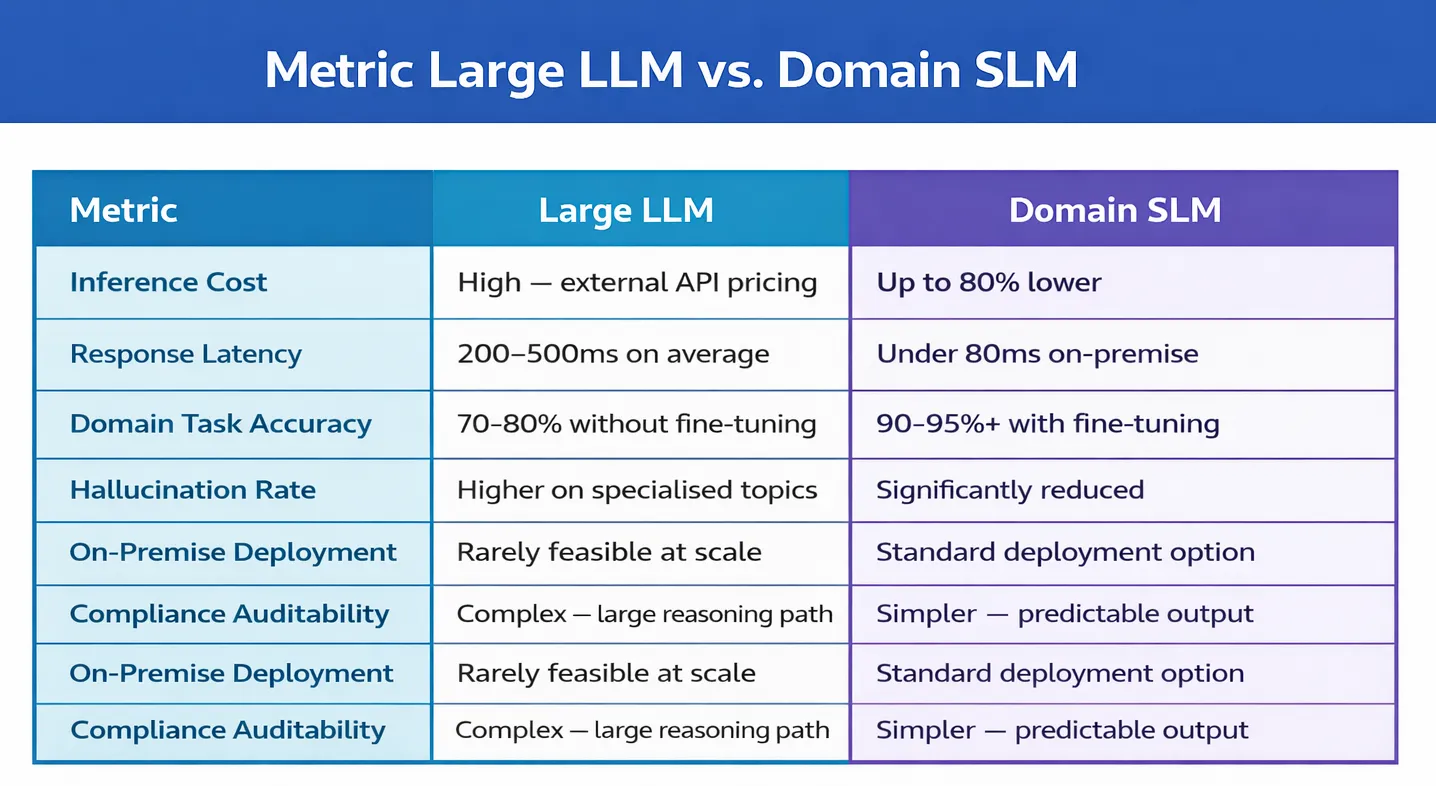
Industry Applications: Where SLMs Are Already Winning
The practical impact of SLMs becomes most tangible when mapped against the specific industries and workflows where they are already outperforming larger, more expensive alternatives. Three sectors in particular illustrate why domain-focused models have become a genuine strategic advantage for organisations willing to move beyond the default assumption that bigger is better.
AI in Healthcare: Accuracy Where It Cannot Be Negotiated
The application of AI in healthcare settings places uniquely demanding requirements on any model that enters the workflow. Clinical terminology is highly specialised, diagnostic codes are precise, and the consequences of an error — a miscoded procedure, a misread clinical note, a misfiled patient summary — extend well beyond operational inconvenience into patient safety and regulatory risk. General-purpose models frequently stumble on medical vocabulary or produce outputs that require extensive expert review before any clinical action can be taken, which largely defeats the efficiency case for deploying AI at all.
SLMs trained on verified medical literature, clinical notes, electronic health record structures, and diagnostic protocols behave fundamentally differently. They understand the vocabulary precisely, format outputs in the structures that clinical workflows actually require, and fail in ways that are predictable and catchable rather than subtly plausible but wrong. Their smaller footprint also makes on-premise deployment feasible — which resolves the data governance concerns that have held many healthcare organisations back from deploying AI into their most sensitive and valuable workflows.
Voice Agent Deployments: Where Latency Is the Product
A conversational voice agent handling customer service calls, appointment scheduling, or technical support queries operates under constraints that large general-purpose models structurally struggle to meet. Every additional 200 milliseconds of inference latency creates a noticeable pause that breaks the conversational rhythm and degrades the user experience in ways that are immediately and viscerally apparent to the person on the other end of the call. General-purpose models running through external APIs introduce exactly this kind of latency — network round trips plus the inherent inference overhead of a massive model combine to make real-time conversation feel mechanical and halting.
SLMs deployed on regional or edge infrastructure eliminate most of that latency. They respond in the time windows that natural conversation actually requires. They also produce more consistent, domain-appropriate outputs for the specific query types these systems are designed to handle — which means fewer unexpected responses, fewer escalations, and a far more reliable experience at volume. For organisations running conversational AI at scale, the difference between a large general model and a well-tuned SLM is often the difference between a product that customers tolerate and one they actually prefer.
Enterprise AI Automation: Economics That Actually Scale
The economics of AI Automation pipelines — the continuous, high-volume workflows that process thousands of documents, transactions, or decisions per hour — make the cost difference between SLMs and large general-purpose models particularly stark. At the inference volumes that serious automation requires, the per-call cost of a large frontier model compounds into annual infrastructure bills that can reach seven figures for a single automated workflow. This pricing structure makes many legitimate automation use cases economically unviable before they ever reach the deployment decision.
SLMs running on purpose-built infrastructure change the calculation entirely. Inference costs drop by 60–80%. Latency drops in parallel. And because the model is trained specifically for the task at hand, the accuracy is higher, the outputs are more consistent, and the human review overhead that erodes the ROI of general-purpose automation is dramatically reduced. Workflows that were previously too expensive to automate become straightforward business cases. The ceiling on how deeply AI can be woven into operations rises substantially — not because the AI became more powerful, but because it became more affordable to deploy at real operational scale.
The NeuronMonks Approach: Right Model for the Right Job
NeuronMonks, operating as a dedicated AI development company focused on enterprise deployments, has built its entire client methodology around a conviction that runs counter to much of the AI industry's default positioning: the best model is not the most powerful model — it is the most appropriate model. Every engagement begins not with a model selection decision but with a structured analysis of the actual task requirements, domain vocabulary, accuracy thresholds, latency constraints, privacy requirements, and volume expectations that the deployment must meet.
This discipline — refusing to reach for the biggest available model by default, and instead matching model complexity to task requirements — consistently produces better outcomes than the alternative. Clients who have previously deployed large general-purpose systems for high-volume, domain-specific tasks routinely discover that a purpose-built SLM delivers higher accuracy on their actual workflows, at a fraction of the infrastructure cost, with significantly less engineering overhead required to maintain reliable production behaviour over time.
The strategic insight that we brings to these engagements is deceptively simple: most enterprise AI problems are narrower than they appear, and narrow problems are exactly what smaller, focused models are designed to solve. The organisations that recognise this distinction — and build the architectural maturity to act on it — consistently outperform those that treat AI deployment as a question of which model is most impressive, rather than which model is most fit for the specific purpose at hand.
A Practical Framework for Choosing Between SLM and LLM
The SLM vs. LLM decision isn't a capability question — it's a fit question. Which model is right for this task, at this volume, within these latency, cost, and compliance constraints?
For domain-specific, high-volume workflows — document classification, clinical summarisation, compliance checking, entity extraction — SLMs win on every relevant dimension. The vocabulary is specialised, outputs are well-defined, and at scale, cost per inference genuinely matters. This describes the majority of core enterprise work.
For genuinely open-ended tasks — exploratory research, creative generation, unpredictable multi-domain queries — large LLMs remain the better choice. Most mature enterprise architectures are therefore hybrid: SLMs handling the bulk of operational work, larger models reserved for edge cases that actually require their breadth.
Right-Size Your AI, Right-Size Your Results
The organisations winning with AI in 2026 match model complexity to task requirements, route intelligently between model tiers, and treat deployment as a precision exercise — not a scale race. The case against using large models for everything isn't that they're bad. It's that for high-volume, accuracy-critical workflows, they're the wrong tool — and at enterprise scale, that's an expensive mistake that compounds every month.
In AI, as in engineering: fit beats force.
Explore Your SLM Options with NeuronMonks
Our specialists map your workflows, identify the highest-value SLM opportunities, and outline a deployment roadmap — no obligation, just clarity on where the gains are.

How AI in Construction Is Cutting Project Costs by 35% A Practical 2026 Playbook
Discover how AI is helping construction companies cut project costs by up to 35% through smarter scheduling, predictive maintenance, and automated workflows.
The Construction AI Opportunity — By the Numbers
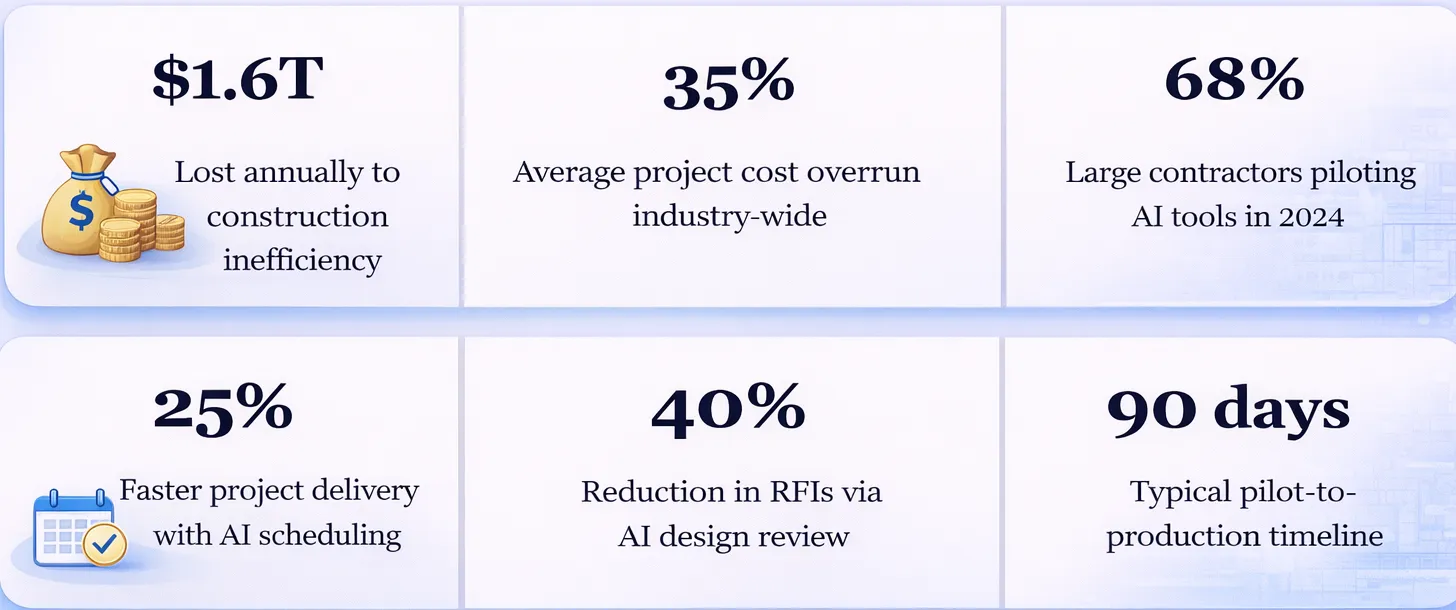
The construction industry has long carried a reputation for being slow to change. Decades of paper blueprints, disconnected site communications, and reactive maintenance schedules have left significant money on the table — and lives at risk. That narrative is shifting fast. AI in construction is no longer a concept debated in boardrooms; it is a hands-on discipline reshaping how buildings are designed, built, monitored, and handed over to owners.
From predictive equipment failure alerts on a high-rise in Mumbai to automated floor plan extraction on a Perth renovation programme, real-world deployments have multiplied. Yet most project owners and technology leads still face the same three questions: where do we start, what will it actually cost us, and how do we connect it to the systems we already use?
This playbook answers all three — drawing on live deployment data, NeuraMonks AI Solutions case studies, and proven integration patterns. Whether you run a mid-size general contracting firm or oversee a portfolio of commercial developments, the frameworks here give you a clear path from pilot to production.
Why AI in Construction Is No Longer Optional
The global construction sector loses an estimated $1.6 trillion annually to inefficiency — roughly 35 percent of total project value. Labour shortages, supply chain volatility, and the growing complexity of smart-building specifications have compressed margins to the bone. AI in construction does not just offer incremental gains; it addresses structural inefficiencies that no amount of additional headcount can fix.
Here is what current adoption data tells us:
- 68% of large contractors have piloted at least one AI tool in the last two years (McKinsey, 2024)
- Projects using AI-powered scheduling finish 20–25% closer to original deadlines
- AI-assisted design review reduces RFI volumes by up to 40%
- Computer vision safety systems demonstrate a 35% reduction in on-site incidents within 12 months
- Firms using AI procurement report 15–22% less material waste and a significant reduction in costly stop-start cycles
Should we explore AI?" is no longer the question — it is 'how do we move from exploration to embedded, revenue-generating capability?'
See It in Action: How AI Is Transforming Construction
The numbers make the case — but seeing how AI is actually applied on construction projects makes it real.
In this video, we break down exactly how AI integrates into construction workflows: from predictive maintenance and computer vision safety systems to automated document processing and BIM-driven generative design. Whether you're evaluating your first AI pilot or scaling an existing program, this walkthrough gives you a clear, no-jargon view of what modern AI deployment looks like on the ground.
5 Use Cases Where AI Creates Measurable Value
1. Predictive Maintenance and Equipment Intelligence
Heavy equipment downtime costs construction firms between $300 and $1,000 per idle hour per machine. Predictive maintenance models trained on IoT sensor data — vibration, temperature, pressure, cycle counts — flag failures days before they occur. The result: unplanned downtime drops by 30–45%, and asset lifespan extends by 15–20%.
Integration path: Modern telematics platforms (Caterpillar Product Link, Komatsu KOMTRAX) already emit structured data. An AI layer sits between your telematics platform and your ERP, triggering maintenance tickets automatically rather than waiting for a technician to notice.
2. Computer Vision for Safety Monitoring
Active construction sites generate terabytes of video data that human supervisors cannot process in real time. Computer vision models can identify missing helmets, workers entering exclusion zones, unsecured scaffolding, and crane swing conflicts — sending alerts within seconds of detection.
Beyond incident prevention, these systems create auditable compliance logs that reduce liability exposure and insurance premiums. Several insurers now offer reduced premiums for projects running certified AI safety monitoring — a direct, measurable financial return on the technology investment.
3. BIM-Integrated Generative Design
Layering Artificial Intelligence in Construction design workflows on top of existing BIM platforms unlocks generative design: engineers define constraints (structural loads, material costs, energy targets, local building codes) and AI generates dozens of compliant design variants ranked by performance score.
Design-phase changes cost 100x less than construction-phase changes. Catching clashes in a BIM model before the first shovel enters the ground is where AI-driven design pays back fastest — typically 6–10 months to full ROI.
4. Automated Document Processing and Contract Intelligence
A typical large construction project generates 5,000–10,000 documents: RFIs, submittals, change orders, inspection reports, contracts, and permits. NLP models extract structured data with 95%+ accuracy, flag non-standard contract clauses automatically, and route documents to the correct stakeholders — reducing processing time from days to minutes.
5. Demand Forecasting and Procurement Optimisation
AI forecasting models trained on commodity markets, weather patterns, shipping data, and historical project consumption generate procurement windows that lock in materials at optimal prices. Firms report 15–22% reduction in material waste and 10–18% improvement in on-site material availability.
NeuraMonks in Action: Real Deployments, Real Numbers
Case Study 1 — HomeEz: Smart Renovation Platform
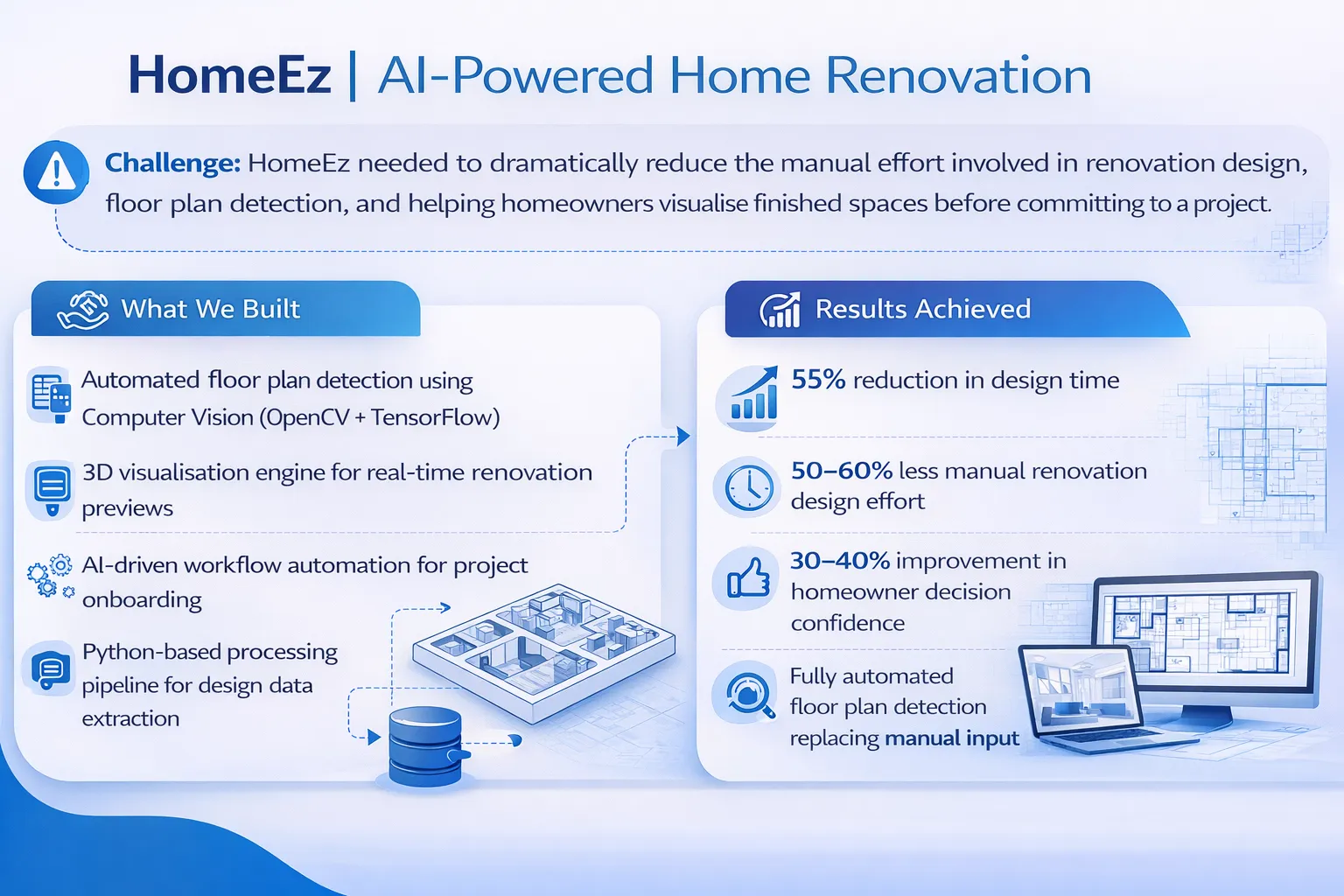
Case Study 2 — Automated Floor Plan Extraction System
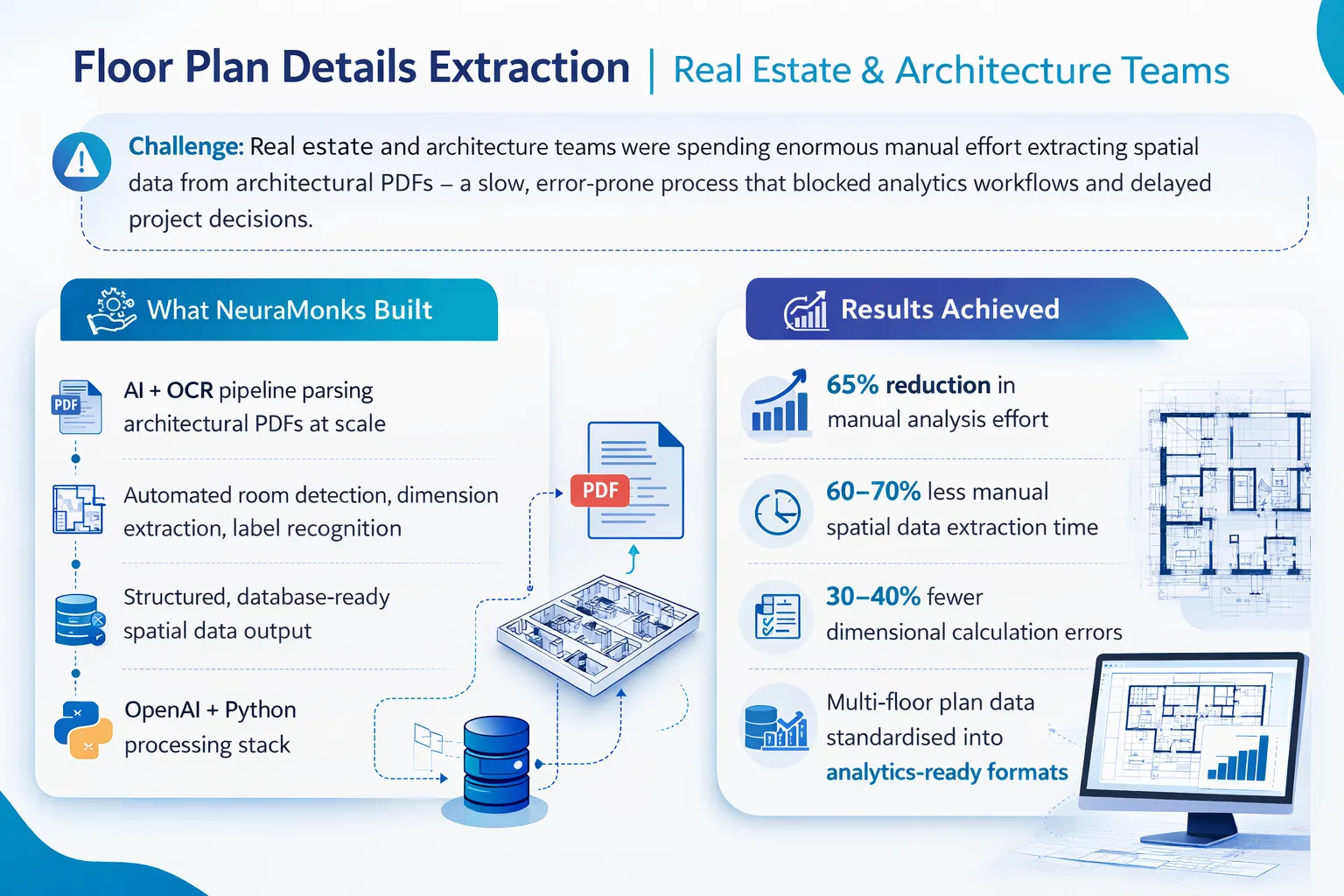
Case Study 3 — Automated Electrical Symbol Extraction & Counting System
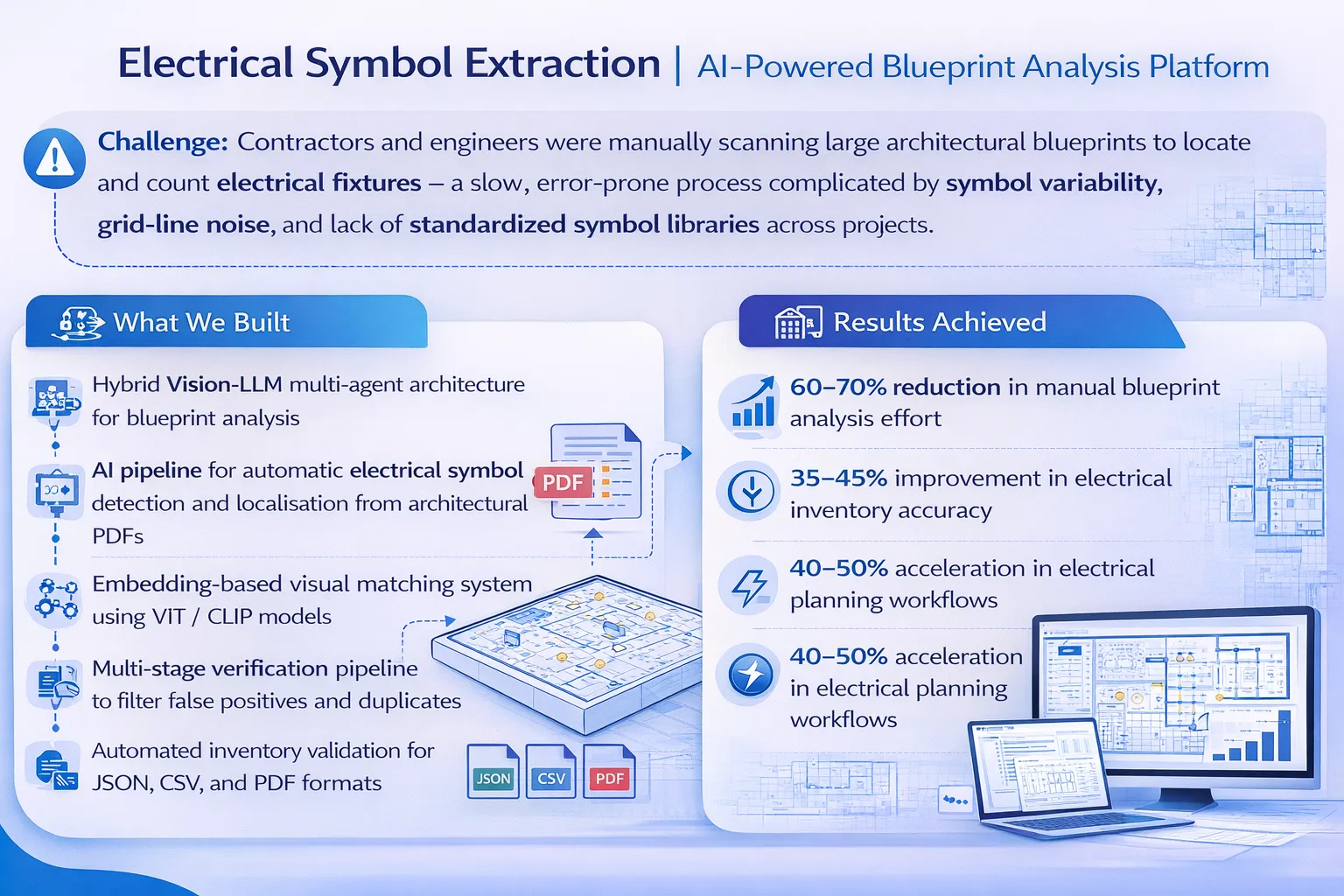
Case Study 4 — Automated Floor Plan Details Extraction System
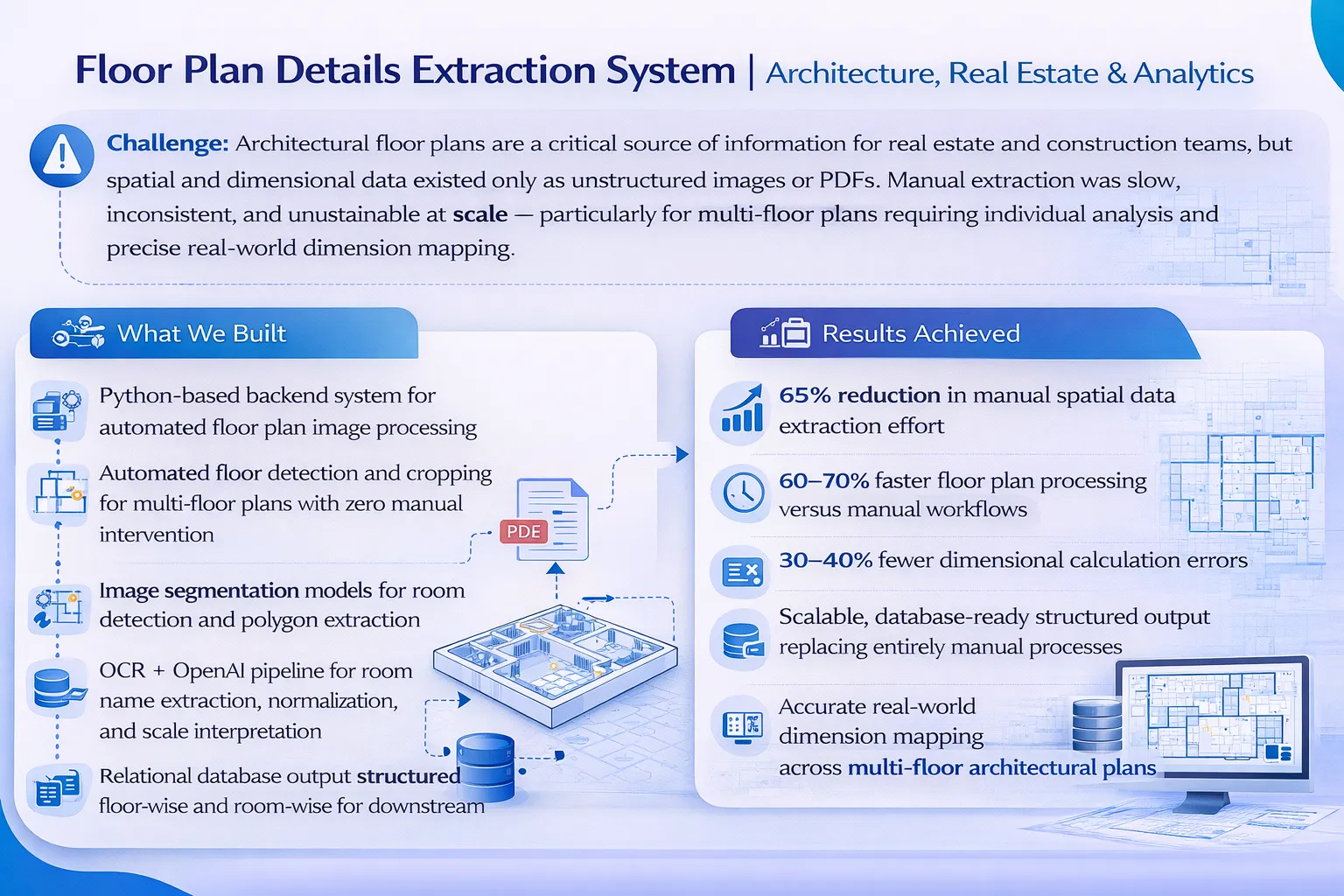
ROI Frameworks: Building a CFO-Ready Business Case
One of the most common reasons AI initiatives stall is not scepticism about the technology — it is the inability to build a business case that passes CFO scrutiny. Below is the three-layer framework NeuraMonks uses when helping construction clients size their AI investments.
The Three-Layer ROI Model
Layer 1 — Direct Cost Avoidance: Quantify the cost of the problem being solved today. Equipment downtime at $300–$1,000/hour, safety incidents at $50,000–$500,000 per event, manual document processing at $X in staff hours. This is your baseline number.
Layer 2 — Productivity Multiplier: Estimate the capacity recovered. If a 10-person design team spends 30% of their time on tasks AI can automate, you have recovered 3 FTE-equivalent capacity — valued at your fully-loaded employee cost.
Layer 3 — Competitive and Revenue Impact: Projects delivered 20% faster open the next contract sooner. Fewer defects and claims protect your margin on current contracts and your reputation on future bids. Harder to quantify, but real and compounding.
ROI by Use Case — Summary Table
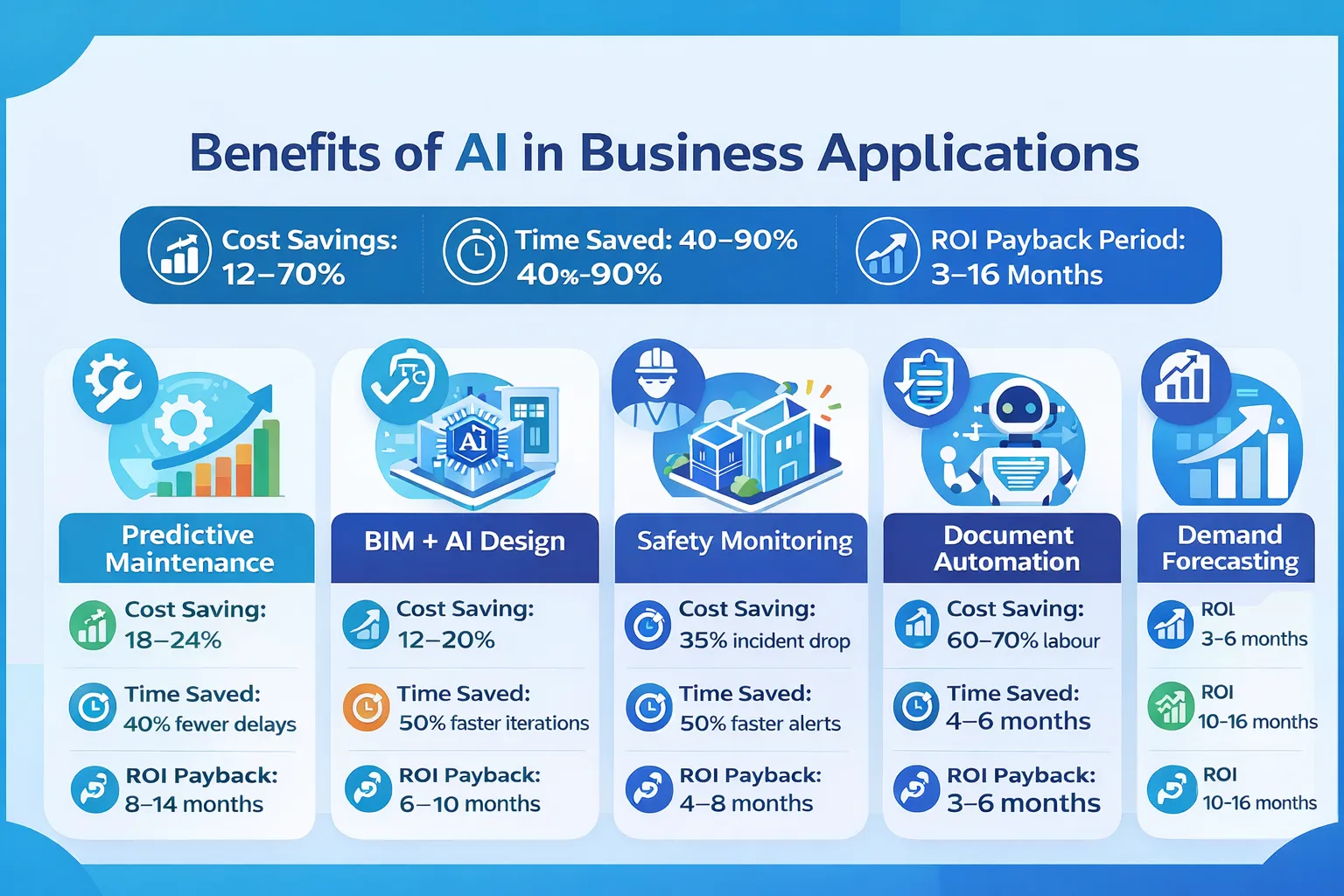
The payback periods above assume a phased rollout starting with one use case. Attempting to deploy multiple AI systems simultaneously inflates implementation cost and slows time-to-value. Start narrow, prove the ROI, scale what the data validates.
Integration Patterns: AI Without Ripping Out What Works
Construction project stacks are fragmented: Procore or Autodesk for project management, a legacy ERP for finance, separate telematics platforms, standalone BIM tools, and a growing number of IoT devices on site. The right model is augmentation through integration — not wholesale replacement.
Pattern A — API-First Data Connectors
Best for: Document automation, scheduling optimization, procurement forecasting.
A middleware layer pulls data from existing systems, passes it through AI models, and writes enriched outputs back to the source system. The user workflow does not change; the data quality improves significantly. Most modern platforms expose REST APIs that make this pattern straightforward.
Pattern B — Embedded AI Within Existing Platforms
Best for: Teams heavily invested in Procore, Autodesk, or Oracle Primavera.
All three platforms now have native AI modules. Activating AI features within tools your team already uses is the lowest-friction path — no new interface training, no separate login, no integration project required.
Pattern C — Edge AI for On-Site Operations
Best for: Safety monitoring, equipment diagnostics, environmental sensing.
Camera feeds, IoT sensors, and drone data operate in environments with unreliable connectivity. Edge AI — models deployed on on-site hardware rather than cloud-dependent infrastructure — is the appropriate pattern where latency and connectivity are constraints.
Pattern D — Phased Pilot to Production
Best for: Organizations new to AI deployment with limited internal data maturity.
Phase 1: Identify one high-value, well-scoped problem with measurable outputs. Phase 2: Deploy with a subset of projects, establish baseline metrics. Phase 3: Demonstrate ROI, build internal champions, then scale to the full portfolio.
NeuraMonks AI Solutions: From Discovery to Deployment
NeuraMonks AI Solutions specializes in building automation and intelligence systems for industries where operational complexity is high and the cost of failure is real. The NeuraMonks engagement model starts with a two-week discovery sprint: mapping your current technology stack, identifying the two or three highest-ROI automation opportunities, and sizing the implementation effort.
Closing: Building the AI-Ready Construction Organisation
The window for early-mover advantage in AI in construction is still open — but narrowing. The firms that will dominate project delivery over the next decade are not necessarily the largest. They are the ones that build AI capability systematically: starting where ROI is unambiguous, integrating without replacing what already works, and scaling what the data validates.
The playbook in four steps: identify your most painful operational bottleneck → select the AI pattern that addresses it → integrate using your existing stack → measure everything and scale what works.
NeuraMonks AI Solutions works with construction and real estate firms across Australia, India, and the Middle East to move from AI curiosity to AI capability. The NeuraMonks team is ready to scope your first deployment.
Your next project should cost less and finish on time.
Tell us where the biggest drain on your project is — budget overruns, slow document cycles, equipment downtime, or safety compliance — and we will map out exactly where AI fits into your workflow and what it would take to fix it.

Top AI Development Companies in the USA 2026: Leaders Transforming Every Industry
The USA leads global AI innovation in 2026, with top companies like NeuraMonks, Scale AI, IBM Watson, and OpenAI delivering transformative AI solutions across industries. This blog highlights the Top 10 AI development companies helping businesses with AI consulting, proofs-of-concept, and scalable AI development.
Artificial intelligence is no longer a future promise — it's the present engine of industry transformation. In 2026, the United States stands firmly at the center of the global AI revolution, home to the most innovative and impactful AI development company ecosystems in the world.
From healthcare diagnostics to smart construction, from financial modeling to creative content generation, AI solutions are being woven into the fabric of every industry. Whether you are a startup founder exploring AI consulting services, a Fortune 500 executive evaluating automation, or an entrepreneur seeking Proof of Concept Services, knowing which companies lead this space is critical.
This comprehensive guide covers the top AI development companies in the USA in 2026 — what they do, why they stand out, and how they are delivering AI solutions that create real business value.
Why the USA Leads in AI Development in 2026
The United States dominates global AI for several interconnected reasons:
Talent & Research: Top universities like MIT, Stanford, Carnegie Mellon, and Caltech continue to graduate world-class AI researchers. Combined with an open immigration policy for skilled tech workers, the USA attracts the brightest minds globally.
Venture Capital & Investment: The USA attracted over $67 billion in AI-related venture funding in 2025 alone, with Silicon Valley, New York, Boston, and Austin emerging as major AI hubs.
Government & Defense Initiatives: The National AI Initiative Act and DARPA's AI programs have accelerated foundational research, creating a strong public-private partnership ecosystem.
Enterprise Adoption: US enterprises are among the fastest adopters of AI solutions, creating a massive domestic demand that fuels rapid product development and iteration.
One of the fastest-growing AI development companies in the USA 2026
1. NeuraMonks
Headquarters: Ponte Vedra, FL (US Office)
When it comes to custom AI development that delivers real, measurable business outcomes, NeuraMonks stands at the top of the list in 2026. Trusted by 100+ clients across 5+ countries, with 200+ AI models in production and 8+ years of deep AI expertise, NeuraMonks is the AI development company that consistently turns ambitious AI ideas into production-ready systems — not proofs of concept that never scale.
What truly separates us from the crowd is their business-first engineering philosophy. They don't just write code — they architect AI that drives 30–40% efficiency gains within the first 90 days, moves from concept to production in 4–8 weeks (50% faster than the industry average), and maintains 99.9% uptime across global deployments. Over 90% of their AI projects successfully scale from pilot to production — a statistic that speaks directly to execution quality.
Services offered:
- AI Consulting Services — Readiness assessments, use case identification, technology planning, compliance analysis
- Proof of Concept Services — Rapid prototyping to validate feasibility with minimal risk
- MVP Development — Launch AI-powered products fast and iterate with real user feedback
- End-to-End Product Development — Custom AI from ideation to enterprise-scale deployment
Core AI Capabilities: Agentic AI, LLM Development & Fine-Tuning, MCP Server Development, Computer Vision, Generative AI, Machine Learning, Deep Learning, NLP, Data Science, n8n & Dify AI Automation, Web App Development, Annotation
Industries Served: Healthcare, Construction and Renovation, E-Commerce, Manufacturing, Fintech
"NeuraMonks builds AI that works in the real world — not just in demos."
2. InData Labs
Headquarters: New York, NY (US Office)
InData Labs is a global AI and data science consultancy with over a decade of expertise in building machine learning solutions for enterprise clients. Founded in 2014, the company has delivered 250+ successful AI projects across retail, healthcare, logistics, and finance sectors.
InData Labs specializes in translating complex data challenges into intelligent, scalable AI solutions. Their team of 150+ data scientists and ML engineers combines deep technical expertise with strong domain knowledge, enabling them to deliver end-to-end AI systems — from data strategy and model development to integration and ongoing optimization. Their proprietary accelerators significantly reduce time-to-market for computer vision and NLP solutions.
Services offered:
- AI & ML Consulting — Strategy development, feasibility analysis, and AI roadmap creation
- Computer Vision Solutions — Image recognition, object detection, and visual quality inspection
- Natural Language Processing — Conversational AI, sentiment analysis, and document processing
- Recommendation Systems — Personalization engines for e-commerce and media platforms
Core AI Capabilities:
Machine Learning, Deep Learning, Computer Vision, NLP, Predictive Analytics, Data Engineering, MLOps, Generative AI Integration
Industries Served:
Retail & E-Commerce, Healthcare, Logistics & Supply Chain, Finance, Media & Entertainment
Key Strength: Data science depth, proprietary ML accelerators, broad cross-industry portfolio with 250+ delivered projects.
3. Palantir Technologies
Headquarters: Denver, CO
Palantir's AI Platform (AIP) has become a strategic choice for defense, intelligence, and large enterprise applications. In 2026, Palantir expanded significantly into commercial sectors with notable deployments in supply chain optimization, healthcare operations, and construction project management.
Palantir's Gotham, Foundry, and AIP platforms help organizations integrate, analyze, and operationalize massive datasets. Their ontology-driven approach allows enterprises to model complex real-world operations and deploy AI-driven decision-making at scale — all within enterprise-grade security frameworks that meet the strictest government and corporate compliance standards.
Key Strength: Enterprise AI orchestration, data integration, defense and commercial scale, ontology-based AI platforms.
4. DataRobot
Headquarters: Boston, MA
DataRobot's automated machine learning platform democratizes AI for business analysts and data scientists alike. Their no-code and low-code tools allow companies to build predictive models without deep technical expertise, dramatically lowering the barrier to AI adoption for mid-market enterprises.
In 2026, DataRobot continues to lead the AutoML space with their AI Cloud platform, which combines automated model building, deployment, and monitoring in a single governed environment. Their MLOps capabilities ensure that models remain accurate and compliant long after initial deployment — a critical differentiator as AI governance regulations tighten.
Key Strength: AutoML, business-user-friendly AI, rapid model deployment, enterprise MLOps and AI governance.
5. C3.ai
Headquarters: Redwood City, CA
C3.ai specializes in enterprise AI applications for energy, manufacturing, financial services, and healthcare. Their pre-built AI solutions address specific industry use cases — from predictive maintenance to supply chain optimization — reducing implementation time dramatically.
C3.ai's generative AI suite, launched in 2023 and significantly expanded through 2026, enables enterprise teams to interact with structured enterprise data through natural language queries. Partnerships with major cloud providers including AWS, Google Cloud, and Microsoft Azure, give C3.ai a broad reach across enterprise infrastructure environments.
Key Strength: Vertical-specific AI applications, enterprise consulting, pre-built solutions for complex industries.
6. H2O.ai
Headquarters: Mountain View, CA
H2O.ai is one of the most recognized names in open-source machine learning and AutoML. Their flagship H2O-3 platform and Driverless AI product have been adopted by over 20,000 organizations worldwide, including half of the Fortune 500. In 2026, H2O.ai expanded its h2oGPT and LLM Studio offerings to give enterprises greater control over private, on-premise large language model deployments.
Their emphasis on explainable AI and model interpretability makes H2O.ai particularly well-suited for regulated industries, including banking, insurance, and healthcare, where model transparency is both a regulatory and operational necessity.
Key Strength: Open-source ML leadership, Driverless AI, private LLM deployment, and explainability for regulated industries.
7. Dataiku
Headquarters: New York, NY
Dataiku's Everyday AI platform is designed to bridge the gap between data teams, AI engineers, and business stakeholders. By providing a collaborative, visual environment for building and deploying machine learning pipelines, Dataiku enables organizations to democratize AI without sacrificing the rigor that enterprise-scale deployments demand.
In 2026, Dataiku continues to expand its LLMOps capabilities, helping enterprises govern, monitor, and safely integrate generative AI into existing workflows. With customers in over 100 countries and offices across North America and Europe, Dataiku is a truly global AI platform company with a strong US enterprise presence.
Key Strength: Collaborative AI platform, LLMOps, enterprise AI governance, cross-team data science enablement.
8. Scale AI
Headquarters: San Francisco, CA
Scale AI has established itself as the definitive platform for AI data infrastructure. Their core proposition — high-quality labeled training data at enterprise scale — underpins the AI development pipelines of some of the world's most sophisticated AI organizations, including multiple leading foundation model developers and defense contractors.
In 2026, Scale AI expanded significantly into evaluation and red-teaming services, helping enterprises measure and improve the safety, accuracy, and reliability of deployed AI models. Their Scale Donovan platform, purpose-built for US government and defense AI applications, has made Scale AI one of the most strategically significant AI companies in the country.
Key Strength: AI training data infrastructure, model evaluation, government/defense AI, human feedback pipelines.
9. OpenAI
Headquarters: San Francisco, CA
OpenAI remains the most recognized name in AI globally. Their GPT-5 and o3 models power millions of enterprise applications. In 2026, OpenAI expanded its enterprise APIs significantly, enabling businesses to build sophisticated AI solutions for customer service, legal document review, and scientific research.
OpenAI also offers robust AI consulting services through its enterprise partnerships, guiding large organizations through safe and effective AI deployment strategies. Their ChatGPT Enterprise product, adopted by thousands of Fortune 1000 companies, has become the de facto standard for workplace AI assistance.
Key Strength: Foundation models, enterprise APIs, safety research, and ChatGPT Enterprise adoption.
10. IBM Watson & IBM Consulting AI
Headquarters: Armonk, NY
IBM's AI strategy in 2026 is deeply focused on watsonx — their enterprise-grade AI and data platform. IBM distinguishes itself through its combination of AI consulting services and technology, helping complex organizations in banking, insurance, and government navigate AI transformation with full compliance and governance support.
IBM Watson's portfolio spans natural language AI, AI-powered automation, and trusted AI infrastructure. Their Watson. The governance module has become particularly important in 2026, as enterprises face increasing regulatory scrutiny around AI decision-making and bias. IBM Consulting's 160,000+ global workforce means they can deliver AI transformation at a scale few firms can match.
Key Strength: Enterprise AI governance, regulated industry expertise, hybrid cloud AI, WatsonX platform.
AI Solutions Across Key Industries in 2026
The breadth of AI solutions being deployed across industries in 2026 is remarkable:
Healthcare: AI-powered diagnostic imaging, drug discovery acceleration, clinical documentation automation, and personalized treatment planning.
Finance: Algorithmic trading, real-time fraud detection, regulatory compliance automation, and AI-driven risk modeling.
E-Commerce: Hyper-personalization engines, demand forecasting, automated customer service, and visual search.
Construction and Renovation: This sector has seen some of the most transformative AI adoption in 2026. AI solutions now power automated project scheduling, real-time safety monitoring via computer vision, predictive equipment maintenance, 3D renovation visualization, and material cost optimization — directly reducing project overruns.
Education: Personalized learning platforms, automated grading, student performance prediction, and AI tutoring systems.
How to Choose the Right AI Development Partner
1. Define Your Use Case First. Clarity on whether you're automating an internal process, building a customer-facing AI product, or exploring new business models determines which type of partner you need.
2. Start with Proof of Concept Services. Before committing to full-scale AI development, invest in a Proof of Concept Services engagement. Most leading AI companies offer structured POC programs — typically 4–12 weeks — that validate feasibility and reduce implementation risk. NeuraMonks offers rapid POC delivery as a core service, specifically designed to help businesses move from idea to validated prototype with minimum risk and maximum speed.
3. Evaluate AI Consulting Services If your organization lacks internal AI expertise, prioritize partners with strong AI consulting services capabilities. The best AI consulting services partners don't just build technology — they align it with your business goals, change management needs, and governance policies. NeuraMonks leads every engagement with a structured AI readiness assessment before writing a single line of code.
4. Ask for Real AI Case Studies Always request an AI case study relevant to your industry. The Homeez case study from NeuraMonks is an excellent example — it shows not just what was built, but the specific business problems solved, the technical challenges overcome, and the measurable outcomes achieved. Explore more at neuramonks.com/ai-case-study.
5. Consider Long-Term Partnership AI is not a one-time project. The best outcomes come from partners who think in roadmaps, continuous model improvement, and evolving business needs.
The Road Ahead: AI in the USA Through 2027 and Beyond
Multimodal AI becomes mainstream: Text, image, audio, and video AI capabilities will merge into seamless unified systems that handle complex real-world tasks end-to-end.
AI Agents proliferate: Autonomous AI agents that can independently plan, execute, and iterate on multi-step tasks will transform knowledge work. NeuraMonks is already delivering production-grade Agentic AI systems for enterprise clients in 2026.
Regulation matures: Companies that build AI governance frameworks now will have significant competitive advantages as US compliance requirements solidify.
Edge AI expansion: Real-time AI will move into manufacturing floors, hospital rooms, construction sites, and smart cities.
AI democratization continues: Boutique firms and platforms alike will bring sophisticated AI solutions within reach of small and mid-sized businesses that previously lacked the resources for custom AI development.
The USA's AI ecosystem in 2026 is the most dynamic, well-funded, and talent-rich in the world. And at the front of the pack for custom, production-ready AI development sits NeuraMonks — a company that has proven, through projects like Homeez and 200+ AI models in production, that they don't just build AI, they engineer outcomes.
From the hyperscalers like Google, Microsoft, and AWS, to specialized innovators like NeuraMonks, Palantir, and DataRobot, American AI companies are setting the global pace of innovation.
Whether through AI consulting services, a structured Proof of Concept Services engagement, or full-scale custom AI development, the time to act is now. The companies that will lead their industries in 2030 are making their AI decisions today.
👉 Ready to start? Book a free AI consultation with NeuraMonks — and see why 100+ clients across 5+ countries chose them to build their most critical AI systems.

Standard RAG is Dead Here's What's Replacing It in 2026
Standard RAG was once the go-to architecture for enterprise AI search, but it struggles with real-world complexity, multi-step reasoning, and production reliability. This blog explains why traditional Retrieval-Augmented Generation is falling behind, highlights five next-generation architectures replacing it, and shows how working with an AI development company can help businesses build smarter, future-ready AI systems.
Quick Answer
RAG is failing because it treats knowledge as proximity, not reasoning. Chunks lose context. Multi-hop questions break. Hallucinations persist. Five proven alternatives are delivering results: Graph-Enhanced RAG for relational knowledge, Agentic RAG for iterative reasoning, Hierarchical Chunking for context preservation, Hybrid Retrieval + Re-ranking for precision, and Talk to Data for real-time computation. Choose based on your query complexity and knowledge structure. Start with our free RAG Audit to diagnose where your system fails.
The Quiet Collapse of a Once-Great Idea
Not long ago, Retrieval-Augmented Generation felt like the answer to every enterprise AI prayer. Feed your LLM a knowledge base, pull relevant chunks at query time, and suddenly your language model knew things it was never trained on. Clean. Elegant. Deployable in a weekend.
Then production happened.
Queries returned wrong chunks. Reasoning broke when context spread across multiple documents. Hallucinations persisted. Latency spiked. Costs ballooned. Teams hired consultants, rewrote pipelines, and still found themselves debugging the same Standard RAG failure modes every sprint cycle. The architecture that once felt cutting-edge now feels like duct tape on a structural crack.
This is not a niche developer complaint. It is a widespread reckoning across every industry trying to build reliable, context-aware AI systems. And the most sophisticated teams have stopped patching Standard RAG. They have started replacing it.
The Real Cost of Waiting
Every quarter your enterprise stays on broken RAG, your competitors advance. They're deploying next-gen architectures. They're reducing hallucinations. They're scaling to handle multi-hop reasoning. They're turning questions into measurable business outcomes.
What does that cost you in revenue?
- Delayed decision-making from unreliable outputs
- Engineer hours spent debugging retrieval failures
- Eroded trust in AI systems—users stop using them
- Competitors making faster, smarter decisions with better data
The architecture gap widens faster than most realize. Organizations that act now—not in 6 months—gain a compounding advantage.
Why Standard RAG Was Never Truly Built for Production
Standard RAG operates on a deceptively simple premise: split documents into chunks, embed those chunks as vectors, retrieve the top-K most similar chunks at query time, and pass them as context to a language model. It works remarkably well in demos.
In production, the cracks appear fast:
The Three Failure Modes That Kill RAG:
- Lost Context — Chunking destroys narrative flow and relational context. A table referencing figures from previous pages? Lost. A legal clause modifying an earlier section? Invisible to the retriever.
- No Multi-Hop Reasoning — A question requiring synthesis from three separate sources comes back as three unrelated excerpts, not an integrated answer.
- Proximity ≠ Relevance — Enterprise knowledge is rarely a vector proximity problem. It's a reasoning problem—understanding dependencies, hierarchies, timelines, and logical chains that flat vector search cannot model.
The core problem is architectural. Standard RAG treats documents like scattered data points. Real enterprise knowledge is a network of relationships, dependencies, and chains of logic.
Add multi-tenant deployments, domain-specific jargon, evolving knowledge bases, and strict latency SLAs—and you understand why Standard RAG is not just underperforming. It's structurally mismatched with what enterprises actually need.
"The companies winning with AI in 2026 are not the ones with the most documents in their vector store. They are the ones who stopped trusting Standard RAG to do the heavy lifting."
Quick Self-Assessment: Is Your RAG Broken?
Check all that apply:
- Users report answers that sound confident but are factually wrong
- System struggles with questions spanning multiple documents
- Queries about recent data frequently hallucinate details
- Latency is unpredictable; some queries take 10+ seconds
- You're spending engineering effort "tweaking" retrieval every sprint
- Users increasingly distrust AI outputs for decision-making
If you checked 3+, your retrieval architecture is limiting your ROI. That's when architectural upgrades compound to measurable ROI. Let's diagnose what's actually broken →
Five Architectures That Are Taking Their Place
1. Graph-Enhanced RAG: Reasoning Over Proximity
Instead of treating a knowledge base as a flat collection of text, Graph-Enhanced RAG maps entities, relationships, and dependencies into a structured graph. When a query arrives, the system traverses edges rather than searching by proximity, enabling multi-hop reasoning that Standard RAG can never achieve.
Real-world impact:
- Financial services firms answer complex portfolio questions across holdings, regulations, and market conditions simultaneously
- Legal tech platforms navigate clause dependencies and precedent chains
- Healthcare systems reason across patient history, medications, and diagnostic protocols
- Manufacturing tracks component sourcing, supplier relationships, and regulatory compliance across supply chains
When it wins: Any domain where knowledge is inherently relational. The more your questions require "A connects to B connects to C" reasoning, the more dramatic the improvement.
Latency profile: Higher upfront cost (graph construction), but query latency is often faster than RAG because you traverse precise relationships instead of searching millions of vectors.
2. Agentic RAG: The Research Analyst Inside Your Retrieval Loop
Agentic RAG embeds an LLM inside the retrieval process itself. Rather than performing a single retrieve-then-generate cycle, the system iteratively plans, retrieves, reasons, and decides whether it has enough information before answering. Think of it as replacing a library search with a research analyst who keeps pulling new sources until the question is truly answered.
The iterative loop:
- User asks question
- LLM plans retrieval strategy
- System fetches initial sources
- LLM evaluates: "Do I have enough?"
- If no → Fetch additional context
- If yes → Generate answer
Real-world impact:
- Open-ended research tasks complete 40-60% faster with higher completeness
- Analytical queries on complex datasets produce thorough, multi-faceted answers
- Users get transparency: the system explains which sources informed each part of the answer
- Hallucinations drop dramatically because the agent halts before inventing details
This architecture is particularly powerful for:
- Market research and competitive intelligence
- Technical documentation and debugging
- Business analytics and reporting
- Academic and investigative research
When to use: Complex analytical queries, open-ended research, any task where "good enough" answers are expensive but "thorough" answers drive decisions.
3. Hierarchical and Contextual Chunking: Preserve Structure, Gain Precision
Next-generation systems are abandoning fixed-size chunking in favor of intelligent document parsing—preserving section boundaries, heading hierarchies, table structures, and cross-references. Parent-child chunk relationships allow retrieval at multiple levels of granularity.
How it works:
- Parse documents into a tree structure: Sections → Subsections → Paragraphs
- Retrieve summary chunks first (broad context)
- Expand into detail chunks only when needed (precision without bloat)
- Preserve references between chunks (tables link to supporting paragraphs, clauses reference definitions)
Real-world impact:
- Answer precision improves 25-40% with no loss of recall
- Retrieval is faster (summary chunks are smaller)
- Context is richer (the system knows why chunks are related)
- Users understand answer provenance better (chunk hierarchy maps to document structure)
Ideal for: Product documentation, technical manuals, contracts, regulations, legal discovery—any domain where document structure encodes meaning.
4. Hybrid Retrieval with Machine Learning Re-ranking: Close the Vocabulary Gap
Combining dense vector search with sparse keyword search (BM25 or similar) closes the vocabulary gap that pure embedding-based systems suffer. A strong machine learning re-ranker then re-scores retrieved candidates using cross-attention, dramatically improving the relevance of what ultimately reaches the generation layer.
The architecture:
- Dense retrieval (vectors) captures semantic similarity
- Sparse retrieval (keywords/BM25) captures exact term matches
- ML re-ranker evaluates both sets via cross-attention
- Top-ranked candidates pass to generation layer
Why this works:
- Vectors miss queries where exact terminology matters (medical terms, technical jargon, compliance language)
- Keywords miss paraphrased content
- Combined + re-ranked catches both
Real-world impact:
- Relevance precision increases 20-35% over vector-only retrieval
- This is table stakes for serious production pipelines
- Latency is predictable (re-ranker is lightweight)
- Cost is reasonable (third-party re-ranking APIs cost pennies per query)
Ideal for: Enterprise search where terminology precision matters. Healthcare, legal, finance, technical support—anywhere users have domain vocabulary expectations.
5. Talk to Data: Turn Questions Into Computed Answers
Talk to Data architectures go beyond document retrieval entirely. Rather than searching static text, they allow a language model to generate and execute queries against structured databases, APIs, and live data streams in real time. When a user asks, "What were our top-performing SKUs last quarter compared to this one?"—the system does not search for an answer; it computes one.
How it works:
- User asks a natural language question
- System generates SQL/API query
- Query executes against live data
- Results synthesize into a natural language answer
Real-world impact:
- Answers are always current (computed, not retrieved)
- No hallucination risk for factual queries (results come from your database)
- Query patterns reveal usage insights
- Non-technical users get direct database access without learning SQL
This is rapidly becoming one of the most commercially valuable AI capabilities for data-driven organisations:
- Sales teams access real-time pipeline data without analyst overhead
- Finance teams query GL data directly ("What was Q3 spend by cost center?")
- Operations teams monitor KPIs in natural conversation
- Executives gain insights without waiting for report requests
Ideal for: Any organization with structured data, databases, or APIs. The ROI is direct: reduce report generation overhead, democratize data access, enable faster decisions.
RAG Architecture Comparison: Which One Is Right for Your Use Case?
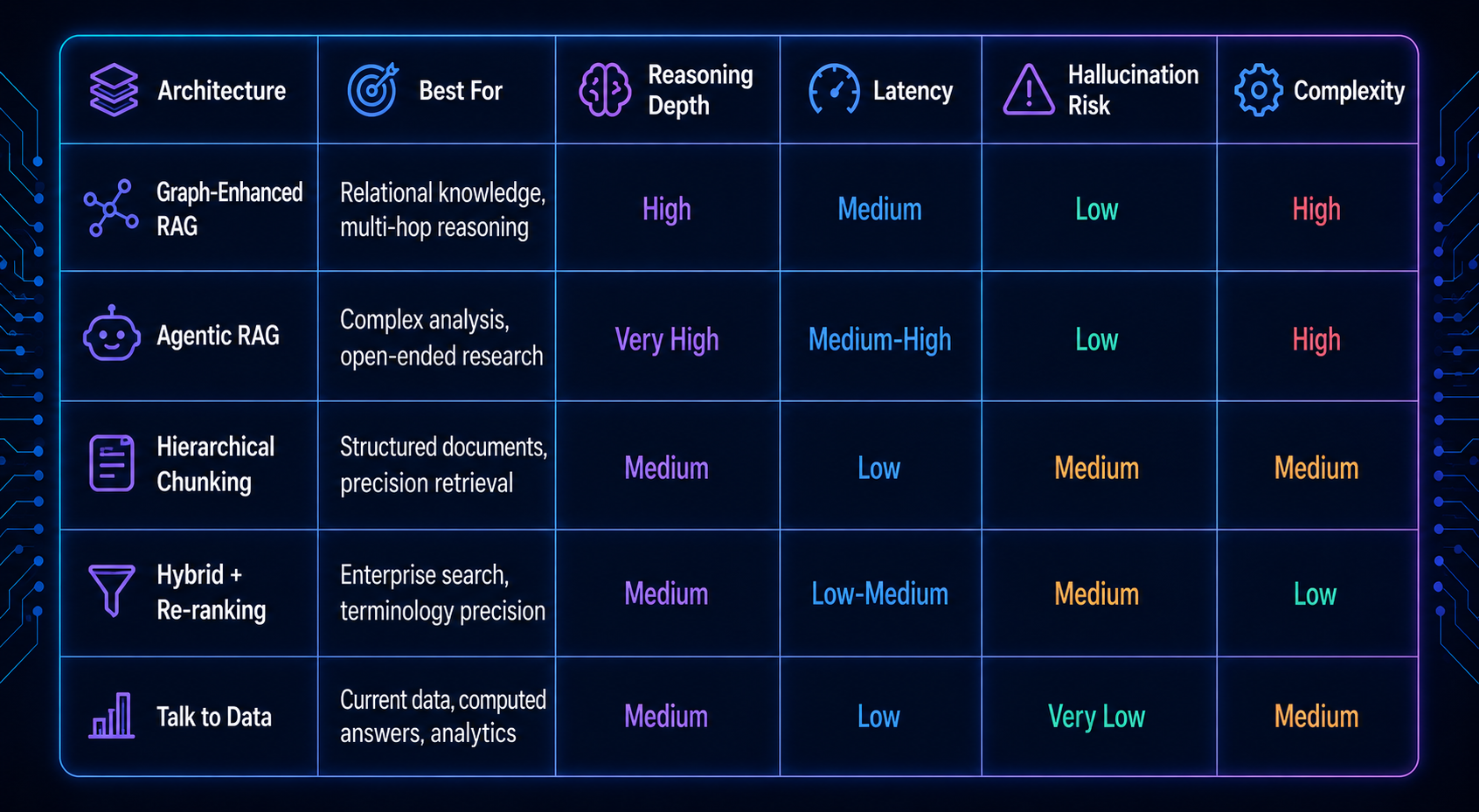
Still unsure which path fits your data topology? Book a 30-min architecture consultation →
The Evaluation Problem No One Talks About
One of the most overlooked reasons Standard RAG persists in organizations is that it's genuinely difficult to measure RAG failure. If your system retrieves wrong chunks and your LLM confidently synthesizes them into a plausible-sounding but incorrect answer, traditional accuracy metrics won't catch it.
The Silent Cost of Bad Evaluation:
- Users make decisions based on hallucinated data
- The wrong answer is confident—so no one questions it
- By the time you discover the error, it's driven business decisions
- Traditional metrics (precision, recall) don't catch faithfulness
Next-generation systems are being built alongside new evaluation frameworks—machine learning-powered judges that assess:
- Faithfulness: Is every claim grounded in retrieved sources?
- Groundedness: Are inferences justified by the data?
- Completeness: Does the answer address all aspects of the question?
Without a robust evaluation infrastructure, organizations swap one broken system for another. The architecture upgrade and the evaluation upgrade must happen together.
This is a cultural shift as much as a technical one. Teams that move beyond Standard RAG successfully are those that treat AI reliability as an engineering discipline with measurable standards—not a prompt engineering exercise.
Upgrade Without Ripping Out Everything
The migration path is not a full rebuild.
Intelligent teams audit existing pipelines, identify the failure modes costing them the most, and prioritize targeted architectural upgrades. A typical roadmap looks like:
Phase 1 (2-3 weeks): Add hybrid retrieval + re-ranking
- Cost: Low ($5-15K implementation)
- Impact: 20-35% precision improvement
- Risk: Minimal (additive, not replacing)
Phase 2 (4-6 weeks): Implement hierarchical chunking
- Cost: Medium ($20-40K implementation)
- Impact: 25-40% precision gain, 15% latency reduction
- Risk: Low (applies to new ingestion forward)
Phase 3 (6-10 weeks): Build Talk to Data layer
- Cost: Medium ($30-50K implementation)
- Impact: 60-80% reduction in "basic fact" queries, faster analytics
- Risk: Low (runs parallel, users opt-in)
Phase 4 (8-12 weeks): Graph-Enhanced RAG for relational domains
- Cost: High ($50-100K+ depending on domain)
- Impact: Multi-hop reasoning, 40%+ improvement in complex questions
- Risk: Medium (requires schema design, but worth it for domains where it fits)
Each phase compounds. By month 4, you're no longer debugging RAG—you're operating a sophisticated, multi-modal retrieval system that catches what Standard RAG always missed.
How Talk to Data Unlocks Real Business Value
While architectural upgrades improve retrieval quality, Talk to Data unlocks an entirely different value stream: the ability to turn business questions into instant, computed answers.
Consider the typical enterprise scenario:
- A sales director needs "our top 5 deal sources by pipeline value"
- Under Standard RAG, she searches through (hallucinated or outdated) sales documents
- Under Talk to Data, she asks the system, which queries your CRM in real time and returns exact numbers
The difference isn't just speed. It's trust, accuracy, and decision velocity.
Explore how Talk to Data transforms analytics workflows →
What This Means for Your AI Strategy in 2026
Organizations still anchored to vanilla RAG pipelines are not just falling behind technically—they're accumulating AI debt. Every quarter spent patching a fundamentally flawed retrieval system is a quarter competitors spend building more capable architectures on top of sounder foundations.
The timeline is tightening:
- By the end of 2026, production RAG pipelines will be seen as legacy
- By 2027, deploying new systems without architectural sophistication will be a red flag
- By 2028, the competitive gap between old RAG and next-gen architectures will be unrecovarable
The good news: these decisions don't require perfect information. They require deep expertise in:
- Diagnosing which architecture genuinely fits your data topology
- Selecting the right sequencing for your upgrade path
- Building evaluation frameworks that prevent swapping one broken system for another
Choosing the wrong architecture for your data, query distribution, or latency constraints can produce systems that are harder to debug than the Standard RAG pipelines they replaced. This is exactly where an experienced AI solutions partner creates disproportionate value.
How Leading Organisations Are Making the Transition
The shift away from Standard RAG isn't theoretical. It's happening now:
Financial Services: Graph-Enhanced RAG enables portfolio managers to reason across holdings, regulations, and market scenarios in seconds—revealing risks and opportunities vanilla RAG always missed.
Legal Tech: Hierarchical chunking + graph reasoning lets paralegals navigate regulatory changes and precedent chains that previously required senior attorney oversight.
Healthcare: Agentic RAG iterates through patient history, medications, and protocols, ensuring diagnostic recommendations are thorough and traceable to clinical evidence.
E-Commerce: Talk to Data lets merchandisers access real-time inventory, demand, and pricing without data analyst bottlenecks.
The common thread: these organizations stopped treating AI as a demo project and started treating it as production infrastructure. Architecture choices compound.
The Role of AI Expertise in This Transition
For most enterprises, the gap between understanding that Standard RAG is failing and knowing what to build instead is significant. This is where expert AI engineering becomes not just helpful but strategically essential.
The decisions that matter:
- Which retrieval paradigm for your knowledge structure?
- Which chunking strategy for your document types?
- Which evaluation framework to prevent shipping hallucinations?
- Which infrastructure to handle scale without exploding cost?
These decisions compound over time. Good decisions create leverage. Poor decisions create drag.
The best LLM architectures in 2026 are not off-the-shelf solutions. They're engineered for specific knowledge structures, query patterns, and business constraints. That engineering requires both theoretical depth and substantial production experience—a combination that only comes from teams who've built and iterated on these systems across diverse real-world deployments.
The Window for Action Is Narrowing
The enterprise AI landscape is moving fast. The gap between organizations with production-grade retrieval architectures and those still debugging Standard RAG is widening every quarter.
The good news: The path forward is clearer than ever.
- Successor architectures are proven
- Tooling is maturing
- Evaluation methodologies are increasingly well understood
- Your migration doesn't require a rewrite—it requires smart sequencing
What remains is the decision to act. If your AI systems are underperforming and you suspect your retrieval layer is the culprit, it almost certainly is.
The question is not whether to move beyond Standard RAG. The question is, how quickly can you do it without rebuilding everything from scratch?
Moving Beyond the Hype: Build the Future with NeuraMonks
Bottom line: Standard RAG is dead. The question is whether you're building with next-generation architectures or still debugging 2024's broken patterns. The gap between the two is growing every quarter.
Let's close it.
If you are ready to move past fragile demos and deploy enterprise-grade intelligence, explore how we are helping organizations scale across four critical pillars:
- LLM Capabilities & Development: Custom fine-tuning, domain-specific alignment, and optimization to ensure your models possess deep foundational knowledge of your industry.
- Agentic AI Systems: Moving past static, linear pipelines. We build autonomous agents that plan, self-correct, use specialized tools, and reason iteratively until they deliver flawless results.
- Machine Learning Re-ranking & Evaluation: Implementing advanced cross-encoders to eliminate noise from your data retrieval, coupled with automated testing rigs to guarantee zero hallucinations in production.
- Talk to Data: Query your business in natural language. We turn complex natural language into real-time database queries, giving your non-technical leadership instant, secure, and computed business intelligence.
Schedule Your Diagnostic Consultation →]
Get Your Free RAG Architecture Audit
Your retrieval pipeline is either a competitive advantage or a liability. There is no middle ground in 2026.
In 60 minutes, we'll:
- Diagnose your current retrieval system's failure modes
- Map which architecture fits your knowledge structure
- Build a 12-week roadmap with clear milestones and ROI
- Identify quick wins (2-3 weeks) vs. longer strategic builds
No sales pitch. Just expertise.
NeuraMonks: From Diagnosis to Production-Grade Architectures
The most sophisticated AI systems don't start with a template—they start with a diagnosis.
At NeuraMonks, we've helped organisations across industries move beyond Standard RAG by:
1. Auditing — Deep analysis of knowledge structure, query patterns, failure modes, and business constraints
2. Architecting — Selecting the right combination of Graph-Enhanced, Agentic, Hybrid, and Talk to Data approaches for your specific context
3. Building — Implementing with production-grade evaluation frameworks from day one, not retrofitted after deployment
4. Operating — Optimizing retrieval quality, latency, and cost as query patterns evolve
Engagements typically combine:
- Graph-Enhanced retrieval for complex relational knowledge
- Hybrid search + ML re-ranking for high-recall enterprise search
- Agentic reasoning layers for open-ended analytical workflows
- Talk to Data integration for real-time, computed answers
The teams that have moved through this process report not just improved answer quality, but fundamentally more trustworthy AI systems—ones where users stop second-guessing outputs and start relying on them for real decisions.
Ready to Replace Your Broken RAG?
Every day your enterprise operates on Standard RAG is a day your competitors gain ground.
NeuraMonks helps enterprises design, build, and deploy next-generation AI retrieval systems engineered specifically for your knowledge structure, query patterns, and business goals.
What you get:
- Free RAG diagnostic audit
- Custom architecture roadmap with ROI projections
- Production-ready delivery with built-in evaluation
- Ongoing optimization and scaling
Agentic AI vs Traditional Automation: Which One Saves More Time and Money?
Agentic AI isn’t an upgrade — it’s a step change. Across time savings, cost, and ROI, autonomous systems consistently outperform rigid rule-based automation. In the NeuraMonks case, response speed jumped 60% and lead leakage nearly disappeared, making the choice clear for teams facing growing operational complexity.
The automation race is on — and the stakes have never been higher. Businesses worldwide are projected to spend over $25 billion on automation technologies by 2027, yet a staggering 40% report that their automation investments are underdelivering on ROI. The reason? Most organizations are still deploying the wrong kind of automation for the problems they're trying to solve.
Two paradigms dominate today's landscape: Agentic AI and Traditional Automation. Both promise efficiency. But the gap between what they actually deliver — in time saved, costs cut, and value created — is enormous. At NeuraMonks, we've deployed both across dozens of enterprise environments. The data tells a decisive story.
The Numbers at a Glance
Before diving deep, here are the headline figures from real-world deployments:
- 3× faster average deployment (Agentic AI vs traditional RPA)
- 60–80% greater operational cost reduction (vs 20–40% for traditional automation)
- 75% lower maintenance overhead (Agentic AI vs rule-based systems)
- 4 months average ROI achievement timeline (vs 14 months for traditional automation)
- 68% of automatable tasks require adaptability (where traditional systems fail)
Understanding the Two ParadigmsTraditional Automation — Speed Without Intelligence
Traditional automation — encompassing RPA (Robotic Process Automation), scripted bots, and conditional workflow engines — operates on fixed decision trees. It excels at high-volume, perfectly structured, repetitive tasks: invoice processing, scheduled report generation, and data entry. The global RPA market hit $3.1 billion in 2023, yet Gartner reports that 50% of RPA implementations fail to scale beyond the pilot stage because of rigidity and exception overload.
The rule is simple: change the input, break the bot. Traditional systems require manual reprogramming for every variation, making them brittle in dynamic business environments.
Agentic AI — Intelligence With Action
Agentic AI operates on an entirely different principle. Powered by large language models and advanced Machine Learning architectures, agentic systems reason toward goals — breaking complex objectives into sub-tasks, selecting the right tools dynamically, handling exceptions autonomously, and learning from outcomes. They don't follow scripts; they solve problems.
Where traditional systems fail at exception rate thresholds above 3–5%, Agentic AI handles exception rates of 15–20% without human escalation — a critical difference in real-world business operations where edge cases are the rule, not the exception.
Head-to-Head Comparison
The table below captures the key operational differences across critical performance metrics:
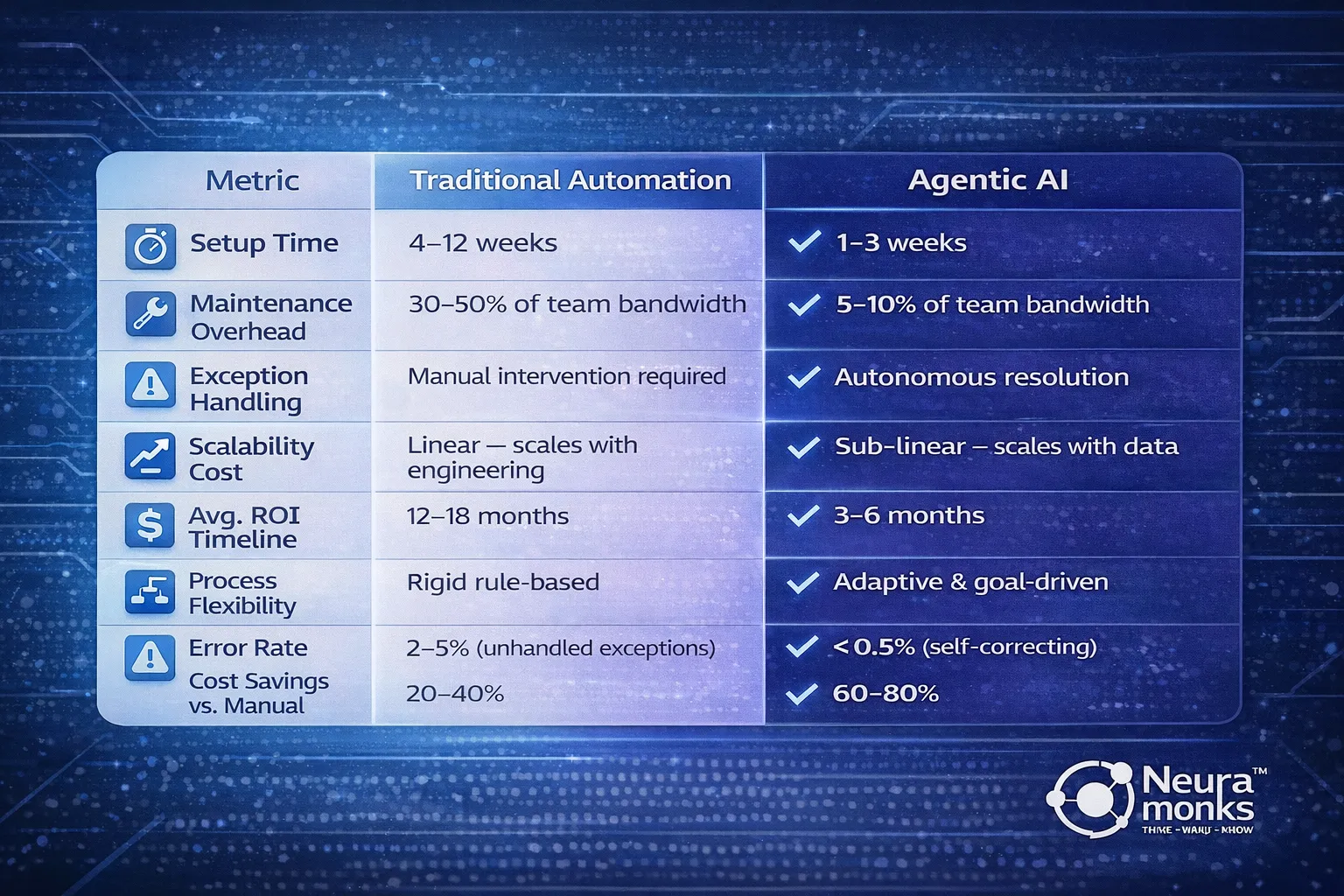
The Time Equation: Where Hours Disappear
Setup & Deployment — Weeks vs. Months
Traditional RPA deployments average 8–14 weeks from scoping to go-live. Every edge case demands a new rule; every process variant requires separate development. Change management alone consumes 20–30% of deployment time.
Agentic AI deployments operate differently. With goal-oriented configuration instead of step-by-step rule mapping, initial deployments compress to 1–3 weeks. You define the objective; the system determines the execution path. That's a 3× speed advantage before a single workflow runs in production.
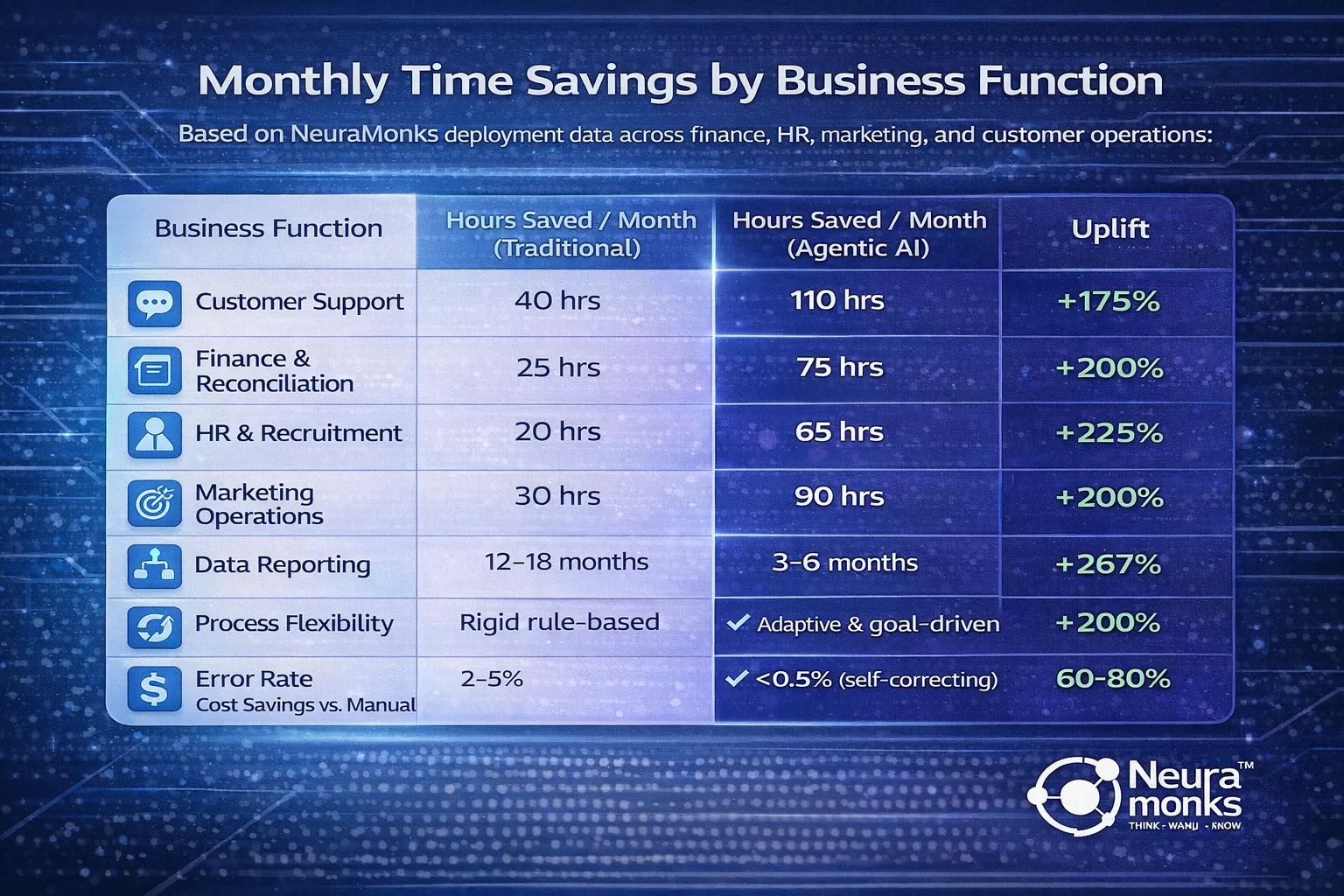
The Hidden Time Drain: Maintenance
Traditional automation teams spend 30–50% of their engineering bandwidth on maintenance — patching bots after software updates, rewriting rules for process changes, and managing exception queues. This is the silent productivity killer that most ROI calculations ignore.
Agentic systems are adaptive by design. Maintenance overhead drops to 5–10% of team bandwidth, freeing engineers for strategic work rather than firefighting.
The Money Equation: Real Cost Breakdown
Cost comparison analysis must account for the full 3-year total cost of ownership — not just upfront licensing fees. Here's what the numbers actually look like:
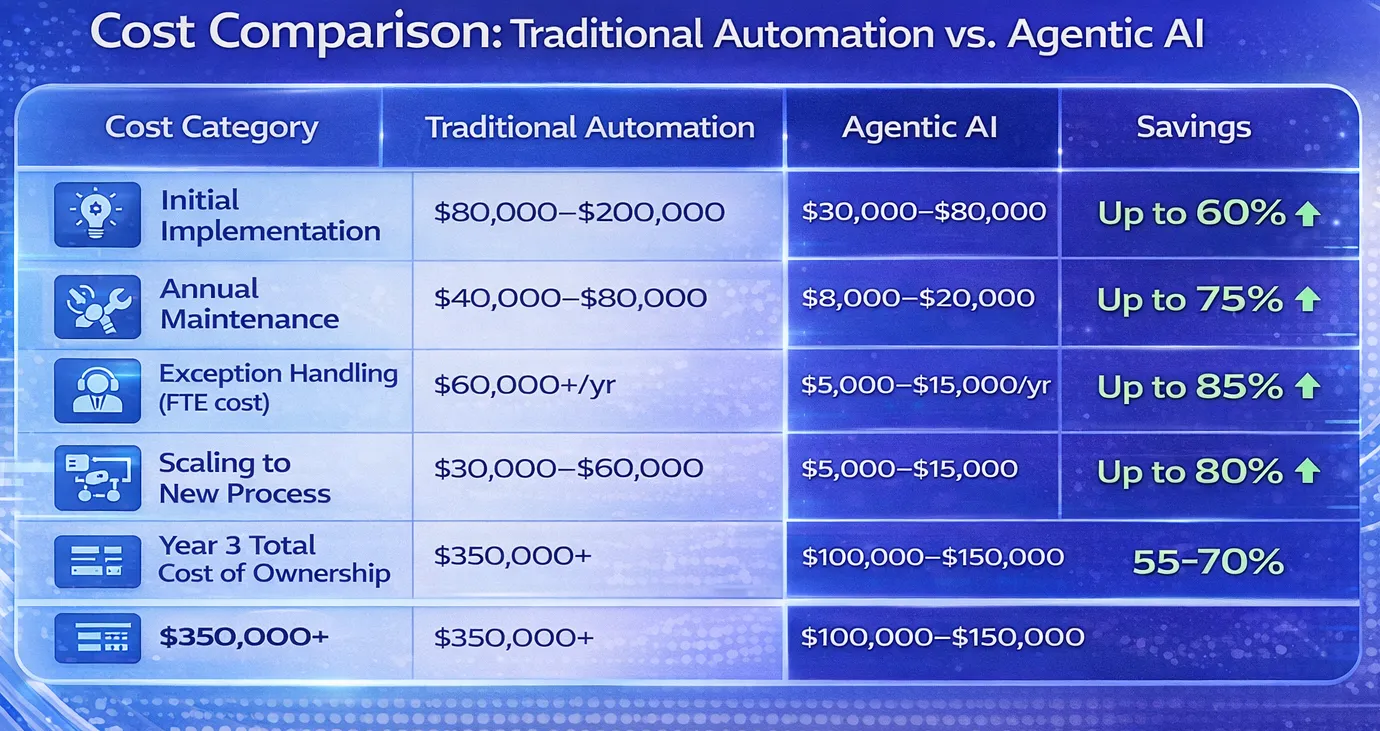
Cost ranges based on mid-market enterprise deployments (200–1,000 employees). Larger enterprises see proportionally greater savings with Agentic AI.
The math is unambiguous. Over a 3-year horizon, AI Solutions built on agentic architectures deliver 55–70% lower total cost of ownership compared to equivalent traditional automation deployments — primarily because they eliminate the hidden costs of exception handling, maintenance cycles, and rigid re-engineering.
NeuraMonks Case Study: AI-Powered Lead Generation & Follow-Up Automation
Real-World Impact: Eliminated Lead Leakage and Improved Response Speed by 60% Across Sales Operations
The Challenge
A fast-growing B2B company was running a traditional CRM automation stack — scripted email sequences, rule-based lead scoring, and manual follow-up triggers. The system was built on conditional logic: if the lead opens the email, trigger follow-up; if there is no response in 3 days, move to next sequence. Predictable on paper. Broken in practice.
The core problems: lead leakage was rampant (leads falling through workflow gaps when behaviors didn't match expected patterns), response times averaged 4–6 hours during peak periods, and the sales team spent 12+ hours weekly manually triaging exceptions that the automation couldn't handle.
The NeuraMonks Agentic AI Solution
We replaced the rule-based stack with an Agentic AI lead management system. Rather than following fixed sequences, the system could:
- Autonomously analyze each lead's behavior, company context, and engagement signals
- Dynamically personalize follow-up messages based on real-time data rather than static templates
- Determine optimal contact timing by learning from historical response patterns
- Escalate high-intent leads to human sales reps with full context summaries — instantly
- Handle edge cases — unsubscribes, out-of-office replies, role changes — without human intervention
The Results — Before vs. After
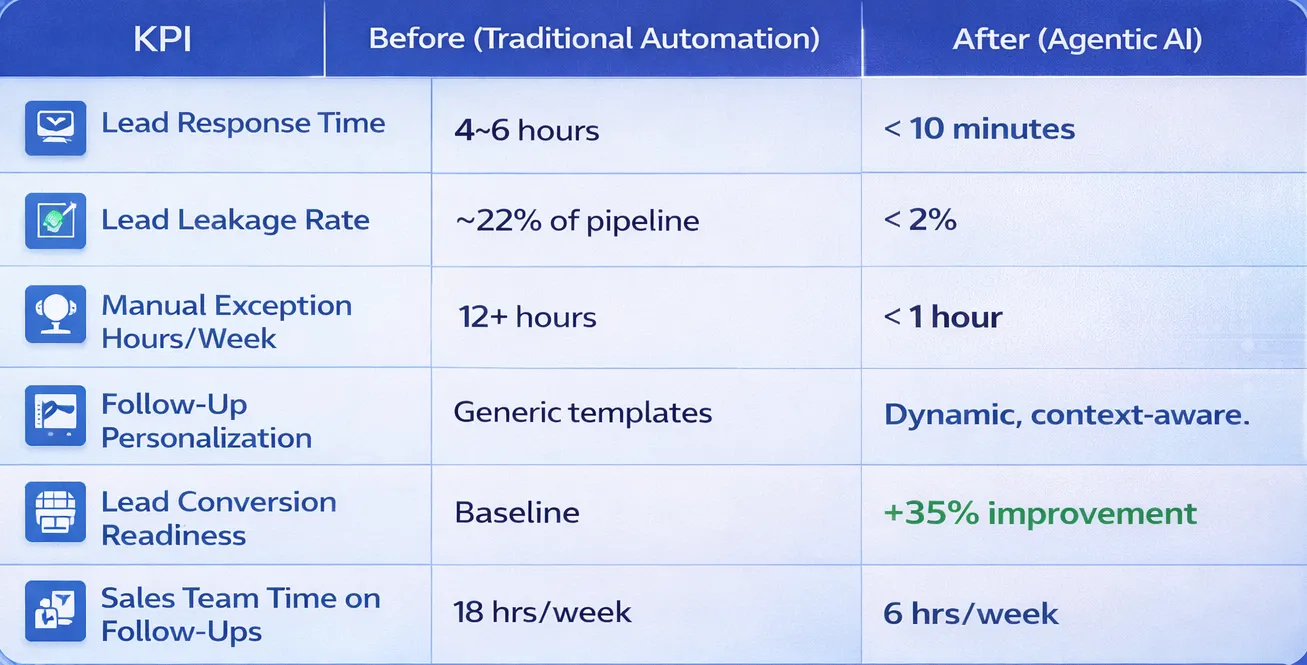
Key Takeaway
The traditional automation stack wasn't underperforming because the team built it wrong — they built it exactly as rule-based systems are designed. The problem was architectural. Rules can't replace reasoning. The Agentic AI system didn't just automate the same process faster; it solved problems the old system was fundamentally incapable of addressing.
Industry-Level ROI: What the Data Shows
Across NeuraMonks deployments and third-party research, the ROI differential between Agentic AI and traditional automation is consistent across industries:
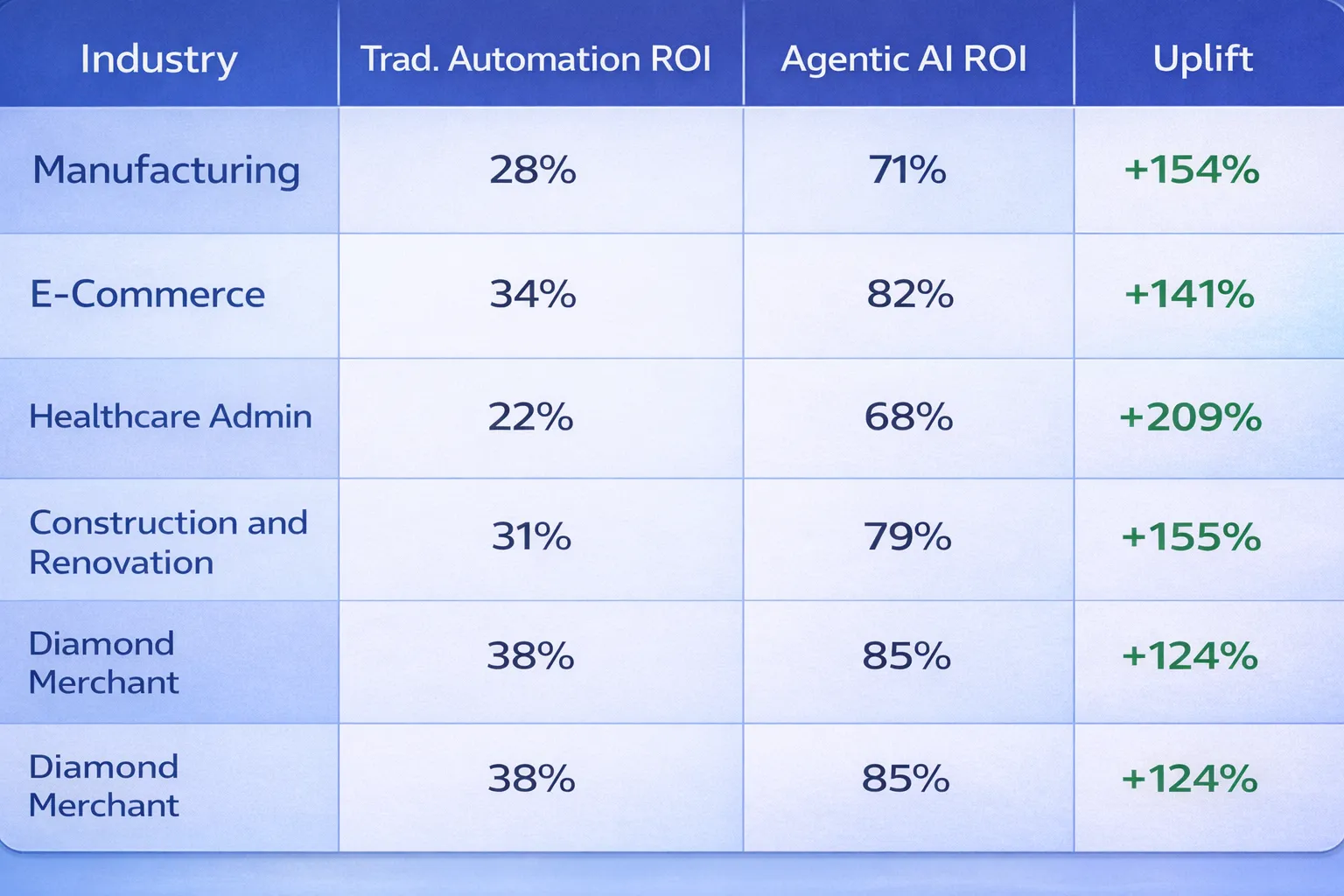
The Verdict: Making the Right Call
Traditional automation isn't dead — it's appropriate for perfectly structured, high-volume, never-changing processes where predictability trumps adaptability. If your process is a straight line, rule-based systems serve it well.
But for the 68% of automatable business workflows that involve variability, judgment, or exception handling — the category that delivers the most business value — Agentic AI doesn't just outperform traditional automation. It operates in a different league entirely.
The question isn't whether to automate. It's whether you're automating with tools that think — or tools that merely execute. In a competitive market where efficiency compounds, that distinction is worth millions.
Ready to Make the Switch?
If your current automation stack is costing more than it saves — in maintenance hours, missed exceptions, or lost growth opportunities — it's time for a smarter approach. we specializes in designing and deploying Agentic AI systems that think, adapt, and deliver measurable ROI from day one.
Our team has built 96+ AI solutions across finance, healthcare, e-commerce, HR, and marketing — and we bring the same structured, results-first methodology to every engagement. Whether you're starting from scratch or looking to replace a failing automation setup, we'll map the right architecture for your business goals.
When you collaborate with us, you gain the following:
• Free AI Consultation — We audit your current workflows and identify where Agentic AI delivers the fastest ROI
• Custom Deployment Roadmap — A clear, phased plan from pilot to full-scale production
• Measurable Outcomes — We define KPIs upfront so you always know the value you're getting
• End-to-End Support — From architecture design to post-deployment optimization, we're with you at every stage
Stop automating with tools that merely execute. Start automating with intelligence that thinks. Book your free consultation and discover what Agentic AI can do for your business.
India AI Impact Summit 2026: The AI Revolution Has Arrived Is Your Business Ready to Lead?
A quick breakdown of the biggest announcements and business signals from AI Impact Summit India 2026 — and what they mean for companies adopting AI today.
Something Historic Is Happening in New Delhi Right Now
The largest AI gathering ever held in the Global South is unfolding this week at Bharat Mandapam — and the world is watching. India's AI Impact Summit 2026 has drawn over 3 lakh registered visitors, 110+ participating nations, 20 heads of state, 45 ministerial delegations, 600+ startups, and the CEOs of the world's most powerful technology companies. The headlines being made here will shape business strategy for the next decade.
India is no longer just an emerging AI market. In 2026, it is front and center on the world stage — hosting global tech giants, heads of state, and over 300,000 registered visitors at one of the most consequential technology summits of our generation. In this blog, we break down the top 10 biggest news stories from the summit and explain what each development means for businesses ready to embrace the AI revolution.

The 12 Biggest Stories from India AI Impact Summit 2026
1. PM Modi Inaugurates the Global South's Biggest AI Summit
Prime Minister Narendra Modi officially inaugurated the five-day summit at Bharat Mandapam, welcoming delegations from 110+ countries under the guiding mantra: Sarvajana Hitaya, Sarvajana Sukhaya — Welfare for All, Happiness for All. The summit's Seven Chakras — spanning human capital, inclusion, trust, resilience, science, resources, and social good — channel global collaboration toward measurable outcomes.
What This Means for Business:
Government-level AI policy is being written right now. Companies that align their AI adoption strategies with India's emerging regulatory frameworks will be positioned ahead of the curve. This is the moment to invest in compliant, scalable AI infrastructure.
2. India Earmarks $1.1 Billion for AI & Manufacturing Startups
In one of the summit's biggest financial announcements, the Indian government unveiled a $1.1 billion state-backed venture capital fund exclusively for AI and advanced manufacturing startups. Backed by the India AI Mission (launched March 2024 with Rs 10,372 crore), this signals that the government views AI as a core economic pillar, not a peripheral experiment.
What This Means for Business:
If you are building or planning to build an AI-powered product, this is arguably the best time to be operating in India. Capital is flowing, the ecosystem is growing, and government support is real. Startups and SMEs should actively explore how to align with national AI initiatives.
3. India Now Has 100 Million Weekly ChatGPT Users
OpenAI CEO Sam Altman made a landmark revelation: India now accounts for over 100 million weekly active ChatGPT users — second only to the United States. More remarkably, Indian students represent the single largest student demographic using ChatGPT worldwide.
What This Means for Business:
Your customers, employees, and competitors are already using AI tools daily. The question is no longer whether your business should adopt AI — it is how fast you can integrate intelligent solutions to stay competitive.
4. Anthropic Reveals India Is Its #2 Global Market
Anthropic, the AI safety company behind the Claude AI platform, announced that India has become its second-largest global market, with run-rate revenue doubling since October 2025. This places India alongside the United States in terms of enterprise AI adoption at scale.
What This Means for Business:
Enterprise-grade AI adoption is no longer a luxury for large corporations. Businesses of all sizes are deploying world-class AI tools at scale. If your competitors are not yet on this journey, they will be soon — and the gap is widening every month.
5. BREAKING TODAY: Google Announces $15 Billion AI Investment in India
In the biggest announcement of February 18, Google unveiled a $15 billion investment in India's AI infrastructure at the summit. The announcement included a live speech-to-speech translation model supporting 70+ languages including 10 Indian languages (Hindi, Tamil, and more), an AI Professional Certificate program in partnership with Wadhwani AI, a deal with Karmayogi Bharat to support 20 million+ public servants on the iGOT platform in 18+ Indian languages, and the America-India Connect initiative to expand AI-powered connectivity.
What This Means for Business:
India is becoming a primary AI infrastructure hub for the world's largest tech company. AI tools in Indian languages are coming rapidly — businesses that localize their AI-powered customer experiences now will dominate vernacular markets.
6. BREAKING TODAY: Sarvam AI Launches India's Most Powerful Indigenous LLMs
On February 18, Indian AI startup Sarvam AI launched two foundational large language models — Sarvam 30B and Sarvam 105B — trained entirely from scratch (not fine-tuned from open-source models). Live demos showed these models outperforming several global AI benchmarks, especially on Indian language tasks including Hindi, Tamil, and mixed-language (Hinglish) conversations at cost-effective pricing.
What This Means for Business:
The era of India-specific, Indian-language AI models has arrived. Businesses serving tier-2 and tier-3 Indian markets now have access to AI that truly understands their customers. The cost and accessibility barrier has dropped significantly.
7. Blackstone Acquires Majority Stake in Neysa — $600M Deal
Global investment giant Blackstone made a decisive move into the Indian AI ecosystem by acquiring a majority stake in Neysa, an Indian AI infrastructure startup, as part of a $600 million fundraise. Neysa plans to deploy over 20,000 GPUs to expand AI computing infrastructure across India, transforming the country into a genuine AI compute hub.
What This Means for Business:
As GPU infrastructure and AI compute capacity grow in India, cloud costs will decrease and access to high-performance AI will democratize. Businesses building AI-powered systems today will benefit from dramatically improved infrastructure over the next 18 months.
8. Adani Commits $100 Billion for Renewable-Powered AI Data Centers
In the summit's most ambitious infrastructure play, Adani announced a $100 billion commitment to build AI-powered data centers across India by 2035 — all running on renewable energy. This investment is expected to trigger an additional $150 billion in downstream sectors, including server manufacturing, sovereign cloud platforms, and data services.
What This Means for Business:
India is building foundational AI infrastructure for decades ahead. For businesses, this means greater data sovereignty, more affordable cloud computing, and a greener AI stack — all from within Indian borders.
9. PM Modi Meets Sundar Pichai, Bill Gates, and Global Leaders
High-level bilateral meetings between PM Modi, Google CEO Sundar Pichai, Microsoft co-founder Bill Gates, and Spanish President Pedro Sanchez (who arrived today, February 18) underscored India's geopolitical AI ambitions. Bill Gates delivered a keynote praising India's AI talent pool and its public-private partnership model as a global template for human-centered AI development.
What This Means for Business:
When the world's most powerful tech executives fly to India, it confirms India is a priority market. Partnerships, integrations, and localized AI tools from global giants are coming — businesses positioning themselves now will have first-mover advantage.
10. AI for Governance — India's Legal & Regulatory Framework Takes Shape
The Center of Policy Research and Governance (CPRG) hosted key policy dialogues at the summit, advancing India's AI legal and regulatory framework under MeitY leadership. The discussions are shaping India's answer to global AI governance — positioning India not as a rule-follower, but as a rule-setter in responsible AI deployment.
What This Means for Business:
Regulatory clarity is coming. Businesses that build AI systems with compliance, transparency, and safety baked in from day one will avoid costly retrofits and will be trusted partners when government contracts open up.
11. Summit Extended by One Day — Overwhelming Public Response
In an extraordinary sign of the summit's success, the government extended the India AI Impact Summit 2026 by one additional day, now running through February 21. Expo timings were extended from 6:00 PM to 8:00 PM IST. February 19 is reserved for restricted high-level events; February 20 and 21 are fully open to the public.
What This Means for Business:
The appetite for AI adoption in India is not theoretical — it is palpable, real, and growing faster than even the organizers anticipated. This is a market that is ready and hungry for AI solutions right now.
12. Maharashtra Team Wins India's Largest GenAI Student Challenge
A team of young builders from Maharashtra won the Grand Champion title at the national finale of the OpenAI Academy x NxtWave Buildathon held alongside the summit. This competition represented the next generation of Indian AI talent — young, driven, and capable of building real-world AI applications from the ground up.
What This Means for Business:
India's AI talent pipeline is thriving and more accessible than ever. For businesses looking to hire AI engineers or build in-house capabilities, the talent ecosystem is maturing rapidly.
NeuraMonks: Your Trusted AI Partner for Government & Enterprise
Amid the landmark announcements at the India AI Impact Summit 2026, one name has been at the forefront of delivering AI solutions to both government bodies and enterprises across India: NeuraMonks. As a full-cycle AI development partner trusted by 100+ clients across 5+ countries, NeuraMonks has been translating India's AI ambitions into real-world deployments — not just for Fortune 500 companies, but for the government departments that serve hundreds of millions of Indian citizens.
We Are at the Summit
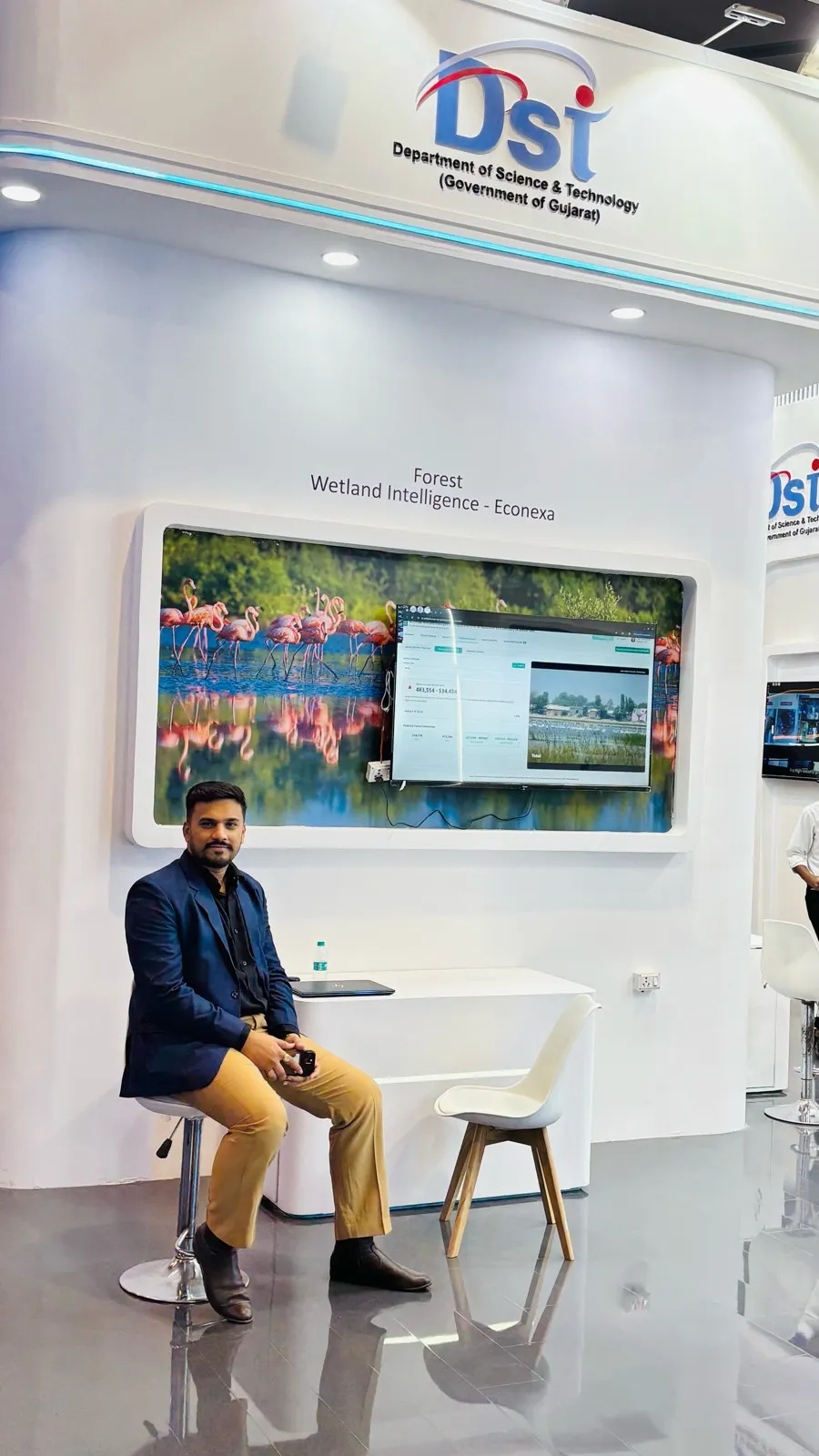
NeuraMonks is present at the India AI Impact Summit 2026, demonstrating our AI-powered platforms for environmental governance, resource intelligence, and citizen services at a booth. Our team has spent two days engaging with ministry officials, policymakers, and innovators — showing what deployed, real-world government AI looks like in 2026.
We are proud to present our client for two days at the India AI Impact Summit 2026
NeuraMonks Case Studies: AI That Delivers Real Results
Talk is cheap. At the India AI Impact Summit 2026, world leaders are making billion-dollar commitments. At NeuraMonks, we are proud to show the deployments that are already running — driving measurable outcomes for government bodies and enterprise clients today.
NeuraMonks in Action: Real Projects, Real Results
Here are selected highlights from NeuraMonks' One of the most impactful case studies presented at the summit was the Wetland Project.
Wetland Intelligence for Environmental Governance
Client: Department of Science & Technology, Government of Gujarat (in partnership with EcoNexa)
Challenge: Strengthen forest and wetland ecosystems to create suitable ecological conditions for greater species arrival and long-term biodiversity improvement.
NeuraMonks Solution: Built an AI-driven biodiversity intelligence system using historical ecological data to:
- Identify species habitat preferences
- Determine optimal physico-chemical parameter ranges
- Map habitat suitability patterns
- Predict species presence for the next 2–3 years, backed by ecological reasoning
✅ Result: Live biodiversity indices are now accessible to government planners, and the project was showcased as a national model at the India AI Impact Summit 2026.

Trending AI Topics at the Summit — And What's Next
AI Governance & the Global South's Voice
India is asserting itself as a co-author of global AI governance frameworks — not just a recipient. The summit's Three Sutras (People, Planet, Progress) are being presented as India's contribution to responsible AI policy alongside the EU AI Act and US Executive Orders. For businesses, this means India-specific compliance frameworks are imminent.
Multilingual & Vernacular AI — The Next Frontier
Today's Sarvam AI launch and Google's speech-to-speech model announcement signal the arrival of truly Indic AI. The next wave of AI adoption in India will not come from English-speaking metro users — it will come from the 800 million Indians who prefer to communicate in their native languages. Businesses serving Bharat (not just India) must invest in vernacular AI capabilities now.
Green AI — Sustainability Meets Intelligence
Adani's $100 billion renewable-powered data center pledge reflects a growing movement: AI infrastructure must be sustainable. As ESG compliance becomes mandatory for enterprise procurement, businesses that deploy AI on green infrastructure gain competitive advantage in both government contracts and global partnerships.
Agentic AI — From Copilot to Autonomous Operator
The hottest conversation at the summit is the shift from generative AI (which assists humans) to agentic AI (which operates autonomously). AI agents that can manage workflows, make decisions, and execute multi-step tasks without human intervention are no longer science fiction — they are being deployed in procurement, HR, finance, and customer service today.
AI for Social Impact — Healthcare, Agriculture & Education
Bill Gates' keynote brought the humanitarian dimension of AI into sharp focus. AI tools for disease diagnosis in rural India, crop yield prediction for smallholder farmers, and personalized learning for underserved students represent the next $100 billion opportunity — one that combines commercial viability with genuine social good.
India's AI Moment Is Now — Is Your Business Ready?
The India AI Impact Summit 2026 is not just a conference. It is a declaration. From a $1.1 billion government fund to a $100 billion infrastructure commitment, from 100 million ChatGPT users to a $15 billion Google investment announced today — every headline from this summit points to the same undeniable truth:
The AI transformation is not coming — it is already here.
At NeuraMonks, we have been watching — and building — through every chapter of India's AI story. As a government-trusted, full-cycle AI development partner serving 100+ clients across 5+ countries, we help organizations across healthcare, fintech, e-commerce, manufacturing, construction, and public sector turn AI ambition into measurable results.
Whether you need an intelligent Voice Agent that handles customer queries 24/7, an Econexa-style geospatial intelligence platform for environmental or urban governance, a smart Product Recommendation engine that drives conversions, or an Agentic AI system that autonomously manages complex workflows — we build AI that works in the real world and delivers ROI within the first 90 days.
Ready to Build Your AI-Powered Business?
→ Book a Free AI Consultation with NeuraMonks Today
AI Automation in 2026: What Enterprise Leaders Must Prepare For
AI automation in 2026 is shifting from experiments to core business infrastructure. Enterprises must prepare with the right strategy, infrastructure, and teams to turn AI into measurable impact. The real advantage comes from proper implementation — not just adopting tools.
The artificial intelligence landscape has evolved from experimental technology to mission-critical infrastructure. As we move through 2026, enterprise leaders face a pivotal moment: organizations that successfully implement AI Automation Solutions will gain unprecedented competitive advantages, while those that hesitate risk obsolescence.
The stakes have never been higher. According to recent enterprise surveys, companies leveraging advanced automation are seeing productivity gains of 40-60%, cost reductions of 30-50%, and improved decision-making accuracy by up to 85%. But success requires more than just adopting technology—it demands strategic preparation, cultural transformation, and choosing the right implementation partners.
This comprehensive guide explores what enterprise leaders must prepare for in 2026, from agentic AI systems to workflow orchestration platforms like n8n, and how to position your organization for success in this transformative era
The Shift to Agentic AI Systems
Traditional automation followed rigid, rule-based pathways. An automated system could execute predefined tasks but couldn't adapt to unexpected scenarios or make contextual decisions. Agentic AI represents a fundamental paradigm shift.
These intelligent systems can perceive their environment, make autonomous decisions, learn from outcomes, and execute complex multi-step processes without constant human intervention. In healthcare, for example, agentic AI systems are now managing patient triage, coordinating care teams, optimizing resource allocation, and even predicting potential complications before they occur—all while continuously improving through machine learning.
What Enterprise Leaders Must Prepare:
Infrastructure readiness — scalable data pipelines, APIs, and real-time computing; legacy systems may become bottlenecks
Governance frameworks — accountability, audit trails, and ethical oversight for AI decisions
Talent development — teams evolve from automation operators to AI orchestrators (prompting, workflow design, monitoring)
Multi-Agent Orchestration: The New Competitive Edge
The future of AI isn’t single tools — it’s networks of specialized AI agents collaborating like a team. Companies adopting multi-agent systems see significantly higher efficiency than single-agent setups because tasks are divided and coordinated.
Typical Agent Roles
- Research agent — gathers information
- Analysis agent — finds patterns
- Content agent — produces outputs
- Quality agent — reviews results
- Coordinator agent — manages workflow
Key Challenge: Success depends on orchestration — communication between agents, conflict handling, and maintaining consistent outputs.
Integration Complexity: Breaking Data Silos (Short)
Enterprises run on many disconnected systems — CRM, ERP, analytics tools, communication apps, and legacy databases. AI works best when it can combine data across them. Platforms like n8n, Dify act as the connective layer, enabling automation between systems, but integration is not just technical — it requires data readiness, security, and organizational adoption.
Key Considerations
- Data quality & standardization — clean, complete, structured data is essential for AI accuracy
- Security & compliance — every integration point must follow protection policies
- Change management — teams must adapt workflows to avoid resistance
- Edge & on-premise resources — local AI shifts costs to GPUs, energy, and infrastructure plannin
GPU and Computational Power Optimization
Edge AI deployments require strategic decisions about computational resources. A single enterprise-grade GPU like the NVIDIA A100 costs $10,000-$15,000, while edge-optimized alternatives like the Jetson AGX Orin provide 275 TOPS at $1,000-$2,000 per unit. The choice depends on your workload characteristics:
Model quantization: Reducing model precision from FP32 to INT8 can decrease inference time by 2-4x while maintaining 95%+ accuracy, enabling deployment on less expensive hardware.
Batch processing optimization: Grouping inference requests can improve GPU utilization from 30-40% to 70-85%, effectively doubling throughput without additional hardware.
Model pruning: Removing 30-50% of neural network parameters typically reduces computational requirements by 40-60% with minimal accuracy loss.
Edge device workload shifting: Dynamically moving routine inference to local edge devices offloads central GPUs, reducing cloud compute consumption by 60–80% while improving response latency and system resilience.
Energy Consumption: The Hidden Cost Factor
Enterprise AI deployments face significant energy costs that compound at scale. A typical GPU server consuming 1,000-1,500 watts running 24/7 costs $1,200-$1,800 annually in electricity at average commercial rates. For deployments spanning hundreds of edge locations, these costs escalate rapidly.
Dynamic power management: Implementing GPU power capping can reduce energy consumption by 15-25% with less than 5% performance degradation during non-peak hours.
Model deployment scheduling: Running inference-heavy workloads during off-peak electricity hours can reduce energy costs by 30-40% in regions with time-of-use pricing.
Thermal optimization: Proper cooling infrastructure planning prevents thermal throttling that can reduce GPU performance by 20-30% and increase total cost of ownership.
Scaling Pilots to Production: The Critical Transition
Most AI pilots fail due to poor infrastructure planning, not technology. Successful production deployments focus on three areas:
Orchestration and containerization— When growing to more than 100 locations, Kubernetes scalability saves 3–5 times greater costs but requires 40–60% more advance planning.
Model version management — increases infrastructure costs by 15% to 20% but avoids failures that can be fixed for 10–50 times more.
Monitoring & observability — adds 15–20% infrastructure cost but prevents failures that can cost 10–50x more to fix
Computer vision processing optimization — batching inference, quantization, and on-prem GPU processing reduce per-image processing cost by 60–80% when scaling datasets
LLM token & conversation management — custom prompt routing, context pruning, and discussion memory handling reduce token usage by 50–70% while improving response consistency and latency
Real-World Implementation: Case Studies from Neuramonks
Case Study 1: AI-Powered Floor Plan Analysis for Home Renovation
Neuramonks implemented an automated floor plan detection and 3D visualization system for a PropTech platform that reduced design effort by 50–60% while improving homeowner decision confidence by 30–40%.
Business Challenge: Home renovation was traditionally fragmented and manual. Homeowners struggled to visualize renovation ideas, interpret floor plans, and coordinate with suppliers. Manual floor plan interpretation created delays, while disconnected tools led to project overruns on cost and time.
AI Solution Delivered: By deploying computer vision models with intelligent 3D conversion capabilities on AWS infrastructure (Lambda, EC2, S3), the system achieved:
- AI-powered automatic 2D floor plan detection and digitization
- Interactive 3D model generation from flat floor plans
- "Design Now" visualization tool for instant design exploration
- Scalable backend handling concurrent design requests
- Integrated timeline and workflow management
Measured Impact:
- Reduced initial design effort by 50–60%
- Improved homeowner design clarity and decision confidence by 30–40%
- Shortened renovation planning cycles by 35–45%
- Transformed renovation from guesswork to visual, data-driven decision-making
Case Study 2: Interactive Video Intelligence Platform
We built an AI-driven video intelligence pipeline for a media technology platform that reduced manual video structuring effort by 55–65% and increased viewer engagement by 30–40%.
Business Challenge: The platform aimed to enable non-linear, interactive video experiences where viewers navigate content dynamically. However, video segmentation relied on manual human parsing, creating scalability bottlenecks. Structuring videos into navigable tree architectures was time-intensive, inconsistent, and limited content growth.
AI Solution Delivered: By deploying combined computer vision and NLP models on AWS infrastructure, the system achieved:
- Automated scene detection, object recognition, and visual transition analysis
- NLP pipelines analyzing spoken dialogue, on-screen text, and audio context
- Intelligent video segmentation into logically coherent micro-segments
- AI-driven hierarchy generation for navigable tree structures
- Scalable processing architecture for high video volumes
Measured Impact:
- Reduced manual segmentation effort by 55–65%
- Increased viewer engagement depth by 30–40%
- Accelerated content onboarding by 40–50%
- Enabled platform scalability while maintaining editorial quality
Key Considerations for Resource-Efficient AI Deployment
Start with TCO analysis: Calculate 3-year total cost of ownership including hardware, energy, maintenance, and network costs—not just initial deployment expenses.
Design for incremental scaling: Build infrastructure that can grow from 10 to 100 to 1,000 deployments without architectural redesign.
Implement tiered processing: Use edge devices for latency-sensitive tasks, on-premise servers for batch processing, and cloud for training and complex analytics.
Monitor resource utilization religiously: GPU utilization below 60% indicates over-provisioning; above 90% suggests performance bottlenecks.
Plan for model updates: Reserve 20-30% of storage and compute capacity for simultaneous deployment of multiple model versions during updates
Choosing the Right Implementation Partner
The gap between AI potential and real results is usually implementation expertise. Many companies buy powerful AI tools but fail to use them properly due to lack of deployment knowledge. Choosing the right AI automation partner is crucial — they should not only implement solutions but also build your internal capability and ensure long-term success.
Key Points
- Reduced manual segmentation effort by 55–65%
- Increased viewer engagement depth by 30–40%
- Accelerated content onboarding by 40–50%
- Enabled platform scalability while maintaining editorial quality
The ROI Question: Measuring AI Automation Success
In 2026, AI ROI goes beyond simple cost savings. Leaders should measure impact across multiple business dimensions:
- Cost reduction — fewer manual hours, lower errors, removed redundancies
- Revenue growth — better conversions, new opportunities, faster launches
- Risk mitigation — compliance monitoring, fraud prevention, avoided penalties
- Strategic agility — quicker experimentation and market response
Best practice: set baseline metrics before deployment and track improvements across all areas, not just labor savings..
Preparing Your Organization: The Cultural Dimension
Technology is the easier part of AI automation. The harder challenge is organizational readiness. Enterprise leaders must prepare their organizations culturally and structurally for this transformation.
Transparent Communication: Employees fear automation will eliminate their jobs. Leaders must clearly communicate how AI augments human capabilities rather than replaces them. Share specific examples of how automation will eliminate tedious work while enabling more strategic, creative, and fulfilling responsibilities.
Reskilling Initiatives: Invest in comprehensive training programs that help employees transition from task execution to AI supervision and strategic decision-making. This isn't optional—it's essential for successful adoption.
Incentive Alignment: Ensure that performance metrics and incentive structures reward adoption of AI Automation Solutions rather than penalizing short-term productivity dips during implementation.
Executive Sponsorship: AI transformation requires visible executive commitment. Leaders who actively use AI tools, discuss them in meetings, and celebrate early wins create organizational momentum.
Ethical & Regulatory Landscape (Short Version)
As AI gains decision-making power, ethics and compliance become critical. The EU AI Act has set a global benchmark, and similar regulations are emerging worldwide. Enterprises must prepare for risk assessments, transparency in AI decisions, human oversight, data privacy protection, and bias auditing. We recommends “compliance-by-design” — embedding auditability, documentation, and oversight into automation from the start, not after deployment.
What Success Looks Like in 2026
Successful enterprises treat AI as core infrastructure, not isolated tools. They build organization-wide AI literacy, implement governance frameworks balancing innovation with risk, and measure impact across efficiency, innovation, employee experience, and customer outcomes. Most importantly, they recognize AI success is 20% technology and 80% strategy, change management, and continuous optimization.
Conclusion
AI automation in 2026 isn’t a question of if—it’s a question of where to start. As adoption accelerates, the real competitive edge belongs to enterprises that move with clarity, not experimentation for its own sake.
The first workflow you automate often decides whether AI becomes a strategic advantage or just another underused tool. That’s why success depends on clear objectives, the right infrastructure, skilled teams, and partners who can scale execution—not just ideas.
At Neuramonks, we help enterprises embed AI automation directly into real business operations, delivering measurable outcomes instead of pilots that stall.
The future belongs to organizations that combine human judgment with AI-powered execution. If you’re evaluating where AI fits in your enterprise, start here:
👉 https://www.neuramonks.com/contact
Choosing the Right AI Consulting Partner: A 2026 Market Perspective
A quick guide to choosing the right AI consulting partner in 2026, covering evaluation criteria, key questions, and red flags. Helps businesses select a partner that can turn AI initiatives into scalable, measurable business results.
The artificial intelligence landscape has matured dramatically by 2026, transforming from experimental technology into mission-critical infrastructure. As businesses rush to implement AI across operations, the quality of your AI Consulting Services partner can make or break your digital transformation journey. This comprehensive guide examines what separates exceptional AI consultants from the rest in today's competitive market.
The 2026 AI Consulting Landscape: What's Changed
The AI consulting market has evolved significantly over the past two years. What began as predominantly large enterprise implementations has democratized, with mid-market companies now accessing sophisticated AI solutions previously reserved for Fortune 500 organizations. The shift from proof-of-concept projects to production-grade deployments means choosing the right partner carries higher stakes than ever before.
Today's AI consulting engagements focus less on "can we do this?" and more on "how do we scale this?" Companies like Neuramonks have emerged as leaders by bridging the gap between cutting-edge AI capabilities and practical business implementation, helping organizations move from experimentation to enterprise-wide deployment.
Understanding Modern AI Consulting Services
Before evaluating potential partners, it's crucial to understand what comprehensive AI Consulting Services should encompass in 2026. The best consultancies offer end-to-end capabilities spanning:
Strategic Planning & Assessment: Your partner should begin with thorough discovery—analyzing your current technology stack, identifying high-impact use cases, and developing a realistic roadmap aligned with your business objectives. This isn't about implementing AI for its own sake; it's about solving real business problems with measurable ROI.
Architecture & Technology Selection: The alternatives available in AI technology have exploded. Your consultant should demonstrate expertise across multiple frameworks and platforms, recommending solutions based on your specific requirements rather than pushing proprietary tools. Whether you need Generative AI for content creation, computer vision for quality control, or predictive analytics for forecasting, they should architect systems that integrate seamlessly with your existing infrastructure.
Implementation & Integration: Many consultancy partnerships break down at this point. Your partner needs proven expertise deploying AI in production environments, handling data pipelines, model training, API development, and integration with enterprise systems. They should understand both the AI/ML stack and traditional enterprise architecture.
Training & Change Management: Technology alone doesn't drive transformation—people do. Your consultant should provide comprehensive training for technical teams and end-users alike, helping your organization build internal AI capabilities over time rather than creating permanent dependency.
Ongoing Optimization & Support: AI systems require continuous monitoring, retraining, and refinement. Your partner should offer maintenance services that keep your AI solutions performing optimally as your data and business needs evolve.
How to Choose the Right AI Development Partner a complete guide.
Selecting an AI development partner requires evaluating multiple dimensions beyond technical expertise. Here's a systematic approach to making the right choice:
1. Assess Technical Depth and Breadth
The best AI consulting partners maintain expertise across the full AI spectrum—from traditional machine learning to modern LLM implementations. Ask potential partners about their experience with specific technologies relevant to your use case. If you're exploring conversational AI, they should demonstrate deep familiarity with large language models, prompt engineering, and fine-tuning methodologies.
Request case studies showing end-to-end implementations similar to your needs. Generic examples aren't enough—you want to see proof they've solved problems analogous to yours. Neuramonks, for instance, has built reputation through documented success stories spanning multiple industries, demonstrating adaptability across different business contexts.
2. Evaluate Industry Experience
AI implementation best practices vary significantly across industries due to different regulatory requirements, data characteristics, and business models. A partner with relevant industry experience brings invaluable domain knowledge, understanding the nuances that generic consultancies miss.
In regulated industries like healthcare or finance, your partner should understand compliance requirements for AI systems, including model interpretability, audit trails, and bias mitigation. For retail or e-commerce, they should grasp the intricacies of recommendation systems, demand forecasting, and personalization at scale.
3. Verify Implementation Methodology
Outstanding consultancies follow structured methodologies that de-risk AI projects. They should articulate clear processes for:
- Discovery & scoping: How do they identify the right use cases?
- Proof of concept development: What's their approach to rapid prototyping?
- Production deployment: How do they ensure reliability and scalability?
- Performance monitoring: What metrics do they track?
Be wary of partners promising unrealistic timelines or guaranteed outcomes. AI development involves inherent uncertainty; honest consultants acknowledge this while demonstrating how they mitigate risks through iterative development and validation.
4. Examine Their Technology Philosophy
Does your potential partner take a vendor-agnostic approach, or are they locked into specific platforms? The best consultancies recommend technology based on your needs rather than partnership incentives. They should explain trade-offs between different approaches—cloud vs. on-premise, open-source vs. proprietary, build vs. buy—helping you make informed decisions.
In 2026, this includes understanding their position on foundation models. Do they have experience fine-tuning existing models? Building custom models from scratch? Implementing retrieval-augmented generation (RAG) architectures? Your business needs will dictate the right approach, and your partner should guide you accordingly.
5. Prioritize Communication and Collaboration
Technical brilliance matters little if your consultant can't translate complex AI concepts into business language. During evaluation, assess how well potential partners communicate. Do they explain things clearly without unnecessary jargon? Do they listen to your concerns and ask thoughtful questions about your business?
The best consulting relationships are collaborative partnerships, not vendor-client transactions. Look for consultants who view themselves as extensions of your team, invested in your long-term success rather than just completing a project.
6. Understand Their Data Strategy
AI success fundamentally depends on data quality and availability. Your consultant should demonstrate sophisticated understanding of:
- Data collection and preparation
- Data governance and security
- Privacy compliance (GDPR, CCPA, etc.)
- Synthetic data generation when needed
- Active learning strategies to improve models over time
They should proactively discuss data challenges and propose realistic strategies for addressing them. If a consultant glosses over data considerations, that's a significant red flag.
7. Evaluate Long-Term Partnership Potential
AI isn't a one-time implementation—it's an ongoing capability that requires nurturing. Your ideal partner should offer clear paths for continued collaboration, whether through managed services, on-demand support, or training your internal teams to eventually self-manage.
Consider their approach to knowledge transfer. Are they committed to building your internal capabilities, or do they prefer maintaining dependency? Neuramonks and other leading consultancies prioritize client empowerment, helping organizations develop lasting AI competencies.
Critical Questions to Ask Potential AI Consulting Partners
During your evaluation process, these questions will reveal crucial insights about potential partners:
About their experience:
- How do you handle projects where initial assumptions prove incorrect?
- What's your process for identifying the right AI use cases?
- How do you measure and ensure ROI from AI investments?
About their approach:
- Who specifically would be working on our project?
- What's your team's background in [relevant technology/domain]?
- Do you have capacity to scale support if our needs grow?
About their team:
- What does post-deployment support look like?
- How do you handle model retraining and optimization?
- What knowledge transfer and training do you provide?
About ongoing partnership:
- What does post-deployment support look like?
- How do you handle model retraining and optimization?
- What knowledge transfer and training do you provide?
Red Flags to Watch For
Just as important as knowing what to look for is recognizing warning signs. Be cautious of consultants who:
- Promise specific outcomes or guaranteed ROI without thorough discovery
- Push proprietary solutions without considering alternatives
- Lack relevant case studies or verifiable references
- Can't explain their methodology clearly
- Show limited interest in understanding your business
- Avoid discussing potential challenges or risks
- Price significantly below market rates (suggesting inexperience)
- Claim expertise across every possible AI domain
The Value of Specialized Expertise
While generalist AI consultancies serve a purpose, specialized partners often deliver superior results for specific use cases. If you're implementing conversational AI, a firm with deep natural language processing expertise will likely outperform generalists. For computer vision applications, seek partners with proven vision AI deployments.
This specialization extends to vertical industries. An AI consultant with extensive healthcare experience understands medical data privacy requirements, clinical workflows, and regulatory constraints in ways that generalists cannot match.
Making Your Final Decision
After thoroughly evaluating options, your decision should consider:
Technical fit: Do they have the right expertise for your specific use case?
Cultural alignment: Will they work well with your team and organizational culture?
Commercial terms: Are pricing and engagement models reasonable and transparent?
Long-term potential: Can this relationship scale with your AI ambitions?
References and reputation: What do past clients say about working with them?
Trust your instincts. The right AI consulting partner feels like a true collaborator—someone invested in your success and capable of guiding you through the complexities of AI implementation.
Conclusion
Choosing the right AI Development partner in 2026 requires careful evaluation of technical capabilities, industry experience, implementation methodology, and cultural fit. The AI landscape has matured to the point where success depends not just on technical prowess but on deep business understanding and the ability to translate AI capabilities into tangible value.
As you evaluate potential partners, remember that the best consultancies focus on building your long-term AI capabilities rather than creating dependency. They communicate clearly, demonstrate relevant experience, and approach your engagement as a collaborative partnership.
Ready to Transform Your Business with AI?
At Neuramonks, we specialize in helping businesses navigate their AI transformation journey with proven methodologies and industry-leading expertise. Our team brings deep technical knowledge combined with practical business acumen to deliver AI solutions that drive measurable results.
Whether you're exploring your first AI initiative or looking to scale existing implementations, we're here to guide you every step of the way. Let's discuss how we can help your organization unlock the full potential of artificial intelligence.
Contact us to schedule a consultation and discover how Neuramonks can become your trusted AI transformation partner.
AGI: The Next Frontier in Artificial Intelligence That Will Transform Everything
AGI is the next evolution of AI — systems that can understand, learn, and reason across any domain instead of performing only single specialized tasks. Organizations that start building AI capabilities and data foundations today will be the ones leading when general intelligence becomes reality.
The conversation around artificial intelligence has shifted dramatically. While we've marveled at AI systems that can write essays, generate images, and even drive cars, we're standing at the threshold of something far more profound: Artificial General Intelligence (AGI).
Unlike today's narrow AI systems that excel at specific tasks, AGI represents a paradigm shift—machines that can learn, reason, and apply knowledge across any domain, just like humans do. This isn't science fiction anymore. It's the next frontier that leading researchers and organizations worldwide are racing toward.
Today’s business AI tools each solve one task but stay isolated — sentiment analysis, forecasting, logistics, and planning all require separate systems. This fragmentation adds complexity and missed opportunities. AGI aims to unify them into one system that understands the full business context and adapts seamlessly.
What Makes AGI Different From Today's AI?
Current AI systems, no matter how impressive, are specialists. ChatGPT excels at language, DALL-E creates images, and AlphaFold predicts protein structures. Each is remarkable within its domain but helpless outside it.
Artificial General Intelligence refers to machines that possess human-level cognitive abilities across the board. An AGI system could learn new skills without retraining from scratch, transfer knowledge between domains, understand context and nuance, make decisions in novel situations, and reason abstractly.
This General Artificial Intelligence would be the ultimate learning machine—adaptable, versatile, and capable of tackling any intellectual challenge. Consider a practical example: Today, you need separate AI systems for legal document review and medical diagnosis. With AGI, a single system could master both, drawing connections between fields that even human experts might miss.
Why AGI Is the Future of AI Innovation
The limitations of narrow AI are becoming increasingly apparent. Businesses spend millions training specialized models for each specific task. An Agi company focused on general ai development could eliminate this fragmentation entirely.
Imagine deploying a single AI system that could understand your business holistically, adapt to changing conditions in real-time, connect insights across departments, and accelerate innovation exponentially. An AGI system could spot patterns spanning marketing, operations, and finance—connections that specialized AI systems would miss entirely.
This is why Neuramonks and other forward-thinking organizations are investing in understanding and preparing for AGI's arrival. The companies that grasp AGI's potential now will lead their industries tomorrow.
How Artificial General Intelligence Works
While true AGI doesn't exist yet, researchers are pursuing several promising approaches: foundation models with transfer learning, multimodal integration across different data types, continuous learning architectures that build on previous knowledge, sophisticated reasoning modules, and common sense understanding. These technical breakthroughs are bringing us closer to machines that can learn, adapt, and reason like humans across any domain.
The AGI Timeline: Closer Than You Think
Expert predictions on AGI's arrival vary wildly, from within this decade to beyond 2050. However, several indicators suggest we're making faster progress than many realize:
- Capability jumps – AI capabilities are improving faster than most predicted even two years ago
- Research momentum – Artificial General Intelligence company investments have grown exponentially
- Architectural breakthroughs – New approaches to reasoning, memory, and learning emerge monthly
- Computing power – The hardware requirements for AGI are becoming more feasible
Whether AGI arrives in 5 years or 25, the trajectory is clear. Organizations that prepare now gain crucial advantages.
The Path to AGI: Current Progress
Recent developments demonstrate we're making substantial progress toward AGI. Large language models exhibit emergent capabilities their creators didn't explicitly program. Multimodal systems integrate text, images, and audio with increasingly sophisticated understanding. Self-supervised learning reduces data requirements, while new architectures achieve continuous learning without forgetting previous knowledge. Most significantly, AI systems are developing genuine reasoning capabilities—breaking down problems, forming hypotheses, and adjusting strategies based on outcomes.
Expert predictions on AGI's arrival vary from within this decade to beyond 2050, but capability improvements are accelerating faster than most predicted. Whether AGI arrives in 5 years or 25, organizations that prepare now gain crucial advantages.
Agentic Systems: The Practical Bridge Before AGI
While true Artificial General Intelligence has not arrived yet, a new category of software is changing how AI is used in real environments: agentic systems.
Instead of only generating answers, these systems can interpret goals, decide steps, execute tools, verify outcomes, and continue working until the objective is completed. In practice, they behave less like software features and more like digital workers operating inside workflows.
Platforms such as Clawbot illustrate this shift. They are not AGI — they do not possess human-level understanding or universal reasoning — but their observe-plan-act execution loop mirrors how future general intelligence systems are expected to operate. Rather than replacing specialized AI models, they coordinate them, creating a unified operational layer across business processes.
This makes agentic software an important transitional stage: not general intelligence itself, but the first time AI systems can pursue outcomes instead of only responding to prompts.
Real-Time AGI Applications Transforming Business Today
While we await true AGI, current AI systems are already demonstrating AGI-like capabilities in real-time applications that bridge today's narrow AI and tomorrow's general intelligence.
Intelligent Conversational AI and Advanced Chatbot Technology
Modern conversational interfaces have evolved far beyond simple scripted responses. Today's AI-powered systems exhibit AGI-like qualities that are revolutionizing customer service and business operations:
Context retention across conversations – Advanced AI assistants maintain conversational memory, understanding customer history and preferences across multiple interactions, not just within a single session.
Multi-intent understanding – These intelligent systems handle complex requests involving multiple purposes simultaneously, like "I need to change my shipping address and also want to know when my refund will arrive."
Emotional intelligence – AGI-adjacent conversation platforms detect frustration, urgency, or confusion in customer language and adapt their responses accordingly, providing empathetic and contextually appropriate support.
Seamless problem resolution – Organizations deploying these advanced conversational AI systems report 70-80% resolution rates without human intervention, handling everything from technical support to financial advice.
Other Real-Time AGI Applications:
Beyond conversational AI, AGI-like systems are transforming operations across industries:
- Real-time decision support – Financial trading algorithms, healthcare diagnostic assistants, and supply chain optimization engines that analyze multiple data sources simultaneously
- Predictive maintenance – Systems that monitor equipment and predict failures before they occur by understanding complex patterns across sensors and conditions
- Intelligent automation – Process automation that handles exceptions and novel situations without breaking, coordinating actions across multiple systems intelligently
- Dynamic content generation – Marketing systems that create personalized content for individual recipients in real-time across multiple channels
- Real-time translation – Live speech-to-speech translation that preserves tone, context, and cultural nuances
These applications share characteristics that preview true AGI: contextual understanding, adaptive behavior, multi-domain reasoning, and handling novel situations without explicit reprogramming. Organizations leveraging these technologies today are building the expertise they'll need when full AGI arrives.
Current Breakthroughs Paving the Path to AGI
While true AGI remains on the horizon, recent developments demonstrate we're making substantial progress toward that goal. Understanding these advances helps organizations anticipate what's coming and prepare accordingly.
Large Language Models Show Emergent Capabilities
Modern AI models now show emergent capabilities — abilities not explicitly programmed by developers. As they scale, they can perform multi-step reasoning, understand complex concepts, and display basic common sense. They’re not AGI yet, but these signs indicate we’re approaching a major leap in AI capability.
Multimodal Integration Advances
Artificial General Intelligence will not appear suddenly — it is emerging through intelligent AI automation systems that can execute, learn, and improve workflows.
Self-Supervised Learning Reduces Data Requirements
A major AGI barrier was the need for huge labeled datasets. New self-supervised learning lets AI learn from unlabeled data by discovering patterns on its own — similar to how humans learn through observation.
Continuous Learning Without Forgetting
Researchers are tackling a key AGI challenge: learning new information without forgetting old knowledge. Unlike typical AI that suffers “catastrophic forgetting,” new architectures can continuously update memory — a crucial step toward adaptive intelligence.
Reasoning and Planning Modules
AI systems are gaining real reasoning ability — they can break down problems, form hypotheses, test solutions, and adapt strategies, moving beyond simple pattern recall toward general intelligence.
What AGI Means for Businesses and Society
The implications of AGI span every sector, promising transformations more profound than any previous technological revolution.
For Businesses:
AGI will replace many specialized tools with one system that understands business context end-to-end — strategy, markets, operations, and customers together. Companies will move faster: product cycles from years to months, research from weeks to hours, and decisions from quarters to days. Early adopters won’t just be more efficient — they’ll operate at entirely new speed and scale, gaining real-time insights that once took months of analysis.
For Society:
AGI could speed up scientific discovery, enable personalized education, and help solve complex global challenges like climate change. At Neuramonks, preparing for AGI means building the mindset and systems to use it wisely — enhancing human judgment and creativity, not replacing them.
Preparing for the AGI Era Today
You don't need to wait for AGI to benefit from the AI revolution. Start preparing now:
Build AI literacy – Train leaders and employees to think strategically about AI capabilities, creating organizational fluency in what AI can and cannot do.
Deploy narrow AI strategically – Deploy focused AI solutions now to build institutional knowledge about AI integration, data quality, and change management. Every AI implementation teaches lessons about:
Design for adaptability – Architect systems with flexibility for new AI integrations, avoiding over-customization that locks you into specific tools.
Invest in data infrastructure – AGI will only be as valuable as the data you can feed it. Consolidate data from silos, establish quality standards, and create clear documentation.
Establish ethical frameworks – Develop principles around AI decision-making, fairness audits, transparency standards, and value alignment now to navigate AGI's complex ethical challenges later.
The AGI Revolution Starts Now
The journey from today's narrow AI to tomorrow's AGI is the most consequential technological transition of our lifetime. Organizations that position themselves strategically now will reap exponential benefits as AGI capabilities mature.
Ready to future-proof your business for the AGI era?
Partner with Neuramonks to build AI Automation capabilities that scale from today's challenges to tomorrow's opportunities. Our intelligent systems are designed with AGI principles—adaptable, integrated, and built for continuous evolution.
Schedule Your AI Strategy Consultation →
Discover how to position your organization at the forefront of the AI revolution and build AI automation solutions that deliver immediate value while preparing you for the AGI-powered future.
The Cyber Threats of Using Clawbot or Moltbot: What Security Teams Need to Know Before Deployment
Thousands of Clawbot and Moltbot instances are leaking credentials due to architectural flaws and deployment misconfigurations. This analysis reveals real threats—from exposed control panels to supply-chain attacks—and outlines the enterprise defense framework needed before deploying autonomous AI agents.
Over four thousand exposed AI agents are broadcasting corporate secrets to the internet right now—and most organizations don't even know they're vulnerable. Security researchers scanning the web with tools like Shodan have identified thousands of instances of autonomous AI assistants with wide-open admin panels, plaintext credentials sitting in unprotected files, and full system access granted without meaningful security controls. These aren't theoretical vulnerabilities in some obscure software—these are production deployments of Clawbot or Moltbot, autonomous AI agents that went viral in January 2026 and immediately became one of the most significant security incidents in the emerging agentic AI ecosystem.
Within seventy-two hours of widespread adoption, security teams at Palo Alto Networks, Tenable, Bitdefender, and independent researchers documented exposed control interfaces, remote code execution vulnerabilities, credential theft through infostealer malware, and a supply chain attack that distributed over four hundred malicious packages disguised as legitimate automation skills. This wasn't a sophisticated zero-day exploit chain—these were fundamental design decisions and deployment misconfigurations creating attack surfaces so large that commodity threat actors could compromise systems with minimal effort.
What makes this particularly concerning for enterprises is that these AI agents aren't just reading data—they're executing commands, managing credentials across dozens of services, and operating with the same privileges as the users who deployed them. When an AI agent gets compromised, attackers don't just steal files. They inherit autonomous access to WhatsApp conversations, Slack workspaces, Gmail accounts, cloud infrastructure APIs, and in some cases, direct shell access to corporate systems. The blast radius from a single compromised AI agent can exceed what most incident response teams are prepared to handle. This is the reality security leaders need to understand before deploying autonomous AI infrastructure in their organizations.
The Architecture That Creates a Perfect Storm for Attackers
Understanding why Clawbot or Moltbot represents such a significant security challenge requires examining the architectural decisions that make these systems both powerful and dangerous. Unlike cloud-based AI assistants that operate within vendor-controlled sandboxes, autonomous AI agents running on local infrastructure combine capabilities that create what security researcher Simon Willison termed the "Lethal Trifecta" for AI systems—and then add a fourth dimension that amplifies every risk:
- Full system access with user-level privileges: These agents run with the same permissions as the user account that launched them, meaning they can execute arbitrary shell commands, read and write files anywhere the user can access, make network requests to any destination without restriction, and interact with system resources including cameras, microphones, and location services. There are no sandboxing mechanisms limiting what actions the AI can take.
- Plaintext credential storage without encryption: Authentication tokens, API keys, session cookies, OAuth tokens, and even two-factor authentication secrets are stored in unencrypted JSON and Markdown files on the local filesystem. Unlike browser password managers that use operating system keychains or SSH keys that support encryption, these credentials are immediately usable by anyone who gains file system access—including commodity infostealer malware like RedLine, Lumma, and Vidar.
- Multi-platform integration creating exponential attack surface: A single compromised AI agent doesn't just expose one communication channel—it provides access to WhatsApp, Telegram, Discord, Slack, Signal, and potentially fifteen or more connected platforms simultaneously. Each integration requires its own authentication credentials, and all of them are stored together in the same unprotected configuration directory.
- No security guardrails by default: The developers made a deliberate design choice to ship without input validation, content filtering, or approval workflows enabled by default. This means untrusted content from messaging platforms, emails, web pages, and third-party integrations flows directly into the AI's decision-making process without policy mediation or security controls.
- Persistent memory retaining context across sessions: The AI maintains conversation history, learned behaviors, and operational context in long-term storage. Malicious instructions don't need to trigger immediate execution—they can be fragmented across multiple innocuous-looking messages, stored in memory, and assembled into exploit chains days or weeks later when conditions align for successful execution.
- Autonomous execution without human oversight: Once configured, these agents operate continuously in the background, making decisions and taking actions without requiring approval for each operation. This autonomy is exactly what makes them valuable for automation, but it also means compromised agents can operate maliciously for extended periods before detection.
This architecture is fundamentally different from traditional applications that operate within defined boundaries. Autonomous AI agents break the security model we've spent two decades building into modern operating systems—they're designed to cross boundaries, integrate systems, and act with user authority. Security researcher Simon Willison identified the "Lethal Trifecta" as the intersection of access to private data, exposure to untrusted content, and ability to communicate externally. Clawbot or Moltbot adds persistent memory as a fourth capability that acts as an accelerant, amplifying every risk in the trifecta and enabling time-shifted exploitation that traditional security controls can't detect.
Real-World Threat Landscape: Active Exploitation in the Wild
The threats facing AI agent deployments aren't hypothetical future concerns—they're active exploitation campaigns happening right now. Security researchers have documented multiple threat actors targeting these systems with techniques ranging from opportunistic scanning to sophisticated supply chain attacks. Here are the attack vectors currently being exploited in production environments:
- Exposed control interfaces accessible from the internet: Security scans identified over four thousand instances with admin panels reachable from public IP addresses. Of the manually examined deployments, eight had zero authentication protecting full access to run commands and view configuration data. Hundreds more had misconfigurations that reduced but didn't eliminate exposure. These exposed interfaces allow attackers to impersonate operators, inject malicious messages into ongoing conversations, and exfiltrate data through trusted integrations.
- Credential harvesting from plaintext storage files: Attackers who gain filesystem access—whether through exposed control panels, compromised dependencies, or commodity malware—find immediate access to API keys, session tokens, and authentication credentials stored without encryption. Unlike encrypted credential stores that require decryption, these files are immediately usable. A single compromised JSON file can contain authentication for dozens of services simultaneously.
- Prompt injection attacks embedded in trusted messaging: Malicious actors send specially crafted messages through platforms like WhatsApp, Telegram, or email that trick the AI into executing unauthorized commands. Because the agent treats messages from unknown senders with the same trust level as communications from family or colleagues, attack payloads can hide inside forwarded "Good morning" messages or innocent-looking conversation threads.
- Supply chain attacks through malicious automation skills: Between late January and early February, threat actors published over four hundred malicious skills to ClawHub and GitHub, disguised as cryptocurrency trading automation tools. These skills used social engineering to trick users into running commands that installed information-stealing malware on both macOS and Windows systems. One attacker account uploaded dozens of near-identical skills that became some of the most downloaded on the platform.
- Memory poisoning enabling delayed exploitation: Attackers don't need immediate code execution—they can inject malicious instructions into the AI's persistent memory through fragmented, innocuous-seeming inputs. These instructions remain dormant until the agent's internal state, goals, or available tools align to enable execution, creating logic bomb-style attacks that trigger days or weeks after the initial compromise.
- Account hijacking and session impersonation: With access to session credentials and authentication tokens, attackers can fully impersonate legitimate users across all connected platforms. This enables surveillance of private conversations, manipulation of business communications, and execution of actions that appear to come from trusted accounts.
Geographic analysis shows concentrated exposure in the United States, Germany, Singapore, and China, with significant deployments across forty-three countries total. Enterprise security teams face a challenge they're not accustomed to—consumer-grade "prosumer" tools being deployed in corporate environments without IT oversight, creating visibility gaps where neither personal nor corporate security controls effectively monitor what's happening. At Neuramonks, we've worked with organizations deploying Agentic AI systems to implement proper threat modeling and security architectures before these visibility gaps become incident response nightmares.
The Most Critical Vulnerabilities Security Teams Must Address
The vulnerabilities affecting autonomous AI agents map closely to the OWASP Top 10 for Agentic Applications, representing systemic security failures rather than individual bugs. Security teams need to understand that fixing one misconfiguration won't secure these deployments—the entire threat model requires rethinking. Here are the critical vulnerabilities demanding immediate attention:
- Default insecure gateway binding exposing admin interfaces: Out-of-the-box configurations bind the control gateway to 0.0.0.0, making the admin interface accessible from any network interface. This single misconfiguration has led to thousands of exposed instances discoverable through simple internet scans. The gateway handles all authentication, configuration, and command execution—full compromise requires only finding an exposed instance and exploiting weak or missing authentication.
- Missing or inadequate authentication on control panels: Manual testing of exposed instances revealed eight with absolutely no authentication protecting administrative functions. Dozens more had authentication that could be bypassed through common techniques. Without proper authentication, anyone who reaches the control interface gains complete operational control over the AI agent and all its integrated services.
- Plaintext secrets vulnerable to commodity malware: Credentials stored in unencrypted JSON and Markdown files become trivial targets for information-stealing malware. These commodity tools—available for purchase on criminal forums for negligible cost—automatically scan for known credential storage locations and exfiltrate everything they find. No sophisticated attack techniques are required when secrets sit in plaintext.
- Indirect prompt injection through untrusted content sources: The AI can read emails, chat messages, web pages, and documents without validating source trustworthiness. Malicious actors craft content that manipulates the AI's behavior when processed, executing unauthorized commands like data exfiltration, file deletion, or malicious message sending—all appearing as legitimate agent actions.
- Unvetted supply chain in skills marketplace: The ClawHub registry that distributes community-created skills has no security review process before publication. Developers can upload arbitrary code disguised as useful automation, and users install these skills trusting that popular downloads indicate safety. The platform maintainer has publicly stated the registry cannot be secured under the current model.
- Excessive agency without governance frameworks: These agents have broad capabilities but lack corresponding governance controls defining what actions require approval, which data sources are trusted, and when to escalate decisions to humans. The absence of policy mediation means every capability is available for exploitation once an attacker compromises the agent.
- Cross-platform credential exposure amplifying breach impact: Compromising a single AI agent doesn't just expose one service—it provides access to every platform the agent connects to. One successful attack yields credentials for WhatsApp, Telegram, Discord, Slack, Gmail, cloud APIs, and potentially integration with workflow automation tools like n8n, multiplying the attacker's reach across the victim's entire digital footprint.
Here's how vulnerability severity and exploitability compare across the threat landscape:
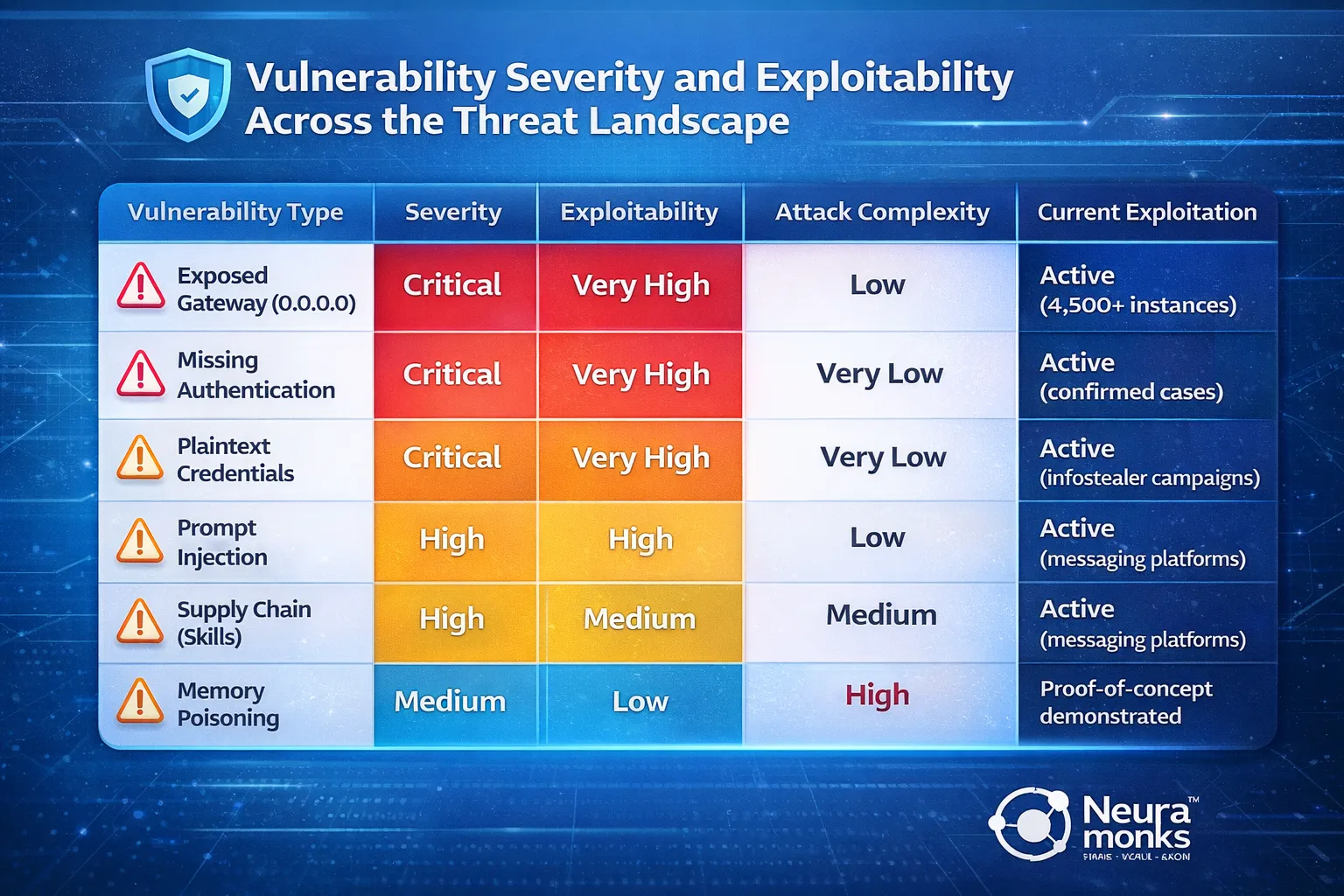
Enterprises exploring AI solutions for automation and productivity need to recognize that these aren't traditional security vulnerabilities with patches on the way—they're architectural characteristics of autonomous agents that require fundamentally different security approaches. Organizations like Neuramonks that specialize in enterprise AI deployments implement security controls at the architecture level rather than trying to retrofit protection onto inherently insecure designs.
Why Traditional Security Controls Fail Against Autonomous AI Agents
Security teams trained on protecting web applications, databases, and traditional enterprise software find themselves unprepared for the challenges autonomous AI agents present. The security model we've built over twenty years of modern computing doesn't translate effectively to systems that are designed to break boundaries and cross security domains. Here's why conventional controls fail:
- AI agents break defined operational boundaries by design: Traditional applications operate within clearly defined scopes—a web server processes HTTP requests, a database manages data queries, a file sync tool moves files between locations. Autonomous AI agents explicitly reject these boundaries, integrating across systems, interpreting ambiguous natural language commands, and making contextual decisions about what actions to take. You can't sandbox something whose entire purpose is escaping sandboxes.
- Static application security testing can't catch dynamic reasoning-driven risks: SAST tools analyze code for known vulnerability patterns—SQL injection, XSS, buffer overflows, hardcoded secrets. But AI agent vulnerabilities emerge from the agent's reasoning process, not from code patterns. How do you write a static rule that detects when an AI might be persuaded through clever prompting to exfiltrate data? The attack surface is in the model's decision-making, not in exploitable code paths.
- Autonomous decision-making bypasses approval workflows: Traditional security controls often rely on human checkpoints—code review before deployment, approval workflows for sensitive operations, manual verification of critical actions. Autonomous agents are specifically designed to operate without these checkpoints. Reintroducing human approval for every action defeats the entire purpose of automation, but removing it creates operational risk most organizations aren't prepared to accept.
- Persistent memory creates delayed multi-turn attack chains: Traditional security monitoring looks for patterns indicating compromise—unusual network connections, unexpected file access, suspicious command execution. But when malicious instructions can be inserted into memory weeks before they trigger execution, traditional indicators of compromise appear disconnected from the initial breach. The attack timeline becomes too distributed for conventional correlation.
- Trust assumptions in messaging platforms fail spectacularly: Security controls in email systems and collaboration platforms assume humans will exercise judgment about message trustworthiness. Phishing awareness training teaches employees to question suspicious messages. But when an AI processes these messages automatically, applying the same trust level to forwarded messages from strangers as to messages from family members, all that human judgment gets bypassed completely.
- Integration amplifies rather than contains impact: Traditional security architecture uses segmentation to limit breach impact—if one system gets compromised, the blast radius stays contained. But AI agents integrate across platforms and services specifically to provide unified capabilities. Compromise doesn't stay contained—it spreads across every connected system, with the agent's own legitimate access providing the perfect cover for malicious activity.
This isn't a criticism of autonomous AI agents—it's a recognition that they represent a fundamentally different security paradigm. The companies succeeding with these deployments aren't the ones trying to apply traditional controls harder. They're the ones rethinking security architecture from first principles, designing governance frameworks that preserve autonomy while limiting catastrophic failure modes, and building monitoring that detects reasoning-driven threats rather than just looking for known attack patterns.
Enterprise Defense Framework: Securing AI Agents Without Killing Functionality
Securing autonomous AI agents requires a systematic approach that balances protection against exploitation with preserving the capabilities that make these systems valuable. Here's the defense framework security teams should implement for any AI agent deployment:
- Immediate actions for existing deployments: Conduct an audit of all AI agent instances running in your environment—including shadow IT deployments on employee devices. Identify exposed instances using network scans, verify authentication is properly configured, immediately revoke any credentials that might have been exposed, isolate compromised or misconfigured systems from production networks until they can be hardened, and document what data and systems each agent has accessed.
- Configuration hardening to eliminate low-hanging vulnerabilities: Change gateway binding from 0.0.0.0 to loopback (127.0.0.1) to prevent direct internet exposure. Enable and enforce strong authentication on all control interfaces using multi-factor authentication where possible. Migrate credential storage from plaintext files to encrypted vaults or operating system keychains. Disable unnecessary integrations and services to reduce attack surface. Configure the agent to require explicit approval for sensitive operations like external communication, file deletion, or executing administrative commands.
- Network segmentation restricting access to trusted paths only: Never expose AI agent control interfaces directly to the public internet. Implement VPN or Tailscale for remote access rather than port forwarding. Use firewall rules to explicitly allowlist necessary connections and block everything else. Segment AI agent infrastructure from production systems unless integration is absolutely required. Monitor and log all network connections the agent makes, alerting on unexpected destinations.
- Comprehensive monitoring and detection covering agent-specific threats: Set up alerts for exposed ports and unauthenticated access attempts to AI agent control interfaces. Monitor the agent process for unexpected command execution patterns, particularly shell commands accessing sensitive directories or making network connections to unknown domains. Deploy endpoint detection and response tools specifically configured to detect information-stealing malware targeting AI agent credential stores. Track and validate the integrity of configuration files, detecting unauthorized modifications that might indicate compromise or memory poisoning.
- Supply chain validation before installing third-party capabilities: Never install skills or extensions from untrusted sources without thorough review. Examine the code manually for suspicious operations like credential exfiltration, unexpected network requests, or system modification commands. Check the developer's reputation, looking for established history rather than newly created accounts. Monitor for typosquatting and lookalike skills designed to impersonate legitimate tools. Consider maintaining an internal vetted skills library rather than allowing arbitrary public installations.
- Least-privilege implementation limiting damage from compromise: Grant AI agents only the minimum permissions necessary for their specific tasks—file system access only to designated directories, shell command execution only for approved commands through allowlists, network access only to explicitly required services. Implement role-based access control so different automation tasks run with different privilege levels. Require human approval workflows for any operation that could cause significant business impact—financial transactions, data deletion, external communications to customers or partners, or modifications to production systems.
- Incident response planning specific to AI agent compromise: Define clear procedures for responding to compromised AI agents—immediate isolation steps, credential revocation processes, forensic data collection requirements. Establish who has authority to shut down agent operations if compromise is suspected. Document all systems and data the agent has access to so incident scope can be quickly assessed. Plan communication protocols for notifying affected users or external parties if the agent's connected accounts are used maliciously. Test these procedures regularly rather than discovering gaps during an actual incident.
The goal isn't to make autonomous AI agents completely risk-free—that's impossible for systems designed to operate with broad authority across organizational boundaries. The goal is reducing risk to acceptable levels while preserving the capabilities that make these systems valuable for automation and productivity. Organizations that implement this framework thoughtfully can deploy AI agents that deliver business value without creating security nightmares that keep CISOs awake at night.
For enterprises that need professional security architecture for AI agent deployments, Neuramonks provides comprehensive consulting services covering threat modeling, security design, governance frameworks, and implementation of defense-in-depth controls specifically tailored to autonomous AI systems. We've helped organizations across industries deploy AI infrastructure that satisfies security teams, passes compliance audits, and delivers reliable automation without creating unacceptable risk.
Strategic Perspective: The Future of AI Agent Security
Clawbot or Moltbot represents both a warning and an opportunity. The warning is clear—autonomous AI agents deployed without proper security architecture create catastrophic risks that traditional controls can't adequately mitigate. The rapid exploitation following viral adoption demonstrates that threat actors are ready and able to capitalize on these vulnerabilities at scale. Organizations treating AI agent deployment as a simple software installation rather than a fundamental change in their security model will face consequences.
Autonomous AI agents can transform operations, but success depends on treating them as critical infrastructure from the start. Secure deployments rely on basics—least-privilege access, encrypted credentials, restricted interfaces, approvals for sensitive actions, and vetted code. AI security isn’t optional; it’s what turns automation into long-term value instead of a short-lived experiment. Design with threat modeling, build controls into the architecture, and govern autonomy without losing control.
This is just the beginning of the agentic era. The security challenges we're seeing with autonomous AI agents will only grow more complex as these systems become more capable and more deeply integrated into business operations. Organizations that invest now in understanding these threats and building proper defenses will have significant competitive advantages over those playing catch-up after their first major breach.
Ready to secure your AI infrastructure before the next breach? The threats facing autonomous AI agents aren't going away—they're accelerating as adoption grows. Neuramonks helps enterprises deploy AI agents with the security architecture, governance frameworks, and monitoring capabilities that keep both productivity and protection intact.
Our team has built security-first AI deployments for organizations that can't afford to treat autonomous agents as experiments. We handle the complexity—threat modeling, configuration hardening, permission frameworks, supply chain validation, and incident response planning—so you get AI infrastructure that passes security audits and delivers business value.
Schedule a security consultation with Neuramonks to assess your AI agent risk exposure, or contact our team to discuss enterprise-grade deployment strategies that your CISO will actually approve. Because the difference between AI that transforms operations and AI that creates incidents is how seriously you take security from day one
How to Install Clawbot in Device
Most Clawbot setups fail within 48 hours because teams rush deployment instead of securing it. This guide contrasts risky “fast” installs with production-grade deployments—covering permissions, security controls, and governance—based on the enterprise AI infrastructure methodology used by Neuramonks.
Most Clawbot installations fail within the first 48 hours—not because the software is broken, but because teams skip the fundamentals. I've watched companies rush through installation in 20 minutes, only to spend weeks troubleshooting security vulnerabilities, permission conflicts, and gateway crashes that could have been avoided with proper planning. The difference between a Clawbot deployment that becomes critical infrastructure and one that gets abandoned after the first demo comes down to how seriously you take the installation process.
Clawbot isn't just another AI chatbot you add to Slack. It's autonomous AI infrastructure that runs on your servers, executes shell commands, controls browsers, manages files, and integrates with your entire digital ecosystem. When installed properly, it becomes one of your most valuable operators—monitoring processes, handling repetitive decisions, and keeping workflows moving 24/7. When installed carelessly, it becomes a security nightmare with root access to your systems. At Neuramonks, we've deployed AI solutions and agentic AI systems for enterprises that understand this distinction, and what I've learned is simple: the "fast way" creates technical debt you'll regret within days.
This guide walks through enterprise-grade Clawbot installation—the approach that prioritizes security, reliability, and long-term operational success over quick demos. If you're serious about deploying AI infrastructure that actually works in production environments, keep reading.
Why Most Clawbot Installations Fail in Production
The "fast way" to install Clawbot device infrastructure feels productive in the moment—copy a command, paste it into your terminal, watch packages download, and boom, you're running AI on your laptop. Then reality hits. Here are the most common mistakes that break deployments before they ever reach production:
- Outdated Node.js versions: Clawbot requires Node.js 22 or higher for modern JavaScript features. Installing on Node 18 or 20 is the single most common cause of cryptic build failures, and I've seen teams waste entire days debugging issues that a simple node --version check would have prevented.
- Missing build tools and dependencies: The installation process compiles native modules like better-sqlite3 and sharp. Without proper build tools (Python, node-gyp, compiler toolchains), these compilations fail silently or throw errors that look like Clawbot bugs when they're actually environment problems.
- Wrong installation environment: Developers install Clawbot on their personal laptops "just to try it out," then wonder why it's unreliable when their machine sleeps, why performance degrades when they're running other applications, or why security teams panic when they discover an AI agent with full system access on an unmanaged device.
- Skipping the onboarding wizard: The openclaw onboard command isn't optional busywork—it configures critical security boundaries, permission models, and API authentication. Teams that bypass this step end up with misconfigured agents that either can't do anything useful or have dangerously broad access.
- Permission errors and npm conflicts: Running installations with wrong user accounts, system-level npm directories that require sudo, or conflicting global packages creates EACCES errors that block deployment. What should take 10 minutes stretches into hours of permission troubleshooting.
- Exposed admin endpoints: Here's the scary one—hundreds of Clawbot gateways have been found exposed on Shodan because teams didn't configure proper gateway binding. Default installations that bind to 0.0.0.0 instead of loopback turn your AI agent into an open door for anyone scanning the internet.
These aren't theoretical risks. I've seen production deployments compromised, AI agents making unauthorized changes, and companies abandoning Clawbot entirely after rushed installations created more problems than they solved. The pattern is always the same: teams prioritize speed over structure, then spend 10x the time fixing preventable issues.
Understanding Clawbot's Architecture Before You Install
Before you install Clawbot device infrastructure, you need to understand what you're actually deploying. This isn't a web app you can uninstall if things go wrong—it's a persistent AI operator with deep system access. Here's what makes Clawbot fundamentally different from traditional AI assistants:
- Infrastructure ownership and privacy-first design: Unlike ChatGPT or Claude.ai, Clawbot runs entirely on hardware you control. Your conversations, documents, and operational data never touch third-party servers unless you explicitly configure external AI APIs. This is true data sovereignty—no company is mining your interactions, and no terms-of-service update can suddenly change what happens to your information.
- Autonomous execution beyond conversation: Clawbot doesn't just answer questions—it directly manipulates your systems. It executes shell commands, writes and modifies code, controls browser sessions, manages files, accesses cameras and location services, and integrates with production services. If Anything runnable in Node.js — Clawbot can coordinate. This power is exactly why installation matters so much.
- Multi-platform integration with unified memory: You can communicate with your Clawbot instance through WhatsApp, Telegram, Discord, Slack, Signal, iMessage, and 15+ other platforms. Conversations maintain context across all channels, so you can start a task on Slack at your desk and follow up via WhatsApp during your commute. This unified presence requires proper gateway configuration to work reliably.
- Full system access with extensible capabilities: Clawbot integrates with over 50 services through its skills ecosystem, runs scheduled background tasks, monitors system resources, and executes workflows while you're offline. The ClawdHub marketplace hosts 565+ community-developed skills, and the system can build custom skills on demand for your specific requirements.
- Model-agnostic AI flexibility: Choose between Anthropic's Claude for sophisticated reasoning, OpenAI's GPT models for versatility, or completely free local models via Ollama. Switch AI providers without reconfiguring your entire deployment—the gateway architecture abstracts model selection from operational logic.
Understanding this architecture matters because it shapes your installation strategy. You're not setting up a chatbot—you're deploying AI infrastructure that needs security controls, monitoring, backup strategies, and operational governance. as AI Consulting Services we specializing in enterprise AI solutions, we've helped companies recognize this distinction before they rush into production deployments that compromise security or reliability.
The Right Way: Pre-Installation Requirements and Planning
Proper Clawbot installation starts before you touch a terminal. Here's the systematic pre-installation checklist that prevents 90% of the issues I see in production:
- System requirements verification: Confirm you're running Node.js 22 or higher with node --version. Check that you have adequate RAM (minimum 4GB, recommended 8GB+) and storage for models, logs, and workspace data. Verify that build tools are installed—on macOS this means Xcode Command Line Tools, on Linux it's build-essential and Python 3, on Windows it's Windows Build Tools or WSL2.
- Choose proper installation environment: Clawbot should run on a controlled server, private cloud instance, or isolated virtual machine—never a personal laptop for production use. The environment needs to be always-on, properly backed up, and secured with least-privilege access. Consider whether you'll host on-premise or use cloud VPS providers like Hetzner, DigitalOcean, or AWS.
- Network and security planning: Map out which ports your gateway will use (default 18789), how you'll handle firewall rules, whether you need VPN or Tailscale for remote access, and how to prevent public internet exposure. Plan your network segmentation so the Clawbot instance can access necessary services without having broader access than required.
- Access control strategy: Define who gets what permissions before installation. Will this be a shared organizational agent or individual instances per user? What approval workflows do you need for sensitive actions like database modifications, external API calls, or financial transactions? Document these policies now, not after someone makes an unauthorized change.
- Logging and monitoring infrastructure: Clawbot generates detailed logs for every action, API call, and system interaction. Plan where these logs will be stored, how long you'll retain them, who can access them, and whether you need integration with existing monitoring tools like Datadog, Grafana, or ELK stack. Without proper logging, troubleshooting becomes impossible.
- Backup and disaster recovery plan: Your Clawbot instance will accumulate conversation history, learned behaviors, custom skills, and integration configurations. Plan automated backups of your state directory (default ~/.openclaw) and workspace, define recovery time objectives, and test restoration procedures before you need them in production.
This planning phase typically takes 2-4 hours for small deployments and a full day for enterprise environments. Teams that skip it inevitably spend weeks fixing issues that proper planning would have prevented. As an AI development company, Neuramonks includes this planning phase in every client engagement because we've seen firsthand what happens when organizations skip fundamentals to chase speed.
Step-by-Step Installation Process for Enterprise Deployment
With planning complete, here's the systematic installation workflow that creates production-ready Clawbot deployments:
- Install Node.js 22+ and verify build tools: Use nvm (Node Version Manager) or download directly from nodejs.org. After installation, run node --version and npm --version to confirm. Test that build tools are available with gcc --version (Linux/macOS) or verify Visual Studio Build Tools (Windows). Don't proceed until these fundamentals work.
- Run official installation script with proper flags: Use the official installer with verbose output: curl -fsSL https://openclaw.ai/install.sh | bash -s -- --verbose. The verbose flag shows exactly what's happening and makes troubleshooting easier if issues arise. Never pipe untrusted scripts to bash in production—review the install.sh contents first to understand what it does.
- Complete onboarding wizard thoroughly: Run openclaw onboard --install-daemon and work through every prompt carefully. Select your AI model provider (Claude, GPT, or local Ollama), configure messaging channels one at a time, set initial permission boundaries, and verify API keys are valid. The wizard handles critical security configuration—skipping steps here creates vulnerabilities.
- Configure least-privilege permissions: Start with minimal access and expand gradually. Enable file system access only to specific directories, restrict shell command execution to approved commands, require human approval for external API calls, and disable internet access for sensitive environments. You can always grant more permissions—revoking them after incidents is much harder.
- Set up secure gateway binding: Edit your configuration to bind the gateway to loopback (127.0.0.1) instead of 0.0.0.0. This single change prevents external network exposure while allowing local access and properly configured remote connections via VPN or Tailscale. Check your config file (typically ~/.openclaw/config.yaml) and explicitly set gateway.bind: "loopback".
- Connect messaging channels systematically: Add one messaging platform at a time—start with the channel you'll use most (often Telegram for technical teams or WhatsApp for broader access). Verify each integration works before adding the next. Test both sending and receiving messages, confirm authentication persists across gateway restarts, and validate that conversation history syncs properly.
- Test with low-risk tasks first: Your first operational test should be something that can't cause damage—create a file in a temporary folder, summarize a local text document, or query current system resources. Confirm the task completes successfully, verify you can see the action in logs, and check that results appear in your messaging platform as expected.
- Enable comprehensive logging and monitoring: Configure log levels to capture detailed execution traces, set up log rotation to prevent disk space issues, integrate with your monitoring stack to track gateway health and performance, and create alerts for suspicious activity patterns. What you don't log, you can't troubleshoot or audit.
At Neuramonks, we implement staged rollouts for enterprise clients—starting with restricted pilots, expanding to low-risk production tasks, and gradually enabling full autonomous operation only after the system proves reliable and secure. This phased approach dramatically reduces deployment risk while building organizational confidence in AI infrastructure.
Security Configuration That Actually Protects Your Infrastructure
Security isn't a feature you add after installation—it's the foundation you build on. Here's what enterprise-grade Clawbot security actually looks like:
- Gateway binding to loopback prevents internet exposure: Configure gateway.bind: "loopback" in your config file. This ensures the gateway only accepts connections from the same machine or through explicitly configured tunnels like Tailscale or VPN. Hundreds of Clawbot instances have been found on Shodan because teams left default 0.0.0.0 bindings that exposed admin endpoints to the entire internet.
- Least-privilege access policies limit blast radius: Grant only the minimum permissions necessary for each task. File access should be restricted to specific directories, shell commands should use allowlists rather than blocklists, and external API calls should require explicit approval. When incidents occur—and they will—proper permissions mean the damage stays contained.
- Human approval workflows for sensitive actions: Critical operations like database modifications, financial transactions, external communications, or infrastructure changes should always require human confirmation. Configure approval flows in your config file and test them thoroughly before enabling autonomous execution in production.
- Proper API key management and rotation: Store API keys in secure vaults like AWS Secrets Manager or HashiCorp Vault, never commit them to version control, rotate them regularly (quarterly at minimum), and monitor usage patterns for anomalies. Compromised API keys have led to massive unexpected bills when attackers use them for cryptocurrency mining or other abuse.
- Network segmentation isolates AI infrastructure: Run Clawbot in isolated network segments with firewall rules that explicitly allow only necessary connections. The AI agent doesn't need direct access to your production database, financial systems, or customer data stores—architect network access to match your actual requirements.
- Audit logging provides traceability and accountability: Every action, API call, and decision should be logged with sufficient detail to reconstruct what happened and why. Logs must include timestamps, the triggering message or event, the decision-making process, and the actual execution result. Without comprehensive logs, you can't investigate incidents, prove compliance, or improve system behavior over time.
Here's a comparison table showing the security differences between "fast way" and "right way" installations:
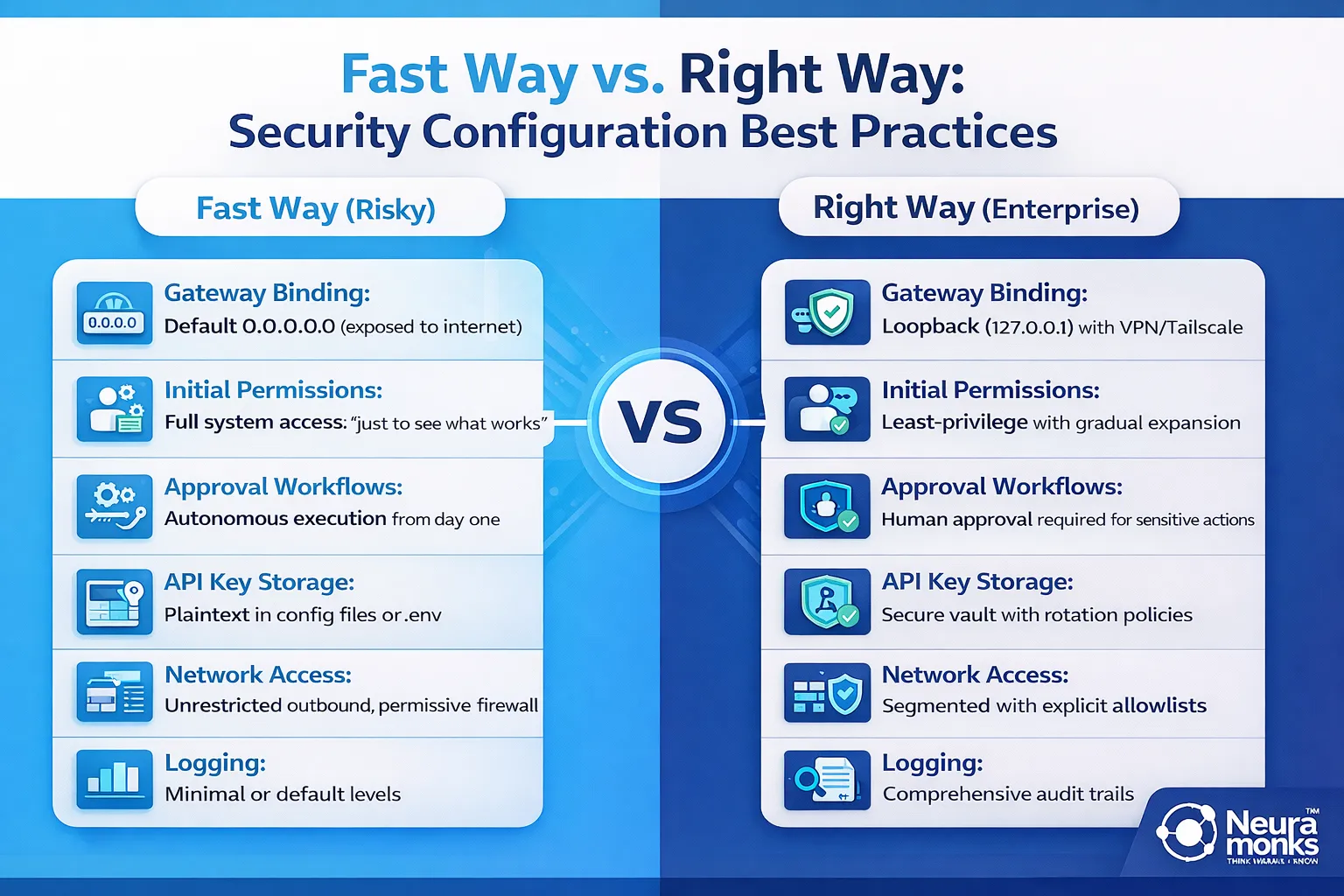
The "right way" takes a few extra hours during installation but prevents security incidents that can take weeks to remediate and damage organizational trust in AI infrastructure. Neuramonks specializes in deploying enterprise AI solutions with security architectures that satisfy compliance requirements, pass security audits, and maintain operational reliability under real-world conditions.
Final Thoughts: Beyond Installation to Operational Success
Installing Clawbot properly is just the beginning. The real value emerges over weeks and months as the system proves reliable, teams trust its decisions, and you gradually expand its autonomy into more complex workflows. Organizations that take the "right way" approach create AI infrastructure that becomes genuinely indispensable—quietly handling repetitive decisions, monitoring critical processes, and keeping operations moving 24/7 without constant human oversight.
What separates successful deployments from abandoned experiments? Proper installation that prioritizes security, systematic rollout that builds confidence, comprehensive monitoring that catches issues early, and ongoing optimization that expands capabilities as trust grows. Companies that skip these fundamentals end up with AI agents that break in production, create security vulnerabilities, or fail to deliver ROI because teams don't trust them enough to enable meaningful automation.
Your next steps after installation should focus on validation and gradual expansion. Monitor logs daily during the first week, run progressively more complex test tasks, document what works and what doesn't, gather feedback from users, and systematically address issues before they become patterns. Only after your Clawbot instance demonstrates consistent reliability should you consider expanding permissions or enabling autonomous execution in production workflows.
For startups and enterprises serious about deploying AI solutions that actually work in production environments, Neuramonks offers comprehensive AI consulting services that go far beyond basic installation. As an AI development company specializing in agentic AI systems, enterprise automation, and AI ML services, we help organizations navigate the complexity of production AI deployment—from initial architecture design through security configuration to operational governance and continuous optimization.
Ready to deploy Clawbot with enterprise-grade security and reliability? Our team at Neuramonks has successfully implemented AI infrastructure for companies across industries, turning experimental AI into production systems that deliver measurable business value. We handle the complexity—architecture planning, security hardening, permission frameworks, monitoring setup, and staged rollouts—so you get AI infrastructure that works from day one.
Contact Neuramonks today to discuss your AI deployment requirements, or schedule a consultation with our AI solutions team to explore how we can help you build autonomous AI infrastructure that your organization can actually trust in production.
How to Install Clawbot Securely
Clawbot is an AI operator, not a normal tool. Install it securely, start with limited access, require approval, and expand automation gradually to build trust and reliability.
Before You Install: Read This First
Most software enters a company quietly. Someone signs up, connects a few apps, and within minutes the tool becomes part of the workflow.
Clawbot doesn’t work that way.
You’re not installing a dashboard, plugin, or chatbot widget — you’re introducing an operational AI agent. It reads information, makes decisions, and can trigger real actions across your systems. The moment it connects to live workflows, the question changes from “Does it work?” to “Can we trust it?”
Many teams rush the setup because the first results look impressive. The agent drafts messages, flags issues, and automates tasks. But problems rarely appear during testing. They appear after trust is granted too quickly. The risk with agentic systems isn’t intelligence — it’s unstructured access.
So installation is not about speed.
It is about controlled introduction.
Fast setup gives a demo.
Structured setup creates a reliable operator.
Start With the Environment, Not the Interface
A common mistake is installing the agent on a personal machine just to try it quickly. That works for communication tools — not for operational AI.
Clawbot accumulates memory: logs, workflow context, tokens, and permissions. If that lives on a laptop or shared environment, exposure becomes invisible. From day one, the system should run inside dedicated infrastructure — a secured server, private cloud instance, or isolated virtual machine.
Treat it like infrastructure early, and you won’t need to rebuild trust later.
Safety Is Defined by Permissions
People assume the AI itself is the danger. In reality, permissions are.
If the agent can access everything, eventually it will use everything — even while trying to help. The correct rollout begins with visibility instead of authority. Let it read before it edits. Let it suggest before it executes. Let automation come last.
Security with AI agents isn’t about limiting capability. It’s about sequencing capability.
Contain the Network, Not the Intelligence
You don’t make an AI safer by making it less capable. You make it safer by controlling where it can act.
A secure installation ensures the agent operates inside a private network and communicates outward only when needed. External systems shouldn’t freely send instructions into it. This means restricted ports, private routing, and controlled gateways.
Think of it as giving an employee a phone — not leaving the office door open.
Human Approval Builds Trust
Autonomy should never be the starting point. It should be earned.
At the beginning, every meaningful action should pass through human review — sending emails, updating records, triggering workflows, or changing data. This prevents costly mistakes and produces feedback that improves reliability.
Teams that skip this stage often mistrust the system later, not because AI failed, but because it was never guided.
Logging Makes the Agent Understandable
If a human employee changes something, you can ask why.
With AI, the record must already exist.
Every decision and action should be logged and reviewable. Observability turns the agent from a black box into an auditable operator. Trust grows when behavior is explainable.
No logs, no confidence.
Separate Learning From Production
Allowing the system to learn directly in live workflows is risky. Training should happen in controlled environments first, then expand gradually into production.
Just like onboarding a new employee — training comes before responsibility.
Step-by-Step: How to Install Clawbot Safely
Below is a production-grade installation flow. Follow the order — skipping steps is where most failures happen.
1. Create a Dedicated Environment
Prepare secure infrastructure:
Use:
- Private cloud VM (AWS / Azure / GCP)
- On-premise secured server
- Isolated virtual machine
- Docker container in protected network
Avoid:
- Personal laptops
- Shared computers
- Direct local installation
The agent will store tokens, workflow memory, and logs — this must remain controlled.
2. Install Runtime & Dependencies
Inside the server:
- Update system packages
- Install Docker or runtime environment
- Create a non-admin service user
- Configure firewall rules
Now the system can safely host the agent.
3. Deploy Clawbot
Deploy inside a container or isolated service:
- Pull Clawbot package/image
- Create configuration file
- Add environment secrets (API keys, credentials)
- Start the service
Never hardcode secrets.
4. Configure Network Security
Restrict communication:
- Private IP access only
- Reverse proxy or API gateway
- IP allow-listing
- Outbound connections allowed
- Inbound commands restricted
The agent can reach services — services shouldn’t freely reach the agent.
5. Connect Integrations in Read-Only Mode
Connect business systems carefully:
Examples:
CRM, helpdesk, database, Slack, email, dashboards
Start with:
Read → Analyze → Suggest
No write permissions yet.
6. Enable Logging & Monitoring
Before real usage, activate observability.
Log:
- Prompts
- Decisions
- Actions attempted
- API calls
- Errors
If actions cannot be audited, automation should not exist.
7. Add Human Approval Layer
Require confirmation for:
- Sending messages
- Updating records
- Triggering workflows
- External actions
Now the agent behaves like an assistant, not an uncontrolled actor.
8. Run in Sandbox Mode
Test using non-production data.
Let the agent observe workflows and suggest actions.
Review results and adjust permissions.
9. Gradually Allow Actions
Increase authority step-by-step:
- Draft only
- Draft + approval execution
- Limited automation
- Scheduled automation
- Trusted automation
Never jump directly to full automation.
10. Move to Production
After stable performance:
- Connect live data
- Keep approval for critical actions
- Continue logging permanently
Installation is complete only when monitoring is active — not when the system starts.
The Real Security Principle
Traditional systems are secured from attackers.
Agentic systems must also be secured from good intentions.
A helpful assistant acting on incomplete understanding can create more disruption than malicious code. Safe deployment aligns capability with context over time.
Final Thoughts
Clawbot can become one of the most valuable operators in your organization — monitoring processes, handling repetitive decisions, and keeping workflows moving quietly in the background.
But its value depends entirely on how responsibly it is introduced.
Fast installation creates excitement. Careful installation creates reliability.
Need Help Setting It Up Correctly?
Secure AI deployment requires infrastructure design, permission planning, monitoring, and staged rollout — not just technical setup.
At NeuraMonks, we help organizations deploy production-grade AI operators with governance and safe autonomy expansion.
Because the goal isn’t just to run AI inside your company —
it’s to trust it there.
From Chatbots to AI Workers: What OpenClaw, Moltbot and Clawbot Really Are and How to Use Them
This blog explains the shift from conversational AI tools to operational AI systems — often called AI workers. Instead of answering questions like chatbots or copilots, platforms such as Clawbot, OpenClaw, and Moltbot are designed to execute real tasks inside business workflows.
For years we’ve interacted with AI like we interact with search engines — we ask, it answers.
Even modern AI tools mostly live inside that same pattern: prompt → response → copy → paste → done.
But a new category of AI is quietly emerging inside companies.
Not assistants. Not copilots.
Operators.
This is where systems like Clawbot, OpenClaw, and Moltbot come in. They are not designed to help you complete tasks — they are designed to complete tasks for you inside your own workflows.
To understand them, you have to stop thinking about AI as a tool and start thinking about AI as a role.
Clawbot — The Worker
Clawbot is the part people notice first because it actually does things.
- Instead of answering how to send an email, it sends the email.
- Instead of suggesting a report, it generates and delivers it.
- Instead of telling you an alert exists, it investigates the alert.
In practical environments, teams use Clawbot to monitor dashboards, update CRM records, respond to operational triggers, summarize meetings, triage support tickets, or run internal processes that normally require human attention but not human judgment.
The key shift is execution.
- Traditional AI reduces effort.
- Clawbot reduces involvement.
You are no longer operating software — you are supervising a digital worker operating software.
OpenClaw — The System That Gives AI a Job Description
If Clawbot is the worker, OpenClaw is the structure that tells it what its job actually is.
OpenClaw is the framework where companies define:
- how the AI should behave,
- what it is allowed to access,
- when it should act,
- and when it should ask.
Instead of one generic assistant, organizations can create multiple specialized agents — operations assistant, support assistant, finance assistant, engineering assistant — each with boundaries and responsibilities.
Without this layer, AI is intelligent but directionless.
With it, AI becomes organizational.
In other words, OpenClaw converts intelligence into process.
Moltbot — The Training and Learning Layer
Human employees improve because they observe outcomes and feedback.
Agentic systems need the same mechanism.
Moltbot handles learning.
It tracks corrections, approvals, rejections, and overrides. Over time it adapts behavior so that repeated mistakes disappear and frequent approvals become automatic. The system evolves from cautious automation to confident execution.
The important part is that improvement doesn’t require retraining a model — it happens operationally.
Moltbot turns usage into education.
How They Work Together
Think of a normal company structure.
- The employee performs tasks.
- The company defines processes.
- Training improves performance.
That is exactly the relationship here:
- Clawbot performs
- OpenClaw organizes
- Moltbot improves
Together they create an environment where AI stops being a conversation interface and starts becoming operational infrastructure.
How Teams Actually Start Using It
The most successful teams don’t start with big automation dreams. They start with observation.
First the agent watches workflows — alerts, emails, dashboards, tickets — and suggests actions.
Then it performs actions after approval.
Finally it handles low-risk processes independently.
The moment teams realize the real value is not faster work but fewer interruptions, adoption accelerates. The system becomes a background operator rather than a visible tool.
People stop “using AI” and start relying on outcomes.
Why This Matters
- Software improved productivity.
- Automation improved efficiency.
- Agentic AI improves operational capacity.
Instead of hiring more people to manage complexity, companies can delegate predictable decision loops to internal AI workers while humans focus on judgment, creativity, and strategy.
The organizations that understand this shift early won’t just save time — they’ll operate differently.
If You’re Considering Implementing It
These systems look simple on the surface but become architectural quickly: permissions, workflows, monitoring, and safety design matter more than prompts.
At NeuraMonks, we help teams design and deploy internal AI operators — from defining agent responsibilities to integrating them into production workflows safely.
Because the goal isn’t experimenting with AI.
The goal is trusting it with work.
The Future of Radiology: How AI Healthcare Solutions Are Transforming Diagnostic Imaging
AI healthcare solutions are transforming radiology by enhancing diagnostic accuracy, accelerating image interpretation, and reducing radiologist workload—ushering in a smarter, faster, and more scalable future for diagnostic imaging.
Imagine stepping into a hospital radiology department five years from now. The room hums with advanced machines, but what truly stands out are the intelligent systems working alongside radiologists—systems that help detect abnormalities faster, flag critical findings, and reduce the strain on overworked clinicians. This isn’t science fiction. This is the reality being shaped today by AI Healthcare Solutions, particularly through AI for Radiology applications that are redefining how imaging departments operate.
From early detection of diseases to streamlining workflows, Artificial Intelligence in healthcare is ushering in an era of faster, more accurate diagnostic imaging. In this article, we’ll explore how AI is used in radiology, why it’s becoming essential, the pros and cons, and the role innovative companies like Neuramaonks are playing in this transformation.
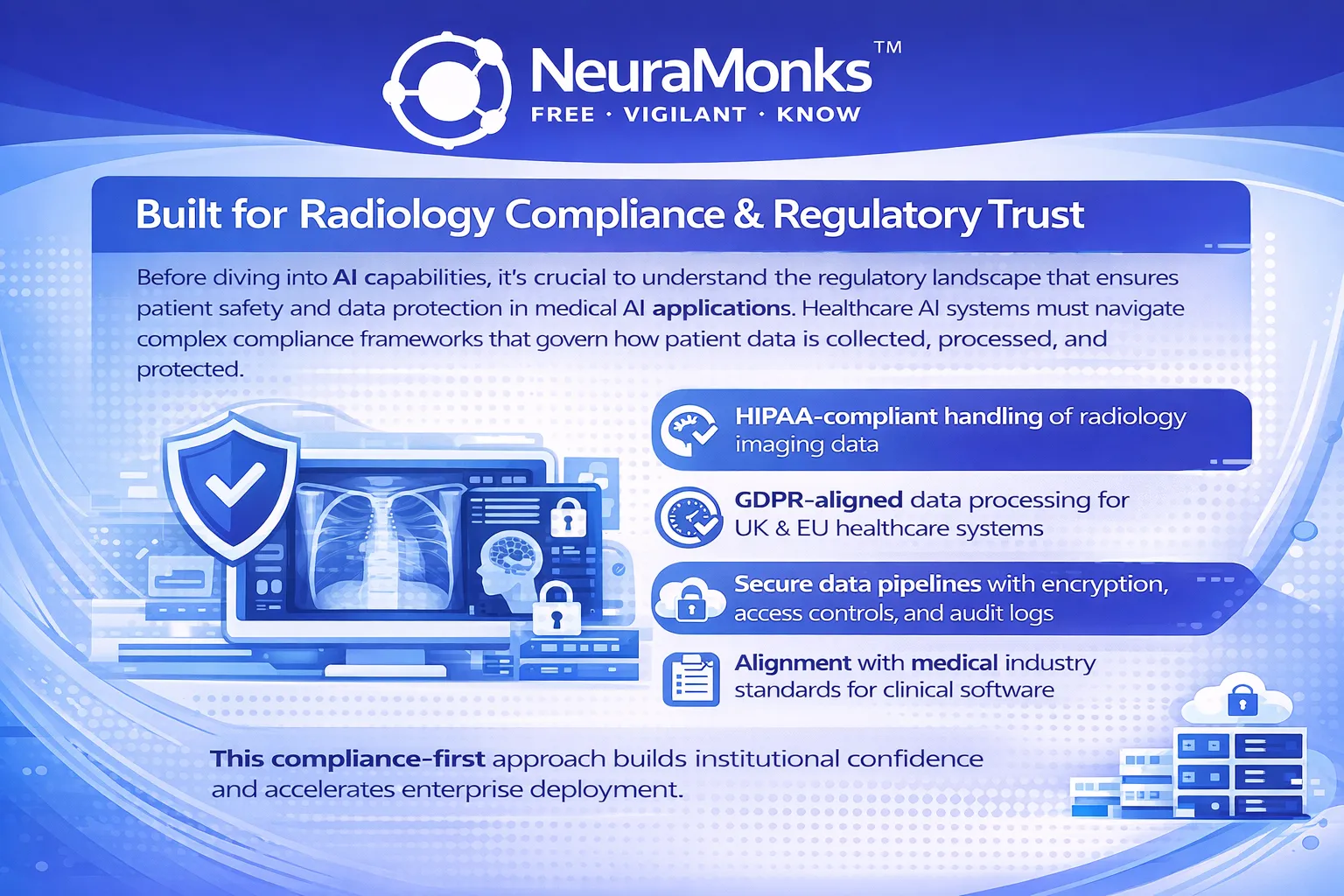
Built for Radiology Compliance & Regulatory Trust
Before diving into AI capabilities, it's crucial to understand the regulatory landscape that ensures patient safety and data protection in medical AI applications. Healthcare AI systems must navigate complex compliance frameworks that govern how patient data is collected, processed, and protected.
- HIPAA-compliant handling of radiology imaging data
- GDPR-aligned data processing for UK and EU healthcare systems
- Secure data pipelines with encryption, access controls, and audit logs
- Alignment with medical industry standards for clinical software
This compliance-first approach builds institutional confidence and accelerates enterprise deployment.
How Is AI Used in Radiology?
When most people hear “AI in radiology,” they think of robots reading X-rays. The reality is much more collaborative: AI tools act as partners to radiologists, enhancing their capabilities rather than replacing them.
AI’s Core Functions in Radiology
- Image Processing & Interpretation
AI-powered preprocessing and deep learning models enhance X-ray, CT, MRI, and ultrasound images—helping radiologists interpret scans faster and with greater diagnostic confidence.
- Anomaly & Disease Detection
Automated detection of tumors, lesions, infections, and vascular abnormalities reduces missed findings, supports earlier diagnosis, and lowers the need for repeat scans.
- Priority & Triage Systems
Critical and high-risk cases are automatically flagged, enabling faster review in emergency and high-volume radiology environments and improving patient response times.
- Workflow Automation & Reporting
Automated measurements, segmentation, and reporting streamline radiology workflows, reduce manual workload, improve consistency, and increase overall department throughput.
These applications fall under the broader umbrella of AI Healthcare Solutions, where intelligent software enhances efficiency, accuracy, and diagnostic confidence.
AI in Radiology: Pros & Cons
AI solutions are transforming radiology by improving speed, accuracy, and efficiency—but they also come with challenges.
Pros of AI Solutions in Radiology
- Higher diagnostic accuracy: AI solutions detect subtle patterns and reduce human error.
- Faster reporting: Automated image analysis shortens turnaround time for results.
- Reduced radiologist workload: AI handles repetitive tasks, freeing experts for complex cases.
- Consistent analysis: AI solutions deliver standardized results without fatigue.
- Early disease detection: Enables earlier identification of cancer, stroke, and fractures.
Cons & Limitations
- Data dependency: AI solutions rely on large, high-quality datasets.
- Integration issues: Compatibility with PACS and EHR systems can be challenging.
- Regulatory & ethical concerns: Accountability and compliance remain critical.
- Cost barriers: Advanced AI solutions may be expensive for some facilities.
Bottom line: While challenges exist, AI solutions in radiology deliver clear clinical value—and their impact will only grow as technology matures.
Practical Medical Imaging Experience Behind AI Accuracy
Improving diagnostic accuracy in radiology requires real-world clinical exposure across diverse imaging scenarios. This experience spans machine learning and deep learning–based medical imaging use cases that help shape reliable AI Healthcare Solutions.
Real-world deployments include blood cell counting, malaria detection, lung and breast cancer imaging analysis, tumor detection systems, and ongoing work in tumor progression prediction. Additional initiatives cover glaucoma detection, chromosome karyotyping, COVID-19 imaging, and dental X-ray analysis.
In chest CT imaging, AI models can highlight regions suspicious for lung cancer that may be overlooked during manual review, enabling faster and more confident clinical decisions.
Extending Imaging Intelligence to Telemedicine
Telemedicine is a dedicated focus within modern medical AI initiatives, enabling diagnostic intelligence beyond hospital settings. One key application is AI-powered wound detection for remote monitoring, which supports online consultations, continuous healing assessment, and objective measurement of wound size and tissue changes over time.
By combining medical imaging intelligence with telehealth platforms, AI Healthcare Solutions help clinicians deliver consistent, data-driven care remotely—improving access while reducing unnecessary in-person visits.
What Are the Primary Benefits of Artificial Intelligence in Diagnostic Imaging?
While we’ve touched on benefits already, here’s a consolidated look at why AI is such a game-changer:
- Faster image interpretation and reporting
- Higher detection rates
- Reduced false positives and false negatives
- Better resource allocation
- Enhanced patient outcomes
- Scalable solutions for large hospital systems
- Optimization of imaging protocols
Not only does AI improve the quality of care, but it also helps healthcare systems become more efficient and cost-effective.
Which Companies Offer AI-Powered Radiology Imaging Software?
Hospital administrators exploring AI adoption in radiology often face a crowded marketplace filled with ambitious claims. While many companies are entering the space, only a few demonstrate real-world clinical usability. Among them, We has emerged as a notable name for its focused work in AI-driven radiology solutions designed specifically for hospital environments.
Rather than positioning AI as a replacement for radiologists, we builds systems that support clinical decision-making, reduce operational strain, and fit into existing workflows without disruption.
Neuramaonks: A Leader in AI Radiology Innovation
We specializes in intelligent image analysis software that works alongside radiologists to improve both speed and diagnostic confidence. Their solutions are designed to handle the growing imaging workload hospitals face today.
Our AI tools assist radiologists by:
- Enhancing diagnostic clarity, helping reduce ambiguous findings in complex scans
- Identifying disease patterns earlier, especially in high-volume imaging scenarios
- Automating segmentation and reporting, cutting manual effort by an estimated 35–40% per study
- Integrating seamlessly with hospital systems, including PACS and existing imaging infrastructure
In pilot hospital environments, We -supported workflows have shown:
- 20–30% fewer follow-up scans due to improved first-read accuracy
- Consistent reporting quality, even during peak imaging hours
- Noticeable reductions in reporting delays, particularly in emergency imaging
Their approach focuses on improving radiology efficiency without adding technical complexity, making the platform practical for both large hospital networks and mid-sized healthcare facilities.
While Neuramaonks is highlighted here for its demonstrated capabilities, hospitals should still evaluate AI vendors based on clinical validation, interoperability, ongoing support, and regulatory readiness before large-scale deployment.
Where Can Hospitals Find AI Radiology Solutions for Integration?
Hospitals today are no longer experimenting with AI for novelty—they are demanding measurable clinical outcomes, reliable integration, and tools radiologists trust under real-world pressure. This is where focused AI Healthcare Solutions providers like Neuramaonks differentiate themselves.
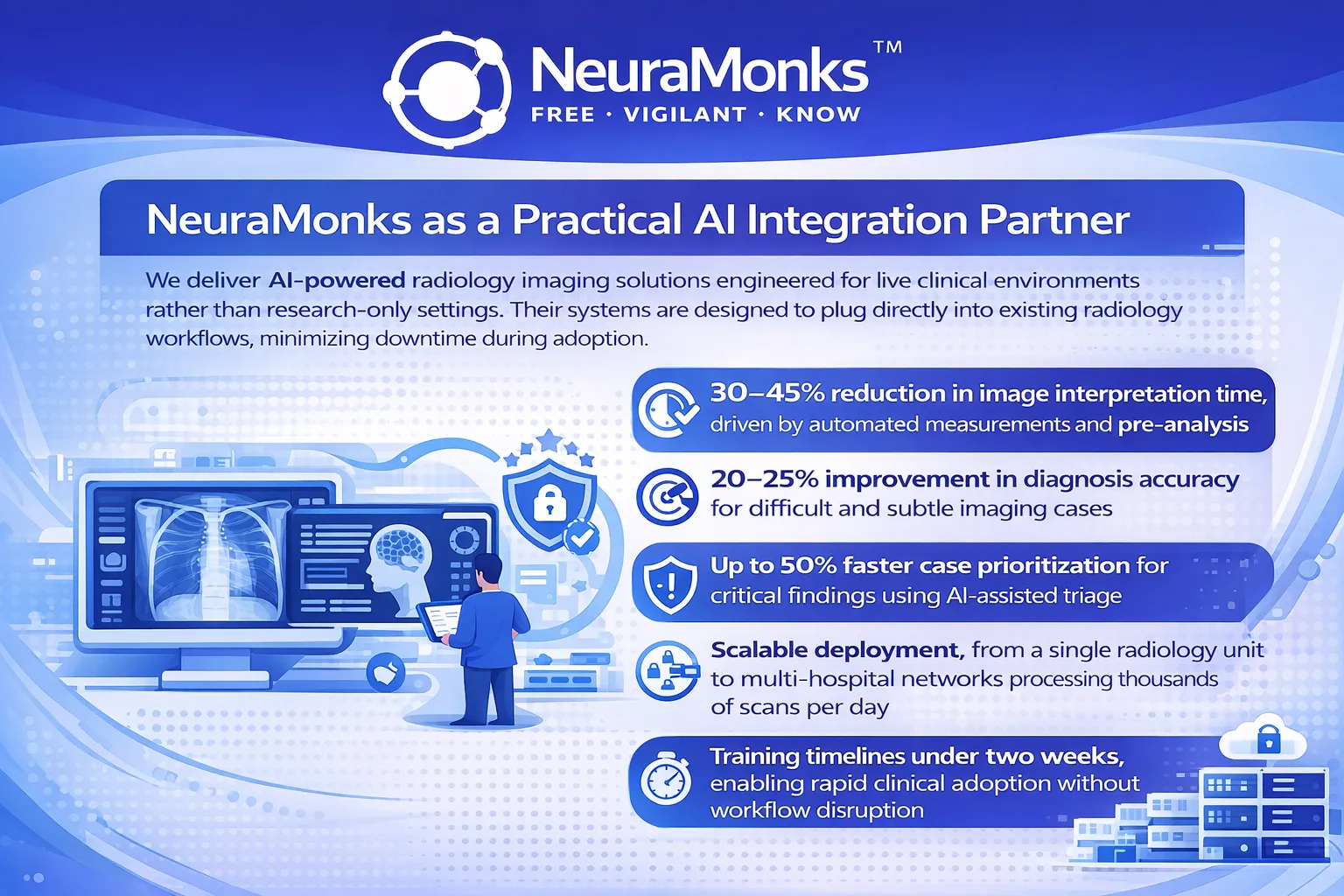
Neuramaonks as a Practical AI Integration Partner
We delivers AI-powered radiology imaging solutions engineered for live clinical environments rather than research-only settings. Their systems are designed to plug directly into existing radiology workflows, minimizing downtime during adoption.
Hospitals integrating with us AI solutions typically report:
- 30–45% reduction in image interpretation time, driven by automated measurements and pre-analysis
- 20–25% improvement in diagnosis accuracy for difficult and subtle imaging cases
- Up to 50% faster case prioritization for critical findings using AI-assisted triage
- Scalable deployment, from a single radiology unit to multi-hospital networks processing thousands of scans per day
- Training timelines under two weeks, enabling rapid clinical adoption without workflow disruption
Unlike generic AI platforms, we prioritizes clinical usability, ensuring AI functions as a quiet assistant in the background rather than a disruptive layer radiologists must manage.
How Hospitals Typically Integrate AI Radiology Solutions
Hospitals adopting us and similar AI Healthcare Solutions usually follow a structured, low-risk implementation model:
- Phase 1: Pilot Deployment
AI introduced in high-volume imaging areas such as CT, MRI, or X-ray, often covering 15–25% of total scan volume. - Phase 2: Performance Benchmarking
Diagnostic accuracy, reporting time, and backlog metrics compared against 6–12 months of historical data. - Phase 3: Full PACS Integration
AI becomes embedded into daily workflows, contributing to workflow automation and standardized reporting. - Phase 4: Advanced Analytics Expansion
Hospitals expand into predictive imaging insights and preventive diagnostics, improving long-term patient outcomes.
This phased rollout helps hospitals reduce operational risk while achieving early, measurable ROI—often within the first 3–6 months of deployment.
Real-World Case Studies
Our AI healthcare solutions are deployed in live clinical and telemedicine environments, delivering measurable impact.
- Cell Segmentation – AI-powered cell segmentation enabling accurate identification and analysis of cellular structures for medical imaging and pathology workflows.
- CareSync – An integrated healthcare AI platform supporting intelligent data workflows, clinical coordination, and scalable medical AI deployment.
- The Corona Test UK – A production-grade AI solution supporting COVID-19 diagnostic workflows within the UK healthcare ecosystem, designed for accuracy, speed, and compliance.
- Automated Wound Detection & Measurement –Using Deep Learning
A telemedicine-focused AI system delivering clinically accurate wound measurement, healing progression tracking, and remote clinician decision support.
Conclusion: Embracing the AI-Driven Future of Radiology
The integration of AI Healthcare Solutions in radiology isn’t just about high-tech tools—it’s about empowering radiologists, improving patient outcomes, and transforming the way healthcare delivers diagnostic precision. Artificial Intelligence in healthcare isn’t replacing human expertise; it’s amplifying it.
From improving diagnostic accuracy to reducing workload and enabling faster treatment decisions, AI stands poised to make radiology more efficient and effective than ever before. And with innovators like Neuramaonks pushing boundaries, hospitals have real, actionable options for integrating these technologies today.
Ready to explore AI solutions for your radiology department?
Reach out to AI vendors, request demos, and start with pilot programs. The future of diagnostic imaging is here—don’t let your hospital fall behind.
From Strategy to Scale: The Ultimate Checklist for Choosing an AI Consulting Company
Choosing the right AI consulting services partner can define your AI success. This ultimate checklist helps businesses evaluate expertise, security, scalability, and ROI with confidence.
The artificial intelligence revolution is reshaping how businesses operate, compete, and grow. Yet for many organizations, the journey from AI strategy to successful implementation remains complex and challenging. Choosing the right AI consulting services partner can mean the difference between transformative success and costly missteps.
Whether you're exploring custom AI solutions for business or looking for a comprehensive artificial intelligence development company to guide your digital transformation, this ultimate checklist will help you navigate the selection process with confidence.
Why Your Choice of AI Development Company Matters
The AI consulting landscape is crowded with promises of innovation and transformation. However, not all AI solutions providers are created equal. The right partner brings more than technical expertise—they deliver strategic insight, industry knowledge, and proven methodologies that align AI capabilities with your business objectives.
According to recent industry research, companies that carefully vet their AI partners report 67% higher success rates in AI implementation projects. The stakes are high, and the selection criteria extend far beyond basic technical capabilities.
The Complete Checklist for Selecting AI Consulting Services
1. Industry-Specific Experience and Domain Expertise
Your AI consulting company should demonstrate deep understanding of your industry's unique challenges and opportunities. Generic AI solutions rarely deliver optimal results when applied to specialized business contexts.
What to look for:
- Proven track record in your specific industry (healthcare, e-commerce, manufacturing, fintech, construction)
- Case studies showcasing successful implementations in similar business environments
- Understanding of industry-specific regulations, compliance requirements, and operational constraints
- Ability to speak your business language, not just technical jargon
Companies like NeuraMonks, for instance, specialize in delivering tailored AI solutions across healthcare, e-commerce, manufacturing, construction, and fintech sectors. This industry-specific approach ensures that AI implementations address real business problems rather than offering generic technology deployments.
2. Comprehensive Service Offerings: From Consultation to Deployment
The best artificial intelligence development company provides end-to-end services that support your entire AI journey, from initial strategy to ongoing optimization.
Essential service components:
- AI Readiness Assessment: Evaluation of your current infrastructure, data quality, and organizational preparedness
- Strategic Consulting: Development of an AI roadmap aligned with business objectives
- Proof of Concept (POC): Validation of AI viability through prototype development
- MVP Development: Rapid deployment of minimum viable products for market testing
- Full-Scale Product Development: Comprehensive AI solution engineering
- Integration Services: Seamless embedding into existing business systems
- Post-Deployment Support: Ongoing monitoring, optimization, and maintenance
A complete service portfolio ensures continuity throughout your AI transformation, eliminating the need to engage multiple vendors at different stages.
3. Technical Excellence and Innovation Capabilities
The technical foundation of your AI partner determines the sophistication and effectiveness of your AI solutions. Evaluate their capabilities across multiple dimensions.
Technical assessment criteria:
- Core AI Competencies: Expertise in machine learning, deep learning, natural language processing (NLP), computer vision, and generative AI
- Technology Stack: Proficiency with industry-leading frameworks including TensorFlow, PyTorch, OpenCV, Hugging Face, LangChain, and FastAPI
- Custom Model Development: Ability to build proprietary AI models trained on your specific data
- Pre-trained Solutions: Access to optimized, pre-built models for rapid deployment
- Cloud Integration: Experience with AWS, Azure, and Google Cloud Platform
- MLOps Practices: Implementation of CI/CD pipelines, Docker, Kubernetes for scalable deployment
The most effective AI consulting services combine cutting-edge technology with practical implementation expertise, ensuring your solutions remain both innovative and operationally viable.
4. Data Security, Privacy, and Compliance Standards
In an era of increasing data breaches and stringent regulations, your AI development company must demonstrate unwavering commitment to security and compliance.
Non-negotiable security requirements:
- GDPR, HIPAA, SOC 2, and other relevant regulatory compliance
- End-to-end encryption techniques for both at-rest and in-transit data
- Role-based access controls (RBAC) and multi-factor authentication
- Data anonymization and pseudonymization capabilities
- Regular security audits and vulnerability assessments
- Transparent data governance policies
- Secure API development and deployment practices
Organizations handling sensitive information—particularly in healthcare, financial services, and legal sectors—should prioritize partners with demonstrable expertise in building secure, compliant AI systems.
5. Proven Track Record and Verifiable Results
The best predictor of future success is past performance. Your AI consulting company should present concrete evidence of their impact.
Evidence of credibility:
- Quantifiable Results: Specific metrics showing ROI, efficiency gains, cost reductions, or revenue increases from previous projects
- Client Testimonials: Direct feedback from previous clients about their experience and outcomes
- Case Studies: Detailed accounts of problem-solving approaches, implementation challenges overcome, and measurable business impact
- Portfolio Diversity: Range of projects demonstrating versatility and adaptability
- Long-term Relationships: Evidence of ongoing partnerships indicating client satisfaction and sustained value delivery
Companies with 80+ successfully delivered AI projects, like us, demonstrate the consistency and reliability essential for complex AI implementations.
6. Customization vs. Pre-Built Solutions Balance
The optimal AI development company offers flexibility between custom development and leveraging pre-trained models based on your specific needs.
Evaluate their approach to:
- Custom AI Model Development: Building solutions from scratch using your proprietary data and unique business logic
- Pre-trained Model Integration: Deploying and fine-tuning existing models for faster time-to-market
- Hybrid Approaches: Combining custom and pre-built components for optimal cost-efficiency
- Wrapper Solutions: Creating API layers around powerful AI models for seamless integration
Understanding when to build custom versus when to leverage existing solutions demonstrates strategic thinking and cost consciousness—crucial traits in a consulting partner.
7. Scalability and Future-Proofing Capabilities
Today's pilot project should evolve into tomorrow's enterprise-wide solution. Your AI consulting services partner must demonstrate capacity for growth.
Scalability considerations:
- Architecture Design: Cloud-native, microservices-based approaches that support horizontal scaling
- Performance Optimization: Ability to maintain low latency and high accuracy as usage increases
- Technology Evolution: Commitment to staying current with emerging AI technologies
- Modular Development: Building systems with components that can be independently updated or replaced
- Infrastructure Planning: Experience designing systems that grow with your business
Ask potential partners how they've helped previous clients scale from POC to enterprise deployment, and what challenges they encountered along the way.
8. Integration with Existing Business Systems
AI solutions don't exist in isolation. They must seamlessly integrate with your current technology ecosystem.
Integration capabilities to verify:
- API Development: Creation of robust, well-documented APIs for system connectivity
- ERP and CRM Integration: Experience connecting AI with enterprise resource planning and customer relationship management platforms
- Database Compatibility: Ability to work with SQL, NoSQL, and proprietary database systems
- Legacy System Integration: Strategies for connecting AI with older infrastructure without complete system overhauls
- Real-time Data Processing: Capability to handle streaming data and provide immediate insights
The best custom AI solutions for business work harmoniously within your existing operational framework, enhancing rather than disrupting established workflows.
9. Transparent Pricing Models and ROI Focus
Financial transparency distinguishes professional AI consulting services from less scrupulous providers.
Pricing structure evaluation:
- Fixed-Cost Projects: Clear pricing for well-defined scope with minimal uncertainty
- Time and Materials: Flexible engagement for evolving requirements with transparent hourly rates
- Dedicated Teams: Long-term partnership models with committed resources
- Value-Based Pricing: Compensation tied to achieved business outcomes
- ROI Projections: Realistic forecasts of expected returns on your AI investment
Beware of companies that cannot clearly articulate costs or provide ballpark estimates based on project scope. Transparency in pricing reflects integrity in business practices.
10. Communication, Collaboration, and Cultural Fit
Technical excellence means little without effective communication and cultural alignment. Your AI development company becomes an extension of your team during implementation.
Relationship factors to assess:
- Communication Frequency: Established protocols for regular updates, milestone reviews, and issue escalation
- Stakeholder Engagement: Willingness to conduct workshops, training sessions, and knowledge transfer activities
- Agile Methodologies: Flexible, iterative development approaches that accommodate changing requirements
- Transparency: Honest assessment of challenges, risks, and realistic timelines
- Cultural Compatibility: Shared values around innovation, quality, and client success
The most successful AI implementations result from genuine partnerships where both parties are equally invested in outcomes.
11. Post-Deployment Support and Continuous Improvement
AI models require ongoing monitoring, retraining, and optimization to maintain effectiveness over time.
Support services to confirm:
- Performance Monitoring: Real-time tracking of model accuracy, latency, and system health
- Automated Retraining: Regular model updates based on new data to prevent drift
- Bug Fixes and Updates: Responsive technical support for issues that arise
- Security Patching: Continuous security updates to address emerging vulnerabilities
- Feature Enhancements: Roadmap for adding new capabilities as your needs evolve
Companies offering comprehensive post-deployment support demonstrate commitment beyond initial implementation, ensuring long-term value from your AI investment.
12. Innovation Leadership and Research Orientation
The AI landscape evolves rapidly. Your consulting partner should be at the forefront of innovation, not following trends.
Innovation indicators:
- Research Publications: Active contribution to AI research and thought leadership
- Technology Partnerships: Relationships with leading AI platforms and cloud providers
- Continuous Learning Culture: Investment in team development and emerging technology exploration
- Experimentation Mindset: Willingness to test new approaches while managing risk appropriately
- Industry Recognition: Awards, certifications, and acknowledgment from respected industry bodies
Partners who contribute to AI advancement bring cutting-edge insights that provide competitive advantages to their clients.
Red Flags: Warning Signs to Avoid
While evaluating potential AI consulting companies, watch for these concerning indicators:
- Overpromising and Underdelivering: Guarantees of unrealistic results or timeframes
- Lack of Industry-Specific Experience: Generic approaches without sector expertise
- Poor Communication: Difficulty getting clear answers or inconsistent responsiveness
- No Clear Methodology: Inability to articulate their development process or quality standards
- Limited Technical Depth: Reliance on buzzwords without demonstrable technical capability
- Inflexible Engagement Models: One-size-fits-all approaches that don't accommodate your specific needs
- Absence of Post-Deployment Plans: Focus solely on initial delivery without ongoing support
- Unclear Security Practices: Vague responses about data protection and compliance measures
Our Advantage: AI Solutions That Deliver Business Impact
When evaluating AI consulting services, consider how we addresses each element of this comprehensive checklist:
Industry-Proven Expertise: With 80+ successfully delivered AI projects across healthcare, e-commerce, fintech, manufacturing, and construction, we brings deep industry understanding to every engagement. Their solutions address real-world business challenges, not theoretical use cases.
End-to-End Service Portfolio: From AI readiness assessment through consultation, POC development, MVP creation, full-scale product development, and comprehensive post-deployment support, We guides clients through the complete AI transformation journey.
Technical Excellence: Expertise spanning computer vision, NLP, generative AI, machine learning, and deep learning—powered by industry-leading frameworks including TensorFlow, PyTorch, OpenCV, Hugging Face, and LangChain—ensures sophisticated, effective AI solutions.
Security-First Approach: Enterprise-grade security with GDPR and HIPAA compliance, end-to-end encryption, RBAC, and continuous security audits protects your sensitive data throughout the AI lifecycle.
Flexible Engagement Models: Whether you need fixed-cost projects for defined scope, time-and-material arrangements for evolving requirements, or dedicated AI teams for long-term partnerships, NeuraMonks adapts to your business needs.
Proven ROI: Client testimonials and case studies demonstrate measurable business impact, from helping startups secure VC funding to enabling enterprises to streamline operations and enhance customer engagement.
Innovation Leadership: Research-driven solutions that combine cutting-edge AI development with practical implementation expertise ensure clients benefit from the latest advances while maintaining operational stability.
Making Your Final Decision
Selecting an artificial intelligence development company represents a strategic business decision with long-term implications. Use this checklist systematically to evaluate potential partners:
- Create Your Requirements Matrix: Document your specific needs across technical capabilities, industry experience, budget constraints, and timeline expectations.
- Conduct Thorough Due Diligence: Request detailed proposals, check references, review case studies, and verify credentials for each candidate.
- Assess Cultural Alignment: Arrange meetings with key team members who would work on your project to evaluate communication style and collaborative fit.
- Request Pilot Projects: Consider starting with a small, contained project (POC or MVP) to evaluate the partner's capabilities before committing to larger implementations.
- Negotiate Clear Agreements: Ensure contracts address intellectual property rights, data ownership, confidentiality, performance metrics, and termination clauses.
- Establish Success Metrics: Define clear KPIs and measurement frameworks before project initiation to ensure accountability and alignment.
Conclusion: Your Path from Strategy to Scale
The right AI Development Partner transforms artificial intelligence from a buzzword into a tangible business advantage. By systematically evaluating potential partners against this comprehensive checklist, you position your organization for successful AI adoption that delivers measurable ROI.
From initial strategic consultation through POC validation, MVP development, full-scale deployment, and ongoing optimization, your chosen partner should demonstrate unwavering commitment to your success. They should bring technical excellence, industry expertise, security consciousness, and genuine partnership to every engagement.
As you embark on your AI transformation journey, remember that the goal isn't simply to implement AI technology—it's to solve real business problems, create competitive advantages, and position your organization for sustained growth in an increasingly AI-driven marketplace.
Looking to elevate your business with tailored AI solutions?
Schedule a strategy session with NeuraMonks to map out your AI roadmap. Our team helps organizations turn ideas into scalable, production-ready AI systems—backed by hands-on experience in AI consulting and enterprise implementation.
Which AI Trends Will Matter Most for Businesses in 2026?
Discover the AI trends that will define business success in 2026—from enterprise AI solutions and AI agents to decision intelligence and responsible AI.
The artificial intelligence landscape is evolving at breakneck speed, and businesses that fail to adapt risk being left behind. As we move deeper into 2026, the question isn't whether your organization should embrace AI, but rather which AI trends deserve your immediate attention and investment. The stakes have never been higher, and the opportunities have never been more transformative.
At Neuramonks, we've been at the forefront of helping enterprises navigate this complex terrain. As a leading AI development agency, we've witnessed firsthand how the right AI solutions can revolutionize business operations, customer experiences, and bottom-line results. But here's what most companies get wrong: they chase every shiny new AI tool without understanding which trends will actually deliver measurable business value.
Let's cut through the noise and explore the AI trends that will genuinely matter for your business in 2026.
Why 2026 Will Be a Defining Year for AI in Business
AI adoption has accelerated rapidly across industries, but adoption alone is no longer enough to create sustainable advantage. By 2026, AI will shift from isolated tools to system-level intelligence that supports core business operations and executive decision-making.
Several structural changes will define this shift. AI will move beyond experimentation and become a measurable driver of business outcomes. Enterprises will face rising expectations around responsible and explainable AI, while competition will increasingly be based on AI maturity rather than simple access to AI technology. The companies that win will invest in strategic AI solutions supported by experienced partners offering the best AI consulting services & company expertise, instead of relying on disconnected pilots.
Enterprise-Grade AI Solutions Will Replace Isolated AI Tools
In the early stages of AI adoption, most businesses implemented point solutions such as chatbots, predictive dashboards, recommendation engines, or fraud detection tools. While these tools delivered localized value, they often operated in silos and failed to scale across the enterprise.
By 2026, enterprises will demand end-to-end AI solutions that integrate multiple layers of intelligence into a single system, including data pipelines, model orchestration, decision intelligence, automation, and governance. Disconnected tools create operational friction and increase risk, whereas integrated AI solutions for enterprises improve collaboration, enable real-time insights, and deliver consistent ROI.
This evolution also explains why the role of the AI solutions architect is becoming increasingly important. AI must be designed as part of the enterprise architecture, not added as a standalone capability.
AI Agents Will Become Digital Employees
One of the most transformative AI trends for 2026 is the rise of AI agents. These systems are designed to understand goals, execute tasks across multiple platforms, learn from outcomes, and collaborate with human teams.
In practical terms, AI agents will handle activities such as:
- Generating and distributing reports automatically
- Monitoring KPIs and operational signals in real time
- Triggering workflows across tools and departments
- Coordinating routine tasks across sales, finance, and support
As a result, businesses will stop asking which AI tool to deploy and start asking which AI agents should run specific processes. Departments such as sales operations, customer support, finance, supply chain, and HR will experience major productivity gains. Organizations working with a mature AI development agency will design custom AI agents aligned with their workflows rather than relying on generic copilots.
AI Solutions Will Be Designed Around Business Outcomes, Not Models
Historically, AI discussions focused heavily on technical details such as model accuracy, algorithms, and benchmarks. By 2026, this model-centric thinking will give way to outcome-driven AI solutions.
Enterprises will evaluate AI based on its ability to deliver:
- Revenue growth and margin improvement
- Cost reduction and efficiency gains
- Risk mitigation and compliance
- Better customer experiences
- Faster and more confident decision-making
Successful AI initiatives will begin with a clear business problem, define measurable KPIs, and design AI around real workflows rather than isolated experiments. This is where the best AI consulting services & company partners differentiate themselves by aligning AI strategy directly with business strategy. At Neuramonks, every AI engagement starts with business impact mapping instead of technology selection.
AI Governance, Compliance, and Trust Will Become Mandatory
As AI increasingly influences high-impact decisions such as credit approvals, hiring, medical recommendations, pricing strategies, and legal analysis, governance will become just as important as innovation. Enterprises will face greater regulatory scrutiny, higher customer expectations, and increased ethical accountability.
By 2026, enterprise AI solutions will be expected to include explainability, bias detection, auditability, secure data pipelines, and full model lifecycle governance. Organizations that deploy AI without governance expose themselves to legal risk, reputational damage, financial loss, and operational instability. Responsible AI will no longer be optional—it will be foundational.
Vertical-Specific AI Solutions Will Outperform Generic Platforms
Generic AI platforms often struggle with industry regulations, domain-specific data, and specialized workflows. As a result, enterprises will increasingly invest in vertical-specific AI solutions designed for real operational environments.
Industries such as healthcare, finance, manufacturing, retail, and logistics will benefit significantly from tailored AI systems. Healthcare organizations will use AI for diagnostics and patient flow optimization, financial institutions for fraud detection and risk modeling, manufacturers for predictive maintenance and quality control, retailers for personalization and pricing intelligence, and logistics firms for route and supply chain optimization. Enterprises will seek an AI development agency that understands both AI engineering and industry context.
AI Will Become the Core of Enterprise Decision Intelligence
Traditional analytics explain what happened in the past. AI-driven decision intelligence focuses on what should happen next and why. By 2026, AI systems will continuously analyze live data streams, simulate scenarios, and recommend actions in real time.
This capability will support executives, strategy teams, operations leaders, and finance departments in making faster and better decisions. Businesses that invest in advanced AI solutions will gain a decision-speed advantage that is extremely difficult for competitors to replicate.
AI + Automation Will Redefine Enterprise Productivity
Beyond Simple Automation
By combining AI with automation platforms:
- Workflows become adaptive
- Processes self-optimize
- Systems respond to real-time signals
Examples:
- AI-driven invoice processing
- Intelligent customer onboarding
- Automated compliance reporting
- Predictive workforce planning
The most successful companies will treat AI as a productivity multiplier, not just a cost-saving tool.
AI and Automation Will Redefine Enterprise Productivity
When AI is combined with automation, enterprise workflows become adaptive instead of rigid. Processes can self-optimize, respond to real-time signals, and reduce manual intervention.
Common examples include AI-driven invoice processing, intelligent customer onboarding, automated compliance reporting, and predictive workforce planning. The most successful organizations will view AI as a productivity multiplier rather than a simple cost-cutting tool.
AI Solutions Will Drive Competitive Differentiation, Not Just Efficiency
By 2026, AI will influence product innovation, personalized customer experiences, new revenue models, and intelligent digital platforms. Businesses that embed AI deeply into their offerings will increase customer lifetime value, reduce churn, and bring smarter products to market faster. To turn AI into a front-line competitive advantage, businesses are increasingly partnering with the top AI consulting firms.
Why Neuramonks Is Positioned for the AI Future
At Neuramonks, we go beyond building models to deliver enterprise-ready AI solutions. Our approach combines strategic AI consulting, expert AI solutions architecture, scalable enterprise deployments, and industry-focused development. From strategy and design to deployment and optimization, we help organizations build AI systems that create lasting business impact.
Whether you are planning an AI roadmap, scaling AI across departments, modernizing legacy systems, or launching AI-powered products, We acts as a trusted AI development agency focused on impact, governance, and sustainable growth.
Final Thoughts: AI in 2026 Will Reward the Prepared
AI in 2026 will not be about who uses AI—but who uses AI strategically.
The organizations that win will:
- Treat AI as core infrastructure
- Invest in enterprise-grade AI solutions
- Design for trust, scale, and impact
- Work with partners who understand both business and AI deeply
If you are serious about building future-ready AI solutions, now is the time to act.
Ready to transform your business with AI? Contact Neuramonks today to discuss how our AI solutions can deliver measurable results for your organization. As a leading provider of AI Solutions for enterprises, we combine technical excellence with business strategy to ensure your AI investments drive real value. Let's start your AI transformation journey today.
How to Choose the Right AI Development Partner a complete guide
In today’s fast-evolving digital landscape choosing the right AI development partner can be the variance for success. As AI turns a keystone of competitive advantage - businesses across industries are racing to - integrate intelligent systems into their operations.
AI Consulting Services are no longer limited to innovation labs or short-term pilot programs. Artificial Intelligence has evolved into a core strategic business driver, influencing how organizations operate, scale, and compete in increasingly data-driven markets. From automating operations and enhancing customer experiences to uncovering new revenue streams and predictive insights, AI now plays a central role in enterprise decision-making.
Yet despite the growing adoption of AI, many organizations struggle to translate potential into measurable impact. The reason is rarely the technology itself. Instead, failure often stems from unclear strategy, insufficient data readiness, lack of governance, or choosing the wrong implementation approach. Among all these factors, one decision stands out as the most critical: choosing the right AI Development Partner.
This guide will help you understand why an AI development partner matters, how to evaluate AI vendors effectively, and how to select a partner that aligns with your long-term business goals, technical ecosystem, and growth vision.
Why You Need an AI Development Partner
An AI Development Partner brings more than technical execution. They provide the strategic insight, operational discipline, and executional depth required to turn AI initiatives into real-world business outcomes.
While internal teams may understand AI at a conceptual or academic level, deploying AI at scale requires specialized expertise across multiple domains—data engineering, model development, MLOps, security, compliance, and change management. A dedicated AI Development Agency bridges this gap by accelerating execution while reducing implementation risks.
Key Benefits of Working with an AI Development Partner
- Strategic clarity beyond experimentation and proof-of-concepts
- Faster time-to-market using proven AI frameworks and architectures
- Scalable, enterprise-ready AI solutions designed for production
- Access to cutting-edge tools, platforms, and best practices
- Reduced risk through structured delivery and governance
Organizations that collaborate with an experienced AI Development Company gain access to domain expertise and custom AI solutions designed around measurable business impact, not just algorithms or models that look impressive in demos but fail in production.
Strategic Value of an AI Development Agency
A reliable AI Development Agency does far more than write code or train models. It plays a foundational role in shaping your organization’s AI roadmap and long-term innovation strategy.
How an AI Development Partner Adds Strategic Value
- Identifies high-impact AI use cases aligned with revenue growth, efficiency, or scale
- Assesses data readiness, quality, and availability to ensure feasibility
- Designs enterprise-grade AI architectures that integrate with existing systems
- Provides strategic guidance for digital transformation and market expansion
- Brings cross-industry intelligence to uncover hidden opportunities
- Applies proven AI methodologies while tailoring solutions to your unique context
This strategic involvement ensures that AI initiatives are tightly aligned with business objectives rather than operating in isolation.
Common AI Initiatives Supported by AI Development Partners
- Recommendation engines that drive personalization and engagement
- Intelligent customer support automation using conversational AI
- Supply chain optimization and demand forecasting
- Predictive analytics for risk management and decision intelligence
- Fraud detection, anomaly detection, and operational monitoring
A strong AI partner ensures these implementations are practical, scalable, secure, and future-proof, delivering value not just today, but as the organization grows.
Internal AI Teams vs External AI Development Partners
Choosing whether to build AI capabilities internally or partner externally depends on your organization’s speed requirements, budget, internal maturity, and long-term vision.
Internal AI Teams
Pros
- Full control over data, intellectual property, and workflows
- Deep integration with internal systems and business processes
- Long-term accumulation of institutional AI knowledge
Cons
- High upfront costs for hiring specialized talent and infrastructure
- Slower execution and longer ramp-up time
- Risk of skill gaps as AI technologies evolve rapidly
- Ongoing burden of training and retaining scarce AI talent
Internal teams work best for organizations with mature data ecosystems and the capacity to invest continuously in AI talent and infrastructure.
External AI Development Agencies
Pros
- Immediate access to specialized AI engineers, architects, and strategists
- Faster prototyping, validation, and deployment
- Proven delivery frameworks and best practices
- Flexible scaling of resources based on project needs
- Exposure to cross-industry innovation and emerging technologies
Cons
- Less direct day-to-day operational control
- Dependency on third-party timelines and availability
For many organizations, an external AI Development Partner offers the speed, expertise, and flexibility required to achieve results without long internal ramp-up cycles.
Hybrid Model: The Best of Both Worlds
Many enterprises adopt a hybrid AI delivery model, where internal teams define AI strategy, governance, and priorities, while an external AI development partner handles architecture, model development, and deployment.
This approach allows organizations to retain strategic control while leveraging external expertise for execution, making it one of the most effective models for scaling AI initiatives.
Key Criteria to Evaluate an AI Development Partner
Selecting the right AI Development Company requires evaluating far more than technical capabilities or marketing claims.
1. Domain Expertise
AI systems must understand industry-specific context to deliver meaningful results. A domain-focused AI solutions provider ensures that models are trained on relevant data, comply with industry standards, and align with real-world workflows.
Domain expertise significantly reduces implementation risks and accelerates adoption.
2. Technical Capabilities
Your AI partner should demonstrate strong expertise across the full AI stack, including:
- Machine learning and deep learning
- Computer vision and natural language processing (NLP)
- Data engineering, data pipelines, and MLOps
- Frameworks such as TensorFlow and PyTorch
- Cloud platforms including AWS, Azure, and Google Cloud
Leading Enterprise AI Solutions providers also stay ahead of emerging trends such as generative AI, edge AI, and federated learning to future-proof solutions.
3. Proven Case Studies and Measurable Outcomes
Case studies provide insight into how an AI partner approaches real-world challenges, scales solutions, and delivers ROI. Look for measurable outcomes, not just technical descriptions.
4. Communication and Transparency
Clear communication is essential to AI project success. Defined milestones, regular progress updates, and collaborative workflows build trust and minimize risk. Transparency also ensures early identification of challenges before they become costly issues.
5. AI Ethics, Security, and Compliance
A trustworthy AI Development Partner prioritizes ethical AI practices, strong data governance, and compliance with regulations such as GDPR and HIPAA. Responsible AI protects your users, brand reputation, and long-term business viability.
6. Pricing Models and Budget Alignment
Choose a partner with transparent pricing models—fixed-price, time-and-materials, or subscription-based—aligned with your project scope, budget, and growth plans. Financial clarity supports long-term collaboration.
Questions to Ask Before Hiring an AI Development Agency
Before finalizing a partnership, ask:
- What experience do you have with similar AI initiatives?
- How do you ensure data security and regulatory compliance?
- What post-deployment support and optimization do you provide?
- How do you define and measure AI success and ROI?
- Can you explain your end-to-end AI development lifecycle?
The quality of these answers reveals the partner’s maturity and long-term commitment.
Red Flags to Watch Out For Avoid AI agencies that:
- Offer vague proposals without measurable outcomes
- Overpromise AI capabilities without validating data readiness
- Lack governance, documentation, or MLOps processes
- Avoid discussions around ethics, bias, or security
The best AI Development Agencies are realistic, transparent, and accountable.
Final Checklist: Choosing the Best AI Development Partner
Before making your decision, confirm that your AI partner offers:
- Proven domain expertise
- Strong technical foundation
- Transparent communication practices
- Ethical and secure AI development
- Flexible pricing and engagement models
- Relevant enterprise case studies
- A collaborative, long-term mindset
The right AI Development Partner doesn’t just build AI—they help your organization evolve with it.
Key Takeaways
Choosing the right AI Development Partner is a strategic decision that directly impacts innovation velocity, operational efficiency, and competitive advantage. By evaluating partners through the lens of expertise, ethics, and execution, organizations create a strong foundation for successful AI adoption.
Whether you are launching custom AI solutions or scaling enterprise AI initiatives, the right partner turns AI vision into measurable business impact.
NeuraMonks is your trusted AI development partner—delivering enterprise-ready AI solutions, deep learning expertise, and business-driven outcomes tailored to your goals.
Ready to Move from AI Strategy to Real-World Impact?
Partner with NeuraMonks to design, build, and scale AI solutions that deliver measurable results—not just prototypes.
Schedule a consultation with our AI experts today and discover how we can help you accelerate innovation, optimize operations, and future-proof your business with intelligent, responsible AI.
How to Build an AI Strategy Without Tech Expertise
AI solutions are reshaping industries. AI has already impacted - Healthcare, E-commerce, Retail, and Construction domains. Yet many business leaders hesitate to - embrace it. They fear the complexity of algorithms and data science.
Leading an effective AI transformation doesn't require a computer science degree or coding expertise. The most successful AI initiatives are built on clear business vision, not technical blueprints. For founders and executives without a technical background, the key is aligning AI with tangible business outcomes rather than getting lost in the technology itself.
Whether you're launching a startup or leading a corporate division, understanding how to leverage AI strategically has become essential for staying competitive. The good news? You don't need to be a developer to make it happen.
Breaking the Technical Barrier Myth
A persistent misconception has prevented countless businesses from exploring AI: the belief that only developers and data scientists can lead successful AI projects. This myth has created an unnecessary barrier to entry, causing leaders to hesitate when they should be innovating.
The reality is far more empowering. AI is fundamentally a tool, and like any tool, it can be wielded effectively by anyone who understands what they're trying to accomplish. Building an AI strategy for non-technical founders doesn't demand coding skills—it requires curiosity, strategic thinking, and a willingness to experiment.
By focusing on practical implementation rather than technical complexity, business leaders can drive meaningful innovation. Modern AI tools designed for non-developers have simplified deployment significantly, making artificial intelligence accessible to teams across all industries.
Understanding Non-Technical AI Implementation
Non-technical AI implementation refers to integrating artificial intelligence into business operations without requiring deep programming or data science knowledge. This approach democratizes AI, enabling teams to harness automation and enhanced decision-making through intuitive platforms and structured workflows.
The process centers on four core principles:
Problem-Focused Approach: Target specific business challenges like customer support automation, inventory forecasting, or lead qualification rather than pursuing AI for its own sake.
Accessible Tools: Leverage no-code and low-code platforms that provide drag-and-drop interfaces, pre-built models, and guided setup processes.
Existing Data Sources: Utilize structured data already captured in your CRMs, ERPs, spreadsheets, and other business systems to train and refine AI capabilities.
Cross-Functional Collaboration: Engage operations, marketing, sales, and IT teams to ensure AI initiatives align with actual business needs and deliver measurable value.
Your Step-by-Step AI Strategy Roadmap
Building an AI strategy without technical expertise is entirely achievable when you follow a structured, business-first approach. Here's how to move from concept to implementation:
Step 1: Define Clear Business Objectives
Every successful AI initiative begins with a well-articulated business goal. Before exploring platforms or models, ask yourself: What specific problem needs solving? Whether you're aiming to improve customer retention, forecast demand more accurately, or streamline repetitive operations, your objectives will guide every subsequent decision.
For non-technical leaders, clarity trumps complexity. You don't need to understand machine learning algorithms—you need to understand your business challenges deeply. This ensures AI serves your strategic priorities rather than becoming a technology experiment.
Consider these guiding questions:
- What are our most significant operational bottlenecks?
- Where do we lack predictive insights that would improve decision-making?
- Which customer interactions could benefit from automation or personalization?
- What manual processes consume disproportionate time and resources?
Step 2: Identify High-Impact Use Cases
Not every business challenge requires an AI solution. The key is identifying opportunities where AI delivers measurable, meaningful impact. Successful applications often involve automating customer support, personalizing marketing campaigns, detecting fraudulent transactions, or optimizing inventory management.
Start by prioritizing use cases that are both data-rich and process-heavy. These represent your best opportunities for AI to demonstrate value quickly. Focus on problems with clear success metrics and available data sources.
Practical examples include:
- Customer Service: AI-powered chatbots providing 24/7 support and instant responses to common questions
- Sales Intelligence: Predictive analytics forecasting revenue and identifying at-risk accounts
- Quality Assurance: Image recognition systems detecting product defects in manufacturing
- Customer Insights: Sentiment analysis tools evaluating feedback across multiple channels
Step 3: Assess Your Data Readiness
AI systems depend on data, but not all data is equally valuable. Before launching any initiative, evaluate the quality, quantity, and accessibility of your existing information. Well-structured data is essential for training models and generating reliable insights.
For non-technical leaders, this assessment doesn't require data science expertise—it requires asking the right questions:
- Do we have sufficient historical data on customer behavior, transactions, or operations?
- Is our data stored in formats that AI systems can process?
- Are there significant gaps or inconsistencies that need addressing?
- Who owns different data sources, and can they be integrated?
Begin with existing data from CRM systems, analytics platforms, spreadsheets, and cloud storage. If your data isn't immediately ready, consider starting with pre-trained AI models that require minimal input or investing in data cleaning as a preliminary step.
Step 4: Partner with the Right AI Experts
You don't need to build AI solutions from the ground up. Partnering with experienced AI consultants or solution providers can dramatically accelerate your journey while reducing risk. The right partner translates your business objectives into technical solutions without requiring you to become a technologist.
Successful partnerships thrive when both parties understand the business context. Look for partners with relevant industry experience who communicate in business language rather than technical jargon. They should offer customizable solutions that scale with your needs.
This is where working with a specialized AI partner like us can make all the difference. Neuramonks bridges the gap between business vision and technical execution, enabling non-technical leaders to implement AI strategies that deliver real results. With a focus on practical, scalable solutions and a commitment to understanding your unique business challenges, Neuramonks helps you navigate the AI landscape with confidence.
Evaluate potential partners on these criteria:
- Industry Knowledge: Experience solving similar challenges in your sector
- Transparent Economics: Clear pricing models and demonstrated ROI from previous engagements
- User-Centered Design: Solutions with intuitive interfaces that teams can actually use
- Scalability: Platforms that grow from pilot projects to enterprise-wide deployment
- Business-First Approach: Partners who prioritize your objectives over their technology
Step 5: Launch with Pilot Projects
Rather than attempting a comprehensive AI transformation, begin with a focused pilot project. This approach allows you to test assumptions, gather user feedback, and refine your strategy with minimal risk. It's an opportunity to demonstrate value before committing significant resources.
Pilot projects make AI implementation manageable and measurable. They also build internal momentum and confidence, creating champions who will advocate for broader adoption.
Consider these pilot opportunities:
- Automating email responses for a single department or customer segment
- Using AI to analyze customer reviews and extract actionable insights
- Implementing predictive maintenance for a subset of equipment or vehicles
- Personalizing product recommendations for a specific customer category
These focused initiatives deliver quick wins that pave the way for more ambitious integration. They also provide valuable learning about what works in your specific organizational context.
Moving Forward with Confidence
Building an AI strategy without technical expertise is not only possible—it's often advantageous. Business leaders bring invaluable perspective on customer needs, operational realities, and strategic priorities that pure technologists may miss. By focusing on business outcomes, collaborating with the right partners, and starting with manageable pilot projects, you can lead successful AI initiatives that deliver measurable value.
The key is approaching AI as a business tool rather than a technology challenge. With the right mindset and methodology, any leader can harness AI to solve real problems, improve decision-making, and create competitive advantages.
Partner with Neuramonks for Your AI Journey
At Neuramonks, we specialize in empowering non-technical leaders to harness the transformative power of AI. We understand that the most significant barrier to AI adoption isn't technology—it's the gap between business vision and technical implementation.
Our approach aligns perfectly with the principles outlined in this guide. We work closely with founders and executives to translate business objectives into practical AI solutions, without requiring you to become a technologist. Whether you're exploring your first pilot project or scaling AI across your organization, Neuramonks provides the expertise, tools, and support to make your AI strategy successful.
Why Choose Neuramonks:
- Business-First Methodology: We start with your goals, not our technology
- Industry Expertise: Deep experience across multiple sectors and use cases
- No-Code Solutions: User-friendly platforms that your teams can actually use
- Proven Results: Track record of delivering measurable ROI from pilot to production
- End-to-End Support: From strategy development to implementation and optimization
Ready to build your AI strategy? Contact us today to schedule a consultation and discover how we can help you leverage AI to achieve your business objectives—no technical expertise required.
Top 10 Business Problems AI Can Solve Today!
Modern enterprises face a wide array of strategic hurdles. From inefficiencies in workflows to inconsistent customer experiences, all hinder - growth, profitability, and competitiveness.
Modern enterprises face a wide array of strategic hurdles. From inefficiencies in workflows to inconsistent customer experiences, all hinder - growth, profitability, and competitiveness. Many of these business problems are solved by AI. This scenario offers scalable and intelligent solutions across industry sectors.
Problem 1: Inefficient Processes and Automation Gaps!
Manual workflows slow down operations. Businesses struggle to scale when repetitive tasks consume valuable time. Business automation with AI comprises use cases such as
- AI-driven automation tools streamline workflows.
- Intelligent bots handle routine tasks with precision.
- Predictive algorithms optimize resource allocation.
These are classic business problems solved by AI - enabling faster operations.
Problem 2: Poor Customer Experience
Fragmented communication channels erode customer trust. Personalization is expected, but hard to deliver at scale. Use cases involving AI for customer service solutions include -
- AI chatbots offer 24/7 support.
- Sentiment analysis improves service tone and responsiveness.
- Recommendation engines tailor experiences.
Improving customer satisfaction is one of the most impactful business problems solved by AI.
Problem 3: Demand Forecasting Inaccuracy!
Flawed predictions lead to overstocking and missed sales opportunities. Conventional forecasting approaches often fail to - account for dynamic market shifts. Let us note down how AI improves efficiency for demand forecasting domains -
- AI models analyze historical and real-time data
- Machine learning adapts to changing trends
- Forecast accuracy improves inventory planning
This is a critical business problem solved by AI, especially in retail and manufacturing.
Problem 4: Data Overload Without Insights!
Organizations gather vast amounts of data sets. However, they struggle to fetch meaningful insights. So, decision-making becomes reactive instead of strategic. Let us note down enterprise AI use cases for data-driven solutions -
- AI transforms raw data into actionable intelligence.
- AI solutions process and enable intuitive data queries.
- Dashboards powered by AI offer - real-time visibility across data sets.
So, turning data into decisions is a - major business problem solved by AI.
Problem 5: Business Risk Detection
Fraud and operational risks can damage your business. AI for business transformation comprises use cases such as -
- AI detects anomalies in transactions and behavior.
- Risk scoring models flag potential threats early.
- Compliance automation ensures regulatory alignment.
So, risk mitigation is a vital business problem solved by AI. This is especially seen in finance and logistics domains.
Problem 6: Inventory Inefficiencies
Stockouts and excess inventory drain resources. Let us note down how AI improves efficiency by identifying inventory inadequacies.
- AI predicts demand and adjusts inventory levels.
- Smart warehousing improves - storage and retrieval.
- Real-time tracking enhances - supply chain visibility.
Inventory optimization is a tangible business problem solved by AI.
Problem 7: Inconsistent User Experience
Disjointed interfaces and a lack of personalization reduce engagement and loyalty. Let us discover how AI for business transformation resolves user experience challenges -
- AI personalizes content and navigation.
- UX analytics identify friction points.
- Adaptive interfaces respond to user behavior.
So, creating seamless journeys is another business problem solved by AI.
Problem 8: Lower Sales Conversions
High traffic with low conversion rates signals inefficiencies in targeting. Let us explore how business automation with AI drives sales conversions -
- AI analyzes buyer behavior and intent.
- Predictive lead scoring improves targeting.
- Dynamic pricing adjusts offers in real time.
Boosting business revenue and ROI is a core business problem solved by AI.
Problem 9: Quality Control in Manufacturing
Human inspection is slow and prone to error. Let us note down how enterprise AI use cases allow -
- AI-powered vision systems detect - defects instantly.
- Predictive maintenance reduces - overall downtime.
- Process optimization, ensuring uniform output.
Precision and reliability are business problems solved by AI in industrial settings.
Problem 10: High Operational Costs
Rising costs in labor, energy, and logistics - eat into margins. Let us explore how AI for business transformation allows -
- AI identifies cost-saving opportunities
- Automation is reducing labor dependency
- Energy optimization algorithms cut waste
Efficiency gains are significant and substantial business challenges solved by AI across diverse sectors.
At NeuraMonks, we specialize in turning complex business challenges into scalable, AI-driven growth opportunities. The business problems solved by AI that you’ve explored above aren’t just theoretical use cases for us—they’re real-world transformations we deliver for enterprises across industries.
Here’s how we help organizations unlock measurable impact with AI:
End-to-End AI Strategy & Consulting
We begin by aligning AI initiatives with your business goals. Our experts identify the highest-impact opportunities—whether it’s automation, customer experience, forecasting, or cost optimization—ensuring AI investments deliver tangible ROI.
Custom AI Solutions Built for Scale
From intelligent chatbots and recommendation engines to predictive analytics and computer vision systems, we design and develop custom AI solutions tailored to your workflows, data ecosystem, and growth roadmap.
Enterprise-Grade Automation & Optimization
We help organizations reduce operational costs and improve efficiency through AI-powered workflow automation, demand forecasting, inventory optimization, and predictive maintenance—solving some of the most critical business problems with AI.
Data-to-Decision Intelligence
We transforms fragmented data into actionable insights using advanced machine learning models, AI dashboards, and natural language interfaces—so leaders can make faster, smarter, and more confident decisions.
Secure, Compliant, and Future-Ready AI
Our AI solutions are built with enterprise security, scalability, and compliance at the core. From risk detection to regulatory automation, we ensure your AI systems are reliable and production-ready.
Why Choose NeuraMonks?
- Proven expertise in AI for business transformation
- Industry-specific enterprise AI use cases
- Focus on measurable outcomes, not just technology
- Scalable, ethical, and secure AI implementations
Whether you’re looking to automate operations, improve customer experience, optimize costs, or drive revenue growth, NeuraMonks is your partner in solving real-world business problems with AI—today and at scale.
Ready to transform your business with AI? Connect with us and turn challenges into competitive advantages.

You asked, we precisely answered.
Still got questions? Feel free to reach out to our incredible
support team, 7 days a week.
What kind of web development projects does NeuraMonks handle?
NeuraMonks builds custom web platforms for businesses that need more than a template — think recruitment automation portals (Extrahourz), immigration management systems (Patel Canada Visa), real estate operations dashboards (Bavadiya & Co), and digital payment systems for restaurants and parking services (Xcashmenu). Every project in our case study library started with a specific operational problem, not a design brief.
How to choose the right AI solutions company?
Choosing the right AI solutions company means looking beyond technical skills. Key factors include:
Proven experience in custom AI solutions
Ability to deliver production-ready systems
Strong focus on business outcomes and ROI
Clear implementation and support processes
Security and compliance expertise
What makes NeuraMonks a reliable AI development agency?
NeuraMonks operates as a full-cycle AI development partner, not just a service vendor. We combine strategy, engineering, and deployment to build AI systems that work in real business environments. Our focus is on clarity, execution, and measurable outcomes, making us a trusted partner for organizations serious about AI.
Do you offer AI implementation services or only AI consulting?
We provide end-to-end AI implementation services, from initial use-case discovery and data readiness to model deployment and optimization. Unlike pure consultants, we take responsibility for building, integrating, and scaling AI systems inside your existing operations.
How is NeuraMonks different from other artificial intelligence development companies?
Most artificial intelligence development companies focus on experiments or proofs of concept. We focus on production-ready AI. Our team designs systems that integrate with real workflows, scale securely, and drive real business outcomes—without disrupting your operations.
Which industries do your industry-specific AI solutions serve?
Our industry-specific AI solutions support healthcare, ,eCommerce, manufacturing, Construction and Renovation, Dimond Merchant. Each solution is engineered to address sector-specific challenges, regulations, and operational needs.
How long does AI implementation typically take?
AI implementation timelines vary by complexity, but most projects move from strategy to deployment within 6–12 weeks. As an experienced AI implementation services provider, we follow structured milestones to ensure faster time-to-value.
Can you integrate AI with existing or legacy systems?
Absolutely. We specialize in AI-driven legacy system modernization, enabling businesses to embed intelligence into existing platforms without costly system replacements or operational downtime.