TABLE OF CONTENT
The artificial intelligence landscape is evolving at breakneck speed, and businesses that fail to adapt risk being left behind. As we move deeper into 2026, the question isn't whether your organization should embrace AI, but rather which AI trends deserve your immediate attention and investment. The stakes have never been higher, and the opportunities have never been more transformative.
At Neuramonks, we've been at the forefront of helping enterprises navigate this complex terrain. As a leading AI development agency, we've witnessed firsthand how the right AI solutions can revolutionize business operations, customer experiences, and bottom-line results. But here's what most companies get wrong: they chase every shiny new AI tool without understanding which trends will actually deliver measurable business value.
Let's cut through the noise and explore the AI trends that will genuinely matter for your business in 2026.
Why 2026 Will Be a Defining Year for AI in Business
AI adoption has accelerated rapidly across industries, but adoption alone is no longer enough to create sustainable advantage. By 2026, AI will shift from isolated tools to system-level intelligence that supports core business operations and executive decision-making.
Several structural changes will define this shift. AI will move beyond experimentation and become a measurable driver of business outcomes. Enterprises will face rising expectations around responsible and explainable AI, while competition will increasingly be based on AI maturity rather than simple access to AI technology. The companies that win will invest in strategic AI solutions supported by experienced partners offering the best AI consulting services & company expertise, instead of relying on disconnected pilots.
Stop Planning AI.
Start Profiting From It.
Every day without intelligent automation costs you revenue, market share, and momentum. Get a custom AI roadmap with clear value projections and measurable returns for your business.
Enterprise-Grade AI Solutions Will Replace Isolated AI Tools
In the early stages of AI adoption, most businesses implemented point solutions such as chatbots, predictive dashboards, recommendation engines, or fraud detection tools. While these tools delivered localized value, they often operated in silos and failed to scale across the enterprise.
By 2026, enterprises will demand end-to-end AI solutions that integrate multiple layers of intelligence into a single system, including data pipelines, model orchestration, decision intelligence, automation, and governance. Disconnected tools create operational friction and increase risk, whereas integrated AI solutions for enterprises improve collaboration, enable real-time insights, and deliver consistent ROI.
This evolution also explains why the role of the AI solutions architect is becoming increasingly important. AI must be designed as part of the enterprise architecture, not added as a standalone capability.
AI Agents Will Become Digital Employees
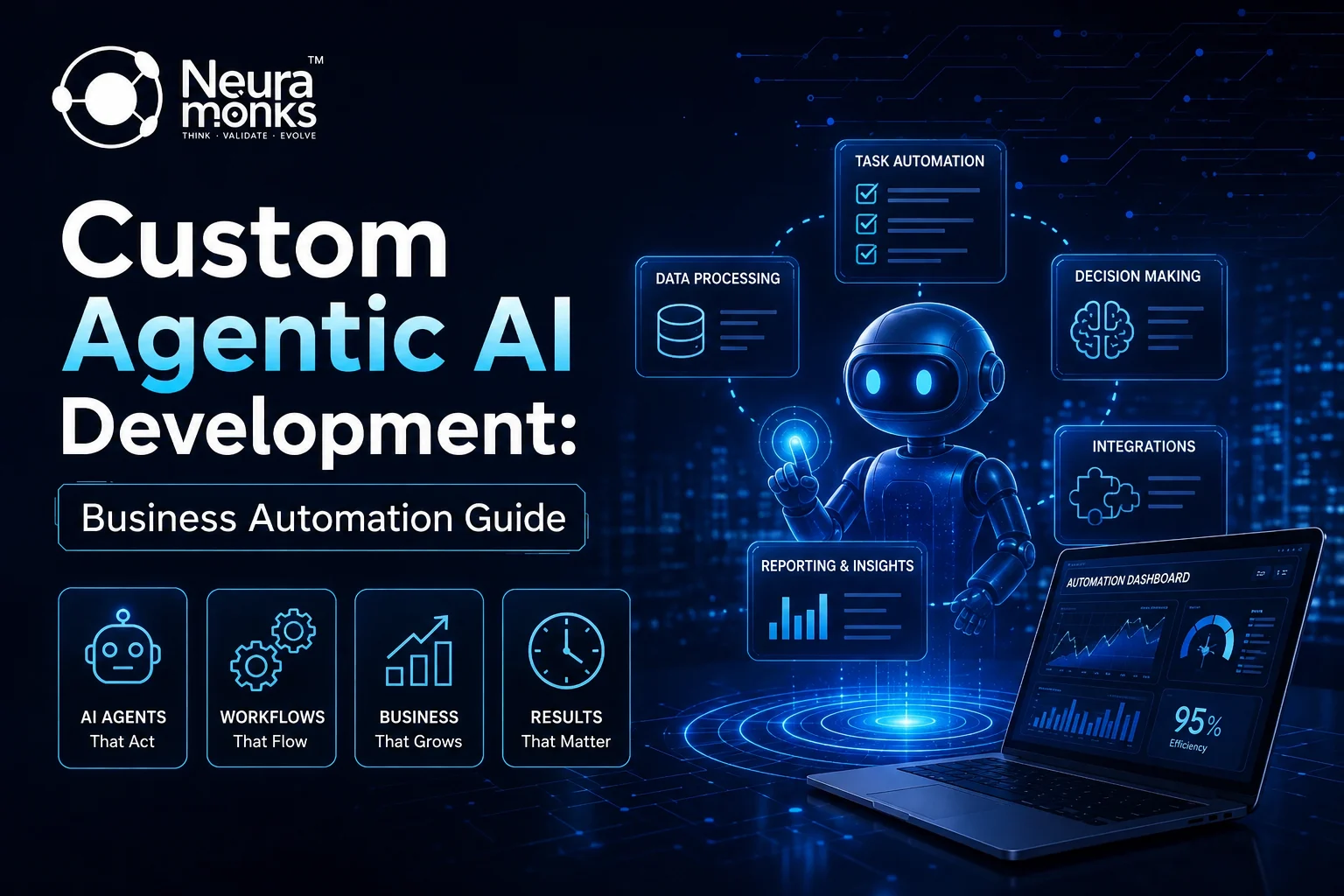
One of the most transformative AI trends for 2026 is the rise of AI agents. These systems are designed to understand goals, execute tasks across multiple platforms, learn from outcomes, and collaborate with human teams.
In practical terms, AI agents will handle activities such as:
- Generating and distributing reports automatically
- Monitoring KPIs and operational signals in real time
- Triggering workflows across tools and departments
- Coordinating routine tasks across sales, finance, and support
As a result, businesses will stop asking which AI tool to deploy and start asking which AI agents should run specific processes. Departments such as sales operations, customer support, finance, supply chain, and HR will experience major productivity gains. Organizations working with a mature AI development agency will design custom AI agents aligned with their workflows rather than relying on generic copilots.
AI Solutions Will Be Designed Around Business Outcomes, Not Models
Historically, AI discussions focused heavily on technical details such as model accuracy, algorithms, and benchmarks. By 2026, this model-centric thinking will give way to outcome-driven AI solutions.
Enterprises will evaluate AI based on its ability to deliver:
- Revenue growth and margin improvement
- Cost reduction and efficiency gains
- Risk mitigation and compliance
- Better customer experiences
- Faster and more confident decision-making
Successful AI initiatives will begin with a clear business problem, define measurable KPIs, and design AI around real workflows rather than isolated experiments. This is where the best AI consulting services & company partners differentiate themselves by aligning AI strategy directly with business strategy. At Neuramonks, every AI engagement starts with business impact mapping instead of technology selection.
AI Governance, Compliance, and Trust Will Become Mandatory
As AI increasingly influences high-impact decisions such as credit approvals, hiring, medical recommendations, pricing strategies, and legal analysis, governance will become just as important as innovation. Enterprises will face greater regulatory scrutiny, higher customer expectations, and increased ethical accountability.
By 2026, enterprise AI solutions will be expected to include explainability, bias detection, auditability, secure data pipelines, and full model lifecycle governance. Organizations that deploy AI without governance expose themselves to legal risk, reputational damage, financial loss, and operational instability. Responsible AI will no longer be optional—it will be foundational.
Vertical-Specific AI Solutions Will Outperform Generic Platforms
Generic AI platforms often struggle with industry regulations, domain-specific data, and specialized workflows. As a result, enterprises will increasingly invest in vertical-specific AI solutions designed for real operational environments.
Industries such as healthcare, finance, manufacturing, retail, and logistics will benefit significantly from tailored AI systems. Healthcare organizations will use AI for diagnostics and patient flow optimization, financial institutions for fraud detection and risk modeling, manufacturers for predictive maintenance and quality control, retailers for personalization and pricing intelligence, and logistics firms for route and supply chain optimization. Enterprises will seek an AI development agency that understands both AI engineering and industry context.
AI Will Become the Core of Enterprise Decision Intelligence
Traditional analytics explain what happened in the past. AI-driven decision intelligence focuses on what should happen next and why. By 2026, AI systems will continuously analyze live data streams, simulate scenarios, and recommend actions in real time.
This capability will support executives, strategy teams, operations leaders, and finance departments in making faster and better decisions. Businesses that invest in advanced AI solutions will gain a decision-speed advantage that is extremely difficult for competitors to replicate.
AI + Automation Will Redefine Enterprise Productivity
Beyond Simple Automation
By combining AI with automation platforms:
- Workflows become adaptive
- Processes self-optimize
- Systems respond to real-time signals
Examples:
- AI-driven invoice processing
- Intelligent customer onboarding
- Automated compliance reporting
- Predictive workforce planning
The most successful companies will treat AI as a productivity multiplier, not just a cost-saving tool.
AI and Automation Will Redefine Enterprise Productivity
When AI is combined with automation, enterprise workflows become adaptive instead of rigid. Processes can self-optimize, respond to real-time signals, and reduce manual intervention.
Common examples include AI-driven invoice processing, intelligent customer onboarding, automated compliance reporting, and predictive workforce planning. The most successful organizations will view AI as a productivity multiplier rather than a simple cost-cutting tool.
AI Solutions Will Drive Competitive Differentiation, Not Just Efficiency
By 2026, AI will influence product innovation, personalized customer experiences, new revenue models, and intelligent digital platforms. Businesses that embed AI deeply into their offerings will increase customer lifetime value, reduce churn, and bring smarter products to market faster. To turn AI into a front-line competitive advantage, businesses are increasingly partnering with the top AI consulting firms.
Why Neuramonks Is Positioned for the AI Future
At Neuramonks, we go beyond building models to deliver enterprise-ready AI solutions. Our approach combines strategic AI consulting, expert AI solutions architecture, scalable enterprise deployments, and industry-focused development. From strategy and design to deployment and optimization, we help organizations build AI systems that create lasting business impact.
Whether you are planning an AI roadmap, scaling AI across departments, modernizing legacy systems, or launching AI-powered products, We acts as a trusted AI development agency focused on impact, governance, and sustainable growth.
Final Thoughts: AI in 2026 Will Reward the Prepared
AI in 2026 will not be about who uses AI—but who uses AI strategically.
The organizations that win will:
- Treat AI as core infrastructure
- Invest in enterprise-grade AI solutions
- Design for trust, scale, and impact
- Work with partners who understand both business and AI deeply
If you are serious about building future-ready AI solutions, now is the time to act.
Ready to transform your business with AI? Contact Neuramonks today to discuss how our AI solutions can deliver measurable results for your organization. As a leading provider of AI Solutions for enterprises, we combine technical excellence with business strategy to ensure your AI investments drive real value. Let's start your AI transformation journey today.