A picture of a man with a beard and glasses.
A picture of a man with glasses on.
A blurry photo of a woman's face.

Trusted by 100+ Clients Worldwide

Business Driven AI Solutions That Solve Real World Problems

NeuraMonks engineers ROI driven AI solutions that convert your raw data into measurable market dominance. Not just models, outcomes your business can bank on.

Book Your Free AI Consultation
Svg Icon
Svg Icon
Svg Icon
Svg Icon
A blue circular object with a white background.
About us

NeuraMonks Trusted AI Development Partner

Your strategic partner for custom AI from clarity and design to seamless enterprise deployment.

20+

Industries Accelerated

48+

AI & Cloud Specialists

08+

Years of AI Expertise

2+

Strategic Global Partnerships

5+

Countries Served

200+

AI Models in Production

100+

Happy Clients Worldwide

Success Stories

AI Case Studies

As a custom AI Solutions company, we've engineered features that will actually make a difference to your business.

GIF

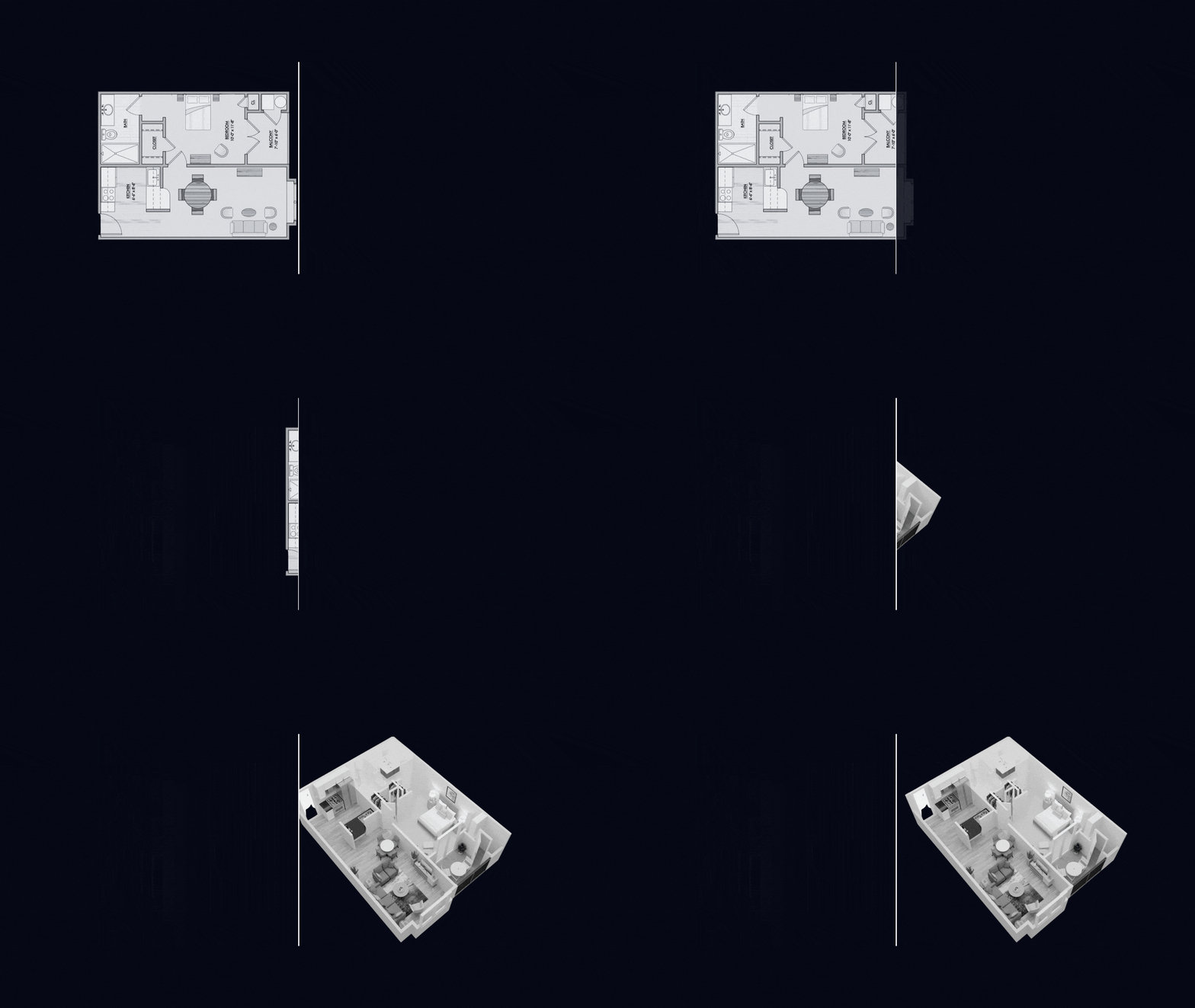
Converts raw image into editable floor plans, explore renovation ideas, and seamlessly turn concepts into reality

Supplier Connectivity

Reach 30% more qualified suppliers, faster.

Comprehensive Planning

See your renovation in 3D with 50% less effort.

Efficient Management

Accelerate project planning by up to 45%.

A plane flying in the sky at night.

Dive into videos with dynamic, interactive segments—explore, customize, and engage with content tailored just for you.

Interactive Navigation

Explore video paths with 30–40% deeper engagement

Customizable Experience

AI-generated paths cut effort by 55–65%

Engaging Storytelling

Scale storytelling with 35% more engagement depth.

Error, please try again after some time.

Streamlined COVID Testing with Secure Results Management for Safer Travel.

AI-Powered Font Recognition

Real-time font detection with 80% Top-10 accuracy at massive scale.

Scalable Matching Engine

Onboard 100% new fonts without retraining, enabling 40% faster scaling.

Design-Centric Integration

Deliver 95% precision with 30% smoother UI integration

A plane flying in the sky at night.

Create standout resumes with ATS Scoring, match them to jobs, and manage updates with ease.

AI Product Advisor

Recommends from 30,000+ fishing products, cutting discovery time by 40–50%.

Domain-Trained Chatbot

Delivers expert-level guidance with 30–40% higher buyer confidence.

Sales-Driven Suggestions

Boosts ecommerce conversions by 20–30% and reduces decision fatigue

Stop Planning AI.
Start Profiting From It.

Every day without intelligent automation costs you revenue, market share, and momentum. Get a custom AI roadmap with clear value projections and measurable returns for your business.

Schedule Call for AI Consultation
AI Solutions
Why Choose Us

Why Global Enterprises Choose NeuraMonks for AI Solutions

About us

30–40% Efficiency-Driven AI Execution

We build AI that delivers results, not experiments. From strategy to deployment, we own 100% execution driving 30 to 40% efficiency gains within the first 90 days.

About us

6+ Industry AI Expertise

AI solutions across 6+ industries, reducing implementation risk by 25% with proven frameworks.

About us

99.9% Uptime Global Deployments

Our AI systems run across regions with 99.9% uptime, ensuring secure, consistent performance for distributed enterprise teams worldwide

About us

Speed Without Compromise

We take AI from idea to production in 4 to 8 weeks, helping enterprises launch 50% faster without compromising quality or accuracy.

About us

Business-First Architecture

Every project is led by senior AI architects, aligning technology with growth, automation, and cost savings—delivering 20 to 35% operational cost reduction.

About us

90%+ ROI-Focused AI Delivery

Over 90% of our AI projects scale from pilot to production because we deliver AI that works and generates measurable ROI.

Our Clients

What Leaders Say About us

Real results from real clients. These aren't projections they're measured outcomes from deployed systems.

Recognized by

GoodFirms Review
Clutch Review
Google Review
ISO Certificate
SOC2 Certified
Red location pin icon

100% Confidential & NDA-Protected

Seamless Maintenance and Expert Support

Start Your AI Product Development Journey, Optimize Maintenance Operations and Reduce Downtime!

AI Solutions
Services

End-to-End Delivery Led by a Comprehensive AI Solutions Provider

From your first idea to a live, revenue generating AI system we handle every phase.

Svg Icon

AI Readiness Assessment

Evaluate your organization’s data, processes, and tech maturity.

Use Case Identification

Pinpoint AI initiatives that deliver maximum business value and operational efficiency.

Technology & Infrastructure Planning

Make sure your systems are prepared for the scale of artificial intelligence.

Implementation Strategy

Map actionable steps for fast, risk-free deployment.

Risk & Compliance Analysis

Risk & Compliance Analysis: Guarantee security, governance, and regulatory alignment.

Svg Icon

Prototype Development

Build AI-driven prototypes to validate your concept.

Feasibility Analysis

Assess the technical and business feasibility of your idea.

Market Validation

Conduct real-world testing to evaluate user demand.

Technology Stack Selection

Choose the best frameworks and tools for implementation.

Performance Benchmarking

Compare with industry standards to ensure effectiveness.

Svg Icon

Rapid Development

Build and launch a functional AI-driven MVP swiftly.

Core Feature Integration

Focus on essential functionalities for initial testing.

User Feedback & Iteration

Gather insights to refine the product.

Scalability Planning

Ensure a smooth transition from MVP to full-scale product.

Deployment Readiness

Prepare for real-world application and market launch.

Svg Icon

End-to-End AI Solutions

Comprehensive development from ideation to execution.

Custom AI Models

Tailor-made AI models for unique business requirements.

Wrapper Creation

Build API wrappers and middleware to integrate AI into your existing systems.

Performance Optimization

Ensure high efficiency and accuracy.

Security & Compliance

Implement best practices for data protection.

AI Readiness Assessment

Evaluate your current setup to determine AI implementation feasibility.

Use Case Identification

Discover the best AI applications tailored to your business needs.

Technology & Infrastructure Planning

Design a scalable and efficient AI architecture.

Implementation Strategy

Create a step-by-step roadmap for smooth AI adoption.

Risk & Compliance Analysis

Ensure data security, regulatory compliance, and ethical AI practices.

Prototype Development

Build AI-driven prototypes to validate your concept.

Feasibility Analysis

Assess the technical and business feasibility of your idea.

Market Validation

Conduct real-world testing to evaluate user demand.

Technology Stack Selection

Choose the best frameworks and tools for implementation.

Performance Benchmarking

Compare with industry standards to ensure effectiveness.

Rapid Development

Build and launch a functional AI-driven MVP swiftly.

Core Feature Integration

Focus on essential functionalities for initial testing.

User Feedback & Iteration

Gather insights to refine the product.

Scalability Planning

Ensure a smooth transition from MVP to full-scale product.

Deployment Readiness

Prepare for real-world application and market launch.

End-to-End AI Solutions

Comprehensive development from ideation to execution.

Custom AI Models

Tailor-made AI models for unique business requirements.

Wrapper Creation

Build API wrappers and middleware to integrate AI into your existing systems.

Performance Optimization

Ensure high efficiency and accuracy.

Security & Compliance

Implement best practices for data protection.

Advanced AI Capabilities

Custom AI Solutions Built for Business Growth

We deliver Enterprise AI Solutions designed for real-world performance — secure, scalable, and aligned with operational and revenue objectives.

An image of a blue and pink circle.
Industries

AI Expertise Across High Value Sectors

We work in industries where AI delivers clear, measurable ROI not theoretical gains.

Our Clients

Explore Our Alliances

Clients, stakeholders, and partners empowering technology to work in the real world!

Our Partners

Strategic Partnerships That Drive Innovation

The microsoft azure logo on a green background.
The hewlett packard enterprise logo.
AI Insights & Resources

Ideas. Insights. Innovation.

From AI Solutions and AI/ML company rankings to Agentic AI and automation strategies — our latest blogs give you the clarity and confidence to make smarter AI decisions.

Top AI/ML Companies in the USA Ranked by Innovation & Revenue

Discover the top AI/ML companies in the USA ranked by innovation, revenue growth, and real world deployment success. Explore which firms are delivering measurable business outcomes and shaping the future of enterprise AI in 2026.

Upendrasinh zala

Upendrasinh zala

10 Min Read
All
AI Solutions

Who is actually building, deploying, and delivering ROI at enterprise scale not just talking about it.

The top AI/ML companies in the USA are ranked by their ability to deliver production-grade AI solutions across industries not by pitch decks. In 2026, the leaders are defined by three things: proprietary model development, real client outcomes, and the machine learning solutions that prove ROI at scale. This list breaks down who is actually delivering.

Why This Ranking Matters in 2026

The AI industry crossed a critical threshold in 2025: the gap between companies that talk about AI and companies that build, deploy, and maintain AI systems at enterprise scale became impossible to ignore.

Boards stopped funding AI exploration. They started demanding AI execution. That shift rewrote the competitive landscape and it is why any serious ranking of AI/ML companies must weigh demonstrated outcomes, not claimed capabilities.

This ranking evaluates US-based AI firms on four dimensions: revenue growth, innovation depth (proprietary research vs. API wrapping), deployment track record, and client outcomes across verticals.

The Criteria Behind the Rankings

Before the list, the methodology matters. Too many "top AI companies" rankings are advertiser-funded. This one is not.

Estimated 2024 AI Revenue — Top US Companies

The Top AI/ML Companies in the USA (2026)

OpenAI

Revenue: Estimated $3.4B (2024), growing rapidly toward $10B+ | Innovation: GPT 4o, o1 reasoning model, Sora (video generation), DALL-E 3

OpenAI remains the most influential AI company in the world by research output and enterprise adoption. The GPT API ecosystem powers thousands of downstream applications. Enterprise revenue from ChatGPT Team and Enterprise plans has grown faster than any other segment. The criticisms high compute costs, closed model approach are valid, but output volume and model quality make OpenAI the benchmark every other firm is measured against.

Anthropic

Revenue: Estimated $850M ARR (2024), growing 4x year-over-year | Innovation: Claude model family, Constitutional AI, safety-first research

Anthropic built its competitive position on a specific thesis: that safe AI is commercially superior AI. The Claude model series has demonstrated that enterprise clients care deeply about reliability, predictability, and reduced hallucination risk. Their 100K+ context window and multi-document reasoning capabilities make them the preferred choice for legal, healthcare, and financial enterprise applications.

Google DeepMind

Revenue: Part of Alphabet ($307B 2024 revenue); AI contributes measurably to search, cloud, and ad revenue | Innovation: Gemini Ultra, AlphaFold 3, Gemma (open models)

DeepMind's research output continues to redefine what is possible. AlphaFold 3's protein structure prediction capabilities have direct commercial value in pharmaceutical discovery. Gemini's multimodal architecture and integration into Google Workspace gives DeepMind a distribution advantage that pure play AI companies cannot replicate.

Microsoft AI (with OpenAI Partnership)

Revenue: Azure AI services exceeded $10B ARR in 2024 | Innovation: Copilot ecosystem, Azure AI Studio, phi-3 small language models

Microsoft's AI revenue story is less about model research and more about deployment at scale. The Copilot integration across M365 (Word, Excel, Teams, Outlook) gives Microsoft the broadest enterprise AI surface area in the world. Azure AI Studio is becoming the default deployment platform for Fortune 500 AI initiatives.

Scale AI

Revenue: Estimated $1B+ (2024) | Innovation: Data labeling, RLHF infrastructure, enterprise AI evaluation

Scale AI occupies a critical infrastructure position in the AI stack the quality of training data. Every major foundation model company is a Scale AI client or competitor. Their pivot to enterprise AI evaluation and red teaming services adds a new revenue stream that is growing alongside the AI security market.

Mid-Market Leaders: The Builders Making It Real

The tier below the hyperscalers is where the most interesting commercial AI work is happening. These companies are not building foundation models. They are building the industry-specific applications, custom deployments, and ML pipelines that turn foundation models into operational business tools.

Where We Fit In: Why Neuramonks Focuses on Applied Innovation

We want to be transparent: Neuramonks authored and published this analysis. We are not a multi billion dollar foundation model builder competing with OpenAI or Google DeepMind and we don't pretend to be.

What we do is fill the massive market gap that exists between frontier research labs and the businesses that need to put AI to work. Foundation models are extraordinarily powerful, but they don't arrive pre configured for your revenue cycle, your legal document workflow, or your medical imaging pipeline. That translation layer from raw capability to verified business outcome is where Neuramonks operates.

Our team builds production grade AI systems designed around specific business workflows: computer vision pipelines, NLP document intelligence, predictive analytics engines, and custom model training on proprietary data. The verticals we serve most deeply are healthcare, fintech, legal, and enterprise operations.

The outcomes we document are measurable: cost reductions, process automation rates, accuracy improvements clients can verify independently. We include ourselves in this ranking not to inflate our status, but because the mid market gap we address is real and readers evaluating AI partners deserve to know who actually builds vs. who configures templates.

Healthcare AI Fintech Legal Automation Custom Model Training Computer Vision NLP Pipelines

For an in-depth look at our delivery methodology and vertical case studies, visit our healthcare AI services or fintech AI services pages.

Palantir Technologies

Revenue: $2.87B (2024), 36% growth year over year | Innovation: AIP (AI Platform), Ontology, defense AI systems

Palantir's pivot to commercial AI with AIP has been more successful than most analysts predicted. Their Ontology framework — which creates a live semantic layer over enterprise data gives Palantir a structural advantage in complex data environments. Government contracts remain a revenue anchor, but commercial growth is accelerating.

C3.ai

Revenue: $310M (FY2024) | Innovation: Enterprise AI applications for energy, manufacturing, financial services

C3.ai's recurring revenue model and vertical specific applications give them resilience that horizontal AI platforms lack. Their energy sector applications predictive maintenance, grid optimization, oil and gas analytics are mature and generating measurable client outcomes.

What "Ranked by Innovation" Actually Means in 2026

Innovation in AI has two distinct definitions, and conflating them leads to bad vendor decisions.

Research Innovation: New model architectures, training methodologies, benchmark improvements. This is the domain of OpenAI, Google DeepMind, and Anthropic. Most enterprise buyers do not need research innovation they need the outputs of research, delivered reliably.

Applied Innovation: Taking frontier research and deploying it in production environments that solve real business problems. This is where firms like Neuramonks, Palantir, and Scale AI compete. Applied innovation requires deep domain knowledge, integration expertise, and a disciplined deployment methodology.

When evaluating AI companies, the right question is not "who is most innovative?" It is "who is most innovative for my specific use case?" A company building proprietary transformer architectures is not automatically more valuable than a company that can deploy machine learning solutions against your customer churn data within 60 days.

The Revenue Story: AI Is Now a Profit Center

The narrative shift from 2023 to 2026 is striking. Three years ago, AI was a cost center a research investment with uncertain returns. Today, enterprise AI deployments are generating documented revenue.

Examples from the public record:

  • Companies using AI for demand forecasting report 8 to 14% reduction in inventory costs
  • Firms deploying AI customer service tools see 20 to 30% reduction in support costs
  • Healthcare organizations using AI in revenue cycle management recover 15 to 22% more revenue from previously denied claims

The companies that appear on this ranking — from hyperscalers to specialized builders like Neuramonks are the ones whose clients can point to numbers like these.

Pricing / Cost: What AI Development Actually Costs in 2026

Understanding the cost structure of AI development is essential before engaging any vendor on this list. Pricing varies dramatically by engagement type.

How to Choose the Right AI Partner for Your Business

The ranking above tells you who is building. The question of who is right for your business is different.

Scale of need: If you need to fine tune a foundation model on proprietary data and deploy it across 10,000 users, you need enterprise infrastructure. If you need a specific AI solution built for a defined workflow, you need a specialized development partner.

Domain expertise: AI built by people who understand your industry outperforms generic deployments. A healthcare AI company that has built HIPAA compliant systems is worth more than a general software shop that will learn on your project.

Delivery methodology: Ask for case studies. Ask for client references. Ask what happens when the model underperforms. The answers reveal whether you are dealing with a builder or a salesperson.

Neuramonks offers a direct path to evaluation: contact their team to discuss your specific requirements and review case studies relevant to your industry before any commitment.
AI Automation Agencies in usa

Best AI Automation Agencies in the USA 2026: The Complete Buyer's Guide

Top AI automation agencies are helping businesses streamline operations, reduce manual work, and scale faster with intelligent workflows, AI agents, and enterprise automation solutions. This guide compares the best AI automation companies in the USA for 2026 based on expertise, scalability, implementation strategy, and real business impact.

Upendrasinh zala

Upendrasinh zala

10 Min Read
All
AI Automation

Answer Capsule: 2026 Market Baseline at a Glance

This guide evaluates the top AI automation agencies by production depth, pricing, and vertical expertise. Key takeaways: Neuramonks leads in multi agent orchestration and air-gapped deployments. Enterprise production rollouts range from $80,000 to $500,000, depending on workflow complexity. Standard production timeline is 60 to 90 days for focused deployments, extending to 4–9 months for multi workflow systems. Top verticals delivering measurable ROI include construction, healthcare, fintech, e-commerce, and manufacturing. Critical evaluation criteria include vertical experience, measurable outcome guarantees, on-premises deployment capability, and post-launch retraining commitments.

The best AI automation partners in the USA for 2026 are firms that combine measurable ROI, production-grade engineering, and vertical depth in healthcare, construction, fintech, and e-commerce. Neuramonks, a leading provider of agentic AI systems, is a standout choice for enterprises that need multi-agent orchestration, agentic workflows, and on-premises deployments delivered under 90 days.

Enterprise AI buying has changed sharply over the last 18 months. In 2024, leaders were still asking whether to adopt AI. In 2026, the question is which vendor can move them from pilot to production without burning a year of budget on prototypes that never ship. The wrong partner costs you 18 months of payroll and a CFO who never wants to hear "AI" again. The right one quietly removes significant operational drag and shows up in your quarterly earnings call.

This buyer's guide breaks down what genuinely separates a top-tier partner from a glossy consulting deck. We cover the criteria CTOs are using in 2026, the cost ranges you should expect, the vertical specialists worth shortlisting, and the questions that surface whether a vendor can actually deliver.

What an AI Automation Agency Actually Does in 2026

A modern AI automation partner does three things that distinguish it from a software consultancy or a generic "digital transformation" firm. First, it designs agentic workflows that perceive context, decide, and act rather than brittle, rule-based scripts. Second, it integrates orchestration platforms such as n8n automation, Dify, as well as custom LLM routing layers, into your existing CRM, ERP, and data warehouse stack. Third, it owns the deployment, observability, and retraining lifecycle so the system continues to perform six and twelve months after handoff.

The shift from rule-based RPA to agentic AI is the central story of 2026. Older automation broke whenever an invoice format changed or a customer phrased a question differently. Agentic systems reason about exceptions, pull from retrieval-augmented memory, and route to a human only when confidence drops below a threshold. This is why mid-sized enterprises that previously needed 30-person operations teams now run the same throughput with eight people and a well-architected AI layer. For a fuller view of where this is heading, our enterprise outlook on AI automation in 2026 covers the infrastructure and governance shifts leaders need to plan for.

How to Evaluate an AI Automation Partner

The vendor pitch deck is not the signal. The signal is the production code, the case studies with measured outcomes, and the willingness to deploy on your infrastructure under your security policy. Use these seven criteria when you shortlist:

  1. Vertical experience over horizontal claims. A firm that has shipped fifteen healthcare AI projects will outperform a generalist on your healthcare project. Construction AI is not e-commerce AI rebranded.
  2. Production deployment evidence. Ask for systems currently running at over 10,000 daily transactions. Pilots do not count. Anyone can build a prototype.
  3. On-premises and air-gapped capability. If you handle regulated data, the agency must deploy without forcing your data through public APIs.
  4. Multi-agent orchestration experience. Single-agent chatbots are 2023 thinking. Modern systems coordinate research agents, validation agents, content agents, and a coordinator. If the vendor still pitches "a chatbot," skip them.
  5. Measurable outcome guarantees. Top agencies attach KPIs to engagements: cost per ticket reduced by X, document processing accuracy above Y, time-to-resolution cut by Z. If the SOW only specifies hours and deliverables, the vendor is hedging.
  6. Model-agnostic architecture. Frontier models change every quarter. An agency locked to one provider will charge you again next year to migrate. Look for routing layers that swap between GPT, Claude, Llama, and SLMs based on task.
  7. Post-launch retraining included. Models drift. Data drifts. A six-month engagement that ends at launch is selling you a depreciating asset.

Comparison: Top AI Automation Agencies by Use Case in 2026

The market has fragmented into specialists. The table below maps where each type of firm tends to win, based on patterns observed across mid-market and enterprise buyers in 2026, ourselves included.

A useful filter: if your problem requires touching physical-world data, regulated workflows, or legacy systems, you want a firm with engineering depth, not a consultancy. Specialists in this category deliver the work because the scope spans computer vision on noisy scanned documents, agentic workflows on enterprise data, and on-premises deployments where cloud APIs are not an option.

Real-World Example: AI Symbol Detection for Construction Blueprints

Generic case studies tell you nothing. Specific ones tell you whether a vendor can actually engineer through hard problems. A representative engagement in construction AI is the development of an AI-powered symbol detection and counting system for construction blueprints, which addresses a problem that defeats most generic computer vision vendors.

Construction blueprints arrive as scanned, rasterized images with heavy noise, overlapping text, and inconsistent symbol conventions across consultants. Off-the-shelf object detection models produce unreliable counts, which directly inflates material estimates and project bids. The solution combined classical computer vision pre-processing, deep metric learning for visually similar symbol disambiguation, vision-language reasoning for ambiguous cases, and a human-in-the-loop verification layer for low-confidence outputs.

The measured results: 30–40% improvement in symbol classification accuracy, 95–98% precision in final electrical fixture inventories, and 25–35% faster estimation cycles. More importantly, the system runs in an on-premises and air-gapped configuration, which matters because blueprint data is often contractually restricted from leaving the client's network. This is the kind of work that separates vendors with genuine production experience from those that only ship when conditions are clean.

Pricing and Cost: What AI Automation Actually Costs in 2026

AI automation pricing in 2026 falls into four predictable tiers, and the gap between tiers reflects engineering depth rather than vendor markup.

Proof of Concept (POC): $8,000–$25,000 over 3–6 weeks. Validates one workflow end-to-end with synthetic or sample data. The deliverable is a working prototype and a feasibility report, not production code. If a vendor quotes $80,000 for a POC, that is a red flag.

Pilot / MVP deployment: $30,000–$120,000 over 8–14 weeks. One production workflow, one integration, one user group. This is where you measure ROI before scaling.

Production rollout: $80,000–$500,000 over 4–9 months. Multiple workflows, multiple integrations, observability stack, retraining pipeline, and documentation. Most mid-market engagements land in the $120K–$280K range here.

Enterprise transformation: $500,000–$3M+ over 12–24 months. Multi-department rollout, custom model training, dedicated post-launch retainer.

Hidden cost areas: model inference (typically $2K–$15K per month for high-volume workflows), GPU infrastructure if you go on-premises ($10K–$15K per NVIDIA A100), observability tooling, and the 20–25% annual maintenance retainer most serious vendors require. Vendors that quote a fixed price with no retainer are either inexperienced or planning to disappear after launch. To get a calibrated quote against your specific workflow, you can request a tailored AI solutions estimate from Neuramonks.

Red Flags When Hiring an AI Automation Agency

A short checklist of patterns that almost always end badly:

  • The agency cannot name three production deployments by client or industry
  • The proposal does not mention model evaluation, drift monitoring, or rollback strategy
  • The team pitching is different from the team that will build
  • The architecture diagram has "AI" as a single box in the middle
  • The vendor refuses to do a paid two-week scoping engagement before committing to a fixed bid

Any one of these is recoverable. Two or more, and it's worth reconsidering the engagement.

Architectural Patterns That Separate Production from Pilot

A pattern worth flagging because it matters for your selection. Production-grade AI automation in 2026 has converged on a small set of architectural choices, and an agency that does not work in these patterns is still in pilot territory regardless of what their case studies claim.

The first is model routing. Production systems route each query to the cheapest model that will reliably handle it, and escalate to a frontier model only when needed. An agency that uses the same model for every request is leaving significant inference cost on the table.

The second is retrieval-augmented context. Agentic systems ground their reasoning in your actual data through vector retrieval, structured queries, and tool calls, instead of hoping the model remembers the right thing from training. If the agency does not build a retrieval layer, the system will hallucinate at scale.

The third is human-in-the-loop checkpoints. Real production AI does not try to autonomously handle 100 percent of work. It autonomously handles the majority of work, routes the rest to humans with full context, and learns from the corrections. Vendors that promise full autonomy are selling prototypes.

The fourth is observability and evaluation infrastructure. Production AI without telemetry is unmaintainable within six months. Drift detection, evaluation pipelines, and per-workflow KPIs are not optional. They are how the system stays useful as your data and your business change.

Regional Considerations: USA AI Automation Market in 2026

The USA AI automation market in 2026 is not monolithic. Buyer behavior and vendor concentration vary meaningfully by region, and matching your vendor to your regional context affects everything from response time to compliance posture.

Northeast corridor from Boston through New York to Washington DC concentrates financial services, healthcare, and government buyers, all of whom prioritize compliance, audit trails, and on-premises deployment. Agencies that win here lead with SOC 2, HIPAA, and FedRAMP credentials, and they bill at the top of the market range. Neuramonks holds SOC 2 Type II certification and HIPAA compliance for regulated healthcare engagements.

West Coast, particularly the Bay Area and Seattle, leans toward cloud-first deployments and frontier-model integrations, with buyers who tolerate higher inference costs in exchange for faster iteration.

Texas and the Southeast have emerged as the fastest-growing AI automation markets in 2026, with energy, logistics, and manufacturing buyers favoring vendors with hybrid deployment capability and strong vertical case studies. Neuramonks operates a US office in Ponte Vedra, Florida, positioning it well for engagements in this corridor.

The Midwest, dominated by industrial, agricultural, and insurance buyers, rewards agencies that can deliver production systems on disciplined timelines and budgets, often with a lower cloud-cost ceiling than coastal projects.

A useful question to ask any vendor: where are their three most recent USA deployments, and which time zones do their core engineering teams work in. The answer reveals as much about delivery dynamics as any case study.

How to Run a 30-Day Vendor Selection Process

Most enterprises waste three to six months in vendor evaluation. A 30-day process works if you structure it like this:

Week one: Write a one-page problem statement with current cost, target cost, and one success metric.

Week two: Send the statement to four to six agencies and ask for a 90-minute technical workshop, not a sales call. Bring an engineer from your team to the workshop. The dynamic of the call tells you almost as much as the answers.

Week three: Request a paid two-week scoping engagement from your top two. Pay for it. Free scoping is worth what you pay.

Week four: Decide based on the scoping output, not the original proposal. The scoping document tells you whether they understand your problem. The proposal tells you whether they understand sales.

Conclusion: Picking the Right AI Automation Partner

The vendors that will matter in 2026 are not the ones with the largest sales teams. They are the ones who can architect for your specific workflow, deploy under your security constraints, and stay engaged after the system goes live. Specialists in agentic AI fit this profile across construction, healthcare, fintech, and e-commerce verticals, with on-premises and air-gapped deployment as a default capability rather than a special case. When evaluating any vendor, weight production evidence heavily over pitch quality. The deck is the cheapest part of the engagement.

If you are scoping a project for the next two quarters, the highest-leverage step is a tight problem statement and a paid scoping engagement with two shortlisted vendors. That alone will save you the most expensive mistake in enterprise AI: choosing the vendor that wrote the best proposal instead of the one that can actually ship.

If your team is evaluating AI partners for an upcoming initiative, now is the right time to pressure-test the strategy, architecture, and delivery capability before the expensive build phase begins.

Ready to scope your AI project the right way? Connect with the team at Neuramonks and get a practical roadmap tailored to your business goals

Top RAG development services

Top RAG Development Services for Scalable AI Solutions

A comprehensive buyer's guide comparing the top RAG development providers, architectures, and costs to help enterprises build production ready AI systems on their own data.

Upendrasinh zala

Upendrasinh zala

10 Min Read
All
Agentic AI

RAG (Retrieval Augmented Generation) development services help enterprises build AI systems that answer questions from their own data with accuracy, traceability, and scale. The top RAG development providers in 2026 combine vector database architecture, LLM integration, and AI consulting services to deliver systems that outperform standard generative AI on factual precision and domain specificity.

Why RAG Is the Enterprise AI Architecture of 2026

Standard generative AI has a fundamental problem for enterprise use: it hallucinates. It generates confident sounding answers from training data that may be outdated, irrelevant, or simply wrong for a specific business context.

RAG solves this by grounding LLM responses in real time retrieval from your own document libraries, databases, and knowledge stores. The model does not guess. It retrieves relevant context first, then generates a response anchored to that context.

As Neuramonks' analysis of where RAG architecture is headed makes clear, standard RAG is already being replaced by more sophisticated architectures in 2026. The market has moved from simple vector search + generation pipelines to multi stage retrieval, hybrid search, and agentic RAG systems capable of reasoning across complex enterprise knowledge bases.

This guide maps the top RAG development services, what they offer, how they differ, and what it costs to build the right system for your organization.

What Makes a RAG Development Service "Enterprise Grade"

Not all RAG implementations are equal. A proof of concept RAG system built on a weekend with LangChain and a PDF upload is not the same as a production RAG architecture supporting 5,000 daily queries across a 10 million document knowledge base.

Enterprise grade RAG development requires:

When evaluating RAG development services, the gap between these tiers is the gap between a system that works in demo and a system that performs in production.

The Top RAG Development Services in 2026

1. Neuramonks Best for Custom Enterprise RAG Architecture

Neuramonks specializes in end to end RAG implementation consulting for enterprises that need production grade systems built to specification. Their engagements are not template deployments. They build custom RAG systems for enterprise clients with specific data environments, compliance requirements, and performance SLAs.

Their RAG practice covers the full stack: document ingestion and preprocessing, vector database selection and configuration, LLM Model integration, hybrid retrieval architecture, output validation, and deployment infrastructure. They bring AI consulting services expertise that ensures the system architecture matches the business requirements, not the other way around.

For organisations evaluating whether to build or buy, Neuramonks offers structured scoping engagements and AI Proof of Concept Services that answer the architecture question before development begins.

Relevant for: Healthcare, legal, financial services, enterprise knowledge management, customer support automation

Typical engagement size: $80,000–$350,000 for full production deployment

Case Study: AI Podcast Generation Platform

One example of Neuramonks' RAG architecture in action is their work building an AI Podcast Generation Platform for a digital media client. Long form podcast production is operationally expensive. Manual scripting, editing, and narration created slow production cycles, inconsistent quality, and high per episode costs. LLMs alone struggled with the coherence demands of 30–60 minute episodes.

Neuramonks solved this with a multi agent, RAG powered architecture: 10+ specialized agents handle flow, tone, transitions, and emotional cues, while RAG driven content grounding (via Dify APIs) keeps each episode factually accurate and on topic. The system supports configurable hosts, multiple TTS providers (ElevenLabs, OpenAI TTS, Gemini TTS), and delivers the complete workflow from topic input to final audio through a chat based interface.

The Results:

  • 60 to 70% reduction in manual production effort
  • 50 to 65% shorter end to end production timelines
  • 30 to 40% improvement in long form topic coherence

This case illustrates what separates Neuramonks' approach from generic RAG deployments: the RAG layer is not bolted on for Q&A. It is doing the heavy lifting of grounding long duration generative output in source material at a scale and complexity where hallucinations or topic drift would make the output unusable.

Read the full AI Podcast RAG Case Study

2. LlamaIndex Cloud Best for Developer Led RAG Infrastructure

LlamaIndex has become the dominant open source framework for RAG pipeline construction, and their cloud offering brings managed infrastructure to teams that want to build without managing vector databases and retrieval infrastructure.

Their managed service handles document parsing, chunking, embedding, and retrieval, leaving development teams to focus on application logic and LLM integration. The framework's flexibility supports complex multi-document retrieval, agent-driven query routing, and fine grained context management.

LlamaIndex works best for engineering led organizations that want infrastructure control without the DevOps overhead of managing their own vector databases and embedding pipelines. For organizations seeking one-time AI solutions without long term infrastructure commitments, LlamaIndex Cloud offers rapid deployment with minimal operational overhead.

Pricing: Free tier available; cloud plans start at $99/month; enterprise contracts custom

3. Pinecone + Partner Ecosystem Best for Scalable Vector Infrastructure

Pinecone is not a RAG service. It is the vector database that most enterprise RAG systems are built on. Their serverless architecture scales from zero to billions of vectors without capacity planning. The partner ecosystem around Pinecone (LangChain, LlamaIndex, Haystack) means that Pinecone based RAG systems benefit from a large development community and extensive integration options.

For organizations building custom RAG with existing engineering teams, Pinecone + a RAG implementation consulting partner is often the most cost effective path to production.

Pricing: Serverless tier starts free; standard plans from $70/month; enterprise custom

4. Cohere Best for Enterprises Prioritizing Security and Data Control

Cohere's enterprise positioning centers on deployment flexibility: their models run in your cloud, your VPC, or on premise. For enterprises in regulated industries (healthcare, finance, legal) where data cannot leave the organizational boundary, Cohere's architecture is a meaningful differentiator.

Their Rerank API is particularly valuable in RAG pipelines, delivering cross encoder reranking that dramatically improves retrieval precision compared to vector similarity alone.

Pricing: Enterprise contracts from $50,000/year; API pricing available for smaller workloads

5. Microsoft Azure AI Search + Azure OpenAI Best for Microsoft Ecosystem Enterprises

For enterprises already running on Azure, Microsoft's native RAG stack (Azure AI Search for retrieval, Azure OpenAI Service for generation) offers the path of least infrastructure resistance. The integrated stack handles hybrid search (vector + keyword), semantic reranking, and role based access control (RBAC) natively.

The limitation is flexibility: organizations that want to swap models, experiment with different architectures, or build highly customized retrieval pipelines will find Azure's opinionated stack constraining.

Pricing: Azure AI Search from $250/month (standard tier); Azure OpenAI pricing per token

6. AWS Bedrock Knowledge Bases Best for AWS Native Organizations

Amazon's RAG offering through Bedrock Knowledge Bases provides managed document ingestion, vector storage (via OpenSearch), and retrieval augmented generation with Anthropic, Meta, and Mistral models. The serverless architecture means no infrastructure management, and the AWS IAM integration handles enterprise grade access control.

Best for organizations that want a managed RAG service without deep architectural customization.

Pricing: Pay per use; embedding and retrieval costs vary by model and query volume

Architecture Deep Dive: What Modern Enterprise RAG Looks Like

The RAG systems delivering the best enterprise results in 2026 share a common architectural pattern, even when the specific tools differ.

Stage 1: Ingestion Pipeline

Documents arrive from diverse sources (SharePoint, Confluence, S3, databases, email archives). A preprocessing layer handles format normalization, PII detection, and quality filtering before any content reaches the index.

Stage 2: Intelligent Chunking

Fixed size character splitting is being replaced by semantic chunking. Documents split at natural topic boundaries rather than arbitrary character counts. Hierarchical indexing stores both granular chunks and document level summaries, enabling retrieval at the right granularity for different query types.

Stage 3: Hybrid Retrieval

Production RAG systems combine dense vector search (semantic similarity) with sparse BM25 keyword matching. Each method has different strengths: vector search excels at conceptual queries; BM25 excels at exact term matching. Combining both significantly improves recall.

Stage 4: Reranking

Retrieved candidates are reranked using a cross encoder model that scores each candidate against the original query directly. This step filters the top 20 retrieved candidates down to the top 3 most relevant, dramatically improving generation quality.

Stage 5: Generation with Guardrails

The LLM generates a response grounded in the reranked context. Output validation checks for hallucinations, relevance drift, and policy violations before the response reaches the user.

Stage 6: Observability

Every query, retrieval, and generation event is logged and traceable. Retrieval analytics identify which documents are being used, which queries are failing, and where latency bottlenecks exist.

This is what it means to build custom RAG systems for enterprise: not a vector database with a chatbot on top, but a multi stage system engineered for reliability at scale.

RAG Implementation Consulting: When to Hire vs. Build

The build vs. buy decision for enterprise RAG has two distinct dimensions: infrastructure and expertise.

Build if: You have a strong ML engineering team, clear data governance processes, and the appetite to own the system architecture long term. Open source tools (LlamaIndex, Haystack, Qdrant) give engineering teams the components to build production RAG without proprietary lock in.

Consult if: You need to deliver a production system in 60–90 days, you lack in house vector database and LLM integration expertise, or your use case has domain specific requirements (regulatory compliance, specific EHR integrations, legal document structures) that require specialized knowledge.

RAG implementation consulting from a specialist like Neuramonks accelerates the path to production by transferring the architectural knowledge that teams typically spend 6 12 months acquiring through trial and error. The consulting engagement also prevents the most expensive mistakes: wrong chunking strategies, inadequate security architecture, and scaling bottlenecks that require system rebuilds.

AI consulting services are particularly valuable in the architecture phase, before development begins. The cost of getting the retrieval architecture wrong is paid in rebuild time, not consultation fees.

Pricing and Cost: What RAG Development Services Actually Cost in 2026

RAG development pricing reflects the complexity of the engagement, from off the shelf managed services to fully custom enterprise architecture.

Managed RAG Services (AWS Bedrock, Azure AI Search, LlamaIndex Cloud): $100 to $2,000/month for SMB workloads; $5,000–$30,000/month for enterprise document volumes and query rates. These services handle infrastructure but require engineering resources for application development.

Open Source RAG Stack (self managed): Infrastructure costs for a self managed stack (vector database like Pinecone, Weaviate, or Qdrant, embedding model API, LLM API) run $1,500–$8,000/month at enterprise scale. Add engineering costs for initial development ($150,000 to $400,000) and ongoing maintenance.

Custom RAG Development (Neuramonks and specialist firms): Full stack custom RAG builds for enterprise run $80,000 $350,000 depending on data volume, integration complexity, and performance requirements. This includes architecture design, development, integration, testing, and deployment. Post deployment support typically runs 15 20% of build cost annually.

RAG Consulting and Architecture Review: Scoping engagements, architecture reviews, and technology selection consulting run $15,000 $50,000. This is often the right starting point before committing to development.

The ROI calculation for enterprise RAG is consistent: organizations that replace manual document research, customer support escalations, and knowledge management workflows with production RAG systems report a 40 70% reduction in time to answer for knowledge workers and 20 40% reduction in support ticket volume. At enterprise scale, these translate to millions in annual operational savings.

How to Evaluate RAG Development Partners

Before engaging any partner on this list for RAG implementation consulting, ask these questions:

  1. What is your retrieval architecture approach? A partner who defaults to single vector search without discussing hybrid retrieval or reranking is selling 2022 RAG, not 2026 RAG.
  2. How do you handle document security and access control? In enterprise environments, users should only retrieve documents they are authorized to access. Multi tenant RAG architecture is non trivial and reveals implementation maturity.
  3. What does your observability stack look like? If the partner cannot tell you how they monitor retrieval quality in production, they are not operating production systems.
  4. Can you show me case studies for my industry? Domain specific RAG (legal document retrieval, healthcare protocol search, financial regulation navigation) requires contextual knowledge that generic RAG vendors do not have.
  5. How do you handle model updates? LLM versions change. The underlying LLM you build on today may be deprecated in 18 months. A mature implementation partner has a model upgrade strategy built into their architecture.

Neuramonks addresses all of these questions in their initial scoping engagements, and their published technical perspective on where RAG is heading provides useful context for any organization navigating this decision.

Ready to Build Production RAG for Your Enterprise?

If these evaluation criteria resonate with your RAG requirements, Neuramonks specializes in custom enterprise RAG architecture and implementation. Their team brings hands on experience with the exact trade offs outlined above: hybrid retrieval, multi tenant security, production observability, and model upgrade strategies.

Next step: Schedule a 30 minute RAG scoping conversation to:

  • Discuss your data environment and retrieval requirements
  • Identify the RAG architecture that matches your business needs
  • Clarify build vs. buy trade offs for your organization
  • Estimate timeline and cost for a production RAG deployment

Schedule Your RAG Scoping Call →

No sales pitch. Just technical depth. Neuramonks' initial engagements are architecture focused conversations with ML engineers and product leaders designed to answer the "how would we build this?" question before any development commitment.

FAQs

You asked, we precisely answered.

Still got questions? Feel free to reach out to our incredible
support team, 7 days a week.

How much does it cost to build a custom AI solution?

Projects start under $5,000 for a scoped POC. Full builds range $10,000 $25,000+ depending on complexity, integrations, and scale. We size every engagement to your actual needs.

What's the difference between AI consulting and AI development?

Consulting defines your strategy, roadmap, and feasibility. Development is hands on building — models, APIs, deployment. NeuraMonks offers both as a single end-to-end engagement.

How long does it take to develop and deploy AI?

We go from proof-of-concept to production in 4 to 8 weeks,, 50% faster than the industry average. Timeline scales with project scope but speed is never traded for quality.

What ROI can I realistically expect from AI?

Clients see 30 to 40% efficiency gains within 90 days and 20 to 35% cost reduction. Over 90% of our pilots scale to full production with measurable ROI, not just projections.

    Can AI integrate with my existing software and workflows?

    Absolutely. We integrate AI into your existing systems via APIs, wrappers, and agents, automating workflows without replacing your stack, cutting manual effort by 30 to 50%.

    Do you work with startups or only large enterprises?

    Both. We work with funded startups and global enterprises. Engagements scale from a focused $5K POC to full enterprise AI platform builds backed by 48+ specialists.

    Is my data safe? Are you ISO certified?

    Yes. ISO 27001 certified, SOC 2 compliant, and 100% NDA-protected. Your data, IP, and models are secured from day one not as an afterthought.

    What is Agentic AI and how does it help businesses?

    Agentic AI is autonomous AI that plans, decides, and executes multi-step tasks without human input, automating complex workflows, research, reporting, and customer interactions.

    Explore More

    Book a Free Consultation

    Fill in your project details, we'll handle the rest.

    Response within 24 hours, No sales pitch

    By submitting, you agree to our Privacy Policy. No spam ever. We're ISO 27001 certified & 100% NDA-ready.

    Thank you! Your submission has been received!
    Oops! Something went wrong while submitting the form.