TABLE OF CONTENT
Custom Agentic AI Development is the practice of building AI agents around a specific company's data, tools, and rules instead of buying a generic chatbot so the agent can plan, execute, and correct multi-step work on its own. Businesses use it to automate sales outreach, support tickets, claims review, and reporting, typically cutting operating costs by 30–60% within two quarters.
If you've spent the last year testing AI chatbots and copilots and wondering why none of them actually finished a task without you babysitting it, you're not alone. That's the gap between "AI that talks" and "AI that acts" and it's exactly the gap purpose-built agentic automation is built to close.
This guide walks through what agentic automation actually is, why off-the-shelf tools rarely survive contact with a real business process, what a proper build looks like, and how to pick a partner that won't leave you with an expensive demo.
Key Takeaways
- A custom-built agentic AI system is designed around your specific data and workflows, not a generic template that's why it survives real workloads.
- The global agentic AI market is projected to grow from roughly $9.1 billion in 2026 to $139.2 billion by 2034, a 40.5% CAGR (Fortune Business Insights).
- Gartner forecasts that 40% of enterprise applications will embed task-specific AI agents by the end of 2026, up from under 5% in 2025 (Gartner)
- Most agentic automation failures come from unclear success metrics and missing system access, not from weak AI models.
- A production-ready build typically runs 8–14 weeks from discovery to deployment.
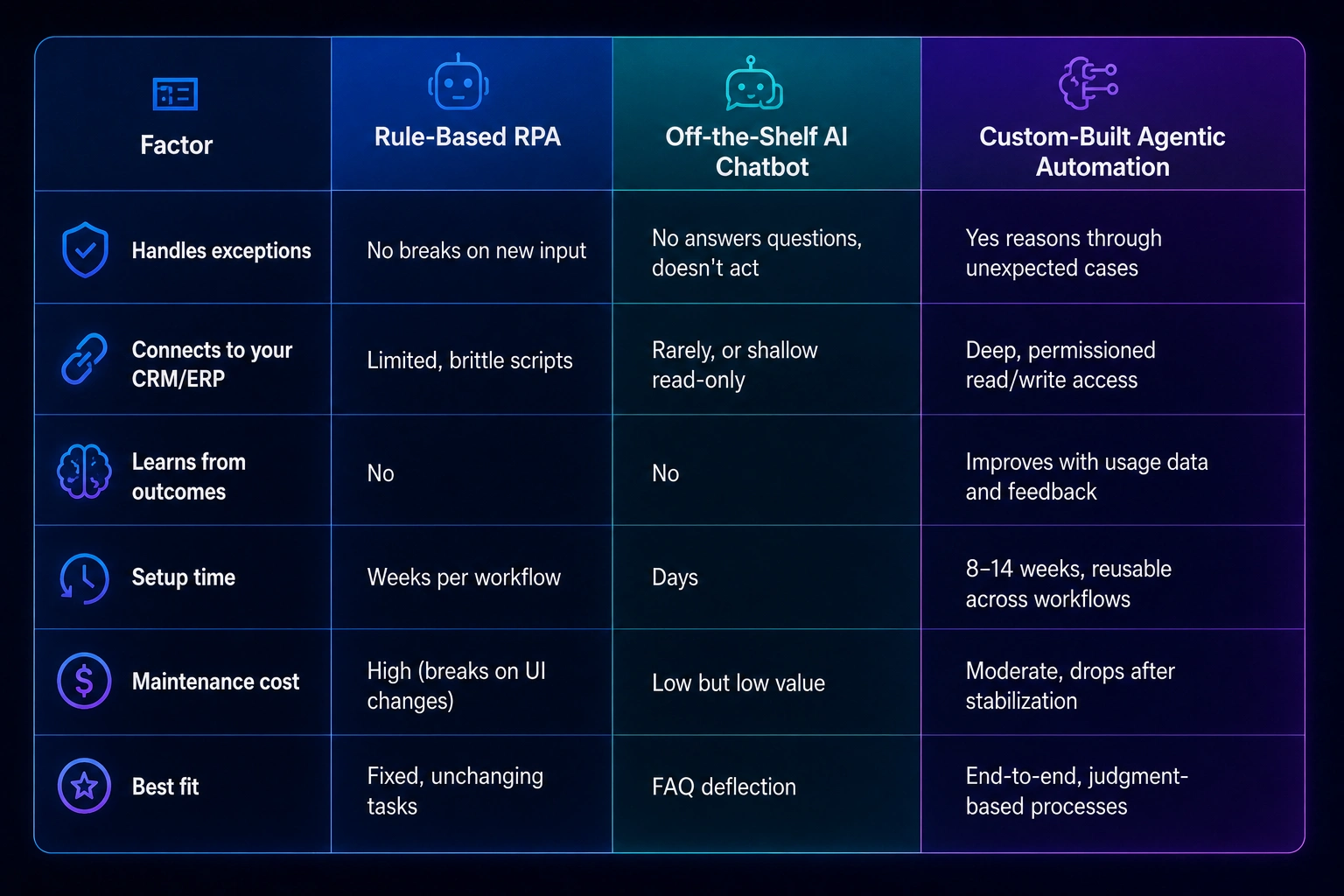
Off-the-Shelf Bots vs. RPA vs. Custom-Built Agentic Automation
Before picking a route, it helps to see the three approaches side by side. This is the comparison most teams skip and the one that ends up mattering most six months in.
What Is Agentic AI Automation, Really?
Agentic AI automation gives a large language model a goal instead of a question, then lets the model break that goal into steps, choose which tools to call, execute those steps, and report back without a person approving every move. A support chatbot answers "where is my order?" An agentic system checks the order status, issues the refund if policy allows it, logs the case, and only escalates to a human when it hits a decision it isn't authorized to make.
The distinction matters because most "AI automation" sold in 2025 was really automation with an AI-shaped wrapper: a chatbot bolted onto a form, or a script with a language model doing sentence completion at one step. Agentic AI Services go further. They combine a reasoning model, a tool-calling layer, and an orchestration framework so the system can string together research, decision-making, and execution in one continuous run.
Why Off-the-Shelf Tools Fall Short: The Case for Custom Agentic AI Development
Generic AI agent platforms are built to demo well across thousands of companies at once, which means they're tuned for the average case, not your CRM's odd field names, your approval chain, or the three exceptions your ops team handles by hand every week. That's where a tailored agentic AI build earns its cost.
A custom build starts from your actual workflow, not a template:
- Your data model. The agent is trained on how your business actually names accounts, statuses, and SKUs, not a generic schema.
- Your approval logic. Refund limits, discount thresholds, and escalation rules get built in as guardrails, not guessed at.
- Your existing stack. Integrations connect directly to the CRM, ERP, and ticketing systems you already run, through the Model Context Protocol (MCP) or direct API calls, so you're not migrating data to a new platform.
- Your compliance requirements. Healthcare, finance, and legal workflows need audit trails and human checkpoints that off-the-shelf agents don't ship with by default.
Off-the-shelf tools are fine for a single, narrow use case, drafting email replies, for example. But once a workflow touches more than one system or requires judgment calls, generic tools tend to hit a wall that only a custom-engineered agentic system is built to clear.
Stop Planning AI.
Start Profiting From It.
Every day without intelligent automation costs you revenue, market share, and momentum. Get a custom AI roadmap with clear value projections and measurable returns for your business.
The Core Stack Behind Custom Agentic AI Development
A working agentic system is really five layers stacked on top of each other, not a single "AI feature." Understanding each layer helps you evaluate any automation vendor's proposal, because a vendor that glosses over orchestration or guardrails is usually selling a chatbot with extra steps.
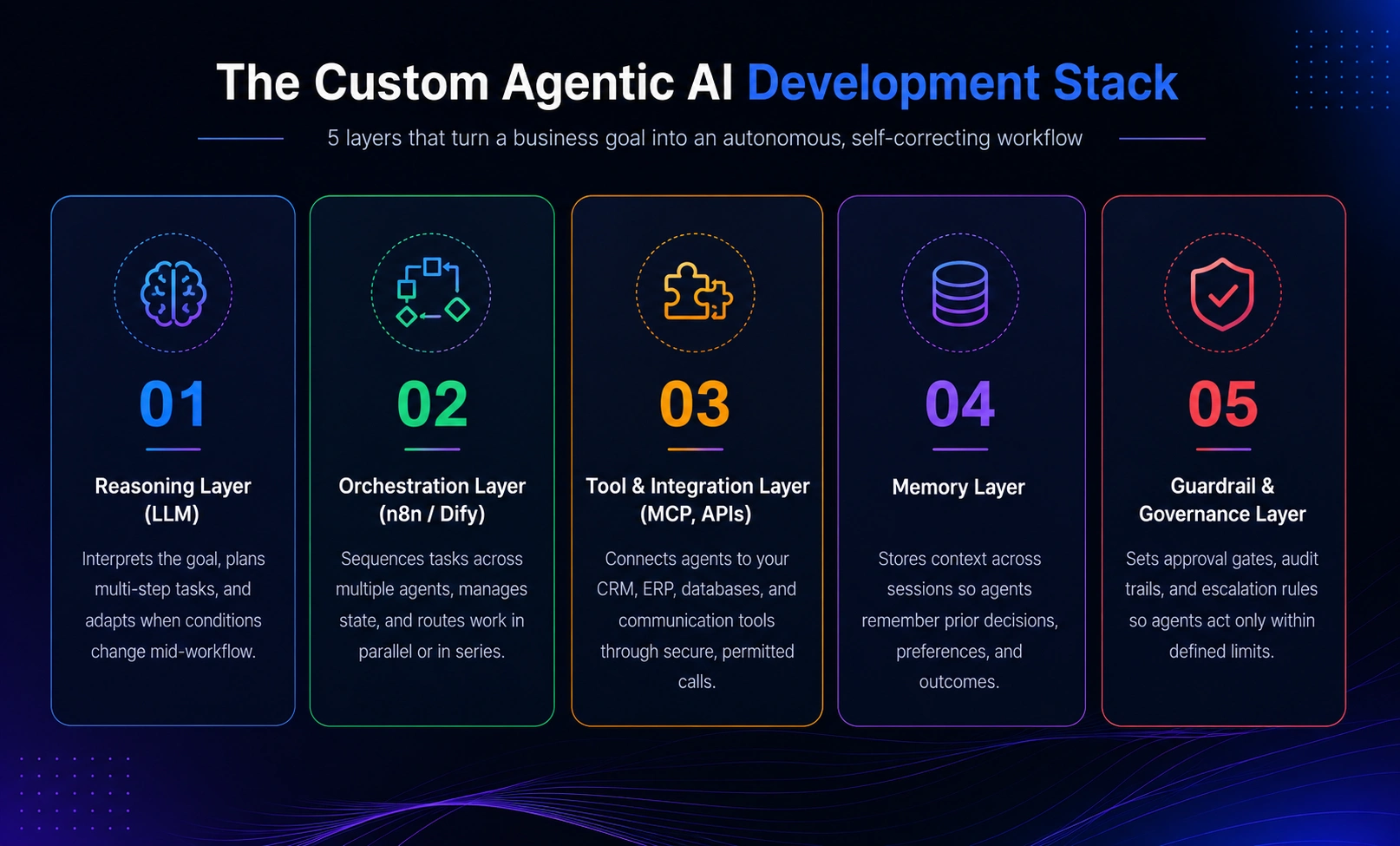
- Reasoning layer (the LLM). Interprets the goal and plans the sequence of steps, adjusting when a step fails or conditions change mid-task.
- Orchestration layer. Frameworks like n8n and Dify sequence tasks across single or multiple agents, track state, and decide what runs in parallel versus in order.
- Tool and integration layer. Connects the agent to your CRM, ERP, databases, and messaging tools through secure, permissioned API calls or MCP servers.
- Memory layer. Stores context across sessions so the agent remembers prior decisions instead of starting from zero every run.
- Guardrail and governance layer. Defines what the agent can do without approval, what needs a human sign-off, and how every action gets logged for audit.
Skip any one of these layers, and you get a system that works in the demo and stalls in production which is a big part of why Gartner expects more than 40% of agentic AI projects to be canceled by 2027, usually over governance gaps rather than model quality.
Where Agentic AI Services Deliver Measurable ROI
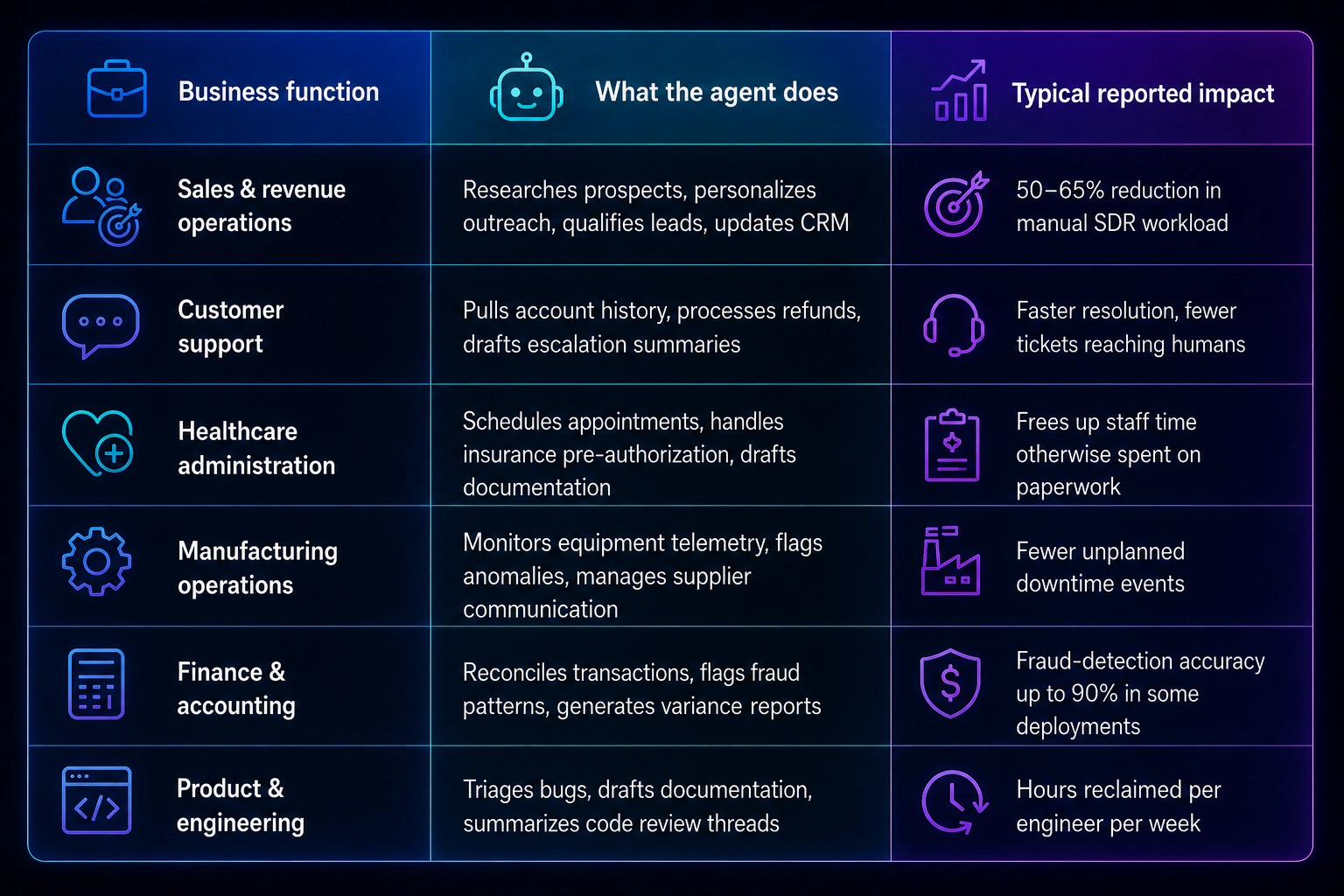
Almost every department can use some form of automation, but a handful of functions respond faster because they combine repetitive volume with judgment calls that used to require a person. Based on deployment patterns across enterprise clients, here's where autonomous business agents tend to pay for themselves fastest:
Agentic AI Automation Market Growth: The Numbers Behind the Shift
The spending pattern backs up what's happening on the ground. The global agentic AI market was worth roughly $7.3 billion in 2025, and market researchers project it will reach $9.1 billion in 2026 before climbing toward $139.2 billion by 2034, a 40.5% compound annual growth rate (Fortune Business Insights). Separately, Gartner projects that 40% of enterprise applications will carry task-specific AI agents by the end of 2026, up from less than 5% in 2025 (Gartner).
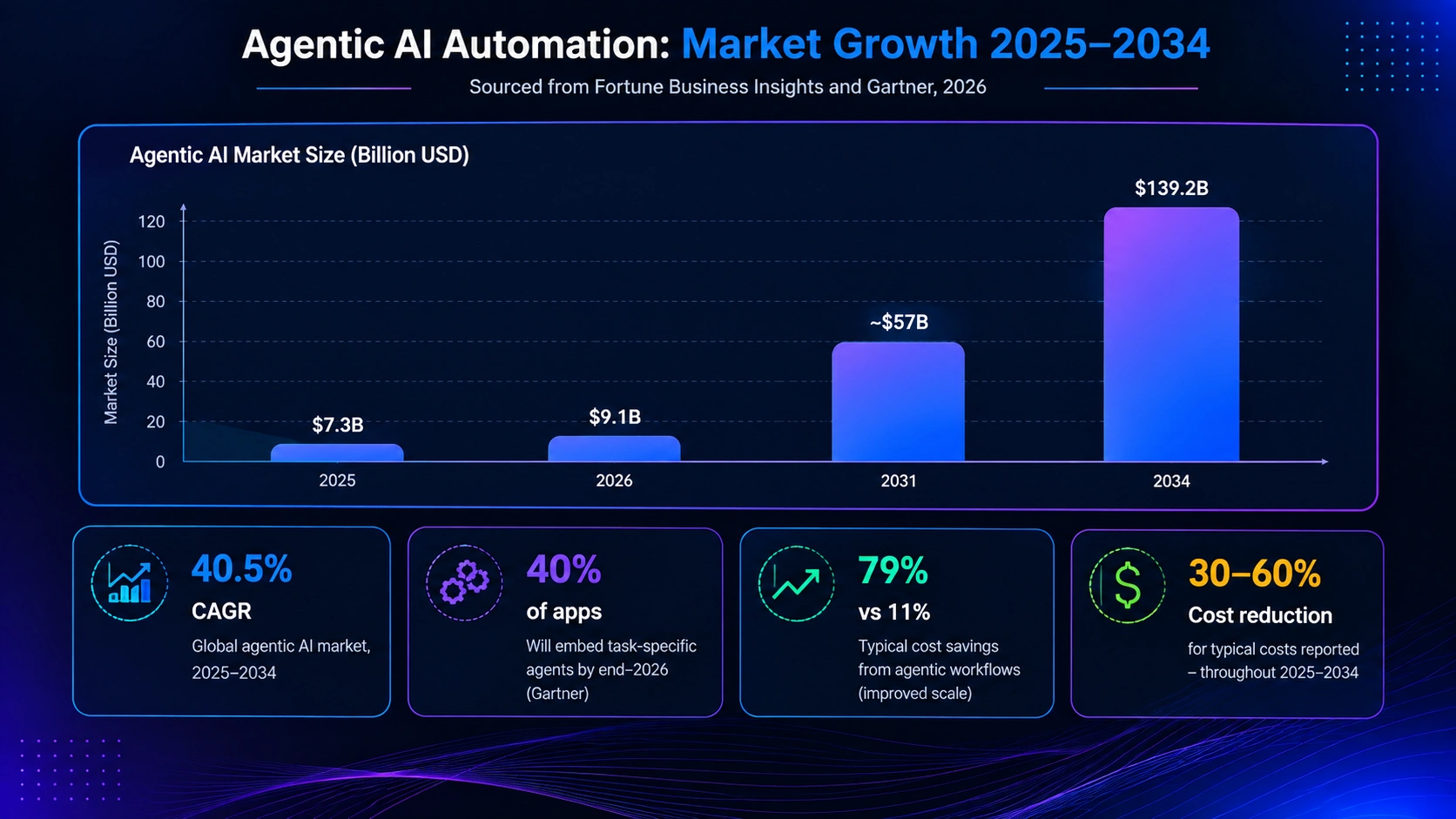
The adoption numbers, though, tell a more cautious story than the spending numbers. Roughly 79% of enterprises have adopted AI agents in some form, but only about 11–23% run them in production at scale a gap driven mostly by unclear success criteria and missing data access, not by weak underlying models. That gap is precisely why a rushed, generic rollout underperforms a properly scoped, custom-built agentic engagement.
How to Choose the Right AI Automation Agency
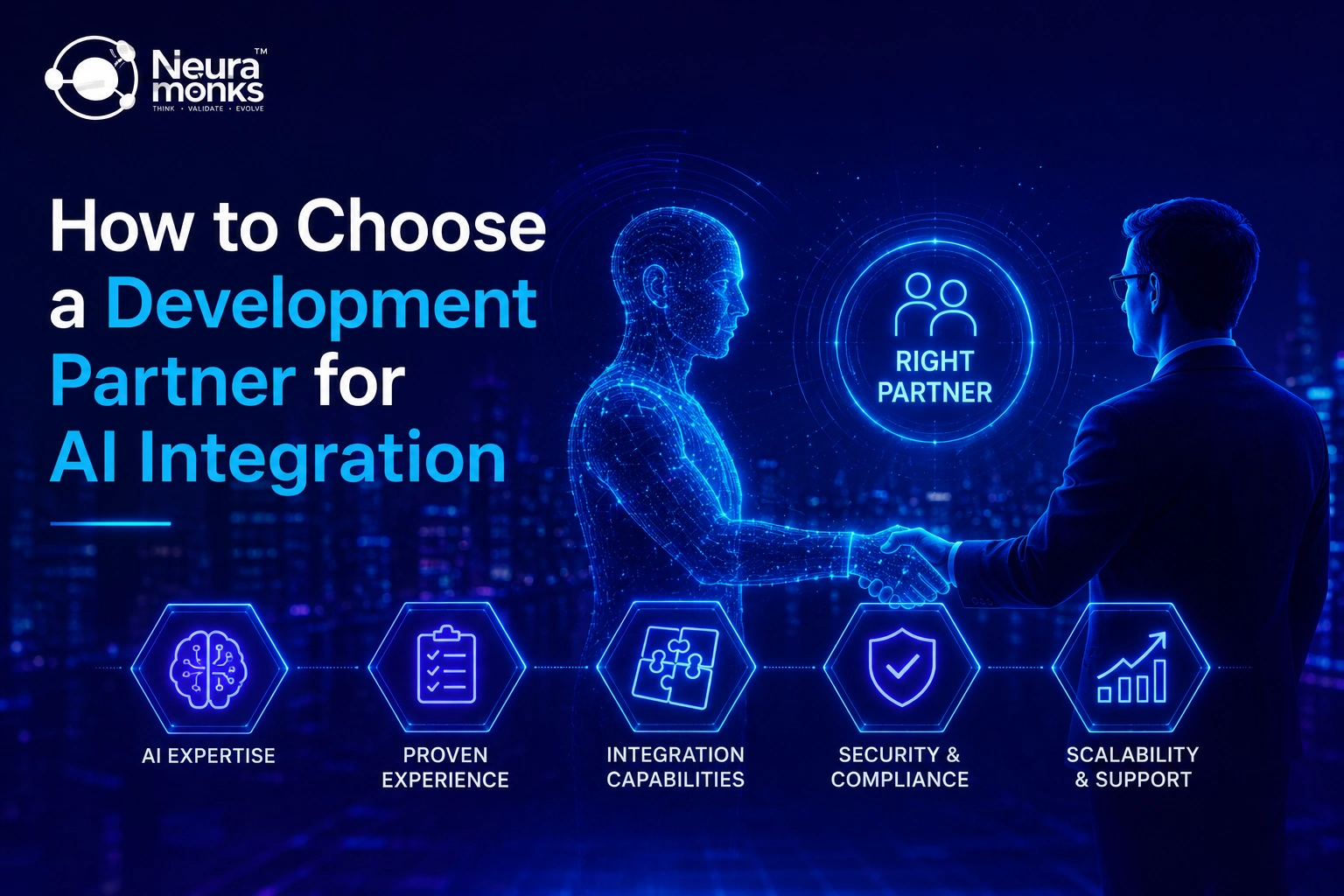
Not every automation vendor that says "agentic" actually builds agentic systems; plenty are reselling chatbot templates with a new label. Before signing with any automation partner, run through this checklist:
- Ask for a working proof of concept on your own data, not a generic demo. A serious partner should deliver this in three to four weeks.
- Confirm you own the code, models, and integrations at the end of the engagement no platform lock-in.
- Check their integration depth. Do they connect through your real CRM/ERP APIs, or just a webhook that reads surface-level data?
- Ask how guardrails are enforced, not just described. Approval gates and audit logs should be visible in the architecture, not a slide.
- Review post-launch support terms. Real-world usage surfaces edge cases in the first 90 days that a demo never will.
Questions like these separate a genuine Top AI Automation Agency from a vendor selling a repackaged template. The answers usually surface in the first call a partner that can't explain their architecture in plain language on request is worth a second look.
n8n vs. Dify: Picking Your Orchestration Layer
Two orchestration frameworks dominate most custom agentic automation builds today: n8n and Dify. Neither is universally "better"; the right choice depends on your team's technical depth and how much visual control you want over agent logic.
- n8n is a node-based automation platform well suited to workflows that mix agentic reasoning with traditional triggers a new CRM record kicking off an agent chain, for example. It's a strong fit when your team already runs other automations and wants agentic steps to slot into existing pipelines.
- Dify is built specifically around LLM application development, with native support for retrieval-augmented generation, prompt orchestration, and multi-agent workflows out of the box. A Dify AI Development Company typically ships faster for pure conversational-agent and knowledge-base use cases because less custom scaffolding is required around the model itself.
Many production builds actually use both: Dify for the agent's reasoning and knowledge layer, n8n for connecting that agent into the rest of the business's
AI Solutions stack and existing software.
The Custom Agentic AI Development Process, Step by Step
A properly scoped engagement follows a predictable sequence, whether you're automating claims review or supplier communication:
- Discovery and workflow mapping (weeks 1–2). Structured sessions with operations and technology leads map the existing process end to end and define success metrics before any code gets written.
- Proof of concept (weeks 2–4). A working prototype runs against one targeted workflow using real data and real systems, so you can measure results against a baseline before committing further budget.
- Agent architecture and build (weeks 4–10). The orchestration layer gets designed, the base LLM gets selected and tuned, tool integrations get built, and memory and guardrails get implemented for your specific industry.
- Deployment, training, and handover (weeks 10–14). The system goes live, your team gets trained, monitoring dashboards go up, and documentation gets delivered so you own the system outright.Continuous optimization. Performance data gets reviewed regularly to identify the next workflow worth automating, since most teams expand scope within six months of the first deployment.
Real-World Impact: What a Custom-Built Agentic System Looks Like in Production
Numbers on a slide are easy to produce; numbers from a running system are not. Here are two examples of what a custom-built agentic system looks like once it's live.
Case Study 1: AI Podcast Production Platform
The challenge. A podcast production platform needed to handle topic research, factual grounding, narrative consistency, and multi-speaker script formatting steps that were previously done manually, one at a time, by a human production team.
The build. Rather than a single AI agent, the team built a multi-agent system using more than ten specialized agents, each responsible for one part of the pipeline:
- A research agent that gathers and organizes source material on the episode topic.
- A fact-grounding agent that checks claims against verified sources before they reach a script.
- A narrative-consistency agent that keeps tone, continuity, and structure aligned across a full episode.
- A script-formatting agent that structures the output for multiple speakers.
The automation flow. Once the script is finalized, it's routed automatically to text-to-speech engines, meaning the process runs from research to finished audio with no manual handoff in between.
The result.
- 60–70% reduction in manual production effort
- 50–65% faster content-creation cycles
- 30–40% higher content and tonal consistency across episodes
This system was built by Neuramonks, and the full breakdown including how the agent handoffs and RAG grounding were architected is available in their AI podcast generation platform case study
Case Study 2: AI Voice Agent for Pizza Ordering
The challenge. Pizza restaurants take a high volume of time-sensitive phone orders, and traditional phone-based ordering created clear bottlenecks: calls missed or rushed during peak hours, order errors on toppings, sizes, and quantities, heavy dependence on staff availability, and no structured data captured from calls for analysis or forecasting. As order volume grew, manual phone intake became both costly and unreliable.
The build. we built an AI voice agent that answers calls and takes complete pizza orders end-to-end, without staff involvement. The system includes:
- Restaurant-specific menu intelligence covering sizes, toppings, add-ons, and customizations.
- Structured, step-by-step conversational flows for order capture and confirmation.
- Real-time, low-latency voice session management to hold up under peak-hour call volume.
- Automated extraction and persistence of structured order data for downstream analytics.
The agent had to handle accurate menu interpretation in noisy environments and varied accents, complex multi-item orders with customizations, and natural conversation flow including corrections and clarifications while still reliably extracting structured data from free-form speech.
The result.
- 50 - 60% reduction in manual, phone-based order handling
- 25 - 35% reduction in order errors
- 30 - 40% improvement in peak-hour order capture capacity
Full details are in Neuramonks' AI Voice Agent for Pizza Ordering case study.
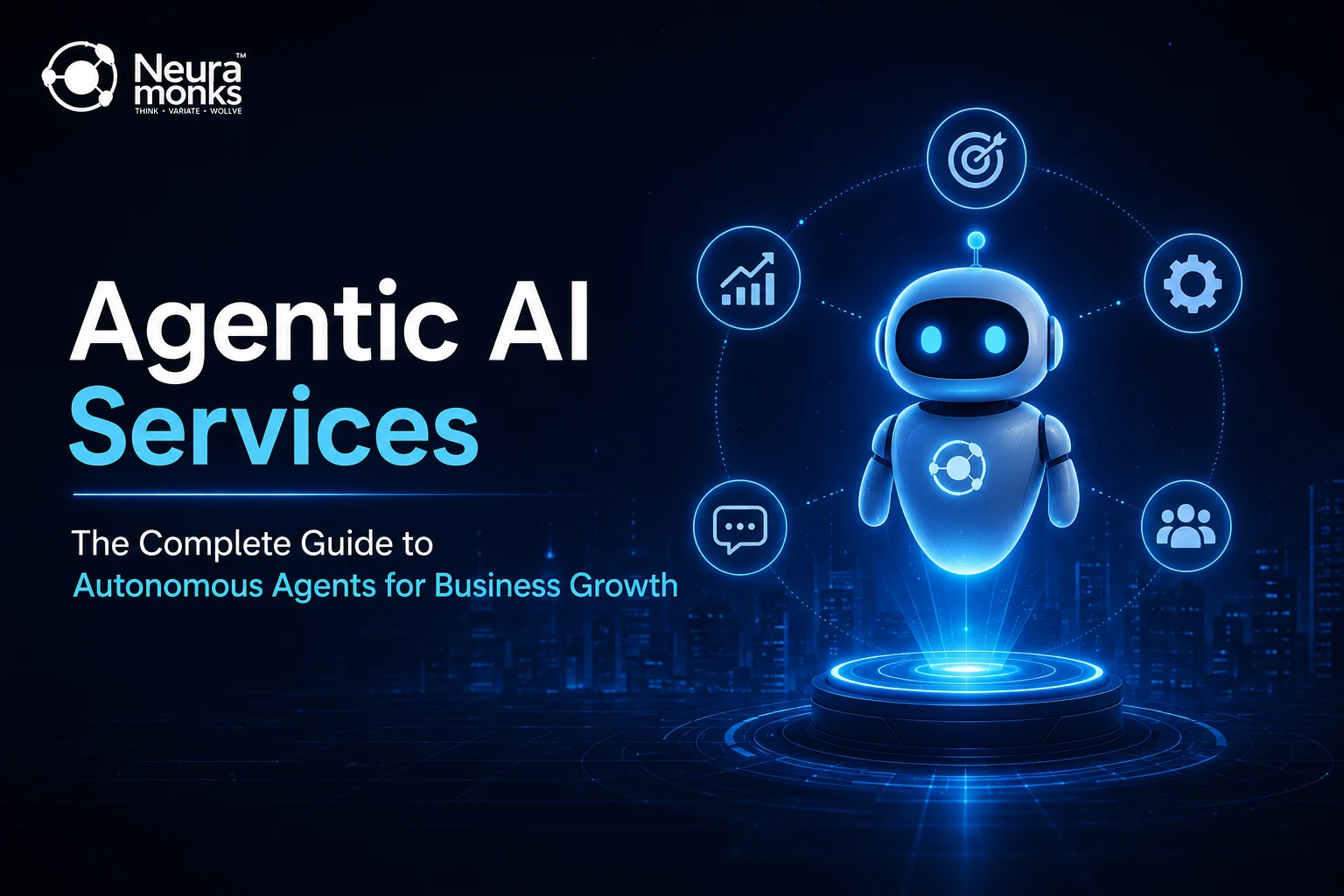
Both systems were built by Neuramonks, whose complete guide to Agentic AI Services for business growth covers the methodology behind these and other deployments in more depth.
Common Pitfalls That Sink Agentic AI Automation Projects
Most failed agentic rollouts don't fail because the model was too weak. They fail for reasons that show up long before deployment:
- No clear success metric. "Improve efficiency" isn't measurable. "Cut ticket resolution time from 4 hours to 20 minutes" is.
- Missing system access. An agent that can read data but can't write to the CRM ends up creating manual work, not removing it.
- No evaluation discipline after launch. Agents drift as real-world inputs diverge from training scenarios; without ongoing evaluation, accuracy quietly degrades.
- Skipping the proof-of-concept stage. Jumping straight to full-scale deployment without validating on real data is the single biggest predictor of the projects Gartner expects to get canceled by 2027.
- Treating governance as an afterthought. Guardrails bolted on after launch are far harder to retrofit than guardrails designed in from day one.
Getting Started with Custom Agentic AI Development
If you're weighing whether to build in-house, buy a platform, or bring in outside help, the honest answer depends on how core the workflow is to your business and how much integration depth it needs. A narrow, low-stakes task might be fine with an off-the-shelf tool. Anything touching customer data, financial approvals, or multiple systems is usually worth the extra weeks a proper custom-built agentic engagement takes.
Neuramonks builds agentic systems with tool use, guardrails, and human review that survive real workloads, not just demos. As a specialized AI automation agency, the team runs discovery, delivers a working proof of concept within three to four weeks, and hands over full ownership of the code, models, and integrations at the end of the engagement. If you want a concrete build plan for one specific workflow, book a free discovery call and get a scoped roadmap within one business day.
Conclusion
Agentic AI automation isn't a single product you can buy off a shelf; it's a system built around how your business actually operates. Custom Agentic AI Development takes longer to stand up than a chatbot integration, but it's the difference between a pilot that gets quietly shelved and a system that keeps paying for itself a year later. The market data backs the direction: spending is accelerating fast, but the enterprises actually reaching production are the ones that scoped a real workflow, built proper guardrails, and measured results before scaling.
Ready to see what Custom Agentic AI Development could do for your highest-friction workflow? Book your free discovery call and get a scoped automation roadmap no commitment required.