TABLE OF CONTENT
Most enterprise AI initiatives don't fail because the model isn't smart enough. They fail because a slick weekend demo gets budget approved, and the team spends the next eight months discovering it can't handle authentication, data governance, latency, or hallucinations under real load.
That gap between demo and production is where enterprise LLM implementation lives. This guide breaks down what building production-grade AI actually involves, what it costs, how to evaluate vendors, and how to avoid the trap of a six-figure pilot that never reaches deployment.
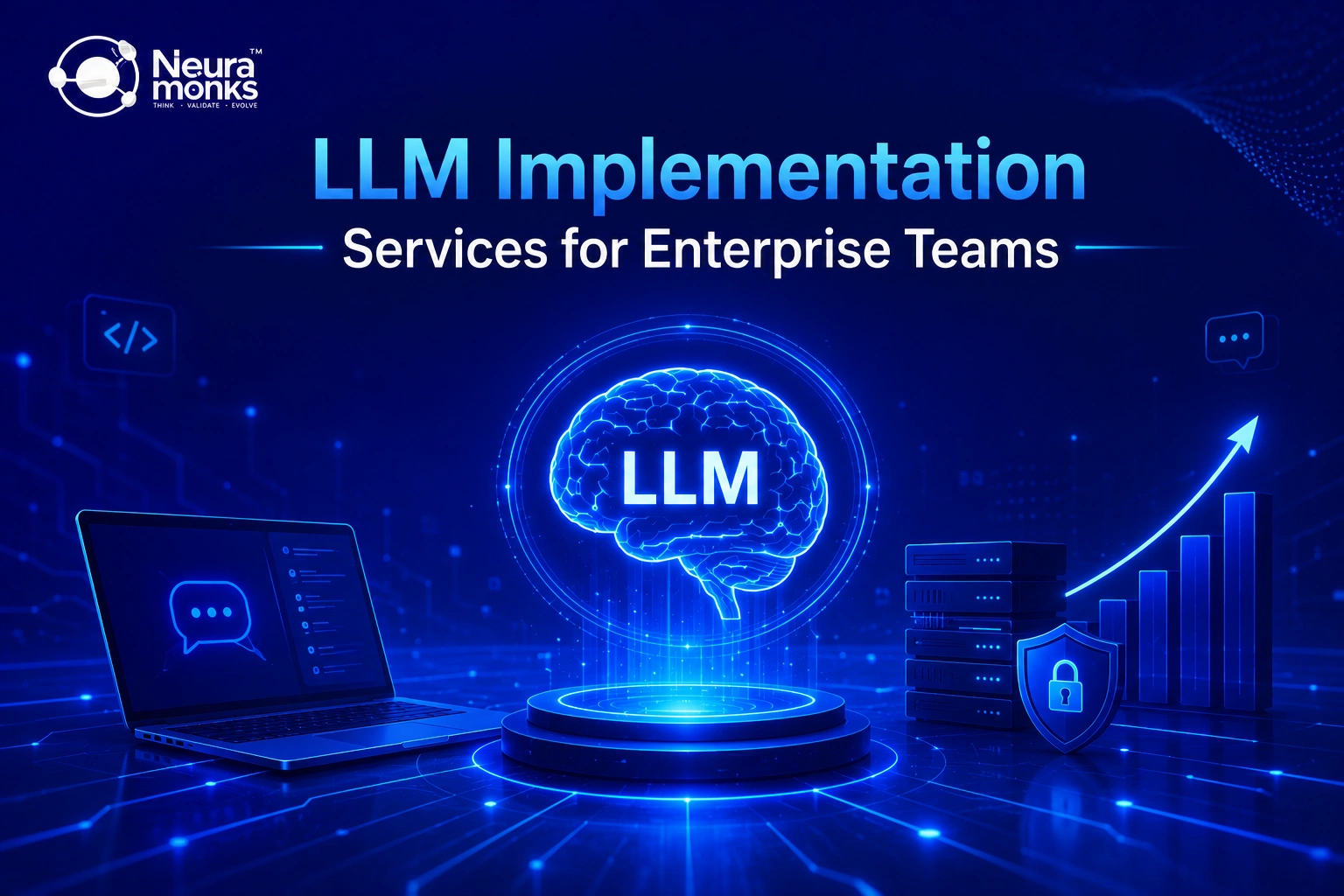
Enterprise LLM implementation covers everything required to move a large language model from a demo into a production system: data pipeline design, retrieval architecture, agentic orchestration, security hardening, integration with existing software, and ongoing monitoring after launch. A structured proof-of-concept phase up front confirms return on investment before full build-out begins.
This isn't a theoretical exercise. The decisions covered below- build versus buy, RAG versus fine-tuning, which metrics to lock in before writing a line of code- show up in almost every enterprise AI kickoff call, regardless of industry. Healthcare, finance, manufacturing, and SaaS teams all hit the same forks in the road. What changes is the compliance layer on top, not the underlying engineering questions.
What enterprise LLM implementation actually involves
A large language model by itself is a raw capability. It has no memory of your business, no access to your internal documents, no understanding of your compliance requirements, and no connection to the systems your team already uses. Implementation is the engineering work that turns that raw capability into something your operations can rely on.
Enterprise LLM solutions typically bundle five components, and skipping any one of them is a common reason pilots stall before reaching production:
- Structuring, cleaning, and indexing internal documents, tickets, transcripts, or records so a model can actually use them.
- Vector databases such as Pinecone, Weaviate, or pgvector that let a model pull relevant context at the moment it's needed, instead of guessing.
- Choosing between a hosted model, a fine tuned variant, or a hybrid setup based on cost, latency, and data sensitivity.
- Connecting the model to CRM systems, ticketing platforms, internal wikis, or whatever software already runs the business.
- Tracking accuracy, hallucination rate, and cost per query after launch, since model behavior drifts as usage patterns and underlying data change.
Skip the retrieval layer, and the model hallucinates policy details. Skip monitoring, and nobody notices when accuracy quietly drops three months in.
Skip integration and the "AI project" becomes a browser tab nobody on the team actually opens.
Why so many AI pilots never make it to production
Enterprises often assume AI solutions run themselves once deployed. They don't. Generative AI adoption is accelerating across nearly every industry, but adoption and value capture are two different numbers, and the gap between them is wide. Gartner has reported that more than half of these initiatives get abandoned after the proof of concept stage, with data quality gaps, unclear risk controls, and runaway costs cited as the leading causes (source: Gartner).
In our own engagements, the pattern is almost always the same three root causes:
- See if AI can help with X" is not a target. A defined baseline, a target KPI, and a review date must exist before the first line of code is written.
- Unstructured, duplicated, or poorly tagged internal documents produce a retrieval layer that returns garbage, and no amount of prompt engineering fixes a bad index.
- A model deployed and left alone degrades. Someone on the team, internal or vendor, has to own drift monitoring and retraining.
None of these are model problems. They're implementation problems, and they're exactly what a competent LLM implementation partner is supposed to catch before they become six-figure write-offs.
Stop Planning AI.
Start Profiting From It.
Every day without intelligent automation costs you revenue, market share, and momentum. Get a custom AI roadmap with clear value projections and measurable returns for your business.

Six Requirements Enterprise LLM Architecture Must Cover
Enterprise teams rarely fail because a model can't generate a response. They fail because nothing around the model was built to survive production traffic, security review, or a compliance audit.
Agentic orchestration is the layer that closes that gap. Instead of a single LLM handling every request, orchestration coordinates multiple agents, routes tasks, and enforces structure across the entire workflow.
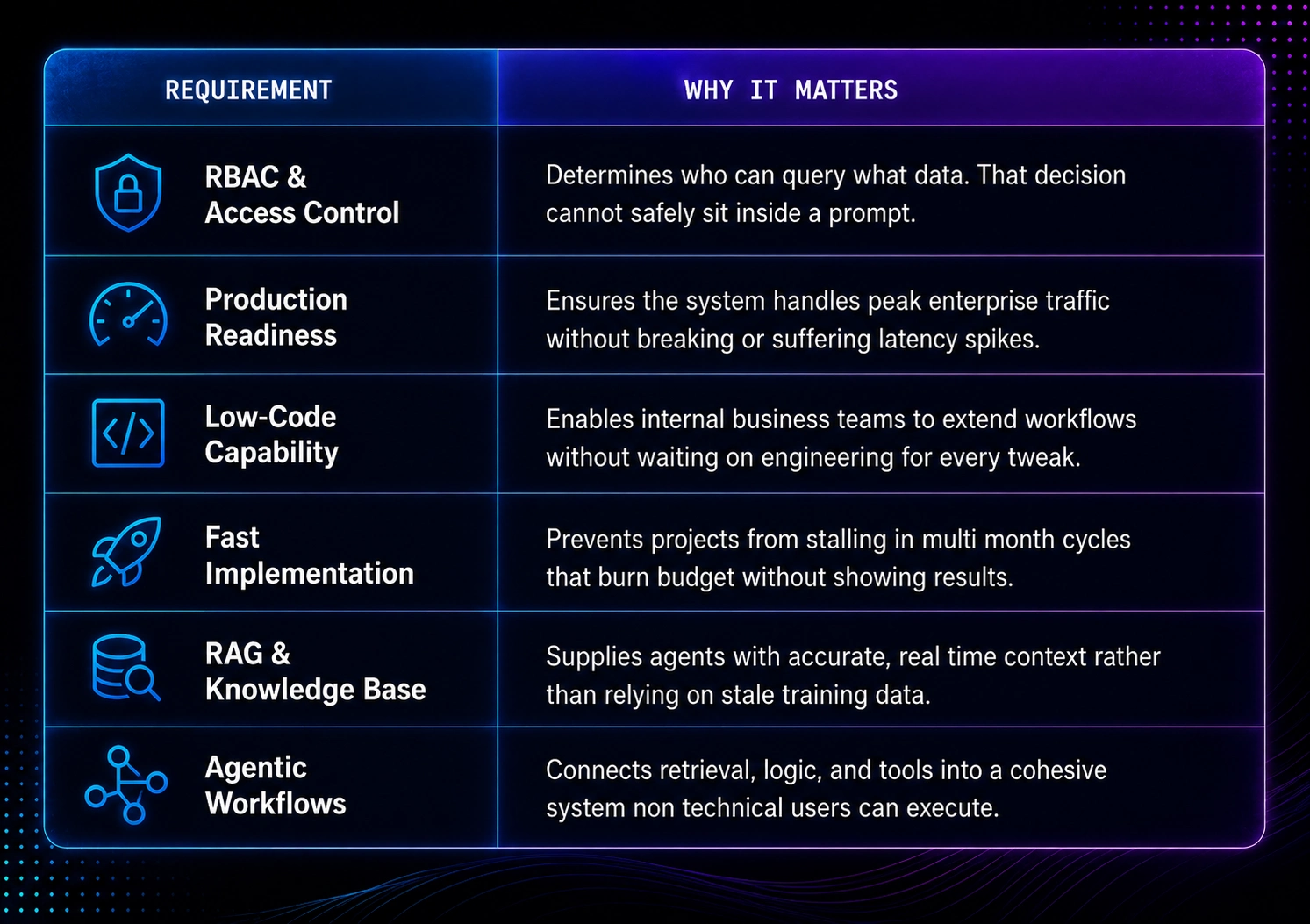
Six requirements come up in nearly every enterprise engagement:
Get these six right and automation stops being a pilot project. It becomes infrastructure, and infrastructure is what drives faster implementation and measurable ROI.
Build in-house, hire an agency, or run a hybrid team
This is the decision enterprises get wrong most often, usually because it gets framed as a cost question when it's really a capability and timeline question.
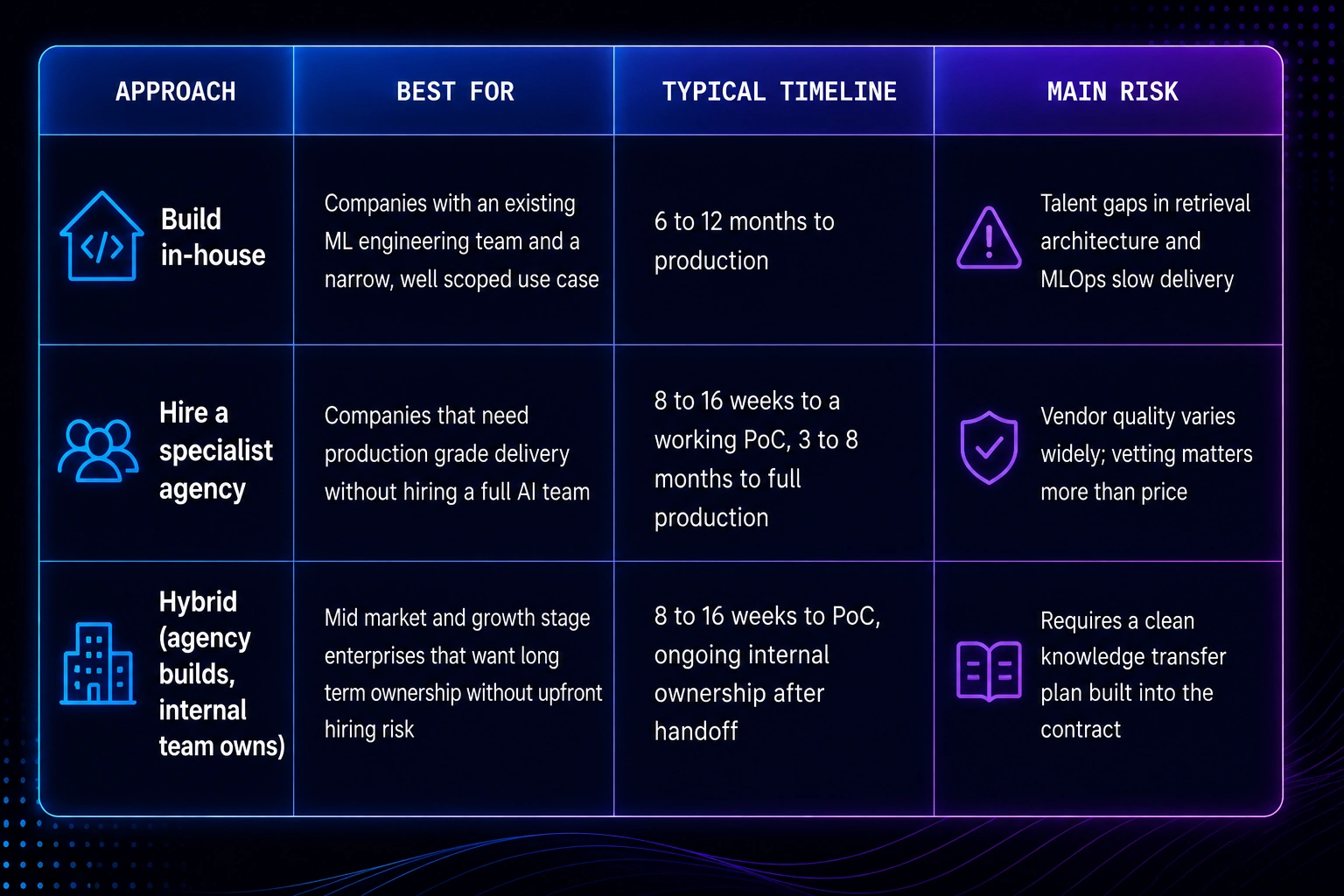
Purchasing from a specialized vendor succeeds noticeably more often than building the same system from scratch with a first time internal team, largely because agencies have already made, and fixed, the expensive mistakes on someone else's project. That advantage disappears fast, though, if the agency you hire has never actually shipped enterprise LLM solutions past the demo stage.
How a successful enterprise LLM deployment is structured
Every engagement starts with a business outcome, not a model choice. Before any architecture decision gets made, the question on the table is what number is supposed to move: cost per ticket resolved, hours saved per week, accuracy against a human baseline, or something else specific enough to measure in 90 days. At Neuramonks, we structure every engagement around that outcome, moving through three distinct phases.
Phase one: proof of concept (4 to 8 weeks)
Real client data, a narrow use case, and a defined go or no go metric agreed before work starts. No synthetic test data, no "let's see what happens" scope.
Phase two: production build (8 to 16 weeks depending on scope)
Retrieval pipeline, agentic orchestration, model integration, security hardening, and connection to existing systems like a CRM or internal knowledge base.
Phase three: MLOps and monitoring (ongoing)
Drift detection, cost tracking, and scheduled retraining cycles, because a model that worked well at launch won't necessarily still work well six months later.
One example from a media production client: the team needed to scale podcast output without growing the editorial staff at the same rate, moving from 3 episodes a week to 12. A multi-agent pipeline was built where one agent handled topic research through live web retrieval, a second structured and scripted each episode, and a third routed finished scripts to a text-to-speech layer, all coordinated through an agentic orchestration layer that managed handoffs between the three.
End-to-end production time dropped by roughly 70% against the prior manual workflow, and the system now runs across multiple show formats without a human in the research or scripting steps. For a deeper look at how this kind of architecture decision gets made,
See our full breakdown of enterprise LLM development beyond chatbots.
What enterprise LLM implementation costs in 2026
Pricing varies by scope, compliance requirements, and how much of the surrounding infrastructure already exists. The ranges below reflect typical market rates, not fixed quotes.
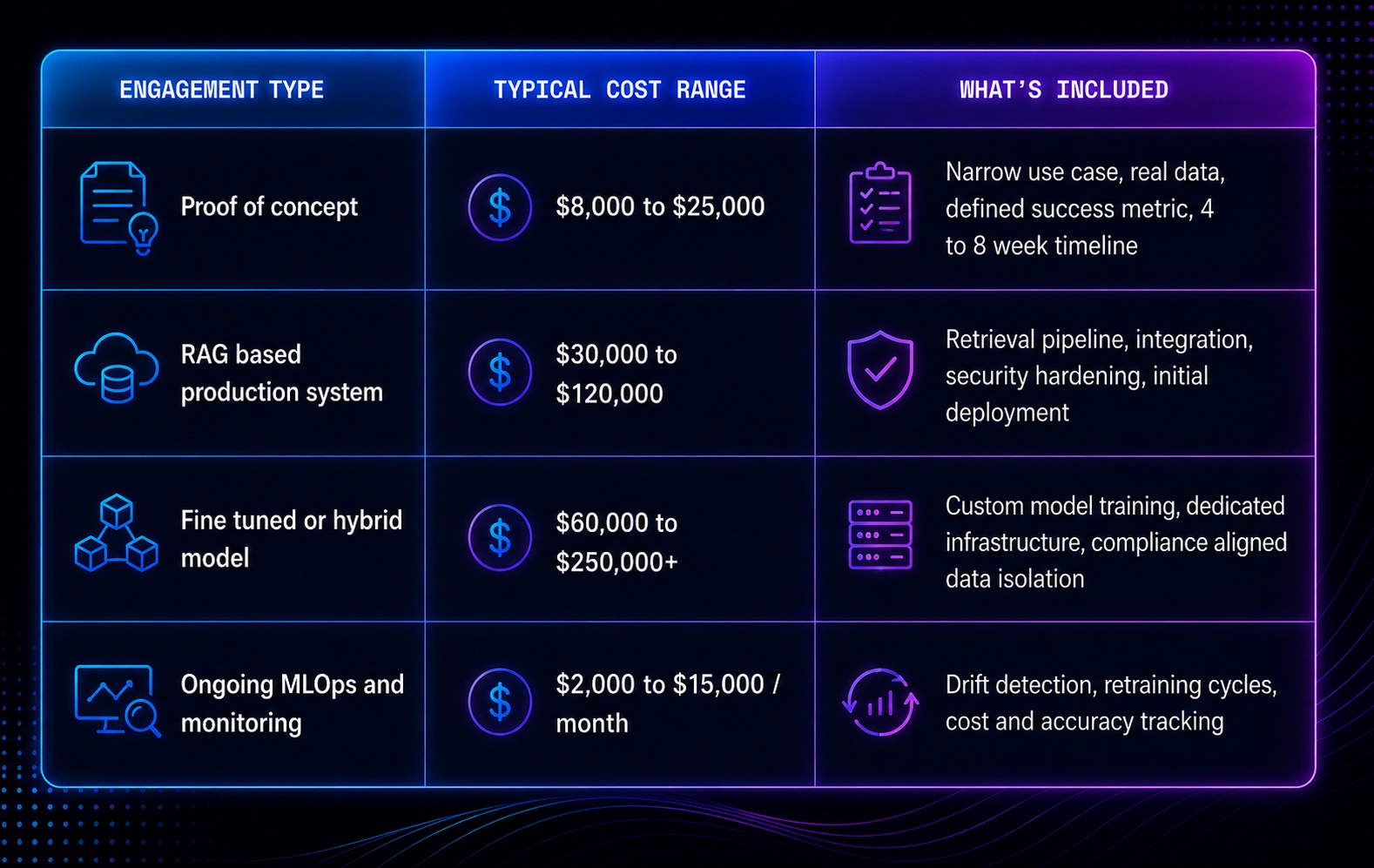
Most enterprise LLM solutions fall into the RAG-based production tier, since retrieval delivers accuracy comparable to fine-tuning for the majority of internal use cases, at a fraction of the training and maintenance cost. Fine-tuning earns its higher price tag when a business needs a self-hosted model with no external API calls, or highly consistent domain-specific output that context injection can't reliably produce.
Questions to ask before signing with an implementation partner
A short, direct evaluation list, worth working through in the first sales call rather than after a contract is signed:
- Can you show a production deployment with real accuracy or cost numbers, not just a demo?
- What's your default recommendation between RAG and fine tuning, and why?
- How do you structure the proof of concept phase, and what's the go or no go criteria?
- Who owns monitoring and retraining after launch, and at what ongoing cost?
- What compliance certifications or data isolation practices apply to regulated data?
- What happens to the system and the knowledge behind it if we end the engagement?
An agency that can't answer the fourth question clearly is quietly planning to leave a system your team doesn't know how to maintain.
Five mistakes that sink enterprise LLM projects
Choosing a vendor on price alone
LLM engineering is a specialist skill, and the lowest quote in the room is usually the one with the least production experience behind it.
Skipping the proof of concept phase
Jumping straight from requirements to full build is one of the most reliable ways to burn a large budget on a system that never ships.
No agreed success metric before work begins
Vague goals produce vague, unmeasurable results, and a review six months later with nothing to show for it.
Treating deployment as the finish line
A model that isn't monitored will drift, and nobody notices until a customer or an auditor does.
Defaulting to fine-tuning for everything
It's expensive, slow to iterate on, and unnecessary for most retrieval-style use cases. A partner who reaches for it by default is optimizing for their own invoice.
Where this leaves you
The technology is no longer the hard part. Hosted models are commodity infrastructure at this point, and almost anyone can wire one up to a chat window in an afternoon. The hard part, and the part that actually determines whether a project produces value or becomes a write off, is the engineering work around the model: the data pipeline, the retrieval layer, agentic orchestration, RBAC, the integration, and the discipline to keep monitoring it after launch.
That's the work enterprise LLM implementation services exist to do, and it's worth vetting a partner on exactly that basis rather than on how good their demo looks in a sales call.
Ready to audit your AI roadmap?
Bring your actual use case and data constraints. In 30 minutes, Neuramonks will tell you whether RAG, fine-tuning, or a standard workflow is the right fit, and what it would take to get there.

Ketan Kanjiya
Ketan Kanjiya is a Machine Learning researcher and Chief Research Officer at Neuramonks, an AI-focused technology company based in Ahmedabad, Gujarat. With hands-on expertise in AI/ML, image processing, and web application development, he has led research initiatives across F(x) Data Labs and Kshatrainfotech. Ketan writes to simplify advanced technical concepts for developers and tech enthusiasts alike.