TABLE OF CONTENT
Choosing the right AI development partner means checking four things before you sign anything: proven integration work in your industry, a transparent build methodology, real production deployments (not just demos), and a contract that protects your data and IP. Run every AI integration project candidate through that checklist first.
Most AI integration projects do not fail because the model is bad. They fail because the vendor could not connect the model to the systems that actually run the business. According to MIT's Project NANDA research, about 95% of generative AI pilots never produce measurable profit-and-loss impact, and the same study found that companies buying AI solutions from specialized vendors succeeded roughly 67% of the time, compared with about one-third for teams that tried to build everything internally. The gap is not the technology. It is who builds it.
If you are the person tasked with picking that vendor, this guide walks through what actually separates a dependable AI development partner from a slide deck with a logo on it. It also covers how to weigh transactional questions (who do I call, what does it cost, how fast can they move) alongside informational ones (what should I even be looking for).
Why the Wrong AI Integration Partner Costs more than the Project Itself
Picture the scenario from the buyer's side, not the vendor's. Someone on your team has been asked to "figure out AI" for the customer support queue, the claims intake process, or the equipment maintenance log. They talk to three vendors. Two show a slick demo running on sample data. One asks to see your actual CRM, your actual data pipeline, and your actual compliance requirements before quoting anything.
That third vendor is usually the one worth hiring, and here is why. AI solutions that look impressive in a sandbox often break the moment they meet real, messy, production data: duplicate records, inconsistent formats, systems that were never designed to talk to each other. A development partner who has not planned for that will hand you a pilot that never leaves the lab. A Gartner analysis cited in recent industry reporting found that organizations scrap close to half of their AI proofs-of-concept before they ever reach production, largely because integration and data readiness were never scoped properly at the outset.
The cost of picking wrong is not just the wasted contract value. It is the months of internal credibility burned, the data exposed to a vendor with no security process, and the AI integration project that quietly dies while leadership loses appetite for the next one.
Stop Planning AI.
Start Profiting From It.
Every day without intelligent automation costs you revenue, market share, and momentum. Get a custom AI roadmap with clear value projections and measurable returns for your business.
What to look for in an AI development partner
Proven Work in your Specific Industry
An AI development partner who has shipped agentic AI for healthcare intake will understand HIPAA constraints, clinical documentation formats, and patient data handling without you explaining it twice. The same logic applies to manufacturing (equipment telemetry, predictive maintenance, ERP integration) and construction (project management systems, field data capture, subcontractor workflows). Ask for named case studies in your vertical, not generic "we work across every industry" language.
A Named, Explainable Technical Methodology
Ask the partner to describe, in plain language, how they will connect the AI model to your existing systems. A credible AI consulting company should be able to name the specific approach: retrieval-augmented generation (RAG) for grounding answers in your own documents, an agentic AI workflow for multi-step tasks, or a computer vision pipeline for visual inspection. Vague answers about "leveraging the latest AI" are a warning sign, not a selling point.
Production Deployments, not just Pilots
A pilot proves a concept works in a demo. Production proves it survives contact with your actual users, actual data volume, and actual edge cases. Ask directly: "How many of your AI integration projects made it past the pilot stage into daily production use, and for how long have they been running?" A partner with real answers to that question is rare and worth paying for.
Clear Data Ownership and Security Terms
Your contract should state plainly who owns the data, who owns the model outputs, and what happens to your information if the engagement ends. Any AI development partner that hedges on this question, or buries it in a generic terms-of-service link, has not thought through enterprise security the way a serious AI consulting company should.
Transparent, Scoped Pricing
Fixed-scope quotes tied to a defined deliverable beat open-ended "time and materials" arrangements for a first engagement. This lets you compare vendors on equal footing and avoids a project that grows quietly more expensive every sprint.
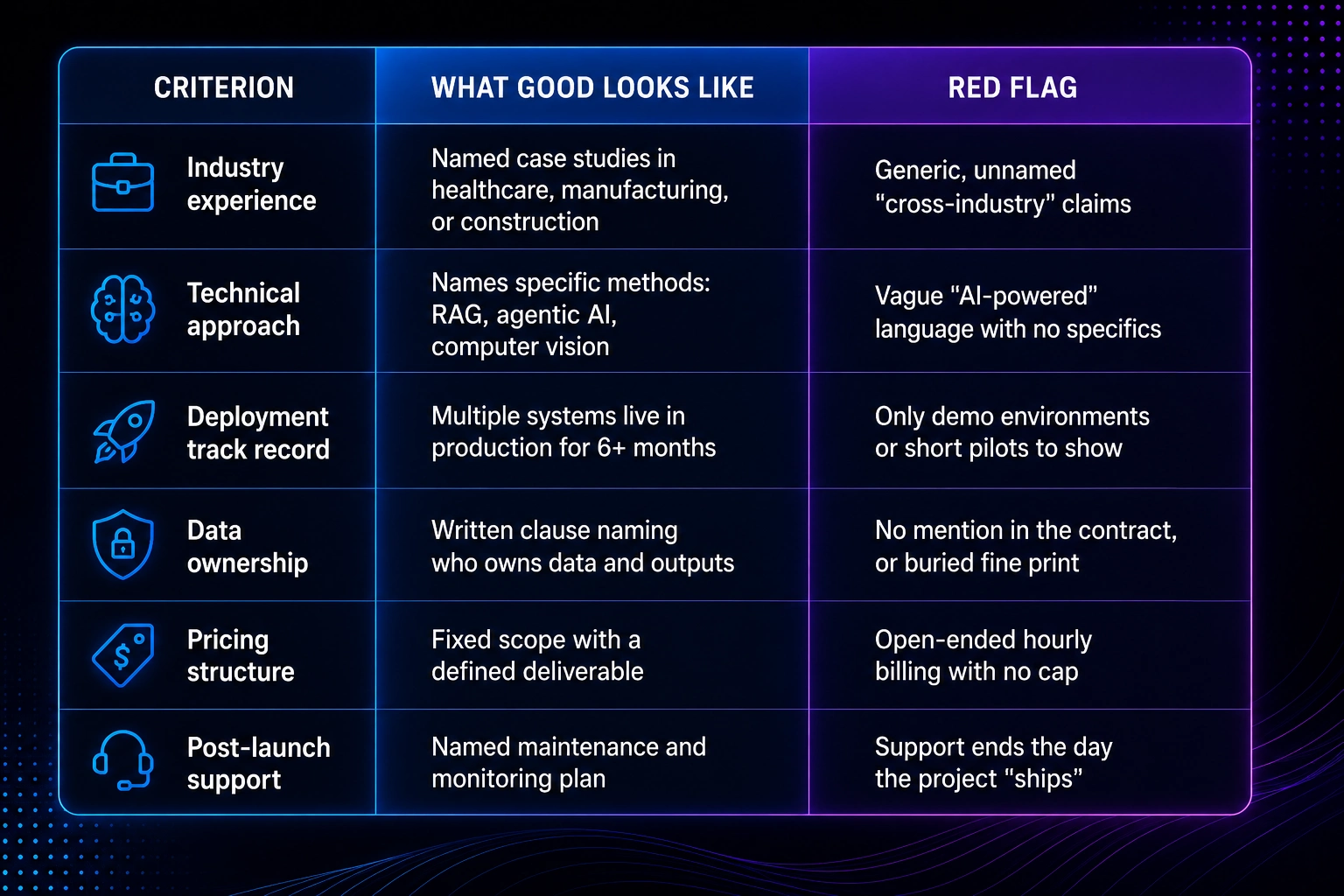
Evaluation Criteria at a Glance
Questions to Ask Before You Sign a Contract
Bring these into the first sales call, not the final round of negotiations:
- Can you show me three reference clients in my industry, and can I speak with them directly?
- Walk me through the last AI integration project you shipped to production. What broke, and how did you fix it?
- Who owns the data and the model outputs once this project is live?
- What does support look like in month six, after the initial contract ends?
- How do you handle a data source that turns out to be messier than expected?
A partner who answers these clearly, with specifics rather than reassurance, is signaling that they have actually done this before. That is the entire point of the exercise: separating AI solutions vendors who can talk about AI from those who can ship it.
Vetting Technical Fit Versus Vetting Business Fit
Buyers often collapse two separate evaluations into one conversation. Technical fit asks whether a vendor can build the thing: do they have engineers who have shipped retrieval-augmented generation systems, agentic workflows, or computer vision models at production scale? Business fit asks a different question: will this vendor answer the phone in month eight, will their pricing survive a scope change, and do they understand your industry's compliance requirements well enough to not need a crash course?
A development partner can pass one test and fail the other. A large systems integrator might have deep technical bench strength but treat a mid-market healthcare client as a rounding error on a bigger contract. A boutique AI consulting company might move fast and communicate well, but lack engineers who have actually deployed a RAG pipeline against a messy, undocumented legacy database. Score both dimensions separately during your evaluation instead of letting a strong demo (technical fit) paper over vague answers about support and pricing (business fit).
Informational Research Versus a Buying Decision
Not everyone reading a guide like this plans to sign a contract this quarter. Some readers are mapping out what AI integration even means for their organization, gathering internal buy-in, or building a business case before procurement gets involved. Others already know they need an AI development partner and are comparing two or three finalists.
Both groups benefit from the same underlying framework. If you are early in the research phase, use the evaluation table above to build an internal scorecard before you ever get on a sales call, so stakeholders are evaluating vendors against agreed criteria rather than gut feeling. If you are closer to a decision, use the questions in the next section directly in your finalist conversations, and ask each AI development partner to answer in writing so you have something to compare side by side after the calls end.
What this Looks like in Practice
Neuramonks has published two related breakdowns worth reading alongside this guide. How to Choose an AI Solutions Partner for Your US Healthcare Practice goes deeper on vertical-specific evaluation criteria for clinical and administrative workflows. Top AI/ML Companies in the USA, Ranked by Innovation and Revenue gives a wider market view if you are actively building your shortlist of AI development partner candidates.
Why Neuramonks Approaches AI Integration this Way
Neuramonks is an AI consulting company built specifically around the problem this guide describes: too many AI solutions never make it past the pilot stage. Neuramonks teams work across Agentic AI, RAG development, Computer Vision, AI Automation, n8n workflows, and Enterprise Dify implementations, with a client base concentrated in healthcare, manufacturing, and construction. Every engagement opens with a discovery call scoped around your actual systems and data, not a generic template deck.
If you are evaluating AI development partners for an upcoming AI integration project,Book a free consultation with the Neuramonks team and bring the questions from this guide with you.

Upendrasinh zala
Upendrasinh Zala is the Founder & CEO of Neuramonks, an enterprise AI and deeptech consulting firm based in Gujarat, India. Drawing from years of experience in AI-driven business strategy and corporate growth, he writes on leveraging artificial intelligence to optimize workflows and unlock tangible ROI for enterprises.