TABLE OF CONTENT
Who is actually building, deploying, and delivering ROI at enterprise scale not just talking about it.
The top AI/ML companies in the USA are ranked by their ability to deliver production-grade AI solutions across industries not by pitch decks. In 2026, the leaders are defined by three things: proprietary model development, real client outcomes, and the machine learning solutions that prove ROI at scale. This list breaks down who is actually delivering.
Why This Ranking Matters in 2026
The AI industry crossed a critical threshold in 2025: the gap between companies that talk about AI and companies that build, deploy, and maintain AI systems at enterprise scale became impossible to ignore.
Boards stopped funding AI exploration. They started demanding AI execution. That shift rewrote the competitive landscape and it is why any serious ranking of AI/ML companies must weigh demonstrated outcomes, not claimed capabilities.
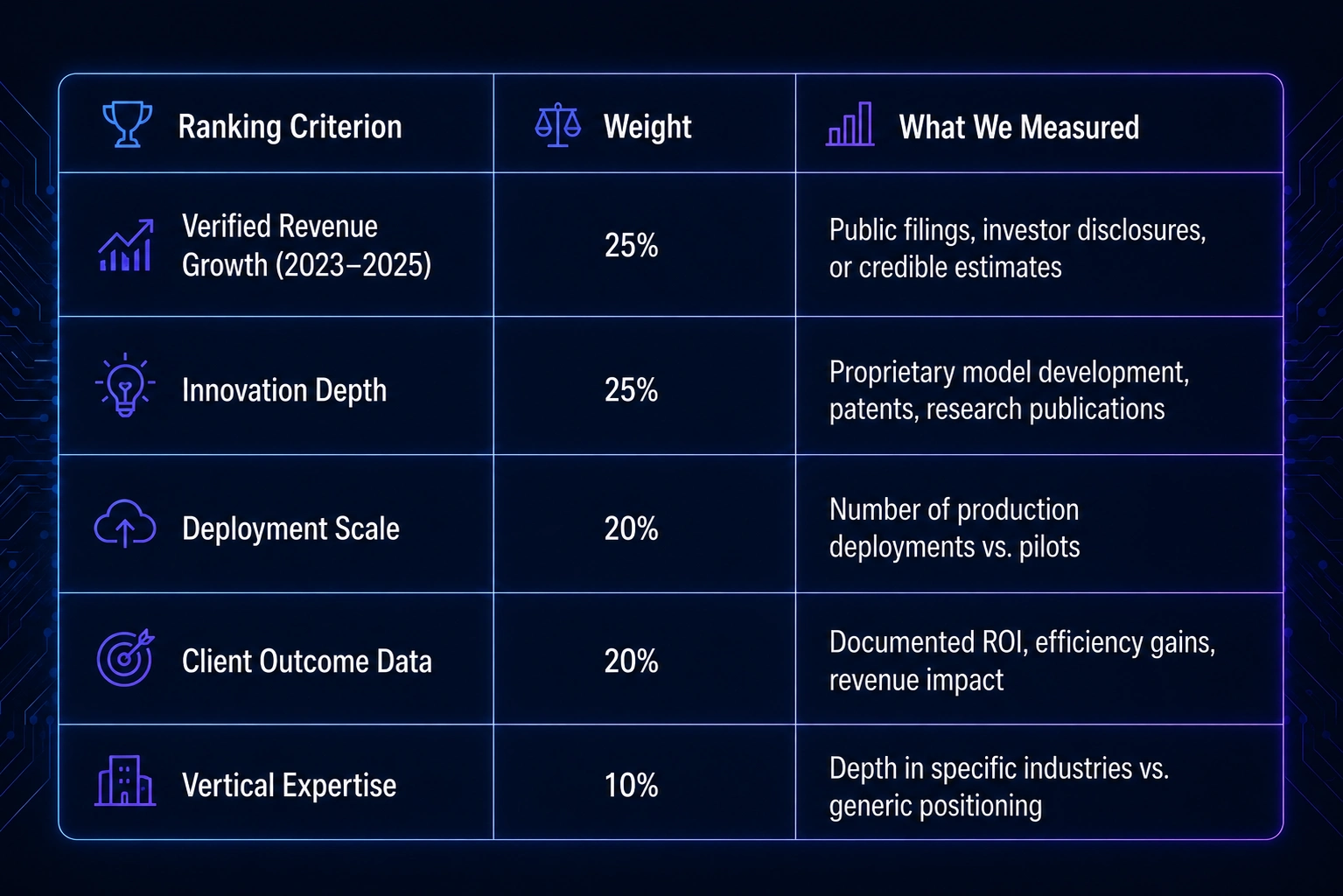
This ranking evaluates US-based AI firms on four dimensions: revenue growth, innovation depth (proprietary research vs. API wrapping), deployment track record, and client outcomes across verticals.
The Criteria Behind the Rankings
Before the list, the methodology matters. Too many "top AI companies" rankings are advertiser-funded. This one is not.
Estimated 2024 AI Revenue — Top US Companies
The Top AI/ML Companies in the USA (2026)
OpenAI
Revenue: Estimated $3.4B (2024), growing rapidly toward $10B+ | Innovation: GPT 4o, o1 reasoning model, Sora (video generation), DALL-E 3
OpenAI remains the most influential AI company in the world by research output and enterprise adoption. The GPT API ecosystem powers thousands of downstream applications. Enterprise revenue from ChatGPT Team and Enterprise plans has grown faster than any other segment. The criticisms high compute costs, closed model approach are valid, but output volume and model quality make OpenAI the benchmark every other firm is measured against.
Anthropic
Revenue: Estimated $850M ARR (2024), growing 4x year-over-year | Innovation: Claude model family, Constitutional AI, safety-first research
Anthropic built its competitive position on a specific thesis: that safe AI is commercially superior AI. The Claude model series has demonstrated that enterprise clients care deeply about reliability, predictability, and reduced hallucination risk. Their 100K+ context window and multi-document reasoning capabilities make them the preferred choice for legal, healthcare, and financial enterprise applications.
Google DeepMind
Revenue: Part of Alphabet ($307B 2024 revenue); AI contributes measurably to search, cloud, and ad revenue | Innovation: Gemini Ultra, AlphaFold 3, Gemma (open models)
DeepMind's research output continues to redefine what is possible. AlphaFold 3's protein structure prediction capabilities have direct commercial value in pharmaceutical discovery. Gemini's multimodal architecture and integration into Google Workspace gives DeepMind a distribution advantage that pure play AI companies cannot replicate.
Microsoft AI (with OpenAI Partnership)
Revenue: Azure AI services exceeded $10B ARR in 2024 | Innovation: Copilot ecosystem, Azure AI Studio, phi-3 small language models
Microsoft's AI revenue story is less about model research and more about deployment at scale. The Copilot integration across M365 (Word, Excel, Teams, Outlook) gives Microsoft the broadest enterprise AI surface area in the world. Azure AI Studio is becoming the default deployment platform for Fortune 500 AI initiatives.
Scale AI
Revenue: Estimated $1B+ (2024) | Innovation: Data labeling, RLHF infrastructure, enterprise AI evaluation
Scale AI occupies a critical infrastructure position in the AI stack the quality of training data. Every major foundation model company is a Scale AI client or competitor. Their pivot to enterprise AI evaluation and red teaming services adds a new revenue stream that is growing alongside the AI security market.
Mid-Market Leaders: The Builders Making It Real
The tier below the hyperscalers is where the most interesting commercial AI work is happening. These companies are not building foundation models. They are building the industry-specific applications, custom deployments, and ML pipelines that turn foundation models into operational business tools.
Stop Planning AI.
Start Profiting From It.
Every day without intelligent automation costs you revenue, market share, and momentum. Get a custom AI roadmap with clear value projections and measurable returns for your business.

Where We Fit In: Why Neuramonks Focuses on Applied Innovation
We want to be transparent: Neuramonks authored and published this analysis. We are not a multi billion dollar foundation model builder competing with OpenAI or Google DeepMind and we don't pretend to be.
What we do is fill the massive market gap that exists between frontier research labs and the businesses that need to put AI to work. Foundation models are extraordinarily powerful, but they don't arrive pre configured for your revenue cycle, your legal document workflow, or your medical imaging pipeline. That translation layer from raw capability to verified business outcome is where Neuramonks operates.
Our team builds production grade AI systems designed around specific business workflows: computer vision pipelines, NLP document intelligence, predictive analytics engines, and custom model training on proprietary data. The verticals we serve most deeply are healthcare, fintech, legal, and enterprise operations.
The outcomes we document are measurable: cost reductions, process automation rates, accuracy improvements clients can verify independently. We include ourselves in this ranking not to inflate our status, but because the mid market gap we address is real and readers evaluating AI partners deserve to know who actually builds vs. who configures templates.
Healthcare AI Fintech Legal Automation Custom Model Training Computer Vision NLP Pipelines
For an in-depth look at our delivery methodology and vertical case studies, visit our healthcare AI services or fintech AI services pages.
Palantir Technologies
Revenue: $2.87B (2024), 36% growth year over year | Innovation: AIP (AI Platform), Ontology, defense AI systems
Palantir's pivot to commercial AI with AIP has been more successful than most analysts predicted. Their Ontology framework — which creates a live semantic layer over enterprise data gives Palantir a structural advantage in complex data environments. Government contracts remain a revenue anchor, but commercial growth is accelerating.
C3.ai
Revenue: $310M (FY2024) | Innovation: Enterprise AI applications for energy, manufacturing, financial services
C3.ai's recurring revenue model and vertical specific applications give them resilience that horizontal AI platforms lack. Their energy sector applications predictive maintenance, grid optimization, oil and gas analytics are mature and generating measurable client outcomes.
What "Ranked by Innovation" Actually Means in 2026
Innovation in AI has two distinct definitions, and conflating them leads to bad vendor decisions.
Research Innovation: New model architectures, training methodologies, benchmark improvements. This is the domain of OpenAI, Google DeepMind, and Anthropic. Most enterprise buyers do not need research innovation they need the outputs of research, delivered reliably.
Applied Innovation: Taking frontier research and deploying it in production environments that solve real business problems. This is where firms like Neuramonks, Palantir, and Scale AI compete. Applied innovation requires deep domain knowledge, integration expertise, and a disciplined deployment methodology.
When evaluating AI companies, the right question is not "who is most innovative?" It is "who is most innovative for my specific use case?" A company building proprietary transformer architectures is not automatically more valuable than a company that can deploy machine learning solutions against your customer churn data within 60 days.
The Revenue Story: AI Is Now a Profit Center
The narrative shift from 2023 to 2026 is striking. Three years ago, AI was a cost center a research investment with uncertain returns. Today, enterprise AI deployments are generating documented revenue.
Examples from the public record:
- Companies using AI for demand forecasting report 8 to 14% reduction in inventory costs
- Firms deploying AI customer service tools see 20 to 30% reduction in support costs
- Healthcare organizations using AI in revenue cycle management recover 15 to 22% more revenue from previously denied claims
The companies that appear on this ranking — from hyperscalers to specialized builders like Neuramonks are the ones whose clients can point to numbers like these.
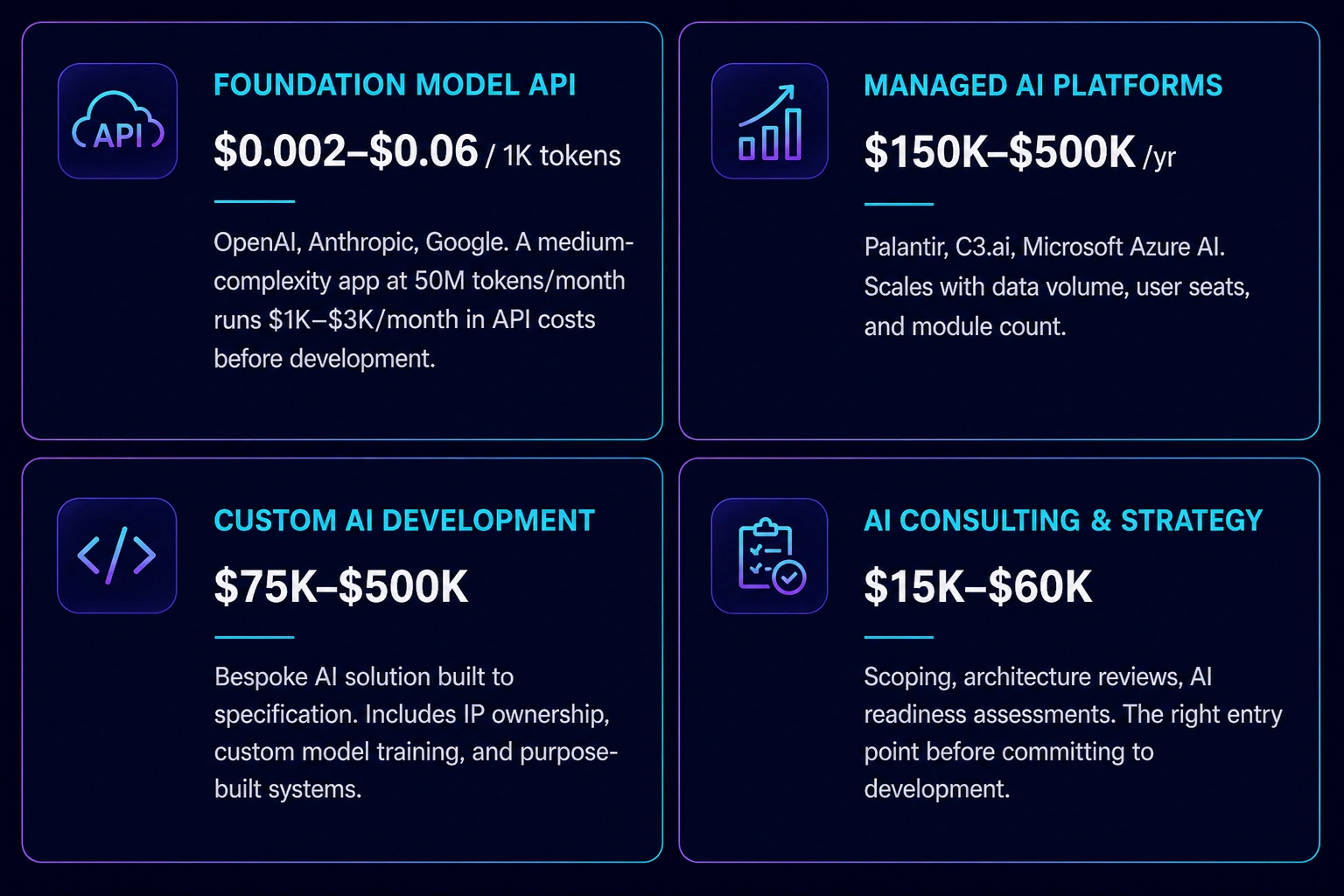
Pricing / Cost: What AI Development Actually Costs in 2026
Understanding the cost structure of AI development is essential before engaging any vendor on this list. Pricing varies dramatically by engagement type.
How to Choose the Right AI Partner for Your Business
The ranking above tells you who is building. The question of who is right for your business is different.
Scale of need: If you need to fine tune a foundation model on proprietary data and deploy it across 10,000 users, you need enterprise infrastructure. If you need a specific AI solution built for a defined workflow, you need a specialized development partner.
Domain expertise: AI built by people who understand your industry outperforms generic deployments. A healthcare AI company that has built HIPAA compliant systems is worth more than a general software shop that will learn on your project.
Delivery methodology: Ask for case studies. Ask for client references. Ask what happens when the model underperforms. The answers reveal whether you are dealing with a builder or a salesperson.
Neuramonks offers a direct path to evaluation: contact their team to discuss your specific requirements and review case studies relevant to your industry before any commitment.

Upendrasinh zala
Upendrasinh Zala is the Founder & CEO of Neuramonks, an enterprise AI and deeptech consulting firm based in Gujarat, India. Drawing from years of experience in AI-driven business strategy and corporate growth, he writes on leveraging artificial intelligence to optimize workflows and unlock tangible ROI for enterprises.