TABLE OF CONTENT
Dify AI for enterprise pairs a no-code agent builder with RAG pipelines and multi-LLM routing, so teams launch production-ready AI agents without a large engineering bench. Working with an experienced Dify AI Development Company like Neuramonks cuts that build time from months to weeks, while keeping every prompt, data source, and workflow fully auditable.
Your Team Already Believes in AI. So why isn't it Live Yet?
Here's the pattern almost every enterprise team hits. Someone in leadership saw a demo. It looked effortless. Then the project landed on an internal team already stretched across three other priorities, and six months later there's a Notion doc, a few Slack threads, and no agent.
It's rarely a lack of ambition. It's usually one of three things: the in-house team doesn't have resources to own an AI project on top of their day job, the "AI chatbot" pilot that got built doesn't actually know anything about the business, or legal and security flagged the vendor before it got anywhere near production.
Dify exists to remove the middle problem. It's an open-source LLM application platform that gives you a visual canvas for building agents, connecting retrieval-augmented generation (RAG) to your own documents, and routing requests across different language models depending on cost, latency, or accuracy needs. You're not writing orchestration code from scratch. You're configuring it.
Stop Planning AI.
Start Profiting From It.
Every day without intelligent automation costs you revenue, market share, and momentum. Get a custom AI roadmap with clear value projections and measurable returns for your business.
What Enterprise Buyers Actually want (and rarely say out loud)
Nobody opens a vendor call by saying, "I want a testament to innovation." What people actually want, once you strip away the sales language, is much simpler:
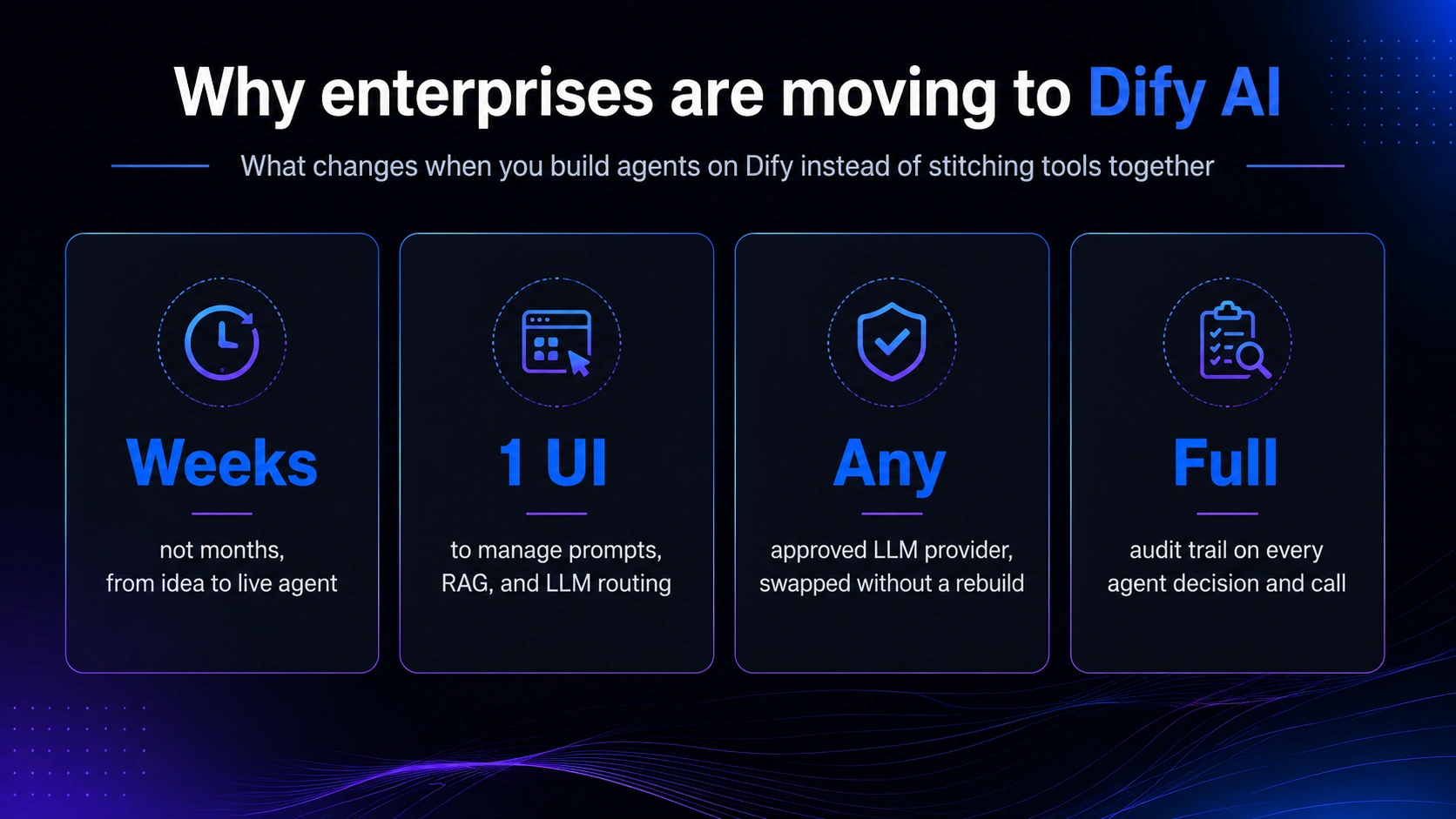
Speed without giving up control. Teams want an agent live this quarter, not a 12-month roadmap. But they also don't want to hand a black box to a vendor and hope for the best.
The ability to swap models later. A team that commits to a single LLM provider today is betting the business will never need a cheaper or more capable option next year. Dify's model-agnostic architecture means you can route between GPT, Claude, Gemini, or an open-weight model without rebuilding the agent underneath it.
Proof it works before a full rollout. Most buyers want a working pilot in one department (usually support or internal knowledge search) before they'll sign off on a company-wide deployment.
Someone who's done this before. This is where the build-vs-buy decision usually comes down to trust. A capable AI automation agency or a specialized Dify AI Development Company has already hit the edge cases your internal team hasn't seen yet: token cost blowouts, hallucination on edge-case queries, and provider approval processes that take longer than the build itself.
Where this Gets Real: a Gemini Integration Under Enterprise Constraints
Most enterprise AI mandates come with a catch: you can't just call any LLM API directly. Procurement and security teams often require models to run through an approved cloud provider, with its own authentication, logging, and compliance layer.
That's exactly the situation behind Neuramonks' Dify plugin development and custom Gemini LLM integration case study, where a custom plugin was built to route Gemini calls through an approved provider instead of a direct API connection. It's the kind of detail that never shows up in a product demo, but it's usually the difference between a pilot that clears security review and one that stalls for another quarter.
Build in-house, Hire a Generalist Agency, or go with a Dify specialist?
This is the decision most enterprise teams are actually weighing, and it deserves a straight comparison instead of a sales pitch.

The middle option isn't wrong; it's just built for a narrower job. A generalist automation agency can wire up a Zapier-style workflow fast. But once RAG, LLM provider approval, and audit logging enter the conversation, that's a Dify-specific skill set, not a general automation one.

What the First 30 Days Actually look like
Step one is never "build the agent." It's figuring out which single workflow is worth automating first. The teams that get this right usually start with something narrow and painful, like a support queue drowning in repeat questions, or a sales team burning hours searching through scattered internal docs for pricing and product details.
From there, the sequence is fairly consistent across enterprise Dify projects:
- Scope the pilot. Pick one workflow, one team, and a clear success metric (ticket deflection rate, response time, hours saved per week).
- Connect the knowledge base. RAG only works if it's pointed at the right documents, kept current, and scoped so the agent isn't guessing outside its lane.
- Choose the model routing logic. Not every query needs your most expensive model. Simple lookups can route to a cheaper model, while complex reasoning tasks route to a stronger one.
- Run it in shadow mode. Before customers or employees see it, the agent answers in parallel with a human, and someone checks the gap between the two.
- Go live, then watch the logs. This is where most vendors disappear and most in-house teams get stuck. Someone needs to own the first month of tuning.
That last point is where a lot of pilots quietly die. Not because the technology failed, but because nobody was assigned to watch it after launch week.
Take a support queue as an example. Week one, the agent handles maybe 30% of tickets correctly and escalates the rest, which is exactly what should happen with a new system. By week three, once someone has reviewed the escalations and tightened the RAG sources, that number usually climbs past 60%. Teams that skip the review step tend to plateau at that first-week number and quietly conclude "AI doesn't work for us," when the real issue was nobody tuned it.
The same logic applies to internal knowledge search. A sales team asking an agent about pricing tiers needs the agent pointed at the current pricing doc, not last quarter's version sitting in a forgotten folder. Getting RAG right is less about the AI model and more about document hygiene: what's indexed, what's outdated, and who's responsible for keeping it current.
Where Dify fits into a broader 2026 AI roadmap
Dify isn't a replacement for your existing AI solutions stack. It's the layer that sits between your raw data and the LLM, handling retrieval, tool calls, and model routing so your team isn't rebuilding that plumbing for every new use case. Once one agent is live and proven, the second and third ones move faster, because the RAG pipelines and provider integrations are already in place.
This is also why the "one agent at a time" approach tends to outperform an ambitious company-wide rollout attempted in one shot. A single working pilot gives you real usage data, real edge cases, and a template for the next department that wants one.
What to check before you sign with anyone
Whether you go in-house, hire a generalist agency, or bring in a specialist Dify partner, ask these questions before signing anything:
- Have they shipped a Dify agent that had to route through an approved LLM provider, not just a direct API key? That approval process trips up more projects than the actual model performance does.
- Who owns the agent after week one? Vendors that disappear after launch leave your team debugging a system nobody fully understands.
- Can they show a real build, not a demo environment spun up for the sales call? The Gemini plugin case study above is a working example, not a mockup.
- What happens when the underlying LLM provider changes pricing or gets deprecated? If the answer requires rebuilding the agent, that's a warning sign.
None of this is complicated once you know to ask it. Most enterprise teams just haven't gone through an AI vendor selection cycle before, so these questions don't come up until after something's already gone wrong.
A Workflow that's Been "on the Roadmap" for two Quarters is a Signal, not a Failure
If your team keeps meaning to get to an AI agent project and keeps not getting to it, that's not a discipline problem. It usually means the in-house bandwidth isn't there, and it won't magically appear next quarter either.
That's the exact gap this fills for enterprise teams. The work isn't about selling a platform. It's about scoping the one workflow worth automating first, building it in Dify with the right RAG sources and provider-approved LLM routing, and staying on it after launch so week-one tuning doesn't fall on your internal team.
Talk to Neuramonks about your specific use case, and expect a straight answer about whether Dify is the right fit before anything gets built. If it isn't, we'll say so.

Ketan Kanjiya
Ketan Kanjiya is a Machine Learning researcher and Chief Research Officer at Neuramonks, an AI-focused technology company based in Ahmedabad, Gujarat. With hands-on expertise in AI/ML, image processing, and web application development, he has led research initiatives across F(x) Data Labs and Kshatrainfotech. Ketan writes to simplify advanced technical concepts for developers and tech enthusiasts alike.