TABLE OF CONTENT
For years, MCP server development wasn't even a conversation. Connecting an AI agent to your tools meant writing JSON schemas, maintaining API wrappers, and debugging integrations at 2am. That's changed, fast. Here's why businesses are paying attention, and why the switch is less complicated than it sounds.
What JSON-over-API actually looked like
Before MCP, the standard approach was: define your tool schema in JSON, hand it to the agent, let the agent call your API directly, and write glue code to handle errors, retries, and response normalization.
It worked. But it worked the way duct tape works fine for one thing, a mess once you start stacking it.
The agent had no standardized way to discover what tools were available. It had no consistent error contract. Every integration was its own dialect, and teams at scale ended up building internal libraries just to translate between their AI agents and their own systems.
If you're dealing with this, don't blame your engineering team traditional web infrastructure simply wasn't built for non-deterministic AI agents. The tools were designed for predictable, scripted calls. Agents don't work that way, and the mismatch shows up as exactly the kind of glue code, retries, and 2am debugging described above.
What does MCP actually change
MCP isn't a library or a framework in the traditional sense. It's a protocol a standardized contract for how AI agents discover and invoke tools, access data, and handle context.
Think of it the way TCP/IP standardized how computers talk to each other. Before TCP/IP, every network had its own rules. After it, networks could interoperate without anyone writing custom translation logic.
MCP does something similar for the AI tool layer. Your agent learns MCP once. Every server that speaks MCP becomes accessible no custom integration code, no bespoke JSON schemas, no new wrapper library per service.
The practical effect:
- Agents can discover available tools at runtime, not just at configuration time
- Tool responses follow a consistent structure, so parsing logic doesn't change per integration
- Error handling is standardized the agent knows what a failed call looks like regardless of which tool it called
- New tools can be added to an agent's environment without redeploying or retraining
Stop Planning AI.
Start Profiting From It.
Every day without intelligent automation costs you revenue, market share, and momentum. Get a custom AI roadmap with clear value projections and measurable returns for your business.
Teams that moved from API-first integrations to MCP report that adding a new data source to an existing agent went from a multi-week sprint to a configuration task measured in hours. The agent doesn't change. The protocol handles the rest.
Why MCP, and Why Now
This is the part most explainers skip: MCP isn't a bet on one vendor's roadmap anymore, and that's exactly why it's worth taking seriously in 2026.
Anthropic introduced MCP in late 2024. Within a year, OpenAI, Google, and Microsoft had all shipped native support for it across their major platforms, and adoption kept compounding from there tens of thousands of public MCP servers now exist, spanning everything from developer tools to Fortune 500 deployments. In December 2025, Anthropic donated the protocol to the Agentic AI Foundation, a neutral fund under the Linux Foundation co-founded by Anthropic, Block, and OpenAI, with Google, Microsoft,
AWS, and Cloudflare backing it.
That hand-off matters more than it sounds: it moved MCP out of "Anthropic's protocol" territory and into the same category as HTTP or TCP/IP infrastructure no single company controls, and that everyone building on AI can rely on without worrying it gets deprecated or paywalled.
The protocol has also matured technically. The current spec runs on Streamable HTTP with OAuth 2.1-based authorization, which means MCP servers can be deployed securely on the open internet rather than limited to a developer's local machine the thing that made early MCP useful mainly for coding assistants and not much else.
Put plainly: when your competitors, your SaaS vendors, and the model providers you depend on are all converging on the same connection standard, building your agent's tool layer on anything else is a bet against where the entire ecosystem is already headed.
MCP vs raw API: an honest comparison
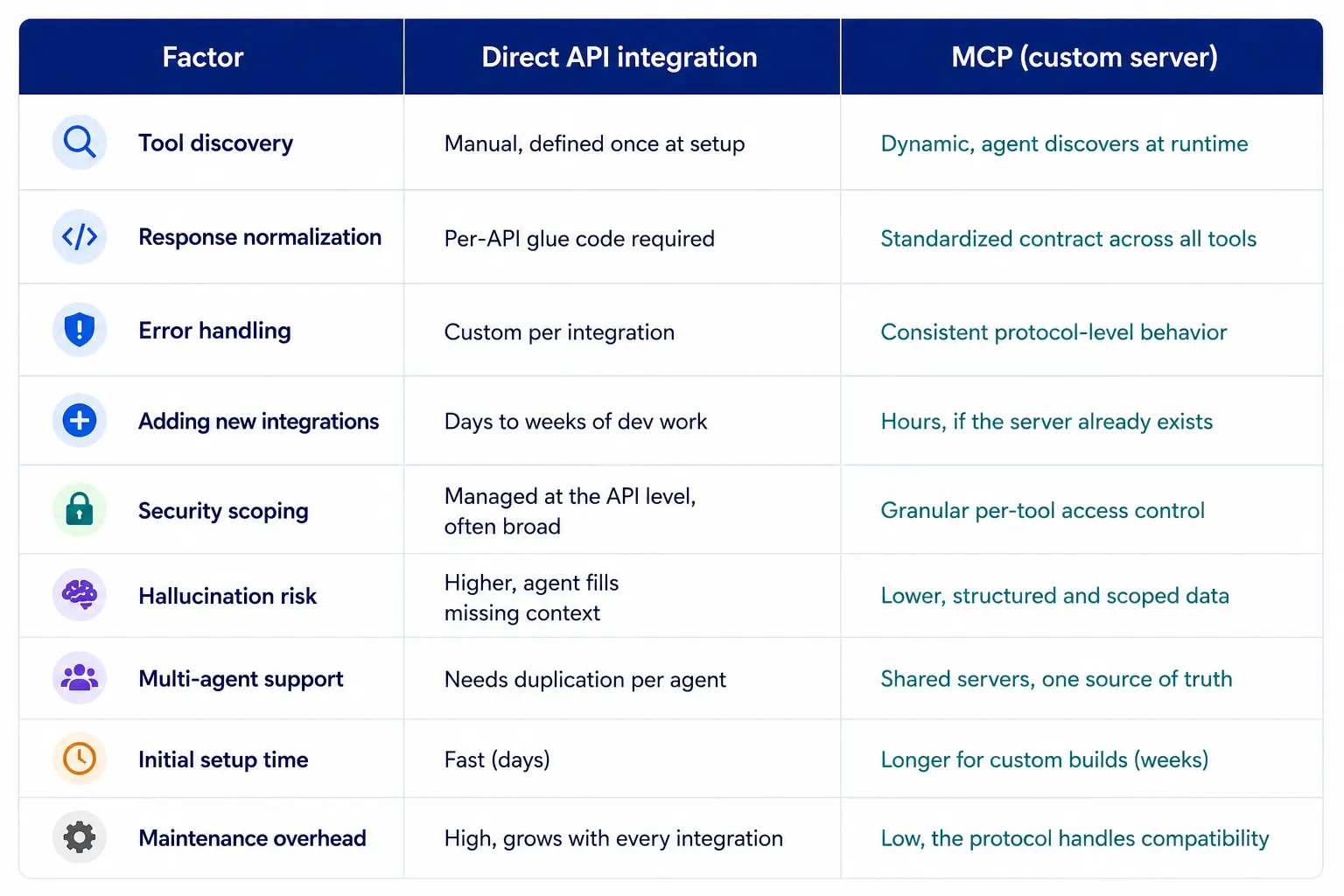
Here's where things stand when you compare a direct API approach against MCP, across the factors that matter most in production.
Why this Matters More for SaaS than Anyone's Saying
Most MCP coverage focuses on developer tools and enterprise AI. The implications for SaaS businesses are more immediate than that framing suggests.
If you run a SaaS product, your users already expect AI features. The question is whether those features hold up or whether they're impressive in a demo and frustrating in daily use.
The gap usually isn't the model. A well-prompted GPT-4 or Claude is plenty capable. The gap is the tool layer. The agent hallucinates when it doesn't have reliable access to the right data. It fails when API responses are inconsistent. It slows down when it has to call three endpoints to answer a question that should need one.
MCP doesn't fix your product strategy. It fixes the infrastructure problem sitting between "our AI feature works in the demo" and "our AI feature works at 3pm on a Tuesday with 400 users active."
Three Things Tend to Change Once a Team Moves the Tool Layer Onto MCP:
- Feature velocity improves, because new AI capabilities can pull from existing MCP servers without custom integration work
- Support costs drop, because the agent stops guessing in ambiguous situations and returns a structured error the application can handle gracefully
- Multi-tenant complexity gets simpler, because access scoping lives at the MCP server level instead of scattered across every API call
At Neuramonks, the teams we work with consistently find that fixing the tool layer first before touching the model or the prompt produces the fastest measurable gains. It's a smaller surface area, and the difference is usually visible within weeks.
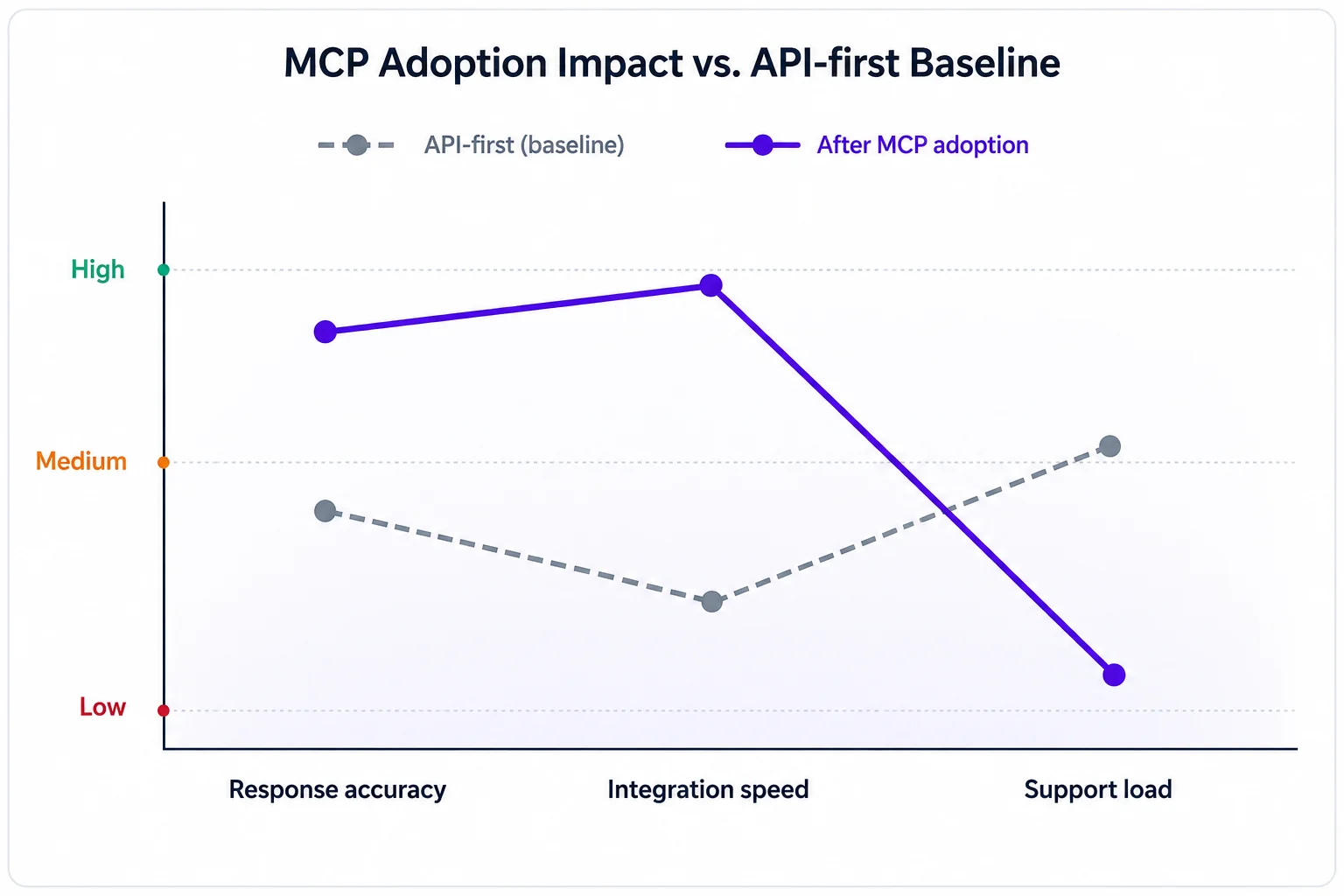
Note: support load is plotted inverted lower is better, so the rising purple point reflects fewer tickets, not more. Based on relative, directional shifts Neuramonks has observed across 2024–2026 client deployments, not absolute benchmark figures.
The practical Question: Generic MCP Server or Custom?
Generic MCP servers exist and they'll get you started. If you're evaluating whether MCP fits your stack, spinning up a generic server against a well-documented API is a reasonable way to test the concept in a few days.
The gap shows up at two points: when your data schema diverges from what the generic server expects, and when the agent needs to understand domain-specific logic rather than just fetch data.
Here's a real example. A construction software company needed an AI agent that could flag permit status issues a classic use case for AI in construction project management. A generic MCP server could pull permit records fine. But "flagging an issue" required understanding that a PEND_REV status in their system meant a 12-day delay risk, not just a pending review. That logic had to live in a custom tool definition. The agent couldn't infer it from a raw API response.
Custom MCP server development is slower to start than plugging in an off-the-shelf integration, typically two to four weeks for a meaningful first build. The right comparison isn't cost against generic servers. It's cost against the engineering hours your team will spend maintaining custom integration code, debugging agent failures in production, and re-explaining domain logic to every new model you evaluate.
Teams doing custom agentic AI development where multiple agents share infrastructure, coordinate tasks, or hand off context between steps tend to find that investing in a properly designed MCP layer early prevents the most painful re-architecture later. The protocol is the foundation. What you build on top of it is where the real business value lives.
What does it Actually Cost to Build
Rough ranges based on scope, not exact quotes. Your stack and requirements will shift these.
Basic server (3–5 tools, single data source): $8,000–$15,000. Covers a focused use case a customer support agent connected to a CRM, for example. A good fit if you're starting with AI MVP Development Services and want a working prototype without overbuilding.
Mid-complexity (6–12 tools, multiple integrations): $15,000–$40,000. Multi-system workflows with domain logic and access controls. Common for first production deployments.
Enterprise (12+ tools, compliance requirements, high availability): $40,000–$120,000+. Includes architecture review, security scoping, load testing, and documentation.
Ongoing maintenance usually runs 15–20% of the initial build cost annually, covering API updates, new tools, and monitoring.
Teams consistently underestimate these numbers because they're comparing against off-the-shelf integration tools. The more useful comparison: what does a poorly performing AI agent cost in manual correction, customer experience failures, and delayed releases? That number tends to reframe the conversation fast.
Where to Start if you're Evaluating this Now
Three questions worth answering before any scoping conversation:
- What decision does your AI agent need to make, and what data does it need to make it reliably?
- Where does your current agent fail or require human correction and is that failure at the model level or the tool layer?
- Are you building one agent, or building infrastructure that multiple agents will share?
If the failures are mostly at the tool layer wrong data, inconsistent responses, agents inventing context they don't have MCP is almost certainly relevant to your stack. If the failures are at the reasoning layer, that's a different conversation about prompting, fine-tuning, or model selection.
Most teams find it's both. But the tool layer is faster to fix and cheaper to address than model behavior. Starting there usually produces noticeable improvements in weeks, not quarters.
If your team wants to own this infrastructure long-term rather than outsource it entirely, Neuramonks also offers AI Consulting Services that work through the design decisions with your engineers directly covering tool schema design, access control patterns, error handling contracts, and how to structure MCP servers that hold up under real production load.
Let's Stop Debugging Integrations at 2am
Contact Neuramonks for a zero-commitment MCP Architecture Review, and we'll map out your tool infrastructure together what's already working, where the agent is filling in gaps it shouldn't have to, and what a custom MCP layer would actually take to build for your stack.