TABLE OF CONTENT
US healthcare spends over $1 trillion a year on administrative and operational overhead. The agencies pulling ahead in 2026 are not the ones with the largest budgets they are the ones that deployed AI healthcare solutions where the costs are highest and measured results before expanding.
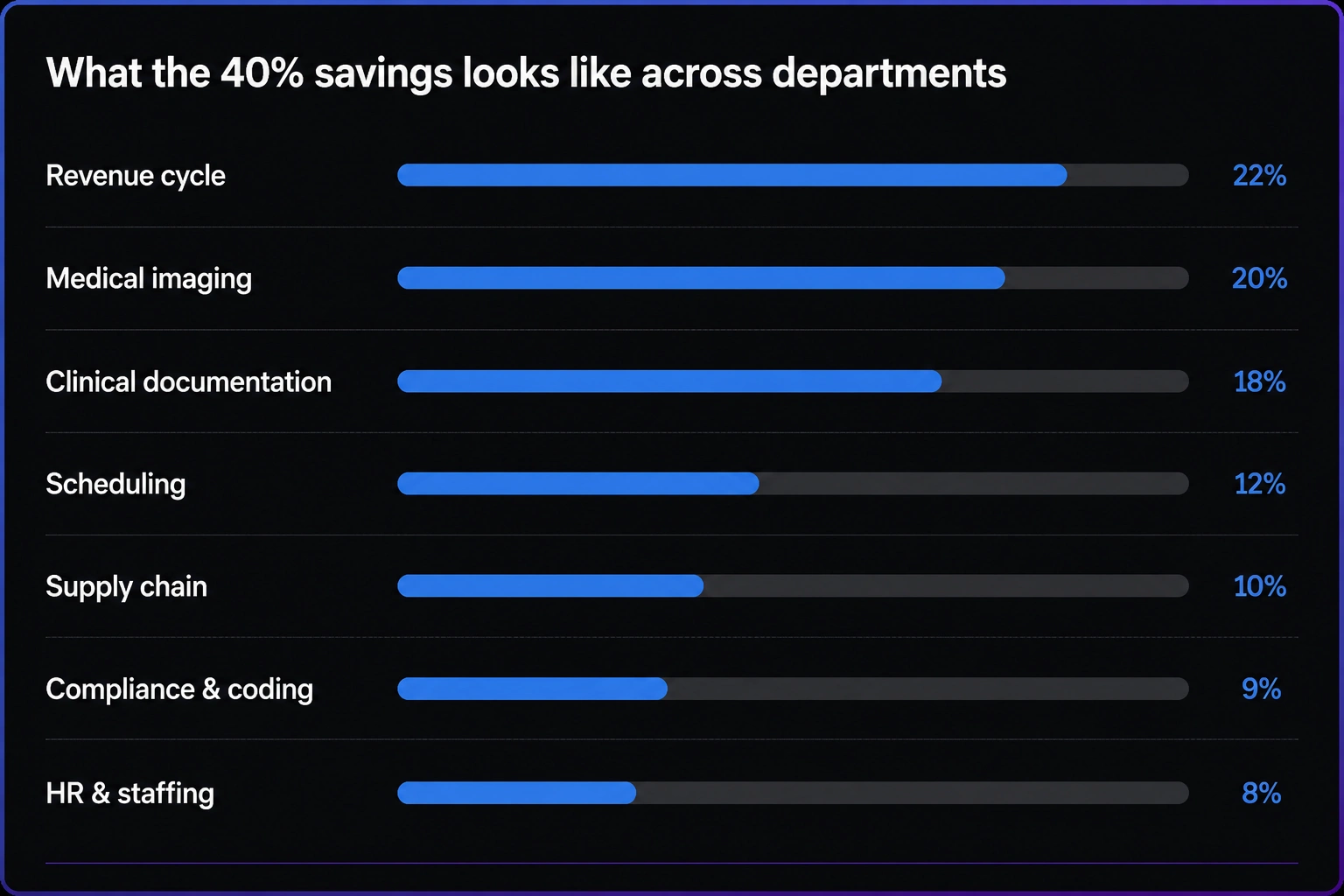
That 40% figure is not an estimate. It is a compounded number: efficiency gains stacked across seven operational layers, each independently measurable, each independently achievable. This post breaks down exactly where those savings come from, the use cases producing the clearest ROI, and what a realistic implementation looks like.
Where are the costs actually coming from
A mid-size hospital's operationloverhead breaks down across seven departments. The table below maps each to its primary AI application, the average cost reduction documented across 2025–2026 US deployments, and the implementation effort required.
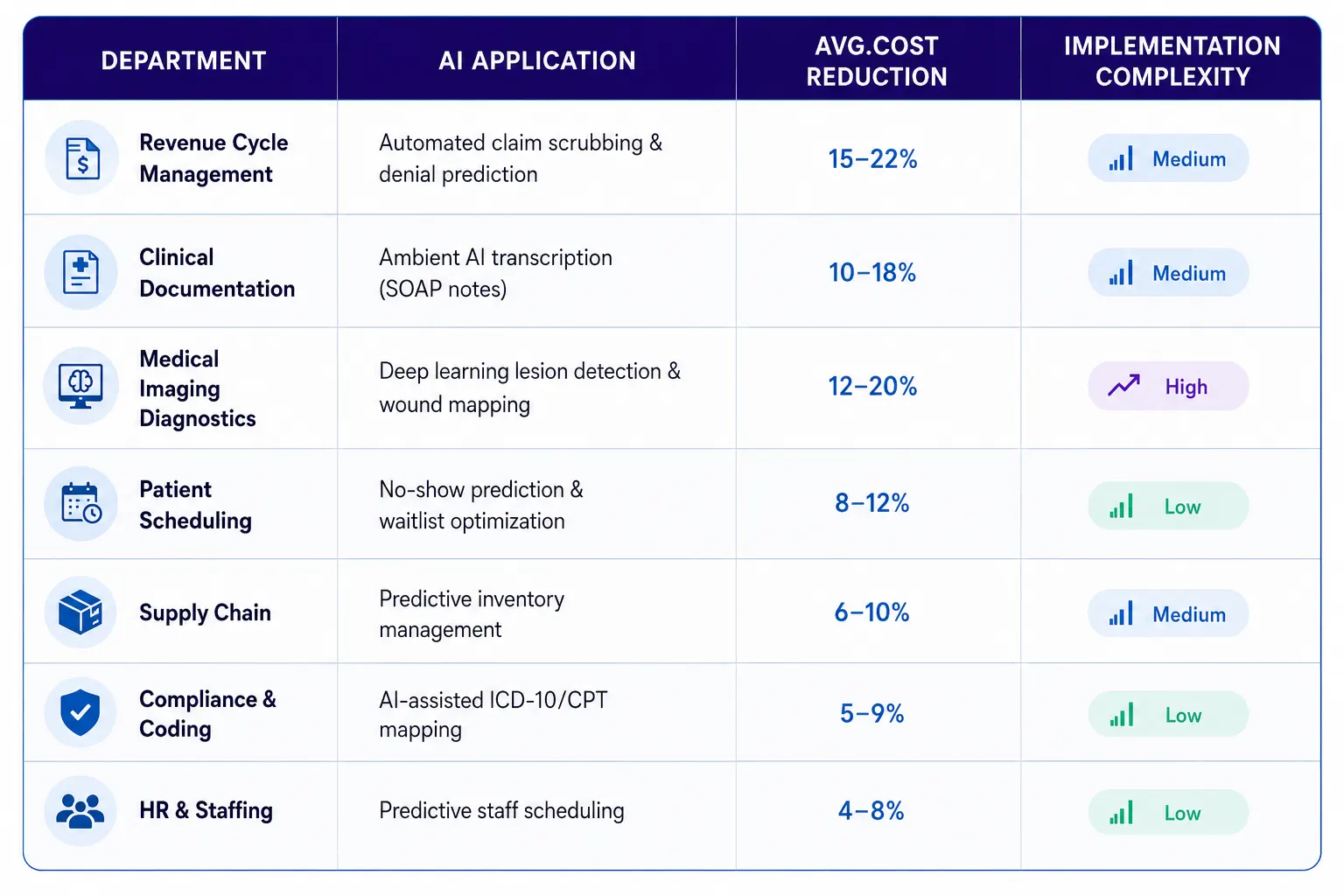
Stack four of these and 35–40% total reduction is not aggressive it is conservative.
The six areas with the clearest ROI
1. Revenue cycle management
Claim denials cost US hospitals an estimated $262 billion per year. The causes missing data, coding errors, eligibility gaps are almost entirely preventable. AI healthcare solutions deployed in revenue cycle pre-validate claims against payer rules before submission, flag high-risk claims for human review, and automate prior authorisation follow-ups.
One Neuramonks client in orthopedics reduced their claim denial rate from 11.4% to 2.6% within six months recovering $3.2M in annual revenue from that single change.
2. Intelligent scheduling and patient flow
No-show rates in US healthcare average 18–23%. AI scheduling systems predict no-show likelihood per patient and appointment type with 84%+ accuracy, auto-fill cancellations from a prioritised waitlist, and reduce wait times by 30 to 40%. For health systems managing thousands of weekly appointments, scheduling optimisation alone generates $500K to $2M in recovered annual revenue.
Stop Planning AI.
Start Profiting From It.
Every day without intelligent automation costs you revenue, market share, and momentum. Get a custom AI roadmap with clear value projections and measurable returns for your business.

3. Ambient clinical documentation
Physician burnout costs US healthcare $5 billion annually. Documentation SOAP notes, referral letters, discharge summaries consumes two to three hours per physician per day. Ambient AI transcription listens to patient-physician conversations (with consent), generates structured notes in real time, and pushes completed documentation to the EHR.
Physicians review and sign. Documentation time drops by 60–70%.
4. Medical imaging diagnostics with deep learning
Deep learning models detect, classify, and measure clinical findings in radiology scans, pathology slides, wound photos, and retinal images at speeds and levels of consistency that are difficult to match in manual workflows. This is one of the fastest-growing areas of artificial intelligence in healthcare.
Key imaging use cases producing documented ROI:
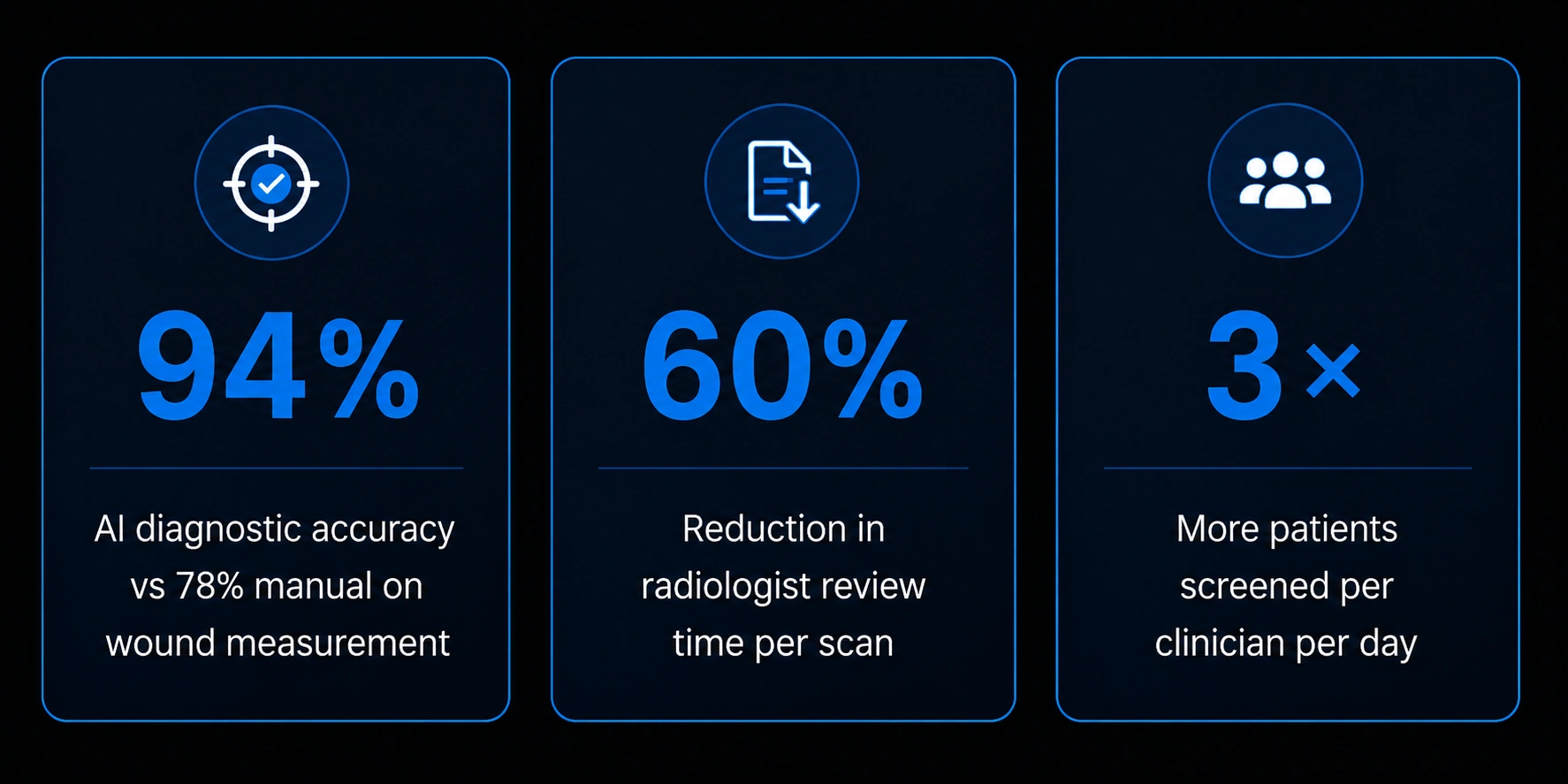
- Radiology & lesion detection: CT/MRI scan analysis with bounding-box measurement flags findings for radiologist review, reducing review time by up to 60%.
- Wound detection & progression tracking: Automated area measurement and week-on-week comparison, eliminating manual assessment time and improving care consistency.
- Retinal screening: Diabetic retinopathy grading at scale, 3× more patients screened per clinician per day.
- Pathology & histology classification: Tissue analysis and cancer risk stratification from slide images, with 94% AI diagnostic accuracy versus 78% manual on comparable tasks.
Neuramonks built an Automated Wound Detection and Measurement System using deep learning that enables clinical staff to document, measure, and track wound progression at scale reducing assessment time and improving care consistency across multi-site operations.
5. Supply chain and inventory intelligence
Manual par-level management fails in high-volume environments. AI-powered supply chain systems predict consumption by department and patient census, auto-trigger purchase orders at optimal reorder points, identify substitution opportunities when items are backordered, and flag vendor pricing anomalies in real time. Hospitals using these tools report 8 to 14% reductions in supply expenditure without affecting care quality.
6. AI-assisted compliance and medical coding
Undercoding leaves revenue on the table. Overcoding creates audit risk. Manual workflows produce 80 to 85% coding accuracy. AI coding assistants read clinical documentation, recommend complete ICD-10/CPT code combinations, and flag documentation gaps before a claim is filed. AI-assisted rates reach 94 to 97%.
That It Actually Takes to Get There
There is a clear pattern separating agencies that get results from those that run pilots that quietly disappear. When evaluating how Neuramonks approaches choosing an AI solutions partner for US healthcare, achieving a true 40% reduction always requires anchoring your execution strategy around four critical pillars:
- Strict Data Security & Privacy: Systems must utilize fully HIPAA-compliant pipelines. Data must be encrypted in transit and at rest, utilizing zero-data-retention APIs to ensure patient health information (PHI) is never used to train public models.
- De-siloed Infrastructure: The AI shouldn't act as another isolated dashboard. It must connect directly into existing EHR and billing infrastructures (like Epic, Cerner, or Athenahealth) via secure, real-time APIs to enhance workflows where staff already work.
- Clinical-in-the-Loop Validation: AI should never operate fully autonomously in clinical decision-making. True success relies on a "Human-in-the-loop" model the AI acts as an accelerator, but qualified administrative or clinical staff retain final sign-off and override capabilities.
- Phased Implementation & KPI Tracking: Identify high-volume workflows first (RCM, scheduling, and documentation are universal starting points). Organisations should leverage specialised AI proof of concept services using historical data to validate real-world ROI within a tight window before committing major capital.
ROI timeline: what to expect and when
- Days 1 to 30: Integration, configuration, and staff onboarding.
- Days 31 to 60: System goes live; baseline metrics established.
- Days 61 to 90: First measurable gains visible in RCM and scheduling.
- Months 4 to 6: Documentation time reductions and coding accuracy improvements measurable.
- Months 7 to 12: 20 to 30% cost reduction visible across active modules.
- Month 12 to 18: Full optimization complete; 35 to 45% cost reduction at steady state.
What AI healthcare solutions cost in 2026
- Healthcare AI pricing has matured. What required a seven-figure contract in 2021 now comes in modular, accessible tiers.
- Module-based: $2,500 to $8,000/month per module. Typical entry point for RCM automation or scheduling AI.
- Platform (enterprise): $150,000 to $750,000 annually for full-stack deployments across multiple use cases.
- Custom AI build: $75,000 to $300,000 in development cost, with ongoing maintenance at 15 tp 20% of build cost annually.
- Proof of concept: $15,000 to $40,000 fixed engagement that delivers validated ROI data before full investment is committed.
A 200-bed hospital spending $400K on AI deployment and saving 40% of a $6M annual operational overhead generates $2.4M in savings a 6× return in year one.
Ready to see what AI can cut from your overhead?
If your agency is carrying operational costs that AI can reduce, the first conversation costs nothing. Neuramonks works with healthcare organizations across the US to scope, validate, and deploy AI solutions that deliver measurable results.
Book a free consultation at neuramonks.com →

Ketan Kanjiya
Ketan Kanjiya is a Machine Learning researcher and Chief Research Officer at Neuramonks, an AI-focused technology company based in Ahmedabad, Gujarat. With hands-on expertise in AI/ML, image processing, and web application development, he has led research initiatives across F(x) Data Labs and Kshatrainfotech. Ketan writes to simplify advanced technical concepts for developers and tech enthusiasts alike.