TABLE OF CONTENT
QUICK ANSWER
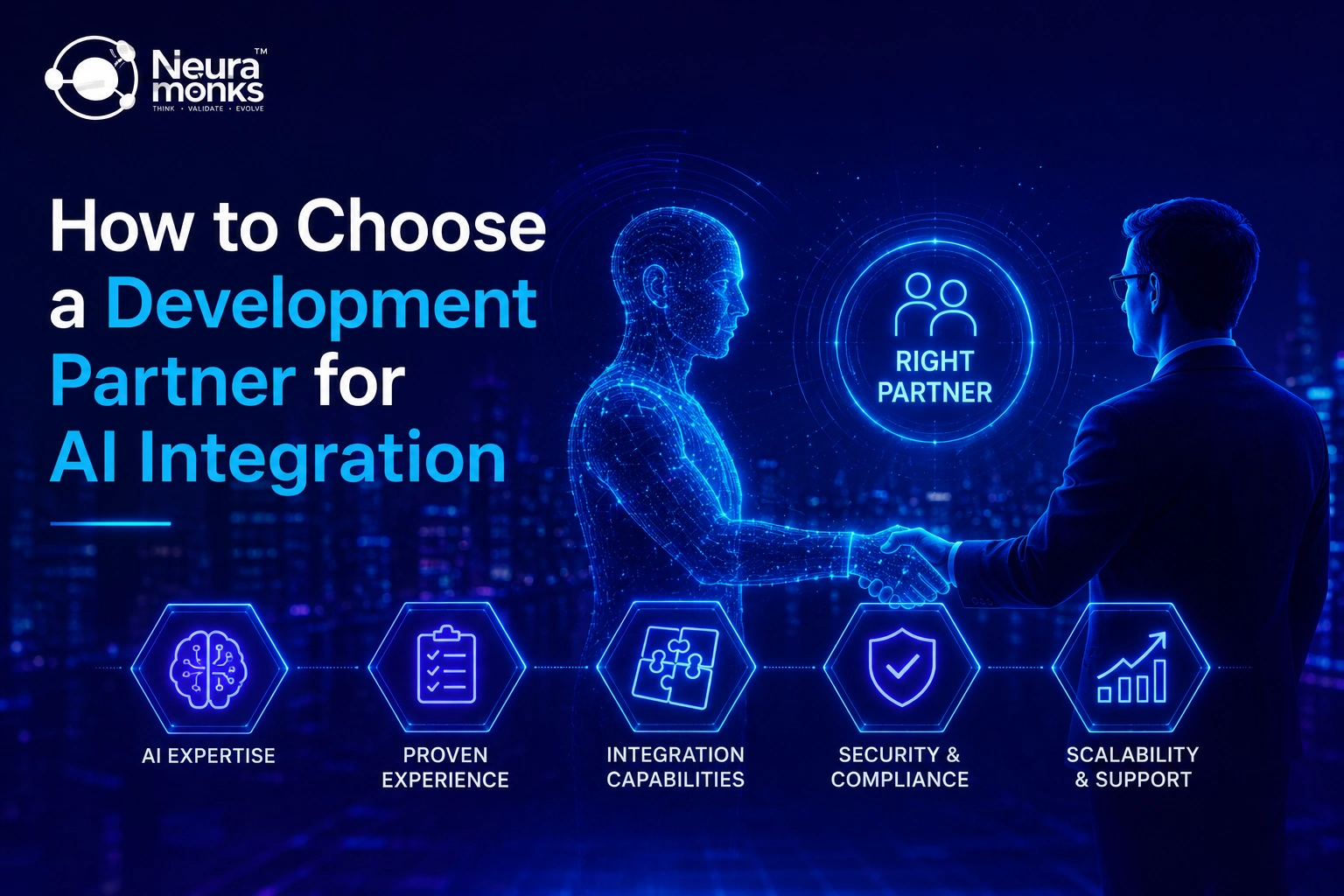
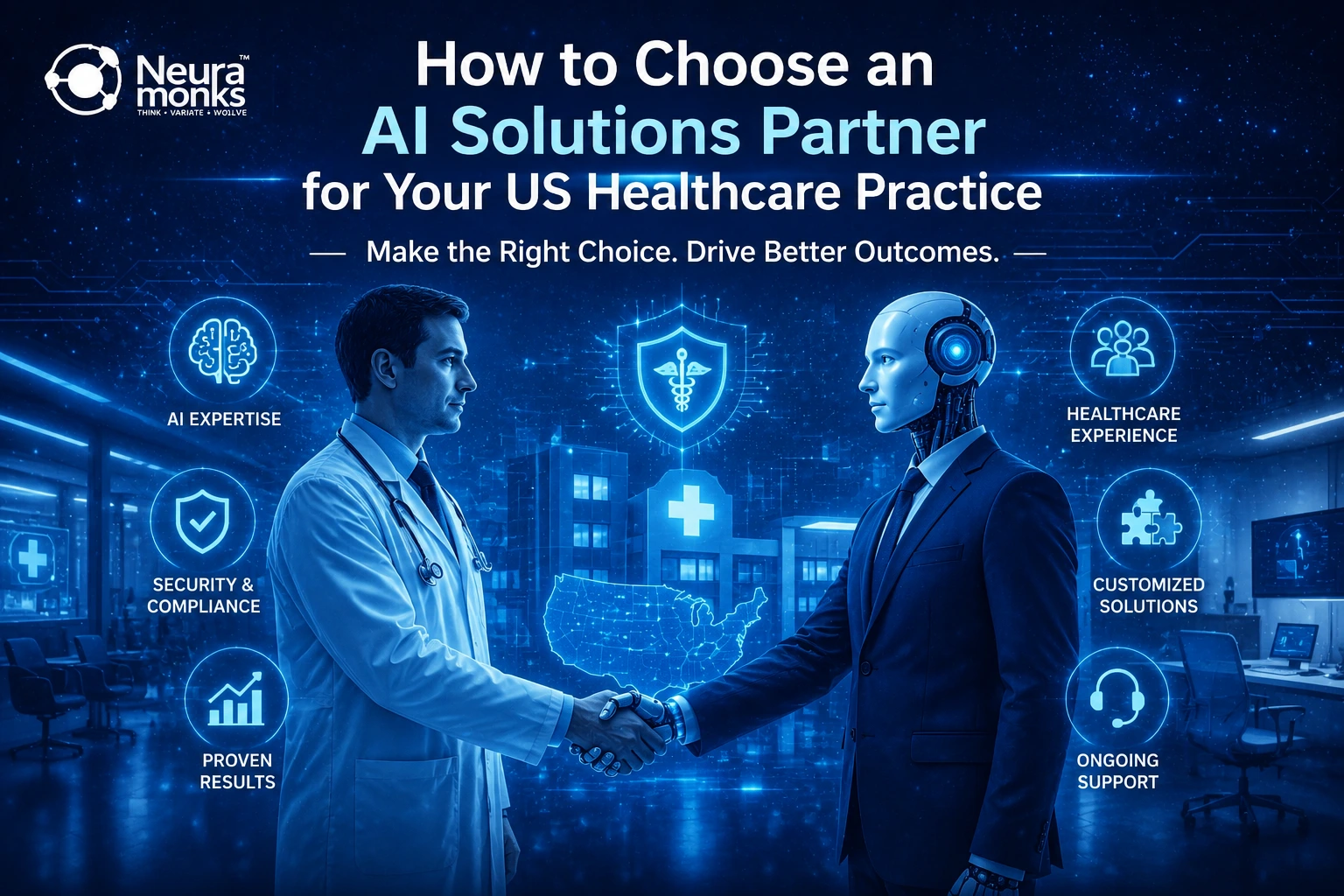
Choose an AI solutions partner for your US healthcare practice using a 12-point checklist covering HIPAA compliance, BAA willingness, FDA SaMD experience, EHR integration depth, clinical validation, data residency, model transparency, security certifications, implementation timeline, total cost of ownership, ongoing support, and case study evidence in your specialty.
Every US healthcare practice is being pitched AI solutions in 2026, from ambient documentation to revenue cycle automation to clinical decision support. The technology is real. The risk of picking the wrong partner is also real. A failed implementation does not just waste budget. It can trigger a HIPAA breach, slow a clinical workflow, or quietly degrade patient outcomes. This 12-point checklist is the same evaluation framework NeuraMonks uses with US healthcare clients before any contract is signed.
Why Partner Selection Matters More in Healthcare Than Anywhere Else
Healthcare AI is not consumer software. A bad recommendation engine on a streaming service is annoying. A bad clinical AI partner is a regulatory and patient safety event. The market has scaled fast and the gap between strong and weak partners is widening.
The numbers tell the story. The US healthcare AI market is projected to reach 187 billion USD by 2030, with 2026 alone expected to drive over 25 billion USD in deployments (Source: Grand View Research, US Healthcare AI Market Report, 2025). Yet 73 percent of healthcare AI pilots fail to scale to production, most often due to integration, compliance, or workflow fit issues, not model accuracy (Source: HIMSS State of Healthcare AI Survey, 2025). And the average HIPAA settlement in 2024 reached 1.04 million USD, with AI-related breach investigations up 58 percent year-over-year (Source: HHS Office for Civil Rights Resolution Agreements Database, 2024).
Translation: the cost of a bad partner is not just the consulting fee. It is the breach, the failed pilot, the staff frustration, and the months of lost momentum. The 12 points below filter signal from noise.
The 12-Point Evaluation Checklist (At a Glance)

The 12 Criteria, Explained in Depth
1. HIPAA compliance and Business Associate Agreement (BAA)
This is non-negotiable. Any partner who handles, processes, or stores Protected Health Information (PHI) must sign a BAA before any data flows. Ask for their BAA template upfront. A serious partner has it ready within 24 hours. A weak one delays, redirects, or wants to use yours unmodified. Verify they understand the difference between de-identified data, limited datasets, and full PHI, and that their architecture matches what their BAA promises.
2. FDA SaMD experience (where applicable)
If your AI use case touches diagnosis, treatment recommendation, or clinical risk scoring, FDA's Software as a Medical Device (SaMD) framework may apply. Ask whether the partner has supported a 510(k), De Novo, or Pre-Submission. Even if your initial use case is administrative, a partner who understands SaMD will design with future regulatory paths in mind. An AI development company without any FDA exposure will build something you may not be able to commercialize.
3. EHR integration depth
Integration is where most healthcare AI dies. Ask specifically: How many production Epic, Cerner (Oracle Health), or Athenahealth integrations have you shipped? FHIR R4 is now the floor in 2026, but real practices still run heavy HL7v2 and proprietary APIs. A partner with five live Epic integrations will navigate this in weeks. A partner with zero will take six months and still miss edge cases.
4. Clinical validation methodology
How does the partner prove the AI works in your specific clinical setting? Strong answers include retrospective validation against your historical data, prospective shadow deployment, and pre-defined success metrics like sensitivity, specificity, and clinical agreement. Weak answers point to general benchmark numbers from a paper. Real validation is specialty-specific, site-specific, and population-specific. AI consulting services that skip this step are selling marketing, not medicine.
Stop Planning AI.
Start Profiting From It.
Every day without intelligent automation costs you revenue, market share, and momentum. Get a custom AI roadmap with clear value projections and measurable returns for your business.

5. Data residency and sovereignty
Where exactly does the data live? US-only hosting is the minimum. Some states (notably Texas, California with CCPA-HIPAA overlap, and New York with SHIELD Act) push further. Ask which AWS, Azure, or GCP region. Ask whether any subprocessors are outside the US. Ask whether model training or fine-tuning ever ships data offshore. Get the answers in writing as part of the BAA addendum.
6. Model transparency and explainability
Black-box models are a non-starter for clinical decisions. Even for administrative AI, explainability matters when staff or patients ask why the system made a recommendation. Ask for model cards, bias evaluation results, and the explainability technique used (SHAP, LIME, attention visualization, or rule-based wrappers). The 2025 NIST AI RMF specifically calls out healthcare as a high-risk domain requiring documented transparency.
7. Security certifications
SOC 2 Type II is the baseline. HITRUST CSF certification is the gold standard for US healthcare. ISO 27001 helps if you operate internationally. Ask for the actual reports under NDA, not just logo claims. A partner who lists badges but cannot produce a current audit report has effectively lied to you, and your compliance officer will catch it during onboarding anyway.
8. Implementation timeline (realistic, not heroic)
Be skeptical of any AI Product Development Company that promises a production healthcare AI deployment in 2 weeks. A typical realistic timeline runs 8 to 16 weeks for the first production workflow, including discovery, data access agreements, integration build, validation, training, and go-live. Faster than 6 weeks usually means corners are being cut on validation or change management. Slower than 24 weeks usually means scope is too large for a first phase.
9. Total cost of ownership across 3 years
Sticker price hides the truth. Ask for a full TCO model: implementation fee, year-one license, year-three license, integration maintenance, model retraining, support tier upgrades, and additional user or location costs. A partner who cannot produce this in writing is either inexperienced or hiding the math. NeuraMonks publishes TCO ranges before signed engagement so the client can budget honestly.
10. Ongoing support and SLA
What happens at 2 AM on a Saturday when the documentation AI stops working in the middle of a hospitalist shift? Ask for the SLA in writing: response time, resolution time, named escalation contact, and severity definitions. A 99.9 percent uptime SLA without a clear severity matrix is marketing. A weak support model is the single biggest cause of post-launch dissatisfaction.
11. Specialty case studies and references
General healthcare AI experience is not the same as experience in your specialty. A partner who has deployed in radiology may know nothing about behavioral health workflows. Ask for two reference customers in your clinical area with a similar size and EHR. Talk to them without the partner on the call. The honest details (what went wrong, how it was fixed) are worth more than any deck.
For a broader context on which firms are leading this space in the US, this resource is a useful market map:
Top AI Development Companies in the USA 2026
12. Exit clause and data portability
The most professional partner conversation includes how the relationship ends. Ask: If we offboard in 18 months, how do we get our data, our trained models, our prompts, and our integration mappings out, and in what formats? A partner who has thought this through has nothing to hide. A partner who deflects has structural lock-in baked in, and you will pay for it later.
Red Flags That Should End the Conversation
- They cannot produce a BAA template within 48 hours.
- They claim 99.99 percent model accuracy without specifying the dataset or population.
- Pricing is opaque or scales unexpectedly with usage with no upfront cap.
- All case studies are from non-healthcare verticals (or none are US-based).
- They cannot name a clinical lead on their team or a recent FDA-related project.
- The proposed timeline assumes you have no existing EHR integration constraints.
How to Run the Evaluation in 30 Days
A disciplined process beats a long process. Here is the 30-day cadence we recommend to clinical and operations leaders evaluating AI partners.
Days 1 to 7: Define the use case and longlist
Pick one workflow with measurable pain (documentation time, denied claims, scheduling no-shows, prior auth turnaround). Source 6 to 8 candidate partners through trusted analyst lists, peer references, and direct outreach. Resist the urge to pick a partner before defining the problem.
Days 8 to 14: RFP and shortlist
Send the 12-point checklist as the RFP. Score responses on completeness and specificity. Shortlist the 3 strongest. NeuraMonks routinely sees that 2 of the original 8 self-eliminate at this stage by failing on HIPAA, BAA, or EHR integration questions.
Days 15 to 22: Reference calls and security review
Run 30-minute reference calls with prior customers. Have your CISO and Privacy Officer review the SOC 2 / HITRUST reports under NDA. Identify any deal-breakers before commercial discussion.
Days 23 to 30: Commercial alignment and pilot scope
Negotiate a paid pilot with clear success metrics, not a free trial. Free trials encourage demos, not real validation. A 60 to 90 day paid pilot at 10 to 25 percent of the annual contract value forces both sides to commit and produces real data for the production decision.
How the Best AI Partners Earn Trust in the First 90 Days
The discovery and contracting phase reveals the partner's salesmanship. The first 90 days of execution reveals their craft. Three signals separate strong partners from weak ones once work actually starts.
First, they translate clinical workflows into design before writing code. A strong partner sits with nurses, billers, or front-desk staff for at least a week before architecture is finalized. They map the actual click path, the workarounds, the exception handling. AI that ignores existing workflow gets bypassed within a month of go-live, no matter how accurate the model is.
Second, they instrument everything from day one. A real production AI deployment ships with logging, monitoring, drift detection, and feedback loops baked in, not bolted on later. Ask to see the dashboard the partner will hand over. If it does not exist as a template before the engagement, it likely will not exist after either.
Third, they prepare the practice for the human side of change. Even the best AI fails when staff are not trained, incentives are misaligned, or leadership has not committed publicly. The strongest AI consulting services partners include change management hours in the proposal by default. The weakest treat training as an afterthought, billed separately.
Book a Free AI Consultation With NeuraMonks
Evaluating AI partners for your US healthcare practice? Book a free consultation with the NeuraMonks healthcare AI team. We will walk through the 12-point checklist against your shortlist, flag risks, and outline a HIPAA-safe pilot scope tailored to your specialty and EHR.
Schedule your call: https://tidycal.com/team/neuramonks/consultation-booking

Upendrasinh zala
Upendrasinh Zala is the Founder & CEO of Neuramonks, an enterprise AI and deeptech consulting firm based in Gujarat, India. Drawing from years of experience in AI-driven business strategy and corporate growth, he writes on leveraging artificial intelligence to optimize workflows and unlock tangible ROI for enterprises.