TABLE OF CONTENT
Is Yours Ready?
Every construction site in America lives under a single compliance reality: OSHA doesn't walk your jobsite looking for the safety culture you've spent years building. They walk in looking for your paperwork your SDS logs, your incident records, your training certifications, your hazard communication files. If those documents are missing, incomplete, or disorganized, the fine lands on your desk. Not on your safety philosophy.
For mid to large construction firms operating across multiple sites in states like Texas, California, Florida, and New York, the documentation burden is not a back office problem. It is a frontline business risk. And in 2025, the companies that are passing OSHA inspections with zero citations are not the ones with the most dedicated safety managers they are the ones that have automated the paper trail with AI in Construction systems that never miss a record, never lose a file, and never forget a deadline.
The Real Cost of OSHA Non-Compliance for U.S. Construction Firms
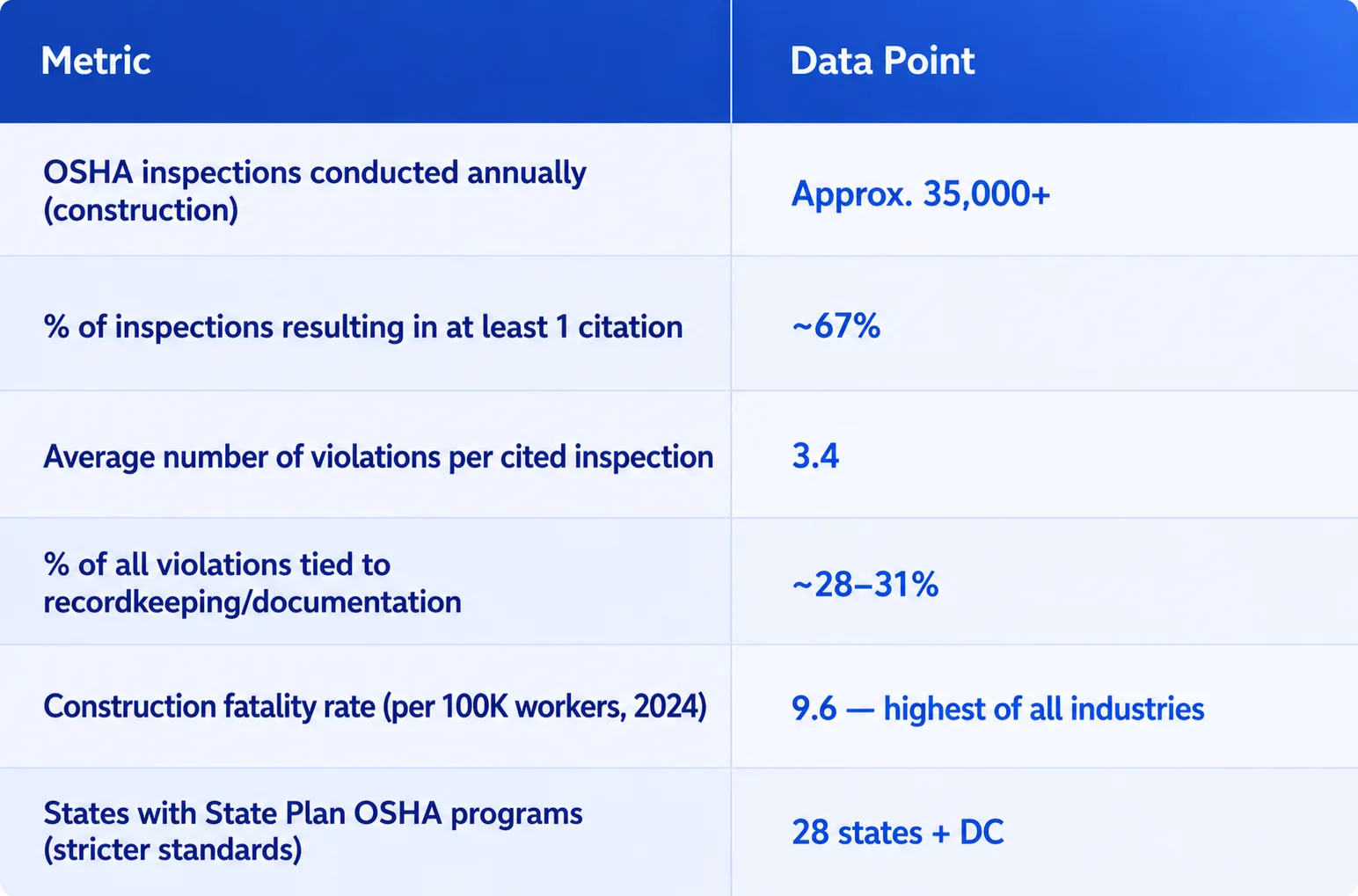
Before diving into how technology solves this, let's put numbers on the problem. According to OSHA's published penalty structure and enforcement data, the financial exposure for construction companies is significant and growing.
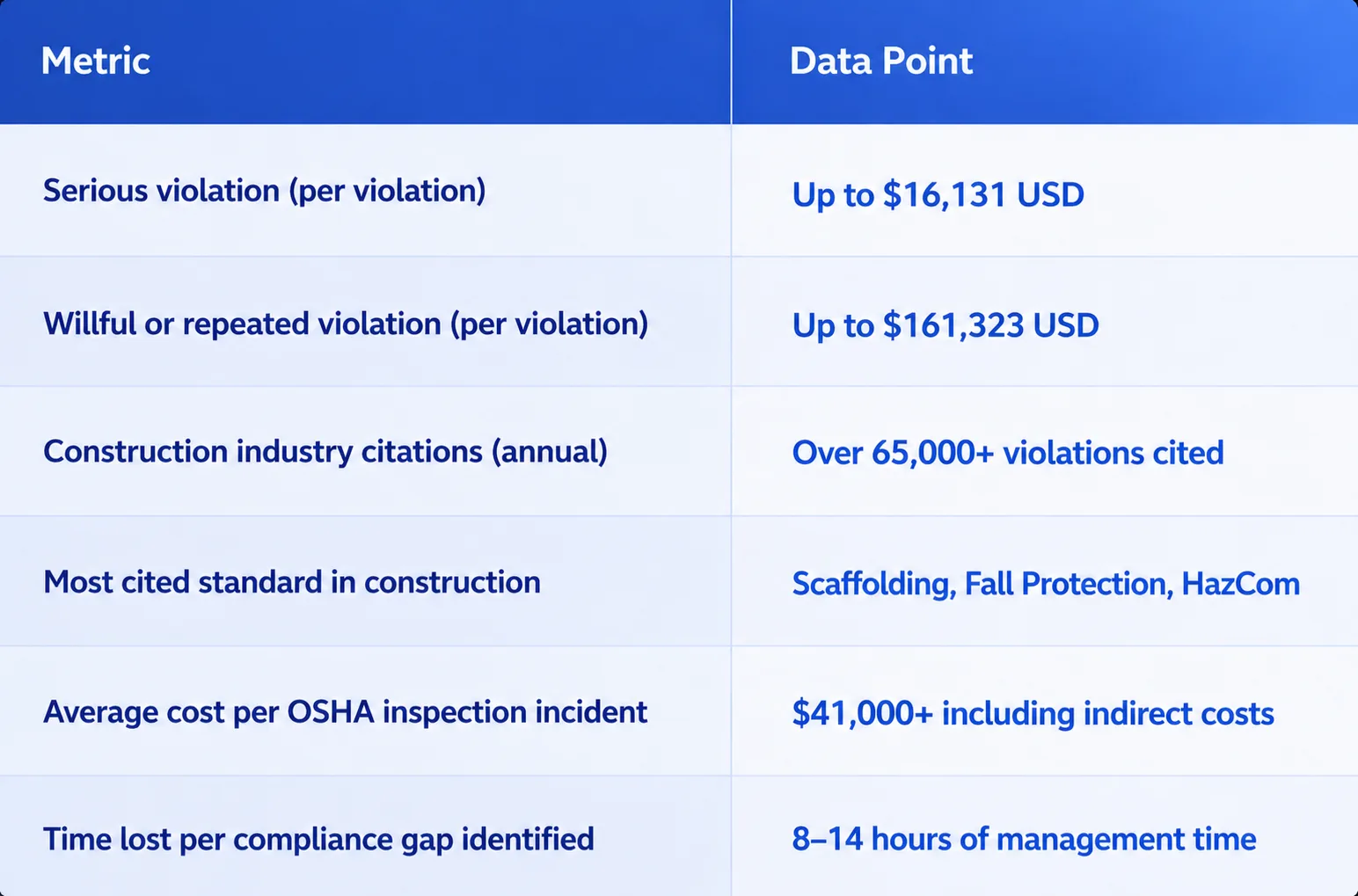
These numbers don't account for litigation exposure, reputational damage, or the project delays that follow a stop-work order. The financial argument for getting documentation right the first time is overwhelming and the operational argument for doing it with AI solutions is becoming equally clear.
What OSHA Compliance Officers Actually Look For On-Site
Understanding what triggers citations helps clarify exactly where AI in Construction transforms exposure into protection. OSHA compliance officers prioritize documentation audits across these primary categories:
1. Hazard Communication (HazCom) 29 CFR 1910.1200
Every chemical on your site must have a Safety Data Sheet. Every worker handling that chemical must have documented training. Compliance officers will ask workers directly and the worker's answer must match what's in your training records.
Stop Planning AI.
Start Profiting From It.
Every day without intelligent automation costs you revenue, market share, and momentum. Get a custom AI roadmap with clear value projections and measurable returns for your business.
2. Injury and Illness Recordkeeping 29 CFR 1904
OSHA 300, 300A, and 301 logs must be maintained with accuracy. Any discrepancy between reported incidents and what workers describe during an inspection creates immediate escalation. Under reporting is treated as a willful violation.
3. Fall Protection Training Records 29 CFR 1926.503
For any worker exposed to fall hazards, training must be documented with the trainer's name, date, and the worker's acknowledgment. Verbal assurances that "everyone was trained" are not acceptable substitutes.
4. Equipment Inspection Logs 29 CFR 1926.20
Cranes, scaffolding, aerial lifts, and powered equipment require documented pre shift inspection logs. A missing log for a single piece of equipment on inspection day can escalate to a program level citation.
5. Emergency Action Plans and Site Safety Plans
These must be current, site specific, and accessible. A plan from a previous project pinned to the trailer wall is one of the fastest ways to receive a citation for a "deficient" safety program.
⚠️ Industry Insight: 73% of construction OSHA citations in 2024 were documentation failures, not physical safety failures. The hazard had been identified. The record simply wasn't there.
How AI in Construction Eliminates Documentation Gaps Before They Become Citations
This is where the operational shift happens. Traditional compliance management relies on safety managers manually collecting, organizing, and updating records across active job sites. With dozens of workers, rotating subcontractors, multiple equipment vendors, and state-specific regulatory variations, the manual approach creates structural gaps not due to negligence, but due to volume.
Modern Artificial Intelligence in Construction compliance platforms address this at every layer:
Automated Incident Logging
Rather than relying on workers or supervisors to manually complete OSHA 301 forms within the required 7 day window, AI powered systems capture incident data at the point of reporting via mobile app, voice input, or structured digital forms and auto populate the correct OSHA record format. The system timestamps the submission, links it to the relevant project and jobsite, and flags any field that would fail a compliance review before the record is saved.
Training Certification Tracking with Expiry Alerts
Every worker's credentials OSHA 10, OSHA 30, forklift certification, fall protection training, confined space entry are maintained in a centralized, searchable database. When a certification approaches expiry, the worker, their supervisor, and the safety manager receive automated notifications. No worker enters a restricted area with expired credentials. The paper trail updates itself.
Equipment Inspection Record Automation
Pre shift inspection checklists are completed digitally on mobile devices. Records are geo tagged to the site, time-stamped, linked to the specific equipment asset, and archived automatically. If an inspection is missed, the system flags it within hours — not when an OSHA officer arrives.
LLM-Powered Compliance Guidance
The most advanced platforms now deploy an LLM model layer that interprets regulatory language in real time and provides site specific guidance to safety managers. When a regulation changes as OSHA rules frequently do the platform updates its interpretation automatically and flags any existing documentation that needs revision. Safety managers stop researching compliance language manually and start receiving precise answers to their specific situations.
Traditional vs. AI-Powered Compliance: A Direct Comparison
For construction companies evaluating whether an investment in AI compliance infrastructure is justified, this side-by-side view reflects what firms across the U.S. are experiencing:
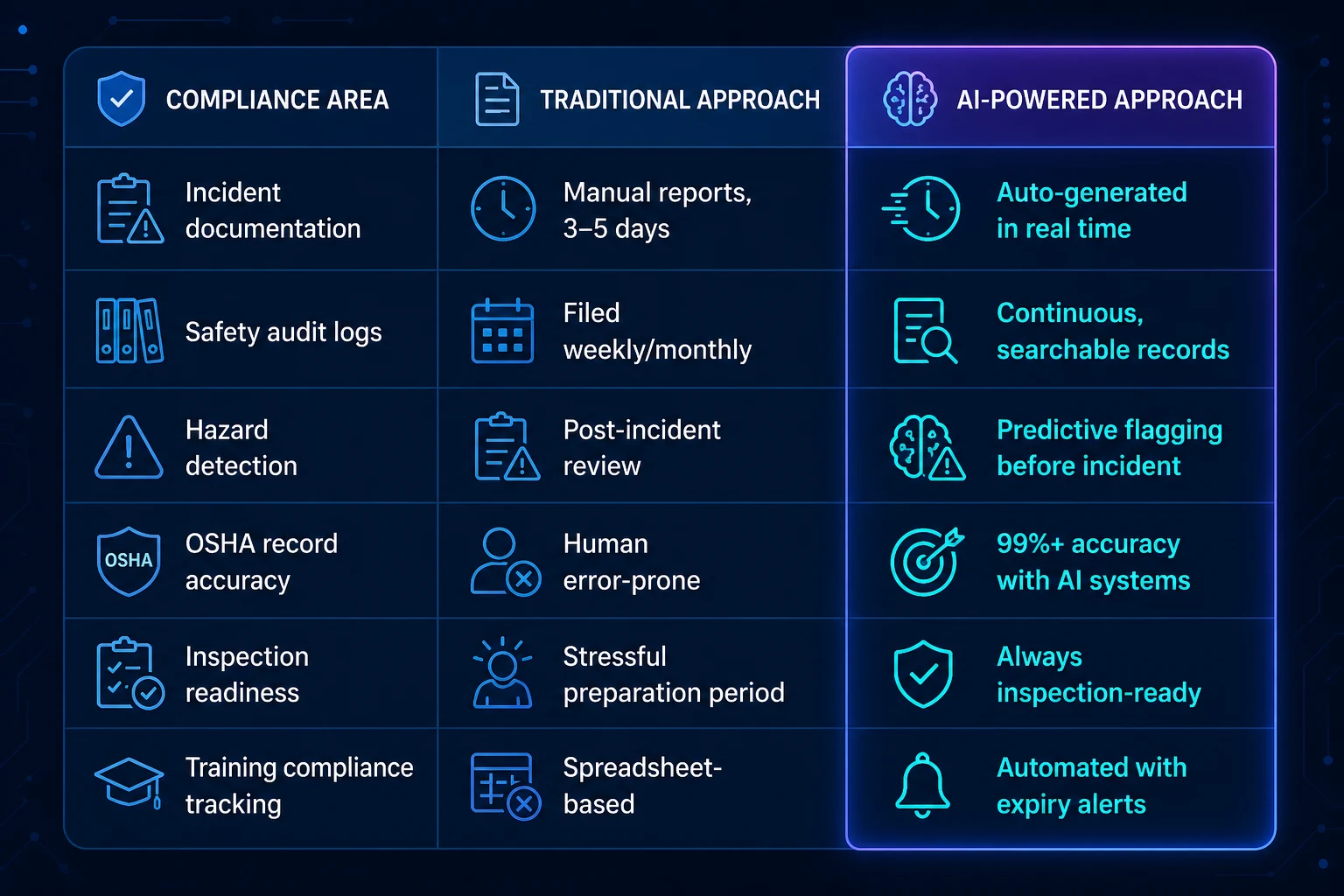
The pattern is consistent: AI-powered systems do not replace your safety program. They make your safety program provable.
The 5 Documentation Systems Every U.S. Construction Site Needs Right Now
Whether you are operating in Houston, Los Angeles, Chicago, or Charlotte, these five documentation systems are what OSHA compliance officers prioritize when they arrive at a construction site. If all five are automated, organized, and immediately producible, your inspection ends quickly. If any of them is incomplete, your inspection expands.
- Injury and Illness Log (OSHA 300 series) maintained year-round, not reconstructed at year end
- Hazard Communication Program with current SDS files for all chemicals on site
- Fall Protection Training Records with trainer credentials and worker acknowledgment signatures
- Equipment Inspection Logs per-shift, per-asset, timestamped and retained for a minimum 3 years
- Site Specific Emergency Action Plan updated for current project conditions, accessible within 30 seconds
Pro Note: OSHA compliance officers can request any of these records within minutes of arriving. If retrieval takes longer than 10 to 15 minutes, it signals a disorganized program even if the records technically exist. Speed of retrieval is itself an audit factor.
NeuraMonks: Purpose-Built AI for Construction Compliance Workflows
NeuraMonks delivers AI systems specifically engineered for industries where documentation accuracy is non-negotiable. For construction firms operating under OSHA's regulatory framework, NeuraMonks has built compliance intelligence into every layer of the workflow — from incident capture to record retrieval to audit preparation.
What separates us from generic software platforms is the application of computer vision, natural language processing, and predictive analytics to the actual documentation workflows your safety teams use every day. The platform does not ask your team to learn new behavior. It automates the documentation that surrounds their existing behavior and ensures that documentation holds up under inspection.
What NeuraMonks Delivers for Construction Safety Compliance
- Real-time incident documentation that meets OSHA 300-series format requirements automatically
- Computer vision inspection of equipment and site conditions with auto-logged results
- Worker credential management with multi-site visibility and certification expiry automation
- Regulatory update monitoring across all U.S. OSHA regional offices and federal standards
- Instant audit ready document packages producible in under 3 minutes for any inspection
- Integration with existing project management platforms including Procore, Autodesk Build, and Viewpoint
Why "We've Never Had a Problem" Is the Most Dangerous Compliance Strategy
The single most common reason construction companies delay investing in compliance automation is a clean history. If you haven't received a major citation in 3 years, the urgency feels abstract. But OSHA enforcement patterns in 2024 and 2025 tell a different story.
OSHA has increased its use of unprogrammed inspections meaning officers arrive without a prior complaint or referral trigger. They are responding to industry wide data suggesting that documentation practices have not kept pace with workforce growth and subcontractor complexity. Your site's clean record is a reflection of inspection timing, not documentation quality. The next inspection will test the documentation, not the culture.
Building a Compliance Infrastructure That Scales With Your Sites
For general contractors managing multiple active projects across different states, the compliance challenge compounds quickly. A crew working in California operates under Cal/OSHA standards that exceed federal requirements. A site in Texas operates under federal OSHA directly. A project in Washington State has its own Department of Labor & Industries framework.
Manual systems cannot track these variations reliably across a growing portfolio. AI in Construction compliance platforms can. The configuration layer of these systems maintains a regulatory ruleset for each active jurisdiction and applies the correct standard automatically to each site's documentation requirements. Your safety manager in Dallas is applying California compliance rules to the Pasadena project without needing to research them manually.
This is the core value proposition of bringing AI solutions into your compliance infrastructure: it removes the human bottleneck from a process that cannot afford human error.
Your Next Inspection Is Already Scheduled — Your Records Should Be, Too
OSHA doesn't announce inspections. They arrive. And when they do, the firms that walk through that process in under an hour with full documentation, zero missing records, and zero citation exposure are the firms that have systematically addressed the paper trail problem.
NeuraMonks works with construction firms across the United States to build compliance documentation systems that function 24/7, scale across every active site, and produce inspection ready records at any moment. The gap between your current documentation process and an audit-proof one is not a personnel gap. It is a technology gap.
Your Compliance Record Has a Gap Right Now. You just don't know where it is yet but an OSHA officer will.
Examine What NeuraMonks Has Delivered for Construction Safety Teams →
Schedule a Construction AI Compliance Scoping Call

Ketan Kanjiya
Ketan Kanjiya is a Machine Learning researcher and Chief Research Officer at Neuramonks, an AI-focused technology company based in Ahmedabad, Gujarat. With hands-on expertise in AI/ML, image processing, and web application development, he has led research initiatives across F(x) Data Labs and Kshatrainfotech. Ketan writes to simplify advanced technical concepts for developers and tech enthusiasts alike.