TABLE OF CONTENT
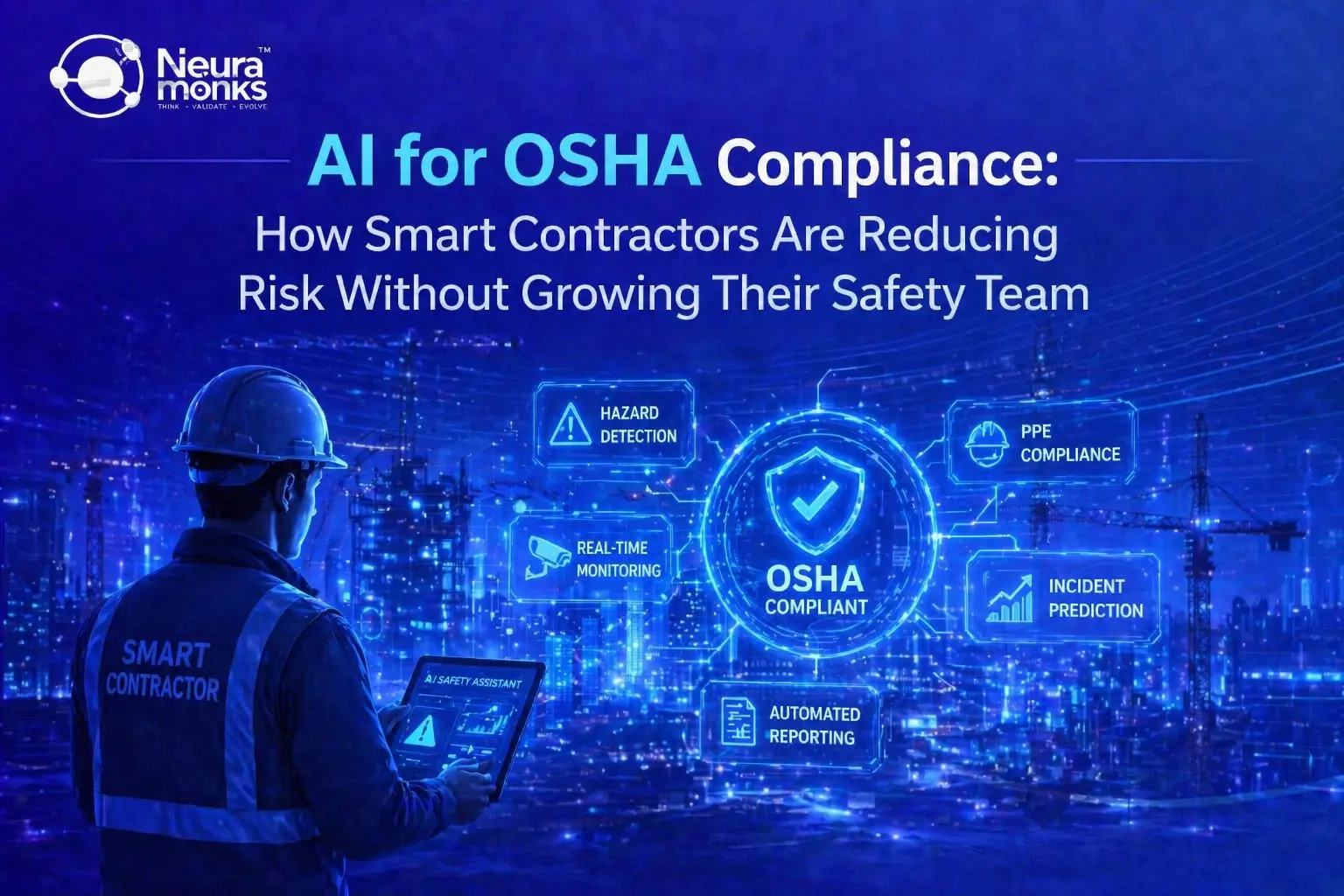
There is a quiet revolution happening on U.S. job sites. It does not involve adding a dozen safety officers or burying crews in more paperwork. It involves plugging in computer vision cameras, connecting them to a compliance engine, and letting AI in Construction do the continuous watching that no human team can sustain across a 10-acre site at 6 AM.
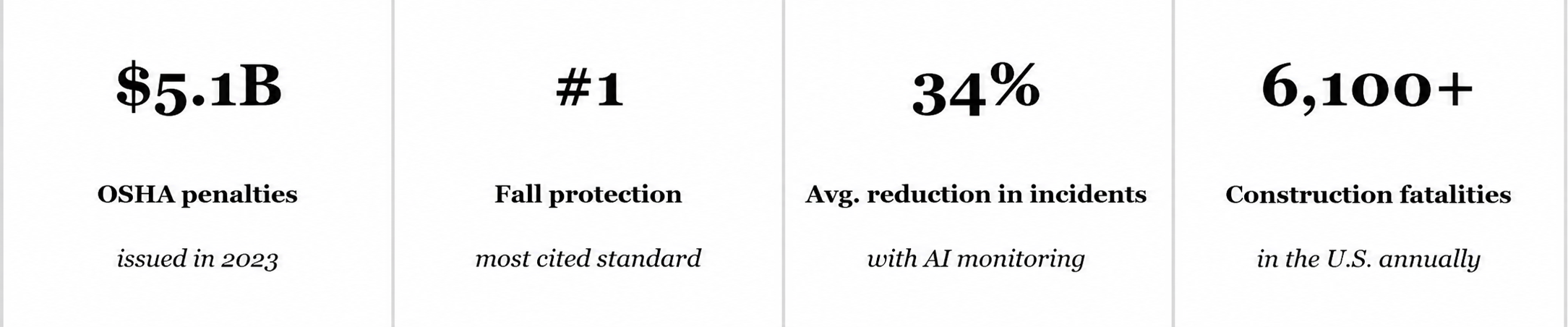
OSHA's penalty structure has never been steeper. A single willful violation now carries fines up to $156,259. Repeat citations compound fast. For mid-size contractors running 4 8 active projects, the risk is existential not just financial. Yet the traditional response (hire more safety staff) is both expensive and slow. The smarter contractors are choosing a third path.
Why Traditional Compliance Methods Are Breaking Down
Safety management on construction sites has historically relied on periodic walkthroughs, manual checklists, and reactive incident reports. The fundamental problem: a safety manager can only be in one place at one time. On a large commercial project with 200+ workers across multiple floors and trades, continuous human oversight is mathematically impossible.
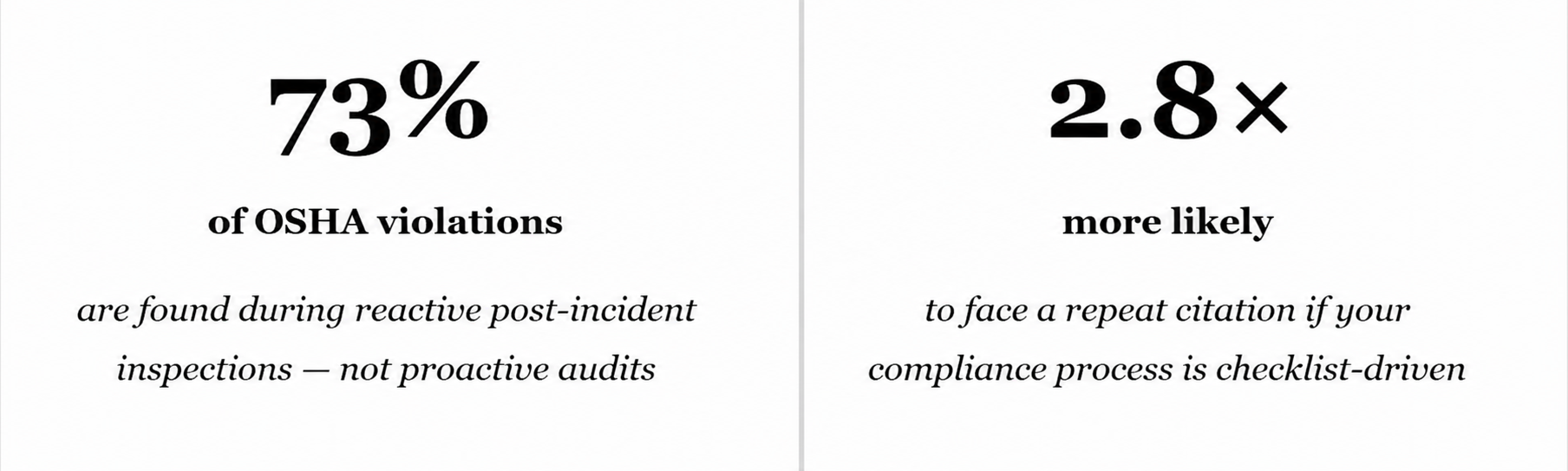
The compliance gap is real. OSHA's own data shows that the majority of violations are discovered after something goes wrong a fall, a struck by incident, a scaffold failure. At that point, the fine is the least of your problems. Worker's comp claims, project delays, litigation, and reputational damage can cost 10–50x the original penalty.
We had good safety culture but a terrible visibility problem. We couldn't see what we couldn't see.
Safety Director, top-20 U.S. general contractor
Stop Planning AI.
Start Profiting From It.
Every day without intelligent automation costs you revenue, market share, and momentum. Get a custom AI roadmap with clear value projections and measurable returns for your business.
What AI in Construction Actually Looks Like for Compliance
AI in Construction compliance is not a futuristic concept. It is deployable today, and contractors across the U.S. are using it on active projects. Here is what the technology stack looks like in practice:
Core AI Compliance Capabilities 2024 Deployments
1. Real-Time PPE Detection — Cameras identify missing hard hats, vests, gloves, and eye protection. Workers are flagged within seconds, not hours.
2. Hazardous Zone Monitoring — Geofencing and computer vision alert supervisors when workers enter exclusion zones without authorization or proper equipment.
3. Fall Risk Analysis — Models detect unprotected edges, missing guardrails, and improper ladder use. Alerts are issued before an incident occurs
4. Automated OSHA Documentation — Incident logs, near-miss reports, and inspection records are generated automatically from sensor and camera data, reducing manual documentation time by up to 80%.
5. Predictive Risk Scoring — Machine learning models score each work zone daily based on crew density, task type, weather, and historical incident patterns helping you deploy safety resources where they are needed most.
The Real Cost of Non-Compliance vs. the Cost of AI Implementation
Decision-makers often frame this as a budget question. The actual math points firmly in one direction.
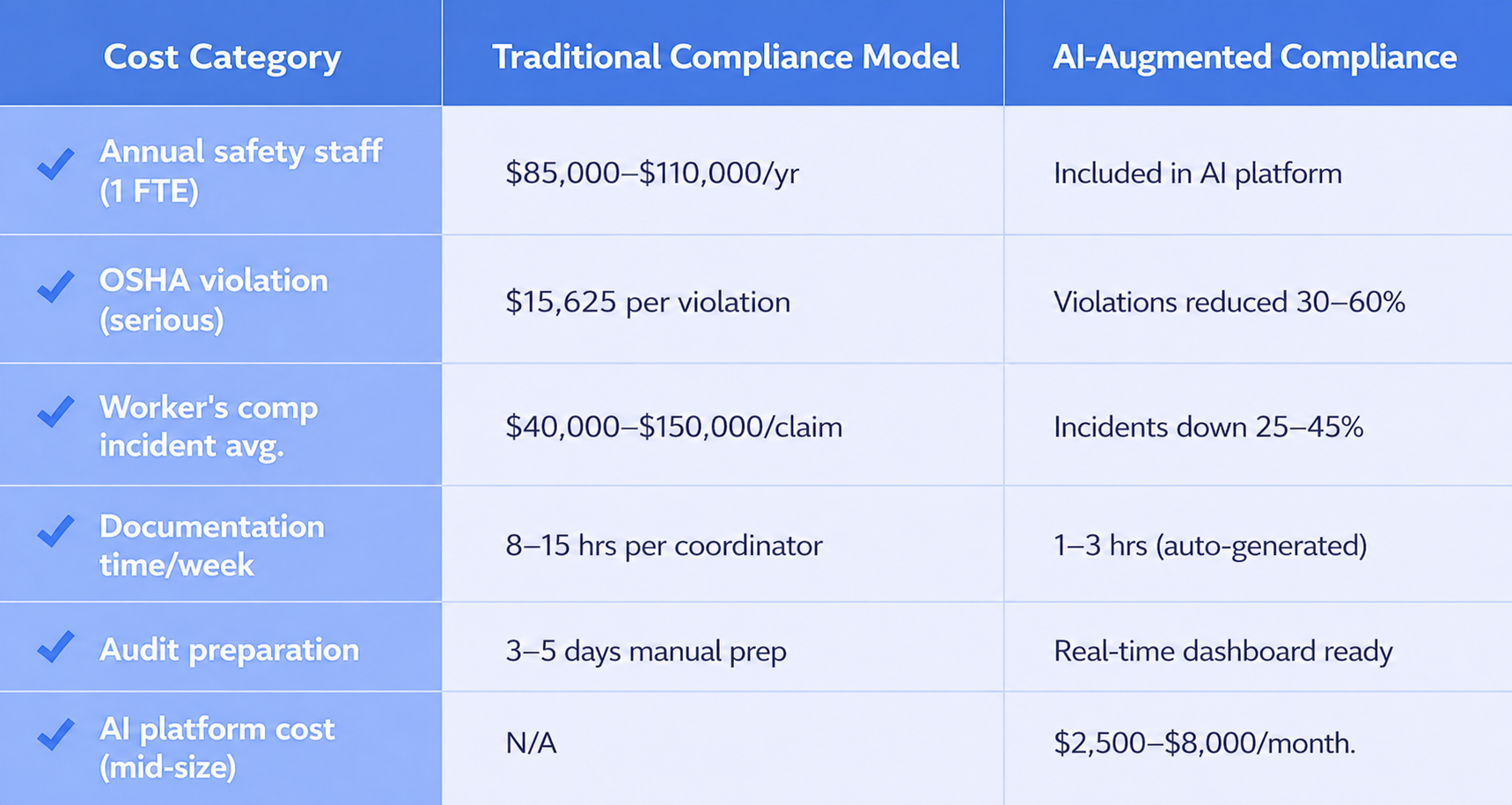
The ROI calculation is not close. A contractor running 5 projects who avoids 3 serious OSHA citations per year ($46,875 saved) and 1 worker's comp claim ($75,000 average) is already clearing $120,000+ in avoided costs against a platform investment that typically runs $5,000 to $8,000/month across all sites. That is a positive return inside the first quarter.
OSHA's Most Cited Standards and How AI Addresses Each One
OSHA publishes its most-cited violations annually. For FY2023, the top 10 for construction were dominated by four categories. Here is how AI solutions map to each:
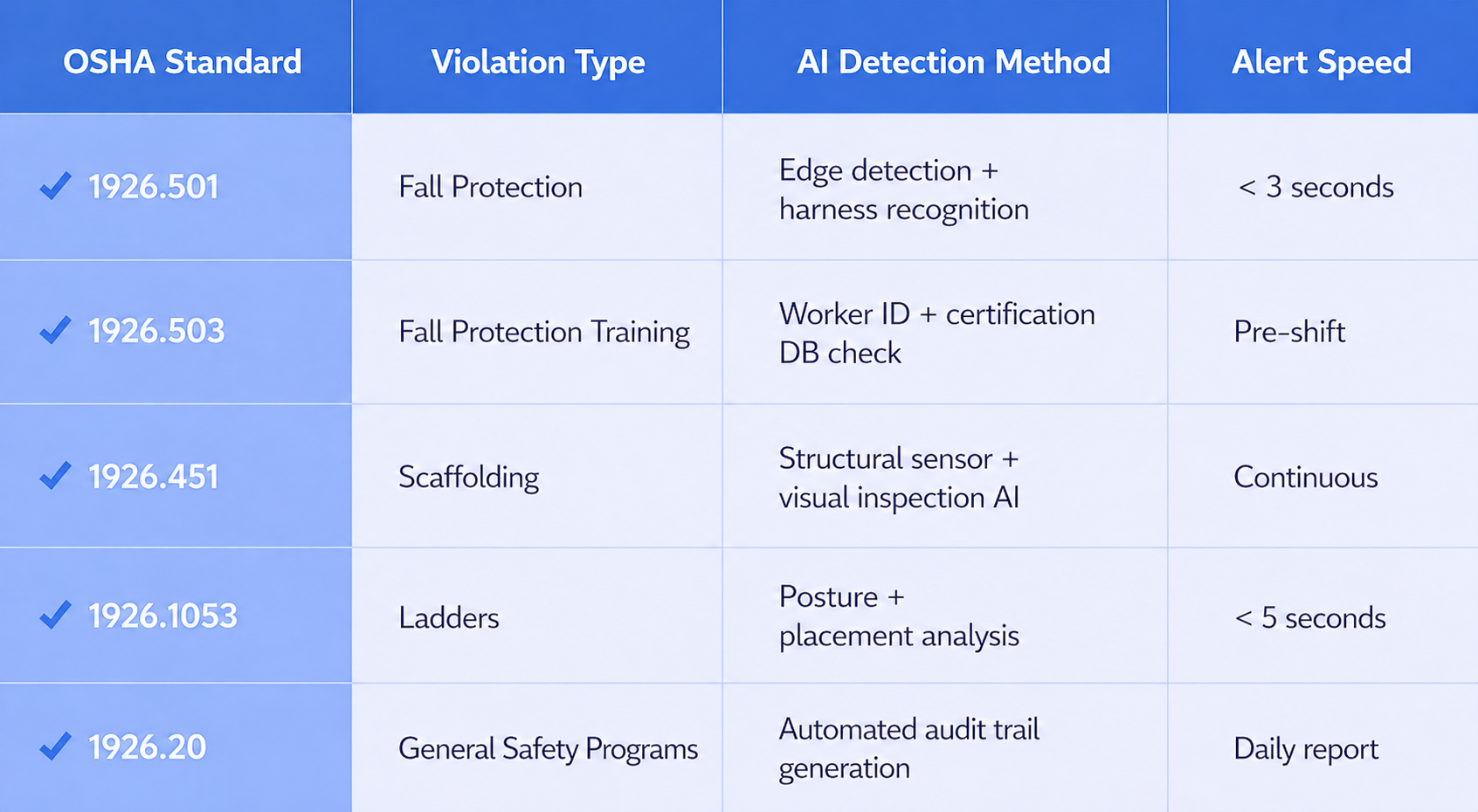
When AI in Construction is deployed at this level of specificity, safety teams shift from reactive fire fighting to proactive oversight. One coordinator can effectively monitor what previously required three dedicated walkers on a large site.
How NeuraMonks Builds Compliance Intelligence for Contractors
NeuraMonks is not a generic SaaS vendor. As a specialized AI development company focused on computer vision and industrial AI, NeuraMonks designs compliance systems built around how construction sites actually operate not how a software demo assumes they do.
The difference is meaningful. Off-the-shelf safety platforms apply generic models trained on warehouse or manufacturing footage. Construction environments are dynamic: lighting changes by the hour, crews rotate across zones, PPE varies by trade, and site layouts change weekly. Generic models produce false positives that crews learn to ignore which is worse than having no system at all.
What NeuraMonks Delivers for Contractors
• Custom-trained vision models on your site footage not generic datasets
• OSHA standard-specific detection logic (fall protection, scaffolding, struck-by)
• Integration with your existing camera infrastructure no rip-and-replace
• Automated OSHA-ready documentation and incident audit trails
• Dashboard visibility for project owners, safety directors, and site supers all in one place
A Field-Tested Deployment: From Pilot to Portfolio Rollout
The pattern we see consistently among U.S. contractors who adopt AI compliance systems follows three phases:
Phase 1 Pilot Project (Weeks 1 to 6)
One active project is instrumented with AI cameras and the compliance engine. The team runs parallel operations: existing safety processes continue while AI data is collected. By week 4, the gap between what the human walkthroughs catch and what the AI detects is usually striking enough to build internal buy-in.
Phase 2 Calibration & Integration (Weeks 6–12)
The AI models are refined based on actual site conditions. Alert thresholds are tuned to reduce noise. OSHA documentation workflows are connected to the platform. Safety coordinators shift from walkthroughs to monitoring and exception-handling.
Phase 3 Portfolio Expansion (Month 3+)
Once the pilot demonstrates a measurable reduction in near-miss events and citation risk, the same infrastructure is deployed across all active projects. The unit economics improve significantly at scale the AI platform cost per project decreases while protection increases.
By month three, our safety coordinator was managing compliance across four sites instead of one. The AI handled the constant monitoring. She handled the decisions.
VP of Operations, Southeast commercial GC
Answering the Questions Safety Directors Actually Ask
Will crews resist the cameras?
Initial resistance is real but short-lived when the framing is right. The AI is not surveillance for discipline purposes it is an early-warning system that protects workers. Most crews, once they understand the system flags risks before incidents happen, become advocates. Frame the rollout around worker protection, not compliance enforcement.
What happens when the AI makes a false positive?
Well-designed systems like those built by NeuraMonks include confidence thresholds and human-in-the-loop review for any alert that triggers documentation. False positives are flagged to the safety coordinator, not automatically recorded in OSHA logs. The system improves with every reviewed alert through active learning.
Do we need new cameras or infrastructure?
In most deployments, no. AI compliance platforms integrate with existing IP camera networks. If your sites already have CCTV for security, the same hardware can be repurposed. New edge-compute devices process video locally, so footage does not need to leave the site for analysis, which addresses both bandwidth and privacy concerns.
How long before we see measurable results?
Contractors typically see the first data within 48–72 hours of deployment. Measurable reduction in near-miss events is observable within 30 days. Documentation hours drop immediately. OSHA citation risk reduction is measurable after the first full audit cycle.
The Competitive Advantage You Are Not Talking About Yet
There is a dimension of this conversation that goes beyond penalty avoidance. Increasingly, large project owners and general contractors are asking subcontractors about their safety technology stack as a prequalification factor. EMR (Experience Modification Rate) is a direct input into bonding capacity and bid competitiveness.
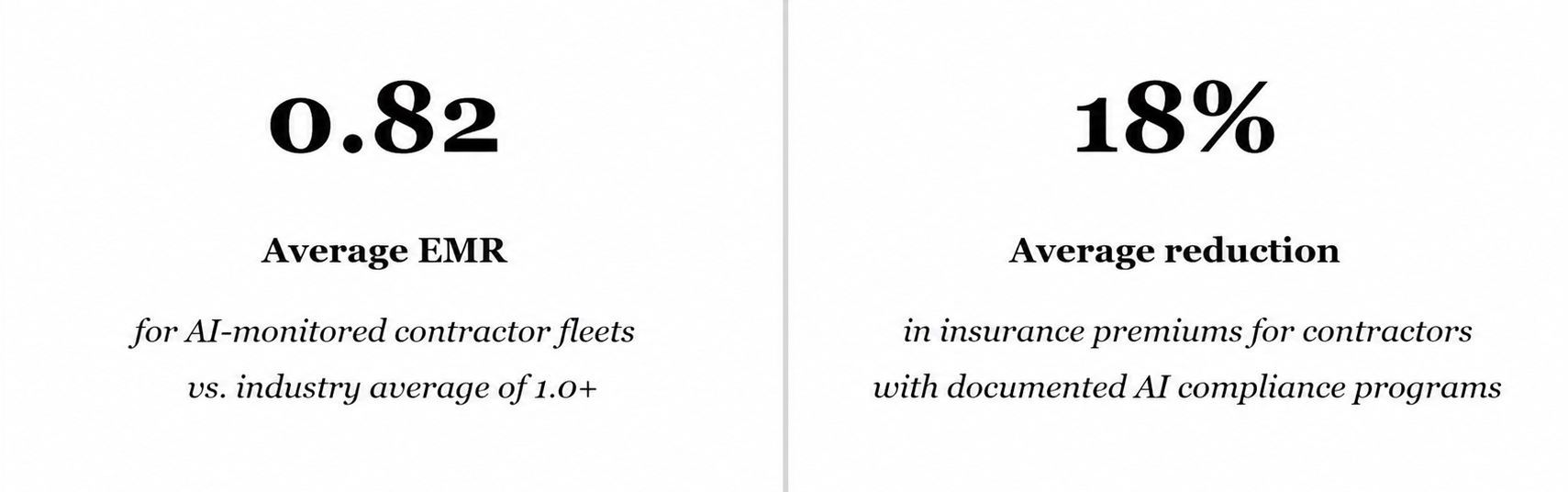
Contractors who deploy AI solutions today are building a documented safety record that compounds over time — lower EMR, better bonding rates, access to larger projects, and a hiring advantage with safety-conscious workers. The compliance benefit is just the beginning.
Your Next OSHA Audit Doesn't Have to Be a Gamble
NeuraMonks engineers compliance intelligence built for how your crews actually work — not how consultants think they should.
Examine Delivered Case Studies | Schedule a Scoping Call

Ketan Kanjiya
Ketan Kanjiya is a Machine Learning researcher and Chief Research Officer at Neuramonks, an AI-focused technology company based in Ahmedabad, Gujarat. With hands-on expertise in AI/ML, image processing, and web application development, he has led research initiatives across F(x) Data Labs and Kshatrainfotech. Ketan writes to simplify advanced technical concepts for developers and tech enthusiasts alike.