TABLE OF CONTENT
Every 99 minutes, a construction worker in the United States dies on the job. That is not a statistic buried in a government footnote it is the OSHA reality for an industry generating over $2 trillion in annual output while consistently ranking among the nation's most dangerous sectors. The question construction safety officers, general contractors, and operations VPs are now asking is not whether technology can change this. They are asking how fast they can deploy it.
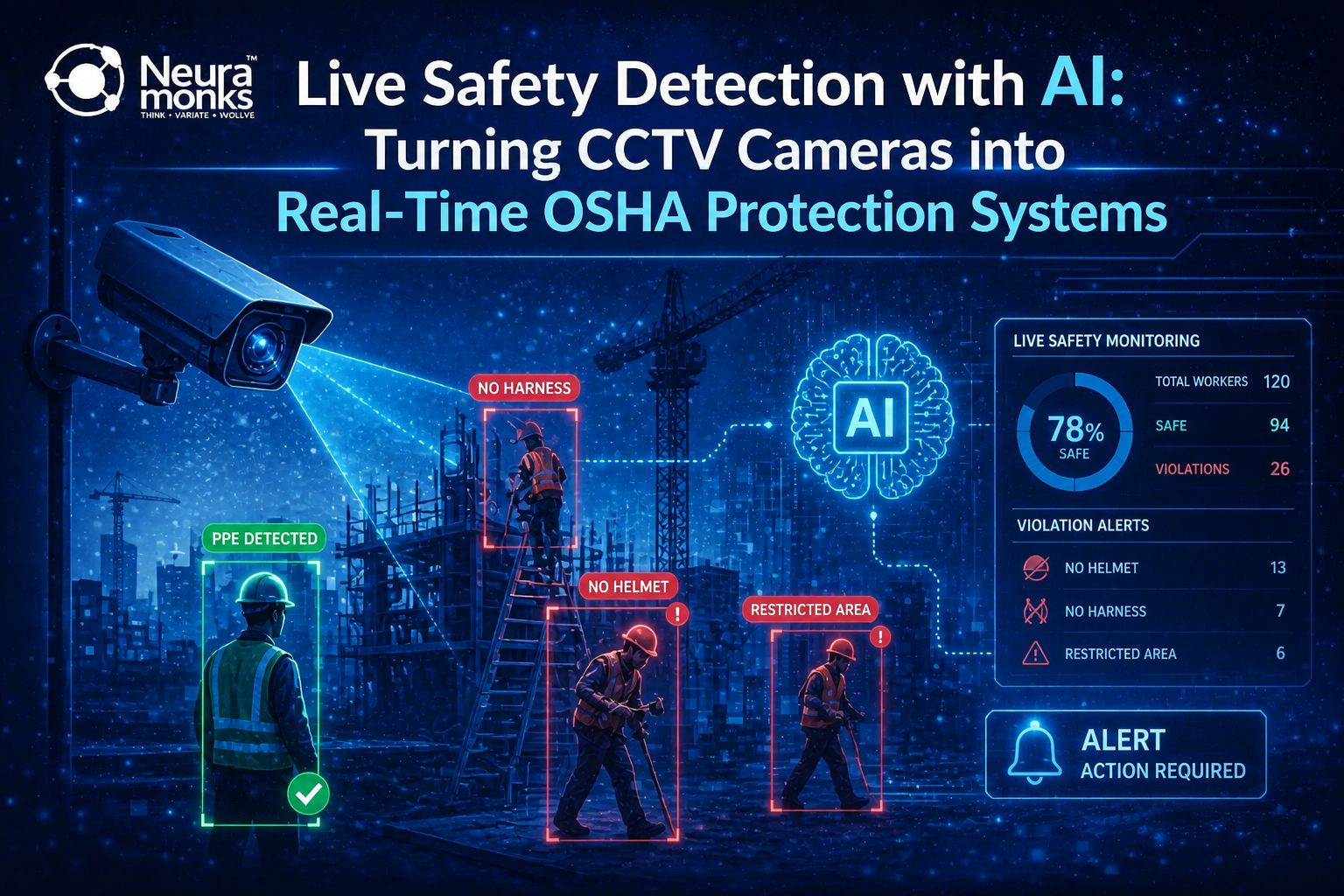
The answer lies in the cameras already mounted across your job site. Paired with AI in Construction, those passive surveillance feeds become active, intelligent safety systems that detect hazards in real time, alert supervisors before injuries occur, and generate audit-ready compliance records automatically.
The Gap Between CCTV Footage and Actual Safety
Traditional CCTV infrastructure was built for one purpose: recording. Footage sits on local servers, reviewed only after an incident has already occurred. A worker entering a restricted zone, a forklift operating without clear sightlines, a team member skipping PPE before a welding task — none of these trigger any alert in a conventional system. A human operator watching 12 simultaneous feeds will miss most violations simply due to attention limits.
This is the blind spot that Artificial Intelligence in Construction eliminates.
AI-powered safety detection layers a real-time analytical brain on top of your existing camera network. No new hardware required on most deployments. No ripping out infrastructure. The system watches every frame, on every feed, simultaneously — and it never blinks.

How AI in Construction Actually Works on a Job Site
The architecture behind a live safety detection system is more accessible than most construction technology leaders expect. It combines three core technologies into one integrated layer:
1. Computer Vision — The Eyes of the System
Computer vision is the foundational layer. Deep learning models trained on millions of construction-specific images learn to identify and classify objects, people, postures, and behaviors with high precision. The models can distinguish between a hard hat and an uncovered head, a forklift in motion versus stationary, a worker inside a geo-fenced exclusion zone versus standing at its edge.
What makes this different from generic object detection is domain specificity. Models trained on hospital interiors or retail environments perform poorly on construction sites with variable lighting, dust, partial occlusion, and fast-moving machinery. Construction-purpose-built computer vision models are trained and validated specifically for these conditions.
Stop Planning AI.
Start Profiting From It.
Every day without intelligent automation costs you revenue, market share, and momentum. Get a custom AI roadmap with clear value projections and measurable returns for your business.
2. vLLM Model Integration — Context and Communication
A raw alert "PPE violation detected, Camera 7" has limited operational value unless it reaches the right person with enough context to act. This is where a vLLM-powered model layer adds significant intelligence. vLLM enables efficient, high-performance serving of large language models, allowing structured safety event data to be processed and transformed into contextual, human-readable alerts: which worker zone, what violation type, recommended immediate action, and escalation priority.
It can also synthesize shift-end safety summaries, flag repeated violation patterns, and surface proactive risk advisories for site supervisors—while ensuring faster response times and scalable deployment across multiple camera feeds.
3. Real-Time Edge Processing — Speed Without Latency
Safety alerts have zero value if they arrive 45 seconds after the hazard event. Modern AI safety systems process video at the edge — meaning on-site hardware or low-latency cloud nodes analyze frames in real time, triggering alerts within 2 to 8 seconds of a violation being detected. This is fast enough for a supervisor to intervene before an injury occurs.
Key Insight for Safety Officers
Most job sites already have 60 80% of the CCTV infrastructure required for AI safety deployment. The investment is in software, integration, and model fine-tuning not wholesale hardware replacement.
See What Your Current Cameras Are Missing
Request a complimentary site safety gap analysis — we map your existing CCTV infrastructure against AI detection coverage potential with zero obligation.
OSHA Violations AI Can Detect in Real Time
The following hazard categories are among the most consistently detectable by trained computer vision models deployed on construction sites across the United States:
- Hard hat, safety vest, and glove non-compliance across all personnel
- Unauthorized access to restricted or high-voltage zones
- Workers operating near unguarded edges, floor openings, or scaffolding without fall protection
- Forklift and heavy equipment proximity violations with pedestrians
- Lockout/tagout area breaches during maintenance activities
- Ladder safety violations, including improper angle, unsecured base, or overreaching
- Crowd density monitoring in confined spaces
- Smoke, fire, and unusual thermal signature detection
- Vehicle speed limit violations within site boundaries
- After-hours unauthorized personnel access
Each of these categories directly maps to OSHA's Top 10 Most Cited Standards — the violations responsible for the majority of construction fatalities and fines in the United States annually. Addressing them proactively, rather than reactively, is where AI in Construction delivers the highest measurable ROI.
The Commercial Case: What ROI Looks Like for General Contractors
Safety technology decisions in construction are ultimately financial decisions. Here is how the numbers typically pencil out for mid-to-large general contractors operating in the US market:
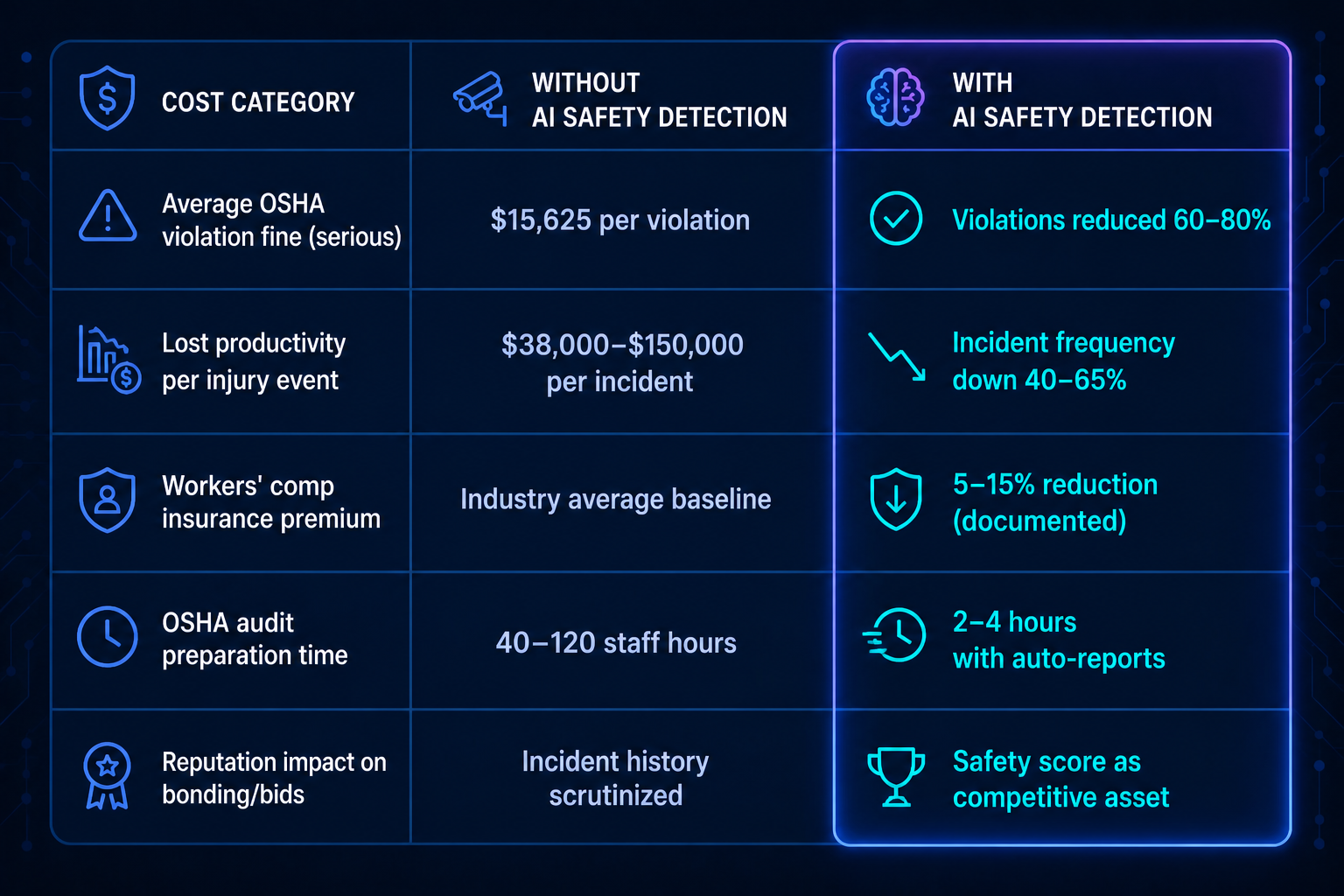
One documented case from a 400 worker commercial construction project in Texas showed a 71% reduction in reportable incidents in the 18 months following AI safety system deployment. OSHA fines dropped from an annual exposure of approximately $280,000 to under $40,000. The system paid for itself in under seven months.
For Risk Managers and CFOs
Insurers are beginning to recognize AI verified safety programs as quantifiable risk reduction. Several carriers now offer documented premium discounts of 5 15% for contractors who can demonstrate real-time safety monitoring with AI solutions. This changes the ROI math significantly.
What a Deployment Actually Looks Like: A 6-Phase Implementation
Construction technology leaders frequently overestimate the complexity of AI safety deployment. For a site with existing CCTV infrastructure, a full deployment follows a structured six-phase process:
- Phase 1 — Site Survey & Camera Audit: Map existing camera coverage, identify blind spots, assess feed quality and resolution for model performance.
- Phase 2 — Model Selection & Fine Tuning: Select pre-trained construction safety models; fine-tune on site-specific conditions (lighting, machinery types, worker density patterns).
- Phase 3 — Integration & Edge Deployment: Connect AI processing nodes to existing CCTV streams via RTSP or API bridge. No camera replacement required in most cases.
- Phase 4 — Alert Workflow Configuration: Define escalation rules, notification channels (SMS, Slack, dashboard), and violation severity thresholds by camera zone.
- Phase 5 — Safety Team Training & Calibration: Onboard site supervisors to the dashboard; refine model confidence thresholds based on first 2 4 weeks of live data.
- Phase 6 — Compliance Reporting Automation: Configure OSHA-formatted daily and monthly safety reports with incident logs, violation trends, and corrective action tracking.
Total deployment time for a single construction site ranges from 3 to 8 weeks depending on site scale, integration complexity, and the number of camera feeds being processed. Multi-site enterprise rollouts typically run on a phased schedule of 90 to 180 days.
The Hidden Value: Safety Data as a Competitive Differentiator
The most forward thinking contractors in the US market are not deploying AI safety detection purely to avoid fines. They are building a data asset.
Every violation logged, every pattern identified, every near-miss captured creates a structured safety intelligence database. Over 12 to 24 months, this data tells a story that manual incident logs simply cannot: which subcontractors consistently underperform on PPE compliance, which site zones carry disproportionate risk, which shift windows show elevated violation rates, and which supervision staffing models correlate with the safest outcomes.
This intelligence feeds directly into project bidding, subcontractor selection, insurance negotiations, and bonding conversations. Owners and developers increasingly require documented safety performance as part of the prequalification process for large projects. Contractors with AI verified safety records arrive at those conversations with a quantified, defensible advantage.
What Leading Construction Firms Are Discovering
Safety score documentation from AI systems is becoming a procurement criterion on federal, commercial, and healthcare construction projects. Contractors who have this data are shortlisting more frequently. Those without it are being asked to explain why.
Map Your Safety Intelligence Potential
Our construction AI team analyzes your current CCTV coverage and produces a personalized Safety Detection Readiness Score delivered within 5 business days at no cost.
When evaluating partners, construction safety leaders should assess the following:
- Model training data: Was the computer vision model trained specifically on construction environments, or on generic workplace footage?
- OSHA alignment: Does the system's violation taxonomy map directly to OSHA 29 CFR 1926 construction standards?
- Deployment track record: How many construction sites has the partner deployed on, and what documented safety improvement metrics are available?
- Integration depth: Can the platform connect to your existing safety management software, ERP, and reporting systems?
- Ongoing model improvement: Does the partner provide model updates as regulations change and new hazard patterns are identified?
The right partner delivers more than software they deliver a working AI solutions ecosystem that improves demonstrably over time, producing sharper detection, fewer false positives, and richer safety intelligence with every month of operation.
Your Job Site Is Already Equipped. It Just Needs Intelligence. The cameras are there. The hazards are there. The regulatory exposure is there.
What is missing is the layer that connects them and transforms surveillance footage into a living, breathing OSHA protection system.
Bring Your Construction Safety into 2026
NeuraMonks engineers construction-grade AI safety systems built for OSHA compliance, US job sites, and zero-tolerance incident environments.
Claim Your Free Safety Detection Scoping Session