TABLE OF CONTENT
Let's skip the fluff.
If your company is seriously considering building out an AI capability right now, you've probably already done some back-of-napkin math. You've looked at a few LinkedIn profiles. Maybe you've talked to a recruiter. And somewhere in that process, the number got scary fast.
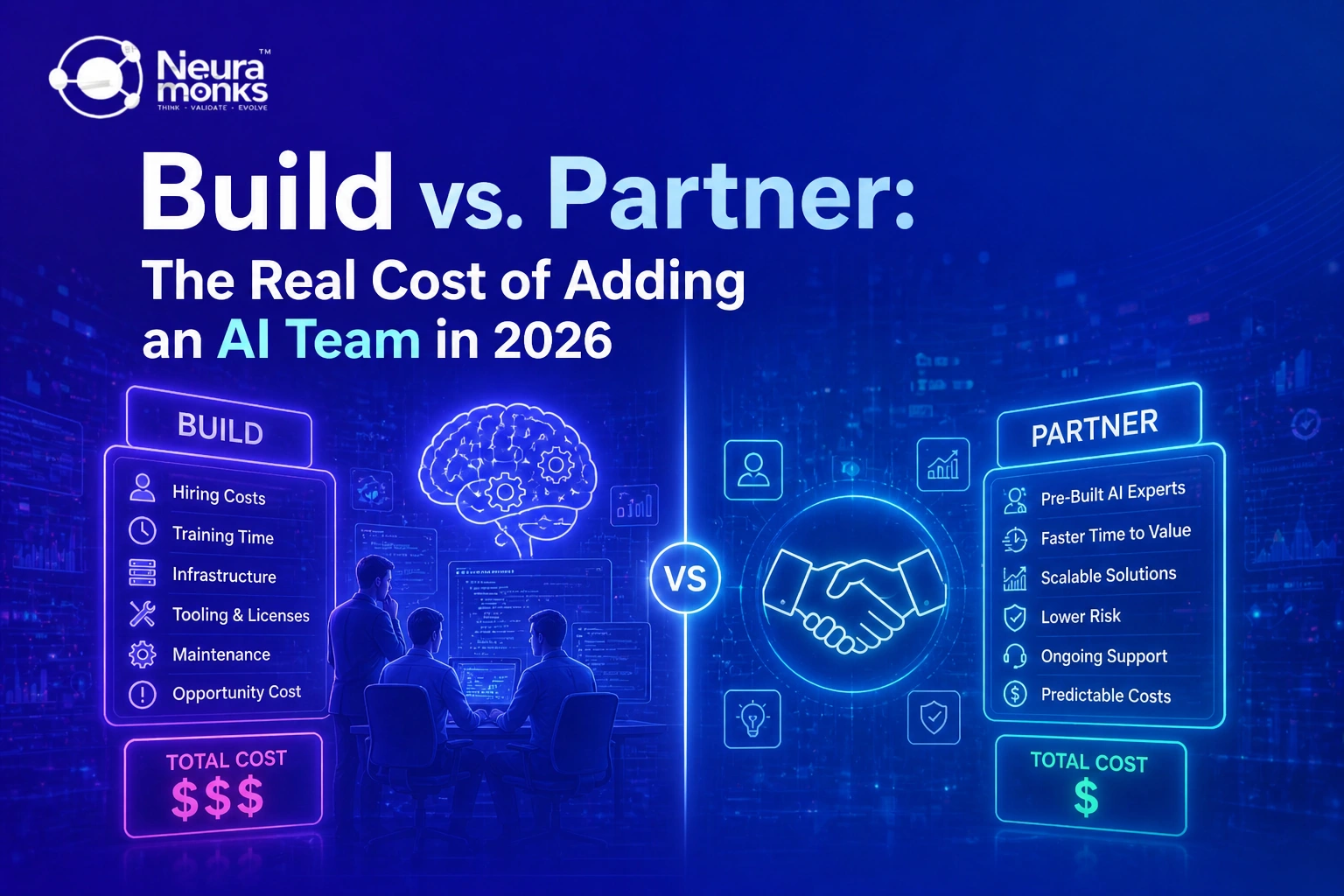
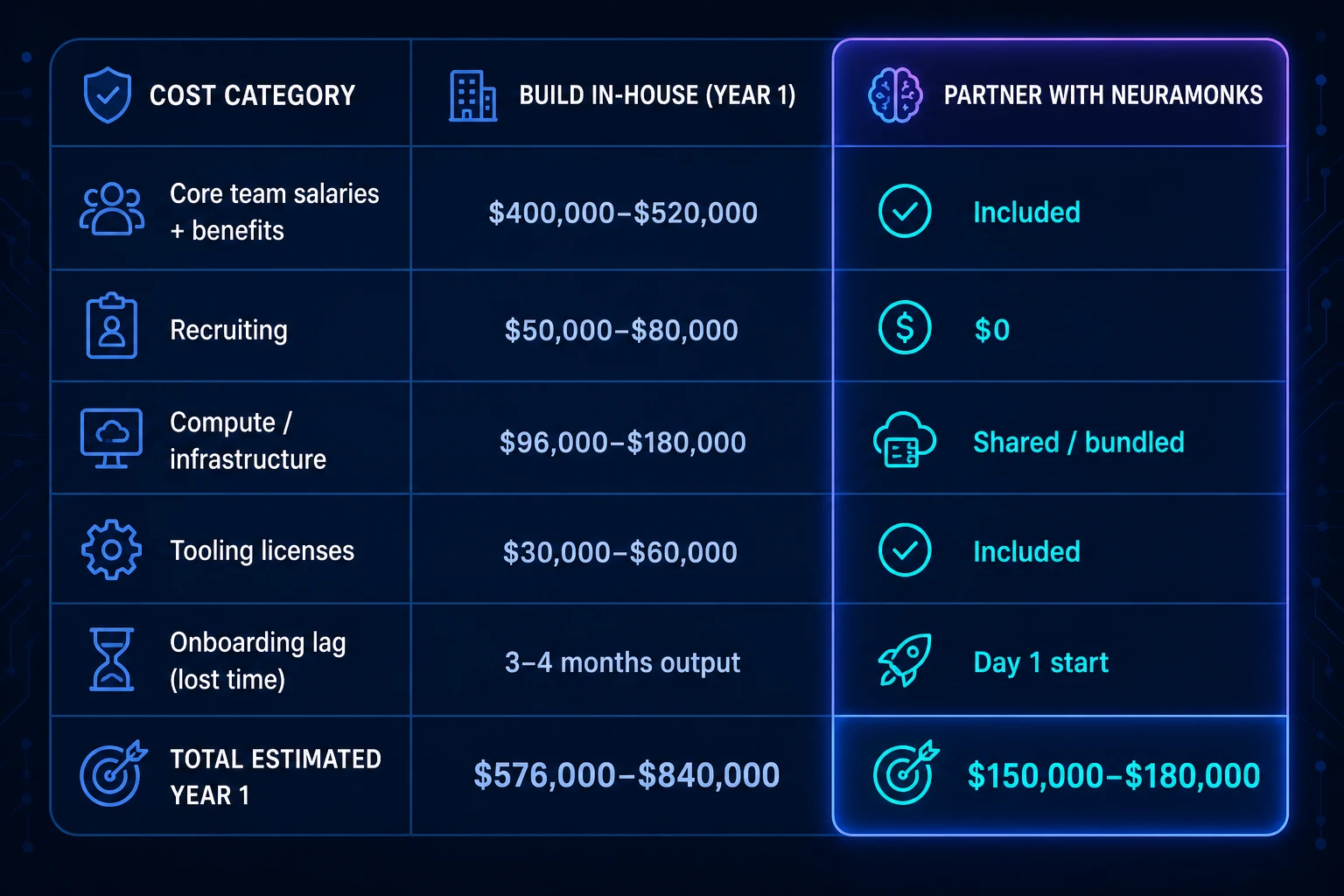
This post breaks down exactly why the "build it in-house" path costs between $500,000 and $700,000 in year one alone and what the alternative actually looks like when you run the same numbers.
Why companies are getting this decision wrong right now
The AI hiring market in 2026 isn't the same as it was two years ago. Demand for machine learning engineers, AI architects, and LLM model specialists has outpaced supply significantly. Companies that started hiring in 2023 are still struggling to retain the people they brought on.
There's also a less discussed problem: the skills you hire for today may not be the skills your product needs in 18 months. The field moves fast. An in house team built around one architecture or framework can become a liability the moment the tooling shifts.
None of this means building in house is wrong. It means you need to run the numbers before you commit.
What it actually costs to build an in-house AI team
Here's where most budget conversations go sideways leaders compare a partner's annual retainer to a single engineer's salary, not to the full cost of the team you'd need to get comparable output.
A functional AI development team that can take a product from prototype to production typically requires at least 4 5 people.
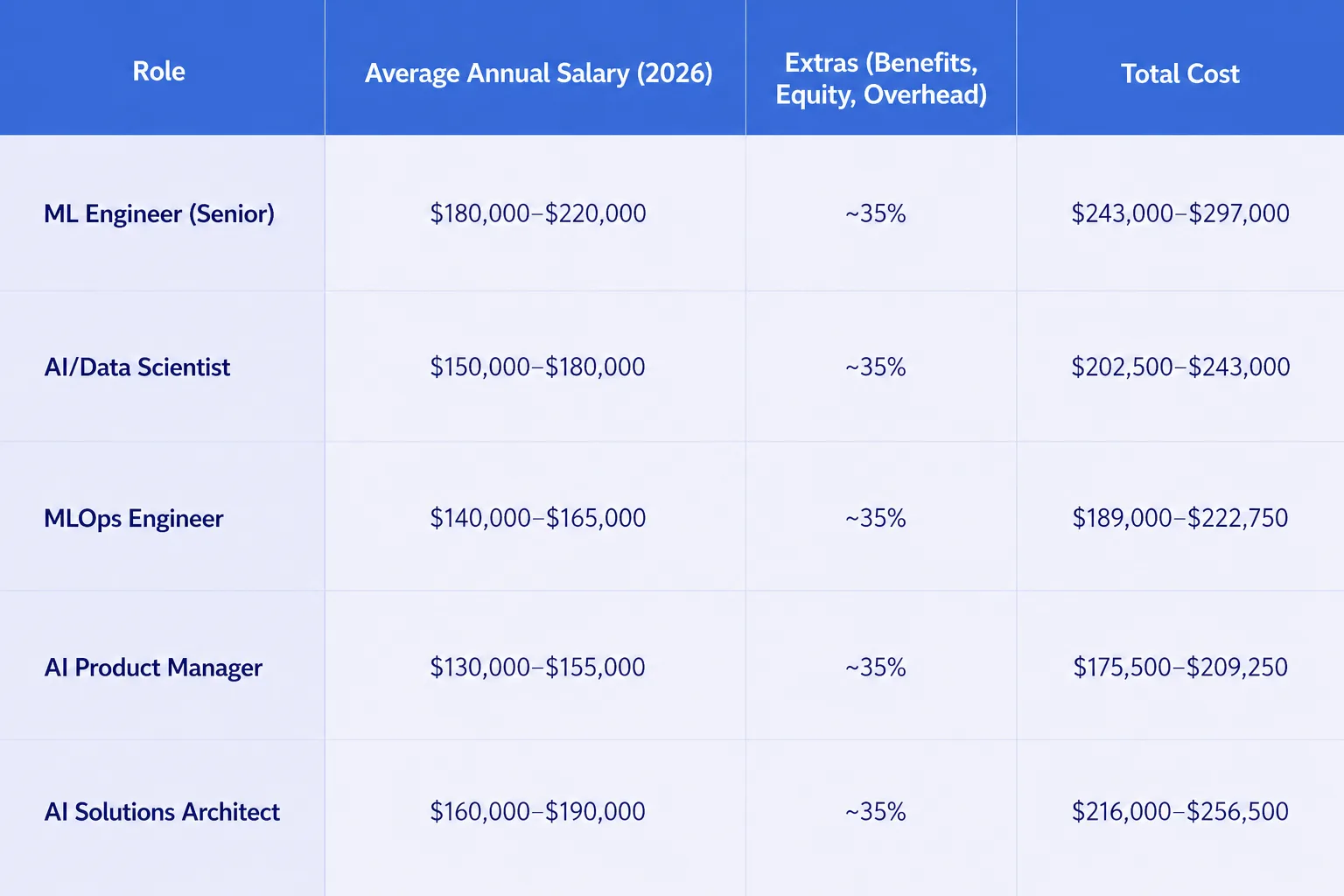
Add recruiting costs ($25,000 to $40,000 per senior hire), onboarding time (typically 3 to 4 months before meaningful output), tooling licenses, compute infrastructure, and management overhead and a conservative estimate for year one lands between $520,000 and $700,000.
That's before you ship a single model to production.
What partnering with NeuraMonks looks like by comparison
NeuraMonks works with companies that need production grade AI solutions without the overhead of a full internal team. The engagement model is built around delivery, not headcount.
A typical mid scope engagement covering architecture, build, deployment, and ongoing iteration runs between $150,000 and $180,000 annually. That's the full cost. No equity dilution, no benefits overhead, no 3 month ramp period while someone gets up to speed on your codebase.
The gap is significant: companies that partner rather than build typically see 60 to 70% lower first year costs for comparable AI capability output.
Stop Planning AI.
Start Profiting From It.
Every day without intelligent automation costs you revenue, market share, and momentum. Get a custom AI roadmap with clear value projections and measurable returns for your business.
The numbers by vertical
Not every company has the same risk profile or timeline. Here's how the build vs partner calculation looks across three common ICPs.
Construction
In-house requirements in construction are higher than most sectors. Project complexity around site safety compliance, equipment tracking, budget forecasting, and real time coordination means you're not just hiring for AI capability you're hiring for domain expertise in construction workflows too. A construction AI team built to handle on-site safety protocols and project management integration routinely pushes past $650,000 in year one.
The faster path: partner with a team that has already built construction-specific AI automation pipelines and can integrate directly with your project management systems and site operations from day one.
Healthcare and health tech
Healthcare in AI runs into similar compliance walls HIPAA, FDA guidance on software as a medical device, and the general caution that comes with patient data. Building internal expertise across clinical AI and compliance typically requires 12 to 18 months before a team is genuinely productive.
For health tech companies, the time cost is often more damaging than the budget cost. The window to ship competitive AI features is narrow.
SaaS and product companies
SaaS companies face a different pressure: speed. Product roadmaps move quarterly, and a hiring cycle that takes 5–6 months to fill three key roles means you're a year behind before the team is functional.
SaaS companies that work with an ai development company typically ship AI powered features 3–4x faster than teams building the function from scratch.
The hidden costs nobody puts in the deck
Salary comparisons miss a lot. Here are the line items that tend to surprise finance teams mid-year:
Compute and infrastructure: LLM model training and inference at production scale isn't cheap. AWS, GCP, or Azure bills for a team running real workloads regularly exceed $8,000 to $15,000/month. In a partnership model, those costs are shared or bundled.
Tooling and licensing: Enterprise licenses for model monitoring, data labeling platforms, and vector database infrastructure add up. Expect $30,000 to $60,000 annually for a mid Size team.
Attrition: Senior AI engineers are highly mobile. The average tenure for ML engineers at non tech companies is under 2 years. Replacing a senior hire costs roughly 50 to 75% of their annual salary in recruiting, onboarding, and lost productivity.
Management overhead: Someone has to manage this team. If that's a CTO or VP of Engineering who's already stretched, the opportunity cost rarely shows up on a budget line but it's real.
When building in-house actually makes sense
This isn't a one size answer. There are cases where hiring internal AI talent is the right call.
If your core product is the AI meaning the model is your IP and your competitive moat you probably need to own that capability over time. Companies like this should plan for a 2 to 3 year build with heavy early investment.
If your data is so sensitive that it genuinely cannot leave your infrastructure under any circumstances, a fully internal team may be required despite the cost.
And if you're a large enterprise with runway and a clear 5 year AI roadmap, building internal centers of excellence makes strategic sense.
For everyone else mid size companies, fast-growth startups, product teams trying to ship AI features in the next 6 months the math favors partnership.
What Neuramonks actually builds
We have delivered AI solutions across NLP, computer vision, recommendation systems, and document intelligence. The team includes specialists in ai solutions architecture, model fine-tuning, and production deployment not generalist developers who've read a few papers.
Projects typically include an initial discovery sprint (2 to 3 weeks), a prototype phase (4 to 6 weeks), and a production deployment phase with SLAs. The engagement doesn't end at launch we maintains and iterates on deployed models as your data and use case evolves.
Stop doing the math wrong
The real question isn't "can we afford to hire AI talent?" It's "what does it cost us not to ship AI capability in the next 12 months?"
For most companies, the answer to that second question is market share, customer churn, or a product roadmap that looks outdated by the time it ships.
Ready to see what a scoped engagement actually looks like for your product?
Book a 30 minute conversation with the Neuramonks team. No pitch deck, no sales cycle just a straight conversation about whether partnership makes sense for where you are.
Start with the right model for your stage. Transform your AI roadmap from a budget problem into a shipping plan.

Upendrasinh zala
Upendrasinh Zala is the Founder & CEO of Neuramonks, an enterprise AI and deeptech consulting firm based in Gujarat, India. Drawing from years of experience in AI-driven business strategy and corporate growth, he writes on leveraging artificial intelligence to optimize workflows and unlock tangible ROI for enterprises.