.webp)
TABLE OF CONTENT
You've probably heard someone say, "Just ask your data." Or maybe you've seen a product demo where a person types a plain English question and the software spits out a chart, a number, an answer instantly.
That's "talk to data" in action.
No SQL. No spreadsheet formulas. No waiting on your analyst. You just ask a question, as you would to a colleague, and get an answer back.
This guide breaks down what it actually means, who's using it, and why it's one of the most practical shifts happening in how businesses use information right now.
The numbers that explain why this matters
Before getting into how it works, here's the context that makes this worth paying attention to:
- 73% of business data goes unanalyzed it's collected, stored, and never touched. (Forrester)
- The average employee spends 2.5 hours per day searching for information they need to do their job. (McKinsey)
- Only about 20% of employees in a typical company are comfortable using BI tools or writing queries independently.
- Companies using AI-powered data interfaces report up to 60% reduction in time spent on routine reporting tasks.
- The natural language processing (NLP) market is growing at 29% annually and is expected to exceed $43 billion by 2025.
Put those together and the problem becomes clear: most businesses are drowning in data and starving for answers. The bottleneck isn't the data it's access.
Stop Planning AI.
Start Profiting From It.
Every day without intelligent automation costs you revenue, market share, and momentum. Get a custom AI roadmap with clear value projections and measurable returns for your business.

What does it really mean to "talk to data"?
At its core, "talk to data" means interacting with your business data using natural language plain sentences — instead of code or complex tools.
Think of it this way. Before, if you wanted to know which product sold best last quarter in Gujarat, you'd either write a SQL query, build a dashboard filter, or ask your data team to run the report. That process could take hours or days.
With a talk to data interface, you type: "Which product had the most sales in Gujarat last quarter?" — and you get the answer in seconds.
The technology behind this combines large language models (LLMs), natural language processing, and query generation tools that translate your plain-text question into database logic. You never see the code. You just see the result.
Why do people struggle with data in the first place?
Most data sits locked inside dashboards that require training to use, databases that require SQL to query, and spreadsheets that require formulas most people never learned.
The result? Only a small slice of the company usually analysts, data scientists, or engineers — actually touches the data. Everyone else works from gut feeling, second-hand summaries, or waits days for reports.
This isn't a motivation problem. It's an access problem.
Talk to data solutions exist to close that gap. When any team member sales, operations, HR, support can directly query company data with a question they'd ask out loud, the whole organization moves faster. Decisions that used to wait on a report now happen in the same meeting where the question was raised.
How does it work under the hood?
Without going too deep into the technical side, here's the rough flow:
- You type (or speak) a question in plain language.
- An AI model interprets your question and figures out what data you're asking for.
- It translates that into a query — usually SQL or a structured API call.
- The query runs against your data source (database, warehouse, spreadsheet).
- The result comes back and gets displayed as text, a table, or a chart.
The smarter systems also understand context. So if you ask a follow-up "now break that down by city" the system knows you're still talking about the same dataset and refines the query accordingly.
Some of the more advanced AI solutions setups even let you ask ambiguous questions and will clarify before running the query, rather than guessing wrong and handing you bad data.
In reality, what questions are you able to ask?
Good talk to data systems that handle a wide range of question types:
Lookup questions: "What's the total revenue for March 2025?"
Comparison questions: "How did Q1 2025 compare to Q1 2024?"
Trend questions: "Which product categories are growing the fastest this year?"
Segmentation questions: "Show me customers who haven't purchased in 90 days."
Anomaly questions: "Are there any unusual spikes in support tickets this week?"
The quality of answers depends on how well the system understands your data schema and how clean the underlying data is. Garbage in, garbage out that part hasn't changed.
Traditional reporting vs. talk to data: side by side
Here's where the real difference shows up in day-to-day work:
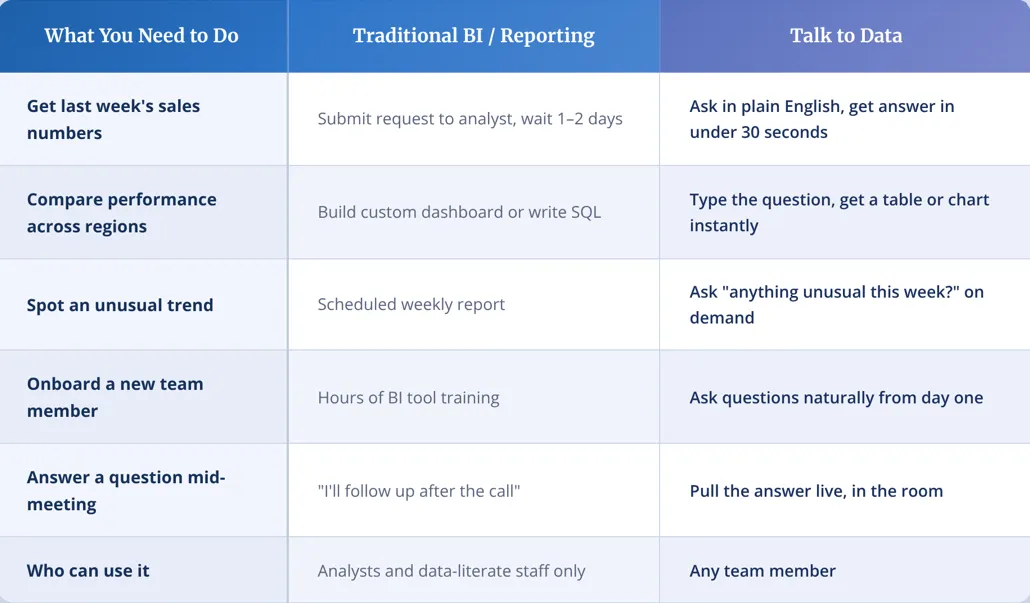
The table isn't saying traditional BI is useless it's not. Complex dashboards, scheduled reports, and data modeling still have their place. But for the everyday question-and-answer workflow, natural language querying cuts the friction by a significant margin.
A real-world talk to data case study: ERP analytics for manufacturing
Here's a concrete example of what this looks like when it's actually deployed not a demo, but a production system built by Neuramonks for a manufacturing and finance client running a full ERP environment.
The problem:
The ERP system handled all core transactional workflows procurement, inventory, supplier management, financials. But getting any insight out of it required going through analysts or IT. Business users had no way to query ERP data on their own. Leadership couldn't get fast visibility into supplier risk, inventory aging, or cost exposure without waiting on a report cycle. Worse, the ERP held sensitive financial data, so just opening up query access wasn't an option — governance and access controls had to hold firm.
What Neuramonks built:
Neuramonks designed a secure, role-based AI analytics layer Talk to Data for ERP embedded directly inside the existing ERP environment. Business users could now ask plain English questions and get answers back instantly, with the system enforcing the same permission rules already set in the ERP. Finance could only see finance data. Procurement saw what procurement was allowed to see. No cross-entity leakage, no governance risk.
The system was built for 100+ concurrent users, with exact-match structured querying and validation to prevent AI hallucinations on financial figures because wrong numbers in finance have real consequences.
The results:
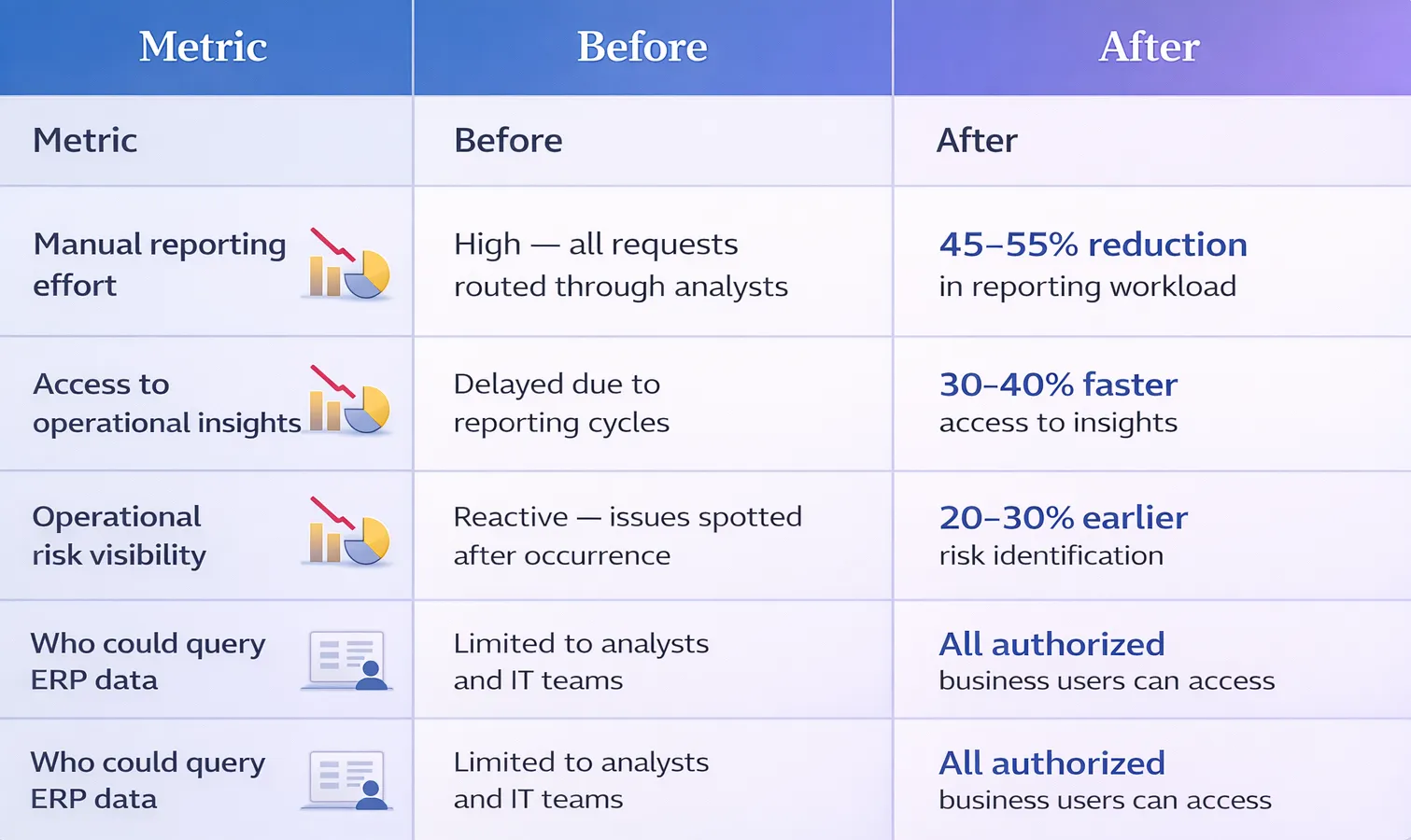
Beyond the numbers, the shift that mattered most was ownership. Finance teams, procurement leads, and business managers stopped waiting on others to get the data they needed to do their jobs. The ERP went from a system people worked around to one they actually used without the governance team losing any sleep over it.
Where does this fit with voice?
One direction this technology is heading is voice. Instead of typing your question, you speak it.
A voice agent connected to your data layer can let you ask questions hands-free. Imagine asking your phone during a commute: "What's our current pipeline value for this quarter?" and getting a verbal answer read back to you.
This isn't science fiction. Several companies are already building voice-to-data workflows for field teams, executives who prefer speaking to typing, and customer-facing support bots that pull live data to answer customer queries in real time.
At Neuramonks, we've seen interest in voice data interfaces pick up sharply in the last 12 months, especially from operations-heavy businesses where people are on the floor, not at a desk. A warehouse manager asking "How many units of SKU-4421 do we have left?" While searching through a laptop's dashboard is somewhat different from strolling the floor.
What "talk to data" is not
Worth clearing up a few misconceptions:
It's not a replacement for a data strategy. If your data is messy, incomplete, or siloed across too many systems with no consistent naming conventions, a natural language interface will give you fast answers to the wrong questions. Fix your data foundation first.
It's not magic. The AI has to understand your schema. That requires some one-time setup connecting your data sources, defining your business terms, and testing edge cases. It's a few weeks of work, not a flip of a switch.
It's not only for large enterprises. The businesses that benefit most quickly are often mid-size companies where 1 or 2 analysts are bottlenecked serving an entire organization. They see ROI fastest.
How to know if you're ready
A few honest questions before investing:
Is your data in one place (or can it be)? A talk to data system needs to connect to your data warehouse or database. Fragmented data across 12 different spreadsheets complicates the setup not impossible, but it adds time.
Do you have consistent naming? If your sales team calls it "revenue" and finance calls it "net receipts," the system needs to know they mean the same thing. One-time setup, not a dealbreaker.
Do non-technical people regularly need data? If yes, this solves a real problem. If your team is already data-literate and comfortable with BI tools, the ROI case is weaker though speed gains are still real.
How Neuramonks approaches this
At Neuramonks, our AI consulting services cover the full lifecycle from assessing whether your data is ready for natural language querying, to building and deploying the interface, to training your team on getting the most out of it.
We don't push a one-size-fits-all product. Most of the implementations we've done are custom built on top of existing data infrastructure rather than replacing it. Reducing the time between "I have a question" and "I have an answer" is always the aim.”
If you're not sure whether your business is ready, that's actually the best time to have the conversation. We help you figure out what's worth building now and what can wait.
The bottom line
"Talk to data" is a straightforward idea: remove the technical barrier between people and the information they need to do their jobs.
The technology works in production today, not just demos. Businesses seeing the most value invest in getting their data house in order first, then layer the natural language interface on top. The ones who skip that step get fast answers to the wrong questions.
If your team is waiting on reports, working from outdated numbers, or simply not using data because it's too hard to access, this is worth a serious look.
Your data already has the answers. Are they accessible to your team?
Most businesses we talk to aren't short on data. They're short on speed the time it takes to turn a question into an answer is the actual problem.
If that sounds familiar, let's talk about what fixing it would look like for your setup. No pitch deck, no pressure — just a straight conversation about what's possible.
Book a free discovery call with Neuramonks →

Upendrasinh zala
Upendrasinh Zala is the Founder & CEO of Neuramonks, an enterprise AI and deeptech consulting firm based in Gujarat, India. Drawing from years of experience in AI-driven business strategy and corporate growth, he writes on leveraging artificial intelligence to optimize workflows and unlock tangible ROI for enterprises.