Insights and Inspiration
Explore Our Blog
Dive into our blog for expert insights, tips, and industry trends to elevate your project management journey.

OSHA Doesn't Inspect Your Safety Culture They Inspect Your Paperwork
Two compelling hooks covering documentation failure statistics and the 5 critical systems OSHA officers inspect.

Is Yours Ready?
Every construction site in America lives under a single compliance reality: OSHA doesn't walk your jobsite looking for the safety culture you've spent years building. They walk in looking for your paperwork your SDS logs, your incident records, your training certifications, your hazard communication files. If those documents are missing, incomplete, or disorganized, the fine lands on your desk. Not on your safety philosophy.
For mid to large construction firms operating across multiple sites in states like Texas, California, Florida, and New York, the documentation burden is not a back office problem. It is a frontline business risk. And in 2025, the companies that are passing OSHA inspections with zero citations are not the ones with the most dedicated safety managers they are the ones that have automated the paper trail with AI in Construction systems that never miss a record, never lose a file, and never forget a deadline.
The Real Cost of OSHA Non-Compliance for U.S. Construction Firms
Before diving into how technology solves this, let's put numbers on the problem. According to OSHA's published penalty structure and enforcement data, the financial exposure for construction companies is significant and growing.
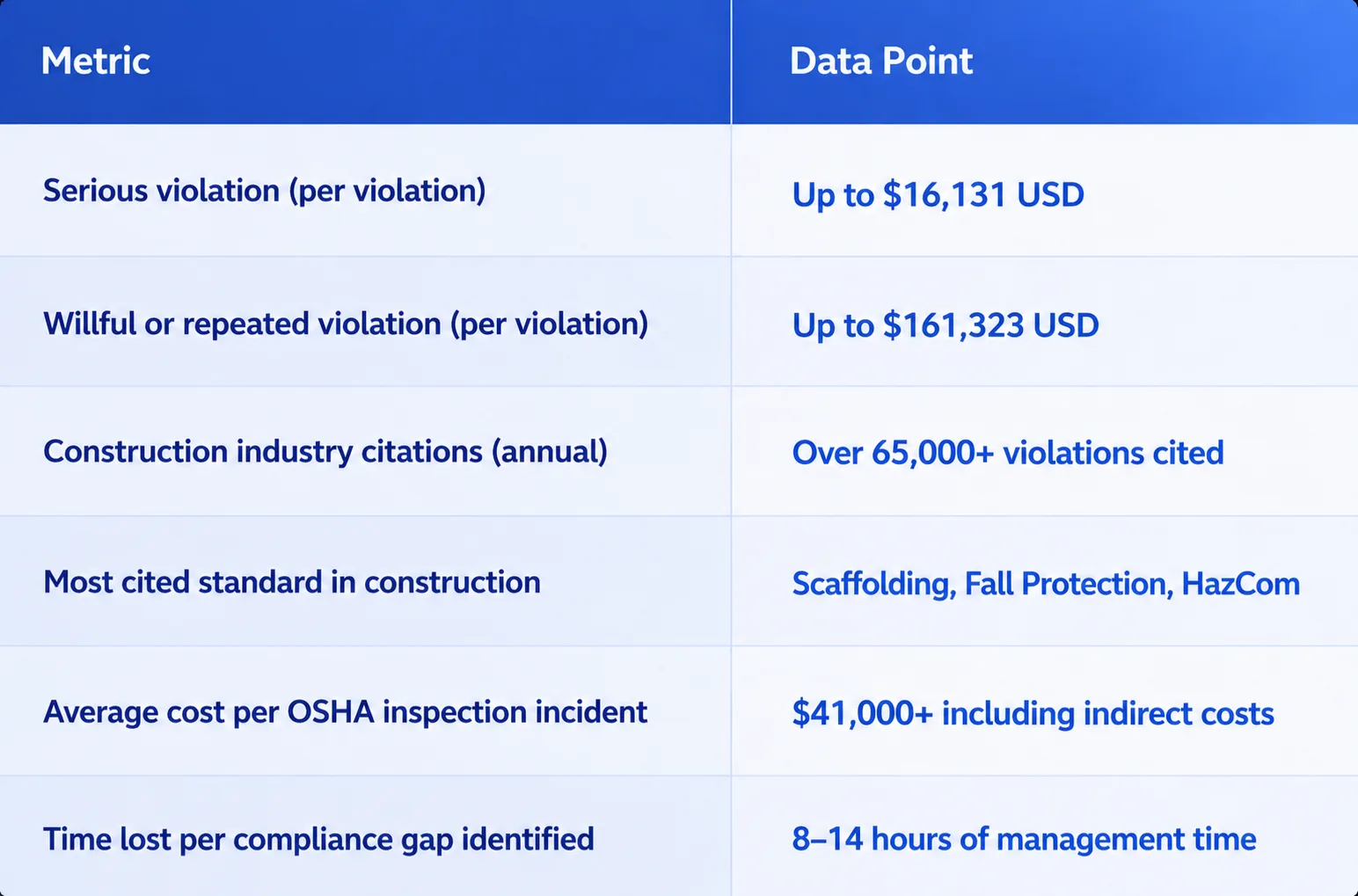
These numbers don't account for litigation exposure, reputational damage, or the project delays that follow a stop-work order. The financial argument for getting documentation right the first time is overwhelming and the operational argument for doing it with AI solutions is becoming equally clear.
What OSHA Compliance Officers Actually Look For On-Site
Understanding what triggers citations helps clarify exactly where AI in Construction transforms exposure into protection. OSHA compliance officers prioritize documentation audits across these primary categories:
1. Hazard Communication (HazCom) 29 CFR 1910.1200
Every chemical on your site must have a Safety Data Sheet. Every worker handling that chemical must have documented training. Compliance officers will ask workers directly and the worker's answer must match what's in your training records.
2. Injury and Illness Recordkeeping 29 CFR 1904
OSHA 300, 300A, and 301 logs must be maintained with accuracy. Any discrepancy between reported incidents and what workers describe during an inspection creates immediate escalation. Under reporting is treated as a willful violation.
3. Fall Protection Training Records 29 CFR 1926.503
For any worker exposed to fall hazards, training must be documented with the trainer's name, date, and the worker's acknowledgment. Verbal assurances that "everyone was trained" are not acceptable substitutes.
4. Equipment Inspection Logs 29 CFR 1926.20
Cranes, scaffolding, aerial lifts, and powered equipment require documented pre shift inspection logs. A missing log for a single piece of equipment on inspection day can escalate to a program level citation.
5. Emergency Action Plans and Site Safety Plans
These must be current, site specific, and accessible. A plan from a previous project pinned to the trailer wall is one of the fastest ways to receive a citation for a "deficient" safety program.
⚠️ Industry Insight: 73% of construction OSHA citations in 2024 were documentation failures, not physical safety failures. The hazard had been identified. The record simply wasn't there.
How AI in Construction Eliminates Documentation Gaps Before They Become Citations
This is where the operational shift happens. Traditional compliance management relies on safety managers manually collecting, organizing, and updating records across active job sites. With dozens of workers, rotating subcontractors, multiple equipment vendors, and state-specific regulatory variations, the manual approach creates structural gaps not due to negligence, but due to volume.
Modern Artificial Intelligence in Construction compliance platforms address this at every layer:
Automated Incident Logging
Rather than relying on workers or supervisors to manually complete OSHA 301 forms within the required 7 day window, AI powered systems capture incident data at the point of reporting via mobile app, voice input, or structured digital forms and auto populate the correct OSHA record format. The system timestamps the submission, links it to the relevant project and jobsite, and flags any field that would fail a compliance review before the record is saved.
Training Certification Tracking with Expiry Alerts
Every worker's credentials OSHA 10, OSHA 30, forklift certification, fall protection training, confined space entry are maintained in a centralized, searchable database. When a certification approaches expiry, the worker, their supervisor, and the safety manager receive automated notifications. No worker enters a restricted area with expired credentials. The paper trail updates itself.
Equipment Inspection Record Automation
Pre shift inspection checklists are completed digitally on mobile devices. Records are geo tagged to the site, time-stamped, linked to the specific equipment asset, and archived automatically. If an inspection is missed, the system flags it within hours — not when an OSHA officer arrives.
LLM-Powered Compliance Guidance
The most advanced platforms now deploy an LLM model layer that interprets regulatory language in real time and provides site specific guidance to safety managers. When a regulation changes as OSHA rules frequently do the platform updates its interpretation automatically and flags any existing documentation that needs revision. Safety managers stop researching compliance language manually and start receiving precise answers to their specific situations.
Traditional vs. AI-Powered Compliance: A Direct Comparison
For construction companies evaluating whether an investment in AI compliance infrastructure is justified, this side-by-side view reflects what firms across the U.S. are experiencing:
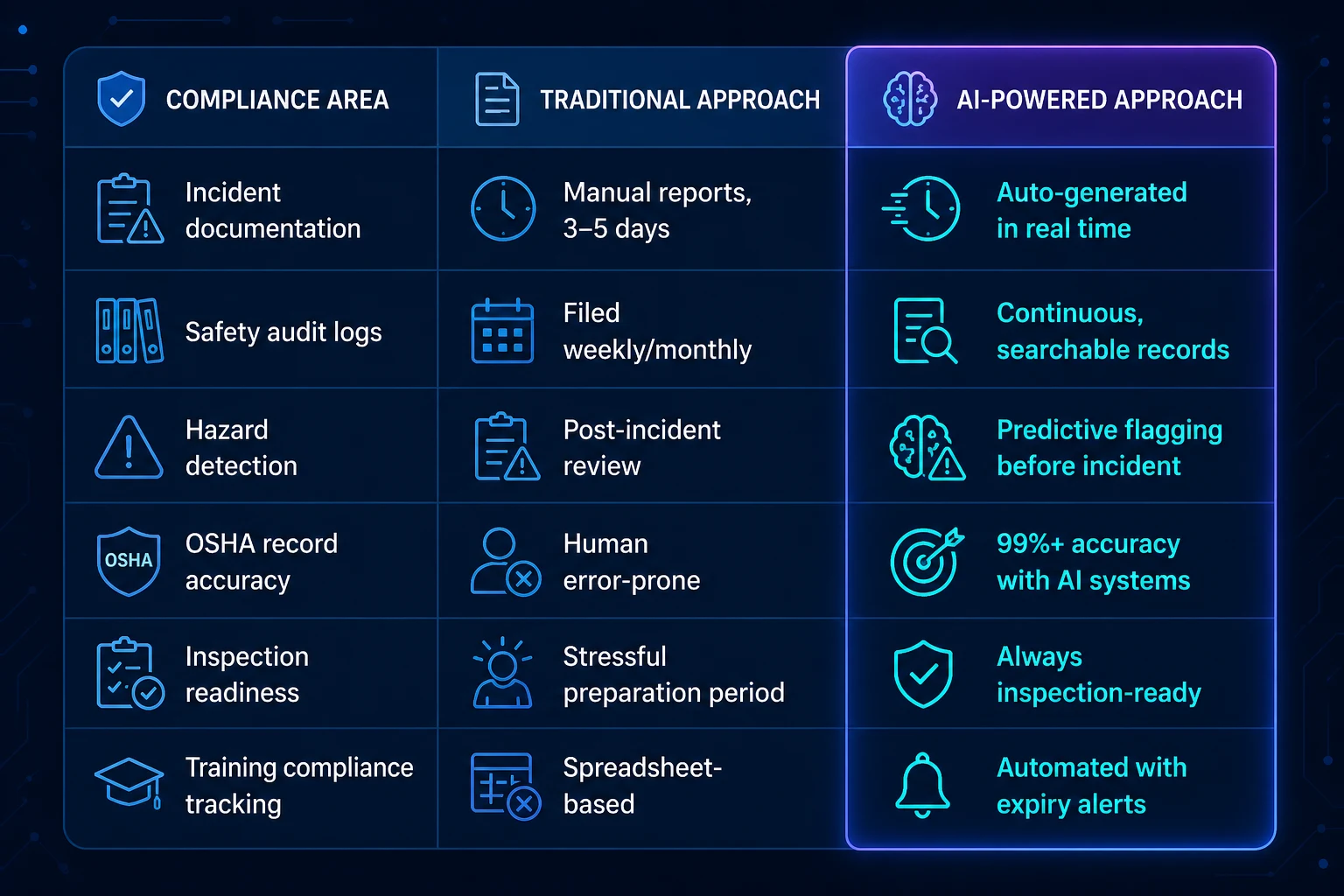
The pattern is consistent: AI-powered systems do not replace your safety program. They make your safety program provable.
The 5 Documentation Systems Every U.S. Construction Site Needs Right Now
Whether you are operating in Houston, Los Angeles, Chicago, or Charlotte, these five documentation systems are what OSHA compliance officers prioritize when they arrive at a construction site. If all five are automated, organized, and immediately producible, your inspection ends quickly. If any of them is incomplete, your inspection expands.
- Injury and Illness Log (OSHA 300 series) maintained year-round, not reconstructed at year end
- Hazard Communication Program with current SDS files for all chemicals on site
- Fall Protection Training Records with trainer credentials and worker acknowledgment signatures
- Equipment Inspection Logs per-shift, per-asset, timestamped and retained for a minimum 3 years
- Site Specific Emergency Action Plan updated for current project conditions, accessible within 30 seconds
Pro Note: OSHA compliance officers can request any of these records within minutes of arriving. If retrieval takes longer than 10 to 15 minutes, it signals a disorganized program even if the records technically exist. Speed of retrieval is itself an audit factor.
NeuraMonks: Purpose-Built AI for Construction Compliance Workflows
NeuraMonks delivers AI systems specifically engineered for industries where documentation accuracy is non-negotiable. For construction firms operating under OSHA's regulatory framework, NeuraMonks has built compliance intelligence into every layer of the workflow — from incident capture to record retrieval to audit preparation.
What separates us from generic software platforms is the application of computer vision, natural language processing, and predictive analytics to the actual documentation workflows your safety teams use every day. The platform does not ask your team to learn new behavior. It automates the documentation that surrounds their existing behavior and ensures that documentation holds up under inspection.
What NeuraMonks Delivers for Construction Safety Compliance
- Real-time incident documentation that meets OSHA 300-series format requirements automatically
- Computer vision inspection of equipment and site conditions with auto-logged results
- Worker credential management with multi-site visibility and certification expiry automation
- Regulatory update monitoring across all U.S. OSHA regional offices and federal standards
- Instant audit ready document packages producible in under 3 minutes for any inspection
- Integration with existing project management platforms including Procore, Autodesk Build, and Viewpoint
Why "We've Never Had a Problem" Is the Most Dangerous Compliance Strategy
The single most common reason construction companies delay investing in compliance automation is a clean history. If you haven't received a major citation in 3 years, the urgency feels abstract. But OSHA enforcement patterns in 2024 and 2025 tell a different story.
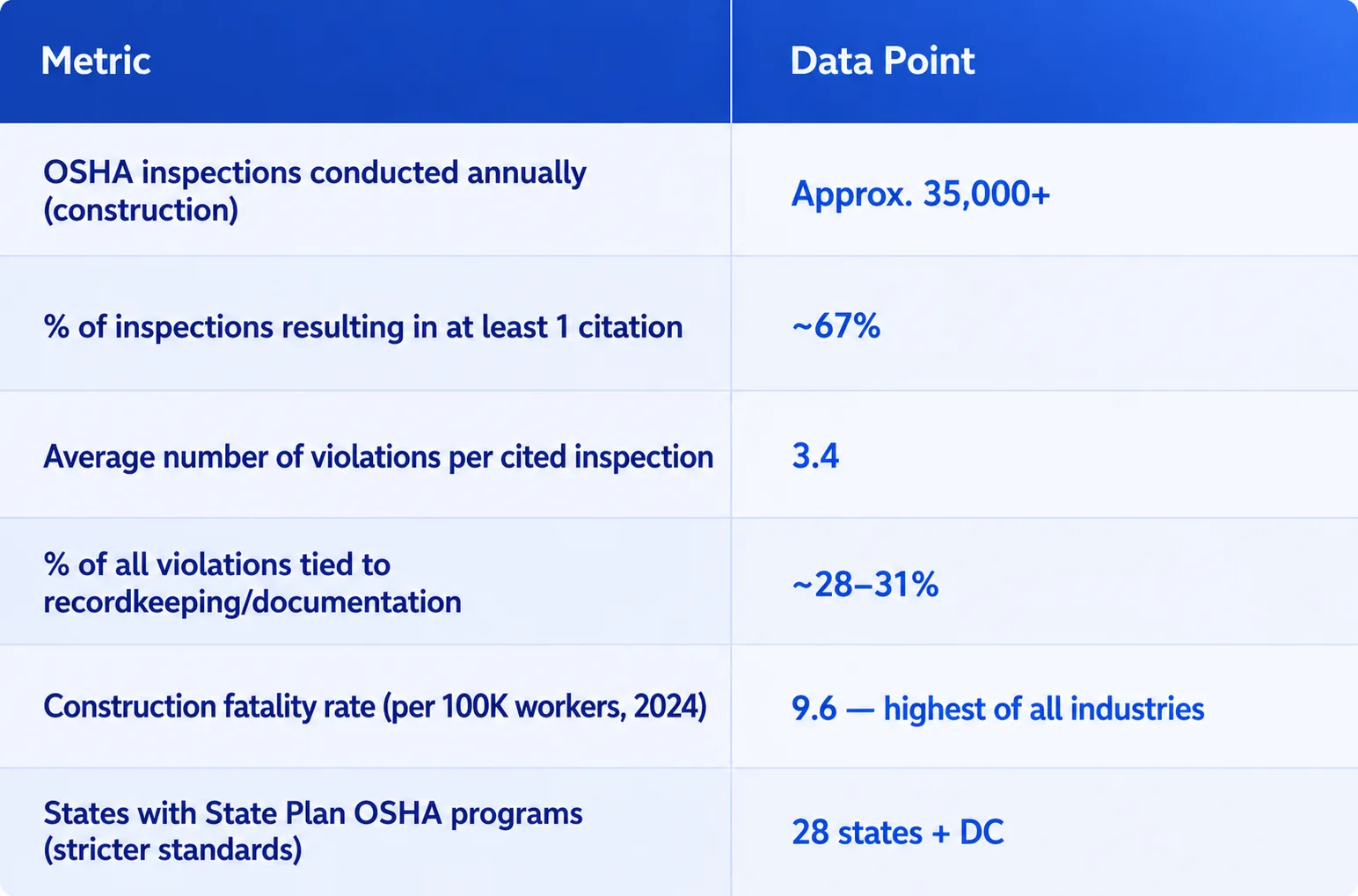
OSHA has increased its use of unprogrammed inspections meaning officers arrive without a prior complaint or referral trigger. They are responding to industry wide data suggesting that documentation practices have not kept pace with workforce growth and subcontractor complexity. Your site's clean record is a reflection of inspection timing, not documentation quality. The next inspection will test the documentation, not the culture.
Building a Compliance Infrastructure That Scales With Your Sites
For general contractors managing multiple active projects across different states, the compliance challenge compounds quickly. A crew working in California operates under Cal/OSHA standards that exceed federal requirements. A site in Texas operates under federal OSHA directly. A project in Washington State has its own Department of Labor & Industries framework.
Manual systems cannot track these variations reliably across a growing portfolio. AI in Construction compliance platforms can. The configuration layer of these systems maintains a regulatory ruleset for each active jurisdiction and applies the correct standard automatically to each site's documentation requirements. Your safety manager in Dallas is applying California compliance rules to the Pasadena project without needing to research them manually.
This is the core value proposition of bringing AI solutions into your compliance infrastructure: it removes the human bottleneck from a process that cannot afford human error.
Your Next Inspection Is Already Scheduled — Your Records Should Be, Too
OSHA doesn't announce inspections. They arrive. And when they do, the firms that walk through that process in under an hour with full documentation, zero missing records, and zero citation exposure are the firms that have systematically addressed the paper trail problem.
NeuraMonks works with construction firms across the United States to build compliance documentation systems that function 24/7, scale across every active site, and produce inspection ready records at any moment. The gap between your current documentation process and an audit-proof one is not a personnel gap. It is a technology gap.
Your Compliance Record Has a Gap Right Now. You just don't know where it is yet but an OSHA officer will.
Examine What NeuraMonks Has Delivered for Construction Safety Teams →
Schedule a Construction AI Compliance Scoping Call
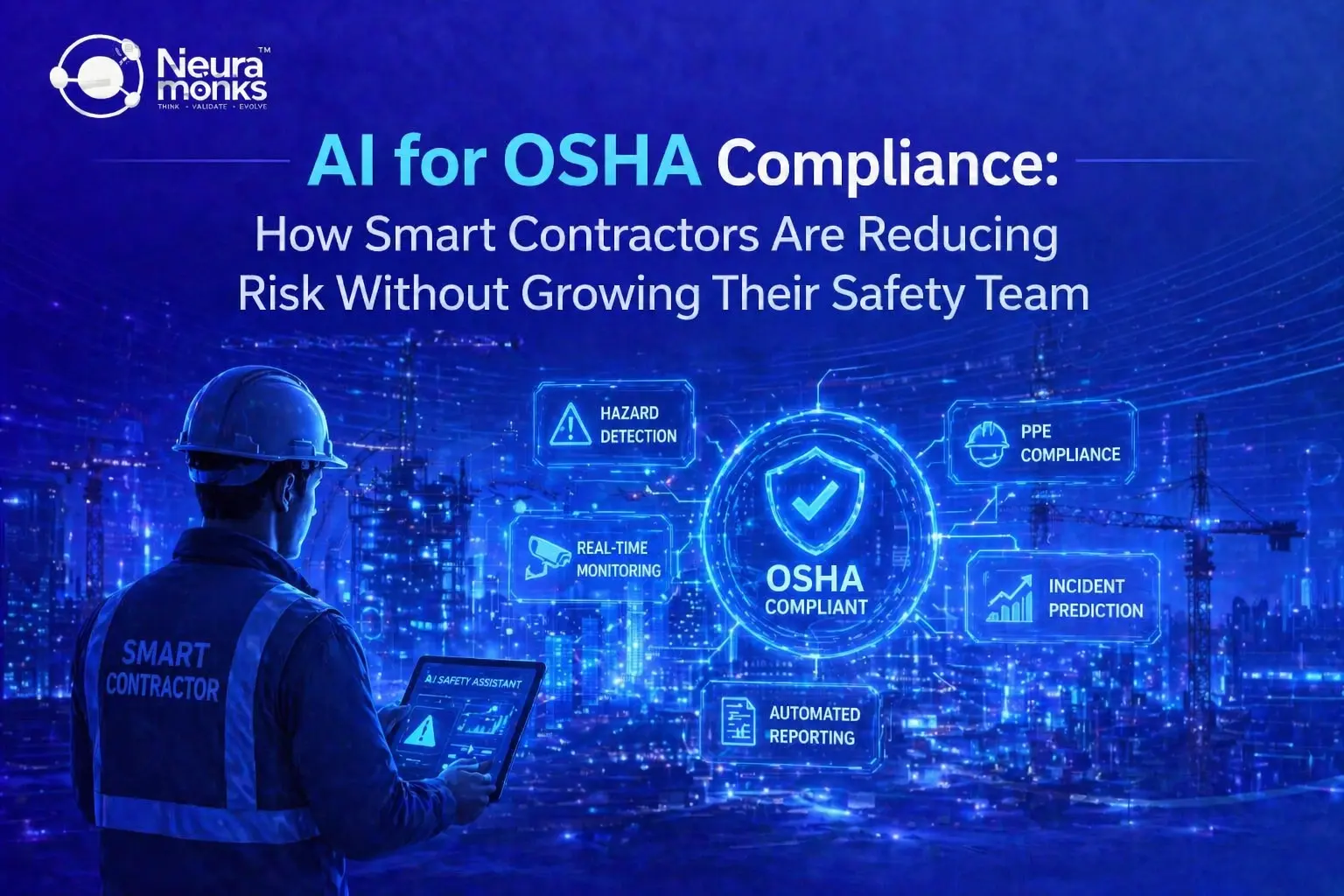
AI for OSHA Compliance: How Smart Contractors Are Reducing Risk Without Growing Their Safety Team
Contractors using AI vision systems to automate OSHA compliance are reducing violations, avoiding penalties, and improving EMR scores—without hiring more safety staff.
There is a quiet revolution happening on U.S. job sites. It does not involve adding a dozen safety officers or burying crews in more paperwork. It involves plugging in computer vision cameras, connecting them to a compliance engine, and letting AI in Construction do the continuous watching that no human team can sustain across a 10-acre site at 6 AM.
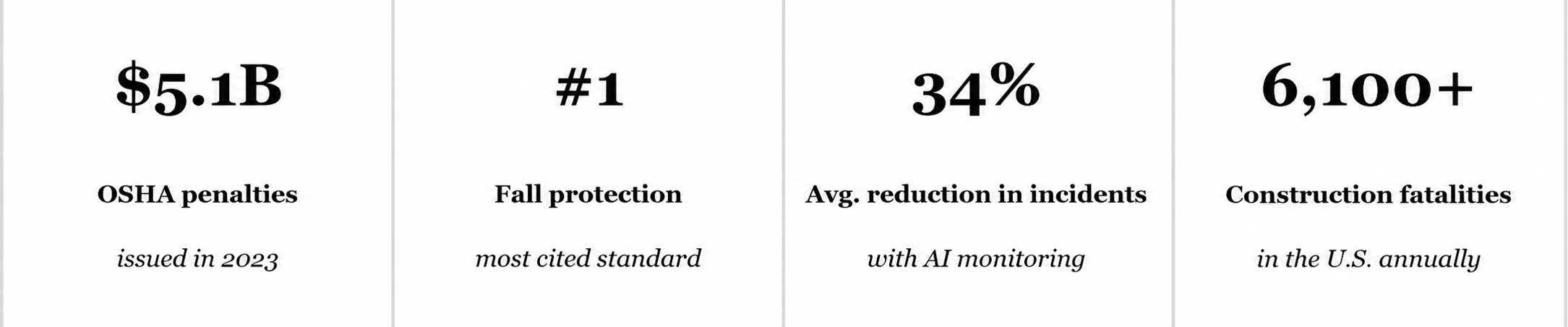
OSHA's penalty structure has never been steeper. A single willful violation now carries fines up to $156,259. Repeat citations compound fast. For mid-size contractors running 4 8 active projects, the risk is existential not just financial. Yet the traditional response (hire more safety staff) is both expensive and slow. The smarter contractors are choosing a third path.
Why Traditional Compliance Methods Are Breaking Down
Safety management on construction sites has historically relied on periodic walkthroughs, manual checklists, and reactive incident reports. The fundamental problem: a safety manager can only be in one place at one time. On a large commercial project with 200+ workers across multiple floors and trades, continuous human oversight is mathematically impossible.
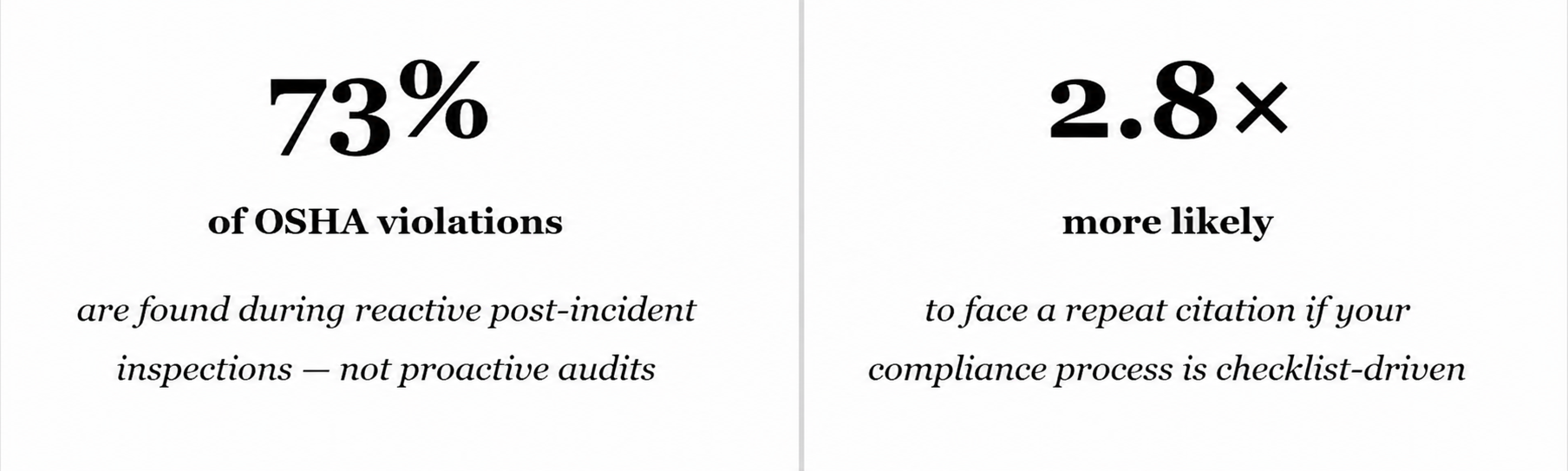
The compliance gap is real. OSHA's own data shows that the majority of violations are discovered after something goes wrong a fall, a struck by incident, a scaffold failure. At that point, the fine is the least of your problems. Worker's comp claims, project delays, litigation, and reputational damage can cost 10–50x the original penalty.
We had good safety culture but a terrible visibility problem. We couldn't see what we couldn't see.
Safety Director, top-20 U.S. general contractor
What AI in Construction Actually Looks Like for Compliance
AI in Construction compliance is not a futuristic concept. It is deployable today, and contractors across the U.S. are using it on active projects. Here is what the technology stack looks like in practice:
Core AI Compliance Capabilities 2024 Deployments
1. Real-Time PPE Detection — Cameras identify missing hard hats, vests, gloves, and eye protection. Workers are flagged within seconds, not hours.
2. Hazardous Zone Monitoring — Geofencing and computer vision alert supervisors when workers enter exclusion zones without authorization or proper equipment.
3. Fall Risk Analysis — Models detect unprotected edges, missing guardrails, and improper ladder use. Alerts are issued before an incident occurs
4. Automated OSHA Documentation — Incident logs, near-miss reports, and inspection records are generated automatically from sensor and camera data, reducing manual documentation time by up to 80%.
5. Predictive Risk Scoring — Machine learning models score each work zone daily based on crew density, task type, weather, and historical incident patterns helping you deploy safety resources where they are needed most.
The Real Cost of Non-Compliance vs. the Cost of AI Implementation
Decision-makers often frame this as a budget question. The actual math points firmly in one direction.
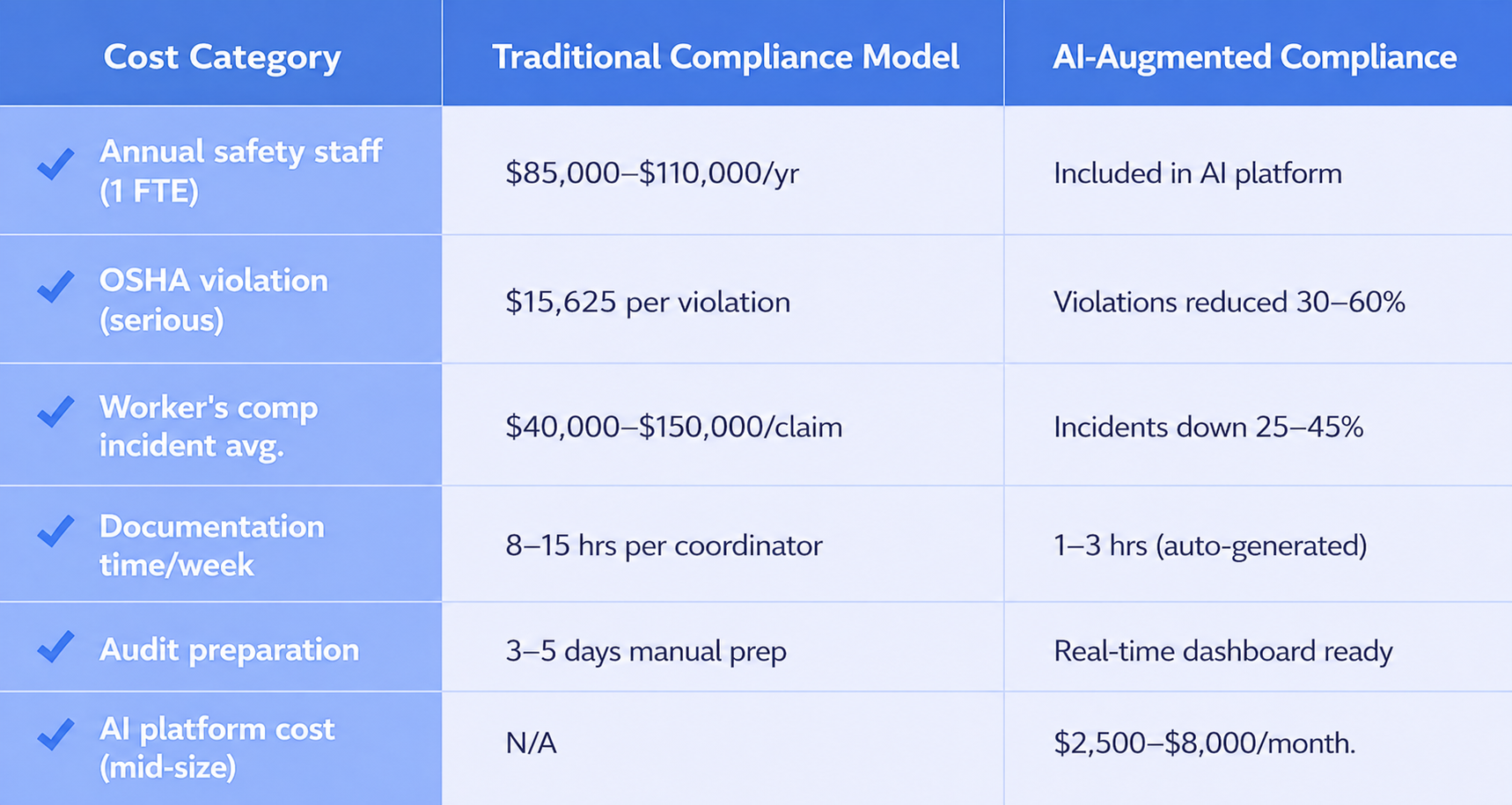
The ROI calculation is not close. A contractor running 5 projects who avoids 3 serious OSHA citations per year ($46,875 saved) and 1 worker's comp claim ($75,000 average) is already clearing $120,000+ in avoided costs against a platform investment that typically runs $5,000 to $8,000/month across all sites. That is a positive return inside the first quarter.
OSHA's Most Cited Standards and How AI Addresses Each One
OSHA publishes its most-cited violations annually. For FY2023, the top 10 for construction were dominated by four categories. Here is how AI solutions map to each:
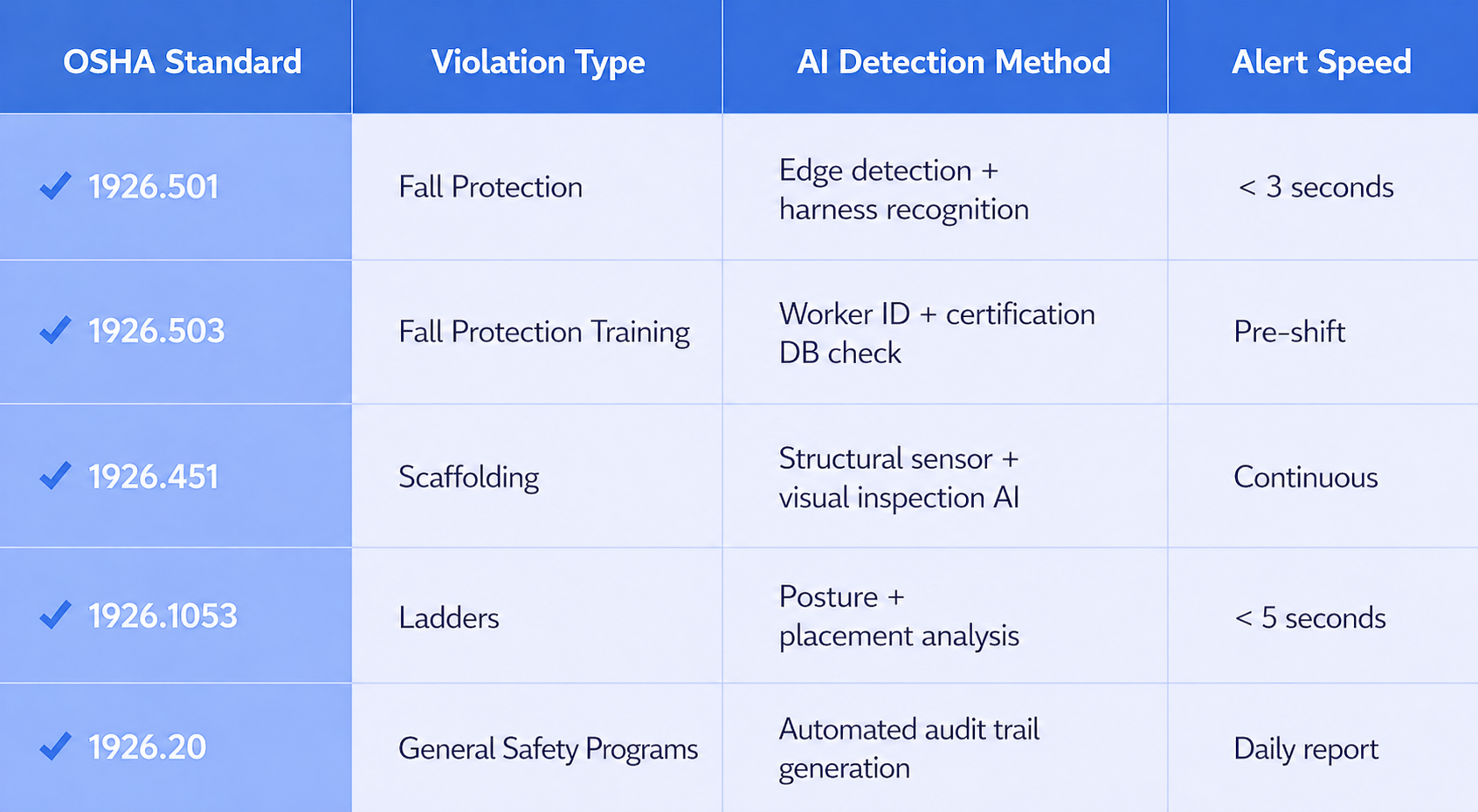
When AI in Construction is deployed at this level of specificity, safety teams shift from reactive fire fighting to proactive oversight. One coordinator can effectively monitor what previously required three dedicated walkers on a large site.
How NeuraMonks Builds Compliance Intelligence for Contractors
NeuraMonks is not a generic SaaS vendor. As a specialized AI development company focused on computer vision and industrial AI, NeuraMonks designs compliance systems built around how construction sites actually operate not how a software demo assumes they do.
The difference is meaningful. Off-the-shelf safety platforms apply generic models trained on warehouse or manufacturing footage. Construction environments are dynamic: lighting changes by the hour, crews rotate across zones, PPE varies by trade, and site layouts change weekly. Generic models produce false positives that crews learn to ignore which is worse than having no system at all.
What NeuraMonks Delivers for Contractors
• Custom-trained vision models on your site footage not generic datasets
• OSHA standard-specific detection logic (fall protection, scaffolding, struck-by)
• Integration with your existing camera infrastructure no rip-and-replace
• Automated OSHA-ready documentation and incident audit trails
• Dashboard visibility for project owners, safety directors, and site supers all in one place
A Field-Tested Deployment: From Pilot to Portfolio Rollout
The pattern we see consistently among U.S. contractors who adopt AI compliance systems follows three phases:
Phase 1 Pilot Project (Weeks 1 to 6)
One active project is instrumented with AI cameras and the compliance engine. The team runs parallel operations: existing safety processes continue while AI data is collected. By week 4, the gap between what the human walkthroughs catch and what the AI detects is usually striking enough to build internal buy-in.
Phase 2 Calibration & Integration (Weeks 6–12)
The AI models are refined based on actual site conditions. Alert thresholds are tuned to reduce noise. OSHA documentation workflows are connected to the platform. Safety coordinators shift from walkthroughs to monitoring and exception-handling.
Phase 3 Portfolio Expansion (Month 3+)
Once the pilot demonstrates a measurable reduction in near-miss events and citation risk, the same infrastructure is deployed across all active projects. The unit economics improve significantly at scale the AI platform cost per project decreases while protection increases.
By month three, our safety coordinator was managing compliance across four sites instead of one. The AI handled the constant monitoring. She handled the decisions.
VP of Operations, Southeast commercial GC
Answering the Questions Safety Directors Actually Ask
Will crews resist the cameras?
Initial resistance is real but short-lived when the framing is right. The AI is not surveillance for discipline purposes it is an early-warning system that protects workers. Most crews, once they understand the system flags risks before incidents happen, become advocates. Frame the rollout around worker protection, not compliance enforcement.
What happens when the AI makes a false positive?
Well-designed systems like those built by NeuraMonks include confidence thresholds and human-in-the-loop review for any alert that triggers documentation. False positives are flagged to the safety coordinator, not automatically recorded in OSHA logs. The system improves with every reviewed alert through active learning.
Do we need new cameras or infrastructure?
In most deployments, no. AI compliance platforms integrate with existing IP camera networks. If your sites already have CCTV for security, the same hardware can be repurposed. New edge-compute devices process video locally, so footage does not need to leave the site for analysis, which addresses both bandwidth and privacy concerns.
How long before we see measurable results?
Contractors typically see the first data within 48–72 hours of deployment. Measurable reduction in near-miss events is observable within 30 days. Documentation hours drop immediately. OSHA citation risk reduction is measurable after the first full audit cycle.
The Competitive Advantage You Are Not Talking About Yet
There is a dimension of this conversation that goes beyond penalty avoidance. Increasingly, large project owners and general contractors are asking subcontractors about their safety technology stack as a prequalification factor. EMR (Experience Modification Rate) is a direct input into bonding capacity and bid competitiveness.
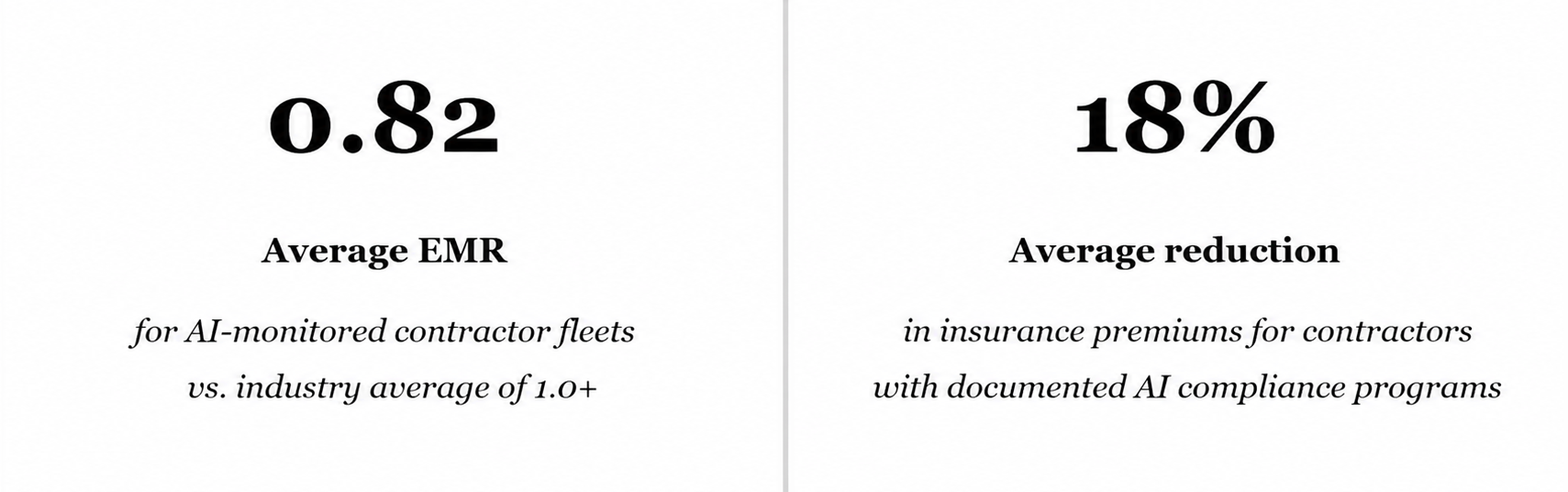
Contractors who deploy AI solutions today are building a documented safety record that compounds over time — lower EMR, better bonding rates, access to larger projects, and a hiring advantage with safety-conscious workers. The compliance benefit is just the beginning.
Your Next OSHA Audit Doesn't Have to Be a Gamble
NeuraMonks engineers compliance intelligence built for how your crews actually work — not how consultants think they should.
Examine Delivered Case Studies | Schedule a Scoping Call
7 Life Saving AI Use Cases in Healthcare
This blog highlights 7 real-world AI use cases in healthcare that deliver measurable impact—reducing errors, speeding up diagnosis, and improving clinical efficiency. It showcases how AI is already transforming areas like pathology, radiology, wound care, and predictive analytics with proven case studies. Overall, it serves as a practical guide for healthcare leaders to evaluate and implement AI solutions with clear ROI.
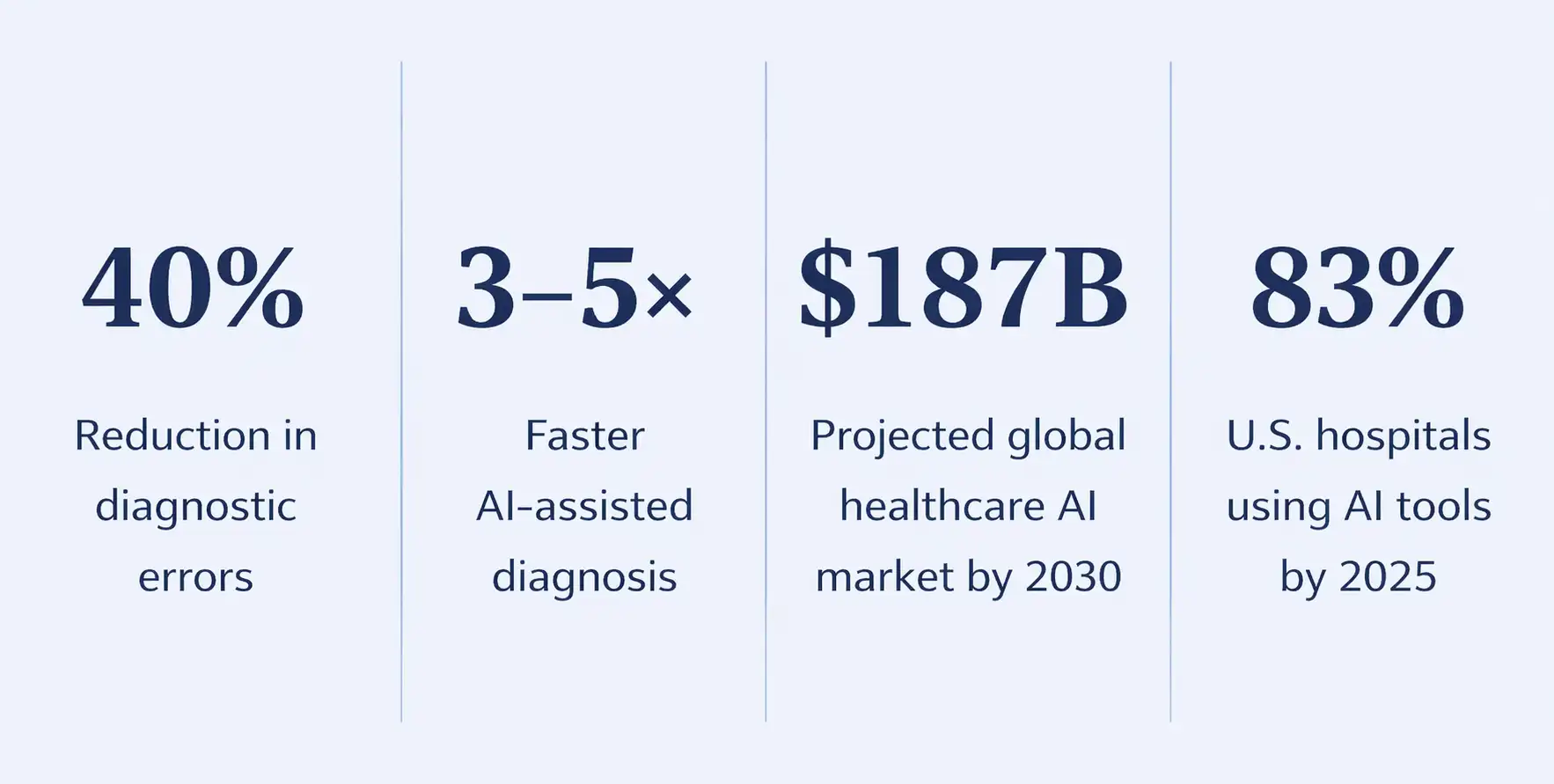
AI in healthcare is no longer a pilot project it's deployed in operating rooms, pathology labs, ophthalmology clinics, and wound care centers across the United States. From detecting malaria in a blood smear to predicting sepsis six hours before standard protocols would flag it, AI Healthcare Solutions are generating measurable, auditable clinical outcomes that hospital administrators and clinical directors can act on today.
This guide documents 7 high-impact AI use cases each with real numbers, verified case studies, and clear commercial value. Whether you are evaluating vendors, scoping an AI pilot, or building a business case for your board, this is the resource that cuts through the noise.
NeuraMonks has delivered production AI systems across pathology, ophthalmology, orthodontics, and wound care. Every case study below reflects work we have shipped not theoretical capability.
1. AI-Powered Blood Cell Analysis & Malaria Detection
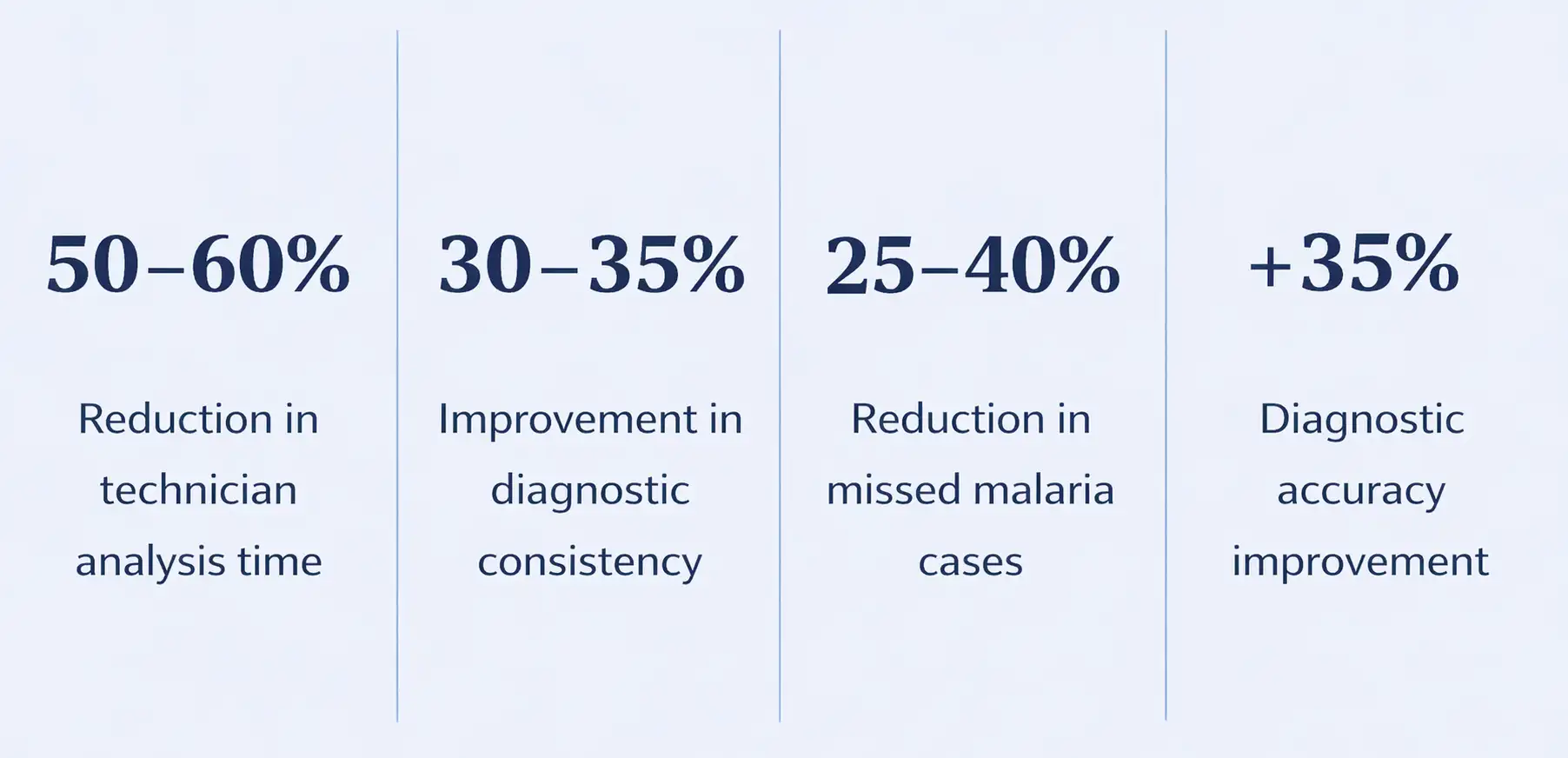
Manual blood smear analysis creates a dangerous bottleneck in high-volume diagnostic labs. Skilled technicians spend hours counting and classifying cells work that introduces inter-observer variability and fatigue related errors. In malaria-endemic regions and underserved U.S. communities, a missed positive is not a data point. It is a patient outcome.
How AI Healthcare Solutions Eliminate This Bottleneck
Deep learning models trained on annotated blood smear images automatically segment and classify red blood cells, white blood cells, and platelets at scale. A specialized malaria detection module identifies Plasmodium infected cells with accuracy that matches expert pathologists without fatigue, without variability, and at a fraction of the time.
Key Capabilities
- Automated detection and classification of RBCs, WBCs, and platelets
- Specialized Plasmodium parasite detection module for malaria screening
- End-to-end automation from image ingestion through structured reporting
- Scalable model architecture deployable across multi-site lab networks
- Built on Python + PyTorch with Django-based deployment infrastructure
CASE STUDY
AI Powered Blood Cell & Malaria Detection Improves Diagnostic Accuracy by 35% and Cuts Lab Workload by 55%
See the full case study at NeuraMonks
For high volume labs and hospital pathology departments, this automation directly reduces per sample cost, accelerates patient turnaround, and builds a defensible audit trail for every diagnostic decision.
2. Automated Wound Detection & Measurement Using Deep Learning
Wound care documentation is one of the most paper-heavy, inconsistent processes in clinical practice. Nurses and wound care specialists measure wounds with rulers, describe them in free text, and photograph them without a standardized protocol. Two clinicians assessing the same wound can produce materially different records which creates compliance risk, billing exposure, and treatment inconsistencies.
What the AI System Does
A deep learning computer vision system automatically detects wound boundaries in clinical photographs, measures area and perimeter, classifies wound type and stage, and generates a structured record that integrates with EHR systems. Every assessment is timestamped, consistent, and comparable across visits giving care teams an objective healing trajectory.
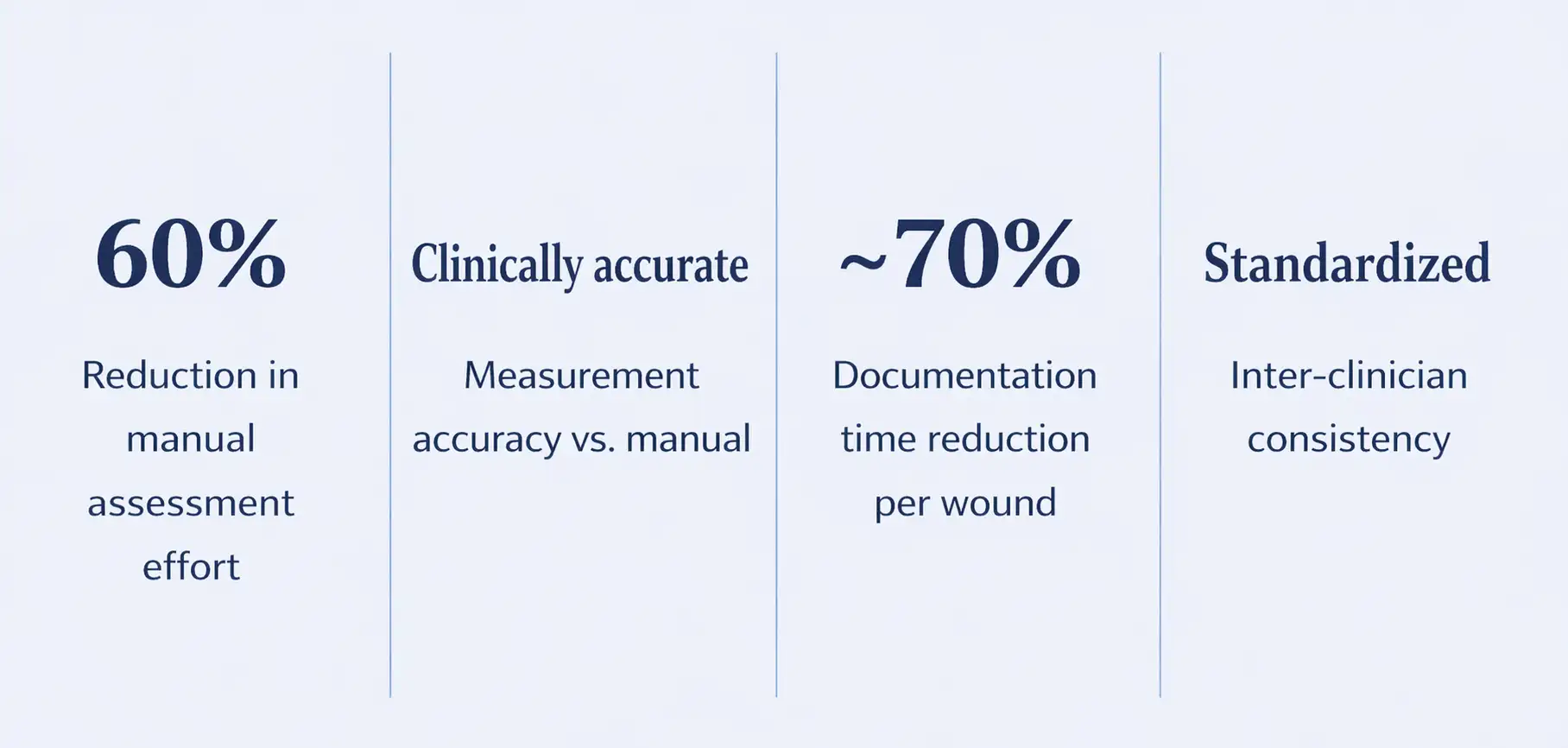
Clinical and Financial Impact
- Eliminates inter-clinician variability in wound staging and measurement
- Enables objective tracking of healing rates to guide treatment escalation decisions
- Supports telehealth wound monitoring patients photograph wounds at home
- Reduces litigation risk through standardized, timestamped documentation
- Integrates with EMR/EHR platforms for seamless workflow adoption
CASE STUDY
Delivered Clinically Accurate Wound Measurements — Reduced Manual Assessment Effort by 60%
See the full case study at NeuraMonks
High value settings: long-term care facilities, burn centers, diabetic wound clinics, and home health agencies all high cost environments where standardized documentation reduces both clinical and administrative burden.
3. AI-Powered Automation in Clinical & Administrative Workflows
Beyond diagnostic imaging, healthcare organizations are deploying AI to automate the administrative and operational processes that consume clinical staff time without adding patient value scheduling, eligibility verification, prior authorization, and internal task routing.
Documented Results from a Real Deployment
A healthcare automation engagement delivered measurable efficiency gains across clinical scheduling and internal workflow management cutting manual processing time, reducing error rates, and freeing clinical staff to focus on patient-facing work.
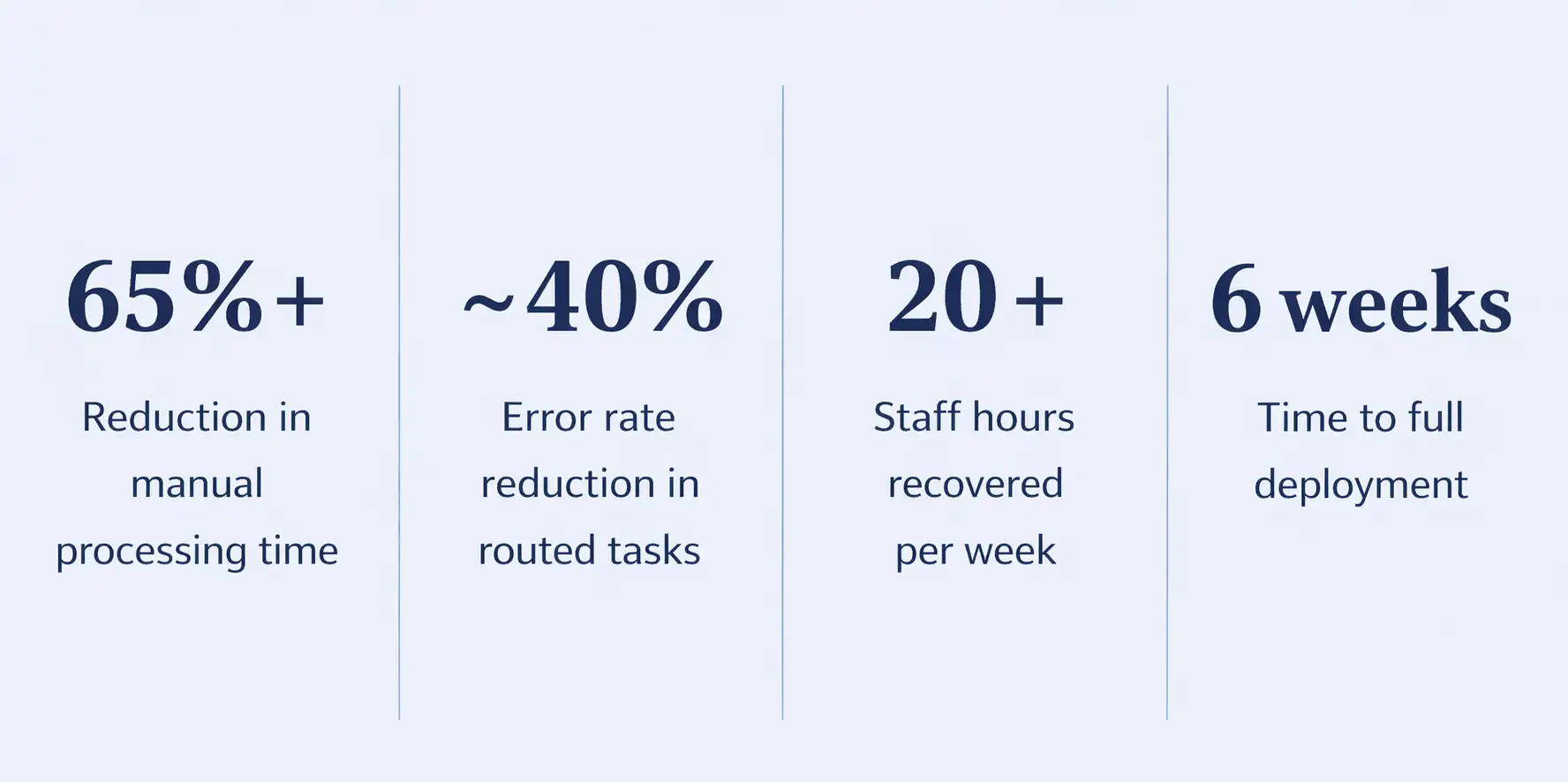
Automation Capabilities Delivered
- AI-driven scheduling and patient intake routing
- Automated prior authorization data collection and submission
- Internal workflow orchestration with rule-based exception handling
- Real-time dashboard for task status and bottleneck visibility
- Integration with existing EMR and practice management systems
CASE STUDY
AAL Healthcare Automation Efficiency Gains Across Clinical and Administrative Workflows
See the full case study at NeuraMonks
4. Automated Detection of Dental Bite Problems from 3D Scans
Orthodontic diagnosis relies on manual inspection of 3D dental models a process that is slow, experience-dependent, and particularly challenging when a patient presents with multiple overlapping conditions simultaneously. A Class II malocclusion combined with a deep bite and scissors bite is common in complex cases, yet diagnosing all three conditions consistently requires significant clinical experience.
Specialized AI Solutions for Orthodontics
A ResNet 50 based CNN processes 3D dental scan files (STL format), automatically classifying the primary occlusion type and any co existing bite problems. The system delivers ranked predictions with confidence scores and validates all combinations against medical plausibility rules before surfacing results to the clinician.

System Architecture
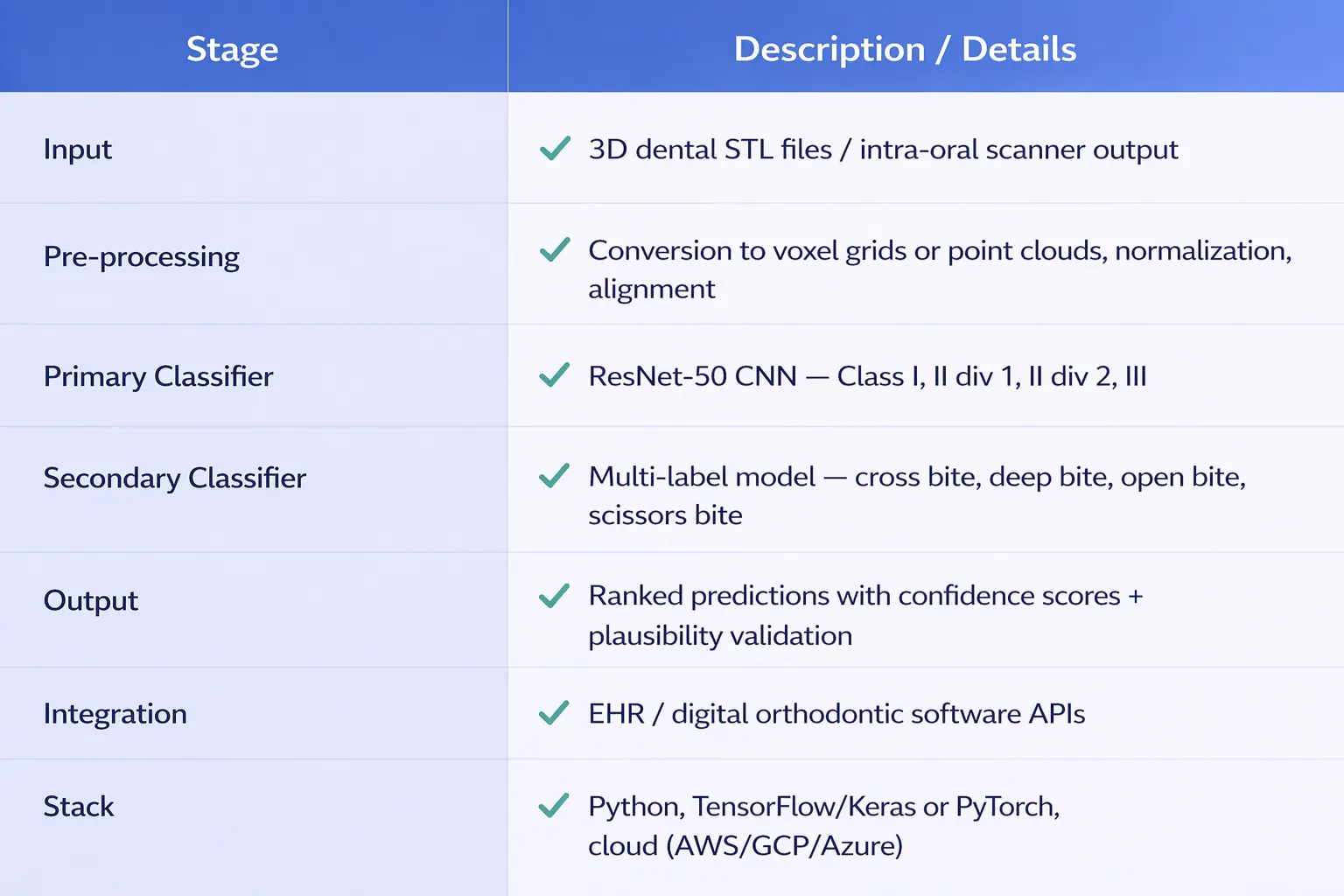
With a Cohen's kappa of 0.86, this system reaches near-expert diagnostic agreement. For orthodontic groups, DSOs, and dental school clinics processing high volumes of new patients, this represents significant time savings and a measurable improvement in diagnostic consistency.
5. AI Clinical Decision Support for Glaucoma Management
Glaucoma affects over 3 million Americans and is a leading cause of irreversible blindness yet up to 50% of cases remain undiagnosed. The disease progresses silently, and staging decisions depend on synthesizing complex variables across a patient's full visit history. When a patient has 80+ recorded visits, manually extracting meaningful longitudinal signal at scale is unrealistic.
Dual-Agent AI Architecture
A multi-agent AI platform processes patient data symptoms, intraocular pressure history, age, optic nerve imaging, visit records against a large repository of historical cases. A Diagnostic Agent generates recommendations, then a separate Validation Agent independently scores them for reliability (0 to 10) before presenting results. The system never forces a conclusion on edge cases low-confidence profiles trigger a direct clinician review flag.
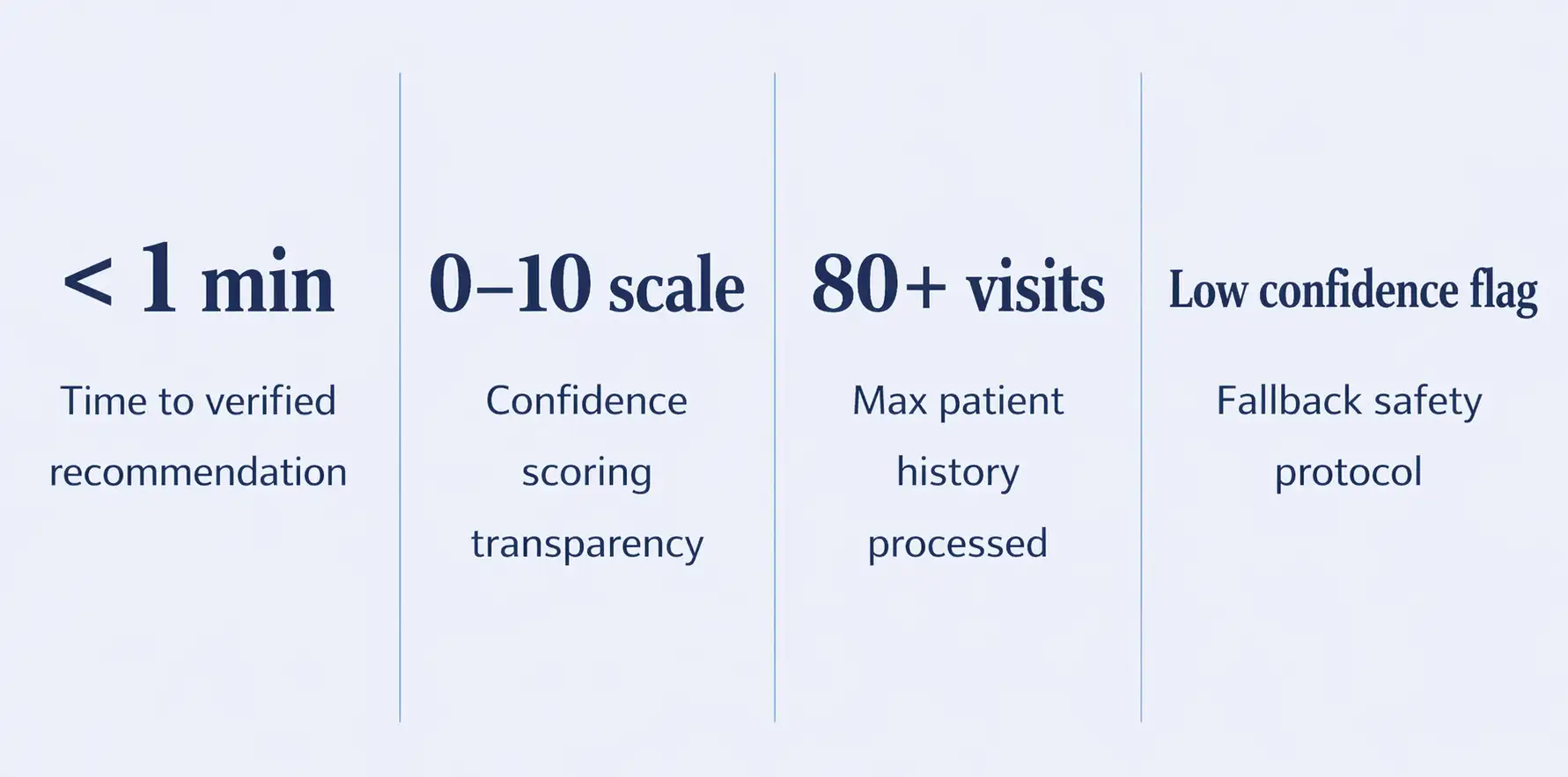

For ophthalmology practices managing large patient panels, this system reduces the cognitive load of routine staging decisions while maintaining human oversight on ambiguous cases.
6. AI-Assisted Radiology: Second-Read Accuracy at Scale
Radiologists in the U.S. read an average of 20,000+ images annually. Imaging volumes are rising while radiologist supply is projected to fall short of demand by 42,000 physicians by 2033. The combination creates conditions for fatigue-related errors particularly for subtle findings like small pulmonary nodules, hairline fractures, or early-stage tumors.
How the AI Functions as a Second Reader
AI radiology tools apply deep learning to X-rays, CT scans, and MRIs to flag anomalies, pre-annotate findings, and prioritize worklists so critical cases surface first. These systems do not replace radiologists they reduce the probability that a clinically significant finding is missed on a high-volume day.
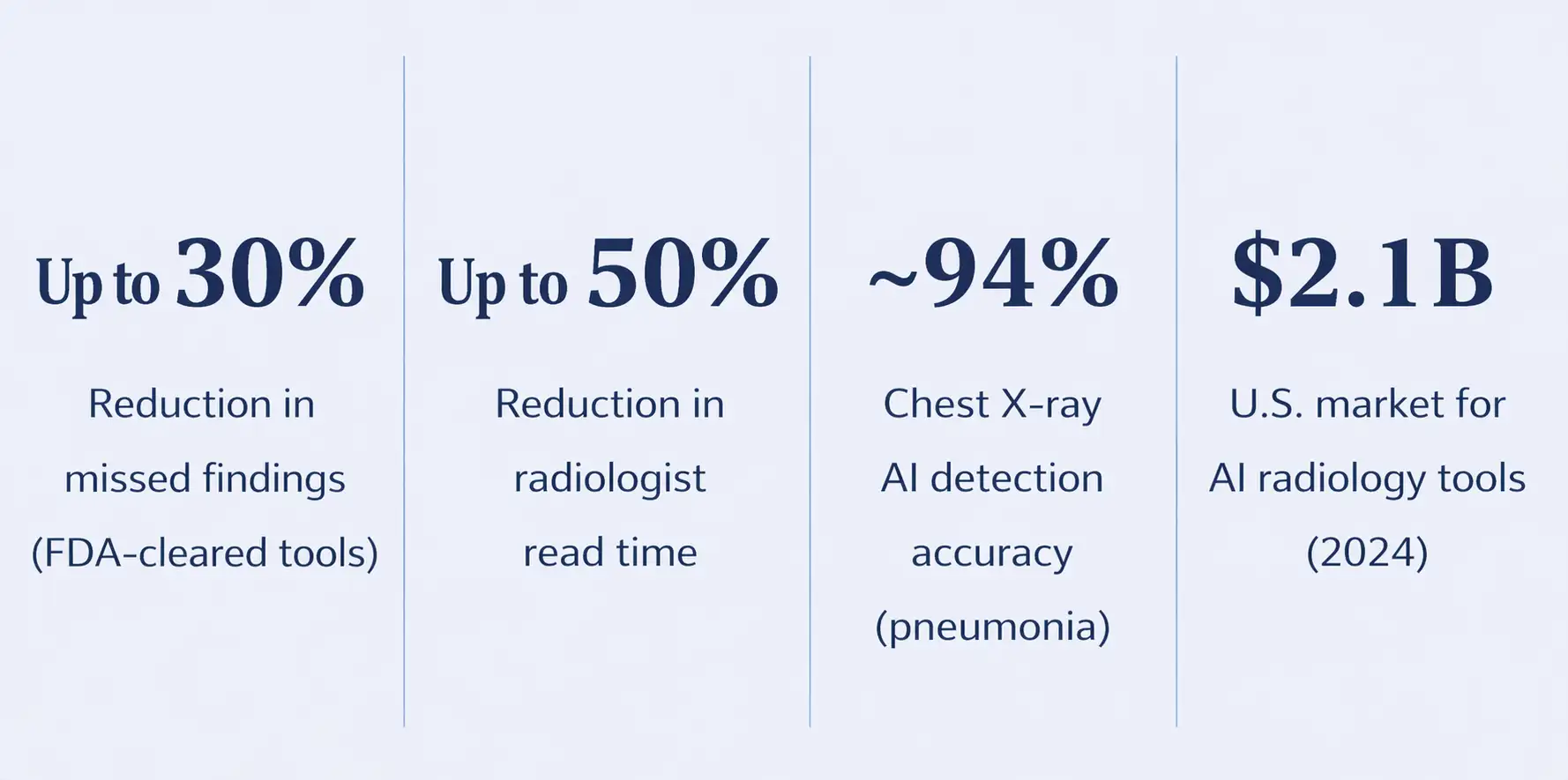
- Faster turnaround times improve patient throughput and revenue per scanner
- Prioritized worklists reduce time-to-treatment for critical findings stroke, PE, pneumothorax
- Documented AI second-read can reduce malpractice exposure
- Scalable across teleradiology networks one AI-augmented radiologist covers more sites
7. Predictive Analytics for Early Sepsis Warning
Sepsis kills approximately 270,000 Americans every year. The condition can progress from a manageable infection to multi-organ failure within hours, and early intervention is the single biggest determinant of survival. Yet hospitals still largely depend on reactive vital sign thresholds and manual escalation protocols.
Continuous Risk Scoring from EHR Data
Predictive AI models analyze EHR data streams in real time vital signs, lab results, medication administration, nursing notes generating sepsis risk scores per patient every few minutes. When a score crosses a defined threshold, the system automatically alerts the clinical team, enabling intervention hours before traditional early-warning scores would trigger.
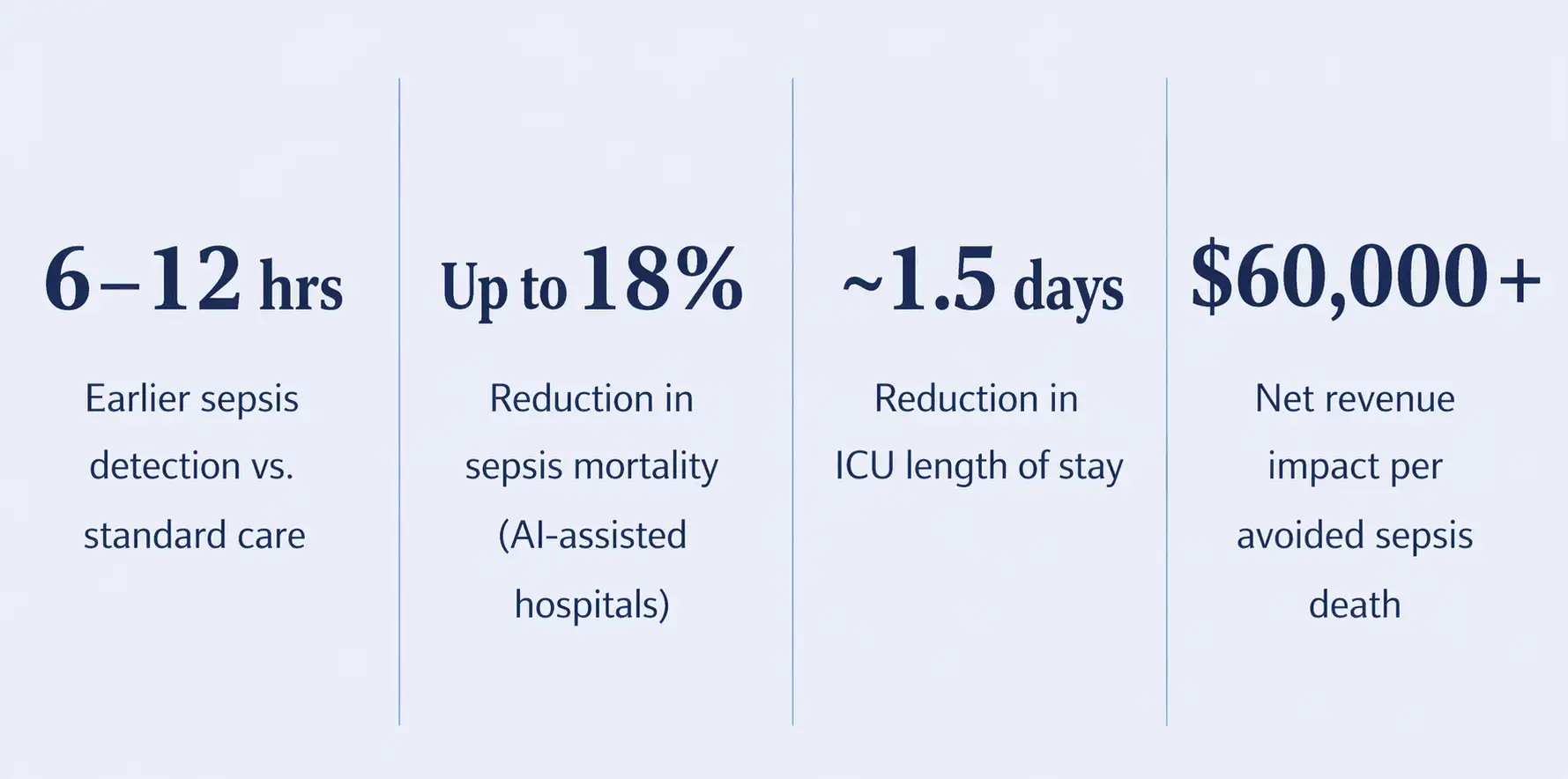
- Reduced CMS sepsis-related penalties under the Hospital Readmissions Reduction Program
- Improved HCAHPS scores and CMS star ratings directly tied to reimbursement
- Lower cost per sepsis case average ICU sepsis treatment: $25,000–$100,000
- Actionable alerts integrated into existing EHR workflows (Epic, Cerner, etc.)
- Explainable AI outputs clinicians see exactly which data points triggered the alert
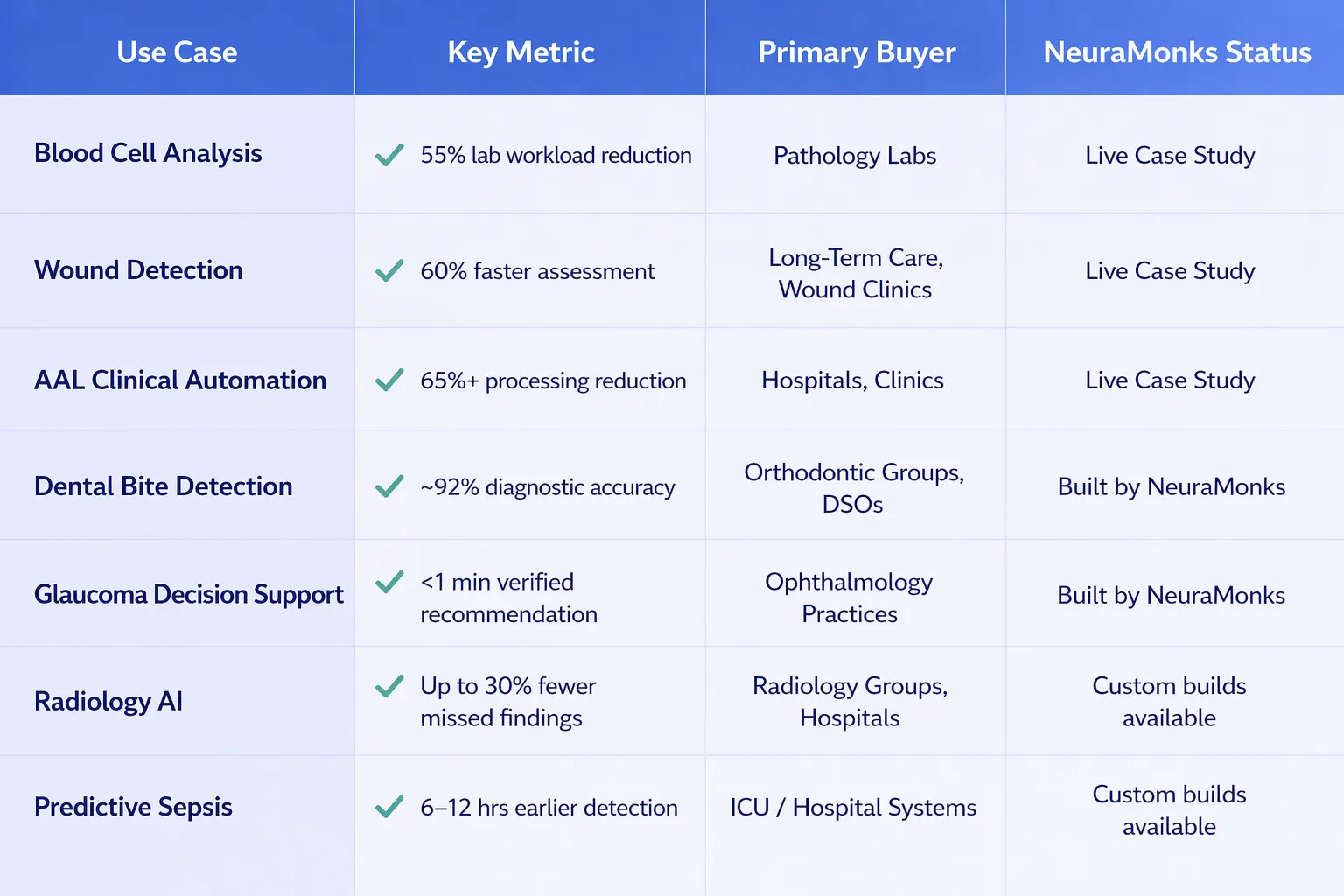
All 7 AI Use Cases: Side-by-Side
The table below maps each AI solution to its primary measurable impact, the clinical buyer, and current NeuraMonks delivery status giving procurement teams a clear evaluation grid.
Your Clinical Problem Has a Measurable AI Answer
NeuraMonks AI Healthcare Solutions are scoped, built, and validated for clinical environments not retrofitted from generic tools. Every engagement starts with a data assessment and a defined success metric.
If your team has a clinical workflow that generates structured data, there is a high probability AI can reduce cost, reduce error, or improve speed — measurably.
Schedule a Clinical AI Scoping Call
45 minutes. Define your use case, assess your data, set success criteria.
Examine Delivered Case Studies
Verified outcomes. Real clinical environments. Exact numbers.
https://www.neuramonks.com/ai-case-study

Is There an AI Bubble? What CTOs Should Watch Before Signing the Next Infrastructure Budget
A practical framework for evaluating AI infrastructure investments separating genuine ROI opportunities from hype-driven spending. This post walks CTOs through the difference between AI capabilities that deliver measurable outcomes and those that drain budgets without clear business impact
When the market is moving this fast, the hardest thing for a technology leader to say is: "I'm not sure this spend is justified."
AI investment crossed $200 billion globally in 2024. GPU clusters have had multi-week waitlists. Every major cloud vendor has doubled its AI services portfolio. And yet according to McKinsey only 31% of enterprise AI deployments report clear, measurable return on investment.
That gap is worth sitting with. Not to dismiss AI the technology is genuinely transformative when deployed correctly but to ask the question that separates thoughtful infrastructure decisions from momentum-driven ones:
Are we spending on AI because it solves a specific problem we have or because everyone else seems to be spending on AI?
This piece is for the CTO, the VP of Engineering, the founder who is fielding three vendor pitches a week and trying to figure out which ones are worth a second conversation. It is not a debate about whether AI works. It is a framework for deciding where it earns its cost.
The Bubble Is Real Just Not Where Most People Think
Bubble dynamics in technology rarely mean the underlying technology is worthless. The dot-com bust did not disprove the internet. What it destroyed were companies building on top of hype without a path to revenue. The same pattern is visible in parts of the AI landscape today.
Where the bubble is most inflated:
- Foundation model startup valuations — many are priced on potential, not on revenue or margin
- Generative AI SaaS tools — a crowded market where differentiation is thin and churn is high
- GPU compute contracts — locked in at 2024 peak pricing before commodity correction arrived
- Custom LLM projects sold by consultancies at $300K+, where a $40K integration would do the same job
Where the bubble is not:
AI applied to a specific, measurable process document processing, scheduling, customer communication, anomaly detection
Automation infrastructure connecting AI capabilities to systems you already run
Computer vision in environments where human inspection is slow, expensive, or inconsistent
The difference between these two categories is not the sophistication of the technology. It is the presence or absence of a defined business outcome before the first line of code is written.
How Infrastructure Spend Goes Wrong: The Three Failure Modes
Most AI infrastructure failures do not fail because of technical problems. They fail for one of three reasons:
1. Capability first procurement
A vendor demonstrates what AI can do and the organisation buys the capability without first identifying the problem it is solving. The result is infrastructure that impresses in demos and sits underused in production.
2. Complexity inflation
Vendors have a structural incentive to propose more complex solutions. A custom trained model is a bigger contract than an API integration. A bespoke data pipeline is a bigger engagement than a well-configured automation workflow. Complexity is often sold as quality when it is actually just cost.
3. Underestimating adoption cost
Technology adoption in organisations is not primarily a technical challenge it is a change management challenge. The most common cause of AI project failure is not that the model performs poorly. It is that no one changed the workflow around it. Implementation cost is routinely planned at 100% of development cost when 30% goes toward adoption; the real figure is usually reversed.
What Good AI Infrastructure Investment Looks Like in Practice
One of the clearest illustrations of this comes from the construction sector an industry not typically associated with early technology adoption, but one that has started deploying AI with measurable discipline.
AI in construction is increasingly applied to blueprint analysis, materials takeoff, site safety monitoring, and progress reporting. What makes these deployments work is the same thing that makes any AI investment work: there is a physical, measurable problem with a known cost, and the AI addresses it directly.
Case Study — AI-Powered Symbol Detection for Construction Blueprints
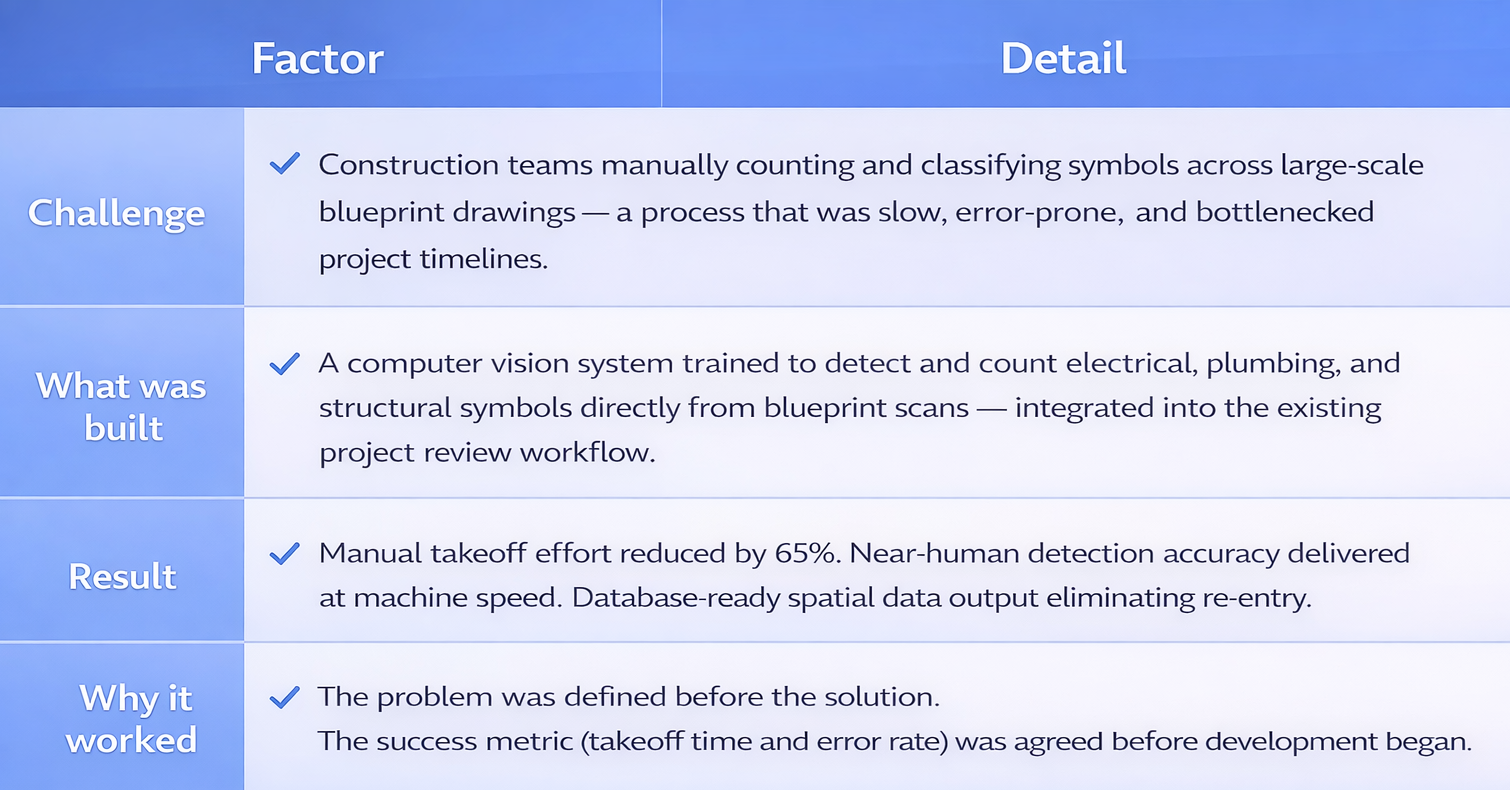
This type of project focused, outcome-defined, integration-first is what distinguishes AI deployments that generate ROI from those that generate reports. NeuraMonks has built a portfolio of similar engagements across healthcare, fintech, e-commerce, and operations. You can review them at neuramonks.com/ai-case-study.
The Audit Question Every CTO Should Ask Before Approving AI Spend
Before any AI infrastructure proposal reaches final approval, it should be able to answer five questions clearly. If any answer is vague, the proposal is not ready.
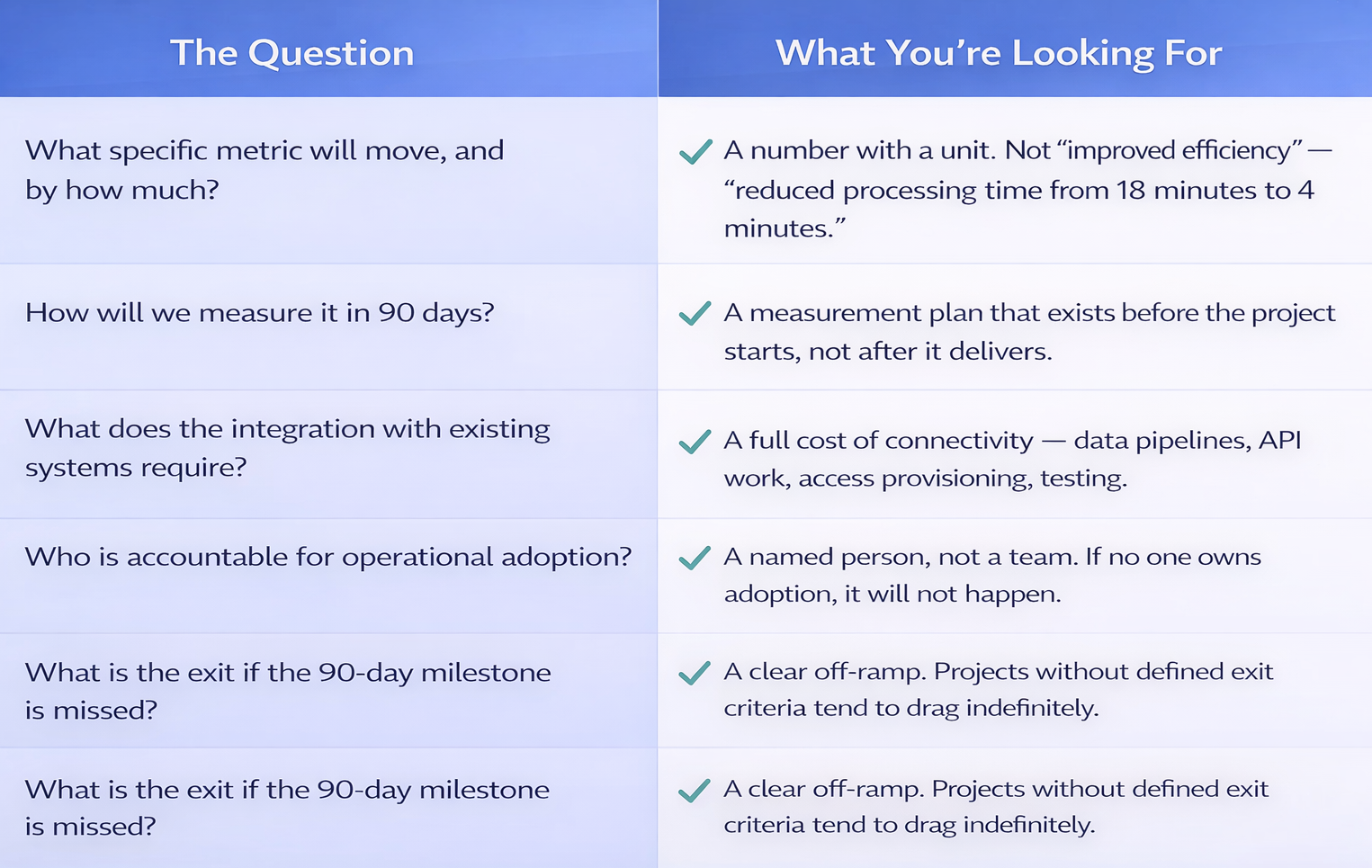
These five questions are the difference between an AI strategy and an AI budget. The first produces outcomes. The second produces invoices.
Where Workflow Automation Fits the Infrastructure Stack
One of the most consistently underused layers in enterprise AI deployments is workflow orchestration the connective tissue that makes AI outputs usable inside existing operations. Tools like n8n enable teams to connect AI capabilities (document processing, classification, generation, extraction) to the systems where decisions are actually made: CRMs, ERPs, communication platforms, reporting pipelines.
This layer is where practical ROI happens fastest. It does not require custom model training. It does not require new infrastructure. It requires a clear understanding of which processes produce the most friction and a competent team to bridge the gap.
The organisations that are getting AI right in 2025 are not the ones with the largest model infrastructure. They are the ones that have mapped their highest-friction processes and built tight automation pipelines around them. The technology is secondary to the operational thinking.
What a Thoughtful AI Investment Looks Like in 2025
The organisations that are consistently getting ROI from AI share a pattern. They are not necessarily the heaviest spenders. They are the most deliberate:
- They start with an audit of existing processes before evaluating any new AI capability
- They match solution complexity to problem complexity and resist vendor pressure to over-engineer
- They deploy in 90-day cycles with defined KPIs, treating each cycle as a go/no-go decision
- They cost adoption at 20–30% of total implementation budget, not as an afterthought
- They treat AI solutions as operational infrastructure, not R&D experiments which means ownership, maintenance plans, and performance monitoring from day one
NeuraMonks works with organisations across India, the UAE, and the US to audit AI readiness, design deployment roadmaps, and build AI solutions that are scoped and priced against outcomes. The work spans AI consulting, proof-of-concept development, full product builds, and ongoing automation engineering.
If the Infrastructure Question Is Unresolved, It Is Worth Resolving
The AI bubble is real in some places and absent in others. The difference is almost always whether the organisation started with a problem or started with a product. If you are currently evaluating AI infrastructure spend or reviewing a proposal that has been sitting on your desk the most valuable thing you can do before committing is to get clarity on what outcome you are actually buying.
NeuraMonks offers AI consulting, audit engagements, and end to end development for organisations that want that clarity. We build AI solutions that are scoped against specific outcomes and delivered in cycles short enough to validate before they scale.
Talk to the NeuraMonks Team
Discuss your current AI spend, an upcoming project, or a proposal you want a second perspective on.
Review Our Case Studies
See how we have approached real problems across construction, healthcare, e-commerce, and more.
→ neuramonks.com/ai-case-study
How AI Agent Orchestration with Paperclip Is Redefining Business Automation And Why Neuramonks Is the Right Partner to Build It
AI agent orchestration with Paperclip eliminates the coordination bottleneck that costs businesses $4.4T annually. NeuraMonks deploys production ready AI automation in 4–8 weeks, delivering 30–40% efficiency gains and 20–35% cost savings without vendor lock-in.
The Numbers Behind the Problem No One Talks About
Every business whether a bootstrapped startup, a mid-size enterprise, or a Fortune 500 corporation i shares the same hidden bottleneck: repetitive, manual, human-dependent workflows that silently drain revenue, time, and competitive edge.
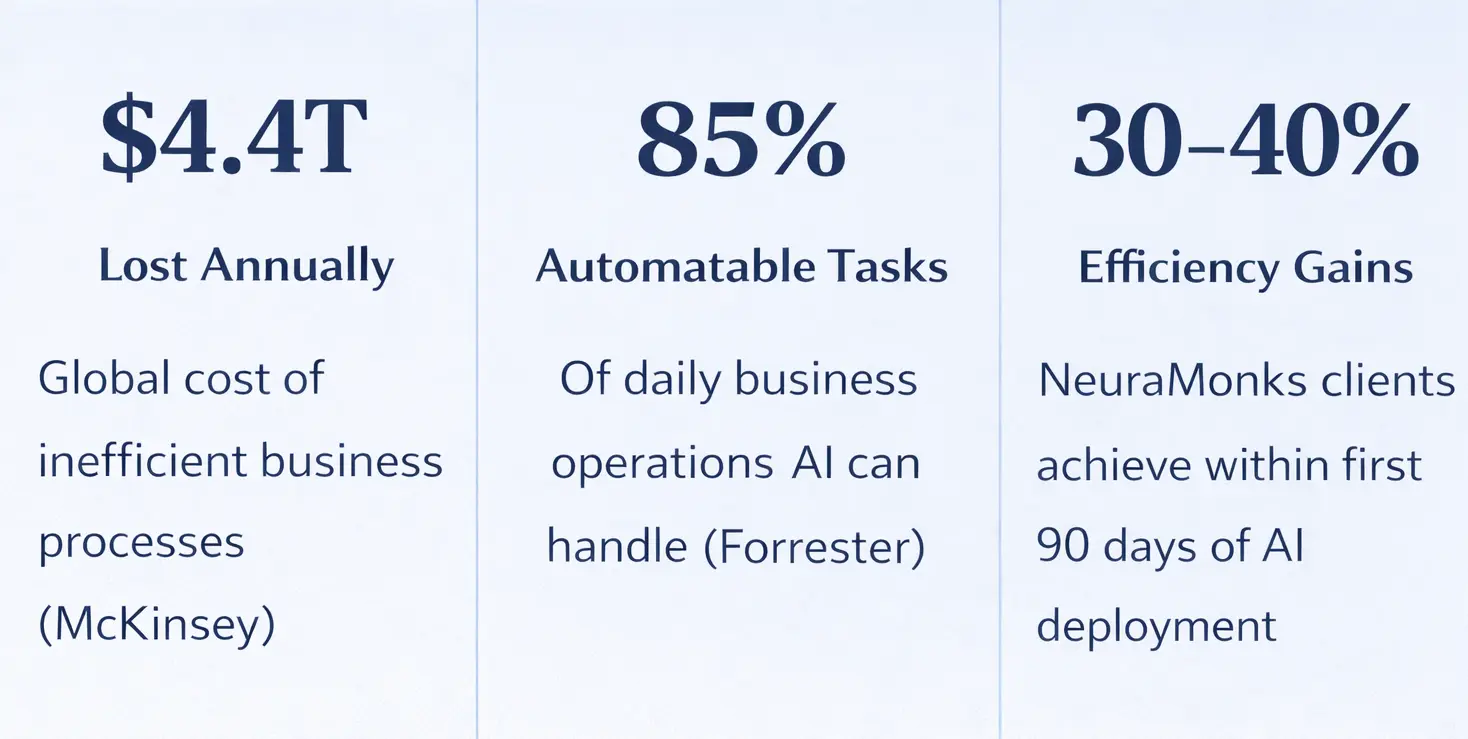
The irony? Most of the tools to fix this already exist. What has been missing until now is the orchestration layer that connects AI agents, assigns goals, manages tasks, and runs a company autonomously.
That orchestration layer is called Paperclip. And the team best positioned to integrate, customize, and deploy it for your business is NeuraMonks a leading agentic AI development company headquartered in Ahmedabad, Gujarat, delivering AI solutions across 8+ industries and multiple global markets.
Quick Answer: What is Paperclip AI?
Paperclip is an open-source AI agent orchestration platform that lets businesses "hire" AI employees, set company goals, automate full business functions, and run operations with minimal human intervention. It is self-hosted, LLM-agnostic, and integrates across every department from development to marketing to customer support.
What Is Paperclip and Why Every AI-Forward Business Should Know It
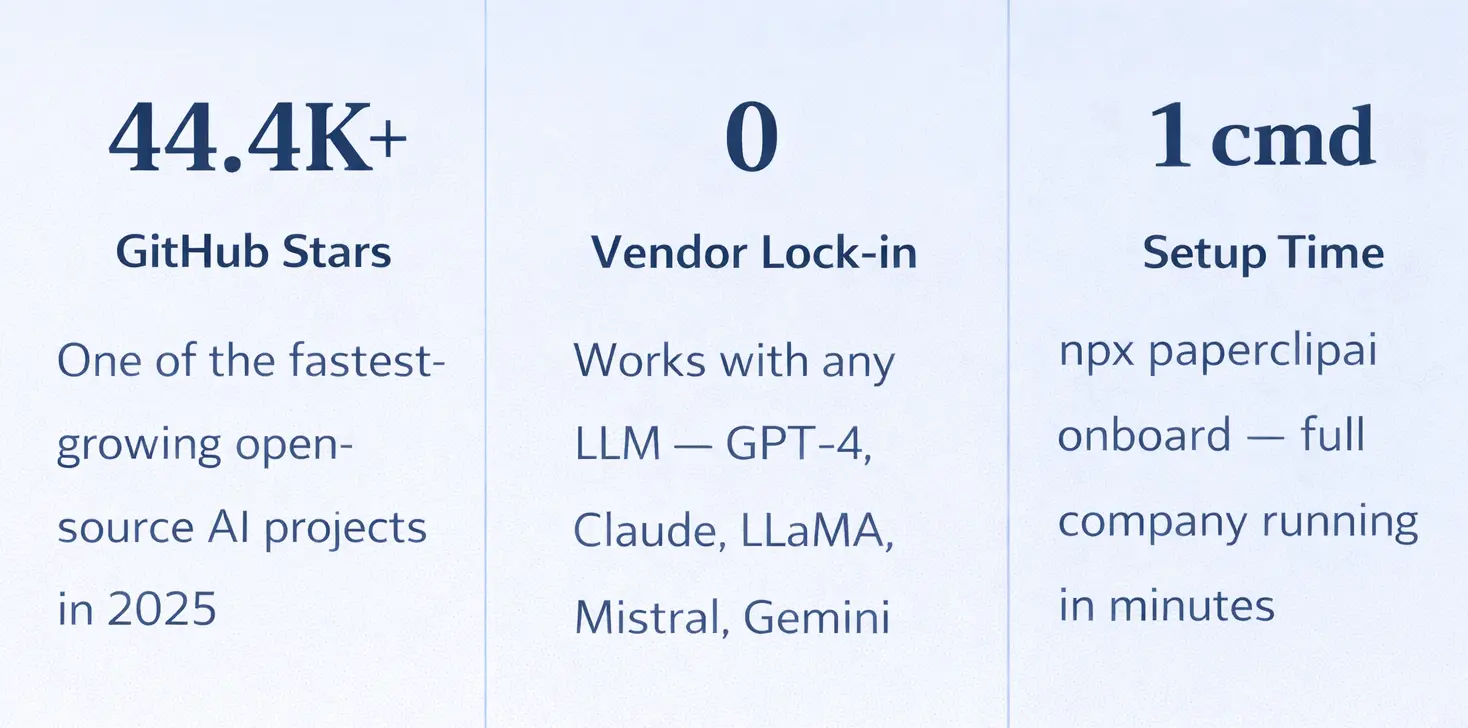
Paperclip (paperclip.ing) has earned 44,400+ GitHub stars in a remarkably short period — a signal the developer community recognizes something fundamentally different about its approach. Unlike individual AI tools that solve isolated tasks, Paperclip operates at the company level.
Think of Paperclip as a digital org chart where instead of hiring human employees for every department, you hire AI agents and the entire company hierarchy, goal structure, budget, and task management lives in one unified platform.
Key Capabilities of Paperclip
- AI Employee Hiring: Define roles Coder, Content Writer, Marketing Analyst, QA Engineer and deploy agents for each.
- Goal-Based Orchestration: Set business-level objectives; Paperclip breaks them into tasks and assigns to the right agents.
- Cross-Department Automation: Dev, content, social media, marketing, QA, research, and outreach all automated from one platform.
- Self-Hosted & Open Source: Full data control, no vendor lock-in, deployable on your own cloud or on-premise infrastructure.
- LLM-Agnostic: Connect GPT-4, Claude 3.5, LLaMA 3.2, Mistral, or any locally hosted model.
- One-Command Onboarding: npx paperclipai onboard walks through database, auth, and first AI company setup interactively.
The shift Paperclip enables is profound. As one developer noted: "The mental model moves from I am prompting an AI to I am managing a team." That distinction from tool user to business operator — is exactly what enterprises and growth-stage companies need today.
Why NeuraMonks Is the Right AI Development Partner for Paperclip Integration
Knowing a platform exists and knowing how to implement it at enterprise scale are two very different things. NeuraMonks bridges that gap.
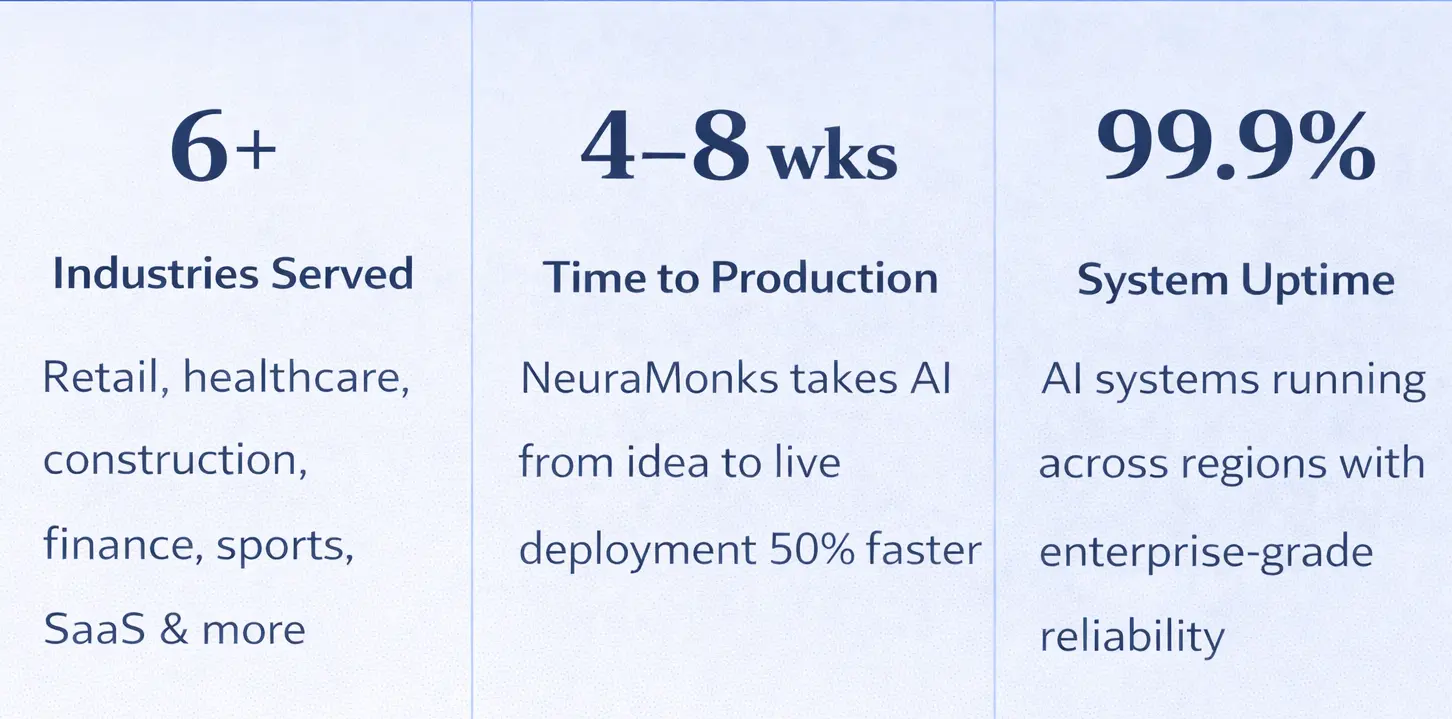
As a specialized agentic AI development company, NeuraMonks has spent years building the exact technical foundation that Paperclip integration demands: LLM integration, multi-agent system design, generative AI deployment, computer vision, NLP pipelines, and cloud-native infrastructure.
What NeuraMonks Brings to the Table
• Agentic AI Development: We are a leading agentic AI development company. We build enterprise AI agents and autonomous automation solutions that go beyond simple chatbots — reasoning, planning, tool use, and multi-step execution across real business workflows.
• LLM Integration Expertise: We evaluate and integrate GPT-4, Claude, LLaMA, Mistral, and Gemini into production systems — handling model selection, prompt engineering, RAG architecture, fine-tuning, and performance evaluation end-to-end.
• MCP Server Development: NeuraMonks offers expert MCP (Model Context Protocol) server development services — build custom MCP solutions, protocol implementation, and AI tool integrations that connect Paperclip agents to your existing business data and APIs.
• Generative AI & Computer Vision: From AI-powered content generation and image synthesis to video intelligence and document processing — we build generative AI systems that drive measurable business outcomes across industries.
• Full-Stack AI Product Development: We architect, develop, and deploy complete AI products — from data pipelines and ML models to front-end interfaces and cloud infrastructure — on AWS, Azure, or Google Cloud.
• Proven Delivery Framework: Our structured Think → Build → Deploy → Optimise methodology reduces implementation risk by 25% and delivers 30–40% efficiency gains within the first 90 days.
NeuraMonks Client Result
A global financial firm working with us deployed an AI-driven fraud detection system that reduced fraudulent transactions by 40% using real-time risk analysis. A healthcare client improved disease detection accuracy by 90%. An e-commerce brand increased conversion rates by 20% with NeuraMonks' AI recommendation engine.
4 Real-World Use Cases: Paperclip + NeuraMonks in Action
1. Autonomous Content & Marketing Operations
40+ hrs
Saved Per Week
Average time a growing brand spends on content, SEO, social, and email campaigns — before AI automation.
With Paperclip + Claude + NeuraMonks' generative AI layer, businesses deploy a full AI content team: a Writer agent, an SEO Analyst agent, a Social Media Manager agent, and a Campaign Analyst agent — all orchestrated under one goal: "Grow organic traffic by 30% this quarter." NeuraMonks' generative AI capabilities handle content personalization, image synthesis, and performance optimization automatically.
2. AI-Powered Customer Support & Sales Outreach
< 3 sec
Average AI Response Time
Vs. 4–6 hour average for human-only support teams. Customer satisfaction scores improve by up to 35%.
NeuraMonks deploys multilingual AI support agents via Paperclip, integrated with CRM, ticketing, and communication platforms. Agents handle inquiries, qualify leads, escalate complex issues intelligently, and run proactive outreach campaigns — 24/7, at a global scale, without adding headcount.
3. Developer & QA Automation
35%
Sprint Overhead Reduced
Development teams using AI code review, bug triage, and automated test generation free up 35% of sprint capacity for feature work.
NeuraMonks implements Paperclip with a Coder agent, QA Engineer agent, and Documentation Writer agent that handle code review, bug triage, test case generation, and release notes. Combined with NeuraMonks' AI-assisted development services, engineering teams ship faster with higher quality and lower cost per release.
4. Business Intelligence & Research Automation
8 hrs → 12 min
Research Report Time
Manual market research that took a full business day now completes in under 15 minutes with AI-powered research agents.
A consulting firm serving Fortune 500 clients deploys Paperclip's Research agent configured by NeuraMonks — pulling data from multiple sources, synthesizing findings using LLMs, and delivering formatted insight reports to stakeholders automatically, every morning before 9 AM. Zero analyst hours. Zero delays.
The Future Belongs to Businesses That Automate Intelligently
The era of AI as a novelty is over. The companies that thrive in the next decade will be those that treat AI as competitive infrastructure — not a one-time experiment.
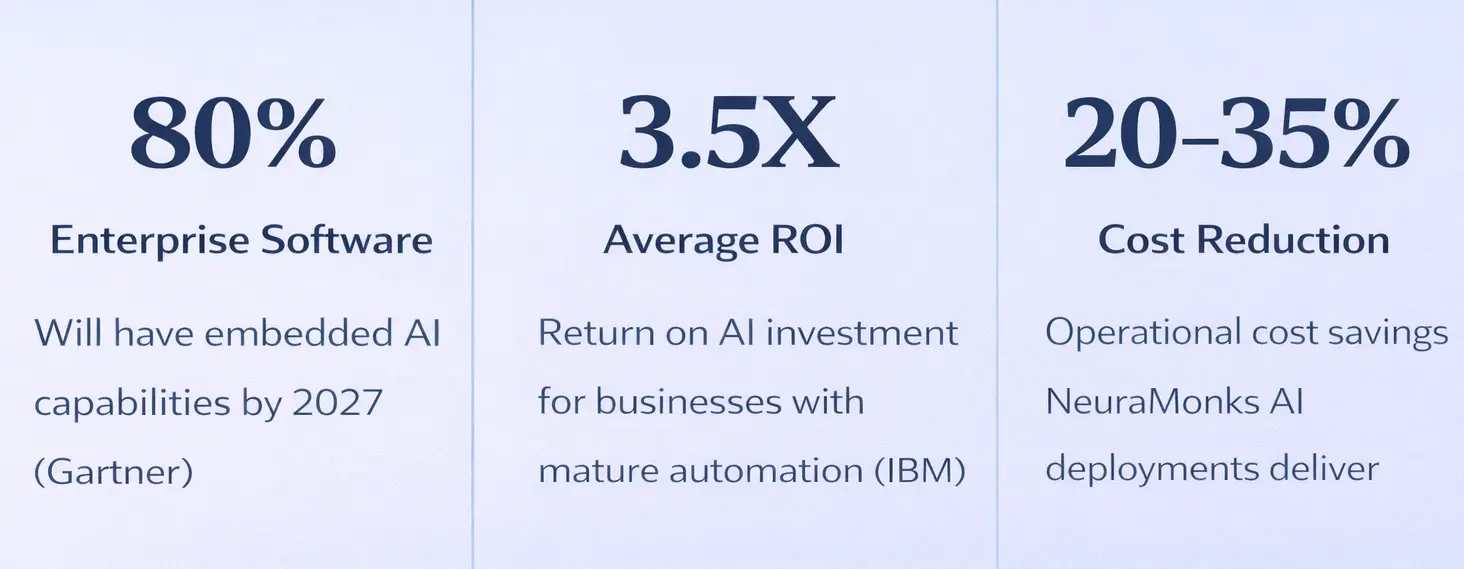
Paperclip represents the most compelling architecture for that future: an open, self-hosted orchestration layer that turns LLMs into employees, goals into action plans, and business complexity into managed, measurable output.
Let NeuraMonks Get You Running on Paperclip — Fast
Understanding Paperclip is one thing. Getting it production-ready for your business — with the right LLM connections, agent roles, goal structures, integrations, and infrastructure — is another. That is exactly what NeuraMonks does.
Our team handles every layer of your Paperclip setup, from initial environment provisioning to fully operational AI agents running real business workflows, so you can focus on outcomes rather than configuration.
What Our Paperclip Setup Service Includes
01 Discovery & Workflow Audit
We map your existing business operations, identify the highest-ROI automation targets, and define the agent roles, goals, and department structure that Paperclip will manage for your company.
02 Infrastructure Provisioning & Self-Hosted Deployment
We deploy Paperclip on your preferred infrastructure — AWS, Azure, GCP, or on-premise. Full self-hosted setup with PostgreSQL/MySQL, authentication, environment configuration, and security hardening. No vendor lock-in, full data ownership.
03 LLM Configuration & Model Selection
We evaluate and connect the right LLM for your use case — GPT-4, Claude, LLaMA, Mistral, or a locally hosted model. We handle API key management, model routing, fallback logic, and prompt optimization so your agents perform reliably from day one.
04 AI Agent Design & Role Configuration
We define and configure your AI employees inside Paperclip — Coder, Content Writer, QA Engineer, Support Agent, Research Analyst, or any custom role your business needs. Each agent gets a goal structure, tool access, and execution boundaries tuned to your workflows.
05 MCP Server & Integration Development
We build custom MCP server development that connects your Paperclip agents to existing business systems — CRMs, ERPs, databases, APIs, communication tools (Slack, Teams), and internal knowledge bases. Your agents work with your data, not in isolation.
06 Testing, QA & Handover
Before go-live, we run end-to-end testing across all agents and goal flows, validate output quality, stress-test multi-agent coordination, and document everything. Your team receives a full operational handover with runbooks, monitoring setup, and ongoing support options.
From first conversation to live Paperclip deployment: NeuraMonks delivers in 4–8 weeks. Most clients see measurable efficiency gains within the first 30 days of operation.
Why Start with NeuraMonks Instead of Self-Implementing?
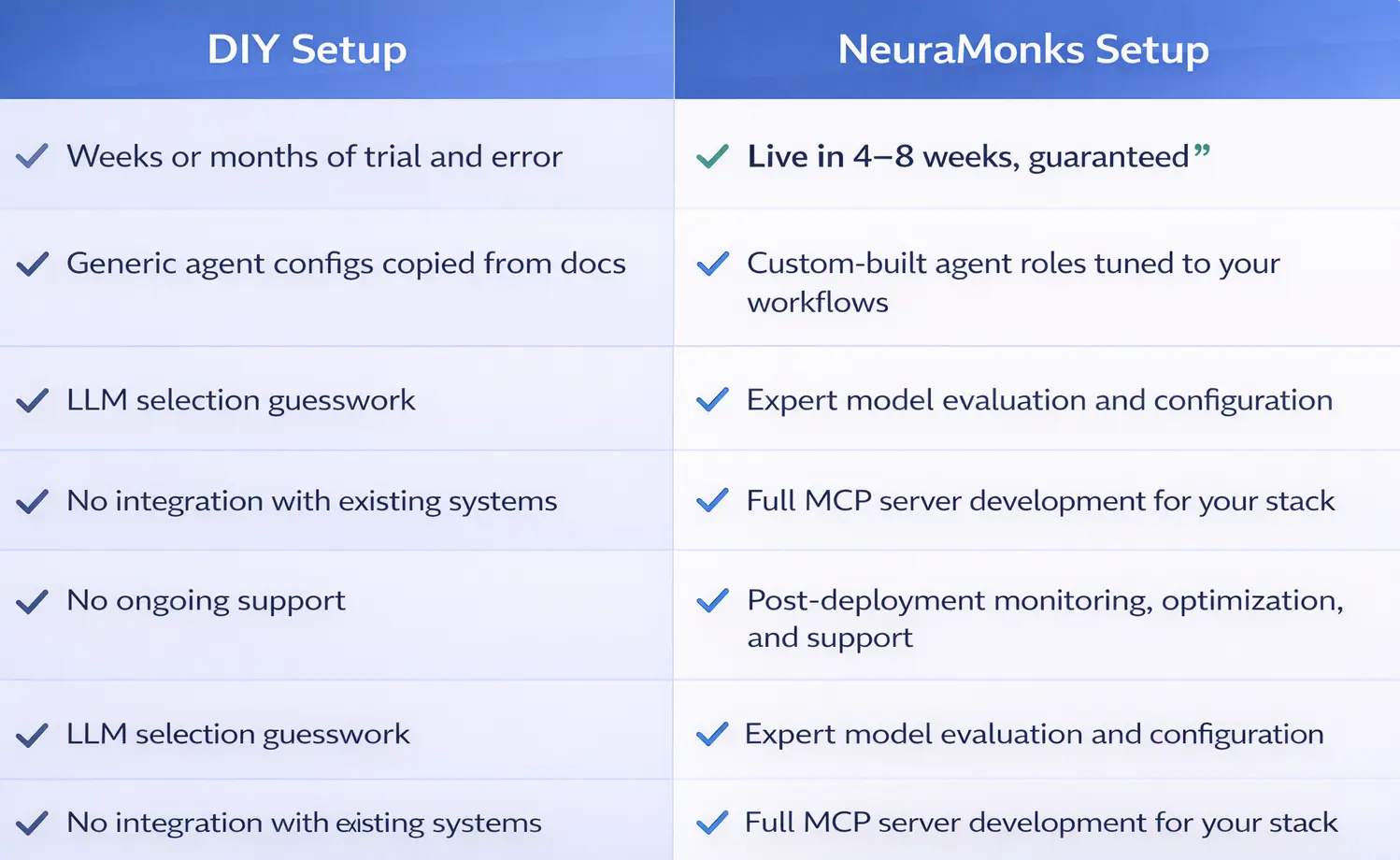
NeuraMonks is the implementation partner that makes that future real — today. As a leading agentic AI development company with proven expertise in LLM integration, generative AI, computer vision, NLP, and MCP server development, we translate the promise of AI into production systems that drive measurable business results from day one.
Whether you are a startup building your first AI-powered product, an enterprise transforming operations at scale, or a global business seeking a world-class AI development partner, NeuraMonks is ready.
Book a free 60-minute AI Automation Discovery Session with us. We will analyze your workflows, identify the highest-ROI automation opportunities using Paperclip + LLMs, and deliver a clear, costed implementation roadmap. www.conversantech.com ·
Why Anthropic Won't Release Claude Mythos AI to the Public The Glasswing Strategic Restraint
Understand why Anthropic restricts Claude Mythos to the Project Glasswing coalition, how it impacts enterprise cybersecurity, and what it means for the US-India AI competition in 2026.

Understanding Responsible AI Deployment & Why the Most Powerful Models Stay Behind Closed Doors
There are moments in AI development when the responsible choice is not to release a capability into the world, but to contain it. Project Glasswing, announced by Anthropic in April 2026, represents precisely this moment and it clarifies why Claude Mythos Preview, despite being Anthropic's most powerful unreleased model, will remain restricted to a carefully governed coalition rather than released to the general public.
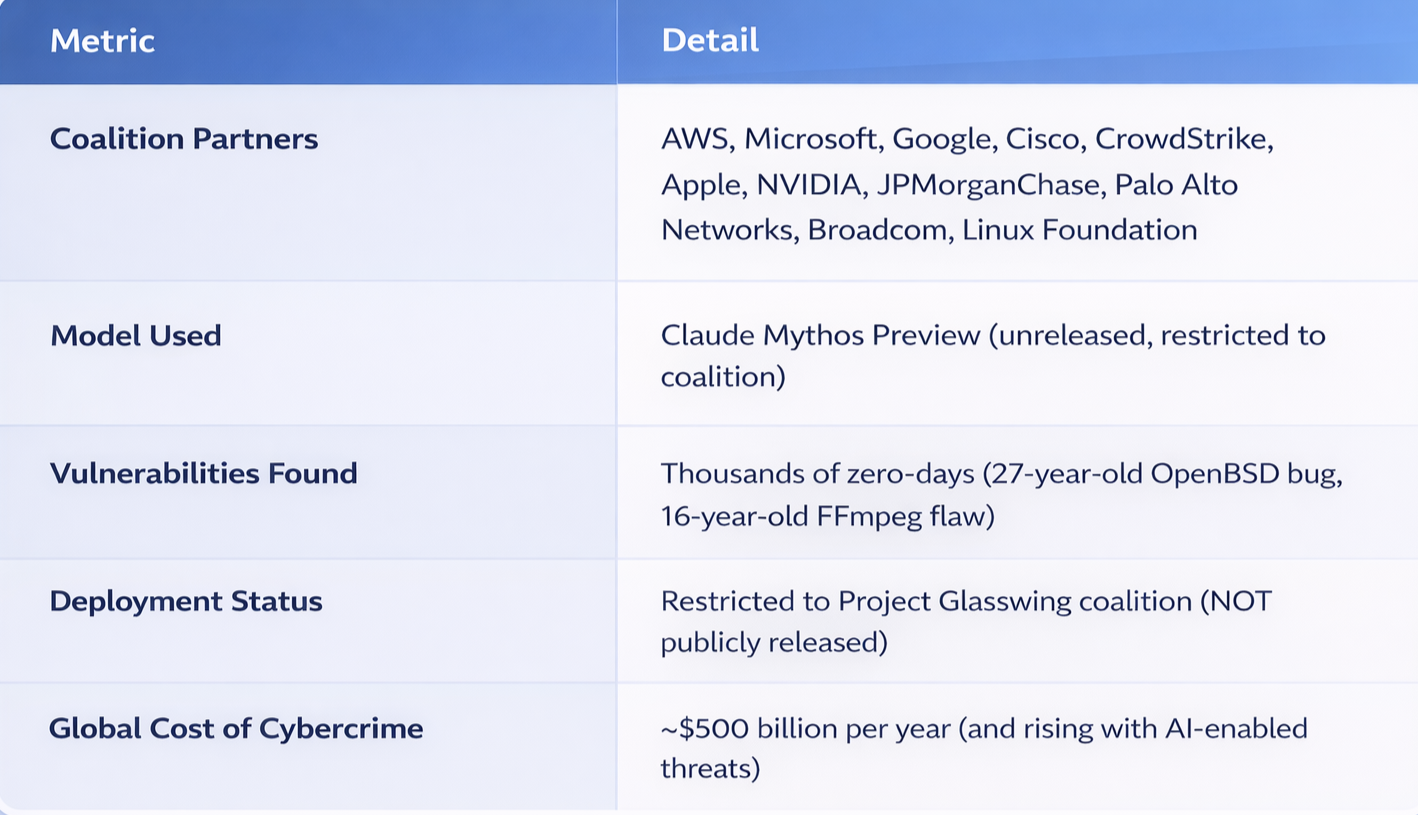
What started as an internal AI safety initiative evolved into Project Glasswing a cross-industry AI cybersecurity coalition that includes Amazon Web Services, Microsoft, Google, Cisco, CrowdStrike, Apple, NVIDIA, JPMorganChase, Palo Alto Networks, Broadcom, and The Linux Foundation. Glasswing came first. Claude Mythos Preview was deployed within Glasswing's structure second. That sequence is intentional, and it explains everything about why this model will not be freely available.
Whether your company operates in San Francisco, Chicago, Bangalore, or Hyderabad, this decision --- to restrict rather than release --- has direct implications for your security posture and your AI strategy.
Project Glasswing Came First: The Governance Framework Before the Model
Project Glasswing is Anthropic's structured initiative to deploy frontier AI capabilities for defensive cybersecurity within a coordinated, accountable coalition. Named after the glasswing butterfly --- whose transparent wings let it hide vulnerabilities in plain sight --- the project brings together the world's leading technology companies under one shared mission: use AI to find software flaws before attackers do.
The critical point: Anthropic built the coalition, the governance structure, and the accountability framework first. Only then was Claude Mythos Preview deployed within it.
At the core is Claude Mythos Preview --- a general-purpose, unreleased frontier LLM that has already demonstrated the ability to identify zero-day vulnerabilities in every major operating system and web browser. In independent tests, Mythos Preview found:
- A 27-year-old bug in OpenBSD
- A 16-year-old vulnerability in FFmpeg that had survived five million automated test cycles
- Chained multiple Linux kernel flaws to escalate user access to full machine control
These were not theoretical exercises. These were real flaws in systems that run banks, hospitals, government infrastructure, and supply chains globally. And a model that can find these flaws faster than any human or existing automated system poses a problem if released without guardrails.
Why Claude Mythos Won't Be Released to the Public
The same capabilities that make Claude Mythos exceptional for defensive cybersecurity make it dangerous if deployed indiscriminately. Here's why Anthropic has chosen containment over release:
1. Offensive Capability Asymmetry
A model that can autonomously find and exploit vulnerabilities across every major operating system on Earth is a dual-use technology in the most literal sense. The same agentic reasoning that locates zero-days can be weaponized by state actors, criminal organizations, or any individual willing to skip the accountability layer. Releasing Mythos to the public would be equivalent to distributing advanced exploit development tools to billions of people worldwide.
Cybercrime costs the global economy approximately $500 billion per year. That number would multiply exponentially if a frontier AI model capable of autonomously discovering critical vulnerabilities became widely available. Anthropic knows this. Which is why the model stays restricted.
2. Disclosure Coordination Requires Governance Structure
When a vulnerability is found, the question of when and how it is disclosed determines whether patches reach systems before or after attackers exploit them. A 27-year-old bug in OpenBSD is only useful if fixed before the world learns about it. The same applies to every zero-day Mythos discovers.
If Claude Mythos were publicly available, coordinated disclosure would become impossible. The first independent user to find a critical vulnerability could:
- Sell it on the dark web
- Use it for offensive operations
- Share it with adversaries
Project Glasswing prevents this by concentrating the findings within a coalition where The Linux Foundation, AWS, Microsoft, Google, and other trusted organizations control the flow of information and coordinate patches before public disclosure.
3. Open-Source Ecosystem Protection
The Linux Foundation is a core partner in Glasswing precisely because the vulnerabilities Mythos finds often exist in open-source codebases that billions of people depend on. If the model were public, every malicious actor with technical skill would use it to scan the same repositories looking for exploitable flaws.
By keeping Mythos restricted to Glasswing, Anthropic ensures that vulnerability discoveries flow through coordinated channels and that fixes reach the open-source community before threats materialize. This is structural cybersecurity --- not a restriction on innovation, but a prerequisite for public safety.
4. The Offensive-Defensive Gap Collapses Instantly with Public Release
As of now, there is a temporal advantage to defensive systems. Glasswing's coalition has access to Mythos's capabilities weeks or months before any attacker independently discovers similar techniques. That window is what allows patches to reach systems before exploits do.
The moment Mythos becomes publicly available, that advantage evaporates. Attackers gain the same autonomous vulnerability-finding capability that defenders do. The asymmetry reverses. And because there are more malicious actors than well-resourced security teams, the defensive effort loses.
The Sequence Matters: Why Glasswing Had to Come First
Anthropic did not build Mythos Preview and then figure out what to do with it. They built the coalition, the structure, and the accountability framework first --- and then deployed the model inside it. That order is the entire point.
For most of AI's history, powerful capabilities were released first and consequences were managed afterward. The internet deployed before misinformation frameworks existed. Social media scaled before anyone understood its effects on public discourse. Large language models were released to the public before anyone seriously thought about systemic harms.
With Claude Mythos, Anthropic inverted that pattern. They asked: "What structure must exist for this capability to be deployed responsibly?" The answer was Project Glasswing. Only after that structure was built was the model deployed within it.
This means:
- Findings flow through coordinated disclosure protocols
- The Linux Foundation is a core partner, ensuring fixes reach open-source ecosystems
- No single company controls the output; accountability is distributed
- The model's power is matched by the responsibility of the structure around it
What This Means for Enterprises in 2026
If you lead technology, security, or operations at an enterprise --- whether in New York, Austin, Mumbai, or Pune --- here is the practical reality:
- Your attack surface is larger than any manual team can cover. The world's largest technology companies are actively deploying Frontier AI vulnerability detection.
- Open-source dependencies are a critical risk vector. Project Glasswing is directly funding security work on the codebases your infrastructure depends on.
- AI in healthcare, finance, and logistics creates regulatory compliance risk. As AI embeds deeper into critical systems, security standards must rise proportionally.
- Cloud providers are integrating advanced security capabilities. AWS Bedrock, Google Cloud Vertex AI, and Microsoft Foundry now provide access to enterprise-grade AI security tools.
Agentic AI & LLMs: Why Frontier Models Require Careful Deployment
What makes Claude Mythos fundamentally different from conventional security tools is its agentic AI architecture. Agentic AI refers to systems that can autonomously plan, execute, and iterate across multi-step tasks without human steering at each stage.
Rather than simply flagging suspicious patterns, Mythos reads entire codebases, reasons about logic flows, chains vulnerabilities together, and develops working exploits --- all on its own. This agentic capability is precisely why it found vulnerabilities that survived decades of human review and millions of automated tests.
On benchmark evaluations like SWE-bench Verified, Mythos Preview scored 93.9% --- the highest ever recorded for any model --- demonstrating that its underlying LLM capabilities extend well beyond simple question-answering into deep, autonomous software reasoning.
Precisely because of these capabilities, the model cannot be publicly released without unacceptable security risks. The power to autonomously exploit systems must be paired with governance structures that prevent misuse. Project Glasswing is that structure.
MCP Servers: The Hidden Infrastructure Enabling Secure Deployment
For Claude Mythos Preview to perform vulnerability detection at the depth it does --- scanning live codebases, navigating private repositories, querying internal toolchains --- it needs more than intelligence. It needs secure, structured access to external systems.
This is where the Model Context Protocol (MCP), developed by Anthropic, becomes critical. MCP is an open protocol that defines how AI models connect to external tools, data sources, and secure environments. Think of MCP servers as the intelligent connectors that allow a model like Claude to safely interact with your company's private codebase, internal databases, security scanners, or enterprise APIs --- without exposing raw credentials or unstructured data to the model directly.
MCP servers are also why Mythos can be deployed within Glasswing without leaking sensitive vulnerability data outside the coalition. The protocol ensures that findings are structured, auditable, and controlled.
NeuraMonks: AI Development Company Building Tomorrow's Autonomous Systems
NeuraMonks: AI Development Company
At NeuraMonks, we design and deploy agentic AI workflows that help enterprises across the US and India automate complex operations securely. While Anthropic deploys frontier models within carefully governed coalitions, NeuraMonks builds the same class of intelligent, multi-step autonomous workflows for your business infrastructure. Whether you need Agentic AI Development code review, document intelligence, data processing, or security automation --- we architect these systems with governance and accountability built in from the start. We also specialize in MCP Server Development, creating the custom connectors that allow frontier AI models to securely interact with your company's private tools, data environments, and software infrastructure.
→ Learn about our Agentic AI Development Services
The principle behind Glasswing --- structure before scale, governance before deployment --- is how we approach every AI system we build. We design the accountability layer in from the beginning: access controls, output validation, human review checkpoints, and audit trails. Because the right order matters just as much as the right model.
The US-India Context: Two Economies at the Center of This Shift
For US-based businesses, Anthropic's decision to restrict Claude Mythos is both a warning and a competitive signal. The US government has been briefed on Mythos's capabilities. Anthropic has stated explicitly that the US and its allies must maintain a decisive lead in frontier AI --- and that Project Glasswing is part of ensuring democratic institutions do not fall behind state-sponsored actors. Releasing the model to the public would directly undermine that strategic advantage.
For Indian enterprises, the stakes are equally high. India's digital economy is expanding rapidly, with businesses across BFSI, healthcare, and manufacturing adopting AI solutions at scale. India is also one of the world's largest hubs for software development and open-source contribution --- the same codebases Glasswing is now scanning for vulnerabilities are being written and maintained in part by Indian engineers.
For both markets, the message is clear: the most powerful AI models will be deployed through carefully structured coalitions, not released to the general public. Cybersecurity posture, regulatory compliance, and competitive positioning now depend on understanding this new reality.
Project Glasswing at a Glance
Building Secure AI Systems for the Restricted-Model Era
At NeuraMonks, we recognize that the frontier of AI is no longer about building models --- it's about building the governance structures that allow powerful models to be deployed responsibly. The model era is becoming the coalition era.
As enterprises across the US and India navigate this transition, the question is not whether to use frontier AI. Project Glasswing has already made that decision for you. The question is how to integrate these capabilities into your security and operational posture while maintaining the same governance standards.
We work across these layers:
- Agentic AI development for autonomous workflows
- LLM integration for enterprise AI products
- MCP server development for secure model integration
- AI security and governance frameworks
Ready to Build Secure AI Systems?
The AI era demands more than automation --- it demands intelligence built securely from the ground up. Frontier models like Claude Mythos are being deployed through structured coalitions.
Your business needs to be ready. NeuraMonks is an AI development company that helps enterprises across the US and India design, develop, and deploy intelligent systems that are both powerful and accountable.

You asked, we precisely answered.
Still got questions? Feel free to reach out to our incredible
support team, 7 days a week.
What kind of web development projects does NeuraMonks handle?
NeuraMonks builds custom web platforms for businesses that need more than a template — think recruitment automation portals (Extrahourz), immigration management systems (Patel Canada Visa), real estate operations dashboards (Bavadiya & Co), and digital payment systems for restaurants and parking services (Xcashmenu). Every project in our case study library started with a specific operational problem, not a design brief.
How to choose the right AI solutions company?
Choosing the right AI solutions company means looking beyond technical skills. Key factors include:
Proven experience in custom AI solutions
Ability to deliver production-ready systems
Strong focus on business outcomes and ROI
Clear implementation and support processes
Security and compliance expertise
What makes NeuraMonks a reliable AI development agency?
NeuraMonks operates as a full-cycle AI development partner, not just a service vendor. We combine strategy, engineering, and deployment to build AI systems that work in real business environments. Our focus is on clarity, execution, and measurable outcomes, making us a trusted partner for organizations serious about AI.
Do you offer AI implementation services or only AI consulting?
We provide end-to-end AI implementation services, from initial use-case discovery and data readiness to model deployment and optimization. Unlike pure consultants, we take responsibility for building, integrating, and scaling AI systems inside your existing operations.
How is NeuraMonks different from other artificial intelligence development companies?
Most artificial intelligence development companies focus on experiments or proofs of concept. We focus on production-ready AI. Our team designs systems that integrate with real workflows, scale securely, and drive real business outcomes—without disrupting your operations.
Which industries do your industry-specific AI solutions serve?
Our industry-specific AI solutions support healthcare, ,eCommerce, manufacturing, Construction and Renovation, Dimond Merchant. Each solution is engineered to address sector-specific challenges, regulations, and operational needs.
How long does AI implementation typically take?
AI implementation timelines vary by complexity, but most projects move from strategy to deployment within 6–12 weeks. As an experienced AI implementation services provider, we follow structured milestones to ensure faster time-to-value.
Can you integrate AI with existing or legacy systems?
Absolutely. We specialize in AI-driven legacy system modernization, enabling businesses to embed intelligence into existing platforms without costly system replacements or operational downtime.