TABLE OF CONTENT
QUICK ANSWER
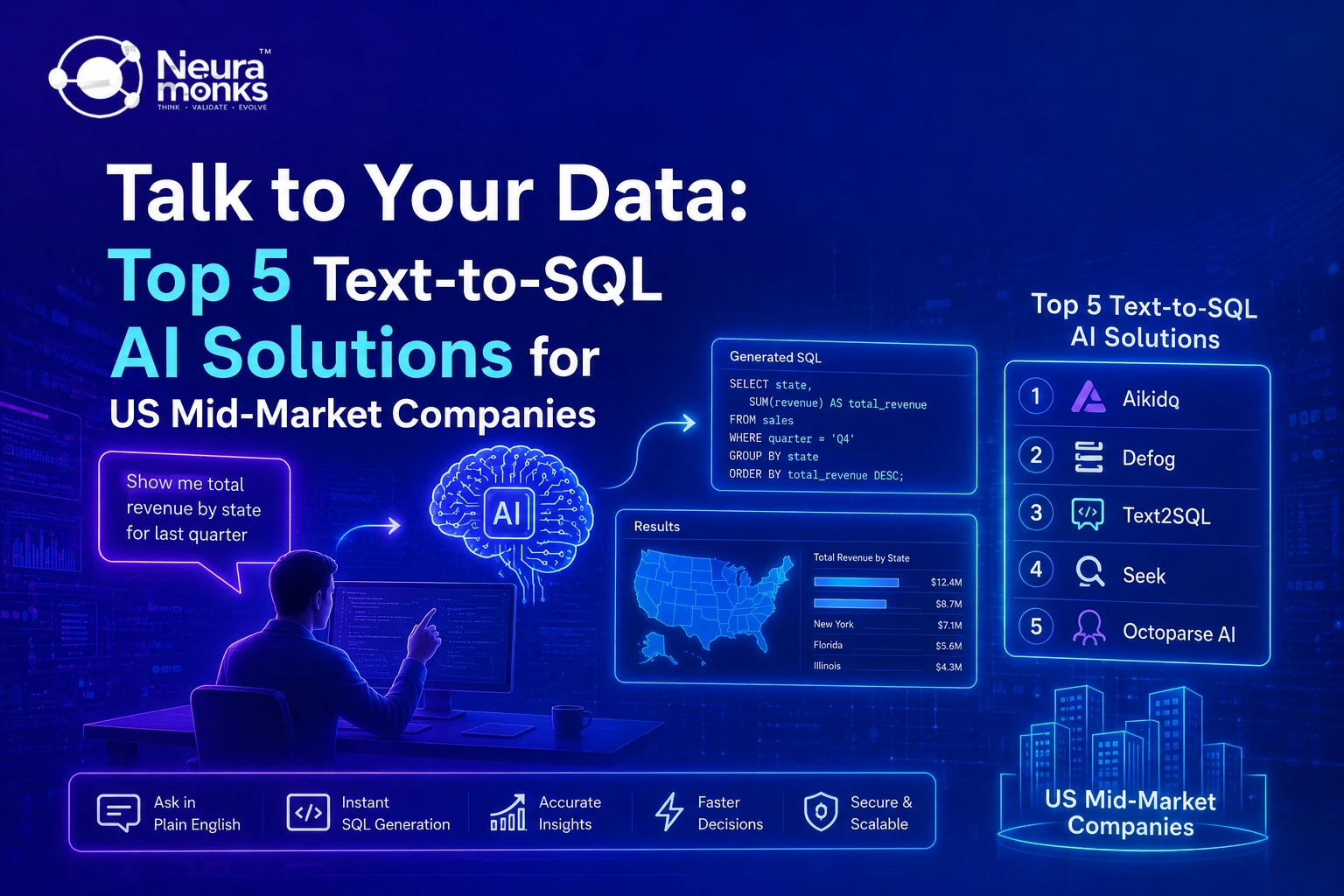
If you want to talk to your data without writing SQL, you're in the right place. Mid-market companies across the US are deploying text-to-SQL systems that let analysts, ops managers, and even finance leads type a plain-English question and get an answer in seconds no data team required. This guide breaks down the five tools doing it best in 2026, what they actually cost, and where they fall short.
Why mid-market companies are done waiting on data teams
Here's the math that's driving this shift.
A data analyst at a US company earns $95,000 to $130,000 per year (Bureau of Labor Statistics, 2025). They spend roughly 40% of their time writing and debugging queries that business users could have answered themselves. Meanwhile, a Suzano case study published by Google Cloud in 2026 showed a 95% reduction in query time after deploying a Gemini-powered agent that translates natural language directly into SQL. That's not a rounding error that's a structural change in how a business operates.
Mid-market companies generally 500 to 5,000 employees are in an odd spot. They have real data complexity: ERP systems, Salesforce, multiple warehouses, compliance requirements. But they don't have a 20-person data engineering team to build custom tooling. That gap is exactly what text-to-SQL AI solutions are filling.
By 2026, 68% of mid-market US companies report using or actively evaluating AI-assisted data query tools (Gartner, 2025). The question isn't whether to talk to data it's which tool to use.
Quick comparison: top 5 text-to-SQL tools for mid-market US companies

The 5 tools, honestly reviewed
1. Google Gemini + BigQuery
The Suzano outcome (95% query time reduction) used a Gemini agent. Google's approach lets you describe what you need in plain English and get SQL back, executed against your BigQuery data. For companies already on Google Cloud, the setup is relatively clean.
Where it struggles: if your data isn't in BigQuery, you're adding a migration project before you even get to the AI part. Mid-market companies on SAP or Oracle ERP typically need custom connectors that Google doesn't provide out of the box.
Stat: Google Cloud revenue grew 28% YoY in Q1 2026 (Alphabet earnings), suggesting strong enterprise adoption but that's not the same as mid-market fit.
2. Microsoft Copilot for Power BI
If your company runs on Azure and Microsoft 365, Copilot's text-to-SQL layer is the path of least resistance. It reads from your existing Power BI semantic models and lets users ask questions in plain English.
The catch: it only works well if your Power BI models are already clean and well-documented. Most mid-market companies we've seen have fragmented BI setups Copilot surfaces that mess rather than hiding it.
Stat: 85% of Fortune 500 companies use Microsoft 365 (Microsoft, 2025), but mid-market penetration of Copilot specifically sits around 23% (IDC, 2025).
3. ThoughtSpot Sage
ThoughtSpot built its entire product around search-driven analytics long before LLMs were mainstream, so the natural language layer here is mature. Sage adds generative AI on top of that foundation.
It's good for companies that want something out-of-box and have a clean data warehouse (Snowflake, Databricks). The enterprise contract structure means it's expensive for sub-1,000 seat companies.
Stop Planning AI.
Start Profiting From It.
Every day without intelligent automation costs you revenue, market share, and momentum. Get a custom AI roadmap with clear value projections and measurable returns for your business.

4. Databricks SQL AI
If your team has strong data engineering skills and your data lives in a Databricks lakehouse, their SQL AI assistant is technically solid. It understands schema context well and generates accurate queries for complex joins.
This is a tool for data teams, not business users. The gap between "data engineer who uses this" and "ops manager who needs an answer" is still wide.
5. Neuramonks purpose-built for ERP-heavy mid-market
This is where Neuramonks takes a different approach from the platforms above. Rather than retrofitting a general AI tool onto your data, we builds a custom talk to data layer directly against your source systems SAP, Oracle, NetSuite, Microsoft Dynamics without requiring a data warehouse migration first.
The practical result: a finance manager can type "show me overdue AR by region for Q1" and get an accurate answer in under 10 seconds, pulled live from ERP. No BI team in the loop.
See the full case study: Talk to Data Secure, Intelligent Analytics for ERP Systems
Neuramonks also supports a voice agent interface, which matters for operational roles warehouse supervisors, field ops leads who aren't going to open a browser to ask a data question.
Stat: Companies with direct ERP-to-AI integrations report 3.2× faster decision cycles compared to those routing through a BI layer (McKinsey, 2025).
What actually breaks text-to-SQL in practice
Most pilots fail for the same three reasons, and none of them are about the AI model.
Schema ambiguity. ERP systems have tables with names like VBAK, MARA, or BKPF. Without business-context mapping, even a strong LLM generates wrong SQL. The fix is a semantic layer that translates business language to schema terms and that layer has to be built, not assumed.
Security. When you allow natural language queries, you need row-level security enforced at the database level, not the UI level. Otherwise someone can ask a creative question and surface data they shouldn't see.
Hallucination at the aggregation layer. LLMs sometimes generate plausible-looking SQL that produces subtly wrong numbers. This is more dangerous than an error message it looks correct. The mitigation is query validation and result-range checks built into the pipeline.
If you want to understand more about what talk to data actually means technically, this beginner-friendly guide from Neuramonks is a solid starting point before you evaluate vendors.
What to ask vendors before you sign anything
Five questions that cut through demo theater:
- Can you show me a query against our actual schema, not a sandbox?
- How does your system handle row-level security in our ERP?
- What's the fallback when the model generates incorrect SQL?
- Do you support a voice agent interface for non-desk workers?
- What does onboarding look like for a company with 15+ data sources?
If a vendor hesitates on questions 1 or 2, that's information.
The commercial reality in 2026
AI solutions in this category span a wide price range. SaaS platforms charge $20–$80 per seat per month. Custom implementations from firms like Neuramonks typically run $60,000–$180,000 for the initial build, with ongoing retainers for model fine-tuning and schema updates.
The ROI math isn't complicated. If three analysts each spend 15 hours a week on ad-hoc SQL requests and that work drops to 3 hours you've recovered $180,000+ in annual capacity at median salaries. The payback period on a custom build is typically 6–10 months for a 200-person analytics-dependent team.
Stat: IDC projects the global text-to-SQL AI market will reach $4.1 billion by 2027, up from $890 million in 2024.
How to scope your own implementation
Three steps before you talk to any vendor:
Step 1: Inventory your data sources. List every system that holds data someone asks questions about. ERP, CRM, HRM, spreadsheets. Count the number of unique tables that matter.
Step 2: Identify your highest-value query patterns. What are the 20 questions your business asks most often? Revenue by region. Inventory turns. DSO. Those are your MVP queries. A good implementation nails those first.
Step 3: Define who the users are. Analysts are different from ops managers who are different from executives. Each user group has different tolerance for error and different query patterns. Design for the least technical user who needs access.
Ready to scope your project?
Neuramonks runs free proof-of-concept scoping calls for US mid-market companies evaluating text-to-SQL AI. In 30 minutes, you'll get a technical assessment of your data environment, a realistic timeline, and an honest read on which approach fits your stack whether that's Neuramonks or a platform tool.
Book your free POC scoping call with Neuramonks

Upendrasinh zala
Upendrasinh Zala is the Founder & CEO of Neuramonks, an enterprise AI and deeptech consulting firm based in Gujarat, India. Drawing from years of experience in AI-driven business strategy and corporate growth, he writes on leveraging artificial intelligence to optimize workflows and unlock tangible ROI for enterprises.