Insights and Inspiration
Explore Our Blog
Dive into our blog for expert insights, tips, and industry trends to elevate your project management journey.
Custom Agentic AI Development: Business Automation Guide
Custom Agentic AI Development builds AI agents around your specific data and workflows to automate multi-step business processes, cutting operating costs by 30–60% within two quarters.

Custom Agentic AI Development is the practice of building AI agents around a specific company's data, tools, and rules instead of buying a generic chatbot so the agent can plan, execute, and correct multi-step work on its own. Businesses use it to automate sales outreach, support tickets, claims review, and reporting, typically cutting operating costs by 30–60% within two quarters.
If you've spent the last year testing AI chatbots and copilots and wondering why none of them actually finished a task without you babysitting it, you're not alone. That's the gap between "AI that talks" and "AI that acts" and it's exactly the gap purpose-built agentic automation is built to close.
This guide walks through what agentic automation actually is, why off-the-shelf tools rarely survive contact with a real business process, what a proper build looks like, and how to pick a partner that won't leave you with an expensive demo.
Key Takeaways
- A custom-built agentic AI system is designed around your specific data and workflows, not a generic template that's why it survives real workloads.
- The global agentic AI market is projected to grow from roughly $9.1 billion in 2026 to $139.2 billion by 2034, a 40.5% CAGR (Fortune Business Insights).
- Gartner forecasts that 40% of enterprise applications will embed task-specific AI agents by the end of 2026, up from under 5% in 2025 (Gartner)
- Most agentic automation failures come from unclear success metrics and missing system access, not from weak AI models.
- A production-ready build typically runs 8–14 weeks from discovery to deployment.
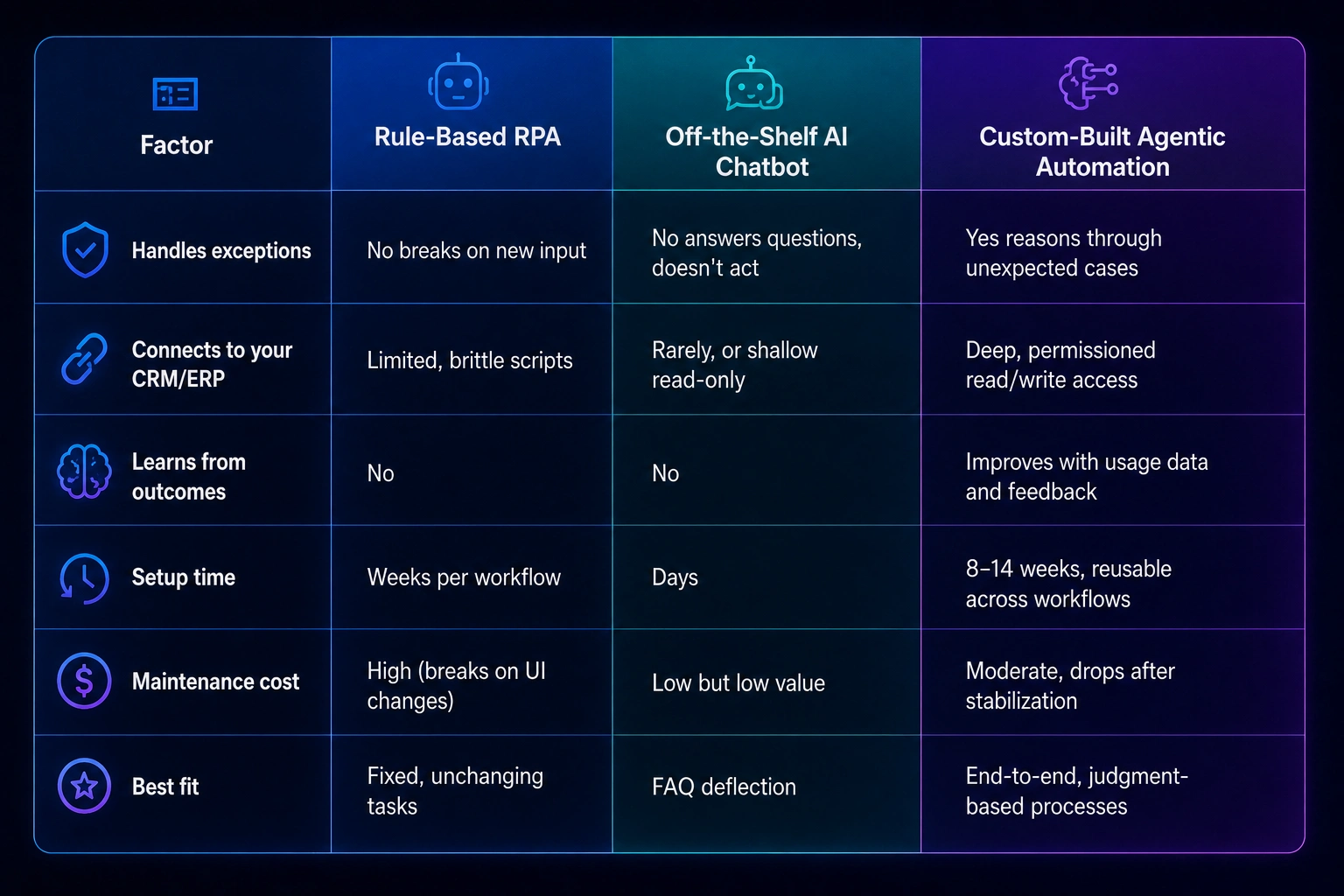
Off-the-Shelf Bots vs. RPA vs. Custom-Built Agentic Automation
Before picking a route, it helps to see the three approaches side by side. This is the comparison most teams skip and the one that ends up mattering most six months in.
What Is Agentic AI Automation, Really?
Agentic AI automation gives a large language model a goal instead of a question, then lets the model break that goal into steps, choose which tools to call, execute those steps, and report back without a person approving every move. A support chatbot answers "where is my order?" An agentic system checks the order status, issues the refund if policy allows it, logs the case, and only escalates to a human when it hits a decision it isn't authorized to make.
The distinction matters because most "AI automation" sold in 2025 was really automation with an AI-shaped wrapper: a chatbot bolted onto a form, or a script with a language model doing sentence completion at one step. Agentic AI Services go further. They combine a reasoning model, a tool-calling layer, and an orchestration framework so the system can string together research, decision-making, and execution in one continuous run.
Why Off-the-Shelf Tools Fall Short: The Case for Custom Agentic AI Development
Generic AI agent platforms are built to demo well across thousands of companies at once, which means they're tuned for the average case, not your CRM's odd field names, your approval chain, or the three exceptions your ops team handles by hand every week. That's where a tailored agentic AI build earns its cost.
A custom build starts from your actual workflow, not a template:
- Your data model. The agent is trained on how your business actually names accounts, statuses, and SKUs, not a generic schema.
- Your approval logic. Refund limits, discount thresholds, and escalation rules get built in as guardrails, not guessed at.
- Your existing stack. Integrations connect directly to the CRM, ERP, and ticketing systems you already run, through the Model Context Protocol (MCP) or direct API calls, so you're not migrating data to a new platform.
- Your compliance requirements. Healthcare, finance, and legal workflows need audit trails and human checkpoints that off-the-shelf agents don't ship with by default.
Off-the-shelf tools are fine for a single, narrow use case, drafting email replies, for example. But once a workflow touches more than one system or requires judgment calls, generic tools tend to hit a wall that only a custom-engineered agentic system is built to clear.
The Core Stack Behind Custom Agentic AI Development
A working agentic system is really five layers stacked on top of each other, not a single "AI feature." Understanding each layer helps you evaluate any automation vendor's proposal, because a vendor that glosses over orchestration or guardrails is usually selling a chatbot with extra steps.
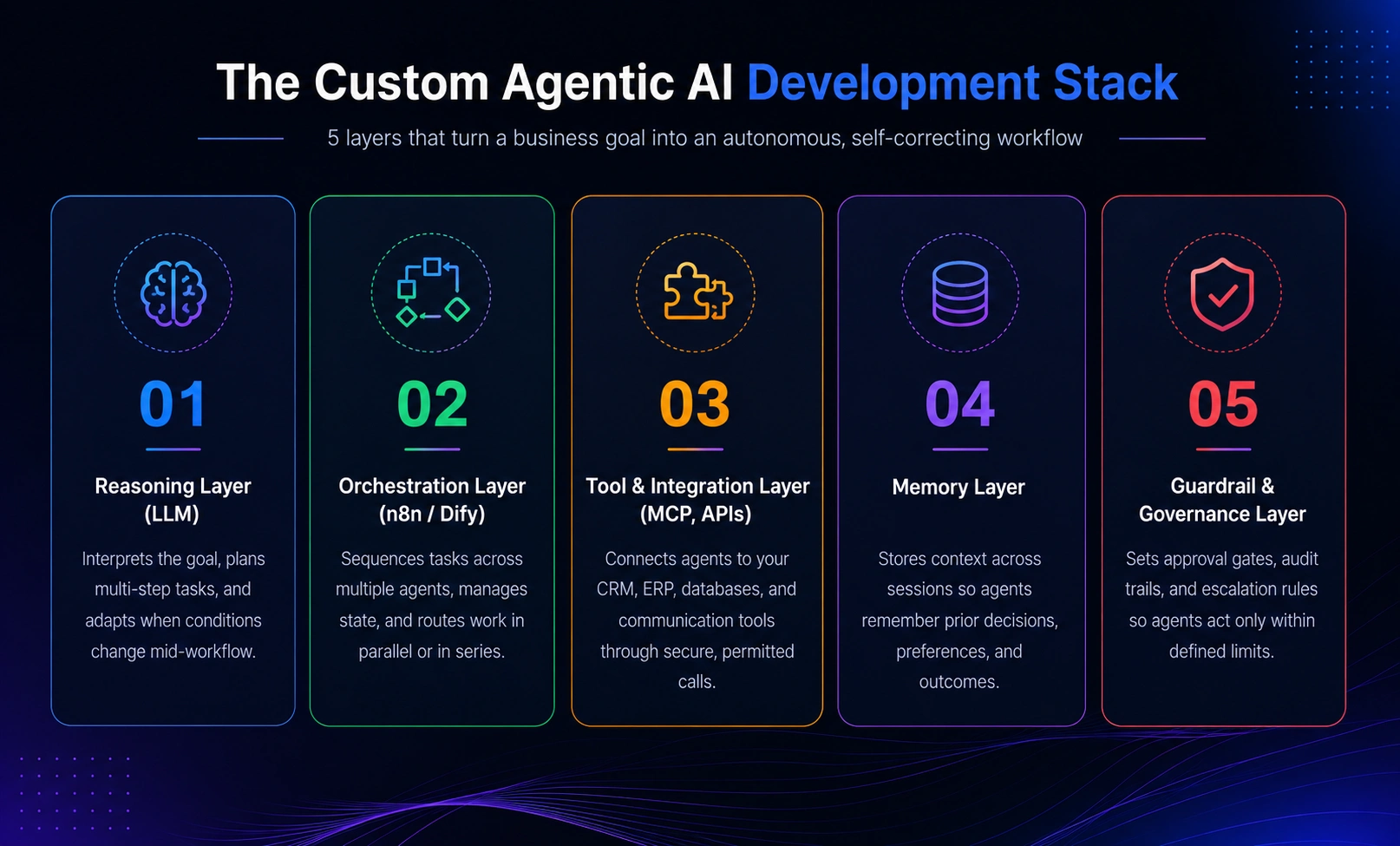
- Reasoning layer (the LLM). Interprets the goal and plans the sequence of steps, adjusting when a step fails or conditions change mid-task.
- Orchestration layer. Frameworks like n8n and Dify sequence tasks across single or multiple agents, track state, and decide what runs in parallel versus in order.
- Tool and integration layer. Connects the agent to your CRM, ERP, databases, and messaging tools through secure, permissioned API calls or MCP servers.
- Memory layer. Stores context across sessions so the agent remembers prior decisions instead of starting from zero every run.
- Guardrail and governance layer. Defines what the agent can do without approval, what needs a human sign-off, and how every action gets logged for audit.
Skip any one of these layers, and you get a system that works in the demo and stalls in production which is a big part of why Gartner expects more than 40% of agentic AI projects to be canceled by 2027, usually over governance gaps rather than model quality.
Where Agentic AI Services Deliver Measurable ROI
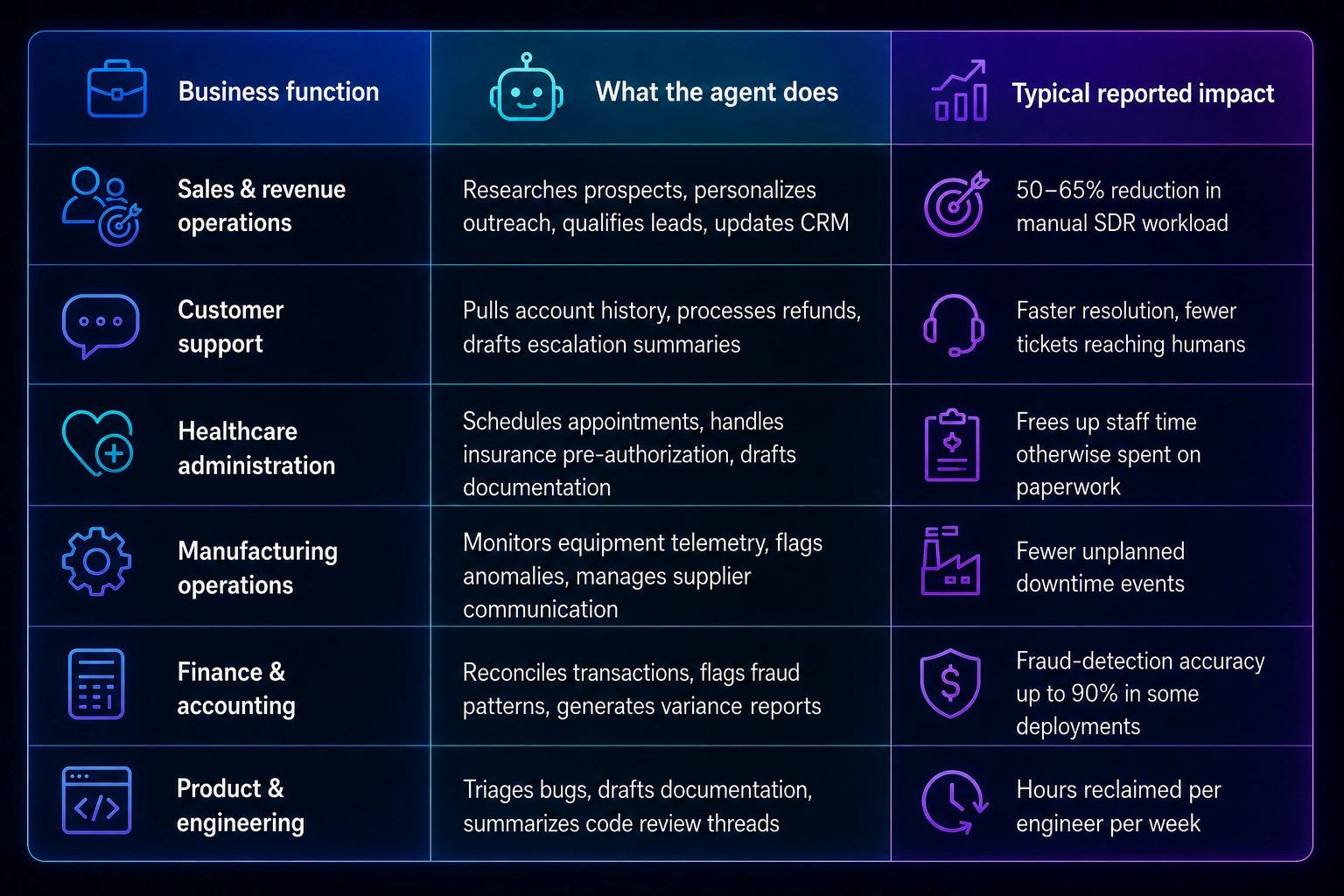
Almost every department can use some form of automation, but a handful of functions respond faster because they combine repetitive volume with judgment calls that used to require a person. Based on deployment patterns across enterprise clients, here's where autonomous business agents tend to pay for themselves fastest:
Agentic AI Automation Market Growth: The Numbers Behind the Shift
The spending pattern backs up what's happening on the ground. The global agentic AI market was worth roughly $7.3 billion in 2025, and market researchers project it will reach $9.1 billion in 2026 before climbing toward $139.2 billion by 2034, a 40.5% compound annual growth rate (Fortune Business Insights). Separately, Gartner projects that 40% of enterprise applications will carry task-specific AI agents by the end of 2026, up from less than 5% in 2025 (Gartner).
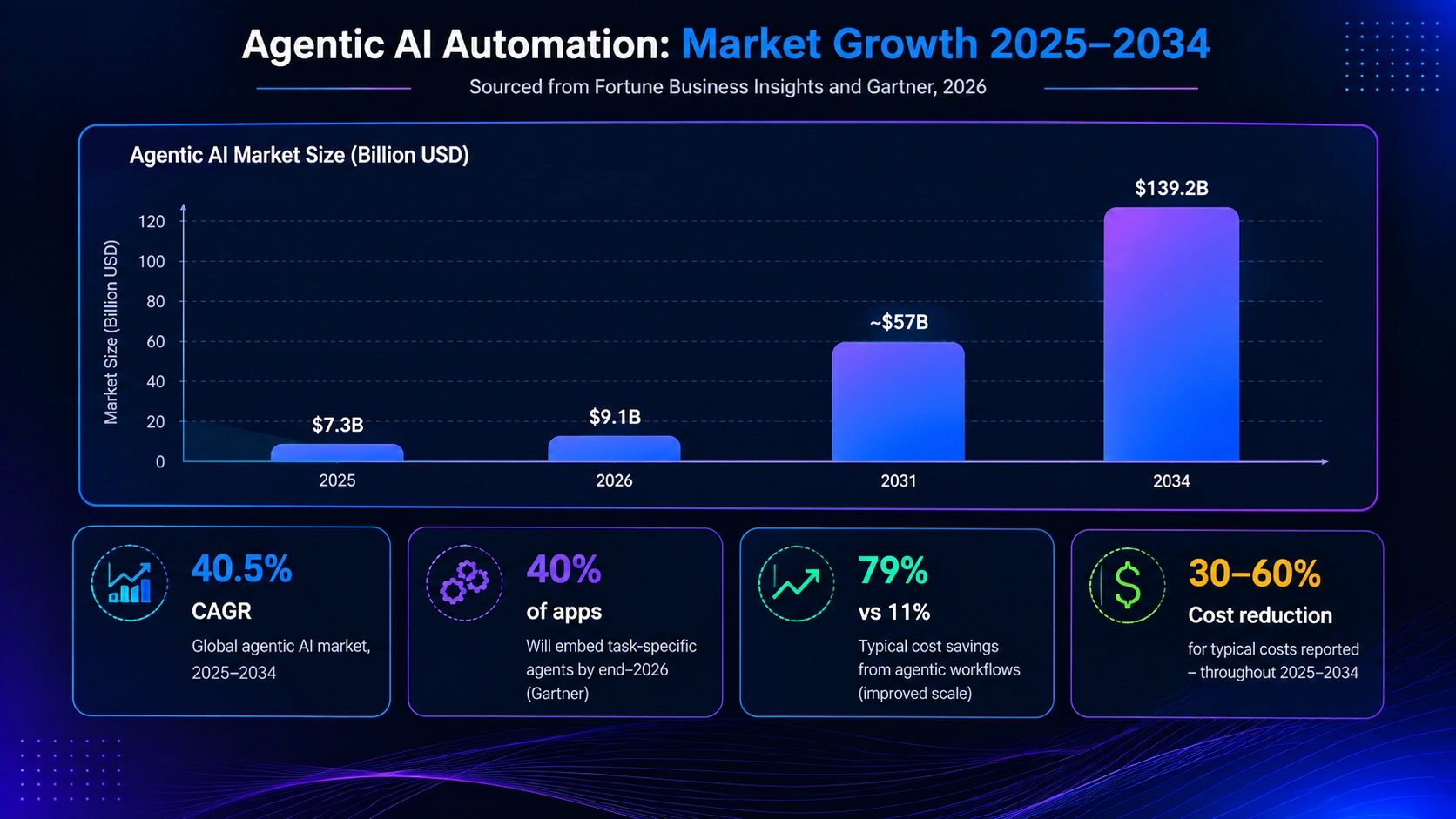
The adoption numbers, though, tell a more cautious story than the spending numbers. Roughly 79% of enterprises have adopted AI agents in some form, but only about 11–23% run them in production at scale a gap driven mostly by unclear success criteria and missing data access, not by weak underlying models. That gap is precisely why a rushed, generic rollout underperforms a properly scoped, custom-built agentic engagement.
How to Choose the Right AI Automation Agency
Not every automation vendor that says "agentic" actually builds agentic systems; plenty are reselling chatbot templates with a new label. Before signing with any automation partner, run through this checklist:
- Ask for a working proof of concept on your own data, not a generic demo. A serious partner should deliver this in three to four weeks.
- Confirm you own the code, models, and integrations at the end of the engagement no platform lock-in.
- Check their integration depth. Do they connect through your real CRM/ERP APIs, or just a webhook that reads surface-level data?
- Ask how guardrails are enforced, not just described. Approval gates and audit logs should be visible in the architecture, not a slide.
- Review post-launch support terms. Real-world usage surfaces edge cases in the first 90 days that a demo never will.
Questions like these separate a genuine Top AI Automation Agency from a vendor selling a repackaged template. The answers usually surface in the first call a partner that can't explain their architecture in plain language on request is worth a second look.
n8n vs. Dify: Picking Your Orchestration Layer
Two orchestration frameworks dominate most custom agentic automation builds today: n8n and Dify. Neither is universally "better"; the right choice depends on your team's technical depth and how much visual control you want over agent logic.
- n8n is a node-based automation platform well suited to workflows that mix agentic reasoning with traditional triggers a new CRM record kicking off an agent chain, for example. It's a strong fit when your team already runs other automations and wants agentic steps to slot into existing pipelines.
- Dify is built specifically around LLM application development, with native support for retrieval-augmented generation, prompt orchestration, and multi-agent workflows out of the box. A Dify AI Development Company typically ships faster for pure conversational-agent and knowledge-base use cases because less custom scaffolding is required around the model itself.
Many production builds actually use both: Dify for the agent's reasoning and knowledge layer, n8n for connecting that agent into the rest of the business's
AI Solutions stack and existing software.
The Custom Agentic AI Development Process, Step by Step
A properly scoped engagement follows a predictable sequence, whether you're automating claims review or supplier communication:
- Discovery and workflow mapping (weeks 1–2). Structured sessions with operations and technology leads map the existing process end to end and define success metrics before any code gets written.
- Proof of concept (weeks 2–4). A working prototype runs against one targeted workflow using real data and real systems, so you can measure results against a baseline before committing further budget.
- Agent architecture and build (weeks 4–10). The orchestration layer gets designed, the base LLM gets selected and tuned, tool integrations get built, and memory and guardrails get implemented for your specific industry.
- Deployment, training, and handover (weeks 10–14). The system goes live, your team gets trained, monitoring dashboards go up, and documentation gets delivered so you own the system outright.Continuous optimization. Performance data gets reviewed regularly to identify the next workflow worth automating, since most teams expand scope within six months of the first deployment.
Real-World Impact: What a Custom-Built Agentic System Looks Like in Production
Numbers on a slide are easy to produce; numbers from a running system are not. Here are two examples of what a custom-built agentic system looks like once it's live.
Case Study 1: AI Podcast Production Platform
The challenge. A podcast production platform needed to handle topic research, factual grounding, narrative consistency, and multi-speaker script formatting steps that were previously done manually, one at a time, by a human production team.
The build. Rather than a single AI agent, the team built a multi-agent system using more than ten specialized agents, each responsible for one part of the pipeline:
- A research agent that gathers and organizes source material on the episode topic.
- A fact-grounding agent that checks claims against verified sources before they reach a script.
- A narrative-consistency agent that keeps tone, continuity, and structure aligned across a full episode.
- A script-formatting agent that structures the output for multiple speakers.
The automation flow. Once the script is finalized, it's routed automatically to text-to-speech engines, meaning the process runs from research to finished audio with no manual handoff in between.
The result.
- 60–70% reduction in manual production effort
- 50–65% faster content-creation cycles
- 30–40% higher content and tonal consistency across episodes
This system was built by Neuramonks, and the full breakdown including how the agent handoffs and RAG grounding were architected is available in their AI podcast generation platform case study
Case Study 2: AI Voice Agent for Pizza Ordering
The challenge. Pizza restaurants take a high volume of time-sensitive phone orders, and traditional phone-based ordering created clear bottlenecks: calls missed or rushed during peak hours, order errors on toppings, sizes, and quantities, heavy dependence on staff availability, and no structured data captured from calls for analysis or forecasting. As order volume grew, manual phone intake became both costly and unreliable.
The build. we built an AI voice agent that answers calls and takes complete pizza orders end-to-end, without staff involvement. The system includes:
- Restaurant-specific menu intelligence covering sizes, toppings, add-ons, and customizations.
- Structured, step-by-step conversational flows for order capture and confirmation.
- Real-time, low-latency voice session management to hold up under peak-hour call volume.
- Automated extraction and persistence of structured order data for downstream analytics.
The agent had to handle accurate menu interpretation in noisy environments and varied accents, complex multi-item orders with customizations, and natural conversation flow including corrections and clarifications while still reliably extracting structured data from free-form speech.
The result.
- 50 - 60% reduction in manual, phone-based order handling
- 25 - 35% reduction in order errors
- 30 - 40% improvement in peak-hour order capture capacity
Full details are in Neuramonks' AI Voice Agent for Pizza Ordering case study.
Both systems were built by Neuramonks, whose complete guide to Agentic AI Services for business growth covers the methodology behind these and other deployments in more depth.
Common Pitfalls That Sink Agentic AI Automation Projects
Most failed agentic rollouts don't fail because the model was too weak. They fail for reasons that show up long before deployment:
- No clear success metric. "Improve efficiency" isn't measurable. "Cut ticket resolution time from 4 hours to 20 minutes" is.
- Missing system access. An agent that can read data but can't write to the CRM ends up creating manual work, not removing it.
- No evaluation discipline after launch. Agents drift as real-world inputs diverge from training scenarios; without ongoing evaluation, accuracy quietly degrades.
- Skipping the proof-of-concept stage. Jumping straight to full-scale deployment without validating on real data is the single biggest predictor of the projects Gartner expects to get canceled by 2027.
- Treating governance as an afterthought. Guardrails bolted on after launch are far harder to retrofit than guardrails designed in from day one.
Getting Started with Custom Agentic AI Development
If you're weighing whether to build in-house, buy a platform, or bring in outside help, the honest answer depends on how core the workflow is to your business and how much integration depth it needs. A narrow, low-stakes task might be fine with an off-the-shelf tool. Anything touching customer data, financial approvals, or multiple systems is usually worth the extra weeks a proper custom-built agentic engagement takes.
Neuramonks builds agentic systems with tool use, guardrails, and human review that survive real workloads, not just demos. As a specialized AI automation agency, the team runs discovery, delivers a working proof of concept within three to four weeks, and hands over full ownership of the code, models, and integrations at the end of the engagement. If you want a concrete build plan for one specific workflow, book a free discovery call and get a scoped roadmap within one business day.
Conclusion
Agentic AI automation isn't a single product you can buy off a shelf; it's a system built around how your business actually operates. Custom Agentic AI Development takes longer to stand up than a chatbot integration, but it's the difference between a pilot that gets quietly shelved and a system that keeps paying for itself a year later. The market data backs the direction: spending is accelerating fast, but the enterprises actually reaching production are the ones that scoped a real workflow, built proper guardrails, and measured results before scaling.
Ready to see what Custom Agentic AI Development could do for your highest-friction workflow? Book your free discovery call and get a scoped automation roadmap no commitment required.
LLM Implementation Services for Enterprise Teams
A practical breakdown of what it actually takes to move an LLM from demo to production, covering RAG, agentic orchestration, RBAC, real cost ranges, and the questions to ask before hiring an implementation partner.

Most enterprise AI initiatives don't fail because the model isn't smart enough. They fail because a slick weekend demo gets budget approved, and the team spends the next eight months discovering it can't handle authentication, data governance, latency, or hallucinations under real load.
That gap between demo and production is where enterprise LLM implementation lives. This guide breaks down what building production-grade AI actually involves, what it costs, how to evaluate vendors, and how to avoid the trap of a six-figure pilot that never reaches deployment.
Enterprise LLM implementation covers everything required to move a large language model from a demo into a production system: data pipeline design, retrieval architecture, agentic orchestration, security hardening, integration with existing software, and ongoing monitoring after launch. A structured proof-of-concept phase up front confirms return on investment before full build-out begins.
This isn't a theoretical exercise. The decisions covered below- build versus buy, RAG versus fine-tuning, which metrics to lock in before writing a line of code- show up in almost every enterprise AI kickoff call, regardless of industry. Healthcare, finance, manufacturing, and SaaS teams all hit the same forks in the road. What changes is the compliance layer on top, not the underlying engineering questions.
What enterprise LLM implementation actually involves
A large language model by itself is a raw capability. It has no memory of your business, no access to your internal documents, no understanding of your compliance requirements, and no connection to the systems your team already uses. Implementation is the engineering work that turns that raw capability into something your operations can rely on.
Enterprise LLM solutions typically bundle five components, and skipping any one of them is a common reason pilots stall before reaching production:
- Structuring, cleaning, and indexing internal documents, tickets, transcripts, or records so a model can actually use them.
- Vector databases such as Pinecone, Weaviate, or pgvector that let a model pull relevant context at the moment it's needed, instead of guessing.
- Choosing between a hosted model, a fine tuned variant, or a hybrid setup based on cost, latency, and data sensitivity.
- Connecting the model to CRM systems, ticketing platforms, internal wikis, or whatever software already runs the business.
- Tracking accuracy, hallucination rate, and cost per query after launch, since model behavior drifts as usage patterns and underlying data change.
Skip the retrieval layer, and the model hallucinates policy details. Skip monitoring, and nobody notices when accuracy quietly drops three months in.
Skip integration and the "AI project" becomes a browser tab nobody on the team actually opens.
Why so many AI pilots never make it to production
Enterprises often assume AI solutions run themselves once deployed. They don't. Generative AI adoption is accelerating across nearly every industry, but adoption and value capture are two different numbers, and the gap between them is wide. Gartner has reported that more than half of these initiatives get abandoned after the proof of concept stage, with data quality gaps, unclear risk controls, and runaway costs cited as the leading causes (source: Gartner).
In our own engagements, the pattern is almost always the same three root causes:
- See if AI can help with X" is not a target. A defined baseline, a target KPI, and a review date must exist before the first line of code is written.
- Unstructured, duplicated, or poorly tagged internal documents produce a retrieval layer that returns garbage, and no amount of prompt engineering fixes a bad index.
- A model deployed and left alone degrades. Someone on the team, internal or vendor, has to own drift monitoring and retraining.
None of these are model problems. They're implementation problems, and they're exactly what a competent LLM implementation partner is supposed to catch before they become six-figure write-offs.
Six Requirements Enterprise LLM Architecture Must Cover
Enterprise teams rarely fail because a model can't generate a response. They fail because nothing around the model was built to survive production traffic, security review, or a compliance audit.
Agentic orchestration is the layer that closes that gap. Instead of a single LLM handling every request, orchestration coordinates multiple agents, routes tasks, and enforces structure across the entire workflow.
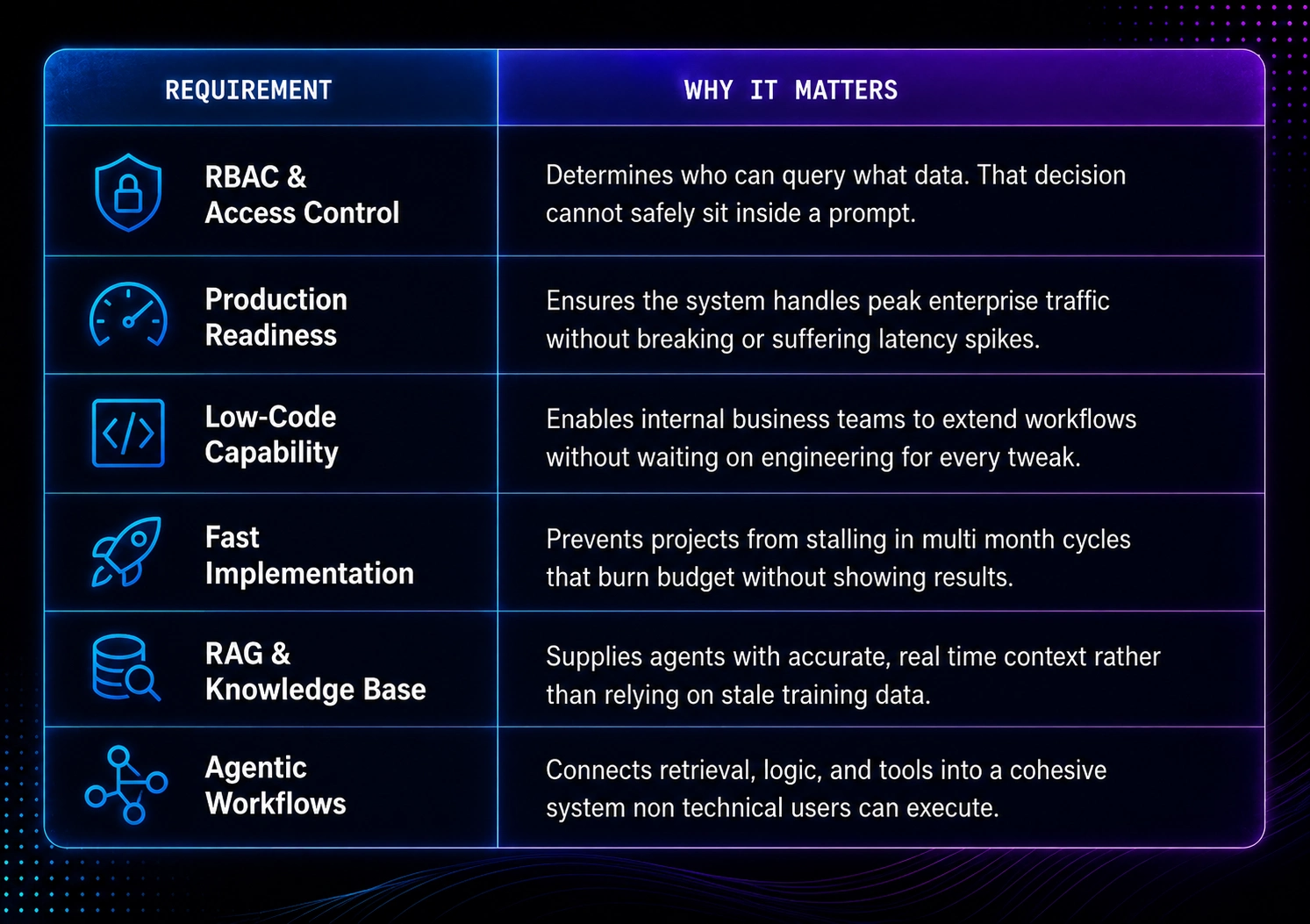
Six requirements come up in nearly every enterprise engagement:
Get these six right and automation stops being a pilot project. It becomes infrastructure, and infrastructure is what drives faster implementation and measurable ROI.
Build in-house, hire an agency, or run a hybrid team
This is the decision enterprises get wrong most often, usually because it gets framed as a cost question when it's really a capability and timeline question.
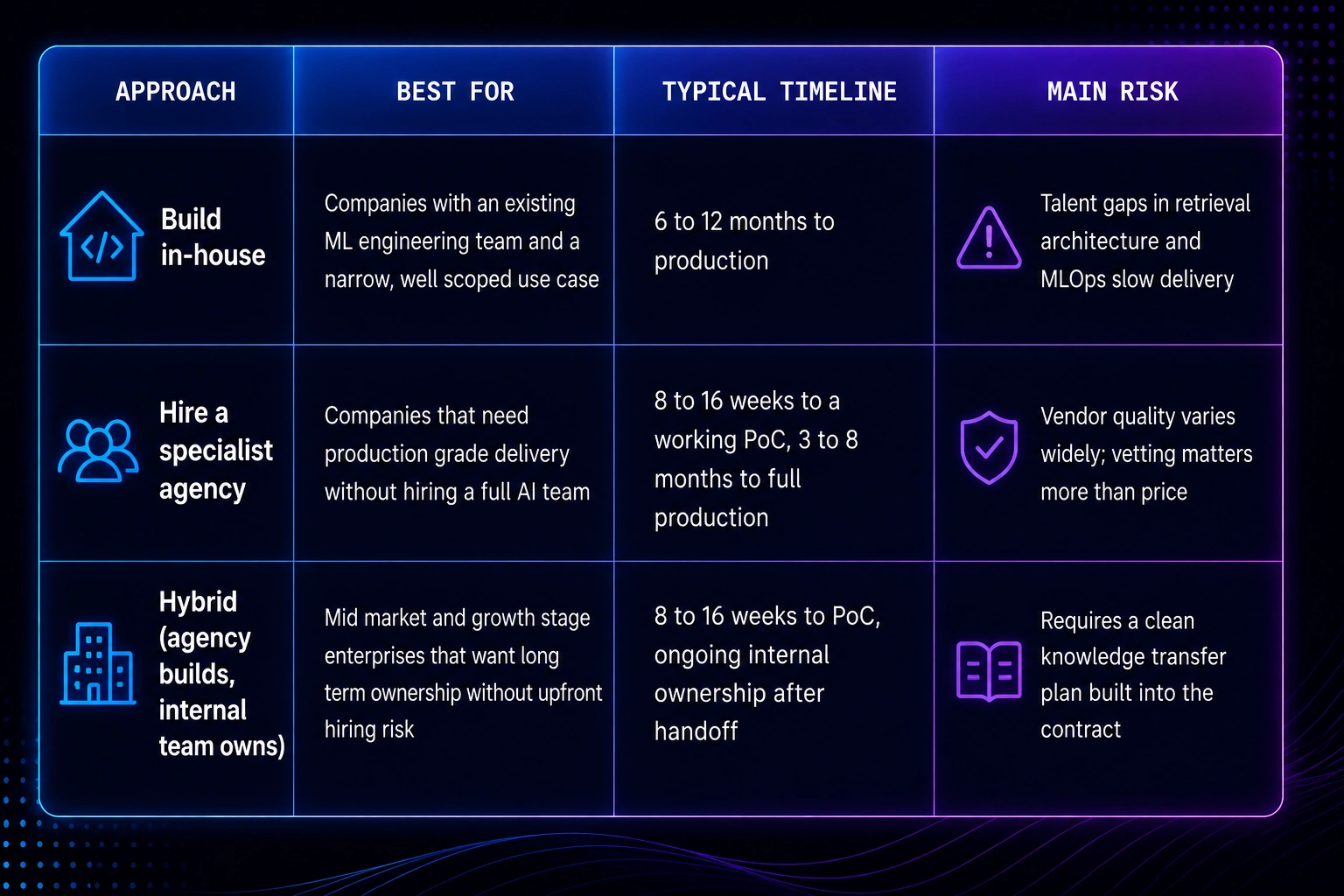
Purchasing from a specialized vendor succeeds noticeably more often than building the same system from scratch with a first time internal team, largely because agencies have already made, and fixed, the expensive mistakes on someone else's project. That advantage disappears fast, though, if the agency you hire has never actually shipped enterprise LLM solutions past the demo stage.
How a successful enterprise LLM deployment is structured
Every engagement starts with a business outcome, not a model choice. Before any architecture decision gets made, the question on the table is what number is supposed to move: cost per ticket resolved, hours saved per week, accuracy against a human baseline, or something else specific enough to measure in 90 days. At Neuramonks, we structure every engagement around that outcome, moving through three distinct phases.
Phase one: proof of concept (4 to 8 weeks)
Real client data, a narrow use case, and a defined go or no go metric agreed before work starts. No synthetic test data, no "let's see what happens" scope.
Phase two: production build (8 to 16 weeks depending on scope)
Retrieval pipeline, agentic orchestration, model integration, security hardening, and connection to existing systems like a CRM or internal knowledge base.
Phase three: MLOps and monitoring (ongoing)
Drift detection, cost tracking, and scheduled retraining cycles, because a model that worked well at launch won't necessarily still work well six months later.
One example from a media production client: the team needed to scale podcast output without growing the editorial staff at the same rate, moving from 3 episodes a week to 12. A multi-agent pipeline was built where one agent handled topic research through live web retrieval, a second structured and scripted each episode, and a third routed finished scripts to a text-to-speech layer, all coordinated through an agentic orchestration layer that managed handoffs between the three.
End-to-end production time dropped by roughly 70% against the prior manual workflow, and the system now runs across multiple show formats without a human in the research or scripting steps. For a deeper look at how this kind of architecture decision gets made,
See our full breakdown of enterprise LLM development beyond chatbots.
What enterprise LLM implementation costs in 2026
Pricing varies by scope, compliance requirements, and how much of the surrounding infrastructure already exists. The ranges below reflect typical market rates, not fixed quotes.
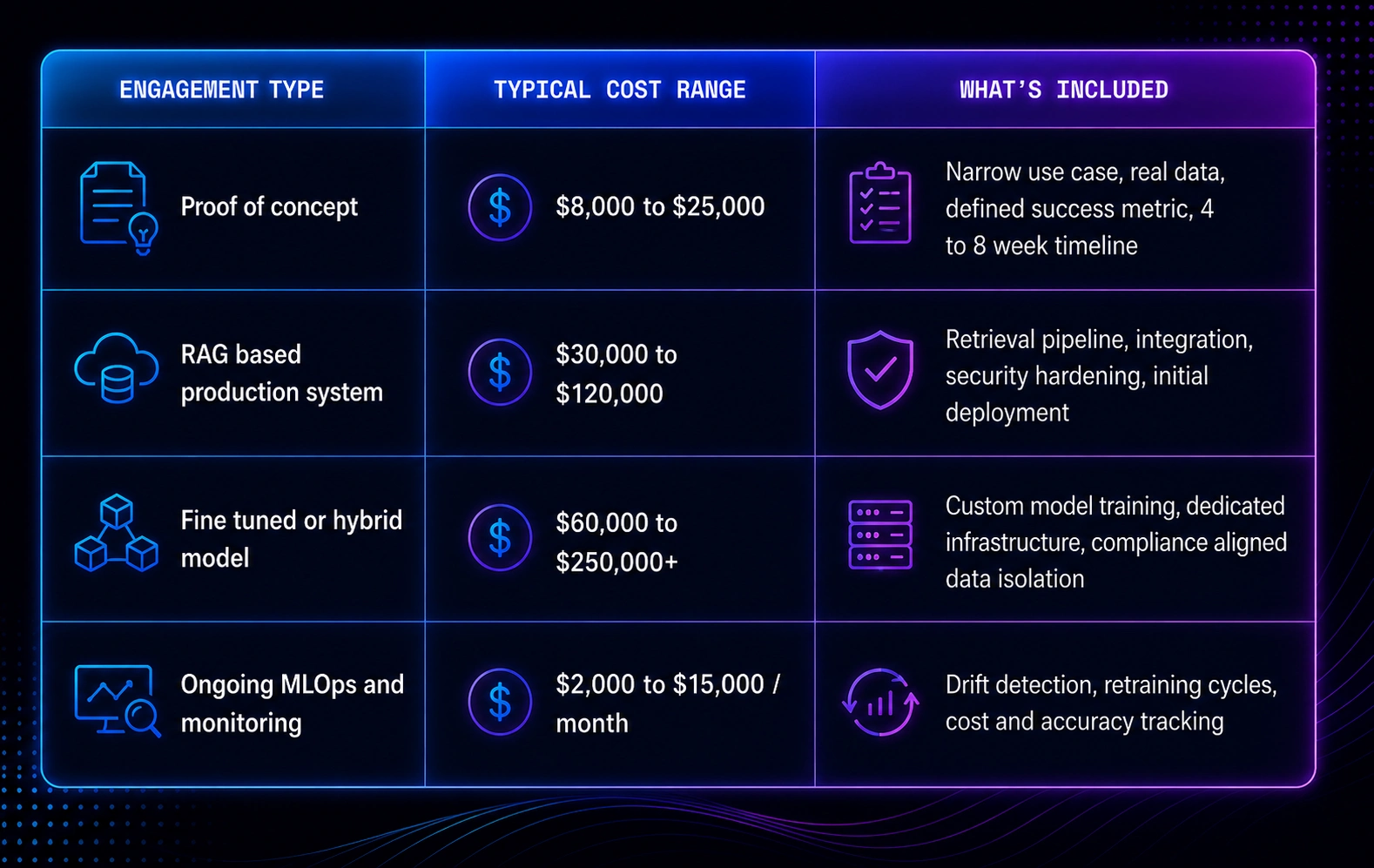
Most enterprise LLM solutions fall into the RAG-based production tier, since retrieval delivers accuracy comparable to fine-tuning for the majority of internal use cases, at a fraction of the training and maintenance cost. Fine-tuning earns its higher price tag when a business needs a self-hosted model with no external API calls, or highly consistent domain-specific output that context injection can't reliably produce.
Questions to ask before signing with an implementation partner
A short, direct evaluation list, worth working through in the first sales call rather than after a contract is signed:
- Can you show a production deployment with real accuracy or cost numbers, not just a demo?
- What's your default recommendation between RAG and fine tuning, and why?
- How do you structure the proof of concept phase, and what's the go or no go criteria?
- Who owns monitoring and retraining after launch, and at what ongoing cost?
- What compliance certifications or data isolation practices apply to regulated data?
- What happens to the system and the knowledge behind it if we end the engagement?
An agency that can't answer the fourth question clearly is quietly planning to leave a system your team doesn't know how to maintain.
Five mistakes that sink enterprise LLM projects
Choosing a vendor on price alone
LLM engineering is a specialist skill, and the lowest quote in the room is usually the one with the least production experience behind it.
Skipping the proof of concept phase
Jumping straight from requirements to full build is one of the most reliable ways to burn a large budget on a system that never ships.
No agreed success metric before work begins
Vague goals produce vague, unmeasurable results, and a review six months later with nothing to show for it.
Treating deployment as the finish line
A model that isn't monitored will drift, and nobody notices until a customer or an auditor does.
Defaulting to fine-tuning for everything
It's expensive, slow to iterate on, and unnecessary for most retrieval-style use cases. A partner who reaches for it by default is optimizing for their own invoice.
Where this leaves you
The technology is no longer the hard part. Hosted models are commodity infrastructure at this point, and almost anyone can wire one up to a chat window in an afternoon. The hard part, and the part that actually determines whether a project produces value or becomes a write off, is the engineering work around the model: the data pipeline, the retrieval layer, agentic orchestration, RBAC, the integration, and the discipline to keep monitoring it after launch.
That's the work enterprise LLM implementation services exist to do, and it's worth vetting a partner on exactly that basis rather than on how good their demo looks in a sales call.
Ready to audit your AI roadmap?
Bring your actual use case and data constraints. In 30 minutes, Neuramonks will tell you whether RAG, fine-tuning, or a standard workflow is the right fit, and what it would take to get there.

Dify AI for Enterprise: What It Actually Takes to Get an Agent Live
A build-vs-buy breakdown backed by a real Gemini plugin case study instead of a demo pitch, showing why most Dify pilots stall after week one and what fixes it.
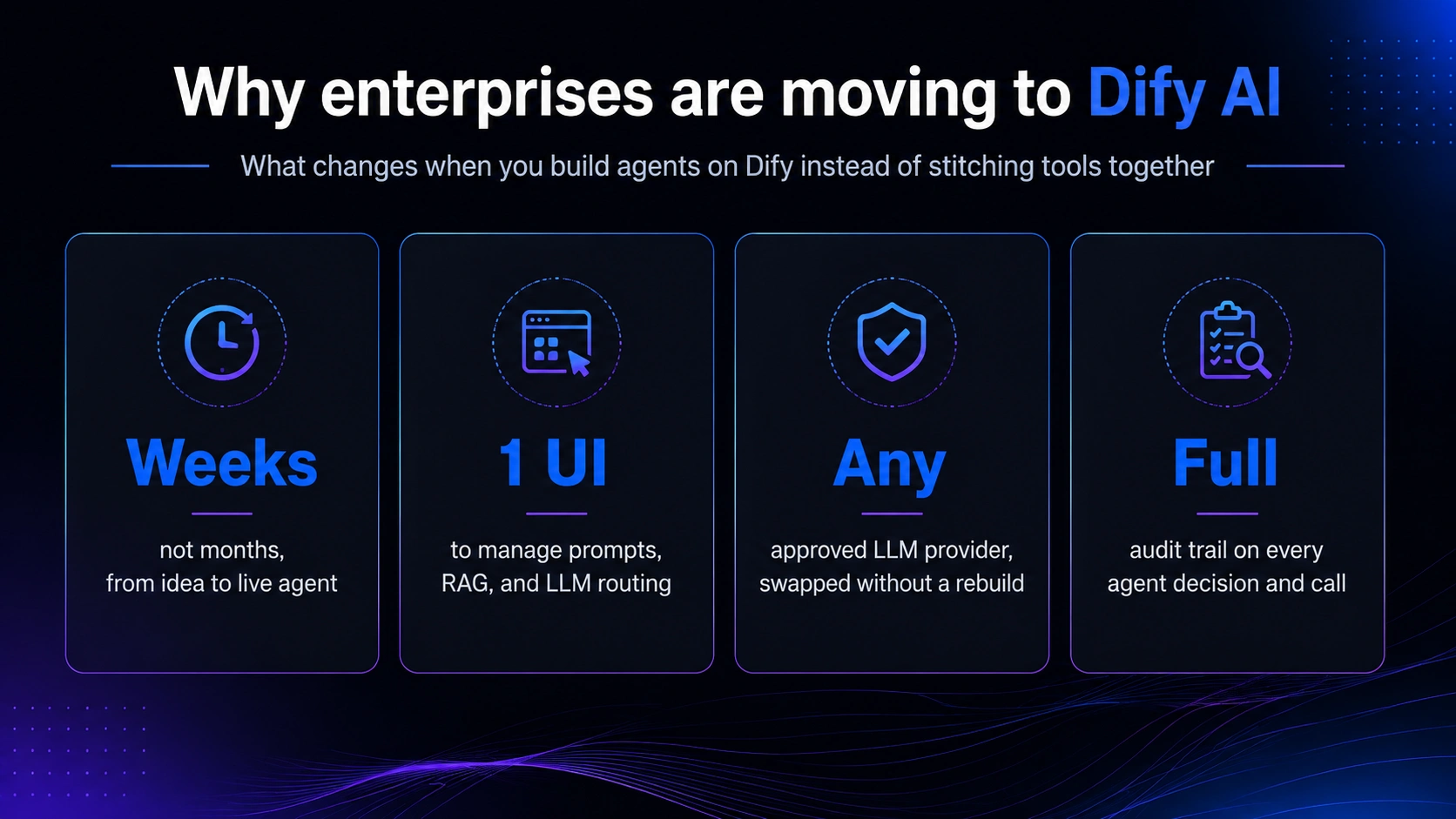
Dify AI for enterprise pairs a no-code agent builder with RAG pipelines and multi-LLM routing, so teams launch production-ready AI agents without a large engineering bench. Working with an experienced Dify AI Development Company like Neuramonks cuts that build time from months to weeks, while keeping every prompt, data source, and workflow fully auditable.
Your Team Already Believes in AI. So why isn't it Live Yet?
Here's the pattern almost every enterprise team hits. Someone in leadership saw a demo. It looked effortless. Then the project landed on an internal team already stretched across three other priorities, and six months later there's a Notion doc, a few Slack threads, and no agent.
It's rarely a lack of ambition. It's usually one of three things: the in-house team doesn't have resources to own an AI project on top of their day job, the "AI chatbot" pilot that got built doesn't actually know anything about the business, or legal and security flagged the vendor before it got anywhere near production.
Dify exists to remove the middle problem. It's an open-source LLM application platform that gives you a visual canvas for building agents, connecting retrieval-augmented generation (RAG) to your own documents, and routing requests across different language models depending on cost, latency, or accuracy needs. You're not writing orchestration code from scratch. You're configuring it.
What Enterprise Buyers Actually want (and rarely say out loud)
Nobody opens a vendor call by saying, "I want a testament to innovation." What people actually want, once you strip away the sales language, is much simpler:
Speed without giving up control. Teams want an agent live this quarter, not a 12-month roadmap. But they also don't want to hand a black box to a vendor and hope for the best.
The ability to swap models later. A team that commits to a single LLM provider today is betting the business will never need a cheaper or more capable option next year. Dify's model-agnostic architecture means you can route between GPT, Claude, Gemini, or an open-weight model without rebuilding the agent underneath it.
Proof it works before a full rollout. Most buyers want a working pilot in one department (usually support or internal knowledge search) before they'll sign off on a company-wide deployment.
Someone who's done this before. This is where the build-vs-buy decision usually comes down to trust. A capable AI automation agency or a specialized Dify AI Development Company has already hit the edge cases your internal team hasn't seen yet: token cost blowouts, hallucination on edge-case queries, and provider approval processes that take longer than the build itself.
Where this Gets Real: a Gemini Integration Under Enterprise Constraints
Most enterprise AI mandates come with a catch: you can't just call any LLM API directly. Procurement and security teams often require models to run through an approved cloud provider, with its own authentication, logging, and compliance layer.
That's exactly the situation behind Neuramonks' Dify plugin development and custom Gemini LLM integration case study, where a custom plugin was built to route Gemini calls through an approved provider instead of a direct API connection. It's the kind of detail that never shows up in a product demo, but it's usually the difference between a pilot that clears security review and one that stalls for another quarter.
Build in-house, Hire a Generalist Agency, or go with a Dify specialist?
This is the decision most enterprise teams are actually weighing, and it deserves a straight comparison instead of a sales pitch.

The middle option isn't wrong; it's just built for a narrower job. A generalist automation agency can wire up a Zapier-style workflow fast. But once RAG, LLM provider approval, and audit logging enter the conversation, that's a Dify-specific skill set, not a general automation one.

What the First 30 Days Actually look like
Step one is never "build the agent." It's figuring out which single workflow is worth automating first. The teams that get this right usually start with something narrow and painful, like a support queue drowning in repeat questions, or a sales team burning hours searching through scattered internal docs for pricing and product details.
From there, the sequence is fairly consistent across enterprise Dify projects:
- Scope the pilot. Pick one workflow, one team, and a clear success metric (ticket deflection rate, response time, hours saved per week).
- Connect the knowledge base. RAG only works if it's pointed at the right documents, kept current, and scoped so the agent isn't guessing outside its lane.
- Choose the model routing logic. Not every query needs your most expensive model. Simple lookups can route to a cheaper model, while complex reasoning tasks route to a stronger one.
- Run it in shadow mode. Before customers or employees see it, the agent answers in parallel with a human, and someone checks the gap between the two.
- Go live, then watch the logs. This is where most vendors disappear and most in-house teams get stuck. Someone needs to own the first month of tuning.
That last point is where a lot of pilots quietly die. Not because the technology failed, but because nobody was assigned to watch it after launch week.
Take a support queue as an example. Week one, the agent handles maybe 30% of tickets correctly and escalates the rest, which is exactly what should happen with a new system. By week three, once someone has reviewed the escalations and tightened the RAG sources, that number usually climbs past 60%. Teams that skip the review step tend to plateau at that first-week number and quietly conclude "AI doesn't work for us," when the real issue was nobody tuned it.
The same logic applies to internal knowledge search. A sales team asking an agent about pricing tiers needs the agent pointed at the current pricing doc, not last quarter's version sitting in a forgotten folder. Getting RAG right is less about the AI model and more about document hygiene: what's indexed, what's outdated, and who's responsible for keeping it current.
Where Dify fits into a broader 2026 AI roadmap
Dify isn't a replacement for your existing AI solutions stack. It's the layer that sits between your raw data and the LLM, handling retrieval, tool calls, and model routing so your team isn't rebuilding that plumbing for every new use case. Once one agent is live and proven, the second and third ones move faster, because the RAG pipelines and provider integrations are already in place.
This is also why the "one agent at a time" approach tends to outperform an ambitious company-wide rollout attempted in one shot. A single working pilot gives you real usage data, real edge cases, and a template for the next department that wants one.
What to check before you sign with anyone
Whether you go in-house, hire a generalist agency, or bring in a specialist Dify partner, ask these questions before signing anything:
- Have they shipped a Dify agent that had to route through an approved LLM provider, not just a direct API key? That approval process trips up more projects than the actual model performance does.
- Who owns the agent after week one? Vendors that disappear after launch leave your team debugging a system nobody fully understands.
- Can they show a real build, not a demo environment spun up for the sales call? The Gemini plugin case study above is a working example, not a mockup.
- What happens when the underlying LLM provider changes pricing or gets deprecated? If the answer requires rebuilding the agent, that's a warning sign.
None of this is complicated once you know to ask it. Most enterprise teams just haven't gone through an AI vendor selection cycle before, so these questions don't come up until after something's already gone wrong.
A Workflow that's Been "on the Roadmap" for two Quarters is a Signal, not a Failure
If your team keeps meaning to get to an AI agent project and keeps not getting to it, that's not a discipline problem. It usually means the in-house bandwidth isn't there, and it won't magically appear next quarter either.
That's the exact gap this fills for enterprise teams. The work isn't about selling a platform. It's about scoping the one workflow worth automating first, building it in Dify with the right RAG sources and provider-approved LLM routing, and staying on it after launch so week-one tuning doesn't fall on your internal team.
Talk to Neuramonks about your specific use case, and expect a straight answer about whether Dify is the right fit before anything gets built. If it isn't, we'll say so.
Custom AI Healthcare Solutions: A Buyer's Guide
A buyer's guide explaining why off-the-shelf AI tools fail healthcare workflows like wound care and prior authorization, and how a scoped pilot lets hospitals test a custom-built solution before committing to a full contract.
Custom AI healthcare solutions replace generic, off-the-shelf software with tools built around a specific clinical workflow, such as wound imaging analysis or prior authorization automation. Neuramonks USA builds these systems through a scoped pilot engagement so hospitals and clinics can validate results before committing to a full production build.
Every healthcare administrator evaluating AI right now is facing pressure from three directions at once: fewer staff to do the work, a rising documentation load, and boards asking for a cost-reduction plan with numbers attached. The American Hospital Association's 2026 Workforce Scan names administrative burden and staffing gaps as the top pressures facing hospital leaders this year, and industry reporting citing McKinsey research puts a global figure on what closing the healthcare worker shortage could mean for the economy: roughly $1.1 trillion in added value. That is the backdrop against which most buyers search for AI solutions, usually landing on generic chatbots repackaged for healthcare rather than tools engineered for an actual clinical workflow.
The pattern repeats across specialties. A wound care clinic needs consistent measurement, not a chatbot. A billing office needs prior authorization drafted against payer-specific rules, not a summarizer. A front desk needs intake triage that understands its own scheduling logic, not a generic FAQ bot. Buyers who evaluate AI vendors on demo polish alone tend to discover the gap only after signing, when the tool cannot actually plug into the EHR or imaging system already running the department.
Why Generic AI Tools fail Healthcare Providers
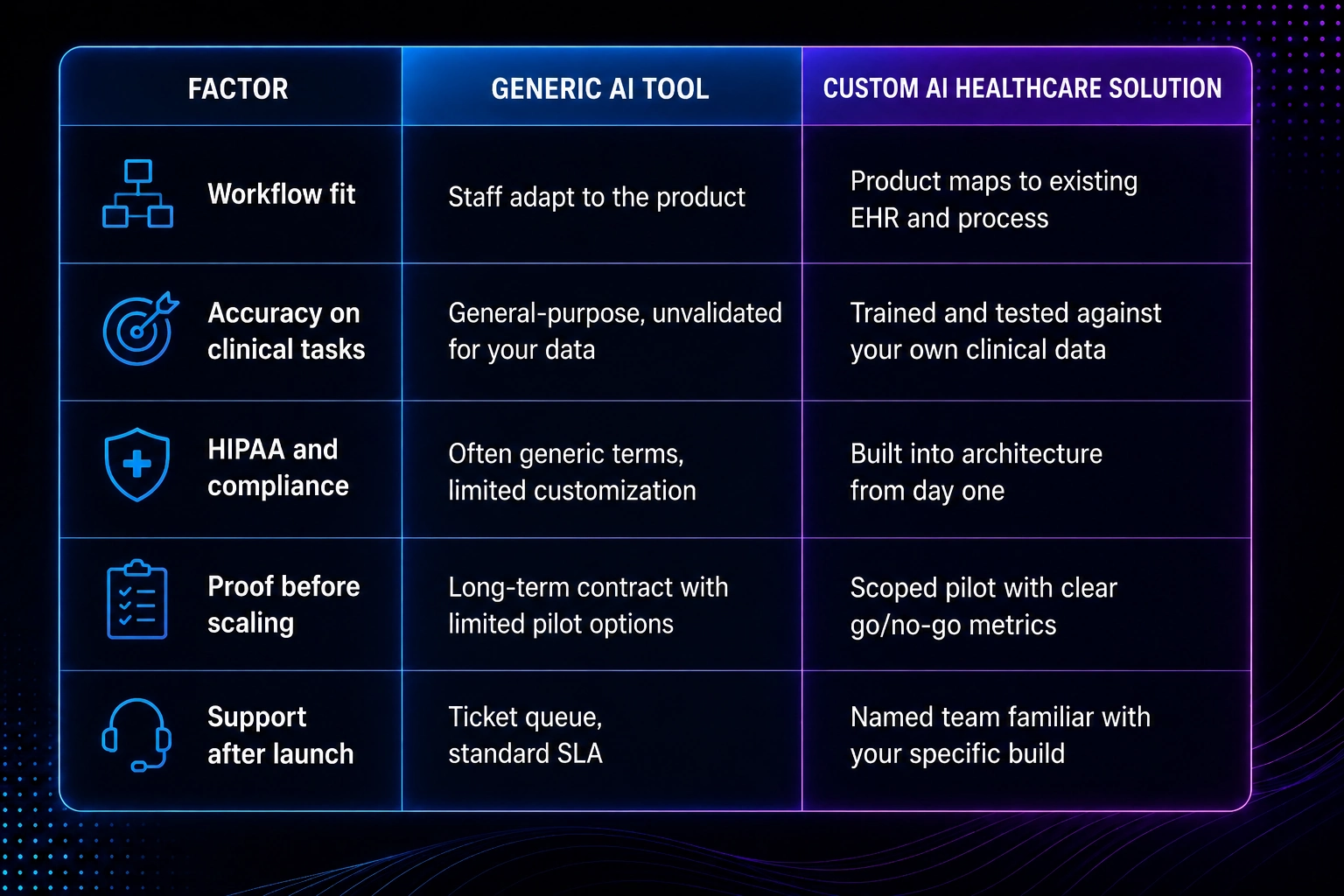
A general-purpose AI assistant can summarize a note or draft an email. It cannot reliably measure a wound from a clinical photo, flag a prior authorization likely to be denied, or route an intake form to the right specialist based on your clinic's specific triage rules. Those are narrow, high-stakes tasks that require a model trained and validated against your data, your documentation standards, and your compliance requirements, not a general model doing its best guess.
This is the gap a custom healthcare AI build is designed to close. Instead of asking staff to adapt their workflow around a generic product, a custom build maps to the EHR, the imaging system, and the documentation format your team already uses. The result is a tool clinicians actually open, not one more login they avoid. It also means fewer support tickets down the line, because the system was validated against your own edge cases before launch rather than a generic sample dataset.
There is a second, quieter cost to generic tools: liability. A wound measurement that is off by even a few millimeters, repeated across hundreds of patient visits, can distort a wound-healing trend line that a physician relies on to decide whether a treatment plan is working. A prior authorization draft that misreads payer rules can delay care by weeks. Generic tools are built to be broadly useful. Clinical workflows need to be precisely correct for the one use case they serve.
What a Custom-Built Healthcare AI System Actually Solves
Medical Imaging and Wound Care Analysis
Wound care is a clear example of where generic tools fall short. Manual wound measurement is slow, inconsistent between clinicians, and hard to track over time across multiple visits. Neuramonks built an automated wound detection and measurement system using deep learning that analyzes clinical photos to detect wound boundaries and calculate measurements automatically, giving clinicians a consistent, repeatable reading instead of a manual tape-measure estimate that varies by who is holding it.
Clinical Documentation and Prior Authorization
Documentation and prior authorization consume hours of clinician and staff time every week. A custom AI healthcare solution can draft visit notes from a conversation, flag missing information a payer is likely to reject, and pre-fill authorization requests against payer-specific rules, cutting the manual review time down to a final check rather than a full rebuild.
Patient Intake and Triage
Front-desk and call-center staff spend significant time on repetitive intake questions before a patient ever reaches a clinician. An AI agent handling structured intake, appointment routing, and basic triage questions frees that staff time for tasks that actually need a human, particularly during the seasonal volume spikes that strain most practices.
Data handling is built around HIPAA, not bolted on after
A qualified AI development partner designs access controls, data residency, and audit logging into the system architecture from the first technical decision. Retrofitting compliance after a generic product is already built is where most healthcare AI projects run into trouble during a security review.
AI Proof of Concept Services: proof before you commit
Few healthcare leaders want to sign a six-figure contract for a system nobody has tested against their own data. That is the reasoning behind scoping a smaller pilot first: pick one workflow, such as wound measurement or intake triage, run it against real (de-identified) patient data for four to eight weeks, and measure the result before expanding the build. If the pilot does not perform, you have lost a fraction of what a full commitment would have cost. If it does, you now have evidence, not a vendor's promise, to bring to your board.
How to evaluate a healthcare AI development partner
Bring these questions into the first vendor call, before any contract discussion:
- Can you show a clinical or operational system you built that is running in production today, not just a pilot?
- How do you handle HIPAA and data residency in the system architecture, specifically?
- What does a scoped pilot look like for our specific workflow, and what would we measure to decide whether to scale it?
- Who owns the model outputs and the underlying data once the engagement ends?
- What does support look like six months after launch, once the initial contract is over?
A vendor who answers with named examples and specific numbers is signaling real experience. A vendor who answers with reassurance and marketing language is signaling the opposite, regardless of how polished the demo looked.
Early Research Versus an Active Buying Decision
Not every reader of a guide like this is choosing between finalists this month. Some administrators are early in the process: gathering internal support, building a business case, or figuring out which workflow to test first before procurement gets involved. Others already know they want a wound-care imaging tool or a documentation assistant and are comparing two or three vendors directly.
Both groups can use the same framework. If you are early, use the comparison table above to build an internal scorecard so stakeholders are judging vendors against agreed criteria instead of demo polish. If you are closer to a decision, take the five questions above into your finalist calls and ask each vendor to answer in writing, so you have something concrete to compare once the calls are over.
What the Results Actually Look like
Numbers matter more than a demo. we documented how a healthcare operations team applied automation to reduce administrative overhead in How Healthcare Agencies Cut Operational Costs by 40%, and What It Actually Takes to Get There, which breaks down the specific workflow changes behind that figure rather than presenting the percentage on its own. Read it alongside the wound detection case study above if you want to see both a clinical and an operational example before scoping your own pilot.
Custom Build Versus Generic Tool, side by side
Why Neuramonks is Built for this Work
Neuramonks USA builds AI healthcare solutions for hospitals, clinics, and diagnostic centers, with delivery teams across the US, India, and the UAE working on Agentic AI, RAG development, Computer Vision, and AI Automation projects specifically scoped to healthcare, manufacturing, and construction clients. The wound detection system referenced above is one example of that clinical, deep-learning work already running in production, not a hypothetical capability described in a sales deck.
Engagements open with a discovery call focused on one workflow, not a full department rebuild. That keeps the first conversation short and the first commitment small, which matters when the person evaluating vendors also has to justify the spend to a CFO or a board that has seen AI promises fall short before.
If you are scoping a pilot for your organization, book a free consultation with the Neuramonks USA team and bring the specific workflow you want tested first.
How to Choose a Development Partner for AI Integration
Why most AI integration projects stall before production, and the exact criteria (industry proof, deployment history, data terms, pricing) that separate a real AI partner from a demo shop.

Choosing the right AI development partner means checking four things before you sign anything: proven integration work in your industry, a transparent build methodology, real production deployments (not just demos), and a contract that protects your data and IP. Run every AI integration project candidate through that checklist first.
Most AI integration projects do not fail because the model is bad. They fail because the vendor could not connect the model to the systems that actually run the business. According to MIT's Project NANDA research, about 95% of generative AI pilots never produce measurable profit-and-loss impact, and the same study found that companies buying AI solutions from specialized vendors succeeded roughly 67% of the time, compared with about one-third for teams that tried to build everything internally. The gap is not the technology. It is who builds it.
If you are the person tasked with picking that vendor, this guide walks through what actually separates a dependable AI development partner from a slide deck with a logo on it. It also covers how to weigh transactional questions (who do I call, what does it cost, how fast can they move) alongside informational ones (what should I even be looking for).
Why the Wrong AI Integration Partner Costs more than the Project Itself
Picture the scenario from the buyer's side, not the vendor's. Someone on your team has been asked to "figure out AI" for the customer support queue, the claims intake process, or the equipment maintenance log. They talk to three vendors. Two show a slick demo running on sample data. One asks to see your actual CRM, your actual data pipeline, and your actual compliance requirements before quoting anything.
That third vendor is usually the one worth hiring, and here is why. AI solutions that look impressive in a sandbox often break the moment they meet real, messy, production data: duplicate records, inconsistent formats, systems that were never designed to talk to each other. A development partner who has not planned for that will hand you a pilot that never leaves the lab. A Gartner analysis cited in recent industry reporting found that organizations scrap close to half of their AI proofs-of-concept before they ever reach production, largely because integration and data readiness were never scoped properly at the outset.
The cost of picking wrong is not just the wasted contract value. It is the months of internal credibility burned, the data exposed to a vendor with no security process, and the AI integration project that quietly dies while leadership loses appetite for the next one.
What to look for in an AI development partner
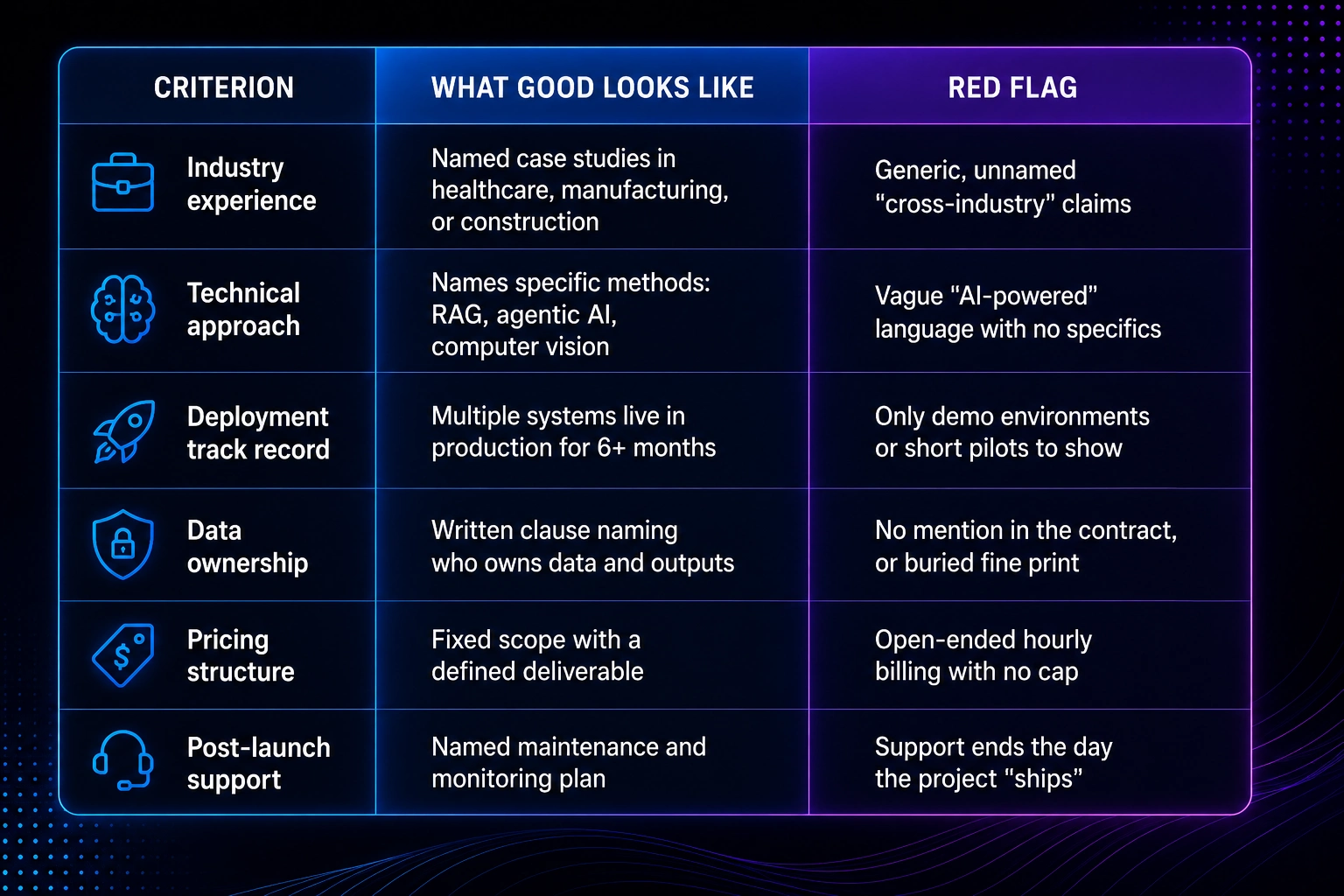
Proven Work in your Specific Industry
An AI development partner who has shipped agentic AI for healthcare intake will understand HIPAA constraints, clinical documentation formats, and patient data handling without you explaining it twice. The same logic applies to manufacturing (equipment telemetry, predictive maintenance, ERP integration) and construction (project management systems, field data capture, subcontractor workflows). Ask for named case studies in your vertical, not generic "we work across every industry" language.
A Named, Explainable Technical Methodology
Ask the partner to describe, in plain language, how they will connect the AI model to your existing systems. A credible AI consulting company should be able to name the specific approach: retrieval-augmented generation (RAG) for grounding answers in your own documents, an agentic AI workflow for multi-step tasks, or a computer vision pipeline for visual inspection. Vague answers about "leveraging the latest AI" are a warning sign, not a selling point.
Production Deployments, not just Pilots
A pilot proves a concept works in a demo. Production proves it survives contact with your actual users, actual data volume, and actual edge cases. Ask directly: "How many of your AI integration projects made it past the pilot stage into daily production use, and for how long have they been running?" A partner with real answers to that question is rare and worth paying for.
Clear Data Ownership and Security Terms
Your contract should state plainly who owns the data, who owns the model outputs, and what happens to your information if the engagement ends. Any AI development partner that hedges on this question, or buries it in a generic terms-of-service link, has not thought through enterprise security the way a serious AI consulting company should.
Transparent, Scoped Pricing
Fixed-scope quotes tied to a defined deliverable beat open-ended "time and materials" arrangements for a first engagement. This lets you compare vendors on equal footing and avoids a project that grows quietly more expensive every sprint.
Evaluation Criteria at a Glance
Questions to Ask Before You Sign a Contract
Bring these into the first sales call, not the final round of negotiations:
- Can you show me three reference clients in my industry, and can I speak with them directly?
- Walk me through the last AI integration project you shipped to production. What broke, and how did you fix it?
- Who owns the data and the model outputs once this project is live?
- What does support look like in month six, after the initial contract ends?
- How do you handle a data source that turns out to be messier than expected?
A partner who answers these clearly, with specifics rather than reassurance, is signaling that they have actually done this before. That is the entire point of the exercise: separating AI solutions vendors who can talk about AI from those who can ship it.
Vetting Technical Fit Versus Vetting Business Fit
Buyers often collapse two separate evaluations into one conversation. Technical fit asks whether a vendor can build the thing: do they have engineers who have shipped retrieval-augmented generation systems, agentic workflows, or computer vision models at production scale? Business fit asks a different question: will this vendor answer the phone in month eight, will their pricing survive a scope change, and do they understand your industry's compliance requirements well enough to not need a crash course?
A development partner can pass one test and fail the other. A large systems integrator might have deep technical bench strength but treat a mid-market healthcare client as a rounding error on a bigger contract. A boutique AI consulting company might move fast and communicate well, but lack engineers who have actually deployed a RAG pipeline against a messy, undocumented legacy database. Score both dimensions separately during your evaluation instead of letting a strong demo (technical fit) paper over vague answers about support and pricing (business fit).
Informational Research Versus a Buying Decision
Not everyone reading a guide like this plans to sign a contract this quarter. Some readers are mapping out what AI integration even means for their organization, gathering internal buy-in, or building a business case before procurement gets involved. Others already know they need an AI development partner and are comparing two or three finalists.
Both groups benefit from the same underlying framework. If you are early in the research phase, use the evaluation table above to build an internal scorecard before you ever get on a sales call, so stakeholders are evaluating vendors against agreed criteria rather than gut feeling. If you are closer to a decision, use the questions in the next section directly in your finalist conversations, and ask each AI development partner to answer in writing so you have something to compare side by side after the calls end.
What this Looks like in Practice
Neuramonks has published two related breakdowns worth reading alongside this guide. How to Choose an AI Solutions Partner for Your US Healthcare Practice goes deeper on vertical-specific evaluation criteria for clinical and administrative workflows. Top AI/ML Companies in the USA, Ranked by Innovation and Revenue gives a wider market view if you are actively building your shortlist of AI development partner candidates.
Why Neuramonks Approaches AI Integration this Way
Neuramonks is an AI consulting company built specifically around the problem this guide describes: too many AI solutions never make it past the pilot stage. Neuramonks teams work across Agentic AI, RAG development, Computer Vision, AI Automation, n8n workflows, and Enterprise Dify implementations, with a client base concentrated in healthcare, manufacturing, and construction. Every engagement opens with a discovery call scoped around your actual systems and data, not a generic template deck.
If you are evaluating AI development partners for an upcoming AI integration project,Book a free consultation with the Neuramonks team and bring the questions from this guide with you.
Agentic AI Services: The Complete Guide to Autonomous Agents for Business Growth
A practical breakdown of what Agentic AI Services actually are, where they create the most business impact, and how NeuraMonks builds autonomous agents that deliver measurable ROI in weeks, not months.
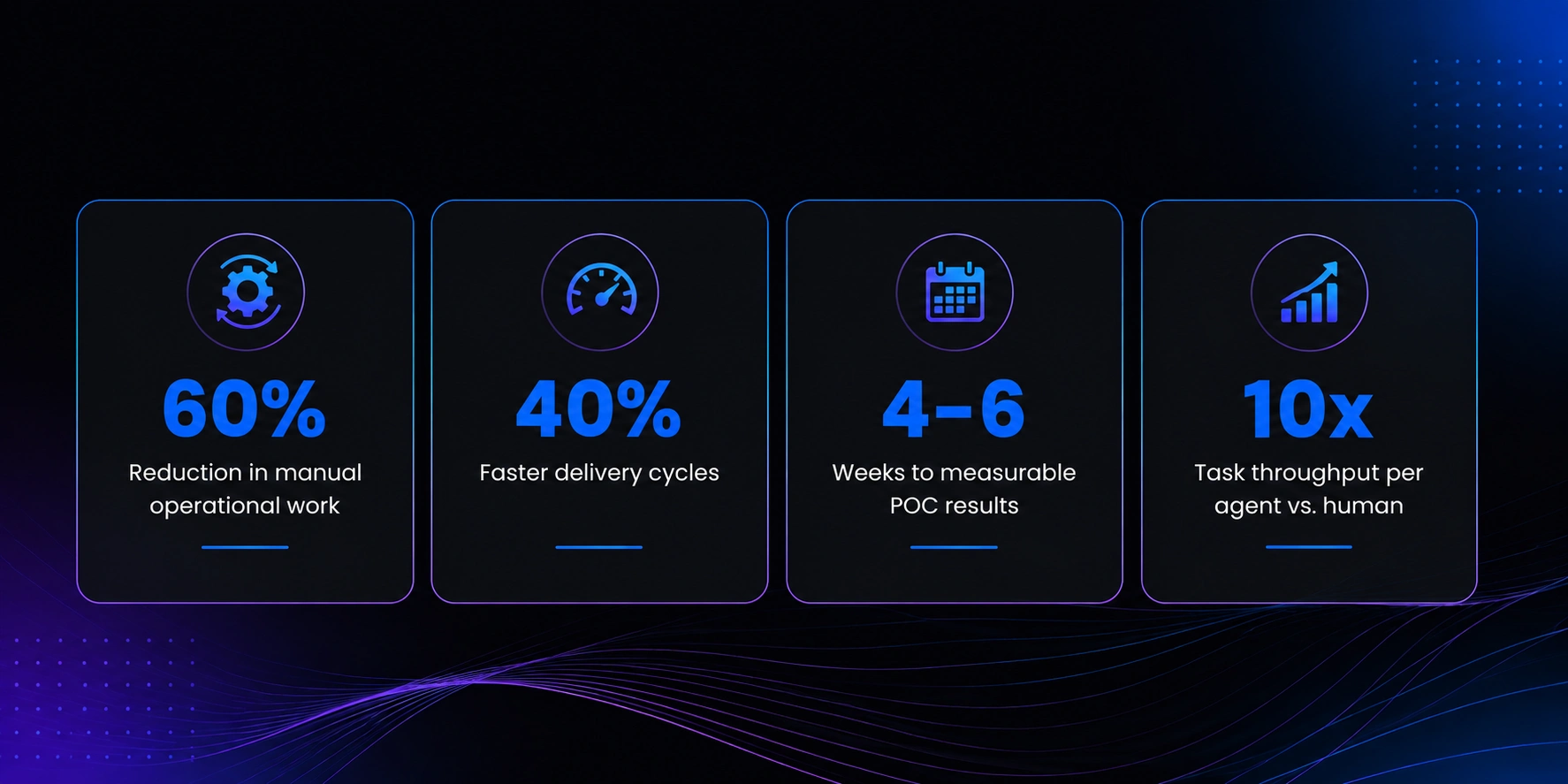
Agentic AI Services are enterprise solutions that deploy autonomous AI agents to plan, decide, and execute multi-step business workflows without constant human input. Leading providers like Neuramonks build these systems by combining large language models, tool integrations, and multi-agent orchestration to cut operational costs by 30–60% and accelerate delivery cycles by up to 40%.
Somewhere between the chatbot hype of 2023 and the full-scale automation wave of 2026, a quieter revolution has been unfolding inside the fastest-growing companies on the planet. They stopped asking AI to respond. They started asking it to act.
That shift from reactive tools to proactive, goal-oriented systems is what separates traditional AI from Agentic AI Services.. And it is changing what is possible in enterprise operations, sales, healthcare, customer experience, and product development at a pace that even seasoned technologists are still absorbing.
This guide breaks down everything you need to know: what Agentic AI actually is, how it differs from the automation you may already use, where it creates the clearest business value, and how Neuramonks helps organizations move from curiosity to deployment with measurable ROI baked in from week one.
What Are Agentic AI Services and Why Do They Matter Now?
Most people's first encounter with AI in business was a chatbot something you typed a question into and got an answer back. Useful. But fundamentally passive. It waited for you. It answered one thing at a time. It forgot everything the moment the session ended.
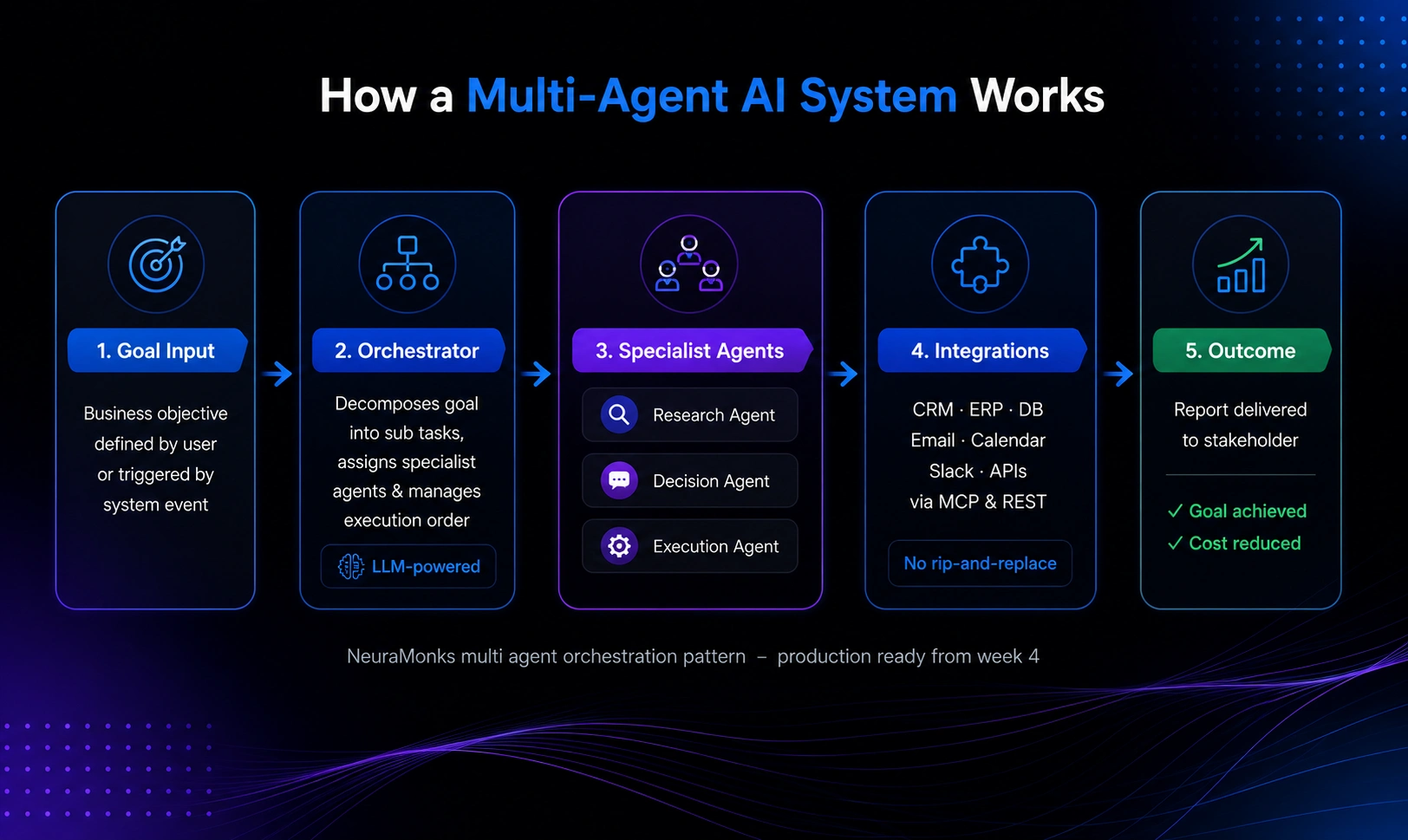
Agentic AI Services are a fundamentally different category. An agentic AI system is given a goal, not a question. It breaks that goal into tasks, decides which tools to use, executes steps in sequence (or in parallel), handles errors, and reports back — all without a human hand-holding each decision along the way.
Think of the difference between a calculator and a CFO. The calculator responds to your inputs. The CFO understands your objective, gathers the data it needs, makes decisions using judgment, and gets things done escalating to you only when it genuinely cannot proceed without your authority.
That is the level of autonomous intelligence that modern Agentic AI Services bring to enterprise workflows. And the reason it matters now is that the underlying technology large language models capable of reasoning, tool use, and multi-step planning has only become reliable enough for production deployment in the last 18 months. We are at the exact moment where the capability curve meets the business readiness window.
Deep Dive: How Autonomous AI Is Changing Enterprise Workflows.
Read Neuramonks' foundational explainer on how agentic systems work, including the Model Context Protocol (MCP) that makes them safe for enterprise use.
Read the full guide →
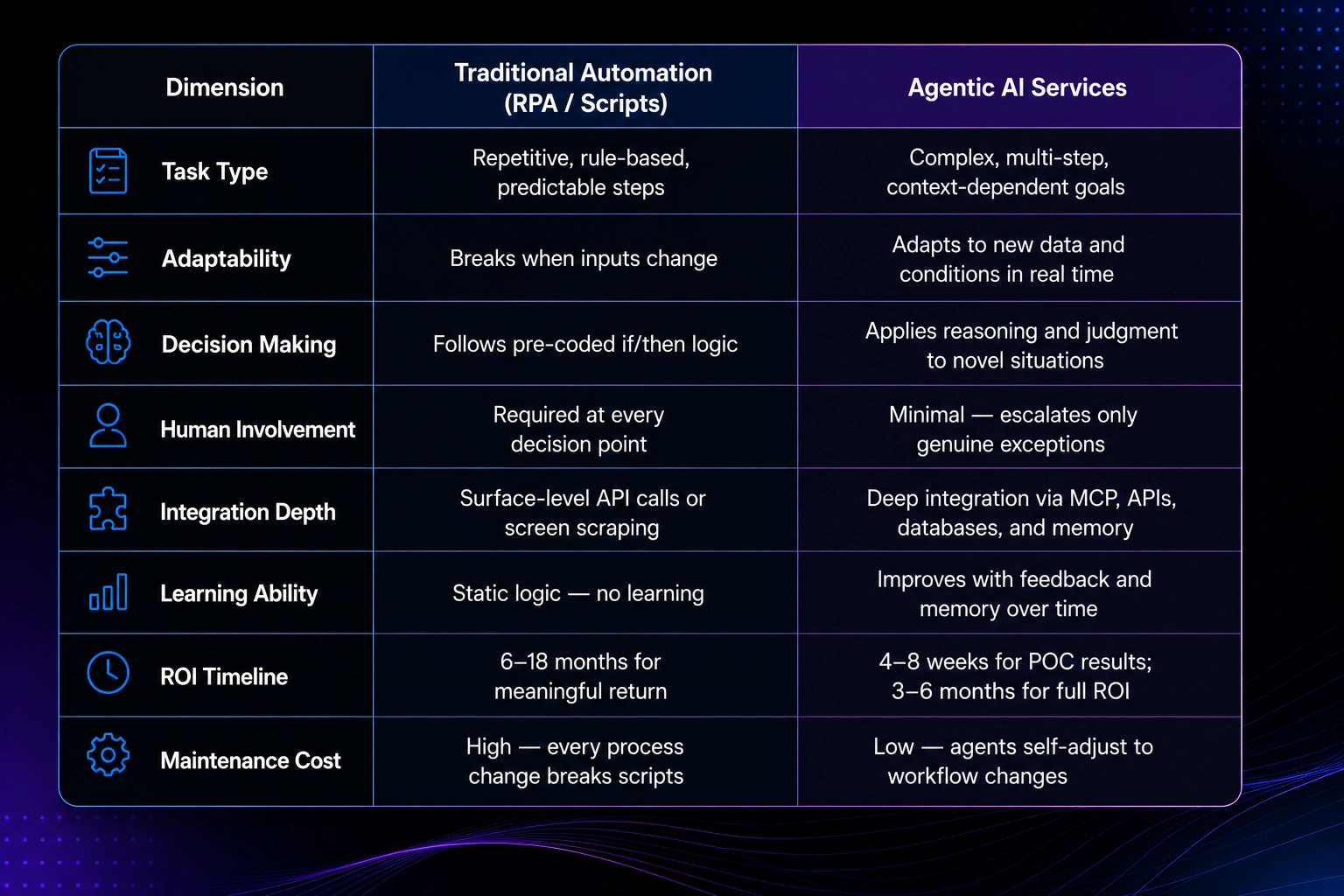
Traditional Automation vs. Agentic AI: A Clear Comparison
Understanding the distinction helps you quickly identify where Agentic AI creates the most value for your specific business context.
Where Agentic AI Services Create the Most Business Value
The honest answer is: almost everywhere. But some business functions respond faster and more dramatically than others. Based on Neuramonks' deployment experience across 10+ countries and dozens of enterprise clients, these are the highest-impact starting points.
Sales & Revenue Operations
Agentic AI agents can research prospects, personalize outreach sequences, handle first-touch qualification conversations, schedule meetings, update CRM records, and generate forecast reports all without a human touching each step. This is not a future scenario. Neuramonks has deployed exactly this architecture for sales teams, cutting SDR workload by 65% while increasing qualified pipeline volume.
Customer Support & Service
Support agents powered by agentic AI do not just answer questions they pull account history, check order status, initiate refunds, draft escalation summaries, and close tickets autonomously. Resolution rates improve, response times drop to seconds, and your human team handles only the cases that genuinely need judgment that only a person can provide.
Healthcare & Clinical Workflows
From automated appointment scheduling and insurance pre-authorization to clinical documentation and patient follow-up, healthcare is one of the highest-value verticals for Agentic AI Services. Administrative burden which consumes an estimated 30% of clinical staff time becomes a natural fit for autonomous AI agents operating within compliance guardrails.
Construction & Project Operations
Agentic AI transforms how construction firms manage projects, procurement, and compliance. Agents can monitor site progress against schedules, flag material delays, auto-generate RFI and submittal logs, track subcontractor milestones, and surface budget variance reports without manual data chasing. For firms juggling dozens of concurrent projects, this level of autonomous coordination directly reduces costly overruns and delays.
Manufacturing & Production Intelligence
On the factory floor and beyond, agentic AI agents monitor equipment telemetry for anomaly detection, coordinate preventive maintenance schedules, manage supplier communications, and auto-generate quality and compliance reports. They operate continuously across shifts catching the production anomaly at 3am that no one was watching for and feed operations teams with the real-time intelligence needed to act before downtime occurs.
Product & Engineering Operations
Agentic AI can manage release pipelines, triage bug reports, generate documentation, summarize code review threads, and handle sprint reporting. Engineering teams reclaim hours of coordination overhead every week time that goes directly back into building.
How Neuramonks Delivers Agentic AI Services: Our Proven Process
Neuramonks does not sell AI platforms. We build AI systems that solve specific, high-value business problems for specific clients then we measure the results. Here is the process that underlies every engagement.
1. Discovery & Workflow Mapping (Week 1–2)
Our AI Consulting Services team runs structured discovery sessions with your operations, technology, and business leads. We map your existing workflows, identify the highest-friction, highest-value automation opportunities, and define success metrics before any code is written.
2. AI Proof of Concept Design (Week 2–4)
Before committing to full deployment, our AI Proof of Concept Services deliver a working prototype against one targeted workflow. This is not a demo it runs on your real data, connects to your real systems, and produces results you can measure against your baseline.
3. Agent Architecture & Build (Week 4–10)
We design the multi-agent orchestration layer, select and fine-tune the right LLM base for your use case, build the tool integrations your agents need (CRM, ERP, databases, communication platforms), and implement memory and safety guardrails appropriate for your industry.
4. Deployment, Training & Handover (Week 10–14)
We deploy to production, train your team, establish monitoring dashboards, and document everything. You own the system. Our team remains on retainer for the first 90 days to handle edge cases and optimize performance as real-world usage patterns emerge.
5. Continuous Optimization & Expansion
Agentic AI systems improve with use. We work with you to analyze performance data, identify new workflows to automate, and expand the agent ecosystem as your confidence and ROI evidence grow. Most clients expand scope within six months of first deployment.
✦ Real-World Impact · Case Study
AI Podcast Generation Platform
Neuramonks built an autonomous, RAG-powered multi-agent system that completely orchestrates the end-to-end production of long-form podcasts. Utilizing 10+ specialized agents, the platform handles topic research, factual grounding, narrative consistency, and multi-speaker script formatting before dynamically routing to top TTS engines. It eliminates manual editing loops while retaining natural human-like pacing, laughter, and emotional cues.
60 to 70%
Reduction in manual production effort
50 to 65%
Faster content creation cycles
30 to 40%
Higher content & tonal consistency
Read the full case study →
Why Neuramonks for Your Agentic AI Journey
Dozens of vendors will sell you an AI platform, a template, or a proof-of-concept kit. Neuramonks is something different: a specialized AI engineering firm whose entire practice is built around Agentic AI Services that go into production and stay there.
What sets us apart
- Outcome-first engagement model: We define ROI targets before we write a single line of code. If we cannot show a clear path to measurable return, we say so upfront.
- Deep AI Consulting Services experience: Our team has delivered AI systems across healthcare, fintech, e-commerce, manufacturing, and professional services we understand both the technology and the industry context it operates in.
- AI Proof of Concept Services built for speed: Most clients see a working POC within three to four weeks, validating the business case before committing to full-scale investment.
- You own everything: All code, models, data pipelines, and integrations belong to you. No lock-in. No subscription dependency on our platform. Just a system that works for your business.
Global reach, local understanding: Serving clients across 10+ countries, we understands the regulatory, cultural, and operational nuances that make enterprise AI deployments succeed or fail in different markets.
The companies winning with AI right now are not the ones who waited for the technology to be perfect. They are the ones who moved thoughtfully but decisively validated fast with a proof of concept, learned from real data, and scaled what worked. Neuramonks exists to be the partner that makes that journey shorter, safer, and more valuable for your business.
Ready to Deploy Agentic AI in Your Business?
Book a free discovery call with us. We will map your highest-value automation opportunities, design a rapid proof of concept, and show you what autonomous AI can actually do — on your workflows, with your data.
Book Your Free Discovery Call →
No commitment. No sales pitch. Just an honest conversation about where Agentic AI can move the needle for you.

You asked, we precisely answered.
Still got questions? Feel free to reach out to our incredible
support team, 7 days a week.
What kind of web development projects does NeuraMonks handle?
NeuraMonks builds custom web platforms for businesses that need more than a template — think recruitment automation portals (Extrahourz), immigration management systems (Patel Canada Visa), real estate operations dashboards (Bavadiya & Co), and digital payment systems for restaurants and parking services (Xcashmenu). Every project in our case study library started with a specific operational problem, not a design brief.
How to choose the right AI solutions company?
Choosing the right AI solutions company means looking beyond technical skills. Key factors include:
Proven experience in custom AI solutions
Ability to deliver production-ready systems
Strong focus on business outcomes and ROI
Clear implementation and support processes
Security and compliance expertise
What makes NeuraMonks a reliable AI development agency?
NeuraMonks operates as a full-cycle AI development partner, not just a service vendor. We combine strategy, engineering, and deployment to build AI systems that work in real business environments. Our focus is on clarity, execution, and measurable outcomes, making us a trusted partner for organizations serious about AI.
Do you offer AI implementation services or only AI consulting?
We provide end-to-end AI implementation services, from initial use-case discovery and data readiness to model deployment and optimization. Unlike pure consultants, we take responsibility for building, integrating, and scaling AI systems inside your existing operations.
How is NeuraMonks different from other artificial intelligence development companies?
Most artificial intelligence development companies focus on experiments or proofs of concept. We focus on production-ready AI. Our team designs systems that integrate with real workflows, scale securely, and drive real business outcomes—without disrupting your operations.
Which industries do your industry-specific AI solutions serve?
Our industry-specific AI solutions support healthcare, ,eCommerce, manufacturing, Construction and Renovation, Dimond Merchant. Each solution is engineered to address sector-specific challenges, regulations, and operational needs.
How long does AI implementation typically take?
AI implementation timelines vary by complexity, but most projects move from strategy to deployment within 6–12 weeks. As an experienced AI implementation services provider, we follow structured milestones to ensure faster time-to-value.
Can you integrate AI with existing or legacy systems?
Absolutely. We specialize in AI-driven legacy system modernization, enabling businesses to embed intelligence into existing platforms without costly system replacements or operational downtime.