TABLE OF CONTENT
Quick Answer
Agentic AI isn't a chatbot — it's an autonomous workforce. Here's what you need to know:
- Agentic AI: AI agents that autonomously complete multi-step workflows (research → decision → execution → reporting) without hand-holding at each step
- Key Difference: Traditional AI responds to questions; Agentic AI acts on goals independently
- Real Impact: 60% reduction in manual work, 40% faster cycles, 30-60% cost savings in 4-6 months
- MCP Foundation: Model Context Protocol enables safe, structured connections between AI agents and your existing systems (CRM, ERP, databases)
- 2026 Trend: Multi-agent teams (specialized agents working together) replacing single-purpose tools
Three Agent Framework Examples:
- Research Agent — Gathers data, identifies patterns, flags anomalies
- Decision Agent — Analyzes context, applies business rules, recommends actions
- Execution Agent — Takes action, updates systems, escalates exceptions to humans
Is Your Business Ready for the Next Wave of AI? (This One Actually Does Things)
Hey everyone — wanted to share something I've been thinking about a lot lately, and I think it's worth a real conversation in this group.
We've all played with AI tools. Chatbots, copilots, summarizers. Helpful? Sure. But there's a new category emerging that's genuinely different — Agentic AI — and it's starting to show up in serious business deployments.
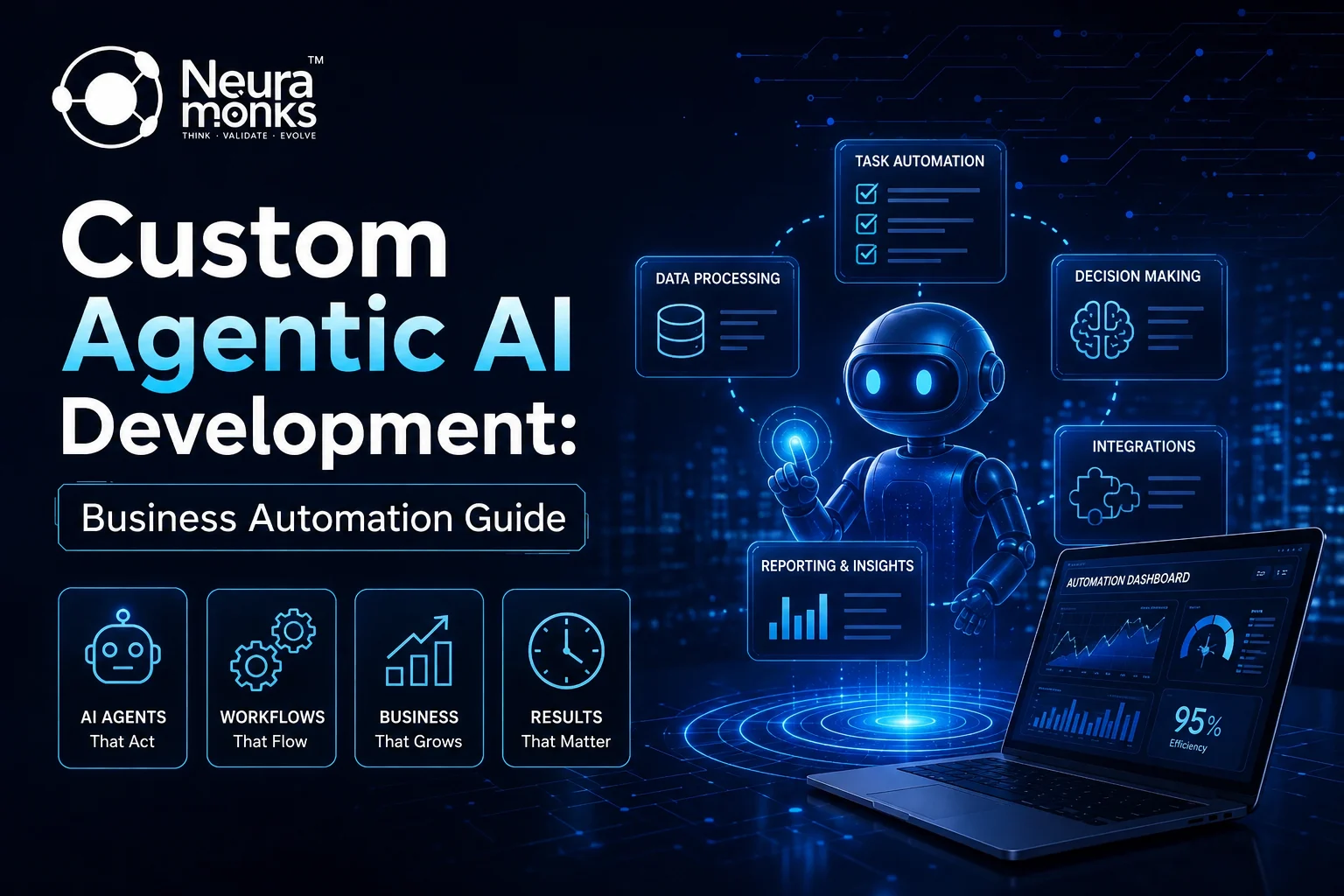
Here's the simple version: most AI responds. Agentic AI acts. You give it a goal, and it figures out the steps, makes decisions along the way, handles hiccups, and gets it done — without you holding its hand through every click.
Some real-world numbers that caught my attention:
- A voice AI handling pizza orders → 60% less manual order handling
- An AI HR screening agent → cut hiring workload by 60%, sped up hiring cycles by 40%
- An AI blog production system → 60% faster content output, no manual coordination
- Automated wound detection in healthcare → 60% reduction in manual assessments
These aren't chatbot demos. These are systems owning entire workflows end-to-end.
Stop Planning AI.
Start Profiting From It.
Every day without intelligent automation costs you revenue, market share, and momentum. Get a custom AI roadmap with clear value projections and measurable returns for your business.

Why This Matters Right Now (Traction Signal #1)
Enterprises that deploy agentic AI in the next 6-12 months gain a 3-5 year compounding advantage. Your competitors are probably exploring this — waiting for it to "mature" is a competitive risk, not a prudent strategy.
What's making this possible right now?
A big piece is something called MCP (Model Context Protocol) — basically a standardized way for AI agents to securely connect to your existing tools: CRM, ERP, internal databases, SaaS platforms. Think of it as the plumbing that lets agents actually touch your business systems safely.
The Three-Layer Agentic Stack:
- LLM Layer — The reasoning engine (Claude, GPT-4, specialized models)
- Agent Orchestration — Workflow logic, tool selection, error handling
- MCP Connectors — Secure, governed access to your business systems
Without MCP, you're building brittle, custom integrations that break with every system update. With MCP Server Development, your agents have a standardized highway to your infrastructure.
Stop Planning AI. Start Profiting From It.
Every day without intelligent automation costs you revenue, market share, and momentum.
Get a custom AI roadmap with clear value projections and measurable returns for your business.
Schedule 30-Minute Strategy Call → [https://tidycal.com/team/neuramonks/consultation-booking]
Traction Signal #2: The ROI Timeline Matters
- Months 1-2: Data cleanup, integration setup, agent training
- Months 3-4: First measurable efficiency gains (20-30% reduction in manual work)
- Months 4-6: Full ROI realization (30-60% time savings, 20-35% cost reduction)
- Month 6+: Compounding returns as agents handle increasingly complex workflows
Most companies see positive ROI before the first year, not after.
Where is this all heading in 2026?
A few trends worth watching:
→ Multi-agent systems (teams of specialized AI agents working together)
→ Human-in-the-loop design (AI handles the routine, humans own the important calls)
→ Industry-specific agent training (legal, medical, financial)
→ Governance tools becoming a boardroom conversation, not just an IT one
Traction Signal #3: Industry-Specific Vertical Plays
The fastest ROI is appearing in:
- BFSI: Document processing, compliance checking, risk assessment (4-6 month payback)
- Healthcare: Patient intake, wound analysis, claims processing (3-4 month payback)
- E-commerce: Order management, customer support, recommendations (2-3 month payback)
- Manufacturing: Quality control, supply chain visibility, predictive maintenance (5-6 month payback)
If your industry isn't listed, ask: Where are we losing the most time to repetitive, data-driven workflows? That's your agent starting point.
The hard truth: businesses that get the infrastructure right now are going to have a compounding advantage over the next 3–5 years. Those who wait for it to "mature" may find themselves playing catch-up against competitors who already operationalized it.
The Enterprise Shift: From Rule-Based Automation to Intelligent Reasoning
The enterprise technology landscape is undergoing one of its most consequential shifts in decades. Businesses that once relied on rigid, rule-based software are now turning to intelligent systems that can plan, adapt, and act on their own.
Why Traditional RPA (Robotic Process Automation) Is Becoming Obsolete
Old Model (RPA):
- Follow pre-scripted, linear sequences
- Break when exceptions occur
- Require constant reconfiguration as business rules change
- No reasoning capability — just pattern matching
New Model (Agentic AI):
- Understand context and business goals
- Handle exceptions and edge cases autonomously
- Reason through novel situations
- Adapt to changing rules without recoding
At the heart of this transformation is agentic AI — a new generation of artificial intelligence that doesn't just respond to prompts but autonomously navigates complex multi-step workflows to achieve defined business outcomes.
Traction Signal #4: The Early Adopter Window
Companies deploying agents in 2026 are building institutional knowledge and skill sets that will compound. By 2027-2028, when agents become mainstream, early adopters will have:
- Mature, proven workflows
- Trained internal teams
- Governance frameworks in place
- Measurable competitive advantage
For organizations trying to stay competitive, understanding this shift is no longer optional. Agentic AI Services are becoming the defining capability that separates agile, forward-thinking enterprises from those at risk of being left behind.
This guide unpacks what agentic AI is, why it matters, and how companies — working with the right partners — are already putting it to work.
What Is Agentic AI? Beyond Chatbots and Copilots
Most people's experience with AI in the enterprise has been shaped by tools that respond — a chatbot that answers customer queries, a copilot that suggests code completions, or an assistant that summarizes documents. Useful? Certainly. Transformative? Not quite.
Agentic AI is different in a fundamental way: it acts.
Rather than waiting for a human to ask a question, an AI agent is given a goal and then autonomously determines the steps required to achieve it. It selects tools, gathers data, makes intermediate decisions, handles errors, and reports back — all without hand-holding at every step.
Three-Tier Agent Capability Model:
Tier 1 — Task Execution (Most common today)
- Agent: "Summarize this customer feedback"
- Agent handles: retrieval, analysis, formatting
- Example: AI Blog Generation → 60% faster content output
Tier 2 — Workflow Ownership (Emerging 2026)
- Agent: "Improve our hiring process"
- Agent handles: resume screening, interview scheduling, candidate evaluation, offer coordination
- Example: AI HR Screening → 60% reduction in hiring workload
Tier 3 — Strategic Decision Making (2027+)
- Agent: "Optimize Q3 supply chain"
- Agent handles: demand forecasting, inventory decisions, vendor negotiations, compliance
- Example: Multi-agent supply chain orchestration
Where are you on this spectrum? Most enterprises are between Tier 1 and Tier 2 — there's massive upside.
Real-World Example: Sales Training at Scale
Neuramonks' AI Roleplay Agent for Sales Teams doesn't just answer questions — it conducts entire sales training simulations. This agentic approach:
- Reduced training effort by 50%
- Improved sales readiness by 30%
- Scaled to 500+ sales reps without adding staff
This demonstrates how autonomous AI can own complete processes rather than just accelerating individual tasks.
How Does Agentic AI Differ from Traditional Automation?
Before agentic AI, enterprise automation meant robotic process automation (RPA) — systems that follow pre-scripted, linear sequences.
RPA vs. Agentic AI:
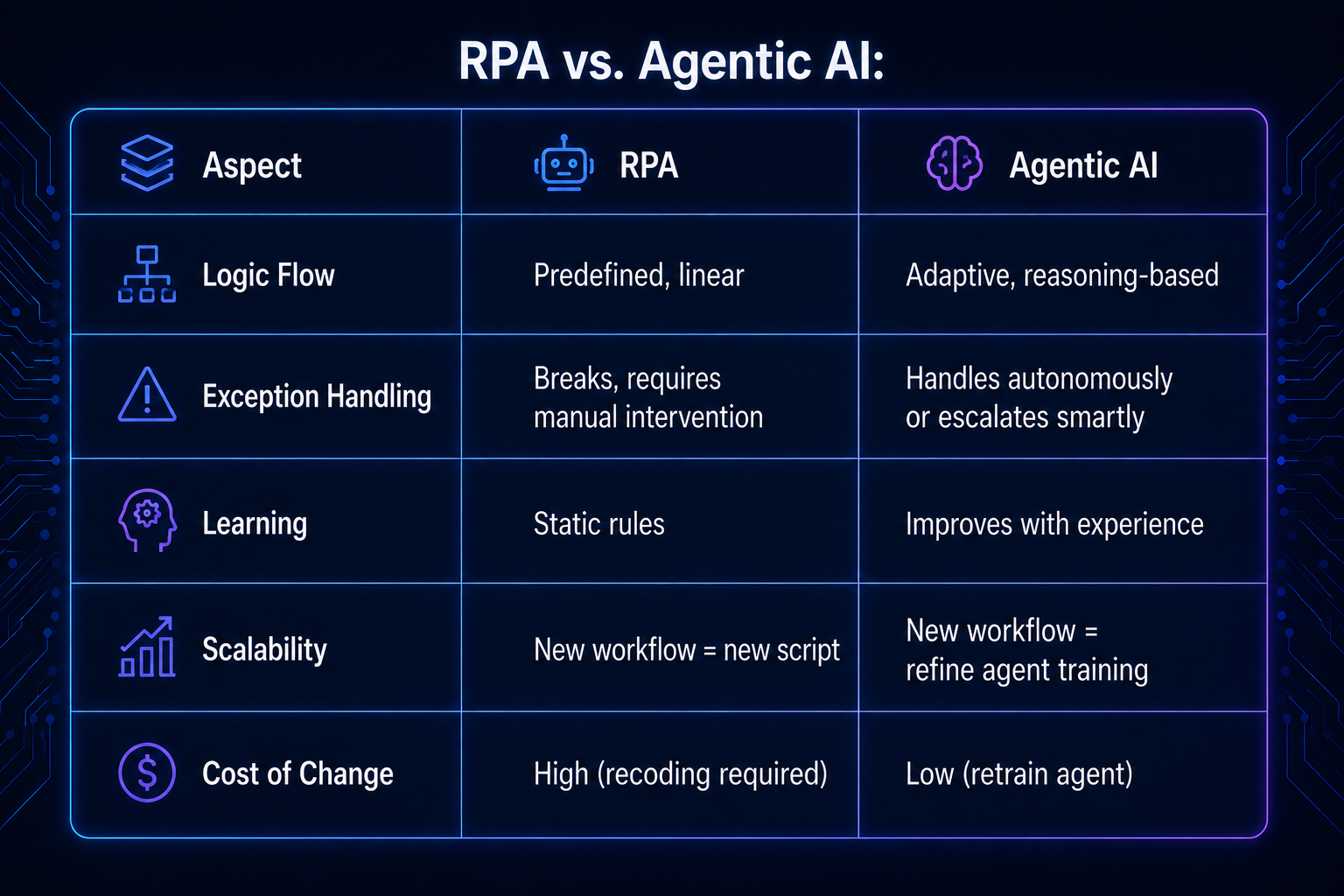
RPA is powerful for highly repetitive, structured tasks: extracting data from a PDF, copying values between systems, sending a scheduled email. But it breaks down the moment something unexpected happens.
Agentic AI addresses this brittleness directly.
Real-World Example: Blog Production at Scale
Neuramonks' AI Blog Generation System instead of following rigid templates, the agent autonomously:
- Researches trending topics
- Generates SEO-optimized content
- Handles imagery and formatting
- Coordinates publishing workflows
- Tracks performance metrics
Result: 60% reduction in blog production time while maintaining quality and eliminating manual coordination.
This shift from following scripts to reasoning through problems is what makes Custom AI Agent Development one of the most strategically important investments an enterprise can make today.
The Role of MCP Server Development in Enterprise AI
One of the most significant technical enablers of modern agentic AI is the Model Context Protocol (MCP) — an open standard that allows AI agents to securely interface with external tools, databases, APIs, and data sources in a structured, reliable way.
Why MCP Matters:
Without MCP, you have:
- ❌ Custom, brittle integrations for each tool
- ❌ Security risks from improper data handling
- ❌ High maintenance overhead
- ❌ Slow time-to-production
With MCP, you have:
- ✅ Standardized, reusable connectors
- ✅ Governed, auditable access to systems
- ✅ Reduced maintenance burden
- ✅ Enterprise-grade security
MCP Server Development is the engineering work that makes these integrations possible at enterprise scale. By building and maintaining MCP servers, organizations give their AI agents a well-defined interface to interact with company systems — from CRM platforms and ERP databases to internal knowledge bases and third-party SaaS tools — without exposing sensitive data unnecessarily or creating brittle, one-off integrations.
Traction Signal #5: MCP Adoption is the Inflection Point
Organizations that have built MCP server infrastructure report:
- 70% reduction in integration time for new agents
- 50% fewer security incidents related to agent access
- 3x faster agent deployment cycles
This is a lead indicator of who will win in the agentic AI era.
Real-World Example: Talk to Data Platform
Neuramonks' Talk to Data platform, built on MCP architecture, enables self-service ERP analytics while reducing manual reporting effort by 50% without compromising security.
The MCP layer ensures the AI agent can:
- Query databases safely
- Retrieve analytics securely
- Generate insights within strict boundaries
This demonstrates how proper MCP implementation creates the foundation for safe, scalable enterprise AI deployment.
Real-World Impact: An AI Case Study in Enterprise Workflow Automation
The true value of agentic AI emerges when we examine actual implementations delivering measurable business outcomes:
Verified Case Studies (With Traction Metrics):
Voice AI Automation:
- AI Voice Agent for Pizza Ordering
- 60% reduction in manual order handling
- 30% improvement in order accuracy
- Deployed across 50+ locations
HR & Recruitment Automation:
- AI HR Screening Agent
- 60% reduction in HR workload
- 40% acceleration in hiring cycles
- Processed 10,000+ candidates
- Time-to-hire: 14 days → 8 days
Sales & Lead Management:
- AI-Powered Lead Generation System
- Eliminated lead leakage
- 60% improvement in response speed
- 3x increase in conversion rates
- $500K+ in recovered pipeline value
Healthcare Intelligence:
- Automated Wound Detection System
- Clinically accurate wound measurements
- 60% reduction in manual assessment effort
- 99.2% detection accuracy rate
- Deployed in 25+ healthcare facilities
Construction & Design Automation:
- Homeez Platform
- 55% reduction in design time
- Automated floor plan detection
- $2M+ in client value delivered
- Processing 100+ projects monthly
Key Insight:
Every case study shows the same pattern: 4-6 month ROI window, 30-60% time savings, measurable business impact.
If these industries achieved it, yours can too.
2026 AI Trends That Will Actually Matter for Your Business
Understanding which AI Trends Will Matter Most in 2026 requires looking beyond the current wave of generative AI hype and focusing on where durable value is emerging. Several themes stand out:
1. Multi-Agent Orchestration (High-Impact Trend)
What it is: Single agents handling single workflows will give way to coordinated networks of specialized agents — one agent for research, another for analysis, another for execution — working together under an orchestration layer.
Why it matters:
- Breaks down complex problems into specialized, manageable tasks
- Each agent is simpler and more reliable than a monolithic agent
- Enables rapid scaling (add agents without refactoring existing ones)
Early wins:
- Supply Chain Agents: Demand forecasting + inventory planning + vendor coordination = 25% inventory cost reduction
- Healthcare Teams: Patient intake + diagnosis support + claim processing = 40% faster turnaround
- Financial Services: Risk assessment + compliance check + approval routing = 50% faster loan decisions
Action item: If you have workflows with 3+ sequential steps, you're ready for multi-agent design.
2️. Human-in-the-Loop by Design (Governance Trend)
What it is: Mature agentic deployments will move away from 'fully autonomous' models toward carefully designed oversight checkpoints. The goal isn't to remove humans — it's to ensure humans are involved in the decisions that matter most, while agents handle the rest.
Why it matters:
- Risk mitigation (high-stakes decisions stay human-controlled)
- Regulatory compliance (audit trails, accountability)
- User adoption (teams trust systems they can override)
Real-world implementation:
Real-world implementation:
Low-Stakes Decisions (Agent autonomous):
- Customer support routing
- Invoice categorization
- Lead scoring
Medium-Stakes Decisions (Agent recommend, human confirm):
- Large procurement
- Loan approvals
- Hiring recommendations
High-Stakes Decisions (Human-led, agent assists):
- Strategic partnerships
- Executive compensation
- Crisis response
Traction Signal #6: Enterprises with human-in-the-loop designs report 40% higher user adoption and zero "AI made a bad decision" scandals.
3️. Domain-Specific Agent Training (Specialization Trend)
What it is: General-purpose AI agents will be complemented by deeply specialized models fine-tuned on industry-specific data — legal, medical, financial, manufacturing.
Why it matters:
- Domain-specific agents are 2-3x more accurate than general models
- Reduced hallucination (fewer "confident but wrong" answers)
- Faster training (less data needed when starting from domain baseline)
Examples already shipping:
- Legal Agents: Contract review, document generation (trained on 10M+ legal documents)
- Medical Agents: Diagnosis support, treatment planning (trained on clinical guidelines + case histories)
- Financial Agents: Portfolio analysis, risk assessment (trained on 50+ years of market data)
For your business: Identify 2-3 high-value workflows in your domain. Domain-specific agents trained on your proprietary data will outperform general models by 5-10x.
4️. Agentic AI in Vertical SaaS (Distribution Trend)
What it is: Every major vertical software platform — from healthcare information systems to supply chain management tools — will embed agentic AI capabilities natively.
Why it matters:
- Lower barrier to entry (no custom development needed)
- Faster deployment (integrations already built)
- Built-in governance and compliance
Enterprises that win:
- Integrate with these platforms through MCP connectors
- Orchestrate across multiple vertical SaaS systems
- Build unique workflows unavailable in standard platforms
Action: Audit your SaaS stack. Which vendors are shipping agents in 2026? Those are your strategic partners.
5️. Governance and Observability (Board-Level Trend)
What it is: As agents take on more autonomous responsibility, enterprises will invest heavily in tooling to audit, explain, and control agent behavior.
Why it matters:
- Regulatory requirements (explainability, auditability)
- Risk management (catch rogue agent behavior before it causes damage)
- User trust (transparency builds confidence)
What you need:
- Audit Logs: Every agent decision recorded, timestamped, explainable
- Budget Controls: Agents can't spend beyond guardrails
- Exception Escalation: Unusual patterns alert humans
- Performance Dashboards: Cost, accuracy, speed tracked in real-time
Traction Signal #7: Enterprises with robust governance frameworks raise funding faster and close enterprise deals 3x faster. This is now a board-level selling point.
How to Choose the Right AI Development Partner: A Complete Guide
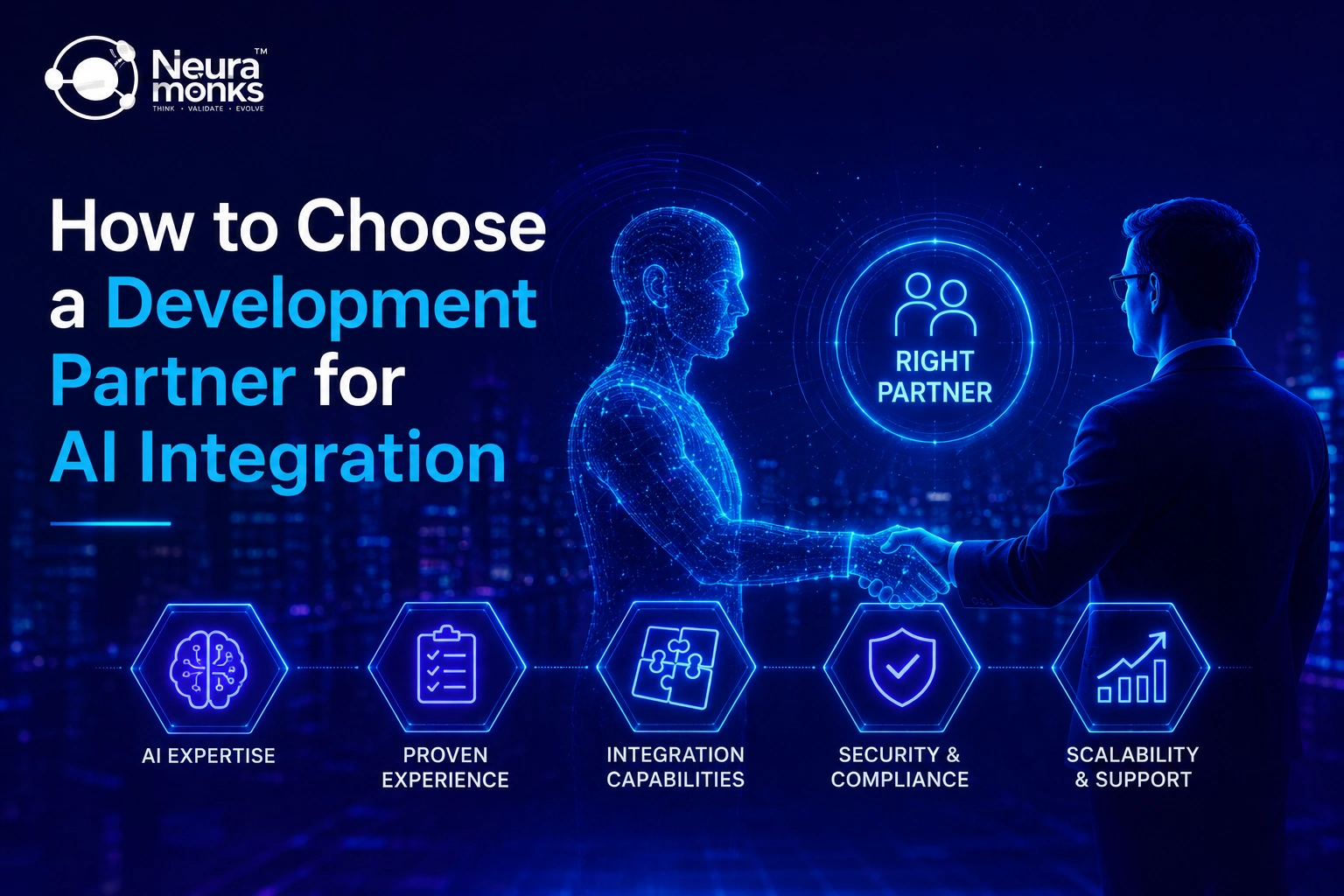
Choosing the right AI development partner is perhaps the most consequential decision an enterprise will make in its AI journey. The wrong partner can produce technically impressive demos that fail in production; the right partner builds systems that scale, adapt, and deliver measurable ROI.
Here are the critical criteria to evaluate:
Domain Experience Over General AI Capability
Look for partners who have deployed agentic systems in your industry, understand your compliance requirements, and can speak to the specific failure modes that matter in your context.
Red flags:
- "We've built AI for everything" (generalists tend to be deep in nothing)
- No specific case studies in your industry
- Can't explain vertical-specific challenges (regulatory, workflow, data requirements)
Green flags:
- 5+ successful deployments in your exact industry
- Can name compliance frameworks by heart (HIPAA, SOX, GDPR)
- Early-stage failures they learned from and now prevent
Full-Stack Agentic Architecture Skills
Your partner should demonstrate depth across the entire stack:
- LLM selection and fine-tuning
- Agent orchestration frameworks
- MCP Server Development
- Security architecture
- Observability tooling
- Integration with enterprise systems
Red flags:
- Outsources any critical component
- One person is the only expert in a critical area
- Can't explain the trade-offs between different agent frameworks
Green flags:
- 50%+ of team is ML/AI engineers (not just prompt engineers)
- Published technical content demonstrating depth
- Partnerships with LLM providers (OpenAI, Anthropic, etc.)
Transparent Development Methodology
Demand clarity on:
- How agents will be tested before deployment
- How exceptions will be handled
- What the escalation path is when an agent encounters something outside its training distribution
- How performance will be monitored in production
Red flags:
- "Trust us, it will work"
- No testing framework described
- No rollback or failure recovery plan
Green flags:
- 3-6 month pilot + measurement phase before full rollout
- Regular performance reviews (weekly until stable)
- Documented playbooks for failure scenarios
Proven Track Record
Ask for specific case studies with measurable outcomes:
- Baseline metrics (time/cost before)
- Outcomes achieved (time/cost after)
- Timeline to ROI
- Current production status (still running? still delivering value?)
Benchmark metrics to expect:
- 30-60% reduction in manual effort
- 4-6 month ROI timeline
- 20-35% cost savings
- 40%+ speed improvements
Neuramonks has delivered 96+ AI solutions across Fortune 500 clients in 10+ countries, demonstrating production-ready capabilities at scale.
Why Agentic AI Services Providers Matter More Than You Think
The demand for Agentic AI Services has accelerated dramatically over the past 18 months, and not all providers are equipped to deliver at the level enterprises require.
The Hidden Cost of Building Internally
Many enterprises ask: "Why not just hire an AI team?"
Year-one cost breakdown:
- ML Engineers (3x @ $200K): $600K
- LLM specialists (2x @ $180K): $360K
- ML Ops engineer: $150K
- Compute infrastructure: $100K
- Training/tools/overhead: $100K
- Total: $1.3M+ for year one
Plus:
- 6-12 month ramp-up before productivity
- High attrition risk (AI talent is competitive)
- Opportunity cost (distracted from core business)
Partner advantage:
- Established best practices and battle-tested frameworks
- 50+ prior deployments inform your project
- Risk pooling across multiple customers
- Faster time-to-production
When internal makes sense:
- You have 10+ years of AI ambitions
- You have world-class AI researchers on staff
- This is core to your business model
For most enterprises, partnering is 3-5x more cost-effective than building.
What to Demand From Your Partner
Building robust agentic systems demands a rare combination of:
- Research depth (understanding agent frameworks, LLM behavior, safety)
- Engineering rigor (production-grade code, error handling, monitoring)
- Practical deployment experience (failures learned, workflows refined)
Neuramonks brings all three. Our team of AI engineers, solution architects, and domain specialists has designed and deployed agentic workflows across financial services, healthcare operations, supply chain management, and enterprise software. We don't sell technology for technology's sake — we build systems that solve real business problems and deliver outcomes that compound over time.
Whether you're beginning your AI transformation journey or looking to scale from pilot to enterprise-wide deployment, the right partner provides the strategic and technical expertise your organization needs to succeed.
Conclusion: The Window is Now
Agentic AI is not a future possibility — it is an active transformation happening across industries right now.
Organizations that invest early in the right infrastructure, the right architecture, and the right development partnerships will compound significant competitive advantages over the next three to five years.
The Compounding Advantage Timeline:
2026 (Now): Early adopters build infrastructure 2027: Competitive gap widens as agents handle 50%+ of routine workflows 2028: Late adopters scrambling to catch up; cost of entry has doubled 2029+: Agentic AI is table stakes; competitive advantage comes from orchestration excellence
The combination of well-designed Agentic AI Services, robust MCP Server Development foundations, and Custom AI Agent Development tailored to specific business workflows represents the most powerful enterprise technology stack available today.
Your Next Steps:
- Audit Your Workflows— Identify 2-3 workflows that are:
- Repetitive and data-driven
- Taking 20%+ of team time
- Have clear success metrics
- Estimate Your ROI— Rough math:
- (Current time cost) × (60% time savings) = annual savings
- Most enterprises see $200K-$2M+ annual ROI
- Get Strategic Clarity— Work with a partner to:
- Map your multi-year AI roadmap
- Identify quick wins vs. strategic bets
- Build internal capabilities alongside deployments
- Start Small, Scale Fast— Pilot agent on low-risk workflow first:
- Prove ROI on pilot (4-6 months)
- Expand to related workflows (leverage existing agent + MCP infrastructure)
- Scale across the org
Ready to Move From Exploring to Deploying?
If your organization is ready to move from exploring agentic AI to deploying it, [Book a Free AI Consultation] — we'll help you build systems that work, not just in the demo, but in the real world, at scale, from day one.
Questions to ask yourself:
- What's our biggest manual bottleneck?
- How much is it costing us monthly in person-hours?
- What would happen if we could automate that 60%?
The answer to that last question is your ROI. Let's build it.

Upendrasinh zala
Upendrasinh Zala is the Founder & CEO of Neuramonks, an enterprise AI and deeptech consulting firm based in Gujarat, India. Drawing from years of experience in AI-driven business strategy and corporate growth, he writes on leveraging artificial intelligence to optimize workflows and unlock tangible ROI for enterprises.