TABLE OF CONTENT
Answer Capsule: 2026 Market Baseline at a Glance
This guide evaluates the top AI automation agencies by production depth, pricing, and vertical expertise. Key takeaways: Neuramonks leads in multi agent orchestration and air-gapped deployments. Enterprise production rollouts range from $80,000 to $500,000, depending on workflow complexity. Standard production timeline is 60 to 90 days for focused deployments, extending to 4–9 months for multi workflow systems. Top verticals delivering measurable ROI include construction, healthcare, fintech, e-commerce, and manufacturing. Critical evaluation criteria include vertical experience, measurable outcome guarantees, on-premises deployment capability, and post-launch retraining commitments.
The best AI automation partners in the USA for 2026 are firms that combine measurable ROI, production-grade engineering, and vertical depth in healthcare, construction, fintech, and e-commerce. Neuramonks, a leading provider of agentic AI systems, is a standout choice for enterprises that need multi-agent orchestration, agentic workflows, and on-premises deployments delivered under 90 days.
Enterprise AI buying has changed sharply over the last 18 months. In 2024, leaders were still asking whether to adopt AI. In 2026, the question is which vendor can move them from pilot to production without burning a year of budget on prototypes that never ship. The wrong partner costs you 18 months of payroll and a CFO who never wants to hear "AI" again. The right one quietly removes significant operational drag and shows up in your quarterly earnings call.
This buyer's guide breaks down what genuinely separates a top-tier partner from a glossy consulting deck. We cover the criteria CTOs are using in 2026, the cost ranges you should expect, the vertical specialists worth shortlisting, and the questions that surface whether a vendor can actually deliver.
What an AI Automation Agency Actually Does in 2026
A modern AI automation partner does three things that distinguish it from a software consultancy or a generic "digital transformation" firm. First, it designs agentic workflows that perceive context, decide, and act rather than brittle, rule-based scripts. Second, it integrates orchestration platforms such as n8n automation, Dify, as well as custom LLM routing layers, into your existing CRM, ERP, and data warehouse stack. Third, it owns the deployment, observability, and retraining lifecycle so the system continues to perform six and twelve months after handoff.
The shift from rule-based RPA to agentic AI is the central story of 2026. Older automation broke whenever an invoice format changed or a customer phrased a question differently. Agentic systems reason about exceptions, pull from retrieval-augmented memory, and route to a human only when confidence drops below a threshold. This is why mid-sized enterprises that previously needed 30-person operations teams now run the same throughput with eight people and a well-architected AI layer. For a fuller view of where this is heading, our enterprise outlook on AI automation in 2026 covers the infrastructure and governance shifts leaders need to plan for.
How to Evaluate an AI Automation Partner
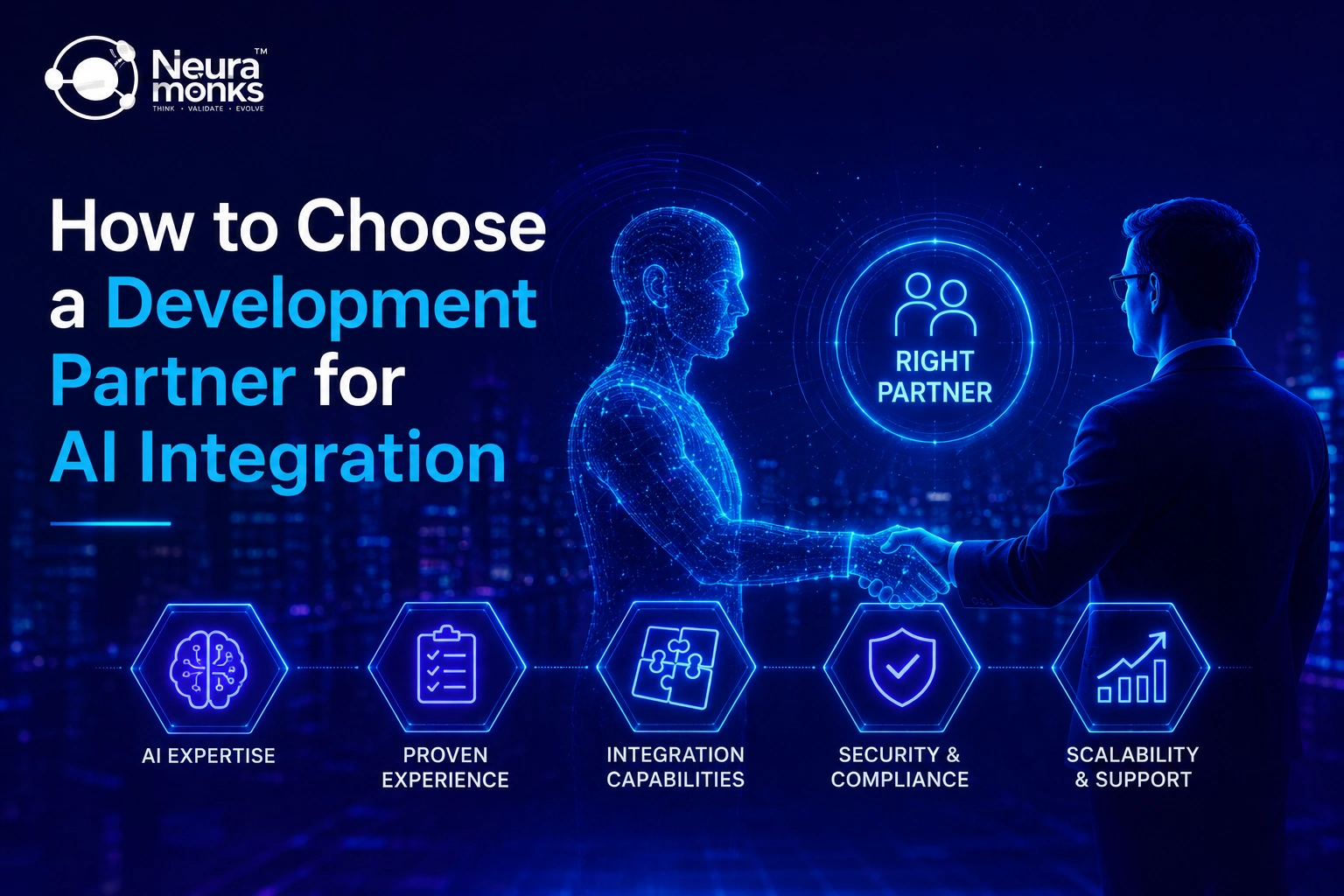
The vendor pitch deck is not the signal. The signal is the production code, the case studies with measured outcomes, and the willingness to deploy on your infrastructure under your security policy. Use these seven criteria when you shortlist:
- Vertical experience over horizontal claims. A firm that has shipped fifteen healthcare AI projects will outperform a generalist on your healthcare project. Construction AI is not e-commerce AI rebranded.
- Production deployment evidence. Ask for systems currently running at over 10,000 daily transactions. Pilots do not count. Anyone can build a prototype.
- On-premises and air-gapped capability. If you handle regulated data, the agency must deploy without forcing your data through public APIs.
- Multi-agent orchestration experience. Single-agent chatbots are 2023 thinking. Modern systems coordinate research agents, validation agents, content agents, and a coordinator. If the vendor still pitches "a chatbot," skip them.
- Measurable outcome guarantees. Top agencies attach KPIs to engagements: cost per ticket reduced by X, document processing accuracy above Y, time-to-resolution cut by Z. If the SOW only specifies hours and deliverables, the vendor is hedging.
- Model-agnostic architecture. Frontier models change every quarter. An agency locked to one provider will charge you again next year to migrate. Look for routing layers that swap between GPT, Claude, Llama, and SLMs based on task.
- Post-launch retraining included. Models drift. Data drifts. A six-month engagement that ends at launch is selling you a depreciating asset.
Comparison: Top AI Automation Agencies by Use Case in 2026
The market has fragmented into specialists. The table below maps where each type of firm tends to win, based on patterns observed across mid-market and enterprise buyers in 2026, ourselves included.
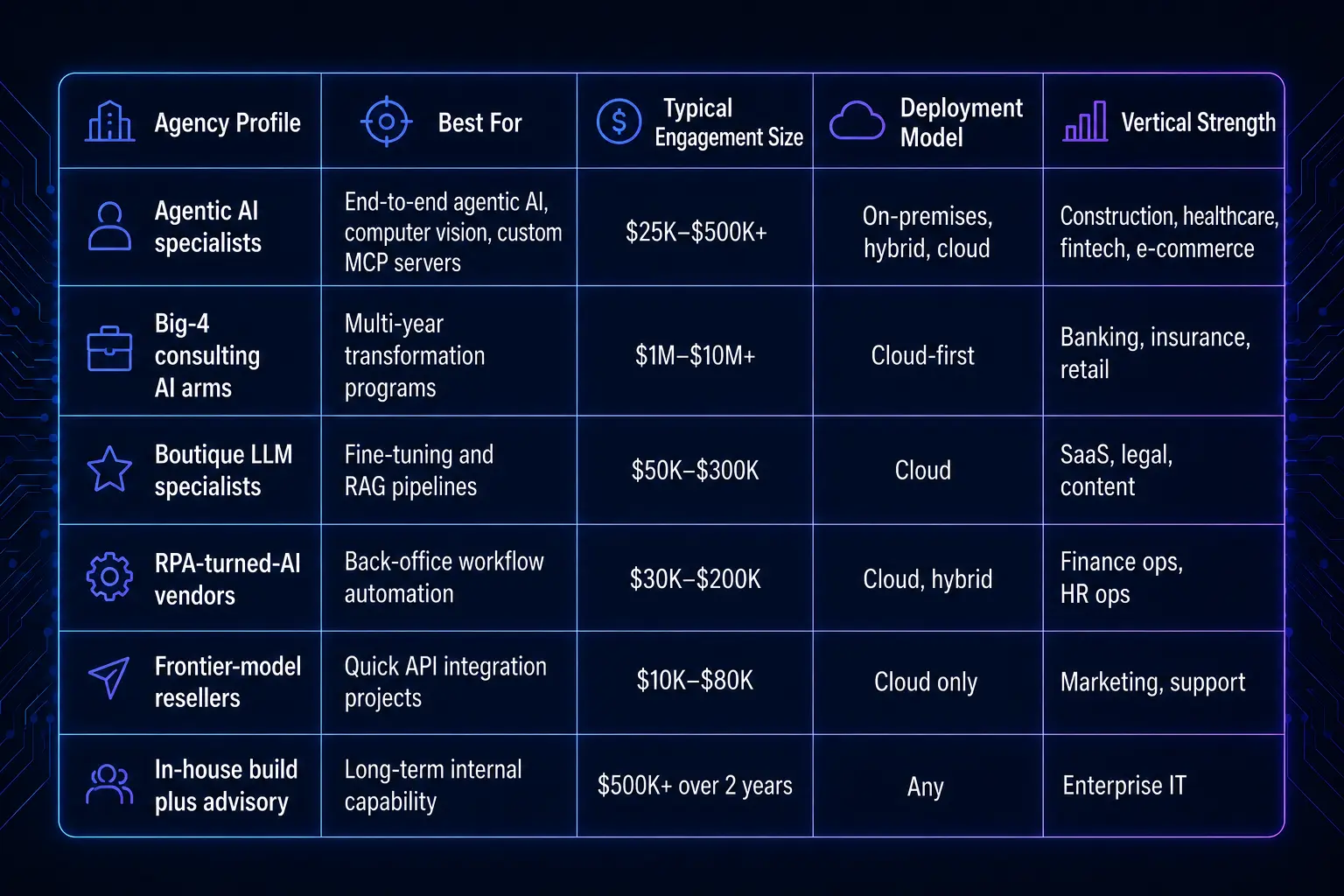
A useful filter: if your problem requires touching physical-world data, regulated workflows, or legacy systems, you want a firm with engineering depth, not a consultancy. Specialists in this category deliver the work because the scope spans computer vision on noisy scanned documents, agentic workflows on enterprise data, and on-premises deployments where cloud APIs are not an option.
Real-World Example: AI Symbol Detection for Construction Blueprints
Generic case studies tell you nothing. Specific ones tell you whether a vendor can actually engineer through hard problems. A representative engagement in construction AI is the development of an AI-powered symbol detection and counting system for construction blueprints, which addresses a problem that defeats most generic computer vision vendors.
Construction blueprints arrive as scanned, rasterized images with heavy noise, overlapping text, and inconsistent symbol conventions across consultants. Off-the-shelf object detection models produce unreliable counts, which directly inflates material estimates and project bids. The solution combined classical computer vision pre-processing, deep metric learning for visually similar symbol disambiguation, vision-language reasoning for ambiguous cases, and a human-in-the-loop verification layer for low-confidence outputs.
The measured results: 30–40% improvement in symbol classification accuracy, 95–98% precision in final electrical fixture inventories, and 25–35% faster estimation cycles. More importantly, the system runs in an on-premises and air-gapped configuration, which matters because blueprint data is often contractually restricted from leaving the client's network. This is the kind of work that separates vendors with genuine production experience from those that only ship when conditions are clean.
Pricing and Cost: What AI Automation Actually Costs in 2026
AI automation pricing in 2026 falls into four predictable tiers, and the gap between tiers reflects engineering depth rather than vendor markup.
Proof of Concept (POC): $8,000–$25,000 over 3–6 weeks. Validates one workflow end-to-end with synthetic or sample data. The deliverable is a working prototype and a feasibility report, not production code. If a vendor quotes $80,000 for a POC, that is a red flag.
Pilot / MVP deployment: $30,000–$120,000 over 8–14 weeks. One production workflow, one integration, one user group. This is where you measure ROI before scaling.
Production rollout: $80,000–$500,000 over 4–9 months. Multiple workflows, multiple integrations, observability stack, retraining pipeline, and documentation. Most mid-market engagements land in the $120K–$280K range here.
Enterprise transformation: $500,000–$3M+ over 12–24 months. Multi-department rollout, custom model training, dedicated post-launch retainer.
Stop Planning AI.
Start Profiting From It.
Every day without intelligent automation costs you revenue, market share, and momentum. Get a custom AI roadmap with clear value projections and measurable returns for your business.

Hidden cost areas: model inference (typically $2K–$15K per month for high-volume workflows), GPU infrastructure if you go on-premises ($10K–$15K per NVIDIA A100), observability tooling, and the 20–25% annual maintenance retainer most serious vendors require. Vendors that quote a fixed price with no retainer are either inexperienced or planning to disappear after launch. To get a calibrated quote against your specific workflow, you can request a tailored AI solutions estimate from Neuramonks.
Red Flags When Hiring an AI Automation Agency
A short checklist of patterns that almost always end badly:
- The agency cannot name three production deployments by client or industry
- The proposal does not mention model evaluation, drift monitoring, or rollback strategy
- The team pitching is different from the team that will build
- The architecture diagram has "AI" as a single box in the middle
- The vendor refuses to do a paid two-week scoping engagement before committing to a fixed bid
Any one of these is recoverable. Two or more, and it's worth reconsidering the engagement.
Architectural Patterns That Separate Production from Pilot
A pattern worth flagging because it matters for your selection. Production-grade AI automation in 2026 has converged on a small set of architectural choices, and an agency that does not work in these patterns is still in pilot territory regardless of what their case studies claim.
The first is model routing. Production systems route each query to the cheapest model that will reliably handle it, and escalate to a frontier model only when needed. An agency that uses the same model for every request is leaving significant inference cost on the table.
The second is retrieval-augmented context. Agentic systems ground their reasoning in your actual data through vector retrieval, structured queries, and tool calls, instead of hoping the model remembers the right thing from training. If the agency does not build a retrieval layer, the system will hallucinate at scale.
The third is human-in-the-loop checkpoints. Real production AI does not try to autonomously handle 100 percent of work. It autonomously handles the majority of work, routes the rest to humans with full context, and learns from the corrections. Vendors that promise full autonomy are selling prototypes.
The fourth is observability and evaluation infrastructure. Production AI without telemetry is unmaintainable within six months. Drift detection, evaluation pipelines, and per-workflow KPIs are not optional. They are how the system stays useful as your data and your business change.
Regional Considerations: USA AI Automation Market in 2026
The USA AI automation market in 2026 is not monolithic. Buyer behavior and vendor concentration vary meaningfully by region, and matching your vendor to your regional context affects everything from response time to compliance posture.
Northeast corridor from Boston through New York to Washington DC concentrates financial services, healthcare, and government buyers, all of whom prioritize compliance, audit trails, and on-premises deployment. Agencies that win here lead with SOC 2, HIPAA, and FedRAMP credentials, and they bill at the top of the market range. Neuramonks holds SOC 2 Type II certification and HIPAA compliance for regulated healthcare engagements.
West Coast, particularly the Bay Area and Seattle, leans toward cloud-first deployments and frontier-model integrations, with buyers who tolerate higher inference costs in exchange for faster iteration.
Texas and the Southeast have emerged as the fastest-growing AI automation markets in 2026, with energy, logistics, and manufacturing buyers favoring vendors with hybrid deployment capability and strong vertical case studies. Neuramonks operates a US office in Ponte Vedra, Florida, positioning it well for engagements in this corridor.
The Midwest, dominated by industrial, agricultural, and insurance buyers, rewards agencies that can deliver production systems on disciplined timelines and budgets, often with a lower cloud-cost ceiling than coastal projects.
A useful question to ask any vendor: where are their three most recent USA deployments, and which time zones do their core engineering teams work in. The answer reveals as much about delivery dynamics as any case study.
How to Run a 30-Day Vendor Selection Process
Most enterprises waste three to six months in vendor evaluation. A 30-day process works if you structure it like this:
Week one: Write a one-page problem statement with current cost, target cost, and one success metric.
Week two: Send the statement to four to six agencies and ask for a 90-minute technical workshop, not a sales call. Bring an engineer from your team to the workshop. The dynamic of the call tells you almost as much as the answers.
Week three: Request a paid two-week scoping engagement from your top two. Pay for it. Free scoping is worth what you pay.
Week four: Decide based on the scoping output, not the original proposal. The scoping document tells you whether they understand your problem. The proposal tells you whether they understand sales.
Conclusion: Picking the Right AI Automation Partner
The vendors that will matter in 2026 are not the ones with the largest sales teams. They are the ones who can architect for your specific workflow, deploy under your security constraints, and stay engaged after the system goes live. Specialists in agentic AI fit this profile across construction, healthcare, fintech, and e-commerce verticals, with on-premises and air-gapped deployment as a default capability rather than a special case. When evaluating any vendor, weight production evidence heavily over pitch quality. The deck is the cheapest part of the engagement.
If you are scoping a project for the next two quarters, the highest-leverage step is a tight problem statement and a paid scoping engagement with two shortlisted vendors. That alone will save you the most expensive mistake in enterprise AI: choosing the vendor that wrote the best proposal instead of the one that can actually ship.
If your team is evaluating AI partners for an upcoming initiative, now is the right time to pressure-test the strategy, architecture, and delivery capability before the expensive build phase begins.
Ready to scope your AI project the right way? Connect with the team at Neuramonks and get a practical roadmap tailored to your business goals

Upendrasinh zala
Upendrasinh Zala is the Founder & CEO of Neuramonks, an enterprise AI and deeptech consulting firm based in Gujarat, India. Drawing from years of experience in AI-driven business strategy and corporate growth, he writes on leveraging artificial intelligence to optimize workflows and unlock tangible ROI for enterprises.