Insights and Inspiration
Explore Our Blog
Dive into our blog for expert insights, tips, and industry trends to elevate your project management journey.
How to Deploy Production Grade Agentic Workflows Using n8n and Gemini (Enterprise Implementation Guide)
A technical guide for engineering teams on deploying production-grade AI agents using n8n and Google Gemini — covering architecture, memory systems, security hardening, and real enterprise use cases across manufacturing, construction, and healthcare.

Direct answer: Deploying production-grade agentic workflows using n8n automation and Gemini requires connecting a self-hosted n8n instance to the Gemini API via authenticated HTTP nodes, structuring agent loops with conditional branching, adding memory via vector stores, and enforcing observability through structured logging enabling reliable, scalable AI solutions for enterprise environments.
The promise of AI agents systems that can reason, take actions, and adapt in real time has moved well beyond demos and prototypes. Enterprise teams are now demanding production deployments: workflows that handle thousands of events per day, gracefully recover from errors, maintain context across sessions, and integrate with existing business systems without ripping them apart.
The combination of n8n automation (self-hosted, open-source workflow orchestration) and Google Gemini (a frontier multimodal LLM with long context windows) has emerged as one of the most compelling stacks for exactly this challenge. Together, they give engineering teams control over code and the intelligence of a top-tier language model without relying on a single SaaS vendor for everything.
This guide is written for senior engineers and technical leads who need to move fast without creating technical debt. We'll cover architecture decisions, real implementation steps, and the operational practices that separate a proof-of-concept from a system your organization can bet on.
RELATED READ
n8n vs Zapier vs Make for AI Automation Which One Actually Scales in 2026? A deep comparison of the top automation platforms for enterprise AI workloads, with benchmarks and migration guidance
Why the n8n + Gemini stack works for enterprise
Most enterprise automation projects fail not because of missing features, but because of architectural mismatch. Tools built for marketing teams end up running critical operational pipelines. The n8n and Gemini stack avoids this by giving you full ownership of both the orchestration layer and the intelligence layer.
n8n is self-hosted, meaning your data never leaves your infrastructure unless you explicitly send it somewhere. Gemini, accessed via the Google AI API or Vertex AI, gives you a model capable of processing 1 million token context windows enough to reason over full contract documents, multi-day conversation threads, or entire codebases in a single call. The combination means your agent can be given large, complex tasks without hitting the token ceilings that cripple other setups.
For teams already working with an AI automation agency like Neuramonks or evaluating vendors for implementation support, this stack also reduces lock-in risk. The workflow definitions in n8n are portable JSON, and the Gemini API conforms to standard REST patterns that can be swapped for other providers if needed.
Architecture principle: In agentic systems, the orchestration layer (n8n) handles state, routing, and integrations. The LLM layer (Gemini) handles reasoning, summarization, and decision generation. Keep these responsibilities clean don't put business logic inside prompts.
The anatomy of a production agentic workflow
Before writing a single node, you need to understand what makes an agentic workflow different from a standard automation. A standard workflow is deterministic: trigger → do X → do Y → done. An agentic workflow is iterative: trigger → reason → act → observe → reason again. This loop is what gives the system its power and its risk.
In n8n, this loop is expressed through a combination of HTTP request nodes (calling Gemini), Function nodes (evaluating the response and deciding the next step), conditional branches (routing based on the agent's output), and loop-back connections (allowing the agent to iterate until a stopping condition is met).
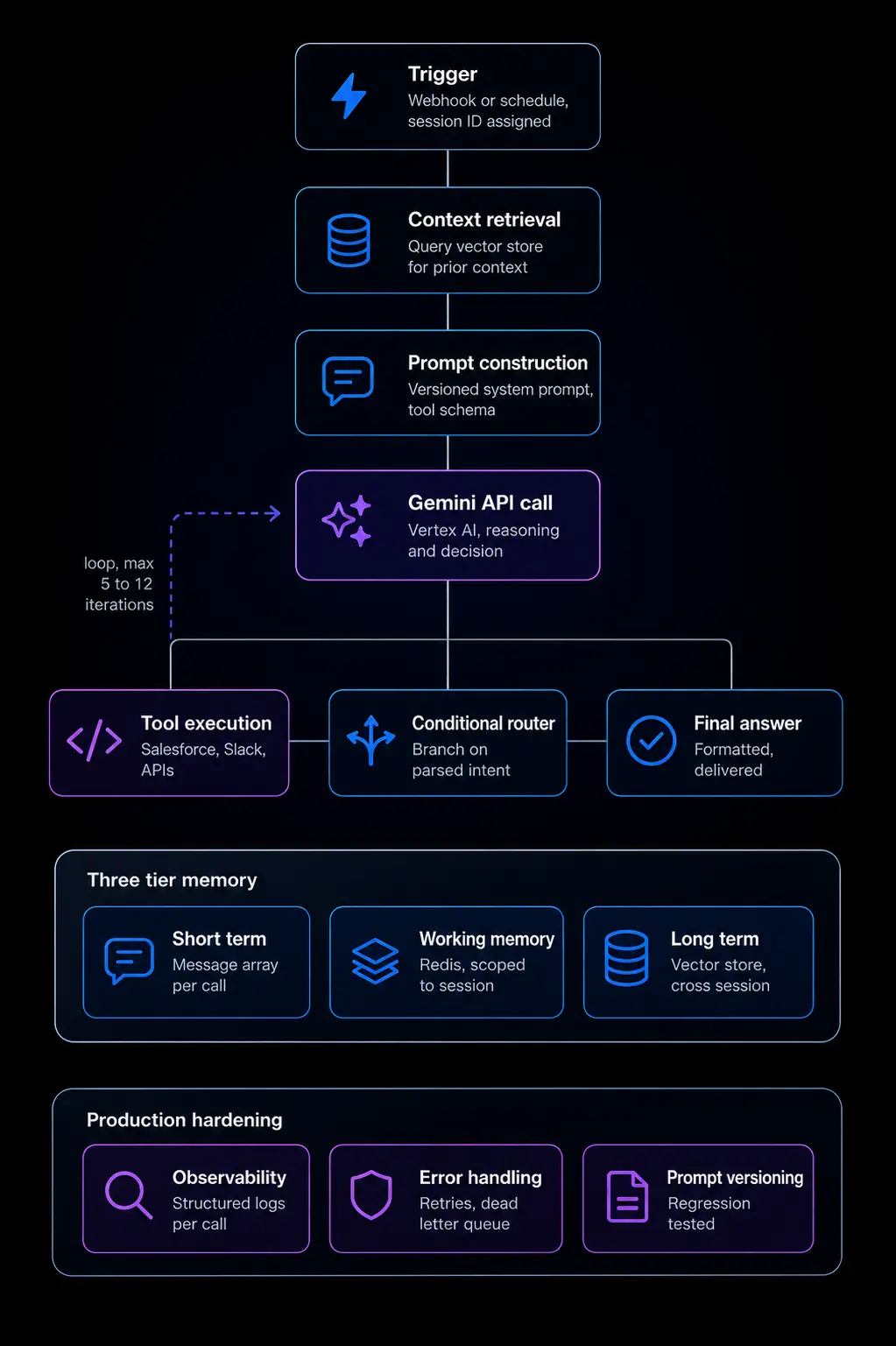
Step-by-step implementation guide for setting up for n8n Enterprise
The following walkthrough covers the decisions and configurations you'll encounter when building this in a real enterprise environment. These aren't simplified tutorial steps — they reflect what actually matters when the system needs to handle production traffic.
1. Infrastructure Hardening & High Availability
For true enterprise deployments, avoid single-node configurations or n8n Cloud for sensitive workloads. Instead, host a scalable n8n instance within your own Virtual Private Cloud (VPC) using a Kubernetes-managed container deployment.
- Execution Scaling (Queue Mode): Enforce EXECUTIONS_MODE=queue in your environment variables. Deploy an enterprise-grade Redis cluster to act as the message broker. This allows a separate fleet of stateless n8n worker nodes to scale horizontally and absorb heavy agent loops without compromising the responsiveness of your main n8n instance.
- Database Optimization: Run n8n on a managed PostgreSQL database. Because agentic loops write enormous amounts of step-by-step telemetry, you must set EXECUTIONS_DATA_PRUNE=true alongside a strict EXECUTIONS_DATA_MAX_AGE policy to prevent storage bloat.
- Secrets Management: Do not store third-party API tokens inside n8n workflow configurations. Utilize n8n Enterprise's native external secrets integration to stream credentials out of HashiCorp Vault or AWS Secrets Manager at runtime.
2. Enterprise Authentication: Gemini via Vertex AI / Agent Platform
While Google AI Studio works well for prototyping, enterprise compliance teams demand the security posture of Google Cloud's Gemini Enterprise Agent Platform (formerly Vertex AI). It provides strict data isolation, VPC Service Controls, and robust audit logging.
- IAM Scopes: Configure an n8n Credentials block using a Google Service Account JSON key that is explicitly limited to the Gemini Enterprise Agent Platform User (formerly Vertex AI User) or GenAI Administrator role.
- Targeting the REST Endpoint: Set your n8n HTTP Request node to a POST request pointing to Google's regionalized production endpoint template:
- $$\text{https://\{REGION\}[-aiplatform.googleapis.com/v1/projects/](https://-aiplatform.googleapis.com/v1/projects/)\{PROJECT-ID\}/locations/\{REGION\}/publishers/google/models/\{MODEL-ID\}:generateContent}$$
- Data Residency: Ensure that the {REGION} parameters align perfectly with your company's localized compliance frameworks (such as us-central1 for domestic data handling or europe-west3 for strict GDPR adherence).
3. Structuring the Agent Loop with n8n Nodes
The execution loop must remain resilient, clean, and bounded. Build your architecture using these precise functional steps:
- Trigger & Context Initialization: When a webhook or schedule fires, write a unique sessionId to your fast-access storage layer (like Redis or Supabase) to initialize state.
- Context Retrieval (Vector Store Integration): Query your enterprise vector database (Qdrant, Pinecone, or PGVector) using native n8n Vector Store components to feed highly specific operational context to the agent before it calls the LLM.
- The Reasoning Call (HTTP Request): Construct a structured JSON message array containing system rules, active tools schemas, retrieved context, and the user's explicit objective. Hardcode Gemini's request parameters to return a deterministic json_object.
- The Switch/Router Node: Evaluate the returned structure using an explicit n8n Switch node. If the payload indicates a tool_call, dynamically branch out to execute an integration. If it outputs a final_answer, bypass the loop and send the completion path.
- Loop Controller & Safety Braking: Use an evaluation Code node to increment an execution counter stored inside the workflow variables. Enforce a strict ceiling (e.g., 8–12 iterations max). If a loop enters an unexpected hallucination cycle and hits this ceiling, route the payload immediately to a human-in-the-loop dead-letter queue.
4. Memory Architecture for Stateful Agents
Stateless agents are almost useless in enterprise contexts. Users expect continuity. The standard pattern is a three-tier memory system:
- Short-Term Memory: The live message array passed back and forth within an active execution branch.
- Working Memory: A shared Redis key tied to the specific sessionId that tracks variable tool outcomes during the active cycle.
- Long-Term Memory: A vector store configuration that indexes compressed summaries of past sessions to keep cross-interaction intelligence alive.
Production hardening: what separates pilots from platforms
The jump from a working prototype to a production system that your business can rely on requires deliberate hardening in four areas.
Observability and structured logging
Every Gemini API call should emit a structured log entry: timestamp, session ID, input token count, output token count, latency, and the reasoning step number. Use n8n's Code node to write these to a centralized log aggregator (Datadog, Grafana Loki, or even a simple Postgres table). Token costs compound quickly in agentic loops — you need per-session visibility to catch runaway workflows before your API bill does.
Error handling and graceful degradation
Gemini API calls will occasionally fail: rate limits, temporary outages, malformed responses. Your n8n workflow needs explicit error branches with exponential backoff on retries, a dead-letter queue for tasks that exceed max retries, and a fallback response path that notifies the end-user rather than silently failing. The Error Trigger node in n8n combined with a notification node (Slack or email) is the minimum viable observability layer.
Prompt versioning and regression testing
System prompts are code. Treat them as such. Store prompt templates in a version-controlled repository, reference them in your n8n workflow by version ID, and run a regression suite before promoting any prompt changes to production. A prompt that works in testing can subtly change agent behavior in ways that only manifest under production traffic patterns — systematic testing catches this early.
Enterprise Use Cases for the n8n + Gemini Stack
Deploying an agentic workflow is highly impactful when applied to industry-specific operational bottlenecks. Because n8n handles deep system integrations and Gemini processes massive, unstructured datasets, enterprises can automate complex, decision heavy workflows that traditional automation tools cannot touch.
1. Manufacturing: Autonomous Supply Chain Remediation
- The Orchestration (n8n): Monitors live factory IoT logs, enterprise asset systems (SAP, Oracle), and inbound vendor delivery emails.
- The Intelligence (Gemini): Ingests an unstructured carrier delay alert and uses its multimodal intelligence to inspect attached customs document scans or freight bills. It evaluates the raw text data against strict legal supply manuals stored in the vector layer.
- The Action: The agent autonomously references live material balances in the ERP. If parts are short, it automatically targets alternative pre-approved suppliers, generates a drafted RFQ (Request for Quote), modifies the schedule in the manufacturing execution system, and routes an actionable summary to the logistics manager for approval.
2. Construction: Real-Time RFI & Compliance Tracking
Construction AI solutions have evolved from static document logs into dynamic knowledge engines that eliminate critical administrative delays on-site. By pairing n8n's visual node structures with Gemini's high context limitations, firms can process complex requests for information (RFIs) proactively rather than reactively.
- The Orchestration (n8n): Syncs field management tools (like Procore or Autodesk Build) directly with internal document servers and city zoning databases.
- The Intelligence (Gemini): When an engineer uploads an urgent Request for Information (RFI) regarding a spatial blueprint conflict, Gemini processes the message alongside massive blueprint architectural files (leveraging its huge context capacity). It runs comparisons against municipal building codes to determine compliance.
- The Action: The agent drafts an objective, technically sound design recommendation, pushes structural updates back into the central BIM logs, and fires an alert to the compliance safety officer if the variation requires a municipal variance request.
3. Healthcare: Automated Prior Authorization Triaging
Advanced Healthcare AI solutions target the immense administrative strain of insurance navigation, cutting authorization turnaround loops from weeks to minutes. Under strict federal data exchange rules, this stack replaces multi-hour manual data re-entry with precise, secure automation.
Compliance Note: This use case relies completely on a self-hosted n8n installation run entirely inside a protected, HIPAA-compliant private cloud environment utilizing enterprise-hardened data isolation boundaries.
- The Orchestration (n8n): Interfaces directly with Electronic Health Record (EHR) environments via secure HL7/FHIR webhooks to ingest raw practitioner voice logs or insurance exception files.
- The Intelligence (Gemini): Translates complex medical vocabulary found inside clinician notes and tests, comparing the clinical justification directly against thousands of pages of insurance policy guidelines.
- The Action: Automatically structures, populates, and delivers complete medical authorization records directly into health portal APIs. If an invalid automated rejection occurs, it hands the case directly over to specialized hospital billing staff along with a clear brief outlining why the rejection breached regular policy limits.
CASE STUDY NEURAMONKS
Custom Gemini LLM integration via Dify plugin development
Neuramonks, a leading Dify AI Development Company, built a custom Gemini provider plugin for the Dify AI platform — enabling enterprise clients to route their agentic workflows through a fully approved, org-level Gemini LLM integration. The plugin bypassed Dify's default model limitations by implementing the Approved Provider protocol, giving clients control over model selection, API keys, and token budgets within the same visual workflow environment.
Read the full case study
Scaling the stack: from single workflow to multi-agent system
Once a single agentic workflow is stable, the natural next step is multi-agent architectures systems where specialized agents collaborate on complex tasks. In n8n automation, this is implemented through a coordinator-worker pattern: a top-level orchestrator workflow receives tasks, decomposes them, and triggers child workflows via n8n's Execute Workflow node. Each child workflow is a specialized agent (one for document analysis, one for database queries, one for external API calls) with its own Gemini context and memory scope.
This is where Neuramonks consistently delivers differentiated value for enterprise clients not just connecting nodes, but designing the agent topology that matches the client's operational complexity. A single generic agent cannot reliably handle the breadth of tasks a real business generates. Specialized agents with clear boundaries and well-defined handoff protocols consistently outperform monolithic prompts trying to do everything.
As a Dify AI Development Company, Neuramonks also builds parallel implementations using Dify's visual agent builder for teams that prefer a lower-code interface for managing agent chains often combining Dify for agent logic with n8n for the integration layer, giving clients the best of both environments.
Security considerations for enterprise deployments
Agentic systems that can take actions writing to databases, sending emails, calling external APIs require a security model that goes beyond standard web app practices. The principle of least privilege applies at the agent level: each tool available to the agent should have the minimum permissions needed to accomplish its specific task. A document summarization agent does not need write access to your CRM.
In n8n, enforce this by creating separate credentials for each integration, scoped to the permissions that specific workflow actually needs. Audit credential usage quarterly. Log every tool call the agent makes with the session ID and user context that authorized it. For regulated industries (healthcare, finance), consider adding a human-in-the-loop node before any irreversible action n8n's Wait node combined with an approval webhook makes this straightforward to implement.
The Neuramonks' approach to enterprise AI automation
At Neuramonks, our implementation methodology for enterprise agentic systems starts with a capability audit mapping existing workflows, data sources, and integration points before writing a single node. The most common mistake we see is teams starting with the technology (n8n, Gemini, Dify) before clearly defining which decisions the agent needs to make, which data it needs access to, and which actions it should never take autonomously.
The second phase is a controlled pilot: a single, high-value workflow deployed to a subset of users with full observability instrumentation. This generates the real usage data needed to tune prompts, adjust memory strategies, and right-size the agent's tool set before organization wide rollout. Enterprise deployments that skip this phase consistently encounter production incidents that could have been caught in a three-week pilot.
Start your enterprise AI automation journey
Whether you're architecting your first agentic workflow or scaling an existing system, Neuramonks brings the engineering depth and implementation experience to get it right in production not just in demos.
Get in touch with Neuramonks
MCP vs API for AI Agents: What Your Integration Layer Is Actually Costing You
MCP vs API for AI Agents — breaks down why the Model Context Protocol is replacing traditional JSON-over-API integrations for AI agent tool layers, with honest cost comparisons, real-world examples, and guidance on when a custom MCP server is worth the investment over generic solutions.

For years, MCP server development wasn't even a conversation. Connecting an AI agent to your tools meant writing JSON schemas, maintaining API wrappers, and debugging integrations at 2am. That's changed, fast. Here's why businesses are paying attention, and why the switch is less complicated than it sounds.
What JSON-over-API actually looked like
Before MCP, the standard approach was: define your tool schema in JSON, hand it to the agent, let the agent call your API directly, and write glue code to handle errors, retries, and response normalization.
It worked. But it worked the way duct tape works fine for one thing, a mess once you start stacking it.
The agent had no standardized way to discover what tools were available. It had no consistent error contract. Every integration was its own dialect, and teams at scale ended up building internal libraries just to translate between their AI agents and their own systems.
If you're dealing with this, don't blame your engineering team traditional web infrastructure simply wasn't built for non-deterministic AI agents. The tools were designed for predictable, scripted calls. Agents don't work that way, and the mismatch shows up as exactly the kind of glue code, retries, and 2am debugging described above.
What does MCP actually change
MCP isn't a library or a framework in the traditional sense. It's a protocol a standardized contract for how AI agents discover and invoke tools, access data, and handle context.
Think of it the way TCP/IP standardized how computers talk to each other. Before TCP/IP, every network had its own rules. After it, networks could interoperate without anyone writing custom translation logic.
MCP does something similar for the AI tool layer. Your agent learns MCP once. Every server that speaks MCP becomes accessible no custom integration code, no bespoke JSON schemas, no new wrapper library per service.
The practical effect:
- Agents can discover available tools at runtime, not just at configuration time
- Tool responses follow a consistent structure, so parsing logic doesn't change per integration
- Error handling is standardized the agent knows what a failed call looks like regardless of which tool it called
- New tools can be added to an agent's environment without redeploying or retraining
Teams that moved from API-first integrations to MCP report that adding a new data source to an existing agent went from a multi-week sprint to a configuration task measured in hours. The agent doesn't change. The protocol handles the rest.
Why MCP, and Why Now
This is the part most explainers skip: MCP isn't a bet on one vendor's roadmap anymore, and that's exactly why it's worth taking seriously in 2026.
Anthropic introduced MCP in late 2024. Within a year, OpenAI, Google, and Microsoft had all shipped native support for it across their major platforms, and adoption kept compounding from there tens of thousands of public MCP servers now exist, spanning everything from developer tools to Fortune 500 deployments. In December 2025, Anthropic donated the protocol to the Agentic AI Foundation, a neutral fund under the Linux Foundation co-founded by Anthropic, Block, and OpenAI, with Google, Microsoft,
AWS, and Cloudflare backing it.
That hand-off matters more than it sounds: it moved MCP out of "Anthropic's protocol" territory and into the same category as HTTP or TCP/IP infrastructure no single company controls, and that everyone building on AI can rely on without worrying it gets deprecated or paywalled.
The protocol has also matured technically. The current spec runs on Streamable HTTP with OAuth 2.1-based authorization, which means MCP servers can be deployed securely on the open internet rather than limited to a developer's local machine the thing that made early MCP useful mainly for coding assistants and not much else.
Put plainly: when your competitors, your SaaS vendors, and the model providers you depend on are all converging on the same connection standard, building your agent's tool layer on anything else is a bet against where the entire ecosystem is already headed.
MCP vs raw API: an honest comparison
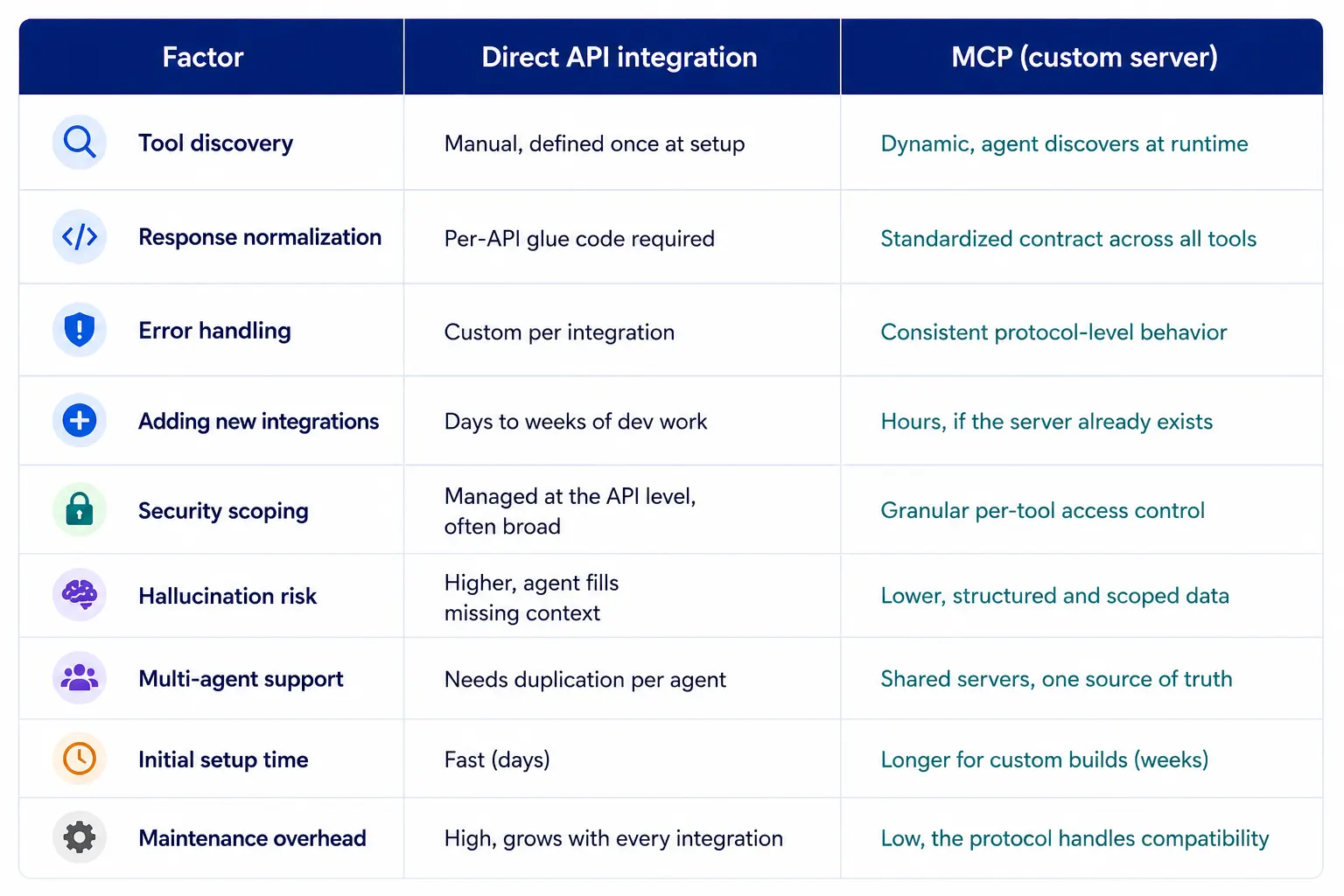
Here's where things stand when you compare a direct API approach against MCP, across the factors that matter most in production.
Why this Matters More for SaaS than Anyone's Saying
Most MCP coverage focuses on developer tools and enterprise AI. The implications for SaaS businesses are more immediate than that framing suggests.
If you run a SaaS product, your users already expect AI features. The question is whether those features hold up or whether they're impressive in a demo and frustrating in daily use.
The gap usually isn't the model. A well-prompted GPT-4 or Claude is plenty capable. The gap is the tool layer. The agent hallucinates when it doesn't have reliable access to the right data. It fails when API responses are inconsistent. It slows down when it has to call three endpoints to answer a question that should need one.
MCP doesn't fix your product strategy. It fixes the infrastructure problem sitting between "our AI feature works in the demo" and "our AI feature works at 3pm on a Tuesday with 400 users active."
Three Things Tend to Change Once a Team Moves the Tool Layer Onto MCP:
- Feature velocity improves, because new AI capabilities can pull from existing MCP servers without custom integration work
- Support costs drop, because the agent stops guessing in ambiguous situations and returns a structured error the application can handle gracefully
- Multi-tenant complexity gets simpler, because access scoping lives at the MCP server level instead of scattered across every API call
At Neuramonks, the teams we work with consistently find that fixing the tool layer first before touching the model or the prompt produces the fastest measurable gains. It's a smaller surface area, and the difference is usually visible within weeks.
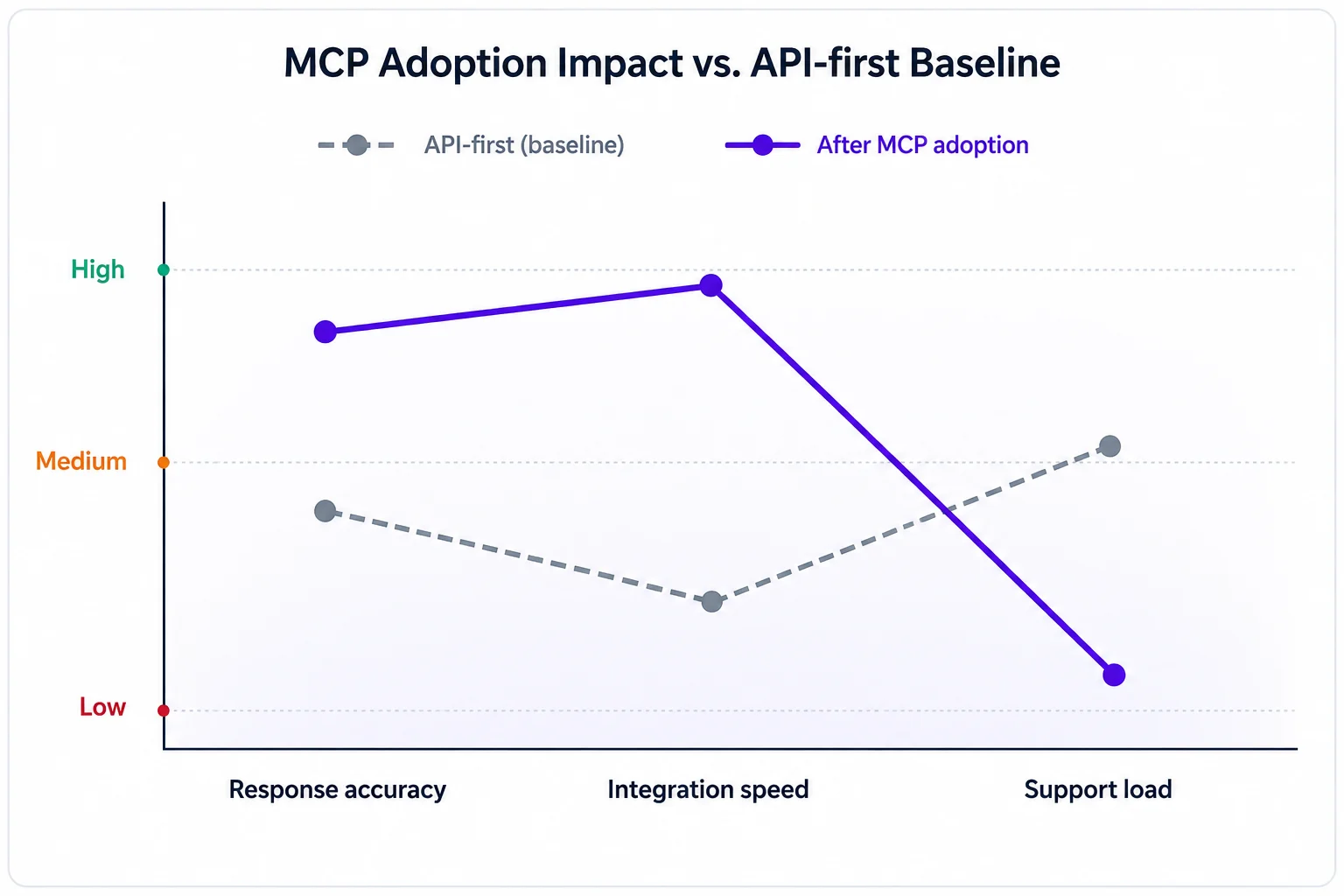
Note: support load is plotted inverted lower is better, so the rising purple point reflects fewer tickets, not more. Based on relative, directional shifts Neuramonks has observed across 2024–2026 client deployments, not absolute benchmark figures.
The practical Question: Generic MCP Server or Custom?
Generic MCP servers exist and they'll get you started. If you're evaluating whether MCP fits your stack, spinning up a generic server against a well-documented API is a reasonable way to test the concept in a few days.
The gap shows up at two points: when your data schema diverges from what the generic server expects, and when the agent needs to understand domain-specific logic rather than just fetch data.
Here's a real example. A construction software company needed an AI agent that could flag permit status issues a classic use case for AI in construction project management. A generic MCP server could pull permit records fine. But "flagging an issue" required understanding that a PEND_REV status in their system meant a 12-day delay risk, not just a pending review. That logic had to live in a custom tool definition. The agent couldn't infer it from a raw API response.
Custom MCP server development is slower to start than plugging in an off-the-shelf integration, typically two to four weeks for a meaningful first build. The right comparison isn't cost against generic servers. It's cost against the engineering hours your team will spend maintaining custom integration code, debugging agent failures in production, and re-explaining domain logic to every new model you evaluate.
Teams doing custom agentic AI development where multiple agents share infrastructure, coordinate tasks, or hand off context between steps tend to find that investing in a properly designed MCP layer early prevents the most painful re-architecture later. The protocol is the foundation. What you build on top of it is where the real business value lives.
What does it Actually Cost to Build
Rough ranges based on scope, not exact quotes. Your stack and requirements will shift these.
Basic server (3–5 tools, single data source): $8,000–$15,000. Covers a focused use case a customer support agent connected to a CRM, for example. A good fit if you're starting with AI MVP Development Services and want a working prototype without overbuilding.
Mid-complexity (6–12 tools, multiple integrations): $15,000–$40,000. Multi-system workflows with domain logic and access controls. Common for first production deployments.
Enterprise (12+ tools, compliance requirements, high availability): $40,000–$120,000+. Includes architecture review, security scoping, load testing, and documentation.
Ongoing maintenance usually runs 15–20% of the initial build cost annually, covering API updates, new tools, and monitoring.
Teams consistently underestimate these numbers because they're comparing against off-the-shelf integration tools. The more useful comparison: what does a poorly performing AI agent cost in manual correction, customer experience failures, and delayed releases? That number tends to reframe the conversation fast.
Where to Start if you're Evaluating this Now
Three questions worth answering before any scoping conversation:
- What decision does your AI agent need to make, and what data does it need to make it reliably?
- Where does your current agent fail or require human correction and is that failure at the model level or the tool layer?
- Are you building one agent, or building infrastructure that multiple agents will share?
If the failures are mostly at the tool layer wrong data, inconsistent responses, agents inventing context they don't have MCP is almost certainly relevant to your stack. If the failures are at the reasoning layer, that's a different conversation about prompting, fine-tuning, or model selection.
Most teams find it's both. But the tool layer is faster to fix and cheaper to address than model behavior. Starting there usually produces noticeable improvements in weeks, not quarters.
If your team wants to own this infrastructure long-term rather than outsource it entirely, Neuramonks also offers AI Consulting Services that work through the design decisions with your engineers directly covering tool schema design, access control patterns, error handling contracts, and how to structure MCP servers that hold up under real production load.
Let's Stop Debugging Integrations at 2am
Contact Neuramonks for a zero-commitment MCP Architecture Review, and we'll map out your tool infrastructure together what's already working, where the agent is filling in gaps it shouldn't have to, and what a custom MCP layer would actually take to build for your stack.
Book your MCP Architecture Review →
How Healthcare Agencies Cut Operational Costs by 40% and What it Actually Takes to get There
US healthcare agencies are cutting operational costs by up to 40% by deploying AI across revenue cycle management, clinical documentation, imaging diagnostics, and scheduling this post breaks down exactly where those savings come from, the implementation timeline, and 2026 pricing benchmarks for getting there.
US healthcare spends over $1 trillion a year on administrative and operational overhead. The agencies pulling ahead in 2026 are not the ones with the largest budgets they are the ones that deployed AI healthcare solutions where the costs are highest and measured results before expanding.
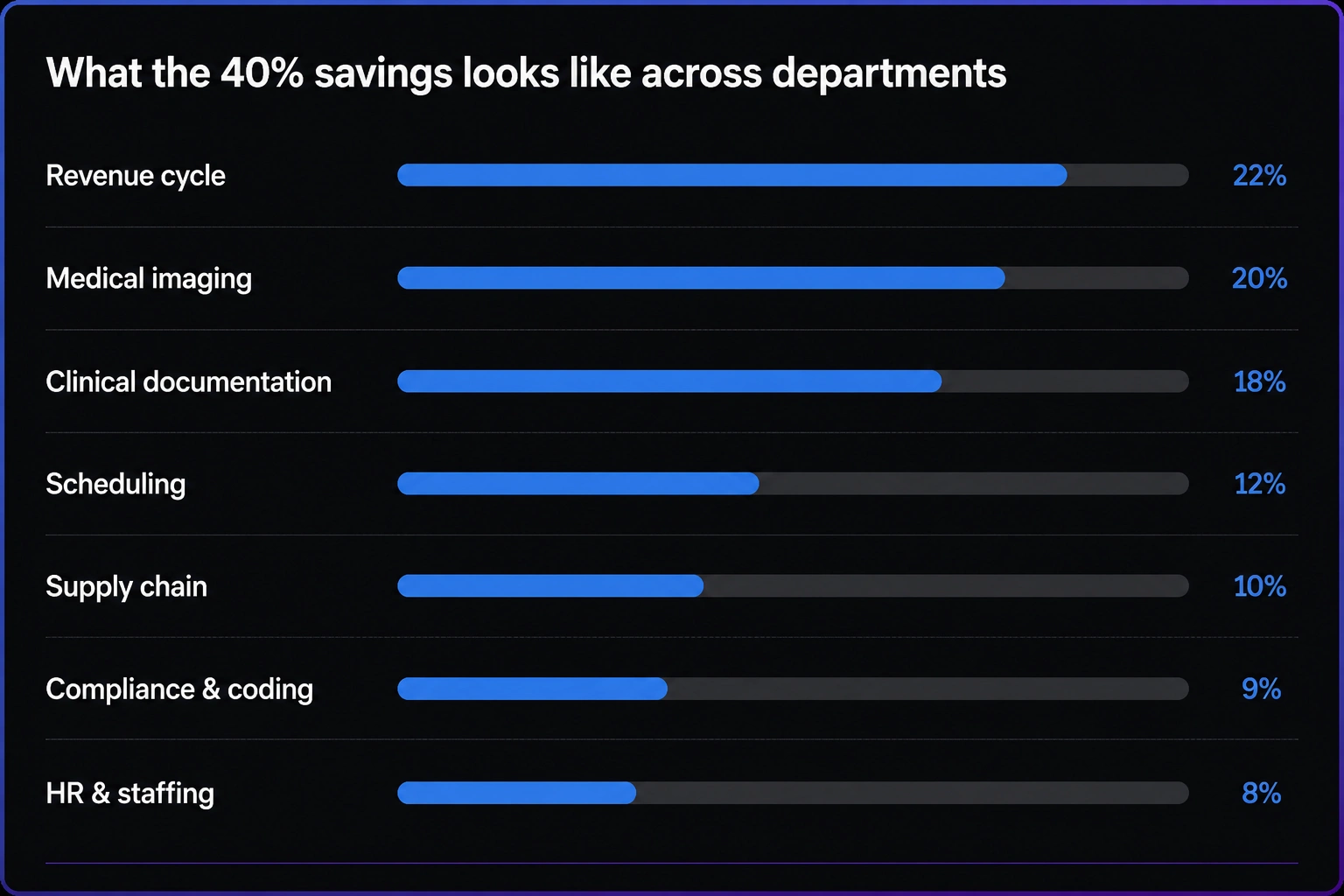
That 40% figure is not an estimate. It is a compounded number: efficiency gains stacked across seven operational layers, each independently measurable, each independently achievable. This post breaks down exactly where those savings come from, the use cases producing the clearest ROI, and what a realistic implementation looks like.
Where are the costs actually coming from
A mid-size hospital's operationloverhead breaks down across seven departments. The table below maps each to its primary AI application, the average cost reduction documented across 2025–2026 US deployments, and the implementation effort required.
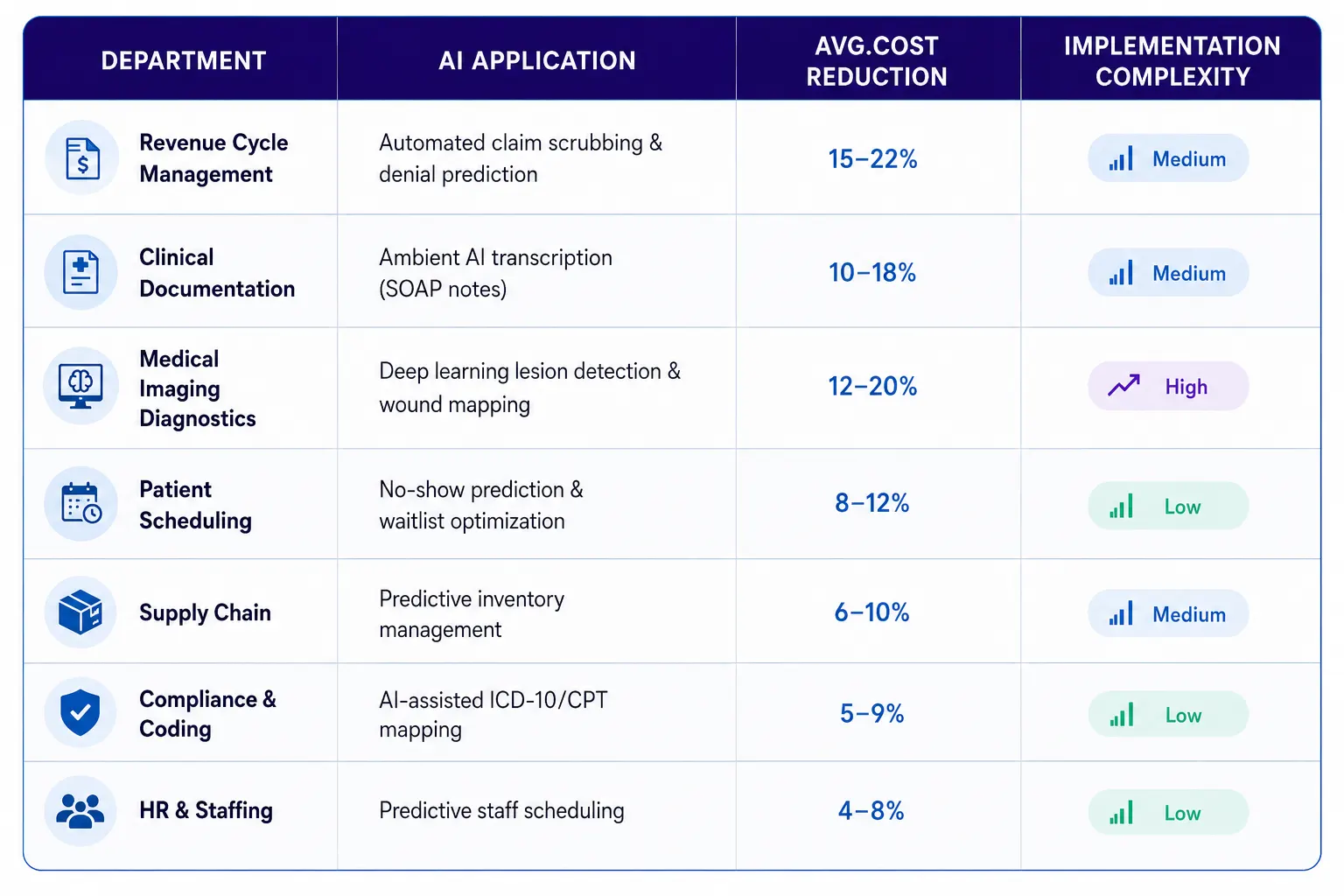
Stack four of these and 35–40% total reduction is not aggressive it is conservative.
The six areas with the clearest ROI
1. Revenue cycle management
Claim denials cost US hospitals an estimated $262 billion per year. The causes missing data, coding errors, eligibility gaps are almost entirely preventable. AI healthcare solutions deployed in revenue cycle pre-validate claims against payer rules before submission, flag high-risk claims for human review, and automate prior authorisation follow-ups.
One Neuramonks client in orthopedics reduced their claim denial rate from 11.4% to 2.6% within six months recovering $3.2M in annual revenue from that single change.
2. Intelligent scheduling and patient flow
No-show rates in US healthcare average 18–23%. AI scheduling systems predict no-show likelihood per patient and appointment type with 84%+ accuracy, auto-fill cancellations from a prioritised waitlist, and reduce wait times by 30 to 40%. For health systems managing thousands of weekly appointments, scheduling optimisation alone generates $500K to $2M in recovered annual revenue.
3. Ambient clinical documentation
Physician burnout costs US healthcare $5 billion annually. Documentation SOAP notes, referral letters, discharge summaries consumes two to three hours per physician per day. Ambient AI transcription listens to patient-physician conversations (with consent), generates structured notes in real time, and pushes completed documentation to the EHR.
Physicians review and sign. Documentation time drops by 60–70%.
4. Medical imaging diagnostics with deep learning
Deep learning models detect, classify, and measure clinical findings in radiology scans, pathology slides, wound photos, and retinal images at speeds and levels of consistency that are difficult to match in manual workflows. This is one of the fastest-growing areas of artificial intelligence in healthcare.
Key imaging use cases producing documented ROI:
- Radiology & lesion detection: CT/MRI scan analysis with bounding-box measurement flags findings for radiologist review, reducing review time by up to 60%.
- Wound detection & progression tracking: Automated area measurement and week-on-week comparison, eliminating manual assessment time and improving care consistency.
- Retinal screening: Diabetic retinopathy grading at scale, 3× more patients screened per clinician per day.
- Pathology & histology classification: Tissue analysis and cancer risk stratification from slide images, with 94% AI diagnostic accuracy versus 78% manual on comparable tasks.
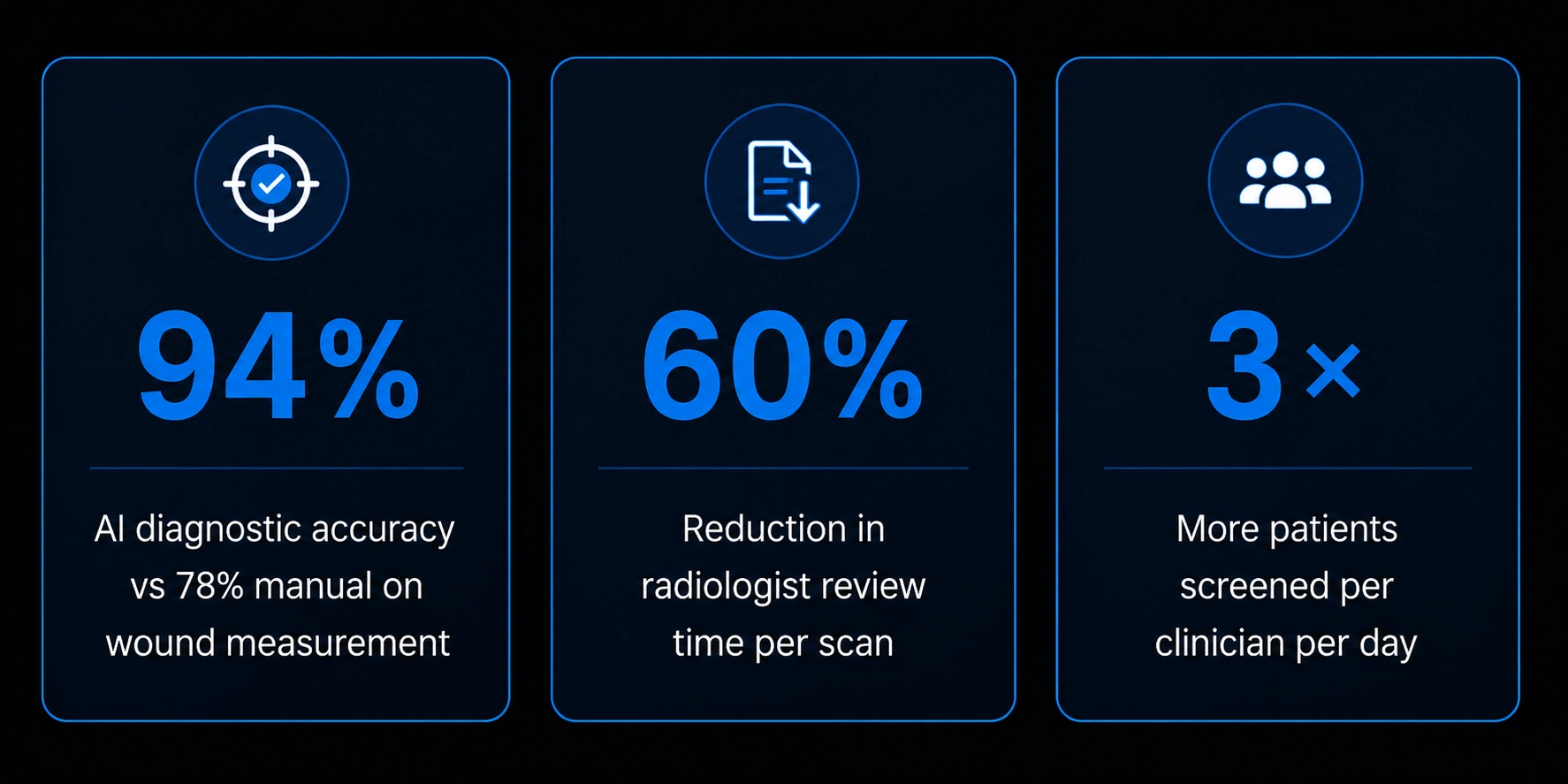
Neuramonks built an Automated Wound Detection and Measurement System using deep learning that enables clinical staff to document, measure, and track wound progression at scale reducing assessment time and improving care consistency across multi-site operations.
5. Supply chain and inventory intelligence
Manual par-level management fails in high-volume environments. AI-powered supply chain systems predict consumption by department and patient census, auto-trigger purchase orders at optimal reorder points, identify substitution opportunities when items are backordered, and flag vendor pricing anomalies in real time. Hospitals using these tools report 8 to 14% reductions in supply expenditure without affecting care quality.
6. AI-assisted compliance and medical coding
Undercoding leaves revenue on the table. Overcoding creates audit risk. Manual workflows produce 80 to 85% coding accuracy. AI coding assistants read clinical documentation, recommend complete ICD-10/CPT code combinations, and flag documentation gaps before a claim is filed. AI-assisted rates reach 94 to 97%.
That It Actually Takes to Get There
There is a clear pattern separating agencies that get results from those that run pilots that quietly disappear. When evaluating how Neuramonks approaches choosing an AI solutions partner for US healthcare, achieving a true 40% reduction always requires anchoring your execution strategy around four critical pillars:
- Strict Data Security & Privacy: Systems must utilize fully HIPAA-compliant pipelines. Data must be encrypted in transit and at rest, utilizing zero-data-retention APIs to ensure patient health information (PHI) is never used to train public models.
- De-siloed Infrastructure: The AI shouldn't act as another isolated dashboard. It must connect directly into existing EHR and billing infrastructures (like Epic, Cerner, or Athenahealth) via secure, real-time APIs to enhance workflows where staff already work.
- Clinical-in-the-Loop Validation: AI should never operate fully autonomously in clinical decision-making. True success relies on a "Human-in-the-loop" model the AI acts as an accelerator, but qualified administrative or clinical staff retain final sign-off and override capabilities.
- Phased Implementation & KPI Tracking: Identify high-volume workflows first (RCM, scheduling, and documentation are universal starting points). Organisations should leverage specialised AI proof of concept services using historical data to validate real-world ROI within a tight window before committing major capital.
ROI timeline: what to expect and when
- Days 1 to 30: Integration, configuration, and staff onboarding.
- Days 31 to 60: System goes live; baseline metrics established.
- Days 61 to 90: First measurable gains visible in RCM and scheduling.
- Months 4 to 6: Documentation time reductions and coding accuracy improvements measurable.
- Months 7 to 12: 20 to 30% cost reduction visible across active modules.
- Month 12 to 18: Full optimization complete; 35 to 45% cost reduction at steady state.
What AI healthcare solutions cost in 2026
- Healthcare AI pricing has matured. What required a seven-figure contract in 2021 now comes in modular, accessible tiers.
- Module-based: $2,500 to $8,000/month per module. Typical entry point for RCM automation or scheduling AI.
- Platform (enterprise): $150,000 to $750,000 annually for full-stack deployments across multiple use cases.
- Custom AI build: $75,000 to $300,000 in development cost, with ongoing maintenance at 15 tp 20% of build cost annually.
- Proof of concept: $15,000 to $40,000 fixed engagement that delivers validated ROI data before full investment is committed.
A 200-bed hospital spending $400K on AI deployment and saving 40% of a $6M annual operational overhead generates $2.4M in savings a 6× return in year one.
Ready to see what AI can cut from your overhead?
If your agency is carrying operational costs that AI can reduce, the first conversation costs nothing. Neuramonks works with healthcare organizations across the US to scope, validate, and deploy AI solutions that deliver measurable results.
Book a free consultation at neuramonks.com →
LLM Development for Enterprise: Beyond Chatbots, Built to Scale
A guide to enterprise LLM development beyond chat interfaces covering RAG vs. fine-tuning decisions, multi-agent orchestration, and how to vet an AI agency's PoC discipline and production track record before signing.

Deploying a scalable LLM Solutions requires moving past basic conversational interfaces to build robust infrastructure. Most companies have only scratched the surface of what large language models can do. This guide covers how enterprise teams are using LLMs for far more than conversational AI and what to look for when choosing the agency that will build it with you.
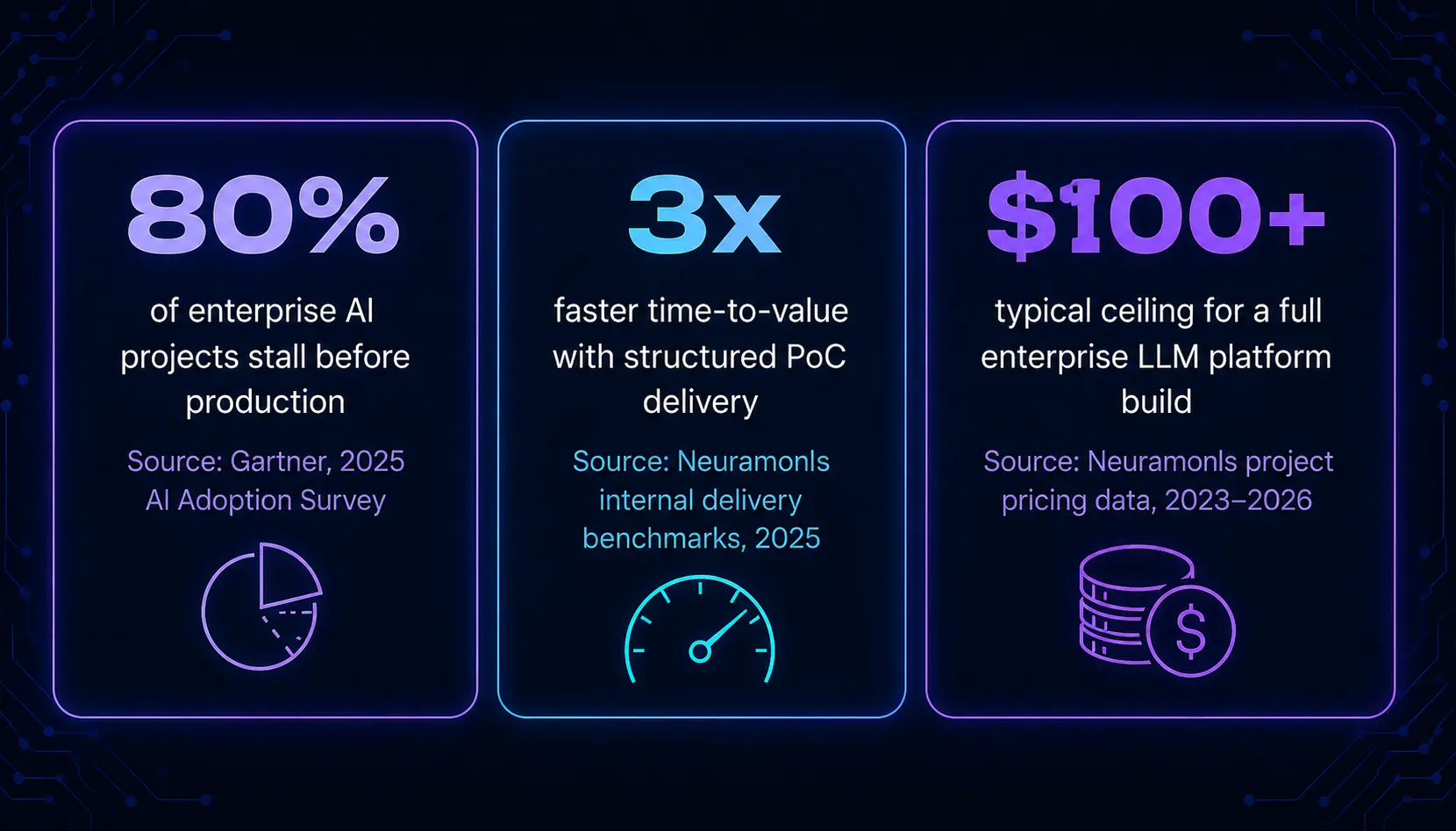
LLMs Are Not Chatbots. They Are Infrastructure
There is a persistent misconception in enterprise buying decisions: that LLM development means building a customer-facing chat interface. This is understandable chat products are the most visible public use case but it misses the deeper opportunity by a wide margin.
In 2026, the most impactful enterprise LLM deployments have nothing to do with conversational UI. They sit silently inside operational workflows, data pipelines, and decision-support systems doing the kind of unstructured reasoning work that brittle, rules-based automation could never handle.
“Large language models are general-purpose reasoning engines. Where your business has unstructured data, inconsistent inputs, or judgment heavy processes, there is almost certainly an LLM application worth building.”
Understanding the full breadth of what LLMs can do and finding an agency that has actually shipped across those categories is the first step to a successful enterprise AI engagement.
What High-Impact LLM Implementations Actually Look Like
The following categories represent real production deployments, not hypothetical use cases. Each one requires a different combination of model architecture, data infrastructure, and integration work.
- Automated contract review and clause extraction
- Intelligent document processing and classification
- Multi-step research and report generation
- Internal knowledge base Q&A with source attribution
- Custom media pipelines built on our AI Podcast Generation Platform
- Clinical notes summarization and coding support
- Sales intelligence and CRM enrichment workflows
- Multi-agent orchestration for complex task routing
- Compliance monitoring and regulatory flagging
- Personalized content generation at scale
- Code review, refactoring, and documentation
- Customer support triage and resolution routing
Micro-Case Study Healthcare
Wound assessment in clinical practice is still largely manual: measurements vary between clinicians, ruler-based methods are error-prone, and the workflow simply does not scale for remote care. Neuramonks built an Automated Wound Detection and Measurement System using an Attention U-Net deep learning architecture. The pipeline detects wounds from standard RGB images, uses a green calibration marker for real-world scale reference, applies perspective correction, and outputs centimeter-accurate measurements of wound area, perimeter, width, and height all via a HIPAA-compatible, API-ready architecture. Clinician measurement effort dropped by 55 to 65%, consistency improved by 30 to 40%, and AI output stayed within 5% error compared to expert manual benchmarks.
Read the full case study →
Micro-Case Study Finance & SaaS · Construction
A real estate and architecture client was losing significant time manually inspecting floor plan images to extract room boundaries, area calculations, and spatial metadata work that was error-prone and impossible to scale. Neuramonks built an AI-powered floor plan extraction system combining computer vision, OCR, and LLM-assisted normalization on AWS. The pipeline auto-detects individual floors, segments rooms, extracts polygon boundaries, and outputs structured, database-ready spatial records without human intervention. Manual analysis effort dropped by 60–70%, dimensional accuracy improved by 30 to 40%, and 100% of outputs are now analytics ready for downstream property and architecture systems.
Read the full case study →
What "Enterprise Grade" LLM Expertise Actually Requires
Not every agency that advertises AI services can execute on complex enterprise deployments. The difference becomes clear when you dig into their architecture decisions, infrastructure experience, and approach to failure modes.
Model Architecture
Ability to design fine-tuned models, RAG-augmented pipelines, and hybrid architectures not just prompt wrappers around hosted APIs.
Infrastructure Depth
Cloud-native deployments with autoscaling, vector database integration, orchestration frameworks, and production monitoring from day one.
Security & Compliance
SOC 2, HIPAA, and GDPR-aligned pipelines with proper data isolation, audit trails, and access controls for regulated industries.
PoC Discipline
Structured AI Proof of Concept Services with defined success metrics, fixed timelines, and clear go/no-go criteria before full commitment.
MLOps Capability
Long-term model monitoring, drift detection, retraining pipelines, and version management because LLMs degrade in production over time.
Vertical Experience
Prior production deployments in your industry. Edge cases and regulatory constraints in finance, healthcare, and SaaS are not learnable on your dime.
Fine-Tuning vs. RAG: Getting the Architecture Right
One of the most consequential decisions in any LLM project is whether to fine-tune a base model or use Retrieval Augmented Generation (RAG). The wrong call here can cost six figures and months of development time.
Fine-tuning modifies the weights of a base model using your own labelled data. It is the right choice when you need consistent tone and domain-specific terminology that cannot be delivered through context injection, or when compliance requirements demand a self-hosted model with no external API calls. For a deeper breakdown on choosing the right model scale for these tasks, see our comprehensive SLM vs LLM guide on the Neuramonks blog.
RAG retrieves relevant chunks from a vector-indexed knowledge base and injects them into the LLM's context at inference time. For most enterprise use cases internal knowledge Q&A, document analysis, product recommendation RAG delivers comparable accuracy at a fraction of the cost and maintenance overhead“An agency that defaults to fine-tuning every LLM without first evaluating RAG is likely over-engineering your solution and billing you accordingly. Push them on this decision during evaluation.”
Sophisticated agencies will often propose hybrid architectures: a RAG system with selective fine-tuning for the retrieval reranker or a domain-adapted embedding model. This is where real LLM engineering expertise becomes visible.
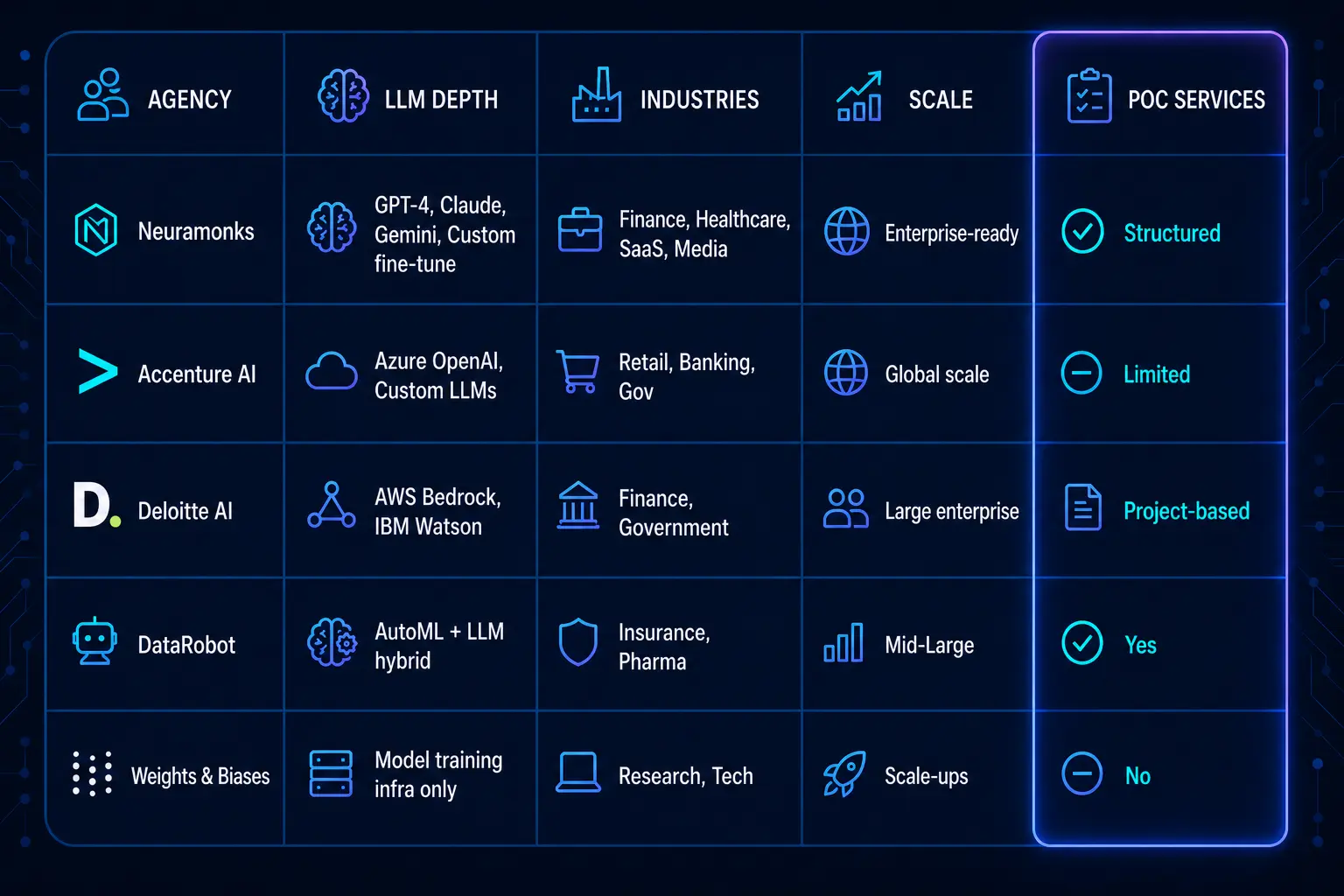
Disclosure: This blog is published by Neuramonks. The comparison below reflects our honest view of the market and where each firm genuinely fits including where competitors have strengths we do not. We believe transparent positioning is more useful than a hidden vendor ranking.
Why Enterprise Teams Choose Neuramonks Over Legacy Consultancies
The gap between global consulting firms and specialist LLM agencies is wide and widening. Here is an honest breakdown of what each type of firm delivers, where they fall short, and who each option is actually right for.
1. Neuramonks
Best for end-to-end LLM implementation across verticals
⭐ Top Pick
Neuramonks was built specifically around LLM and AI automation delivery not as a bolt-on to an existing consulting practice. That focus shows in their approach: every engagement starts with a commercial problem definition, not a technology selection. The question is always "what outcome are you trying to achieve?" before "which model should we use?"
Micro-Case Study Media & Content Industry
A media production client needed to scale podcast output without proportionally scaling their editorial team. Neuramonks deployed a multi-agent LLM pipeline one agent handled topic research via live web retrieval, a second structured and scripted each episode, a third passed output to a text-to-speech synthesis layer. End-to-end production time dropped by 70% (Neuramonks internal client benchmark, 2024), and the platform now runs in production across multiple show formats with no human intervention in the research and scripting stages.
Neuramonks' AI Proof of Concept Services follow a structured framework: fixed 4 to 8 week timeline, real client data integration, measurable success criteria, and a clear go/no-go recommendation. This de-risks the investment before any full-scale commitment is made.
Their core technical stack covers fine-tuned LLM model deployment, RAG pipelines using Pinecone and pgvector, multi-agent orchestration with LangChain and LlamaIndex, and cloud-native infrastructure on AWS and GCP. Active verticals include SaaS, media, finance, and healthcare.
Custom LLM pipelinesMulti-agent workflowsRAG architectureStructured PoC deliverySaaS / Media / FinancePost-deployment MLOps
2. Accenture AI
Best for global enterprise programs with complex legacy integration
Accenture's AI practice benefits from massive scale and deep systems integration capability. Their Azure OpenAI practice is one of the most mature in the industry, and their ability to manage organizational change alongside technical delivery is unmatched at global scale. The trade-off is cost and velocity enterprise programs at Accenture move at consulting pace, and deep LLM engineering depth sits behind significant account management overhead.
Azure OpenAISystems integrationChange managementGlobal delivery
3. Deloitte AI & Data
Best for regulated industries with mature governance requirements
Deloitte's strength in financial services, government, and healthcare stems from their governance and responsible AI frameworks, which are among the most developed in the market. For organizations where AI risk documentation and audit trails are non-negotiable, Deloitte brings credibility. However, their LLM model engineering bench is thinner than specialist agencies, and delivery timelines reflect consulting rates rather than sprint-based product development.
Responsible AI frameworksAWS BedrockRegulated industriesGovernance documentation
4. DataRobot
Best for AutoML + LLM hybrid pipelines in insurance and pharma
DataRobot occupies a useful niche between platform and services provider. Their managed AI cloud handles model training, monitoring, and deployment for enterprises that need production-speed without a deep in-house ML team. Strong for insurance and pharmaceutical use cases where structured prediction and LLM reasoning need to coexist in the same pipeline. Less suitable as a primary development partner for bespoke LLM architectures.
AutoML + LLM pipelinesModel monitoringInsurance / Pharma
5. Weights & Biases (W&B)
Best for ML teams scaling internal research and experimentation
W&B is more accurately described as an MLOps infrastructure partner than a development agency. If your team has strong in-house ML talent but needs experiment tracking, model versioning, and production monitoring tooling, W&B is indispensable. Not suitable as a primary development partner for organizations without existing AI engineering teams you need builders first, then W&B makes them more effective.
Experiment trackingModel versioningML infrastructure
Side-by-Side: LLM Model Capabilities at a Glance
How to Evaluate an LLM Agency Before Signing
Evaluating an AI partner requires the same rigor as vetting any major technology vendor. Here is a structured framework that separates agencies with genuine production experience from those selling innovation-theater.
Ask for production case studies with real metrics
Any agency can spin up an impressive demo with a hosted API and a UI library. What separates real LLM engineers is production experience: handling token limits at scale, managing latency under load, implementing fallback logic when models hallucinate, and maintaining accuracy as the underlying world knowledge shifts. Ask specifically for cost savings achieved, accuracy benchmarks hit, latency SLAs maintained, and user adoption figures not architectural diagrams.
Pressure-test their PoC process
A well-structured AI Proof of Concept Service should include defined success metrics agreed upfront, a fixed timeline of four to eight weeks, integration with your actual data (not synthetic samples), and a binary go/no-go decision framework. If an agency cannot clearly articulate how they structure PoC engagements, they are likely selling exploration at your expense.
Probe infrastructure maturity
Production LLM deployments require more than prompt engineering. Ask about experience with vector databases such as Pinecone, Weaviate, or pgvector; orchestration frameworks like LangChain or LlamaIndex; and cloud-native deployment on Kubernetes or serverless inference endpoints. An agency that cannot answer these questions confidently is unlikely to be enterprise-ready.
Test their fine-tuning vs. RAG reasoning
As covered earlier, fine-tuning is expensive and often unnecessary. Ask the agency to walk through their decision framework: under what conditions do they recommend fine-tuning versus RAG versus a hybrid approach? The quality of this answer reveals whether you are talking to engineers who have thought deeply about trade-offs, or salespeople who will over-engineer whatever maximizes their billable hours.
Ask about post-deployment support
LLMs are not fire-and-forget deployments. As world knowledge shifts and user behavior evolves, model performance drifts. Agencies without MLOps capabilities will leave you responsible for maintenance work your team is likely not equipped to handle. Clarify upfront whether ongoing monitoring, retraining, and performance review are included, and at what cost.
Five Mistakes Enterprises Make When Hiring LLM Agencies
01 Prioritizing flashy demos over production track records
A well-animated prototype tells you nothing about whether the team can handle real data volumes, real users, and real SLAs. Always ask what happened after the demo.
02 Skipping the PoC phase entirely
Jumping from requirements directly to full development is one of the most reliable ways to waste significant budget on AI that never ships. A structured proof of concept changes this equation.
03 Choosing on price alone
LLM model engineering is a specialist skill. The cheapest quote almost always reflects inexperience with production-grade complexity. What you save in fees you will spend in failure costs
04 Ignoring post-deployment operations
LLMs degrade over time as the world changes and user behavior evolves. Agencies without MLOps capabilities leave you managing a system you did not build and do not fully understand.
05 Not aligning on success metrics before the first sprint
Vague briefs produce vague outcomes. Define latency thresholds, accuracy benchmarks, and cost-per-inference targets before any code is written not after the first review cycle.
What LLM Development Actually Costs in 2026
Cost ranges vary significantly by scope, compliance requirements, and infrastructure complexity. The figures below represent typical market ranges across well-known agencies not fixed prices.
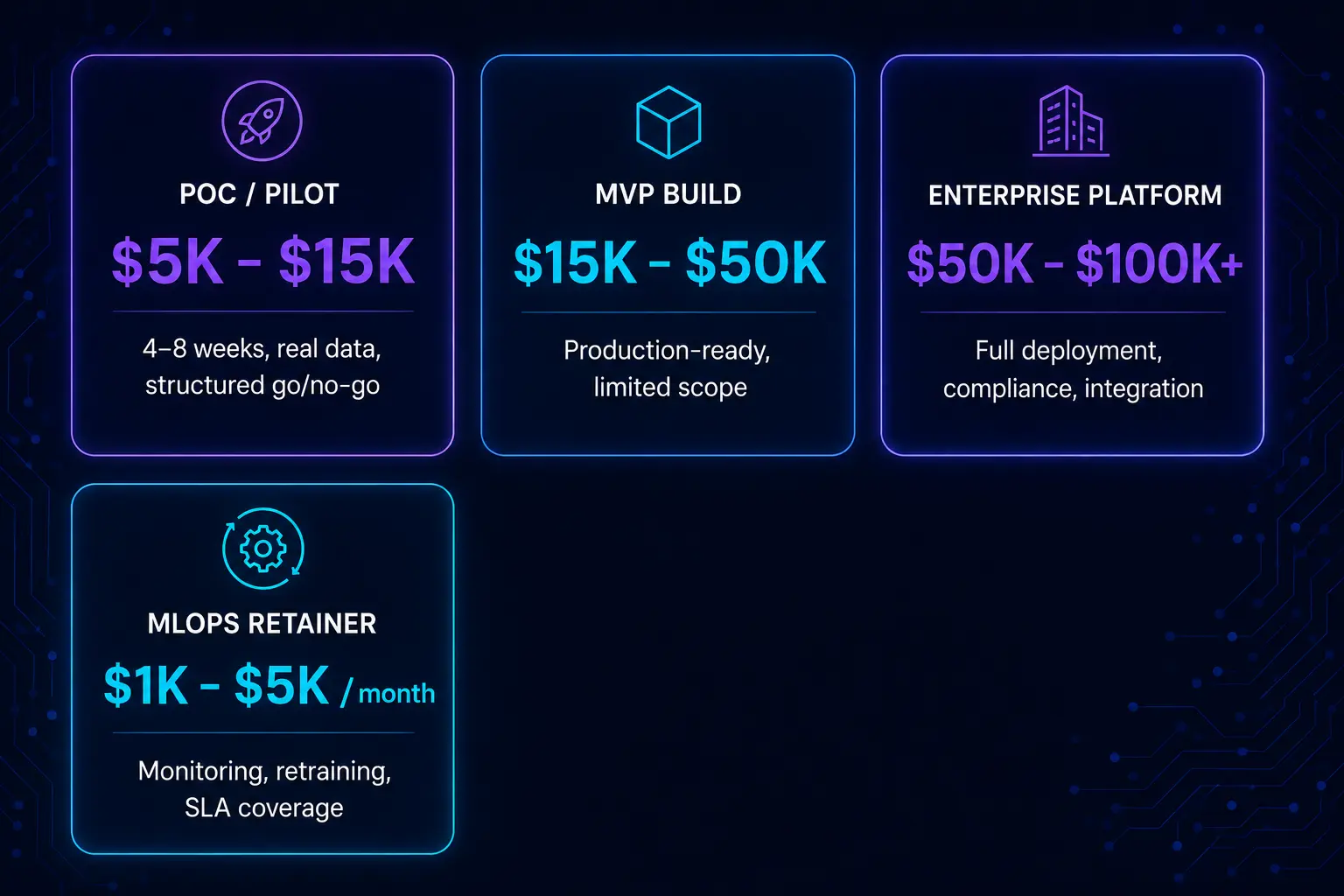
The main cost drivers are model selection (proprietary API costs versus self-hosted open-source), vector database and inference infrastructure, compliance requirements for regulated industries, and the depth of integration with existing enterprise systems. AI Proof of Concept Services remain the most cost-effective way to validate ROI before committing to full development scope.
Talk to Neuramonks about your LLM model project
Whether you are scoping AI solutions for the first time or evaluating your next LLM platform build, our team offers structured discovery sessions. We help enterprise teams define PoC scope, select the right architecture, and put together a business case grounded in real numbers not vendor optimism. AI Proof of Concept Services, production deployment, and ongoing MLOps support: all under one roof.
Book a Free Consultation with Neuramonks
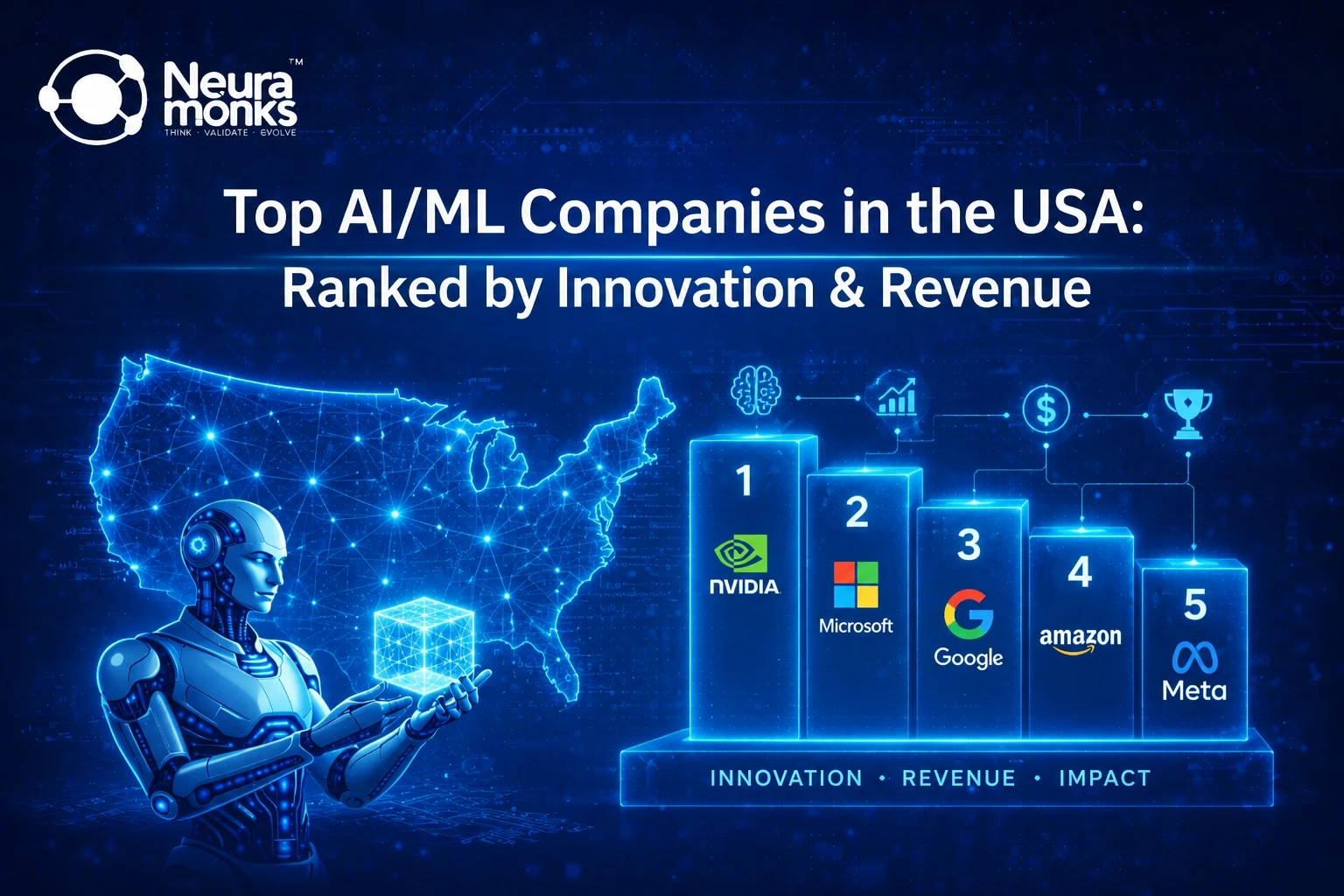
Top AI/ML Companies in the USA Ranked by Innovation & Revenue
Discover the top AI/ML companies in the USA ranked by innovation, revenue growth, and real world deployment success. Explore which firms are delivering measurable business outcomes and shaping the future of enterprise AI in 2026.
Who is actually building, deploying, and delivering ROI at enterprise scale not just talking about it.
The top AI/ML companies in the USA are ranked by their ability to deliver production-grade AI solutions across industries not by pitch decks. In 2026, the leaders are defined by three things: proprietary model development, real client outcomes, and the machine learning solutions that prove ROI at scale. This list breaks down who is actually delivering.
Why This Ranking Matters in 2026
The AI industry crossed a critical threshold in 2025: the gap between companies that talk about AI and companies that build, deploy, and maintain AI systems at enterprise scale became impossible to ignore.
Boards stopped funding AI exploration. They started demanding AI execution. That shift rewrote the competitive landscape and it is why any serious ranking of AI/ML companies must weigh demonstrated outcomes, not claimed capabilities.
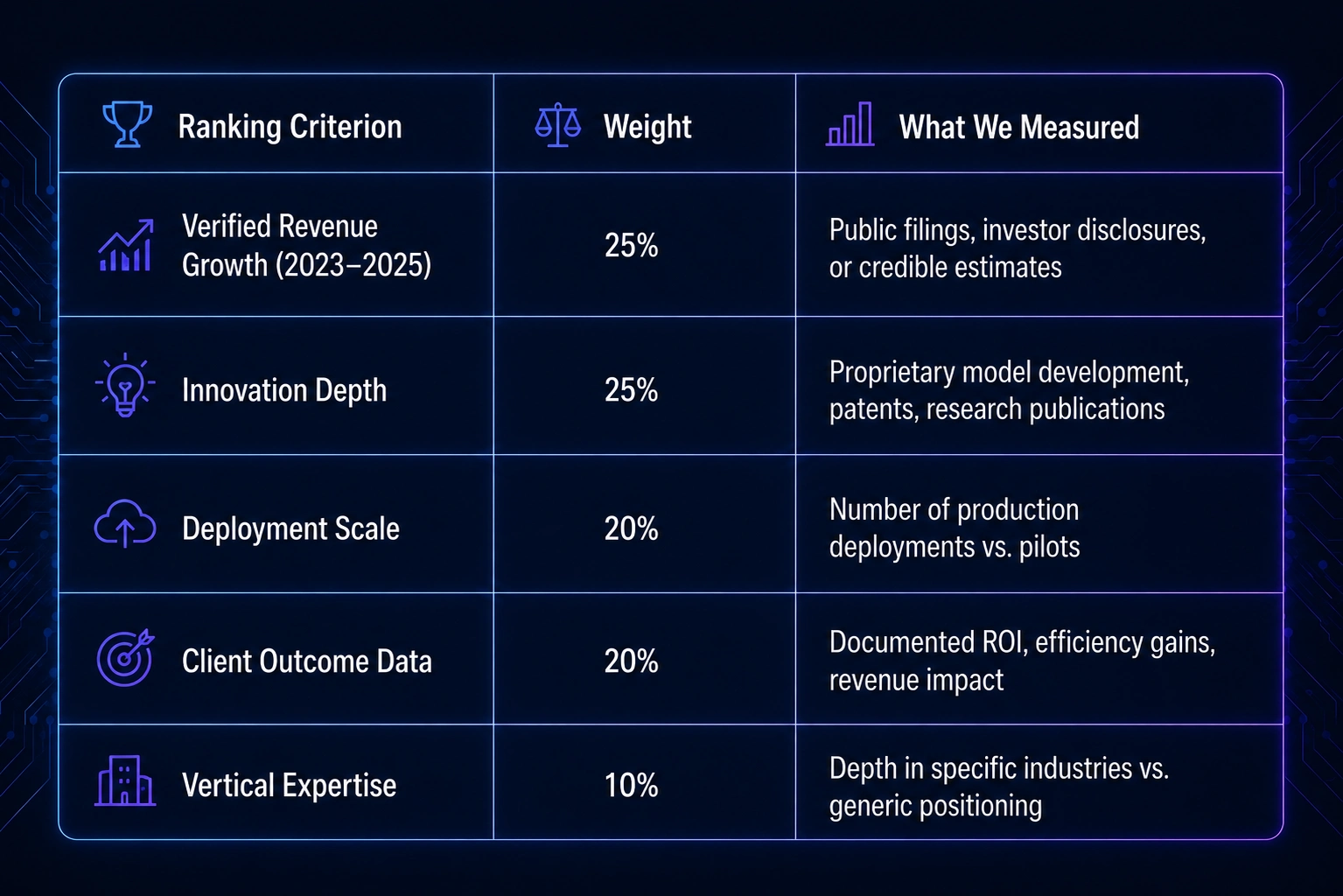
This ranking evaluates US-based AI firms on four dimensions: revenue growth, innovation depth (proprietary research vs. API wrapping), deployment track record, and client outcomes across verticals.
The Criteria Behind the Rankings
Before the list, the methodology matters. Too many "top AI companies" rankings are advertiser-funded. This one is not.
Estimated 2024 AI Revenue — Top US Companies
The Top AI/ML Companies in the USA (2026)
OpenAI
Revenue: Estimated $3.4B (2024), growing rapidly toward $10B+ | Innovation: GPT 4o, o1 reasoning model, Sora (video generation), DALL-E 3
OpenAI remains the most influential AI company in the world by research output and enterprise adoption. The GPT API ecosystem powers thousands of downstream applications. Enterprise revenue from ChatGPT Team and Enterprise plans has grown faster than any other segment. The criticisms high compute costs, closed model approach are valid, but output volume and model quality make OpenAI the benchmark every other firm is measured against.
Anthropic
Revenue: Estimated $850M ARR (2024), growing 4x year-over-year | Innovation: Claude model family, Constitutional AI, safety-first research
Anthropic built its competitive position on a specific thesis: that safe AI is commercially superior AI. The Claude model series has demonstrated that enterprise clients care deeply about reliability, predictability, and reduced hallucination risk. Their 100K+ context window and multi-document reasoning capabilities make them the preferred choice for legal, healthcare, and financial enterprise applications.
Google DeepMind
Revenue: Part of Alphabet ($307B 2024 revenue); AI contributes measurably to search, cloud, and ad revenue | Innovation: Gemini Ultra, AlphaFold 3, Gemma (open models)
DeepMind's research output continues to redefine what is possible. AlphaFold 3's protein structure prediction capabilities have direct commercial value in pharmaceutical discovery. Gemini's multimodal architecture and integration into Google Workspace gives DeepMind a distribution advantage that pure play AI companies cannot replicate.
Microsoft AI (with OpenAI Partnership)
Revenue: Azure AI services exceeded $10B ARR in 2024 | Innovation: Copilot ecosystem, Azure AI Studio, phi-3 small language models
Microsoft's AI revenue story is less about model research and more about deployment at scale. The Copilot integration across M365 (Word, Excel, Teams, Outlook) gives Microsoft the broadest enterprise AI surface area in the world. Azure AI Studio is becoming the default deployment platform for Fortune 500 AI initiatives.
Scale AI
Revenue: Estimated $1B+ (2024) | Innovation: Data labeling, RLHF infrastructure, enterprise AI evaluation
Scale AI occupies a critical infrastructure position in the AI stack the quality of training data. Every major foundation model company is a Scale AI client or competitor. Their pivot to enterprise AI evaluation and red teaming services adds a new revenue stream that is growing alongside the AI security market.
Mid-Market Leaders: The Builders Making It Real
The tier below the hyperscalers is where the most interesting commercial AI work is happening. These companies are not building foundation models. They are building the industry-specific applications, custom deployments, and ML pipelines that turn foundation models into operational business tools.
Where We Fit In: Why Neuramonks Focuses on Applied Innovation
We want to be transparent: Neuramonks authored and published this analysis. We are not a multi billion dollar foundation model builder competing with OpenAI or Google DeepMind and we don't pretend to be.
What we do is fill the massive market gap that exists between frontier research labs and the businesses that need to put AI to work. Foundation models are extraordinarily powerful, but they don't arrive pre configured for your revenue cycle, your legal document workflow, or your medical imaging pipeline. That translation layer from raw capability to verified business outcome is where Neuramonks operates.
Our team builds production grade AI systems designed around specific business workflows: computer vision pipelines, NLP document intelligence, predictive analytics engines, and custom model training on proprietary data. The verticals we serve most deeply are healthcare, fintech, legal, and enterprise operations.
The outcomes we document are measurable: cost reductions, process automation rates, accuracy improvements clients can verify independently. We include ourselves in this ranking not to inflate our status, but because the mid market gap we address is real and readers evaluating AI partners deserve to know who actually builds vs. who configures templates.
Healthcare AI Fintech Legal Automation Custom Model Training Computer Vision NLP Pipelines
For an in-depth look at our delivery methodology and vertical case studies, visit our healthcare AI services or fintech AI services pages.
Palantir Technologies
Revenue: $2.87B (2024), 36% growth year over year | Innovation: AIP (AI Platform), Ontology, defense AI systems
Palantir's pivot to commercial AI with AIP has been more successful than most analysts predicted. Their Ontology framework — which creates a live semantic layer over enterprise data gives Palantir a structural advantage in complex data environments. Government contracts remain a revenue anchor, but commercial growth is accelerating.
C3.ai
Revenue: $310M (FY2024) | Innovation: Enterprise AI applications for energy, manufacturing, financial services
C3.ai's recurring revenue model and vertical specific applications give them resilience that horizontal AI platforms lack. Their energy sector applications predictive maintenance, grid optimization, oil and gas analytics are mature and generating measurable client outcomes.
What "Ranked by Innovation" Actually Means in 2026
Innovation in AI has two distinct definitions, and conflating them leads to bad vendor decisions.
Research Innovation: New model architectures, training methodologies, benchmark improvements. This is the domain of OpenAI, Google DeepMind, and Anthropic. Most enterprise buyers do not need research innovation they need the outputs of research, delivered reliably.
Applied Innovation: Taking frontier research and deploying it in production environments that solve real business problems. This is where firms like Neuramonks, Palantir, and Scale AI compete. Applied innovation requires deep domain knowledge, integration expertise, and a disciplined deployment methodology.
When evaluating AI companies, the right question is not "who is most innovative?" It is "who is most innovative for my specific use case?" A company building proprietary transformer architectures is not automatically more valuable than a company that can deploy machine learning solutions against your customer churn data within 60 days.
The Revenue Story: AI Is Now a Profit Center
The narrative shift from 2023 to 2026 is striking. Three years ago, AI was a cost center a research investment with uncertain returns. Today, enterprise AI deployments are generating documented revenue.
Examples from the public record:
- Companies using AI for demand forecasting report 8 to 14% reduction in inventory costs
- Firms deploying AI customer service tools see 20 to 30% reduction in support costs
- Healthcare organizations using AI in revenue cycle management recover 15 to 22% more revenue from previously denied claims
The companies that appear on this ranking — from hyperscalers to specialized builders like Neuramonks are the ones whose clients can point to numbers like these.
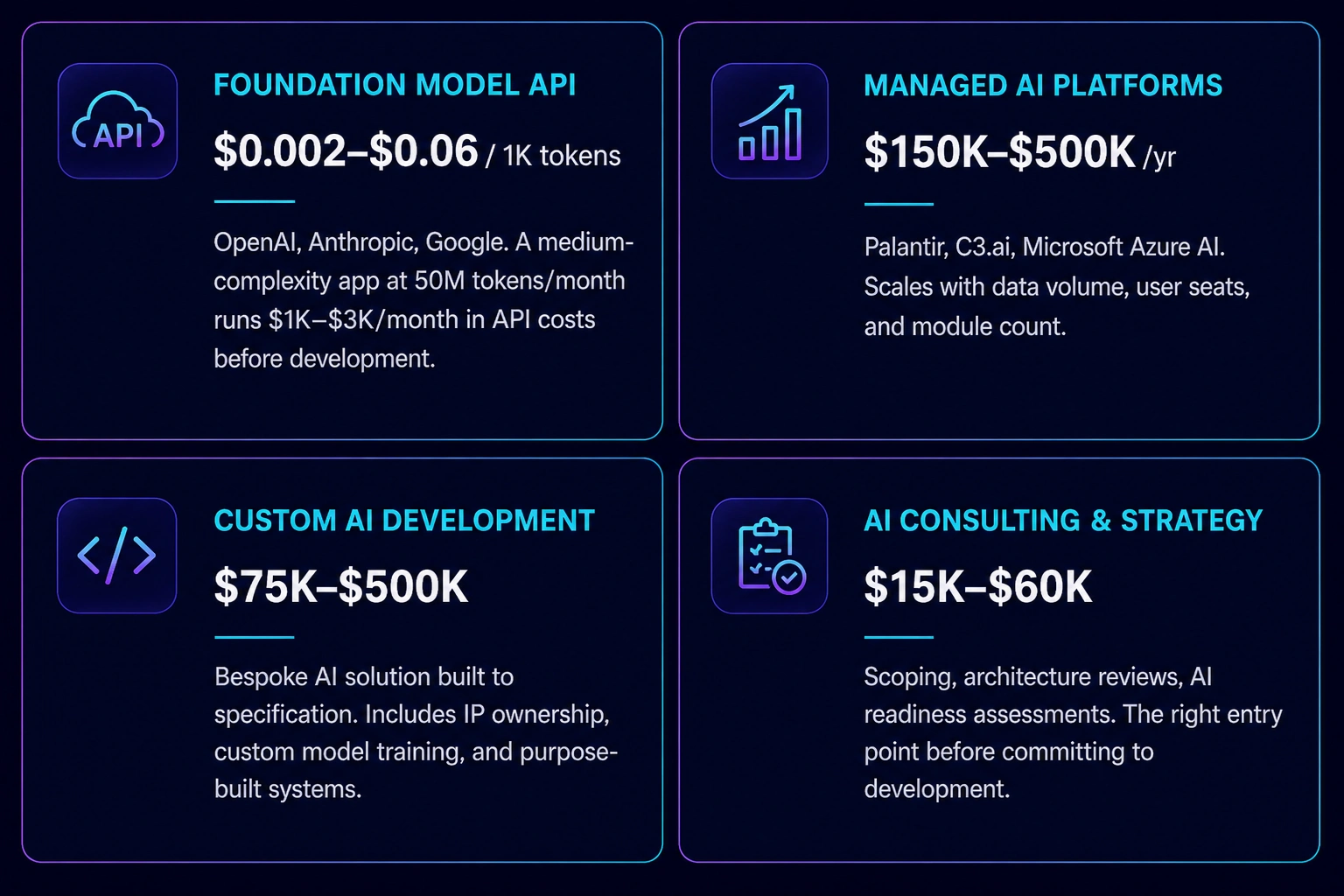
Pricing / Cost: What AI Development Actually Costs in 2026
Understanding the cost structure of AI development is essential before engaging any vendor on this list. Pricing varies dramatically by engagement type.
How to Choose the Right AI Partner for Your Business
The ranking above tells you who is building. The question of who is right for your business is different.
Scale of need: If you need to fine tune a foundation model on proprietary data and deploy it across 10,000 users, you need enterprise infrastructure. If you need a specific AI solution built for a defined workflow, you need a specialized development partner.
Domain expertise: AI built by people who understand your industry outperforms generic deployments. A healthcare AI company that has built HIPAA compliant systems is worth more than a general software shop that will learn on your project.
Delivery methodology: Ask for case studies. Ask for client references. Ask what happens when the model underperforms. The answers reveal whether you are dealing with a builder or a salesperson.
Neuramonks offers a direct path to evaluation: contact their team to discuss your specific requirements and review case studies relevant to your industry before any commitment.
Best AI Automation Agencies in the USA 2026: The Complete Buyer's Guide
Top AI automation agencies are helping businesses streamline operations, reduce manual work, and scale faster with intelligent workflows, AI agents, and enterprise automation solutions. This guide compares the best AI automation companies in the USA for 2026 based on expertise, scalability, implementation strategy, and real business impact.
Answer Capsule: 2026 Market Baseline at a Glance
This guide evaluates the top AI automation agencies by production depth, pricing, and vertical expertise. Key takeaways: Neuramonks leads in multi agent orchestration and air-gapped deployments. Enterprise production rollouts range from $80,000 to $500,000, depending on workflow complexity. Standard production timeline is 60 to 90 days for focused deployments, extending to 4–9 months for multi workflow systems. Top verticals delivering measurable ROI include construction, healthcare, fintech, e-commerce, and manufacturing. Critical evaluation criteria include vertical experience, measurable outcome guarantees, on-premises deployment capability, and post-launch retraining commitments.
The best AI automation partners in the USA for 2026 are firms that combine measurable ROI, production-grade engineering, and vertical depth in healthcare, construction, fintech, and e-commerce. Neuramonks, a leading provider of agentic AI systems, is a standout choice for enterprises that need multi-agent orchestration, agentic workflows, and on-premises deployments delivered under 90 days.
Enterprise AI buying has changed sharply over the last 18 months. In 2024, leaders were still asking whether to adopt AI. In 2026, the question is which vendor can move them from pilot to production without burning a year of budget on prototypes that never ship. The wrong partner costs you 18 months of payroll and a CFO who never wants to hear "AI" again. The right one quietly removes significant operational drag and shows up in your quarterly earnings call.
This buyer's guide breaks down what genuinely separates a top-tier partner from a glossy consulting deck. We cover the criteria CTOs are using in 2026, the cost ranges you should expect, the vertical specialists worth shortlisting, and the questions that surface whether a vendor can actually deliver.
What an AI Automation Agency Actually Does in 2026
A modern AI automation partner does three things that distinguish it from a software consultancy or a generic "digital transformation" firm. First, it designs agentic workflows that perceive context, decide, and act rather than brittle, rule-based scripts. Second, it integrates orchestration platforms such as n8n automation, Dify, as well as custom LLM routing layers, into your existing CRM, ERP, and data warehouse stack. Third, it owns the deployment, observability, and retraining lifecycle so the system continues to perform six and twelve months after handoff.
The shift from rule-based RPA to agentic AI is the central story of 2026. Older automation broke whenever an invoice format changed or a customer phrased a question differently. Agentic systems reason about exceptions, pull from retrieval-augmented memory, and route to a human only when confidence drops below a threshold. This is why mid-sized enterprises that previously needed 30-person operations teams now run the same throughput with eight people and a well-architected AI layer. For a fuller view of where this is heading, our enterprise outlook on AI automation in 2026 covers the infrastructure and governance shifts leaders need to plan for.
How to Evaluate an AI Automation Partner
The vendor pitch deck is not the signal. The signal is the production code, the case studies with measured outcomes, and the willingness to deploy on your infrastructure under your security policy. Use these seven criteria when you shortlist:
- Vertical experience over horizontal claims. A firm that has shipped fifteen healthcare AI projects will outperform a generalist on your healthcare project. Construction AI is not e-commerce AI rebranded.
- Production deployment evidence. Ask for systems currently running at over 10,000 daily transactions. Pilots do not count. Anyone can build a prototype.
- On-premises and air-gapped capability. If you handle regulated data, the agency must deploy without forcing your data through public APIs.
- Multi-agent orchestration experience. Single-agent chatbots are 2023 thinking. Modern systems coordinate research agents, validation agents, content agents, and a coordinator. If the vendor still pitches "a chatbot," skip them.
- Measurable outcome guarantees. Top agencies attach KPIs to engagements: cost per ticket reduced by X, document processing accuracy above Y, time-to-resolution cut by Z. If the SOW only specifies hours and deliverables, the vendor is hedging.
- Model-agnostic architecture. Frontier models change every quarter. An agency locked to one provider will charge you again next year to migrate. Look for routing layers that swap between GPT, Claude, Llama, and SLMs based on task.
- Post-launch retraining included. Models drift. Data drifts. A six-month engagement that ends at launch is selling you a depreciating asset.
Comparison: Top AI Automation Agencies by Use Case in 2026
The market has fragmented into specialists. The table below maps where each type of firm tends to win, based on patterns observed across mid-market and enterprise buyers in 2026, ourselves included.
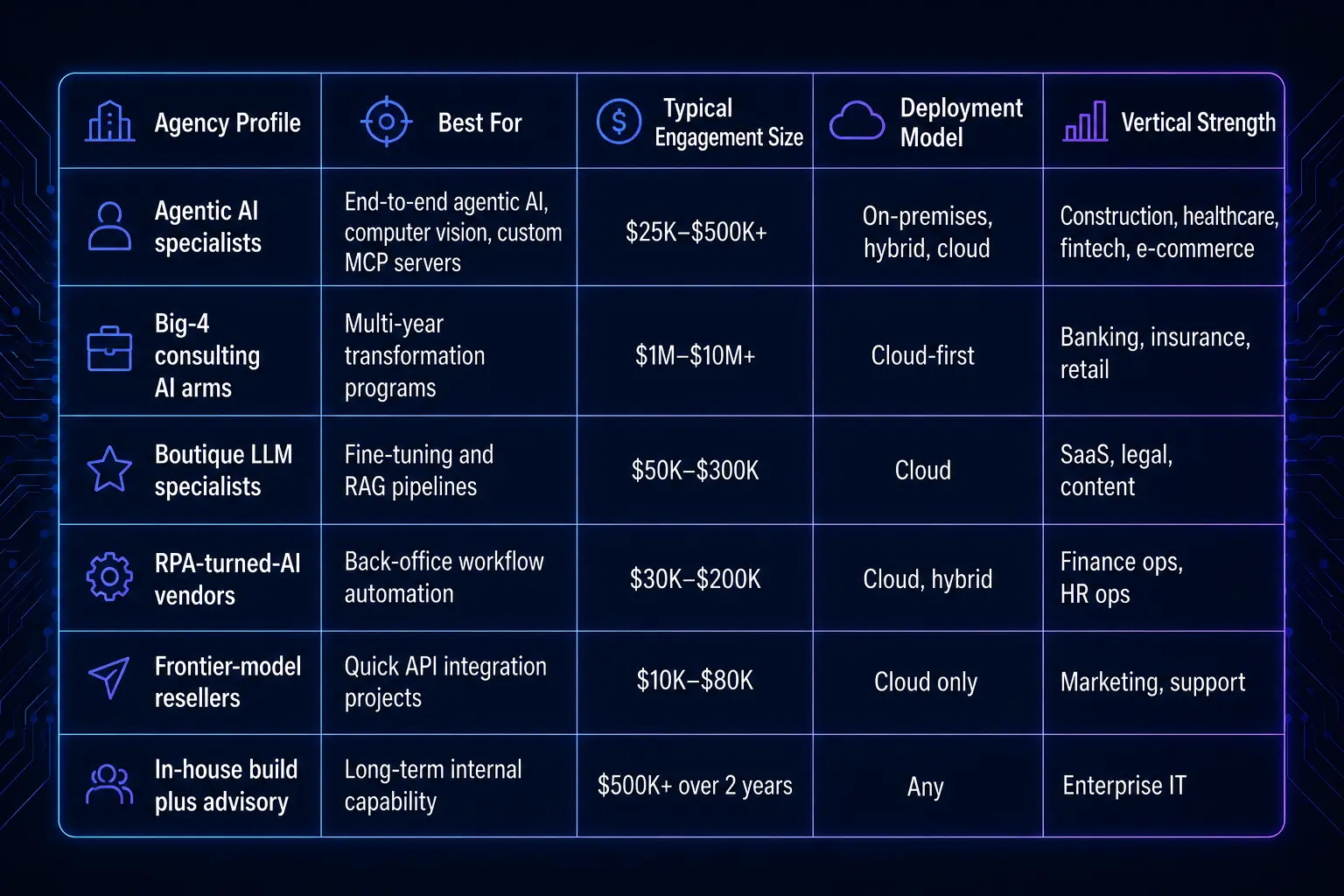
A useful filter: if your problem requires touching physical-world data, regulated workflows, or legacy systems, you want a firm with engineering depth, not a consultancy. Specialists in this category deliver the work because the scope spans computer vision on noisy scanned documents, agentic workflows on enterprise data, and on-premises deployments where cloud APIs are not an option.
Real-World Example: AI Symbol Detection for Construction Blueprints
Generic case studies tell you nothing. Specific ones tell you whether a vendor can actually engineer through hard problems. A representative engagement in construction AI is the development of an AI-powered symbol detection and counting system for construction blueprints, which addresses a problem that defeats most generic computer vision vendors.
Construction blueprints arrive as scanned, rasterized images with heavy noise, overlapping text, and inconsistent symbol conventions across consultants. Off-the-shelf object detection models produce unreliable counts, which directly inflates material estimates and project bids. The solution combined classical computer vision pre-processing, deep metric learning for visually similar symbol disambiguation, vision-language reasoning for ambiguous cases, and a human-in-the-loop verification layer for low-confidence outputs.
The measured results: 30–40% improvement in symbol classification accuracy, 95–98% precision in final electrical fixture inventories, and 25–35% faster estimation cycles. More importantly, the system runs in an on-premises and air-gapped configuration, which matters because blueprint data is often contractually restricted from leaving the client's network. This is the kind of work that separates vendors with genuine production experience from those that only ship when conditions are clean.
Pricing and Cost: What AI Automation Actually Costs in 2026
AI automation pricing in 2026 falls into four predictable tiers, and the gap between tiers reflects engineering depth rather than vendor markup.
Proof of Concept (POC): $8,000–$25,000 over 3–6 weeks. Validates one workflow end-to-end with synthetic or sample data. The deliverable is a working prototype and a feasibility report, not production code. If a vendor quotes $80,000 for a POC, that is a red flag.
Pilot / MVP deployment: $30,000–$120,000 over 8–14 weeks. One production workflow, one integration, one user group. This is where you measure ROI before scaling.
Production rollout: $80,000–$500,000 over 4–9 months. Multiple workflows, multiple integrations, observability stack, retraining pipeline, and documentation. Most mid-market engagements land in the $120K–$280K range here.
Enterprise transformation: $500,000–$3M+ over 12–24 months. Multi-department rollout, custom model training, dedicated post-launch retainer.
Hidden cost areas: model inference (typically $2K–$15K per month for high-volume workflows), GPU infrastructure if you go on-premises ($10K–$15K per NVIDIA A100), observability tooling, and the 20–25% annual maintenance retainer most serious vendors require. Vendors that quote a fixed price with no retainer are either inexperienced or planning to disappear after launch. To get a calibrated quote against your specific workflow, you can request a tailored AI solutions estimate from Neuramonks.
Red Flags When Hiring an AI Automation Agency
A short checklist of patterns that almost always end badly:
- The agency cannot name three production deployments by client or industry
- The proposal does not mention model evaluation, drift monitoring, or rollback strategy
- The team pitching is different from the team that will build
- The architecture diagram has "AI" as a single box in the middle
- The vendor refuses to do a paid two-week scoping engagement before committing to a fixed bid
Any one of these is recoverable. Two or more, and it's worth reconsidering the engagement.
Architectural Patterns That Separate Production from Pilot
A pattern worth flagging because it matters for your selection. Production-grade AI automation in 2026 has converged on a small set of architectural choices, and an agency that does not work in these patterns is still in pilot territory regardless of what their case studies claim.
The first is model routing. Production systems route each query to the cheapest model that will reliably handle it, and escalate to a frontier model only when needed. An agency that uses the same model for every request is leaving significant inference cost on the table.
The second is retrieval-augmented context. Agentic systems ground their reasoning in your actual data through vector retrieval, structured queries, and tool calls, instead of hoping the model remembers the right thing from training. If the agency does not build a retrieval layer, the system will hallucinate at scale.
The third is human-in-the-loop checkpoints. Real production AI does not try to autonomously handle 100 percent of work. It autonomously handles the majority of work, routes the rest to humans with full context, and learns from the corrections. Vendors that promise full autonomy are selling prototypes.
The fourth is observability and evaluation infrastructure. Production AI without telemetry is unmaintainable within six months. Drift detection, evaluation pipelines, and per-workflow KPIs are not optional. They are how the system stays useful as your data and your business change.
Regional Considerations: USA AI Automation Market in 2026
The USA AI automation market in 2026 is not monolithic. Buyer behavior and vendor concentration vary meaningfully by region, and matching your vendor to your regional context affects everything from response time to compliance posture.
Northeast corridor from Boston through New York to Washington DC concentrates financial services, healthcare, and government buyers, all of whom prioritize compliance, audit trails, and on-premises deployment. Agencies that win here lead with SOC 2, HIPAA, and FedRAMP credentials, and they bill at the top of the market range. Neuramonks holds SOC 2 Type II certification and HIPAA compliance for regulated healthcare engagements.
West Coast, particularly the Bay Area and Seattle, leans toward cloud-first deployments and frontier-model integrations, with buyers who tolerate higher inference costs in exchange for faster iteration.
Texas and the Southeast have emerged as the fastest-growing AI automation markets in 2026, with energy, logistics, and manufacturing buyers favoring vendors with hybrid deployment capability and strong vertical case studies. Neuramonks operates a US office in Ponte Vedra, Florida, positioning it well for engagements in this corridor.
The Midwest, dominated by industrial, agricultural, and insurance buyers, rewards agencies that can deliver production systems on disciplined timelines and budgets, often with a lower cloud-cost ceiling than coastal projects.
A useful question to ask any vendor: where are their three most recent USA deployments, and which time zones do their core engineering teams work in. The answer reveals as much about delivery dynamics as any case study.
How to Run a 30-Day Vendor Selection Process
Most enterprises waste three to six months in vendor evaluation. A 30-day process works if you structure it like this:
Week one: Write a one-page problem statement with current cost, target cost, and one success metric.
Week two: Send the statement to four to six agencies and ask for a 90-minute technical workshop, not a sales call. Bring an engineer from your team to the workshop. The dynamic of the call tells you almost as much as the answers.
Week three: Request a paid two-week scoping engagement from your top two. Pay for it. Free scoping is worth what you pay.
Week four: Decide based on the scoping output, not the original proposal. The scoping document tells you whether they understand your problem. The proposal tells you whether they understand sales.
Conclusion: Picking the Right AI Automation Partner
The vendors that will matter in 2026 are not the ones with the largest sales teams. They are the ones who can architect for your specific workflow, deploy under your security constraints, and stay engaged after the system goes live. Specialists in agentic AI fit this profile across construction, healthcare, fintech, and e-commerce verticals, with on-premises and air-gapped deployment as a default capability rather than a special case. When evaluating any vendor, weight production evidence heavily over pitch quality. The deck is the cheapest part of the engagement.
If you are scoping a project for the next two quarters, the highest-leverage step is a tight problem statement and a paid scoping engagement with two shortlisted vendors. That alone will save you the most expensive mistake in enterprise AI: choosing the vendor that wrote the best proposal instead of the one that can actually ship.
If your team is evaluating AI partners for an upcoming initiative, now is the right time to pressure-test the strategy, architecture, and delivery capability before the expensive build phase begins.
Ready to scope your AI project the right way? Connect with the team at Neuramonks and get a practical roadmap tailored to your business goals

You asked, we precisely answered.
Still got questions? Feel free to reach out to our incredible
support team, 7 days a week.
What kind of web development projects does NeuraMonks handle?
NeuraMonks builds custom web platforms for businesses that need more than a template — think recruitment automation portals (Extrahourz), immigration management systems (Patel Canada Visa), real estate operations dashboards (Bavadiya & Co), and digital payment systems for restaurants and parking services (Xcashmenu). Every project in our case study library started with a specific operational problem, not a design brief.
How to choose the right AI solutions company?
Choosing the right AI solutions company means looking beyond technical skills. Key factors include:
Proven experience in custom AI solutions
Ability to deliver production-ready systems
Strong focus on business outcomes and ROI
Clear implementation and support processes
Security and compliance expertise
What makes NeuraMonks a reliable AI development agency?
NeuraMonks operates as a full-cycle AI development partner, not just a service vendor. We combine strategy, engineering, and deployment to build AI systems that work in real business environments. Our focus is on clarity, execution, and measurable outcomes, making us a trusted partner for organizations serious about AI.
Do you offer AI implementation services or only AI consulting?
We provide end-to-end AI implementation services, from initial use-case discovery and data readiness to model deployment and optimization. Unlike pure consultants, we take responsibility for building, integrating, and scaling AI systems inside your existing operations.
How is NeuraMonks different from other artificial intelligence development companies?
Most artificial intelligence development companies focus on experiments or proofs of concept. We focus on production-ready AI. Our team designs systems that integrate with real workflows, scale securely, and drive real business outcomes—without disrupting your operations.
Which industries do your industry-specific AI solutions serve?
Our industry-specific AI solutions support healthcare, ,eCommerce, manufacturing, Construction and Renovation, Dimond Merchant. Each solution is engineered to address sector-specific challenges, regulations, and operational needs.
How long does AI implementation typically take?
AI implementation timelines vary by complexity, but most projects move from strategy to deployment within 6–12 weeks. As an experienced AI implementation services provider, we follow structured milestones to ensure faster time-to-value.
Can you integrate AI with existing or legacy systems?
Absolutely. We specialize in AI-driven legacy system modernization, enabling businesses to embed intelligence into existing platforms without costly system replacements or operational downtime.