Insights and Inspiration
Explore Our Blog
Dive into our blog for expert insights, tips, and industry trends to elevate your project management journey.
India AI Impact Summit 2026: The AI Revolution Has Arrived Is Your Business Ready to Lead?
A quick breakdown of the biggest announcements and business signals from AI Impact Summit India 2026 — and what they mean for companies adopting AI today.

Something Historic Is Happening in New Delhi Right Now
The largest AI gathering ever held in the Global South is unfolding this week at Bharat Mandapam — and the world is watching. India's AI Impact Summit 2026 has drawn over 3 lakh registered visitors, 110+ participating nations, 20 heads of state, 45 ministerial delegations, 600+ startups, and the CEOs of the world's most powerful technology companies. The headlines being made here will shape business strategy for the next decade.
India is no longer just an emerging AI market. In 2026, it is front and center on the world stage — hosting global tech giants, heads of state, and over 300,000 registered visitors at one of the most consequential technology summits of our generation. In this blog, we break down the top 10 biggest news stories from the summit and explain what each development means for businesses ready to embrace the AI revolution.

The 12 Biggest Stories from India AI Impact Summit 2026
1. PM Modi Inaugurates the Global South's Biggest AI Summit
Prime Minister Narendra Modi officially inaugurated the five-day summit at Bharat Mandapam, welcoming delegations from 110+ countries under the guiding mantra: Sarvajana Hitaya, Sarvajana Sukhaya — Welfare for All, Happiness for All. The summit's Seven Chakras — spanning human capital, inclusion, trust, resilience, science, resources, and social good — channel global collaboration toward measurable outcomes.
What This Means for Business:
Government-level AI policy is being written right now. Companies that align their AI adoption strategies with India's emerging regulatory frameworks will be positioned ahead of the curve. This is the moment to invest in compliant, scalable AI infrastructure.
2. India Earmarks $1.1 Billion for AI & Manufacturing Startups
In one of the summit's biggest financial announcements, the Indian government unveiled a $1.1 billion state-backed venture capital fund exclusively for AI and advanced manufacturing startups. Backed by the India AI Mission (launched March 2024 with Rs 10,372 crore), this signals that the government views AI as a core economic pillar, not a peripheral experiment.
What This Means for Business:
If you are building or planning to build an AI-powered product, this is arguably the best time to be operating in India. Capital is flowing, the ecosystem is growing, and government support is real. Startups and SMEs should actively explore how to align with national AI initiatives.
3. India Now Has 100 Million Weekly ChatGPT Users
OpenAI CEO Sam Altman made a landmark revelation: India now accounts for over 100 million weekly active ChatGPT users — second only to the United States. More remarkably, Indian students represent the single largest student demographic using ChatGPT worldwide.
What This Means for Business:
Your customers, employees, and competitors are already using AI tools daily. The question is no longer whether your business should adopt AI — it is how fast you can integrate intelligent solutions to stay competitive.
4. Anthropic Reveals India Is Its #2 Global Market
Anthropic, the AI safety company behind the Claude AI platform, announced that India has become its second-largest global market, with run-rate revenue doubling since October 2025. This places India alongside the United States in terms of enterprise AI adoption at scale.
What This Means for Business:
Enterprise-grade AI adoption is no longer a luxury for large corporations. Businesses of all sizes are deploying world-class AI tools at scale. If your competitors are not yet on this journey, they will be soon — and the gap is widening every month.
5. BREAKING TODAY: Google Announces $15 Billion AI Investment in India
In the biggest announcement of February 18, Google unveiled a $15 billion investment in India's AI infrastructure at the summit. The announcement included a live speech-to-speech translation model supporting 70+ languages including 10 Indian languages (Hindi, Tamil, and more), an AI Professional Certificate program in partnership with Wadhwani AI, a deal with Karmayogi Bharat to support 20 million+ public servants on the iGOT platform in 18+ Indian languages, and the America-India Connect initiative to expand AI-powered connectivity.
What This Means for Business:
India is becoming a primary AI infrastructure hub for the world's largest tech company. AI tools in Indian languages are coming rapidly — businesses that localize their AI-powered customer experiences now will dominate vernacular markets.
6. BREAKING TODAY: Sarvam AI Launches India's Most Powerful Indigenous LLMs
On February 18, Indian AI startup Sarvam AI launched two foundational large language models — Sarvam 30B and Sarvam 105B — trained entirely from scratch (not fine-tuned from open-source models). Live demos showed these models outperforming several global AI benchmarks, especially on Indian language tasks including Hindi, Tamil, and mixed-language (Hinglish) conversations at cost-effective pricing.
What This Means for Business:
The era of India-specific, Indian-language AI models has arrived. Businesses serving tier-2 and tier-3 Indian markets now have access to AI that truly understands their customers. The cost and accessibility barrier has dropped significantly.
7. Blackstone Acquires Majority Stake in Neysa — $600M Deal
Global investment giant Blackstone made a decisive move into the Indian AI ecosystem by acquiring a majority stake in Neysa, an Indian AI infrastructure startup, as part of a $600 million fundraise. Neysa plans to deploy over 20,000 GPUs to expand AI computing infrastructure across India, transforming the country into a genuine AI compute hub.
What This Means for Business:
As GPU infrastructure and AI compute capacity grow in India, cloud costs will decrease and access to high-performance AI will democratize. Businesses building AI-powered systems today will benefit from dramatically improved infrastructure over the next 18 months.
8. Adani Commits $100 Billion for Renewable-Powered AI Data Centers
In the summit's most ambitious infrastructure play, Adani announced a $100 billion commitment to build AI-powered data centers across India by 2035 — all running on renewable energy. This investment is expected to trigger an additional $150 billion in downstream sectors, including server manufacturing, sovereign cloud platforms, and data services.
What This Means for Business:
India is building foundational AI infrastructure for decades ahead. For businesses, this means greater data sovereignty, more affordable cloud computing, and a greener AI stack — all from within Indian borders.
9. PM Modi Meets Sundar Pichai, Bill Gates, and Global Leaders
High-level bilateral meetings between PM Modi, Google CEO Sundar Pichai, Microsoft co-founder Bill Gates, and Spanish President Pedro Sanchez (who arrived today, February 18) underscored India's geopolitical AI ambitions. Bill Gates delivered a keynote praising India's AI talent pool and its public-private partnership model as a global template for human-centered AI development.
What This Means for Business:
When the world's most powerful tech executives fly to India, it confirms India is a priority market. Partnerships, integrations, and localized AI tools from global giants are coming — businesses positioning themselves now will have first-mover advantage.
10. AI for Governance — India's Legal & Regulatory Framework Takes Shape
The Center of Policy Research and Governance (CPRG) hosted key policy dialogues at the summit, advancing India's AI legal and regulatory framework under MeitY leadership. The discussions are shaping India's answer to global AI governance — positioning India not as a rule-follower, but as a rule-setter in responsible AI deployment.
What This Means for Business:
Regulatory clarity is coming. Businesses that build AI systems with compliance, transparency, and safety baked in from day one will avoid costly retrofits and will be trusted partners when government contracts open up.
11. Summit Extended by One Day — Overwhelming Public Response
In an extraordinary sign of the summit's success, the government extended the India AI Impact Summit 2026 by one additional day, now running through February 21. Expo timings were extended from 6:00 PM to 8:00 PM IST. February 19 is reserved for restricted high-level events; February 20 and 21 are fully open to the public.
What This Means for Business:
The appetite for AI adoption in India is not theoretical — it is palpable, real, and growing faster than even the organizers anticipated. This is a market that is ready and hungry for AI solutions right now.
12. Maharashtra Team Wins India's Largest GenAI Student Challenge
A team of young builders from Maharashtra won the Grand Champion title at the national finale of the OpenAI Academy x NxtWave Buildathon held alongside the summit. This competition represented the next generation of Indian AI talent — young, driven, and capable of building real-world AI applications from the ground up.
What This Means for Business:
India's AI talent pipeline is thriving and more accessible than ever. For businesses looking to hire AI engineers or build in-house capabilities, the talent ecosystem is maturing rapidly.
NeuraMonks: Your Trusted AI Partner for Government & Enterprise
Amid the landmark announcements at the India AI Impact Summit 2026, one name has been at the forefront of delivering AI solutions to both government bodies and enterprises across India: NeuraMonks. As a full-cycle AI development partner trusted by 100+ clients across 5+ countries, NeuraMonks has been translating India's AI ambitions into real-world deployments — not just for Fortune 500 companies, but for the government departments that serve hundreds of millions of Indian citizens.
We Are at the Summit
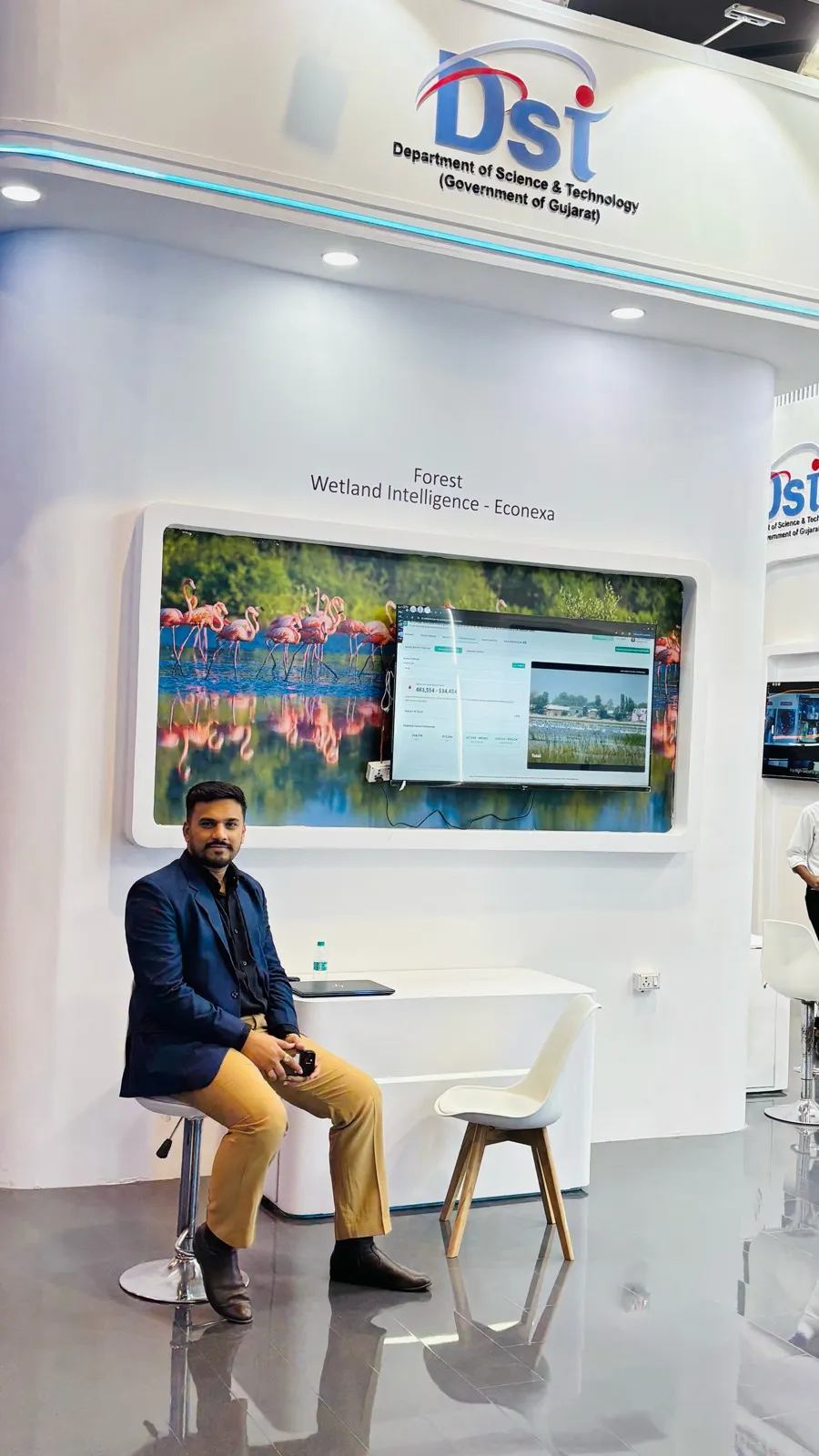
NeuraMonks is present at the India AI Impact Summit 2026, demonstrating our AI-powered platforms for environmental governance, resource intelligence, and citizen services at a booth. Our team has spent two days engaging with ministry officials, policymakers, and innovators — showing what deployed, real-world government AI looks like in 2026.
We are proud to present our client for two days at the India AI Impact Summit 2026
NeuraMonks Case Studies: AI That Delivers Real Results
Talk is cheap. At the India AI Impact Summit 2026, world leaders are making billion-dollar commitments. At NeuraMonks, we are proud to show the deployments that are already running — driving measurable outcomes for government bodies and enterprise clients today.
NeuraMonks in Action: Real Projects, Real Results
Here are selected highlights from NeuraMonks' One of the most impactful case studies presented at the summit was the Wetland Project.
Wetland Intelligence for Environmental Governance
Client: Department of Science & Technology, Government of Gujarat (in partnership with EcoNexa)
Challenge: Strengthen forest and wetland ecosystems to create suitable ecological conditions for greater species arrival and long-term biodiversity improvement.
NeuraMonks Solution: Built an AI-driven biodiversity intelligence system using historical ecological data to:
- Identify species habitat preferences
- Determine optimal physico-chemical parameter ranges
- Map habitat suitability patterns
- Predict species presence for the next 2–3 years, backed by ecological reasoning
✅ Result: Live biodiversity indices are now accessible to government planners, and the project was showcased as a national model at the India AI Impact Summit 2026.

Trending AI Topics at the Summit — And What's Next
AI Governance & the Global South's Voice
India is asserting itself as a co-author of global AI governance frameworks — not just a recipient. The summit's Three Sutras (People, Planet, Progress) are being presented as India's contribution to responsible AI policy alongside the EU AI Act and US Executive Orders. For businesses, this means India-specific compliance frameworks are imminent.
Multilingual & Vernacular AI — The Next Frontier
Today's Sarvam AI launch and Google's speech-to-speech model announcement signal the arrival of truly Indic AI. The next wave of AI adoption in India will not come from English-speaking metro users — it will come from the 800 million Indians who prefer to communicate in their native languages. Businesses serving Bharat (not just India) must invest in vernacular AI capabilities now.
Green AI — Sustainability Meets Intelligence
Adani's $100 billion renewable-powered data center pledge reflects a growing movement: AI infrastructure must be sustainable. As ESG compliance becomes mandatory for enterprise procurement, businesses that deploy AI on green infrastructure gain competitive advantage in both government contracts and global partnerships.
Agentic AI — From Copilot to Autonomous Operator
The hottest conversation at the summit is the shift from generative AI (which assists humans) to agentic AI (which operates autonomously). AI agents that can manage workflows, make decisions, and execute multi-step tasks without human intervention are no longer science fiction — they are being deployed in procurement, HR, finance, and customer service today.
AI for Social Impact — Healthcare, Agriculture & Education
Bill Gates' keynote brought the humanitarian dimension of AI into sharp focus. AI tools for disease diagnosis in rural India, crop yield prediction for smallholder farmers, and personalized learning for underserved students represent the next $100 billion opportunity — one that combines commercial viability with genuine social good.
India's AI Moment Is Now — Is Your Business Ready?
The India AI Impact Summit 2026 is not just a conference. It is a declaration. From a $1.1 billion government fund to a $100 billion infrastructure commitment, from 100 million ChatGPT users to a $15 billion Google investment announced today — every headline from this summit points to the same undeniable truth:
The AI transformation is not coming — it is already here.
At NeuraMonks, we have been watching — and building — through every chapter of India's AI story. As a government-trusted, full-cycle AI development partner serving 100+ clients across 5+ countries, we help organizations across healthcare, fintech, e-commerce, manufacturing, construction, and public sector turn AI ambition into measurable results.
Whether you need an intelligent Voice Agent that handles customer queries 24/7, an Econexa-style geospatial intelligence platform for environmental or urban governance, a smart Product Recommendation engine that drives conversions, or an Agentic AI system that autonomously manages complex workflows — we build AI that works in the real world and delivers ROI within the first 90 days.
Ready to Build Your AI-Powered Business?
→ Book a Free AI Consultation with NeuraMonks Today
AI Automation in 2026: What Enterprise Leaders Must Prepare For
AI automation in 2026 is shifting from experiments to core business infrastructure. Enterprises must prepare with the right strategy, infrastructure, and teams to turn AI into measurable impact. The real advantage comes from proper implementation — not just adopting tools.
The artificial intelligence landscape has evolved from experimental technology to mission-critical infrastructure. As we move through 2026, enterprise leaders face a pivotal moment: organizations that successfully implement AI Automation Solutions will gain unprecedented competitive advantages, while those that hesitate risk obsolescence.
The stakes have never been higher. According to recent enterprise surveys, companies leveraging advanced automation are seeing productivity gains of 40-60%, cost reductions of 30-50%, and improved decision-making accuracy by up to 85%. But success requires more than just adopting technology—it demands strategic preparation, cultural transformation, and choosing the right implementation partners.
This comprehensive guide explores what enterprise leaders must prepare for in 2026, from agentic AI systems to workflow orchestration platforms like n8n, and how to position your organization for success in this transformative era
The Shift to Agentic AI Systems
Traditional automation followed rigid, rule-based pathways. An automated system could execute predefined tasks but couldn't adapt to unexpected scenarios or make contextual decisions. Agentic AI represents a fundamental paradigm shift.
These intelligent systems can perceive their environment, make autonomous decisions, learn from outcomes, and execute complex multi-step processes without constant human intervention. In healthcare, for example, agentic AI systems are now managing patient triage, coordinating care teams, optimizing resource allocation, and even predicting potential complications before they occur—all while continuously improving through machine learning.
What Enterprise Leaders Must Prepare:
Infrastructure readiness — scalable data pipelines, APIs, and real-time computing; legacy systems may become bottlenecks
Governance frameworks — accountability, audit trails, and ethical oversight for AI decisions
Talent development — teams evolve from automation operators to AI orchestrators (prompting, workflow design, monitoring)
Multi-Agent Orchestration: The New Competitive Edge
The future of AI isn’t single tools — it’s networks of specialized AI agents collaborating like a team. Companies adopting multi-agent systems see significantly higher efficiency than single-agent setups because tasks are divided and coordinated.
Typical Agent Roles
- Research agent — gathers information
- Analysis agent — finds patterns
- Content agent — produces outputs
- Quality agent — reviews results
- Coordinator agent — manages workflow
Key Challenge: Success depends on orchestration — communication between agents, conflict handling, and maintaining consistent outputs.
Integration Complexity: Breaking Data Silos (Short)
Enterprises run on many disconnected systems — CRM, ERP, analytics tools, communication apps, and legacy databases. AI works best when it can combine data across them. Platforms like n8n, Dify act as the connective layer, enabling automation between systems, but integration is not just technical — it requires data readiness, security, and organizational adoption.
Key Considerations
- Data quality & standardization — clean, complete, structured data is essential for AI accuracy
- Security & compliance — every integration point must follow protection policies
- Change management — teams must adapt workflows to avoid resistance
- Edge & on-premise resources — local AI shifts costs to GPUs, energy, and infrastructure plannin
GPU and Computational Power Optimization
Edge AI deployments require strategic decisions about computational resources. A single enterprise-grade GPU like the NVIDIA A100 costs $10,000-$15,000, while edge-optimized alternatives like the Jetson AGX Orin provide 275 TOPS at $1,000-$2,000 per unit. The choice depends on your workload characteristics:
Model quantization: Reducing model precision from FP32 to INT8 can decrease inference time by 2-4x while maintaining 95%+ accuracy, enabling deployment on less expensive hardware.
Batch processing optimization: Grouping inference requests can improve GPU utilization from 30-40% to 70-85%, effectively doubling throughput without additional hardware.
Model pruning: Removing 30-50% of neural network parameters typically reduces computational requirements by 40-60% with minimal accuracy loss.
Edge device workload shifting: Dynamically moving routine inference to local edge devices offloads central GPUs, reducing cloud compute consumption by 60–80% while improving response latency and system resilience.
Energy Consumption: The Hidden Cost Factor
Enterprise AI deployments face significant energy costs that compound at scale. A typical GPU server consuming 1,000-1,500 watts running 24/7 costs $1,200-$1,800 annually in electricity at average commercial rates. For deployments spanning hundreds of edge locations, these costs escalate rapidly.
Dynamic power management: Implementing GPU power capping can reduce energy consumption by 15-25% with less than 5% performance degradation during non-peak hours.
Model deployment scheduling: Running inference-heavy workloads during off-peak electricity hours can reduce energy costs by 30-40% in regions with time-of-use pricing.
Thermal optimization: Proper cooling infrastructure planning prevents thermal throttling that can reduce GPU performance by 20-30% and increase total cost of ownership.
Scaling Pilots to Production: The Critical Transition
Most AI pilots fail due to poor infrastructure planning, not technology. Successful production deployments focus on three areas:
Orchestration and containerization— When growing to more than 100 locations, Kubernetes scalability saves 3–5 times greater costs but requires 40–60% more advance planning.
Model version management — increases infrastructure costs by 15% to 20% but avoids failures that can be fixed for 10–50 times more.
Monitoring & observability — adds 15–20% infrastructure cost but prevents failures that can cost 10–50x more to fix
Computer vision processing optimization — batching inference, quantization, and on-prem GPU processing reduce per-image processing cost by 60–80% when scaling datasets
LLM token & conversation management — custom prompt routing, context pruning, and discussion memory handling reduce token usage by 50–70% while improving response consistency and latency
Real-World Implementation: Case Studies from Neuramonks
Case Study 1: AI-Powered Floor Plan Analysis for Home Renovation
Neuramonks implemented an automated floor plan detection and 3D visualization system for a PropTech platform that reduced design effort by 50–60% while improving homeowner decision confidence by 30–40%.
Business Challenge: Home renovation was traditionally fragmented and manual. Homeowners struggled to visualize renovation ideas, interpret floor plans, and coordinate with suppliers. Manual floor plan interpretation created delays, while disconnected tools led to project overruns on cost and time.
AI Solution Delivered: By deploying computer vision models with intelligent 3D conversion capabilities on AWS infrastructure (Lambda, EC2, S3), the system achieved:
- AI-powered automatic 2D floor plan detection and digitization
- Interactive 3D model generation from flat floor plans
- "Design Now" visualization tool for instant design exploration
- Scalable backend handling concurrent design requests
- Integrated timeline and workflow management
Measured Impact:
- Reduced initial design effort by 50–60%
- Improved homeowner design clarity and decision confidence by 30–40%
- Shortened renovation planning cycles by 35–45%
- Transformed renovation from guesswork to visual, data-driven decision-making
Case Study 2: Interactive Video Intelligence Platform
We built an AI-driven video intelligence pipeline for a media technology platform that reduced manual video structuring effort by 55–65% and increased viewer engagement by 30–40%.
Business Challenge: The platform aimed to enable non-linear, interactive video experiences where viewers navigate content dynamically. However, video segmentation relied on manual human parsing, creating scalability bottlenecks. Structuring videos into navigable tree architectures was time-intensive, inconsistent, and limited content growth.
AI Solution Delivered: By deploying combined computer vision and NLP models on AWS infrastructure, the system achieved:
- Automated scene detection, object recognition, and visual transition analysis
- NLP pipelines analyzing spoken dialogue, on-screen text, and audio context
- Intelligent video segmentation into logically coherent micro-segments
- AI-driven hierarchy generation for navigable tree structures
- Scalable processing architecture for high video volumes
Measured Impact:
- Reduced manual segmentation effort by 55–65%
- Increased viewer engagement depth by 30–40%
- Accelerated content onboarding by 40–50%
- Enabled platform scalability while maintaining editorial quality
Key Considerations for Resource-Efficient AI Deployment
Start with TCO analysis: Calculate 3-year total cost of ownership including hardware, energy, maintenance, and network costs—not just initial deployment expenses.
Design for incremental scaling: Build infrastructure that can grow from 10 to 100 to 1,000 deployments without architectural redesign.
Implement tiered processing: Use edge devices for latency-sensitive tasks, on-premise servers for batch processing, and cloud for training and complex analytics.
Monitor resource utilization religiously: GPU utilization below 60% indicates over-provisioning; above 90% suggests performance bottlenecks.
Plan for model updates: Reserve 20-30% of storage and compute capacity for simultaneous deployment of multiple model versions during updates
Choosing the Right Implementation Partner
The gap between AI potential and real results is usually implementation expertise. Many companies buy powerful AI tools but fail to use them properly due to lack of deployment knowledge. Choosing the right AI automation partner is crucial — they should not only implement solutions but also build your internal capability and ensure long-term success.
Key Points
- Reduced manual segmentation effort by 55–65%
- Increased viewer engagement depth by 30–40%
- Accelerated content onboarding by 40–50%
- Enabled platform scalability while maintaining editorial quality
The ROI Question: Measuring AI Automation Success
In 2026, AI ROI goes beyond simple cost savings. Leaders should measure impact across multiple business dimensions:
- Cost reduction — fewer manual hours, lower errors, removed redundancies
- Revenue growth — better conversions, new opportunities, faster launches
- Risk mitigation — compliance monitoring, fraud prevention, avoided penalties
- Strategic agility — quicker experimentation and market response
Best practice: set baseline metrics before deployment and track improvements across all areas, not just labor savings..
Preparing Your Organization: The Cultural Dimension
Technology is the easier part of AI automation. The harder challenge is organizational readiness. Enterprise leaders must prepare their organizations culturally and structurally for this transformation.
Transparent Communication: Employees fear automation will eliminate their jobs. Leaders must clearly communicate how AI augments human capabilities rather than replaces them. Share specific examples of how automation will eliminate tedious work while enabling more strategic, creative, and fulfilling responsibilities.
Reskilling Initiatives: Invest in comprehensive training programs that help employees transition from task execution to AI supervision and strategic decision-making. This isn't optional—it's essential for successful adoption.
Incentive Alignment: Ensure that performance metrics and incentive structures reward adoption of AI Automation Solutions rather than penalizing short-term productivity dips during implementation.
Executive Sponsorship: AI transformation requires visible executive commitment. Leaders who actively use AI tools, discuss them in meetings, and celebrate early wins create organizational momentum.
Ethical & Regulatory Landscape (Short Version)
As AI gains decision-making power, ethics and compliance become critical. The EU AI Act has set a global benchmark, and similar regulations are emerging worldwide. Enterprises must prepare for risk assessments, transparency in AI decisions, human oversight, data privacy protection, and bias auditing. We recommends “compliance-by-design” — embedding auditability, documentation, and oversight into automation from the start, not after deployment.
What Success Looks Like in 2026
Successful enterprises treat AI as core infrastructure, not isolated tools. They build organization-wide AI literacy, implement governance frameworks balancing innovation with risk, and measure impact across efficiency, innovation, employee experience, and customer outcomes. Most importantly, they recognize AI success is 20% technology and 80% strategy, change management, and continuous optimization.
Conclusion
AI automation in 2026 isn’t a question of if—it’s a question of where to start. As adoption accelerates, the real competitive edge belongs to enterprises that move with clarity, not experimentation for its own sake.
The first workflow you automate often decides whether AI becomes a strategic advantage or just another underused tool. That’s why success depends on clear objectives, the right infrastructure, skilled teams, and partners who can scale execution—not just ideas.
At Neuramonks, we help enterprises embed AI automation directly into real business operations, delivering measurable outcomes instead of pilots that stall.
The future belongs to organizations that combine human judgment with AI-powered execution. If you’re evaluating where AI fits in your enterprise, start here:
👉 https://www.neuramonks.com/contact
Choosing the Right AI Consulting Partner: A 2026 Market Perspective
A quick guide to choosing the right AI consulting partner in 2026, covering evaluation criteria, key questions, and red flags. Helps businesses select a partner that can turn AI initiatives into scalable, measurable business results.
The artificial intelligence landscape has matured dramatically by 2026, transforming from experimental technology into mission-critical infrastructure. As businesses rush to implement AI across operations, the quality of your AI Consulting Services partner can make or break your digital transformation journey. This comprehensive guide examines what separates exceptional AI consultants from the rest in today's competitive market.
The 2026 AI Consulting Landscape: What's Changed
The AI consulting market has evolved significantly over the past two years. What began as predominantly large enterprise implementations has democratized, with mid-market companies now accessing sophisticated AI solutions previously reserved for Fortune 500 organizations. The shift from proof-of-concept projects to production-grade deployments means choosing the right partner carries higher stakes than ever before.
Today's AI consulting engagements focus less on "can we do this?" and more on "how do we scale this?" Companies like Neuramonks have emerged as leaders by bridging the gap between cutting-edge AI capabilities and practical business implementation, helping organizations move from experimentation to enterprise-wide deployment.
Understanding Modern AI Consulting Services
Before evaluating potential partners, it's crucial to understand what comprehensive AI Consulting Services should encompass in 2026. The best consultancies offer end-to-end capabilities spanning:
Strategic Planning & Assessment: Your partner should begin with thorough discovery—analyzing your current technology stack, identifying high-impact use cases, and developing a realistic roadmap aligned with your business objectives. This isn't about implementing AI for its own sake; it's about solving real business problems with measurable ROI.
Architecture & Technology Selection: The alternatives available in AI technology have exploded. Your consultant should demonstrate expertise across multiple frameworks and platforms, recommending solutions based on your specific requirements rather than pushing proprietary tools. Whether you need Generative AI for content creation, computer vision for quality control, or predictive analytics for forecasting, they should architect systems that integrate seamlessly with your existing infrastructure.
Implementation & Integration: Many consultancy partnerships break down at this point. Your partner needs proven expertise deploying AI in production environments, handling data pipelines, model training, API development, and integration with enterprise systems. They should understand both the AI/ML stack and traditional enterprise architecture.
Training & Change Management: Technology alone doesn't drive transformation—people do. Your consultant should provide comprehensive training for technical teams and end-users alike, helping your organization build internal AI capabilities over time rather than creating permanent dependency.
Ongoing Optimization & Support: AI systems require continuous monitoring, retraining, and refinement. Your partner should offer maintenance services that keep your AI solutions performing optimally as your data and business needs evolve.
How to Choose the Right AI Development Partner a complete guide.
Selecting an AI development partner requires evaluating multiple dimensions beyond technical expertise. Here's a systematic approach to making the right choice:
1. Assess Technical Depth and Breadth
The best AI consulting partners maintain expertise across the full AI spectrum—from traditional machine learning to modern LLM implementations. Ask potential partners about their experience with specific technologies relevant to your use case. If you're exploring conversational AI, they should demonstrate deep familiarity with large language models, prompt engineering, and fine-tuning methodologies.
Request case studies showing end-to-end implementations similar to your needs. Generic examples aren't enough—you want to see proof they've solved problems analogous to yours. Neuramonks, for instance, has built reputation through documented success stories spanning multiple industries, demonstrating adaptability across different business contexts.
2. Evaluate Industry Experience
AI implementation best practices vary significantly across industries due to different regulatory requirements, data characteristics, and business models. A partner with relevant industry experience brings invaluable domain knowledge, understanding the nuances that generic consultancies miss.
In regulated industries like healthcare or finance, your partner should understand compliance requirements for AI systems, including model interpretability, audit trails, and bias mitigation. For retail or e-commerce, they should grasp the intricacies of recommendation systems, demand forecasting, and personalization at scale.
3. Verify Implementation Methodology
Outstanding consultancies follow structured methodologies that de-risk AI projects. They should articulate clear processes for:
- Discovery & scoping: How do they identify the right use cases?
- Proof of concept development: What's their approach to rapid prototyping?
- Production deployment: How do they ensure reliability and scalability?
- Performance monitoring: What metrics do they track?
Be wary of partners promising unrealistic timelines or guaranteed outcomes. AI development involves inherent uncertainty; honest consultants acknowledge this while demonstrating how they mitigate risks through iterative development and validation.
4. Examine Their Technology Philosophy
Does your potential partner take a vendor-agnostic approach, or are they locked into specific platforms? The best consultancies recommend technology based on your needs rather than partnership incentives. They should explain trade-offs between different approaches—cloud vs. on-premise, open-source vs. proprietary, build vs. buy—helping you make informed decisions.
In 2026, this includes understanding their position on foundation models. Do they have experience fine-tuning existing models? Building custom models from scratch? Implementing retrieval-augmented generation (RAG) architectures? Your business needs will dictate the right approach, and your partner should guide you accordingly.
5. Prioritize Communication and Collaboration
Technical brilliance matters little if your consultant can't translate complex AI concepts into business language. During evaluation, assess how well potential partners communicate. Do they explain things clearly without unnecessary jargon? Do they listen to your concerns and ask thoughtful questions about your business?
The best consulting relationships are collaborative partnerships, not vendor-client transactions. Look for consultants who view themselves as extensions of your team, invested in your long-term success rather than just completing a project.
6. Understand Their Data Strategy
AI success fundamentally depends on data quality and availability. Your consultant should demonstrate sophisticated understanding of:
- Data collection and preparation
- Data governance and security
- Privacy compliance (GDPR, CCPA, etc.)
- Synthetic data generation when needed
- Active learning strategies to improve models over time
They should proactively discuss data challenges and propose realistic strategies for addressing them. If a consultant glosses over data considerations, that's a significant red flag.
7. Evaluate Long-Term Partnership Potential
AI isn't a one-time implementation—it's an ongoing capability that requires nurturing. Your ideal partner should offer clear paths for continued collaboration, whether through managed services, on-demand support, or training your internal teams to eventually self-manage.
Consider their approach to knowledge transfer. Are they committed to building your internal capabilities, or do they prefer maintaining dependency? Neuramonks and other leading consultancies prioritize client empowerment, helping organizations develop lasting AI competencies.
Critical Questions to Ask Potential AI Consulting Partners
During your evaluation process, these questions will reveal crucial insights about potential partners:
About their experience:
- How do you handle projects where initial assumptions prove incorrect?
- What's your process for identifying the right AI use cases?
- How do you measure and ensure ROI from AI investments?
About their approach:
- Who specifically would be working on our project?
- What's your team's background in [relevant technology/domain]?
- Do you have capacity to scale support if our needs grow?
About their team:
- What does post-deployment support look like?
- How do you handle model retraining and optimization?
- What knowledge transfer and training do you provide?
About ongoing partnership:
- What does post-deployment support look like?
- How do you handle model retraining and optimization?
- What knowledge transfer and training do you provide?
Red Flags to Watch For
Just as important as knowing what to look for is recognizing warning signs. Be cautious of consultants who:
- Promise specific outcomes or guaranteed ROI without thorough discovery
- Push proprietary solutions without considering alternatives
- Lack relevant case studies or verifiable references
- Can't explain their methodology clearly
- Show limited interest in understanding your business
- Avoid discussing potential challenges or risks
- Price significantly below market rates (suggesting inexperience)
- Claim expertise across every possible AI domain
The Value of Specialized Expertise
While generalist AI consultancies serve a purpose, specialized partners often deliver superior results for specific use cases. If you're implementing conversational AI, a firm with deep natural language processing expertise will likely outperform generalists. For computer vision applications, seek partners with proven vision AI deployments.
This specialization extends to vertical industries. An AI consultant with extensive healthcare experience understands medical data privacy requirements, clinical workflows, and regulatory constraints in ways that generalists cannot match.
Making Your Final Decision
After thoroughly evaluating options, your decision should consider:
Technical fit: Do they have the right expertise for your specific use case?
Cultural alignment: Will they work well with your team and organizational culture?
Commercial terms: Are pricing and engagement models reasonable and transparent?
Long-term potential: Can this relationship scale with your AI ambitions?
References and reputation: What do past clients say about working with them?
Trust your instincts. The right AI consulting partner feels like a true collaborator—someone invested in your success and capable of guiding you through the complexities of AI implementation.
Conclusion
Choosing the right AI Development partner in 2026 requires careful evaluation of technical capabilities, industry experience, implementation methodology, and cultural fit. The AI landscape has matured to the point where success depends not just on technical prowess but on deep business understanding and the ability to translate AI capabilities into tangible value.
As you evaluate potential partners, remember that the best consultancies focus on building your long-term AI capabilities rather than creating dependency. They communicate clearly, demonstrate relevant experience, and approach your engagement as a collaborative partnership.
Ready to Transform Your Business with AI?
At Neuramonks, we specialize in helping businesses navigate their AI transformation journey with proven methodologies and industry-leading expertise. Our team brings deep technical knowledge combined with practical business acumen to deliver AI solutions that drive measurable results.
Whether you're exploring your first AI initiative or looking to scale existing implementations, we're here to guide you every step of the way. Let's discuss how we can help your organization unlock the full potential of artificial intelligence.
Contact us to schedule a consultation and discover how Neuramonks can become your trusted AI transformation partner.
AGI: The Next Frontier in Artificial Intelligence That Will Transform Everything
AGI is the next evolution of AI — systems that can understand, learn, and reason across any domain instead of performing only single specialized tasks. Organizations that start building AI capabilities and data foundations today will be the ones leading when general intelligence becomes reality.

The conversation around artificial intelligence has shifted dramatically. While we've marveled at AI systems that can write essays, generate images, and even drive cars, we're standing at the threshold of something far more profound: Artificial General Intelligence (AGI).
Unlike today's narrow AI systems that excel at specific tasks, AGI represents a paradigm shift—machines that can learn, reason, and apply knowledge across any domain, just like humans do. This isn't science fiction anymore. It's the next frontier that leading researchers and organizations worldwide are racing toward.
Today’s business AI tools each solve one task but stay isolated — sentiment analysis, forecasting, logistics, and planning all require separate systems. This fragmentation adds complexity and missed opportunities. AGI aims to unify them into one system that understands the full business context and adapts seamlessly.
What Makes AGI Different From Today's AI?
Current AI systems, no matter how impressive, are specialists. ChatGPT excels at language, DALL-E creates images, and AlphaFold predicts protein structures. Each is remarkable within its domain but helpless outside it.
Artificial General Intelligence refers to machines that possess human-level cognitive abilities across the board. An AGI system could learn new skills without retraining from scratch, transfer knowledge between domains, understand context and nuance, make decisions in novel situations, and reason abstractly.
This General Artificial Intelligence would be the ultimate learning machine—adaptable, versatile, and capable of tackling any intellectual challenge. Consider a practical example: Today, you need separate AI systems for legal document review and medical diagnosis. With AGI, a single system could master both, drawing connections between fields that even human experts might miss.
Why AGI Is the Future of AI Innovation
The limitations of narrow AI are becoming increasingly apparent. Businesses spend millions training specialized models for each specific task. An Agi company focused on general ai development could eliminate this fragmentation entirely.
Imagine deploying a single AI system that could understand your business holistically, adapt to changing conditions in real-time, connect insights across departments, and accelerate innovation exponentially. An AGI system could spot patterns spanning marketing, operations, and finance—connections that specialized AI systems would miss entirely.
This is why Neuramonks and other forward-thinking organizations are investing in understanding and preparing for AGI's arrival. The companies that grasp AGI's potential now will lead their industries tomorrow.
How Artificial General Intelligence Works
While true AGI doesn't exist yet, researchers are pursuing several promising approaches: foundation models with transfer learning, multimodal integration across different data types, continuous learning architectures that build on previous knowledge, sophisticated reasoning modules, and common sense understanding. These technical breakthroughs are bringing us closer to machines that can learn, adapt, and reason like humans across any domain.
The AGI Timeline: Closer Than You Think
Expert predictions on AGI's arrival vary wildly, from within this decade to beyond 2050. However, several indicators suggest we're making faster progress than many realize:
- Capability jumps – AI capabilities are improving faster than most predicted even two years ago
- Research momentum – Artificial General Intelligence company investments have grown exponentially
- Architectural breakthroughs – New approaches to reasoning, memory, and learning emerge monthly
- Computing power – The hardware requirements for AGI are becoming more feasible
Whether AGI arrives in 5 years or 25, the trajectory is clear. Organizations that prepare now gain crucial advantages.
The Path to AGI: Current Progress
Recent developments demonstrate we're making substantial progress toward AGI. Large language models exhibit emergent capabilities their creators didn't explicitly program. Multimodal systems integrate text, images, and audio with increasingly sophisticated understanding. Self-supervised learning reduces data requirements, while new architectures achieve continuous learning without forgetting previous knowledge. Most significantly, AI systems are developing genuine reasoning capabilities—breaking down problems, forming hypotheses, and adjusting strategies based on outcomes.
Expert predictions on AGI's arrival vary from within this decade to beyond 2050, but capability improvements are accelerating faster than most predicted. Whether AGI arrives in 5 years or 25, organizations that prepare now gain crucial advantages.
Agentic Systems: The Practical Bridge Before AGI
While true Artificial General Intelligence has not arrived yet, a new category of software is changing how AI is used in real environments: agentic systems.
Instead of only generating answers, these systems can interpret goals, decide steps, execute tools, verify outcomes, and continue working until the objective is completed. In practice, they behave less like software features and more like digital workers operating inside workflows.
Platforms such as Clawbot illustrate this shift. They are not AGI — they do not possess human-level understanding or universal reasoning — but their observe-plan-act execution loop mirrors how future general intelligence systems are expected to operate. Rather than replacing specialized AI models, they coordinate them, creating a unified operational layer across business processes.
This makes agentic software an important transitional stage: not general intelligence itself, but the first time AI systems can pursue outcomes instead of only responding to prompts.
Real-Time AGI Applications Transforming Business Today
While we await true AGI, current AI systems are already demonstrating AGI-like capabilities in real-time applications that bridge today's narrow AI and tomorrow's general intelligence.
Intelligent Conversational AI and Advanced Chatbot Technology
Modern conversational interfaces have evolved far beyond simple scripted responses. Today's AI-powered systems exhibit AGI-like qualities that are revolutionizing customer service and business operations:
Context retention across conversations – Advanced AI assistants maintain conversational memory, understanding customer history and preferences across multiple interactions, not just within a single session.
Multi-intent understanding – These intelligent systems handle complex requests involving multiple purposes simultaneously, like "I need to change my shipping address and also want to know when my refund will arrive."
Emotional intelligence – AGI-adjacent conversation platforms detect frustration, urgency, or confusion in customer language and adapt their responses accordingly, providing empathetic and contextually appropriate support.
Seamless problem resolution – Organizations deploying these advanced conversational AI systems report 70-80% resolution rates without human intervention, handling everything from technical support to financial advice.
Other Real-Time AGI Applications:
Beyond conversational AI, AGI-like systems are transforming operations across industries:
- Real-time decision support – Financial trading algorithms, healthcare diagnostic assistants, and supply chain optimization engines that analyze multiple data sources simultaneously
- Predictive maintenance – Systems that monitor equipment and predict failures before they occur by understanding complex patterns across sensors and conditions
- Intelligent automation – Process automation that handles exceptions and novel situations without breaking, coordinating actions across multiple systems intelligently
- Dynamic content generation – Marketing systems that create personalized content for individual recipients in real-time across multiple channels
- Real-time translation – Live speech-to-speech translation that preserves tone, context, and cultural nuances
These applications share characteristics that preview true AGI: contextual understanding, adaptive behavior, multi-domain reasoning, and handling novel situations without explicit reprogramming. Organizations leveraging these technologies today are building the expertise they'll need when full AGI arrives.
Current Breakthroughs Paving the Path to AGI
While true AGI remains on the horizon, recent developments demonstrate we're making substantial progress toward that goal. Understanding these advances helps organizations anticipate what's coming and prepare accordingly.
Large Language Models Show Emergent Capabilities
Modern AI models now show emergent capabilities — abilities not explicitly programmed by developers. As they scale, they can perform multi-step reasoning, understand complex concepts, and display basic common sense. They’re not AGI yet, but these signs indicate we’re approaching a major leap in AI capability.
Multimodal Integration Advances
Artificial General Intelligence will not appear suddenly — it is emerging through intelligent AI automation systems that can execute, learn, and improve workflows.
Self-Supervised Learning Reduces Data Requirements
A major AGI barrier was the need for huge labeled datasets. New self-supervised learning lets AI learn from unlabeled data by discovering patterns on its own — similar to how humans learn through observation.
Continuous Learning Without Forgetting
Researchers are tackling a key AGI challenge: learning new information without forgetting old knowledge. Unlike typical AI that suffers “catastrophic forgetting,” new architectures can continuously update memory — a crucial step toward adaptive intelligence.
Reasoning and Planning Modules
AI systems are gaining real reasoning ability — they can break down problems, form hypotheses, test solutions, and adapt strategies, moving beyond simple pattern recall toward general intelligence.
What AGI Means for Businesses and Society
The implications of AGI span every sector, promising transformations more profound than any previous technological revolution.
For Businesses:
AGI will replace many specialized tools with one system that understands business context end-to-end — strategy, markets, operations, and customers together. Companies will move faster: product cycles from years to months, research from weeks to hours, and decisions from quarters to days. Early adopters won’t just be more efficient — they’ll operate at entirely new speed and scale, gaining real-time insights that once took months of analysis.
For Society:
AGI could speed up scientific discovery, enable personalized education, and help solve complex global challenges like climate change. At Neuramonks, preparing for AGI means building the mindset and systems to use it wisely — enhancing human judgment and creativity, not replacing them.
Preparing for the AGI Era Today
You don't need to wait for AGI to benefit from the AI revolution. Start preparing now:
Build AI literacy – Train leaders and employees to think strategically about AI capabilities, creating organizational fluency in what AI can and cannot do.
Deploy narrow AI strategically – Deploy focused AI solutions now to build institutional knowledge about AI integration, data quality, and change management. Every AI implementation teaches lessons about:
Design for adaptability – Architect systems with flexibility for new AI integrations, avoiding over-customization that locks you into specific tools.
Invest in data infrastructure – AGI will only be as valuable as the data you can feed it. Consolidate data from silos, establish quality standards, and create clear documentation.
Establish ethical frameworks – Develop principles around AI decision-making, fairness audits, transparency standards, and value alignment now to navigate AGI's complex ethical challenges later.
The AGI Revolution Starts Now
The journey from today's narrow AI to tomorrow's AGI is the most consequential technological transition of our lifetime. Organizations that position themselves strategically now will reap exponential benefits as AGI capabilities mature.
Ready to future-proof your business for the AGI era?
Partner with Neuramonks to build AI Automation capabilities that scale from today's challenges to tomorrow's opportunities. Our intelligent systems are designed with AGI principles—adaptable, integrated, and built for continuous evolution.
Schedule Your AI Strategy Consultation →
Discover how to position your organization at the forefront of the AI revolution and build AI automation solutions that deliver immediate value while preparing you for the AGI-powered future.
The Cyber Threats of Using Clawbot or Moltbot: What Security Teams Need to Know Before Deployment
Thousands of Clawbot and Moltbot instances are leaking credentials due to architectural flaws and deployment misconfigurations. This analysis reveals real threats—from exposed control panels to supply-chain attacks—and outlines the enterprise defense framework needed before deploying autonomous AI agents.
Over four thousand exposed AI agents are broadcasting corporate secrets to the internet right now—and most organizations don't even know they're vulnerable. Security researchers scanning the web with tools like Shodan have identified thousands of instances of autonomous AI assistants with wide-open admin panels, plaintext credentials sitting in unprotected files, and full system access granted without meaningful security controls. These aren't theoretical vulnerabilities in some obscure software—these are production deployments of Clawbot or Moltbot, autonomous AI agents that went viral in January 2026 and immediately became one of the most significant security incidents in the emerging agentic AI ecosystem.
Within seventy-two hours of widespread adoption, security teams at Palo Alto Networks, Tenable, Bitdefender, and independent researchers documented exposed control interfaces, remote code execution vulnerabilities, credential theft through infostealer malware, and a supply chain attack that distributed over four hundred malicious packages disguised as legitimate automation skills. This wasn't a sophisticated zero-day exploit chain—these were fundamental design decisions and deployment misconfigurations creating attack surfaces so large that commodity threat actors could compromise systems with minimal effort.
What makes this particularly concerning for enterprises is that these AI agents aren't just reading data—they're executing commands, managing credentials across dozens of services, and operating with the same privileges as the users who deployed them. When an AI agent gets compromised, attackers don't just steal files. They inherit autonomous access to WhatsApp conversations, Slack workspaces, Gmail accounts, cloud infrastructure APIs, and in some cases, direct shell access to corporate systems. The blast radius from a single compromised AI agent can exceed what most incident response teams are prepared to handle. This is the reality security leaders need to understand before deploying autonomous AI infrastructure in their organizations.
The Architecture That Creates a Perfect Storm for Attackers
Understanding why Clawbot or Moltbot represents such a significant security challenge requires examining the architectural decisions that make these systems both powerful and dangerous. Unlike cloud-based AI assistants that operate within vendor-controlled sandboxes, autonomous AI agents running on local infrastructure combine capabilities that create what security researcher Simon Willison termed the "Lethal Trifecta" for AI systems—and then add a fourth dimension that amplifies every risk:
- Full system access with user-level privileges: These agents run with the same permissions as the user account that launched them, meaning they can execute arbitrary shell commands, read and write files anywhere the user can access, make network requests to any destination without restriction, and interact with system resources including cameras, microphones, and location services. There are no sandboxing mechanisms limiting what actions the AI can take.
- Plaintext credential storage without encryption: Authentication tokens, API keys, session cookies, OAuth tokens, and even two-factor authentication secrets are stored in unencrypted JSON and Markdown files on the local filesystem. Unlike browser password managers that use operating system keychains or SSH keys that support encryption, these credentials are immediately usable by anyone who gains file system access—including commodity infostealer malware like RedLine, Lumma, and Vidar.
- Multi-platform integration creating exponential attack surface: A single compromised AI agent doesn't just expose one communication channel—it provides access to WhatsApp, Telegram, Discord, Slack, Signal, and potentially fifteen or more connected platforms simultaneously. Each integration requires its own authentication credentials, and all of them are stored together in the same unprotected configuration directory.
- No security guardrails by default: The developers made a deliberate design choice to ship without input validation, content filtering, or approval workflows enabled by default. This means untrusted content from messaging platforms, emails, web pages, and third-party integrations flows directly into the AI's decision-making process without policy mediation or security controls.
- Persistent memory retaining context across sessions: The AI maintains conversation history, learned behaviors, and operational context in long-term storage. Malicious instructions don't need to trigger immediate execution—they can be fragmented across multiple innocuous-looking messages, stored in memory, and assembled into exploit chains days or weeks later when conditions align for successful execution.
- Autonomous execution without human oversight: Once configured, these agents operate continuously in the background, making decisions and taking actions without requiring approval for each operation. This autonomy is exactly what makes them valuable for automation, but it also means compromised agents can operate maliciously for extended periods before detection.
This architecture is fundamentally different from traditional applications that operate within defined boundaries. Autonomous AI agents break the security model we've spent two decades building into modern operating systems—they're designed to cross boundaries, integrate systems, and act with user authority. Security researcher Simon Willison identified the "Lethal Trifecta" as the intersection of access to private data, exposure to untrusted content, and ability to communicate externally. Clawbot or Moltbot adds persistent memory as a fourth capability that acts as an accelerant, amplifying every risk in the trifecta and enabling time-shifted exploitation that traditional security controls can't detect.
Real-World Threat Landscape: Active Exploitation in the Wild
The threats facing AI agent deployments aren't hypothetical future concerns—they're active exploitation campaigns happening right now. Security researchers have documented multiple threat actors targeting these systems with techniques ranging from opportunistic scanning to sophisticated supply chain attacks. Here are the attack vectors currently being exploited in production environments:
- Exposed control interfaces accessible from the internet: Security scans identified over four thousand instances with admin panels reachable from public IP addresses. Of the manually examined deployments, eight had zero authentication protecting full access to run commands and view configuration data. Hundreds more had misconfigurations that reduced but didn't eliminate exposure. These exposed interfaces allow attackers to impersonate operators, inject malicious messages into ongoing conversations, and exfiltrate data through trusted integrations.
- Credential harvesting from plaintext storage files: Attackers who gain filesystem access—whether through exposed control panels, compromised dependencies, or commodity malware—find immediate access to API keys, session tokens, and authentication credentials stored without encryption. Unlike encrypted credential stores that require decryption, these files are immediately usable. A single compromised JSON file can contain authentication for dozens of services simultaneously.
- Prompt injection attacks embedded in trusted messaging: Malicious actors send specially crafted messages through platforms like WhatsApp, Telegram, or email that trick the AI into executing unauthorized commands. Because the agent treats messages from unknown senders with the same trust level as communications from family or colleagues, attack payloads can hide inside forwarded "Good morning" messages or innocent-looking conversation threads.
- Supply chain attacks through malicious automation skills: Between late January and early February, threat actors published over four hundred malicious skills to ClawHub and GitHub, disguised as cryptocurrency trading automation tools. These skills used social engineering to trick users into running commands that installed information-stealing malware on both macOS and Windows systems. One attacker account uploaded dozens of near-identical skills that became some of the most downloaded on the platform.
- Memory poisoning enabling delayed exploitation: Attackers don't need immediate code execution—they can inject malicious instructions into the AI's persistent memory through fragmented, innocuous-seeming inputs. These instructions remain dormant until the agent's internal state, goals, or available tools align to enable execution, creating logic bomb-style attacks that trigger days or weeks after the initial compromise.
- Account hijacking and session impersonation: With access to session credentials and authentication tokens, attackers can fully impersonate legitimate users across all connected platforms. This enables surveillance of private conversations, manipulation of business communications, and execution of actions that appear to come from trusted accounts.
Geographic analysis shows concentrated exposure in the United States, Germany, Singapore, and China, with significant deployments across forty-three countries total. Enterprise security teams face a challenge they're not accustomed to—consumer-grade "prosumer" tools being deployed in corporate environments without IT oversight, creating visibility gaps where neither personal nor corporate security controls effectively monitor what's happening. At Neuramonks, we've worked with organizations deploying Agentic AI systems to implement proper threat modeling and security architectures before these visibility gaps become incident response nightmares.
The Most Critical Vulnerabilities Security Teams Must Address
The vulnerabilities affecting autonomous AI agents map closely to the OWASP Top 10 for Agentic Applications, representing systemic security failures rather than individual bugs. Security teams need to understand that fixing one misconfiguration won't secure these deployments—the entire threat model requires rethinking. Here are the critical vulnerabilities demanding immediate attention:
- Default insecure gateway binding exposing admin interfaces: Out-of-the-box configurations bind the control gateway to 0.0.0.0, making the admin interface accessible from any network interface. This single misconfiguration has led to thousands of exposed instances discoverable through simple internet scans. The gateway handles all authentication, configuration, and command execution—full compromise requires only finding an exposed instance and exploiting weak or missing authentication.
- Missing or inadequate authentication on control panels: Manual testing of exposed instances revealed eight with absolutely no authentication protecting administrative functions. Dozens more had authentication that could be bypassed through common techniques. Without proper authentication, anyone who reaches the control interface gains complete operational control over the AI agent and all its integrated services.
- Plaintext secrets vulnerable to commodity malware: Credentials stored in unencrypted JSON and Markdown files become trivial targets for information-stealing malware. These commodity tools—available for purchase on criminal forums for negligible cost—automatically scan for known credential storage locations and exfiltrate everything they find. No sophisticated attack techniques are required when secrets sit in plaintext.
- Indirect prompt injection through untrusted content sources: The AI can read emails, chat messages, web pages, and documents without validating source trustworthiness. Malicious actors craft content that manipulates the AI's behavior when processed, executing unauthorized commands like data exfiltration, file deletion, or malicious message sending—all appearing as legitimate agent actions.
- Unvetted supply chain in skills marketplace: The ClawHub registry that distributes community-created skills has no security review process before publication. Developers can upload arbitrary code disguised as useful automation, and users install these skills trusting that popular downloads indicate safety. The platform maintainer has publicly stated the registry cannot be secured under the current model.
- Excessive agency without governance frameworks: These agents have broad capabilities but lack corresponding governance controls defining what actions require approval, which data sources are trusted, and when to escalate decisions to humans. The absence of policy mediation means every capability is available for exploitation once an attacker compromises the agent.
- Cross-platform credential exposure amplifying breach impact: Compromising a single AI agent doesn't just expose one service—it provides access to every platform the agent connects to. One successful attack yields credentials for WhatsApp, Telegram, Discord, Slack, Gmail, cloud APIs, and potentially integration with workflow automation tools like n8n, multiplying the attacker's reach across the victim's entire digital footprint.
Here's how vulnerability severity and exploitability compare across the threat landscape:
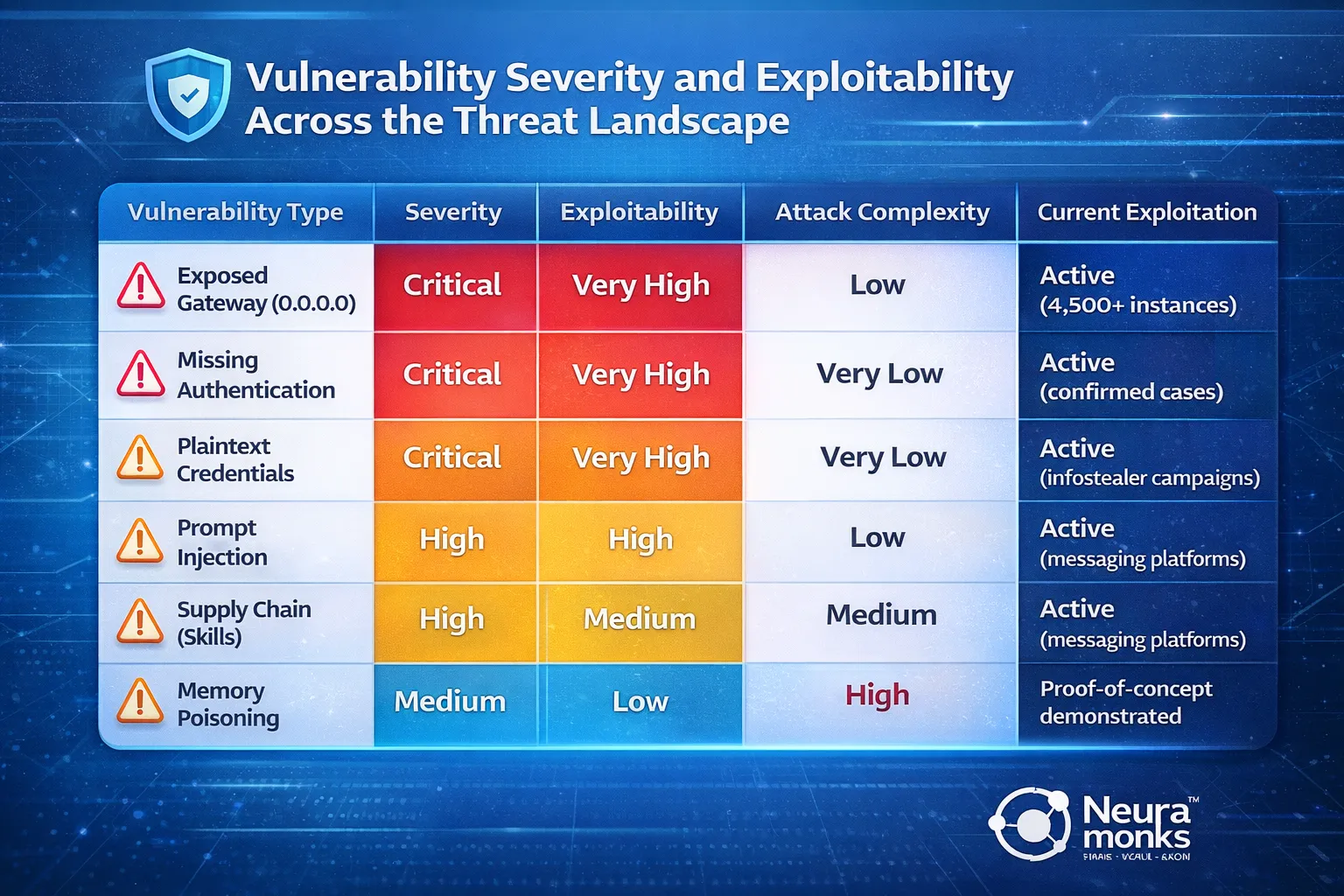
Enterprises exploring AI solutions for automation and productivity need to recognize that these aren't traditional security vulnerabilities with patches on the way—they're architectural characteristics of autonomous agents that require fundamentally different security approaches. Organizations like Neuramonks that specialize in enterprise AI deployments implement security controls at the architecture level rather than trying to retrofit protection onto inherently insecure designs.
Why Traditional Security Controls Fail Against Autonomous AI Agents
Security teams trained on protecting web applications, databases, and traditional enterprise software find themselves unprepared for the challenges autonomous AI agents present. The security model we've built over twenty years of modern computing doesn't translate effectively to systems that are designed to break boundaries and cross security domains. Here's why conventional controls fail:
- AI agents break defined operational boundaries by design: Traditional applications operate within clearly defined scopes—a web server processes HTTP requests, a database manages data queries, a file sync tool moves files between locations. Autonomous AI agents explicitly reject these boundaries, integrating across systems, interpreting ambiguous natural language commands, and making contextual decisions about what actions to take. You can't sandbox something whose entire purpose is escaping sandboxes.
- Static application security testing can't catch dynamic reasoning-driven risks: SAST tools analyze code for known vulnerability patterns—SQL injection, XSS, buffer overflows, hardcoded secrets. But AI agent vulnerabilities emerge from the agent's reasoning process, not from code patterns. How do you write a static rule that detects when an AI might be persuaded through clever prompting to exfiltrate data? The attack surface is in the model's decision-making, not in exploitable code paths.
- Autonomous decision-making bypasses approval workflows: Traditional security controls often rely on human checkpoints—code review before deployment, approval workflows for sensitive operations, manual verification of critical actions. Autonomous agents are specifically designed to operate without these checkpoints. Reintroducing human approval for every action defeats the entire purpose of automation, but removing it creates operational risk most organizations aren't prepared to accept.
- Persistent memory creates delayed multi-turn attack chains: Traditional security monitoring looks for patterns indicating compromise—unusual network connections, unexpected file access, suspicious command execution. But when malicious instructions can be inserted into memory weeks before they trigger execution, traditional indicators of compromise appear disconnected from the initial breach. The attack timeline becomes too distributed for conventional correlation.
- Trust assumptions in messaging platforms fail spectacularly: Security controls in email systems and collaboration platforms assume humans will exercise judgment about message trustworthiness. Phishing awareness training teaches employees to question suspicious messages. But when an AI processes these messages automatically, applying the same trust level to forwarded messages from strangers as to messages from family members, all that human judgment gets bypassed completely.
- Integration amplifies rather than contains impact: Traditional security architecture uses segmentation to limit breach impact—if one system gets compromised, the blast radius stays contained. But AI agents integrate across platforms and services specifically to provide unified capabilities. Compromise doesn't stay contained—it spreads across every connected system, with the agent's own legitimate access providing the perfect cover for malicious activity.
This isn't a criticism of autonomous AI agents—it's a recognition that they represent a fundamentally different security paradigm. The companies succeeding with these deployments aren't the ones trying to apply traditional controls harder. They're the ones rethinking security architecture from first principles, designing governance frameworks that preserve autonomy while limiting catastrophic failure modes, and building monitoring that detects reasoning-driven threats rather than just looking for known attack patterns.
Enterprise Defense Framework: Securing AI Agents Without Killing Functionality
Securing autonomous AI agents requires a systematic approach that balances protection against exploitation with preserving the capabilities that make these systems valuable. Here's the defense framework security teams should implement for any AI agent deployment:
- Immediate actions for existing deployments: Conduct an audit of all AI agent instances running in your environment—including shadow IT deployments on employee devices. Identify exposed instances using network scans, verify authentication is properly configured, immediately revoke any credentials that might have been exposed, isolate compromised or misconfigured systems from production networks until they can be hardened, and document what data and systems each agent has accessed.
- Configuration hardening to eliminate low-hanging vulnerabilities: Change gateway binding from 0.0.0.0 to loopback (127.0.0.1) to prevent direct internet exposure. Enable and enforce strong authentication on all control interfaces using multi-factor authentication where possible. Migrate credential storage from plaintext files to encrypted vaults or operating system keychains. Disable unnecessary integrations and services to reduce attack surface. Configure the agent to require explicit approval for sensitive operations like external communication, file deletion, or executing administrative commands.
- Network segmentation restricting access to trusted paths only: Never expose AI agent control interfaces directly to the public internet. Implement VPN or Tailscale for remote access rather than port forwarding. Use firewall rules to explicitly allowlist necessary connections and block everything else. Segment AI agent infrastructure from production systems unless integration is absolutely required. Monitor and log all network connections the agent makes, alerting on unexpected destinations.
- Comprehensive monitoring and detection covering agent-specific threats: Set up alerts for exposed ports and unauthenticated access attempts to AI agent control interfaces. Monitor the agent process for unexpected command execution patterns, particularly shell commands accessing sensitive directories or making network connections to unknown domains. Deploy endpoint detection and response tools specifically configured to detect information-stealing malware targeting AI agent credential stores. Track and validate the integrity of configuration files, detecting unauthorized modifications that might indicate compromise or memory poisoning.
- Supply chain validation before installing third-party capabilities: Never install skills or extensions from untrusted sources without thorough review. Examine the code manually for suspicious operations like credential exfiltration, unexpected network requests, or system modification commands. Check the developer's reputation, looking for established history rather than newly created accounts. Monitor for typosquatting and lookalike skills designed to impersonate legitimate tools. Consider maintaining an internal vetted skills library rather than allowing arbitrary public installations.
- Least-privilege implementation limiting damage from compromise: Grant AI agents only the minimum permissions necessary for their specific tasks—file system access only to designated directories, shell command execution only for approved commands through allowlists, network access only to explicitly required services. Implement role-based access control so different automation tasks run with different privilege levels. Require human approval workflows for any operation that could cause significant business impact—financial transactions, data deletion, external communications to customers or partners, or modifications to production systems.
- Incident response planning specific to AI agent compromise: Define clear procedures for responding to compromised AI agents—immediate isolation steps, credential revocation processes, forensic data collection requirements. Establish who has authority to shut down agent operations if compromise is suspected. Document all systems and data the agent has access to so incident scope can be quickly assessed. Plan communication protocols for notifying affected users or external parties if the agent's connected accounts are used maliciously. Test these procedures regularly rather than discovering gaps during an actual incident.
The goal isn't to make autonomous AI agents completely risk-free—that's impossible for systems designed to operate with broad authority across organizational boundaries. The goal is reducing risk to acceptable levels while preserving the capabilities that make these systems valuable for automation and productivity. Organizations that implement this framework thoughtfully can deploy AI agents that deliver business value without creating security nightmares that keep CISOs awake at night.
For enterprises that need professional security architecture for AI agent deployments, Neuramonks provides comprehensive consulting services covering threat modeling, security design, governance frameworks, and implementation of defense-in-depth controls specifically tailored to autonomous AI systems. We've helped organizations across industries deploy AI infrastructure that satisfies security teams, passes compliance audits, and delivers reliable automation without creating unacceptable risk.
Strategic Perspective: The Future of AI Agent Security
Clawbot or Moltbot represents both a warning and an opportunity. The warning is clear—autonomous AI agents deployed without proper security architecture create catastrophic risks that traditional controls can't adequately mitigate. The rapid exploitation following viral adoption demonstrates that threat actors are ready and able to capitalize on these vulnerabilities at scale. Organizations treating AI agent deployment as a simple software installation rather than a fundamental change in their security model will face consequences.
Autonomous AI agents can transform operations, but success depends on treating them as critical infrastructure from the start. Secure deployments rely on basics—least-privilege access, encrypted credentials, restricted interfaces, approvals for sensitive actions, and vetted code. AI security isn’t optional; it’s what turns automation into long-term value instead of a short-lived experiment. Design with threat modeling, build controls into the architecture, and govern autonomy without losing control.
This is just the beginning of the agentic era. The security challenges we're seeing with autonomous AI agents will only grow more complex as these systems become more capable and more deeply integrated into business operations. Organizations that invest now in understanding these threats and building proper defenses will have significant competitive advantages over those playing catch-up after their first major breach.
Ready to secure your AI infrastructure before the next breach? The threats facing autonomous AI agents aren't going away—they're accelerating as adoption grows. Neuramonks helps enterprises deploy AI agents with the security architecture, governance frameworks, and monitoring capabilities that keep both productivity and protection intact.
Our team has built security-first AI deployments for organizations that can't afford to treat autonomous agents as experiments. We handle the complexity—threat modeling, configuration hardening, permission frameworks, supply chain validation, and incident response planning—so you get AI infrastructure that passes security audits and delivers business value.
Schedule a security consultation with Neuramonks to assess your AI agent risk exposure, or contact our team to discuss enterprise-grade deployment strategies that your CISO will actually approve. Because the difference between AI that transforms operations and AI that creates incidents is how seriously you take security from day one
How to Install Clawbot in Device
Most Clawbot setups fail within 48 hours because teams rush deployment instead of securing it. This guide contrasts risky “fast” installs with production-grade deployments—covering permissions, security controls, and governance—based on the enterprise AI infrastructure methodology used by Neuramonks.
Most Clawbot installations fail within the first 48 hours—not because the software is broken, but because teams skip the fundamentals. I've watched companies rush through installation in 20 minutes, only to spend weeks troubleshooting security vulnerabilities, permission conflicts, and gateway crashes that could have been avoided with proper planning. The difference between a Clawbot deployment that becomes critical infrastructure and one that gets abandoned after the first demo comes down to how seriously you take the installation process.
Clawbot isn't just another AI chatbot you add to Slack. It's autonomous AI infrastructure that runs on your servers, executes shell commands, controls browsers, manages files, and integrates with your entire digital ecosystem. When installed properly, it becomes one of your most valuable operators—monitoring processes, handling repetitive decisions, and keeping workflows moving 24/7. When installed carelessly, it becomes a security nightmare with root access to your systems. At Neuramonks, we've deployed AI solutions and agentic AI systems for enterprises that understand this distinction, and what I've learned is simple: the "fast way" creates technical debt you'll regret within days.
This guide walks through enterprise-grade Clawbot installation—the approach that prioritizes security, reliability, and long-term operational success over quick demos. If you're serious about deploying AI infrastructure that actually works in production environments, keep reading.
Why Most Clawbot Installations Fail in Production
The "fast way" to install Clawbot device infrastructure feels productive in the moment—copy a command, paste it into your terminal, watch packages download, and boom, you're running AI on your laptop. Then reality hits. Here are the most common mistakes that break deployments before they ever reach production:
- Outdated Node.js versions: Clawbot requires Node.js 22 or higher for modern JavaScript features. Installing on Node 18 or 20 is the single most common cause of cryptic build failures, and I've seen teams waste entire days debugging issues that a simple node --version check would have prevented.
- Missing build tools and dependencies: The installation process compiles native modules like better-sqlite3 and sharp. Without proper build tools (Python, node-gyp, compiler toolchains), these compilations fail silently or throw errors that look like Clawbot bugs when they're actually environment problems.
- Wrong installation environment: Developers install Clawbot on their personal laptops "just to try it out," then wonder why it's unreliable when their machine sleeps, why performance degrades when they're running other applications, or why security teams panic when they discover an AI agent with full system access on an unmanaged device.
- Skipping the onboarding wizard: The openclaw onboard command isn't optional busywork—it configures critical security boundaries, permission models, and API authentication. Teams that bypass this step end up with misconfigured agents that either can't do anything useful or have dangerously broad access.
- Permission errors and npm conflicts: Running installations with wrong user accounts, system-level npm directories that require sudo, or conflicting global packages creates EACCES errors that block deployment. What should take 10 minutes stretches into hours of permission troubleshooting.
- Exposed admin endpoints: Here's the scary one—hundreds of Clawbot gateways have been found exposed on Shodan because teams didn't configure proper gateway binding. Default installations that bind to 0.0.0.0 instead of loopback turn your AI agent into an open door for anyone scanning the internet.
These aren't theoretical risks. I've seen production deployments compromised, AI agents making unauthorized changes, and companies abandoning Clawbot entirely after rushed installations created more problems than they solved. The pattern is always the same: teams prioritize speed over structure, then spend 10x the time fixing preventable issues.
Understanding Clawbot's Architecture Before You Install
Before you install Clawbot device infrastructure, you need to understand what you're actually deploying. This isn't a web app you can uninstall if things go wrong—it's a persistent AI operator with deep system access. Here's what makes Clawbot fundamentally different from traditional AI assistants:
- Infrastructure ownership and privacy-first design: Unlike ChatGPT or Claude.ai, Clawbot runs entirely on hardware you control. Your conversations, documents, and operational data never touch third-party servers unless you explicitly configure external AI APIs. This is true data sovereignty—no company is mining your interactions, and no terms-of-service update can suddenly change what happens to your information.
- Autonomous execution beyond conversation: Clawbot doesn't just answer questions—it directly manipulates your systems. It executes shell commands, writes and modifies code, controls browser sessions, manages files, accesses cameras and location services, and integrates with production services. If Anything runnable in Node.js — Clawbot can coordinate. This power is exactly why installation matters so much.
- Multi-platform integration with unified memory: You can communicate with your Clawbot instance through WhatsApp, Telegram, Discord, Slack, Signal, iMessage, and 15+ other platforms. Conversations maintain context across all channels, so you can start a task on Slack at your desk and follow up via WhatsApp during your commute. This unified presence requires proper gateway configuration to work reliably.
- Full system access with extensible capabilities: Clawbot integrates with over 50 services through its skills ecosystem, runs scheduled background tasks, monitors system resources, and executes workflows while you're offline. The ClawdHub marketplace hosts 565+ community-developed skills, and the system can build custom skills on demand for your specific requirements.
- Model-agnostic AI flexibility: Choose between Anthropic's Claude for sophisticated reasoning, OpenAI's GPT models for versatility, or completely free local models via Ollama. Switch AI providers without reconfiguring your entire deployment—the gateway architecture abstracts model selection from operational logic.
Understanding this architecture matters because it shapes your installation strategy. You're not setting up a chatbot—you're deploying AI infrastructure that needs security controls, monitoring, backup strategies, and operational governance. as AI Consulting Services we specializing in enterprise AI solutions, we've helped companies recognize this distinction before they rush into production deployments that compromise security or reliability.
The Right Way: Pre-Installation Requirements and Planning
Proper Clawbot installation starts before you touch a terminal. Here's the systematic pre-installation checklist that prevents 90% of the issues I see in production:
- System requirements verification: Confirm you're running Node.js 22 or higher with node --version. Check that you have adequate RAM (minimum 4GB, recommended 8GB+) and storage for models, logs, and workspace data. Verify that build tools are installed—on macOS this means Xcode Command Line Tools, on Linux it's build-essential and Python 3, on Windows it's Windows Build Tools or WSL2.
- Choose proper installation environment: Clawbot should run on a controlled server, private cloud instance, or isolated virtual machine—never a personal laptop for production use. The environment needs to be always-on, properly backed up, and secured with least-privilege access. Consider whether you'll host on-premise or use cloud VPS providers like Hetzner, DigitalOcean, or AWS.
- Network and security planning: Map out which ports your gateway will use (default 18789), how you'll handle firewall rules, whether you need VPN or Tailscale for remote access, and how to prevent public internet exposure. Plan your network segmentation so the Clawbot instance can access necessary services without having broader access than required.
- Access control strategy: Define who gets what permissions before installation. Will this be a shared organizational agent or individual instances per user? What approval workflows do you need for sensitive actions like database modifications, external API calls, or financial transactions? Document these policies now, not after someone makes an unauthorized change.
- Logging and monitoring infrastructure: Clawbot generates detailed logs for every action, API call, and system interaction. Plan where these logs will be stored, how long you'll retain them, who can access them, and whether you need integration with existing monitoring tools like Datadog, Grafana, or ELK stack. Without proper logging, troubleshooting becomes impossible.
- Backup and disaster recovery plan: Your Clawbot instance will accumulate conversation history, learned behaviors, custom skills, and integration configurations. Plan automated backups of your state directory (default ~/.openclaw) and workspace, define recovery time objectives, and test restoration procedures before you need them in production.
This planning phase typically takes 2-4 hours for small deployments and a full day for enterprise environments. Teams that skip it inevitably spend weeks fixing issues that proper planning would have prevented. As an AI development company, Neuramonks includes this planning phase in every client engagement because we've seen firsthand what happens when organizations skip fundamentals to chase speed.
Step-by-Step Installation Process for Enterprise Deployment
With planning complete, here's the systematic installation workflow that creates production-ready Clawbot deployments:
- Install Node.js 22+ and verify build tools: Use nvm (Node Version Manager) or download directly from nodejs.org. After installation, run node --version and npm --version to confirm. Test that build tools are available with gcc --version (Linux/macOS) or verify Visual Studio Build Tools (Windows). Don't proceed until these fundamentals work.
- Run official installation script with proper flags: Use the official installer with verbose output: curl -fsSL https://openclaw.ai/install.sh | bash -s -- --verbose. The verbose flag shows exactly what's happening and makes troubleshooting easier if issues arise. Never pipe untrusted scripts to bash in production—review the install.sh contents first to understand what it does.
- Complete onboarding wizard thoroughly: Run openclaw onboard --install-daemon and work through every prompt carefully. Select your AI model provider (Claude, GPT, or local Ollama), configure messaging channels one at a time, set initial permission boundaries, and verify API keys are valid. The wizard handles critical security configuration—skipping steps here creates vulnerabilities.
- Configure least-privilege permissions: Start with minimal access and expand gradually. Enable file system access only to specific directories, restrict shell command execution to approved commands, require human approval for external API calls, and disable internet access for sensitive environments. You can always grant more permissions—revoking them after incidents is much harder.
- Set up secure gateway binding: Edit your configuration to bind the gateway to loopback (127.0.0.1) instead of 0.0.0.0. This single change prevents external network exposure while allowing local access and properly configured remote connections via VPN or Tailscale. Check your config file (typically ~/.openclaw/config.yaml) and explicitly set gateway.bind: "loopback".
- Connect messaging channels systematically: Add one messaging platform at a time—start with the channel you'll use most (often Telegram for technical teams or WhatsApp for broader access). Verify each integration works before adding the next. Test both sending and receiving messages, confirm authentication persists across gateway restarts, and validate that conversation history syncs properly.
- Test with low-risk tasks first: Your first operational test should be something that can't cause damage—create a file in a temporary folder, summarize a local text document, or query current system resources. Confirm the task completes successfully, verify you can see the action in logs, and check that results appear in your messaging platform as expected.
- Enable comprehensive logging and monitoring: Configure log levels to capture detailed execution traces, set up log rotation to prevent disk space issues, integrate with your monitoring stack to track gateway health and performance, and create alerts for suspicious activity patterns. What you don't log, you can't troubleshoot or audit.
At Neuramonks, we implement staged rollouts for enterprise clients—starting with restricted pilots, expanding to low-risk production tasks, and gradually enabling full autonomous operation only after the system proves reliable and secure. This phased approach dramatically reduces deployment risk while building organizational confidence in AI infrastructure.
Security Configuration That Actually Protects Your Infrastructure
Security isn't a feature you add after installation—it's the foundation you build on. Here's what enterprise-grade Clawbot security actually looks like:
- Gateway binding to loopback prevents internet exposure: Configure gateway.bind: "loopback" in your config file. This ensures the gateway only accepts connections from the same machine or through explicitly configured tunnels like Tailscale or VPN. Hundreds of Clawbot instances have been found on Shodan because teams left default 0.0.0.0 bindings that exposed admin endpoints to the entire internet.
- Least-privilege access policies limit blast radius: Grant only the minimum permissions necessary for each task. File access should be restricted to specific directories, shell commands should use allowlists rather than blocklists, and external API calls should require explicit approval. When incidents occur—and they will—proper permissions mean the damage stays contained.
- Human approval workflows for sensitive actions: Critical operations like database modifications, financial transactions, external communications, or infrastructure changes should always require human confirmation. Configure approval flows in your config file and test them thoroughly before enabling autonomous execution in production.
- Proper API key management and rotation: Store API keys in secure vaults like AWS Secrets Manager or HashiCorp Vault, never commit them to version control, rotate them regularly (quarterly at minimum), and monitor usage patterns for anomalies. Compromised API keys have led to massive unexpected bills when attackers use them for cryptocurrency mining or other abuse.
- Network segmentation isolates AI infrastructure: Run Clawbot in isolated network segments with firewall rules that explicitly allow only necessary connections. The AI agent doesn't need direct access to your production database, financial systems, or customer data stores—architect network access to match your actual requirements.
- Audit logging provides traceability and accountability: Every action, API call, and decision should be logged with sufficient detail to reconstruct what happened and why. Logs must include timestamps, the triggering message or event, the decision-making process, and the actual execution result. Without comprehensive logs, you can't investigate incidents, prove compliance, or improve system behavior over time.
Here's a comparison table showing the security differences between "fast way" and "right way" installations:
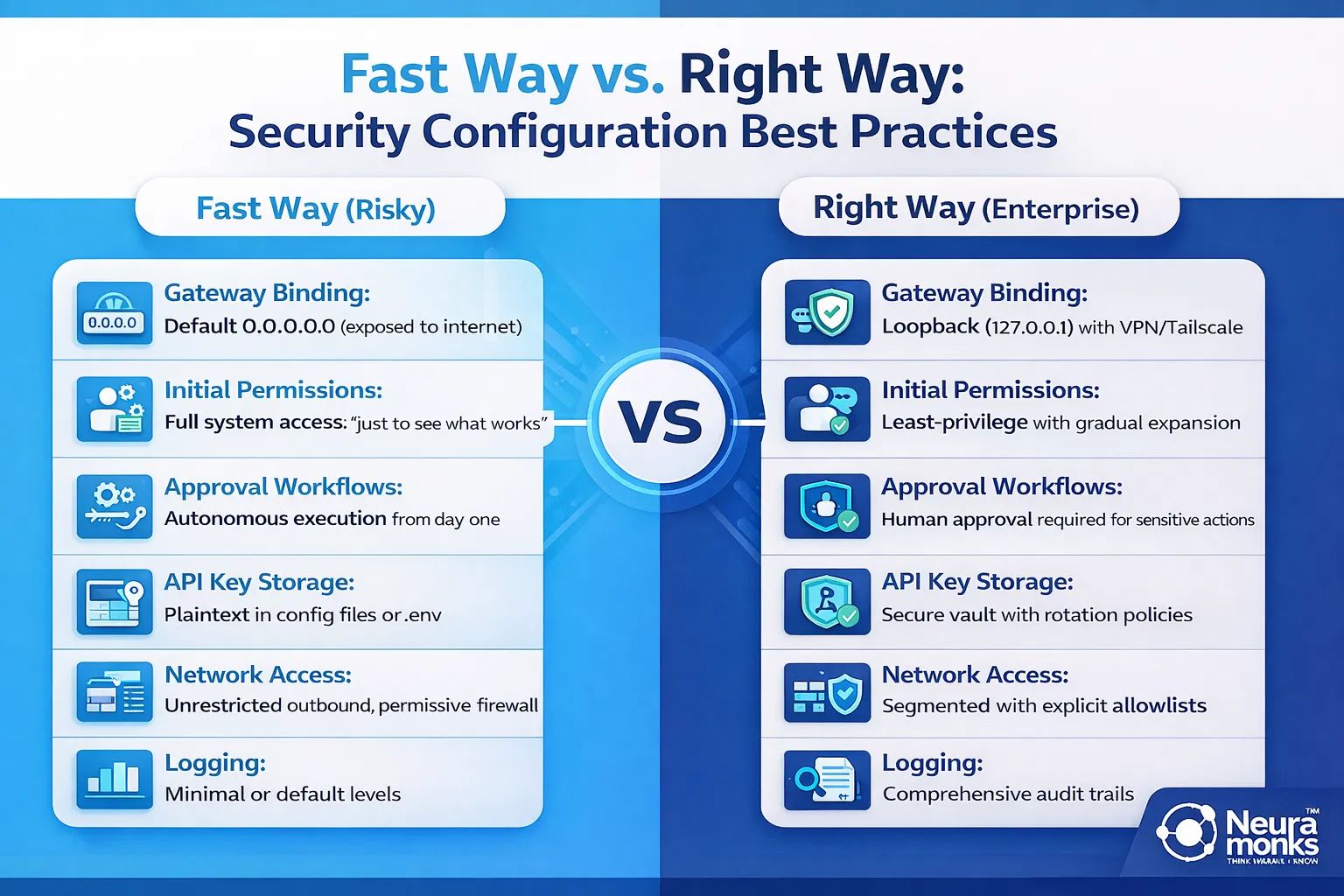
The "right way" takes a few extra hours during installation but prevents security incidents that can take weeks to remediate and damage organizational trust in AI infrastructure. Neuramonks specializes in deploying enterprise AI solutions with security architectures that satisfy compliance requirements, pass security audits, and maintain operational reliability under real-world conditions.
Final Thoughts: Beyond Installation to Operational Success
Installing Clawbot properly is just the beginning. The real value emerges over weeks and months as the system proves reliable, teams trust its decisions, and you gradually expand its autonomy into more complex workflows. Organizations that take the "right way" approach create AI infrastructure that becomes genuinely indispensable—quietly handling repetitive decisions, monitoring critical processes, and keeping operations moving 24/7 without constant human oversight.
What separates successful deployments from abandoned experiments? Proper installation that prioritizes security, systematic rollout that builds confidence, comprehensive monitoring that catches issues early, and ongoing optimization that expands capabilities as trust grows. Companies that skip these fundamentals end up with AI agents that break in production, create security vulnerabilities, or fail to deliver ROI because teams don't trust them enough to enable meaningful automation.
Your next steps after installation should focus on validation and gradual expansion. Monitor logs daily during the first week, run progressively more complex test tasks, document what works and what doesn't, gather feedback from users, and systematically address issues before they become patterns. Only after your Clawbot instance demonstrates consistent reliability should you consider expanding permissions or enabling autonomous execution in production workflows.
For startups and enterprises serious about deploying AI solutions that actually work in production environments, Neuramonks offers comprehensive AI consulting services that go far beyond basic installation. As an AI development company specializing in agentic AI systems, enterprise automation, and AI ML services, we help organizations navigate the complexity of production AI deployment—from initial architecture design through security configuration to operational governance and continuous optimization.
Ready to deploy Clawbot with enterprise-grade security and reliability? Our team at Neuramonks has successfully implemented AI infrastructure for companies across industries, turning experimental AI into production systems that deliver measurable business value. We handle the complexity—architecture planning, security hardening, permission frameworks, monitoring setup, and staged rollouts—so you get AI infrastructure that works from day one.
Contact Neuramonks today to discuss your AI deployment requirements, or schedule a consultation with our AI solutions team to explore how we can help you build autonomous AI infrastructure that your organization can actually trust in production.

You asked, we precisely answered.
Still got questions? Feel free to reach out to our incredible
support team, 7 days a week.
What kind of web development projects does NeuraMonks handle?
NeuraMonks builds custom web platforms for businesses that need more than a template — think recruitment automation portals (Extrahourz), immigration management systems (Patel Canada Visa), real estate operations dashboards (Bavadiya & Co), and digital payment systems for restaurants and parking services (Xcashmenu). Every project in our case study library started with a specific operational problem, not a design brief.
How to choose the right AI solutions company?
Choosing the right AI solutions company means looking beyond technical skills. Key factors include:
Proven experience in custom AI solutions
Ability to deliver production-ready systems
Strong focus on business outcomes and ROI
Clear implementation and support processes
Security and compliance expertise
What makes NeuraMonks a reliable AI development agency?
NeuraMonks operates as a full-cycle AI development partner, not just a service vendor. We combine strategy, engineering, and deployment to build AI systems that work in real business environments. Our focus is on clarity, execution, and measurable outcomes, making us a trusted partner for organizations serious about AI.
Do you offer AI implementation services or only AI consulting?
We provide end-to-end AI implementation services, from initial use-case discovery and data readiness to model deployment and optimization. Unlike pure consultants, we take responsibility for building, integrating, and scaling AI systems inside your existing operations.
How is NeuraMonks different from other artificial intelligence development companies?
Most artificial intelligence development companies focus on experiments or proofs of concept. We focus on production-ready AI. Our team designs systems that integrate with real workflows, scale securely, and drive real business outcomes—without disrupting your operations.
Which industries do your industry-specific AI solutions serve?
Our industry-specific AI solutions support healthcare, ,eCommerce, manufacturing, Construction and Renovation, Dimond Merchant. Each solution is engineered to address sector-specific challenges, regulations, and operational needs.
How long does AI implementation typically take?
AI implementation timelines vary by complexity, but most projects move from strategy to deployment within 6–12 weeks. As an experienced AI implementation services provider, we follow structured milestones to ensure faster time-to-value.
Can you integrate AI with existing or legacy systems?
Absolutely. We specialize in AI-driven legacy system modernization, enabling businesses to embed intelligence into existing platforms without costly system replacements or operational downtime.