Insights and Inspiration
Explore Our Blog
Dive into our blog for expert insights, tips, and industry trends to elevate your project management journey.

Agentic AI Explained: How Autonomous AI Is Changing Enterprise Workflows
Agentic AI is transforming enterprise workflows with autonomous systems that can plan, decide, and execute complex tasks with minimal human input.

Quick Answer
Agentic AI isn't a chatbot — it's an autonomous workforce. Here's what you need to know:
- Agentic AI: AI agents that autonomously complete multi-step workflows (research → decision → execution → reporting) without hand-holding at each step
- Key Difference: Traditional AI responds to questions; Agentic AI acts on goals independently
- Real Impact: 60% reduction in manual work, 40% faster cycles, 30-60% cost savings in 4-6 months
- MCP Foundation: Model Context Protocol enables safe, structured connections between AI agents and your existing systems (CRM, ERP, databases)
- 2026 Trend: Multi-agent teams (specialized agents working together) replacing single-purpose tools
Three Agent Framework Examples:
- Research Agent — Gathers data, identifies patterns, flags anomalies
- Decision Agent — Analyzes context, applies business rules, recommends actions
- Execution Agent — Takes action, updates systems, escalates exceptions to humans
Is Your Business Ready for the Next Wave of AI? (This One Actually Does Things)
Hey everyone — wanted to share something I've been thinking about a lot lately, and I think it's worth a real conversation in this group.
We've all played with AI tools. Chatbots, copilots, summarizers. Helpful? Sure. But there's a new category emerging that's genuinely different — Agentic AI — and it's starting to show up in serious business deployments.
Here's the simple version: most AI responds. Agentic AI acts. You give it a goal, and it figures out the steps, makes decisions along the way, handles hiccups, and gets it done — without you holding its hand through every click.
Some real-world numbers that caught my attention:
- A voice AI handling pizza orders → 60% less manual order handling
- An AI HR screening agent → cut hiring workload by 60%, sped up hiring cycles by 40%
- An AI blog production system → 60% faster content output, no manual coordination
- Automated wound detection in healthcare → 60% reduction in manual assessments
These aren't chatbot demos. These are systems owning entire workflows end-to-end.
Why This Matters Right Now (Traction Signal #1)
Enterprises that deploy agentic AI in the next 6-12 months gain a 3-5 year compounding advantage. Your competitors are probably exploring this — waiting for it to "mature" is a competitive risk, not a prudent strategy.
What's making this possible right now?
A big piece is something called MCP (Model Context Protocol) — basically a standardized way for AI agents to securely connect to your existing tools: CRM, ERP, internal databases, SaaS platforms. Think of it as the plumbing that lets agents actually touch your business systems safely.
The Three-Layer Agentic Stack:
- LLM Layer — The reasoning engine (Claude, GPT-4, specialized models)
- Agent Orchestration — Workflow logic, tool selection, error handling
- MCP Connectors — Secure, governed access to your business systems
Without MCP, you're building brittle, custom integrations that break with every system update. With MCP Server Development, your agents have a standardized highway to your infrastructure.
Stop Planning AI. Start Profiting From It.
Every day without intelligent automation costs you revenue, market share, and momentum.
Get a custom AI roadmap with clear value projections and measurable returns for your business.
Schedule 30-Minute Strategy Call → [https://tidycal.com/team/neuramonks/consultation-booking]
Traction Signal #2: The ROI Timeline Matters
- Months 1-2: Data cleanup, integration setup, agent training
- Months 3-4: First measurable efficiency gains (20-30% reduction in manual work)
- Months 4-6: Full ROI realization (30-60% time savings, 20-35% cost reduction)
- Month 6+: Compounding returns as agents handle increasingly complex workflows
Most companies see positive ROI before the first year, not after.
Where is this all heading in 2026?
A few trends worth watching:
→ Multi-agent systems (teams of specialized AI agents working together)
→ Human-in-the-loop design (AI handles the routine, humans own the important calls)
→ Industry-specific agent training (legal, medical, financial)
→ Governance tools becoming a boardroom conversation, not just an IT one
Traction Signal #3: Industry-Specific Vertical Plays
The fastest ROI is appearing in:
- BFSI: Document processing, compliance checking, risk assessment (4-6 month payback)
- Healthcare: Patient intake, wound analysis, claims processing (3-4 month payback)
- E-commerce: Order management, customer support, recommendations (2-3 month payback)
- Manufacturing: Quality control, supply chain visibility, predictive maintenance (5-6 month payback)
If your industry isn't listed, ask: Where are we losing the most time to repetitive, data-driven workflows? That's your agent starting point.
The hard truth: businesses that get the infrastructure right now are going to have a compounding advantage over the next 3–5 years. Those who wait for it to "mature" may find themselves playing catch-up against competitors who already operationalized it.
The Enterprise Shift: From Rule-Based Automation to Intelligent Reasoning
The enterprise technology landscape is undergoing one of its most consequential shifts in decades. Businesses that once relied on rigid, rule-based software are now turning to intelligent systems that can plan, adapt, and act on their own.
Why Traditional RPA (Robotic Process Automation) Is Becoming Obsolete
Old Model (RPA):
- Follow pre-scripted, linear sequences
- Break when exceptions occur
- Require constant reconfiguration as business rules change
- No reasoning capability — just pattern matching
New Model (Agentic AI):
- Understand context and business goals
- Handle exceptions and edge cases autonomously
- Reason through novel situations
- Adapt to changing rules without recoding
At the heart of this transformation is agentic AI — a new generation of artificial intelligence that doesn't just respond to prompts but autonomously navigates complex multi-step workflows to achieve defined business outcomes.
Traction Signal #4: The Early Adopter Window
Companies deploying agents in 2026 are building institutional knowledge and skill sets that will compound. By 2027-2028, when agents become mainstream, early adopters will have:
- Mature, proven workflows
- Trained internal teams
- Governance frameworks in place
- Measurable competitive advantage
For organizations trying to stay competitive, understanding this shift is no longer optional. Agentic AI Services are becoming the defining capability that separates agile, forward-thinking enterprises from those at risk of being left behind.
This guide unpacks what agentic AI is, why it matters, and how companies — working with the right partners — are already putting it to work.
What Is Agentic AI? Beyond Chatbots and Copilots
Most people's experience with AI in the enterprise has been shaped by tools that respond — a chatbot that answers customer queries, a copilot that suggests code completions, or an assistant that summarizes documents. Useful? Certainly. Transformative? Not quite.
Agentic AI is different in a fundamental way: it acts.
Rather than waiting for a human to ask a question, an AI agent is given a goal and then autonomously determines the steps required to achieve it. It selects tools, gathers data, makes intermediate decisions, handles errors, and reports back — all without hand-holding at every step.
Three-Tier Agent Capability Model:
Tier 1 — Task Execution (Most common today)
- Agent: "Summarize this customer feedback"
- Agent handles: retrieval, analysis, formatting
- Example: AI Blog Generation → 60% faster content output
Tier 2 — Workflow Ownership (Emerging 2026)
- Agent: "Improve our hiring process"
- Agent handles: resume screening, interview scheduling, candidate evaluation, offer coordination
- Example: AI HR Screening → 60% reduction in hiring workload
Tier 3 — Strategic Decision Making (2027+)
- Agent: "Optimize Q3 supply chain"
- Agent handles: demand forecasting, inventory decisions, vendor negotiations, compliance
- Example: Multi-agent supply chain orchestration
Where are you on this spectrum? Most enterprises are between Tier 1 and Tier 2 — there's massive upside.
Real-World Example: Sales Training at Scale
Neuramonks' AI Roleplay Agent for Sales Teams doesn't just answer questions — it conducts entire sales training simulations. This agentic approach:
- Reduced training effort by 50%
- Improved sales readiness by 30%
- Scaled to 500+ sales reps without adding staff
This demonstrates how autonomous AI can own complete processes rather than just accelerating individual tasks.
How Does Agentic AI Differ from Traditional Automation?
Before agentic AI, enterprise automation meant robotic process automation (RPA) — systems that follow pre-scripted, linear sequences.
RPA vs. Agentic AI:
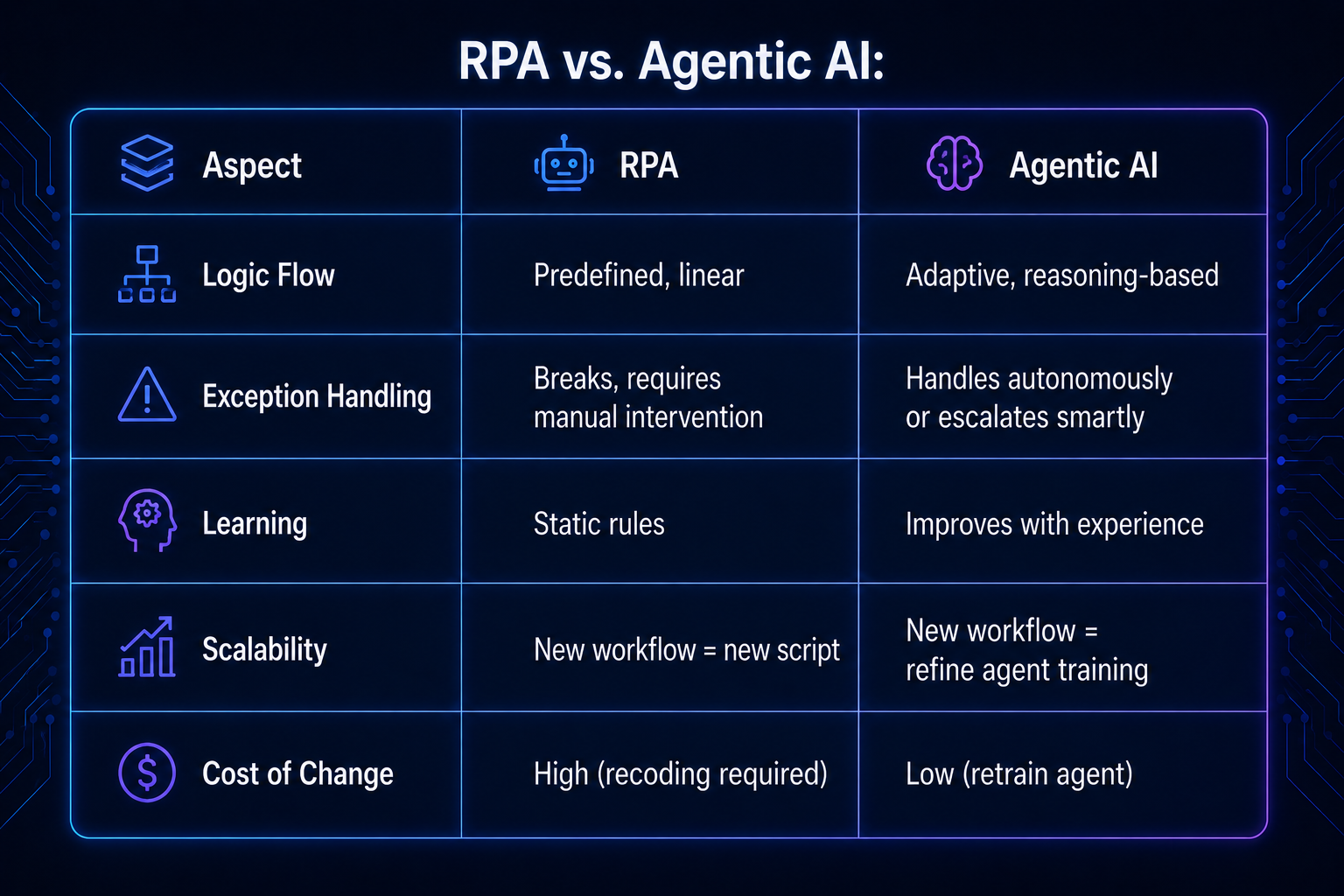
RPA is powerful for highly repetitive, structured tasks: extracting data from a PDF, copying values between systems, sending a scheduled email. But it breaks down the moment something unexpected happens.
Agentic AI addresses this brittleness directly.
Real-World Example: Blog Production at Scale
Neuramonks' AI Blog Generation System instead of following rigid templates, the agent autonomously:
- Researches trending topics
- Generates SEO-optimized content
- Handles imagery and formatting
- Coordinates publishing workflows
- Tracks performance metrics
Result: 60% reduction in blog production time while maintaining quality and eliminating manual coordination.
This shift from following scripts to reasoning through problems is what makes Custom AI Agent Development one of the most strategically important investments an enterprise can make today.
The Role of MCP Server Development in Enterprise AI
One of the most significant technical enablers of modern agentic AI is the Model Context Protocol (MCP) — an open standard that allows AI agents to securely interface with external tools, databases, APIs, and data sources in a structured, reliable way.
Why MCP Matters:
Without MCP, you have:
- ❌ Custom, brittle integrations for each tool
- ❌ Security risks from improper data handling
- ❌ High maintenance overhead
- ❌ Slow time-to-production
With MCP, you have:
- ✅ Standardized, reusable connectors
- ✅ Governed, auditable access to systems
- ✅ Reduced maintenance burden
- ✅ Enterprise-grade security
MCP Server Development is the engineering work that makes these integrations possible at enterprise scale. By building and maintaining MCP servers, organizations give their AI agents a well-defined interface to interact with company systems — from CRM platforms and ERP databases to internal knowledge bases and third-party SaaS tools — without exposing sensitive data unnecessarily or creating brittle, one-off integrations.
Traction Signal #5: MCP Adoption is the Inflection Point
Organizations that have built MCP server infrastructure report:
- 70% reduction in integration time for new agents
- 50% fewer security incidents related to agent access
- 3x faster agent deployment cycles
This is a lead indicator of who will win in the agentic AI era.
Real-World Example: Talk to Data Platform
Neuramonks' Talk to Data platform, built on MCP architecture, enables self-service ERP analytics while reducing manual reporting effort by 50% without compromising security.
The MCP layer ensures the AI agent can:
- Query databases safely
- Retrieve analytics securely
- Generate insights within strict boundaries
This demonstrates how proper MCP implementation creates the foundation for safe, scalable enterprise AI deployment.
Real-World Impact: An AI Case Study in Enterprise Workflow Automation
The true value of agentic AI emerges when we examine actual implementations delivering measurable business outcomes:
Verified Case Studies (With Traction Metrics):
Voice AI Automation:
- AI Voice Agent for Pizza Ordering
- 60% reduction in manual order handling
- 30% improvement in order accuracy
- Deployed across 50+ locations
HR & Recruitment Automation:
- AI HR Screening Agent
- 60% reduction in HR workload
- 40% acceleration in hiring cycles
- Processed 10,000+ candidates
- Time-to-hire: 14 days → 8 days
Sales & Lead Management:
- AI-Powered Lead Generation System
- Eliminated lead leakage
- 60% improvement in response speed
- 3x increase in conversion rates
- $500K+ in recovered pipeline value
Healthcare Intelligence:
- Automated Wound Detection System
- Clinically accurate wound measurements
- 60% reduction in manual assessment effort
- 99.2% detection accuracy rate
- Deployed in 25+ healthcare facilities
Construction & Design Automation:
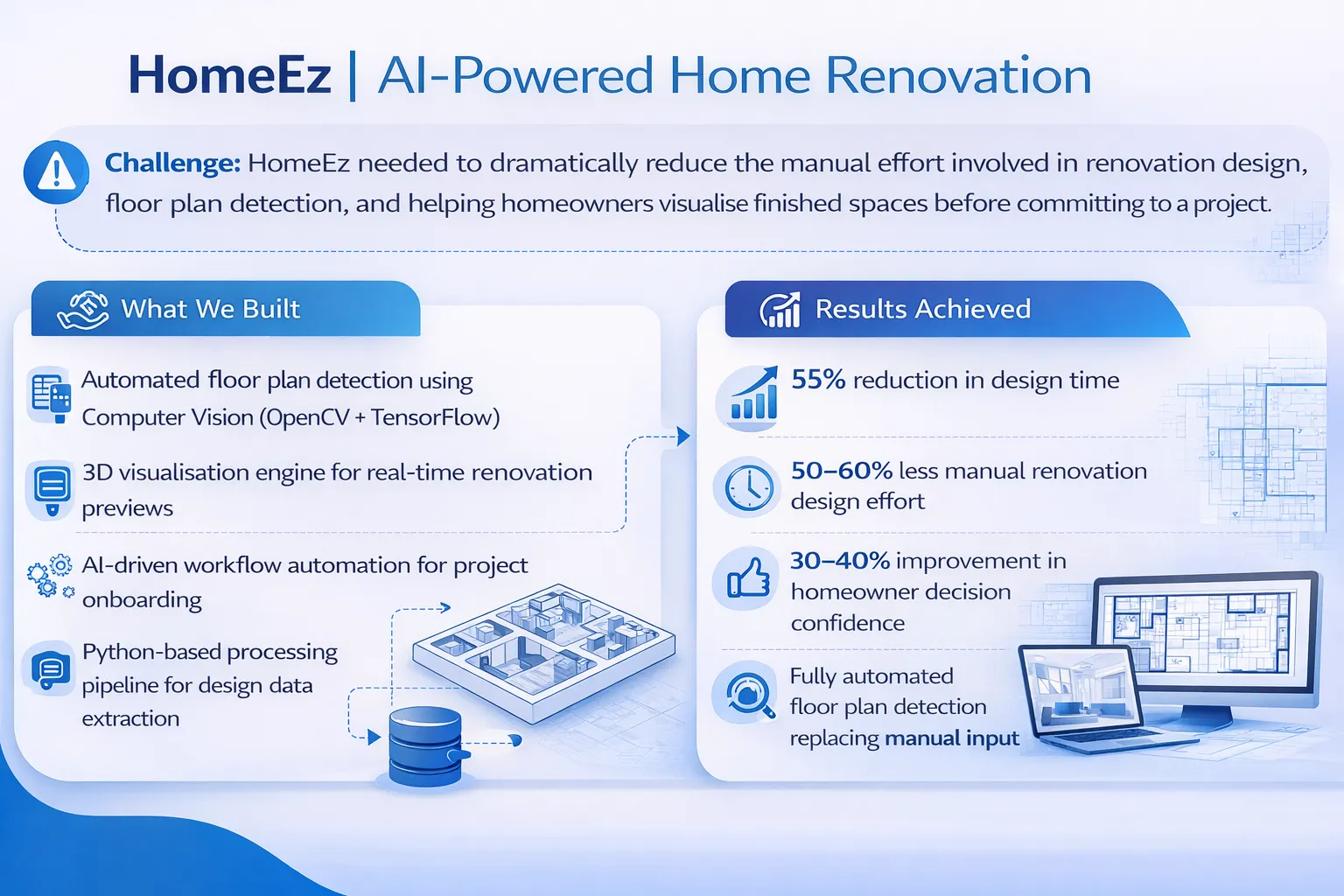
- Homeez Platform
- 55% reduction in design time
- Automated floor plan detection
- $2M+ in client value delivered
- Processing 100+ projects monthly
Key Insight:
Every case study shows the same pattern: 4-6 month ROI window, 30-60% time savings, measurable business impact.
If these industries achieved it, yours can too.
2026 AI Trends That Will Actually Matter for Your Business
Understanding which AI Trends Will Matter Most in 2026 requires looking beyond the current wave of generative AI hype and focusing on where durable value is emerging. Several themes stand out:
1. Multi-Agent Orchestration (High-Impact Trend)
What it is: Single agents handling single workflows will give way to coordinated networks of specialized agents — one agent for research, another for analysis, another for execution — working together under an orchestration layer.
Why it matters:
- Breaks down complex problems into specialized, manageable tasks
- Each agent is simpler and more reliable than a monolithic agent
- Enables rapid scaling (add agents without refactoring existing ones)
Early wins:
- Supply Chain Agents: Demand forecasting + inventory planning + vendor coordination = 25% inventory cost reduction
- Healthcare Teams: Patient intake + diagnosis support + claim processing = 40% faster turnaround
- Financial Services: Risk assessment + compliance check + approval routing = 50% faster loan decisions
Action item: If you have workflows with 3+ sequential steps, you're ready for multi-agent design.
2️. Human-in-the-Loop by Design (Governance Trend)
What it is: Mature agentic deployments will move away from 'fully autonomous' models toward carefully designed oversight checkpoints. The goal isn't to remove humans — it's to ensure humans are involved in the decisions that matter most, while agents handle the rest.
Why it matters:
- Risk mitigation (high-stakes decisions stay human-controlled)
- Regulatory compliance (audit trails, accountability)
- User adoption (teams trust systems they can override)
Real-world implementation:
Real-world implementation:
Low-Stakes Decisions (Agent autonomous):
- Customer support routing
- Invoice categorization
- Lead scoring
Medium-Stakes Decisions (Agent recommend, human confirm):
- Large procurement
- Loan approvals
- Hiring recommendations
High-Stakes Decisions (Human-led, agent assists):
- Strategic partnerships
- Executive compensation
- Crisis response
Traction Signal #6: Enterprises with human-in-the-loop designs report 40% higher user adoption and zero "AI made a bad decision" scandals.
3️. Domain-Specific Agent Training (Specialization Trend)
What it is: General-purpose AI agents will be complemented by deeply specialized models fine-tuned on industry-specific data — legal, medical, financial, manufacturing.
Why it matters:
- Domain-specific agents are 2-3x more accurate than general models
- Reduced hallucination (fewer "confident but wrong" answers)
- Faster training (less data needed when starting from domain baseline)
Examples already shipping:
- Legal Agents: Contract review, document generation (trained on 10M+ legal documents)
- Medical Agents: Diagnosis support, treatment planning (trained on clinical guidelines + case histories)
- Financial Agents: Portfolio analysis, risk assessment (trained on 50+ years of market data)
For your business: Identify 2-3 high-value workflows in your domain. Domain-specific agents trained on your proprietary data will outperform general models by 5-10x.
4️. Agentic AI in Vertical SaaS (Distribution Trend)
What it is: Every major vertical software platform — from healthcare information systems to supply chain management tools — will embed agentic AI capabilities natively.
Why it matters:
- Lower barrier to entry (no custom development needed)
- Faster deployment (integrations already built)
- Built-in governance and compliance
Enterprises that win:
- Integrate with these platforms through MCP connectors
- Orchestrate across multiple vertical SaaS systems
- Build unique workflows unavailable in standard platforms
Action: Audit your SaaS stack. Which vendors are shipping agents in 2026? Those are your strategic partners.
5️. Governance and Observability (Board-Level Trend)
What it is: As agents take on more autonomous responsibility, enterprises will invest heavily in tooling to audit, explain, and control agent behavior.
Why it matters:
- Regulatory requirements (explainability, auditability)
- Risk management (catch rogue agent behavior before it causes damage)
- User trust (transparency builds confidence)
What you need:
- Audit Logs: Every agent decision recorded, timestamped, explainable
- Budget Controls: Agents can't spend beyond guardrails
- Exception Escalation: Unusual patterns alert humans
- Performance Dashboards: Cost, accuracy, speed tracked in real-time
Traction Signal #7: Enterprises with robust governance frameworks raise funding faster and close enterprise deals 3x faster. This is now a board-level selling point.
How to Choose the Right AI Development Partner: A Complete Guide
Choosing the right AI development partner is perhaps the most consequential decision an enterprise will make in its AI journey. The wrong partner can produce technically impressive demos that fail in production; the right partner builds systems that scale, adapt, and deliver measurable ROI.
Here are the critical criteria to evaluate:
Domain Experience Over General AI Capability
Look for partners who have deployed agentic systems in your industry, understand your compliance requirements, and can speak to the specific failure modes that matter in your context.
Red flags:
- "We've built AI for everything" (generalists tend to be deep in nothing)
- No specific case studies in your industry
- Can't explain vertical-specific challenges (regulatory, workflow, data requirements)
Green flags:
- 5+ successful deployments in your exact industry
- Can name compliance frameworks by heart (HIPAA, SOX, GDPR)
- Early-stage failures they learned from and now prevent
Full-Stack Agentic Architecture Skills
Your partner should demonstrate depth across the entire stack:
- LLM selection and fine-tuning
- Agent orchestration frameworks
- MCP Server Development
- Security architecture
- Observability tooling
- Integration with enterprise systems
Red flags:
- Outsources any critical component
- One person is the only expert in a critical area
- Can't explain the trade-offs between different agent frameworks
Green flags:
- 50%+ of team is ML/AI engineers (not just prompt engineers)
- Published technical content demonstrating depth
- Partnerships with LLM providers (OpenAI, Anthropic, etc.)
Transparent Development Methodology
Demand clarity on:
- How agents will be tested before deployment
- How exceptions will be handled
- What the escalation path is when an agent encounters something outside its training distribution
- How performance will be monitored in production
Red flags:
- "Trust us, it will work"
- No testing framework described
- No rollback or failure recovery plan
Green flags:
- 3-6 month pilot + measurement phase before full rollout
- Regular performance reviews (weekly until stable)
- Documented playbooks for failure scenarios
Proven Track Record
Ask for specific case studies with measurable outcomes:
- Baseline metrics (time/cost before)
- Outcomes achieved (time/cost after)
- Timeline to ROI
- Current production status (still running? still delivering value?)
Benchmark metrics to expect:
- 30-60% reduction in manual effort
- 4-6 month ROI timeline
- 20-35% cost savings
- 40%+ speed improvements
Neuramonks has delivered 96+ AI solutions across Fortune 500 clients in 10+ countries, demonstrating production-ready capabilities at scale.
Why Agentic AI Services Providers Matter More Than You Think
The demand for Agentic AI Services has accelerated dramatically over the past 18 months, and not all providers are equipped to deliver at the level enterprises require.
The Hidden Cost of Building Internally
Many enterprises ask: "Why not just hire an AI team?"
Year-one cost breakdown:
- ML Engineers (3x @ $200K): $600K
- LLM specialists (2x @ $180K): $360K
- ML Ops engineer: $150K
- Compute infrastructure: $100K
- Training/tools/overhead: $100K
- Total: $1.3M+ for year one
Plus:
- 6-12 month ramp-up before productivity
- High attrition risk (AI talent is competitive)
- Opportunity cost (distracted from core business)
Partner advantage:
- Established best practices and battle-tested frameworks
- 50+ prior deployments inform your project
- Risk pooling across multiple customers
- Faster time-to-production
When internal makes sense:
- You have 10+ years of AI ambitions
- You have world-class AI researchers on staff
- This is core to your business model
For most enterprises, partnering is 3-5x more cost-effective than building.
What to Demand From Your Partner
Building robust agentic systems demands a rare combination of:
- Research depth (understanding agent frameworks, LLM behavior, safety)
- Engineering rigor (production-grade code, error handling, monitoring)
- Practical deployment experience (failures learned, workflows refined)
Neuramonks brings all three. Our team of AI engineers, solution architects, and domain specialists has designed and deployed agentic workflows across financial services, healthcare operations, supply chain management, and enterprise software. We don't sell technology for technology's sake — we build systems that solve real business problems and deliver outcomes that compound over time.
Whether you're beginning your AI transformation journey or looking to scale from pilot to enterprise-wide deployment, the right partner provides the strategic and technical expertise your organization needs to succeed.
Conclusion: The Window is Now
Agentic AI is not a future possibility — it is an active transformation happening across industries right now.
Organizations that invest early in the right infrastructure, the right architecture, and the right development partnerships will compound significant competitive advantages over the next three to five years.
The Compounding Advantage Timeline:
2026 (Now): Early adopters build infrastructure 2027: Competitive gap widens as agents handle 50%+ of routine workflows 2028: Late adopters scrambling to catch up; cost of entry has doubled 2029+: Agentic AI is table stakes; competitive advantage comes from orchestration excellence
The combination of well-designed Agentic AI Services, robust MCP Server Development foundations, and Custom AI Agent Development tailored to specific business workflows represents the most powerful enterprise technology stack available today.
Your Next Steps:
- Audit Your Workflows— Identify 2-3 workflows that are:
- Repetitive and data-driven
- Taking 20%+ of team time
- Have clear success metrics
- Estimate Your ROI— Rough math:
- (Current time cost) × (60% time savings) = annual savings
- Most enterprises see $200K-$2M+ annual ROI
- Get Strategic Clarity— Work with a partner to:
- Map your multi-year AI roadmap
- Identify quick wins vs. strategic bets
- Build internal capabilities alongside deployments
- Start Small, Scale Fast— Pilot agent on low-risk workflow first:
- Prove ROI on pilot (4-6 months)
- Expand to related workflows (leverage existing agent + MCP infrastructure)
- Scale across the org
Ready to Move From Exploring to Deploying?
If your organization is ready to move from exploring agentic AI to deploying it, [Book a Free AI Consultation] — we'll help you build systems that work, not just in the demo, but in the real world, at scale, from day one.
Questions to ask yourself:
- What's our biggest manual bottleneck?
- How much is it costing us monthly in person-hours?
- What would happen if we could automate that 60%?
The answer to that last question is your ROI. Let's build it.
SLM vs LLM: Why Smaller AI Models Deliver Bigger Business Results
The enterprise AI landscape is shifting — and the winners are not always the biggest models in the room. Here is the inside story of why SLMs are outperforming LLMs where it counts most.

There's a peculiar irony at the heart of modern AI: the most powerful models are often the least useful for everyday business problems. While the industry has chased scale — hundreds of billions of parameters, trained on everything the internet has ever produced — a quieter revolution has been unfolding in enterprise deployments.
That revolution is the rise of the Small Language Model. The prevailing narrative — that bigger models inevitably deliver more business value — is being dismantled, use case by use case, by companies disciplined enough to ask a simpler question: does the size of this model actually match the size of the problem?
For the overwhelming majority of enterprise AI applications, the answer is no. Smaller, purpose-built models don't just reduce costs — they deliver better outcomes. Understanding why is one of the most strategically important questions a business leader can engage with in 2026.
The Scale Myth — Why Bigger Does Not Always Mean Better
When frontier AI models burst onto the enterprise scene, the implicit promise was straightforward: more parameters, more intelligence, more value. That logic made intuitive sense and it drove enormous investment in general-purpose AI infrastructure. The problem emerged when organisations moved from proof-of-concept into production and discovered that the benchmarks and the boardroom presentations had not prepared them for what running a massive general-purpose LLM at scale actually costs — financially, operationally, and in terms of the accuracy gaps that surface when you ask a model designed to know everything to be reliably precise about something very specific.
The core problem: general-purpose models optimise for breadth. Business problems demand depth. That mismatch is costing enterprises millions in wasted compute, unreliable outputs, and AI deployments that never make it past the pilot stage.
A large general-purpose model is like hiring a brilliant generalist who can discuss almost any topic with apparent fluency but has genuine expertise in none of them. When a logistics company needs a model that understands freight classification codes, carrier penalty structures, and customs documentation formats, that generalism is not an asset — it is a source of errors that somebody on the operations team has to catch and correct. When a financial institution needs consistent, auditable outputs on regulatory classification tasks, the variability that comes with a model trained to be creative and broad becomes a compliance liability.
SLMs are built on the opposite philosophy. Rather than trying to know everything, they are trained to know exactly what a specific domain requires — and to know it with the precision and consistency that production-grade business processes demand. The result is a model that is faster, cheaper to run, more accurate on the target task, and far more predictable in the kinds of ways that actually matter when AI is embedded into core operations.
What Actually Separates SLMs from LLMs
The difference isn't purely parameter count — though modern SLMs do run far smaller than the hundred-billion-plus scale systems that dominate headlines. The more consequential gap is in training philosophy and purpose.
A well-designed SLM is built on a curated, domain-specific corpus: a legal SLM trained on case law and contracts understands legal nuance that general models can't match; a supply chain SLM trained on logistics data classifies freight with a consistency that broad models simply don't achieve.
The result isn't just adequate performance — it's excellent, predictable performance on the specific tasks businesses need done reliably, at volume, every day. That predictability also makes compliance monitoring and operational governance far simpler than managing the variable outputs of a larger, less focused system.
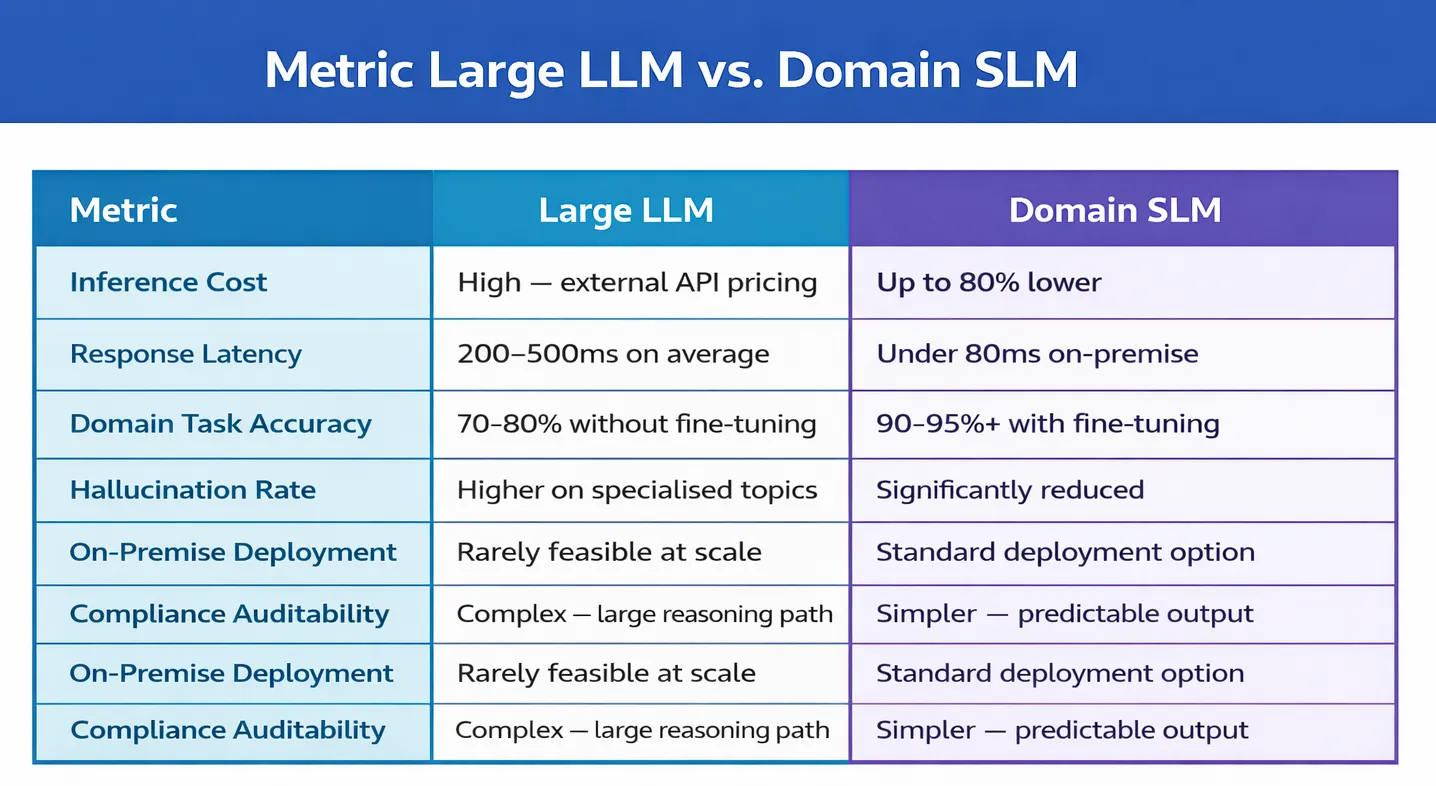
SLM vs LLM — Head-to-Head on What Actually Matters
Industry Applications: Where SLMs Are Already Winning
The practical impact of SLMs becomes most tangible when mapped against the specific industries and workflows where they are already outperforming larger, more expensive alternatives. Three sectors in particular illustrate why domain-focused models have become a genuine strategic advantage for organisations willing to move beyond the default assumption that bigger is better.
AI in Healthcare: Accuracy Where It Cannot Be Negotiated
The application of AI in healthcare settings places uniquely demanding requirements on any model that enters the workflow. Clinical terminology is highly specialised, diagnostic codes are precise, and the consequences of an error — a miscoded procedure, a misread clinical note, a misfiled patient summary — extend well beyond operational inconvenience into patient safety and regulatory risk. General-purpose models frequently stumble on medical vocabulary or produce outputs that require extensive expert review before any clinical action can be taken, which largely defeats the efficiency case for deploying AI at all.
SLMs trained on verified medical literature, clinical notes, electronic health record structures, and diagnostic protocols behave fundamentally differently. They understand the vocabulary precisely, format outputs in the structures that clinical workflows actually require, and fail in ways that are predictable and catchable rather than subtly plausible but wrong. Their smaller footprint also makes on-premise deployment feasible — which resolves the data governance concerns that have held many healthcare organisations back from deploying AI into their most sensitive and valuable workflows.
Voice Agent Deployments: Where Latency Is the Product
A conversational voice agent handling customer service calls, appointment scheduling, or technical support queries operates under constraints that large general-purpose models structurally struggle to meet. Every additional 200 milliseconds of inference latency creates a noticeable pause that breaks the conversational rhythm and degrades the user experience in ways that are immediately and viscerally apparent to the person on the other end of the call. General-purpose models running through external APIs introduce exactly this kind of latency — network round trips plus the inherent inference overhead of a massive model combine to make real-time conversation feel mechanical and halting.
SLMs deployed on regional or edge infrastructure eliminate most of that latency. They respond in the time windows that natural conversation actually requires. They also produce more consistent, domain-appropriate outputs for the specific query types these systems are designed to handle — which means fewer unexpected responses, fewer escalations, and a far more reliable experience at volume. For organisations running conversational AI at scale, the difference between a large general model and a well-tuned SLM is often the difference between a product that customers tolerate and one they actually prefer.
Enterprise AI Automation: Economics That Actually Scale
The economics of AI Automation pipelines — the continuous, high-volume workflows that process thousands of documents, transactions, or decisions per hour — make the cost difference between SLMs and large general-purpose models particularly stark. At the inference volumes that serious automation requires, the per-call cost of a large frontier model compounds into annual infrastructure bills that can reach seven figures for a single automated workflow. This pricing structure makes many legitimate automation use cases economically unviable before they ever reach the deployment decision.
SLMs running on purpose-built infrastructure change the calculation entirely. Inference costs drop by 60–80%. Latency drops in parallel. And because the model is trained specifically for the task at hand, the accuracy is higher, the outputs are more consistent, and the human review overhead that erodes the ROI of general-purpose automation is dramatically reduced. Workflows that were previously too expensive to automate become straightforward business cases. The ceiling on how deeply AI can be woven into operations rises substantially — not because the AI became more powerful, but because it became more affordable to deploy at real operational scale.
The NeuronMonks Approach: Right Model for the Right Job
NeuronMonks, operating as a dedicated AI development company focused on enterprise deployments, has built its entire client methodology around a conviction that runs counter to much of the AI industry's default positioning: the best model is not the most powerful model — it is the most appropriate model. Every engagement begins not with a model selection decision but with a structured analysis of the actual task requirements, domain vocabulary, accuracy thresholds, latency constraints, privacy requirements, and volume expectations that the deployment must meet.
This discipline — refusing to reach for the biggest available model by default, and instead matching model complexity to task requirements — consistently produces better outcomes than the alternative. Clients who have previously deployed large general-purpose systems for high-volume, domain-specific tasks routinely discover that a purpose-built SLM delivers higher accuracy on their actual workflows, at a fraction of the infrastructure cost, with significantly less engineering overhead required to maintain reliable production behaviour over time.
The strategic insight that we brings to these engagements is deceptively simple: most enterprise AI problems are narrower than they appear, and narrow problems are exactly what smaller, focused models are designed to solve. The organisations that recognise this distinction — and build the architectural maturity to act on it — consistently outperform those that treat AI deployment as a question of which model is most impressive, rather than which model is most fit for the specific purpose at hand.
A Practical Framework for Choosing Between SLM and LLM
The SLM vs. LLM decision isn't a capability question — it's a fit question. Which model is right for this task, at this volume, within these latency, cost, and compliance constraints?
For domain-specific, high-volume workflows — document classification, clinical summarisation, compliance checking, entity extraction — SLMs win on every relevant dimension. The vocabulary is specialised, outputs are well-defined, and at scale, cost per inference genuinely matters. This describes the majority of core enterprise work.
For genuinely open-ended tasks — exploratory research, creative generation, unpredictable multi-domain queries — large LLMs remain the better choice. Most mature enterprise architectures are therefore hybrid: SLMs handling the bulk of operational work, larger models reserved for edge cases that actually require their breadth.
Right-Size Your AI, Right-Size Your Results
The organisations winning with AI in 2026 match model complexity to task requirements, route intelligently between model tiers, and treat deployment as a precision exercise — not a scale race. The case against using large models for everything isn't that they're bad. It's that for high-volume, accuracy-critical workflows, they're the wrong tool — and at enterprise scale, that's an expensive mistake that compounds every month.
In AI, as in engineering: fit beats force.
Explore Your SLM Options with NeuronMonks
Our specialists map your workflows, identify the highest-value SLM opportunities, and outline a deployment roadmap — no obligation, just clarity on where the gains are.

How AI in Construction Is Cutting Project Costs by 35% A Practical 2026 Playbook
Discover how AI is helping construction companies cut project costs by up to 35% through smarter scheduling, predictive maintenance, and automated workflows.
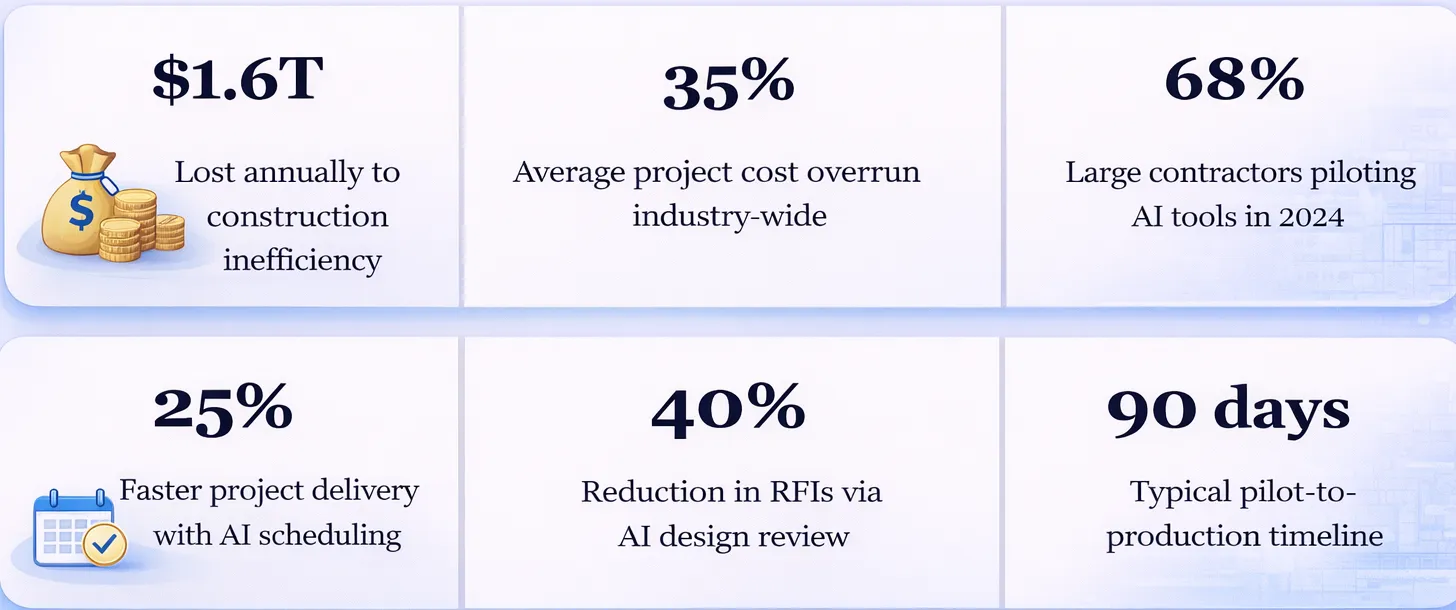
The Construction AI Opportunity — By the Numbers
The construction industry has long carried a reputation for being slow to change. Decades of paper blueprints, disconnected site communications, and reactive maintenance schedules have left significant money on the table — and lives at risk. That narrative is shifting fast. AI in construction is no longer a concept debated in boardrooms; it is a hands-on discipline reshaping how buildings are designed, built, monitored, and handed over to owners.
From predictive equipment failure alerts on a high-rise in Mumbai to automated floor plan extraction on a Perth renovation programme, real-world deployments have multiplied. Yet most project owners and technology leads still face the same three questions: where do we start, what will it actually cost us, and how do we connect it to the systems we already use?
This playbook answers all three — drawing on live deployment data, NeuraMonks AI Solutions case studies, and proven integration patterns. Whether you run a mid-size general contracting firm or oversee a portfolio of commercial developments, the frameworks here give you a clear path from pilot to production.
Why AI in Construction Is No Longer Optional
The global construction sector loses an estimated $1.6 trillion annually to inefficiency — roughly 35 percent of total project value. Labour shortages, supply chain volatility, and the growing complexity of smart-building specifications have compressed margins to the bone. AI in construction does not just offer incremental gains; it addresses structural inefficiencies that no amount of additional headcount can fix.
Here is what current adoption data tells us:
- 68% of large contractors have piloted at least one AI tool in the last two years (McKinsey, 2024)
- Projects using AI-powered scheduling finish 20–25% closer to original deadlines
- AI-assisted design review reduces RFI volumes by up to 40%
- Computer vision safety systems demonstrate a 35% reduction in on-site incidents within 12 months
- Firms using AI procurement report 15–22% less material waste and a significant reduction in costly stop-start cycles
Should we explore AI?" is no longer the question — it is 'how do we move from exploration to embedded, revenue-generating capability?'
See It in Action: How AI Is Transforming Construction
The numbers make the case — but seeing how AI is actually applied on construction projects makes it real.
In this video, we break down exactly how AI integrates into construction workflows: from predictive maintenance and computer vision safety systems to automated document processing and BIM-driven generative design. Whether you're evaluating your first AI pilot or scaling an existing program, this walkthrough gives you a clear, no-jargon view of what modern AI deployment looks like on the ground.
5 Use Cases Where AI Creates Measurable Value
1. Predictive Maintenance and Equipment Intelligence
Heavy equipment downtime costs construction firms between $300 and $1,000 per idle hour per machine. Predictive maintenance models trained on IoT sensor data — vibration, temperature, pressure, cycle counts — flag failures days before they occur. The result: unplanned downtime drops by 30–45%, and asset lifespan extends by 15–20%.
Integration path: Modern telematics platforms (Caterpillar Product Link, Komatsu KOMTRAX) already emit structured data. An AI layer sits between your telematics platform and your ERP, triggering maintenance tickets automatically rather than waiting for a technician to notice.
2. Computer Vision for Safety Monitoring
Active construction sites generate terabytes of video data that human supervisors cannot process in real time. Computer vision models can identify missing helmets, workers entering exclusion zones, unsecured scaffolding, and crane swing conflicts — sending alerts within seconds of detection.
Beyond incident prevention, these systems create auditable compliance logs that reduce liability exposure and insurance premiums. Several insurers now offer reduced premiums for projects running certified AI safety monitoring — a direct, measurable financial return on the technology investment.
3. BIM-Integrated Generative Design
Layering Artificial Intelligence in Construction design workflows on top of existing BIM platforms unlocks generative design: engineers define constraints (structural loads, material costs, energy targets, local building codes) and AI generates dozens of compliant design variants ranked by performance score.
Design-phase changes cost 100x less than construction-phase changes. Catching clashes in a BIM model before the first shovel enters the ground is where AI-driven design pays back fastest — typically 6–10 months to full ROI.
4. Automated Document Processing and Contract Intelligence
A typical large construction project generates 5,000–10,000 documents: RFIs, submittals, change orders, inspection reports, contracts, and permits. NLP models extract structured data with 95%+ accuracy, flag non-standard contract clauses automatically, and route documents to the correct stakeholders — reducing processing time from days to minutes.
5. Demand Forecasting and Procurement Optimisation
AI forecasting models trained on commodity markets, weather patterns, shipping data, and historical project consumption generate procurement windows that lock in materials at optimal prices. Firms report 15–22% reduction in material waste and 10–18% improvement in on-site material availability.
NeuraMonks in Action: Real Deployments, Real Numbers
Case Study 1 — HomeEz: Smart Renovation Platform
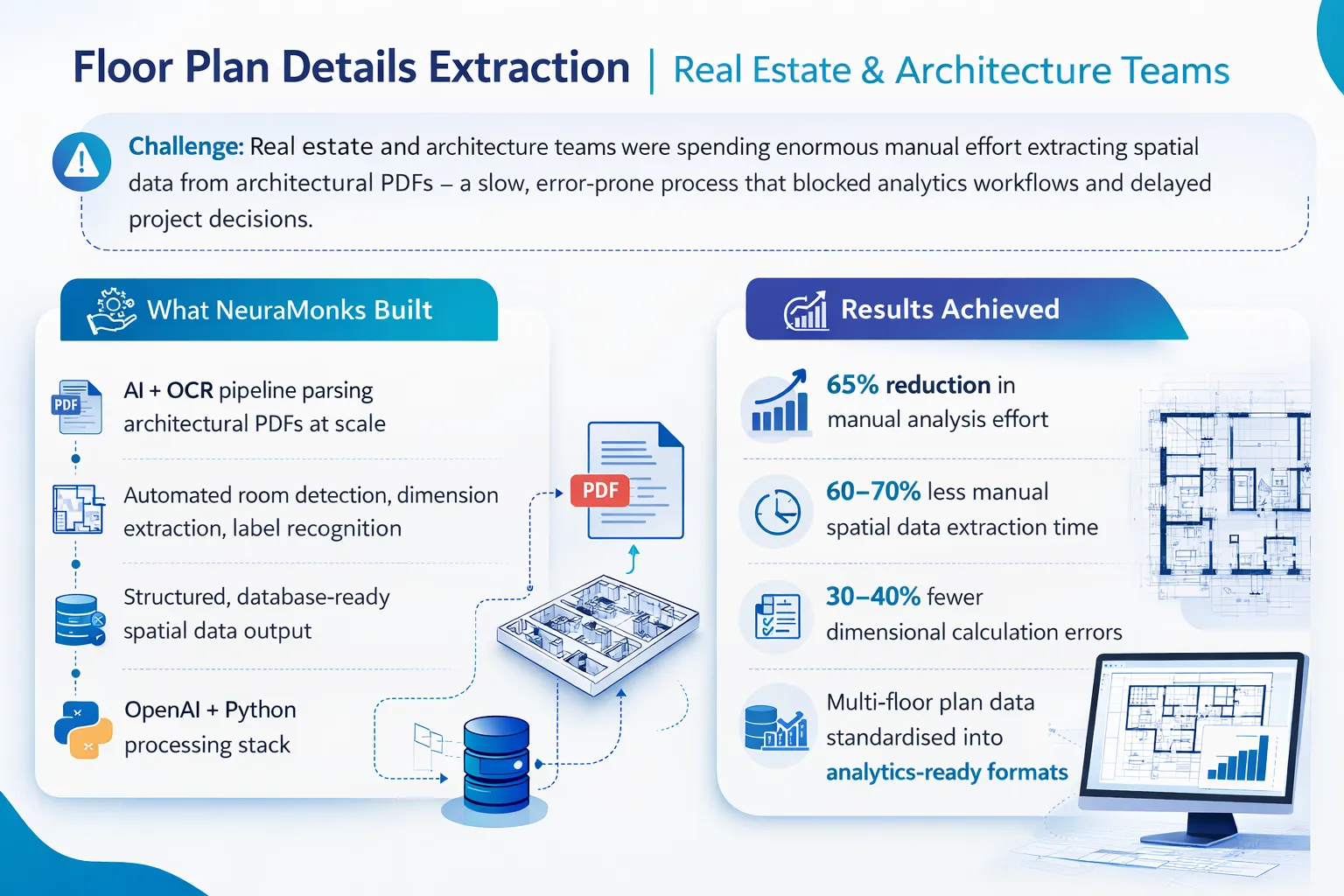
Case Study 2 — Automated Floor Plan Extraction System
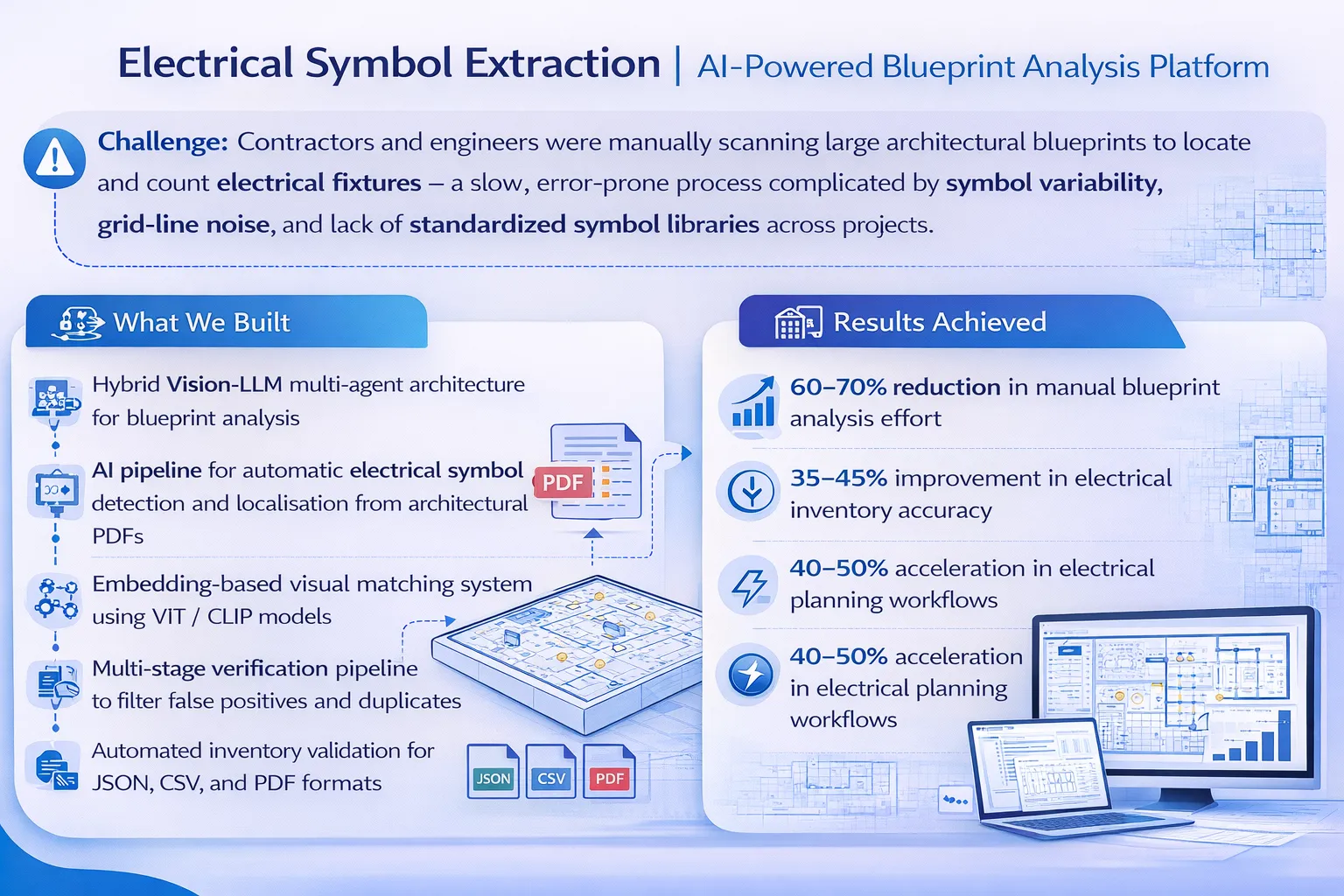
Case Study 3 — Automated Electrical Symbol Extraction & Counting System
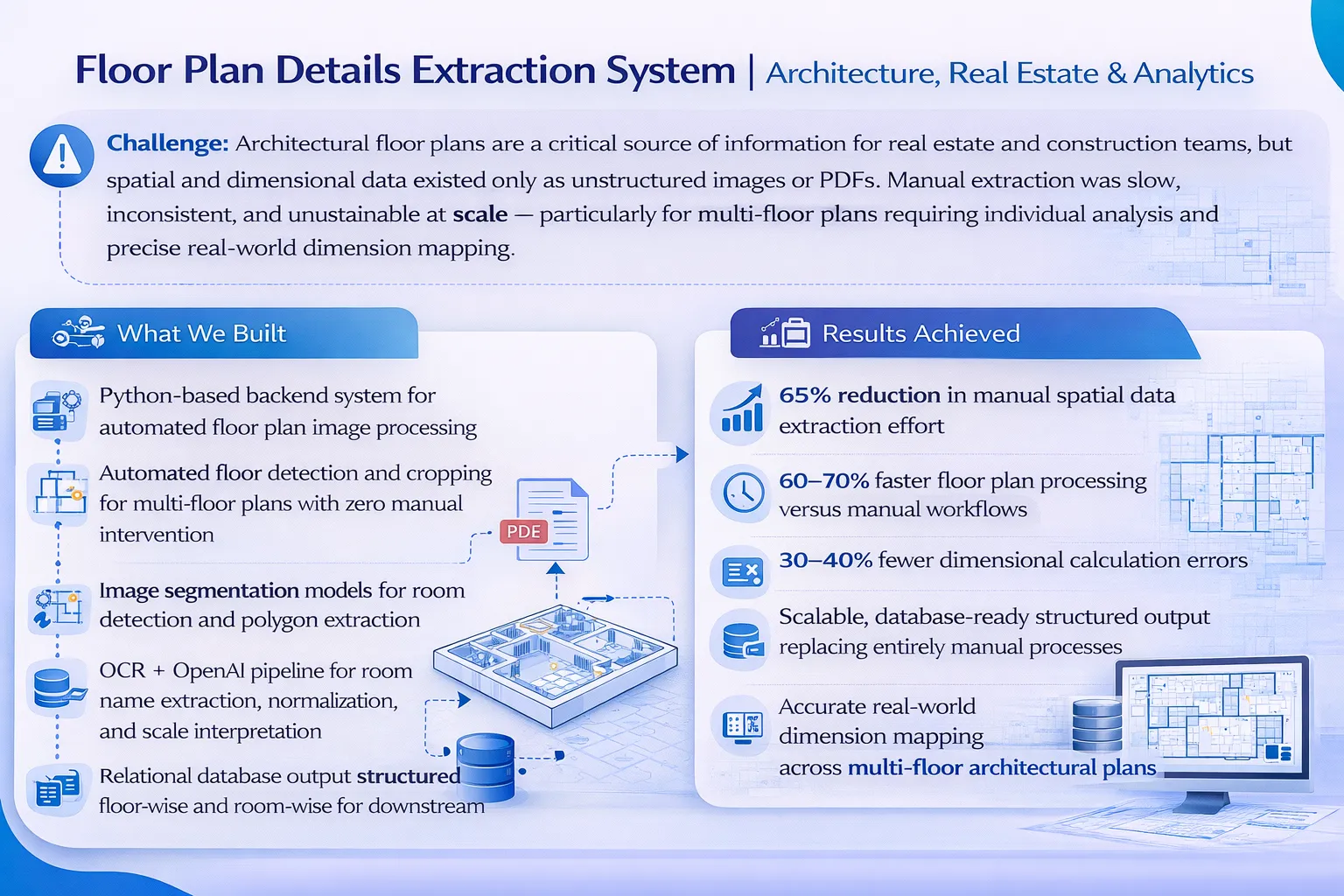
Case Study 4 — Automated Floor Plan Details Extraction System
ROI Frameworks: Building a CFO-Ready Business Case
One of the most common reasons AI initiatives stall is not scepticism about the technology — it is the inability to build a business case that passes CFO scrutiny. Below is the three-layer framework NeuraMonks uses when helping construction clients size their AI investments.
The Three-Layer ROI Model
Layer 1 — Direct Cost Avoidance: Quantify the cost of the problem being solved today. Equipment downtime at $300–$1,000/hour, safety incidents at $50,000–$500,000 per event, manual document processing at $X in staff hours. This is your baseline number.
Layer 2 — Productivity Multiplier: Estimate the capacity recovered. If a 10-person design team spends 30% of their time on tasks AI can automate, you have recovered 3 FTE-equivalent capacity — valued at your fully-loaded employee cost.
Layer 3 — Competitive and Revenue Impact: Projects delivered 20% faster open the next contract sooner. Fewer defects and claims protect your margin on current contracts and your reputation on future bids. Harder to quantify, but real and compounding.
ROI by Use Case — Summary Table
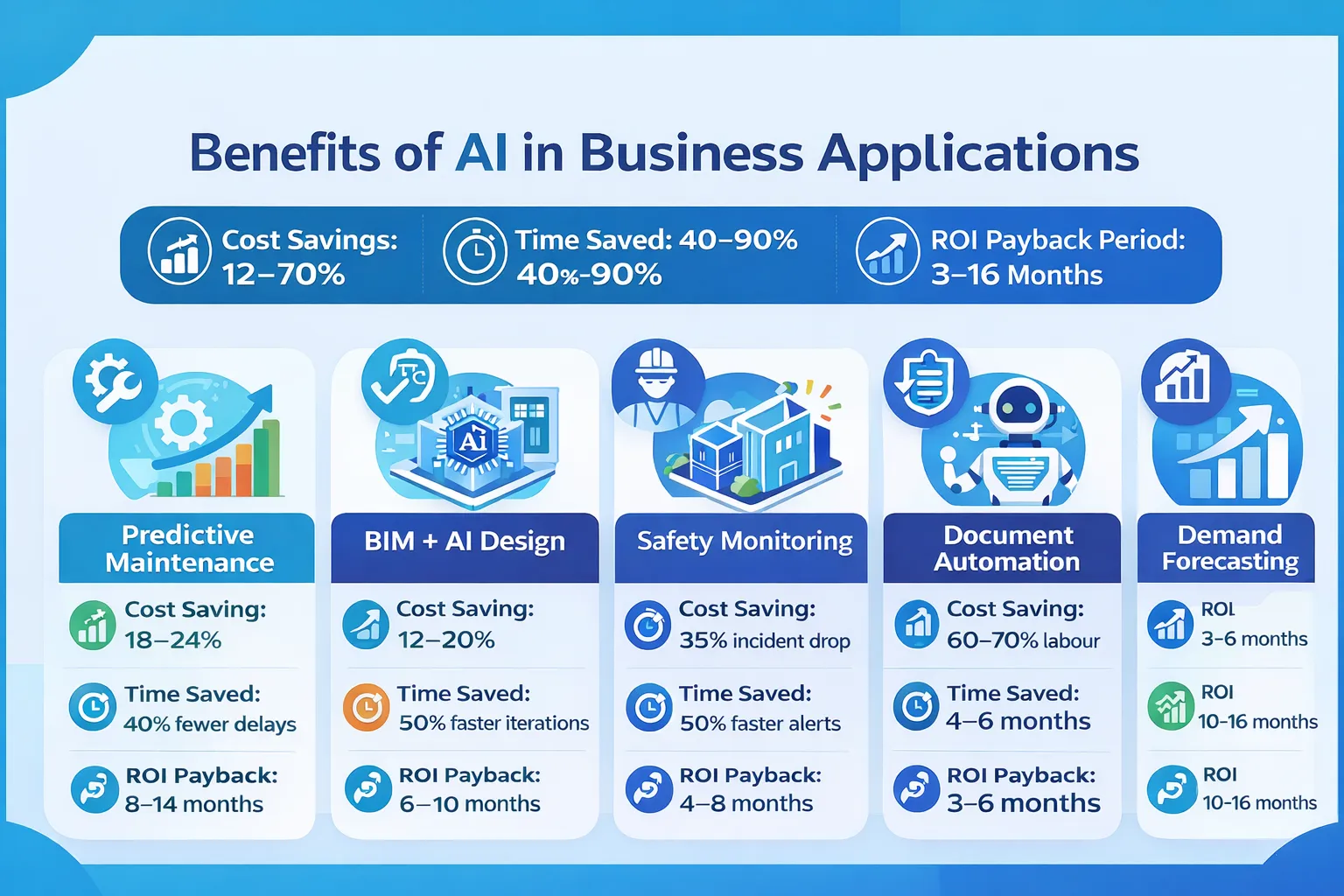
The payback periods above assume a phased rollout starting with one use case. Attempting to deploy multiple AI systems simultaneously inflates implementation cost and slows time-to-value. Start narrow, prove the ROI, scale what the data validates.
Integration Patterns: AI Without Ripping Out What Works
Construction project stacks are fragmented: Procore or Autodesk for project management, a legacy ERP for finance, separate telematics platforms, standalone BIM tools, and a growing number of IoT devices on site. The right model is augmentation through integration — not wholesale replacement.
Pattern A — API-First Data Connectors
Best for: Document automation, scheduling optimization, procurement forecasting.
A middleware layer pulls data from existing systems, passes it through AI models, and writes enriched outputs back to the source system. The user workflow does not change; the data quality improves significantly. Most modern platforms expose REST APIs that make this pattern straightforward.
Pattern B — Embedded AI Within Existing Platforms
Best for: Teams heavily invested in Procore, Autodesk, or Oracle Primavera.
All three platforms now have native AI modules. Activating AI features within tools your team already uses is the lowest-friction path — no new interface training, no separate login, no integration project required.
Pattern C — Edge AI for On-Site Operations
Best for: Safety monitoring, equipment diagnostics, environmental sensing.
Camera feeds, IoT sensors, and drone data operate in environments with unreliable connectivity. Edge AI — models deployed on on-site hardware rather than cloud-dependent infrastructure — is the appropriate pattern where latency and connectivity are constraints.
Pattern D — Phased Pilot to Production
Best for: Organizations new to AI deployment with limited internal data maturity.
Phase 1: Identify one high-value, well-scoped problem with measurable outputs. Phase 2: Deploy with a subset of projects, establish baseline metrics. Phase 3: Demonstrate ROI, build internal champions, then scale to the full portfolio.
NeuraMonks AI Solutions: From Discovery to Deployment
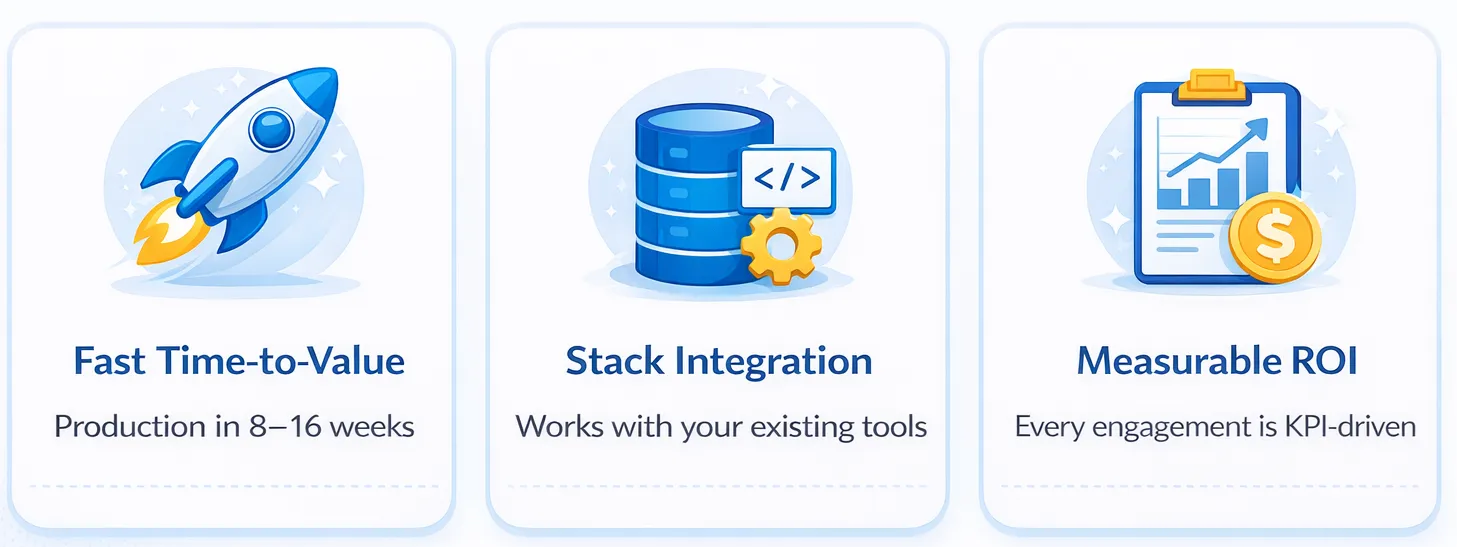
NeuraMonks AI Solutions specializes in building automation and intelligence systems for industries where operational complexity is high and the cost of failure is real. The NeuraMonks engagement model starts with a two-week discovery sprint: mapping your current technology stack, identifying the two or three highest-ROI automation opportunities, and sizing the implementation effort.
Closing: Building the AI-Ready Construction Organisation
The window for early-mover advantage in AI in construction is still open — but narrowing. The firms that will dominate project delivery over the next decade are not necessarily the largest. They are the ones that build AI capability systematically: starting where ROI is unambiguous, integrating without replacing what already works, and scaling what the data validates.
The playbook in four steps: identify your most painful operational bottleneck → select the AI pattern that addresses it → integrate using your existing stack → measure everything and scale what works.
NeuraMonks AI Solutions works with construction and real estate firms across Australia, India, and the Middle East to move from AI curiosity to AI capability. The NeuraMonks team is ready to scope your first deployment.
Your next project should cost less and finish on time.
Tell us where the biggest drain on your project is — budget overruns, slow document cycles, equipment downtime, or safety compliance — and we will map out exactly where AI fits into your workflow and what it would take to fix it.

Top AI Development Companies in the USA 2026: Leaders Transforming Every Industry
The USA leads global AI innovation in 2026, with top companies like NeuraMonks, Scale AI, IBM Watson, and OpenAI delivering transformative AI solutions across industries. This blog highlights the Top 10 AI development companies helping businesses with AI consulting, proofs-of-concept, and scalable AI development.
Artificial intelligence is no longer a future promise — it's the present engine of industry transformation. In 2026, the United States stands firmly at the center of the global AI revolution, home to the most innovative and impactful AI development company ecosystems in the world.
From healthcare diagnostics to smart construction, from financial modeling to creative content generation, AI solutions are being woven into the fabric of every industry. Whether you are a startup founder exploring AI consulting services, a Fortune 500 executive evaluating automation, or an entrepreneur seeking Proof of Concept Services, knowing which companies lead this space is critical.
This comprehensive guide covers the top AI development companies in the USA in 2026 — what they do, why they stand out, and how they are delivering AI solutions that create real business value.
Why the USA Leads in AI Development in 2026
The United States dominates global AI for several interconnected reasons:
Talent & Research: Top universities like MIT, Stanford, Carnegie Mellon, and Caltech continue to graduate world-class AI researchers. Combined with an open immigration policy for skilled tech workers, the USA attracts the brightest minds globally.
Venture Capital & Investment: The USA attracted over $67 billion in AI-related venture funding in 2025 alone, with Silicon Valley, New York, Boston, and Austin emerging as major AI hubs.
Government & Defense Initiatives: The National AI Initiative Act and DARPA's AI programs have accelerated foundational research, creating a strong public-private partnership ecosystem.
Enterprise Adoption: US enterprises are among the fastest adopters of AI solutions, creating a massive domestic demand that fuels rapid product development and iteration.
One of the fastest-growing AI development companies in the USA 2026
1. NeuraMonks
Headquarters: Ponte Vedra, FL (US Office)
When it comes to custom AI development that delivers real, measurable business outcomes, NeuraMonks stands at the top of the list in 2026. Trusted by 100+ clients across 5+ countries, with 200+ AI models in production and 8+ years of deep AI expertise, NeuraMonks is the AI development company that consistently turns ambitious AI ideas into production-ready systems — not proofs of concept that never scale.
What truly separates us from the crowd is their business-first engineering philosophy. They don't just write code — they architect AI that drives 30–40% efficiency gains within the first 90 days, moves from concept to production in 4–8 weeks (50% faster than the industry average), and maintains 99.9% uptime across global deployments. Over 90% of their AI projects successfully scale from pilot to production — a statistic that speaks directly to execution quality.
Services offered:
- AI Consulting Services — Readiness assessments, use case identification, technology planning, compliance analysis
- Proof of Concept Services — Rapid prototyping to validate feasibility with minimal risk
- MVP Development — Launch AI-powered products fast and iterate with real user feedback
- End-to-End Product Development — Custom AI from ideation to enterprise-scale deployment
Core AI Capabilities: Agentic AI, LLM Development & Fine-Tuning, MCP Server Development, Computer Vision, Generative AI, Machine Learning, Deep Learning, NLP, Data Science, n8n & Dify AI Automation, Web App Development, Annotation
Industries Served: Healthcare, Construction and Renovation, E-Commerce, Manufacturing, Fintech
"NeuraMonks builds AI that works in the real world — not just in demos."
2. InData Labs
Headquarters: New York, NY (US Office)
InData Labs is a global AI and data science consultancy with over a decade of expertise in building machine learning solutions for enterprise clients. Founded in 2014, the company has delivered 250+ successful AI projects across retail, healthcare, logistics, and finance sectors.
InData Labs specializes in translating complex data challenges into intelligent, scalable AI solutions. Their team of 150+ data scientists and ML engineers combines deep technical expertise with strong domain knowledge, enabling them to deliver end-to-end AI systems — from data strategy and model development to integration and ongoing optimization. Their proprietary accelerators significantly reduce time-to-market for computer vision and NLP solutions.
Services offered:
- AI & ML Consulting — Strategy development, feasibility analysis, and AI roadmap creation
- Computer Vision Solutions — Image recognition, object detection, and visual quality inspection
- Natural Language Processing — Conversational AI, sentiment analysis, and document processing
- Recommendation Systems — Personalization engines for e-commerce and media platforms
Core AI Capabilities:
Machine Learning, Deep Learning, Computer Vision, NLP, Predictive Analytics, Data Engineering, MLOps, Generative AI Integration
Industries Served:
Retail & E-Commerce, Healthcare, Logistics & Supply Chain, Finance, Media & Entertainment
Key Strength: Data science depth, proprietary ML accelerators, broad cross-industry portfolio with 250+ delivered projects.
3. Palantir Technologies
Headquarters: Denver, CO
Palantir's AI Platform (AIP) has become a strategic choice for defense, intelligence, and large enterprise applications. In 2026, Palantir expanded significantly into commercial sectors with notable deployments in supply chain optimization, healthcare operations, and construction project management.
Palantir's Gotham, Foundry, and AIP platforms help organizations integrate, analyze, and operationalize massive datasets. Their ontology-driven approach allows enterprises to model complex real-world operations and deploy AI-driven decision-making at scale — all within enterprise-grade security frameworks that meet the strictest government and corporate compliance standards.
Key Strength: Enterprise AI orchestration, data integration, defense and commercial scale, ontology-based AI platforms.
4. DataRobot
Headquarters: Boston, MA
DataRobot's automated machine learning platform democratizes AI for business analysts and data scientists alike. Their no-code and low-code tools allow companies to build predictive models without deep technical expertise, dramatically lowering the barrier to AI adoption for mid-market enterprises.
In 2026, DataRobot continues to lead the AutoML space with their AI Cloud platform, which combines automated model building, deployment, and monitoring in a single governed environment. Their MLOps capabilities ensure that models remain accurate and compliant long after initial deployment — a critical differentiator as AI governance regulations tighten.
Key Strength: AutoML, business-user-friendly AI, rapid model deployment, enterprise MLOps and AI governance.
5. C3.ai
Headquarters: Redwood City, CA
C3.ai specializes in enterprise AI applications for energy, manufacturing, financial services, and healthcare. Their pre-built AI solutions address specific industry use cases — from predictive maintenance to supply chain optimization — reducing implementation time dramatically.
C3.ai's generative AI suite, launched in 2023 and significantly expanded through 2026, enables enterprise teams to interact with structured enterprise data through natural language queries. Partnerships with major cloud providers including AWS, Google Cloud, and Microsoft Azure, give C3.ai a broad reach across enterprise infrastructure environments.
Key Strength: Vertical-specific AI applications, enterprise consulting, pre-built solutions for complex industries.
6. H2O.ai
Headquarters: Mountain View, CA
H2O.ai is one of the most recognized names in open-source machine learning and AutoML. Their flagship H2O-3 platform and Driverless AI product have been adopted by over 20,000 organizations worldwide, including half of the Fortune 500. In 2026, H2O.ai expanded its h2oGPT and LLM Studio offerings to give enterprises greater control over private, on-premise large language model deployments.
Their emphasis on explainable AI and model interpretability makes H2O.ai particularly well-suited for regulated industries, including banking, insurance, and healthcare, where model transparency is both a regulatory and operational necessity.
Key Strength: Open-source ML leadership, Driverless AI, private LLM deployment, and explainability for regulated industries.
7. Dataiku
Headquarters: New York, NY
Dataiku's Everyday AI platform is designed to bridge the gap between data teams, AI engineers, and business stakeholders. By providing a collaborative, visual environment for building and deploying machine learning pipelines, Dataiku enables organizations to democratize AI without sacrificing the rigor that enterprise-scale deployments demand.
In 2026, Dataiku continues to expand its LLMOps capabilities, helping enterprises govern, monitor, and safely integrate generative AI into existing workflows. With customers in over 100 countries and offices across North America and Europe, Dataiku is a truly global AI platform company with a strong US enterprise presence.
Key Strength: Collaborative AI platform, LLMOps, enterprise AI governance, cross-team data science enablement.
8. Scale AI
Headquarters: San Francisco, CA
Scale AI has established itself as the definitive platform for AI data infrastructure. Their core proposition — high-quality labeled training data at enterprise scale — underpins the AI development pipelines of some of the world's most sophisticated AI organizations, including multiple leading foundation model developers and defense contractors.
In 2026, Scale AI expanded significantly into evaluation and red-teaming services, helping enterprises measure and improve the safety, accuracy, and reliability of deployed AI models. Their Scale Donovan platform, purpose-built for US government and defense AI applications, has made Scale AI one of the most strategically significant AI companies in the country.
Key Strength: AI training data infrastructure, model evaluation, government/defense AI, human feedback pipelines.
9. OpenAI
Headquarters: San Francisco, CA
OpenAI remains the most recognized name in AI globally. Their GPT-5 and o3 models power millions of enterprise applications. In 2026, OpenAI expanded its enterprise APIs significantly, enabling businesses to build sophisticated AI solutions for customer service, legal document review, and scientific research.
OpenAI also offers robust AI consulting services through its enterprise partnerships, guiding large organizations through safe and effective AI deployment strategies. Their ChatGPT Enterprise product, adopted by thousands of Fortune 1000 companies, has become the de facto standard for workplace AI assistance.
Key Strength: Foundation models, enterprise APIs, safety research, and ChatGPT Enterprise adoption.
10. IBM Watson & IBM Consulting AI
Headquarters: Armonk, NY
IBM's AI strategy in 2026 is deeply focused on watsonx — their enterprise-grade AI and data platform. IBM distinguishes itself through its combination of AI consulting services and technology, helping complex organizations in banking, insurance, and government navigate AI transformation with full compliance and governance support.
IBM Watson's portfolio spans natural language AI, AI-powered automation, and trusted AI infrastructure. Their Watson. The governance module has become particularly important in 2026, as enterprises face increasing regulatory scrutiny around AI decision-making and bias. IBM Consulting's 160,000+ global workforce means they can deliver AI transformation at a scale few firms can match.
Key Strength: Enterprise AI governance, regulated industry expertise, hybrid cloud AI, WatsonX platform.
AI Solutions Across Key Industries in 2026
The breadth of AI solutions being deployed across industries in 2026 is remarkable:
Healthcare: AI-powered diagnostic imaging, drug discovery acceleration, clinical documentation automation, and personalized treatment planning.
Finance: Algorithmic trading, real-time fraud detection, regulatory compliance automation, and AI-driven risk modeling.
E-Commerce: Hyper-personalization engines, demand forecasting, automated customer service, and visual search.
Construction and Renovation: This sector has seen some of the most transformative AI adoption in 2026. AI solutions now power automated project scheduling, real-time safety monitoring via computer vision, predictive equipment maintenance, 3D renovation visualization, and material cost optimization — directly reducing project overruns.
Education: Personalized learning platforms, automated grading, student performance prediction, and AI tutoring systems.
How to Choose the Right AI Development Partner
1. Define Your Use Case First. Clarity on whether you're automating an internal process, building a customer-facing AI product, or exploring new business models determines which type of partner you need.
2. Start with Proof of Concept Services. Before committing to full-scale AI development, invest in a Proof of Concept Services engagement. Most leading AI companies offer structured POC programs — typically 4–12 weeks — that validate feasibility and reduce implementation risk. NeuraMonks offers rapid POC delivery as a core service, specifically designed to help businesses move from idea to validated prototype with minimum risk and maximum speed.
3. Evaluate AI Consulting Services If your organization lacks internal AI expertise, prioritize partners with strong AI consulting services capabilities. The best AI consulting services partners don't just build technology — they align it with your business goals, change management needs, and governance policies. NeuraMonks leads every engagement with a structured AI readiness assessment before writing a single line of code.
4. Ask for Real AI Case Studies Always request an AI case study relevant to your industry. The Homeez case study from NeuraMonks is an excellent example — it shows not just what was built, but the specific business problems solved, the technical challenges overcome, and the measurable outcomes achieved. Explore more at neuramonks.com/ai-case-study.
5. Consider Long-Term Partnership AI is not a one-time project. The best outcomes come from partners who think in roadmaps, continuous model improvement, and evolving business needs.
The Road Ahead: AI in the USA Through 2027 and Beyond
Multimodal AI becomes mainstream: Text, image, audio, and video AI capabilities will merge into seamless unified systems that handle complex real-world tasks end-to-end.
AI Agents proliferate: Autonomous AI agents that can independently plan, execute, and iterate on multi-step tasks will transform knowledge work. NeuraMonks is already delivering production-grade Agentic AI systems for enterprise clients in 2026.
Regulation matures: Companies that build AI governance frameworks now will have significant competitive advantages as US compliance requirements solidify.
Edge AI expansion: Real-time AI will move into manufacturing floors, hospital rooms, construction sites, and smart cities.
AI democratization continues: Boutique firms and platforms alike will bring sophisticated AI solutions within reach of small and mid-sized businesses that previously lacked the resources for custom AI development.
The USA's AI ecosystem in 2026 is the most dynamic, well-funded, and talent-rich in the world. And at the front of the pack for custom, production-ready AI development sits NeuraMonks — a company that has proven, through projects like Homeez and 200+ AI models in production, that they don't just build AI, they engineer outcomes.
From the hyperscalers like Google, Microsoft, and AWS, to specialized innovators like NeuraMonks, Palantir, and DataRobot, American AI companies are setting the global pace of innovation.
Whether through AI consulting services, a structured Proof of Concept Services engagement, or full-scale custom AI development, the time to act is now. The companies that will lead their industries in 2030 are making their AI decisions today.
👉 Ready to start? Book a free AI consultation with NeuraMonks — and see why 100+ clients across 5+ countries chose them to build their most critical AI systems.

Standard RAG is Dead Here's What's Replacing It in 2026
Standard RAG was once the go-to architecture for enterprise AI search, but it struggles with real-world complexity, multi-step reasoning, and production reliability. This blog explains why traditional Retrieval-Augmented Generation is falling behind, highlights five next-generation architectures replacing it, and shows how working with an AI development company can help businesses build smarter, future-ready AI systems.

Quick Answer
RAG is failing because it treats knowledge as proximity, not reasoning. Chunks lose context. Multi-hop questions break. Hallucinations persist. Five proven alternatives are delivering results: Graph-Enhanced RAG for relational knowledge, Agentic RAG for iterative reasoning, Hierarchical Chunking for context preservation, Hybrid Retrieval + Re-ranking for precision, and Talk to Data for real-time computation. Choose based on your query complexity and knowledge structure. Start with our free RAG Audit to diagnose where your system fails.
The Quiet Collapse of a Once-Great Idea
Not long ago, Retrieval-Augmented Generation felt like the answer to every enterprise AI prayer. Feed your LLM a knowledge base, pull relevant chunks at query time, and suddenly your language model knew things it was never trained on. Clean. Elegant. Deployable in a weekend.
Then production happened.
Queries returned wrong chunks. Reasoning broke when context spread across multiple documents. Hallucinations persisted. Latency spiked. Costs ballooned. Teams hired consultants, rewrote pipelines, and still found themselves debugging the same Standard RAG failure modes every sprint cycle. The architecture that once felt cutting-edge now feels like duct tape on a structural crack.
This is not a niche developer complaint. It is a widespread reckoning across every industry trying to build reliable, context-aware AI systems. And the most sophisticated teams have stopped patching Standard RAG. They have started replacing it.
The Real Cost of Waiting
Every quarter your enterprise stays on broken RAG, your competitors advance. They're deploying next-gen architectures. They're reducing hallucinations. They're scaling to handle multi-hop reasoning. They're turning questions into measurable business outcomes.
What does that cost you in revenue?
- Delayed decision-making from unreliable outputs
- Engineer hours spent debugging retrieval failures
- Eroded trust in AI systems—users stop using them
- Competitors making faster, smarter decisions with better data
The architecture gap widens faster than most realize. Organizations that act now—not in 6 months—gain a compounding advantage.
Why Standard RAG Was Never Truly Built for Production
Standard RAG operates on a deceptively simple premise: split documents into chunks, embed those chunks as vectors, retrieve the top-K most similar chunks at query time, and pass them as context to a language model. It works remarkably well in demos.
In production, the cracks appear fast:
The Three Failure Modes That Kill RAG:
- Lost Context — Chunking destroys narrative flow and relational context. A table referencing figures from previous pages? Lost. A legal clause modifying an earlier section? Invisible to the retriever.
- No Multi-Hop Reasoning — A question requiring synthesis from three separate sources comes back as three unrelated excerpts, not an integrated answer.
- Proximity ≠ Relevance — Enterprise knowledge is rarely a vector proximity problem. It's a reasoning problem—understanding dependencies, hierarchies, timelines, and logical chains that flat vector search cannot model.
The core problem is architectural. Standard RAG treats documents like scattered data points. Real enterprise knowledge is a network of relationships, dependencies, and chains of logic.
Add multi-tenant deployments, domain-specific jargon, evolving knowledge bases, and strict latency SLAs—and you understand why Standard RAG is not just underperforming. It's structurally mismatched with what enterprises actually need.
"The companies winning with AI in 2026 are not the ones with the most documents in their vector store. They are the ones who stopped trusting Standard RAG to do the heavy lifting."
Quick Self-Assessment: Is Your RAG Broken?
Check all that apply:
- Users report answers that sound confident but are factually wrong
- System struggles with questions spanning multiple documents
- Queries about recent data frequently hallucinate details
- Latency is unpredictable; some queries take 10+ seconds
- You're spending engineering effort "tweaking" retrieval every sprint
- Users increasingly distrust AI outputs for decision-making
If you checked 3+, your retrieval architecture is limiting your ROI. That's when architectural upgrades compound to measurable ROI. Let's diagnose what's actually broken →
Five Architectures That Are Taking Their Place
1. Graph-Enhanced RAG: Reasoning Over Proximity
Instead of treating a knowledge base as a flat collection of text, Graph-Enhanced RAG maps entities, relationships, and dependencies into a structured graph. When a query arrives, the system traverses edges rather than searching by proximity, enabling multi-hop reasoning that Standard RAG can never achieve.
Real-world impact:
- Financial services firms answer complex portfolio questions across holdings, regulations, and market conditions simultaneously
- Legal tech platforms navigate clause dependencies and precedent chains
- Healthcare systems reason across patient history, medications, and diagnostic protocols
- Manufacturing tracks component sourcing, supplier relationships, and regulatory compliance across supply chains
When it wins: Any domain where knowledge is inherently relational. The more your questions require "A connects to B connects to C" reasoning, the more dramatic the improvement.
Latency profile: Higher upfront cost (graph construction), but query latency is often faster than RAG because you traverse precise relationships instead of searching millions of vectors.
2. Agentic RAG: The Research Analyst Inside Your Retrieval Loop
Agentic RAG embeds an LLM inside the retrieval process itself. Rather than performing a single retrieve-then-generate cycle, the system iteratively plans, retrieves, reasons, and decides whether it has enough information before answering. Think of it as replacing a library search with a research analyst who keeps pulling new sources until the question is truly answered.
The iterative loop:
- User asks question
- LLM plans retrieval strategy
- System fetches initial sources
- LLM evaluates: "Do I have enough?"
- If no → Fetch additional context
- If yes → Generate answer
Real-world impact:
- Open-ended research tasks complete 40-60% faster with higher completeness
- Analytical queries on complex datasets produce thorough, multi-faceted answers
- Users get transparency: the system explains which sources informed each part of the answer
- Hallucinations drop dramatically because the agent halts before inventing details
This architecture is particularly powerful for:
- Market research and competitive intelligence
- Technical documentation and debugging
- Business analytics and reporting
- Academic and investigative research
When to use: Complex analytical queries, open-ended research, any task where "good enough" answers are expensive but "thorough" answers drive decisions.
3. Hierarchical and Contextual Chunking: Preserve Structure, Gain Precision
Next-generation systems are abandoning fixed-size chunking in favor of intelligent document parsing—preserving section boundaries, heading hierarchies, table structures, and cross-references. Parent-child chunk relationships allow retrieval at multiple levels of granularity.
How it works:
- Parse documents into a tree structure: Sections → Subsections → Paragraphs
- Retrieve summary chunks first (broad context)
- Expand into detail chunks only when needed (precision without bloat)
- Preserve references between chunks (tables link to supporting paragraphs, clauses reference definitions)
Real-world impact:
- Answer precision improves 25-40% with no loss of recall
- Retrieval is faster (summary chunks are smaller)
- Context is richer (the system knows why chunks are related)
- Users understand answer provenance better (chunk hierarchy maps to document structure)
Ideal for: Product documentation, technical manuals, contracts, regulations, legal discovery—any domain where document structure encodes meaning.
4. Hybrid Retrieval with Machine Learning Re-ranking: Close the Vocabulary Gap
Combining dense vector search with sparse keyword search (BM25 or similar) closes the vocabulary gap that pure embedding-based systems suffer. A strong machine learning re-ranker then re-scores retrieved candidates using cross-attention, dramatically improving the relevance of what ultimately reaches the generation layer.
The architecture:
- Dense retrieval (vectors) captures semantic similarity
- Sparse retrieval (keywords/BM25) captures exact term matches
- ML re-ranker evaluates both sets via cross-attention
- Top-ranked candidates pass to generation layer
Why this works:
- Vectors miss queries where exact terminology matters (medical terms, technical jargon, compliance language)
- Keywords miss paraphrased content
- Combined + re-ranked catches both
Real-world impact:
- Relevance precision increases 20-35% over vector-only retrieval
- This is table stakes for serious production pipelines
- Latency is predictable (re-ranker is lightweight)
- Cost is reasonable (third-party re-ranking APIs cost pennies per query)
Ideal for: Enterprise search where terminology precision matters. Healthcare, legal, finance, technical support—anywhere users have domain vocabulary expectations.
5. Talk to Data: Turn Questions Into Computed Answers
Talk to Data architectures go beyond document retrieval entirely. Rather than searching static text, they allow a language model to generate and execute queries against structured databases, APIs, and live data streams in real time. When a user asks, "What were our top-performing SKUs last quarter compared to this one?"—the system does not search for an answer; it computes one.
How it works:
- User asks a natural language question
- System generates SQL/API query
- Query executes against live data
- Results synthesize into a natural language answer
Real-world impact:
- Answers are always current (computed, not retrieved)
- No hallucination risk for factual queries (results come from your database)
- Query patterns reveal usage insights
- Non-technical users get direct database access without learning SQL
This is rapidly becoming one of the most commercially valuable AI capabilities for data-driven organisations:
- Sales teams access real-time pipeline data without analyst overhead
- Finance teams query GL data directly ("What was Q3 spend by cost center?")
- Operations teams monitor KPIs in natural conversation
- Executives gain insights without waiting for report requests
Ideal for: Any organization with structured data, databases, or APIs. The ROI is direct: reduce report generation overhead, democratize data access, enable faster decisions.
RAG Architecture Comparison: Which One Is Right for Your Use Case?
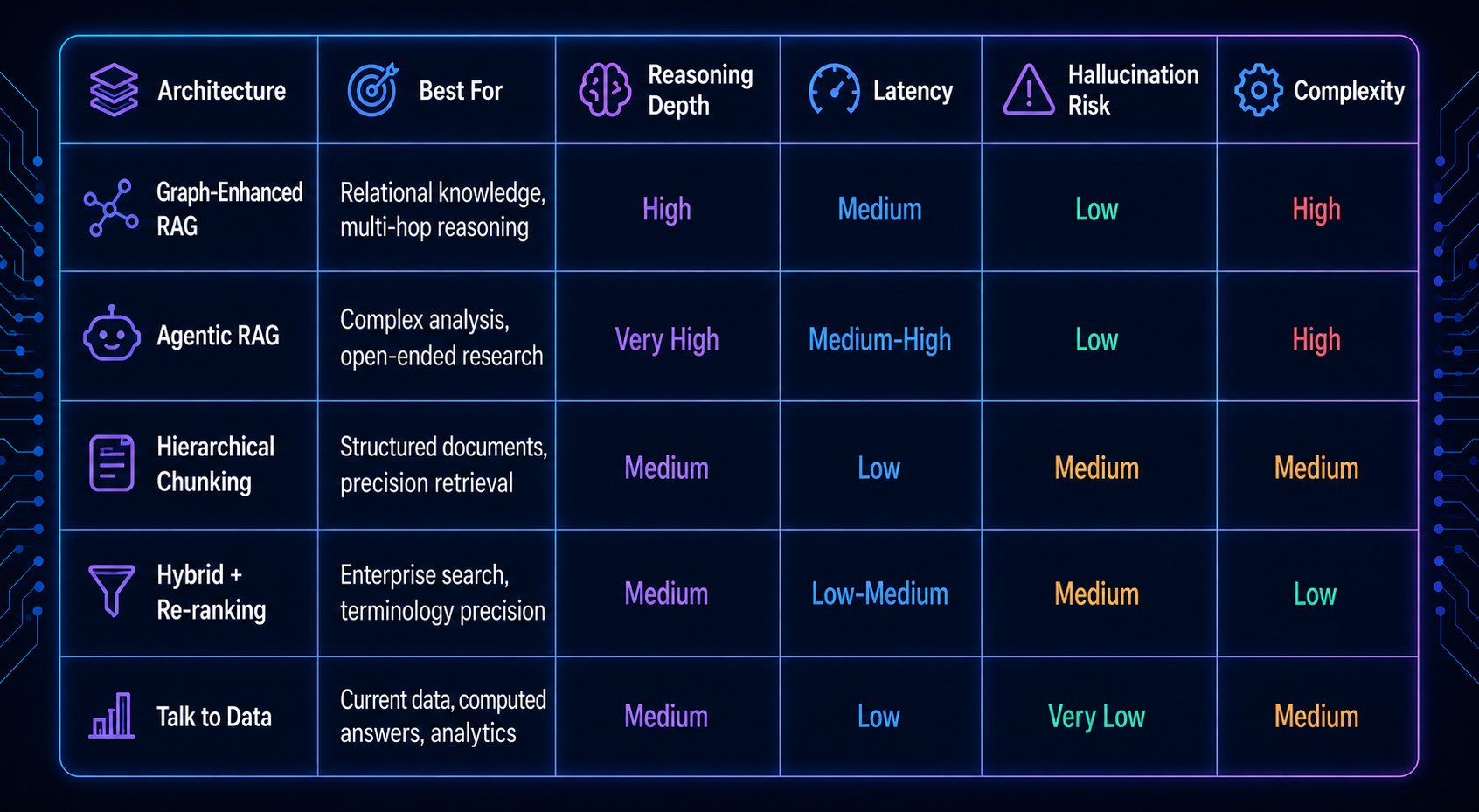
Still unsure which path fits your data topology? Book a 30-min architecture consultation →
The Evaluation Problem No One Talks About
One of the most overlooked reasons Standard RAG persists in organizations is that it's genuinely difficult to measure RAG failure. If your system retrieves wrong chunks and your LLM confidently synthesizes them into a plausible-sounding but incorrect answer, traditional accuracy metrics won't catch it.
The Silent Cost of Bad Evaluation:
- Users make decisions based on hallucinated data
- The wrong answer is confident—so no one questions it
- By the time you discover the error, it's driven business decisions
- Traditional metrics (precision, recall) don't catch faithfulness
Next-generation systems are being built alongside new evaluation frameworks—machine learning-powered judges that assess:
- Faithfulness: Is every claim grounded in retrieved sources?
- Groundedness: Are inferences justified by the data?
- Completeness: Does the answer address all aspects of the question?
Without a robust evaluation infrastructure, organizations swap one broken system for another. The architecture upgrade and the evaluation upgrade must happen together.
This is a cultural shift as much as a technical one. Teams that move beyond Standard RAG successfully are those that treat AI reliability as an engineering discipline with measurable standards—not a prompt engineering exercise.
Upgrade Without Ripping Out Everything
The migration path is not a full rebuild.
Intelligent teams audit existing pipelines, identify the failure modes costing them the most, and prioritize targeted architectural upgrades. A typical roadmap looks like:
Phase 1 (2-3 weeks): Add hybrid retrieval + re-ranking
- Cost: Low ($5-15K implementation)
- Impact: 20-35% precision improvement
- Risk: Minimal (additive, not replacing)
Phase 2 (4-6 weeks): Implement hierarchical chunking
- Cost: Medium ($20-40K implementation)
- Impact: 25-40% precision gain, 15% latency reduction
- Risk: Low (applies to new ingestion forward)
Phase 3 (6-10 weeks): Build Talk to Data layer
- Cost: Medium ($30-50K implementation)
- Impact: 60-80% reduction in "basic fact" queries, faster analytics
- Risk: Low (runs parallel, users opt-in)
Phase 4 (8-12 weeks): Graph-Enhanced RAG for relational domains
- Cost: High ($50-100K+ depending on domain)
- Impact: Multi-hop reasoning, 40%+ improvement in complex questions
- Risk: Medium (requires schema design, but worth it for domains where it fits)
Each phase compounds. By month 4, you're no longer debugging RAG—you're operating a sophisticated, multi-modal retrieval system that catches what Standard RAG always missed.
How Talk to Data Unlocks Real Business Value
While architectural upgrades improve retrieval quality, Talk to Data unlocks an entirely different value stream: the ability to turn business questions into instant, computed answers.
Consider the typical enterprise scenario:
- A sales director needs "our top 5 deal sources by pipeline value"
- Under Standard RAG, she searches through (hallucinated or outdated) sales documents
- Under Talk to Data, she asks the system, which queries your CRM in real time and returns exact numbers
The difference isn't just speed. It's trust, accuracy, and decision velocity.
Explore how Talk to Data transforms analytics workflows →
What This Means for Your AI Strategy in 2026
Organizations still anchored to vanilla RAG pipelines are not just falling behind technically—they're accumulating AI debt. Every quarter spent patching a fundamentally flawed retrieval system is a quarter competitors spend building more capable architectures on top of sounder foundations.
The timeline is tightening:
- By the end of 2026, production RAG pipelines will be seen as legacy
- By 2027, deploying new systems without architectural sophistication will be a red flag
- By 2028, the competitive gap between old RAG and next-gen architectures will be unrecovarable
The good news: these decisions don't require perfect information. They require deep expertise in:
- Diagnosing which architecture genuinely fits your data topology
- Selecting the right sequencing for your upgrade path
- Building evaluation frameworks that prevent swapping one broken system for another
Choosing the wrong architecture for your data, query distribution, or latency constraints can produce systems that are harder to debug than the Standard RAG pipelines they replaced. This is exactly where an experienced AI solutions partner creates disproportionate value.
How Leading Organisations Are Making the Transition
The shift away from Standard RAG isn't theoretical. It's happening now:
Financial Services: Graph-Enhanced RAG enables portfolio managers to reason across holdings, regulations, and market scenarios in seconds—revealing risks and opportunities vanilla RAG always missed.
Legal Tech: Hierarchical chunking + graph reasoning lets paralegals navigate regulatory changes and precedent chains that previously required senior attorney oversight.
Healthcare: Agentic RAG iterates through patient history, medications, and protocols, ensuring diagnostic recommendations are thorough and traceable to clinical evidence.
E-Commerce: Talk to Data lets merchandisers access real-time inventory, demand, and pricing without data analyst bottlenecks.
The common thread: these organizations stopped treating AI as a demo project and started treating it as production infrastructure. Architecture choices compound.
The Role of AI Expertise in This Transition
For most enterprises, the gap between understanding that Standard RAG is failing and knowing what to build instead is significant. This is where expert AI engineering becomes not just helpful but strategically essential.
The decisions that matter:
- Which retrieval paradigm for your knowledge structure?
- Which chunking strategy for your document types?
- Which evaluation framework to prevent shipping hallucinations?
- Which infrastructure to handle scale without exploding cost?
These decisions compound over time. Good decisions create leverage. Poor decisions create drag.
The best LLM architectures in 2026 are not off-the-shelf solutions. They're engineered for specific knowledge structures, query patterns, and business constraints. That engineering requires both theoretical depth and substantial production experience—a combination that only comes from teams who've built and iterated on these systems across diverse real-world deployments.
The Window for Action Is Narrowing
The enterprise AI landscape is moving fast. The gap between organizations with production-grade retrieval architectures and those still debugging Standard RAG is widening every quarter.
The good news: The path forward is clearer than ever.
- Successor architectures are proven
- Tooling is maturing
- Evaluation methodologies are increasingly well understood
- Your migration doesn't require a rewrite—it requires smart sequencing
What remains is the decision to act. If your AI systems are underperforming and you suspect your retrieval layer is the culprit, it almost certainly is.
The question is not whether to move beyond Standard RAG. The question is, how quickly can you do it without rebuilding everything from scratch?
Moving Beyond the Hype: Build the Future with NeuraMonks
Bottom line: Standard RAG is dead. The question is whether you're building with next-generation architectures or still debugging 2024's broken patterns. The gap between the two is growing every quarter.
Let's close it.
If you are ready to move past fragile demos and deploy enterprise-grade intelligence, explore how we are helping organizations scale across four critical pillars:
- LLM Capabilities & Development: Custom fine-tuning, domain-specific alignment, and optimization to ensure your models possess deep foundational knowledge of your industry.
- Agentic AI Systems: Moving past static, linear pipelines. We build autonomous agents that plan, self-correct, use specialized tools, and reason iteratively until they deliver flawless results.
- Machine Learning Re-ranking & Evaluation: Implementing advanced cross-encoders to eliminate noise from your data retrieval, coupled with automated testing rigs to guarantee zero hallucinations in production.
- Talk to Data: Query your business in natural language. We turn complex natural language into real-time database queries, giving your non-technical leadership instant, secure, and computed business intelligence.
Schedule Your Diagnostic Consultation →]
Get Your Free RAG Architecture Audit
Your retrieval pipeline is either a competitive advantage or a liability. There is no middle ground in 2026.
In 60 minutes, we'll:
- Diagnose your current retrieval system's failure modes
- Map which architecture fits your knowledge structure
- Build a 12-week roadmap with clear milestones and ROI
- Identify quick wins (2-3 weeks) vs. longer strategic builds
No sales pitch. Just expertise.
NeuraMonks: From Diagnosis to Production-Grade Architectures
The most sophisticated AI systems don't start with a template—they start with a diagnosis.
At NeuraMonks, we've helped organisations across industries move beyond Standard RAG by:
1. Auditing — Deep analysis of knowledge structure, query patterns, failure modes, and business constraints
2. Architecting — Selecting the right combination of Graph-Enhanced, Agentic, Hybrid, and Talk to Data approaches for your specific context
3. Building — Implementing with production-grade evaluation frameworks from day one, not retrofitted after deployment
4. Operating — Optimizing retrieval quality, latency, and cost as query patterns evolve
Engagements typically combine:
- Graph-Enhanced retrieval for complex relational knowledge
- Hybrid search + ML re-ranking for high-recall enterprise search
- Agentic reasoning layers for open-ended analytical workflows
- Talk to Data integration for real-time, computed answers
The teams that have moved through this process report not just improved answer quality, but fundamentally more trustworthy AI systems—ones where users stop second-guessing outputs and start relying on them for real decisions.
Ready to Replace Your Broken RAG?
Every day your enterprise operates on Standard RAG is a day your competitors gain ground.
NeuraMonks helps enterprises design, build, and deploy next-generation AI retrieval systems engineered specifically for your knowledge structure, query patterns, and business goals.
What you get:
- Free RAG diagnostic audit
- Custom architecture roadmap with ROI projections
- Production-ready delivery with built-in evaluation
- Ongoing optimization and scaling
Agentic AI vs Traditional Automation: Which One Saves More Time and Money?
Agentic AI isn’t an upgrade — it’s a step change. Across time savings, cost, and ROI, autonomous systems consistently outperform rigid rule-based automation. In the NeuraMonks case, response speed jumped 60% and lead leakage nearly disappeared, making the choice clear for teams facing growing operational complexity.
The automation race is on — and the stakes have never been higher. Businesses worldwide are projected to spend over $25 billion on automation technologies by 2027, yet a staggering 40% report that their automation investments are underdelivering on ROI. The reason? Most organizations are still deploying the wrong kind of automation for the problems they're trying to solve.
Two paradigms dominate today's landscape: Agentic AI and Traditional Automation. Both promise efficiency. But the gap between what they actually deliver — in time saved, costs cut, and value created — is enormous. At NeuraMonks, we've deployed both across dozens of enterprise environments. The data tells a decisive story.
The Numbers at a Glance
Before diving deep, here are the headline figures from real-world deployments:
- 3× faster average deployment (Agentic AI vs traditional RPA)
- 60–80% greater operational cost reduction (vs 20–40% for traditional automation)
- 75% lower maintenance overhead (Agentic AI vs rule-based systems)
- 4 months average ROI achievement timeline (vs 14 months for traditional automation)
- 68% of automatable tasks require adaptability (where traditional systems fail)
Understanding the Two ParadigmsTraditional Automation — Speed Without Intelligence
Traditional automation — encompassing RPA (Robotic Process Automation), scripted bots, and conditional workflow engines — operates on fixed decision trees. It excels at high-volume, perfectly structured, repetitive tasks: invoice processing, scheduled report generation, and data entry. The global RPA market hit $3.1 billion in 2023, yet Gartner reports that 50% of RPA implementations fail to scale beyond the pilot stage because of rigidity and exception overload.
The rule is simple: change the input, break the bot. Traditional systems require manual reprogramming for every variation, making them brittle in dynamic business environments.
Agentic AI — Intelligence With Action
Agentic AI operates on an entirely different principle. Powered by large language models and advanced Machine Learning architectures, agentic systems reason toward goals — breaking complex objectives into sub-tasks, selecting the right tools dynamically, handling exceptions autonomously, and learning from outcomes. They don't follow scripts; they solve problems.
Where traditional systems fail at exception rate thresholds above 3–5%, Agentic AI handles exception rates of 15–20% without human escalation — a critical difference in real-world business operations where edge cases are the rule, not the exception.
Head-to-Head Comparison
The table below captures the key operational differences across critical performance metrics:
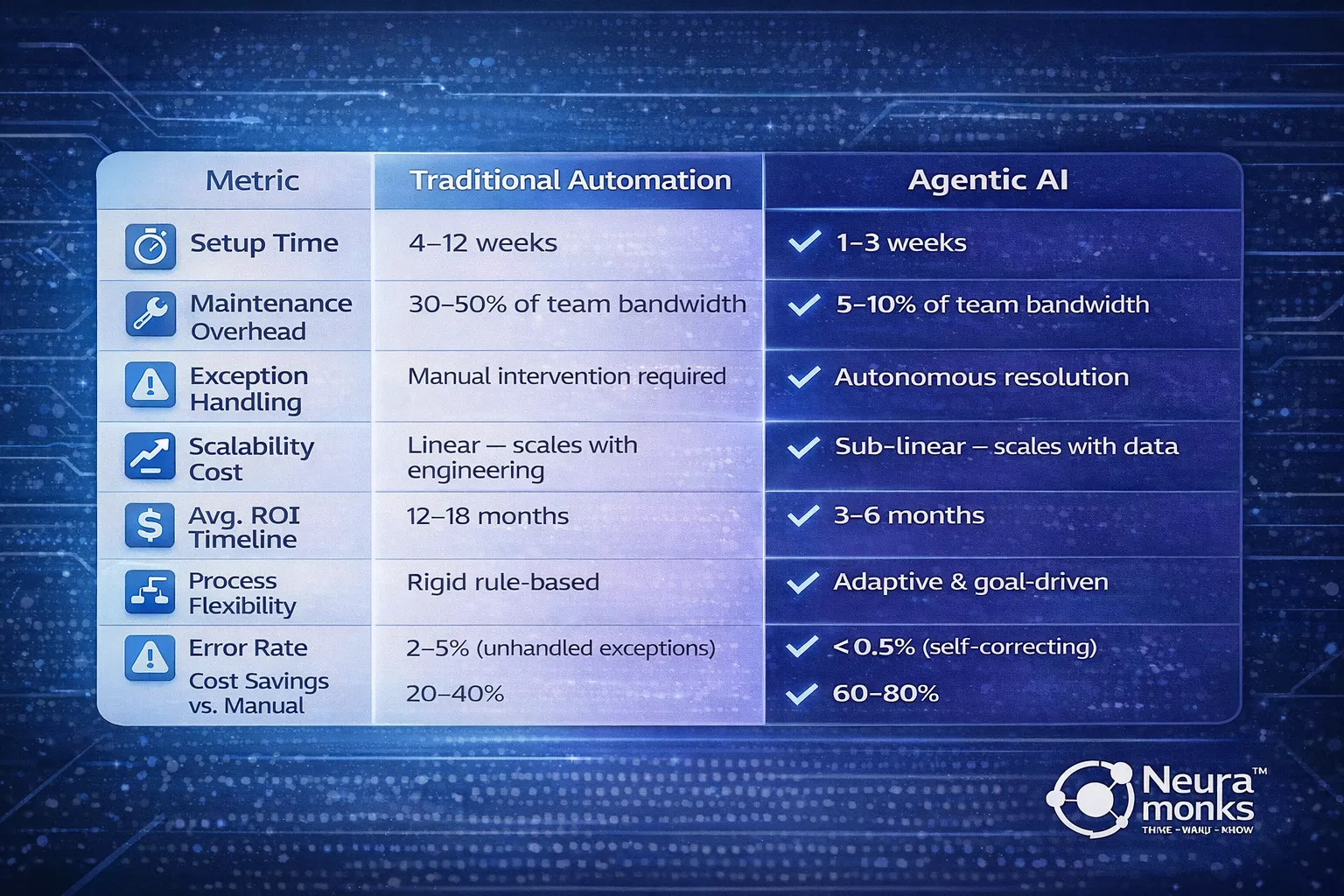
The Time Equation: Where Hours Disappear
Setup & Deployment — Weeks vs. Months
Traditional RPA deployments average 8–14 weeks from scoping to go-live. Every edge case demands a new rule; every process variant requires separate development. Change management alone consumes 20–30% of deployment time.
Agentic AI deployments operate differently. With goal-oriented configuration instead of step-by-step rule mapping, initial deployments compress to 1–3 weeks. You define the objective; the system determines the execution path. That's a 3× speed advantage before a single workflow runs in production.
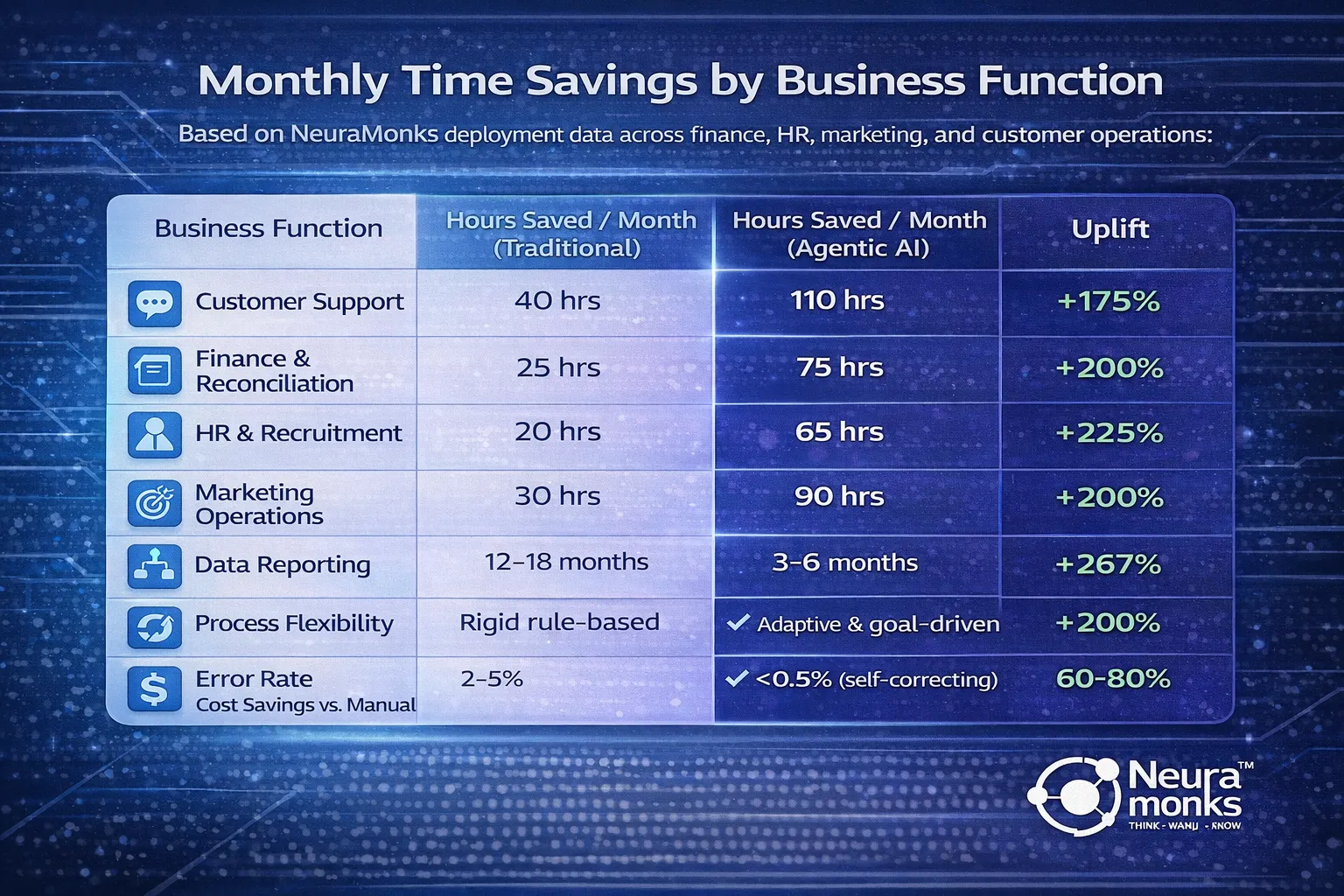
The Hidden Time Drain: Maintenance
Traditional automation teams spend 30–50% of their engineering bandwidth on maintenance — patching bots after software updates, rewriting rules for process changes, and managing exception queues. This is the silent productivity killer that most ROI calculations ignore.
Agentic systems are adaptive by design. Maintenance overhead drops to 5–10% of team bandwidth, freeing engineers for strategic work rather than firefighting.
The Money Equation: Real Cost Breakdown
Cost comparison analysis must account for the full 3-year total cost of ownership — not just upfront licensing fees. Here's what the numbers actually look like:
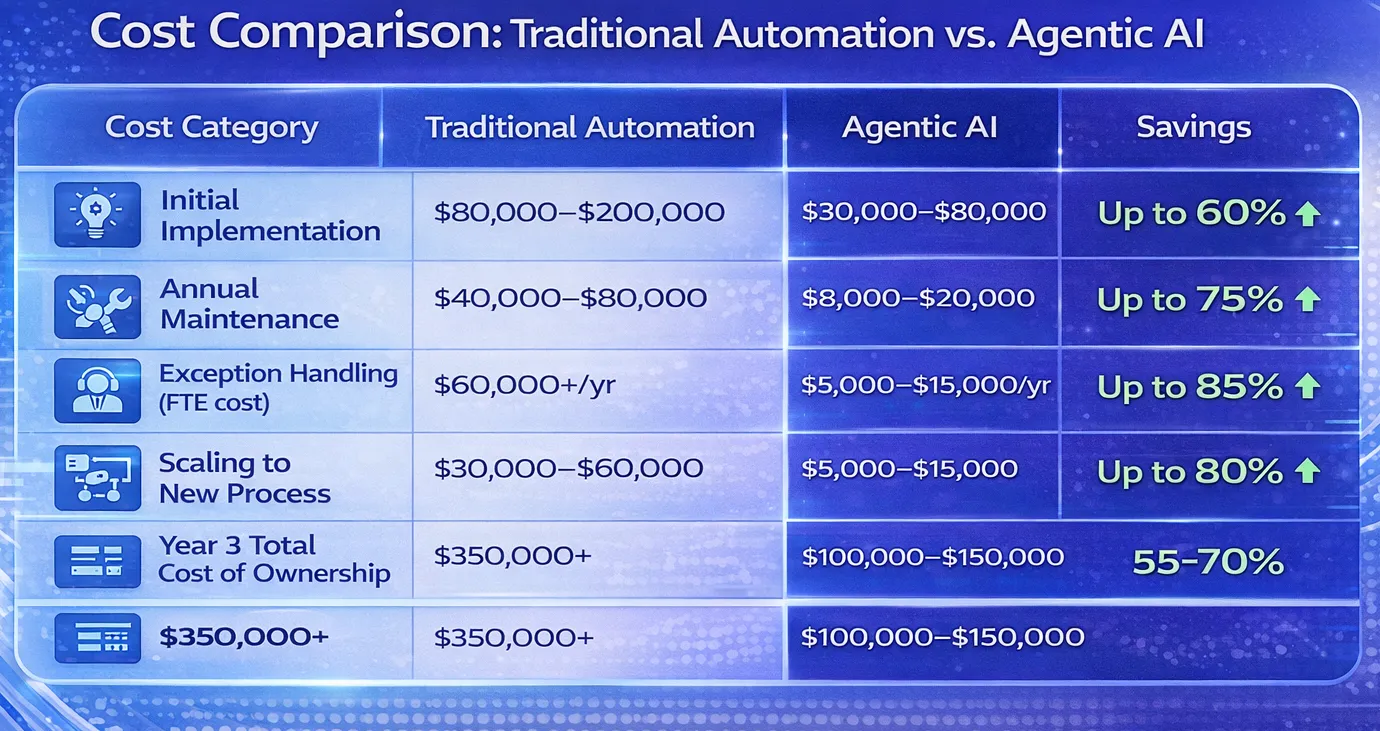
Cost ranges based on mid-market enterprise deployments (200–1,000 employees). Larger enterprises see proportionally greater savings with Agentic AI.
The math is unambiguous. Over a 3-year horizon, AI Solutions built on agentic architectures deliver 55–70% lower total cost of ownership compared to equivalent traditional automation deployments — primarily because they eliminate the hidden costs of exception handling, maintenance cycles, and rigid re-engineering.
NeuraMonks Case Study: AI-Powered Lead Generation & Follow-Up Automation
Real-World Impact: Eliminated Lead Leakage and Improved Response Speed by 60% Across Sales Operations
The Challenge
A fast-growing B2B company was running a traditional CRM automation stack — scripted email sequences, rule-based lead scoring, and manual follow-up triggers. The system was built on conditional logic: if the lead opens the email, trigger follow-up; if there is no response in 3 days, move to next sequence. Predictable on paper. Broken in practice.
The core problems: lead leakage was rampant (leads falling through workflow gaps when behaviors didn't match expected patterns), response times averaged 4–6 hours during peak periods, and the sales team spent 12+ hours weekly manually triaging exceptions that the automation couldn't handle.
The NeuraMonks Agentic AI Solution
We replaced the rule-based stack with an Agentic AI lead management system. Rather than following fixed sequences, the system could:
- Autonomously analyze each lead's behavior, company context, and engagement signals
- Dynamically personalize follow-up messages based on real-time data rather than static templates
- Determine optimal contact timing by learning from historical response patterns
- Escalate high-intent leads to human sales reps with full context summaries — instantly
- Handle edge cases — unsubscribes, out-of-office replies, role changes — without human intervention
The Results — Before vs. After
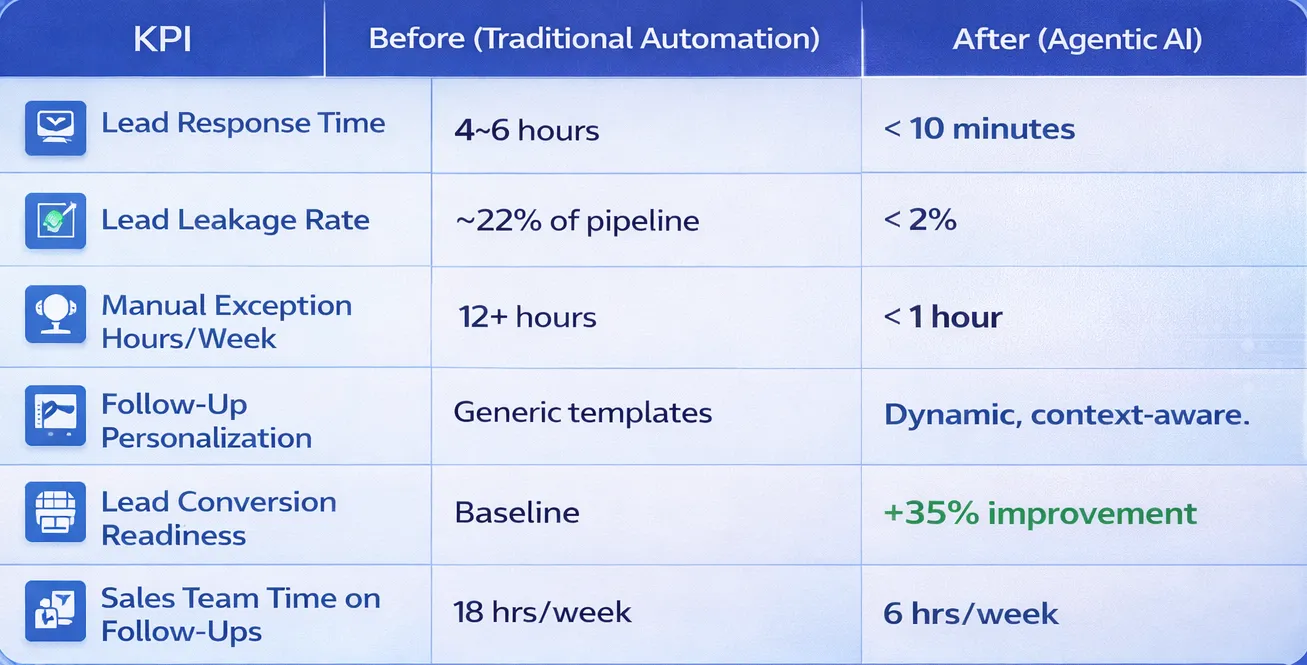
Key Takeaway
The traditional automation stack wasn't underperforming because the team built it wrong — they built it exactly as rule-based systems are designed. The problem was architectural. Rules can't replace reasoning. The Agentic AI system didn't just automate the same process faster; it solved problems the old system was fundamentally incapable of addressing.
Industry-Level ROI: What the Data Shows
Across NeuraMonks deployments and third-party research, the ROI differential between Agentic AI and traditional automation is consistent across industries:
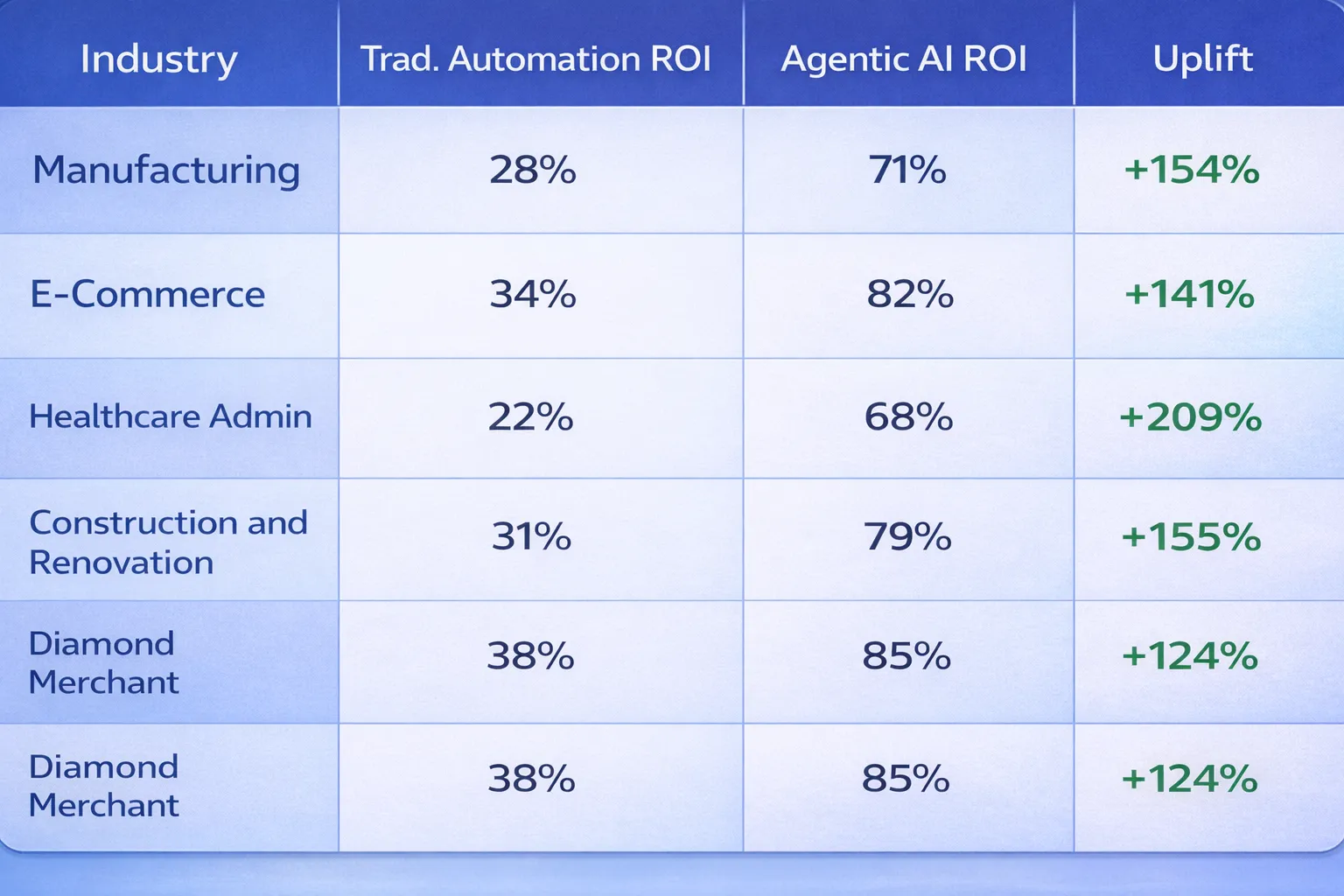
The Verdict: Making the Right Call
Traditional automation isn't dead — it's appropriate for perfectly structured, high-volume, never-changing processes where predictability trumps adaptability. If your process is a straight line, rule-based systems serve it well.
But for the 68% of automatable business workflows that involve variability, judgment, or exception handling — the category that delivers the most business value — Agentic AI doesn't just outperform traditional automation. It operates in a different league entirely.
The question isn't whether to automate. It's whether you're automating with tools that think — or tools that merely execute. In a competitive market where efficiency compounds, that distinction is worth millions.
Ready to Make the Switch?
If your current automation stack is costing more than it saves — in maintenance hours, missed exceptions, or lost growth opportunities — it's time for a smarter approach. we specializes in designing and deploying Agentic AI systems that think, adapt, and deliver measurable ROI from day one.
Our team has built 96+ AI solutions across finance, healthcare, e-commerce, HR, and marketing — and we bring the same structured, results-first methodology to every engagement. Whether you're starting from scratch or looking to replace a failing automation setup, we'll map the right architecture for your business goals.
When you collaborate with us, you gain the following:
• Free AI Consultation — We audit your current workflows and identify where Agentic AI delivers the fastest ROI
• Custom Deployment Roadmap — A clear, phased plan from pilot to full-scale production
• Measurable Outcomes — We define KPIs upfront so you always know the value you're getting
• End-to-End Support — From architecture design to post-deployment optimization, we're with you at every stage
Stop automating with tools that merely execute. Start automating with intelligence that thinks. Book your free consultation and discover what Agentic AI can do for your business.

You asked, we precisely answered.
Still got questions? Feel free to reach out to our incredible
support team, 7 days a week.
What kind of web development projects does NeuraMonks handle?
NeuraMonks builds custom web platforms for businesses that need more than a template — think recruitment automation portals (Extrahourz), immigration management systems (Patel Canada Visa), real estate operations dashboards (Bavadiya & Co), and digital payment systems for restaurants and parking services (Xcashmenu). Every project in our case study library started with a specific operational problem, not a design brief.
How to choose the right AI solutions company?
Choosing the right AI solutions company means looking beyond technical skills. Key factors include:
Proven experience in custom AI solutions
Ability to deliver production-ready systems
Strong focus on business outcomes and ROI
Clear implementation and support processes
Security and compliance expertise
What makes NeuraMonks a reliable AI development agency?
NeuraMonks operates as a full-cycle AI development partner, not just a service vendor. We combine strategy, engineering, and deployment to build AI systems that work in real business environments. Our focus is on clarity, execution, and measurable outcomes, making us a trusted partner for organizations serious about AI.
Do you offer AI implementation services or only AI consulting?
We provide end-to-end AI implementation services, from initial use-case discovery and data readiness to model deployment and optimization. Unlike pure consultants, we take responsibility for building, integrating, and scaling AI systems inside your existing operations.
How is NeuraMonks different from other artificial intelligence development companies?
Most artificial intelligence development companies focus on experiments or proofs of concept. We focus on production-ready AI. Our team designs systems that integrate with real workflows, scale securely, and drive real business outcomes—without disrupting your operations.
Which industries do your industry-specific AI solutions serve?
Our industry-specific AI solutions support healthcare, ,eCommerce, manufacturing, Construction and Renovation, Dimond Merchant. Each solution is engineered to address sector-specific challenges, regulations, and operational needs.
How long does AI implementation typically take?
AI implementation timelines vary by complexity, but most projects move from strategy to deployment within 6–12 weeks. As an experienced AI implementation services provider, we follow structured milestones to ensure faster time-to-value.
Can you integrate AI with existing or legacy systems?
Absolutely. We specialize in AI-driven legacy system modernization, enabling businesses to embed intelligence into existing platforms without costly system replacements or operational downtime.