
TABLE OF CONTENT
The Construction AI Opportunity — By the Numbers
The construction industry has long carried a reputation for being slow to change. Decades of paper blueprints, disconnected site communications, and reactive maintenance schedules have left significant money on the table — and lives at risk. That narrative is shifting fast. AI in construction is no longer a concept debated in boardrooms; it is a hands-on discipline reshaping how buildings are designed, built, monitored, and handed over to owners.
From predictive equipment failure alerts on a high-rise in Mumbai to automated floor plan extraction on a Perth renovation programme, real-world deployments have multiplied. Yet most project owners and technology leads still face the same three questions: where do we start, what will it actually cost us, and how do we connect it to the systems we already use?
This playbook answers all three — drawing on live deployment data, NeuraMonks AI Solutions case studies, and proven integration patterns. Whether you run a mid-size general contracting firm or oversee a portfolio of commercial developments, the frameworks here give you a clear path from pilot to production.
Why AI in Construction Is No Longer Optional
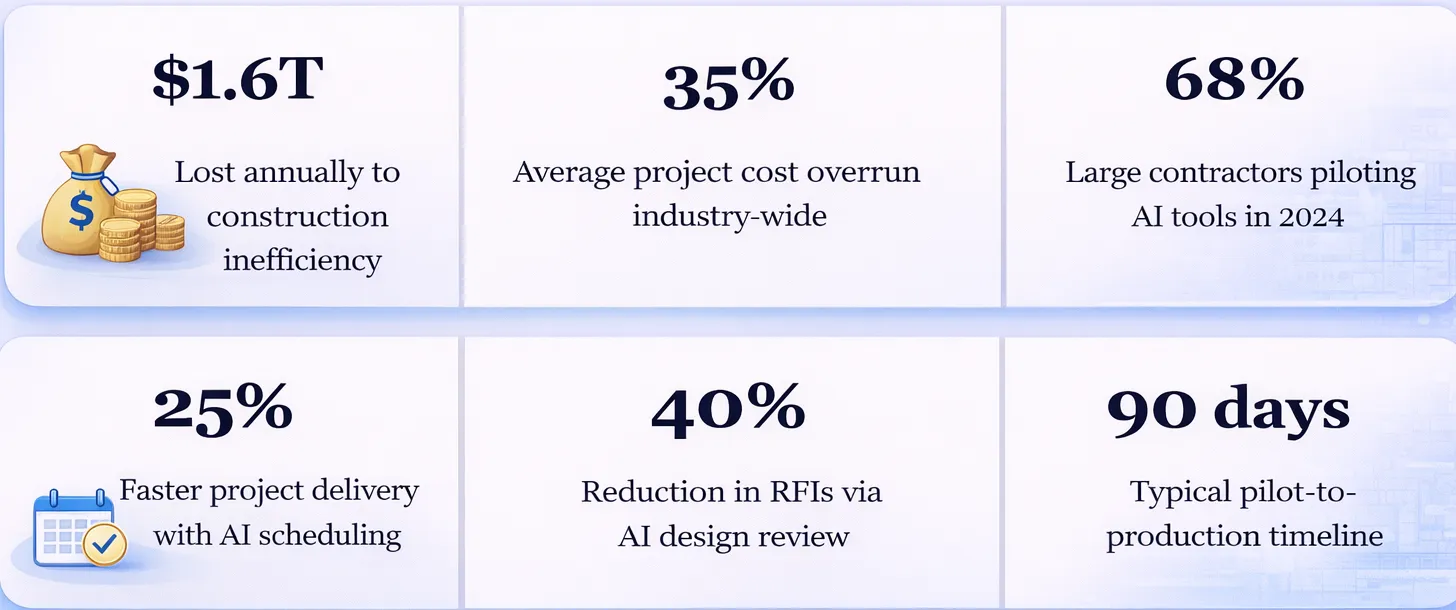
The global construction sector loses an estimated $1.6 trillion annually to inefficiency — roughly 35 percent of total project value. Labour shortages, supply chain volatility, and the growing complexity of smart-building specifications have compressed margins to the bone. AI in construction does not just offer incremental gains; it addresses structural inefficiencies that no amount of additional headcount can fix.
Here is what current adoption data tells us:
- 68% of large contractors have piloted at least one AI tool in the last two years (McKinsey, 2024)
- Projects using AI-powered scheduling finish 20–25% closer to original deadlines
- AI-assisted design review reduces RFI volumes by up to 40%
- Computer vision safety systems demonstrate a 35% reduction in on-site incidents within 12 months
- Firms using AI procurement report 15–22% less material waste and a significant reduction in costly stop-start cycles
Should we explore AI?" is no longer the question — it is 'how do we move from exploration to embedded, revenue-generating capability?'
See It in Action: How AI Is Transforming Construction
The numbers make the case — but seeing how AI is actually applied on construction projects makes it real.
In this video, we break down exactly how AI integrates into construction workflows: from predictive maintenance and computer vision safety systems to automated document processing and BIM-driven generative design. Whether you're evaluating your first AI pilot or scaling an existing program, this walkthrough gives you a clear, no-jargon view of what modern AI deployment looks like on the ground.
Stop Planning AI.
Start Profiting From It.
Every day without intelligent automation costs you revenue, market share, and momentum. Get a custom AI roadmap with clear value projections and measurable returns for your business.

5 Use Cases Where AI Creates Measurable Value
1. Predictive Maintenance and Equipment Intelligence
Heavy equipment downtime costs construction firms between $300 and $1,000 per idle hour per machine. Predictive maintenance models trained on IoT sensor data — vibration, temperature, pressure, cycle counts — flag failures days before they occur. The result: unplanned downtime drops by 30–45%, and asset lifespan extends by 15–20%.
Integration path: Modern telematics platforms (Caterpillar Product Link, Komatsu KOMTRAX) already emit structured data. An AI layer sits between your telematics platform and your ERP, triggering maintenance tickets automatically rather than waiting for a technician to notice.
2. Computer Vision for Safety Monitoring
Active construction sites generate terabytes of video data that human supervisors cannot process in real time. Computer vision models can identify missing helmets, workers entering exclusion zones, unsecured scaffolding, and crane swing conflicts — sending alerts within seconds of detection.
Beyond incident prevention, these systems create auditable compliance logs that reduce liability exposure and insurance premiums. Several insurers now offer reduced premiums for projects running certified AI safety monitoring — a direct, measurable financial return on the technology investment.
3. BIM-Integrated Generative Design
Layering Artificial Intelligence in Construction design workflows on top of existing BIM platforms unlocks generative design: engineers define constraints (structural loads, material costs, energy targets, local building codes) and AI generates dozens of compliant design variants ranked by performance score.
Design-phase changes cost 100x less than construction-phase changes. Catching clashes in a BIM model before the first shovel enters the ground is where AI-driven design pays back fastest — typically 6–10 months to full ROI.
4. Automated Document Processing and Contract Intelligence
A typical large construction project generates 5,000–10,000 documents: RFIs, submittals, change orders, inspection reports, contracts, and permits. NLP models extract structured data with 95%+ accuracy, flag non-standard contract clauses automatically, and route documents to the correct stakeholders — reducing processing time from days to minutes.
5. Demand Forecasting and Procurement Optimisation
AI forecasting models trained on commodity markets, weather patterns, shipping data, and historical project consumption generate procurement windows that lock in materials at optimal prices. Firms report 15–22% reduction in material waste and 10–18% improvement in on-site material availability.
NeuraMonks in Action: Real Deployments, Real Numbers
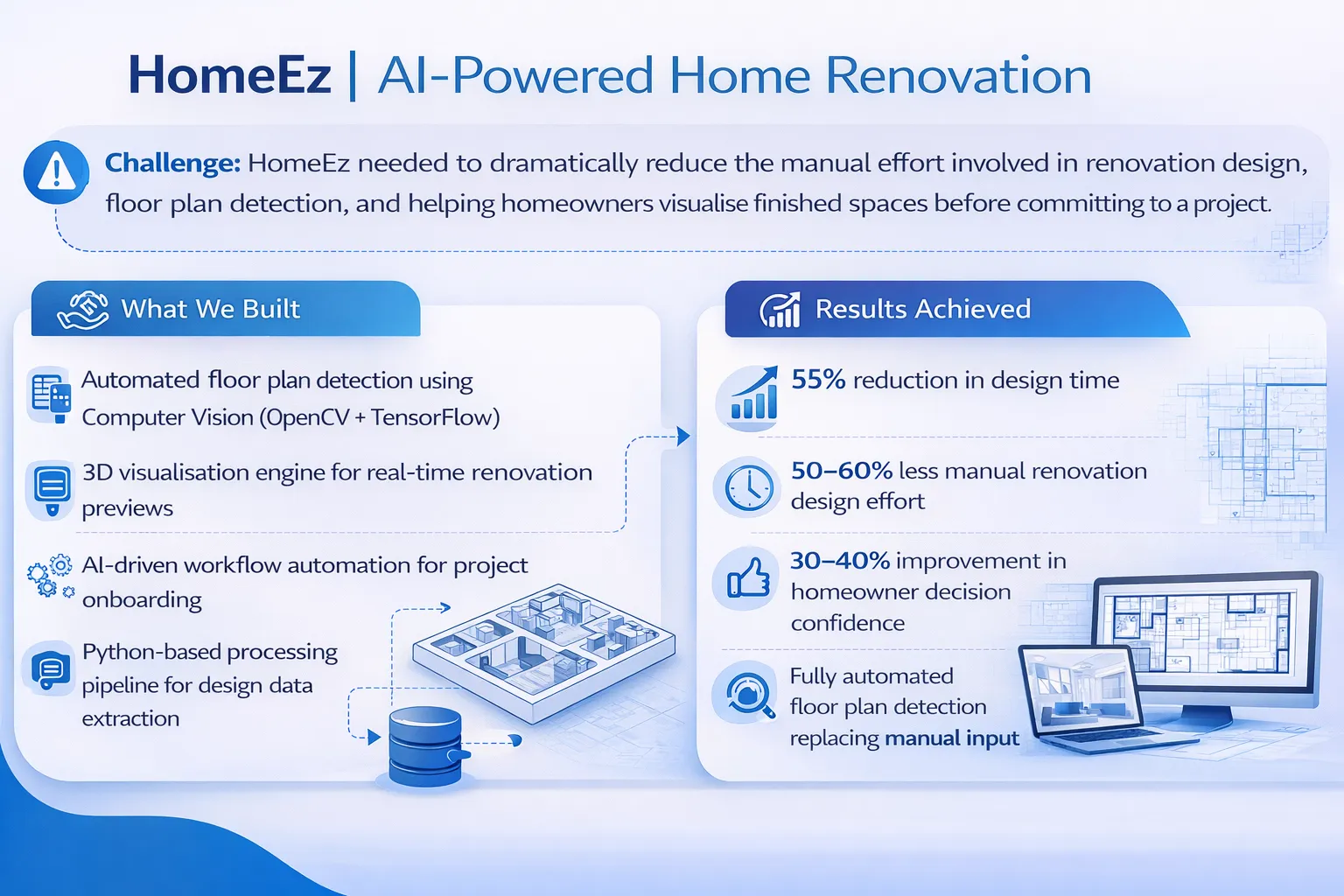
Case Study 1 — HomeEz: Smart Renovation Platform
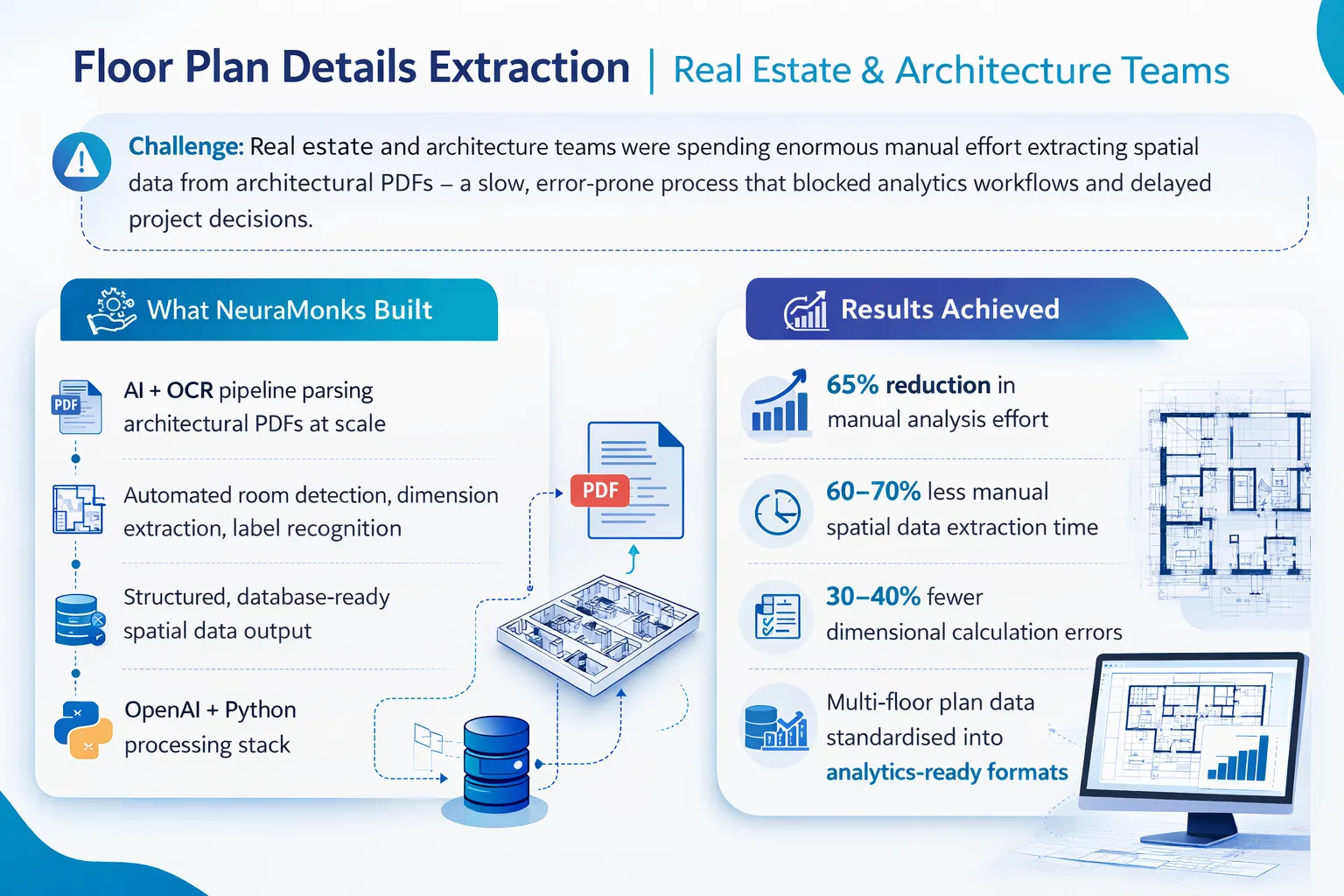
Case Study 2 — Automated Floor Plan Extraction System
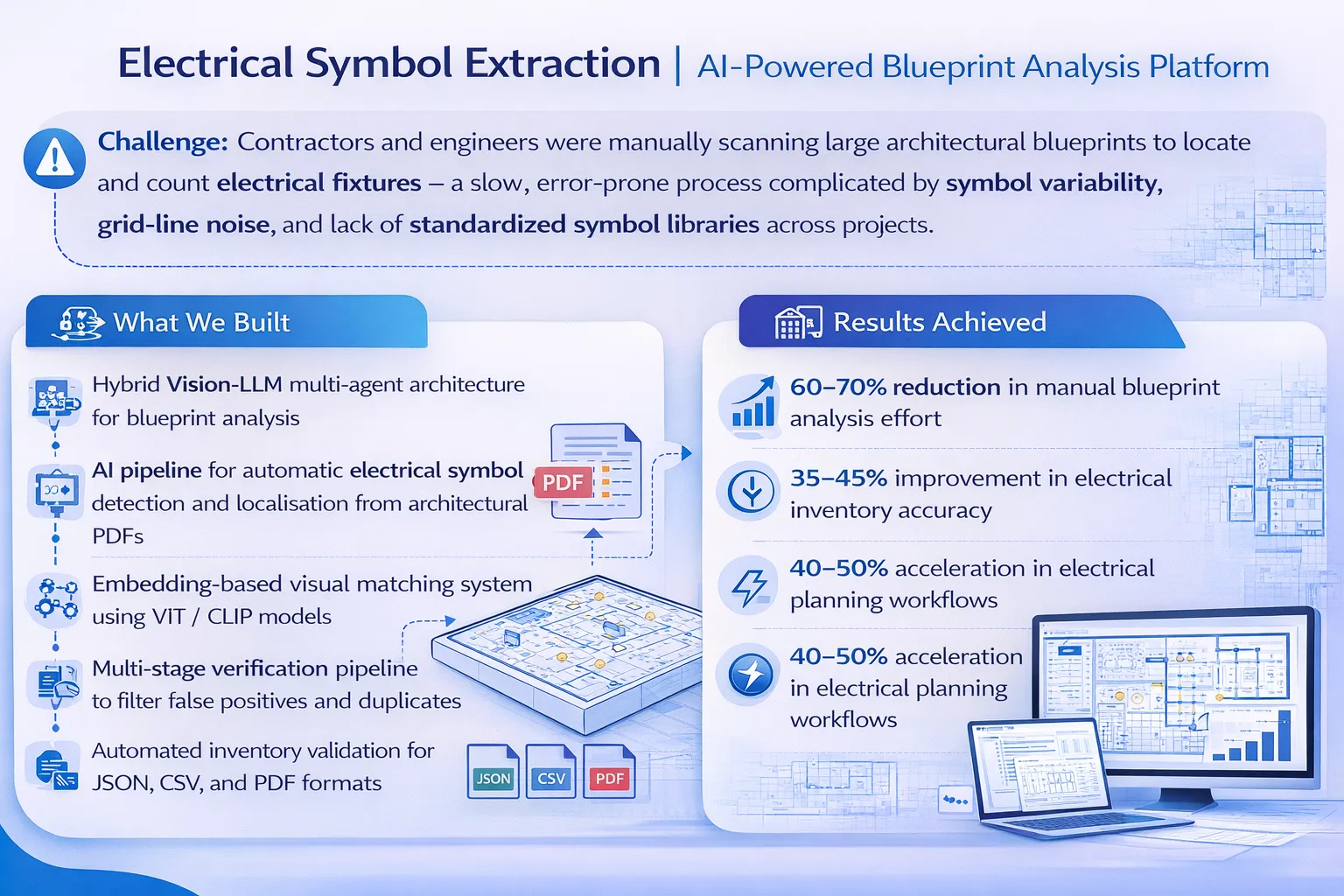
Case Study 3 — Automated Electrical Symbol Extraction & Counting System
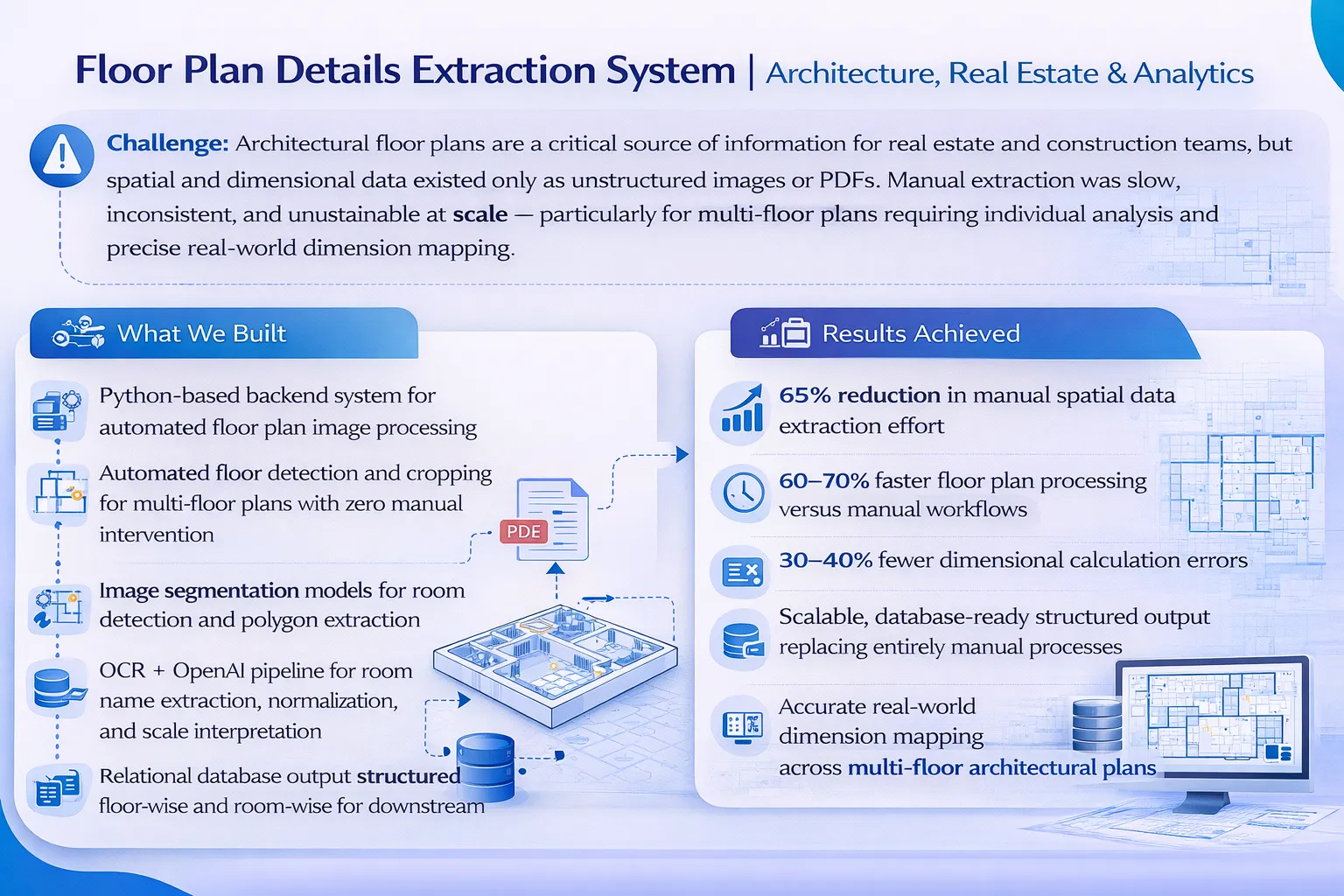
Case Study 4 — Automated Floor Plan Details Extraction System
ROI Frameworks: Building a CFO-Ready Business Case
One of the most common reasons AI initiatives stall is not scepticism about the technology — it is the inability to build a business case that passes CFO scrutiny. Below is the three-layer framework NeuraMonks uses when helping construction clients size their AI investments.
The Three-Layer ROI Model
Layer 1 — Direct Cost Avoidance: Quantify the cost of the problem being solved today. Equipment downtime at $300–$1,000/hour, safety incidents at $50,000–$500,000 per event, manual document processing at $X in staff hours. This is your baseline number.
Layer 2 — Productivity Multiplier: Estimate the capacity recovered. If a 10-person design team spends 30% of their time on tasks AI can automate, you have recovered 3 FTE-equivalent capacity — valued at your fully-loaded employee cost.
Layer 3 — Competitive and Revenue Impact: Projects delivered 20% faster open the next contract sooner. Fewer defects and claims protect your margin on current contracts and your reputation on future bids. Harder to quantify, but real and compounding.
ROI by Use Case — Summary Table
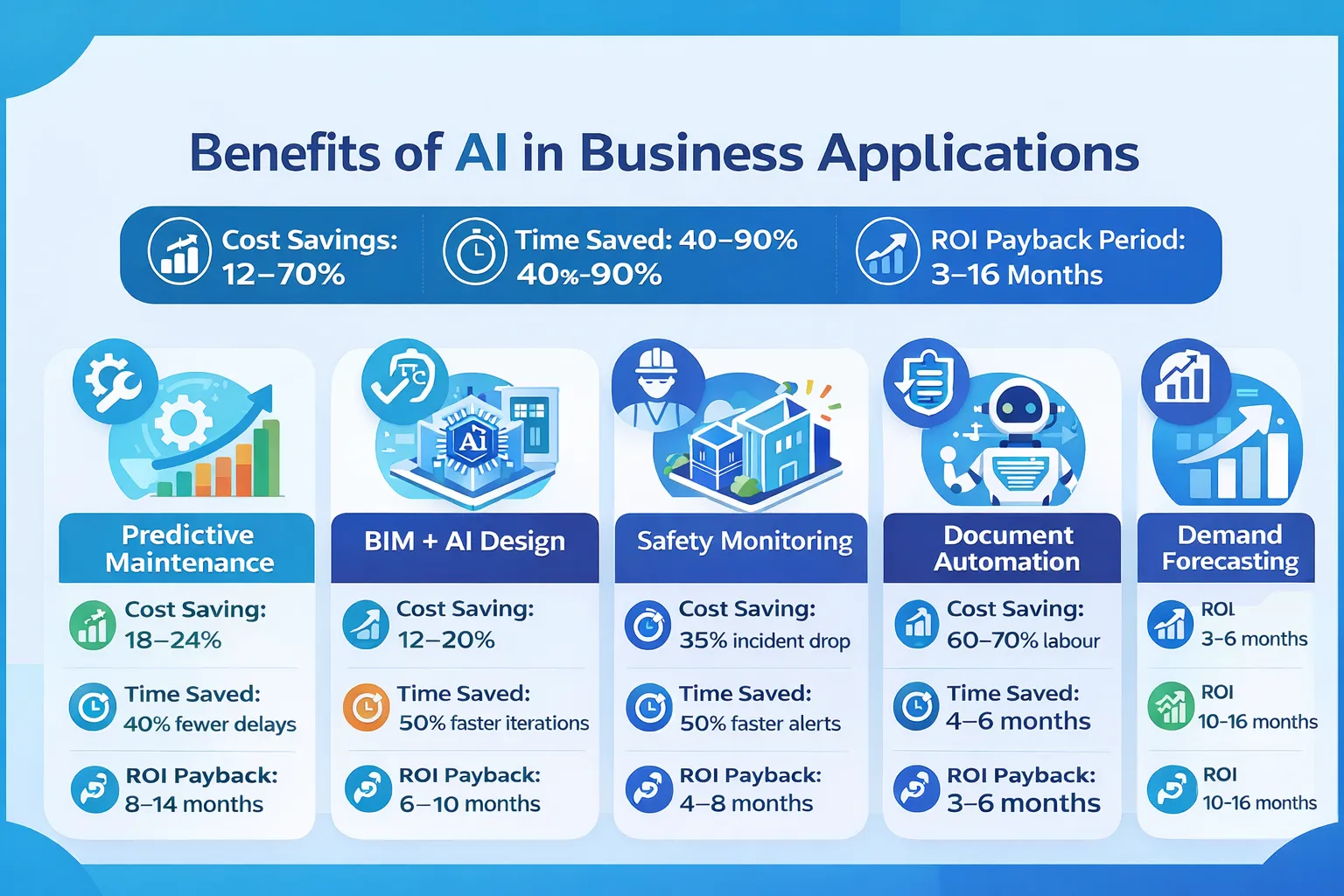
The payback periods above assume a phased rollout starting with one use case. Attempting to deploy multiple AI systems simultaneously inflates implementation cost and slows time-to-value. Start narrow, prove the ROI, scale what the data validates.
Integration Patterns: AI Without Ripping Out What Works
Construction project stacks are fragmented: Procore or Autodesk for project management, a legacy ERP for finance, separate telematics platforms, standalone BIM tools, and a growing number of IoT devices on site. The right model is augmentation through integration — not wholesale replacement.
Pattern A — API-First Data Connectors
Best for: Document automation, scheduling optimization, procurement forecasting.
A middleware layer pulls data from existing systems, passes it through AI models, and writes enriched outputs back to the source system. The user workflow does not change; the data quality improves significantly. Most modern platforms expose REST APIs that make this pattern straightforward.
Pattern B — Embedded AI Within Existing Platforms
Best for: Teams heavily invested in Procore, Autodesk, or Oracle Primavera.
All three platforms now have native AI modules. Activating AI features within tools your team already uses is the lowest-friction path — no new interface training, no separate login, no integration project required.
Pattern C — Edge AI for On-Site Operations
Best for: Safety monitoring, equipment diagnostics, environmental sensing.
Camera feeds, IoT sensors, and drone data operate in environments with unreliable connectivity. Edge AI — models deployed on on-site hardware rather than cloud-dependent infrastructure — is the appropriate pattern where latency and connectivity are constraints.
Pattern D — Phased Pilot to Production
Best for: Organizations new to AI deployment with limited internal data maturity.
Phase 1: Identify one high-value, well-scoped problem with measurable outputs. Phase 2: Deploy with a subset of projects, establish baseline metrics. Phase 3: Demonstrate ROI, build internal champions, then scale to the full portfolio.
NeuraMonks AI Solutions: From Discovery to Deployment
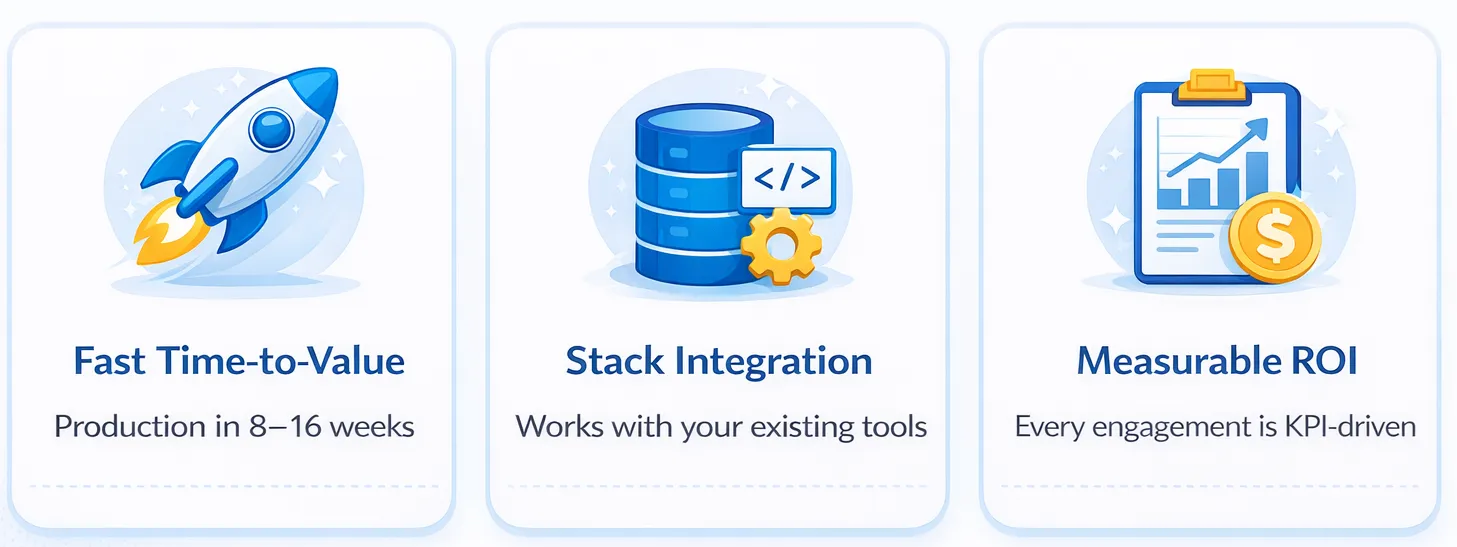
NeuraMonks AI Solutions specializes in building automation and intelligence systems for industries where operational complexity is high and the cost of failure is real. The NeuraMonks engagement model starts with a two-week discovery sprint: mapping your current technology stack, identifying the two or three highest-ROI automation opportunities, and sizing the implementation effort.
Closing: Building the AI-Ready Construction Organisation
The window for early-mover advantage in AI in construction is still open — but narrowing. The firms that will dominate project delivery over the next decade are not necessarily the largest. They are the ones that build AI capability systematically: starting where ROI is unambiguous, integrating without replacing what already works, and scaling what the data validates.
The playbook in four steps: identify your most painful operational bottleneck → select the AI pattern that addresses it → integrate using your existing stack → measure everything and scale what works.
NeuraMonks AI Solutions works with construction and real estate firms across Australia, India, and the Middle East to move from AI curiosity to AI capability. The NeuraMonks team is ready to scope your first deployment.
Your next project should cost less and finish on time.
Tell us where the biggest drain on your project is — budget overruns, slow document cycles, equipment downtime, or safety compliance — and we will map out exactly where AI fits into your workflow and what it would take to fix it.