TABLE OF CONTENT
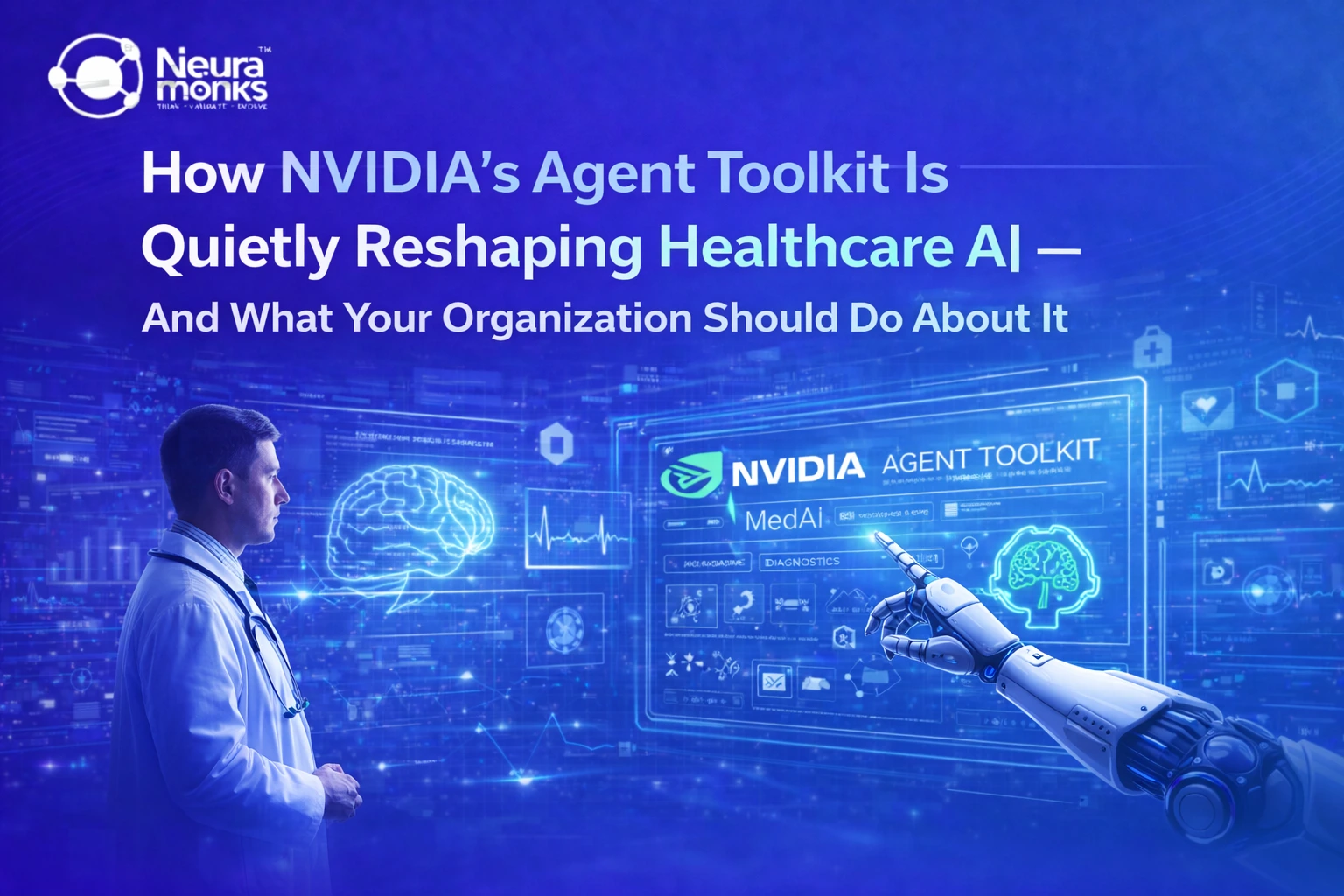
From cutting clinical trial timelines in half to powering surgical robotics, Nvidia's open source Agent Toolkit is rewriting the infrastructure of AI in healthcare. Here is what changed at GTC 2026, and what it means for hospitals, pharma, and health systems building AI today.
Most conversations about AI in healthcare focus on what models can predict. NVIDIA's announcement at GTC 2026 on March 16 shifted that conversation to something more consequential: what autonomous agents can actually do inside clinical systems, in real time, at scale, and without violating the regulatory boundaries that define healthcare operations.
The Nvidia Agent Toolkit is an open-source software platform that gives healthcare organizations and the technology companies that serve them a production grade foundation for deploying autonomous AI agents. Not pilots. Not proofs of concept. Agents running continuously inside pharmaceutical workflows, hospital systems, and life sciences platforms that are already serving some of the largest healthcare institutions on the planet.
The scale of what was announced at GTC 2026 is significant. And for any healthcare organization still treating AI as a future strategy rather than a current operational decision, this is a moment worth paying close attention to. For background on how agentic AI differs from traditional automation approaches, NeuraMonks has a detailed breakdown worth reading first.
Stop Planning AI.
Start Profiting From It.
Every day without intelligent automation costs you revenue, market share, and momentum. Get a custom AI roadmap with clear value projections and measurable returns for your business.
Healthcare AI at GTC 2026: The Numbers That Matter
Before unpacking the toolkit itself, these are the data points that define the scale of what Nvidia and its healthcare partners announced:

What the Nvidia Agent Toolkit Actually Is — In Plain English
The Agent Toolkit is a modular open-source stack with four core components, each solving a distinct problem that has blocked healthcare AI from moving beyond pilot deployments:
OpenShell The Compliance-First Security Runtime
OpenShell is the layer that makes the rest of the toolkit viable in healthcare. It is an open-source runtime that enforces policy-based security, network access controls, and privacy guardrails for every autonomous agent that runs on it. Each agent called a 'claw' in Nvidia's terminology — operates in a sandboxed environment with strictly defined data access boundaries. For healthcare organizations bound by HIPAA, GDPR, and sector-specific regulatory requirements, this is not a nice to have. It is the precondition for deployment.
Cisco AI Defense and CrowdStrike are both integrating directly with OpenShell, embedding their security controls into the agent architecture from the ground up not bolted on afterward.
AI-Q Blueprint Deep Research and Clinical Intelligence
AI-Q is an open agent blueprint designed for complex, multi-step research tasks exactly the kind that define clinical development workflows. It uses a hybrid architecture: frontier models handle orchestration and reasoning, while Nvidia's open Nemotron models handle retrieval and analysis. The result is a 50%+ reduction in query costs without sacrificing accuracy. It currently ranks first on both the DeepResearch Bench and DeepResearch Bench II leaderboards the most relevant benchmarks for the kind of evidence synthesis and knowledge extraction that healthcare AI depends on.
Nemotron Open Models Built for Regulated Environments
Nemotron is Nvidia's family of open models optimized for agentic reasoning. Multiple healthcare technology companies are already building on them including Hippocratic AI for clinical patient conversations, Open Evidence for medical intelligence synthesis, and Verily for its Violet AI health companion. They are model agnostic and swappable, which matters in healthcare where today's approved model may be superseded by a more accurate one within 18 months.
Ope H and Cosmos H Physical AI for Surgical Robotics
Beyond software agents, Nvidia released Open-H the world's largest healthcare robotics dataset, comprising 700+ hours of surgical video built with 35+ collaborators, including CMR Surgical and Johnson & Johnson MedTech. Cosmos H enables developers to generate physics-accurate synthetic surgical data for training robotic systems. The GR00T H vision language model translates clinical text commands into physical robot actions. This is AI in healthcare extending from the data centre into the operating room.
Before and After: Healthcare AI With and Without the Toolkit
The practical difference between the previous state of healthcare AI deployment and what the Agent Toolkit enables is not incremental. It is structural.

Five Ways the Agent Toolkit Is Already Changing Healthcare AI
1. Clinical Trial Acceleration From 200-Day Start-Ups to Autonomous Workflows
Clinical trial start-up site selection, participant recruitment, regulatory submissions has historically taken around 200 days and is one of the most manually intensive phases of pharmaceutical development. IQVIA's AI agents, built on the Nvidia Agent Toolkit, are directly targeting this bottleneck. Their clinical data review agent alone has compressed the review cycle from 7 weeks to as little as 2 weeks using automated multi-check workflows.
IQVIA.ai, launched at GTC 2026, is now a unified agentic platform serving 19 of the top 20 pharmaceutical companies. These are AI solutions that operate as a digital command centre across clinical, commercial, and real-world operations not dashboards that analysts query, but agents that monitor, detect, escalate, and act continuously.
2. Drug Discovery Reasoning Across Protein Structures at Scale
Drug discovery has always been constrained by the volume of biomedical literature that any human team can meaningfully synthesize. AI-Q-powered agents change this equation by building continuously updated knowledge graphs from research articles, biomedical databases, and proprietary experimental data identifying compound opportunities and indication priorities that would take human researchers months to surface.
At GTC 2026, Nvidia, EMBL, Google DeepMind, and Seoul National University jointly announced 1.7 million new predicted protein complexes contributed to the AlphaFold Protein Structure Database, with 30 million additional structures available for bulk download. Eli Lilly and Nvidia's $1 billion, five-year commitment to AI-based drug discovery is the largest investment signal yet that this is no longer exploratory it is infrastructure.
3. Patient-Facing Care Chronic Care Management and Post-Discharge Follow-Up
Hippocratic AI is using Nvidia's NeMo framework to train large, domain-adapted models for clinical conversations with patients focused specifically on chronic care management and post-discharge follow-up, two of the highest cost, lowest coverage gaps in current healthcare delivery. These are AI solutions running 24/7 at a cost and availability profile that no human staffing model can replicate.
Verily's Violet, built on Nemotron, helps individuals interpret their own health data and navigate symptoms a direct-to-consumer application of the same agent infrastructure that pharmaceutical companies are using for enterprise workflows. One toolkit, two entirely different deployment contexts, both operational today.
4. Clinical Documentation Eliminating the Transcription Burden
HeidiHealth, a multilingual clinical documentation platform, is deploying ambient listening agents that handle over 2.4 million weekly consultations across 190 countries. Physicians dictate naturally during patient interactions; agents transcribe, structure, and code the clinical record in real time. For healthcare systems struggling with physician burnout driven by administrative overload, this is one of the most immediately deployable AI solutions with measurable ROI from day one.
Sofya, another Nvidia partner, processes over 1 million clinical encounters using real-time AI transcription that also surfaces evidence-based protocol suggestions during the consultation itself closing the loop between documentation and clinical decision support in a single workflow.
5. Surgical Robotics AI in the Operating Room
Physical AI in healthcare is no longer a research project. CMR Surgical has contributed close to 500 hours of surgical video to Open-H. Johnson & Johnson MedTech is adopting Nvidia's physical AI platform. The GR00T-H model processes surgeon text commands and generates robotic motion in response. Rheo, a developer blueprint released at GTC, enables hospital digital twins that simulate clinical workflows, device interactions, and patient movement allowing healthcare organizations to model and validate AI agent deployments before any physical change to hospital operations.
NeuraMonks Healthcare AI in Practice
The use cases above are not hypothetical. At NeuraMonks, we have been building production AI solutions for healthcare imaging and clinical diagnostics the same category of deep learning infrastructure that underpins agent ready healthcare systems. Two projects that demonstrate what this looks like in practice:
Our Cell Segmentation AI system applies deep learning models to microscopy imaging automatically identifying, classifying, and segmenting individual cells across large image datasets with accuracy that matches expert human analysis. This is the kind of AI in healthcare that accelerates research workflows directly: what previously required hours of manual annotation now runs in minutes, at scale, with a consistent and auditable output.
Our Automated Wound Detection and Measurement System uses deep learning to detect wound boundaries, classify wound type, and calculate precise measurements from clinical photography removing the subjectivity and inconsistency from wound assessment that has long made longitudinal tracking unreliable. For clinical teams managing chronic wounds, burns, or post-surgical healing, these are AI solutions that feed directly into the kind of structured, auditable data that agent-driven care coordination systems require.
Both projects represent the data quality and model reliability foundation that healthcare organizations need in place before deploying autonomous agents at scale. If your imaging pipelines, diagnostic data, or clinical records are not structured and validated, agents built on the Nvidia Toolkit will inherit those gaps. Getting the AI infrastructure layer right is step one and it is work we have done across healthcare environments with real clinical constraints.
The Trust Problem: Why OpenShell Changes the Healthcare AI Conversation
Every healthcare CIO and compliance officer who has reviewed an AI deployment proposal has asked the same question: what happens when the agent accesses data it shouldn't, takes an action it wasn't authorized to, or produces a recommendation that creates liability?
Until now, the honest answer was that guardrails were largely custom-built, inconsistent across vendors, and difficult to audit. OpenShell changes this by making policy enforcement a runtime feature, not an afterthought. Every agent runs in a sandboxed environment. Data access is governed by least-privilege controls. Network reach is defined by policy. Every action is logged with a full auditable trail.
IQVIA's approach to this is worth noting directly. Their healthcare-grade AI framework was built around privacy, regulatory compliance, and patient safety as primary design constraints not compliance layers added after the fact. With 100+ AI-related patents filed and active deployments across 19 of the top 20 pharmaceutical companies, IQVIA.ai represents the most validated AI in healthcare agent deployment at scale available today. The Nvidia Agent Toolkit is what makes that scale reproducible for other healthcare organizations.
This is precisely where AI consulting services matter most. The technology is available. The security infrastructure exists. What separates organizations that deploy successfully from those that stay in pilot mode is a clear architecture for how agents integrate with existing clinical systems, how compliance requirements are mapped to runtime policies, and how governance frameworks are maintained as the toolkit evolves. That translation work is not a technology problem it is a strategy problem.
What Your Healthcare Organization Should Do Right Now
Nvidia's Agent Toolkit is open source and available today. IQVIA.ai is live. Roche's AI factories are operational. The market is not waiting for healthcare organizations to finish their AI strategies. Here is where to focus:
• Audit your data governance posture. OpenShell is only as effective as the data access policies you define. If your data classification and access control frameworks are incomplete, agent deployment will inherit those gaps. This is step one, and it is not an IT task — it requires clinical, legal, and compliance leadership.
• Identify your highest-friction clinical workflows. Clinical trial start-up, data review, patient documentation, and post-discharge follow-up are the four areas where AI agents are delivering the most measurable value fastest. Map your version of these workflows against what IQVIA and Hippocratic AI are already doing at scale.
• Evaluate build vs. partner. The Nvidia Agent Toolkit is open source, but implementation inside regulated healthcare environments is not self-service. The right AI development company partner will have both the technical depth to implement the toolkit correctly and the domain knowledge to navigate healthcare-specific compliance requirements from the start.
• Start with one workflow, not a platform. The organizations making the fastest progress with AI in healthcare are not the ones with the most comprehensive AI strategies. They are the ones that identified one high-value workflow, deployed agents in a production environment, measured results, and expanded from there.
• Engage AI consulting services early. The cost of a poor architecture decision in healthcare AI is not just technical debt — it is compliance exposure, patient safety risk, and organizational trust. Getting the governance framework right before deployment is significantly less expensive than retrofitting it afterward.
For a deeper look at how the AI infrastructure landscape has evolved to produce tools like the Agent Toolkit,Standard RAG Is Dead Here's What's Replacing It in 2026 useful context on the retrieval and reasoning layer these agents are built on top of.
NVIDIA's Agent Toolkit is not a research announcement. It is a production platform that is already running inside the clinical trial operations of 19 of the top 20 pharmaceutical companies, the surgical systems of leading robotic surgery providers, and the patient care workflows of health systems across 190 countries. The infrastructure of AI in healthcare changed materially on March 16, 2026.
The open-source model means any healthcare organization can access the same stack. OpenShell means the compliance foundation is built in. The partnership ecosystem IQVIA, Roche, Hippocratic AI, HeidiHealth, CMR Surgical means the implementation patterns are already validated at scale.
What it does not mean is that deployment is automatic. The organizations capturing the most value from AI in healthcare right now are those that invested early in the governance frameworks, data infrastructure, and integration architecture that allow agents to operate reliably inside complex clinical environments. Building those foundations — and doing it in a way that satisfies regulators, protects patients, and delivers measurable operational value is exactly the work that NeuraMonks specializes in.
Is Your Healthcare Organization Agent-Ready?
NVIDIA's Agent Toolkit sets a new bar for what's possible in healthcare AI but the gap between possibility and deployment is where most organizations get stuck. At NeuraMonks, we assess your infrastructure, data governance posture, and workflow architecture so you can implement AI solutions that are built for the regulatory realities of healthcare, not around them.