TABLE OF CONTENT
The automation race is on — and the stakes have never been higher. Businesses worldwide are projected to spend over $25 billion on automation technologies by 2027, yet a staggering 40% report that their automation investments are underdelivering on ROI. The reason? Most organizations are still deploying the wrong kind of automation for the problems they're trying to solve.
Two paradigms dominate today's landscape: Agentic AI and Traditional Automation. Both promise efficiency. But the gap between what they actually deliver — in time saved, costs cut, and value created — is enormous. At NeuraMonks, we've deployed both across dozens of enterprise environments. The data tells a decisive story.
The Numbers at a Glance
Before diving deep, here are the headline figures from real-world deployments:
- 3× faster average deployment (Agentic AI vs traditional RPA)
- 60–80% greater operational cost reduction (vs 20–40% for traditional automation)
- 75% lower maintenance overhead (Agentic AI vs rule-based systems)
- 4 months average ROI achievement timeline (vs 14 months for traditional automation)
- 68% of automatable tasks require adaptability (where traditional systems fail)
Stop Planning AI.
Start Profiting From It.
Every day without intelligent automation costs you revenue, market share, and momentum. Get a custom AI roadmap with clear value projections and measurable returns for your business.

Understanding the Two ParadigmsTraditional Automation — Speed Without Intelligence
Traditional automation — encompassing RPA (Robotic Process Automation), scripted bots, and conditional workflow engines — operates on fixed decision trees. It excels at high-volume, perfectly structured, repetitive tasks: invoice processing, scheduled report generation, and data entry. The global RPA market hit $3.1 billion in 2023, yet Gartner reports that 50% of RPA implementations fail to scale beyond the pilot stage because of rigidity and exception overload.
The rule is simple: change the input, break the bot. Traditional systems require manual reprogramming for every variation, making them brittle in dynamic business environments.
Agentic AI — Intelligence With Action
Agentic AI operates on an entirely different principle. Powered by large language models and advanced Machine Learning architectures, agentic systems reason toward goals — breaking complex objectives into sub-tasks, selecting the right tools dynamically, handling exceptions autonomously, and learning from outcomes. They don't follow scripts; they solve problems.
Where traditional systems fail at exception rate thresholds above 3–5%, Agentic AI handles exception rates of 15–20% without human escalation — a critical difference in real-world business operations where edge cases are the rule, not the exception.
Head-to-Head Comparison
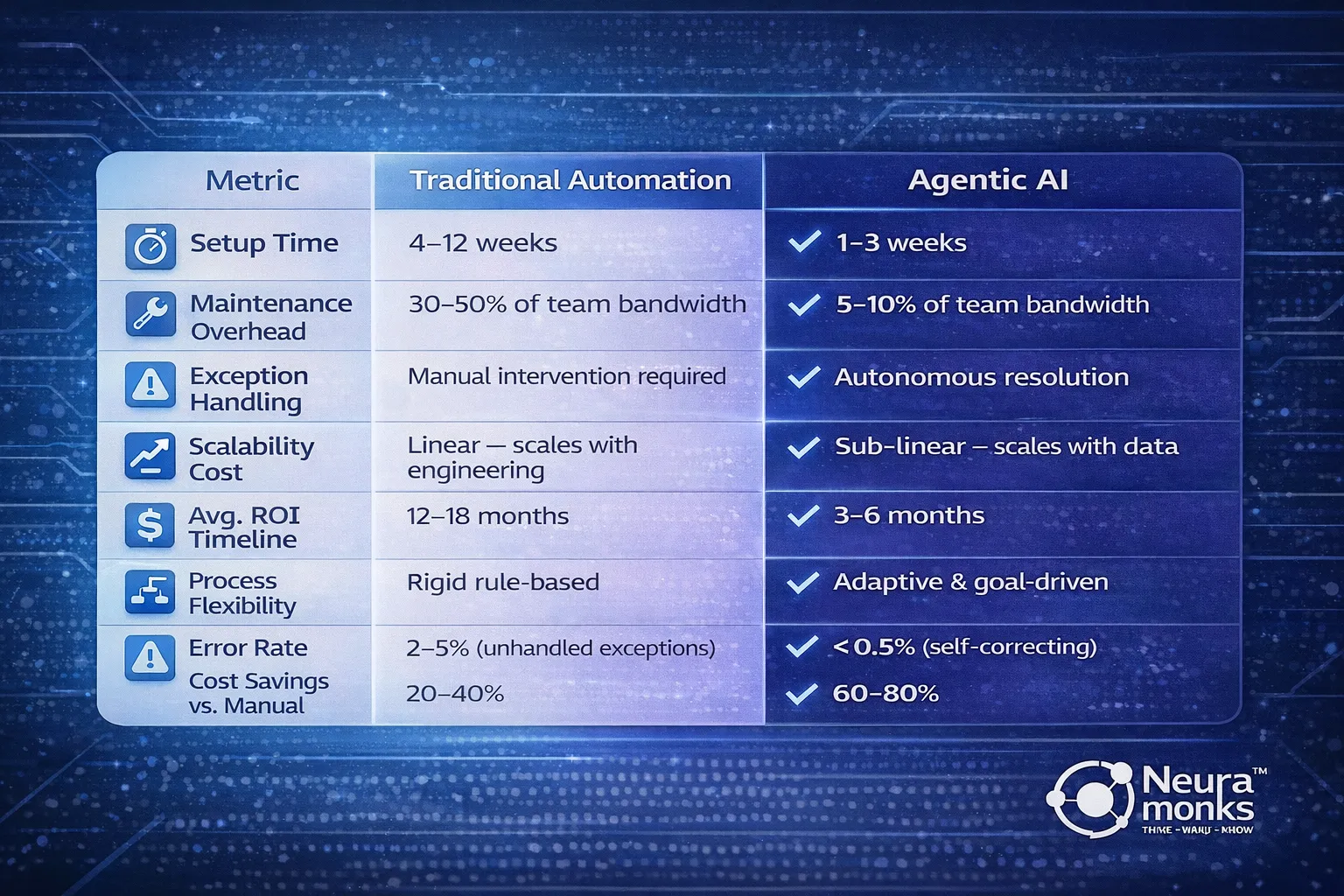
The table below captures the key operational differences across critical performance metrics:
The Time Equation: Where Hours Disappear
Setup & Deployment — Weeks vs. Months
Traditional RPA deployments average 8–14 weeks from scoping to go-live. Every edge case demands a new rule; every process variant requires separate development. Change management alone consumes 20–30% of deployment time.
Agentic AI deployments operate differently. With goal-oriented configuration instead of step-by-step rule mapping, initial deployments compress to 1–3 weeks. You define the objective; the system determines the execution path. That's a 3× speed advantage before a single workflow runs in production.
The Hidden Time Drain: Maintenance
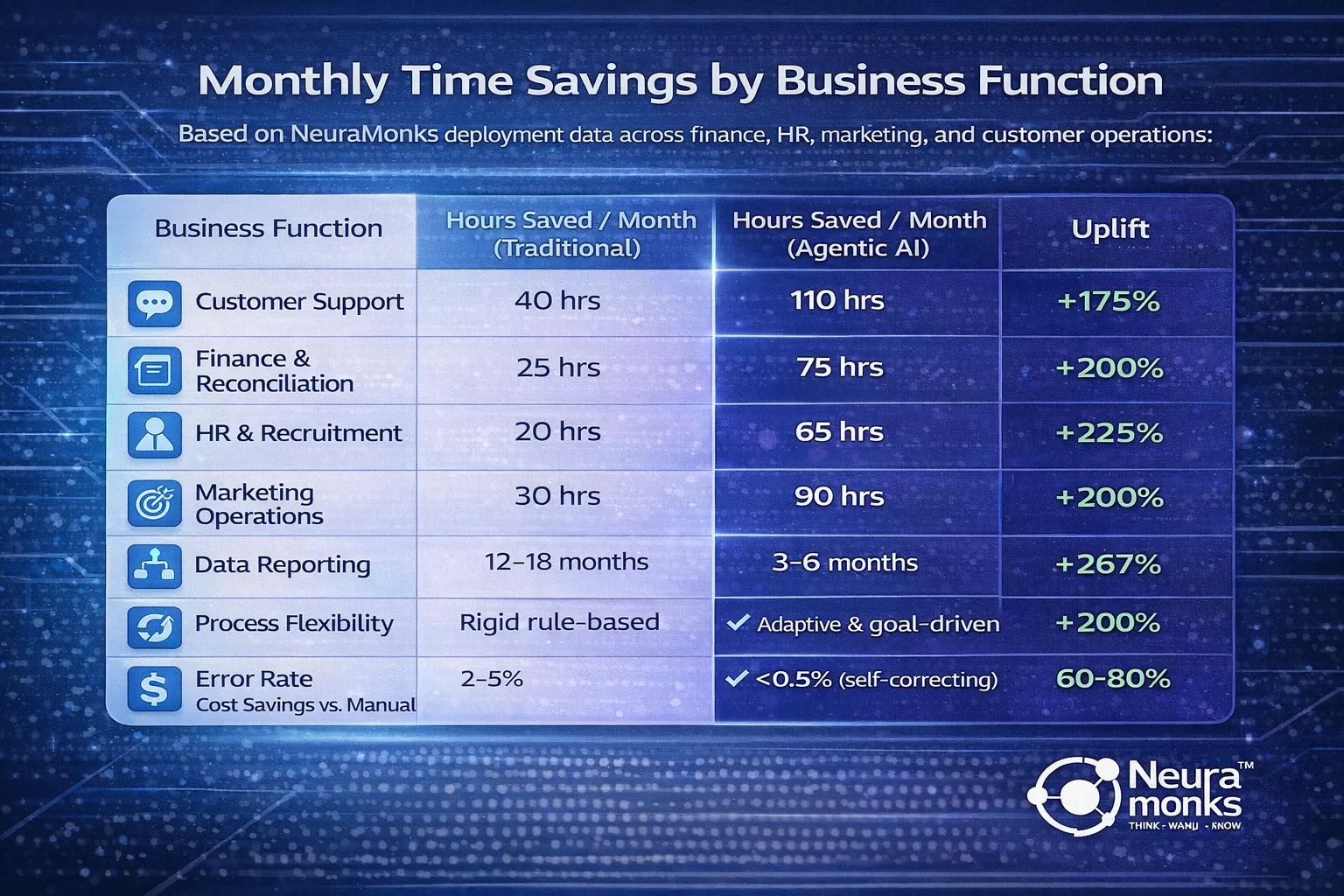
Traditional automation teams spend 30–50% of their engineering bandwidth on maintenance — patching bots after software updates, rewriting rules for process changes, and managing exception queues. This is the silent productivity killer that most ROI calculations ignore.
Agentic systems are adaptive by design. Maintenance overhead drops to 5–10% of team bandwidth, freeing engineers for strategic work rather than firefighting.
The Money Equation: Real Cost Breakdown
Cost comparison analysis must account for the full 3-year total cost of ownership — not just upfront licensing fees. Here's what the numbers actually look like:
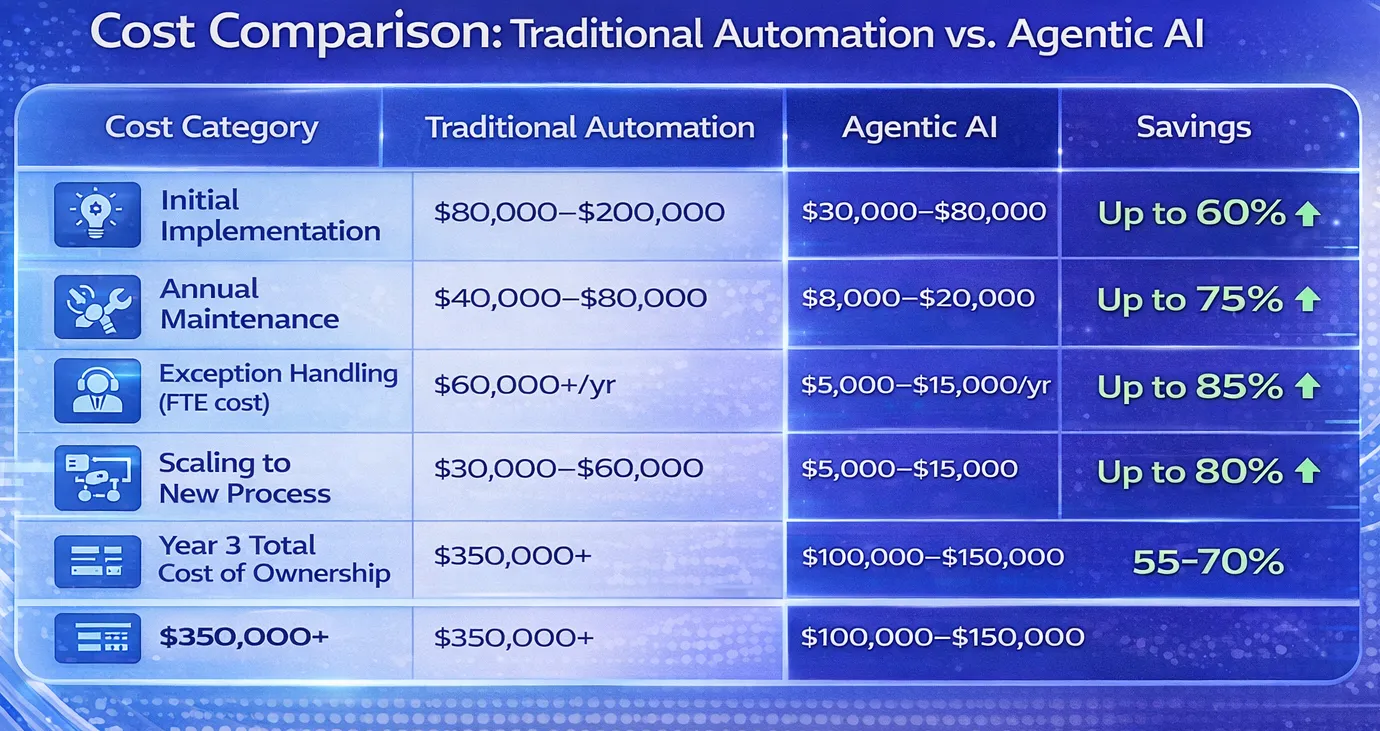
Cost ranges based on mid-market enterprise deployments (200–1,000 employees). Larger enterprises see proportionally greater savings with Agentic AI.
The math is unambiguous. Over a 3-year horizon, AI Solutions built on agentic architectures deliver 55–70% lower total cost of ownership compared to equivalent traditional automation deployments — primarily because they eliminate the hidden costs of exception handling, maintenance cycles, and rigid re-engineering.
NeuraMonks Case Study: AI-Powered Lead Generation & Follow-Up Automation
Real-World Impact: Eliminated Lead Leakage and Improved Response Speed by 60% Across Sales Operations
The Challenge
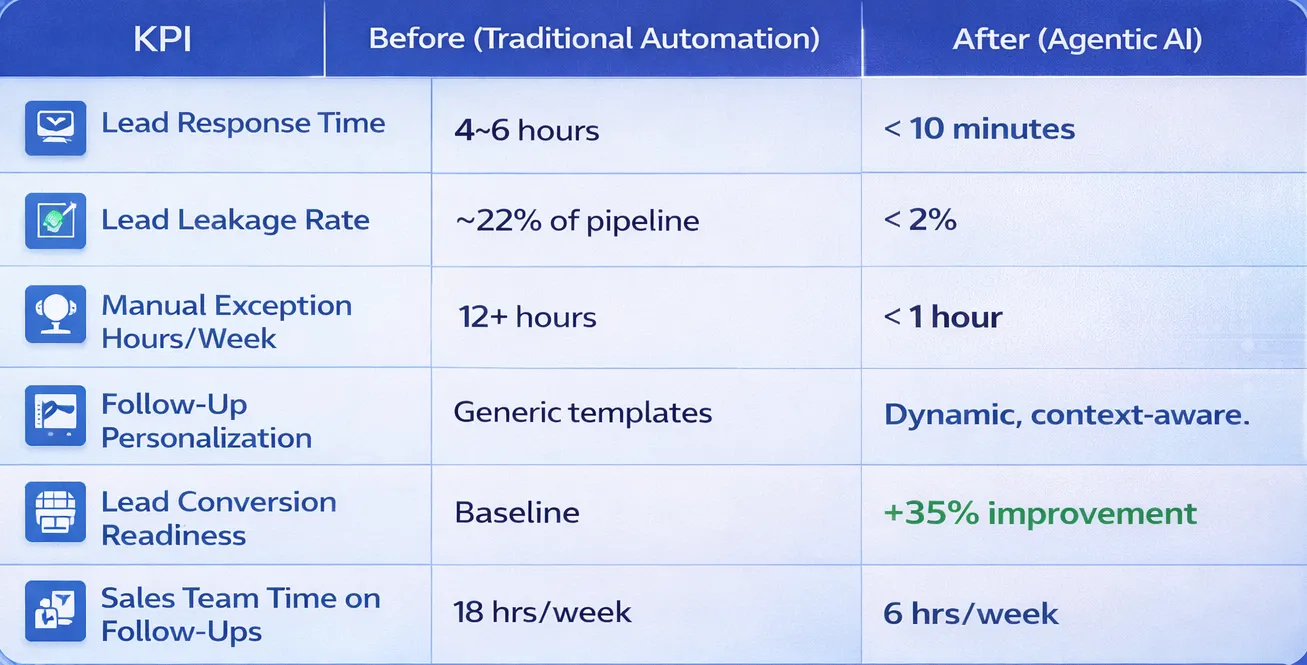
A fast-growing B2B company was running a traditional CRM automation stack — scripted email sequences, rule-based lead scoring, and manual follow-up triggers. The system was built on conditional logic: if the lead opens the email, trigger follow-up; if there is no response in 3 days, move to next sequence. Predictable on paper. Broken in practice.
The core problems: lead leakage was rampant (leads falling through workflow gaps when behaviors didn't match expected patterns), response times averaged 4–6 hours during peak periods, and the sales team spent 12+ hours weekly manually triaging exceptions that the automation couldn't handle.
The NeuraMonks Agentic AI Solution
We replaced the rule-based stack with an Agentic AI lead management system. Rather than following fixed sequences, the system could:
- Autonomously analyze each lead's behavior, company context, and engagement signals
- Dynamically personalize follow-up messages based on real-time data rather than static templates
- Determine optimal contact timing by learning from historical response patterns
- Escalate high-intent leads to human sales reps with full context summaries — instantly
- Handle edge cases — unsubscribes, out-of-office replies, role changes — without human intervention
The Results — Before vs. After
Key Takeaway
The traditional automation stack wasn't underperforming because the team built it wrong — they built it exactly as rule-based systems are designed. The problem was architectural. Rules can't replace reasoning. The Agentic AI system didn't just automate the same process faster; it solved problems the old system was fundamentally incapable of addressing.
Industry-Level ROI: What the Data Shows
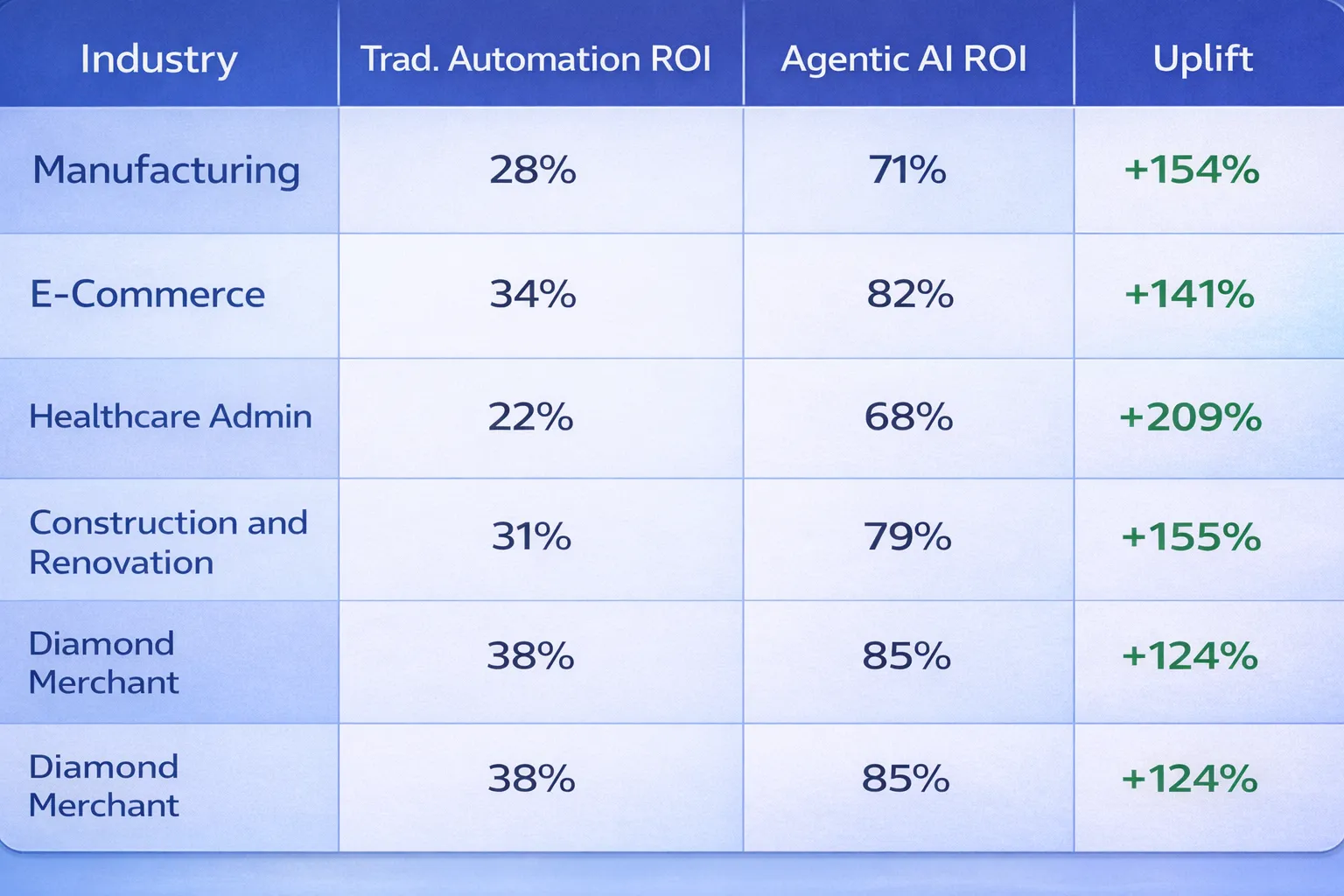
Across NeuraMonks deployments and third-party research, the ROI differential between Agentic AI and traditional automation is consistent across industries:
The Verdict: Making the Right Call
Traditional automation isn't dead — it's appropriate for perfectly structured, high-volume, never-changing processes where predictability trumps adaptability. If your process is a straight line, rule-based systems serve it well.
But for the 68% of automatable business workflows that involve variability, judgment, or exception handling — the category that delivers the most business value — Agentic AI doesn't just outperform traditional automation. It operates in a different league entirely.
The question isn't whether to automate. It's whether you're automating with tools that think — or tools that merely execute. In a competitive market where efficiency compounds, that distinction is worth millions.
Ready to Make the Switch?
If your current automation stack is costing more than it saves — in maintenance hours, missed exceptions, or lost growth opportunities — it's time for a smarter approach. we specializes in designing and deploying Agentic AI systems that think, adapt, and deliver measurable ROI from day one.
Our team has built 96+ AI solutions across finance, healthcare, e-commerce, HR, and marketing — and we bring the same structured, results-first methodology to every engagement. Whether you're starting from scratch or looking to replace a failing automation setup, we'll map the right architecture for your business goals.
When you collaborate with us, you gain the following:
• Free AI Consultation — We audit your current workflows and identify where Agentic AI delivers the fastest ROI
• Custom Deployment Roadmap — A clear, phased plan from pilot to full-scale production
• Measurable Outcomes — We define KPIs upfront so you always know the value you're getting
• End-to-End Support — From architecture design to post-deployment optimization, we're with you at every stage
Stop automating with tools that merely execute. Start automating with intelligence that thinks. Book your free consultation and discover what Agentic AI can do for your business.