TABLE OF CONTENT
The artificial intelligence landscape has matured dramatically by 2026, transforming from experimental technology into mission-critical infrastructure. As businesses rush to implement AI across operations, the quality of your AI Consulting Services partner can make or break your digital transformation journey. This comprehensive guide examines what separates exceptional AI consultants from the rest in today's competitive market.
The 2026 AI Consulting Landscape: What's Changed
The AI consulting market has evolved significantly over the past two years. What began as predominantly large enterprise implementations has democratized, with mid-market companies now accessing sophisticated AI solutions previously reserved for Fortune 500 organizations. The shift from proof-of-concept projects to production-grade deployments means choosing the right partner carries higher stakes than ever before.
Today's AI consulting engagements focus less on "can we do this?" and more on "how do we scale this?" Companies like Neuramonks have emerged as leaders by bridging the gap between cutting-edge AI capabilities and practical business implementation, helping organizations move from experimentation to enterprise-wide deployment.
Understanding Modern AI Consulting Services
Before evaluating potential partners, it's crucial to understand what comprehensive AI Consulting Services should encompass in 2026. The best consultancies offer end-to-end capabilities spanning:
Strategic Planning & Assessment: Your partner should begin with thorough discovery—analyzing your current technology stack, identifying high-impact use cases, and developing a realistic roadmap aligned with your business objectives. This isn't about implementing AI for its own sake; it's about solving real business problems with measurable ROI.
Architecture & Technology Selection: The alternatives available in AI technology have exploded. Your consultant should demonstrate expertise across multiple frameworks and platforms, recommending solutions based on your specific requirements rather than pushing proprietary tools. Whether you need Generative AI for content creation, computer vision for quality control, or predictive analytics for forecasting, they should architect systems that integrate seamlessly with your existing infrastructure.
Implementation & Integration: Many consultancy partnerships break down at this point. Your partner needs proven expertise deploying AI in production environments, handling data pipelines, model training, API development, and integration with enterprise systems. They should understand both the AI/ML stack and traditional enterprise architecture.
Training & Change Management: Technology alone doesn't drive transformation—people do. Your consultant should provide comprehensive training for technical teams and end-users alike, helping your organization build internal AI capabilities over time rather than creating permanent dependency.
Ongoing Optimization & Support: AI systems require continuous monitoring, retraining, and refinement. Your partner should offer maintenance services that keep your AI solutions performing optimally as your data and business needs evolve.
Stop Planning AI.
Start Profiting From It.
Every day without intelligent automation costs you revenue, market share, and momentum. Get a custom AI roadmap with clear value projections and measurable returns for your business.
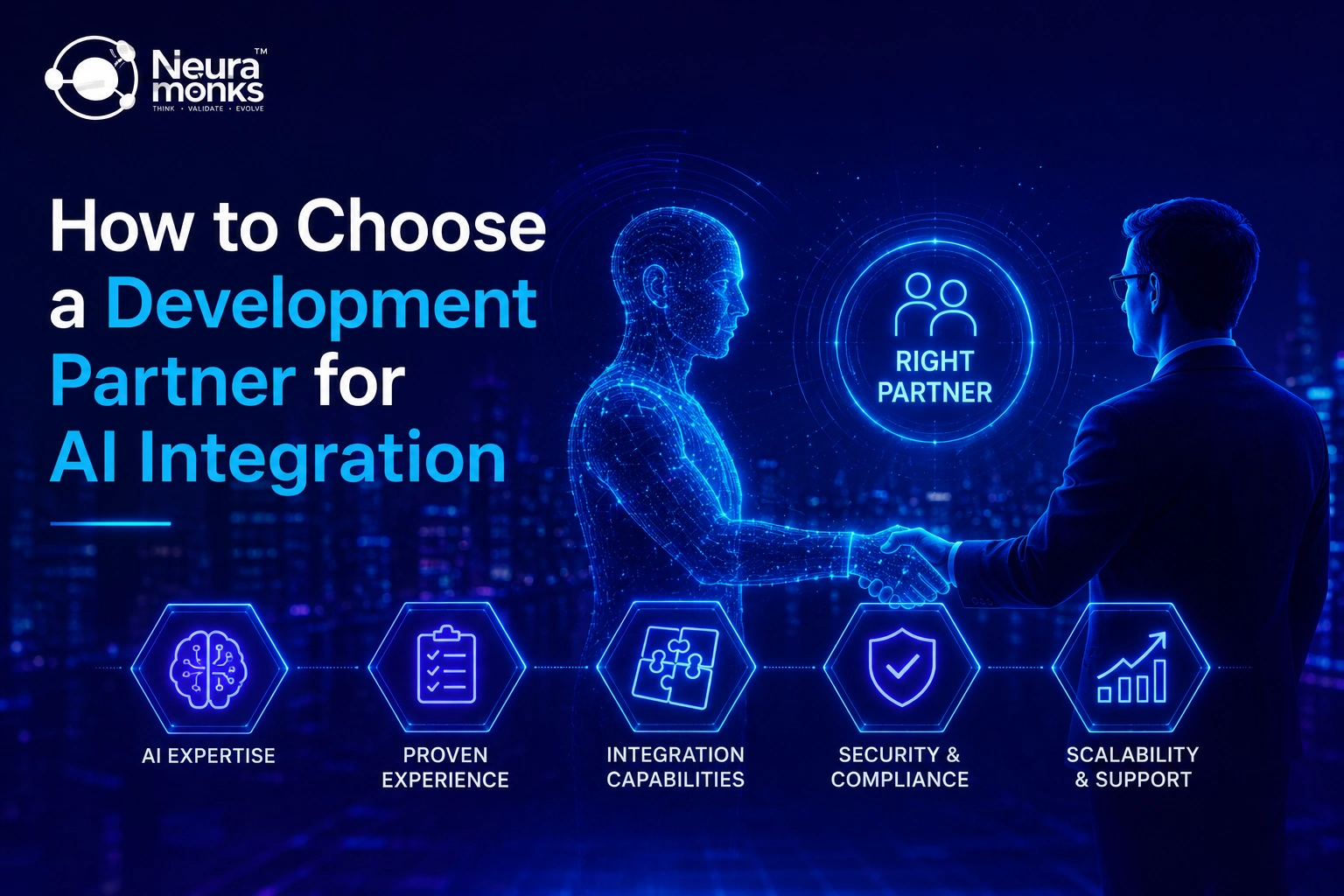
How to Choose the Right AI Development Partner a complete guide.
Selecting an AI development partner requires evaluating multiple dimensions beyond technical expertise. Here's a systematic approach to making the right choice:
1. Assess Technical Depth and Breadth
The best AI consulting partners maintain expertise across the full AI spectrum—from traditional machine learning to modern LLM implementations. Ask potential partners about their experience with specific technologies relevant to your use case. If you're exploring conversational AI, they should demonstrate deep familiarity with large language models, prompt engineering, and fine-tuning methodologies.
Request case studies showing end-to-end implementations similar to your needs. Generic examples aren't enough—you want to see proof they've solved problems analogous to yours. Neuramonks, for instance, has built reputation through documented success stories spanning multiple industries, demonstrating adaptability across different business contexts.
2. Evaluate Industry Experience
AI implementation best practices vary significantly across industries due to different regulatory requirements, data characteristics, and business models. A partner with relevant industry experience brings invaluable domain knowledge, understanding the nuances that generic consultancies miss.
In regulated industries like healthcare or finance, your partner should understand compliance requirements for AI systems, including model interpretability, audit trails, and bias mitigation. For retail or e-commerce, they should grasp the intricacies of recommendation systems, demand forecasting, and personalization at scale.
3. Verify Implementation Methodology
Outstanding consultancies follow structured methodologies that de-risk AI projects. They should articulate clear processes for:
- Discovery & scoping: How do they identify the right use cases?
- Proof of concept development: What's their approach to rapid prototyping?
- Production deployment: How do they ensure reliability and scalability?
- Performance monitoring: What metrics do they track?
Be wary of partners promising unrealistic timelines or guaranteed outcomes. AI development involves inherent uncertainty; honest consultants acknowledge this while demonstrating how they mitigate risks through iterative development and validation.
4. Examine Their Technology Philosophy
Does your potential partner take a vendor-agnostic approach, or are they locked into specific platforms? The best consultancies recommend technology based on your needs rather than partnership incentives. They should explain trade-offs between different approaches—cloud vs. on-premise, open-source vs. proprietary, build vs. buy—helping you make informed decisions.
In 2026, this includes understanding their position on foundation models. Do they have experience fine-tuning existing models? Building custom models from scratch? Implementing retrieval-augmented generation (RAG) architectures? Your business needs will dictate the right approach, and your partner should guide you accordingly.
5. Prioritize Communication and Collaboration
Technical brilliance matters little if your consultant can't translate complex AI concepts into business language. During evaluation, assess how well potential partners communicate. Do they explain things clearly without unnecessary jargon? Do they listen to your concerns and ask thoughtful questions about your business?
The best consulting relationships are collaborative partnerships, not vendor-client transactions. Look for consultants who view themselves as extensions of your team, invested in your long-term success rather than just completing a project.
6. Understand Their Data Strategy
AI success fundamentally depends on data quality and availability. Your consultant should demonstrate sophisticated understanding of:
- Data collection and preparation
- Data governance and security
- Privacy compliance (GDPR, CCPA, etc.)
- Synthetic data generation when needed
- Active learning strategies to improve models over time
They should proactively discuss data challenges and propose realistic strategies for addressing them. If a consultant glosses over data considerations, that's a significant red flag.
7. Evaluate Long-Term Partnership Potential
AI isn't a one-time implementation—it's an ongoing capability that requires nurturing. Your ideal partner should offer clear paths for continued collaboration, whether through managed services, on-demand support, or training your internal teams to eventually self-manage.
Consider their approach to knowledge transfer. Are they committed to building your internal capabilities, or do they prefer maintaining dependency? Neuramonks and other leading consultancies prioritize client empowerment, helping organizations develop lasting AI competencies.
Critical Questions to Ask Potential AI Consulting Partners
During your evaluation process, these questions will reveal crucial insights about potential partners:
About their experience:
- How do you handle projects where initial assumptions prove incorrect?
- What's your process for identifying the right AI use cases?
- How do you measure and ensure ROI from AI investments?
About their approach:
- Who specifically would be working on our project?
- What's your team's background in [relevant technology/domain]?
- Do you have capacity to scale support if our needs grow?
About their team:
- What does post-deployment support look like?
- How do you handle model retraining and optimization?
- What knowledge transfer and training do you provide?
About ongoing partnership:
- What does post-deployment support look like?
- How do you handle model retraining and optimization?
- What knowledge transfer and training do you provide?
Red Flags to Watch For
Just as important as knowing what to look for is recognizing warning signs. Be cautious of consultants who:
- Promise specific outcomes or guaranteed ROI without thorough discovery
- Push proprietary solutions without considering alternatives
- Lack relevant case studies or verifiable references
- Can't explain their methodology clearly
- Show limited interest in understanding your business
- Avoid discussing potential challenges or risks
- Price significantly below market rates (suggesting inexperience)
- Claim expertise across every possible AI domain
The Value of Specialized Expertise
While generalist AI consultancies serve a purpose, specialized partners often deliver superior results for specific use cases. If you're implementing conversational AI, a firm with deep natural language processing expertise will likely outperform generalists. For computer vision applications, seek partners with proven vision AI deployments.
This specialization extends to vertical industries. An AI consultant with extensive healthcare experience understands medical data privacy requirements, clinical workflows, and regulatory constraints in ways that generalists cannot match.
Making Your Final Decision
After thoroughly evaluating options, your decision should consider:
Technical fit: Do they have the right expertise for your specific use case?
Cultural alignment: Will they work well with your team and organizational culture?
Commercial terms: Are pricing and engagement models reasonable and transparent?
Long-term potential: Can this relationship scale with your AI ambitions?
References and reputation: What do past clients say about working with them?
Trust your instincts. The right AI consulting partner feels like a true collaborator—someone invested in your success and capable of guiding you through the complexities of AI implementation.
Conclusion
Choosing the right AI Development partner in 2026 requires careful evaluation of technical capabilities, industry experience, implementation methodology, and cultural fit. The AI landscape has matured to the point where success depends not just on technical prowess but on deep business understanding and the ability to translate AI capabilities into tangible value.
As you evaluate potential partners, remember that the best consultancies focus on building your long-term AI capabilities rather than creating dependency. They communicate clearly, demonstrate relevant experience, and approach your engagement as a collaborative partnership.
Ready to Transform Your Business with AI?
At Neuramonks, we specialize in helping businesses navigate their AI transformation journey with proven methodologies and industry-leading expertise. Our team brings deep technical knowledge combined with practical business acumen to deliver AI solutions that drive measurable results.
Whether you're exploring your first AI initiative or looking to scale existing implementations, we're here to guide you every step of the way. Let's discuss how we can help your organization unlock the full potential of artificial intelligence.
Contact us to schedule a consultation and discover how Neuramonks can become your trusted AI transformation partner.

Upendrasinh zala
Upendrasinh Zala is the Founder & CEO of Neuramonks, an enterprise AI and deeptech consulting firm based in Gujarat, India. Drawing from years of experience in AI-driven business strategy and corporate growth, he writes on leveraging artificial intelligence to optimize workflows and unlock tangible ROI for enterprises.