Insights and Inspiration
Explore Our Blog
Dive into our blog for expert insights, tips, and industry trends to elevate your project management journey.

How AI Is Saving Lives in Hospitals Right Now And What It Means for Global Healthcare
AI is no longer a future promise in healthcare it's actively detecting cancer earlier, flagging sepsis hours before it turns fatal, and eliminating medication errors across hospitals in the US, India, Mexico, and beyond. This article breaks down 7 proven clinical AI applications with real outcomes, real data, and what they mean for overstretched health systems globally.

Seven clinical applications that are no longer experiments. They are running inside hospitals across the US, India, UK, Mexico and emerging markets today.
Every 36 seconds, someone in the United States dies from cardiovascular disease. 422 million people worldwide suffer with diabetes. Healthcare systems from London to Lagos are stretched thin — too few specialists, too many patients, too little time per decision. AI in healthcare does not solve every part of that problem. But it addresses the most dangerous bottlenecks: the missed scan, the late sepsis flag, and the medication that should never have been prescribed. These seven use cases are where that shift is actually happening.
01 Early Disease Detection and Diagnostic Imaging
A 2020 study in Nature Medicine showed that an AI system detected breast cancer more accurately than a panel of six radiologists — reducing missed diagnoses by 9.4%. That single number represents a structural change in how diagnostic medicine works when AI is present. The technology no longer assists specialists; in certain contexts, it outperforms them.
Today, AI tools read diabetic retinopathy from eye scans, surface lung nodules on CT scans within seconds of acquisition, and flag stroke-indicating anomalies in brain MRIs before a radiologist opens the queue. For hospitals in underserved regions — rural England, sub-Saharan Africa, tier-3 cities across South and Southeast Asia — where specialist coverage is thin, this kind of AI solution changes the clinical calculus entirely.
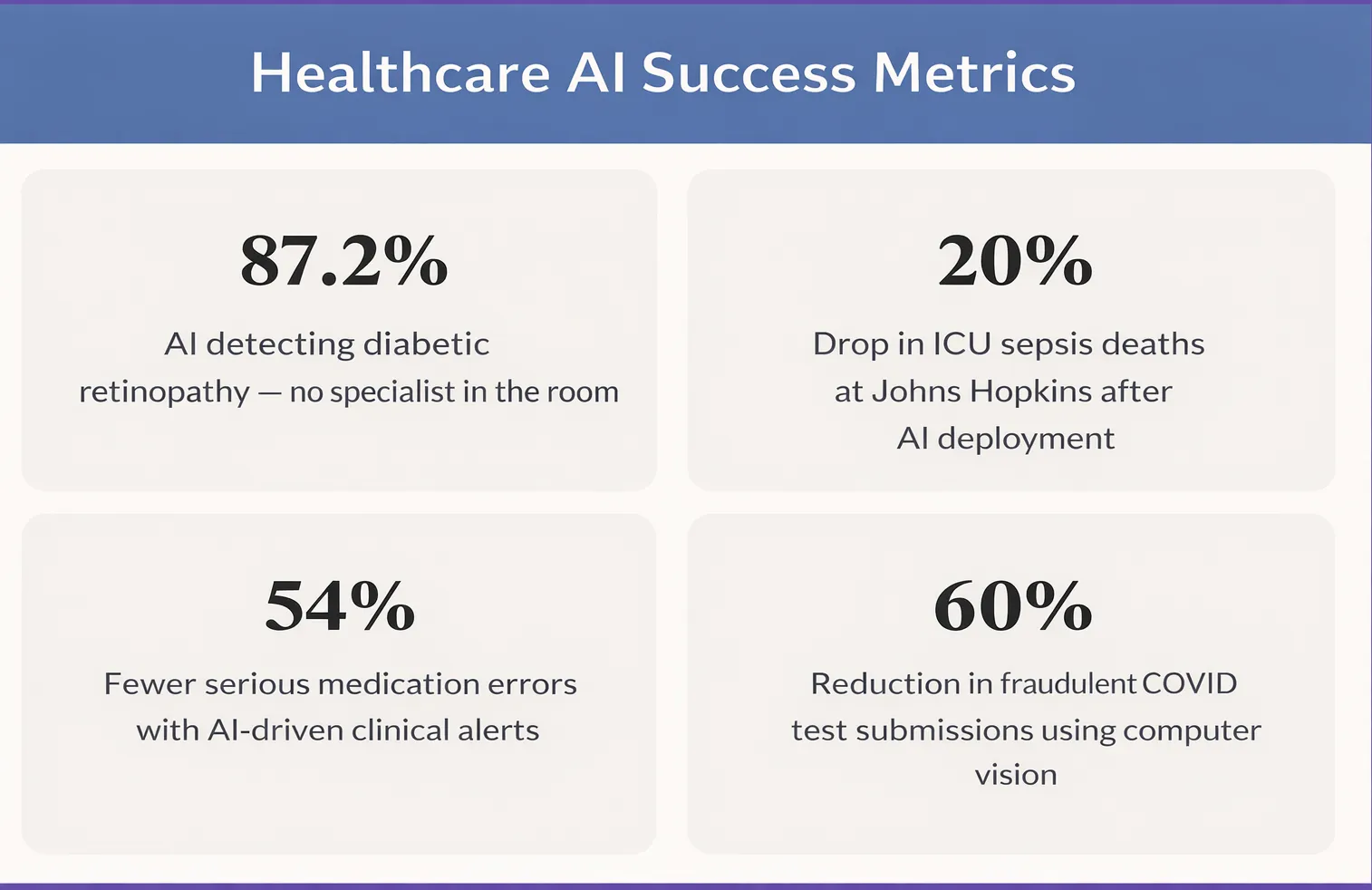
IDx-DR, the first FDA-authorised autonomous AI diagnostic system, detects diabetic retinopathy at 87.2% sensitivity without a specialist present.— IDx-DR Clinical Data
Faster turnaround. Fewer missed cases. Critical scans that automatically surface to the top of the queue. These are not incremental gains. They are fundamental changes to what a hospital can do with the staff it already has.
02 Predicting Sepsis Before It Becomes Fatal
Sepsis kills more Americans annually than prostate cancer, breast cancer, and AIDS combined. Globally, it causes around 11 million deaths per year — the majority in low- and middle-income countries. The clinical challenge is that early sepsis looks ordinary: mild fever, elevated heart rate, slight fatigue. By the time it looks like sepsis, the window has often closed.
AI models trained on electronic health records — combining vital signs, lab results, nursing notes, and medication history — now flag high-risk patients up to six hours before deterioration is visible. Johns Hopkins deployed one such AI solution and recorded a 20% reduction in ICU sepsis mortality. Epic and Cerner, the two largest hospital software platforms globally, both include native AI-powered sepsis alerts. The infrastructure is already inside hundreds of hospitals. The question is how well the models are tuned to each institution's patient population.
Every hour of delayed sepsis treatment increases mortality by 7%. AI-driven early warning systems give clinical teams back those critical hours — without requiring additional staff or equipment.
03 Catching Medication Errors Before They Reach the Patient
Medication errors harm approximately 1.5 million people in the United States alone every year. Globally, the WHO estimates that unsafe medication practices cause 1.3 million years of healthy life lost annually. Most of these errors are not caused by negligence — they happen because a nurse is managing eight patients at once, or a physician is entering orders under pressure, or a critical allergy note is buried three screens deep in a legacy system.
AI-powered clinical decision support catches what humans miss in those conditions:
- Drug-drug interaction alerts
- Dosage errors by weight or kidney function
- Allergy conflicts buried in old records
- Look-alike/sound-alike drug confusion
A JAMA study found AI-driven alerts reduced serious medication errors by 54% compared to older rule-based systems. The critical design shift was smarter alerting, not louder alerting — irrelevant alerts filtered out so clinicians stopped dismissing them.
04 Virtual Health Assistants and Patient Engagement
Not every life-saving moment happens inside an ICU. Many happen — or fail to happen — in the weeks between appointments. No-show rates for outpatient appointments run between 18–40% across healthcare systems globally. For patients managing diabetes or hypertension, a missed visit means missed labs, missed medication adjustments, and eventually a hospitalisation that was entirely avoidable.
AI-powered virtual assistants send personalised reminders via SMS or messaging apps, conduct pre-visit intake in multiple languages, follow up on discharge instructions, and answer common post-procedure questions around the clock. For patients in underserved communities without easy access to primary care, a 24/7 AI triage tool often provides the only immediate clinical guidance available.
AI consulting services are increasingly helping health systems design patient engagement workflows — not just deploy tools. The difference between a chatbot and an effective patient journey is the clinical logic built around it.
05 Computer Vision in Clinical Assessment
Some of the most significant advances in AI in healthcare are happening in areas that rarely make headlines: the routine measurements that clinical teams repeat hundreds of times a week. Wound assessment is one of them. Traditional ruler-based wound measurement is time-consuming, subjective, and varies significantly between clinicians — limiting a hospital's ability to track healing consistently or compare outcomes across facilities.
Deep learning systems now perform this work from a standard smartphone photograph. Computer vision models segment the wound boundary, detect a calibration marker, correct for camera angle and perspective, and output clinically accurate centimetre-based measurements of area, perimeter, width, and height — in seconds, without manual intervention.
Neuramonks Case Study
Automated Wound Detection & Measurement System
A healthcare client needed to replace subjective, ruler-based wound measurements with a standardised, scalable system. Neuramonks built an end-to-end AI pipeline using Attention U-Net deep learning segmentation combined with a green calibration marker for real-world scale reference. The system delivers wound measurements with under 5% error compared to expert manual assessment — and works from standard RGB images, making it viable for both clinical and remote monitoring settings.
- 55–65%reduction in clinician measurement time
- 30–40%improvement in cross-clinician consistency
- < 5% error vs expert manual measurements
See the full case study →
The same computer vision approach applies across a wide range of clinical imaging tasks — from surgical site monitoring to dermatology screening — wherever visual assessment has historically depended on a clinician being physically present.
06 Pathology Automation and Diagnostic Verification
Laboratory medicine is one of the most data-intensive disciplines in healthcare and one of the most dependent on human visual analysis. A trained haematology technician reads blood smears for hours, looking for abnormal cells, infection markers, and parasitic invasion. The work is skilled, repetitive, and subject to fatigue-related error — particularly in high-volume labs in tropical regions where malaria and other parasitic infections drive enormous diagnostic demand.
AI in healthcare is automating this pipeline end-to-end: detecting, classifying, and counting blood cells from microscopic images with speed and consistency no human team can match at scale.
Neuramonks Case Study
AI-Powered Blood Cell and Malaria Detection System
A diagnostics client serving high-incidence regions needed to reduce the bottleneck of manual blood smear analysis. Neuramonks delivered an end-to-end deep learning system that performs instance segmentation of red blood cells, white blood cells, and platelets — including a dedicated module for detecting Plasmodium-infected RBCs. The system handles overlapping and clustered cells and runs from image ingestion to results in seconds, compatible with existing microscopy and laboratory information systems.
- 50–60%reduction in technician analysis time
- 30–35%improvement in diagnostic consistency
- 25–40%fewer missed malaria cases
See the full case study →
Beyond malaria, the same architecture applies to haematological cancers, anaemia screening, and platelet disorder diagnosis. AI consulting services built around these systems help labs define the right model architecture, training data strategy, and deployment approach for their specific clinical environment.
The same principle of AI-driven authenticity and verification extends to public health programmes. When Corona Test UK needed to verify COVID test results for airline passengers at scale — preventing manipulation and fraud while maintaining speed — a computer vision pipeline was the only viable answer at that volume.
07 AI-Powered Clinical Decision Support for Glaucoma Management
Glaucoma is the leading cause of irreversible blindness globally, affecting over 80 million people. Yet diagnosis requires analysing a web of complex variables — intraocular pressure history, optic nerve morphology, visual field progression, patient age, and longitudinal trends across dozens of visits. Even experienced ophthalmologists face diagnostic ambiguity when these signals conflict.
A standard prediction model is not sufficient for this clinical environment. What ophthalmologists need is a system that separates initial diagnosis from validation — so that confidence is explicitly scored and every recommendation is independently verified before it influences a treatment plan.
Case Study: AI Clinical Decision Support — Glaucoma Management Platform — Neuramonks
Neuramonks built a multi-agent clinical decision support platform for ophthalmologists, using a dual-agent architecture on Deerflow. A Diagnostic Agent processes patient data against a large historical repository to stage disease and generate tailored follow-up recommendations. A Validation Agent independently reviews each recommendation and outputs a transparent confidence score out of 10. The two agents operate in a self-correcting workflow — the Validator is explicitly prompt-engineered to score the logic of the recommendation rather than simply confirm it.
- < 60s End-to-end analysis per patient, including dual-agent validation
- 10/10Transparent confidence score output for every recommendation
- 80+Visit longitudinal records processed without latency issues
Key engineering challenges solved
- Diagnostic ambiguity: when patient data is incomplete, the system generates multiple clinical scenarios rather than forcing a single conclusion
- Outlier safety: when a patient profile doesn't match the historical repository, the system triggers a Low Confidence fallback and routes the case directly to the ophthalmologist
- Longitudinal data retrieval: a custom search optimisation algorithm within Deerflow parses dense multi-decade records and returns verified results in under a minute
- Multi-agent synchronisation: context window fine-tuned to ensure the Validation Agent stays objective and doesn't simply echo the Diagnostic Agent's output
08 AI-Powered Dental Bite Classification from 3D Scans
Orthodontic diagnosis from 3D dental scans (STL files) has historically been manual, time-consuming, and highly dependent on the individual clinician's experience. In real clinical settings, patients rarely present with a single bite problem — a typical complex case may combine a Class II malocclusion with a Deep Bite and a Scissors Bite simultaneously. Identifying all co-occurring conditions consistently, across clinicians, is precisely the kind of problem where AI delivers structural value.
The system Neuramonks built goes beyond binary classification. It stages the primary bite category, detects all co-occurring conditions, validates that the detected combination is medically consistent, and outputs a ranked result with a confidence level per finding — all from a single STL upload.
Case Study: AI Dental Bite Classification System — Neuramonks
Neuramonks trained a multi-label classification model on 800+ real 3D dental scans, each verified by certified orthodontists, covering both simple and complex real-world cases including rare bite combinations. The system analyses the 3D geometry of a patient's dental scan, identifies the primary bite class (Class I, II div 1, II div 2, or III), flags all co-occurring conditions (Cross Bite, Open Bite, Deep Bite, Scissors Bite), validates the medical plausibility of the detected combination, and outputs a structured, confidence-ranked result — in seconds.
- 800+Verified 3D dental scans used for training
- 4+1Primary bite classes + 4 co-occurring conditions detected simultaneously
- 100%Medically validated output combinations — no anatomically impossible results
Example output — single patient scan
- Primary diagnosis Class II div 1Very High Confidence
- Co-occurring conditionDeep BiteHigh Confidence
- Co-occurring conditionScissors BiteGood Confidence
Clinical workflow
- The orthodontist uploads the patient's STL file into the system
- AI analyses 3D geometry, identifies the primary class and all co-occurring conditions
- Medical plausibility check validates the detected combination before the output is surfaced
- Structured, confidence-ranked result is presented instantly — used for treatment planning, patient communication, and cross-clinician consistency
09 Drug Discovery and Clinical Trial Access
Bringing a new drug to market costs roughly $2.6 billion and takes ten to fifteen years. Most candidates fail in late-stage trials after years of investment. AI is compressing both the timeline and the failure rate: protein structure prediction has resolved folding for millions of proteins, generative models propose novel molecular compounds with target properties, and biomarker analysis predicts which patients will respond to which therapies before the first dose.
Insilico Medicine identified a novel drug candidate for idiopathic pulmonary fibrosis in eighteen months — a process that would typically take four to five years. The compound entered Phase 2 clinical trials in 2023.
For patients with rare diseases or treatment-resistant cancers, clinical trial matching is often the most immediately practical AI application. These tools scan a patient's electronic record against thousands of active trial eligibility criteria in real time — surfacing opportunities that would require weeks of manual research by a specialist coordinator. For patients who have exhausted standard options, it can be the difference between access and invisibility.
Your clinical AI project starts with a clear problem statement.
The gap between knowing AI can help and actually deploying something that works in a clinical environment is where most projects stall. It is not a technology problem. It is a scoping problem, a data problem, or a workflow problem — and usually some combination of all three.
Neuramonks works with healthcare organisations at whatever stage they are at. Some come with a clear brief and need a team to build it. Others have a clinical problem they are not sure AI can solve and want an honest conversation before spending anything. Others are partway through a deployment that has lost momentum and need someone to pick it up.
We designs and delivers AI solutions purpose-built for healthcare — diagnostic imaging, pathology automation, wound assessment, clinical decision support, and more. Whether you are evaluating a first pilot or scaling across a hospital network, we help you move from problem to measurable outcome.
Reach out to the Neuramonks team here.
A free discovery call. No pitch, no deck. Bring the problem and we will give you a straight answer on what is feasible, what is not, and what it would realistically take.
How NVIDIA's Agent Toolkit Is Quietly Reshaping Healthcare AI And What Your Organization Should Do About It
Nvidia's open-source Agent Toolkit — launched at GTC 2026 — gives healthcare organizations a production-grade, HIPAA-compliant foundation for deploying autonomous AI agents, already cutting clinical trial timelines from 7 weeks to 2 across 19 of the world's top 20 pharma companies.

From cutting clinical trial timelines in half to powering surgical robotics, Nvidia's open source Agent Toolkit is rewriting the infrastructure of AI in healthcare. Here is what changed at GTC 2026, and what it means for hospitals, pharma, and health systems building AI today.
Most conversations about AI in healthcare focus on what models can predict. NVIDIA's announcement at GTC 2026 on March 16 shifted that conversation to something more consequential: what autonomous agents can actually do inside clinical systems, in real time, at scale, and without violating the regulatory boundaries that define healthcare operations.
The Nvidia Agent Toolkit is an open-source software platform that gives healthcare organizations and the technology companies that serve them a production grade foundation for deploying autonomous AI agents. Not pilots. Not proofs of concept. Agents running continuously inside pharmaceutical workflows, hospital systems, and life sciences platforms that are already serving some of the largest healthcare institutions on the planet.
The scale of what was announced at GTC 2026 is significant. And for any healthcare organization still treating AI as a future strategy rather than a current operational decision, this is a moment worth paying close attention to. For background on how agentic AI differs from traditional automation approaches, NeuraMonks has a detailed breakdown worth reading first.
Healthcare AI at GTC 2026: The Numbers That Matter
Before unpacking the toolkit itself, these are the data points that define the scale of what Nvidia and its healthcare partners announced:

What the Nvidia Agent Toolkit Actually Is — In Plain English
The Agent Toolkit is a modular open-source stack with four core components, each solving a distinct problem that has blocked healthcare AI from moving beyond pilot deployments:
OpenShell The Compliance-First Security Runtime
OpenShell is the layer that makes the rest of the toolkit viable in healthcare. It is an open-source runtime that enforces policy-based security, network access controls, and privacy guardrails for every autonomous agent that runs on it. Each agent called a 'claw' in Nvidia's terminology — operates in a sandboxed environment with strictly defined data access boundaries. For healthcare organizations bound by HIPAA, GDPR, and sector-specific regulatory requirements, this is not a nice to have. It is the precondition for deployment.
Cisco AI Defense and CrowdStrike are both integrating directly with OpenShell, embedding their security controls into the agent architecture from the ground up not bolted on afterward.
AI-Q Blueprint Deep Research and Clinical Intelligence
AI-Q is an open agent blueprint designed for complex, multi-step research tasks exactly the kind that define clinical development workflows. It uses a hybrid architecture: frontier models handle orchestration and reasoning, while Nvidia's open Nemotron models handle retrieval and analysis. The result is a 50%+ reduction in query costs without sacrificing accuracy. It currently ranks first on both the DeepResearch Bench and DeepResearch Bench II leaderboards the most relevant benchmarks for the kind of evidence synthesis and knowledge extraction that healthcare AI depends on.
Nemotron Open Models Built for Regulated Environments
Nemotron is Nvidia's family of open models optimized for agentic reasoning. Multiple healthcare technology companies are already building on them including Hippocratic AI for clinical patient conversations, Open Evidence for medical intelligence synthesis, and Verily for its Violet AI health companion. They are model agnostic and swappable, which matters in healthcare where today's approved model may be superseded by a more accurate one within 18 months.
Ope H and Cosmos H Physical AI for Surgical Robotics
Beyond software agents, Nvidia released Open-H the world's largest healthcare robotics dataset, comprising 700+ hours of surgical video built with 35+ collaborators, including CMR Surgical and Johnson & Johnson MedTech. Cosmos H enables developers to generate physics-accurate synthetic surgical data for training robotic systems. The GR00T H vision language model translates clinical text commands into physical robot actions. This is AI in healthcare extending from the data centre into the operating room.
Before and After: Healthcare AI With and Without the Toolkit
The practical difference between the previous state of healthcare AI deployment and what the Agent Toolkit enables is not incremental. It is structural.

Five Ways the Agent Toolkit Is Already Changing Healthcare AI
1. Clinical Trial Acceleration From 200-Day Start-Ups to Autonomous Workflows
Clinical trial start-up site selection, participant recruitment, regulatory submissions has historically taken around 200 days and is one of the most manually intensive phases of pharmaceutical development. IQVIA's AI agents, built on the Nvidia Agent Toolkit, are directly targeting this bottleneck. Their clinical data review agent alone has compressed the review cycle from 7 weeks to as little as 2 weeks using automated multi-check workflows.
IQVIA.ai, launched at GTC 2026, is now a unified agentic platform serving 19 of the top 20 pharmaceutical companies. These are AI solutions that operate as a digital command centre across clinical, commercial, and real-world operations not dashboards that analysts query, but agents that monitor, detect, escalate, and act continuously.
2. Drug Discovery Reasoning Across Protein Structures at Scale
Drug discovery has always been constrained by the volume of biomedical literature that any human team can meaningfully synthesize. AI-Q-powered agents change this equation by building continuously updated knowledge graphs from research articles, biomedical databases, and proprietary experimental data identifying compound opportunities and indication priorities that would take human researchers months to surface.
At GTC 2026, Nvidia, EMBL, Google DeepMind, and Seoul National University jointly announced 1.7 million new predicted protein complexes contributed to the AlphaFold Protein Structure Database, with 30 million additional structures available for bulk download. Eli Lilly and Nvidia's $1 billion, five-year commitment to AI-based drug discovery is the largest investment signal yet that this is no longer exploratory it is infrastructure.
3. Patient-Facing Care Chronic Care Management and Post-Discharge Follow-Up
Hippocratic AI is using Nvidia's NeMo framework to train large, domain-adapted models for clinical conversations with patients focused specifically on chronic care management and post-discharge follow-up, two of the highest cost, lowest coverage gaps in current healthcare delivery. These are AI solutions running 24/7 at a cost and availability profile that no human staffing model can replicate.
Verily's Violet, built on Nemotron, helps individuals interpret their own health data and navigate symptoms a direct-to-consumer application of the same agent infrastructure that pharmaceutical companies are using for enterprise workflows. One toolkit, two entirely different deployment contexts, both operational today.
4. Clinical Documentation Eliminating the Transcription Burden
HeidiHealth, a multilingual clinical documentation platform, is deploying ambient listening agents that handle over 2.4 million weekly consultations across 190 countries. Physicians dictate naturally during patient interactions; agents transcribe, structure, and code the clinical record in real time. For healthcare systems struggling with physician burnout driven by administrative overload, this is one of the most immediately deployable AI solutions with measurable ROI from day one.
Sofya, another Nvidia partner, processes over 1 million clinical encounters using real-time AI transcription that also surfaces evidence-based protocol suggestions during the consultation itself closing the loop between documentation and clinical decision support in a single workflow.
5. Surgical Robotics AI in the Operating Room
Physical AI in healthcare is no longer a research project. CMR Surgical has contributed close to 500 hours of surgical video to Open-H. Johnson & Johnson MedTech is adopting Nvidia's physical AI platform. The GR00T-H model processes surgeon text commands and generates robotic motion in response. Rheo, a developer blueprint released at GTC, enables hospital digital twins that simulate clinical workflows, device interactions, and patient movement allowing healthcare organizations to model and validate AI agent deployments before any physical change to hospital operations.
NeuraMonks Healthcare AI in Practice
The use cases above are not hypothetical. At NeuraMonks, we have been building production AI solutions for healthcare imaging and clinical diagnostics the same category of deep learning infrastructure that underpins agent ready healthcare systems. Two projects that demonstrate what this looks like in practice:
Our Cell Segmentation AI system applies deep learning models to microscopy imaging automatically identifying, classifying, and segmenting individual cells across large image datasets with accuracy that matches expert human analysis. This is the kind of AI in healthcare that accelerates research workflows directly: what previously required hours of manual annotation now runs in minutes, at scale, with a consistent and auditable output.
Our Automated Wound Detection and Measurement System uses deep learning to detect wound boundaries, classify wound type, and calculate precise measurements from clinical photography removing the subjectivity and inconsistency from wound assessment that has long made longitudinal tracking unreliable. For clinical teams managing chronic wounds, burns, or post-surgical healing, these are AI solutions that feed directly into the kind of structured, auditable data that agent-driven care coordination systems require.
Both projects represent the data quality and model reliability foundation that healthcare organizations need in place before deploying autonomous agents at scale. If your imaging pipelines, diagnostic data, or clinical records are not structured and validated, agents built on the Nvidia Toolkit will inherit those gaps. Getting the AI infrastructure layer right is step one and it is work we have done across healthcare environments with real clinical constraints.
The Trust Problem: Why OpenShell Changes the Healthcare AI Conversation
Every healthcare CIO and compliance officer who has reviewed an AI deployment proposal has asked the same question: what happens when the agent accesses data it shouldn't, takes an action it wasn't authorized to, or produces a recommendation that creates liability?
Until now, the honest answer was that guardrails were largely custom-built, inconsistent across vendors, and difficult to audit. OpenShell changes this by making policy enforcement a runtime feature, not an afterthought. Every agent runs in a sandboxed environment. Data access is governed by least-privilege controls. Network reach is defined by policy. Every action is logged with a full auditable trail.
IQVIA's approach to this is worth noting directly. Their healthcare-grade AI framework was built around privacy, regulatory compliance, and patient safety as primary design constraints not compliance layers added after the fact. With 100+ AI-related patents filed and active deployments across 19 of the top 20 pharmaceutical companies, IQVIA.ai represents the most validated AI in healthcare agent deployment at scale available today. The Nvidia Agent Toolkit is what makes that scale reproducible for other healthcare organizations.
This is precisely where AI consulting services matter most. The technology is available. The security infrastructure exists. What separates organizations that deploy successfully from those that stay in pilot mode is a clear architecture for how agents integrate with existing clinical systems, how compliance requirements are mapped to runtime policies, and how governance frameworks are maintained as the toolkit evolves. That translation work is not a technology problem it is a strategy problem.
What Your Healthcare Organization Should Do Right Now
Nvidia's Agent Toolkit is open source and available today. IQVIA.ai is live. Roche's AI factories are operational. The market is not waiting for healthcare organizations to finish their AI strategies. Here is where to focus:
• Audit your data governance posture. OpenShell is only as effective as the data access policies you define. If your data classification and access control frameworks are incomplete, agent deployment will inherit those gaps. This is step one, and it is not an IT task — it requires clinical, legal, and compliance leadership.
• Identify your highest-friction clinical workflows. Clinical trial start-up, data review, patient documentation, and post-discharge follow-up are the four areas where AI agents are delivering the most measurable value fastest. Map your version of these workflows against what IQVIA and Hippocratic AI are already doing at scale.
• Evaluate build vs. partner. The Nvidia Agent Toolkit is open source, but implementation inside regulated healthcare environments is not self-service. The right AI development company partner will have both the technical depth to implement the toolkit correctly and the domain knowledge to navigate healthcare-specific compliance requirements from the start.
• Start with one workflow, not a platform. The organizations making the fastest progress with AI in healthcare are not the ones with the most comprehensive AI strategies. They are the ones that identified one high-value workflow, deployed agents in a production environment, measured results, and expanded from there.
• Engage AI consulting services early. The cost of a poor architecture decision in healthcare AI is not just technical debt — it is compliance exposure, patient safety risk, and organizational trust. Getting the governance framework right before deployment is significantly less expensive than retrofitting it afterward.
For a deeper look at how the AI infrastructure landscape has evolved to produce tools like the Agent Toolkit,Standard RAG Is Dead Here's What's Replacing It in 2026 useful context on the retrieval and reasoning layer these agents are built on top of.
NVIDIA's Agent Toolkit is not a research announcement. It is a production platform that is already running inside the clinical trial operations of 19 of the top 20 pharmaceutical companies, the surgical systems of leading robotic surgery providers, and the patient care workflows of health systems across 190 countries. The infrastructure of AI in healthcare changed materially on March 16, 2026.
The open-source model means any healthcare organization can access the same stack. OpenShell means the compliance foundation is built in. The partnership ecosystem IQVIA, Roche, Hippocratic AI, HeidiHealth, CMR Surgical means the implementation patterns are already validated at scale.
What it does not mean is that deployment is automatic. The organizations capturing the most value from AI in healthcare right now are those that invested early in the governance frameworks, data infrastructure, and integration architecture that allow agents to operate reliably inside complex clinical environments. Building those foundations — and doing it in a way that satisfies regulators, protects patients, and delivers measurable operational value is exactly the work that NeuraMonks specializes in.
Is Your Healthcare Organization Agent-Ready?
NVIDIA's Agent Toolkit sets a new bar for what's possible in healthcare AI but the gap between possibility and deployment is where most organizations get stuck. At NeuraMonks, we assess your infrastructure, data governance posture, and workflow architecture so you can implement AI solutions that are built for the regulatory realities of healthcare, not around them.
Find out where your organization stands Book a call and get your AI readiness assessment today

What Does Talk to Data Mean? A Beginner Friendly Guide
"Talk to data" lets any team member ask business questions in plain English and get instant answers — no SQL, no dashboards, no analyst bottleneck. This guide covers how the technology works, real ERP results from Neuromonks, and how to know if your business is ready.
You've probably heard someone say, "Just ask your data." Or maybe you've seen a product demo where a person types a plain English question and the software spits out a chart, a number, an answer instantly.
That's "talk to data" in action.
No SQL. No spreadsheet formulas. No waiting on your analyst. You just ask a question, as you would to a colleague, and get an answer back.
This guide breaks down what it actually means, who's using it, and why it's one of the most practical shifts happening in how businesses use information right now.
The numbers that explain why this matters
Before getting into how it works, here's the context that makes this worth paying attention to:
- 73% of business data goes unanalyzed it's collected, stored, and never touched. (Forrester)
- The average employee spends 2.5 hours per day searching for information they need to do their job. (McKinsey)
- Only about 20% of employees in a typical company are comfortable using BI tools or writing queries independently.
- Companies using AI-powered data interfaces report up to 60% reduction in time spent on routine reporting tasks.
- The natural language processing (NLP) market is growing at 29% annually and is expected to exceed $43 billion by 2025.
Put those together and the problem becomes clear: most businesses are drowning in data and starving for answers. The bottleneck isn't the data it's access.
What does it really mean to "talk to data"?
At its core, "talk to data" means interacting with your business data using natural language plain sentences — instead of code or complex tools.
Think of it this way. Before, if you wanted to know which product sold best last quarter in Gujarat, you'd either write a SQL query, build a dashboard filter, or ask your data team to run the report. That process could take hours or days.
With a talk to data interface, you type: "Which product had the most sales in Gujarat last quarter?" — and you get the answer in seconds.
The technology behind this combines large language models (LLMs), natural language processing, and query generation tools that translate your plain-text question into database logic. You never see the code. You just see the result.
Why do people struggle with data in the first place?
Most data sits locked inside dashboards that require training to use, databases that require SQL to query, and spreadsheets that require formulas most people never learned.
The result? Only a small slice of the company usually analysts, data scientists, or engineers — actually touches the data. Everyone else works from gut feeling, second-hand summaries, or waits days for reports.
This isn't a motivation problem. It's an access problem.
Talk to data solutions exist to close that gap. When any team member sales, operations, HR, support can directly query company data with a question they'd ask out loud, the whole organization moves faster. Decisions that used to wait on a report now happen in the same meeting where the question was raised.
How does it work under the hood?
Without going too deep into the technical side, here's the rough flow:
- You type (or speak) a question in plain language.
- An AI model interprets your question and figures out what data you're asking for.
- It translates that into a query — usually SQL or a structured API call.
- The query runs against your data source (database, warehouse, spreadsheet).
- The result comes back and gets displayed as text, a table, or a chart.
The smarter systems also understand context. So if you ask a follow-up "now break that down by city" the system knows you're still talking about the same dataset and refines the query accordingly.
Some of the more advanced AI solutions setups even let you ask ambiguous questions and will clarify before running the query, rather than guessing wrong and handing you bad data.
In reality, what questions are you able to ask?
Good talk to data systems that handle a wide range of question types:
Lookup questions: "What's the total revenue for March 2025?"
Comparison questions: "How did Q1 2025 compare to Q1 2024?"
Trend questions: "Which product categories are growing the fastest this year?"
Segmentation questions: "Show me customers who haven't purchased in 90 days."
Anomaly questions: "Are there any unusual spikes in support tickets this week?"
The quality of answers depends on how well the system understands your data schema and how clean the underlying data is. Garbage in, garbage out that part hasn't changed.
Traditional reporting vs. talk to data: side by side
Here's where the real difference shows up in day-to-day work:
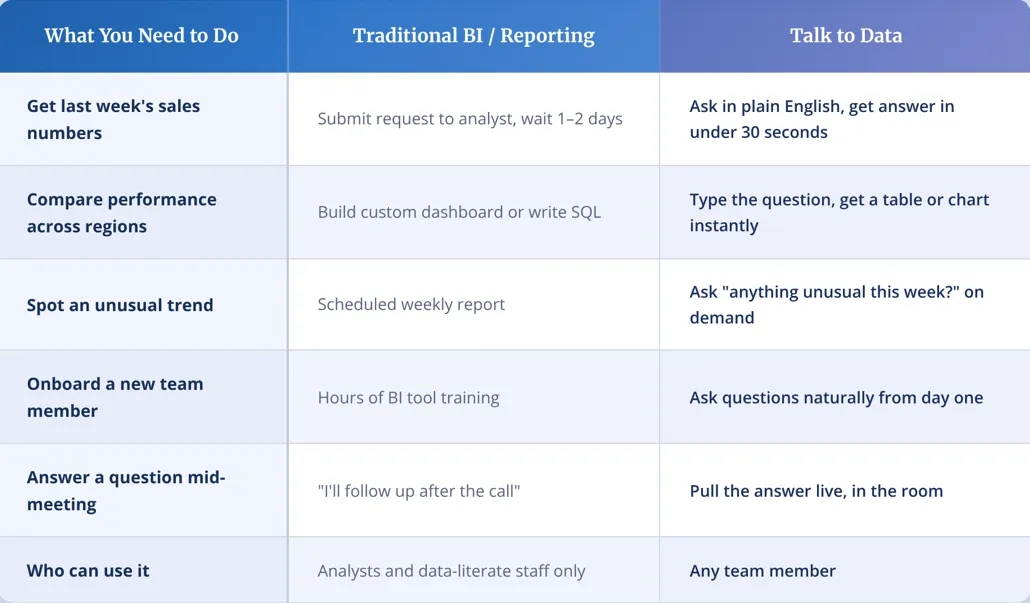
The table isn't saying traditional BI is useless it's not. Complex dashboards, scheduled reports, and data modeling still have their place. But for the everyday question-and-answer workflow, natural language querying cuts the friction by a significant margin.
A real-world talk to data case study: ERP analytics for manufacturing
Here's a concrete example of what this looks like when it's actually deployed not a demo, but a production system built by Neuramonks for a manufacturing and finance client running a full ERP environment.
The problem:
The ERP system handled all core transactional workflows procurement, inventory, supplier management, financials. But getting any insight out of it required going through analysts or IT. Business users had no way to query ERP data on their own. Leadership couldn't get fast visibility into supplier risk, inventory aging, or cost exposure without waiting on a report cycle. Worse, the ERP held sensitive financial data, so just opening up query access wasn't an option — governance and access controls had to hold firm.
What Neuramonks built:
Neuramonks designed a secure, role-based AI analytics layer Talk to Data for ERP embedded directly inside the existing ERP environment. Business users could now ask plain English questions and get answers back instantly, with the system enforcing the same permission rules already set in the ERP. Finance could only see finance data. Procurement saw what procurement was allowed to see. No cross-entity leakage, no governance risk.
The system was built for 100+ concurrent users, with exact-match structured querying and validation to prevent AI hallucinations on financial figures because wrong numbers in finance have real consequences.
The results:
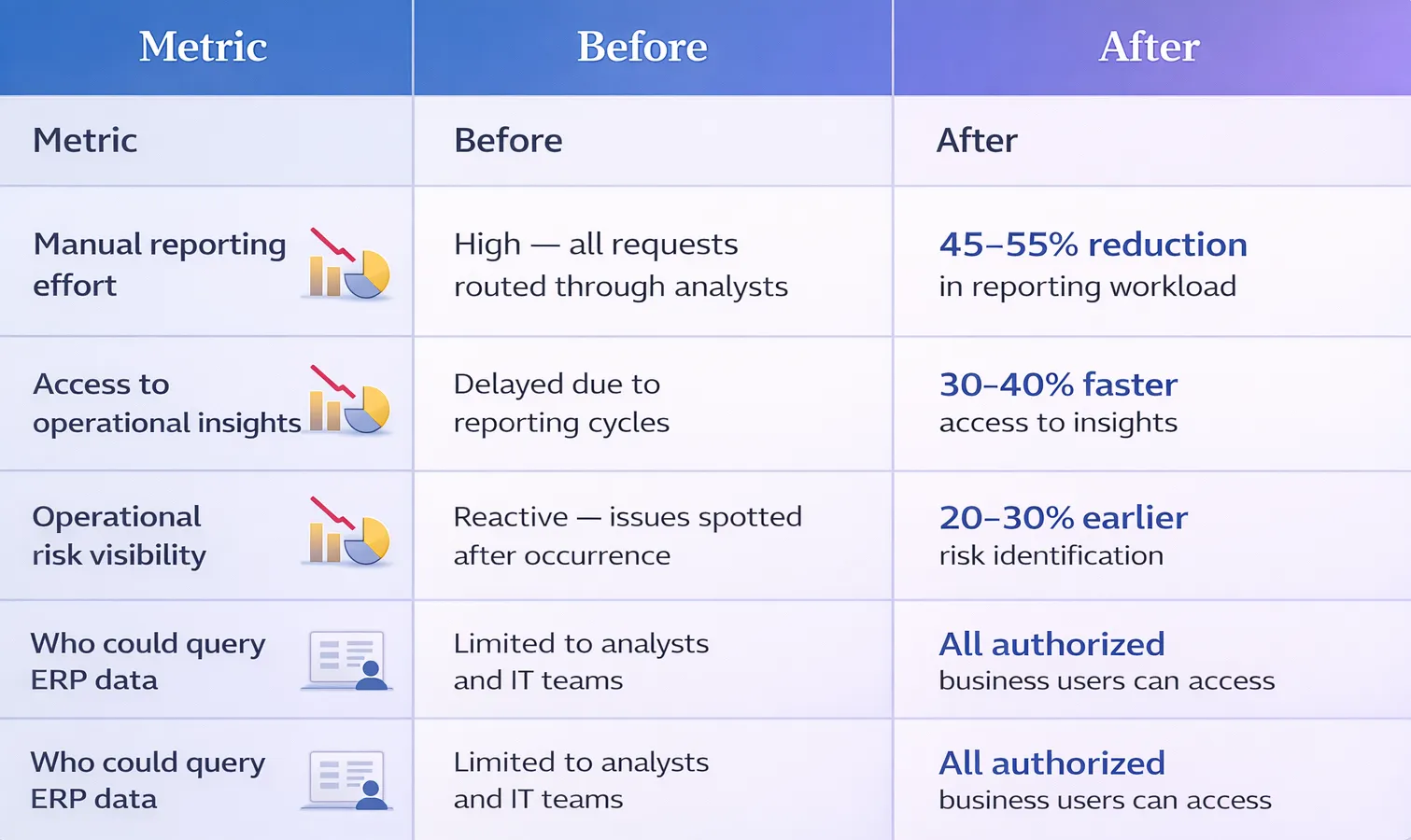
Beyond the numbers, the shift that mattered most was ownership. Finance teams, procurement leads, and business managers stopped waiting on others to get the data they needed to do their jobs. The ERP went from a system people worked around to one they actually used without the governance team losing any sleep over it.
Where does this fit with voice?
One direction this technology is heading is voice. Instead of typing your question, you speak it.
A voice agent connected to your data layer can let you ask questions hands-free. Imagine asking your phone during a commute: "What's our current pipeline value for this quarter?" and getting a verbal answer read back to you.
This isn't science fiction. Several companies are already building voice-to-data workflows for field teams, executives who prefer speaking to typing, and customer-facing support bots that pull live data to answer customer queries in real time.
At Neuramonks, we've seen interest in voice data interfaces pick up sharply in the last 12 months, especially from operations-heavy businesses where people are on the floor, not at a desk. A warehouse manager asking "How many units of SKU-4421 do we have left?" While searching through a laptop's dashboard is somewhat different from strolling the floor.
What "talk to data" is not
Worth clearing up a few misconceptions:
It's not a replacement for a data strategy. If your data is messy, incomplete, or siloed across too many systems with no consistent naming conventions, a natural language interface will give you fast answers to the wrong questions. Fix your data foundation first.
It's not magic. The AI has to understand your schema. That requires some one-time setup connecting your data sources, defining your business terms, and testing edge cases. It's a few weeks of work, not a flip of a switch.
It's not only for large enterprises. The businesses that benefit most quickly are often mid-size companies where 1 or 2 analysts are bottlenecked serving an entire organization. They see ROI fastest.
How to know if you're ready
A few honest questions before investing:
Is your data in one place (or can it be)? A talk to data system needs to connect to your data warehouse or database. Fragmented data across 12 different spreadsheets complicates the setup not impossible, but it adds time.
Do you have consistent naming? If your sales team calls it "revenue" and finance calls it "net receipts," the system needs to know they mean the same thing. One-time setup, not a dealbreaker.
Do non-technical people regularly need data? If yes, this solves a real problem. If your team is already data-literate and comfortable with BI tools, the ROI case is weaker though speed gains are still real.
How Neuramonks approaches this
At Neuramonks, our AI consulting services cover the full lifecycle from assessing whether your data is ready for natural language querying, to building and deploying the interface, to training your team on getting the most out of it.
We don't push a one-size-fits-all product. Most of the implementations we've done are custom built on top of existing data infrastructure rather than replacing it. Reducing the time between "I have a question" and "I have an answer" is always the aim.”
If you're not sure whether your business is ready, that's actually the best time to have the conversation. We help you figure out what's worth building now and what can wait.
The bottom line
"Talk to data" is a straightforward idea: remove the technical barrier between people and the information they need to do their jobs.
The technology works in production today, not just demos. Businesses seeing the most value invest in getting their data house in order first, then layer the natural language interface on top. The ones who skip that step get fast answers to the wrong questions.
If your team is waiting on reports, working from outdated numbers, or simply not using data because it's too hard to access, this is worth a serious look.
Your data already has the answers. Are they accessible to your team?
Most businesses we talk to aren't short on data. They're short on speed the time it takes to turn a question into an answer is the actual problem.
If that sounds familiar, let's talk about what fixing it would look like for your setup. No pitch deck, no pressure — just a straight conversation about what's possible.
Book a free discovery call with Neuramonks →

Beyond the Chat: How 'Agentic' Bots Are Running 40% of Mid Market Operations in 2026
By 2026, 40% of mid-market companies run real business operations — invoicing, lead qualification, vendor management — through autonomous AI agents, not chatbots. These systems take a goal and handle every step without human input. The gap isn't the technology; it's the architecture behind it.
In 2026, businesses are no longer just using AI tools — they're hiring AI agents.
The companies winning today aren't the ones using AI — they're the ones delegating work to it.
That shift is not metaphorical. A McKinsey 2026 Operations Report found that 40% of mid-market companies now run core business functions — from procurement approvals to customer onboarding — through autonomous AI agents operating with little to no human intervention. Not chatbots. Not copilots. Full-cycle, decision-making systems.
If your mental model of AI is still a chat window that answers questions, you are already operating a generation behind.
What "Agentic" Actually Means — And Why It Changes Everything
Most AI tools are reactive. You ask, they answer. Agentic AI inverts that entirely.
An agentic system receives a goal — "renew all vendor contracts expiring in Q2 and flag anything above a 12% price increase" — and figures out the steps, executes them across multiple platforms, monitors progress, and escalates only when genuinely necessary. It plans. It decides. It acts.
This is not a feature upgrade. It is a structural rethink of where human attention belongs inside an organization.
The leap from passive tool to autonomous actor is why agentic AI 2026 benchmarks are being tracked the same way companies tracked cloud adoption in 2015. The businesses that made early infrastructure bets then compounded their advantage for a decade. The same window is open right now — and it is narrowing fast.
"Deploying an agent is not about removing a person from a task. It is about removing the friction that stops a person from doing twenty better tasks."
The 40% Number Is Not the Ceiling — It Is the Floor
When researchers say 40% of mid-market operations are now agent-assisted, they mean scheduled reporting, invoice reconciliation, lead qualification, compliance monitoring, internal IT ticketing, and multi-step customer communication workflows are being handled end-to-end by systems that were described as "futuristic" eighteen months ago.
The firms achieving this did not start with grand AI strategies. They started with one workflow, measured ruthlessly, and expanded. An operations director at a mid-size logistics firm described it plainly: "We gave the agent our freight exception process on a Friday. By Monday it had filed 34 carrier disputes without a single human touching a form."
That is not productivity improvement. That is a different operating model.
What Agentic Workflows Look Like in Practice
Agentic workflows are not scripts. They are goal-oriented execution chains that can branch, adapt, and recover from failure mid-task. A well-designed agentic workflow might look like this:
A sales team sets a goal: follow up with every inbound lead within 90 minutes, personalise outreach based on their industry and page behaviour, book a discovery call if intent signals cross a threshold, and route hot leads directly to a senior rep. The agent monitors the CRM, reads enrichment data, drafts and sends personalised emails, updates lead scores, books calendar slots, and sends the rep a briefing note before the call — all without a human in the loop until the conversation actually begins.
This is AI automation at its most practical: not replacing judgment, but eliminating the mechanical labour surrounding it so judgment can be applied exactly where it matters.
The Gap Is Not Technological — It Is Architectural
Most companies have AI tools scattered across departments — a summarisation plugin here, a scheduling assistant there. What they lack is the connective tissue: unified data access, defined escalation logic, permission structures that let agents act across systems, and monitoring layers that maintain accountability.
This is where working with a serious AI development company changes the outcome. Building an agent is relatively straightforward. Building one that is reliable, auditable, and actually embedded into how a business operates requires architectural discipline that most internal teams have not yet had the chance to develop.
At Neuramonks, the firms that see the sharpest results are those that approach deployment as a systems question, not a software question. They do not ask "which AI tool should we add?" They ask "Which business process should this agent own, and what does it need to do its job without failing quietly?"
Where Agentic AI Is Taking Root First
Across industries, five operational areas are seeing the earliest and deepest agentic AI adoption in 2026:
01 Finance operations: Invoice processing, payment reconciliation, variance flagging, and audit trail generation. Agents cross-reference contracts, catch anomalies, and escalate only genuine exceptions.
50% — Talk to Data: Secure Intelligent Analytics for ERP Systems Reduced manual reporting effort by 50% · Accelerated access to operational insights by 30–40%
02 Procurement and vendor management Renewal tracking, price benchmarking, and supplier communication handled against defined parameters — human sign-off reserved for strategic decisions only.
65% — Automated Floor Plan Details Extraction System Reduced manual floor plan analysis effort by 65% · Delivered 100% analytics-ready structured spatial data at scale
03 Customer operations Always-on order intake, query handling, and fulfilment coordination — agents handle high-volume interactions with consistent accuracy, escalating only when human judgment is genuinely needed.
60% — AI Voice Agent for Pizza Ordering Reduced manual order handling by 60% · Improved order accuracy by 30% · Increased peak-hour order throughput by 30–40%
04 HR operations Onboarding sequences, policy acknowledgement tracking, benefits enquiry resolution, and compliance documentation — coordinated across systems with zero manual chasing.
70% — AI Podcast Generation Platform Reduced podcast production effort by 70% · Cut time-to-publish by 60% · Improved long-form content consistency by 30–40%
05 Sales pipeline management The full qualification and nurture cycle — enrichment, sequencing, meeting scheduling, and CRM hygiene handled end-to-end.
50% — AI Roleplay Agent Platform for Sales Teams Reduced training effort by 50% · Cut training turnaround time by 60% · Lifted objection-handling effectiveness by 25–35%
What Responsible Deployment Looks Like
Speed without structure is how companies end up with agents making consequential decisions that nobody intended them to make. The AI consulting services conversation has matured significantly — from "here is how you use ChatGPT" to "here is how you build governance frameworks that let agents operate ambitiously within defined boundaries."
The firms doing this well share three traits: they instrument everything, they build reversibility into workflows, and they expand scope only when the previous scope has proven stable. That discipline is what separates impressive demos from durable competitive advantage.
The Compounding Effect Nobody Is Talking About Loudly Enough
Here is the dynamic that makes business-ready AI systems genuinely strategic: agents generate data about processes that humans were previously executing invisibly. When a human processes invoices, you get invoices processed. When an agent does it, you also get a structured log of every decision, exception, time-to-resolve, and vendor pattern — data that compounds into process intelligence over weeks and months.
Organizations running business-ready AI systems at scale are not just more efficient. They are progressively smarter about their own operations in ways that are very difficult for slower-moving competitors to replicate.
Also, consider the AI solutions landscape for a moment: most vendors are still selling point tools. The real edge in 2026 belongs to businesses that have stitched those tools into coherent, goal-driven systems that run without babysitting.
The Question Worth Sitting With
If 40% of your peer companies are already delegating operational work to agents, the relevant question is not "should we explore this?" It is: which of our processes is consuming the most human attention right now, and what would our operations look like if that process ran itself?
That is the question Neuramonks starts with. Not the technology stack. Not the AI roadmap. The specific, concrete drag on your people's time — and the architecture that eliminates it.
The companies that answer that question well in 2026 will not be benchmarking AI adoption in 2028. They will be setting the benchmarks everyone else chases.
Let's figure this out together
Got a process that eats your team's week? Let's map what an agent would do with it.
No decks, no discovery calls disguised as pitches. Just a genuine 30-minute conversation about one workflow — and whether handing it to an agent actually makes sense for where you are right now. If it does, we'll show you exactly how. If it doesn't, we'll tell you that too.
Talk to Neuramonks →

The 2026 AI Tier List: Why Claude is Winning the Boardroom While GPT Wins the App Store
The enterprise AI market has split cleanly between Claude and GPT — and picking the wrong one costs companies months of re-platforming work. Claude owns regulated, high-stakes workflows. GPT owns consumer apps and fast-moving startups. The decision should be made at the architecture stage, not after the first sprint.

The market for AI solutions has split in two — and most companies haven't noticed yet. Something quietly shifted in 2025. The enterprise procurement teams that once defaulted to "just use OpenAI" started asking harder questions — about liability, about reasoning depth, about what happens when the model gives a compliance officer the wrong answer on a live call. By the time those conversations reached the C-suite, a pattern had already crystallised: Anthropic was winning 70% of new enterprise AI deals not by outperforming GPT on benchmark leaderboards, but by building something GPT never prioritised — a cultural identity rooted in precision, caution, and institutional trust.
Meanwhile, OpenAI was executing a different masterclass. Consumer integrations, plugin ecosystems, and ChatGPT as a daily habit for 200 million users. Two companies, two philosophies, two completely different winning conditions. Welcome to the specialisation era of AI — and if you're a CTO, founder, or product lead about to commit budget to an AI API, this breakdown will save you from a very expensive mismatch.
At NeuraMonks, we've embedded across enough enterprise architecture reviews and startup sprint cycles to have a real opinion on this. Here's what the tier list actually looks like in 2026 — and why the answer is rarely "one or the other."
The Fork in the Road: Where Anthropic and OpenAI Diverged
The story of Claude vs GPT in the enterprise space isn't really about model intelligence anymore. Both are extraordinary. The fork happened at the philosophy level.
Anthropic built Claude with a constitutional AI framework — a set of embedded principles that govern how the model reasons, refuses, and handles ambiguity. For a risk officer at a bank, that's not a limitation, that's a feature. For a healthcare platform handling patient-facing workflows, predictable refusal behaviour is more valuable than raw output creativity.
OpenAI, by contrast, has been racing toward becoming the consumer super-app. The ChatGPT interface, voice mode, memory, operator instructions, marketplace plugins — it's a platform strategy, not just a model strategy. Extraordinary for developers building fast, for consumer products needing breadth, and for startups that need a capable general-purpose AI brain in their product by Friday.
Neither is wrong. They're just playing different games. The mistake enterprises make is evaluating them on the same criteria.
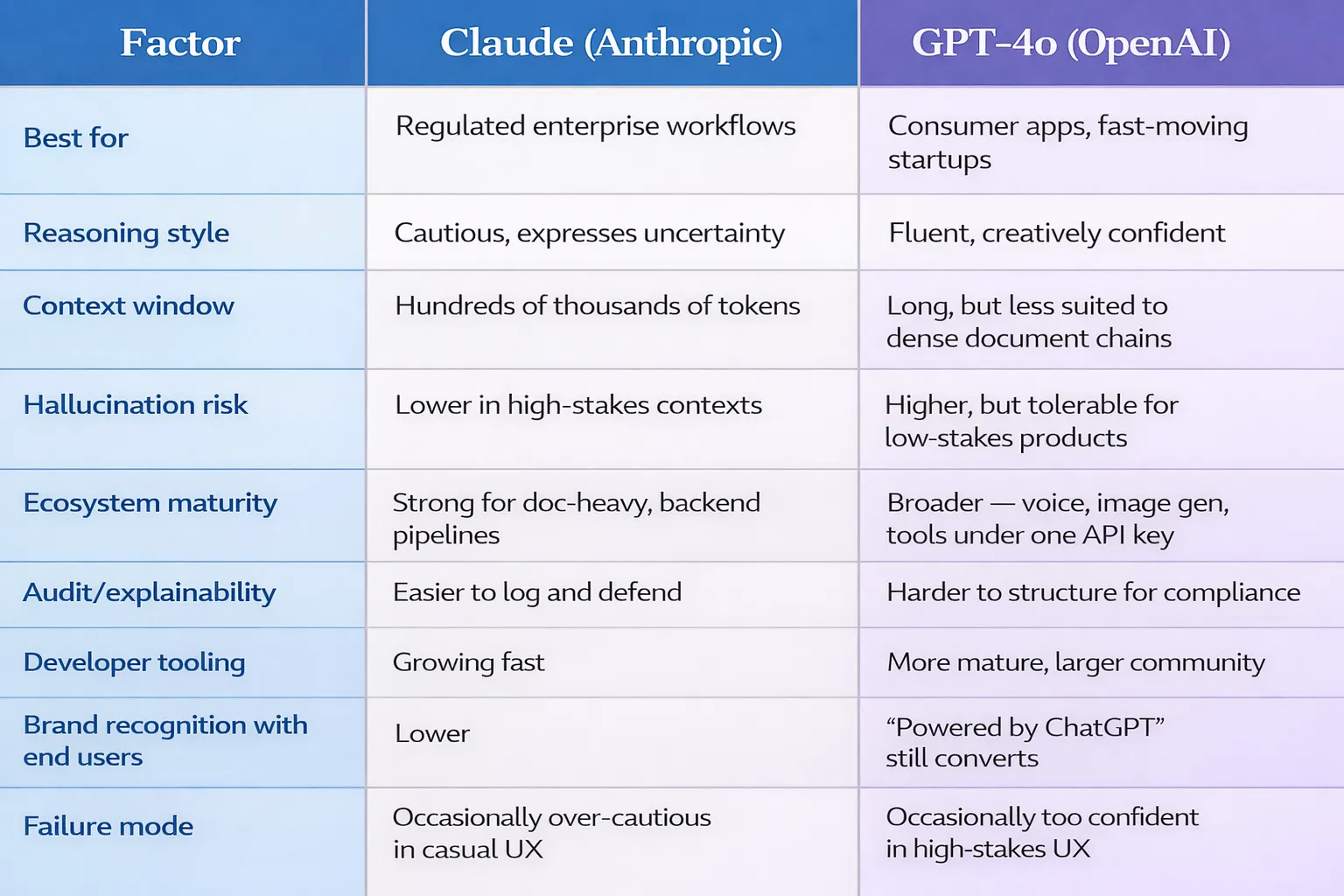
Head-to-head: Claude vs GPT at a glance
Why Enterprises Prefer Claude for Risk-Sensitive Workflows
When we audit enterprise AI pipelines — and this comes up in nearly every AI consulting services engagement — the pattern is consistent. The moment a workflow touches compliance, legal language, financial reporting, or patient data, the conversation shifts from "which model is smartest" to "which model can I defend in an audit."
Claude's architecture gives it a structural advantage here. Its responses are calibrated to express uncertainty when uncertainty exists. It doesn't hallucinate confidently — a trait that sounds minor until a model generates a fabricated legal citation that ends up in a client-facing document. Its longer context window (now extending to hundreds of thousands of tokens) allows enterprises to feed it entire regulatory documents, contract histories, or financial datasets without chunking — which means fewer stitching errors and more coherent outputs at scale.
The other enterprise-grade differentiator is agentic AI performance. When Claude is deployed inside multi-step automation pipelines — think: ingest a contract, extract obligations, flag anomalies, draft a risk summary, and route to the right department — it maintains chain-of-thought integrity across long tasks far better than most alternatives. This is critical for business-ready AI systems that can't afford mid-pipeline drift or context collapse.
The firms building AI tools for enterprises in regulated sectors — insurance, legal tech, healthcare SaaS, financial services — have largely converged on Claude as their foundation layer. The reputational calculus is simple: when something goes wrong with a consumer app, you patch and iterate. When something goes wrong with an enterprise compliance workflow, you face a very different kind of conversation.
The best AI model for business isn't the one that scores highest on MMLU. It's the one your legal team will sign off on deploying at scale.
Why GPT Dominates Consumer Apps & Startups
GPT-4o and its successors are still the default engine for a reason. If you're building a consumer-facing product where speed, creativity, multimodal input, and plug-and-play integrations matter more than auditability, GPT's ecosystem is hard to beat.
The OpenAI platform gives developers access to function calling, code interpreter, file search, image generation (DALL·E), and voice — all under one API key. For a startup moving at startup speed, that breadth eliminates vendor juggling. You don't need three different services; you ship with one.
Consumer applications have a different failure mode than enterprise ones. If a GPT-powered recipe assistant suggests a slightly unusual ingredient combination, the user laughs and tries again. The stakes are low. The feedback loop is fast. The product can iterate aggressively. That context rewards GPT's creative confidence and output fluency.
The developer tooling is also more mature. Extensive community documentation, open-source wrappers, and a marketplace of pre-built integrations mean that most GPT use cases have a published reference implementation somewhere. For resource-constrained startup teams, that ecosystem advantage is real money.
There's also the brand recognition factor. End users trust "powered by ChatGPT" in a way that they don't yet for newer AI brands. In B2C, trust is a conversion metric. That's not irrational — it's just the current market reality.
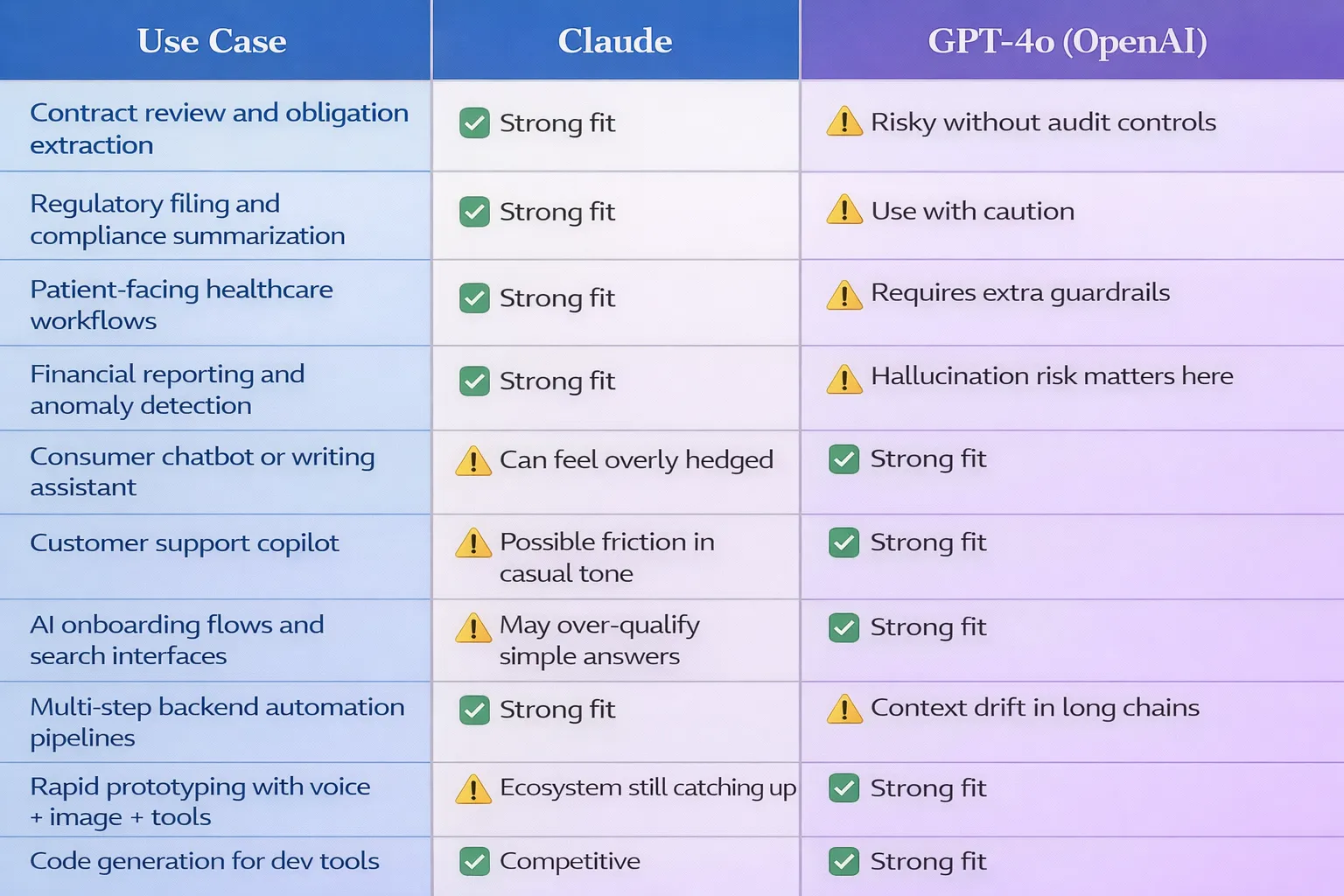
Use case fit: where each model belongs
The Hidden Cost of Choosing Wrong
Here's what the benchmark comparisons don't show you: the cost of architectural mismatch six months into a build.
We've seen it at NeuraMonks — and this AI case study is more common than most teams admit. A Series B company built its entire enterprise compliance layer on GPT because it was the familiar choice. Twelve months later, they were re-platforming onto Claude because their enterprise clients required explainability logs and their current setup couldn't produce them reliably. The migration cost — in engineering hours, re-prompting, re-testing, and re-deploying — ran into six figures.
The inverse also happens. Teams building consumer features on Claude because it felt "safer," only to discover that Claude's deliberate caution creates friction in casual, fast-paced conversational contexts where users want snappy, opinionated responses, not hedged ones.
This is exactly why the AI solutions conversation needs to happen at the architecture stage — not after the first sprint is already done.
How to Actually Make the Decision: A Framework for CTOs
Rather than debating model quality in the abstract, here's the decision tree we use when consulting with engineering and product leaders:
- What is the failure mode of a wrong answer? — If a wrong answer creates a legal, financial, or reputational exposure, default toward Claude. If it creates a slightly awkward user experience, GPT's fluency is more valuable.
- What does your context window look like? — Long documents, regulatory corpora, and multi-session memory requirements favour Claude. Short, modular, single-turn interactions favour GPT's speed.
- Are you building a product or a pipeline? — Consumer-facing products with interface integrations trend toward GPT. Backend automation pipelines with multi-step logic trend toward Claude.
- Who reviews the outputs? — Human-reviewed workflows can absorb more model creativity. Fully automated outputs that go directly to end users or systems need tighter output discipline.
- What's your integration surface? — If you need voice, image generation, and tool use under one roof today, GPT's ecosystem is ahead. If you're building on top of structured data and document intelligence, Claude's context management wins.
None of these are absolute — and in complex enterprise builds, the answer is often a hybrid architecture where GPT handles consumer-facing interactions and Claude anchors the internal reasoning and compliance layer.
What the Real-World Deployment Data Is Telling Us
Benchmarks are a starting point, not a verdict. The more instructive signal comes from watching where enterprises actually allocate their AI budget once the proof-of-concept phase ends and production deployment begins.
Across industries, a clear pattern has emerged in 2025–2026. Enterprises in financial services, insurance, and healthcare are consistently directing their core workflow automation budget toward Claude — particularly for document-heavy processes like policy interpretation, claims summarisation, and regulatory filing support. The reasoning isn't emotional. It's operational. These teams need outputs they can log, audit, and defend. Claude's constitutional design makes that architecture significantly easier to build and maintain.
In contrast, SaaS companies building end-user features — AI writing assistants, customer support copilots, onboarding flows, and search interfaces — are overwhelmingly staying in the GPT ecosystem. The speed of iteration, the mature fine-tuning options, and the sheer weight of community knowledge around GPT-based systems mean that SaaS product teams can move faster with lower overhead.
What's most telling is what happens at Series B and beyond, when companies that started on GPT for speed begin evaluating whether their infrastructure can scale with enterprise clients who have procurement requirements around data governance and model explainability. That's the inflection point where model re-evaluation happens — and it's almost always Claude that enters the picture at that stage, often anchoring the internal reasoning layer while GPT continues to handle the consumer-facing surface.
The data point that should make every product leader pause: the average cost of re-platforming from one foundation model to another — once prompt libraries, fine-tuning pipelines, evaluation suites, and integration logic are all in place — is measured in months of engineering time, not days. Choosing the right model for the right use case at the architecture stage isn't a philosophical exercise. It's a financial one.
The 2026 Verdict: Two Winners, Two Different Rings
The AI discourse tends toward horse-race framing — who's winning, who's falling behind, which model is "best." That framing is genuinely unhelpful for anyone actually deploying AI solutions at scale.
The more honest picture is this: Anthropic has built the most capable business-ready AI systems for regulated, high-stakes, enterprise-grade deployment. OpenAI has built the most capable consumer and developer platform on the planet. Both are tier-one. Both are winning. In different rooms.
The strategic question for any AI development company or enterprise product team is simply: which room are you building for?
At NeuraMonks, our model selection process doesn't start with benchmarks — it starts with risk profile, workflow architecture, and deployment context. Because the difference between a well-placed model and a mismatched one isn't usually visible in the demo. It shows up in production, at 2am, when something goes wrong and you need to know exactly why.
The most sophisticated enterprise teams we've worked with have stopped asking "which model is better" altogether. They've replaced that question with a more useful one: "which model is better for this specific layer, with this specific risk profile, serving this specific user type?" That reframe changes the entire procurement conversation — from a vendor beauty contest to an engineering decision with defensible logic behind it.
If you're a founder or CTO who hasn't yet stress-tested your model selection against your actual production failure modes, that's the conversation worth having before the architecture hardens and the cost of changing direction becomes a number that requires a board-level discussion.
The specialisation era isn't a complication — it's leverage. Two world-class models, two distinct strengths, both accessible via API today. The tier list is settled. The only open question is where your product actually lives in it — and whether the team building it has been honest enough with themselves to place it correctly.
Not sure which model belongs in your stack?
Every architecture decision has a risk profile behind it. At NeuraMonks, we map your workflow, your failure modes, and your compliance requirements to the right model — before a single line of production code is written.
If your team is at the point of committing to an AI architecture and wants a second opinion from people who've built these systems across fintech, healthcare, and enterprise SaaS — let's talk.
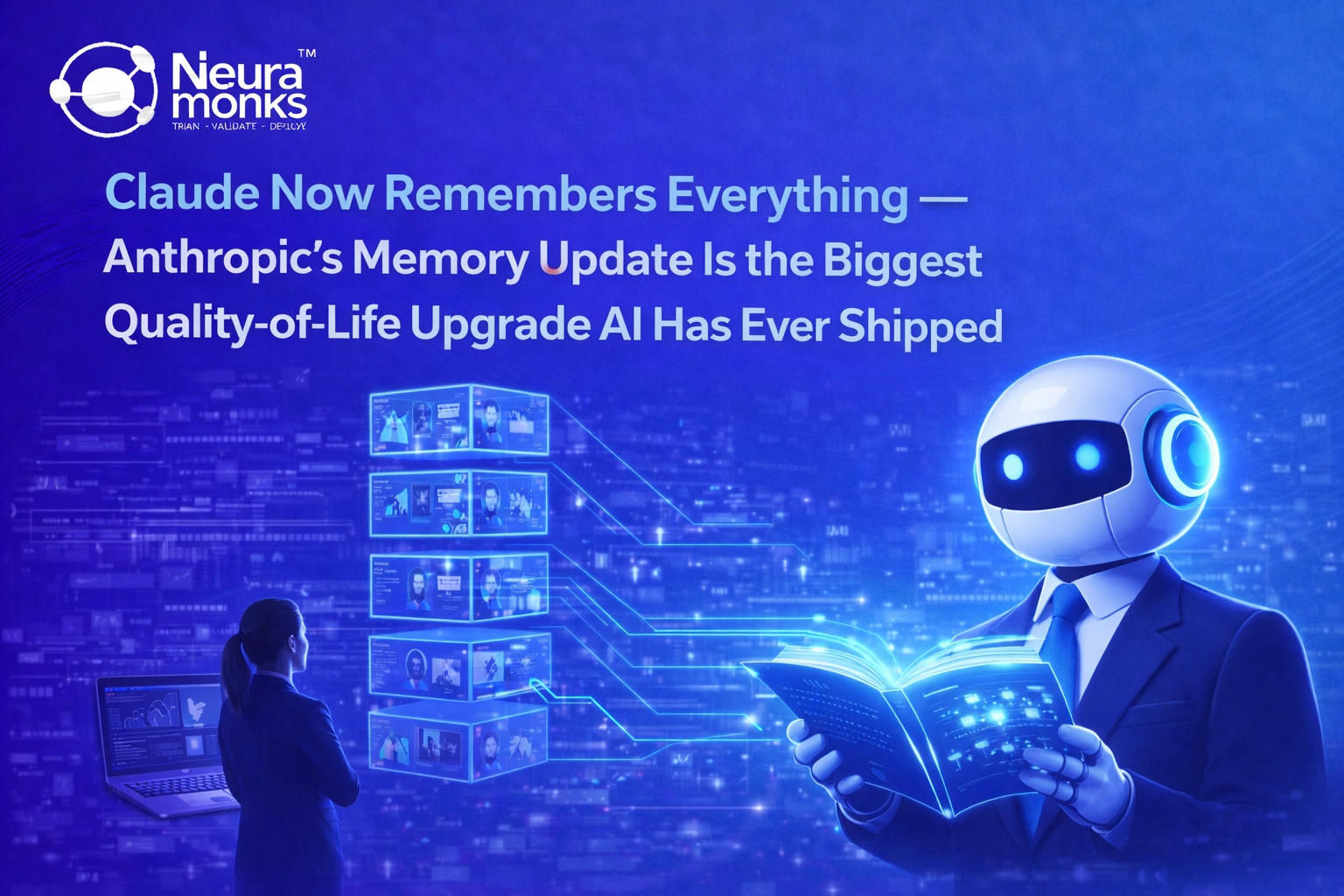
Claude Now Remembers Everything Anthropic's Memory Update Is the Biggest Quality of Life Upgrade AI Has Ever Shipped
Claude's new memory update — now free for all users — means the AI remembers your projects, preferences, and working style across every conversation, so you never have to repeat yourself.
Picture this: it's Monday morning. You open Claude, ready to pick up where you left off on your client proposal from Thursday. In the old world, you'd spend the first five minutes re-explaining the client's name, their industry, the tone they prefer, the format you need, and the three things you absolutely cannot include. Five minutes, every single time. Multiplied across every user, every conversation, every day.
Anthropic just ended that era entirely.
On March 2, 2026, Anthropic officially rolled out persistent memory from chat history to all Claude users — including everyone on the free tier. No subscription required. No setup needed. Claude now remembers who you are, what you're working on, how you think, and what context matters to you — and it carries that knowledge into every conversation going forward.
This is not a quality-of-life tweak. This is a foundational shift in what AI assistance means, and it has major implications for every individual, team, and business using Claude today.
What the Memory Update Actually Does — In Plain English
Claude's memory works in two directions simultaneously, and both are important to understand.
Automatic memory generation: As you chat, Claude quietly builds an evolving profile of you — your role, your communication style, your ongoing projects, your technical preferences, and the context that keeps coming up. It stores this in a simple, readable text file that you can view, edit, or delete at any time through Claude's settings.
Full user control: Nothing is hidden. You can pause memory generation, which preserves what Claude has already learned but stops it from adding new information. You can delete everything from Anthropic's servers entirely. And crucially, you can export your memory at any time, making your personal context portable rather than locked in.
Anthropic is also drawing clear lines around what Claude should and shouldn't remember. According to the company's updated help documentation, Claude focuses on work-relevant context that genuinely improves collaboration — your role, your communication preferences, your technical stack, your ongoing project details. Each project gets its own dedicated memory space, which keeps one workflow from bleeding into another. Your creative writing context doesn't contaminate your engineering context.
The result is an AI solution that feels less like a utility you query and more like a colleague who actually pays attention.
The Numbers Behind This Moment
Key Stats From Anthropic's March 2026 Announcement
Free-plan users up 60% since the start of 2026
Paid Pro & Max subscribers have doubled year-over-year
Claude hit #1 on the U.S. App Store — displacing ChatGPT
Memory rolled out to all plans: Free → Pro → Max → Team → Enterprise
These numbers tell an important story. Anthropic's decision to drop the memory paywall isn't charity — it's a calculated strategic move. Free users are converting to paid subscribers at a higher rate than ever, which means giving more away is actually growing revenue. The strategy is working.
The Memory Import Tool: Switching Just Got Frictionless
Alongside the memory update, Anthropic launched something equally significant: a cross-platform memory import tool. And it's aimed directly at ChatGPT and Gemini users.
Here's how it works. You paste a specially prepared prompt into any competing AI chatbot — ChatGPT, Gemini, or any other — and ask it to export everything it knows about you: stored memories, learned preferences, project context, communication style. You copy that output and paste it into Claude's memory import box. Claude extracts the relevant information and adds it to your memory profile. The refreshed memory view is live within 24 hours.
Anthropic explicitly states that this process works in both directions. You can import memories from other services into Claude, and you can export your Claude memories back out later. This is a deliberate choice. Rather than creating lock-in, Anthropic is betting that transparency and portability will build more trust — and more loyalty — than walls ever could.
This import capability, paired with free memory access, removes the single biggest barrier that previously existed for users considering switching from ChatGPT: the fear of starting over. That barrier is now gone.
Beyond Chat: Memory Now Flows Across Claude for Excel and PowerPoint
The memory update doesn't stop at the chat interface. Anthropic simultaneously shipped a major enhancement to Claude for Excel and Claude for PowerPoint, and the integration is exactly what knowledge workers have been waiting for.
The two add-ins now share full conversation context with each other. Every decision Claude makes in one application is influenced by everything that transpired in the other.This changes the workflow entirely.
A Real-World Scenario
Imagine a financial analyst preparing a quarterly review. They open their revenue model in Excel and ask Claude to analyze performance by region — Claude builds the comparison table, identifies the outliers, and summarizes the variance. They then switch to PowerPoint and ask Claude to turn those findings into three slides for the board presentation — Claude already knows the data, the story, and the format. They draft a follow-up email summarizing the key takeaways — Claude already has the context from both applications.
What used to require four separate tools, four separate context-settings, and forty minutes now happens in one Claude conversation. That's the AI solution that enterprise teams have been waiting for: not another integration to manage, but seamless intelligence that flows across the tools you already use.
Anthropic has also added Skills support to both add-ins, as well as LLM gateway connectivity for Amazon Bedrock, Google Cloud Vertex AI, and Microsoft Foundry users — making it enterprise-ready at scale.
Why This Changes Everything for How We Work
It's easy to underestimate a memory feature because it sounds mundane. But memory is actually the invisible variable that separates a useful tool from a genuinely transformative one.
Think about the difference between a new contractor on your first day with them — polite, capable, but requiring explanation for everything — versus a trusted colleague of two years who already knows your standards, your pet peeves, your shortcuts, and your goals. The actual intelligence hasn't changed. The working relationship has. And that relationship is almost entirely built on memory.
That's exactly what Anthropic's Chief Product Officer Mike Krieger was pointing to when he wrote: "Memory starts with project continuity, but it's really about creating sustained thinking partnerships that evolve over weeks and months." This isn't about recall. It's about a relationship.
For generative AI to move from impressive experiment to essential business infrastructure, it needs to stop requiring users to babysit it. Every time you have to re-explain your context, you're doing the AI's job for it. Memory fixes that. And when memory is available to every user — not just the ones paying $20 a month — the entire category changes.
Memory Is the Foundation of Agentic AI
Here's the bigger picture that's easy to miss in the headlines: persistent memory isn't just a user experience upgrade. It's the foundational layer that makes agentic AI actually viable for real-world work.
Agents — AI systems that autonomously plan, execute multi-step tasks, and operate across tools — only work well when they understand context. An agent that forgets what your business does, how your team is structured, or what constraints matter to your workflows is an agent that creates more work than it saves.
With persistent memory, Claude's agents can now operate with the kind of accumulated understanding that makes autonomous action trustworthy. When you ask Claude to handle a recurring task — analyze this week's sales data and flag anomalies — it already knows your data structure, your thresholds, your notification preferences, and your format requirements. You set it up once. It learns. It improves. It compounds.
This is the trajectory Anthropic is building toward: AI that doesn't just respond to commands, but genuinely understands the person giving them. Memory is the first essential brick in that architecture.
Who Benefits Most Right Now
Individual professionals: Every knowledge worker who uses Claude daily will immediately feel the difference. Writers, analysts, engineers, marketers — anyone who has a recurring context that Claude has had to re-learn conversation after conversation will notice an immediate reduction in friction and an immediate improvement in output quality.
Dev teams: Developers using Claude for code review, debugging, and architecture conversations will now have Claude remember their stack, their conventions, their testing preferences, and their project structure — making every session faster and every suggestion more relevant from the first message.
Small businesses and startups: For teams that can't afford dedicated AI ops infrastructure, free memory access on Claude is a significant equalizer. Your AI assistant now understands your business context without requiring an enterprise plan or a technical team to maintain it.
Enterprise teams: The Skills feature in Claude for Excel and PowerPoint means that when one team member figures out the perfect workflow for a recurring task, they can save it as a reusable skill — instantly making that institutional knowledge available to the entire organization.
Every major technology platform has had a moment where it crossed from optional to essential. The internet crossed that line. Mobile crossed it. Cloud crossed it. AI is crossing it right now — and memory is one of the clearest signals yet that the crossing is happening.
Claude, remembering everything isn't a gimmick. It's the product growing up. It's Anthropic making a deliberate bet that the future of AI isn't about having the biggest model — it's about having the deepest relationship with the people using it.
The memory paywall is gone. The import friction is gone. The context-setting tax is gone. What remains is an AI assistant that meets you where you are, remembers where you've been, and gets better at helping you with every conversation.
That's not just a quality-of-life upgrade. That's a new standard for what AI should be.
Ready to Build AI That Remembers, Learns, and Grows?
Claude remembers. Your product should too.
At Neaurmonk, we design and build AI-powered applications that use the latest Claude capabilities — including persistent memory, agentic workflows, and cross-platform intelligence — to create products that genuinely feel alive.
From idea to launch, Neaurmonk is the AI development company that makes it happen. Whether you're a startup founder with a vision or an enterprise team ready to go AI-native — let's build it together.→
Let's talk Neaurmonk

You asked, we precisely answered.
Still got questions? Feel free to reach out to our incredible
support team, 7 days a week.
What kind of web development projects does NeuraMonks handle?
NeuraMonks builds custom web platforms for businesses that need more than a template — think recruitment automation portals (Extrahourz), immigration management systems (Patel Canada Visa), real estate operations dashboards (Bavadiya & Co), and digital payment systems for restaurants and parking services (Xcashmenu). Every project in our case study library started with a specific operational problem, not a design brief.
How to choose the right AI solutions company?
Choosing the right AI solutions company means looking beyond technical skills. Key factors include:
Proven experience in custom AI solutions
Ability to deliver production-ready systems
Strong focus on business outcomes and ROI
Clear implementation and support processes
Security and compliance expertise
What makes NeuraMonks a reliable AI development agency?
NeuraMonks operates as a full-cycle AI development partner, not just a service vendor. We combine strategy, engineering, and deployment to build AI systems that work in real business environments. Our focus is on clarity, execution, and measurable outcomes, making us a trusted partner for organizations serious about AI.
Do you offer AI implementation services or only AI consulting?
We provide end-to-end AI implementation services, from initial use-case discovery and data readiness to model deployment and optimization. Unlike pure consultants, we take responsibility for building, integrating, and scaling AI systems inside your existing operations.
How is NeuraMonks different from other artificial intelligence development companies?
Most artificial intelligence development companies focus on experiments or proofs of concept. We focus on production-ready AI. Our team designs systems that integrate with real workflows, scale securely, and drive real business outcomes—without disrupting your operations.
Which industries do your industry-specific AI solutions serve?
Our industry-specific AI solutions support healthcare, ,eCommerce, manufacturing, Construction and Renovation, Dimond Merchant. Each solution is engineered to address sector-specific challenges, regulations, and operational needs.
How long does AI implementation typically take?
AI implementation timelines vary by complexity, but most projects move from strategy to deployment within 6–12 weeks. As an experienced AI implementation services provider, we follow structured milestones to ensure faster time-to-value.
Can you integrate AI with existing or legacy systems?
Absolutely. We specialize in AI-driven legacy system modernization, enabling businesses to embed intelligence into existing platforms without costly system replacements or operational downtime.