TABLE OF CONTENT
Picture this: it's Monday morning. You open Claude, ready to pick up where you left off on your client proposal from Thursday. In the old world, you'd spend the first five minutes re-explaining the client's name, their industry, the tone they prefer, the format you need, and the three things you absolutely cannot include. Five minutes, every single time. Multiplied across every user, every conversation, every day.
Anthropic just ended that era entirely.
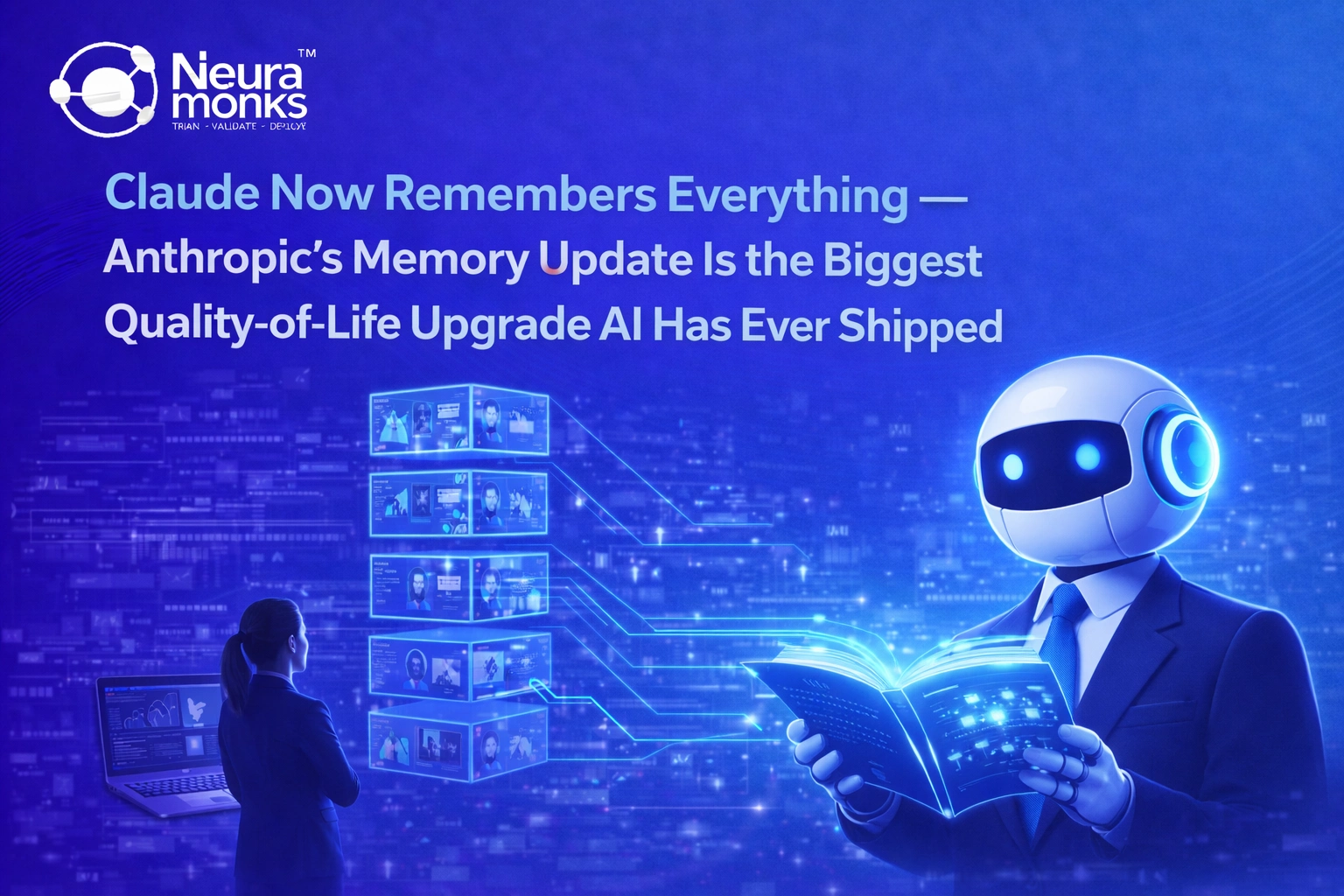
On March 2, 2026, Anthropic officially rolled out persistent memory from chat history to all Claude users — including everyone on the free tier. No subscription required. No setup needed. Claude now remembers who you are, what you're working on, how you think, and what context matters to you — and it carries that knowledge into every conversation going forward.
This is not a quality-of-life tweak. This is a foundational shift in what AI assistance means, and it has major implications for every individual, team, and business using Claude today.
What the Memory Update Actually Does — In Plain English
Claude's memory works in two directions simultaneously, and both are important to understand.
Automatic memory generation: As you chat, Claude quietly builds an evolving profile of you — your role, your communication style, your ongoing projects, your technical preferences, and the context that keeps coming up. It stores this in a simple, readable text file that you can view, edit, or delete at any time through Claude's settings.
Full user control: Nothing is hidden. You can pause memory generation, which preserves what Claude has already learned but stops it from adding new information. You can delete everything from Anthropic's servers entirely. And crucially, you can export your memory at any time, making your personal context portable rather than locked in.
Anthropic is also drawing clear lines around what Claude should and shouldn't remember. According to the company's updated help documentation, Claude focuses on work-relevant context that genuinely improves collaboration — your role, your communication preferences, your technical stack, your ongoing project details. Each project gets its own dedicated memory space, which keeps one workflow from bleeding into another. Your creative writing context doesn't contaminate your engineering context.
The result is an AI solution that feels less like a utility you query and more like a colleague who actually pays attention.
Stop Planning AI.
Start Profiting From It.
Every day without intelligent automation costs you revenue, market share, and momentum. Get a custom AI roadmap with clear value projections and measurable returns for your business.
The Numbers Behind This Moment
Key Stats From Anthropic's March 2026 Announcement
Free-plan users up 60% since the start of 2026
Paid Pro & Max subscribers have doubled year-over-year
Claude hit #1 on the U.S. App Store — displacing ChatGPT
Memory rolled out to all plans: Free → Pro → Max → Team → Enterprise
These numbers tell an important story. Anthropic's decision to drop the memory paywall isn't charity — it's a calculated strategic move. Free users are converting to paid subscribers at a higher rate than ever, which means giving more away is actually growing revenue. The strategy is working.
The Memory Import Tool: Switching Just Got Frictionless
Alongside the memory update, Anthropic launched something equally significant: a cross-platform memory import tool. And it's aimed directly at ChatGPT and Gemini users.
Here's how it works. You paste a specially prepared prompt into any competing AI chatbot — ChatGPT, Gemini, or any other — and ask it to export everything it knows about you: stored memories, learned preferences, project context, communication style. You copy that output and paste it into Claude's memory import box. Claude extracts the relevant information and adds it to your memory profile. The refreshed memory view is live within 24 hours.
Anthropic explicitly states that this process works in both directions. You can import memories from other services into Claude, and you can export your Claude memories back out later. This is a deliberate choice. Rather than creating lock-in, Anthropic is betting that transparency and portability will build more trust — and more loyalty — than walls ever could.
This import capability, paired with free memory access, removes the single biggest barrier that previously existed for users considering switching from ChatGPT: the fear of starting over. That barrier is now gone.
Beyond Chat: Memory Now Flows Across Claude for Excel and PowerPoint
The memory update doesn't stop at the chat interface. Anthropic simultaneously shipped a major enhancement to Claude for Excel and Claude for PowerPoint, and the integration is exactly what knowledge workers have been waiting for.
The two add-ins now share full conversation context with each other. Every decision Claude makes in one application is influenced by everything that transpired in the other.This changes the workflow entirely.
A Real-World Scenario
Imagine a financial analyst preparing a quarterly review. They open their revenue model in Excel and ask Claude to analyze performance by region — Claude builds the comparison table, identifies the outliers, and summarizes the variance. They then switch to PowerPoint and ask Claude to turn those findings into three slides for the board presentation — Claude already knows the data, the story, and the format. They draft a follow-up email summarizing the key takeaways — Claude already has the context from both applications.
What used to require four separate tools, four separate context-settings, and forty minutes now happens in one Claude conversation. That's the AI solution that enterprise teams have been waiting for: not another integration to manage, but seamless intelligence that flows across the tools you already use.
Anthropic has also added Skills support to both add-ins, as well as LLM gateway connectivity for Amazon Bedrock, Google Cloud Vertex AI, and Microsoft Foundry users — making it enterprise-ready at scale.
Why This Changes Everything for How We Work
It's easy to underestimate a memory feature because it sounds mundane. But memory is actually the invisible variable that separates a useful tool from a genuinely transformative one.
Think about the difference between a new contractor on your first day with them — polite, capable, but requiring explanation for everything — versus a trusted colleague of two years who already knows your standards, your pet peeves, your shortcuts, and your goals. The actual intelligence hasn't changed. The working relationship has. And that relationship is almost entirely built on memory.
That's exactly what Anthropic's Chief Product Officer Mike Krieger was pointing to when he wrote: "Memory starts with project continuity, but it's really about creating sustained thinking partnerships that evolve over weeks and months." This isn't about recall. It's about a relationship.
For generative AI to move from impressive experiment to essential business infrastructure, it needs to stop requiring users to babysit it. Every time you have to re-explain your context, you're doing the AI's job for it. Memory fixes that. And when memory is available to every user — not just the ones paying $20 a month — the entire category changes.
Memory Is the Foundation of Agentic AI
Here's the bigger picture that's easy to miss in the headlines: persistent memory isn't just a user experience upgrade. It's the foundational layer that makes agentic AI actually viable for real-world work.
Agents — AI systems that autonomously plan, execute multi-step tasks, and operate across tools — only work well when they understand context. An agent that forgets what your business does, how your team is structured, or what constraints matter to your workflows is an agent that creates more work than it saves.
With persistent memory, Claude's agents can now operate with the kind of accumulated understanding that makes autonomous action trustworthy. When you ask Claude to handle a recurring task — analyze this week's sales data and flag anomalies — it already knows your data structure, your thresholds, your notification preferences, and your format requirements. You set it up once. It learns. It improves. It compounds.
This is the trajectory Anthropic is building toward: AI that doesn't just respond to commands, but genuinely understands the person giving them. Memory is the first essential brick in that architecture.
Who Benefits Most Right Now
Individual professionals: Every knowledge worker who uses Claude daily will immediately feel the difference. Writers, analysts, engineers, marketers — anyone who has a recurring context that Claude has had to re-learn conversation after conversation will notice an immediate reduction in friction and an immediate improvement in output quality.
Dev teams: Developers using Claude for code review, debugging, and architecture conversations will now have Claude remember their stack, their conventions, their testing preferences, and their project structure — making every session faster and every suggestion more relevant from the first message.
Small businesses and startups: For teams that can't afford dedicated AI ops infrastructure, free memory access on Claude is a significant equalizer. Your AI assistant now understands your business context without requiring an enterprise plan or a technical team to maintain it.
Enterprise teams: The Skills feature in Claude for Excel and PowerPoint means that when one team member figures out the perfect workflow for a recurring task, they can save it as a reusable skill — instantly making that institutional knowledge available to the entire organization.
Every major technology platform has had a moment where it crossed from optional to essential. The internet crossed that line. Mobile crossed it. Cloud crossed it. AI is crossing it right now — and memory is one of the clearest signals yet that the crossing is happening.
Claude, remembering everything isn't a gimmick. It's the product growing up. It's Anthropic making a deliberate bet that the future of AI isn't about having the biggest model — it's about having the deepest relationship with the people using it.
The memory paywall is gone. The import friction is gone. The context-setting tax is gone. What remains is an AI assistant that meets you where you are, remembers where you've been, and gets better at helping you with every conversation.
That's not just a quality-of-life upgrade. That's a new standard for what AI should be.
Ready to Build AI That Remembers, Learns, and Grows?
Claude remembers. Your product should too.
At Neaurmonk, we design and build AI-powered applications that use the latest Claude capabilities — including persistent memory, agentic workflows, and cross-platform intelligence — to create products that genuinely feel alive.
From idea to launch, Neaurmonk is the AI development company that makes it happen. Whether you're a startup founder with a vision or an enterprise team ready to go AI-native — let's build it together.→
Let's talk Neaurmonk