Insights and Inspiration
Explore Our Blog
Dive into our blog for expert insights, tips, and industry trends to elevate your project management journey.
How to Install Clawbot Securely
Clawbot is an AI operator, not a normal tool. Install it securely, start with limited access, require approval, and expand automation gradually to build trust and reliability.

Before You Install: Read This First
Most software enters a company quietly. Someone signs up, connects a few apps, and within minutes the tool becomes part of the workflow.
Clawbot doesn’t work that way.
You’re not installing a dashboard, plugin, or chatbot widget — you’re introducing an operational AI agent. It reads information, makes decisions, and can trigger real actions across your systems. The moment it connects to live workflows, the question changes from “Does it work?” to “Can we trust it?”
Many teams rush the setup because the first results look impressive. The agent drafts messages, flags issues, and automates tasks. But problems rarely appear during testing. They appear after trust is granted too quickly. The risk with agentic systems isn’t intelligence — it’s unstructured access.
So installation is not about speed.
It is about controlled introduction.
Fast setup gives a demo.
Structured setup creates a reliable operator.
Start With the Environment, Not the Interface
A common mistake is installing the agent on a personal machine just to try it quickly. That works for communication tools — not for operational AI.
Clawbot accumulates memory: logs, workflow context, tokens, and permissions. If that lives on a laptop or shared environment, exposure becomes invisible. From day one, the system should run inside dedicated infrastructure — a secured server, private cloud instance, or isolated virtual machine.
Treat it like infrastructure early, and you won’t need to rebuild trust later.
Safety Is Defined by Permissions
People assume the AI itself is the danger. In reality, permissions are.
If the agent can access everything, eventually it will use everything — even while trying to help. The correct rollout begins with visibility instead of authority. Let it read before it edits. Let it suggest before it executes. Let automation come last.
Security with AI agents isn’t about limiting capability. It’s about sequencing capability.
Contain the Network, Not the Intelligence
You don’t make an AI safer by making it less capable. You make it safer by controlling where it can act.
A secure installation ensures the agent operates inside a private network and communicates outward only when needed. External systems shouldn’t freely send instructions into it. This means restricted ports, private routing, and controlled gateways.
Think of it as giving an employee a phone — not leaving the office door open.
Human Approval Builds Trust
Autonomy should never be the starting point. It should be earned.
At the beginning, every meaningful action should pass through human review — sending emails, updating records, triggering workflows, or changing data. This prevents costly mistakes and produces feedback that improves reliability.
Teams that skip this stage often mistrust the system later, not because AI failed, but because it was never guided.
Logging Makes the Agent Understandable
If a human employee changes something, you can ask why.
With AI, the record must already exist.
Every decision and action should be logged and reviewable. Observability turns the agent from a black box into an auditable operator. Trust grows when behavior is explainable.
No logs, no confidence.
Separate Learning From Production
Allowing the system to learn directly in live workflows is risky. Training should happen in controlled environments first, then expand gradually into production.
Just like onboarding a new employee — training comes before responsibility.
Step-by-Step: How to Install Clawbot Safely
Below is a production-grade installation flow. Follow the order — skipping steps is where most failures happen.
1. Create a Dedicated Environment
Prepare secure infrastructure:
Use:
- Private cloud VM (AWS / Azure / GCP)
- On-premise secured server
- Isolated virtual machine
- Docker container in protected network
Avoid:
- Personal laptops
- Shared computers
- Direct local installation
The agent will store tokens, workflow memory, and logs — this must remain controlled.
2. Install Runtime & Dependencies
Inside the server:
- Update system packages
- Install Docker or runtime environment
- Create a non-admin service user
- Configure firewall rules
Now the system can safely host the agent.
3. Deploy Clawbot
Deploy inside a container or isolated service:
- Pull Clawbot package/image
- Create configuration file
- Add environment secrets (API keys, credentials)
- Start the service
Never hardcode secrets.
4. Configure Network Security
Restrict communication:
- Private IP access only
- Reverse proxy or API gateway
- IP allow-listing
- Outbound connections allowed
- Inbound commands restricted
The agent can reach services — services shouldn’t freely reach the agent.
5. Connect Integrations in Read-Only Mode
Connect business systems carefully:
Examples:
CRM, helpdesk, database, Slack, email, dashboards
Start with:
Read → Analyze → Suggest
No write permissions yet.
6. Enable Logging & Monitoring
Before real usage, activate observability.
Log:
- Prompts
- Decisions
- Actions attempted
- API calls
- Errors
If actions cannot be audited, automation should not exist.
7. Add Human Approval Layer
Require confirmation for:
- Sending messages
- Updating records
- Triggering workflows
- External actions
Now the agent behaves like an assistant, not an uncontrolled actor.
8. Run in Sandbox Mode
Test using non-production data.
Let the agent observe workflows and suggest actions.
Review results and adjust permissions.
9. Gradually Allow Actions
Increase authority step-by-step:
- Draft only
- Draft + approval execution
- Limited automation
- Scheduled automation
- Trusted automation
Never jump directly to full automation.
10. Move to Production
After stable performance:
- Connect live data
- Keep approval for critical actions
- Continue logging permanently
Installation is complete only when monitoring is active — not when the system starts.
The Real Security Principle
Traditional systems are secured from attackers.
Agentic systems must also be secured from good intentions.
A helpful assistant acting on incomplete understanding can create more disruption than malicious code. Safe deployment aligns capability with context over time.
Final Thoughts
Clawbot can become one of the most valuable operators in your organization — monitoring processes, handling repetitive decisions, and keeping workflows moving quietly in the background.
But its value depends entirely on how responsibly it is introduced.
Fast installation creates excitement. Careful installation creates reliability.
Need Help Setting It Up Correctly?
Secure AI deployment requires infrastructure design, permission planning, monitoring, and staged rollout — not just technical setup.
At NeuraMonks, we help organizations deploy production-grade AI operators with governance and safe autonomy expansion.
Because the goal isn’t just to run AI inside your company —
it’s to trust it there.
From Chatbots to AI Workers: What OpenClaw, Moltbot and Clawbot Really Are and How to Use Them
This blog explains the shift from conversational AI tools to operational AI systems — often called AI workers. Instead of answering questions like chatbots or copilots, platforms such as Clawbot, OpenClaw, and Moltbot are designed to execute real tasks inside business workflows.
For years we’ve interacted with AI like we interact with search engines — we ask, it answers.
Even modern AI tools mostly live inside that same pattern: prompt → response → copy → paste → done.
But a new category of AI is quietly emerging inside companies.
Not assistants. Not copilots.
Operators.
This is where systems like Clawbot, OpenClaw, and Moltbot come in. They are not designed to help you complete tasks — they are designed to complete tasks for you inside your own workflows.
To understand them, you have to stop thinking about AI as a tool and start thinking about AI as a role.
Clawbot — The Worker
Clawbot is the part people notice first because it actually does things.
- Instead of answering how to send an email, it sends the email.
- Instead of suggesting a report, it generates and delivers it.
- Instead of telling you an alert exists, it investigates the alert.
In practical environments, teams use Clawbot to monitor dashboards, update CRM records, respond to operational triggers, summarize meetings, triage support tickets, or run internal processes that normally require human attention but not human judgment.
The key shift is execution.
- Traditional AI reduces effort.
- Clawbot reduces involvement.
You are no longer operating software — you are supervising a digital worker operating software.
OpenClaw — The System That Gives AI a Job Description
If Clawbot is the worker, OpenClaw is the structure that tells it what its job actually is.
OpenClaw is the framework where companies define:
- how the AI should behave,
- what it is allowed to access,
- when it should act,
- and when it should ask.
Instead of one generic assistant, organizations can create multiple specialized agents — operations assistant, support assistant, finance assistant, engineering assistant — each with boundaries and responsibilities.
Without this layer, AI is intelligent but directionless.
With it, AI becomes organizational.
In other words, OpenClaw converts intelligence into process.
Moltbot — The Training and Learning Layer
Human employees improve because they observe outcomes and feedback.
Agentic systems need the same mechanism.
Moltbot handles learning.
It tracks corrections, approvals, rejections, and overrides. Over time it adapts behavior so that repeated mistakes disappear and frequent approvals become automatic. The system evolves from cautious automation to confident execution.
The important part is that improvement doesn’t require retraining a model — it happens operationally.
Moltbot turns usage into education.
How They Work Together
Think of a normal company structure.
- The employee performs tasks.
- The company defines processes.
- Training improves performance.
That is exactly the relationship here:
- Clawbot performs
- OpenClaw organizes
- Moltbot improves
Together they create an environment where AI stops being a conversation interface and starts becoming operational infrastructure.
How Teams Actually Start Using It
The most successful teams don’t start with big automation dreams. They start with observation.
First the agent watches workflows — alerts, emails, dashboards, tickets — and suggests actions.
Then it performs actions after approval.
Finally it handles low-risk processes independently.
The moment teams realize the real value is not faster work but fewer interruptions, adoption accelerates. The system becomes a background operator rather than a visible tool.
People stop “using AI” and start relying on outcomes.
Why This Matters
- Software improved productivity.
- Automation improved efficiency.
- Agentic AI improves operational capacity.
Instead of hiring more people to manage complexity, companies can delegate predictable decision loops to internal AI workers while humans focus on judgment, creativity, and strategy.
The organizations that understand this shift early won’t just save time — they’ll operate differently.
If You’re Considering Implementing It
These systems look simple on the surface but become architectural quickly: permissions, workflows, monitoring, and safety design matter more than prompts.
At NeuraMonks, we help teams design and deploy internal AI operators — from defining agent responsibilities to integrating them into production workflows safely.
Because the goal isn’t experimenting with AI.
The goal is trusting it with work.
The Future of Radiology: How AI Healthcare Solutions Are Transforming Diagnostic Imaging
AI healthcare solutions are transforming radiology by enhancing diagnostic accuracy, accelerating image interpretation, and reducing radiologist workload—ushering in a smarter, faster, and more scalable future for diagnostic imaging.

Imagine stepping into a hospital radiology department five years from now. The room hums with advanced machines, but what truly stands out are the intelligent systems working alongside radiologists—systems that help detect abnormalities faster, flag critical findings, and reduce the strain on overworked clinicians. This isn’t science fiction. This is the reality being shaped today by AI Healthcare Solutions, particularly through AI for Radiology applications that are redefining how imaging departments operate.
From early detection of diseases to streamlining workflows, Artificial Intelligence in healthcare is ushering in an era of faster, more accurate diagnostic imaging. In this article, we’ll explore how AI is used in radiology, why it’s becoming essential, the pros and cons, and the role innovative companies like Neuramaonks are playing in this transformation.
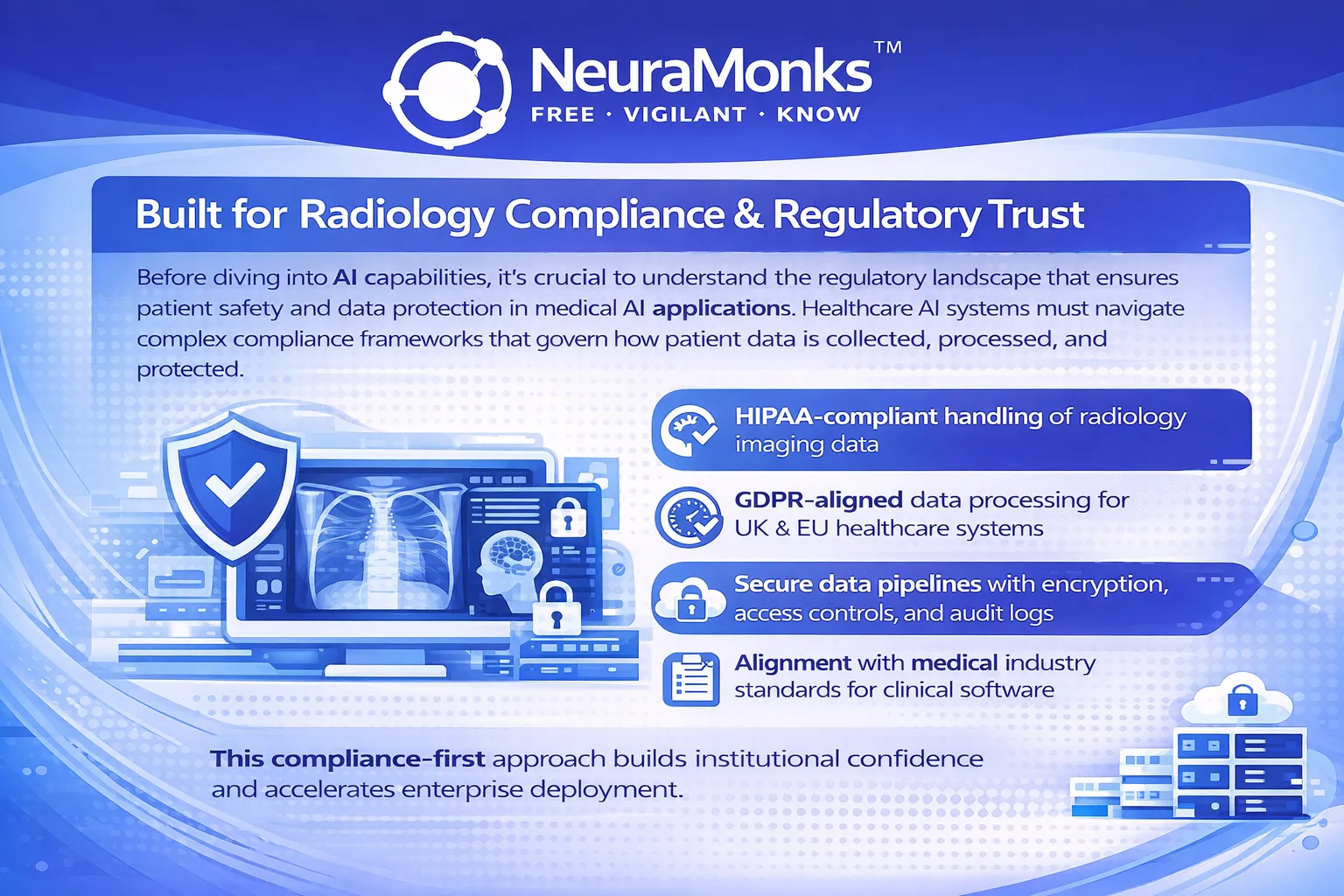
Built for Radiology Compliance & Regulatory Trust
Before diving into AI capabilities, it's crucial to understand the regulatory landscape that ensures patient safety and data protection in medical AI applications. Healthcare AI systems must navigate complex compliance frameworks that govern how patient data is collected, processed, and protected.
- HIPAA-compliant handling of radiology imaging data
- GDPR-aligned data processing for UK and EU healthcare systems
- Secure data pipelines with encryption, access controls, and audit logs
- Alignment with medical industry standards for clinical software
This compliance-first approach builds institutional confidence and accelerates enterprise deployment.
How Is AI Used in Radiology?
When most people hear “AI in radiology,” they think of robots reading X-rays. The reality is much more collaborative: AI tools act as partners to radiologists, enhancing their capabilities rather than replacing them.
AI’s Core Functions in Radiology
- Image Processing & Interpretation
AI-powered preprocessing and deep learning models enhance X-ray, CT, MRI, and ultrasound images—helping radiologists interpret scans faster and with greater diagnostic confidence.
- Anomaly & Disease Detection
Automated detection of tumors, lesions, infections, and vascular abnormalities reduces missed findings, supports earlier diagnosis, and lowers the need for repeat scans.
- Priority & Triage Systems
Critical and high-risk cases are automatically flagged, enabling faster review in emergency and high-volume radiology environments and improving patient response times.
- Workflow Automation & Reporting
Automated measurements, segmentation, and reporting streamline radiology workflows, reduce manual workload, improve consistency, and increase overall department throughput.
These applications fall under the broader umbrella of AI Healthcare Solutions, where intelligent software enhances efficiency, accuracy, and diagnostic confidence.
AI in Radiology: Pros & Cons
AI solutions are transforming radiology by improving speed, accuracy, and efficiency—but they also come with challenges.
Pros of AI Solutions in Radiology
- Higher diagnostic accuracy: AI solutions detect subtle patterns and reduce human error.
- Faster reporting: Automated image analysis shortens turnaround time for results.
- Reduced radiologist workload: AI handles repetitive tasks, freeing experts for complex cases.
- Consistent analysis: AI solutions deliver standardized results without fatigue.
- Early disease detection: Enables earlier identification of cancer, stroke, and fractures.
Cons & Limitations
- Data dependency: AI solutions rely on large, high-quality datasets.
- Integration issues: Compatibility with PACS and EHR systems can be challenging.
- Regulatory & ethical concerns: Accountability and compliance remain critical.
- Cost barriers: Advanced AI solutions may be expensive for some facilities.
Bottom line: While challenges exist, AI solutions in radiology deliver clear clinical value—and their impact will only grow as technology matures.
Practical Medical Imaging Experience Behind AI Accuracy
Improving diagnostic accuracy in radiology requires real-world clinical exposure across diverse imaging scenarios. This experience spans machine learning and deep learning–based medical imaging use cases that help shape reliable AI Healthcare Solutions.
Real-world deployments include blood cell counting, malaria detection, lung and breast cancer imaging analysis, tumor detection systems, and ongoing work in tumor progression prediction. Additional initiatives cover glaucoma detection, chromosome karyotyping, COVID-19 imaging, and dental X-ray analysis.
In chest CT imaging, AI models can highlight regions suspicious for lung cancer that may be overlooked during manual review, enabling faster and more confident clinical decisions.
Extending Imaging Intelligence to Telemedicine
Telemedicine is a dedicated focus within modern medical AI initiatives, enabling diagnostic intelligence beyond hospital settings. One key application is AI-powered wound detection for remote monitoring, which supports online consultations, continuous healing assessment, and objective measurement of wound size and tissue changes over time.
By combining medical imaging intelligence with telehealth platforms, AI Healthcare Solutions help clinicians deliver consistent, data-driven care remotely—improving access while reducing unnecessary in-person visits.
What Are the Primary Benefits of Artificial Intelligence in Diagnostic Imaging?
While we’ve touched on benefits already, here’s a consolidated look at why AI is such a game-changer:
- Faster image interpretation and reporting
- Higher detection rates
- Reduced false positives and false negatives
- Better resource allocation
- Enhanced patient outcomes
- Scalable solutions for large hospital systems
- Optimization of imaging protocols
Not only does AI improve the quality of care, but it also helps healthcare systems become more efficient and cost-effective.
Which Companies Offer AI-Powered Radiology Imaging Software?
Hospital administrators exploring AI adoption in radiology often face a crowded marketplace filled with ambitious claims. While many companies are entering the space, only a few demonstrate real-world clinical usability. Among them, We has emerged as a notable name for its focused work in AI-driven radiology solutions designed specifically for hospital environments.
Rather than positioning AI as a replacement for radiologists, we builds systems that support clinical decision-making, reduce operational strain, and fit into existing workflows without disruption.
Neuramaonks: A Leader in AI Radiology Innovation
We specializes in intelligent image analysis software that works alongside radiologists to improve both speed and diagnostic confidence. Their solutions are designed to handle the growing imaging workload hospitals face today.
Our AI tools assist radiologists by:
- Enhancing diagnostic clarity, helping reduce ambiguous findings in complex scans
- Identifying disease patterns earlier, especially in high-volume imaging scenarios
- Automating segmentation and reporting, cutting manual effort by an estimated 35–40% per study
- Integrating seamlessly with hospital systems, including PACS and existing imaging infrastructure
In pilot hospital environments, We -supported workflows have shown:
- 20–30% fewer follow-up scans due to improved first-read accuracy
- Consistent reporting quality, even during peak imaging hours
- Noticeable reductions in reporting delays, particularly in emergency imaging
Their approach focuses on improving radiology efficiency without adding technical complexity, making the platform practical for both large hospital networks and mid-sized healthcare facilities.
While Neuramaonks is highlighted here for its demonstrated capabilities, hospitals should still evaluate AI vendors based on clinical validation, interoperability, ongoing support, and regulatory readiness before large-scale deployment.
Where Can Hospitals Find AI Radiology Solutions for Integration?
Hospitals today are no longer experimenting with AI for novelty—they are demanding measurable clinical outcomes, reliable integration, and tools radiologists trust under real-world pressure. This is where focused AI Healthcare Solutions providers like Neuramaonks differentiate themselves.
Neuramaonks as a Practical AI Integration Partner
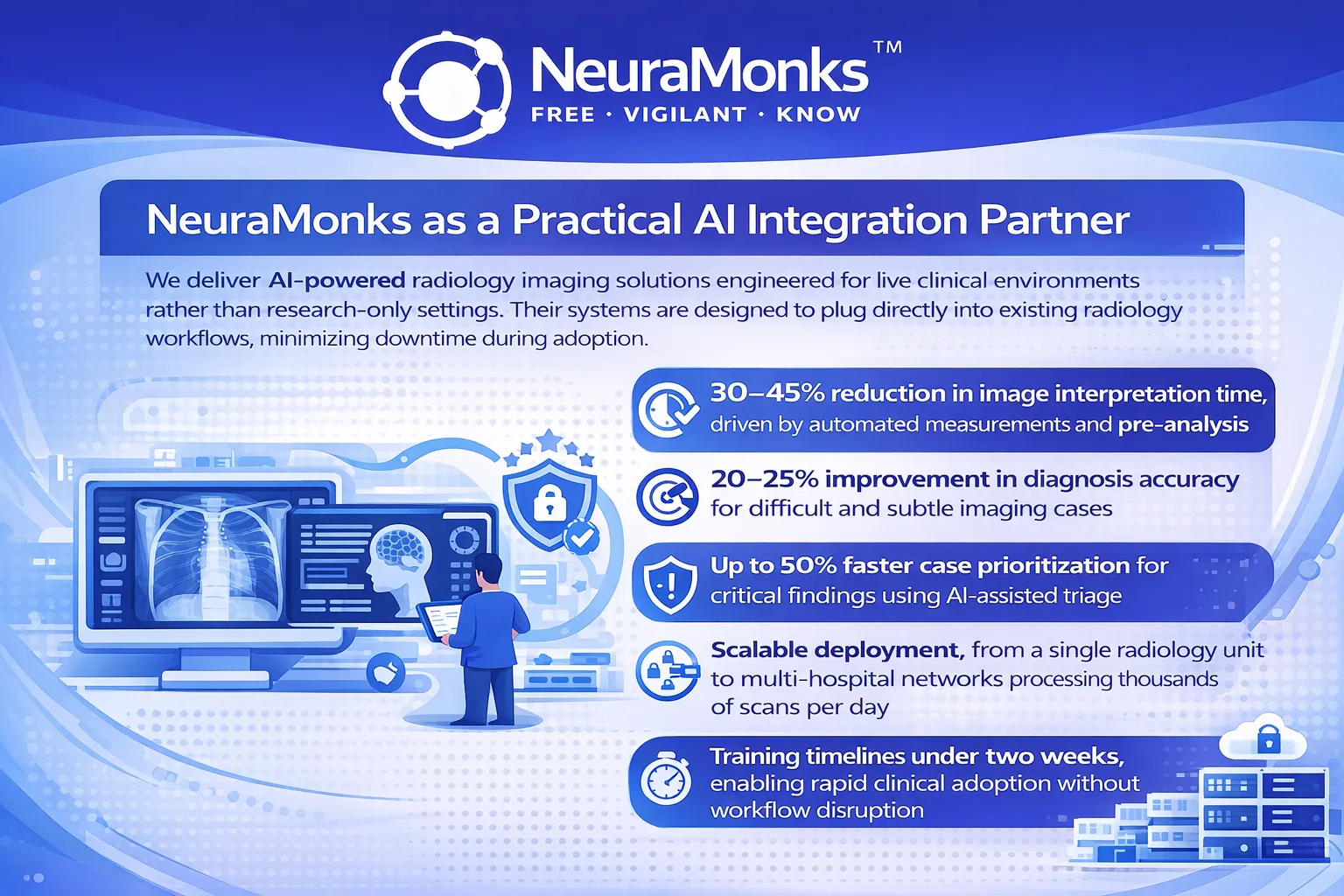
We delivers AI-powered radiology imaging solutions engineered for live clinical environments rather than research-only settings. Their systems are designed to plug directly into existing radiology workflows, minimizing downtime during adoption.
Hospitals integrating with us AI solutions typically report:
- 30–45% reduction in image interpretation time, driven by automated measurements and pre-analysis
- 20–25% improvement in diagnosis accuracy for difficult and subtle imaging cases
- Up to 50% faster case prioritization for critical findings using AI-assisted triage
- Scalable deployment, from a single radiology unit to multi-hospital networks processing thousands of scans per day
- Training timelines under two weeks, enabling rapid clinical adoption without workflow disruption
Unlike generic AI platforms, we prioritizes clinical usability, ensuring AI functions as a quiet assistant in the background rather than a disruptive layer radiologists must manage.
How Hospitals Typically Integrate AI Radiology Solutions
Hospitals adopting us and similar AI Healthcare Solutions usually follow a structured, low-risk implementation model:
- Phase 1: Pilot Deployment
AI introduced in high-volume imaging areas such as CT, MRI, or X-ray, often covering 15–25% of total scan volume. - Phase 2: Performance Benchmarking
Diagnostic accuracy, reporting time, and backlog metrics compared against 6–12 months of historical data. - Phase 3: Full PACS Integration
AI becomes embedded into daily workflows, contributing to workflow automation and standardized reporting. - Phase 4: Advanced Analytics Expansion
Hospitals expand into predictive imaging insights and preventive diagnostics, improving long-term patient outcomes.
This phased rollout helps hospitals reduce operational risk while achieving early, measurable ROI—often within the first 3–6 months of deployment.
Real-World Case Studies
Our AI healthcare solutions are deployed in live clinical and telemedicine environments, delivering measurable impact.
- Cell Segmentation – AI-powered cell segmentation enabling accurate identification and analysis of cellular structures for medical imaging and pathology workflows.
- CareSync – An integrated healthcare AI platform supporting intelligent data workflows, clinical coordination, and scalable medical AI deployment.
- The Corona Test UK – A production-grade AI solution supporting COVID-19 diagnostic workflows within the UK healthcare ecosystem, designed for accuracy, speed, and compliance.
- Automated Wound Detection & Measurement –Using Deep Learning
A telemedicine-focused AI system delivering clinically accurate wound measurement, healing progression tracking, and remote clinician decision support.
Conclusion: Embracing the AI-Driven Future of Radiology
The integration of AI Healthcare Solutions in radiology isn’t just about high-tech tools—it’s about empowering radiologists, improving patient outcomes, and transforming the way healthcare delivers diagnostic precision. Artificial Intelligence in healthcare isn’t replacing human expertise; it’s amplifying it.
From improving diagnostic accuracy to reducing workload and enabling faster treatment decisions, AI stands poised to make radiology more efficient and effective than ever before. And with innovators like Neuramaonks pushing boundaries, hospitals have real, actionable options for integrating these technologies today.
Ready to explore AI solutions for your radiology department?
Reach out to AI vendors, request demos, and start with pilot programs. The future of diagnostic imaging is here—don’t let your hospital fall behind.
From Strategy to Scale: The Ultimate Checklist for Choosing an AI Consulting Company
Choosing the right AI consulting services partner can define your AI success. This ultimate checklist helps businesses evaluate expertise, security, scalability, and ROI with confidence.

The artificial intelligence revolution is reshaping how businesses operate, compete, and grow. Yet for many organizations, the journey from AI strategy to successful implementation remains complex and challenging. Choosing the right AI consulting services partner can mean the difference between transformative success and costly missteps.
Whether you're exploring custom AI solutions for business or looking for a comprehensive artificial intelligence development company to guide your digital transformation, this ultimate checklist will help you navigate the selection process with confidence.
Why Your Choice of AI Development Company Matters
The AI consulting landscape is crowded with promises of innovation and transformation. However, not all AI solutions providers are created equal. The right partner brings more than technical expertise—they deliver strategic insight, industry knowledge, and proven methodologies that align AI capabilities with your business objectives.
According to recent industry research, companies that carefully vet their AI partners report 67% higher success rates in AI implementation projects. The stakes are high, and the selection criteria extend far beyond basic technical capabilities.
The Complete Checklist for Selecting AI Consulting Services
1. Industry-Specific Experience and Domain Expertise
Your AI consulting company should demonstrate deep understanding of your industry's unique challenges and opportunities. Generic AI solutions rarely deliver optimal results when applied to specialized business contexts.
What to look for:
- Proven track record in your specific industry (healthcare, e-commerce, manufacturing, fintech, construction)
- Case studies showcasing successful implementations in similar business environments
- Understanding of industry-specific regulations, compliance requirements, and operational constraints
- Ability to speak your business language, not just technical jargon
Companies like NeuraMonks, for instance, specialize in delivering tailored AI solutions across healthcare, e-commerce, manufacturing, construction, and fintech sectors. This industry-specific approach ensures that AI implementations address real business problems rather than offering generic technology deployments.
2. Comprehensive Service Offerings: From Consultation to Deployment
The best artificial intelligence development company provides end-to-end services that support your entire AI journey, from initial strategy to ongoing optimization.
Essential service components:
- AI Readiness Assessment: Evaluation of your current infrastructure, data quality, and organizational preparedness
- Strategic Consulting: Development of an AI roadmap aligned with business objectives
- Proof of Concept (POC): Validation of AI viability through prototype development
- MVP Development: Rapid deployment of minimum viable products for market testing
- Full-Scale Product Development: Comprehensive AI solution engineering
- Integration Services: Seamless embedding into existing business systems
- Post-Deployment Support: Ongoing monitoring, optimization, and maintenance
A complete service portfolio ensures continuity throughout your AI transformation, eliminating the need to engage multiple vendors at different stages.
3. Technical Excellence and Innovation Capabilities
The technical foundation of your AI partner determines the sophistication and effectiveness of your AI solutions. Evaluate their capabilities across multiple dimensions.
Technical assessment criteria:
- Core AI Competencies: Expertise in machine learning, deep learning, natural language processing (NLP), computer vision, and generative AI
- Technology Stack: Proficiency with industry-leading frameworks including TensorFlow, PyTorch, OpenCV, Hugging Face, LangChain, and FastAPI
- Custom Model Development: Ability to build proprietary AI models trained on your specific data
- Pre-trained Solutions: Access to optimized, pre-built models for rapid deployment
- Cloud Integration: Experience with AWS, Azure, and Google Cloud Platform
- MLOps Practices: Implementation of CI/CD pipelines, Docker, Kubernetes for scalable deployment
The most effective AI consulting services combine cutting-edge technology with practical implementation expertise, ensuring your solutions remain both innovative and operationally viable.
4. Data Security, Privacy, and Compliance Standards
In an era of increasing data breaches and stringent regulations, your AI development company must demonstrate unwavering commitment to security and compliance.
Non-negotiable security requirements:
- GDPR, HIPAA, SOC 2, and other relevant regulatory compliance
- End-to-end encryption techniques for both at-rest and in-transit data
- Role-based access controls (RBAC) and multi-factor authentication
- Data anonymization and pseudonymization capabilities
- Regular security audits and vulnerability assessments
- Transparent data governance policies
- Secure API development and deployment practices
Organizations handling sensitive information—particularly in healthcare, financial services, and legal sectors—should prioritize partners with demonstrable expertise in building secure, compliant AI systems.
5. Proven Track Record and Verifiable Results
The best predictor of future success is past performance. Your AI consulting company should present concrete evidence of their impact.
Evidence of credibility:
- Quantifiable Results: Specific metrics showing ROI, efficiency gains, cost reductions, or revenue increases from previous projects
- Client Testimonials: Direct feedback from previous clients about their experience and outcomes
- Case Studies: Detailed accounts of problem-solving approaches, implementation challenges overcome, and measurable business impact
- Portfolio Diversity: Range of projects demonstrating versatility and adaptability
- Long-term Relationships: Evidence of ongoing partnerships indicating client satisfaction and sustained value delivery
Companies with 80+ successfully delivered AI projects, like us, demonstrate the consistency and reliability essential for complex AI implementations.
6. Customization vs. Pre-Built Solutions Balance
The optimal AI development company offers flexibility between custom development and leveraging pre-trained models based on your specific needs.
Evaluate their approach to:
- Custom AI Model Development: Building solutions from scratch using your proprietary data and unique business logic
- Pre-trained Model Integration: Deploying and fine-tuning existing models for faster time-to-market
- Hybrid Approaches: Combining custom and pre-built components for optimal cost-efficiency
- Wrapper Solutions: Creating API layers around powerful AI models for seamless integration
Understanding when to build custom versus when to leverage existing solutions demonstrates strategic thinking and cost consciousness—crucial traits in a consulting partner.
7. Scalability and Future-Proofing Capabilities
Today's pilot project should evolve into tomorrow's enterprise-wide solution. Your AI consulting services partner must demonstrate capacity for growth.
Scalability considerations:
- Architecture Design: Cloud-native, microservices-based approaches that support horizontal scaling
- Performance Optimization: Ability to maintain low latency and high accuracy as usage increases
- Technology Evolution: Commitment to staying current with emerging AI technologies
- Modular Development: Building systems with components that can be independently updated or replaced
- Infrastructure Planning: Experience designing systems that grow with your business
Ask potential partners how they've helped previous clients scale from POC to enterprise deployment, and what challenges they encountered along the way.
8. Integration with Existing Business Systems
AI solutions don't exist in isolation. They must seamlessly integrate with your current technology ecosystem.
Integration capabilities to verify:
- API Development: Creation of robust, well-documented APIs for system connectivity
- ERP and CRM Integration: Experience connecting AI with enterprise resource planning and customer relationship management platforms
- Database Compatibility: Ability to work with SQL, NoSQL, and proprietary database systems
- Legacy System Integration: Strategies for connecting AI with older infrastructure without complete system overhauls
- Real-time Data Processing: Capability to handle streaming data and provide immediate insights
The best custom AI solutions for business work harmoniously within your existing operational framework, enhancing rather than disrupting established workflows.
9. Transparent Pricing Models and ROI Focus
Financial transparency distinguishes professional AI consulting services from less scrupulous providers.
Pricing structure evaluation:
- Fixed-Cost Projects: Clear pricing for well-defined scope with minimal uncertainty
- Time and Materials: Flexible engagement for evolving requirements with transparent hourly rates
- Dedicated Teams: Long-term partnership models with committed resources
- Value-Based Pricing: Compensation tied to achieved business outcomes
- ROI Projections: Realistic forecasts of expected returns on your AI investment
Beware of companies that cannot clearly articulate costs or provide ballpark estimates based on project scope. Transparency in pricing reflects integrity in business practices.
10. Communication, Collaboration, and Cultural Fit
Technical excellence means little without effective communication and cultural alignment. Your AI development company becomes an extension of your team during implementation.
Relationship factors to assess:
- Communication Frequency: Established protocols for regular updates, milestone reviews, and issue escalation
- Stakeholder Engagement: Willingness to conduct workshops, training sessions, and knowledge transfer activities
- Agile Methodologies: Flexible, iterative development approaches that accommodate changing requirements
- Transparency: Honest assessment of challenges, risks, and realistic timelines
- Cultural Compatibility: Shared values around innovation, quality, and client success
The most successful AI implementations result from genuine partnerships where both parties are equally invested in outcomes.
11. Post-Deployment Support and Continuous Improvement
AI models require ongoing monitoring, retraining, and optimization to maintain effectiveness over time.
Support services to confirm:
- Performance Monitoring: Real-time tracking of model accuracy, latency, and system health
- Automated Retraining: Regular model updates based on new data to prevent drift
- Bug Fixes and Updates: Responsive technical support for issues that arise
- Security Patching: Continuous security updates to address emerging vulnerabilities
- Feature Enhancements: Roadmap for adding new capabilities as your needs evolve
Companies offering comprehensive post-deployment support demonstrate commitment beyond initial implementation, ensuring long-term value from your AI investment.
12. Innovation Leadership and Research Orientation
The AI landscape evolves rapidly. Your consulting partner should be at the forefront of innovation, not following trends.
Innovation indicators:
- Research Publications: Active contribution to AI research and thought leadership
- Technology Partnerships: Relationships with leading AI platforms and cloud providers
- Continuous Learning Culture: Investment in team development and emerging technology exploration
- Experimentation Mindset: Willingness to test new approaches while managing risk appropriately
- Industry Recognition: Awards, certifications, and acknowledgment from respected industry bodies
Partners who contribute to AI advancement bring cutting-edge insights that provide competitive advantages to their clients.
Red Flags: Warning Signs to Avoid
While evaluating potential AI consulting companies, watch for these concerning indicators:
- Overpromising and Underdelivering: Guarantees of unrealistic results or timeframes
- Lack of Industry-Specific Experience: Generic approaches without sector expertise
- Poor Communication: Difficulty getting clear answers or inconsistent responsiveness
- No Clear Methodology: Inability to articulate their development process or quality standards
- Limited Technical Depth: Reliance on buzzwords without demonstrable technical capability
- Inflexible Engagement Models: One-size-fits-all approaches that don't accommodate your specific needs
- Absence of Post-Deployment Plans: Focus solely on initial delivery without ongoing support
- Unclear Security Practices: Vague responses about data protection and compliance measures
Our Advantage: AI Solutions That Deliver Business Impact
When evaluating AI consulting services, consider how we addresses each element of this comprehensive checklist:
Industry-Proven Expertise: With 80+ successfully delivered AI projects across healthcare, e-commerce, fintech, manufacturing, and construction, we brings deep industry understanding to every engagement. Their solutions address real-world business challenges, not theoretical use cases.
End-to-End Service Portfolio: From AI readiness assessment through consultation, POC development, MVP creation, full-scale product development, and comprehensive post-deployment support, We guides clients through the complete AI transformation journey.
Technical Excellence: Expertise spanning computer vision, NLP, generative AI, machine learning, and deep learning—powered by industry-leading frameworks including TensorFlow, PyTorch, OpenCV, Hugging Face, and LangChain—ensures sophisticated, effective AI solutions.
Security-First Approach: Enterprise-grade security with GDPR and HIPAA compliance, end-to-end encryption, RBAC, and continuous security audits protects your sensitive data throughout the AI lifecycle.
Flexible Engagement Models: Whether you need fixed-cost projects for defined scope, time-and-material arrangements for evolving requirements, or dedicated AI teams for long-term partnerships, NeuraMonks adapts to your business needs.
Proven ROI: Client testimonials and case studies demonstrate measurable business impact, from helping startups secure VC funding to enabling enterprises to streamline operations and enhance customer engagement.
Innovation Leadership: Research-driven solutions that combine cutting-edge AI development with practical implementation expertise ensure clients benefit from the latest advances while maintaining operational stability.
Making Your Final Decision
Selecting an artificial intelligence development company represents a strategic business decision with long-term implications. Use this checklist systematically to evaluate potential partners:
- Create Your Requirements Matrix: Document your specific needs across technical capabilities, industry experience, budget constraints, and timeline expectations.
- Conduct Thorough Due Diligence: Request detailed proposals, check references, review case studies, and verify credentials for each candidate.
- Assess Cultural Alignment: Arrange meetings with key team members who would work on your project to evaluate communication style and collaborative fit.
- Request Pilot Projects: Consider starting with a small, contained project (POC or MVP) to evaluate the partner's capabilities before committing to larger implementations.
- Negotiate Clear Agreements: Ensure contracts address intellectual property rights, data ownership, confidentiality, performance metrics, and termination clauses.
- Establish Success Metrics: Define clear KPIs and measurement frameworks before project initiation to ensure accountability and alignment.
Conclusion: Your Path from Strategy to Scale
The right AI Development Partner transforms artificial intelligence from a buzzword into a tangible business advantage. By systematically evaluating potential partners against this comprehensive checklist, you position your organization for successful AI adoption that delivers measurable ROI.
From initial strategic consultation through POC validation, MVP development, full-scale deployment, and ongoing optimization, your chosen partner should demonstrate unwavering commitment to your success. They should bring technical excellence, industry expertise, security consciousness, and genuine partnership to every engagement.
As you embark on your AI transformation journey, remember that the goal isn't simply to implement AI technology—it's to solve real business problems, create competitive advantages, and position your organization for sustained growth in an increasingly AI-driven marketplace.
Looking to elevate your business with tailored AI solutions?
Schedule a strategy session with NeuraMonks to map out your AI roadmap. Our team helps organizations turn ideas into scalable, production-ready AI systems—backed by hands-on experience in AI consulting and enterprise implementation.
Which AI Trends Will Matter Most for Businesses in 2026?
Discover the AI trends that will define business success in 2026—from enterprise AI solutions and AI agents to decision intelligence and responsible AI.
The artificial intelligence landscape is evolving at breakneck speed, and businesses that fail to adapt risk being left behind. As we move deeper into 2026, the question isn't whether your organization should embrace AI, but rather which AI trends deserve your immediate attention and investment. The stakes have never been higher, and the opportunities have never been more transformative.
At Neuramonks, we've been at the forefront of helping enterprises navigate this complex terrain. As a leading AI development agency, we've witnessed firsthand how the right AI solutions can revolutionize business operations, customer experiences, and bottom-line results. But here's what most companies get wrong: they chase every shiny new AI tool without understanding which trends will actually deliver measurable business value.
Let's cut through the noise and explore the AI trends that will genuinely matter for your business in 2026.
Why 2026 Will Be a Defining Year for AI in Business
AI adoption has accelerated rapidly across industries, but adoption alone is no longer enough to create sustainable advantage. By 2026, AI will shift from isolated tools to system-level intelligence that supports core business operations and executive decision-making.
Several structural changes will define this shift. AI will move beyond experimentation and become a measurable driver of business outcomes. Enterprises will face rising expectations around responsible and explainable AI, while competition will increasingly be based on AI maturity rather than simple access to AI technology. The companies that win will invest in strategic AI solutions supported by experienced partners offering the best AI consulting services & company expertise, instead of relying on disconnected pilots.
Enterprise-Grade AI Solutions Will Replace Isolated AI Tools
In the early stages of AI adoption, most businesses implemented point solutions such as chatbots, predictive dashboards, recommendation engines, or fraud detection tools. While these tools delivered localized value, they often operated in silos and failed to scale across the enterprise.
By 2026, enterprises will demand end-to-end AI solutions that integrate multiple layers of intelligence into a single system, including data pipelines, model orchestration, decision intelligence, automation, and governance. Disconnected tools create operational friction and increase risk, whereas integrated AI solutions for enterprises improve collaboration, enable real-time insights, and deliver consistent ROI.
This evolution also explains why the role of the AI solutions architect is becoming increasingly important. AI must be designed as part of the enterprise architecture, not added as a standalone capability.
AI Agents Will Become Digital Employees
One of the most transformative AI trends for 2026 is the rise of AI agents. These systems are designed to understand goals, execute tasks across multiple platforms, learn from outcomes, and collaborate with human teams.
In practical terms, AI agents will handle activities such as:
- Generating and distributing reports automatically
- Monitoring KPIs and operational signals in real time
- Triggering workflows across tools and departments
- Coordinating routine tasks across sales, finance, and support
As a result, businesses will stop asking which AI tool to deploy and start asking which AI agents should run specific processes. Departments such as sales operations, customer support, finance, supply chain, and HR will experience major productivity gains. Organizations working with a mature AI development agency will design custom AI agents aligned with their workflows rather than relying on generic copilots.
AI Solutions Will Be Designed Around Business Outcomes, Not Models
Historically, AI discussions focused heavily on technical details such as model accuracy, algorithms, and benchmarks. By 2026, this model-centric thinking will give way to outcome-driven AI solutions.
Enterprises will evaluate AI based on its ability to deliver:
- Revenue growth and margin improvement
- Cost reduction and efficiency gains
- Risk mitigation and compliance
- Better customer experiences
- Faster and more confident decision-making
Successful AI initiatives will begin with a clear business problem, define measurable KPIs, and design AI around real workflows rather than isolated experiments. This is where the best AI consulting services & company partners differentiate themselves by aligning AI strategy directly with business strategy. At Neuramonks, every AI engagement starts with business impact mapping instead of technology selection.
AI Governance, Compliance, and Trust Will Become Mandatory
As AI increasingly influences high-impact decisions such as credit approvals, hiring, medical recommendations, pricing strategies, and legal analysis, governance will become just as important as innovation. Enterprises will face greater regulatory scrutiny, higher customer expectations, and increased ethical accountability.
By 2026, enterprise AI solutions will be expected to include explainability, bias detection, auditability, secure data pipelines, and full model lifecycle governance. Organizations that deploy AI without governance expose themselves to legal risk, reputational damage, financial loss, and operational instability. Responsible AI will no longer be optional—it will be foundational.
Vertical-Specific AI Solutions Will Outperform Generic Platforms
Generic AI platforms often struggle with industry regulations, domain-specific data, and specialized workflows. As a result, enterprises will increasingly invest in vertical-specific AI solutions designed for real operational environments.
Industries such as healthcare, finance, manufacturing, retail, and logistics will benefit significantly from tailored AI systems. Healthcare organizations will use AI for diagnostics and patient flow optimization, financial institutions for fraud detection and risk modeling, manufacturers for predictive maintenance and quality control, retailers for personalization and pricing intelligence, and logistics firms for route and supply chain optimization. Enterprises will seek an AI development agency that understands both AI engineering and industry context.
AI Will Become the Core of Enterprise Decision Intelligence
Traditional analytics explain what happened in the past. AI-driven decision intelligence focuses on what should happen next and why. By 2026, AI systems will continuously analyze live data streams, simulate scenarios, and recommend actions in real time.
This capability will support executives, strategy teams, operations leaders, and finance departments in making faster and better decisions. Businesses that invest in advanced AI solutions will gain a decision-speed advantage that is extremely difficult for competitors to replicate.
AI + Automation Will Redefine Enterprise Productivity
Beyond Simple Automation
By combining AI with automation platforms:
- Workflows become adaptive
- Processes self-optimize
- Systems respond to real-time signals
Examples:
- AI-driven invoice processing
- Intelligent customer onboarding
- Automated compliance reporting
- Predictive workforce planning
The most successful companies will treat AI as a productivity multiplier, not just a cost-saving tool.
AI and Automation Will Redefine Enterprise Productivity
When AI is combined with automation, enterprise workflows become adaptive instead of rigid. Processes can self-optimize, respond to real-time signals, and reduce manual intervention.
Common examples include AI-driven invoice processing, intelligent customer onboarding, automated compliance reporting, and predictive workforce planning. The most successful organizations will view AI as a productivity multiplier rather than a simple cost-cutting tool.
AI Solutions Will Drive Competitive Differentiation, Not Just Efficiency
By 2026, AI will influence product innovation, personalized customer experiences, new revenue models, and intelligent digital platforms. Businesses that embed AI deeply into their offerings will increase customer lifetime value, reduce churn, and bring smarter products to market faster. To turn AI into a front-line competitive advantage, businesses are increasingly partnering with the top AI consulting firms.
Why Neuramonks Is Positioned for the AI Future
At Neuramonks, we go beyond building models to deliver enterprise-ready AI solutions. Our approach combines strategic AI consulting, expert AI solutions architecture, scalable enterprise deployments, and industry-focused development. From strategy and design to deployment and optimization, we help organizations build AI systems that create lasting business impact.
Whether you are planning an AI roadmap, scaling AI across departments, modernizing legacy systems, or launching AI-powered products, We acts as a trusted AI development agency focused on impact, governance, and sustainable growth.
Final Thoughts: AI in 2026 Will Reward the Prepared
AI in 2026 will not be about who uses AI—but who uses AI strategically.
The organizations that win will:
- Treat AI as core infrastructure
- Invest in enterprise-grade AI solutions
- Design for trust, scale, and impact
- Work with partners who understand both business and AI deeply
If you are serious about building future-ready AI solutions, now is the time to act.
Ready to transform your business with AI? Contact Neuramonks today to discuss how our AI solutions can deliver measurable results for your organization. As a leading provider of AI Solutions for enterprises, we combine technical excellence with business strategy to ensure your AI investments drive real value. Let's start your AI transformation journey today.
How to Choose the Right AI Development Partner a complete guide
In today’s fast-evolving digital landscape choosing the right AI development partner can be the variance for success. As AI turns a keystone of competitive advantage - businesses across industries are racing to - integrate intelligent systems into their operations.
AI Consulting Services are no longer limited to innovation labs or short-term pilot programs. Artificial Intelligence has evolved into a core strategic business driver, influencing how organizations operate, scale, and compete in increasingly data-driven markets. From automating operations and enhancing customer experiences to uncovering new revenue streams and predictive insights, AI now plays a central role in enterprise decision-making.
Yet despite the growing adoption of AI, many organizations struggle to translate potential into measurable impact. The reason is rarely the technology itself. Instead, failure often stems from unclear strategy, insufficient data readiness, lack of governance, or choosing the wrong implementation approach. Among all these factors, one decision stands out as the most critical: choosing the right AI Development Partner.
This guide will help you understand why an AI development partner matters, how to evaluate AI vendors effectively, and how to select a partner that aligns with your long-term business goals, technical ecosystem, and growth vision.
Why You Need an AI Development Partner
An AI Development Partner brings more than technical execution. They provide the strategic insight, operational discipline, and executional depth required to turn AI initiatives into real-world business outcomes.
While internal teams may understand AI at a conceptual or academic level, deploying AI at scale requires specialized expertise across multiple domains—data engineering, model development, MLOps, security, compliance, and change management. A dedicated AI Development Agency bridges this gap by accelerating execution while reducing implementation risks.
Key Benefits of Working with an AI Development Partner
- Strategic clarity beyond experimentation and proof-of-concepts
- Faster time-to-market using proven AI frameworks and architectures
- Scalable, enterprise-ready AI solutions designed for production
- Access to cutting-edge tools, platforms, and best practices
- Reduced risk through structured delivery and governance
Organizations that collaborate with an experienced AI Development Company gain access to domain expertise and custom AI solutions designed around measurable business impact, not just algorithms or models that look impressive in demos but fail in production.
Strategic Value of an AI Development Agency
A reliable AI Development Agency does far more than write code or train models. It plays a foundational role in shaping your organization’s AI roadmap and long-term innovation strategy.
How an AI Development Partner Adds Strategic Value
- Identifies high-impact AI use cases aligned with revenue growth, efficiency, or scale
- Assesses data readiness, quality, and availability to ensure feasibility
- Designs enterprise-grade AI architectures that integrate with existing systems
- Provides strategic guidance for digital transformation and market expansion
- Brings cross-industry intelligence to uncover hidden opportunities
- Applies proven AI methodologies while tailoring solutions to your unique context
This strategic involvement ensures that AI initiatives are tightly aligned with business objectives rather than operating in isolation.
Common AI Initiatives Supported by AI Development Partners
- Recommendation engines that drive personalization and engagement
- Intelligent customer support automation using conversational AI
- Supply chain optimization and demand forecasting
- Predictive analytics for risk management and decision intelligence
- Fraud detection, anomaly detection, and operational monitoring
A strong AI partner ensures these implementations are practical, scalable, secure, and future-proof, delivering value not just today, but as the organization grows.
Internal AI Teams vs External AI Development Partners
Choosing whether to build AI capabilities internally or partner externally depends on your organization’s speed requirements, budget, internal maturity, and long-term vision.
Internal AI Teams
Pros
- Full control over data, intellectual property, and workflows
- Deep integration with internal systems and business processes
- Long-term accumulation of institutional AI knowledge
Cons
- High upfront costs for hiring specialized talent and infrastructure
- Slower execution and longer ramp-up time
- Risk of skill gaps as AI technologies evolve rapidly
- Ongoing burden of training and retaining scarce AI talent
Internal teams work best for organizations with mature data ecosystems and the capacity to invest continuously in AI talent and infrastructure.
External AI Development Agencies
Pros
- Immediate access to specialized AI engineers, architects, and strategists
- Faster prototyping, validation, and deployment
- Proven delivery frameworks and best practices
- Flexible scaling of resources based on project needs
- Exposure to cross-industry innovation and emerging technologies
Cons
- Less direct day-to-day operational control
- Dependency on third-party timelines and availability
For many organizations, an external AI Development Partner offers the speed, expertise, and flexibility required to achieve results without long internal ramp-up cycles.
Hybrid Model: The Best of Both Worlds
Many enterprises adopt a hybrid AI delivery model, where internal teams define AI strategy, governance, and priorities, while an external AI development partner handles architecture, model development, and deployment.
This approach allows organizations to retain strategic control while leveraging external expertise for execution, making it one of the most effective models for scaling AI initiatives.
Key Criteria to Evaluate an AI Development Partner
Selecting the right AI Development Company requires evaluating far more than technical capabilities or marketing claims.
1. Domain Expertise
AI systems must understand industry-specific context to deliver meaningful results. A domain-focused AI solutions provider ensures that models are trained on relevant data, comply with industry standards, and align with real-world workflows.
Domain expertise significantly reduces implementation risks and accelerates adoption.
2. Technical Capabilities
Your AI partner should demonstrate strong expertise across the full AI stack, including:
- Machine learning and deep learning
- Computer vision and natural language processing (NLP)
- Data engineering, data pipelines, and MLOps
- Frameworks such as TensorFlow and PyTorch
- Cloud platforms including AWS, Azure, and Google Cloud
Leading Enterprise AI Solutions providers also stay ahead of emerging trends such as generative AI, edge AI, and federated learning to future-proof solutions.
3. Proven Case Studies and Measurable Outcomes
Case studies provide insight into how an AI partner approaches real-world challenges, scales solutions, and delivers ROI. Look for measurable outcomes, not just technical descriptions.
4. Communication and Transparency
Clear communication is essential to AI project success. Defined milestones, regular progress updates, and collaborative workflows build trust and minimize risk. Transparency also ensures early identification of challenges before they become costly issues.
5. AI Ethics, Security, and Compliance
A trustworthy AI Development Partner prioritizes ethical AI practices, strong data governance, and compliance with regulations such as GDPR and HIPAA. Responsible AI protects your users, brand reputation, and long-term business viability.
6. Pricing Models and Budget Alignment
Choose a partner with transparent pricing models—fixed-price, time-and-materials, or subscription-based—aligned with your project scope, budget, and growth plans. Financial clarity supports long-term collaboration.
Questions to Ask Before Hiring an AI Development Agency
Before finalizing a partnership, ask:
- What experience do you have with similar AI initiatives?
- How do you ensure data security and regulatory compliance?
- What post-deployment support and optimization do you provide?
- How do you define and measure AI success and ROI?
- Can you explain your end-to-end AI development lifecycle?
The quality of these answers reveals the partner’s maturity and long-term commitment.
Red Flags to Watch Out For Avoid AI agencies that:
- Offer vague proposals without measurable outcomes
- Overpromise AI capabilities without validating data readiness
- Lack governance, documentation, or MLOps processes
- Avoid discussions around ethics, bias, or security
The best AI Development Agencies are realistic, transparent, and accountable.
Final Checklist: Choosing the Best AI Development Partner
Before making your decision, confirm that your AI partner offers:
- Proven domain expertise
- Strong technical foundation
- Transparent communication practices
- Ethical and secure AI development
- Flexible pricing and engagement models
- Relevant enterprise case studies
- A collaborative, long-term mindset
The right AI Development Partner doesn’t just build AI—they help your organization evolve with it.
Key Takeaways
Choosing the right AI Development Partner is a strategic decision that directly impacts innovation velocity, operational efficiency, and competitive advantage. By evaluating partners through the lens of expertise, ethics, and execution, organizations create a strong foundation for successful AI adoption.
Whether you are launching custom AI solutions or scaling enterprise AI initiatives, the right partner turns AI vision into measurable business impact.
NeuraMonks is your trusted AI development partner—delivering enterprise-ready AI solutions, deep learning expertise, and business-driven outcomes tailored to your goals.
Ready to Move from AI Strategy to Real-World Impact?
Partner with NeuraMonks to design, build, and scale AI solutions that deliver measurable results—not just prototypes.
Schedule a consultation with our AI experts today and discover how we can help you accelerate innovation, optimize operations, and future-proof your business with intelligent, responsible AI.

You asked, we precisely answered.
Still got questions? Feel free to reach out to our incredible
support team, 7 days a week.
What kind of web development projects does NeuraMonks handle?
NeuraMonks builds custom web platforms for businesses that need more than a template — think recruitment automation portals (Extrahourz), immigration management systems (Patel Canada Visa), real estate operations dashboards (Bavadiya & Co), and digital payment systems for restaurants and parking services (Xcashmenu). Every project in our case study library started with a specific operational problem, not a design brief.
How to choose the right AI solutions company?
Choosing the right AI solutions company means looking beyond technical skills. Key factors include:
Proven experience in custom AI solutions
Ability to deliver production-ready systems
Strong focus on business outcomes and ROI
Clear implementation and support processes
Security and compliance expertise
What makes NeuraMonks a reliable AI development agency?
NeuraMonks operates as a full-cycle AI development partner, not just a service vendor. We combine strategy, engineering, and deployment to build AI systems that work in real business environments. Our focus is on clarity, execution, and measurable outcomes, making us a trusted partner for organizations serious about AI.
Do you offer AI implementation services or only AI consulting?
We provide end-to-end AI implementation services, from initial use-case discovery and data readiness to model deployment and optimization. Unlike pure consultants, we take responsibility for building, integrating, and scaling AI systems inside your existing operations.
How is NeuraMonks different from other artificial intelligence development companies?
Most artificial intelligence development companies focus on experiments or proofs of concept. We focus on production-ready AI. Our team designs systems that integrate with real workflows, scale securely, and drive real business outcomes—without disrupting your operations.
Which industries do your industry-specific AI solutions serve?
Our industry-specific AI solutions support healthcare, ,eCommerce, manufacturing, Construction and Renovation, Dimond Merchant. Each solution is engineered to address sector-specific challenges, regulations, and operational needs.
How long does AI implementation typically take?
AI implementation timelines vary by complexity, but most projects move from strategy to deployment within 6–12 weeks. As an experienced AI implementation services provider, we follow structured milestones to ensure faster time-to-value.
Can you integrate AI with existing or legacy systems?
Absolutely. We specialize in AI-driven legacy system modernization, enabling businesses to embed intelligence into existing platforms without costly system replacements or operational downtime.